Article

Field-Controlled Magnetisation Patterns in Three-Arm Star-Shaped Nanoparticles as Prototypes of Reconfigurable Routing and Vortex State Memory Devices

1
Institute of Nuclear Physics Polish Academy of Sciences, PL-31-342 Krakow, Poland
2
Faculty of Materials Science and Physics, Cracow University of Technology, ul. Podchorążych 1, PL-30-084 Krakow, Poland
*
Authors to whom correspondence should be addressed.
Appl. Sci. 2026, 16(2), 1145; https://doi.org/10.3390/app16021145
Submission received: 11 December 2025 / Revised: 21 January 2026 / Accepted: 21 January 2026 / Published: 22 January 2026
(This article belongs to the Special Issue Application of Magnetic Nanoparticles)

Abstract

A model of nanoparticles has been designed to partially resemble self-similar ferroelastic star-like domain textures. Numerical computations have been used to find the equilibrium configurations of magnetisation in such systems. As expected from the symmetry, the self-similar initial states give room to other types of domain structure as a function of the star parameters. When relaxed without an external field, the self-similar pattern mostly turns into a massive vortex in the centre with radially oriented domains in the star’s peripheral arms. In contrast, a random initial state ends up in a configuration of a triple valve with one input and two outputs, or vice versa, analogous to logical gates. A treatment with an in-plane magnetic field always leads to the valve configuration. The triple-valve states turn out stable, whereas the vortex ones are metastable. The results may be in the design of magnetic-based logic devices.

1. Introduction

Triple magnetic junctions are promising for the development of more efficient and energetically economical logic systems [1,2]. An essential issue in this field is the appropriate design of domain walls and a facility in an external stirring of their arrangement [3,4]. The magnetic order, in particular, the formation of vortices, is essential in the performance of magnetic logic gates [5,6]. The use of magnetic nanoparticles and/or nanodots [7], which exhibit a strong sensitivity and directly detectable variations in their magnetic state, is desirable for the manufacturing of magnetic switches and sensors [7,8,9].
Elucidative examples of triple geometry can be found in natural systems. In particular, three-arm star patterns of ferroic domains are observed in several systems in which a phase transition consists of the loss of threefold or sixfold crystallographic axes [10,11,12,13,14]. The ferroelastic star patterns resemble triple junctions ubiquitous in logic devices. Magnetic analogues of electronic structures are now being extensively studied in view of reducing electron leakage and energy consumption [15]. Various arrangements of magnetic domain walls, vortices, fan-out gates, etc. have been considered [16,17,18].
In the case of ferroelastics, the mechanism of formation of the triple star patterns is somewhat different depending on whether the low-symmetry phase is orthorhombic or monoclinic and whether one of the preserved axes stays parallel to the initial three-fold axis [10,14]. When the latter is not the case, an arm of the star consists of a twinned pair of ferroelastic domains [11]. The star’s frames are planar domain walls characteristic of ferroelastic phase transitions. In principle, the system prefers stress-free orientations of domain walls predictable from the decomposition of the point group of the high-symmetry phase into left cosets of its low-symmetry subgroup. New energetic conditions, however, arise when ideal stress-free domain walls intersect, forming lines parallel to the initial three-fold axis. The traces of these lines on the plane perpendicular to the triple axis can be treated as nodes with varying numbers of outgoing branches, i.e., as traces of domain walls. It has been shown [19] that every such node, except for one, generates a stress due to a disclination when the spontaneous strain of the ferroic phase departs from zero. The exceptional stress-free, or zero-disclination, node consists of two opposite sectors of a domain, say VI, with one sector containing five and the other one approximately 30° large segments; the rest of the space is filled with two remaining domains VII and VIII, whose angular extent is about 3 × 30° = 90°. The node has been given the name (3, 1, 3, 5) [19], which refers to the extent of the sectors, and has been shown to rest stress-free independently of the actual value of the spontaneous strain. The actual value of the strain determines the exact angles. It is by nesting such nodes that the three-arm stars come into being. This mechanism has been shown in Figure S15 of ref. [13] (Supporting Information). To preserve the (3, 1, 3, 5) structure, the star nests one within another, which gives rise to several levels of self-similarity, in that an outer star is an image of its inner predecessor by a homothety with the scaling factor determined by the actual extent of the angles. A particularly rich star-like pattern has recently been observed in organic–inorganic hybrids [13]. Some of the phases involved are ferroelectric. The use of ferreoelastic and ferroelectric triple elements in logic devices deserves further studies. Here, we present the results for a system of analogous geometry consisting of isotropic magnetic materials. The objective of the present study is to reveal the impact of a self-similar (with several levels of scaling) initial state on the equilibrium arrangement of magnetic domains in a tri-fold star-like system across a wide range of angles that determine it. The novelty of the approach lies in the use of a geometry derived from a ferroelastic domain texture, which also exhibits several degrees of self-similarity. This allows us to study how this geometry implies the system’s stable and metastable magnetic configurations, with a view to their potential usefulness in nanotechnological and spintronic devices. The ability to form metastable vortex configurations places this system within the scope of vortex logic research [2,16]. We confirm, however, the finding of [2] (Supplementary Information), that the transverse domain walls typical for our logical two-in-one-out and two-out-one-in configurations are always energetically favoured over the central vortex marking the all-in and all-out states. This is important for designing scalable three-terminal devices that can perform inverter and buffer operations [2]. In contrast, however, to refs. [5,16], we stick to the natural geometry of the nested self-similar stars stemming from ferroelastics without artificial additional notches introduced to stir the motion of vortex-like domain walls through triple junctions by an external magnetic field. Our results provide a basis for the further unification of the two approaches. Our simulations also reveal two opposite circulations, which is further evidence of what we read in ref. [16]: “two circulation directions, or chiralities, of vortices can be used to represent binary 0 and binary 1 such that the DWs themselves act as information carriers”. In turn, the stable configurations of the type two-in one-out or vice versa are encountered in triple-junction nanostructures. In this context, an interesting issue is the intensity of the magnetisation in the triangular arms of stars.
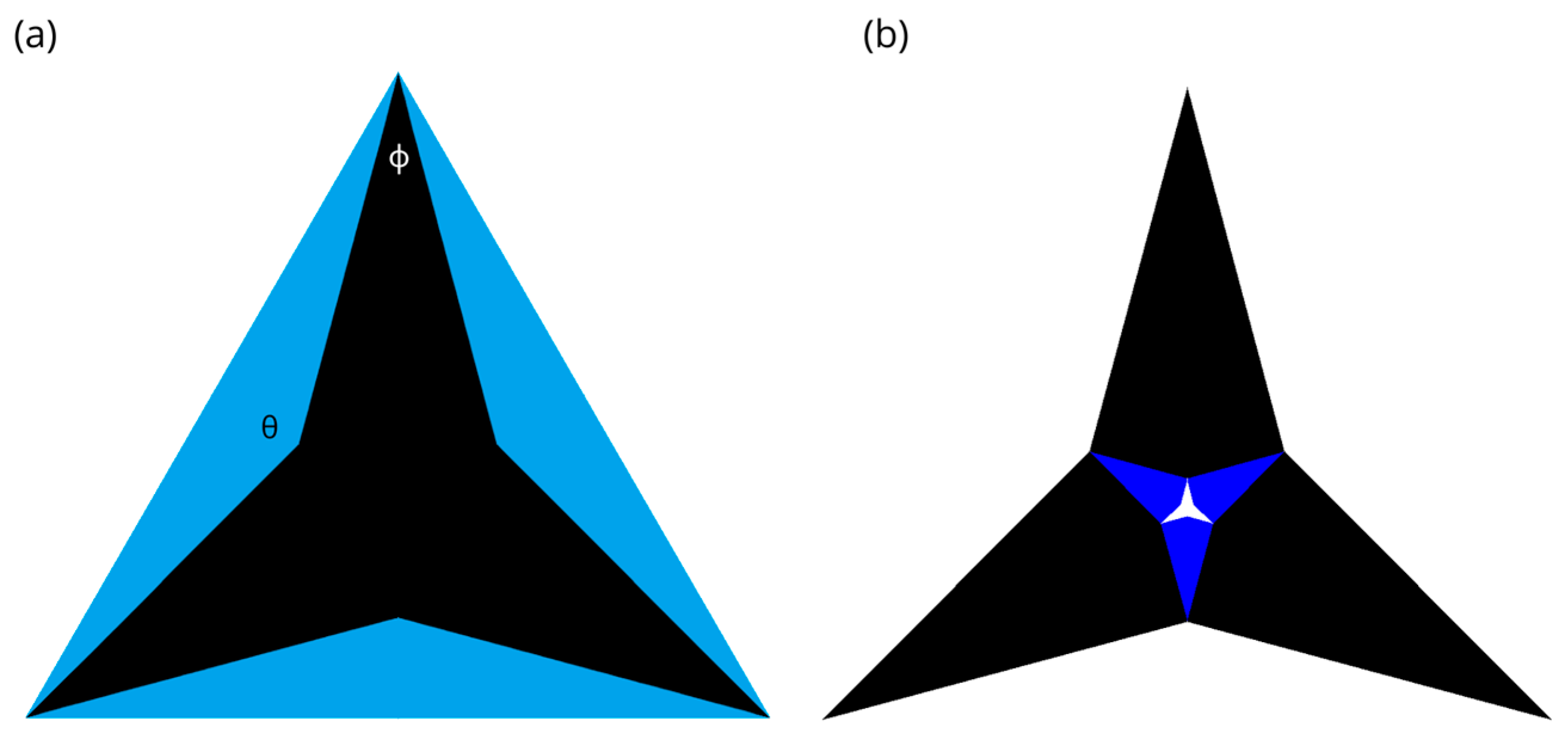
In this paper, we study triple structures filled with ferromagnetic domains as potential prototypes for magnetic logic devices and switch sensors. The analogy of magnetic and ferroelastic structures is all the more pronounced that some materials studied in [13] are ferroelectric. Contrary, however, to the materials studied in ref. [13] where the spontaneous electric polarisation is parallel to the generic triple axis, we impose here the magnetisation in the plane of the star, which is one of the possible choices giving rise to potentially three input or output paths for the magnetic flux as it is encountered in logic devices. The basic geometry of the star-like magnetic particle is depicted in Figure 1 for a particular choice of angle φ = 30° (Ɵ = 150°) corresponding to the ideal ferroelastic case. This geometry allows us to exploit the shape anisotropy induced by the star’s acute arms. The gradually narrowing arms tend to align the magnetisation along their axes, even if the material itself does not show a magnetocrystalline anisotropy. We verify the expectations derived from the ferroelastic patterns through numerical modelling using the software MuMax3.10. It allows us to find the equilibrium stable or metastable configurations as functions of the applied external field. The details of the model, the geometry, the material selection, and the computational techniques are outlined in Section 2. Section 3 presents relaxed patterns obtained both without and with an external magnetic field for various initial configurations, revealing the impact of the initial self-similarity on stable or metastable magnetic configurations. The treatment with a magnetic field enables us to predict the switching mechanisms of the system under study. The angular parameters of the star are crucial for the particles’ coercivity and switching performance. Section 4 summarises the observations made and states suggestions for their practical applications.

2. Materials and Methods

The geometry of a magnetic star, inspired by the similar shapes in ferroelastic species, is schematised in Figure 1. The panel (a) illustrates the carving of the magnetic region (black) on the background of a non-magnetic surrounding (light blue). Such a star shows a symmetry of the 2D dihedral point group 3m (D3) and is parametrised with an angle φ or, equivalently, Ɵ   =   φ + 120 ° , marked in the Figure. In the ideal geometry corresponding to a vanishing spontaneous strain in the ferroelastic material [13], the angle φ = 30° or Ɵ = 150°. In Figure 1a, one sees how the black star is carved out of an equilateral blue triangle; three similar isosceles triangles of an angle Ɵ are removed from the initial triangle.
The scheme of Figure 1b is constructed so that the angles delineating the kite-like deltoidal regions of the same colour correspond to those of the node (3, 1, 3, 5) [19] of the ideal ferroelastic case. The innermost white region in Figure 1b is a core that constitutes a limit of the self-similarity or the first generation of refs. [13,20]. Indeed, the scaling invariance cannot descend below the atomic scale in any real material. Therefore, the smallest star must exist as a generic level or the first generation of self-similarity [20].
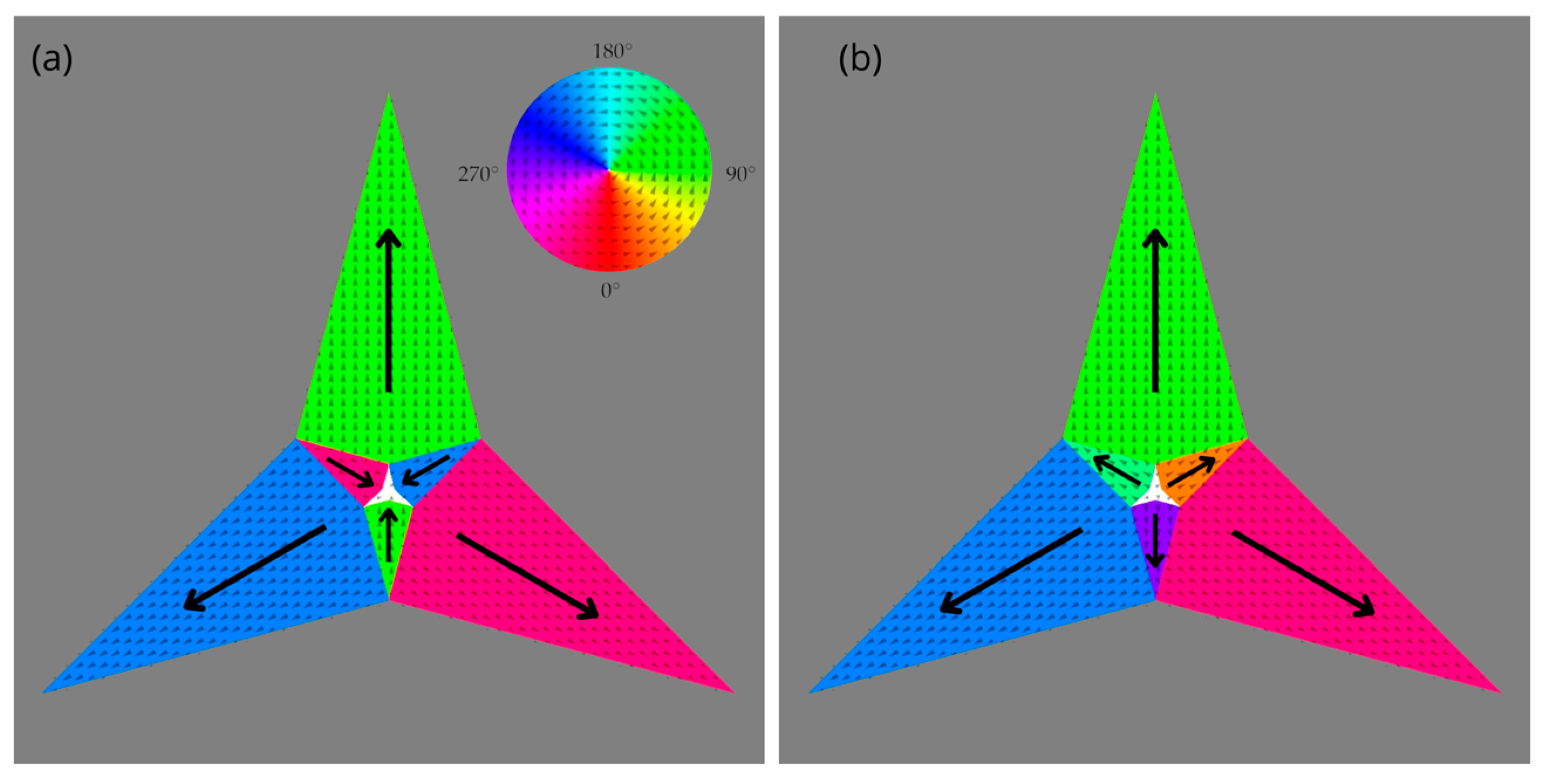
The fundamental difference between the ferreoelastic and the present case is, now that the imposed magnetisation laying in the plane of the particle exhibits pseudovectorial (antisymmetric second-rank tensor) nature, in contrast with strain, which is a symmetric second rank tensor. The pseudovector, when reflected in a plane perpendicular to it, can be oriented in two opposite directions, whereas the opposite directions are equivalent for the strain. Consequently, an initial self-similar state may be prepared in two different manners schematised in Figure 2.
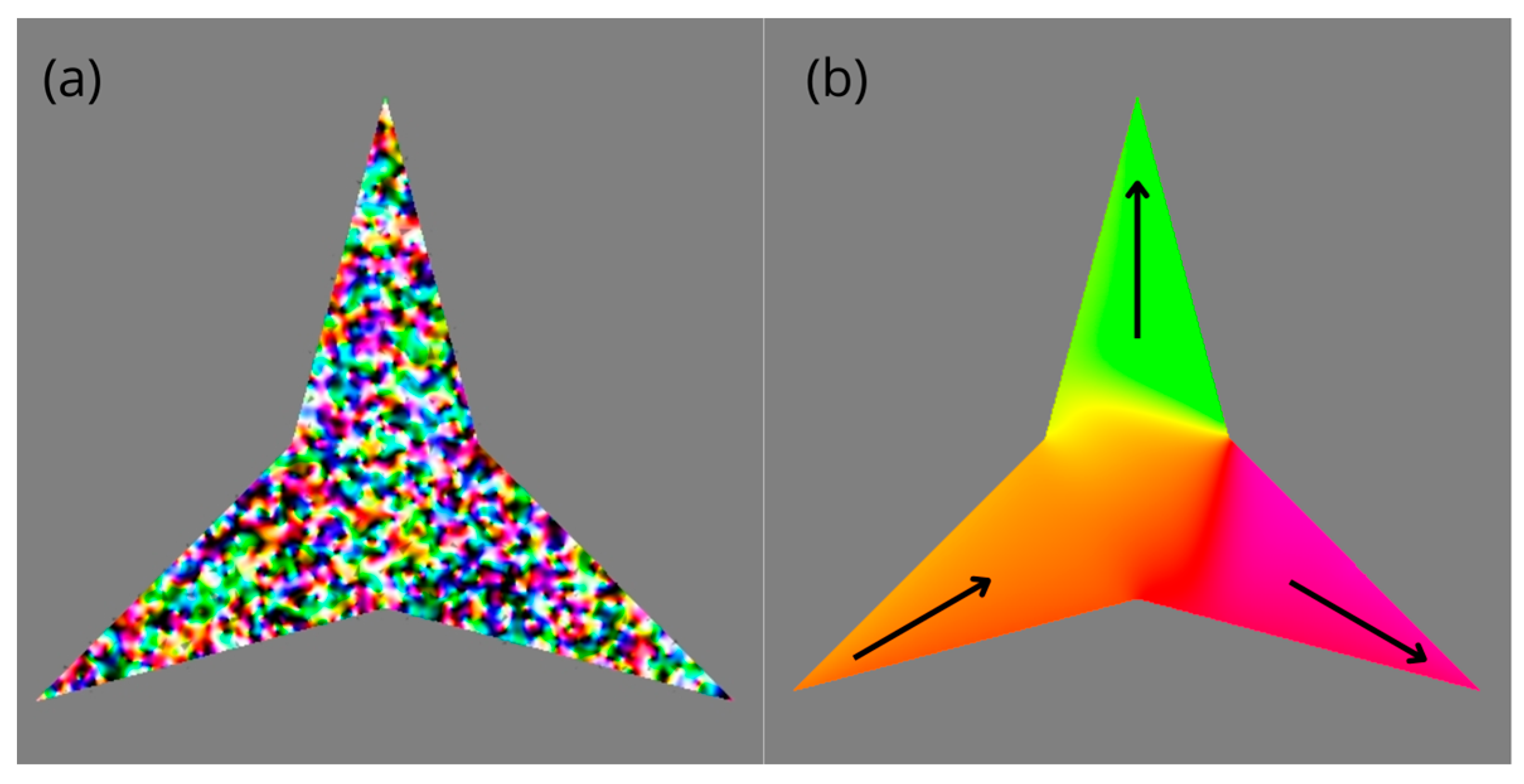
The arrangement of Figure 2a involves three orientations of magnetisation aligned along the axes of the arms of the star. The magnetisation in the oppositely oriented arms belonging to consecutive generations of self-similarity is the same or is rotated by 180°, as the pseudovector does not change under this rotation. The number of the imposed domains is, therefore, 3, as is the case in the ferroelastic material. In contrast to that, the arrangement of Figure 2b shows opposite magnetisation in the oppositely directed arms, i.e., the magnetisations of oppositely oriented arms of subsequent generations are their mutual images in the mirror plane perpendicular to the arms related in such a way. The number of colours is now 6, violet representing the direction opposite to green, orange to blue, and cyan to magenta. In what follows, we will call the configurations of Figure 2a,b 3-domain and 6-domain configurations, respectively.
The initial magnetic configurations do not correspond a priori to a minimum of energy; i.e., they are not equilibrium states. In what follows, we study the impact of the initially prepared self-similar arrangements on the closest stable or metastable magnetic state. We use the software MuMax3.10 [22,23,24] to relax the system to the corresponding equilibrium states. An advantage of this software is that it uses a well-defined voxel size (2 nm × 2 nm × 2 nm). It bears an analogy to natural materials, in which the scale cannot be fine-grained beyond the atomic size limit. It is noteworthy that the same limitation is in power in the ferroelastic case, which, all that withstanding, shows quite a number of self-similarity levels. The size of the largest triangle of Figure 1 and Figure 2 is such that the vertical and horizontal dimensions of the outer square marked with gray are 1000 × 1000 voxels. The height of the largest triangle, thus, amounts to 800 voxels. The thickness of the system is held constantly at 5 voxels. We have checked that, with this thickness, the magnetisation is always uniform across the dimension perpendicular to the image plane. The thickness is, at the same time, sufficient to use the parameters specific to bulk material.
The simulations reproduce physical behaviour of the coarse-grained magnetisation M subjected to a local magnetic field H e f f resulting from the field applied from outside and one produced by the neighbouring voxels. The magnetisation then obeys the Landau–Lifshitz–Gilbert (LLG) equation:
d M d t = γ ( M × H e f f η M × d M d t ) ,
where γ is the electron gyromagnetic ratio and η is a phenomenological damping parameter [25]
Our simulations are performed quasi-statically; i.e., they consist in finding a minimum of magnetic energy starting from an initial configuration, without, however, taking into account inertial effects of spin rotations that may happen in real systems as a result of sudden changes of external field or of the configuration of neighbouring spins. Out of the operation modes offered by the software MuMax3.10 [22,23,24], we use the relax one in finding the equilibrium configurations without an external field (Section 3.1). The magnetic moments of the voxels then evolve according to the Landau–Lifshitz–Gilbert (LLG) Equation (1) with a defined damping constant. Apart from the study without an external field (Section 3.1) and at the first stage of modelling for the extreme value of the external field B = 1000 mT, where the system searches its equilibrium state after being put into an initial saturated configuration with all the voxel moments aligned with the external field (Section 3.2), the dimensionless damping factor in the LLG equation amounts to 0.02. In the study with a varying external field, the field is swept from +1000 mT to −1000 mT with an increment of 1 mT. The mode minimize of MuMax3.10 is then employed. This search for a minimum of energy is enhanced by the conjugate gradient method [26] with extreme damping, which makes the motion of the magnetic moments equivalent to a wandering on the energy map. The simulation is stopped when the maximal unitless torque, normalised specifically to the MuMax3.10 software, becomes smaller than 10−6 [27]. The procedure corresponds to a physical precessional motion of magnetic moments, however, slowed down to zero by an extremely large damping constant in the Landau–Lifshitz–Gilbert equation [28].
The material under study here is Permalloy, i.e., an isotropic magnet whose saturation magnetisation is M s   =   800 k A m , and the exchange interaction constant amounts to A e x   =   1.3 × 10 11 J m [29,30]. The system’s size is selected so that the parameters of Permalloy are appropriate. The only source of anisotropy, therefore, is the shape anisotropy. This seems an appropriate choice for the first reference study.

3. Results

To reveal the behaviour of the system in different conditions, we show below the results in the zero external field starting from the self-similar and random configurations and, afterwards, under a uniaxial varying magnetic field. The parameters Ɵ = 120° + φ of the stars have been selected so as to cover the region from the most acute star to the limit at which it becomes equivalent to an equilateral triangle. This is presented in Figure 3. The tightest angle φ allowing one to model a triangle with its apex consisting of a single voxel (and not a 1D chain of voxels attached to the apex, which would introduce a different geometry) amounts to φ = 6°, so that Ɵ = 126°.

3.1. Non-Biased Paths to Equilibrium States

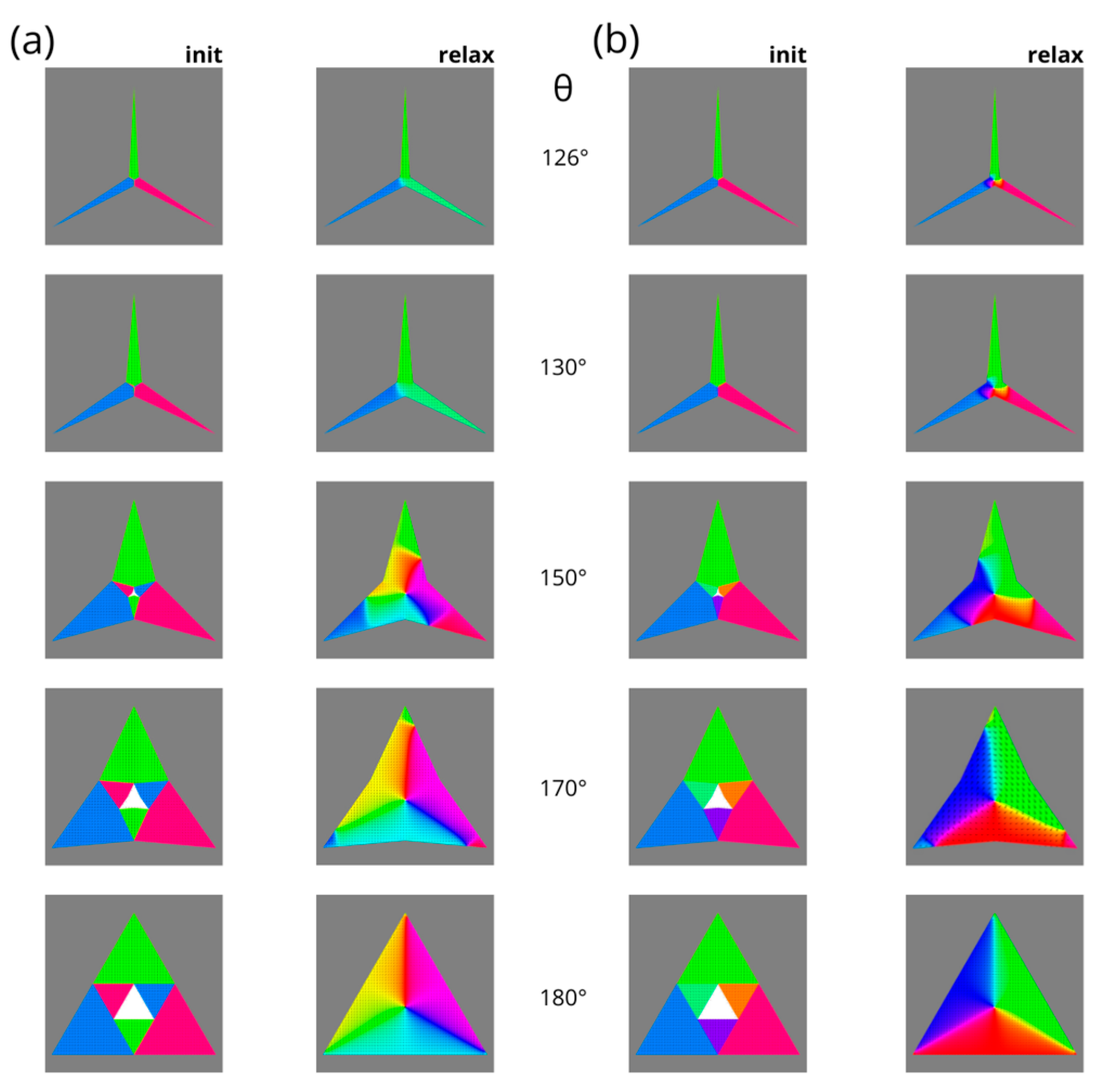
The first series of studies is carried out without any external field. This allows one to watch the configurations to which the initial 3- and 6-domain partly self-similar patterns defined in Figure 2 wander spontaneously, without any symmetry-breaking perturbation, as functions of the angle Ɵ. The angle turns out to be crucial in the qualitative determination of the final state. Some examples are shown in Figure 3.
The white innermost star in the initial states contains spins directed perpendicularly to the star’s plane towards the viewer in accordance with the colour code of the software MuMax3.10. This choice has been made to avoid any initial bias for the in-plane magnetic moments. It also turns out to be a good guess because an upward spot, although reduced in size, is present in all the relaxed configurations independently of the initial conditions. The spot has been found to be a concomitant of a vortex [31].
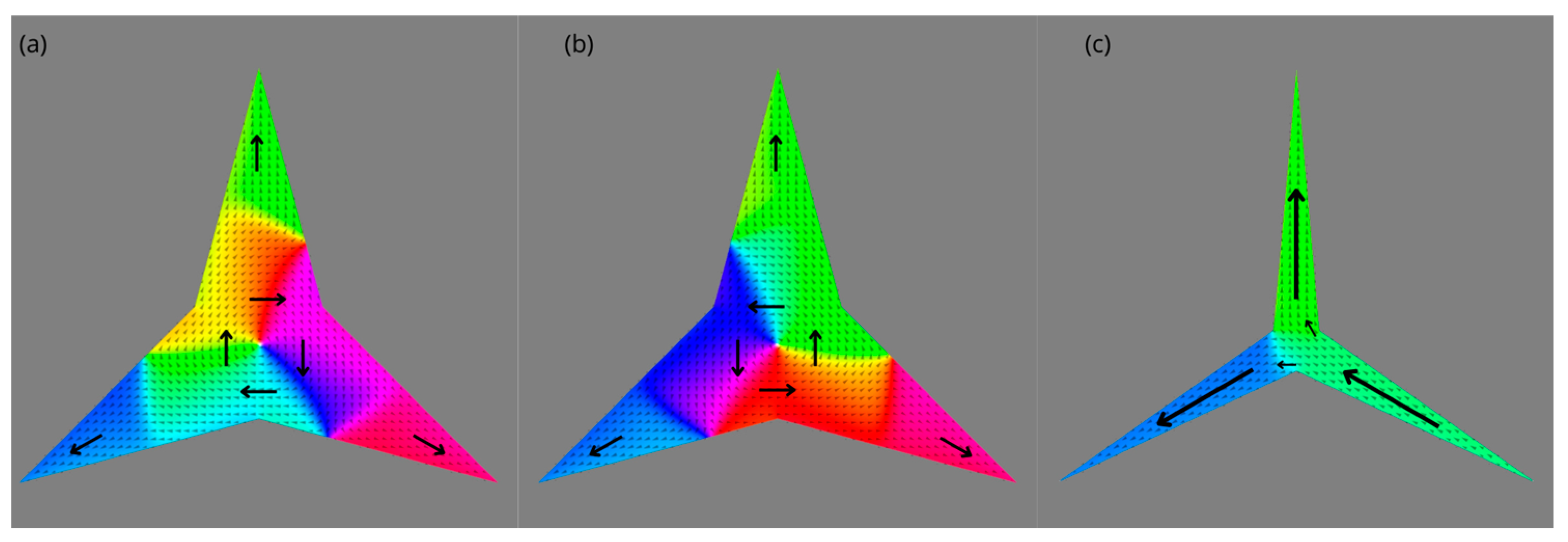
Whereas the 6-domain commencing leads systematically to a central vortex, in the 3-domain initial state, the vortex seems to be hindered by narrow arms (126° and 130°) and appears for Ɵ larger than 150°. The radial extent of the vortex is limited to the central part of the star, whereas the peripheral apices mainly remain in their initial radially divergent configurations. The vortex is always separated from the radially oriented parts by a kind of domain walls. The walls are not straight, and their lateral extent varies along their lengths. The phenomenon is more pronounced for the 6-domain initial configurations, e.g., for 150°, the domain wall separating the vortex from the green area of the vertical arm is quite sharp on the left-hand border of the arm and separates regions differing by 60°, whereas it is diffused, if present at all, on the right-hand border, where the green colour dominates on both sides. In column (a) of Figure 3, the walls are much sharper on all their lengths. An example of this kind of behaviour is provided in Figure 4. It is noteworthy that the chirality of the vortices with three and six initial domains is opposite; the white spot in the centre always points upwards, but the circulations of the magnetic moments are opposite.
In the cases of the narrowest arms (Ɵ = 126° and 130°), the system ends up in a different configuration deprived of a central vortex. The final configurations then resemble a three-wave valve, a router, or a logical gate in that the two arms are oriented out of the centre and one into the centre of the star. Thus, the two arms play the role of outputs and the third, the reversed one, becomes the input. This is achieved by a quasi-180° reorientation of one of the arms (see the lower right arms in Figure 3a for 126° and 130°). In contrast to that, the configurations involving six initial domains always evolve towards a vortex in the centre of the star.
A comparison of energies of the narrowest stars (Ɵ = 126° and 130°) reveals that the triple-valve configurations are more stable (Figure 3a) than the vortex ones (Figure 3b) in that the energies of the former are about three times smaller than those of the latter. On the other hand, the energies of the vortex states for Ɵ = 150°, 170°, and 180° are equal to five significant figures in spite of the geometric differences. This can be seen in Table 1.
A study with a completely random initial configuration turns out to be much more time-consuming. Generally, such simulations favour the triple-valve final state. Figure 5 shows both the initial and the final states for Ɵ = 150°.
The final stage is clearly the logical gate with one input and two output arms. The domain of the input arm shows a very regular deltoid shape, limited by somewhat curved domain walls. This is in correspondence with the geometry of the node (3, 1, 3, 5) [13]. The energy of this triple valve turns out to. Be almost four times lower than that of the vortex states of Figure 4.

3.2. Switching Properties and Equilibrium States Under an External Field

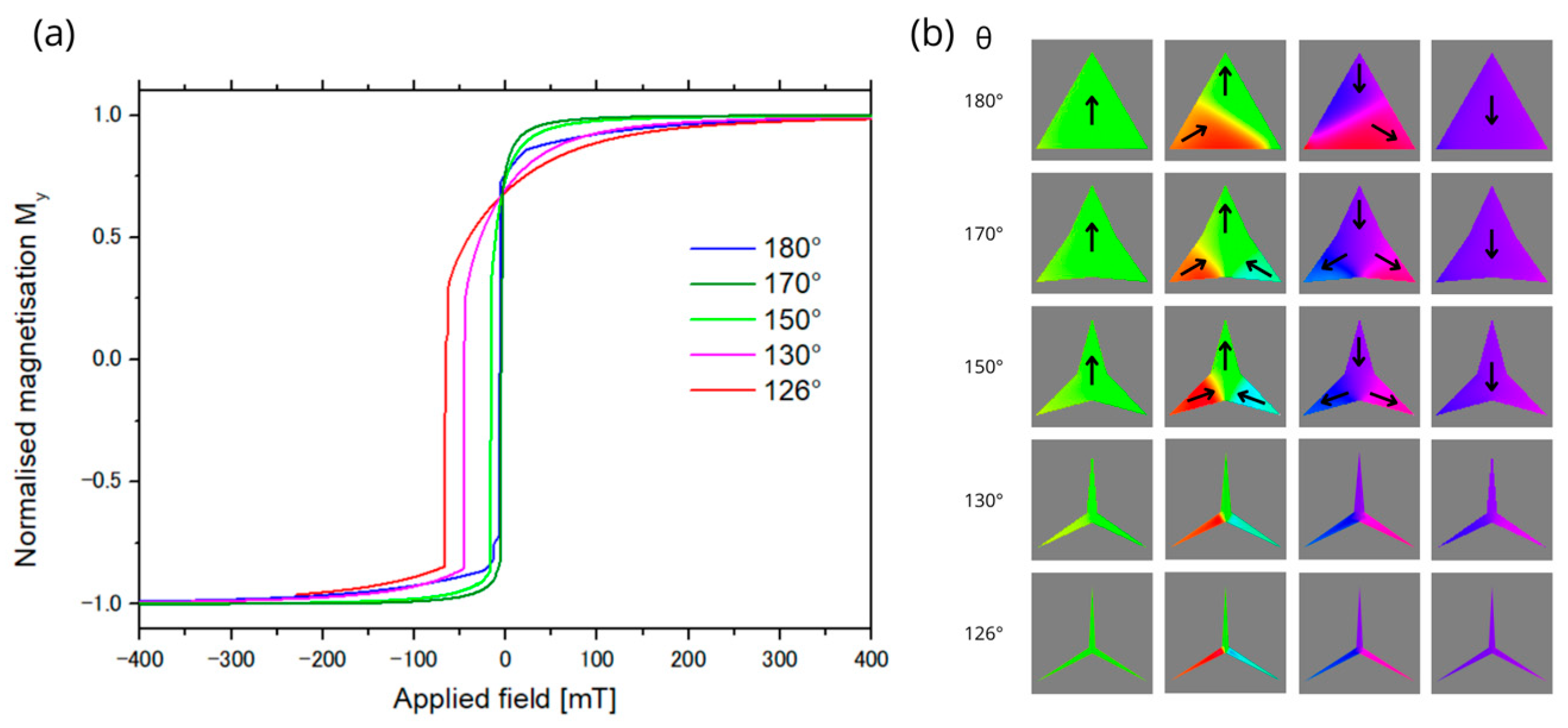
A treatment with an external magnetic field may cast light on the most efficient method of fabrication and preparation of configurations useful for technological applications. A series of such studies are depicted in Figure 6 for five angles Ɵ defining the geometry of the star: 180°, 170°, 150°, 130°, and 126°. The external field is applied vertically, i.e., along the axis of the upward arm. The initial value of the field is 1000 mT. It practically ensures a complete bias upwards for Ɵ = 180°, but more acute stars relax to slightly inhomogeneous states at this field, as it follows from the application of the relax operational mode of MuMax3.10. The field is decreased at a 1 mT increment down to −1000 mT. This protocol allows us to satisfy the conditions of adiabaticity and to study a complete switching of the particles. The recording of the net magnetisation in the vertical (y) direction provides the corresponding hysteresis loops. They turn out to be symmetric. Therefore, only the parts of the hysteresis loops obtained with a decreasing field are shown in Figure 6a for clarity.
The coercive field increases with a decreasing angle Ɵ and is the largest for the most acute stars. The remagnetisation starts with the reorientation of spins in the arms situated at the angle of 120° with respect to the applied field. The reorientation initiates in the apices of the arms and spreads out to the centre of the star. As a result, a configuration of the triple valve “two in–one out” forms before the step-like reversal of the vertical arm. This jump reverses the magnetisation in all three arms so that a triple valve “one in–two out” comes into being, which further becomes progressively saturated. Apart from step-like-jumps, the hysteresis loops show rounded parts for the field values where the pattern varies in a continuous way. An exception is the case of the regular triangle at Ɵ = 180° (blue curve in Figure 6a), where the progressive expansion of the region coloured in red in Figure 6b manifests itself in a slanting straight part preceding the reversal jump. This behaviour manifests the lack of an obstacle imposed by the cusp-like connection of the lower arms when Ɵ ≠ 180°.
The configurations arising after switching off the field are all of the type triple valve in analogy to those observed for the most acute stars with the 3-domain initial state (see Figure 3a for Ɵ = 126° and Ɵ = 130°) as well as for the random initial state of Figure 5. The configurations are not identical, however. Their energies, when obtained with the field treatment, are down to half as high as the ones attained with a self-similar and random initial state. Thus, the external field helps to find the most stable triple-valve arrangements.

4. Discussion and Conclusions

The minimisation procedures reported in Section 2 lead to local energy minima which are directly attainable from the prescribed initial states. The minima can, thus, be local or global, corresponding to whether the configurations are metastable or stable, respectively. The recapitulative Table 1 allows one to compare the energies of the particular relaxed states at B = 0 described in Section 3 along with the corresponding energy densities.
The energies of the vortex states in the 6-domain initial configurations for Ɵ = 126° and Ɵ = 130° are clearly higher than those of the triple-valve type configurations in the 3-domain counterparts. The vortex spin arrangements are, thus, metastable. The self-similar initial configuration of the present systems seems to be a good choice for obtaining vortex states useful in many logic devices [18,32,33,34]. The 2D chirality of the vortices is clearly determined by whether the initial self-similar configuration is 3-domain or 6-domain (see Figure 2). Whereas the 3-domain arrangement favours left-handed helicity, the 6-domain arrangement privileges the right-handed one. The fact that the vortex state does not arise in the most acute 3-domain stars indicates that the 6-domain initial state better stimulates the circulating magnetic flux against the triple-valve one. The findings specify the conditions for the obtainment of the desired 2D chirality essential for the vortex domain-wall logic gates [16].
Both types of arrangements in magnetic nanoparticles and their systems are now extensively studied as potential elements of memory and logic devices [35,36,37,38,39,40]. Their design should be based on the predictable patterns of magnetisation and their liability to external stirring by magnetic fields and other stimuli. The geometry of triple junctions is of special interest in this context because it underlies the functionality of logic gates and transistors [15,16,41]. This geometry has been encountered in the ferroelastic domain textures [11,13,19] with an additional property of several levels of scaling invariance or self-similarity. The latter characteristic turns out to exhibit an unexpected robustness with respect to some external perturbations [20]. While not directly transferable to magnetic structures, for symmetry reasons, such geometry has been used here as initial configurations in magnetic particles shaped into a form of three-arm stars. When relaxed, such initial states have been shown in Section 3 to give rise to metastable vortex configurations widely studied in the logic devices [18,32,33,34]. In some cases, the relaxed pattern, usually stable, corresponds to a triple valve. The treatment with a homogeneous external field uncontestably favours such configurations. The coercivity of the magnetic elements is also an important factor for technology, especially when the memory storage devices are considered. In the case of our three-arm stars, the coercive field increases with the acuity of the stars. This indicates the effective modalities for the fabrication of magnetic configurations desired for a specific application.

Author Contributions

Conceptualisation, D.K. and P.Z. (Piotr Zieliński); methodology, D.K. and P.Z. (Piotr Zieliński); software, D.K.; investigation, D.K., P.Z. (Piotr Zegan), Y.P. and P.Z. (Piotr Zieliński); data curation, D.K.; writing—original draft preparation, D.K., P.Z. (Piotr Zegan), Y.P. and P.Z. (Piotr Zieliński); writing—review and editing, D.K., P.Z. (Piotr Zegan), Y.P. and P.Z. (Piotr Zieliński); visualisation, D.K.; supervision, P.Z. (Piotr Zieliński); funding acquisition, D.K. All authors have read and agreed to the published version of the manuscript.

Funding

This research was funded by the Polish high-performance computing infrastructure PLGrid (HPC Center: ACK Cyfronet AGH) for providing the computer facilities and support within computational grant no. PLG/2024/017851.

Institutional Review Board Statement

Not applicable.

Informed Consent Statement

Not applicable.

Data Availability Statement

The raw data supporting the conclusions of this article will be made available by the authors on request.

Conflicts of Interest

The authors declare no conflicts of interest.

References

  1. Chen, Z.; Lin, T.-Y.; Wei, X.; Matsunaga, M.; Doi, T.; Ochiai, Y.; Aoki, N.; Bird, J.P. The Magnetic Y-Branch Nanojunction: Domain-Wall Structure and Magneto-Resistance. Appl. Phys. Lett. 2012, 101, 102403. [Google Scholar] [CrossRef]
  2. Currivan-Incorvia, J.A.; Siddiqui, S.; Dutta, S.; Evarts, E.R.; Zhang, J.; Bono, D.; Ross, C.A.; Baldo, M.A. Logic Circuit Prototypes for Three-Terminal Magnetic Tunnel Junctions with Mobile Domain Walls. Nat. Commun. 2016, 7, 10275. [Google Scholar] [CrossRef]
  3. Saxena, V.; Gutzeit, M.; Rodríguez-Sota, A.; Haldar, S.; Zahner, F.; Wiesendanger, R.; Kubetzka, A.; Heinze, S.; Von Bergmann, K. Strain-Driven Domain Wall Network with Chiral Junctions in an Antiferromagnet. Nat. Commun. 2025, 16, 10808. [Google Scholar] [CrossRef] [PubMed]
  4. Alamdar, M.; Leonard, T.; Cui, C.; Rimal, B.P.; Xue, L.; Akinola, O.G.; Xiao, T.P.; Friedman, J.S.; Bennett, C.H.; Marinella, M.J.; et al. Domain Wall-Magnetic Tunnel Junction Spin–Orbit Torque Devices and Circuits for in-Memory Computing. Appl. Phys. Lett. 2021, 118, 112401. [Google Scholar] [CrossRef]
  5. Bhattacharjee, P.; Barman, S. Three-Input Magnetic Logic Gates Using Magnetic Vortex Transistor. Phys. Status Solidi (a) 2022, 219, 2200397. [Google Scholar] [CrossRef]
  6. Anisul Haque, S.; Yamamoto, M.; Nakatani, R.; Endo, Y. Binary Logic Gates by Ferromagnetic Nanodots. J. Magn. Magn. Mater. 2004, 282, 380–384. [Google Scholar] [CrossRef]
  7. Koh, I.; Josephson, L. Magnetic Nanoparticle Sensors. Sensors 2009, 9, 8130–8145. [Google Scholar] [CrossRef]
  8. Darton, N.J.; Ionescu, A.; Llandro, J. (Eds.) Sensing Magnetic Nanoparticles. In Magnetic Nanoparticles in Biosensing and Medicine; Cambridge University Press: Cambridge, UK, 2019; pp. 172–227. ISBN 978-1-139-38122-2. [Google Scholar]
  9. Jia, F.; Xu, L.; Yan, W.; Wu, W.; Yu, Q.; Tian, X.; Dai, R.; Li, X. A Magnetic Relaxation Switch Aptasensor for the Rapid Detection of Pseudomonas Aeruginosa Using Superparamagnetic Nanoparticles. Microchim. Acta 2017, 184, 1539–1545. [Google Scholar] [CrossRef]
  10. Manolikas, C.; Amelinckx, S. Phase transitions in ferroelastic lead orthovanadate as observed by means of electron microscopy and electron diffraction. I. Static observations. Phys. Status Solidi (a) 1980, 60, 607–617. [Google Scholar] [CrossRef]
  11. Boulesteix, C.; Yangui, B. Star patterns and dissociation of interfaces without spontaneous strain compatibility between orientation domains in ferroelastic crystals. Case of a monoclinic rare earth sesquioxide. Phys. Status Solidi (a) 1983, 78, 303–308. [Google Scholar] [CrossRef]
  12. Curnoe, S.H.; Jacobs, A.E. Statics and Dynamics of Domain Patterns in Hexagonal-Orthorhombic Ferroelastics. Phys. Rev. B 2001, 63, 094110. [Google Scholar] [CrossRef][Green Version]
  13. Krupińska, A.; Burzyńska, B.; Kinzhybalo, V.; Dziuk, B.; Szklarz, P.; Kajewski, D.; Zaręba, J.K.; Drwęcka, A.; Zelewski, S.J.; Durlak, P.; et al. Ferroelectricity, Piezoelectricity, and Unprecedented Starry Ferroelastic Patterns in Organic–Inorganic (CH3C(NH2)2)3[Sb2X9] (X = Cl/Br/I) Hybrids. Inorg. Chem. 2025, 64, 9639–9651. [Google Scholar] [CrossRef]
  14. Vicens, J.; Delavignette, P. A Particular Domain Configuration Observed in a New Phase of the Ta—N System. Phys. Status Solidi (a) 1976, 33, 497–509. [Google Scholar] [CrossRef]
  15. Bhattacharjee, P.; Barman, A.; Barman, S. Operation of Magnetic Vortex Transistor by Spin-Polarized Current: A Micromagnetic Approach. Phys. Status Solidi (a) 2022, 219, 2100564. [Google Scholar] [CrossRef]
  16. Omari, K.A.; Hayward, T.J. Chirality-Based Vortex Domain-Wall Logic Gates. Phys. Rev. Appl. 2014, 2, 044001. [Google Scholar] [CrossRef]
  17. Gypens, P.; Van Waeyenberge, B.; Di Ventra, M.; Leliaert, J.; Pinna, D. Nanomagnetic Self-Organizing Logic Gates. Phys. Rev. Appl. 2021, 16, 024055. [Google Scholar] [CrossRef]
  18. Hertel, R.; Gliga, S.; Fähnle, M.; Schneider, C.M. Ultrafast Nanomagnetic Toggle Switching of Vortex Cores. Phys. Rev. Lett. 2007, 98, 117201. [Google Scholar] [CrossRef] [PubMed]
  19. Kitano, Y.; Kifune, K.; Komura, Y. Star-Lisclination in a Ferro-Elastic Material B19 MgCd Alloy. J. Phys. Colloq. 1988, 49, C5-201–C5-206. [Google Scholar] [CrossRef]
  20. Sobieszczyk, P.; Mroczek, M.; Kuźma, D.; Zieliński, P. Negative Mechanical Characteristics of Self-Similar Star-Like Hinged Grilles. Phys. Status Solidi (b) 2024, 261, 2400399. [Google Scholar] [CrossRef]
  21. Kuźma, D.; Pastukh, O.; Zieliński, P. Competing Magnetocrystalline and Shape Anisotropy in Thin Nanoparticles. Crystals 2024, 14, 375. [Google Scholar] [CrossRef]
  22. Vansteenkiste, A.; Leliaert, J.; Dvornik, M.; Helsen, M.; Garcia-Sanchez, F.; Waeyenberge, B.V. The Design and Verification of MuMax3. AIP Adv. 2014, 4, 107133. [Google Scholar] [CrossRef]
  23. Leliaert, J.; Dvornik, M.; Mulkers, J.; De Clercq, J.; Milošević, M.V.; Van Waeyenberge, B. Fast Micromagnetic Simulations on GPU—Recent Advances Made with mumax3. J. Phys. D Appl. Phys. 2018, 51, 123002. [Google Scholar] [CrossRef]
  24. Moreels, L.; Lateur, I.; De Gusem, D.; Mulkers, J.; Maes, J.; Milošević, M.V.; Leliaert, J.; Van Waeyenberge, B. Mumax+: Extensible GPU-Accelerated Micromagnetics and Beyond. arXiv 2024, arXiv:2411.18194. [Google Scholar]
  25. Aharoni, A. Introduction to the Theory of Ferromagnetism, 2nd ed.; repr.; Oxford University Press: Oxford, UK, 2007; ISBN 978-0-19-850809-0. [Google Scholar]
  26. Bouwmeester, H.; Dougherty, A.; Knyazev, A.V. Nonsymmetric Preconditioning for Conjugate Gradient and Steepest Descent Methods. Procedia Comput. Sci. 2015, 51, 276–285. [Google Scholar] [CrossRef]
  27. Joos, J.J.; Bassirian, P.; Gypens, P.; Mulkers, J.; Litzius, K.; Van Waeyenberge, B.; Leliaert, J. Tutorial: Simulating Modern Magnetic Material Systems in Mumax3. J. Appl. Phys. 2023, 134, 171101. [Google Scholar] [CrossRef]
  28. Lifshitz, E.M.; Pitaevskii, L.P.; Pitaevskii, L.P. Statistical Physics: Theory of the Condensed State, 3rd ed.; Course of Theoretical Physics; Elsevier Science: Saint Louis, MO, USA, 2013; ISBN 978-0-7506-2636-1. [Google Scholar]
  29. Nahrwold, G.; Scholtyssek, J.M.; Motl-Ziegler, S.; Albrecht, O.; Merkt, U.; Meier, G. Structural, Magnetic, and Transport Properties of Permalloy for Spintronic Experiments. J. Appl. Phys. 2010, 108, 013907. [Google Scholar] [CrossRef]
  30. Nguyen, T.M.; Cottam, M.G.; Liu, H.Y.; Wang, Z.K.; Ng, S.C.; Kuok, M.H.; Lockwood, D.J.; Nielsch, K.; Gösele, U. Spin Waves in Permalloy Nanowires: The Importance of Easy-Plane Anisotropy. Phys. Rev. B 2006, 73, 140402. [Google Scholar] [CrossRef][Green Version]
  31. Park, G.; Kim, B.; Kim, S.-K. From Trochoidal Symmetry to Chaotic Vortex-Core Reversal in Magnetic Nanostructures. npj Spintron. 2025, 3, 42. [Google Scholar] [CrossRef]
  32. Guslienko, K.Y.; Han, X.F.; Keavney, D.J.; Divan, R.; Bader, S.D. Magnetic Vortex Core Dynamics in Cylindrical Ferromagnetic Dots. Phys. Rev. Lett. 2006, 96, 067205. [Google Scholar] [CrossRef]
  33. Gypens, P.; Leliaert, J.; Schütz, G.; Van Waeyenberge, B. Commensurate Vortex-Core Switching in Magnetic Nanodisks at Gigahertz Frequencies. Phys. Rev. B 2022, 105, 094420. [Google Scholar] [CrossRef]
  34. Van Waeyenberge, B.; Puzic, A.; Stoll, H.; Chou, K.W.; Tyliszczak, T.; Hertel, R.; Fähnle, M.; Brückl, H.; Rott, K.; Reiss, G.; et al. Magnetic Vortex Core Reversal by Excitation with Short Bursts of an Alternating Field. Nature 2006, 444, 461–464. [Google Scholar] [CrossRef]
  35. Kuźma, D.; Laskowski, Ł.; Kłos, J.W.; Zieliński, P. Effects of Shape on Magnetization Switching in Systems of Magnetic Elongated Nanoparticles. J. Magn. Magn. Mater. 2022, 545, 168685. [Google Scholar] [CrossRef]
  36. Kuźma, D.; Pastukh, O.; Zieliński, P. Spacing Dependent Mechanisms of Remagnetization in 1D System of Elongated Diamond Shaped Thin Magnetic Particles. Magnetochemistry 2022, 8, 102. [Google Scholar] [CrossRef]
  37. Ding, J.; Kostylev, M.; Adeyeye, A.O. Realization of a Mesoscopic Reprogrammable Magnetic Logic Based on a Nanoscale Reconfigurable Magnonic Crystal. Appl. Phys. Lett. 2012, 100, 073114. [Google Scholar] [CrossRef]
  38. Orlov, A.; Imre, A.; Csaba, G.; Ji, L.; Porod, W.; Bernstein, G.H. Magnetic Quantum-Dot Cellular Automata: Recent Developments and Prospects. J. Nanoelectron. Optoelectron. 2008, 3, 55–68. [Google Scholar] [CrossRef]
  39. Nordquist, K. Process Development of Sub-0.5 Μm Nonvolatile Magnetoresistive Random Access Memory Arrays. J. Vac. Sci. Technol. B 1997, 15, 2274. [Google Scholar] [CrossRef]
  40. Wu, L.; Jubert, P.-O.; Berman, D.; Imaino, W.; Nelson, A.; Zhu, H.; Zhang, S.; Sun, S. Monolayer Assembly of Ferrimagnetic CoxFe3−xO4 Nanocubes for Magnetic Recording. Nano Lett. 2014, 14, 3395–3399. [Google Scholar] [CrossRef] [PubMed]
  41. Kumar, D.; Barman, S.; Barman, A. Magnetic Vortex Based Transistor Operations. Sci. Rep. 2014, 4, 4108. [Google Scholar] [CrossRef]
Figure 1. (a) Geometry of carving a star-like particle: the magnetic region (black) on the background of a non-magnetic surrounding (light blue), and (b) schematic of introducing self-similarity. Different colors correspond to successive generations (white—first generation, blue—second generation, black—third generation).
Applsci 16 01145 g001
Figure 2. Two self-similar arrangements of magnetisation in the geometry of a three-arm star, (a) involving 3 domains, and (b) involving 6 domains. The orientation of magnetisation is represented with colours according to the colour circle of the software MuMax3.10. The circle is shown in the inset. The direction of arrows is correlated with colours. Red: horizontal right, green: vertical upwards, cyan: horizontal left, violet: vertical downwards [21]. Black arrows may help the reader to realise the magnetisation orientation in particular domains.
Applsci 16 01145 g002
Figure 3. Relaxation of the 3- and 6-domain self-similar configurations (see Figure 2) for 5 angles Ɵ marked in the middle in degrees. In column (a), the starting point is 3-domain, and, in column (b), 6-domain configuration. The magnetisation maps for all the states in column (a) init are analogous to Figure 2a, the map for the two upper panels of column (a) relax are given in Figure 4c, and the map for the three lower panels of the same column in Figure 4a. The same magnetisation maps for the whole column (b) init is analogous to that of Figure 2b, and the map for column (b) relax is analogous to that of Figure 4b. The colour coding is analogous to that in Figure 2.
Applsci 16 01145 g003
Figure 4. Magnification of relaxed vortices for Ɵ = 150° of Figure 3a relax (a) and Figure 3b relax (b). The panel (c) schematises the one-in-two-out configuration of two upper panel of column (a) relax of Figure 3. The colour coding is analogous to that in Figure 2.
Applsci 16 01145 g004
Figure 5. Totally random (in-plane and out-of-plane) initial configuration at Ɵ = 150° (a) and the coresponding relaxed magnetisation map (b). The colour coding is analogous to that in Figure 2.
Applsci 16 01145 g005
Figure 6. (a) Half-loops of hysteresis corresponding to decreasing field for the stars specified in column Ɵ. (b) Initial states (B = 1000 mT), the states just before and just after switching and the reversed states of the stars at B = −1000 mT.
Applsci 16 01145 g006
Table 1. Magnetic energy of the relaxed configurations obtained at B = 0 without (initial configuration type: 3-domain, and 6-domain; see Figure 2) and after external field treatment (configuration type: hysteris). Asterisks (*) indicate vortex states. Total energies Etot are shown along with energy density per m3 and per voxel.
Configuration TypeEtot
[10−5 pJ]
Etot_density
[kJ/m3]
Etot/Voxel
[10−24 J]
126°3-domain2.52786814.46473115.7179
6-domain *2.52786814.46473115.7179
hysteresis1.0451265.9803247.8426
130°3-domain2.98103010.4763483.8107
6-domain *2.98145110.4778283.8226
hysteresis0.8581703.0159024.1271
150°3-domain *2.9240303.6914729.5318
6-domain *2.9247863.6924229.5394
hysteresis0.4972990.627825.0226
random0.8465561.068748.5499
170°3-domain *0.6808680.544004.3520
6-domain *1.7927141.4323611.4588
hysteresis0.1802860.144051.1527
180°3-domain *0.5118970.347242.7779
6-domain *1.3600050.922547.3804
hysteresis0.5110970.346702.7736
Disclaimer/Publisher’s Note: The statements, opinions and data contained in all publications are solely those of the individual author(s) and contributor(s) and not of MDPI and/or the editor(s). MDPI and/or the editor(s) disclaim responsibility for any injury to people or property resulting from any ideas, methods, instructions or products referred to in the content.