Shaking Table Test-Based Verification of PDEM for Random Seismic Response of Anchored Rock Slopes


Abstract
1. Introduction
2. Research Methods
2.1. Probability Density Evolution Method
2.2. Generation of Stochastic Ground Motion
3. Model Test Design
3.1. Test Preparation
3.2. Verification of the Rationality of the Shaking Table Model
4. Model Test Verification of Probability Density Evolution Method
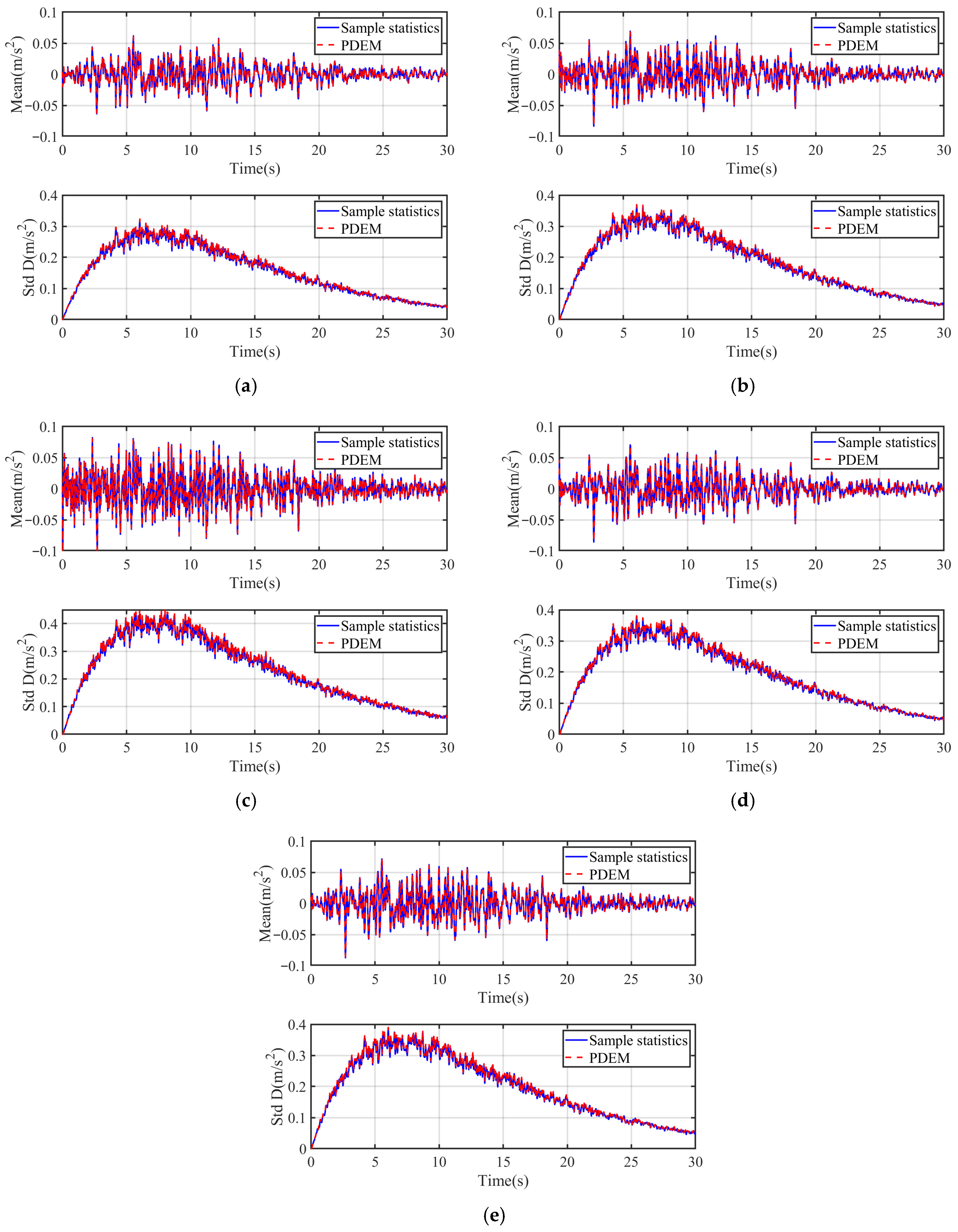
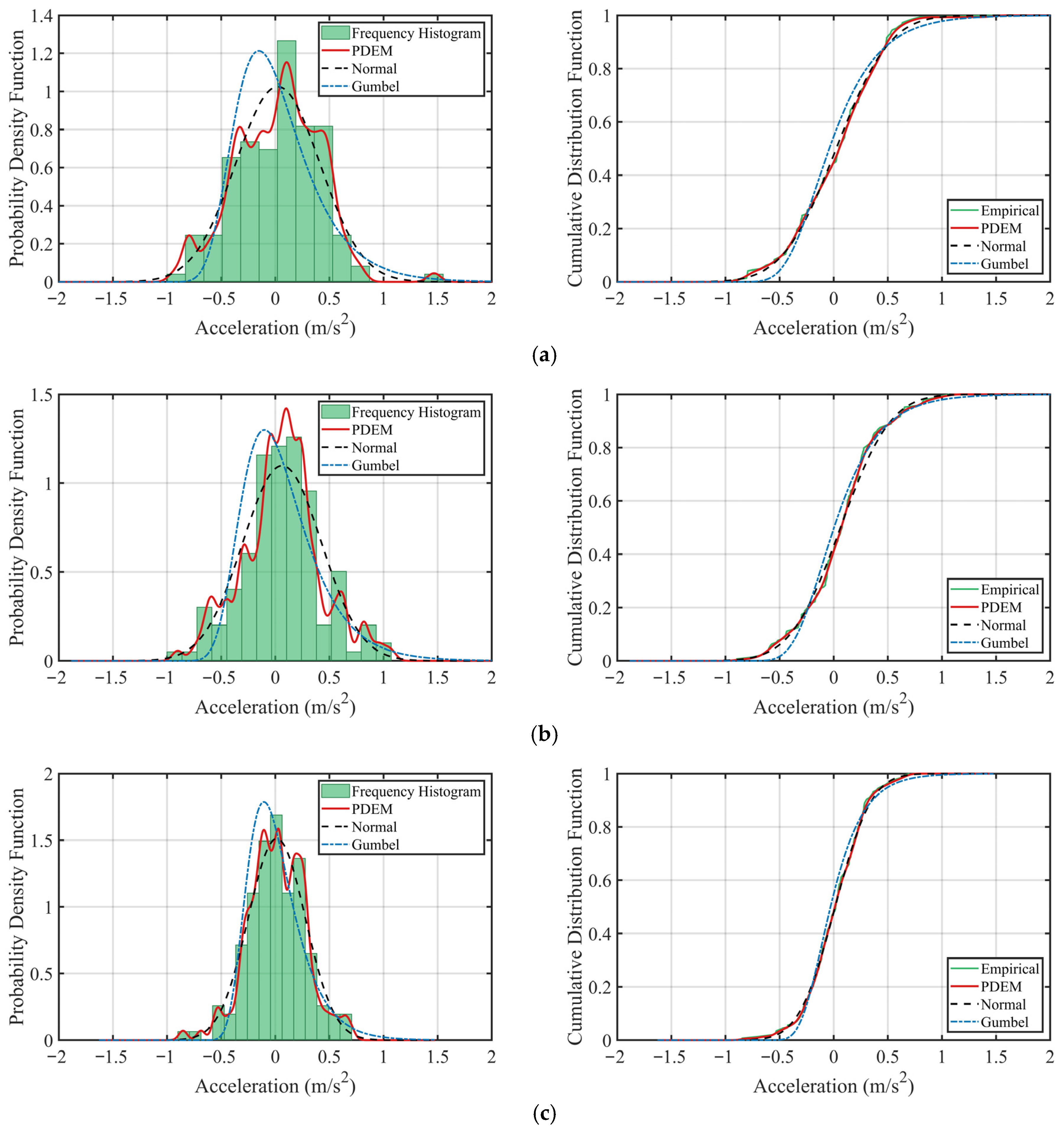
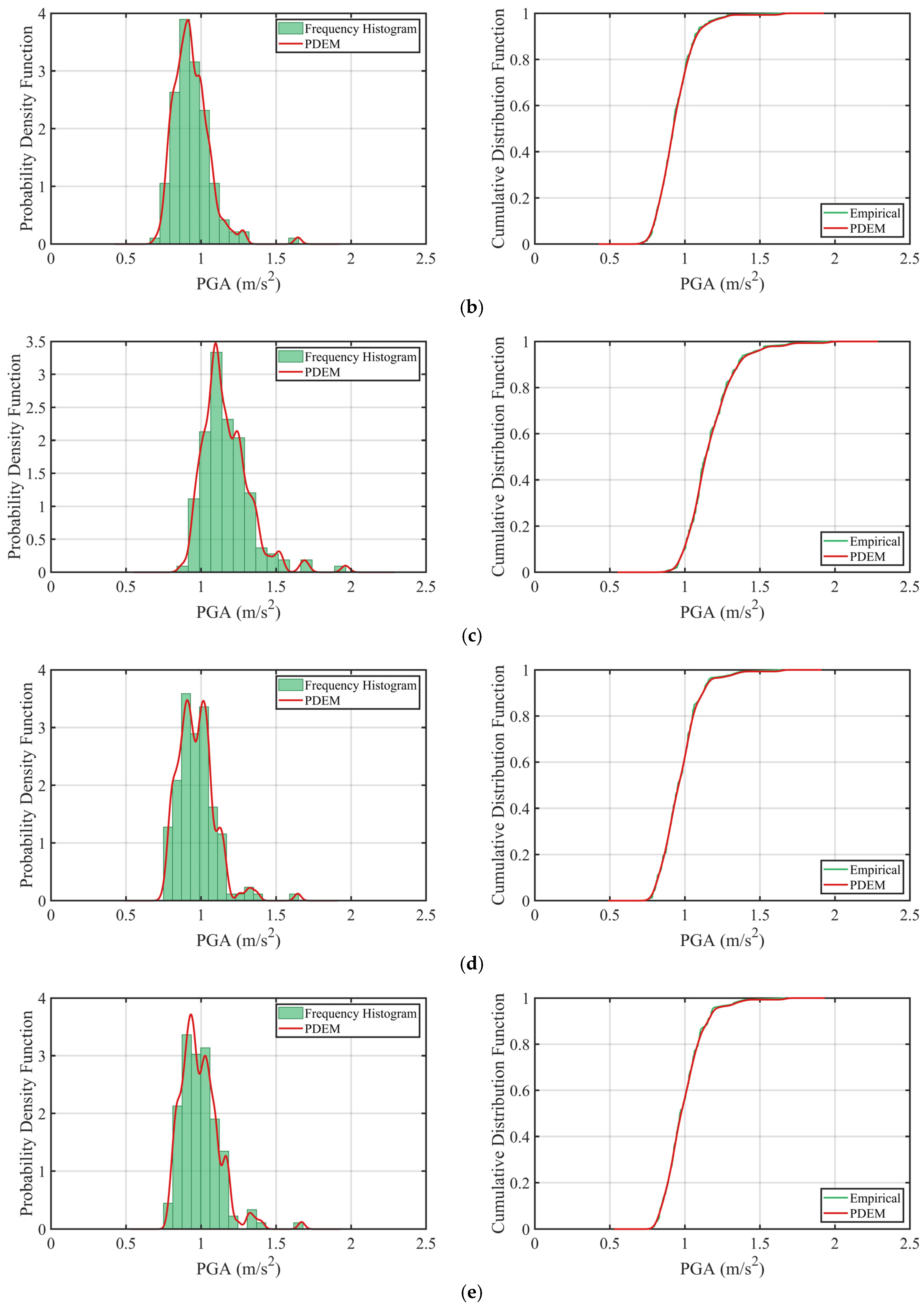
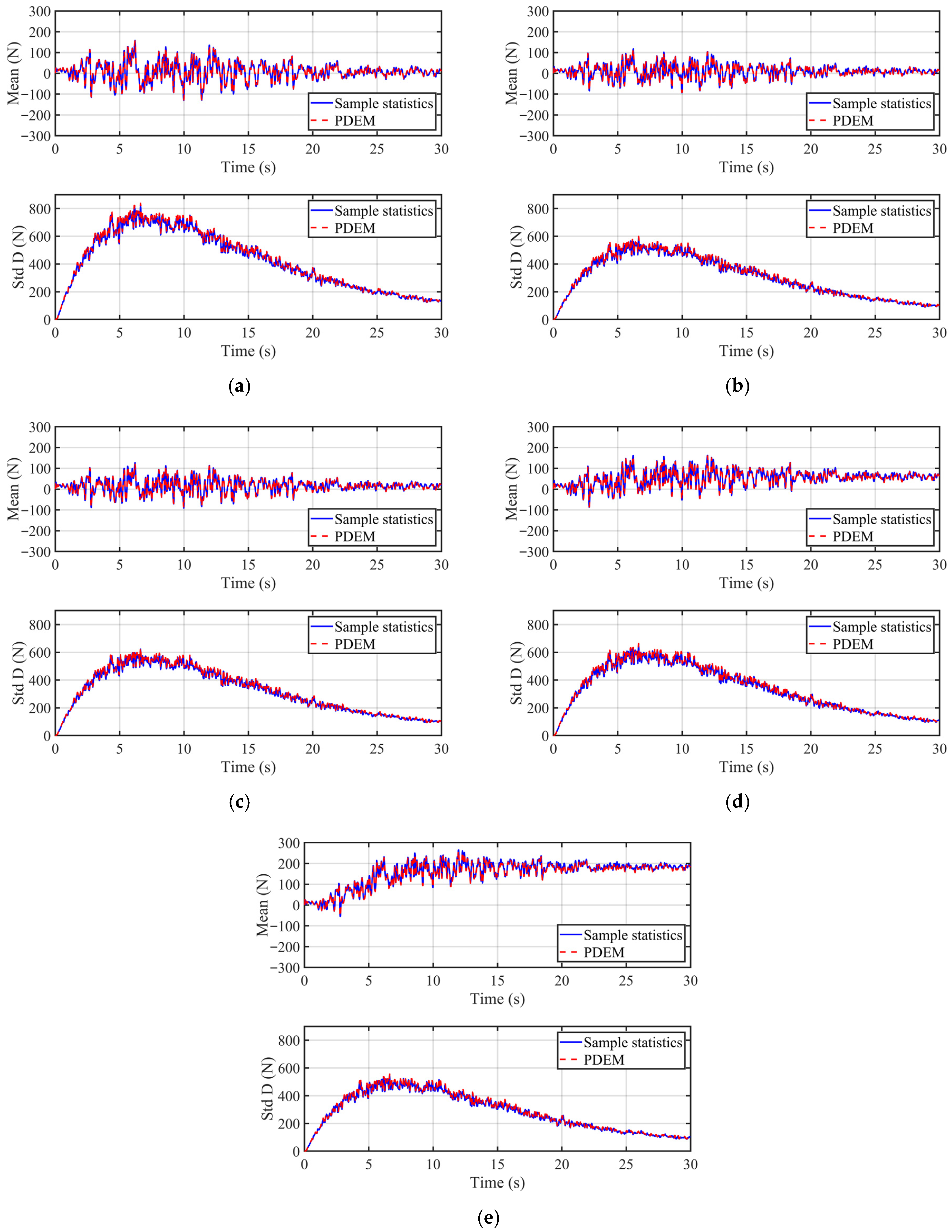
4.1. Acceleration Response of Anchored Slopes Under Random Seismic Action
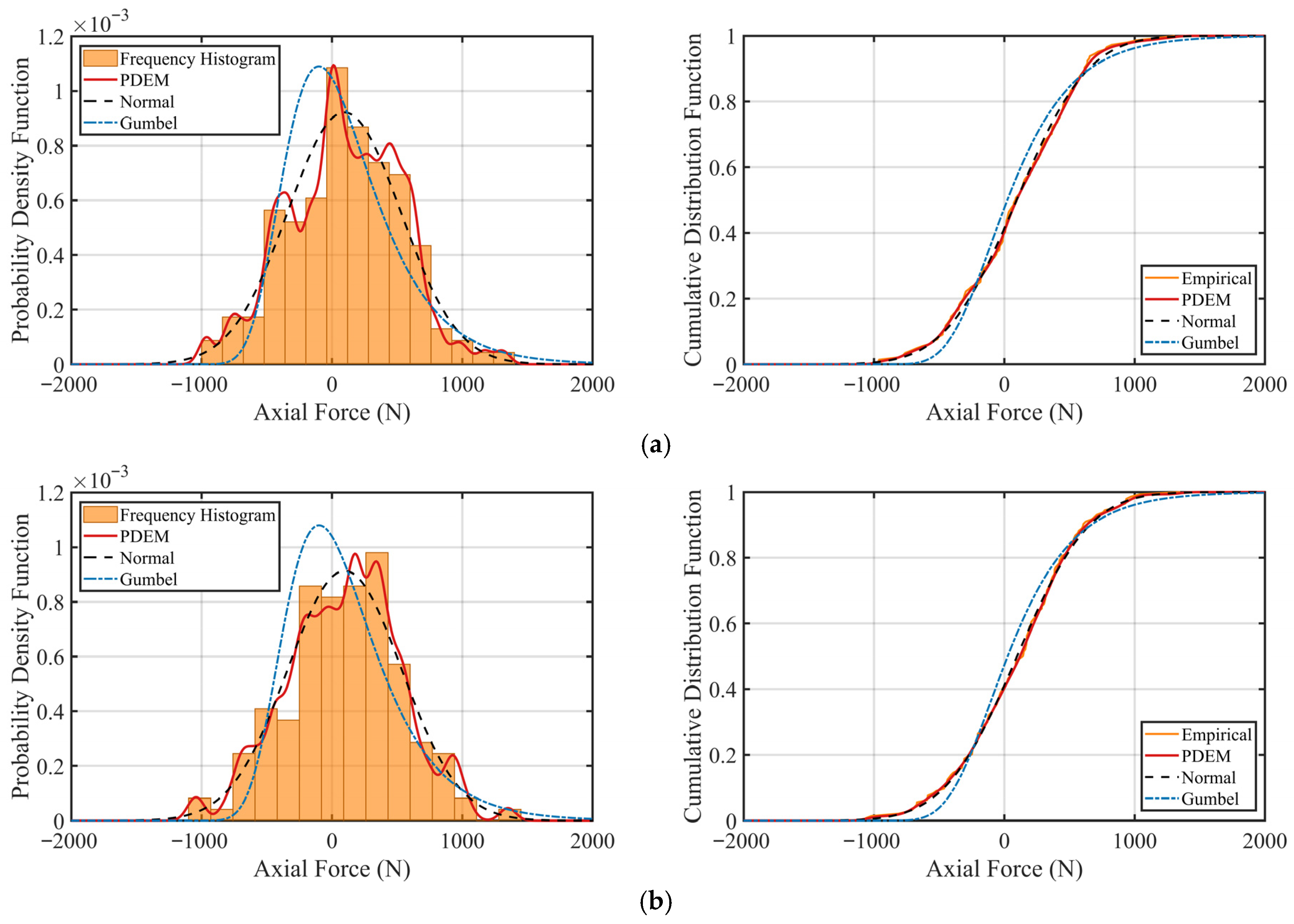
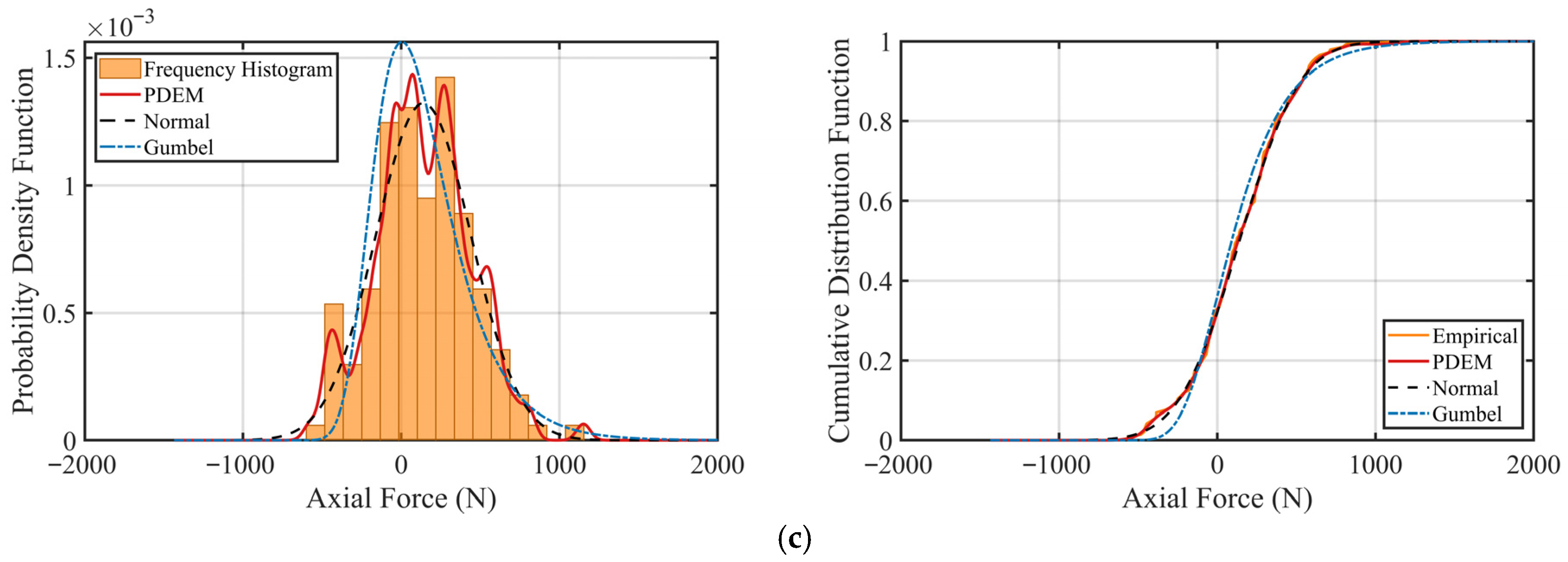
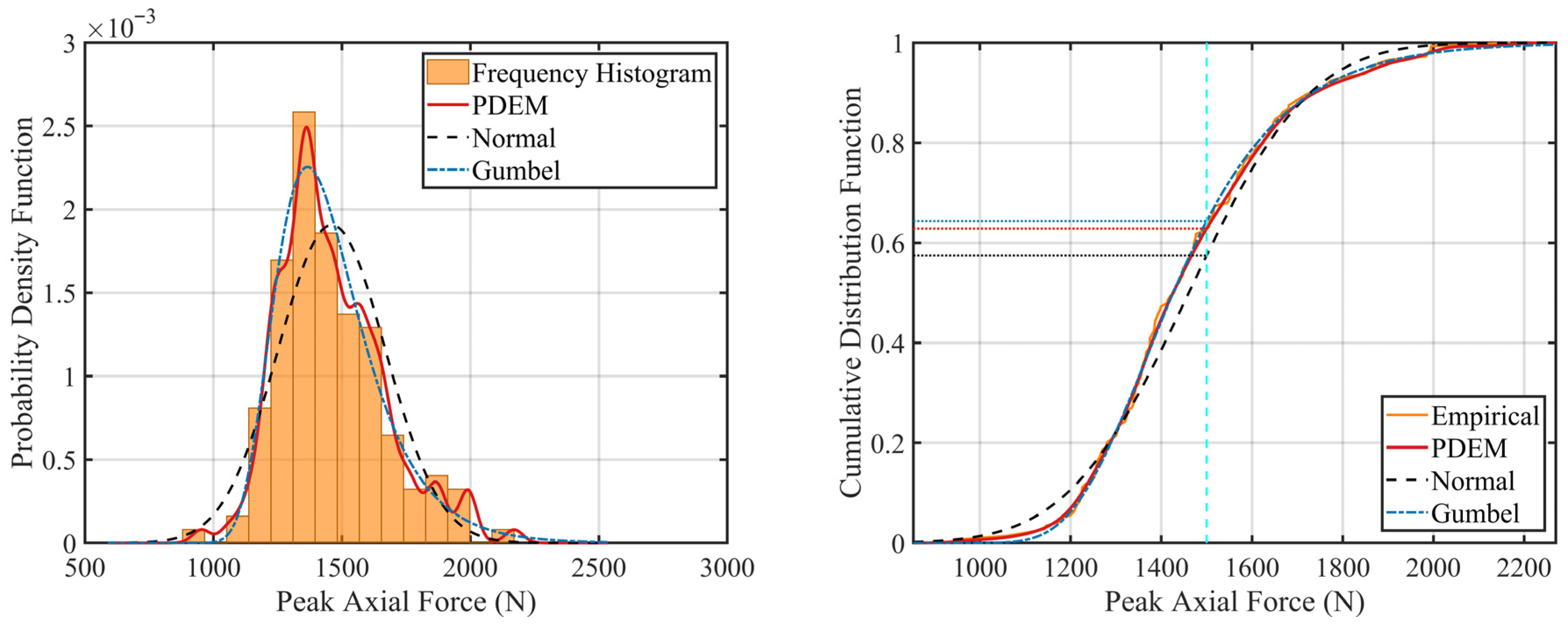
4.2. Axial Force Response of Anchor Bolts in Anchored Slopes Under Random Seismic Excitation
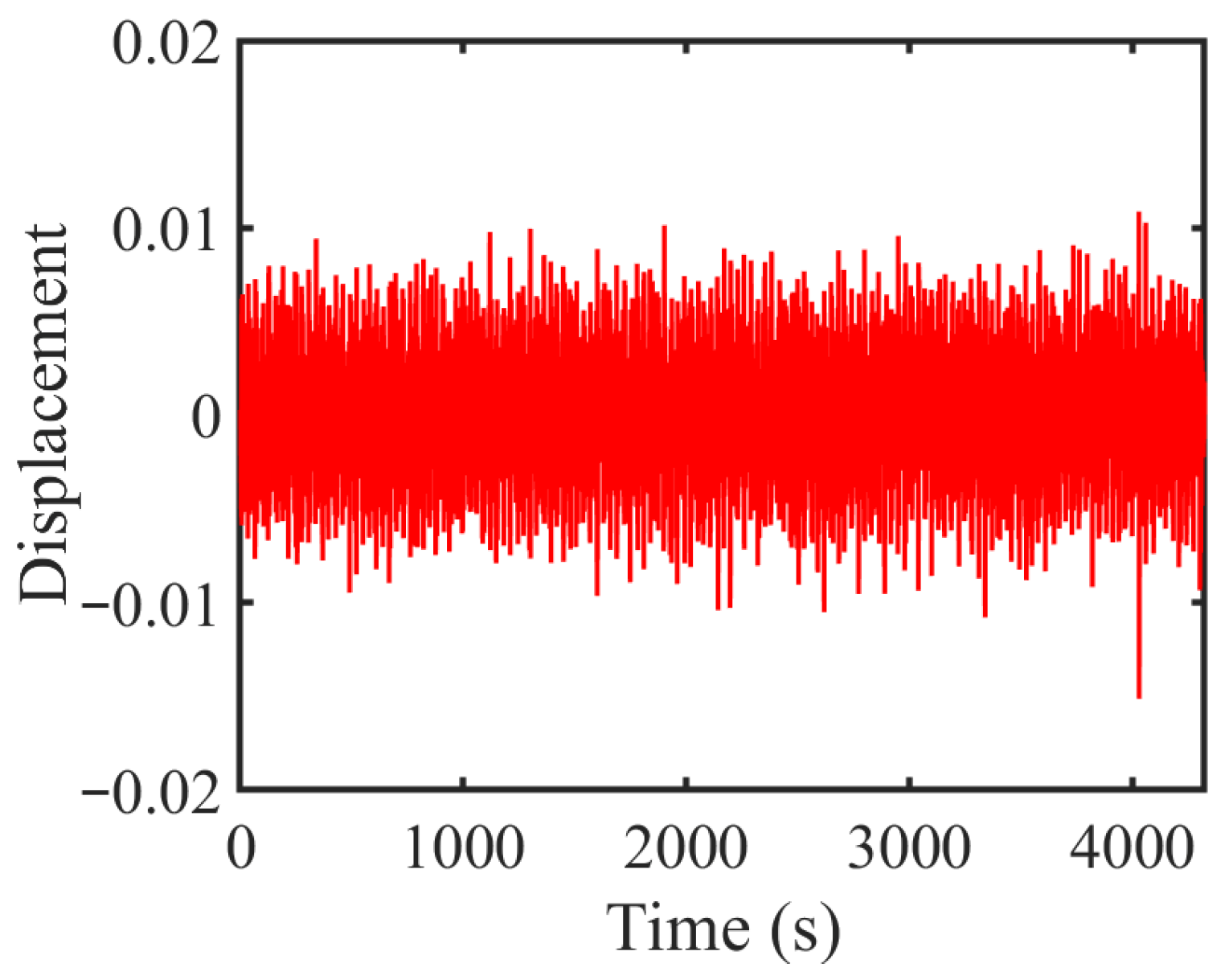
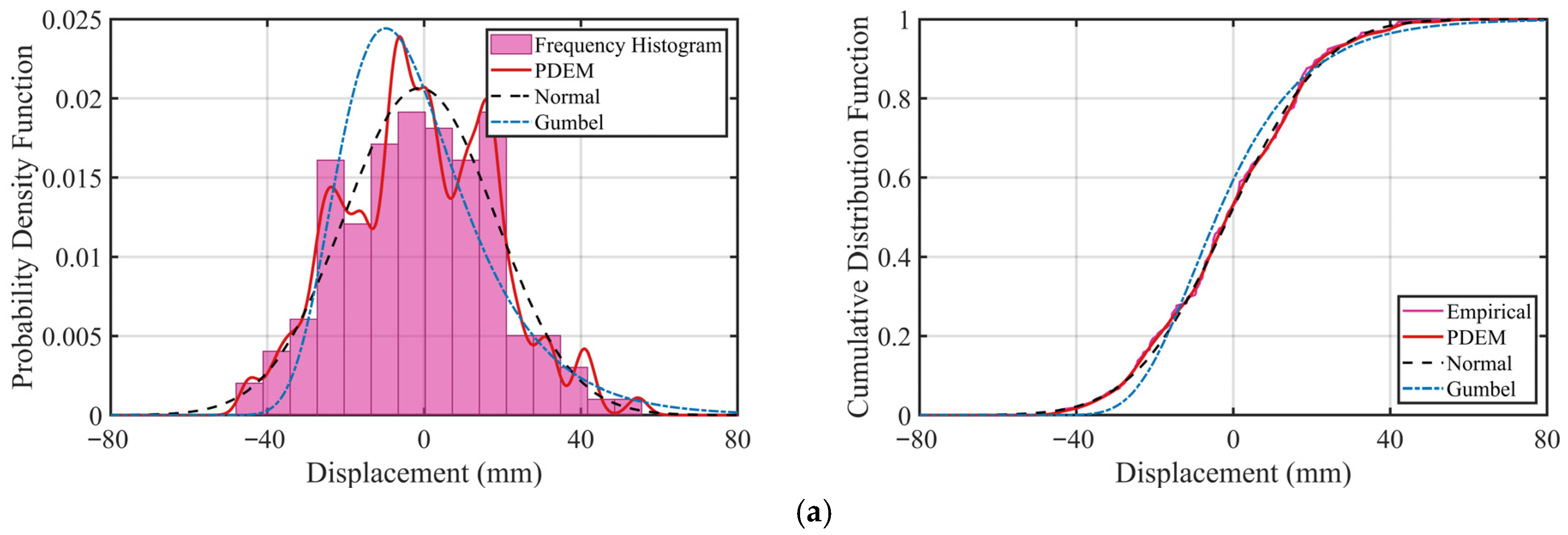
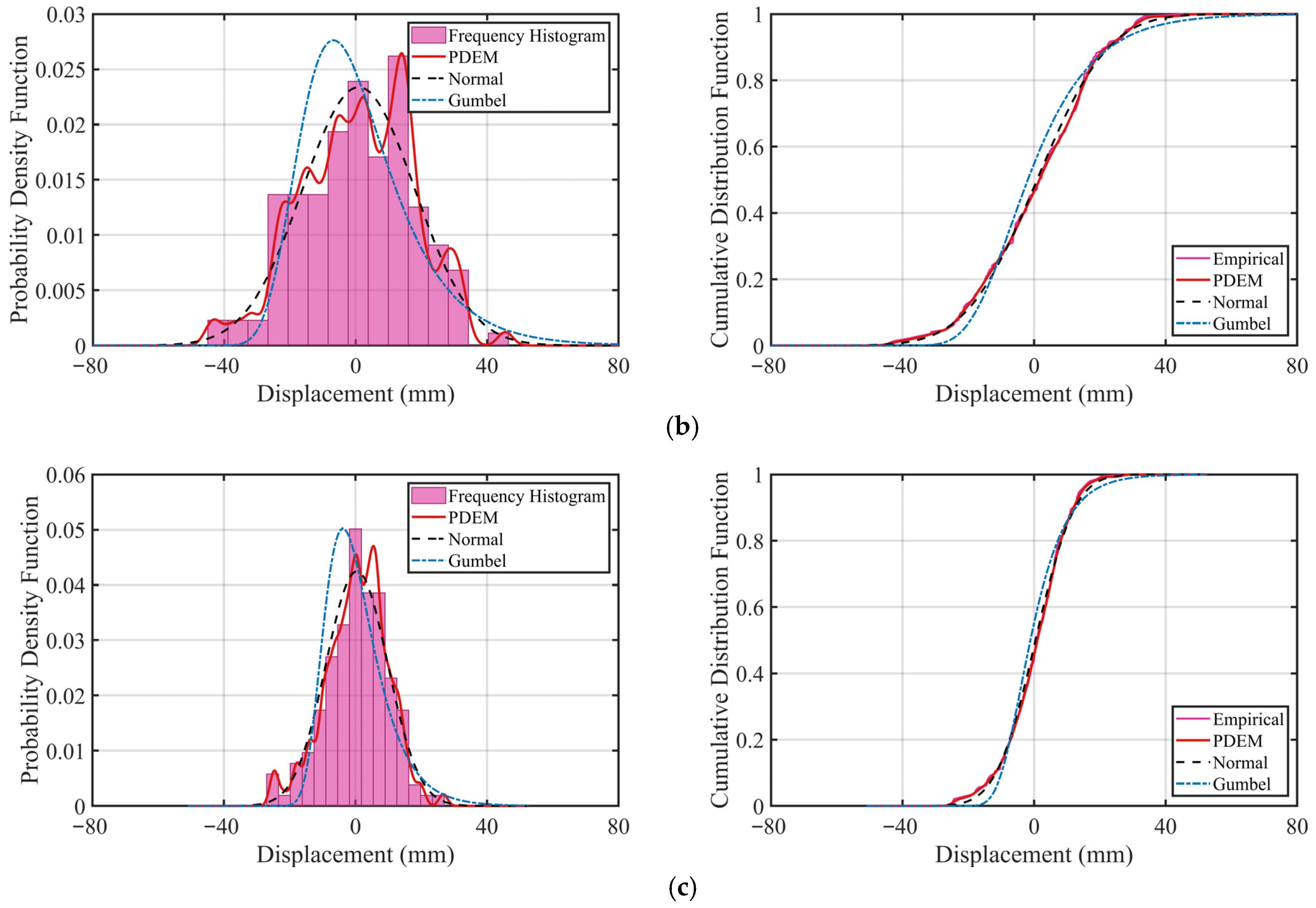
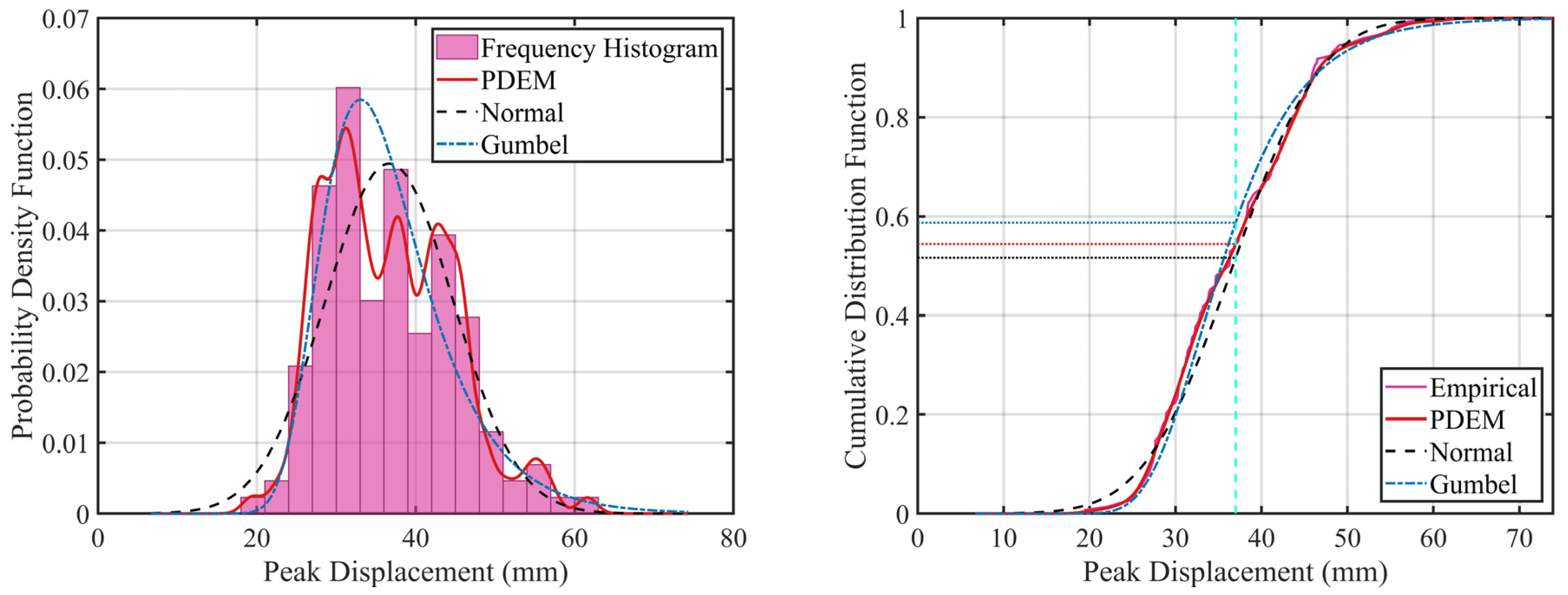
4.3. Absolute Displacement Response of Anchored Slopes Under Random Seismic Action
4.4. Probability Density Evolution Process of Ground Motion Response
5. Conclusions
- The PDEM is significantly superior to traditional parametric models in terms of capturing the transient probabilistic evolution characteristics of key response quantities of anchored slopes. Whether it is acceleration, changes in anchor bolt axial force, or displacement response, the PDFs and CDFs predicted by the PDEM at typical moments such as 5 s, 10 s, and 15 s are highly consistent with the frequency histograms and empirical distributions. It accurately reproduces the distribution morphology, peak position, tail decay, and even local multimodal structures. In contrast, the normal and Gumbel distributions, due to their inherent unimodality and specific tail characteristics, cannot truly reflect the complexity of the responses, especially with systematic underestimation in the tail region of extreme events.
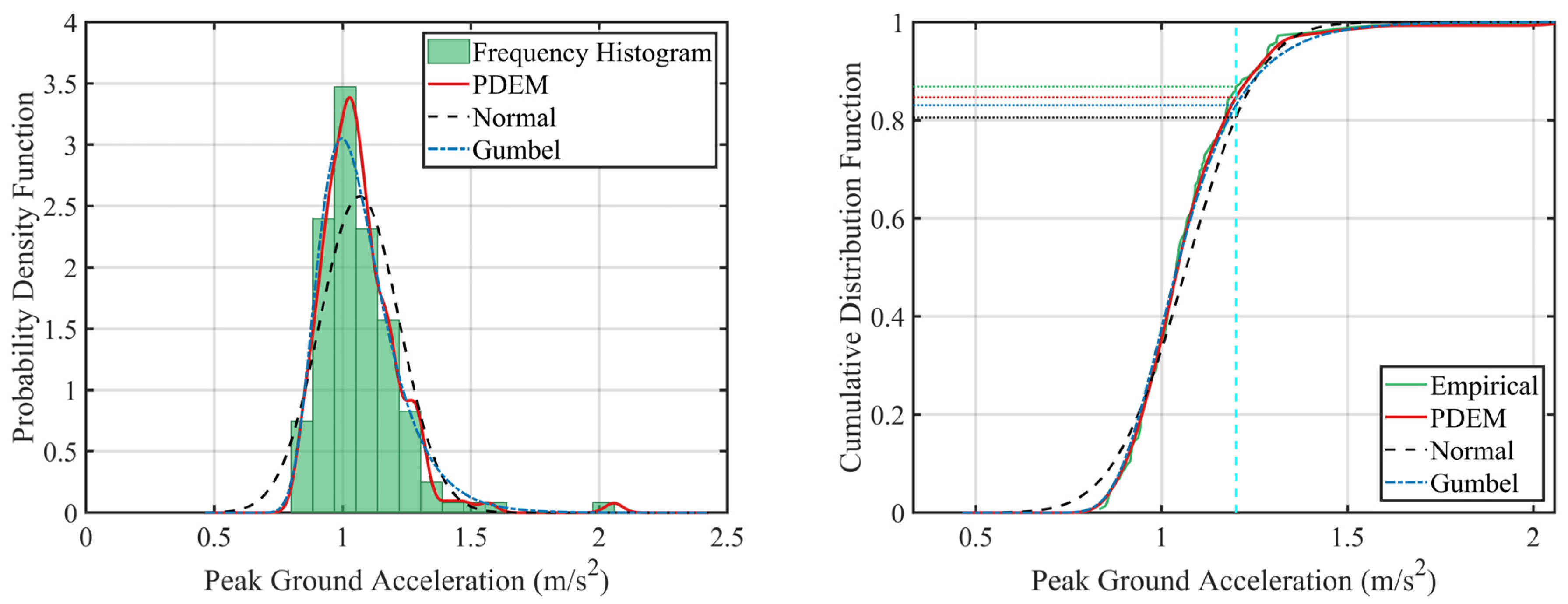
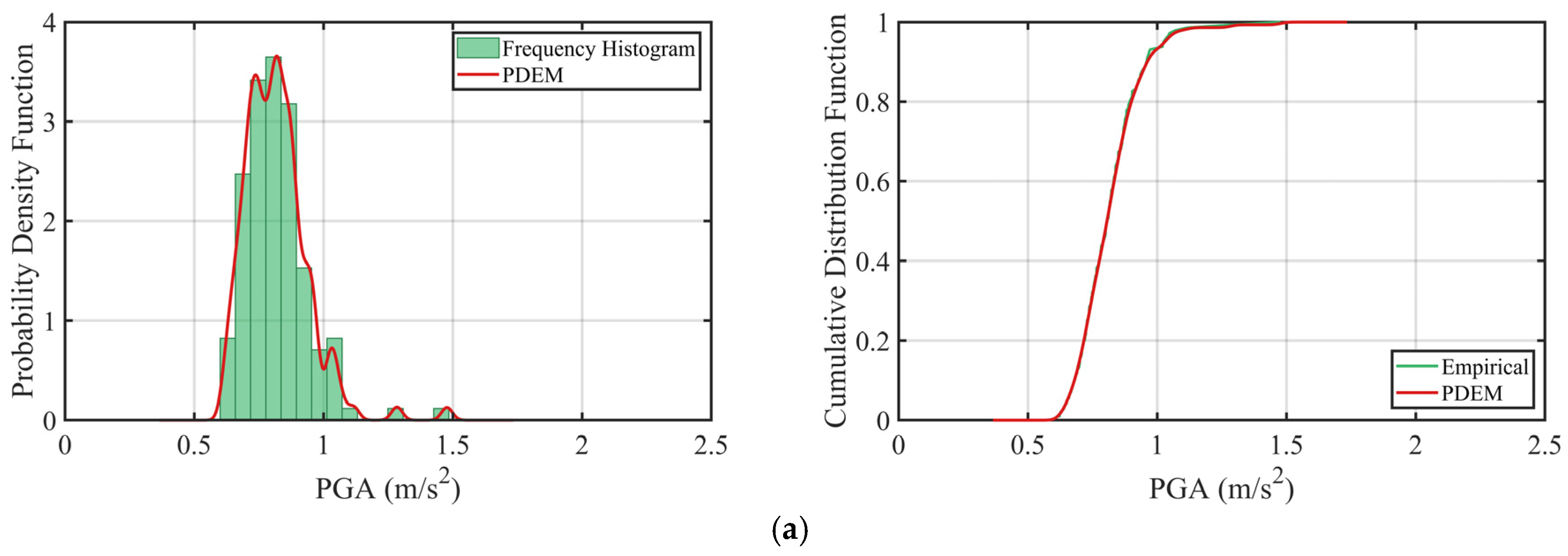
- In the reliability assessment of peak responses (such as PGA, maximum axial force change, and peak displacement), the PDEM demonstrates excellent accuracy. Taking the peak PGA at the slope top as an example, the reliability of “PGA < 1.2 m/s2” predicted by the PDEM is 85.5%, with a deviation of only 0.8% from the empirical distribution result (86.3%), while the deviations of the normal distribution and Gumbel distribution are as high as 5.8% and 3.3%, respectively. A similar pattern holds for axial force and displacement responses, indicating that the PDEM can significantly reduce the systematic error of reliability estimation under the condition of limited samples.
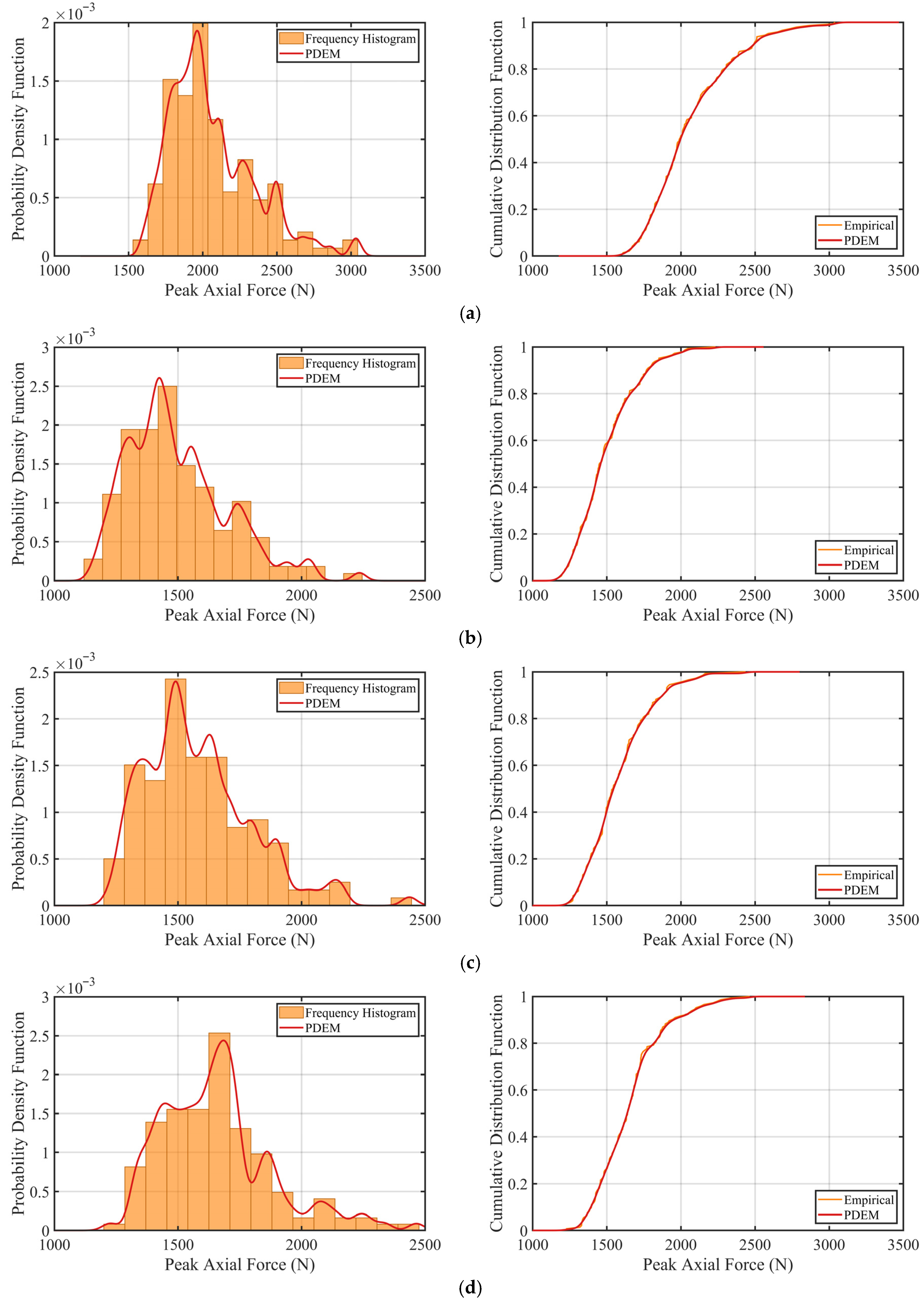
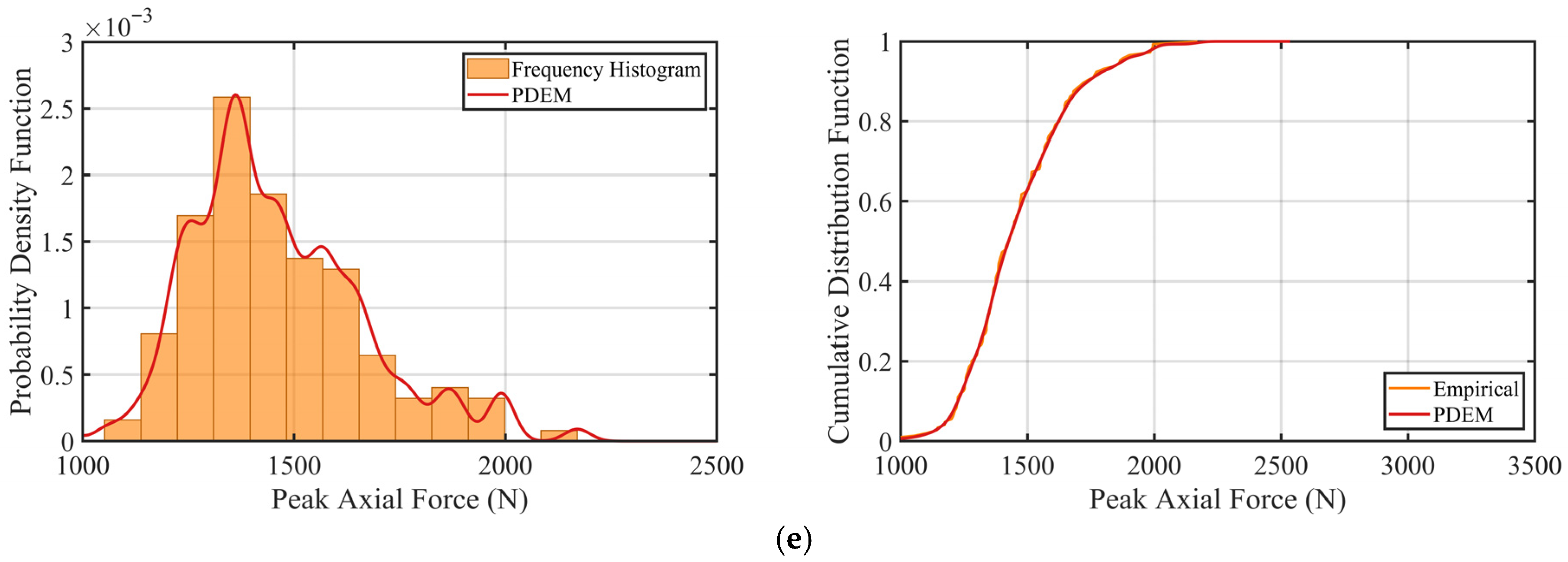
- Anchored slopes exhibit clear spatial response patterns under low-intensity seismic excitation, and the PDEM can effectively reproduce these physical characteristics. The acceleration response shows an obvious elevation amplification effect, while the standard deviation of the change in anchor axial force decreases with increasing elevation, which is attributed to the longer free segments and relatively flexible constraints of the upper anchors. The multi-point response PDF/CDF obtained by the PDEM is highly consistent with direct statistical results, verifying its physical consistency and applicability in spatial multi-point probabilistic modeling.
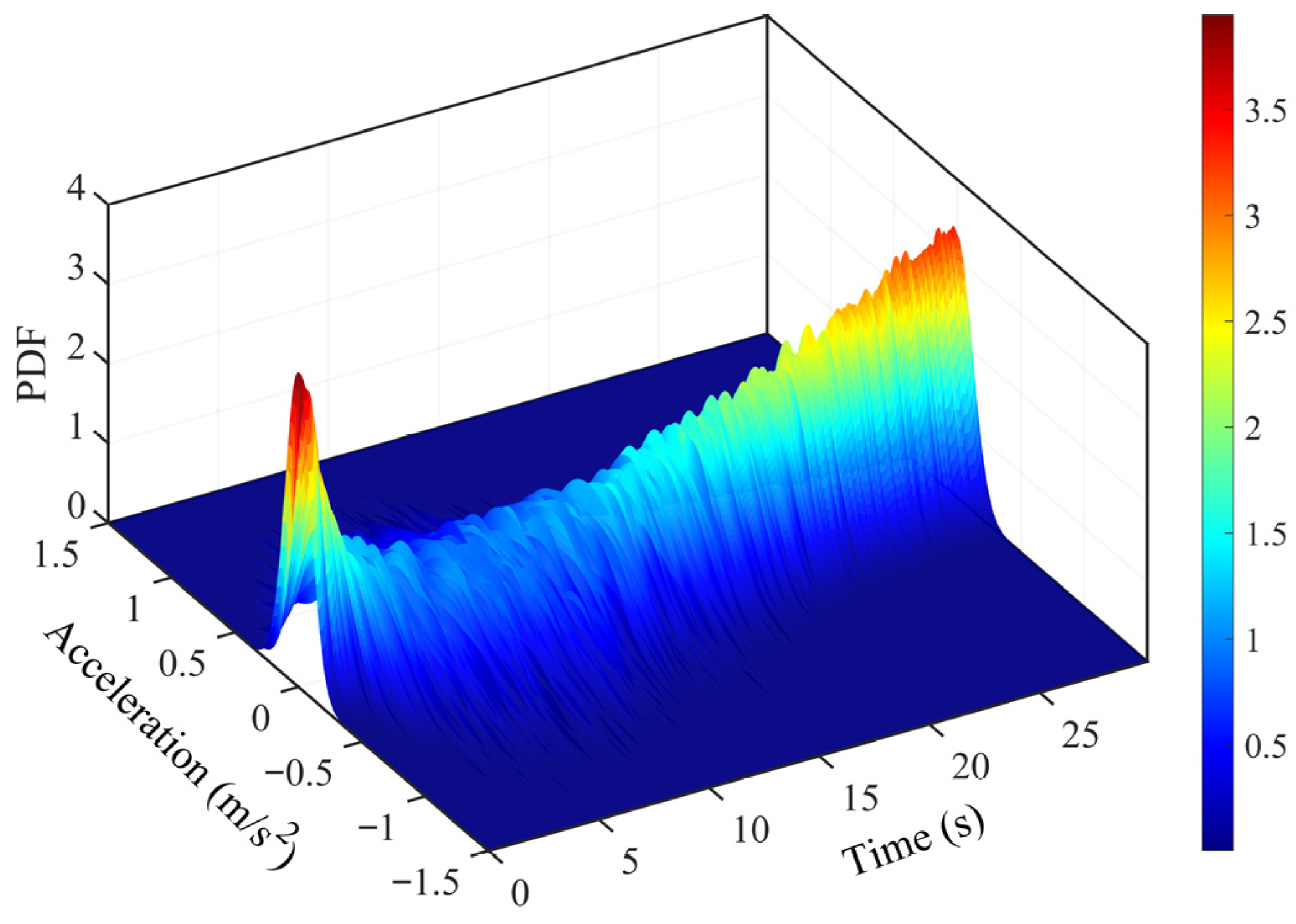
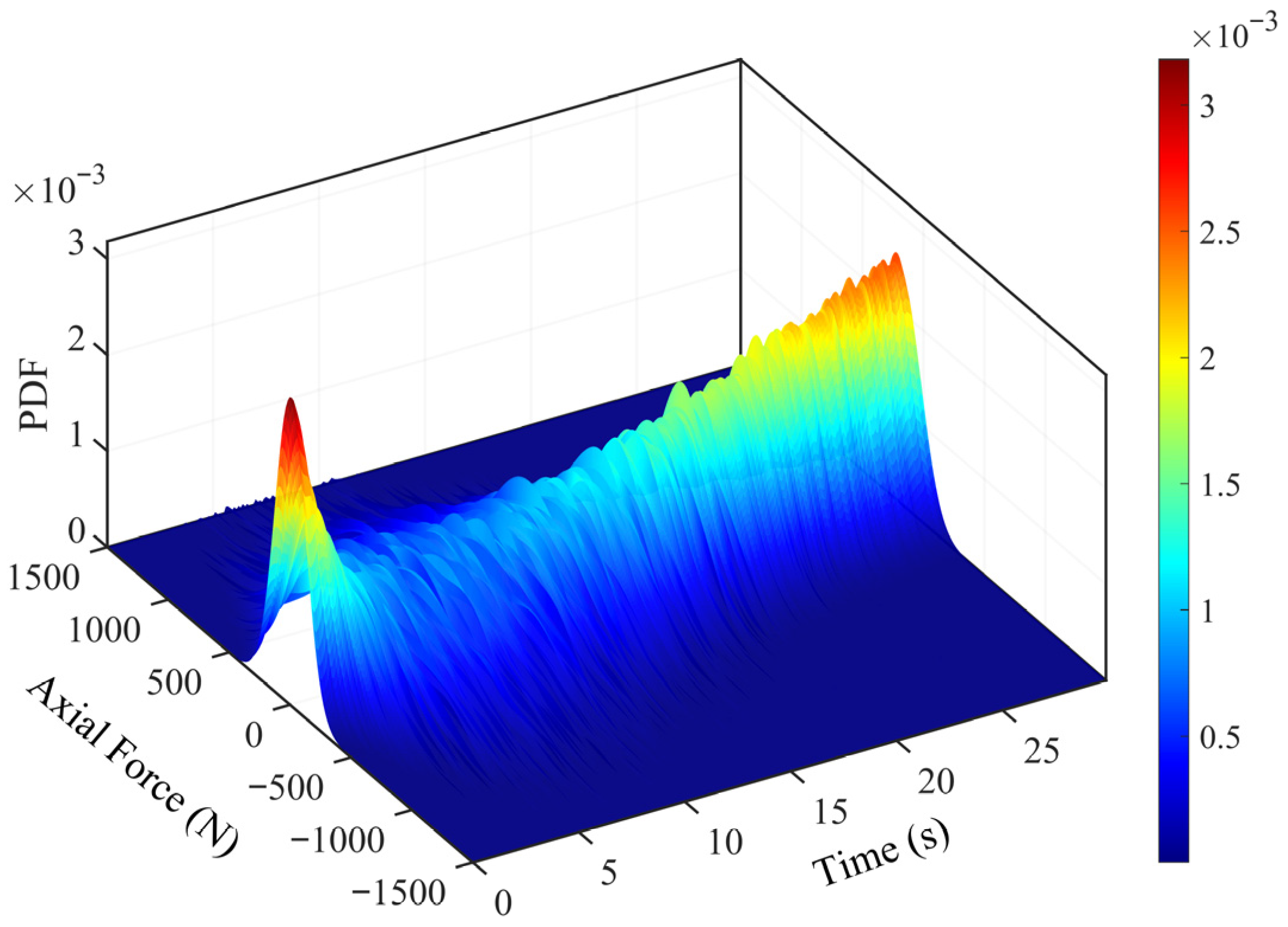
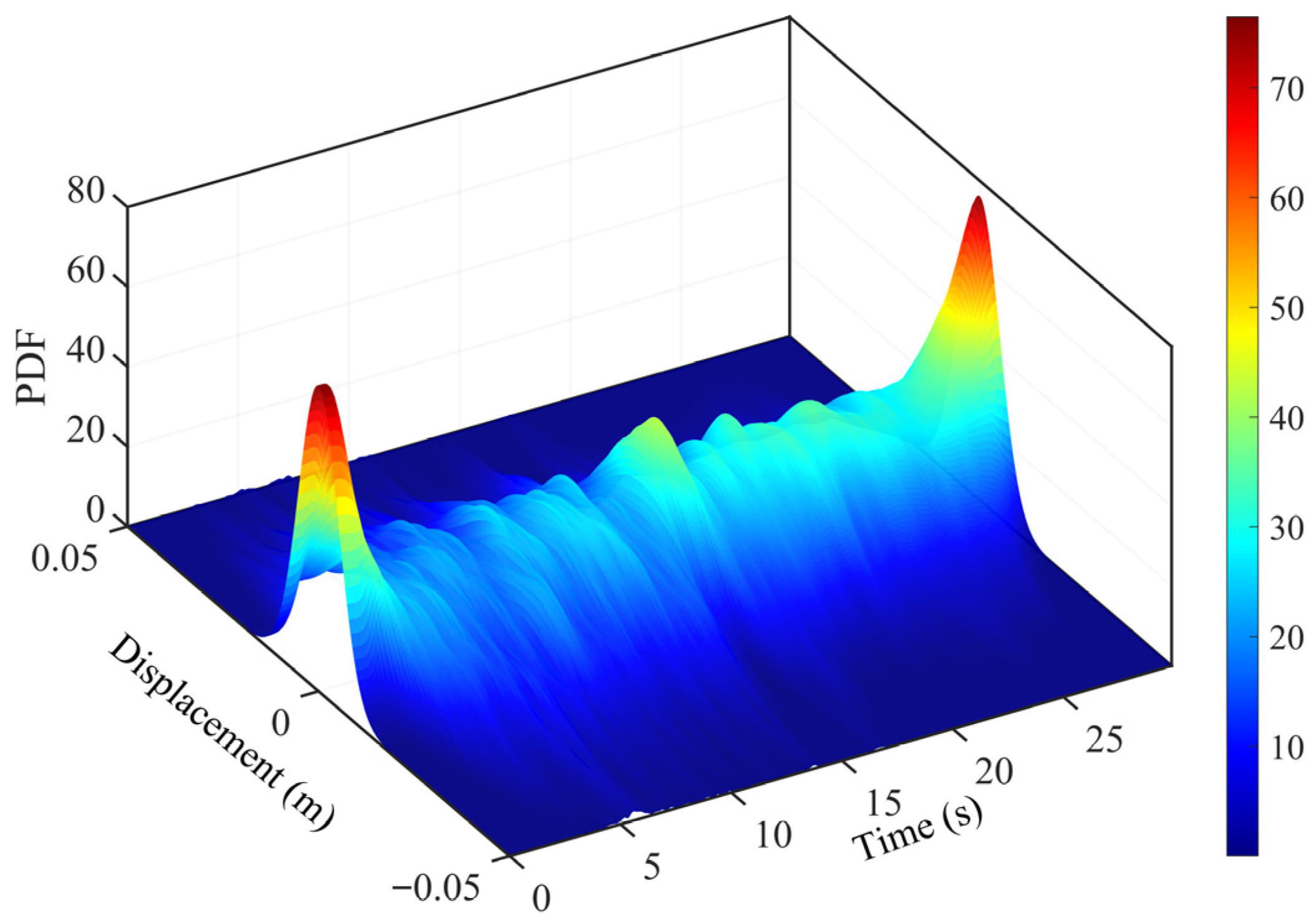
- By constructing a three-dimensional probability density evolution cloud map of acceleration, axial force, and displacement, the PDEM completely reveals the entire evolutionary law of the response PDF from being “narrow and high” in the initial stage of an earthquake, “wide and flat” in the main shock stage, to “re-convergent” after the earthquake, which is highly consistent with the earthquake energy input–dissipation mechanism. This capability indicates that the PDEM can not only faithfully track the instantaneous uncertainty of non-stationary and non-linear systems but can also provide a continuous, smooth, and physically reasonable probabilistic description tool for dynamic reliability analysis.
Author Contributions
Funding
Institutional Review Board Statement
Informed Consent Statement
Data Availability Statement
Conflicts of Interest
References
- Ji, J.; Gao, Y.; Lü, Q.; Wu, Z.; Zhang, W.; Zhang, C. China’s Early Warning System Progress. Science 2019, 365, 332. [Google Scholar] [CrossRef]
- Li, X.; He, S. Seismically Induced Slope Instabilities and the Corresponding Treatments: The Case of a Road in the Wenchuan Earthquake Hit Region. J. Mt. Sci. 2009, 6, 96–100. [Google Scholar] [CrossRef]
- Huang, Y.; Zhang, W.; Xu, Q.; Xie, P.; Hao, L. Run-out Analysis of Flow-like Landslides Triggered by the Ms 8.0 2008 Wenchuan Earthquake Using Smoothed Particle Hydrodynamics. Landslides 2012, 9, 275–283. [Google Scholar] [CrossRef]
- Steedman, R.S.; Zeng, X. The Influence of Phase on the Calculation of Pseudo-Static Earth Pressure on a Retaining Wall. Géotechnique 1990, 40, 103–112. [Google Scholar] [CrossRef]
- Tsai, C.-C.; Chien, Y.-C. A General Model for Predicting the Earthquake-Induced Displacements of Shallow and Deep Slope Failures. Eng. Geol. 2016, 206, 50–59. [Google Scholar] [CrossRef]
- Ji, J.; Zhang, W.; Zhang, F.; Gao, Y.; Lü, Q. Reliability Analysis on Permanent Displacement of Earth Slopes Using the Simplified Bishop Method. Comput. Geotech. 2020, 117, 103286. [Google Scholar] [CrossRef]
- Zhao, L.; Huang, Y.; Chen, Z.; Ye, B.; Liu, F. Dynamic Failure Processes and Failure Mechanism of Soil Slope under Random Earthquake Ground Motions. Soil Dyn. Earthq. Eng. 2020, 133, 106147. [Google Scholar] [CrossRef]
- Huang, Y.; Zhao, L.; Li, X. Slope-Dynamic Reliability Analysis Considering Spatial Variability of Soil Parameters. Int. J. Geomech. 2020, 20, 04020068. [Google Scholar] [CrossRef]
- Song, L.; Xu, B.; Kong, X.; Zou, D.; Pang, R.; Yu, X.; Zhang, Z. Three-Dimensional Slope Dynamic Stability Reliability Assessment Based on the Probability Density Evolution Method. Soil Dyn. Earthq. Eng. 2019, 120, 360–368. [Google Scholar] [CrossRef]
- Huang, Y.; Hu, H.; Xiong, M. Performance-Based Seismic Fragility Analysis of Retaining Walls Based on the Probability Density Evolution Method. Struct. Infrastruct. Eng. 2019, 15, 103–112. [Google Scholar] [CrossRef]
- Wang, G.; Pang, R.; Yu, X.; Xu, B. Permanent Displacement Reliability Analysis of Soil Slopes Subjected to Mainshock-Aftershock Sequences. Comput. Geotech. 2023, 153, 105069. [Google Scholar] [CrossRef]
- Pan, Q.-J.; Leung, Y.-F.; Hsu, S.-C. Stochastic Seismic Slope Stability Assessment Using Polynomial Chaos Expansions Combined with Relevance Vector Machine. Geosci. Front. 2021, 12, 405–414. [Google Scholar] [CrossRef]
- Chen, J.-F.; Du, C.-C.; Peng, M.; Sun, R.; Zhao, F.; Shi, Z.-M. System Reliability Analysis of a Slope Stabilized with Anchor Cables and Piles under Seismic Loading. Acta Geotech. 2023, 18, 4493–4514. [Google Scholar] [CrossRef]
- Li, J.; Chen, J.-B. Stochastic Dynamics of Structures, 1st ed.; John Wiley & Sons, Ltd.: Hoboken, NJ, USA, 2009. [Google Scholar]
- Ba, Z.; Kuo, C.; Liang, J. Quantifying the contributions of multi-source uncertainties in dynamic soil-pile-nuclear power plant structure response via probability density evolution method. Comput. Geotech. 2025, 186, 107430. [Google Scholar] [CrossRef]
- Li, J.; Chen, J.B. Probability Density Evolution Method for Dynamic Response Analysis of Structures with Uncertain Parameters. Comput. Mech. 2004, 34, 400–409. [Google Scholar] [CrossRef]
- Li, J.; Chen, J. The Probability Density Evolution Method for Dynamic Response Analysis of Non-linear Stochastic Structures. Numer. Meth. Eng. 2006, 65, 882–903. [Google Scholar] [CrossRef]
- Gao, X.; Jia, J.; Bao, X.; Mei, G.; Zhang, L.; Tu, B.; Gao, X.; Jia, J.; Zhang, L.; Zhao, Y.; et al. Shaking Table Model Tests and Stability Analysis of Slopes Reinforced with New Anti-Seismic Anchor Cables. KSCE J. Civ. Eng. 2024, 28, 4973–4989. [Google Scholar] [CrossRef]
- Liu, H.; Xu, Q.; Li, Y.; Fan, X. Response of High-Strength Rock Slope to Seismic Waves in a Shaking Table Test. Bull. Seismol. Soc. Am. 2013, 103, 3012–3025. [Google Scholar] [CrossRef]
- Liu, H.; Xu, Q.; Li, Y. Effect of Lithology and Structure on Seismic Response of Steep Slope in a Shaking Table Test. J. Mt. Sci. 2014, 11, 371–383. [Google Scholar] [CrossRef]
- Hu, H.; Huang, Y.; Zhao, L.; Xiong, M. Shaking Table Tests on Slope Reinforced by Anchored Piles under Random Earthquake Ground Motions. Acta Geotech. 2022, 17, 4113–4130. [Google Scholar] [CrossRef]
- Gao, X.; Jia, J.; Zhang, L.; Zhao, Y.; Tu, B. Mechanical Properties and Reasonable Proportions of Granite Similar Materials with Varying Degrees of Weathering. Eng. Fail. Anal. 2025, 84, 140. [Google Scholar] [CrossRef]
- Wartman, J.; Seed, R.B.; Bray, J.D. Shaking Table Modeling of Seismically Induced Deformations in Slopes. J. Geotech. Geoenviron. Eng. 2005, 131, 610–622. [Google Scholar] [CrossRef]
- Lin, M.-L.; Wang, K.-L. Seismic Slope Behavior in a Large-Scale Shaking Table Model Test. Eng. Geol. 2006, 86, 118–133. [Google Scholar] [CrossRef]
- Liu, Z.; Liu, W.; Peng, Y. Random Function Based Spectral Representation of Stationary and Non-Stationary Stochastic Processes. Probabilistic Eng. Mech. 2016, 45, 115–126. [Google Scholar] [CrossRef]
- Deodatis, G. Non-Stationary Stochastic Vector Processes: Seismic Ground Motion Applications. Probabilistic Eng. Mech. 1996, 11, 149–167. [Google Scholar] [CrossRef]
- Cacciola, P.; Deodatis, G. A Method for Generating Fully Non-Stationary and Spectrum-Compatible Ground Motion Vector Processes. Soil Dyn. Earthq. Eng. 2011, 31, 351–360. [Google Scholar] [CrossRef]
- GB/T50011-2010; Seismic Design Code for Buildings. China Building Industry Press: Beijing, China, 2010.
- Liu, Z.; Zeng, B.; Wu, L. A Spectral Representation-Stochastic Function Method for Simulating Non-Stationary Seismic Ground Motion Processes. J. Vib. Eng. 2015, 28, 411–417. [Google Scholar] [CrossRef]
- Chen, J.; Yang, J.; Li, J. A GF-Discrepancy for Point Selection in Stochastic Seismic Response Analysis of Structures with Uncertain Parameters. Struct. Saf. 2016, 59, 20–31. [Google Scholar] [CrossRef]
- Iai, S. Similitude for Shaking Table Tests on Soil-Structure-Fluid Model in 1g Gravitational Field. Soils Found. 1989, 29, 105–118. [Google Scholar] [CrossRef]
- Meymand, P.J. Shaking Table Scale Model Tests of Nonlinear Soil-Pile-Superstructure Interaction in Soft Clay; University of California: Berkeley, CA, USA, 1998. (In English) [Google Scholar]
- Zhao, W.; Gao, H.; Chen, W.; Liu, J.; Peng, W.; Zhou, S. Experimental Study on Similar Materials for Tunnel Lining Concrete in Geomechanical Model Tests. Eng. Fail. Anal. 2023, 152, 107456. [Google Scholar] [CrossRef]
- El-Ramly, H.; Morgenstern, N.R.; Cruden, D.M. Probabilistic Slope Stability Analysis for Practice. Can. Geotech. J. 2002, 39, 665–683. [Google Scholar] [CrossRef]
- Baecher, G.B.; Christian, J.T. Reliability and Statistics in Geotechnical Engineering; John Wiley & Sons: Hoboken, NJ, USA, 2003. [Google Scholar]
- Xiao, J.; Gong, W.; Martin, J.R., II; Shen, M.; Luo, Z. Probabilistic Seismic Stability Analysis of Slope at a given Site in a Specified Exposure Time. Eng. Geol. 2016, 212, 53–62. [Google Scholar] [CrossRef]
- SLOAN, S.W. Geotechnical Stability Analysis. Géotechnique 2013, 63, 531–571. [Google Scholar] [CrossRef]
- Na, U.J.; Ray Chaudhuri, S.; Shinozuka, M. Effects of Spatial Variation of Soil Properties on Seismic Performance of Port Structures. Soil Dyn. Earthq. Eng. 2009, 29, 537–545. [Google Scholar] [CrossRef]
- Tsompanakis, Y.; Lagaros, N.D.; Psarropoulos, P.N.; Georgopoulos, E.C. Probabilistic Seismic Slope Stability Assessment of Geostructures. Struct. Infrastruct. Eng. 2010, 6, 179–191. [Google Scholar] [CrossRef]
- Argyroudis, S.; Kaynia, A.M.; Pitilakis, K. Development of Fragility Functions for Geotechnical Constructions: Application to Cantilever Retaining Walls. Soil Dyn. Earthq. Eng. 2013, 50, 106–116. [Google Scholar] [CrossRef]
- Jafarian, Y.; Miraei, M. Scalar- and Vector-Valued Fragility Analyses of Gravity Quay Wall on Liquefiable Soil: Example of Kobe Port. Int. J. Geomech. 2019, 19, 30. [Google Scholar] [CrossRef]
- Jafarian, Y.; Miraei, M. Seismic Performance Assessment of High CFRDs Based on Fragility Analysis. Sci. China Technol. Sci. 2019, 62, 635–648. [Google Scholar] [CrossRef]
- Mai, C.; Konakli, K.; Sudret, B. Seismic Fragility Curves for Structures Using Non-Parametric Representations. Front. Struct. Civ. Eng. 2017, 11, 169–186. [Google Scholar] [CrossRef]
- Zheng, G.; Wang, R.Z.; Cheng, X.S.; Lei, Y.W.; Li, X.Y.; Zhou, Q. Mechanism and Control of Progressive Collapse of Tied-Back Excavations Induced by Local Anchor Failure. Acta Geotech. 2024, 19, 763–781. [Google Scholar] [CrossRef]
- Shi, K.; Wu, X.; Liu, Z.; Dai, S. Coupled Calculation Model for Anchoring Force Loss in a Slope Reinforced by a Frame Beam and Anchor Cables. Eng. Geol. 2019, 260, 105245. [Google Scholar] [CrossRef]
- Fu, X.; Ji, W.-Y.; Zhang, J.-J.; Cao, L.-C.; Fan, G. Seismic Response for Plane Sliding of Slope Reinforced by Anchor-Chain-Framed Ground Beams through Shaking Table Test. Yantu Lixue/Rock Soil Mech. 2018, 39, 1709–1719. [Google Scholar] [CrossRef]
- Pan, X.; Jia, J. Time-Dependent System Reliability Analysis of Anchor-Reinforced Slopes Based on Surrogate Models. Comput. Geotech. 2025, 184, 107257. [Google Scholar] [CrossRef]
- Jia, J.; Gao, X.; Bao, X.; Xiang, X.; Zhang, L.; Tu, B. Dynamic Stability Analysis Method of Anchored Rocky Slope Considering Seismic Deterioration Effect. Sci. Rep. 2024, 14, 7014. [Google Scholar] [CrossRef] [PubMed]









| Parameter | (s−1) | γ | a | b | c | d | T(s) | |
| Value | 25 | 0.45 | 2.85 | 3.5 | 0.3 | 4 | 2 | 15 |
| Serial Number | Working Condition | Seismic Waves Type | Peak Acceleration/g |
|---|---|---|---|
| 1 | WN1 | white noise | 0.1 |
| 2~26 | SW1~25 | random seismic waves | 0.1 |
| 27 | WN2 | white noise | 0.1 |
| 28~52 | SW26~50 | random seismic waves | 0.1 |
| 53 | WN3 | white noise | 0.1 |
| 54~78 | SW51~75 | random seismic waves | 0.1 |
| 79 | WN4 | white noise | 0.1 |
| 80~104 | SW76~100 | random seismic waves | 0.1 |
| 105 | WN5 | white noise | 0.1 |
| 106~130 | SW101~125 | random seismic waves | 0.1 |
| 131 | WN6 | white noise | 0.1 |
| 132~150 | SW126~144 | random seismic waves | 0.1 |
| 151 | WN7 | white noise | 0.1 |
| Serial Number | Physical Quantity | Dimension | Similar Relationship | Similarity Constant | Note |
|---|---|---|---|---|---|
| 1 | Geometric dimension L | [L] | CL | 30 | controlled variable |
| 2 | Density ρ | [M][L]−3 | Cρ | 1 | controlled variable |
| 3 | Acceleration a | [L][M]−2 | Ca | 1 | controlled variable |
| 4 | Elastic modulus E | [M][L]−1[T]−2 | CE = CρCLCa | 30 | |
| 5 | Poisson’s ratio μ | 1 | Cμ = 1 | 1 | |
| 6 | Strain ε | 1 | Cε = 1 | 1 | |
| 7 | Stress σ | [M][L]−1[T]−2 | Cσ = CρCLCa | 30 | |
| 8 | speed v | [L][T]−1 | Cv = CL1/2Ca1/2 | 5.48 | |
| 9 | displacement u | [L] | Cu = CL | 30 | |
| 10 | time t | [T] | Ct = CL1/2Ca−1/2 | 5.48 | |
| 11 | force F | [M][L][T]−2 | CF = CL3 | 27,000 | |
| 12 | Frequency ω | [T]−1 | Cω = CL−1/2Ca1/2 | 0.18 | |
| 13 | damping ratio ξ | 1 | Cξ = 1 | 1 | |
| 14 | cohesion c | [M][L]−1[T]−2 | Cc = CρCLCa | 30 |
| Rock | Category | Density/kg·m−3 | Cohesion/kPa | Angle of Internal Friction/° | Compressive Strength/kPa | Elastic Modulus/MPa |
|---|---|---|---|---|---|---|
| Completely weathered granite | Original rock test value | 2183 | 3259.4 | 32.3 | 9718.2 | 3230.3 |
| Similar material value | 2183 | 108.6 | 32.3 | 323.9 | 107.7 |
Disclaimer/Publisher’s Note: The statements, opinions and data contained in all publications are solely those of the individual author(s) and contributor(s) and not of MDPI and/or the editor(s). MDPI and/or the editor(s) disclaim responsibility for any injury to people or property resulting from any ideas, methods, instructions or products referred to in the content. |
© 2026 by the authors. Licensee MDPI, Basel, Switzerland. This article is an open access article distributed under the terms and conditions of the Creative Commons Attribution (CC BY) license.
Share and Cite
Pan, X.; Jia, J.; Zhang, L. Shaking Table Test-Based Verification of PDEM for Random Seismic Response of Anchored Rock Slopes. Appl. Sci. 2026, 16, 1146. https://doi.org/10.3390/app16021146
Pan X, Jia J, Zhang L. Shaking Table Test-Based Verification of PDEM for Random Seismic Response of Anchored Rock Slopes. Applied Sciences. 2026; 16(2):1146. https://doi.org/10.3390/app16021146
Chicago/Turabian StylePan, Xuegang, Jinqing Jia, and Lihua Zhang. 2026. "Shaking Table Test-Based Verification of PDEM for Random Seismic Response of Anchored Rock Slopes" Applied Sciences 16, no. 2: 1146. https://doi.org/10.3390/app16021146
APA StylePan, X., Jia, J., & Zhang, L. (2026). Shaking Table Test-Based Verification of PDEM for Random Seismic Response of Anchored Rock Slopes. Applied Sciences, 16(2), 1146. https://doi.org/10.3390/app16021146