Shortening Recovery Periods Is a Better Time-Efficient Strategy to Enhance Single and Repeated High-Intensity Efforts Using Elastic Band Exercises with Different Force-Vectors


Abstract
1. Introduction
2. Materials and Methods
2.1. Design
2.2. Participants
2.3. Training Intervention
2.4. Testing Procedures
2.5. Triple Hop Test
2.6. Speed Test
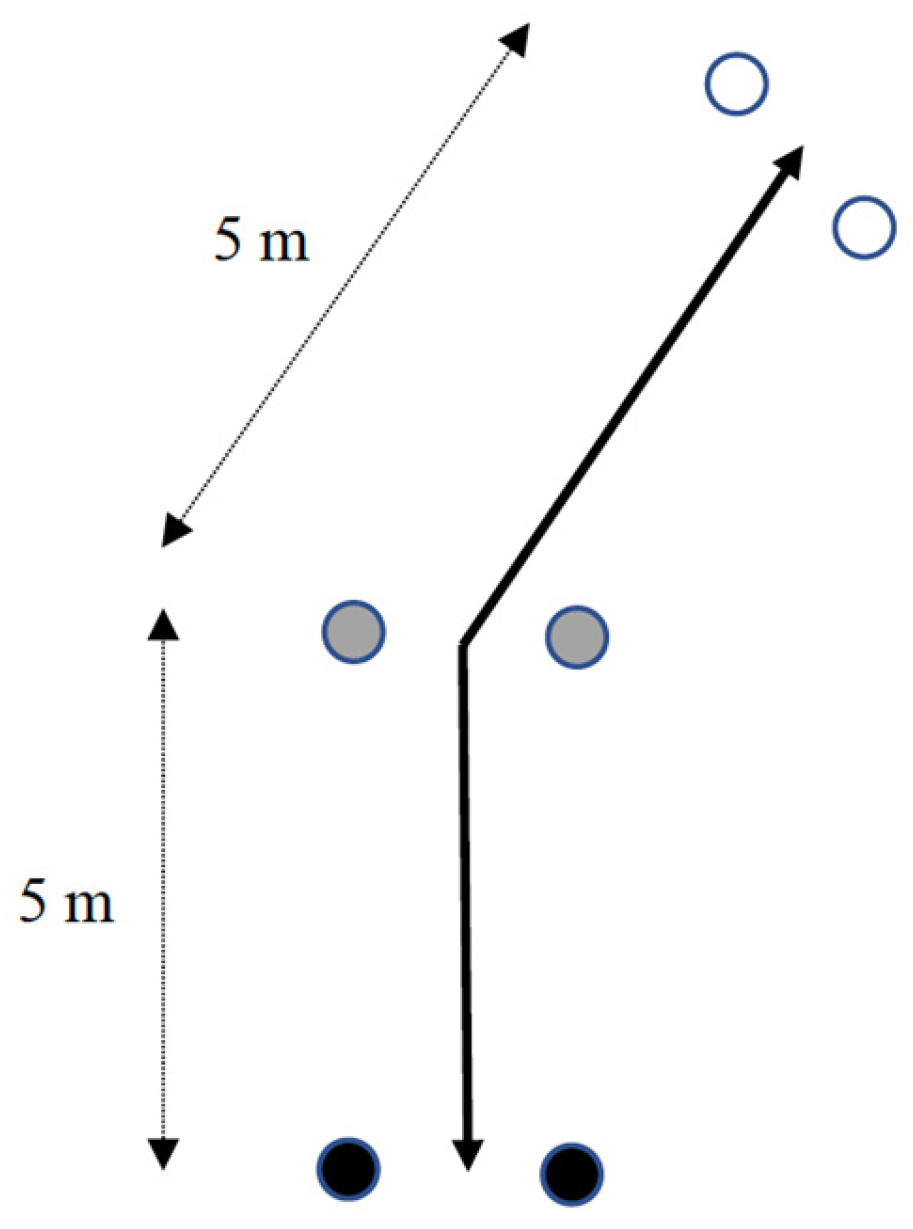
2.7. 45° Change of Direction Test
2.8. Repeated Sprint Ability Test
2.9. Statistical Analyses
3. Results
4. Discussion
5. Conclusions
Author Contributions
Funding
Institutional Review Board Statement
Informed Consent Statement
Data Availability Statement
Conflicts of Interest
References
- García-Benítez, S.; Courel-Ibáñez, J.; Pérez-Bilbao, T.; Felipe, J.L. Game Responses During Young Padel Match Play: Age and Sex Comparisons. J. Strength Cond. Res. 2018, 32, 1144–1149. [Google Scholar] [CrossRef] [Scilit]
- Courel-Ibáñez, J.; Llorca-Miralles, J. Physical Fitness in Young Padel Players: A Cross-Sectional Study. Int. J. Environ. Res. Public Health 2021, 18, 2658. [Google Scholar] [CrossRef] [Scilit] [PubMed]
- Martín-Miguel, I.; Escudero-Tena, A.; Muñoz, D.; Sánchez-Alcaraz, B.J. Performance Analysis in Padel: A Systematic Review. J. Hum. Kinet. 2023, 89, 213–230. [Google Scholar] [CrossRef] [Scilit] [PubMed]
- Castillo-Rodríguez, A.; Alvero-Cruz, J.R.; Hernández-Mendo, A.; Fernández-García, J.C. Physical and physiological responses in Paddle Tennis competition. Int. J. Perform. Anal. Sport 2014, 14, 524–534. [Google Scholar] [CrossRef] [Scilit]
- Priego Quesada, J.I.; Olaso Melis, J.; Llana Belloch, S.; Pérez Soriano, P.; González García, J.C.; Sanchís Almenara, M. Padel: A quantitative study of the shots and movements in the high-performance. J. Hum. Sport Exerc. 2013, 8, 925–931. [Google Scholar] [CrossRef] [Scilit]
- Carrasco, L.; Romero, S.; Sañudo, B.; de Hoyo, M. Game analysis and energy requirements of paddle tennis competition. Sci. Sports 2011, 26, 338–344. [Google Scholar] [CrossRef] [Scilit]
- Gonzalo-Skok, O.; Tous-Fajardo, J.; Arjol-Serrano, J.L.; Suarez-Arrones, L.; Casajús, J.A.; Mendez-Villanueva, A. Improvement of Repeated-Sprint Ability and Horizontal-Jumping Performance in Elite Young Basketball Players With Low-Volume Repeated-Maximal-Power Training. Int. J. Sports Physiol. Perform. 2016, 11, 464–473. [Google Scholar] [CrossRef] [Scilit]
- Gonzalo-Skok, O.; Tous-Fajardo, J. Power Loss Minimization Through Maximal Power Endurance or Repeated Power Training Programs. Int. J. Sports Physiol. Perform. 2025, 20, 463–472. [Google Scholar] [CrossRef] [Scilit]
- Katushabe, E.T.; Kramer, M. Effects of Combined Power Band Resistance Training on Sprint Speed, Agility, Vertical Jump Height, and Strength in Collegiate Soccer Players. Int. J. Exerc. Sci. 2020, 13, 950–963. [Google Scholar] [CrossRef] [Scilit]
- Tuyà Viñas, S.; Fernández-Valdés Villa, B.; Pérez-Chirinos Buxadé, C.; González, J.; Moras Feliu, G. Decision making influences movement variability and performance of high-level female football players in an elastic resistance task. Front. Psychol. 2023, 14, 1175248. [Google Scholar] [CrossRef] [Scilit]
- Girard, O.; Mendez-Villanueva, A.; Bishop, D. Repeated-Sprint Ability—Part I. Sports Med. 2011, 41, 673–694. [Google Scholar] [CrossRef] [Scilit]
- Bishop, D.; Girard, O.; Mendez-Villanueva, A. Repeated-Sprint Ability—Part II. Sports Med. 2011, 41, 741–756. [Google Scholar] [CrossRef] [Scilit]
- Verkhoshansky, Y.; Siff, M. (Eds.) Supertraining, 6th ed.; Verkhoshansky: Rome, Italy, 2009. [Google Scholar]
- Freitas, T.T.; Pereira, L.A.; Alcaraz, P.E.; Azevedo, P.H.S.M.; Bishop, C.; Loturco, I. Percentage-Based Change of Direction Deficit: A New Approach to Standardize Time- and Velocity-Derived Calculations. J. Strength Cond. Res. 2022, 36, 3521–3526. [Google Scholar] [CrossRef] [Scilit] [PubMed]
- Gonzalo-Skok, O.; Bishop, C. Influence of Maturation and Determinants of Repeated-Sprint Ability in Youth Basketball Players. J. Strength Cond. Res. 2023, 38, 325–333. [Google Scholar] [CrossRef] [Scilit] [PubMed]
- Koo, T.K.; Li, M.Y. A Guideline of Selecting and Reporting Intraclass Correlation Coefficients for Reliability Research. J. Chiropr. Med. 2016, 15, 155–163, Erratum in J. Chiropr. Med. 2017, 16, 346. https://doi.org/10.1016/j.jcm.2017.10.001. [Google Scholar] [CrossRef] [Scilit] [PubMed] [PubMed Central]
- Cormack, S.J.; Newton, R.U.; McGuigan, M.R.; Doyle, T.L. Reliability of measures obtained during single and repeated countermovement jumps. Int. J. Sports Physiol. Perform. 2008, 3, 131–144. [Google Scholar] [CrossRef] [Scilit] [PubMed]
- Bravo, D.; Impellizzeri, F.; Rampinini, E.; Castagna, C.; Bishop, D.; Wisloff, U. Sprint vs. Interval Training in Football. Int. J. Sports Med. 2008, 29, 668–674. [Google Scholar] [CrossRef] [Scilit]
- Buchheit, M.; Millet, G.P.; Parisy, A.; Pourchez, S.; Laursen, P.B.; Ahmaidi, S. Supramaximal Training and Postexercise Parasympathetic Reactivation in Adolescents. Med. Sci. Sports Exerc. 2008, 40, 362–371. [Google Scholar] [CrossRef] [Scilit]
- Buchheit, M.; Mendez-Villanueva, A.; Delhomel, G.; Brughelli, M.; Ahmaidi, S. Improving Repeated Sprint Ability in Young Elite Soccer Players: Repeated Shuttle Sprints Vs. Explosive Strength Training. J. Strength Cond. Res. 2010, 24, 2715–2722. [Google Scholar] [CrossRef] [Scilit]
- Fernandez-Fernandez, J.; Sanz-Rivas, D.; Kovacs, M.S.; Moya, M. In-Season Effect of a Combined Repeated Sprint and Explosive Strength Training Program on Elite Junior Tennis Players. J. Strength Cond. Res. 2015, 29, 351–357. [Google Scholar] [CrossRef] [Scilit]
- Suarez-Arrones, L.; Tous-Fajardo, J.; Núñez, J.; Gonzalo-Skok, O.; Gálvez, J.; Mendez-Villanueva, A. Concurrent Repeated-Sprint and Resistance Training with Superimposed Vibrations in Rugby Players. Int. J. Sports Physiol. Perform. 2014, 9, 667–673. [Google Scholar] [CrossRef] [Scilit] [PubMed]
- Buchheit, M.; Samozino, P.; Glynn, J.A.; Michael, B.S.; Al Haddad, H.; Mendez-Villanueva, A.; Morin, J.B. Mechanical determinants of acceleration and maximal sprinting speed in highly trained young soccer players. J. Sports Sci. 2014, 32, 1906–1913. [Google Scholar] [CrossRef] [Scilit] [PubMed]
- Taylor, J.; Macpherson, T.; Spears, I.; Weston, M. The Effects of Repeated-Sprint Training on Field-Based Fitness Measures: A Meta-Analysis of Controlled and Non-Controlled Trials. Sports Med. 2015, 45, 881–891. [Google Scholar] [CrossRef] [Scilit] [PubMed]
- Buchheit, M.; Mendez-Villanueva, A.; Quod, M.; Quesnel, T.; Ahmaidi, S. Improving Acceleration and Repeated Sprint Ability in Well-Trained Adolescent Handball Players: Speed Versus Sprint Interval Training. Int. J. Sports Physiol. Perform. 2010, 5, 152–164. [Google Scholar] [CrossRef] [Scilit]
- Buchheit, M. Repeated-Sprint Performance in Team Sport Players: Associations with Measures of Aerobic Fitness, Metabolic Control and Locomotor Function. Int. J. Sports Med. 2012, 33, 230–239. [Google Scholar] [CrossRef] [Scilit]
- García-López, D.; de Paz, J.A.; Moneo, E.; Jiménez-Jiménez, R.; Bresciani, G.; Izquierdo, M. Effects of Short vs. Long Rest Period Between Sets on Elbow-Flexor Muscular Endurance During Resistance Trainingto Failure. J. Strength Cond. Res. 2007, 21, 1320–1324. [Google Scholar] [CrossRef] [Scilit]
- Bogdanis, G.C.; Papaspyrou, A.; Souglis, A.G.; Theos, A.; Sotiropoulos, A.; Maridaki, M. Effects of Two Different Half-Squat Training Programs on Fatigue During Repeated Cycling Sprints in Soccer Players. J. Strength Cond. Res. 2011, 25, 1849–1856. [Google Scholar] [CrossRef] [Scilit]
- Arede, J.; Leite, N.; Tous-Fajardo, J.; Bishop, C.; Gonzalo-Skok, O. Enhancing High-Intensity Actions During a Basketball Game After a Strength Training Program with Random Recovery Times Between Sets. J. Strength Cond. Res. 2022, 36, 1989–1997. [Google Scholar] [CrossRef] [Scilit]
- Hammami, M.; Zmijewski, P. Comparative analysis of standard and contrast elastic resistance band training effects on physical fitness in female adolescent handball players. Biol. Sport 2024, 41, 119–127. [Google Scholar] [CrossRef] [Scilit]
- Núñez-González, J.L.; Gonzalo-Skok, O.; García, M.J.; Hernández Abad, F.; Núñez, F.J. Effects of Sidestep Exercise with Elastic Bands on Multidirectional Speed Abilities and Navicular Drop in Young Male Football Players: A Randomized Cross-Over Trial. Appl. Sci. 2025, 15, 2892. [Google Scholar] [CrossRef] [Scilit]
- Hernández-Abad, F. Variable Resistance Training Methods. In Resistance Training Methods: From Theory to Practice; Muñoz-López, A., Taiar, R., Sañudo, B., Eds.; Springer: Cham, Switzerland, 2022; pp. 137–149. [Google Scholar]
- Nagahara, R.; Mizutani, M.; Matsuo, A.; Kanehisa, H.; Fukunaga, T. Association of Sprint Performance with Ground Reaction Forces During Acceleration and Maximal Speed Phases in a Single Sprint. J. Appl. Biomech. 2018, 34, 104–110. [Google Scholar] [CrossRef] [Scilit]
- Wallace, B.J.; Winchester, J.B.; McGuigan, M.R. Effects of Elastic Bands on Force and Power Characteristics During the Back Squat Exercise. J. Strength Cond. Res. 2006, 20, 268–272. [Google Scholar]
- Nuñez, F.J.; de Hoyo, M.; López, A.M.; Sañudo, B.; Otero-Esquina, C.; Sanchez, H.; Gonzalo-Skok, O. Eccentric-Concentric Ratio: A Key Factor for Defining Strength Training in Soccer. Int. J. Sports Med. 2019, 40, 796–802. [Google Scholar] [CrossRef] [Scilit]
- Harris, N.; Cronin, J.; Keogh, J. Contraction force specificity and its relationship to functional performance. J. Sports Sci. 2007, 25, 201–212. [Google Scholar] [CrossRef] [Scilit]
- Loturco, I.; Pereira, L.A.; Reis, V.P.; Zanetti, V.; Bishop, C.; McGuigan, M.R. Traditional Free-Weight vs. Variable Resistance Training Applied to Elite Young Soccer Players During a Short Preseason: Effects on Strength, Speed, and Power Performance. J. Strength Cond. Res. 2022, 36, 3432–3439. [Google Scholar] [CrossRef] [Scilit]


| ICC (95% CI) | CV (95% CI) | |
|---|---|---|
| Triple Hop R (cm) | 0.85 (0.68, 0.91) | 2.65 (2.23, 3.59) |
| Triple Hop L (cm) | 0.84 (0.72, 0.96) | 2.59 (2.18, 3.49) |
| 5 m (s) | 0.73 (0.55, 0.84) | 2.91 (2.44, 3.72) |
| 10 m (s) | 0.73 (0.55, 0.84) | 2.89 (2.37, 3.65) |
| COD45R (s) | 0.92 (0.84, 0.97) | 2.11 (1.65, 2.96) |
| COD45L (s) | 0.93 (0.85, 0.97) | 2.19 (1.71, 3.08) |
| RSAb (s) | 0.91 (0.84, 0.98) | 1.58 (1.24, 2.22) |
| RSAm (s) | 0.89 (0.81, 0.97) | 1.87 (1.46, 2.62) |
| RSAw (s) | 0.84 (0.72, 0.96) | 2.16 (1.69, 3.03) |
| %Dec (%) | 0.80 (0.68; 0.92) | 3.77 (2.95, 5.32) |
| Change (B–A) (95% CI) | d (95% CI) | p-Value | Period (p) | Sequence (p) | |
|---|---|---|---|---|---|
| Triple Hop R (cm) | 3.85 (−98.3 to 106.0) | 0.03 (−0.87 to 0.93) | 0.93 | NS | NS |
| Triple Hop L (cm) | 19.5 (−1.24 to 40.2) | 0.85 (−0.054 to −1.75) | 0.06 | NS | NS |
| 5 m (s) | −0.18 (−0.065 to 0.029) | −0.33 (−1.19 to 0.53) | 0.43 | NS | NS |
| 10 m (s) | −0.03 (−0.102 to 0.045) | −0.36 (−1.22 to −0.54) | 0.428 | NS | NS |
| COD45R (s) | 0.03 (−0.027 to 0.085) | 0.46 (−0.43 to 1.35) | 0.29 | 0.01 | NS |
| COD45L (s) | 0.03 (−0.019 to 0.073) | 0.49 (−0.35 to 1.33) | 0.23 | 0.02 | NS |
| RSAb (s) | −0.02 (−0.103 to 0.061) | −0.24 (−1.15 to 0.68) | 0.59 | 0.014 | NS |
| RSAm (s) | −0.04 (−0.125 to 0.047) | −0.41 (−1.32 to 0.50) | 0.356 | 0.005 | NS |
| RSAw (s) | −0.01 (−0.105 to 0.093) | −0.05 (−0.96 to 0.85) | 0.906 | NS | NS |
| %Dec (%) | 0.99 (−0.669 to 2.66) | 0.54 (−0.36 to 1.44) | 0.225 | NS | NS |
Disclaimer/Publisher’s Note: The statements, opinions and data contained in all publications are solely those of the individual author(s) and contributor(s) and not of MDPI and/or the editor(s). MDPI and/or the editor(s) disclaim responsibility for any injury to people or property resulting from any ideas, methods, instructions or products referred to in the content. |
© 2026 by the authors. Licensee MDPI, Basel, Switzerland. This article is an open access article distributed under the terms and conditions of the Creative Commons Attribution (CC BY) license.
Share and Cite
Escrivá-Estelles, C.; Ribas-Cuenca, I.; Gonzalo-Skok, O. Shortening Recovery Periods Is a Better Time-Efficient Strategy to Enhance Single and Repeated High-Intensity Efforts Using Elastic Band Exercises with Different Force-Vectors. Appl. Sci. 2026, 16, 1125. https://doi.org/10.3390/app16021125
Escrivá-Estelles C, Ribas-Cuenca I, Gonzalo-Skok O. Shortening Recovery Periods Is a Better Time-Efficient Strategy to Enhance Single and Repeated High-Intensity Efforts Using Elastic Band Exercises with Different Force-Vectors. Applied Sciences. 2026; 16(2):1125. https://doi.org/10.3390/app16021125
Chicago/Turabian StyleEscrivá-Estelles, Carlos, Iván Ribas-Cuenca, and Oliver Gonzalo-Skok. 2026. "Shortening Recovery Periods Is a Better Time-Efficient Strategy to Enhance Single and Repeated High-Intensity Efforts Using Elastic Band Exercises with Different Force-Vectors" Applied Sciences 16, no. 2: 1125. https://doi.org/10.3390/app16021125
APA StyleEscrivá-Estelles, C., Ribas-Cuenca, I., & Gonzalo-Skok, O. (2026). Shortening Recovery Periods Is a Better Time-Efficient Strategy to Enhance Single and Repeated High-Intensity Efforts Using Elastic Band Exercises with Different Force-Vectors. Applied Sciences, 16(2), 1125. https://doi.org/10.3390/app16021125