1. Introduction
Transport is an integral component of modern society, yet it is simultaneously one of the major contributors to environmental pollution. Both road and rail transport play essential roles in passenger mobility, but their environmental impacts differ substantially. This article focuses on comparing the monetary effects of non-market impacts and their valuation. Although non-market impacts can typically be identified relatively easily, the challenge lies in their quantification and monetisation. Quantification refers to expressing the magnitude of an impact—for example, how many users utilise transport services and what time or fuel savings they achieve, how many traffic accidents are likely to occur and how severe they may be, how many tonnes of individual pollutants are released into the atmosphere, and so forth. These data are often difficult to obtain; in the context of transport projects, relevant sources usually include transport models as well as various databases and projections. After quantifying non-market impacts, it is necessary to express them in monetary terms. The most commonly used approach for valuing non-market impacts is the concept of the consumer’s marginal willingness to pay. Marginal willingness to pay measures the maximum monetary amount that individuals (consumers) are willing to pay for a specific outcome they perceive as desirable. To estimate how much consumers are willing to pay, various techniques are applied, such as stated preference methods, revealed preference methods, or benefit transfer methods—each based on empirical surveys of consumer behaviour [
1]. Several alternative approaches exist for valuing non-market impacts. One such alternative is the avoided-cost method, which estimates the expenses that would need to be incurred to obtain an equivalent outcome from another source [
2,
3,
4]. Since the necessary empirical surveys to determine consumer willingness to pay have not yet been conducted under Slovak conditions, the valuation of most impacts relies on prices derived from or adopted from relevant international sources [
5,
6,
7]. Among the major non-market impacts generated by transport are emissions of air pollutants, which form the basis of the comparison presented in this article.
The Kralovany–Trstena regional line located in the northern Slovakia Orava region was selected, because it was considered inefficient by the Value for Money Unit of the Slovak Republic. In 2021, the Value for Money Unit did not recommend the purchase of new diesel multiple units for this line [
8], and in 2021, at the meeting of the Transport and Construction Commission of the Slovak Republic, a proposal was presented to minimise operating costs on this line with a gradual phase-out of service.
The selected railway line is characterised by a low average operating speed (31 km/h), caused by operational constraints. The line includes sections running through cuttings with steep rock faces at multiple locations. Transport demand is also low, specifically fewer than 50 passengers per train. The national rail operator, Železničná spoločnosť Slovensko, disagreed with the recommendations in both 2020 and 2021 and initicted investments into the renewal of the rolling stock, arguing that rail transport is more environmentally friendly than road transport. This standpoint, however, did not take into account the fact that the trains operate at an average occupancy rate of only 25% and that the line is not electrified.
Various pollutants from exhaust gases were selected for the assessment, such as fine particulate matter PM2.5 and nitrogen oxides (NOx) produced as by-products of combustion engines; sulphur dioxide (SO2), present in the exhaust gases of internal combustion engines; non-methane volatile organic compounds (NMVOC), which arise from fuel combustion and vehicle operation; and ammonia (NH3). For the calculation of monetary impacts, the Cost–Benefit Analysis methodology was applied, as described in this article for the required computations.
2. Methodology for Calculating the Monetary Impacts of Environmental Change
Environmental pollution represents one of the external, non-monetary costs of transport, borne primarily by third parties—that is, individuals (or, more broadly, the environment) in the affected area, rather than direct users of transport services. While pedestrian or cycling transport can be assumed to impose (almost) zero such costs, in other transport modes that rely on the combustion of hydrocarbon fuels, these costs are substantial. Different modes of transport may therefore result in positive or negative changes in the level of harmful emissions released into the environment [
1].
In this context, environmental pollution refers primarily to air pollutants produced by the combustion of fuels—i.e., exhaust gases. In our calculations, the following pollutants are considered:
Since the assessment focuses exclusively on exhaust emissions, the calculation of emissions from road vehicles must be based on fuel and energy consumption data. These depend on several factors, including average vehicle speeds (50 km/h in urban areas, 90 km/h outside urban areas), annual vehicle-kilometres travelled, and the composition of the passenger car fleet. A segment of a conservative forecast of the expected evolution of the vehicle fleet composition is presented in
Table 1 [
9]. The orange color stands for road transport; the green color stands for rail transport; the blue color stands for economical variable values. This applies for the whole article.
This trend is nevertheless considered relevant given the declared objectives of the European Union in the field of reducing environmental pollution and greenhouse gas emissions, as well as the ongoing transformation of the automotive industry [
10].
Table 2 specifies the average fuel and energy consumption as a function of vehicle category and speed [
6]. For the calculations, legally permitted speed limits within the territory of the Slovak Republic were applied: 50 km/h in urban areas and 90 km/h in non-urban areas. In the model scenario, the line does not include motorway sections, where the maximum permitted speed is 130 km/h [
1].
To calculate the total fuel consumption, it is necessary to determine the unit prices of the respective energy sources. Fuel prices fluctuate frequently due to numerous external factors; therefore, the average prices of diesel and petrol for the period 2015–2022 from the database of the Statistical Office of the Slovak Republic were used in the calculations. These prices were subsequently adjusted for relevant taxes to ensure their applicability. The price of electricity was determined as a weighted average of charging costs across different charging modes (home vs. charging station; slow vs. fast charging), also adjusted for taxes. The resulting recommended prices are as follows [
1]:
Fuel consumption of railway vehicles (traction diesel and traction electricity) for selected rolling stock types is presented in
Table 3. The average consumption of traction diesel/traction energy was provided by Železničná spoločnosť Slovensko a.s., Bratislava, Slovakia.
Using the calculated values, fuel consumption is first obtained in volumetric units. For further calculations, it is necessary to convert this consumption into mass units based on the density of the individual fuels, as follows [
1]:
Petrol: 0.72 kg/L,
Diesel: 0.82 kg/L.
If fuel consumption is known, it is possible to determine the total quantity of emitted pollutants using so-called emission factors. Since the societal unit costs are expressed in kilograms, the corresponding quantities must likewise be expressed in kilograms. The emission factor specifies the amount of harmful substances released into the atmosphere per kilogram of burned fuel. For road vehicles, several data sources are available for this purpose. Standardised emission factors are typically established with respect to the characteristic vehicle fleet of a given country or region and for different vehicle categories. For the purposes of this article, data provided by the European Environment Agency (EEA) for the year 2019 may be used, as summarised in
Table 4 for road vehicles and
Table 5 for railway vehicles [
11,
12].
In
Table 6, a selected segment of the unit costs of pollutant emissions from transport (EUR/kg) is presented [
13]. The listed unit values have been time-adjusted according to real GDP growth using an elasticity of 0.8 (for the Slovak Republic).
3. Description of the Model Case
For the comparison of external monetary environmental impacts generated by railway and road transport in the Slovak Republic, the Kralovany–Trstena line was selected. This line is located in the Orava region. For the purpose of comparison and construction of the transport model, the characteristics were divided into the transport (operational) characteristics and the carriage (transport-demand) characteristics. The transport characteristics focus on the operational properties of the line—specifically the characteristics of the railway line, road infrastructure, vehicles, railway stations, and stops. The carriage characteristics analyse quantitative indicators.
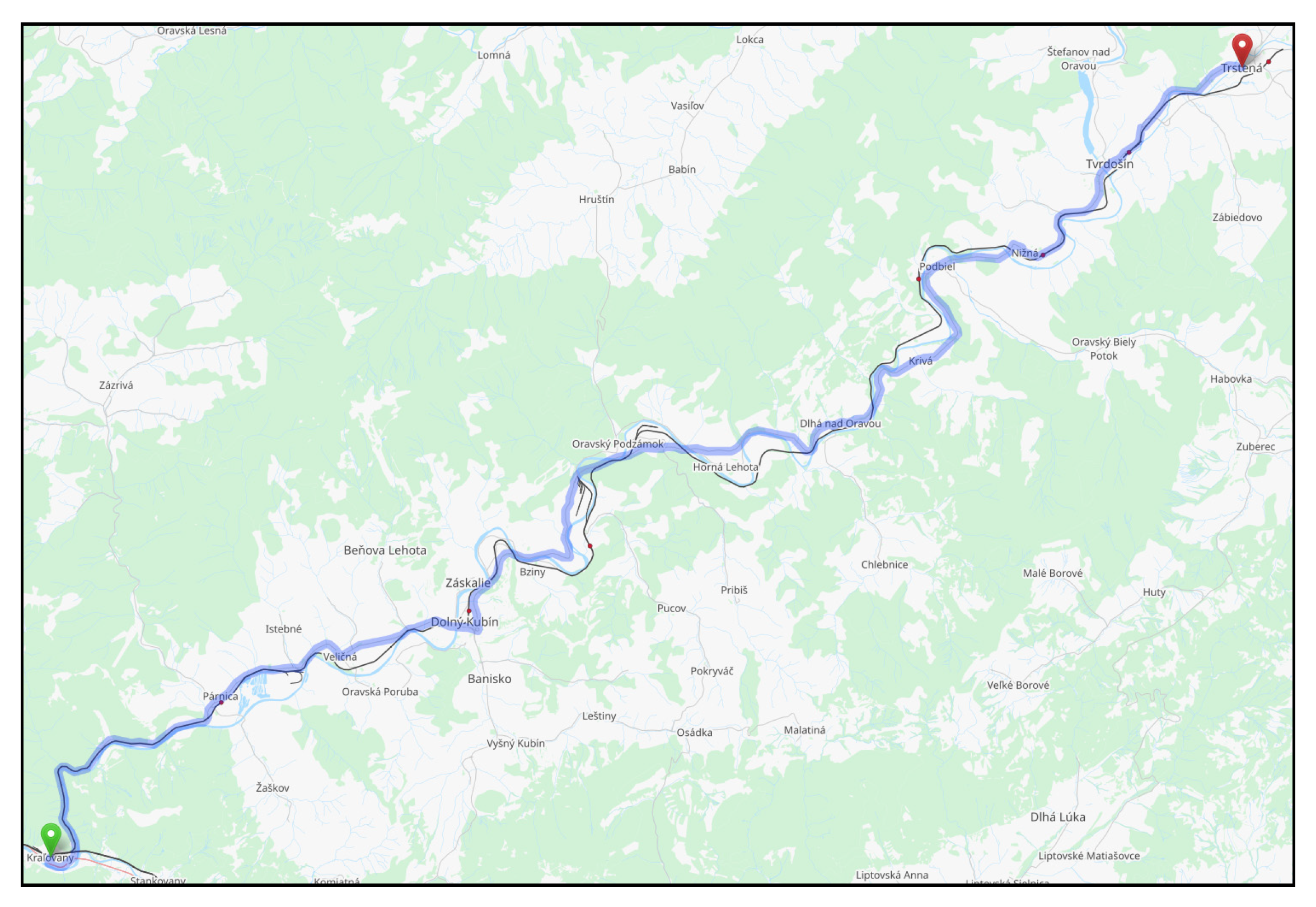
Figure 1 shows a map of the Kralovany–Trstena line [
14], displaying:
From the map, it is clear that the railway line runs parallel to the road.
3.1. Rail Transport
From the perspective of rail transport, the Kralovany–Trstena line is operated on railway line no. 181 with a total length of just under 57 km. The transit time is 109 min, with an average travel speed of 31 km/h. Transport is provided by diesel multiple units of class 813/913, intended for operation on non-electrified regional lines. The capacity of the unit is 83 seated passengers and 120 standing passengers [
15].
The line has a standard gauge of 1435 mm. Within the line, eight railway stations and eleven stops are served, with two stops equipped with passing loops enabling train crossings. A summarised overview of the railway operation parameters is shown in
Table 7 [
16].
3.2. Road Transport
From the perspective of road transport, the Kralovany–Trstena route is operated by bus services, with the possibility of using individual automobile transport. The connection between these towns follows first-class roads I/70 (Dolný Kubín district) and I/59 (Tvrdošín district), which form part of the internationally significant route E77. A summary of the characteristics of the road connection is presented in
Table 8.
The total distance by car is 54 km, with a travel time of 61 min and an average travel speed of 53 km/h. Along this route, there are four railway level crossings and 49 pedestrian crossings [
14].
Bus transport covers a route length of 72 km, with a travel time of 99 min and an average speed of 44 km/h. There are 35 bus stops along the route. Bus services are operated by ARRIVA Liorbus, a.s., Ruzomberok, Slovakia [
17].
3.3. Transport Demand Characteristics
Rail passenger transport on line number 181, according to statistics of the Ministry of Transport, transports 1097 persons per day [
18]. Considering that the line is served daily by 25 train connections [
19], the average occupancy of one train is 44 passengers. This low average occupancy of diesel multiple units, whose capacity is 200 persons, together with high costs, results in this line being considered inefficient and included among the lines where the discontinuation of regional passenger rail transport is being considered. For the given line, a transport forecast was prepared based on a multi-criteria analysis.
Table 9 presents the results of the forecast of the development of passengers transported by rail until 2035 and the distribution of passengers according to the fare level. Passengers are divided into free-fare passengers with a 0% fare payment, discounted-fare passengers with a 40% fare payment, and full-fare passengers with a 100% fare payment. The discounted-fare group consists of passengers with a disability card (2.88%). The full-fare group consists of adult passengers without entitlement to any discount (47.51%). The free-fare group (49.60%) consists of children, pupils, students, and pensioners.
Passengers using rail transport had to be reassigned to an alternative mode of transport. Based on studies [
20,
21,
22,
23], hypotheses were formulated. To verify this hypothesis, the authors conducted a simple questionnaire survey in which regular train passengers were asked which mode of transport they would prefer if regional rail services on the analysed section were discontinued. The survey was carried out during peak traffic periods in the morning and afternoon over three days—Monday, Wednesday, and Friday. Irregular passengers did not participate in the survey and did not express their views on the issue. The results of the empirical survey determined the preferences of rail passengers as follows:
Free-fare passengers will switch to bus transport in the event of the discontinuation of rail transport,
Passengers with a disability card as well as passengers without any fare discount would prefer individual automobile transport after the discontinuation of rail transport.
4. Determination of the External Monetary Impacts of Environmental Pollution from Rail Passenger Transport on the Kralovany–Trstena Line
In comparing external monetary impacts, we will first address rail transport in the case that the regional line is not discontinued. The average consumption is presented in
Table 3. On the given line, transport is provided by the diesel multiple unit 813/913, therefore the calculations will use the average consumption of 0.5871 L/train-km. To make this calculation possible, the transport performance expressed in persons must be converted into transport performance expressed in train-kilometres. This conversion is presented in
Table 10, where the average occupancy of the train is 44 persons (rounded upwards) and the transport distance is 57 km. The train must operate over the entire distance, which means that we will consider the full distance also in the calculations.
The next step in calculating the monetary impacts is the calculation of the consumed diesel fuel for the individual years. By this calculation we obtain the total volume of diesel consumed in volumetric units (litres). For the following calculations it is necessary to convert this volumetric unit into a mass unit according to the density of diesel fuel, which is 0.82 kg/L.
Table 11 presents the results of the calculation both in volumetric units and converted into mass units based on the transport performance for the individual years.
If the diesel fuel consumption is calculated in kilograms, it is then possible, according to the emission factors, to calculate the total amount of emitted pollutants in kilograms (the unit costs of pollutants are expressed per kilogram). In the calculation of pollutant emissions,
Table 5 is used, specifically the row for diesel multiple units.
Table 12 presents the results of the calculations of emitted pollutants already expressed in kilograms for the monitored Kralovany–Trstena line.
After quantifying the physical units of pollutant emissions, i.e., quantifying the amount, it is possible to proceed to the valuation of these pollutant units in monetary units in EUR. For the valuation,
Table 6 is used and the results are presented in
Table 13.
In
Table 13, the results of the monetary impacts of environmental pollution from rail transport indicate that the valuation of pollution increases each year as the transport performance increases. For the purposes of this article, it is also necessary to calculate the monetary impacts of environmental pollution from road transport, specifically bus transport and individual automobile transport. The transport performance of rail transport will be redistributed according to customer preferences, which were determined by the empirical survey.
5. Determination of the External Monetary Impacts of Environmental Pollution from Road Passenger Transport on the Kralovany–Trstena Route
As stated above, in order to make a comparison of the monetary impacts of environmental pollution from rail and road transport possible, it is necessary to quantify the monetary impacts for road transport. In the calculations we will consider the same transport performance as in rail transport, only the passengers will be redistributed according to preferences as follows: free-fare passengers will be transferred to bus transport, discounted-fare and full-fare passengers to individual automobile transport. The distribution of passengers is shown in
Table 14.
As in the calculations for rail transport, it is also necessary here to convert the transport performance in persons into transport performance in vehicles and subsequently vehicle-kilometres in bus transport. In the calculations, the recommended average bus occupancy of 22 passengers and 1.5 passengers per automobile will be used, and the distances in bus transport of 72 km and in individual automobile transport of 54 km (
Table 8). In the case of individual automobile transport, it is necessary to divide the transport performance according to the propulsion category into petrol, diesel, and electric vehicles (according to
Table 1).
Table 15 presents the transport performance of passengers transferred from rail to road transport in vehicle-kilometres.
From the table, despite the increasing number of passengers, the transport performance in individual automobile transport decreases in the petrol and diesel vehicle categories, since an increasing number of electric vehicles is expected. In the case of electric vehicles, zero emissions are assumed; therefore, this performance will not be considered further in the calculations [
1].
The next step, as in the calculations for rail transport, is to determine the total amount of consumed fuels. In the calculations we will use the data from
Table 2; however, the electric vehicle category will no longer be included, since this type of propulsion is considered pollutant-free (exhaust gases emission free). It is necessary to divide the route into an urban section, where an average speed of 50 km/h will be used, and a non-urban section, where the average fuel consumption corresponding to a speed of 90 km/h will be applied.
Table 16 presents the percentage distribution of the road infrastructure into non-urban area, urban area of a municipality, and urban area of a town for bus transport and individual automobile transport.
In calculating the consumed fuels we draw on
Table 15 (transport performance),
Table 16 (distribution of road infrastructure), and
Table 2 (average fuel consumption depending on vehicle category and speed in L/km for petrol and diesel).
Table 17 presents the fuel consumption in volumetric units (L) according to vehicle category—bus, petrol car, and diesel car—and according to the type of road infrastructure.
For better clarity and easier conversion of volumetric units (L) into mass units (kg),
Table 18 presents the total fuel consumption only for petrol and diesel. Subsequently, the fuel consumption is presented also in mass units (kg) according to the density of the individual fuels, namely petrol 0.72 kg/L and diesel 0.82 kg/L.
If the fuel consumption is calculated in mass units, it is possible, according to the emission factors, to calculate the total amount of emitted pollutants in kilograms. In the calculation of pollutant emissions,
Table 4 and
Table 18 are used.
Table 19 presents the results of the calculations for the monitored period and the amount of pollutants in kilograms separately for buses, petrol automobiles, and diesel automobiles.
For the valuation of pollutant costs from transport, it is no longer necessary to divide according to vehicle category.
Table 20 therefore presents the aggregate calculations of the individual emitted pollutants for all three categories of road vehicles.
After quantifying the physical units of pollutant emissions, i.e., quantifying the amount, it is possible to proceed to the valuation of these pollutant units in monetary units. For the valuation, as in rail transport,
Table 6 is used, and the results are presented in
Table 21.
Table 21 presents the results of the monetary impacts of environmental pollution from road transport and it can be stated that the amount of pollutant costs increases every year despite the increasing share of electromobility.
6. Discussion and Conclusions
Rail transport is considered an ecological mode of transport primarily due to its externalities. For comparison, we selected a line that is considered inefficient due to single-track operation and limited capacity, which affects speed and capacity. The type of line also has a significant impact on the environmental performance of rail transport. This line is not electrified and therefore transport is provided by diesel multiple units. According to the general claim, rail transport should be more environmentally friendly than road transport. To verify this claim, the monetary impacts of environmental pollution from transport were calculated in this article for the selected line, where passengers from rail transport were transferred to road transport according to passenger preferences, assuming that rail transport were discontinued. The Cost–Benefit Analysis method was used in the calculations, which is used in the economic evaluation of transport projects. Verification of the claim that rail transport is more environmentally friendly than road transport on the given line is presented in
Table 22.
From
Table 22 it follows that the monetary impacts (costs) of pollutants in road transport are lower than in rail transport.
Table 23 compares the individual pollutants in rail and road transport.
Table 23 shows that rail transport has higher monetary impacts compared to road transport for the pollutants PM
2.5, which are fine particulate matter; SO
2—sulphur dioxide; and NMVOC. Conversely, road transport has higher quantified monetary impacts compared to rail transport in the case of nitrogen oxides (NO
x) and significantly lower monetary impacts in the case of ammonia (NH
3). It should be emphasised that, in the case of individual automobile transport, electric vehicles were not considered in the calculations, as these vehicles do not generate these pollutants. The trend of electric vehicle purchases in Slovakia shows an increasing tendency (
Table 1).
In the case of rail transport, the use of diesel multiple units on the given line has a significant impact on the monetary impacts of pollutant emissions. If the line were electrified, similarly to electric vehicles, pollutants would not be produced. However, this line is not sufficiently significant to be included in the planned electrification of lines in the Slovak Republic. Another option for reducing pollutant emissions in rail transport would be the purchase of hybrid units (BEMU). However, this would require substantial investment, and the return on investment, given the transport intensity on the Kralovany–Trstena line, would be very long.
In conclusion, it can be stated that pollutants are not the only externality affecting transport costs. Other externalities include accidents, vehicle operation, greenhouse gas emissions, and noise. The monetary assessment of these externalities is part of the authors’ further research.
Author Contributions
Conceptualization, E.B. and F.B.; methodology, E.B.; software, E.B. and F.B.; validation, F.B., E.B. and B.B.; formal analysis, F.B.; investigation, E.B.; resources, F.B.; data curation, B.B.; writing—original draft preparation, E.B.; writing—review and editing, F.B.; visualisation, B.B.; supervision, E.B. and F.B.; project administration, F.B.; funding acquisition, F.B. All authors have read and agreed to the published version of the manuscript.
Funding
This article was created in the context of the project KEGA 027ŽU-4/2024 supported by the Ministry of Education, Research, Development and Youth of the Slovak Republic.
Institutional Review Board Statement
Not applicable.
Informed Consent Statement
Not applicable.
Data Availability Statement
The original contributions presented in this study are included in the article. Further inquiries can be directed to the corresponding author.
Conflicts of Interest
The authors declare no conflicts of interest.
References
- Metodická Príručka k Tvorbe Analýzy Nákladov a Prínosov. Methodological Guide to the Creation of Cost-Benefit Analysis (CBA). Published by the Ministry of Transport of Slovak Republic, Version 1.0. 15. 04. 2024. Available online: https://www.mindop.sk/fileadmin/dokumenty/rezortne_metodiky/Metodika_CBA/Pr%C3%ADru%C4%8Dka_CBA_1.0.pdf (accessed on 27 October 2025).
- Vickerman, R. The transport problem: The need for consistent policies of pricing and investment. Transp. Policy 2024, 16, 49–58. [Google Scholar] [CrossRef]
- Koba, R.; Lipka, P.; Kalinowski, M.; Czaplewski, K.; Witkowska, J.; Weintrit, A. External Transport Costs and Implications for Sustainable Transport Policy. Sustainability 2024, 16, 9687. [Google Scholar] [CrossRef]
- de Rus, G.; Socorro, M.P.; Valido, J.; Campos, J. Cost–benefit analysis of transport projects: Theoretical framework and practical rules. Transp. Policy 2022, 123, 25–39. [Google Scholar] [CrossRef]
- Mann, I.; Levinson, D.M. Access-based cost–benefit analysis. J. Transp. Geogr. 2024, 119, 103952. [Google Scholar] [CrossRef]
- de la Hoz, D.; Galindo, I.; Mejía Dorantes, L.; Roux, E.; de Ortuzar, M.; de Ortuzar, J.M. Analysing road networks vulnerability through cost–benefit analysis and dynamic assignment methods. Eur. Transp. (Emerg. Transp. Sci.) 2025, 2, 100020. [Google Scholar] [CrossRef]
- Wang, Y.; Levinson, D. The accuracy of benefit-cost analysis for transport projects supported by the Asian Development Bank. East. Asia Soc. Transp. Stud. 2023, 9, 100104. [Google Scholar] [CrossRef]
- Modernizácia Vozidlového Parku ZSSK, Časť 6. (Modernization of the ZSSK Rolling Stock, Part 6). Available online: https://www.mfsr.sk/files/archiv/22/Hodnotenie_ZSSK_9-DMJ-aktualizacia_20211130.pdf (accessed on 29 September 2025).
- Slovak Electric Vehicle AssocICTion, Data and Statistics. Available online: https://seva.sk/en/data-statistics/ (accessed on 29 September 2025).
- TAG unit A1.1 Cost-Benefit Analysis, Department for Transport, UK; May 2018 (Update May 2025). Available online: https://www.gov.uk/government/publications/webtag-tag-unit-a1-1-cost-benefit-analysis-may-2018 (accessed on 31 October 2025).
- EMEP/EEA Air Pollutant Emission Inventory Guidebook 2019. Available online: https://www.eea.europa.eu/publications/emep-eea-guidebook-2019/part-b-sectoral-guidance-chapters/1-energy/1-a-combustion (accessed on 18 July 2025).
- Vyhláška č. 228/2014 Z.z. Ministerstva Zivotného Prostredia Slovenskej Republiky, Ktorou sa Ustanovujú Požiadavky na Kvalitu Palív a Vedenie Prevádzkovej Evidencie o Palivách. Decree No. 228/2014 Coll. of the Ministry of the Environment of the Slovak Republic, Which Establishes Requirements for Fuel Quality and Maintenance of Operational Records on Fuels. Available online: https://www.enviro.sk/33/228-2014-z-z-vyhlaska-ministerstva-zivotneho-prostredia-slovenskej-republiky-ktorou-sa-ustanovuju-poziadavky-na-kvalitu-paliv-a-vedenie-prevadzkovej-evidencie-o-palivach-uniqueidOhwOuzC33qd2W4_6TwF4qICV4Kbj8fRfxIlqGnzCOwWVdaLTRYHmJQ/?ns=1748794277 (accessed on 18 July 2025).
- Handbook on the External Costs of Transport, Version 2019—1.1, EC. April 2020. Available online: https://ec.europa.eu/transport/themes/sustainable/studies/sustainable_en (accessed on 5 November 2025).
- OpenStreetMap. Trasa: Kraľovany—Trstená. 2024. Available online: https://www.openstreetmap.org/directions?engine=graphhopper_car&route=49.15230%2C19.12820%3B49.35920%2C19.60860#map=11/49.2549/19.3682&layers=T (accessed on 5 November 2025).
- RIALWAY.INFO. Motorová Jednotka Radu 813/913. (RIALWAY.INFO. Motor Unit Series 813/913). Available online: https://www.zeleznicne.info/view.php?cisloclanku=2008070004&nazevclanku=motorovajednotka-radu-813913 (accessed on 5 November 2025).
- VLAKY.NET. ŽSR 181 Kraľovany—Trstená. Available online: https://www.vlaky.net/trate/54/zsr-181-kralovany-trstena/#tratTab5 (accessed on 5 November 2025).
- ARRIVA Liorbus. Cestovné Poriadky. (Timetable). Available online: https://arriva.sk/liorbus/regionalna-doprava/cestovne-poriadky/#dk (accessed on 29 September 2025).
- Ministry of Transport. Plán Dopravnej Obslužnosti Slovensko pre Zelezničnú Osobnú Dopravu—Príloha č. 1. (Transport Service Plan Slovakia for Railway Passenger Transport—Annex No. 1.). 2018. Available online: https://www.mindop.sk/fileadmin/dokumenty/strategia_dopravy/K%C3%B3pia_-_Intervaly_dopravnej_obsluhy_v_jednotliv%C3%BDch_f%C3%A1zach_implement%C3%A1cie_PDO_pod%C4%BEa_jednotliv%C3%BDch_trat%C3%AD_nov%C3%A9_%C4%8D%C3%ADslovanie_liniek.xlsx (accessed on 29 September 2025).
- Železničná spoločnosť Slovensko. Cestovné Poriadky. (Timeable). Available online: https://www.zssk.sk/wp-content/uploads/2024/11/KCP-GVD_www_SK_24.pdf (accessed on 29 September 2025).
- Shires, J.D.; Ojeda-Cabral, M.; Wardman, M. The impact of planned disruptions on rail passenger demand. Transportation 2019, 46, 2003–2028. [Google Scholar] [CrossRef]
- Bickel, J.; Geržinič, M.; van Oort, N.; Cats, O. Heterogeneity in route choice behaviour during unplanned train disruptions considering the possibility of teleworking. Transp. Res. Part A Policy Pract. 2025, 179, 103926. [Google Scholar] [CrossRef]
- Zhu, S.; Levinson, D.; Liu, H.X. Exploring the behaviour of suburban train users in the event of disruptions. Transp. Res. Part F Traffic Psychol. Behav. 2019, 62, 428–443. [Google Scholar] [CrossRef]
- Cats, O.; Jenelius, E. Dynamic passenger assignment for major railway disruptions considering information interventions. Netw. Spat. Econ. 2019, 19, 791–824. [Google Scholar] [CrossRef]
Figure 1.
Map representation of the Kralovany–Trstena line.
Figure 1.
Map representation of the Kralovany–Trstena line.
Table 1.
Forecast of the expected evolution of the vehicle fleet composition.
Table 1.
Forecast of the expected evolution of the vehicle fleet composition.
Composition of Passenger Cars by Type of Propulsion
(%) |
|---|
| Year | Petrol | Diesel | Electric |
|---|
| 2025 | 54.27 | 44.40 | 1.33 |
| 2026 | 53.66 | 43.91 | 2.43 |
| 2027 | 53.08 | 43.43 | 3.49 |
| 2028 | 52.51 | 42.96 | 4.53 |
| 2029 | 51.96 | 42.51 | 5.53 |
| 2030 | 51.43 | 42.08 | 6.50 |
| 2031 | 50.60 | 41.40 | 8.00 |
| 2032 | 49.53 | 40.53 | 9.94 |
| 2033 | 48.22 | 39.46 | 12.32 |
| 2034 | 46.74 | 38.25 | 15.01 |
| 2035 | 44.83 | 36.68 | 18.50 |
Table 2.
Average fuel and energy consumption by vehicle category and speed.
Table 2.
Average fuel and energy consumption by vehicle category and speed.
| Average Fuel and Energy Consumption |
|---|
| Vehicle Category | Unit | Speed
(km/h) |
|---|
| 50 | 90 |
|---|
| Passenger cars (petrol) | L/km | 0.066 | 0.059 |
| Passenger cars (diesel) | L/km | 0.057 | 0.055 |
| Passenger cars (electric) | kWh/km | 0.138 | 0.177 |
| Buses (diesel) | L/km | 0.262 | 0.238 |
Table 3.
Average consumption of traction diesel and electric energy for various rail vehicle class.
Table 3.
Average consumption of traction diesel and electric energy for various rail vehicle class.
| Average Consumption of Traction |
|---|
| Power Type | Unit | Rail Vehicle Class |
|---|
| 861 | 840 | 813 | 812 | 661 | BEMU |
|---|
| Traction diesel | L/train-km | 1.8051 | 0.6318 | 0.5871 | 0.4810 | 7.0800 | - |
| Electric energy | kWh/train-km | - | - | - | - | - | 7.0800 |
Table 4.
Emissions factors of pollutants for road vehicles.
Table 4.
Emissions factors of pollutants for road vehicles.
Emission Factors of Pollutants for Road Vehicles
(g/kg) |
|---|
| Vehicle Category | Pollutant Type |
|---|
| PM2.5 | NOX | SO2 | NMVOC | NH3 |
|---|
| Passenger cars (petrol) | 0.030 | 8.730 | 0.020 | 10.050 | 1.106 |
| Passenger cars (diesel) | 1.100 | 12.960 | 0.020 | 0.700 | 0.065 |
| Light commercial vehicles (diesel) | 1.520 | 14.910 | 0.020 | 1.540 | 0.038 |
| Medium-duty trucks (diesel) | 0.940 | 33.370 | 0.020 | 1.920 | 0.013 |
| Heavy-duty trucks (diesel | 0.940 | 33.370 | 0.020 | 1.920 | 0.013 |
| Buses (diesel) | 0.940 | 33.370 | 0.020 | 1.920 | 0.013 |
Table 5.
Emission factors of pollutants for railway vehicles.
Table 5.
Emission factors of pollutants for railway vehicles.
Emission Factors of Pollutants for Railway Vehicles
(g/kg) |
|---|
| Vehicle Category | Pollutant Type |
|---|
| PM2.5 | NOX | SO2 | NMVOC | NH3 |
|---|
| Line locomotive | 1.100 | 63.000 | 0.020 | 4.800 | 10.000 |
| Diesel multiple unit | 1.000 | 39.900 | 0.020 | 4.700 | 10.000 |
Table 6.
Prediction of costs of pollutant emissions from transport.
Table 6.
Prediction of costs of pollutant emissions from transport.
Costs of Pollutant Emissions from Transport
(EUR/kg) |
|---|
| Year | Pollutant Type |
|---|
| PM2.5 | NOX | SO2 | NMVOC | NH3 |
|---|
| 2025 | 93.1 | 23.2 | 15.9 | 1.1 | 38.5 |
| 2026 | 95.2 | 23.7 | 16.3 | 1.2 | 39.4 |
| 2027 | 96.8 | 24.1 | 16.6 | 1.2 | 40.0 |
| 2028 | 98.1 | 24.4 | 16.8 | 1.2 | 40.6 |
| 2029 | 99.5 | 24.8 | 17.0 | 1.2 | 41.2 |
| 2030 | 100.8 | 25.1 | 17.3 | 1.2 | 41.7 |
| 2031 | 102.0 | 25.4 | 17.5 | 1.3 | 42.2 |
| 2032 | 103.3 | 25.7 | 17.7 | 1.3 | 42.7 |
| 2033 | 104.5 | 26.1 | 17.9 | 1.3 | 43.2 |
| 2034 | 105.8 | 26.4 | 18.1 | 1.3 | 43.8 |
| 2035 | 107.0 | 26.7 | 18.3 | 1.3 | 44.3 |
Table 7.
Characteristics of the Kralovany–Trstena railway.
Table 7.
Characteristics of the Kralovany–Trstena railway.
| Kralovany–Trstena Railway Parameters |
|---|
| Route number | 181 | |
| Route length | 57 | km |
| Travel time | 109 | min |
| Average travel speed | 31 | km/h |
| Track gauge | 1435 | mm |
| Maximum gradient | 15 | ‰ |
| Traction power supply | - | none |
| Number of railway stations | 8 | stations |
| Number of railway stops | 11 | stops |
| Number of stops with passing loops | 2 | passing loops |
Table 8.
Characteristics of the Kralovany–Trstena road.
Table 8.
Characteristics of the Kralovany–Trstena road.
| Kralovany–Trstena Road Parameters |
|---|
| Road section number (Dolný Kubín district) | I/70 | |
| Road section number (Tvrdošín district) | I/59 | |
| Road classification (I/70; I/59) | 1-st | class |
| Distance by car | 54 | km |
| Travel time by car | 61 | min |
| Average travel speed by car | 53 | km/h |
| Number of pedestrian crossings | 49 | crossings |
| Number of signal-controlled intersections | 0 | traffic light controlled intersection |
| Number of railway level crossings | 4 | crossings |
| Distance by bus | 72 | km |
| Travel time by bus | 99 | min |
| Average travel speed by bus | 44 | km/h |
| Number of bus stops | 35 | stops |
Table 9.
Forecast of the development of passengers transported by rail until 2035.
Table 9.
Forecast of the development of passengers transported by rail until 2035.
| Number of Passengers Transported by Rail |
|---|
| Year | Total | Fare Type |
|---|
| Free | Discounted | Full |
|---|
| 2025 | 400,405 | 198,601 | 11,571 | 190,233 |
| 2026 | 406,349 | 201,550 | 11,742 | 193,057 |
| 2027 | 412,381 | 204,541 | 11,917 | 195,923 |
| 2028 | 418,502 | 207,577 | 12,094 | 198,831 |
| 2029 | 424,714 | 210,659 | 12,273 | 201,782 |
| 2030 | 431,019 | 213,786 | 12,455 | 204,778 |
| 2031 | 437,417 | 216,959 | 12,641 | 207,817 |
| 2032 | 443,910 | 220,180 | 12,828 | 210,902 |
| 2033 | 450,500 | 223,448 | 13,019 | 214,033 |
| 2034 | 457,187 | 226,765 | 13,212 | 217,210 |
| 2035 | 463,974 | 230,132 | 13,407 | 220,435 |
Table 10.
Development of train-kilometres on the Kralovany–Trstena line forecast.
Table 10.
Development of train-kilometres on the Kralovany–Trstena line forecast.
| Transport Performance |
|---|
| Year | (Number of Persons) | (Train-km) |
|---|
| 2025 | 400,405 | 518,757 |
| 2026 | 406,349 | 526,452 |
| 2027 | 412,381 | 534,261 |
| 2028 | 418,502 | 542,184 |
| 2029 | 424,714 | 550,221 |
| 2030 | 431,019 | 558,372 |
| 2031 | 437,417 | 566,694 |
| 2032 | 443,910 | 575,073 |
| 2033 | 450,500 | 583,623 |
| 2034 | 457,187 | 592,287 |
| 2035 | 463,974 | 601,065 |
Table 11.
Consumption of diesel fuel on the Kralovany–Trstena line forecast.
Table 11.
Consumption of diesel fuel on the Kralovany–Trstena line forecast.
| Consumption of Traction Diesel Fuel |
|---|
| Year | (L) | (kg) |
|---|
| 2025 | 304,581.52 | 249,756.85 |
| 2026 | 309,099.54 | 253,461.63 |
| 2027 | 313,684.50 | 257,221.29 |
| 2028 | 318,336.39 | 261,035.84 |
| 2029 | 323,055.21 | 264,905.27 |
| 2030 | 327,840.96 | 268,829.59 |
| 2031 | 332,727.12 | 272,836.24 |
| 2032 | 337,646.74 | 276,870.33 |
| 2033 | 342,666.76 | 280,986.75 |
| 2034 | 347,753.72 | 285,158.05 |
| 2035 | 352,907.61 | 289,384.24 |
Table 12.
Amount of emitted pollutants per year of a diesel multiple unit prediction.
Table 12.
Amount of emitted pollutants per year of a diesel multiple unit prediction.
Amount of Emitted Pollutants
(kg) |
|---|
| Year | Pollutant Type |
|---|
| PM2.5 | NOx | SO2 | NMVOC | NH3 |
|---|
| 2025 | 249.76 | 9965.30 | 5.00 | 1173.86 | 2497.57 |
| 2026 | 253.46 | 10,113.12 | 5.07 | 1191.27 | 2534.62 |
| 2027 | 257.22 | 10,263.13 | 5.14 | 1208.94 | 2572.21 |
| 2028 | 261.04 | 10,415.33 | 5.22 | 1226.87 | 2610.36 |
| 2029 | 264.91 | 10,569.72 | 5.30 | 1245.05 | 2649.05 |
| 2030 | 268.83 | 10,726.30 | 5.38 | 1263.50 | 2688.30 |
| 2031 | 272.84 | 10,886.17 | 5.46 | 1282.33 | 2728.36 |
| 2032 | 276.87 | 11,047.13 | 5.54 | 1301.29 | 2768.70 |
| 2033 | 280.99 | 11,211.37 | 5.62 | 1320.64 | 2809.87 |
| 2034 | 285.16 | 11,377.81 | 5.70 | 1340.24 | 2851.58 |
| 2035 | 289.38 | 11,546.43 | 5.79 | 1360.11 | 2893.84 |
Table 13.
External monetary impacts of environmental pollution from rail passenger transport prediction.
Table 13.
External monetary impacts of environmental pollution from rail passenger transport prediction.
Costs of Pollutants in Rail Transport
(EUR) |
|---|
| Year | Pollutant Type |
|---|
| PM2.5 | NOX | SO2 | NMVOC | NH3 | Total |
|---|
| 2025 | 23,244.87 | 231,095.27 | 79.62 | 1314.72 | 96,181.36 | 351,915.84 |
| 2026 | 24,116.87 | 239,782.05 | 82.63 | 1369.96 | 99,787.84 | 365,139.36 |
| 2027 | 24,886.16 | 247,444.05 | 85.24 | 1414.46 | 102,965.68 | 376,795.60 |
| 2028 | 25,599.78 | 254,550.67 | 87.71 | 1459.97 | 105,902.24 | 387,600.37 |
| 2029 | 26,352.78 | 262,023.37 | 90.28 | 1506.52 | 109,008.52 | 398,981.46 |
| 2030 | 27,084.58 | 269,337.41 | 92.80 | 1554.10 | 112,048.17 | 410,117.07 |
| 2031 | 27,840.21 | 276,835.20 | 95.38 | 1602.91 | 115,164.18 | 421,537.88 |
| 2032 | 28,589.63 | 284,353.03 | 97.96 | 1652.64 | 118,279.00 | 432,972.26 |
| 2033 | 29,363.12 | 292,056.22 | 100.59 | 1703.62 | 121,470.57 | 444,694.13 |
| 2034 | 30,155.46 | 299,918.97 | 103.28 | 1755.72 | 124,756.65 | 456,690.08 |
| 2035 | 30,969.90 | 308,058.78 | 106.09 | 1808.94 | 128,139.34 | 469,083.06 |
Table 14.
Preferential transfer of passengers from rail transport prediction.
Table 14.
Preferential transfer of passengers from rail transport prediction.
Passenger Transferred from Rail Transport
(Persons) |
|---|
| Year | Transfer to Bus Transport | Transfer to Individual Car Transport |
|---|
| 2025 | 198,601 | 201,804 |
| 2026 | 201,550 | 204,799 |
| 2027 | 204,541 | 207,840 |
| 2028 | 207,577 | 210,925 |
| 2029 | 210,659 | 214,055 |
| 2030 | 213,786 | 217,233 |
| 2031 | 216,959 | 220,458 |
| 2032 | 220,180 | 223,730 |
| 2033 | 223,448 | 227,052 |
| 2034 | 226,765 | 230,422 |
| 2035 | 230,132 | 233,842 |
Table 15.
Transport performance of passengers transferred from rail to road transport prediction.
Table 15.
Transport performance of passengers transferred from rail to road transport prediction.
Transport Performance
(Vehicle km) |
|---|
| Year | Bus Transport | Individual Car Transport |
|---|
| Petrol Vehicles | Diesel Vehicles | Electric Vehicles |
|---|
| 2025 | 650,016.00 | 3,942,685.11 | 3,225,635.14 | 96,623.76 |
| 2026 | 659,664.00 | 3,956,234.82 | 3,237,388.58 | 179,158.60 |
| 2027 | 669,456.00 | 3,971,572.99 | 3,249,536.83 | 261,130.18 |
| 2028 | 679,392.00 | 3,987,251.28 | 3,262,089.41 | 343,977.31 |
| 2029 | 689,472.00 | 4,004,045.91 | 3,275,827.40 | 426,142.68 |
| 2030 | 699,696.00 | 4,022,025.55 | 3,290,819.27 | 508,325.22 |
| 2031 | 710,064.00 | 4,015,862.93 | 3,285,706.03 | 634,919.04 |
| 2032 | 720,648.00 | 3,989,302.71 | 3,264,414.27 | 800,599.01 |
| 2033 | 731,304.00 | 3,941,441.08 | 3,225,409.89 | 1,007,021.03 |
| 2034 | 742,176.00 | 3,877,181.15 | 3,172,917.83 | 1,245,111.02 |
| 2035 | 753,192.00 | 3,773,937.34 | 3,087,843.44 | 1,557,391.05 |
Table 16.
Distribution of road infrastructure usage for individual car transportation (ICT) and bus transportation (BT).
Table 16.
Distribution of road infrastructure usage for individual car transportation (ICT) and bus transportation (BT).
Distribution of Road Infrastructure Usage
(%) |
|---|
| Urban Area of Town | Urban Area of Municipality | Non-Urban Area |
|---|
| ICT | BT | ICT | BT | ICT | BT |
|---|
| 26.57 | 31.96 | 27.39 | 28.42 | 46.04 | 39.63 |
Table 17.
Fuel consumption prediction according to vehicle category and the type of road infrastructure.
Table 17.
Fuel consumption prediction according to vehicle category and the type of road infrastructure.
Fuel Consumption Prediction
(L) |
|---|
| Year | Urban Area of Town | Urban Area of Municipality | Non-Urban Area |
|---|
| Diesel Bus | Petrol Car | Diesel Car | Diesel Bus | Petrol Car | Diesel Car | Diesel Bus | Petrol Car | Diesel Car |
|---|
| 2025 | 54,429.22 | 69,139.71 | 48,851.92 | 48,400.45 | 71,273.50 | 50,359.58 | 61,309.12 | 107,097.52 | 81,679.53 |
| 2026 | 55,237.10 | 69,377.33 | 49,029.93 | 49,118.85 | 71,518.44 | 50,543.08 | 62,219.11 | 107,465.58 | 81,977.15 |
| 2027 | 56,057.03 | 69,646.30 | 49,213.91 | 49,847.96 | 71,795.71 | 50,732.74 | 63,142.69 | 107,882.22 | 82,284.77 |
| 2028 | 56,889.02 | 69,921.24 | 49,404.02 | 50,587.80 | 72,079.14 | 50,928.72 | 64,079.85 | 108,308.10 | 82,602.63 |
| 2029 | 57,733.08 | 70,215.75 | 49,612.08 | 51,338.36 | 72,382.74 | 51,143.20 | 65,030.59 | 108,764.30 | 82,950.50 |
| 2030 | 58,589.18 | 70,531.04 | 49,839.13 | 52,099.64 | 72,707.76 | 51,377.26 | 65,994.91 | 109,252.69 | 83,330.13 |
| 2031 | 59,457.35 | 70,422.98 | 49,761.69 | 52,871.65 | 72,596.36 | 51,297.43 | 66,972.81 | 109,085.29 | 83,200.65 |
| 2032 | 60,343.60 | 69,957.21 | 49,439.23 | 53,659.74 | 72,116.22 | 50,965.01 | 67,971.09 | 108,363.82 | 82,661.50 |
| 2033 | 61,235.89 | 69,117.90 | 48,848.51 | 54,453.19 | 71,251.01 | 50,356.07 | 68,976.15 | 107,063.73 | 81,673.83 |
| 2034 | 62,146.26 | 67,991.02 | 48,053.52 | 55,262.72 | 70,089.35 | 49,536.54 | 70,001.60 | 105,318.20 | 80,344.63 |
| 2035 | 63,068.68 | 66,180.52 | 46,765.08 | 56,082.98 | 68,222.97 | 48,208.34 | 71,040.62 | 102,513.72 | 78,190.37 |
Table 18.
Fuel consumption prediction in road transport for various fuels and vehicle types.
Table 18.
Fuel consumption prediction in road transport for various fuels and vehicle types.
| Fuel Consumption Prediction |
|---|
| Year | (L) | (kg) |
|---|
| Diesel Buses | Petrol Cars | Diesel Cars | Diesel Buses | Petrol Cars | Diesel Cars |
|---|
| 2025 | 164,138.79 | 247,510.73 | 180,891.04 | 134,593.81 | 178,207.73 | 148,330.65 |
| 2026 | 166,575.05 | 248,361.34 | 181,550.16 | 136,591.55 | 178,820.17 | 148,871.13 |
| 2027 | 169,047.68 | 249,324.23 | 182,231.43 | 138,619.10 | 179,513.45 | 149,429.77 |
| 2028 | 171,556.67 | 250,308.47 | 182,935.36 | 140,676.47 | 180,222.10 | 150,007.00 |
| 2029 | 174,102.02 | 251,362.79 | 183,705.78 | 142,763.66 | 180,981.21 | 150,638.74 |
| 2030 | 176,683.74 | 252,491.50 | 184,546.51 | 144,880.66 | 181,793.88 | 151,328.14 |
| 2031 | 179,301.81 | 252,104.63 | 184,259.77 | 147,027.48 | 181,515.33 | 151,093.01 |
| 2032 | 181,974.43 | 250,437.25 | 183,065.74 | 149,219.03 | 180,314.82 | 150,113.91 |
| 2033 | 184,665.23 | 247,432.63 | 180,878.41 | 151,425.49 | 178,151.50 | 148,320.29 |
| 2034 | 187,410.57 | 243,398.58 | 177,934.69 | 153,676.67 | 175,246.98 | 145,906.45 |
| 2035 | 190,192.28 | 236,917.22 | 173,163.79 | 155,957.67 | 170,580.40 | 141,994.31 |
Table 19.
Amount of partial pollutants emitted from road vehicles according to vehicle category prediction.
Table 19.
Amount of partial pollutants emitted from road vehicles according to vehicle category prediction.
Amount of Partial Pollutants
(kg) |
|---|
| Year | Vehicle Category | Pollutant Type |
|---|
| PM2.5 | NOX | SO2 | NMVOC | NH3 |
|---|
| 2025 | bus | 126.52 | 4491.40 | 2.69 | 258.42 | 1.75 |
| diesel car | 163.16 | 1922.37 | 2.97 | 103.83 | 9.64 |
| petrol car | 5.35 | 1555.75 | 3.56 | 1790.99 | 197.10 |
| 2026 | bus | 128.40 | 4558.06 | 2.73 | 262.26 | 1.78 |
| diesel car | 163.76 | 1929.37 | 2.98 | 104.21 | 9.68 |
| petrol car | 5.36 | 1561.10 | 3.58 | 1797.14 | 197.78 |
| 2027 | bus | 130.30 | 4625.72 | 2.77 | 266.15 | 1.80 |
| diesel car | 164.37 | 1936.61 | 2.99 | 104.60 | 9.71 |
| petrol car | 5.39 | 1567.15 | 3.59 | 1804.11 | 198.54 |
| 2028 | bus | 132.24 | 4694.37 | 2.81 | 270.10 | 1.83 |
| diesel car | 165.01 | 1944.09 | 3.00 | 105.00 | 9.75 |
| petrol car | 5.41 | 1573.34 | 3.60 | 1811.23 | 199.33 |
| 2029 | bus | 134.20 | 4764.02 | 2.86 | 274.11 | 1.86 |
| diesel car | 165.70 | 1952.28 | 3.01 | 105.45 | 9.79 |
| petrol car | 5.43 | 1579.97 | 3.62 | 1818.86 | 200.17 |
| 2030 | bus | 136.19 | 4834.67 | 2.90 | 278.17 | 1.88 |
| diesel car | 166.46 | 1961.21 | 3.03 | 105.93 | 9.84 |
| petrol car | 5.45 | 1587.06 | 3.64 | 1827.03 | 201.06 |
| 2031 | bus | 138.21 | 4906.31 | 2.94 | 282.29 | 1.91 |
| diesel car | 166.20 | 1958.17 | 3.02 | 105.77 | 9.82 |
| petrol car | 5.45 | 1584.63 | 3.63 | 1824.23 | 200.76 |
| 2032 | bus | 140.27 | 4979.44 | 2.98 | 286.50 | 1.94 |
| diesel car | 165.13 | 1945.48 | 3.00 | 105.08 | 9.76 |
| petrol car | 5.41 | 1574.15 | 3.61 | 1812.16 | 199.43 |
| 2033 | bus | 142.34 | 5053.07 | 3.03 | 290.74 | 1.97 |
| diesel car | 163.15 | 1922.23 | 2.97 | 103.82 | 9.64 |
| petrol car | 5.34 | 1555.26 | 3.56 | 1790.42 | 197.04 |
| 2034 | bus | 144.46 | 5128.19 | 3.07 | 295.06 | 2.00 |
| diesel car | 160.50 | 1890.95 | 2.92 | 102.13 | 9.48 |
| petrol car | 5.26 | 1529.91 | 3.50 | 1761.23 | 193.82 |
| 2035 | bus | 146.60 | 5204.31 | 3.12 | 299.44 | 2.03 |
| diesel car | 156.19 | 1840.25 | 2.84 | 99.40 | 9.23 |
| petrol car | 5.12 | 1489.17 | 3.41 | 1714.33 | 188.66 |
Table 20.
Total amount of pollutants emitted from road vehicles prediction.
Table 20.
Total amount of pollutants emitted from road vehicles prediction.
Total Amount of Pollutants
(kg) |
|---|
| Year | Pollutant Type |
|---|
| PM2.5 | NOX | SO2 | NMVOC | NH3 |
|---|
| 2025 | 295.03 | 7969.51 | 9.22 | 2153.24 | 208.49 |
| 2026 | 297.52 | 8048.53 | 9.29 | 2163.61 | 209.23 |
| 2027 | 300.06 | 8129.48 | 9.35 | 2174.86 | 210.06 |
| 2028 | 302.65 | 8211.80 | 9.42 | 2186.34 | 210.90 |
| 2029 | 305.33 | 8296.27 | 9.49 | 2198.41 | 211.81 |
| 2030 | 308.10 | 8382.94 | 9.56 | 2211.13 | 212.78 |
| 2031 | 309.85 | 8449.10 | 9.59 | 2212.29 | 212.49 |
| 2032 | 310.80 | 8499.06 | 9.59 | 2203.74 | 211.13 |
| 2033 | 310.84 | 8530.56 | 9.56 | 2184.98 | 208.64 |
| 2034 | 310.21 | 8549.04 | 9.50 | 2158.43 | 205.30 |
| 2035 | 307.91 | 8533.72 | 9.37 | 2113.17 | 199.92 |
Table 21.
Prediction calculation of the external monetary impacts of environmental pollution from road passenger transport.
Table 21.
Prediction calculation of the external monetary impacts of environmental pollution from road passenger transport.
Pollutant Costs in Road Transport
(EUR) |
|---|
| Year | Pollutant Type |
|---|
| PM2.5 | NOX | SO2 | NMVOC | NH3 | Total |
|---|
| 2025 | 27,467.12 | 184,892.73 | 146.64 | 2368.56 | 8026.82 | 222,901.87 |
| 2026 | 28,323.80 | 190,750.16 | 151.36 | 2596.33 | 8243.56 | 230,065.20 |
| 2027 | 29,045.82 | 195,920.51 | 155.23 | 2609.83 | 8402.27 | 236,133.66 |
| 2028 | 29,689.99 | 200,368.00 | 158.22 | 2623.60 | 8562.74 | 241,402.56 |
| 2029 | 30,380.32 | 205,747.43 | 161.29 | 2638.10 | 8726.68 | 247,653.82 |
| 2030 | 31,056.74 | 210,411.82 | 165.39 | 2653.35 | 8873.08 | 253,160.39 |
| 2031 | 31,605.07 | 214,607.18 | 167.87 | 2875.97 | 8967.01 | 258,223.10 |
| 2032 | 32,105.71 | 218,425.94 | 169.80 | 2864.87 | 9015.06 | 262,581.36 |
| 2033 | 32,482.45 | 222,647.67 | 171.09 | 2840.48 | 9013.46 | 267,155.15 |
| 2034 | 32,820.28 | 225,694.77 | 171.89 | 2805.95 | 8992.35 | 270,485.24 |
| 2035 | 32,946.52 | 227,850.34 | 171.48 | 2747.12 | 8856.41 | 272,571.86 |
Table 22.
Comparison of the predicted external monetary impacts of environmental pollution between road and rail transport on the Kralovany–Trstena line.
Table 22.
Comparison of the predicted external monetary impacts of environmental pollution between road and rail transport on the Kralovany–Trstena line.
Pollutant Cost Comparison
(EUR) |
|---|
| | Transport Type | Cost Difference
(Rail − Road) |
|---|
| Road | Rail |
|---|
| 2025 | 351,915.84 | 222,901.87 | −129,013.97 |
| 2026 | 365,139.36 | 230,065.20 | −135,074.16 |
| 2027 | 376,795.60 | 236,133.66 | −140,661.94 |
| 2028 | 387,600.37 | 241,402.56 | −146,197.81 |
| 2029 | 398,981.46 | 247,653.82 | −151,327.64 |
| 2030 | 410,117.07 | 253,160.39 | −156,956.68 |
| 2031 | 421,537.88 | 258,223.10 | −163,314.78 |
| 2032 | 432,972.26 | 262,581.36 | −170,390.90 |
| 2033 | 444,694.13 | 267,155.15 | −177,538.98 |
| 2034 | 456,690.08 | 270,485.24 | −186,204.84 |
| 2035 | 469,083.06 | 272,571.86 | −196,511.20 |
Table 23.
Comparison of monitored pollutants between road and rail transport on the Kralovany–Trstena line.
Table 23.
Comparison of monitored pollutants between road and rail transport on the Kralovany–Trstena line.
Predicted Pollutant Costs
(EUR) |
|---|
| Year | Pollutant Type |
|---|
| PM2.5 | NOX | SO2 | NMVOC | NH3 |
|---|
| Road | Rail | Road | Rail | Road | Rail | Road | Rail | Road | Rail |
|---|
| 2025 | 23,244.87 | 27,467.12 | 231,095.27 | 184,892.73 | 79.62 | 146.64 | 1314.72 | 2368.56 | 96,181.36 | 8026.82 |
| 2026 | 24,116.87 | 28,323.80 | 239,782.05 | 190,750.16 | 82.63 | 151.36 | 1369.96 | 2596.33 | 99,787.84 | 8243.56 |
| 2027 | 24,886.16 | 29,045.82 | 247,444.05 | 195,920.51 | 85.24 | 155.23 | 1414.46 | 2609.83 | 102,965.68 | 8402.27 |
| 2028 | 25,599.78 | 29,689.99 | 254,550.67 | 200,368.00 | 87.71 | 158.22 | 1459.97 | 2623.60 | 105,902.24 | 8562.74 |
| 2029 | 26,352.78 | 30,380.32 | 262,023.37 | 205,747.43 | 90.28 | 161.29 | 1506.52 | 2638.10 | 109,008.52 | 8726.68 |
| 2030 | 27,084.58 | 31,056.74 | 269,337.41 | 210,411.82 | 92.80 | 165.39 | 1554.10 | 2653.35 | 112,048.17 | 8873.08 |
| 2031 | 27,840.21 | 31,605.07 | 276,835.20 | 214,607.18 | 95.38 | 167.87 | 1602.91 | 2875.97 | 115,164.18 | 8967.01 |
| 2032 | 28,589.63 | 32,105.71 | 284,353.03 | 218,425.94 | 97.96 | 169.80 | 1652.64 | 2864.87 | 118,279.00 | 9015.06 |
| 2033 | 29,363.12 | 32,482.45 | 292,056.22 | 222,647.67 | 100.59 | 171.09 | 1703.62 | 2840.48 | 121,470.57 | 9013.46 |
| 2034 | 30,155.46 | 32,820.28 | 299,918.97 | 225,694.77 | 103.28 | 171.89 | 1755.72 | 2805.95 | 124,756.65 | 8992.35 |
| 2035 | 30,969.90 | 32,946.52 | 308,058.78 | 227,850.34 | 106.09 | 171.48 | 1808.94 | 2747.12 | 128,139.34 | 8856.41 |
| Disclaimer/Publisher’s Note: The statements, opinions and data contained in all publications are solely those of the individual author(s) and contributor(s) and not of MDPI and/or the editor(s). MDPI and/or the editor(s) disclaim responsibility for any injury to people or property resulting from any ideas, methods, instructions or products referred to in the content. |