Gas–Liquid Two-Phase Boiling Heat Transfer Mechanism in Cooling Water Jacket of Intense Thermal Load Engine and Its Improvement


Abstract
1. Introduction
2. Model Establishment
2.1. Mathematical Model
2.1.1. Eulerian Two-Phase Model
2.1.2. RPI Two-Phase Boiling Heat Transfer Model
2.2. Model Establishment
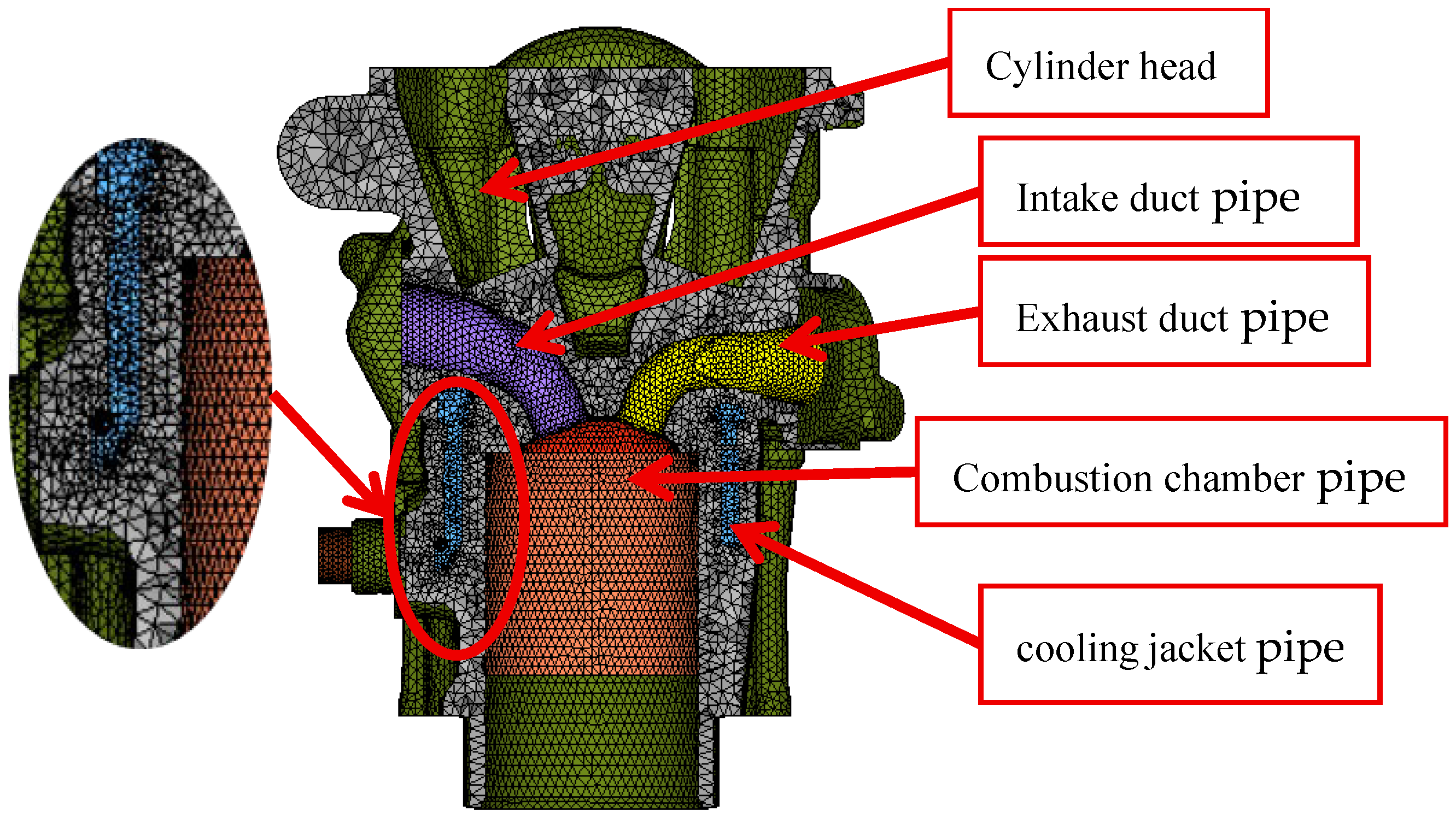
2.2.1. Geometry Model
2.2.2. Boundary Condition of Model
3. Results Analysis
3.1. Deficiencies of Prototype Water Jacket
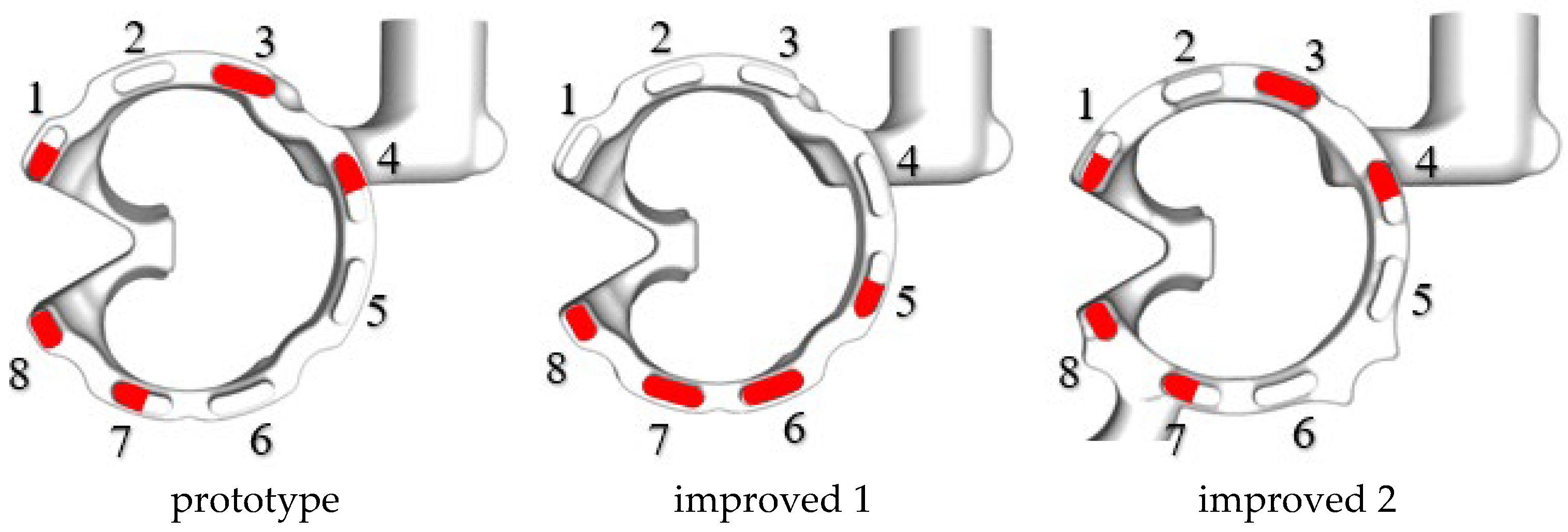
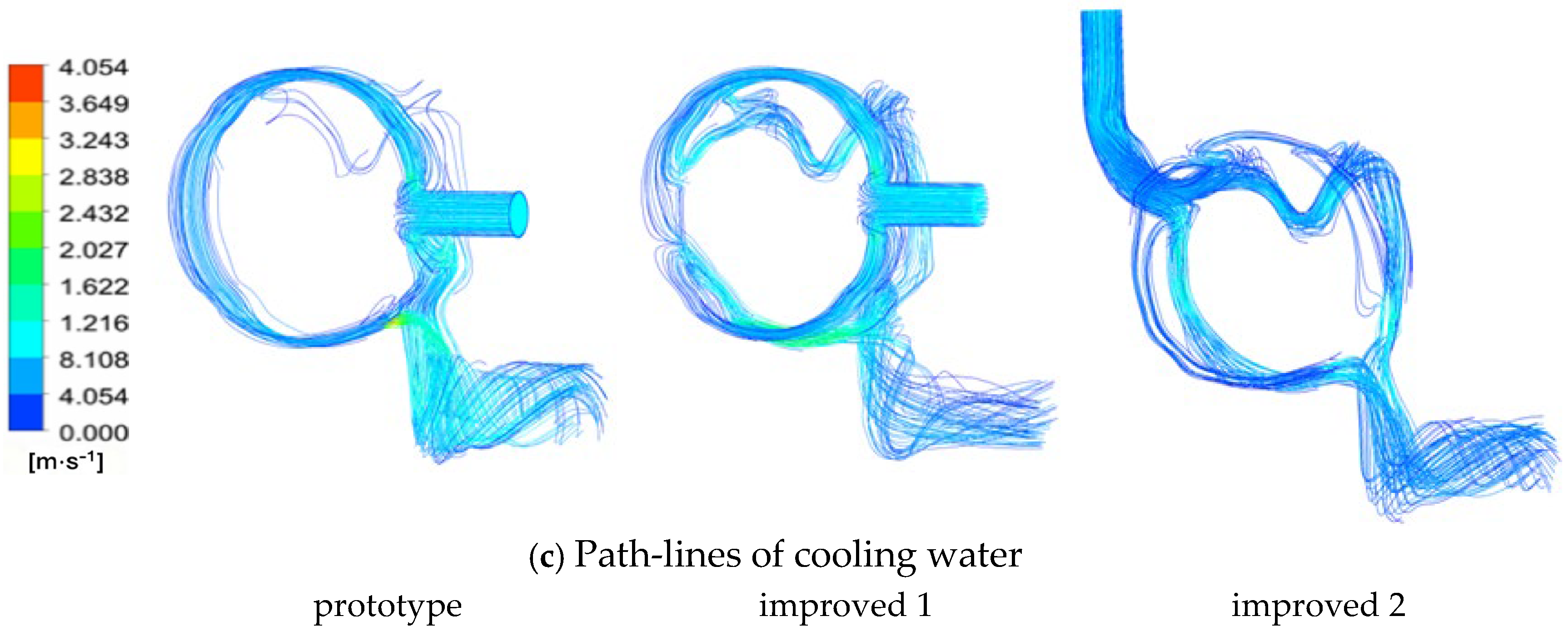
3.2. Improved Schemes of Water Jacket
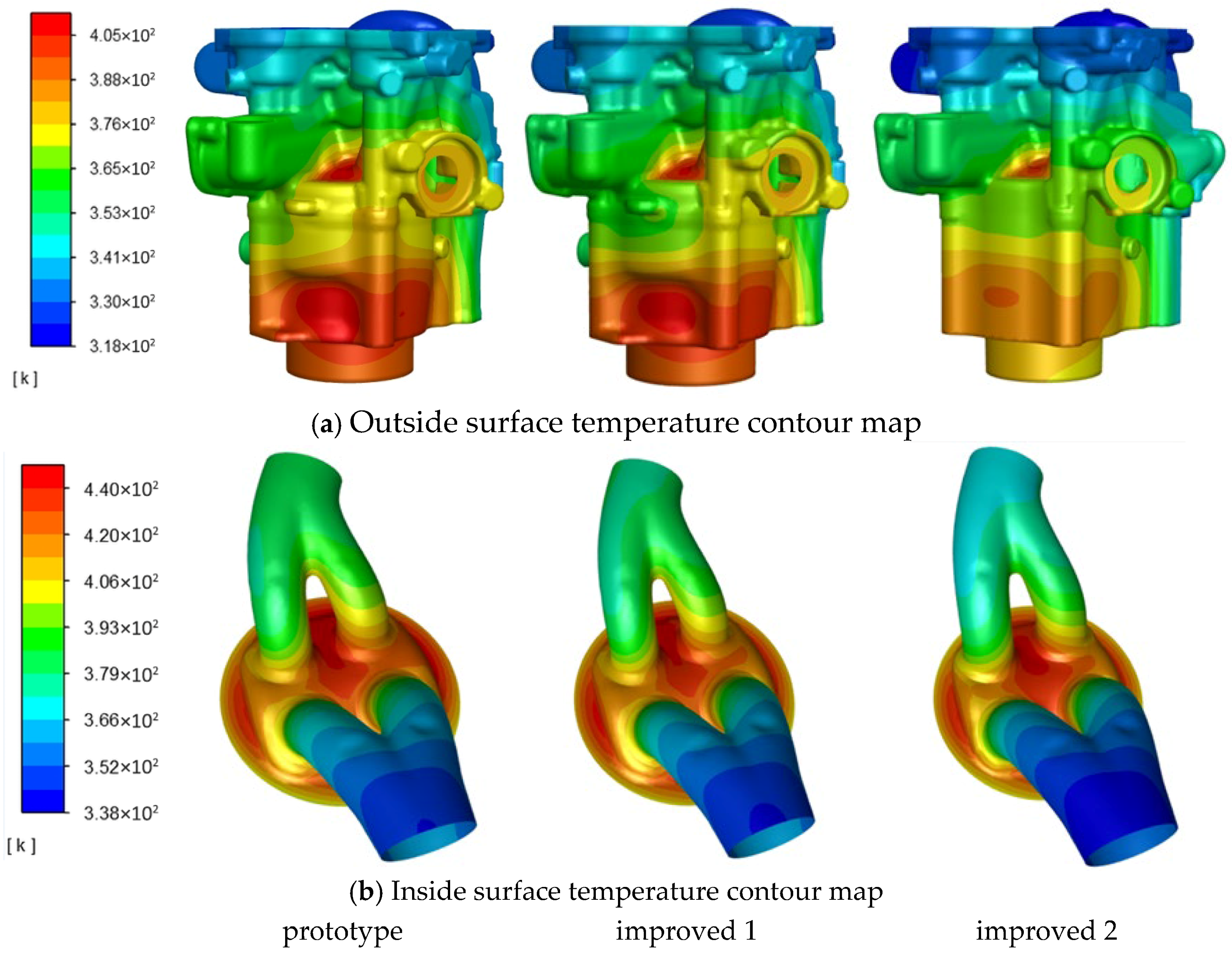
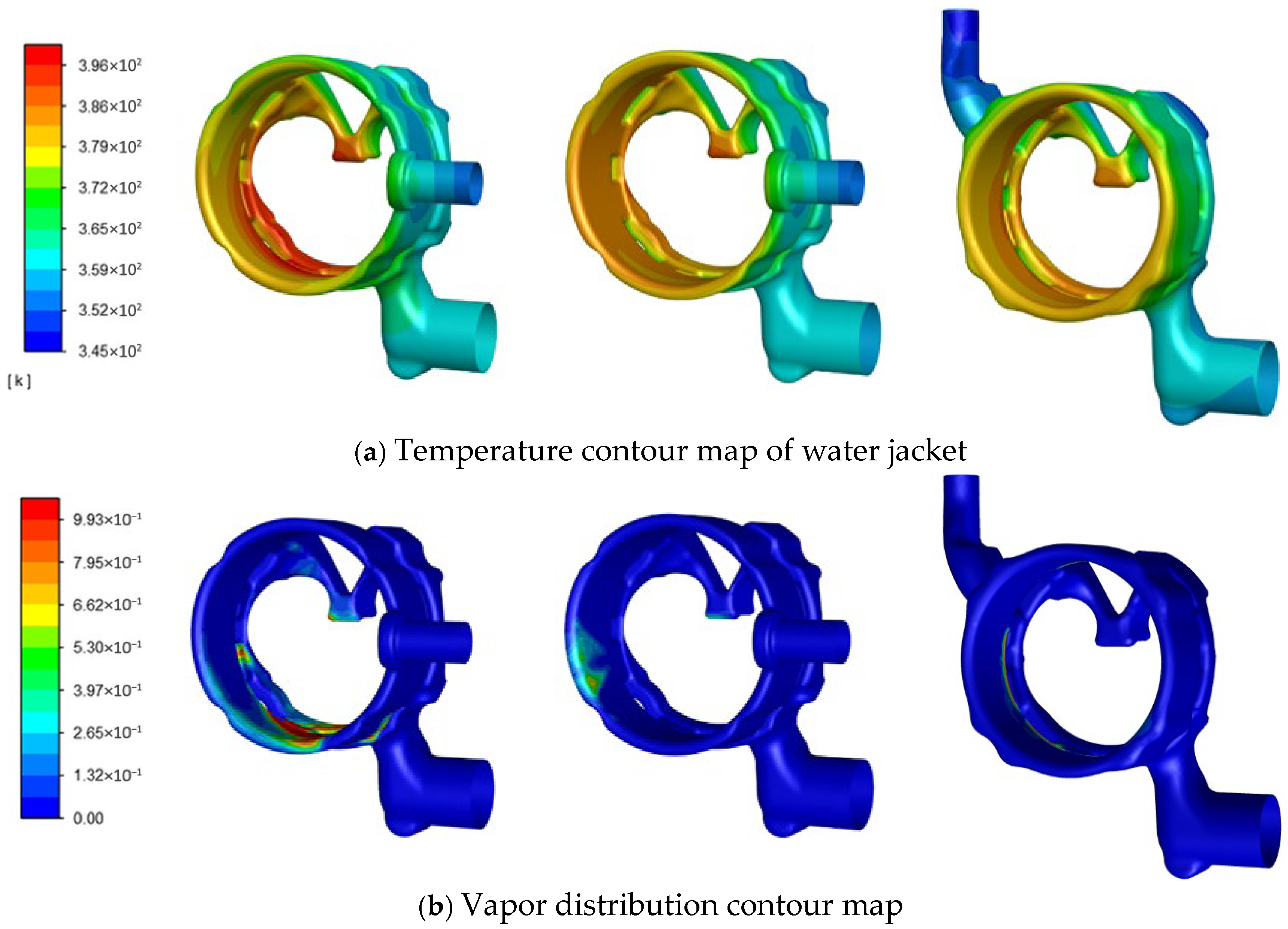
3.3. Numerical Analysis of Heat Transfer Performance of Improved Schemes
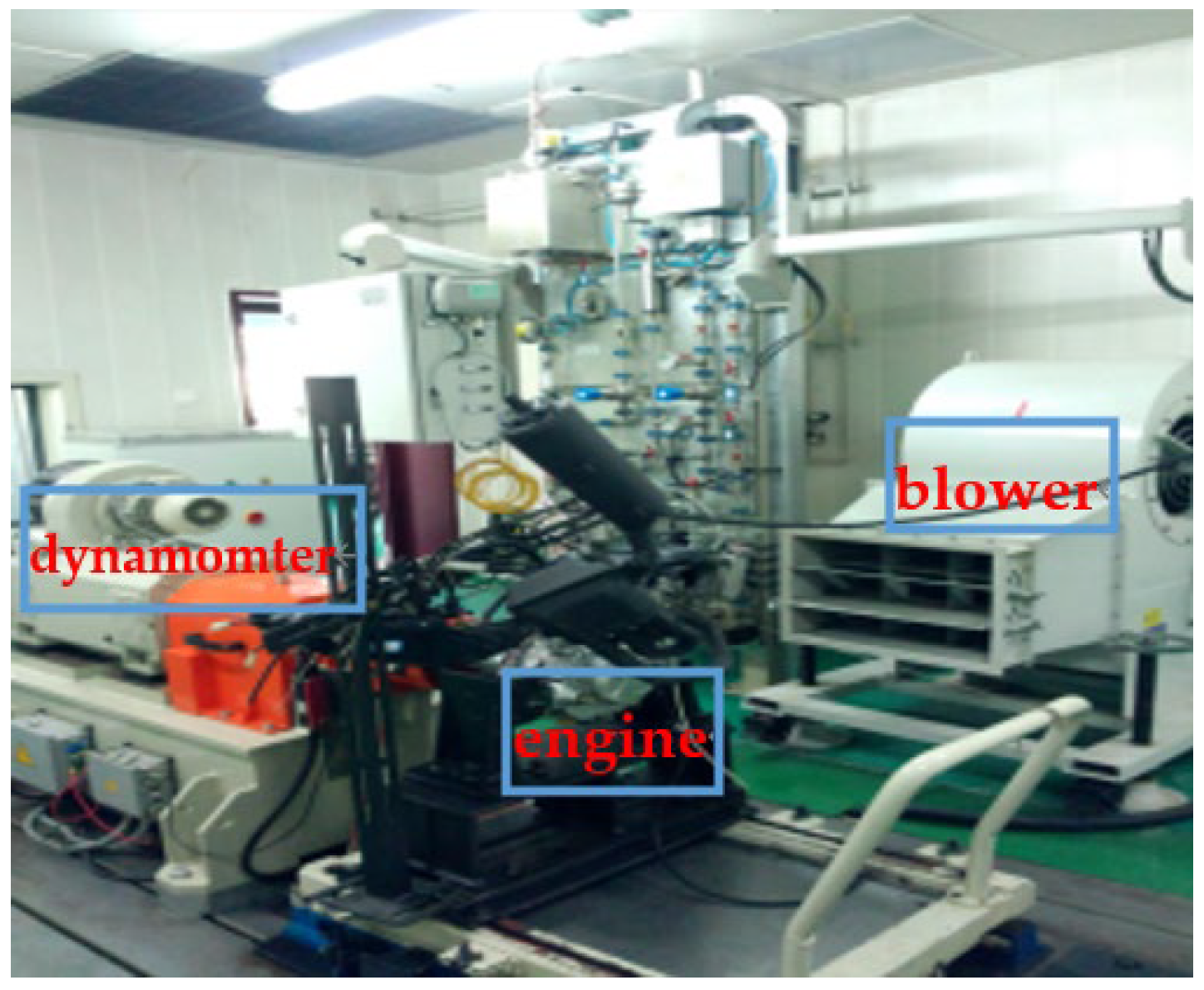
4. Simulation Verification and Prototype Comparison
5. Research on the Mechanism and Control of Enhanced Heat Transfer in Gas–Liquid Two-Phase Boiling
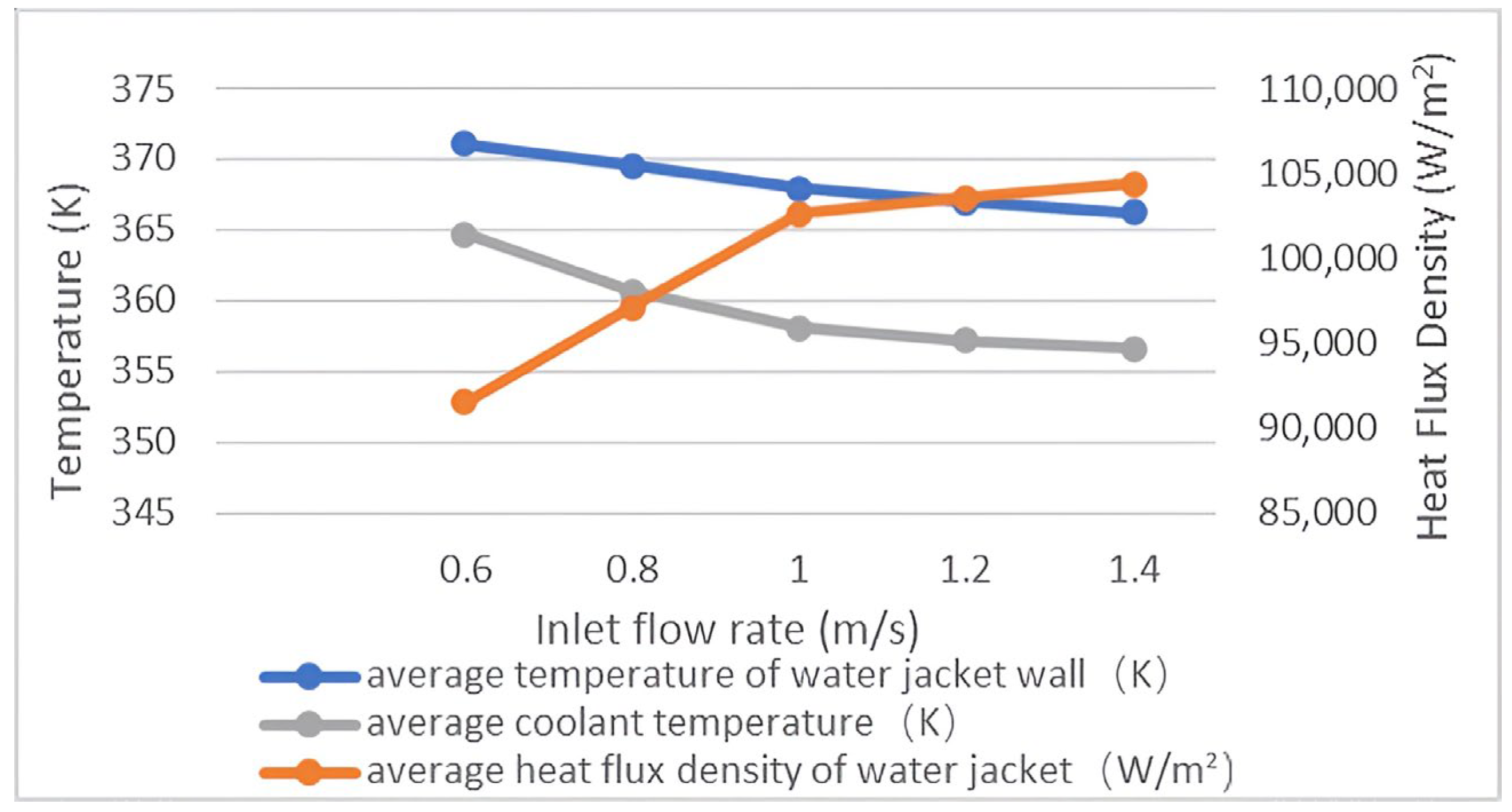
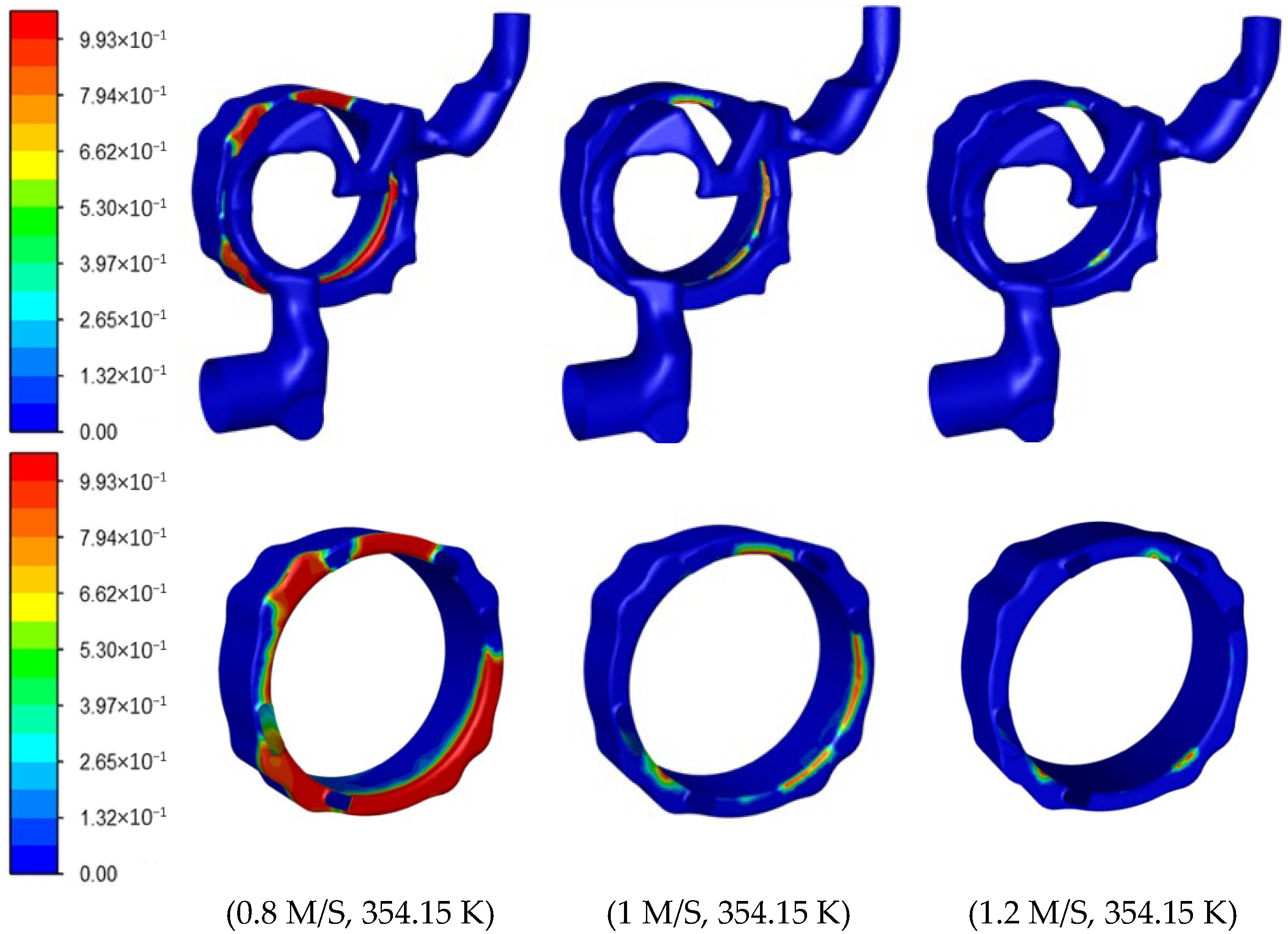
5.1. Study on the Influence Mechanism of Flow Rate on Boiling Heat Transfer
5.2. Study on the Effect Mechanism of Temperature on Boiling in the Water Jacket
6. Conclusions
- (1)
- The engine in the paper has a high thermal load and boiling occurs within the water jacket. Therefore, using the RPI two-phase boiling heat transfer model for numerical simulation is more suitable, with a simulation error of less than 5%. The simulation results are in good agreement with the experimental data.
- (2)
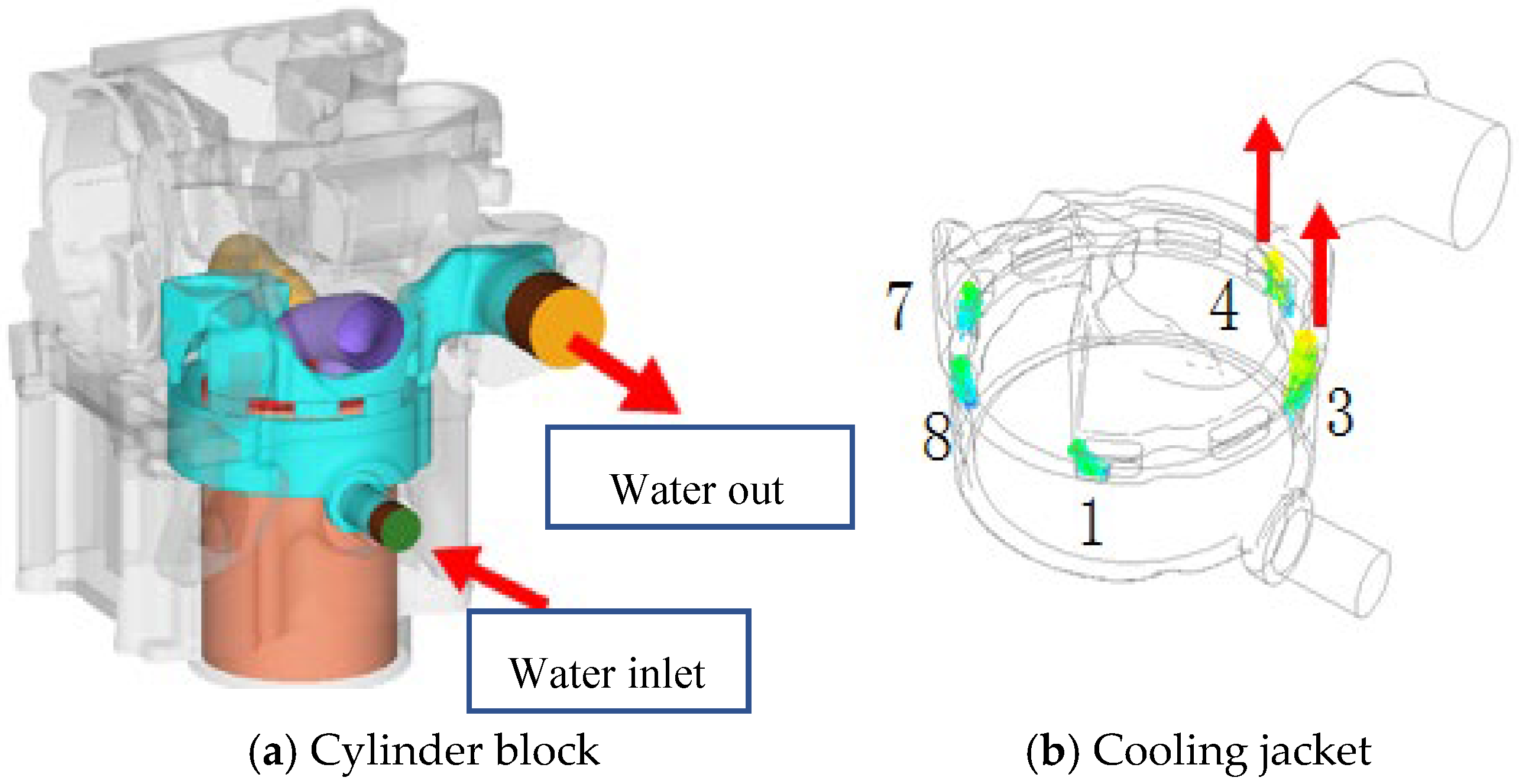
- The original machine model has issues with localized high temperature and significant temperature differences, which affect its lifespan. We propose improvements to the water distribution holes and the total inlet and outlet scheme to address this issue. Compared to the original machine, the temperature at the spark plug position in the improved scheme 2 decreased by 8.4 K, and the maximum temperature difference between the intake and exhaust of the cylinder head decreased by 14 K. Moreover, the local maximum gasification rate is less than 50%. Prototype testing also confirmed that the improved scheme effectively enhanced the heat exchange performance of the water jacket.
- (3)
- A too low flow rate may lead to local film boiling, which deteriorates heat transfer. An excessively high flow rate will strongly disperse the boiling bubbles, resulting in a heat transfer method of pure liquid phase convection, which cannot utilize the enhanced heat transfer capability of two-phase boiling. Appropriately reducing the flow rate can not only take advantage of the enhanced heat transfer efficiency of subcooled boiling, but also save pump power consumption and improve engine fuel economy.
- (4)
- The complex structure of the actual engine jacket enhances the convective motion’s transport effect on bubbles, while the narrow channel also intensifies the disturbance of bubbles to the convective motion. During design, attention should be paid to this transport effect, controlling subcooled boiling in the high-temperature zone and preventing the occurrence of film boiling.
- (5)
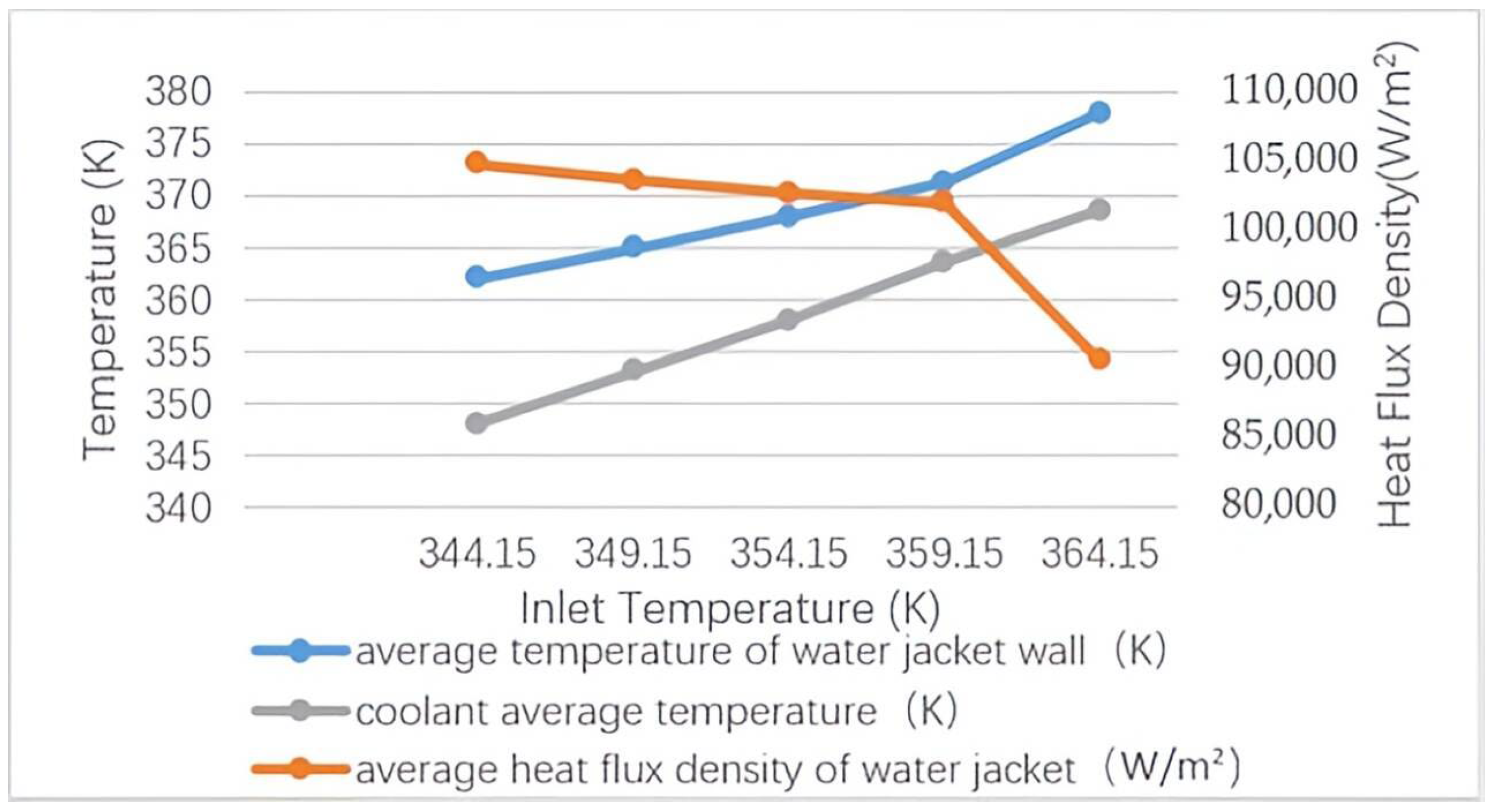
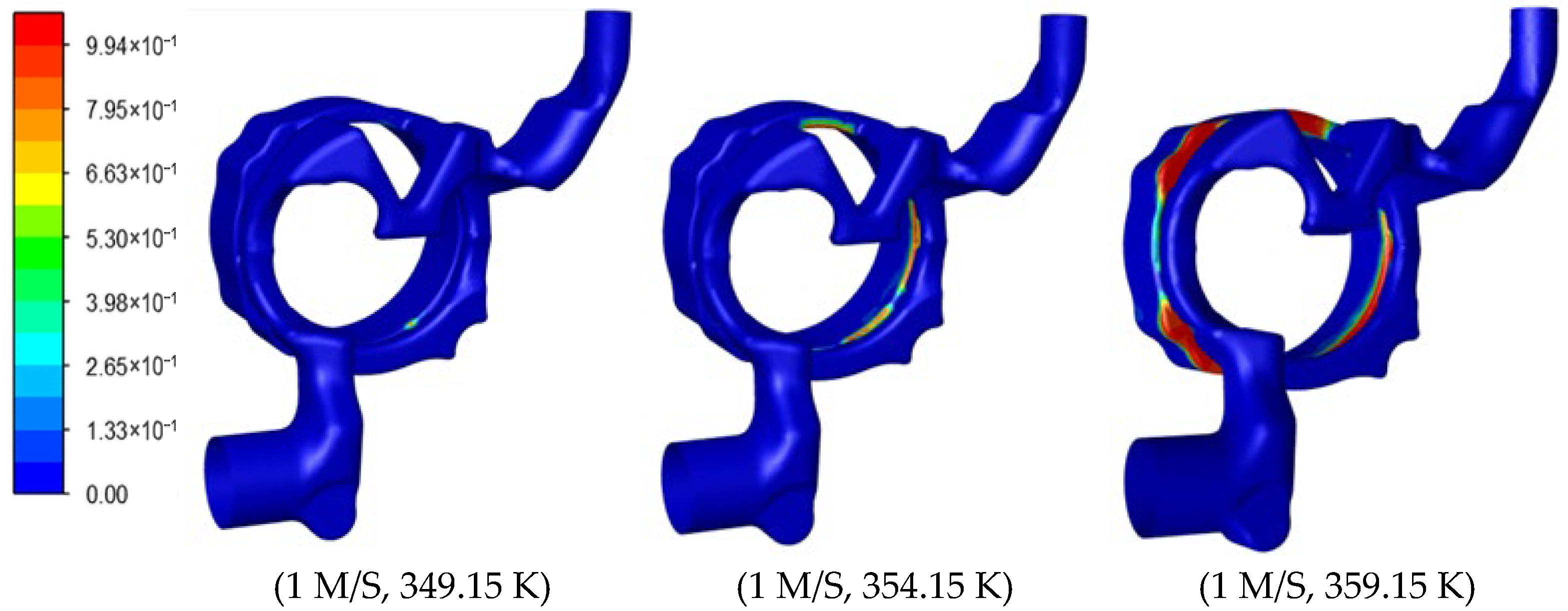
- An excessively low inlet temperature of coolant cannot generate boiling and higher cooling efficiency can only be achieved by increasing the flow rate, leading to an increase in the power consumption of the water pump. An excessively high inlet temperature will cause local film boiling, which will deteriorate heat transfer. Only by designing an appropriate inlet temperature can the two-phase enhanced heat transfer capability of subcooled boiling be utilized effectively.
- (6)
- The rational design of the water jacket structure and coolant inlet parameters can effectively utilize the heat transfer potential of boiling. In this paper, the average heat flux density of two-phase boiling is increased by 13.9% compared to pure forced convection, which helps to reduce the power consumption of the water pump and improve fuel economy.
Author Contributions
Funding
Institutional Review Board Statement
Informed Consent Statement
Data Availability Statement
Acknowledgments
Conflicts of Interest
References
- Thomaz, F.; Malaquias, A.C.T.; de Paula, G.A.R.; Baêta, J.G.C. Thermal management of an internal combustion engine focused on vehicle performance maximization: A numerical assessment. Proc. Inst. Mech. Eng. Part D J. Automob. Eng. 2021, 235, 2296–2310. [Google Scholar] [CrossRef]
- Yu, C.; Zhang, W.B.; Wang, G.Y.; Huang, M.; Sui, J.; Zhao, H.M. Experimental study of dual-cycle thermal management system for engineering radiator. Sci. Rep. 2024, 14, 19691. [Google Scholar] [CrossRef] [PubMed]
- Deng, Y.; Liu, H.; Zhao, X.; Chen, J. Effects of cold start control strategy on cold start performance of the diesel engine based on a comprehensive preheat diesel engine model. Appl. Energy 2018, 210, 279–287. [Google Scholar] [CrossRef]
- Stanivuk, T.; Lalic, B.; Mikulicic, J.Z.; Sundov, M. Simulation Modelling of Marine Diesel Engine Cooling System. Trans. Marit. Sci. 2021, 10, 112–125. [Google Scholar] [CrossRef]
- Cheng, H.J.; Ma, Y.D.; Xu, Y.K.; Wu, Y.X.; Dong, L.P.; Yu, Z.H.; Zhang, Y.L. Performance Study of Cooling System for a High-Power Heavy Truck Based on 1D/3D Coupled Simulation. Automot. Eng. 2024, 46, 1125–1135. [Google Scholar] [CrossRef]
- Naderi, A.; Qasemian, A.; Shojaeefard, M.H.; Samiezadeh, S.; Younesi, M.; Sohani, A.; Hoseinzadeh, S. A smart load-speed sensitive cooling map to have a high-performance thermal management system in an internal combustion engine. Energy 2021, 229, 120667. [Google Scholar] [CrossRef]
- Zhang, J.H.; Xu, Z.X.; Wang, J.C.; Xu, T.S.; Lin, Z.F.; Ma, L. Research on Subcooled Boiling Multiphase Flow Simulation and Engine Cooling Structure. Automob. Technol. 2020, 2, 39–46. [Google Scholar]
- Deng, L.; Zhang, J.; Hao, G. Influence of cooling gallery structure on the flow patterns of two-phase flow and heat transfer characteristics. Int. Commun. Heat Mass Transf. 2020, 110, 104407. [Google Scholar] [CrossRef]
- Zhang, B.; Zhang, P.; Zeng, F.M. Multiobjective optimization of the cooling system of a marine diesel engine. Energy Sci. Eng. 2021, 9, 1887–1907. [Google Scholar] [CrossRef]
- Cho, J.; Kim, K.; Yang, K.; Suh, I.; Kim, H. The CAE Analysis of a Cylinder Head Water Jacket Design for Engine Cooling Optimization. In Proceedings of the WCX World Congress Experience, Detroit, MI, USA, 10–12 April 2018. [Google Scholar]
- Bi, Y.H.; Chen, S.J.; Yao, G.Z.; Chen, M.Y.; Shen, L.Z.; Xia, K.L. Study on the influence of coolant flow uniformity on the thermal deformation of cylinder liner. Automot. Eng. 2021, 43, 34–43. [Google Scholar] [CrossRef]
- Lu, R.J.; Wang, W.K.; Chen, H.L.; Cai, W.Y. Analysis and optimization design of engine cooling water jacket. Mach. Des. Manuf. 2018, 44, 134–140. [Google Scholar] [CrossRef]
- Zeng, Y.; An, C.H.; Hu, P.; Li, L.B.; Wei, H.; Li, S.Q. The Thermodynamics Simulation Analysis and Optimization of Novel Two-cylinder Engine Water Jacket. Small Intern. Combust. Engine Veh. Tech. 2020, 49, 11092. [Google Scholar]
- Gholinia, M.; Pourfallah, M.; Chamani, H.R. Numerical investigation of heat transfers in the water jacket of heavy duty diesel engine by considering boiling phenomenon. Case Stud. Therm. Eng. 2018, 12, 497–509. [Google Scholar] [CrossRef]
- Ni, J.; Cao, T.; Hou, L.; Dong, F. Experimental study on bubble size distribution of subcooled flow boiling in cylinder head of internal combustion engines. J. Mech. Sci. Technol. 2019, 33, 913–921. [Google Scholar] [CrossRef]
- Dong, F.; Gong, W.; Zhang, W.W.; Yin, B.F.; Sun, J.Z. Experiment of Vapor-Liquid Flow Visualization and Heat Transfer in Water Jacket of Cylinder Head of Internal Combustion Engine. Trans. CSICE 2015, 33, 466–471. [Google Scholar] [CrossRef]
- Xu, Z.L.; Dong, F.; Wu, Z.W. Simulation Study on Boiling Heat Transfer of the Water Jacket of Engine Cylinder Head. J. Yangzhou Univ. 2018, 21, 35–41. [Google Scholar]
- Cheng, N.; Guo, Y.; Peng, C.H. A numerical simulation of single bubble growth in subcooled boiling water. Ann. Nucl. Energy 2019, 124, 179–186. [Google Scholar] [CrossRef]
- Zhang, J.H.; Zhao, Y.H.; Xu, Z.X.; Hu, H.; Wang, J.; Ma, L. Simulation and Experimental Study on Boiling Heat Transfer in Engine Water Jacket. Chin. Intern. Combust. Engine Eng. 2018, 39, 42–48. [Google Scholar] [CrossRef]
- Dong, F.; Wang, Z.; Cao, T.; Ni, J. A novel interphase mass transfer model toward the VOF simulation of subcooled flow boiling. Numer. Heat Transf. Appl. 2019, 76, 220–231. [Google Scholar] [CrossRef]
- Hua, S.Y.; Huang, R.H.; Zhou, P. Numerical investigation of two-phase flow characteristics of subcooled boiling in IC engine cooling passages using a new 3D two-fluid model. Appl. Therm. Eng. 2015, 90, 648–663. [Google Scholar] [CrossRef]
- Nourbakhsh, A.; Bayareh, M.; Mohammadi, A.; Jahantighi, S. Effect analysis on boiling heat transfer performance of an internal combustion engine at the shutdown time. Int. J. Therm. Sci. 2018, 129, 365–374. [Google Scholar] [CrossRef]
- Han, L.J.; Liu, J.M.; Wang, P.K.; Wang, L.F.; Huang, R.H. An Experimental Study for Simulating the Boiling Heat Transfer of Water-Jacket in the Cylinder Head of a Diesel Engine. Automot. Eng. 2018, 40, 417–422. [Google Scholar] [CrossRef]
- Gu, F.; Wu, H.J.; Cui, G.Q. Subcooled Boiling Model Based on VOF Two-Phase Flow Method and Experimental Verification on Cylinder Head. Trans. CSICE 2014, 32, 372–376. [Google Scholar] [CrossRef]
- Gu, F.; Wu, H.J.; Cui, G.Q. Research on Subcooled Boiling Numerical Model of Cylinder Head Water-Jacket of Heavy Duty Diesel Engine. Chin. Intern. Combust. Engine Eng. 2014, 35, 78–83. [Google Scholar] [CrossRef]
- Hua, S.Y.; Huang, R.H.; Chen, L.; Yang, Z.H.; Wang, L.F. Experiment on Heat Transfer Characteristics of Subcooled Flow Boiling in a Water Jacket Simulated Channel of Diesel Engines. Trans. CSICE 2015, 33, 171–177. [Google Scholar] [CrossRef]
- Kurul, N.; Podowski, M.Z. On the modeling of multidimensional effects in boiling channels. In Proceedings of the 27th National Heat Transfer Conference, Minneapolis, MN, USA, 28–31 July 1991. [Google Scholar]
- Lavieville, J.; Quemerais, E.; Mimouni, S.; Boucker, M.; Mechitoua, N. NEPTUNE CFD V1.0 Theory Manual; EDF: New York, NY, USA, 2005. [Google Scholar]
- Tolubinski, V.I.; Kostanchuk, D.M. Vapor bubbles growth rate and heat transfer intensity at subcooled water boiling. In Proceedings of the 4th International Heat Transfer Conference, Paris, France, 31 August–5 September 1970. [Google Scholar]
- Zhang, Y.G.; Mao, H.P.; Su, T.X.; Wang, J.; Ying, H. Numerical Simulation Based Overall Discrete Method for Thermo-Fluid-Solid Coupling of Cylinder Head. Trans. Beijing Inst. Technol. 2016, 36, 563–568. [Google Scholar] [CrossRef]
- Dong, F.; Hu, G.L.; Guo, C.H. Optimization of Cooling Water Jacket Structure Based on Thermal-Fluid-Solid Direction Coupling Method. Chin. Intern. Combust. Engine Eng. 2015, 36, 77–84. [Google Scholar] [CrossRef]
- Liu, Y.; Li, G.X.; Fu, S.; Shi, X.; Bai, S. A New Single Phase Boiling Model for Heat Transfer Calculation of Cooling Water-Jacket in Cylinder Head. Trans. CSICE 2008, 26, 76–82. [Google Scholar] [CrossRef]
- Liu, X.R.; Li, G.X.; Hu, Y.P.; Fu, S.; Deng, K.Y. Design Criterion for Cylinder Head Water-Jacket Based on Boiling Heat Transfer Model. Chin. Intern. Combust. Engine Eng. 2014, 35, 72–78. [Google Scholar] [CrossRef]



| Model Type | Temperature Measurement Point | Experimental Value | Simulation Value | Error% |
|---|---|---|---|---|
| Prototype model | 1 | 421.3 K | 404.9 K | 4.1 |
| 2 | 451.3 K | 440.1 K | 2.5 | |
| improved model | 1 | 415.2 K | 396.5 K | 4.7 |
| 2 | 447.5 K | 435.3 K | 2.8 |
| Inlet Flow Rate (m/s) | Area-Averaged Vapor Fraction |
|---|---|
| 0.8 | 3.2% |
| 1.0 | 0.2% |
| 1.2 | 0.06% |
| Single-Phase | Two-Phase | |
|---|---|---|
| The maximum temperature on the combustion chamber wall (K) | 453.8 | 435.3 |
| The maximum temperature of engine body (K) | 419.3 | 396.5 |
| Average heat flux density (W/m2) | 90,125.6 | 102,653.1 |
Disclaimer/Publisher’s Note: The statements, opinions and data contained in all publications are solely those of the individual author(s) and contributor(s) and not of MDPI and/or the editor(s). MDPI and/or the editor(s) disclaim responsibility for any injury to people or property resulting from any ideas, methods, instructions or products referred to in the content. |
© 2026 by the authors. Licensee MDPI, Basel, Switzerland. This article is an open access article distributed under the terms and conditions of the Creative Commons Attribution (CC BY) license.
Share and Cite
Tang, G.; Yuan, C. Gas–Liquid Two-Phase Boiling Heat Transfer Mechanism in Cooling Water Jacket of Intense Thermal Load Engine and Its Improvement. Appl. Sci. 2026, 16, 1081. https://doi.org/10.3390/app16021081
Tang G, Yuan C. Gas–Liquid Two-Phase Boiling Heat Transfer Mechanism in Cooling Water Jacket of Intense Thermal Load Engine and Its Improvement. Applied Sciences. 2026; 16(2):1081. https://doi.org/10.3390/app16021081
Chicago/Turabian StyleTang, Gangzhi, and Chaojie Yuan. 2026. "Gas–Liquid Two-Phase Boiling Heat Transfer Mechanism in Cooling Water Jacket of Intense Thermal Load Engine and Its Improvement" Applied Sciences 16, no. 2: 1081. https://doi.org/10.3390/app16021081
APA StyleTang, G., & Yuan, C. (2026). Gas–Liquid Two-Phase Boiling Heat Transfer Mechanism in Cooling Water Jacket of Intense Thermal Load Engine and Its Improvement. Applied Sciences, 16(2), 1081. https://doi.org/10.3390/app16021081