Next Article in Journal
Gas–Liquid Two-Phase Boiling Heat Transfer Mechanism in Cooling Water Jacket of Intense Thermal Load Engine and Its Improvement
Next Article in Special Issue
Electron Paramagnetic Resonance Study of Pulsed Electric Field-Assisted Internalization of Spin Probes into Yeast Cells
Previous Article in Journal
Analysis-Based Dynamic Response of Possible Self-Excited Oscillation in a Pumped-Storage Power Station
Previous Article in Special Issue
The Impact of Pulsed Electric Field Treatment of Beetroots on the Physicochemical Properties of Juice, Dried Juice, and Dried Pomace
 
 
Due to scheduled maintenance work on our servers, there may be short service disruptions on this website between 11:00 and 12:00 CEST on March 28th.
Article

Experimental Evaluation of Pulse Width Effects Under Equal-Dose Pulsed Electric Field Treatment on A375 Cells

School of Electrical Engineering, Chongqing University, Chongqing 400044, China
*
Author to whom correspondence should be addressed.
Appl. Sci. 2026, 16(2), 1086; https://doi.org/10.3390/app16021086
Submission received: 18 December 2025 / Revised: 14 January 2026 / Accepted: 20 January 2026 / Published: 21 January 2026

Featured Application

This study establishes an experimental relationship between pulse width and cellular/subcellular damage under equal-dose conditions, providing guidance for parameter selection in PEF-based cell ablation and tumor-related applications.

Abstract

Pulsed electric fields (PEFs) are widely recognized as a non-thermal, selective physical therapy with wide clinical application in tumor ablation. The pulse width determines how electrical energy is distributed across plasma membrane to intracellular organelles. However, under an engineering-defined equal-dose condition (N·E2·tp), which serves as a practical control parameter rather than a measure of true cellular energy absorption, systematic and comparable experimental characterization of cellular and subcellular responses across pulse widths from the microsecond to nanosecond range remains limited. In this study, PEFs with pulse widths ranging from 100 μs to 50 ns were applied under equal-dose constraints, and cellular responses were evaluated using transmission electron microscopy (TEM), multi-organelle fluorescence imaging, and flow cytometry. The results indicate that pulse-width-dependent effects were observed under a fixed pulse-number, dose-equalized framework in which electric field strength varied across conditions. Structural and functional changes were observed in multiple organelles, including the nucleus, mitochondria, endoplasmic reticulum, and Golgi apparatus. Notably, nanosecond pulses were more effective in inducing mitochondrial membrane potential loss and increasing the proportion of apoptotic or non-viable cells. These findings demonstrate that, under equal-dose conditions, pulse width is a key temporal parameter governing PEF-induced biological effects, indicating that identical dose constraints do not necessarily result in equivalent biological responses. This work provides experimental foundation for parameter selection and optimization in PEF-based biomedical applications.

1. Introduction

When cells are exposed to pulsed electric fields (PEFs), the resulting increase in transmembrane potential can induce electroporation, characterized by the formation of nanoscale pores in the plasma membrane [1,2,3]. At sufficiently high field intensities, pore formation becomes irreversible and cells fail to reseal, ultimately leading to cell death [4]. This non-thermal mechanism has been translated clinically as focal ablation technique that has demonstrated safety and efficacy for treating a range of solid tumors, including lesions in challenging anatomical locations [5,6].
Among the various electrical parameters governing PEF treatments, pulse width plays a particularly important role in regulating cellular responses [2,7]. Physically, the cell can be approximated as a multilayer RC network consisting of the plasma membrane, cytoplasm, and organelle membranes, where membrane charging is governed by a characteristic time constant [2,8,9]. When the pulse width is at the microsecond scale, the plasma membrane can charge sufficiently to establish a transmembrane potential, and charge accumulation on the outer membrane shields the intracellular electric field, causing most of the electrical energy to be deposited at the plasma membrane [10,11]. In contrast, when the pulse width is shortened to the nanosecond scale, the pulse rise time is steeper and the spectrum shifts toward higher frequencies; the membrane cannot fully charge, the shielding effect is reduced, and the electric field penetrates more effectively into the cell [12,13]. Recent experimental studies have proven that shortening the pulse width from the microsecond to the nanosecond range can significantly alter the extent and pattern of cellular damage, often leading to enhanced intracellular effects [7,14,15,16]. Such observations suggest that the temporal scale of electric stimulation is a key determinant of how cells respond to PEF exposure. However, existing studies remain difficult to compare directly because experimental configurations vary (e.g., electrode geometry/spacing, medium properties, conductivity, cell type, and temperature), pulse numbers differ, and most critically dose definitions are inconsistent [17,18,19,20]. Consequently, although pulse width has been widely recognized as a key parameter, a systematic experimental evaluation under well-defined equal-dose conditions remains limited, particularly at the subcellular level [21,22]. It should be mentioned that the equal-dose definition serves as an engineering-level control rather than a biological absorbed dose.
In this study, we address this gap by experimentally evaluating pulse-width-dependent PEF effects under a unified, equal-dose framework using A375 cells. By fixing the pulse number and repetition frequency within each experimental setup and adjusting the electric field strength to maintain equal dose, we systematically compare cellular and subcellular responses across pulse widths ranging from microseconds to nanoseconds. Multiple complementary experimental techniques, including multiorganelle fluorescence imaging, transmission electron microscopy (TEM), and flow cytometry, are employed to assess functional alterations, ultrastructural damage, and cell fate outcomes. By focusing on experimentally observable responses rather than mechanistic modeling, this work aims to provide reproducible evidence and practical guidance for pulse width selection in PEF-based biomedical applications.

2. Materials and Methods

2.1. Cell Culture

The human melanoma cell line A375 was obtained from the American Type Culture Collection (ATCC, Manassas, VA, USA). A375 cells were selected as a representative human tumor cell model with stable growth and well-characterized morphology, enabling reproducible evaluation of pulse-width-dependent PEF effects. Moreover, A375 cells can be readily handled both as adherent monolayers for fluorescence imaging and as suspended samples for flow cytometry and TEM, matching the experimental configurations used in this study. Cells were cultured in high-glucose Dulbecco’s Modified Eagle Medium (DMEM; HyClone, Logan, UT, USA) supplemented with 10% fetal bovine serum (FBS) and 1% penicillin-streptomycin solution. Cells were maintained at 37 °C in a humidified incubator with 5% CO2. Mycoplasma contamination was routinely tested to ensure experimental reliability.

2.2. PEF Treatment System

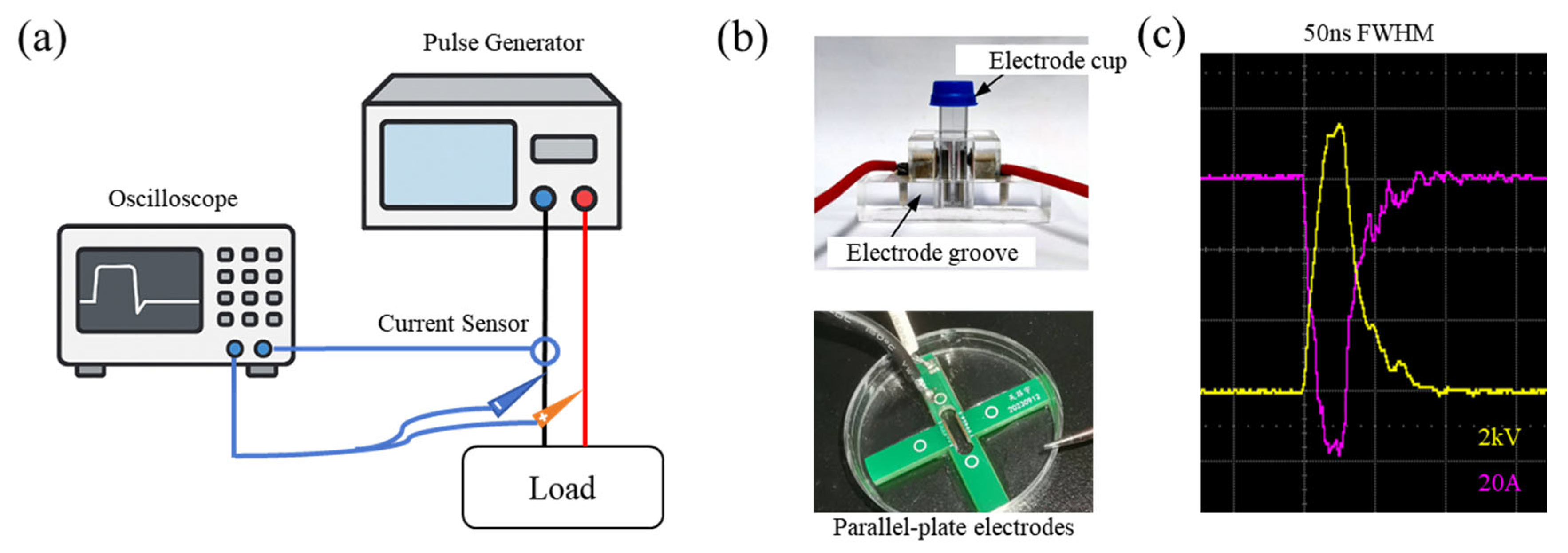
The experimental setup is illustrated in Figure 1. Electric pulses were generated using a laboratory-built nanosecond pulse generator based on a Marx circuit (Chongqing University, Chongqing, China) [23,24], with a maximum output voltage of 5 kV, an adjustable pulse width range of 40 ns to 100 μs, and a repetition frequency ranging from 1 Hz to 1.5 MHz. Pulse width was defined as the full width at half maximum (FWHM) of the voltage waveform. Representative waveforms of ultrashort pulses are shown in Figure 2. Longer pulse widths were generated using the same pulse generator architecture, resulting in comparable rise and fall rates (dv/dt) across different pulse-width conditions. The pulse generator was controlled by a function generator (AFG31000; Tektronix, Beaverton, OR, USA). The load voltage was measured using a 1000× high-voltage probe (Teledyne LeCroy, Chestnut Ridge, NY, USA) with a bandwidth of 400 MHz, and the current was monitored using a current probe (Pearson Electronics, Palo Alto, CA, USA) with a bandwidth of 400 MHz. Voltage and current signals were recorded in real time using an oscilloscope (WavePro; Teledyne LeCroy, Chestnut Ridge, NY, USA) with a bandwidth of 2 GHz for calibration of pulse waveforms and verification of energy consistency.
During PEF treatment, temperature variations in the treatment system were monitored in real time. The results showed that temperature changes remained within the normal experimental range, and no significant temperature increase was observed. Based on these measurements, thermal effects were not considered a major contributing factor in the analysis, and the observed biological responses were mainly attributed to the non-thermal effects of PEF.

2.3. Equal-Dose Definition and Parameter Settings

An equal-dose strategy was adopted in different experimental systems to compare the biological effects of pulsed electric fields (PEFs with different pulse widths). For fluorescence imaging experiments, adherent cells were treated using parallel-plate electrodes with 600 pulses applied. For transmission electron microscopy and flow cytometry analyses, suspended cells were treated using a cuvette electrode with 200 pulses applied. Within each experimental system, the pulse number and repetition frequency were kept constant (1 Hz), and the electric field strength E was adjusted for different pulse widths to ensure equal dose across groups, thereby enabling parameter comparability among different pulse-width conditions within the same system.
From a practical perspective, a unified definition of the electrical energy dose was proposed:
d o s e = n = 1 N E n 2 t p , n [ ( k V / c m ) 2 s ]
where N is the total number of pulses, E n 2 is the electric field strength of the n-th pulse, and t p , n is the pulse width. For square-wave pulses with constant amplitude, the dose can be simplified as:
d o s e = N E 2 t p
This equal-dose definition was used as an engineering-level control parameter to ensure comparability among different pulse widths within the same experimental system. The detailed PEF parameters for all experimental groups are summarized in Table 1. It should be noted that dose equivalence was maintained within each experimental configuration, rather than across different assay modalities (adherent vs. suspended cells).
In all experiments, a sham (unexposed) control group was included, in which cells were placed in the same electrode setup and underwent the same handling/staining procedures, but no electric pulses were delivered.

2.4. Fluorescence Imaging of Adherent Cells

To evaluate the responses of different subcellular organelles to PEF treatment with varying pulse widths under equal-dose conditions, cells were labeled with multiple organelle-specific fluorescent probes. Cell nuclei were stained with Hoechst 33,342 (Beyotime Biotechnology, Shanghai, China) to assess nuclear integrity and chromatin morphology. The endoplasmic reticulum was specifically labeled with ER-Tracker™ Red (Beyotime Biotechnology, Shanghai, China) to observe its morphology and stress-related alterations. Lysosomes were stained using LysoTracker™ Green (Beyotime Biotechnology, Shanghai, China) to reflect changes in the acidic environment. Mitochondrial membrane potential was evaluated using the JC-1 probe (Beyotime Biotechnology, Shanghai, China), where red fluorescence indicates a high membrane potential and green fluorescence indicates membrane depolarization. The Golgi apparatus was labeled with BODIPY FL C5-Ceramide (GLPBIO, Montclair, CA, USA) to track changes in Golgi structure and membrane transport function. All probes were prepared according to the manufacturers’ recommended concentrations and incubated with cells at 37 °C for 20–30 min. After incubation, cells were gently washed twice with serum-free medium to remove unbound dyes. Pulses were delivered immediately after washing.
Following PEF treatment, cells were immediately imaged using a widefield inverted fluorescence microscope (DMi8; Leica Microsystems, Wetzlar, Germany) equipped with a Leica HC PL FLUOTAR 20×/0.40 NA objective (working distance: 1.2 mm). Images were captured using a CCD camera(DFC7000 T; Leica Microsystems, Wetzlar, Germany) with constant acquisition settings across all experimental groups (exposure time: 200 ms; gain: 1.0×). Acquired images included bright-field, fluorescence, and merged images to visualize overall cell morphology as well as the spatial localization and functional changes in organelles. All imaging parameters, including excitation/emission channels, exposure time, and gain, were kept constant across all experimental groups.
For each pulse-width condition, fluorescence imaging was performed in three independent PEF exposures (biological replicates), and fluorescence signals were acquired from the predefined central region between the electrodes. Quantitative analysis was performed using ImageJ (version 1.53t) after background subtraction. To account for potential differences in adherent cell density/confluence among conditions, mean fluorescence intensity (MFI) was normalized to the cell-covered area in each image (i.e., fluorescence intensity per unit cell area). To facilitate comparison across different experimental batches, fluorescence intensities were normalized to the corresponding control group (set to 1). Here, the control group refers to a sham (unexposed) control processed identically but without pulse delivery. All data are presented as mean ± standard deviation (SD). To minimize focus-related bias, images were acquired after optimizing the focal plane using the fluorescence signal (sharp nuclear/organellar boundaries). During ImageJ quantification, only cells in clearly focused fields were included; out-of-focus images/cells were excluded.

2.5. Transmission Electron Microscopy (TEM)

After PEF treatment, A375 cells were sequentially fixed with 2.5% glutaraldehyde (Servicebio, Wuhan, China) and 1% osmium tetroxide (Ted Pella Inc., Redding, CA, USA). Samples were dehydrated through a graded series of ethanol solutions (30–100%; Sinopharm Group Chemical Reagent Co., Ltd., Shanghai, China) followed by acetone (Sinopharm Group Chemical Reagent Co., Ltd., Shanghai, China), and then embedded in epoxy resin (SPI, West Chester, PA, USA). Ultrathin sections (~70 nm) were prepared using an ultramicrotome (UC7; Leica Microsystems, Wetzlar, Germany) equipped with a diamond knife (Diatome, Biel, Switzerland) and mounted on 150-mesh copper grids coated with Formvar film (SPI, West Chester, PA, USA). Sections were stained with uranyl acetate and lead citrate, and subsequently observed and imaged using a transmission electron microscope (Hitachi, Tokyo, Japan).
To minimize selection bias, samples from at least three independent experiments were analyzed for each group. For each experiment, multiple fields of view were randomly selected for ultrastructural observation, and images were recorded under identical magnification and contrast settings. TEM analysis focused on qualitative morphological characterization, and the images presented in this study are representative of the observed ultrastructural alterations. The evaluated features included changes in the nuclear envelope, mitochondrial cristae, endoplasmic reticulum lumen, and Golgi apparatus.
For TEM experiments, suspended cells were treated using a cuvette electrode with 200 pulses and immediately fixed. The pulse width groups and equal-dose constraints were consistent with those described in this study and were used to compare ultrastructural differences induced by different pulse widths.
TEM analysis in this study was primarily qualitative and aimed at representative visualization of ultrastructural alterations rather than quantitative scoring.

2.6. Flow Cytometry Analysis

For flow cytometry analysis, suspended A375 cells were treated using a cuvette electrode with 200 pulses and subsequently stained with Annexin V-FITC and propidium iodide (PI) to evaluate differences in cell death patterns under different pulse-width conditions. After PEF treatment, cells were stained using an Annexin V-FITC/PI apoptosis detection kit (Yeasen Biotechnology Co., Ltd., Shanghai, China). Cells were collected by centrifugation, resuspended in binding buffer, and incubated for 15 min in the dark. Immediately after PEF treatment, cells were stained with Annexin V-FITC and PI without a recovery interval.
Flow cytometry data were acquired using a flow cytometer (CytoFLEX; Beckman Coulter, Brea, CA, USA), with no fewer than 10,000 events collected for each sample. Unstained and single-stained controls were included for compensation adjustment. Compensation was performed using unstained and single-stained cell controls (Annexin V-FITC only and PI only) acquired with the same instrument settings. The compensation matrix was calculated in the CytoFLEX software (version 3.2.1) and applied to all samples prior to quadrant gating. Data were analyzed using a four-quadrant gating strategy, where Annexin V/PI cells were classified as viable, Annexin V+/PI cells as early apoptotic, Annexin V+/PI+ cells as late apoptotic or necrotic, and Annexin V/PI+ cells as primary necrotic cells. Flow cytometry measurements were performed using three independent pulse-exposure samples per condition (n = 3).

2.7. Statistical Analysis

All quantitative data were obtained from at least three independent experiments. Results are presented as mean ± standard deviation. Normality was assessed using the Shapiro–Wilk test. For normally distributed data, one-way analysis of variance (ANOVA) followed by appropriate post hoc multiple comparison tests was applied. For non-normally distributed data, nonparametric tests were used. Statistical significance was defined as p < 0.05. Statistical analyses were performed using GraphPad Prism version 10.1.2 (GraphPad Software, San Diego, CA, USA).

3. Results

3.1. Ultrastructural Changes Under Different Pulse Widths

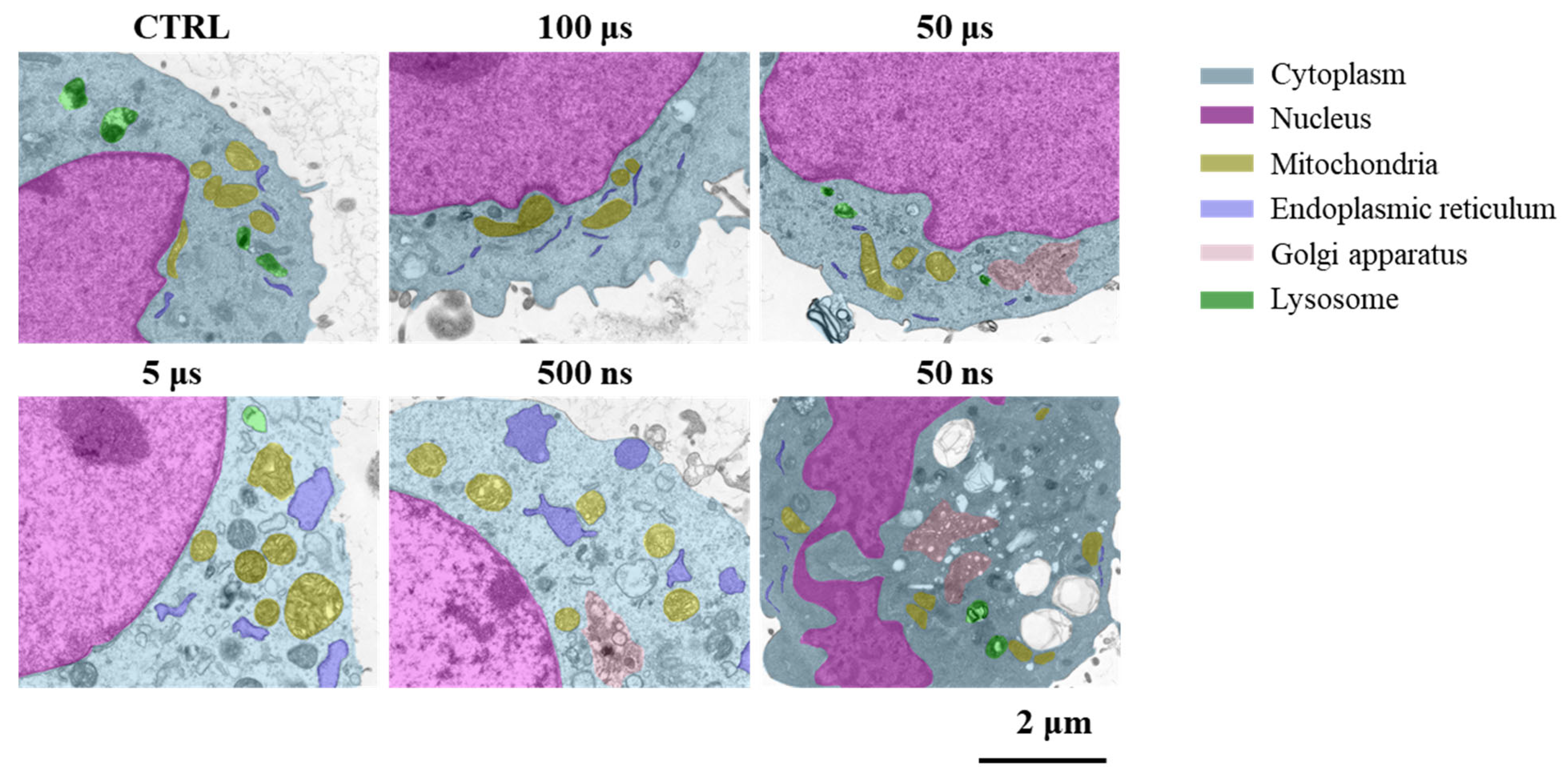
Transmission electron microscopy (TEM) was used to examine ultrastructural changes in A375 cells after pulsed electric field treatment, and the results are shown in Figure 2. Cells exposed to different pulse widths exhibited different extents of subcellular structural damage.
Cells in the control group and the 100 μs pulse-width group maintained intact overall structures. The cell membrane remained continuous, with abundant slender microvilli observed on the membrane surface. The cytoplasmic matrix appeared homogeneous with numerous mitochondria and preserved morphology and clearly organized cristae. In the 50 μs group, mild ultrastructural alterations were observed. Some organelles exhibited slight swelling, the cytoplasmic matrix appeared mildly less dense, and in some cells, mitochondrial cristae were reduced or partially disrupted. More pronounced ultrastructural damage were observed in the 5 μs group. Loss of membrane integrity was evident, accompanied by disorganized cytoplasmic structures. Organelles were generally swollen, and vacuole-like structures were frequently observed. Cells treated with 500 ns pulses also exhibited marked structural alterations. Local membrane protrusion or rupture was observed in some regions, the cytoplasm showed a certain degree of condensation, and mitochondria appeared swollen with partially damaged cristae. The most severe ultrastructural damage were observed in the 50 ns group. These cells exhibited pronounced cytoplasmic condensation, reduced continuity of the nuclear envelope, and chromatin margination. Multiple organelles displayed significant swelling and localized membrane disruption.

3.2. Fluorescence Responses of Major Organelles Under Different Pulse Widths

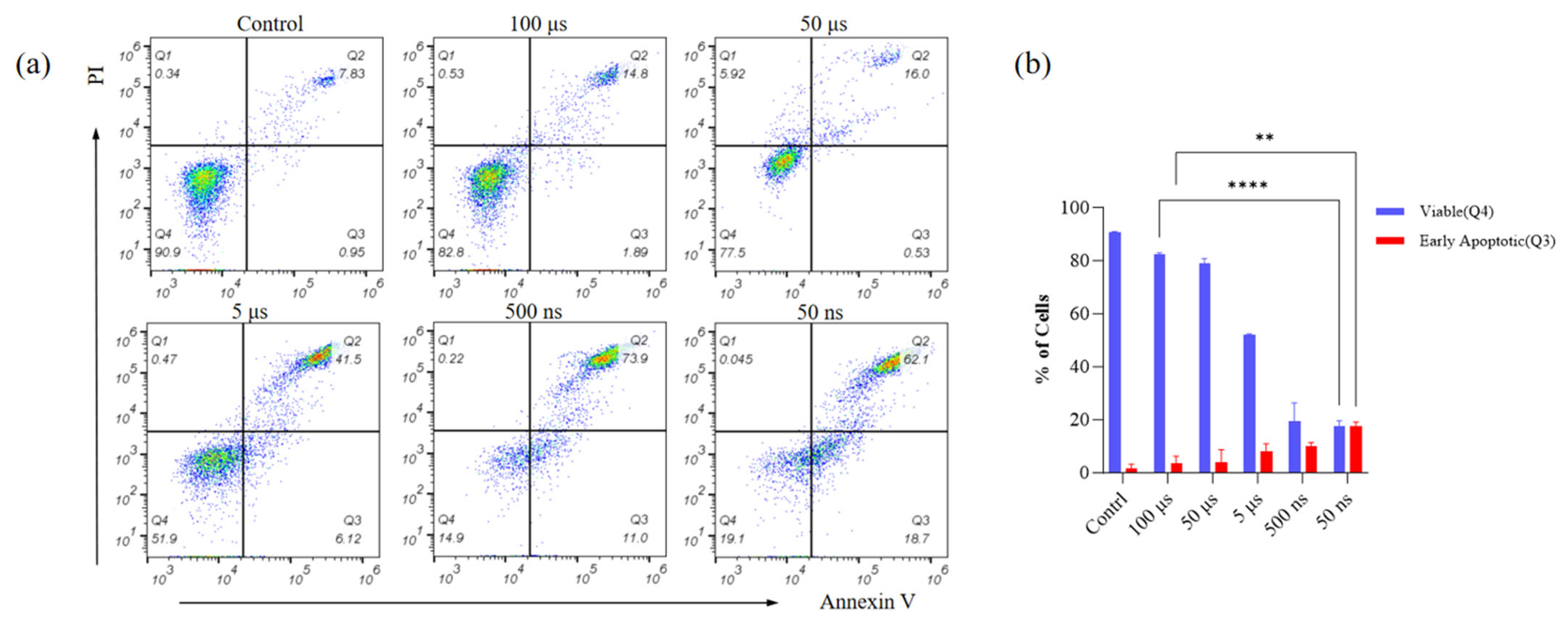
Based on the ultrastructural observations, fluorescence imaging was further employed to evaluate functional changes in major organelles under equal-dose pulsed electric field treatment. The results were shown in Figure 3. Different pulse widths induced distinct changes in fluorescence signals across multiple organelles. Uncropped raw fields of view for the representative images in Figure 3 are provided in the Supplementary Information (Figure S1) to facilitate assessment of imaging context.

3.2.1. Nucleus

Hoechst staining revealed a pronounced pulse-width-dependent decrease in nuclear fluorescence intensity. When the pulse width was compressed to 50 ns, the fluorescence signal dropped to approximately 40% of that in the control group, whereas under long-pulse conditions (100 μs), nuclear fluorescence remained largely unchanged. This suggested that at longer pulse width, energy was primarily dissipated through membrane electroporation rather than being delivered to the nuclear region. Previous studies [25] have demonstrated that ultrashort pulses can directly induce DNA damage, a phenomenon known in nsPEF research as the intracellular electrophysical effect [26,27]. As nuclear DNA damage represented a central trigger of apoptotic signaling, this result implied that ultrashort pulses may initiate apoptosis by disrupting genetic material integrity.

3.2.2. Endoplasmic Reticulum

ER-Tracker Red staining showed that fluorescence intensity markedly decreased to less than 30% of the control group when the pulse width was compressed into the nanosecond regime. The ER-Tracker Red dye bound to sulfonylurea receptors on the endoplasmic reticulum, labeling the ER in living cells. These results indicated that nanosecond pulses can effectively penetrate the plasma membrane and act directly on the ER, causing structural disorganization and functional impairment. Similar observations [28,29] have been reported, in which nsPEFs trigger ER stress responses, consistent with the present findings.

3.2.3. Lysosomes

Interestingly, unlike the monotonic dependence observed in the nucleus and ER, lysosomal fluorescence exhibited a non-monotonic trend. LysoTracker dyes label lysosomes in living cells by exploiting their weakly basic nature—protonated and retained within the acidic lysosomal lumen (pH 4.5–5.5). Following long-pulse treatment (100–5 μs), lysosomal fluorescence increased by approximately two-fold, whereas under ultrashort pulses (500–50 ns), the fluorescence intensity significantly decreased to about 60% of control group. This non-monotonic pattern could be interpreted as two potential cellular states: long pulses might promote lysosomal activation, whereas short pulses may induce membrane permeabilization. However, this interpretation remains speculative [30]. The underlying mechanism requires future investigation (e.g., lysosomal pH or membrane integrity assays).

3.2.4. Mitochondria

It has been reported that nsPEFs can induce dissipation of the mitochondrial membrane potential and swelling of mitochondria. In our experiments, we observed a progressive loss of mitochondrial membrane potential with pulse-width compression, as evidenced by an >80% decrease in the red/green fluorescence ratio of JC-1 staining, indicating depolarization and increased membrane permeability. JC-1 dye aggregated into red-emitting J-aggregates (590 nm) under high membrane potential, while in depolarized mitochondria, it remained as green-emitting monomers (529 nm). Therefore, the red/green ratio reflects mitochondrial functional integrity. This observation is consistent with previous reports [31], implying that mitochondrial injury leads to metabolic dysfunction, cytochrome-c release, and caspase cascade activation—key events in apoptosis progression.

3.2.5. Golgi Apparatus

BODIPY staining of the Golgi apparatus revealed significant structural collapse following pulse-width compression. Under 50 ns short pulses, fluorescence intensity decreased by over 75%, indicating Golgi fragmentation and loss of membrane integrity, whereas long pulses (100–50 μs) caused less than 10% fluorescence reduction. BODIPY, a lipophilic dye, specifically embeds into Golgi membranes and emits bright green fluorescence upon excitation. Previous studies have demonstrated that Golgi disruption interferes with protein processing and vesicular transport, amplifying stress signaling and promoting apoptosis [8,9].
In summary, the fluorescence imaging results confirmed that organelle structural and functional integrity deteriorated progressively under equal-dose pulse-width compression. Considering the pivotal roles of these organelles in apoptotic signaling, the observed damages collectively drive cells toward programmed death, providing direct mechanistic evidence for the apoptosis outcomes verified by flow cytometry.

3.3. Flow Cytometric Detection of Apoptosis and Necrosis

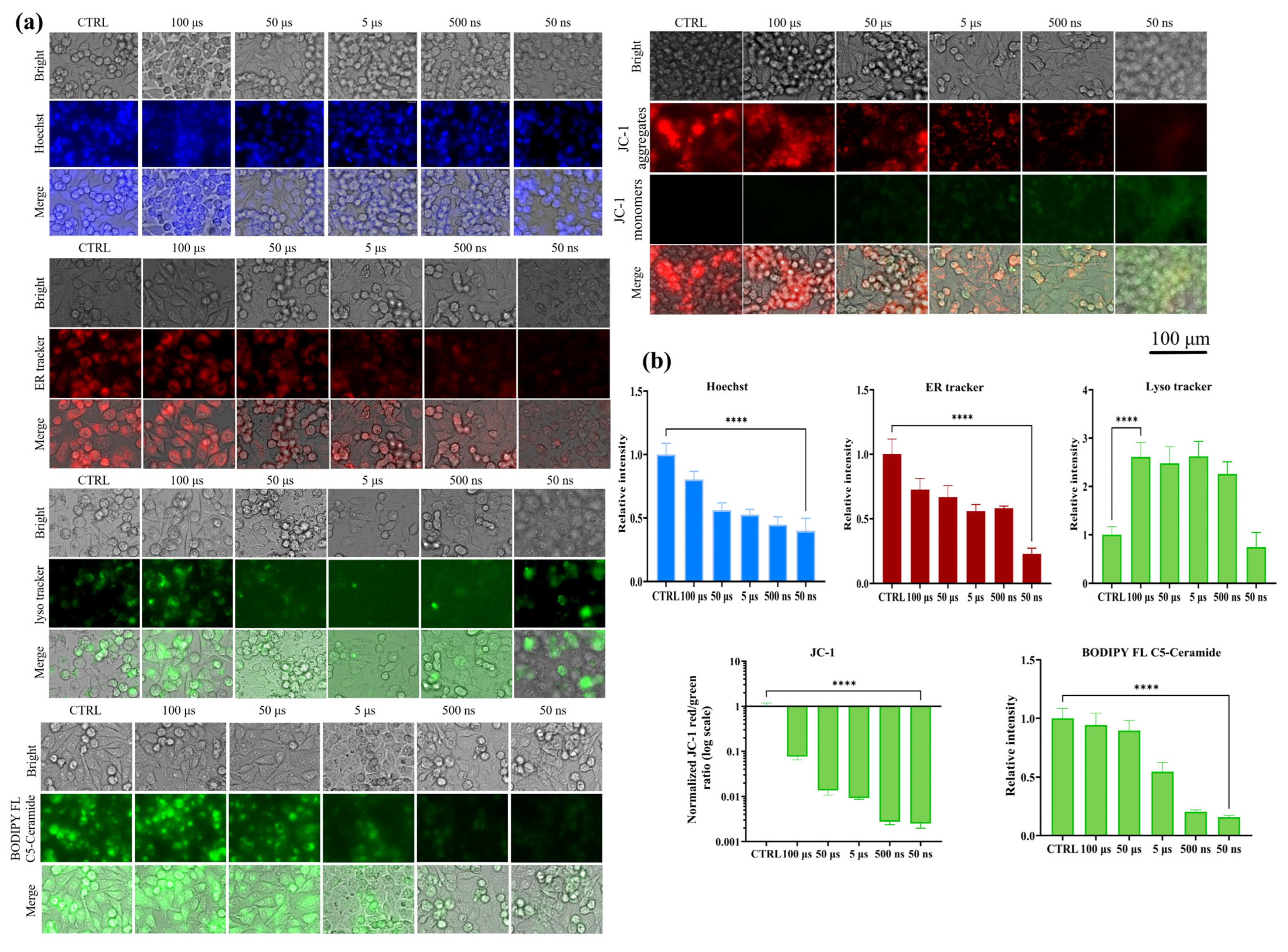
Annexin V-FITC/PI flow cytometry was used to analyze cell death patterns of A375 cells treated with pulsed electric fields of different pulse widths under equal-dose conditions. The results are shown in Figure 4. In the control group, the majority of cells remained viable, accounting for approximately 90% of the population, with only a small fraction of early apoptotic cells observed. After treatment with 100 μs and 50 μs pulses, the proportion of early apoptotic cells increased slightly to approximately 5–7%, while most cells remained viable. When the pulse width was reduced to 5 μs, the proportion of early apoptotic cells increased to approximately 37%, accompanied by the appearance of a certain fraction of late apoptotic or necrotic cells. Further reduction of the pulse width to 500 ns and 50 ns resulted in a marked decrease in cell viability, with the combined proportion of early and late apoptotic/necrotic cells exceeding 70%, and the viable cell fraction decreasing to below 20%.

4. Discussion

Overall, under equal-dose conditions, compression of the pulse width from the microsecond to the nanosecond range resulted in increasingly pronounced subcellular structural and functional alterations. Specifically, TEM revealed reduced nuclear envelope continuity, disruption of mitochondrial cristae, and dilation of the endoplasmic reticulum lumen. Correspondingly, fluorescence imaging demonstrated decreased nuclear staining intensity, reduced mitochondrial membrane potential-associated signals, and weakened labeling of the endoplasmic reticulum and Golgi apparatus. Flow cytometry further showed an increased proportion of early and late apoptotic/necrotic populations and a reduced fraction of viable cells under short-pulse conditions. Together, these cross-scale observations indicate that pulse width can substantially modulate intracellular damage patterns and cellular outcomes even under equal-dose constraints, suggesting that an equal dose does not necessarily correspond to an equivalent biological effect. The main contribution of this work lies in establishing a comparable “pulse-width–effect” relationship based on experimental characterization, providing guidance for parameter selection and optimization in PEF-related biomedical applications. From a physical perspective, nanosecond pulses contain higher-frequency components, for which membrane charging and ionic screening are less effective. As a result, the electric field can penetrate more efficiently into the cell interior and interact with intracellular membranes and organelles. This frequency-dependent behavior provides a physical explanation for the enhanced intracellular effects observed under ultrashort pulse conditions
It should be emphasized that the “equal dose” employed in this study was an engineering-based control framework, defined using pulse parameters ( E 2 t p ) to ensure comparability of stimulation strength across groups. This definition was not equivalent to the absorbed dose or actual energy uptake at the cellular level. Therefore, the observation of divergent biological responses under equal-dose conditions highlighted the importance of the pulse width characteristics of PEF stimulation. However, the physical coupling processes and biological event sequences underlying these differences required further investigation using approaches with higher temporal resolution. Based on the current experimental data, the interpretation was that shorter pulses are more effective in inducing pronounced intracellular structural and functional alterations, and that these alterations were consistently reflected across multiple experimental endpoints, rather than assigning specific cell death pathways based on morphology or single indicators [32,33].
A key consideration in our experimental design is the inherent coupling between pulse width and electric field amplitude under the constant N·E2·tp constraint. To maintain dose equivalence, applying shorter pulses necessitates the use of higher electric fields (see Table 1). Consequently, the enhanced intracellular effects observed at shorter pulse widths (e.g., 50 ns) could be attributed to the combined influence of reduced pulse duration and elevated field strength, rather than pulse width alone. Disentangling the individual contributions of these two interdependent parameters represents an important focus for future mechanistic studies. Future studies may also incorporate blinded or semi-quantitative scoring of ultrastructural damage to further strengthen statistical robustness
A notable observation in this study was the non-monotonic response of lysosomes under different pulse-width conditions. Experimental results showed enhanced LysoTracker fluorescence under longer pulse widths (100–5 μs), whereas a marked decrease in fluorescence was observed under ultrashort pulse conditions (500–50 ns). This behavior differed from the monotonic decrease observed for mitochondria and the endoplasmic reticulum and may reflect two distinct cellular states [34,35]. Under long-pulse conditions, enhanced lysosomal acidity or increased lysosome-related activity may lead to greater dye accumulation and increased fluorescence. In contrast, under ultrashort pulse conditions, compromised lysosomal membrane integrity or impaired maintenance of the acidic environment may reduce dye retention, resulting in decreased fluorescence signals. It should be noted that these interpretations are based on the physicochemical properties of the fluorescent probe and established biological context, and further experimental validation was required [36,37], such as time-resolved imaging, lysosomal pH or ion-sensitive probes, or membrane integrity markers, to distinguish between these possibilities more directly. It is important to note that the findings of this study are derived from experiments using the A375 melanoma cell line. While this provides a controlled model for understanding pulse-width effects, further investigations with diverse cell types are warranted to assess the generalizability of the observed phenomena
Future studies incorporating three-dimensional cell or tissue models will be valuable for further validating the “equal-dose–pulse-width–effect” relationship proposed here and for enhancing the generalizability and translational relevance of these findings.

5. Conclusions

In this study, the experimental effects of pulsed electric fields (PEFs) with different pulse widths on A375 cells and their subcellular structures were systematically investigated under equal-dose conditions. The results demonstrated that pulse width is an important temporal parameter influencing PEF-induced biological responses. Under equal-dose constraints, compression of the pulse width from the microsecond to the nanosecond range was associated with more pronounced cellular and subcellular alterations, including increased structural changes, attenuation of organelle-related functional signals, and elevated proportions of apoptotic or dead cells. These findings indicate that distinct biological responses can arise under equal-dose conditions when pulse width is varied, highlighting pulse width as a critical dimension for parameter selection and optimization in PEF-based biomedical applications. The present work provides experimental foundation for biomedical applications such tissue ablation.

Supplementary Materials

The following supporting information can be downloaded at https://www.mdpi.com/article/10.3390/app16021086/s1, Figure S1: Set of raw fluorescence microscopy images.

Author Contributions

Conceptualization, H.K. and C.Y.; methodology, H.K.; software, H.K.; validation, H.K., F.W. and C.Y.; formal analysis, H.K.; investigation, H.K., F.W., K.C., S.W. and R.L.; resources, C.Y.; data curation, H.K.; writing—original draft preparation, H.K.; writing—review and editing, H.K. and C.Y.; visualization, H.K.; supervision, C.Y.; project administration, C.Y.; funding acquisition, C.Y. All authors have read and agreed to the published version of the manuscript.

Funding

This work was financially supported by the National Natural Science Foundation of China (Grant No. 52237010).

Institutional Review Board Statement

Not applicable.

Informed Consent Statement

Not applicable.

Data Availability Statement

The data presented in this study are available from the corresponding author upon reasonable request.

Acknowledgments

The author would like to thank Wenjing Liao for her encouragement and support throughout this work.

Conflicts of Interest

The authors declare no conflicts of interest.

References

  1. Kotnik, T.; Rems, L.; Tarek, M.; Miklavčič, D. Membrane Electroporation and Electropermeabilization: Mechanisms and Models. Annu. Rev. Biophys. 2019, 48, 63–91. [Google Scholar] [CrossRef] [PubMed]
  2. Kotnik, T.; Miklavčič, D. Theoretical Evaluation of Voltage Inducement on Internal Membranes of Biological Cells Exposed to Electric Fields. Biophys. J. 2006, 90, 480–491. [Google Scholar] [CrossRef] [PubMed]
  3. Weaver, J.C. Electroporation: A General Phenomenon for Manipulating Cells and Tissues. J. Cell. Biochem. 1993, 51, 426–435. [Google Scholar] [CrossRef] [PubMed]
  4. Batista Napotnik, T.; Polajžer, T.; Miklavčič, D. Cell Death Due to Electroporation—A Review. Bioelectrochemistry 2021, 141, 107871. [Google Scholar] [CrossRef]
  5. George, A.K.; Miocinovic, R.; Patel, A.R.; Lomas, D.J.; Correa, A.F.; Chen, D.Y.T.; Rastinehad, A.R.; Schwartz, M.J.; Uchio, E.M.; Sidana, A.; et al. A Description and Safety Overview of Irreversible Electroporation for Prostate Tissue Ablation in Intermediate-Risk Prostate Cancer Patients: Preliminary Results from the PRESERVE Trial. Cancers 2024, 16, 2178. [Google Scholar] [CrossRef]
  6. Hassany, M.; Mahboub, A.M.; Mostafa, W.; Debian, H.; Shousha, H.I.; El-Serafy, M. Assessment of Efficacy and Safety of Irreversible Electroporation versus TACE for Treatment of Difficult Location Hepatocellular Carcinoma. Egypt. Liver J. 2024, 14, 33. [Google Scholar] [CrossRef]
  7. Beebe, S.J.; Blackmore, P.F.; White, J.; Joshi, R.P.; Schoenbach, K.H. Nanosecond Pulsed Electric Fields Modulate Cell Function through Intracellular Signal Transduction Mechanisms. Physiol. Meas. 2004, 25, 1077–1093. [Google Scholar] [CrossRef]
  8. Foster, K.R.; Schwan, H.P. Dielectric Properties of Tissues and Biological Materials: A Critical Review. Crit. Rev. Biomed. Eng. 1989, 17, 25–104. [Google Scholar]
  9. Asami, K. Characterization of Biological Cells by Dielectric Spectroscopy. J. Non-Cryst. Solids 2002, 305, 268–277. [Google Scholar] [CrossRef]
  10. Murovec, T.; Sweeney, D.C.; Latouche, E.; Brosseau, C.; Davalos, R.V. Modeling of Transmembrane Potential in Realistic Multicellular Structures before Electroporation. Biophys. J. 2016, 111, 2286–2295. [Google Scholar] [CrossRef]
  11. Frey, W.; White, J.A.; Price, R.O.; Blackmore, P.F.; Joshi, R.P.; Nuccitelli, R.; Beebe, S.J.; Schoenbach, K.H.; Kolb, J.F. Plasma Membrane Voltage Changes during Nanosecond Pulsed Electric Field Exposure. Biophys. J. 2006, 90, 3608–3615. [Google Scholar] [CrossRef] [PubMed]
  12. Gul, K.; Mumtaz, S. Nanosecond Pulsed Electric Fields (nsPEFs) for Precision Intracellular Oncotherapy: Recent Advances and Emerging Directions. Int. J. Mol. Sci. 2025, 26, 11268. [Google Scholar] [CrossRef]
  13. Merla, C.; Pakhomov, A.G.; Semenov, I.; Vernier, P.T. Frequency Spectrum of Induced Transmembrane Potential and Permeabilization Efficacy of Bipolar Electric Pulses. Biochim. Et Biophys. Acta (BBA)—Biomembr. 2017, 1859, 1282–1290. [Google Scholar] [CrossRef]
  14. Chopinet, L.; Rols, M.-P. Nanosecond Electric Pulses: A Mini-Review of the Present State of the Art. Bioelectrochemistry 2015, 103, 2–6. [Google Scholar] [CrossRef] [PubMed]
  15. Vernier, P.T.; Sun, Y.; Gundersen, M.A. Nanoelectropulse-Driven Membrane Perturbation and Small Molecule Permeabilization. BMC Cell Biol. 2006, 7, 37. [Google Scholar] [CrossRef]
  16. Batista Napotnik, T.; Reberšek, M.; Vernier, P.T.; Mali, B.; Miklavčič, D. Effects of High Voltage Nanosecond Electric Pulses on Eukaryotic Cells (In Vitro): A Systematic Review. Bioelectrochemistry 2016, 110, 1–12. [Google Scholar] [CrossRef]
  17. Cemazar, M.; Sersa, G.; Frey, W.; Miklavcic, D.; Teissié, J. Recommendations and Requirements for Reporting on Applications of Electric Pulse Delivery for Electroporation of Biological Samples. Bioelectrochemistry 2018, 122, 69–76. [Google Scholar] [CrossRef]
  18. Aycock, K.N.; Davalos, R.V. Irreversible Electroporation: Background, Theory, and Review of Recent Developments in Clinical Oncology. Bioelectricity 2019, 1, 214–234. [Google Scholar] [CrossRef]
  19. Buchmann, L.; Böcker, L.; Frey, W.; Haberkorn, I.; Nyffeler, M.; Mathys, A. Energy Input Assessment for Nanosecond Pulsed Electric Field Processing and Its Application in a Case Study with Chlorella vulgaris. Innov. Food Sci. Emerg. Technol. 2018, 47, 445–453. [Google Scholar] [CrossRef]
  20. Potočnik, T.; Maček Lebar, A.; Kos, Š.; Reberšek, M.; Pirc, E.; Serša, G.; Miklavčič, D. Effect of Experimental Electrical and Biological Parameters on Gene Transfer by Electroporation: A Systematic Review and Meta-Analysis. Pharmaceutics 2022, 14, 2700. [Google Scholar] [CrossRef]
  21. Jacobs, E.J.; Arroyo, J.P.; Powar, M.; Santos, P.P.; Allen, I.; Davalos, R. Power-Driven Electroporation Is Predictive of Treatment Outcomes in a Conductivity-Independent Manner. BME Front. 2025, 6, 0169. [Google Scholar] [CrossRef] [PubMed]
  22. Scuderi, M.; Dermol-Černe, J.; Amaral da Silva, C.; Muralidharan, A.; Boukany, P.E.; Rems, L. Models of Electroporation and the Associated Transmembrane Molecular Transport Should Be Revisited. Bioelectrochemistry 2022, 147, 108216. [Google Scholar] [CrossRef] [PubMed]
  23. Wu, F.; Yao, C.; Chen, Y.; Liang, Y.; Dong, S.; Wang, H. All-Solid-State Ultrashort Pulse Generator by Capacitive Chopping Circuit. IEEE Trans. Power Electron. 2023, 38, 9897–9906. [Google Scholar] [CrossRef]
  24. Wu, F.; Zhao, L.; Dong, S.; Zhou, X.; Zeng, W.; Yao, C.; Yu, L. Magnetic Coupling Resonant-Based Air-Isolated Module for High Voltage Pulse Generators. IEEE Trans. Ind. Electron. 2022, 70, 2431–2439. [Google Scholar] [CrossRef]
  25. Yao, C.; Ning, J.; Liu, H.; Lv, Y.; Zhao, Y.; Dong, S. Nanosecond Pulses Targeting Intracellular Ablation Increase Destruction of Tumor Cells with Irregular Morphology. Bioelectrochemistry 2020, 132, 107432. [Google Scholar] [CrossRef]
  26. Schoenbach, K.H.; Beebe, S.J.; Buescher, E.S. Intracellular Effect of Ultrashort Electrical Pulses. Bioelectromagnetics 2001, 22, 440–448. [Google Scholar] [CrossRef]
  27. Schoenbach, K.H. From the Basic Science of Biological Effects of Ultrashort Electrical Pulses to Medical Therapies. Bioelectromagnetics 2018, 39, 257–276. [Google Scholar] [CrossRef]
  28. Furumoto, Y.; Sato, D.; Teranishi, K.; Shimomura, N.; Hamada, Y.; Miyake, M.; Oyadomari, S. Activation of Endoplasmic Reticulum Stress Response by Applying of Nanosecond Pulsed Electric Fields for Medical Application. In Proceedings of the 2018 IEEE International Power Modulator and High Voltage Conference (IPMHVC), Jackson, WY, USA, 3–7 June 2018; pp. 456–460. [Google Scholar]
  29. Hamada, Y.; Furumoto, Y.; Izutani, A.; Taniuchi, S.; Miyake, M.; Oyadomari, M.; Teranishi, K.; Shimomura, N.; Oyadomari, S. Nanosecond Pulsed Electric Fields Induce the Integrated Stress Response via Reactive Oxygen Species-Mediated Heme-Regulated Inhibitor (HRI) Activation. PLoS ONE 2020, 15, e0229948. [Google Scholar] [CrossRef]
  30. Thompson, G.L.; Beier, H.T.; Ibey, B.L. Tracking Lysosome Migration Within Chinese Hamster Ovary (CHO) Cells Following Exposure to Nanosecond Pulsed Electric Fields. Bioengineering 2018, 5, 103. [Google Scholar] [CrossRef]
  31. Beebe, S.J.; Chen, Y.J.; Sain, N.M.; Schoenbach, K.H.; Xiao, S. Transient Features in Nanosecond Pulsed Electric Fields Differentially Modulate Mitochondria and Viability. PLoS ONE 2012, 7, e51349. [Google Scholar] [CrossRef]
  32. Wu, F.; Li, L.; Chen, K.; Kou, H.; Mao, Y.; Liang, R.; Liu, H.; Yao, C. Statistical Property of Absorbed Energy in Monolayer Cell Collectives with Porous Dielectric Structure during Irreversible Electroporation Therapy. Appl. Phys. Lett. 2024, 125, 134103. [Google Scholar] [CrossRef]
  33. Wu, F.; Kou, H.; Chen, K.; Li, L.; Wang, S.; Liang, R.; Lei, Y.; Chen, Y.; Liu, H.; Yao, C. Gamma-Distributed Energy Heterogeneity Modulates Pulsed Electric Field Ablation Efficacy in Millimeter-Scale Multicellular Monolayers. Appl. Phys. Lett. 2025, 127, 063705. [Google Scholar] [CrossRef]
  34. Bendiske, J.; Bahr, B.A. Lysosomal Activation Is a Compensatory Response Against Protein Accumulation and Associated Synaptopathogenesis—An Approach for Slowing Alzheimer Disease? J. Neuropathol. Exp. Neurol. 2003, 62, 451–463. [Google Scholar] [CrossRef]
  35. Napotnik, T.B.; Wu, Y.-H.; Gundersen, M.A.; Miklavčič, D.; Vernier, P.T. Nanosecond Electric Pulses Cause Mitochondrial Membrane Permeabilization in Jurkat Cells. Bioelectromagnetics 2012, 33, 257–264. [Google Scholar] [CrossRef]
  36. Barzinmehr, H.; Ramezanpour, S.; Shiri, P.; Ahadi, E.M.; Mohammadi, S.; Yazdian, F.; Tavatoni, P. A Review of Fluorescent Peptide-Based Chemosensors with Selectivity for Metal Ions. Coord. Chem. Rev. 2024, 518, 216055. [Google Scholar] [CrossRef]
  37. Zheng, X.; Cheng, W.; Ji, C.; Zhang, J.; Yin, M. Detection of Metal Ions in Biological Systems: A Review. Rev. Anal. Chem. 2020, 39, 231–246. [Google Scholar] [CrossRef]
Figure 1. (a) Schematic illustration of the pulsed electric field (PEF) experimental setup. (b) Experimental electrodes. Among them, the pulse width is defined as the full width at half maximum, and the spacing between the electrode cup and the PCB electrode is 2 mm. The parallel plate electrodes were custom-fabricated and constructed from platinum with a purity of ≥99.9%. (c) 50 ns pulsed waveform.
Applsci 16 01086 g001
Figure 2. Transmission electron microscopy (TEM) images of cells after pulsed electric field treatment with different pulse widths under equal-dose conditions. Cells treated with pulse widths ranging from the microsecond scale (100 µs) to the nanosecond scale (50 ns) exhibit progressively more pronounced ultrastructural alterations. White indicates lipid droplets (LD). Scale bar: 2 µm.
Applsci 16 01086 g002
Figure 3. Multi-organelle fluorescence imaging and quantitative analysis of A375 cells after pulsed electric field treatment with different pulse widths under equal-dose conditions. (a) Representative fluorescence images of major organelles, including the nucleus (Hoechst 33342, blue), endoplasmic reticulum (ER-Tracker™ Red, red), lysosomes (LysoTracker™ Green, green), mitochondrial membrane potential (JC-1 probe, red/green channels), and Golgi apparatus (BODIPY FL C5-Ceramide, green). Merged bright-field and fluorescence images show overall cell morphology and organelle distribution. Scale bar: 100 μm. (b) Quantitative analysis of relative fluorescence intensities for different organelles. Fluorescence intensities were normalized to the control group (CTRL). Statistical significance is indicated as follows: **** p < 0.0001.
Applsci 16 01086 g003
Figure 4. (a) Apoptosis analysis of A375 cells after pulsed electric field treatment with different pulse widths under equal-dose conditions, assessed by Annexin V-FITC/PI double staining. The horizontal axis represents Annexin V-FITC (early apoptosis), and the vertical axis represents PI (late apoptosis or necrosis). As the pulse width is reduced from 100 μs to 50 ns, the proportions of early and late apoptotic/necrotic cell populations increase accordingly. (b) Quantitative analysis of live cells (Annexin V/PI) and early apoptotic cells (Annexin V+/PI) under various pulsed width conditions. Data are presented as mean ± standard deviation (SD) from at least three independent experiments (n ≥ 3). Statistical significance is indicated as follows: ** p < 0.01, **** p < 0.0001.
Applsci 16 01086 g004
Table 1. PEF treatment parameters under different experimental configurations (equal-dose constraint, frequency = 1 Hz). Dose equivalence is defined within each experimental setup and should not be directly compared across different configurations. For the suspended-cell experiments (TEM/flow cytometry), cells were treated in a commercial BTX 1 mm gap electroporation cuvette with a sample volume of 10 μL per exposure.
No.Experimental SetupCell StateElectrode ConfigurationPulse Width (tp)Electric Field Strength (E, kV/cm)Number of Pulses (N)Frequency (Hz)Specific Energy (J/mL)
1 Fluorescence imagingAdherentParallel-plate electrodes50 ns20.06001
2 Fluorescence imagingAdherentParallel-plate electrodes500 ns6.32
3 Fluorescence imagingAdherentParallel-plate electrodes5 μs2.00
4 Fluorescence imagingAdherentParallel-plate electrodes50 μs0.63
5 Fluorescence imagingAdherentParallel-plate electrodes100 μs0.45
6 TEM/Flow cytometrySuspendedCuvette electrode50 ns20.0200140
7 TEM/Flow cytometrySuspendedCuvette electrode500 ns6.32
8 TEM/Flow cytometrySuspendedCuvette electrode5 μs2.00
9 TEM/Flow cytometrySuspendedCuvette electrode50 μs0.63
10 TEM/Flow cytometrySuspendedCuvette electrode100 μs0.45
Disclaimer/Publisher’s Note: The statements, opinions and data contained in all publications are solely those of the individual author(s) and contributor(s) and not of MDPI and/or the editor(s). MDPI and/or the editor(s) disclaim responsibility for any injury to people or property resulting from any ideas, methods, instructions or products referred to in the content.