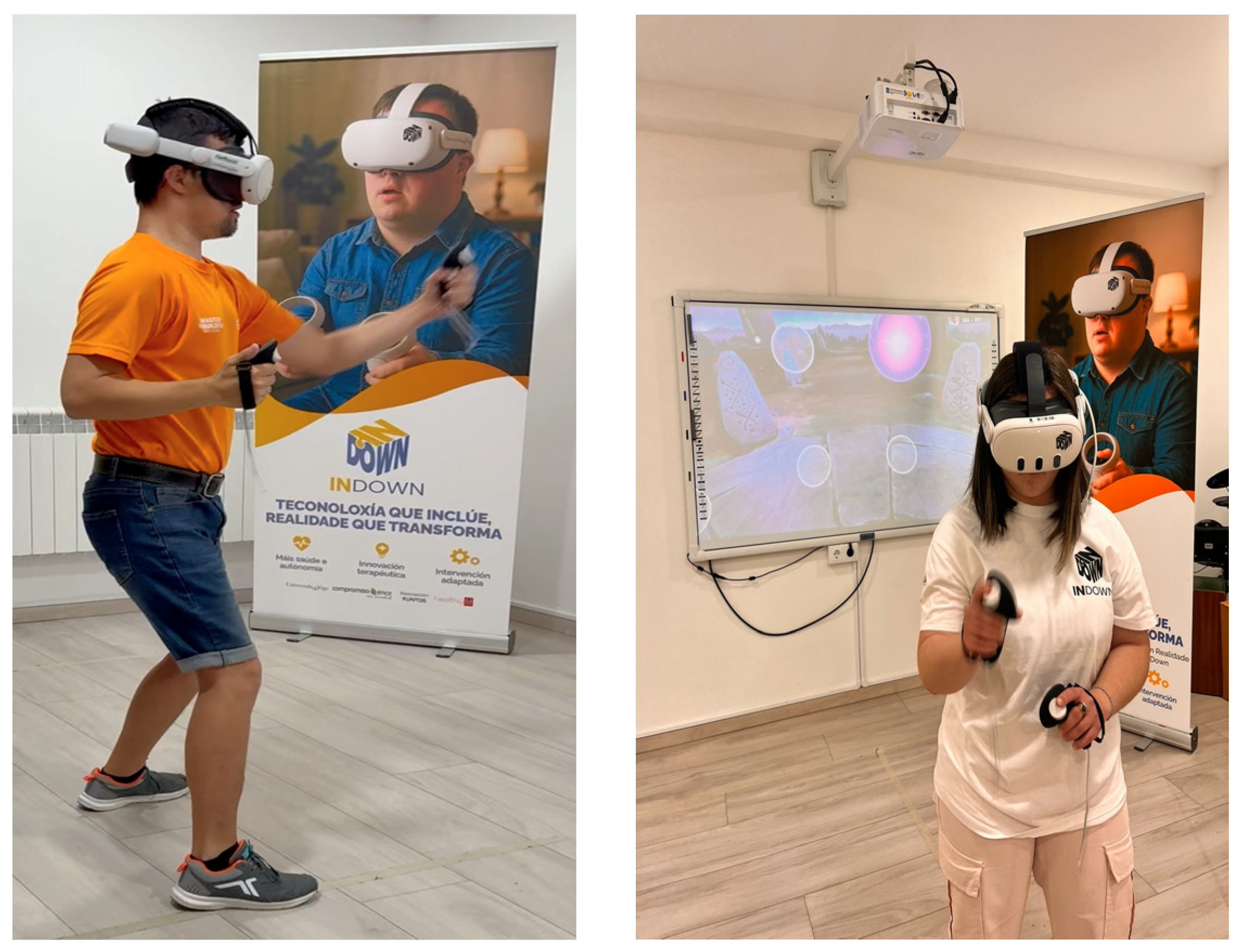
Immersive Virtual Reality-Based Exercise Intervention and Its Impact on Strength and Body Composition in Adults with Down Syndrome: Insights from the InDown Pilot Project



Abstract
1. Introduction
2. Materials and Methods
2.1. Study Design
2.2. Participants
2.3. Intervention Program
2.4. Outcome Measures
- System usability, using the System Usability Scale (SUS). The SUS is a widely used survey designed to quickly and easily assess the usability of a product or service. It consists of 10 items rated on a 5-point Likert scale, generating a score out of 100. The Spanish version of the SUS was administered immediately after the intervention [27].
- The safety of the immersive experience. Simulator Sickness Questionnaire (SSQ). We assessed using the SSQ, adapted and validated for Spanish [28]. This tool is widely applied to measure cybersickness frequency in the general population [29]. The questionnaire was completed immediately after the intervention.
- Body Composition. Body composition was assessed using the Tanita MC-780 analyzer, which provided fat mass (FM), fat-free mass (FFM), muscle mass (MM), and total body water (TBW). We performed a segmented body composition analysis for the trunk, upper limbs (right and left), and lower limbs (right and left). Sex, age, and height were entered into the device, with height measured using a SECA stadiometer (SECA, Germany; accuracy: 0.1 cm). Data collection took approximately 20 s. Body mass index (BMI) was calculated as weight (kg) divided by height squared (m2). VFR was estimated indirectly and expressed on a scale from 0 to 59, where 1–12 indicates healthy visceral fat levels, and 13–59 indicates excessive levels. This BIA technology has been recently validated in adults with varying levels of physical activity [32].
- Muscular Strength. Upper-body strength was measured using a handgrip dynamometer (Jamar, Sammons Preston Inc., Bolingbrook, IL, USA). Participants performed the test in a seated position to enhance focus, an adaptation shown to have no significant effect (p > 0.001) compared to standing in individuals with DS [33,34]. Lower-limb strength and functional capacity were assessed using the Five Sit-to-Stand Test (5STS) [35]. Participants began seated with their backs against the chair, arms crossed over their chests, and feet firmly on the floor. They were instructed to complete five sit-to-stand cycles as quickly as possible. A visual demonstration and verbal encouragement were provided. A familiarization trial preceded two recorded attempts, and the mean time was used as the final measure [36,37].
2.5. Data Analysis
3. Results
4. Discussion
Limitations
5. Conclusions
Author Contributions
Funding
Institutional Review Board Statement
Informed Consent Statement
Data Availability Statement
Acknowledgments
Conflicts of Interest
References
- Kuo, H.T.; Lee, T.H.; Su, L.A.; Wu, L.Y.; Mao, P.Y.; Yang, C.C. Impact of resistance training on body composition and physical function in individuals with Down syndrome: A meta-analysis. Diagnostics 2024, 14, 2620. [Google Scholar] [CrossRef] [PubMed]
- Méndez-Martínez, M.; Rodríguez-Grande, E.I. Effects of therapeutic exercise on the motor function of adults with Down syndrome: A systematic review and meta-analysis. Sci. Rep. 2023, 13, 20815. [Google Scholar] [CrossRef] [PubMed]
- Hojlo, M.A.; Milliken, A.L.; Baumer, N.T.; Davidson, E.J. DSFit: A feasibility pilot study of a group exercise programme for adolescents with Down syndrome. J. Intellel. Disabil. Res. 2022, 66, 952–966. [Google Scholar] [CrossRef] [PubMed]
- Shin, Y.A.; Hong, S.M.; Lee, J.S.; Jeong, H.B. The effect of resistance and balance training on postural control and physical fitness in adults with Down syndrome. Exerc. Sci. 2021, 30, 175–182. [Google Scholar] [CrossRef]
- McMahon, D.D.; Barrio, B.; McMahon, A.K.; Tutt, K.; Firestone, J. Virtual reality exercise games for high school students with intellectual and developmental disabilities. J. Spec. Educ. Technol. 2019, 34, 87–96. [Google Scholar] [CrossRef]
- Barbour, B.; Sefton, L.; Bruce, R.M.; Valmaggia, L.; Runswick, O.R. Acute psychological and physiological benefits of exercising with virtual reality. PLoS ONE 2024, 19, e0314331. [Google Scholar] [CrossRef]
- Yalon-Chamovitz, S.; Weiss, P.L.T. Virtual reality as a leisure activity for young adults with physical and intellectual disabilities. Res. Dev. Disabil. 2008, 29, 273–287. [Google Scholar] [CrossRef]
- Lotan, M.; Yalon-Chamovitz, S.; Weiss, P.L. Improving physical fitness of individuals with intellectual and developmental disabilities through a virtual reality intervention program. Res. Dev. Disabil. 2009, 30, 229–239. [Google Scholar] [CrossRef]
- Abdel Ghafar, M.A.; Abdelraouf, O.R. Effect of virtual reality versus traditional physical therapy on functional balance in children with Down Syndrome: A randomized comparative study. Int. J. Physiother. Res. 2017, 5, 2088–2094. [Google Scholar] [CrossRef][Green Version]
- Berg, P.; Becker, T.; Martian, A.; Danielle, P.K.; Wingen, J. Motor Control Outcomes Following Nintendo Wii Use by a Child with Down Syndrome. Pediatr. Phys. Ther. 2012, 24, 78–84. [Google Scholar] [CrossRef]
- Carrogi-Vianna, D.; Lopes, P.B.; Cymrot, R.; Hengles Almeida, J.J.; Yazaki, M.L.; Blascovi-Assis, S.M. Analysis of movement acceleration of Down’s syndrome teenagers playing computer games. Games Health J. 2017, 6, 358–364. [Google Scholar] [CrossRef]
- Gómez Álvarez, N.; Venegas Mortecinos, A.; Zapata Rodríguez, V.; López Fontanilla, M.; Maudier Vásquez, M.; Pavez-Adasme, G.; Hemández-Mosqueira, C. Efecto de una intervención basada en realidad virtual sobre las habilidades motrices básicas y control postural de niños con Síndrome de Down. Rev. Chil. Pediatría 2018, 89, 747–752. [Google Scholar] [CrossRef]
- Lin, H.-C.; Wuang, Y.-P. Strength and agility training in adolescents with Down syndrome: A randomized controlled trial. Res. Dev. Disabil. 2012, 33, 2236–2244. [Google Scholar] [CrossRef] [PubMed]
- Memon, A.G.; Ali, S.; Adnan, Q.; Tahir, S. Effects of Virtual Reality on Static and Dynamic Balance among Individuals with Down Syndrome. J. Liaquat Univ. Med. Health Sci. 2024, 23, 116–120. [Google Scholar] [CrossRef]
- Rahman, S.A.; Rahman, A. Efficacy of virtual reality-based therapy on balance in children with Down syndrome. World Appl. Sci. J. 2010, 10, 254–261. [Google Scholar]
- Reis, J.R.G.; Neiva, C.M.; Pessoa Filho, D.M.; Ciolac, E.G.; Verardi, C.E.L.; da Cruz Siqueira, L.O.; de Freitas Gonçalves, D.; da Silva, G.R.; Hiraga, C.Y.; Tonello, M.G.M. Virtual reality therapy: Motor coordination and balance analysis in children and teenagers with Down syndrome. Eur. J. Hum. Mov. 2017, 38, 53–67. [Google Scholar]
- Suarez-Villadat, B.; Sadarangani, K.P.; Villagra, A. Effectiveness of exergames programme to modify body composition and health-related physical fitness in adolescents with down syndrome after COVID-19 quarantine. Eur. J. Sport Sci. 2023, 23, 2210–2220. [Google Scholar] [CrossRef]
- Wuang, Y.P.; Chiang, C.S.; Su, C.Y.; Wang, C.C. Effectiveness of virtual reality using Wii gaming technology in children with Down syndrome. Res. Dev. Disabil. 2011, 32, 312–321. [Google Scholar] [CrossRef]
- Piñar-Lara, M.; Cortés-Pérez, I.; Díaz-Fernández, Á.; Montilla-Ibanez, M.; Sedeño-Vidal, A.; Obrero-Gaitán, E. Virtual reality-based therapy can enhance balance and muscular endurance in children and adolescents with down syndrome: A systematic review with a meta-analysis. Bioengineering 2024, 11, 1112. [Google Scholar] [CrossRef]
- Michalski, S.; Szpak, A.; Ellison, C.; Cornish, R.; Loetscher, T. Using virtual reality to improve classroom behavior in people with Down syndrome: Within-subjects experimental design. JMIR Serious Games 2022, 10, e34373. [Google Scholar] [CrossRef]
- Michalski, S.; Gallomarino, N.; Szpak, A.; May, K.; Lee, G.; Ellison, C.; Loetscher, T. Improving real-world skills in people with intellectual disabilities: An immersive virtual reality intervention. Virtual Real. 2023, 27, 3521–3532. [Google Scholar] [CrossRef] [PubMed]
- Elboraey, A. Fully Immersive Virtual Reality for Cognitive Functions of Children with Down Syndrome: Randomized clinical Trial. Int. J. Phy. Ther. AlSalam Univ. 2025, 2, 1–11. [Google Scholar] [CrossRef]
- Yunus, F.T.; Widagda, I.M.; Isma, R. The Effect of Sensory-Motor Virtual Reality on Balance in Children with Clinical Down Syndrome. J. Kedokt. Diponegoro (Diponegoro Med. J.) 2024, 13, 66–71. [Google Scholar] [CrossRef]
- Ochi, G.; Kuwamizu, R.; Fujimoto, T.; Ikarashi, K.; Yamashiro, K.; Sato, D. The effects of acute virtual reality exergaming on mood and executive function: Exploratory crossover trial. JMIR Serious Games 2022, 10, e38200. [Google Scholar] [CrossRef] [PubMed]
- Xu, W.; Liang, H.N.; Baghaei, N.; Ma, X.; Yu, K.; Meng, X.; Wen, S. Effects of an immersive virtual reality exergame on university students’ anxiety, depression, and perceived stress: Pilot feasibility and usability study. JMIR Serious Games 2021, 9, e29330. [Google Scholar] [CrossRef]
- Fernhall, B.O.; Mccubbin, J.A.; Pitetti, K.H.; Rintala, P.; Rimmer, J.H.; Millar, A.L.; De Silva, A. Prediction of maximal heart rate in individuals with mental retardation. Med. Sci. Sports Exerc. 2001, 33, 1655–1660. [Google Scholar] [CrossRef]
- Hedlefs Aguilar, M.I.; Garza Villegas, A. Análisis comparativo de la Escala de Usabilidad del Sistema (EUS) en dos versiones/Comparative analysis of the System Usability Scale (SUS) in two versions. RECI 2016, 5, 44–58. [Google Scholar] [CrossRef]
- Campo-Prieto, P.; Rodríguez-Fuentes, G.; Cancela Carral, J.M. Traducción y adaptación transcultural al español del Simulator Sickness Questionnaire (Translation and cross-cultural adaptation to Spanish of the Simulator Sickness Questionnaire). Retos 2021, 43, 503–509. [Google Scholar] [CrossRef]
- Kennedy, R.S.; Lane, N.E.; Berbaum, K.S.; Lilienthal, M.G. Simulator sickness questionnaire: An enhanced method for quantifying simulator sickness. Int. J. Aviat. Psychol. 1993, 3, 203–220. [Google Scholar] [CrossRef]
- IJsselsteijn, W.A.; de Kort, Y.A.W.; Poels, K. The Game Experience Questionnaire; Eindhoven University of Technology: Eindhoven, The Netherlands, 2013. [Google Scholar]
- Denisova, A.; Nordin, A.I.; Cairns, P. The convergence of player experience questionnaires. In Proceedings of the 2016 Annual Symposium on Computer-Human Interaction in Play, Austin, TX, USA, 16–19 October 2016; pp. 33–36. [Google Scholar] [CrossRef]
- Vila, E.; Bezerra, P.; Silva, B.; Cancela, J.M. BIA-assessed cellular hydration and strength in healthy older adults. Clin. Nutr. ESPEN 2024, 64, 144–148. [Google Scholar] [CrossRef]
- Tejero-Gonzalez, C.M.; Martinez-Gomez, D.; Bayon-Serna, J.; Izquierdo-Gomez, R.; Castro-Piñero, J.; Veiga, O.L. Reliability of the ALPHA health-related fitness test battery in adolescents with Down syndrome. J. Strength Cond. Res. 2013, 27, 3221–3224. [Google Scholar] [CrossRef] [PubMed]
- Melo, G.L.; Espírito Santo, R.C.; Dubey, V.P.; Agostinis-Sobrinho, C. Handgrip strength measurement protocols in individuals with Down syndrome: A systematic review and meta-regression: Handgrip strength measurement protocols and Down syndrome. Ann. Med. 2025, 57, 2453077. [Google Scholar] [CrossRef] [PubMed]
- Wang, T.H.; Liao, H.F.; Peng, Y.C. Reliability and validity of the five-repetition sit-to-stand test for children with cerebral palsy. Clin. Rehabil. 2012, 26, 664–671. [Google Scholar] [CrossRef] [PubMed]
- Farías-Valenzuela, C.; Arenas-Sánchez, G.; Cofré-Bolados, C.; Espinoza-Salinas, A.; AlvarezArangua, S.; Espoz-Lazo, S. Pruebas dinamométricas y desempeño funcional en adolescentes con discapacidad intelectual moderada. J. Sport Health Res. 2019, 11, 229–238. [Google Scholar]
- Farías-Valenzuela, C.; Shepherd-Shepherd, C.; Ferrero-Hernández, P.; López-Sánchez, G.F.; Espoz-Lazo, S.; Cofre-Bolados, C.; Val Martin, P.; De Victo, E.R.; Ferrari, G. Five-repetition sit-to-stand test validation in adolescents and adults with intellectual disabilities. Sci. Rep. 2024, 14, 30355. [Google Scholar] [CrossRef]
- Montalva-Valenzuela, F.; Castillo-Paredes, A.; Farias-Valenzuela, C.; Andrades-Ramírez, O.; Concha-Cisternas, Y.; Guzmán-Muñoz, E. Effects of exercise, physical activity, and sports on physical fitness in adults with Down syndrome: A systematic review. AIMS Public Health 2024, 11, 577–600. [Google Scholar] [CrossRef]
- Rubio-Arias, J.A.; Verdejo-Herrero, A.; Andreu-Caravaca, L.; Ramos-Campo, D.J. Impact of immersive virtual reality games or traditional physical exercise on cardiovascular and autonomic responses, enjoyment and sleep quality: A randomized crossover study. Virtual Real. 2024, 28, 64. [Google Scholar] [CrossRef]
- Lewis, J.R.; Sauro, J. Item benchmarks for the System Usability Scale. J. Usability Stud. 2018, 13, 158–167. [Google Scholar]
- Bimberg, P.; Weissker, T.; Kulik, A. On the usage of the Simulator Sickness Questionnaire for virtual reality research. In Proceedings of the 2020 IEEE Conference on Virtual Reality and 3D User Interfaces Abstracts and Workshops (VRW) 2020, Atlanta, GA, USA, 22–26 March 2020. [Google Scholar]
- Brown, P.; Spronck, P.; Powell, W. The simulator sickness questionnaire, and the erroneous zero baseline assumption. Front. Virtual Real. 2022, 3, 945800. [Google Scholar] [CrossRef]
- Campo-Prieto, P.; Cancela, J.M.; Rodríguez-Fuentes, G. Immersive virtual reality as physical therapy in older adults: Present or future (systematic review). Virtual Real. 2021, 25, 801–817. [Google Scholar] [CrossRef]
- Mintz, M.; Ferguson, C.; Bray Dayton, L.A.; Wilroy, J.; Rimmer, J.H. Qualitative evaluation of factors influencing adherence to virtual exercise programs for people with physical disabilities. Front. Rehabil. Sci. 2024, 5, 1470630. [Google Scholar] [CrossRef]
- Post, E.M.; Kraemer, W.J.; Kackley, M.L.; Caldwell, L.K.; Volek, J.S.; Focht, B.C.; Newton, R.U.; Häkkinen, K.; Maresh, C.M. The effects of resistance training on physical fitness and neuromotor-cognitive functions in adults with Down syndrome. Front. Rehabil. Sci. 2022, 3, 927629. [Google Scholar] [CrossRef]
- González-Agüero, A.; Ara, I.; Moreno, L.A.; Vicente-Rodríguez, G.; Casajús, J.A. Fat and lean masses in youths with Down syndrome: Gender differences. Res. Dev. Disabil. 2011, 32, 1685–1693. [Google Scholar] [CrossRef]
- Guijarro, M.; Valero, C.; Paule, B.; Gonzalez-Macias, J.; Riancho, J.A. Bone mass in young adults with Down syndrome. J. Int. Dis. Res. 2008, 52, 182–189. [Google Scholar] [CrossRef]
- Pecoraro, L.; Ferron, E.; Solfa, M.; Mirandola, M.; Lauriola, S.; Piacentini, G.; Pietrobelli, A. Body composition and laboratory parameters in children with down syndrome: The DONUT study. Clin. Nutr. ESPEN 2023, 57, 253–257. [Google Scholar] [CrossRef] [PubMed]


| n = 20 | ||
|---|---|---|
| Mean | SD | |
| Age (years) | 29.85 | 9.37 |
| Gender, female (%) | 70.00 | - |
| IVR Experience (%) | 0.00 | |
| Height (cm) | 153.29 | 9.23 |
| Weight (kg) | 64.47 | 16.18 |
| BMI (Kg/m2) | 27.88 | 5.86 |
| Degree of intellectual disability, Mild (%) | 80.00 | - |
| Overweight (%) | 20.00 | - |
| Obesity (%) | 40.00 | - |
| Dominant hand, Right (%) | 75.00 | - |
| Variables | Intermediate Assessment 2 Weeks After the Start (n = 20) | Post Intervention Assessment (n = 20) | ||||
|---|---|---|---|---|---|---|
| Mean ± SD | Min | Max | Mean ± SD | Min | Max | |
| SUS (0–100) | 92.88 ± 18.15 | 76 | 100 | 95.03 ± 14.55 | 78 | 100 |
| SSQ (0–48) | 2.12 ± 1.15 | 0 | 7 | 1.98 ± 0.98 | 0 | 5 |
| GEQ | ||||||
| Positive experiences (0–4) | 3.01 ± 1.05 | 1 | 4 | 3.65 ± 0.85 | 2 | 4 |
| Negative experiences (0–4) | 0.00 ± 0.00 | 0 | 0 | 0.00 ± 0.00 | 0 | 0 |
| Fatigue (0–4) | 0.95 ± 0.66 | 0 | 2 | 1.35 ± 0.87 | 1 | 3 |
| Return to reality (0–4) | 0.25 ± 0.17 | 0 | 1 | 0.16 ± 0.10 | 0 | 1 |
| Baseline (n = 20) | Post Intervention (n = 20) | Paired t Test | Holm-Adjusted p-Value | Cohen’s d | |||||
|---|---|---|---|---|---|---|---|---|---|
| Mean ± SD | Min | Max | Mean ± SD | Min | Max | ||||
| Upper-body strength, dominant hand (kg) | 23.44 ± 8.95 | 8.00 | 38.00 | 26.25 ± 7.38 | 15.00 | 39.00 | t = −0.970; p = 0.340 | 0.680 | 0.34 |
| Upper-limb strength, no dominant hand (kg) | 23.31 ± 7.52 | 11.00 | 38.00 | 23.81 ± 7.47 | 10.00 | 39.00 | t = −0.189; p = 0.852 | 1 | 0.07 |
| Lower-limb strength (s) | 13.01 ± 3.59 | 7.31 | 18.43 | 10.48 ± 1.85 | 7.14 | 13.41 | t = −2.504; p = 0.018 | 0.018 | 0.89 |
| Baseline (n = 20) | Post Intervention (n = 20) | Paired t Test | Holm-Adjusted p-Value | Cohen’s d | |||||
|---|---|---|---|---|---|---|---|---|---|
| Mean ± SD | Min | Max | Mean ± SD | Min | Max | ||||
| Weight (kg) | 64.47 ± 16.18 | 40.00 | 98.90 | 64.70 ± 16.38 | 40.20 | 98.20 | t = −0.040; p = 0.968 | 1 | 0.01 |
| BMI (Kg/m2) | 27.88 ± 5.86 | 20.10 | 41.20 | 28.05 ± 5.91 | 20.20 | 40.90 | t = −0.084; p = 0.934 | 1 | 0.02 |
| Fat Mass (Kg) | 15.92 ± 9.06 | 4.20 | 32.50 | 14.94 ± 8.63 | 3.20 | 31.00 | t = 0.314; p = 0.756 | 1 | 0.07 |
| Fat-Free Mass (Kg) | 48.55 ± 9.50 | 35.80 | 67.40 | 49.76 ± 9.75 | 35.00 | 67.20 | t = −0.356; p = 0.724 | 1 | 0.08 |
| Muscular Mass (Kg) | 46.09 ± 9.06 | 34.00 | 64.10 | 47.24 ± 9.29 | 33.20 | 63.90 | t = −0.356; p = 0.724 | 1 | 0.08 |
| Total Body Water (Kg) | 36.16 ± 6.48 | 26.80 | 52.30 | 37.05 ± 7.07 | 26.70 | 49.20 | t = −0.386; p = 0.702 | 1 | 0.09 |
| Trunk | |||||||||
| Fat Mass (Kg) | 8.73 ± 5.53 | 0.70 | 18.90 | 7.43 ± 5.47 | 0.60 | 19.10 | t = 0.665; p = 0.511 | 1 | 0.15 |
| Fat-Free Mass (Kg) | 27.71 ± 4.54 | 20.90 | 35.30 | 26.30 ± 4.56 | 19.50 | 35.20 | t = 0.875; p = 0.389 | 1 | 0.20 |
| Muscular Mass (Kg) | 26.40 ± 4.39 | 19.90 | 33.80 | 25.04 ± 4.42 | 18.50 | 33.70 | t = 0.871; p = 0.391 | 1 | 0.20 |
| Upper Limb | |||||||||
| Fat Mass, left (Kg) | 0.84 ± 0.62 | 0.20 | 2.30 | 0.94 ± 0.66 | 0.20 | 2.30 | t = −0.415; p = 0.681 | 1 | 0.09 |
| Fat-Free Mass, left (Kg) | 2.65 ± 0.85 | 1.20 | 4.60 | 2.71 ± 0.75 | 1.60 | 3.70 | t = −0.220; p = 0.827 | 1 | 0.05 |
| Muscular Mass, left (Kg) | 2.49 ± 0.79 | 1.10 | 4.30 | 2.56 ± 0.71 | 1.50 | 3.50 | t = −0.236; p = 0.815 | 1 | 0.05 |
| Fat Mass, right (Kg) | 0.78 ± 0.60 | 0.20 | 2.20 | 0.83 ± 0.49 | 0.30 | 2.00 | t = −0.256; p = 0.800 | 1 | 0.06 |
| Fat-Free Mass, right (Kg) | 2.73 ± 0.97 | 0.80 | 4.80 | 2.81 ± 0.86 | 1.70 | 4.60 | t = −0.271; p = 0.788 | 1 | 0.06 |
| Muscular Mass, right (Kg) | 2.57 ± 0.91 | 0.70 | 4.50 | 2.64 ± 0.80 | 1.60 | 3.70 | t = −0.247; p = 0.806 | 1 | 0.06 |
| Lower Limb | |||||||||
| Fat Mass, left (Kg) | 2.81 ± 1.73 | 1.00 | 7.20 | 2.91 ± 1.56 | 0.90 | 6.40 | t = −0.172; p = 0.865 | 1 | 0.04 |
| Fat-Free Mass, left (Kg) | 7.66 ± 1.74 | 5.60 | 11.20 | 8.70 ± 2.16 | 6.00 | 12.70 | t = −1.502; p = 0.143 | 1 | 0.34 |
| Muscular Mass, left (Kg) | 7.24 ± 1.64 | 5.30 | 10.60 | 8.24 ± 2.04 | 5.70 | 12.00 | t = −1.538; p = 0.135 | 1 | 0.34 |
| Fat Mass, right (Kg) | 2.74 ± 1.75 | 0.90 | 7.20 | 2.91 ± 1.53 | 0.80 | 5.80 | t = −0.290; p = 0.774 | 1 | 0.07 |
| Fat-Free Mass, right (Kg) | 7.81 ± 1.71 | 5.60 | 11.50 | 8.99 ± 2.07 | 6.20 | 12.60 | t = −1.748; p = 0.091 | 1 | 0.39 |
| Muscular Mass, right (Kg) | 7.39 ± 1.62 | 5.30 | 10.90 | 8.52 ± 1.95 | 5.90 | 11.90 | t = −1.786; p = 0.084 | 1 | 0.40 |
Disclaimer/Publisher’s Note: The statements, opinions and data contained in all publications are solely those of the individual author(s) and contributor(s) and not of MDPI and/or the editor(s). MDPI and/or the editor(s) disclaim responsibility for any injury to people or property resulting from any ideas, methods, instructions or products referred to in the content. |
© 2026 by the authors. Licensee MDPI, Basel, Switzerland. This article is an open access article distributed under the terms and conditions of the Creative Commons Attribution (CC BY) license.
Share and Cite
Cancela-Carral, J.M.; López Rodríguez, A.; Campo-Prieto, P. Immersive Virtual Reality-Based Exercise Intervention and Its Impact on Strength and Body Composition in Adults with Down Syndrome: Insights from the InDown Pilot Project. Appl. Sci. 2026, 16, 1059. https://doi.org/10.3390/app16021059
Cancela-Carral JM, López Rodríguez A, Campo-Prieto P. Immersive Virtual Reality-Based Exercise Intervention and Its Impact on Strength and Body Composition in Adults with Down Syndrome: Insights from the InDown Pilot Project. Applied Sciences. 2026; 16(2):1059. https://doi.org/10.3390/app16021059
Chicago/Turabian StyleCancela-Carral, José María, Adriana López Rodríguez, and Pablo Campo-Prieto. 2026. "Immersive Virtual Reality-Based Exercise Intervention and Its Impact on Strength and Body Composition in Adults with Down Syndrome: Insights from the InDown Pilot Project" Applied Sciences 16, no. 2: 1059. https://doi.org/10.3390/app16021059
APA StyleCancela-Carral, J. M., López Rodríguez, A., & Campo-Prieto, P. (2026). Immersive Virtual Reality-Based Exercise Intervention and Its Impact on Strength and Body Composition in Adults with Down Syndrome: Insights from the InDown Pilot Project. Applied Sciences, 16(2), 1059. https://doi.org/10.3390/app16021059