1. Introduction
In China, the eastern part of the country is where much of the focus is on preventing and controlling mine floors. After decades of research on how to deal with mine water catastrophes, the ideas and technology for stopping and controlling floor water disasters have gotten a lot better. The current research on the prevention and management of water inrush from floor faults primarily emphasizes fault occurrence, water-rich detection, remedial measures, and the evaluation and forecasting of water inrush [
1,
2,
3,
4,
5].
The current prevention and control technology for floor confined water and fault activation water inrush primarily encompasses theoretical approaches, detecting methods, drainage techniques, pressure reduction strategies, and the preservation of waterproof coal pillars, yielding notable outcomes in engineering practice [
6,
7,
8,
9]. There are two types of floor faults: water-rich faults and non-water-rich faults. Targeted water damage prevention measures are typically not implemented for non-water-rich faults; for water-rich faults, grouting plugging, water drainage, or both are typically chosen based on factors like the occurrence of the fault, the floor aquifer’s water-richness, and the hydraulic connection between the fault and the aquifer [
10,
11,
12]. Using theoretical analysis and numerical simulation, Dong F [
13] examined the factors that prevent floor water inrush in ultra-wide working face mining conditions, elucidating the connections between floor failure depth, maximum shear stress, maximum principal stress, vertical stress, and pore water pressure. Wang Q [
14] addressed the issue of water inrush from floors in faulted and fractured coal seams by employing ground-based regional pre-grouting reinforcement technique. This efficiently controlled the water input at the working face to below 10 m
3/h, providing a direct standard for water hazard management in mines under similar conditions. The study by Zheng Q et al. [
15] indicates that the combined effects of mining and karst water significantly reduce the strength of the coal seam floor, with damage increasing rapidly when water pressure exceeds 3 MPa. Numerical models further validate that elevated water pressure exacerbates the proliferation of floor damage, whereas grouting reinforcement significantly mitigates the risk of water inrush. Chang Q et al.’s study [
16] showed that the advancing distance and filling procedure have a major impact on the floor’s failure and deformation. The filling step and maximum floor displacement had a concave quadratic relationship, while the advancing distance and maximum displacement had a convex quadratic relationship, according to FLAC3D analysis. Moreover, a persistent increase in longitudinal failure is caused by an increase in the filling stage. According to Wang B et al.’s research [
17], U-shaped roof cutting with a high roof penetration degree (RPD) can significantly reduce the risk of water inrush by reducing the floor failure depth and maintaining the integrity of the impervious layer; on the other hand, a low RPD increases this risk.
For the safe mining of coal seams situated over limited aquifers, accurate forecasting of the water inrush risk resulting from fault activation is essential. Based on a significant number of floor water-inrush events, numerous researchers have created a variety of mathematical models and assessment frameworks, employing techniques such as grey theory, fuzzy mathematics, catastrophe theory, analytic hierarchy process, and neural networks, to evaluate and predict the risks associated with fault activation and confined-water outburst disasters.
Wu Q et al. [
18] combined GIS with the analytic hierarchy process to develop a risk assessment and zoning model for floor water inrush while also suggesting stratified preventive and control measures. They did this by taking into account nine principal regulatory elements. A vulnerability index methodology that combines the analytic hierarchy process (AHP) with a geo-graphic information system (GIS) was proposed by Wu Q et al. [
19]. Six important regulating factors were integrated to complete a geographic zoning assessment of floor water-inrush risk in coal mines. The Donghuantuo Coal Mine was used to demonstrate the technique’s efficacy and provide a reference for water-inrush risk prediction and zoning. To forecast floor water inrush, Liu W et al. [
20] integrated a hybrid BPNN–AdaBoost AI model with GIS. The Yangcheng coal mine case study demonstrated that the hybrid model outperforms a single neural network in terms of accuracy and designated the middle portion of the mining region as a high-risk zone.
Previous studies have primarily examined water inrush related to major faults and aquifer systems, with limited focus on delayed inrush induced by small-scale faults in the coal seam floor under deep mining conditions. However, frequent accidents in China’s Huainan, Huaibei, and Shandong mining areas, as well as in the Upper Silesian and Ruhr Basins, demonstrate that minor faults can act as hidden water-conducting channels when confined aquifers breach the floor. For instance, a study [
21] on the Xinhu Coal Mine in Anhui Province, China, demonstrated that horizontal regional grouting through multiple directional wells can effectively control water inflow and reduce the risk of water inrush during longwall mining. To address this gap, this study employs numerical simulation and multi-factor coupling analysis to clarify the mechanism of delayed floor water inrush caused by small fault activation, emphasizing the roles of fault geometry, fracture zone width, aquifer pressure, and aquifer–coal seam spacing in the transition from mechanical failure to seepage instability, thereby providing a theoretical basis for hazard prediction and prevention in deep coal mining.
The objective of this study is to investigate the mechanisms behind delayed floor water inrush induced by the activation of minor faults during coal seam mining. Specifically, the study aims to identify the critical factors—such as fault angle, fracture zone width, aquifer water pressure, and the distance between the coal seam and the aquifer—which contribute to the activation of minor faults and subsequent water inflow. Using FLAC3D models and sensitivity analysis, this research will provide a quantitative understanding of how these factors influence water inrush processes, offering insights into the delay mechanisms. The findings are expected to contribute to the development of more accurate risk prediction frameworks for water inrush hazards in mining operations. In particular, the study will help calibrate existing models for predicting water influx and improve strategies for mitigating water-related mining risks by identifying key parameters that influence water inrush dynamics.
2. Engineering Background
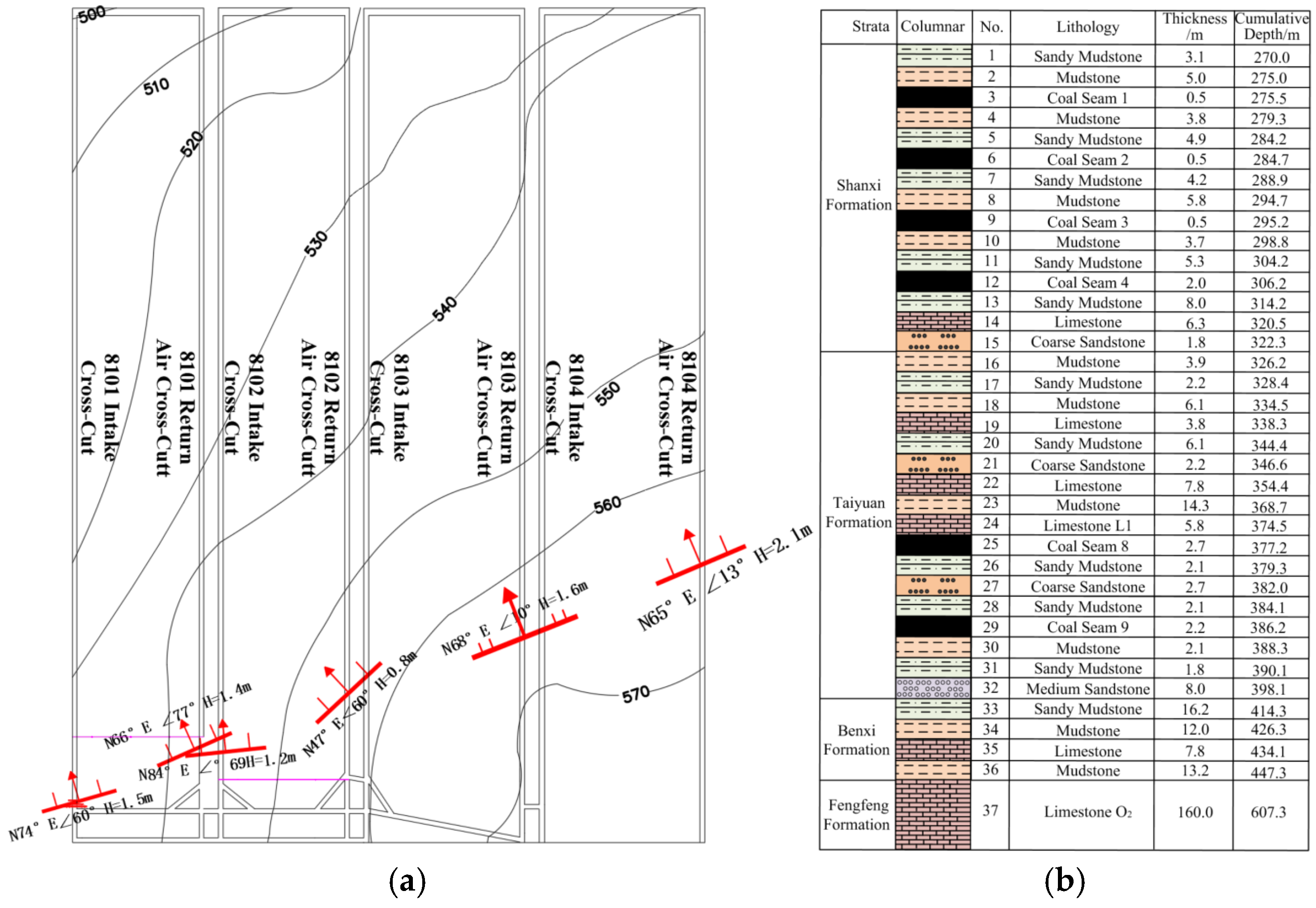
To examine the mechanism of floor lagging water inrush induced by the activation of minor faults, the mining and hydrogeological circumstances of the 8101 working face are employed as the engineering environment, illustrated by the whole histogram of the 8101 working face in
Figure 1.
The working face of the 8101 is 787 m long and 146 m wide. In a monoclinic shape, the coal seam usually dips to the northwest. The thickness ranges from 2.00 to 3.10 m, with an average of 2.65 m. The angle of the dip ranges from 2 to 8 degrees, with an average of 5 degrees. The working face is between 346 and 397 m below the surface. The coal seam structure is straightforward, its occurrence is consistent, and the mining method employed is full-height primary mining. The northern part of the working face is the security coal pillar for the mining border. The southern part has the roads for transporting and returning air to the No. 8 coal mining region. The western part is the mine’s security coal pillar, the eastern part is solid coal, and the lower part has solid coal from the No. 9 coal seam. The adjacent surface primarily consists of agricultural area, characterized by a steep terrain and well-developed valleys, facilitating the drainage of surface water. The area has residential residences, cave dwellings, and additional structures, devoid of any water bodies. The elevation varies from 836.8 to 990 m, with a mean of 913.8 m. The working face of the coal seam floor is between 530 and 593 m high, with an average height of 561.5 m.
The coal seam is 70.2 m away from the limestone aquifer of the Middle Ordovician Fengfeng Formation (O2f). The water pressure there is 3.0 MPa, whereas the water pressure at the base of the No. 8 coal seam is 2.3 MPa. The Fengfeng Formation (O2f) limestone aquifer has a water level of +798 m, an inflow (injection) water volume of 0.0010 to 0.5178 L/s·m, and a permeability coefficient that ranges from 0.013 to 0.7139 m/d. The aquifer demonstrates inconsistent water availability, ranging from weak to moderate levels.
The bottom of the Upper Carboniferous Taiyuan Formation (C3t) consists of the K1 medium-grained sandstone, with an average thickness of 8 m. It is located 35 m from Coal Seam No. 8, with a water level elevation of +760 to +766 m. The specific yield ranges from 0.0151 to 0.1 L/s·m, and the permeability coefficient ranges from 0.0690 to 0.2644 m/d. It is classified as an aquifer with weak water abundance and poses no threat to the mining of Coal Seams No. 8 and No. 9.
3. Numerical Simulation of Water Inrush Delayed by Activation of Small Fault in Floor
3.1. Fluid–Solid Coupling Numerical Simulation Principle
FLAC3D is a program that simulates three-dimensional finite differences. For numerical simulation, the finite difference approach is used. In the engineering challenges of coal seam mining and roadway excavation, numerical solutions that fulfill the equilibrium equations, geometric equations, constitutive equations, and boundary conditions are determined. The software can mimic the discontinuous nature of different material properties at multiple interfaces, which is a good way to simulate how tiny faults are activated during mining operations at the working face.
Roof and floor stress fields will balance during coal seam extraction. A new equilibrium will change the coal seam floor, rock layer, and high-pressure water penetration pathways and mechanisms. In order to simplify the permeability coefficient model of a small fault fracture zone, the piecewise linear function is used to express the change in permeability coefficient at different volumetric strain stages.
Kf stands for the minor fault fracture zone’s permeability coefficient, Kf0 for the minor fault fracture zone’s initial permeability coefficient, a and b for the coefficients obtained from experimental fitting, the value of coefficient a is −5000, εv for the volumetric strain, and εv0 for the minor fault fracture zone’s initial volumetric strain.
The rock strata except small faults adopt the trilinear strain softening constitutive model, and the cohesion remains unchanged at the initial value in the linear elastic stage, while it decreases linearly from the initial value to the residual value in the strain softening stage, and remains unchanged in the residual stage. The permeability models of different rock strata except small faults are defined as isotropic permeability models. However, considering that the rock will expand and fail in the strain softening stage, Equations (1) and (2) are used to dynamically adjust the rock porosity
n and permeability coefficient
k.
The model has four kinds of boundary conditions: given pore water pressure, set the velocity component of the outer normal direction of the boundary, permeable boundary and impermeable boundary. Among them, the upper boundary of the model is a permeable boundary, and the boundaries around the model are impermeable boundaries. The fault zone is modeled as a hydraulic connection channel between the aquifer and the overlying strata, allowing bidirectional flow according to its permeability evolution. The interface between the aquifer and the fault zone uses a pressure–displacement coupled boundary condition, enabling the pore pressure and deformation to be exchanged during calculation.
The FLAC3D integrated FISH language is employed to dynamically implement alterations in the mechanical properties and permeability coefficients of minor fault fracture zones and adjacent rock formations. The exact procedures are as follows: (1) set the model’s calculation time step to 50 so that the volume strain for every model unit is automatically retrieved; (2) use formulae 1–3 to dynamically modify the porosity and permeability coefficient values in each model part. The following step will be automatically excavated until the mining model of the entire working face reaches 160 m. Continue repeating steps 1 and 2 until the stress and seepage fields of the minor fault and nearby rock are balanced.
3.2. The Establishment of Numerical Model
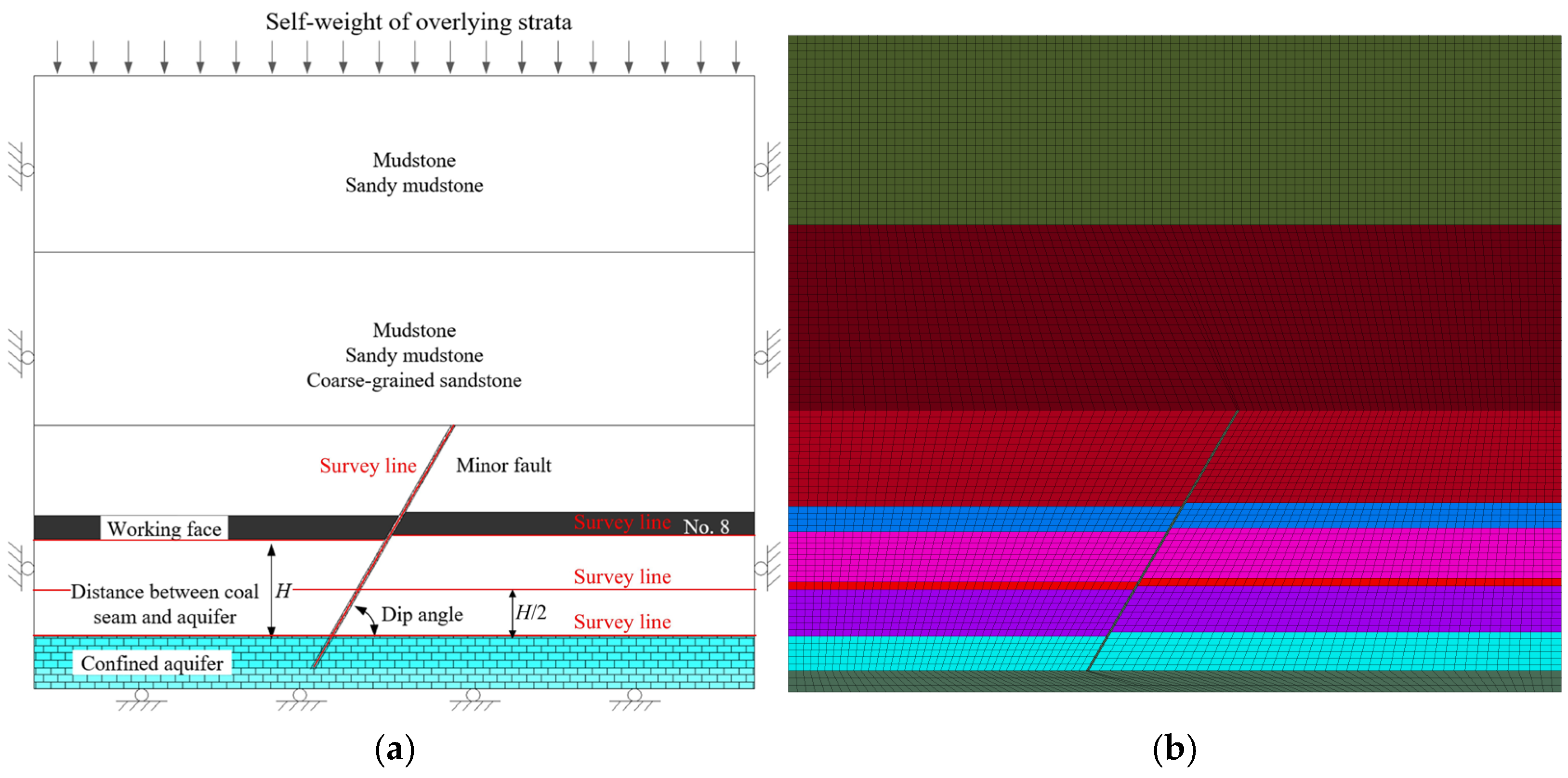
The distribution map, minor faults, and hydrogeological data serve as the foundation for the physical conceptual model, whilst the test working face serves as the basis for the numerical model. A representative section is used as the modeling foundation to ensure that the model appropriately represents geological conditions and coal mining operations. Subsequently, a FLAC3D fluid–solid coupling numerical model for coal mining, incorporating minor faults, is developed, as illustrated in
Figure 2.
The geological coordinate system is used to spatially locate the system during the development of the three-dimensional numerical model: the positive X axis points in the direction of the movement of the coal mine face. The Z axis points in the direction of the vertical bed-ding of the rock layer, while the Y axis points in the direction of the tilt of the working face. This creates a coordinate system that is right-handed. Due to the influence of a minor fault structure, the No. 8 coal seam in the research region displays a little dip angle. The characteristics of a nearly horizontal coal seam are that its mean dip angle is less than 5°. For convenience of analysis, the rock strata in the numerical simulation are laid horizontally. The upper boundary of the model uses a stress boundary condition to accurately depict the stress state of deep rock strata. An equal compensatory load is applied based on the self-weight stress calculation of the underlying rock strata. This treatment procedure adheres to the Saint-Venant principle and can successfully mitigate the impact of boundary effects. The total displacement constraint is applied at the model’s base, while the lateral boundary employs the normal displacement constraint, so accurately defining the numerical solution domain in accordance with the actual geomechanical environment.
The numerical model’s boundary conditions are defined as follows: displacement is restricted to zero in both horizontal and vertical directions; the model’s lower boundary maintains zero displacement, while the upper boundary is designated as free to simulate actual stratum constraints. The fault consists of two crack edges with a spacing of 0.6 m. The space between the crack edges is filled with filler material, and contact surfaces are established between the crack edges and the zone elements. In our model, the “fracture zone width” refers to the area surrounding the minor fault where the material properties—especially permeability—are adjusted to simulate the behavior of fractured rock. This region does not represent actual crack faces in the coal seam but rather a band with modified physical and mechanical characteristics to reflect the fractured nature of the fault zone. The space between these “crack faces” in the model is filled with a material that simulates fractured rock, and the parameter values of this material are shown in
Table 1. The hydrostatic pressure of the Ordovician limestone at the base is around 3.0 MPa, and the average thickness of the eight coal seams is 2.7 m. The dimensions of the model are 170 m high, 200 m long, and 100 m broad. Sand clay, mudstone, coarse sandstone, coal, sandy mudstone, and limestone are all included in declining order from the perspective of model generality.
3.3. Scheme of Numerical Simulation
Examining the process of floor lagging-induced water inrush when the mining face crosses small faults inside a constrained aquifer is the goal of numerical modeling. Four criteria have been identified as the subjects of investigation based on the study elements discussed in the preceding chapters: aquifer water pressure, minor fault angle, narrow fault fracture zone width, and aquifer proximity to the coal seam bottom. The simulation is conducted for the No. 8 coal seam. The mining sequence progresses from left to right, commencing at a position 75 m from the fault. To investigate the vertical displacement and stress progression of the floor during coal seam extraction and seepage, horizontal monitoring lines were implemented in the coal seam floor, aquifer ceiling, and above the aquifer. Each survey line elucidates the multi-field coupling response characteristics of various layers affected by mining through the real-time collection of vertical displacement, main stress, and pore water pressure data. Moreover, by situating survey lines at different altitudes within the minor fault fracture zone, one can analyze the variations in internal water pressure within the small fault during the progression of the working face. A survey line was established along the fault dip direction, located in the middle section of the fault, to monitor changes in fault pore-water pressure and the vertical stress state throughout the entire excavation period. The open-off cut begins 20 m from the left boundary, and excavation is then carried out in compliance with the working face’s specified step distance. Before crossing the fault, 20 m of excavation is done at each stage; after crossing the fault, the excavation is changed to 10 m at each step until a total of 160 m of mining is completed.
Scheme 1: The influence of minor fault angles on the activation and permeability of small faults in the substrate is analyzed. The angles of minor faults are determined to be 50°, 55°, 60°, 65°, and 70°, respectively.
Scheme 2: It is examined how the width of minor fault fracture zones affects the floor’s small faults’ activation seepage. The minor fault fracture zone’s widths are found to be 0.2, 0.4, 0.6, 0.8, and 1.0 m, respectively.
Scheme 3: Analysis is done on how aquifer water pressure affects the activation and infiltration of tiny faults in the ground. The aquifer’s water pressure is set at 1 MPa, 2 MPa, 3 MPa, 4 MPa, and 5 MPa, in that order.
Analysis is done on how aquifer water pressure affects the activation and infiltration of small faults in the ground. The aquifer’s water pressure is set at 1 MPa, 2 MPa, 3 MPa, 4 MPa, and 5 MPa, in that order.
In this study, a representative longitudinal section was selected to establish the numerical model. This simplification is based on detailed geological and hydrogeological data, which indicate that the strata distribution, coal seam dip, and fault geometry are relatively uniform along the strike of the 8101 working face. Field investigation and borehole data confirm that no significant secondary faults or lithological variations occur within the studied segment. Therefore, the selected section can effectively reflect the typical mechanical and seepage behaviors of the coal seam floor under mining disturbance. Although the simplification to a single section may not capture local heterogeneities along the strike, it provides a reliable basis for understanding the general evolution pattern of fault activation and delayed water inrush.
4. The Influence of Small Faults on the Movement of Floor Strata in Coal Seam Mining
4.1. The Evolution Law of Displacement Field Under Different Propulsion Distances
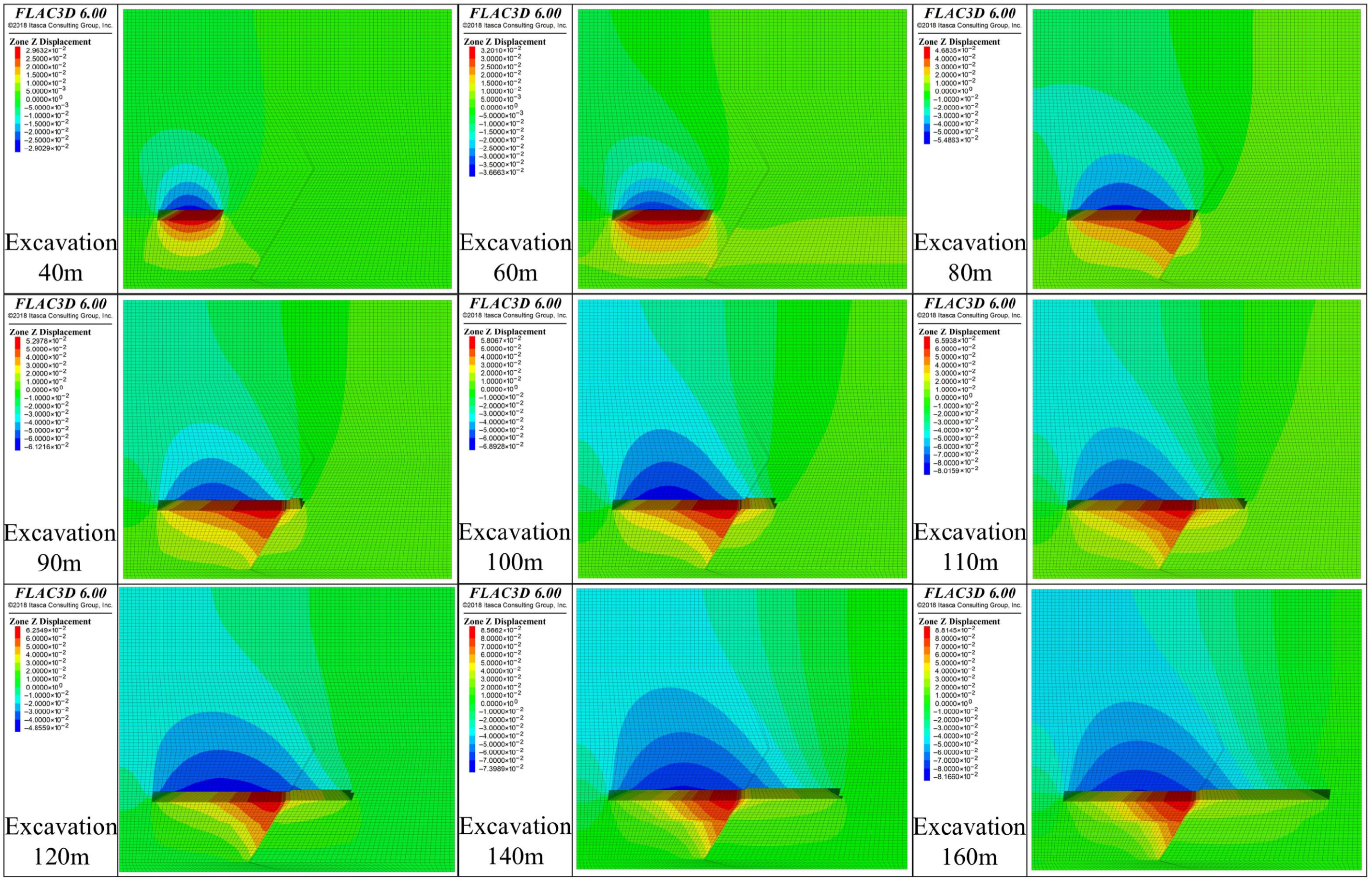
The evolution of the floor displacement field corresponding to different working face advancing distances is shown in
Figure 3. The continuity of deformation in the coal seam floor layers is impacted by discontinuous deformation that happens in the upper and lower plates of minor faults during mining operations at the working face. The coal seam floor exhibits a continuous arching distortion in its deformation prior to the working face crossing the tiny fault. The coal seam floor exhibits discontinuous distortion upon excavation of the working face to the fault, with the hanging wall of the minor fault experiencing more deformation than the footwall. The hanging wall’s deformation increases as the working face slowly withdraws from the minor fault, and the footwall’s deformation, which is impacted by mining activities, also increases; however, the overall deformation is still less than that of the minor fault’s hanging wall.
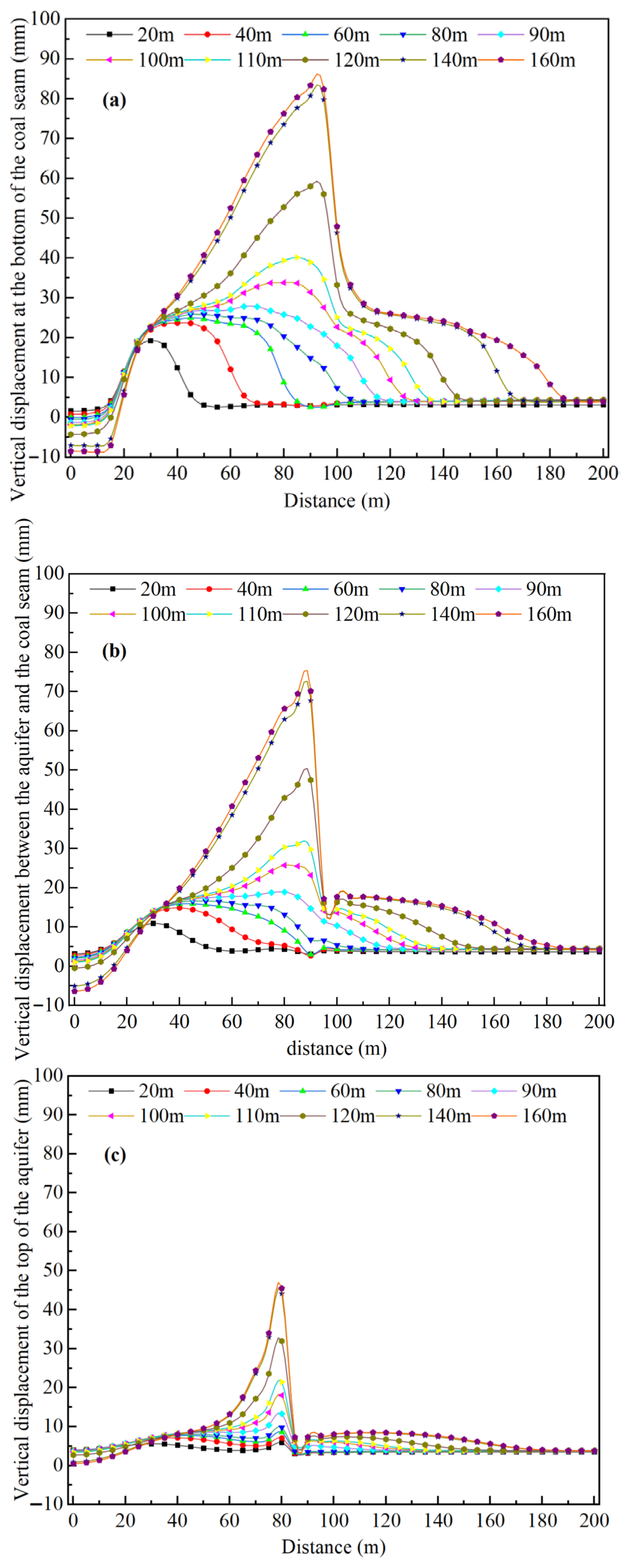
The displacement curve of the floor strata across numerous layers influenced by minor faults is produced by placing displacement survey lines at the base of the coal seam, the midpoint of the aquifer, the coal seam itself, and the uppermost section of the aquifer, as shown in
Figure 4. The heave deformation of the coal seam floor remains rather consistent as the working face advances to 90 m, as shown in
Figure 4a. No significant deformation is found in the upper or lower plates at the minor fault site. When the working face moves to 100 m, the deformation from the minor fault displacement exceeds that of other regions at the coal seam’s base. The maximum deformation is 27.8 mm. The difference between the deformation at the minor fault site and the deformation at other places along the base of the coal seam becomes more pronounced as the working face moves forward. The deformation of the minor fault displacement develops significantly as the working face is advanced to 120 m, reaching a maximum deformation of 58.0 mm with a 19.1 mm increment. The highest deformation at the minor fault site is measured at 83.3 mm at a working face progress of 160 m. The displacement curve of the coal seam’s intermediate layers and the aquifer in
Figure 4b shows that, although the deformation magnitude is less, the deformation trend of the middle strata and the aquifer both mirrors that of the coal seam’s base. The maximum deformation at the minor fault locati0n, measured at 70.1 mm during the working face excavation to a depth of 160 m, differs from the maximum deformation at the base of the coal seam by 13.2 mm. The displacement curve of the aquifer’s apex in
Figure 4c shows that the deformation of minor faults and surrounding rock is insignificant, as is the deformation in other places, because of aquifer water pressure and mining disturbances. Due mostly to the minor fault’s upper plate’s substantial upward movement, the minor fault’s largest vertical displacement, measured at 44.1 mm, is recorded after the working face has advanced to 160 m.
The gradual increase in displacement as the excavation face approaches the fault is mainly attributed to stress redistribution and the mechanical weakening of the rock mass within the fault zone. When the working face advances toward the fault, the overburden and abutment stresses tend to concentrate near the fault interface, resulting in intensified deformation of the surrounding rock. Since the fault zone generally exhibits lower stiffness and strength compared to the intact rock, it responds with larger displacements under the same loading conditions. Once the excavation face crosses the fault, part of the accumulated stress is released and transferred to the rock mass on the opposite side, leading to a reduction in displacement. In essence, the fault behaves as a mechanical discontinuity that amplifies deformation when approached and attenuates it after being crossed, due to its dual role in concentrating and dissipating stresses.
To quantitatively evaluate the potential hazard level, the maximum uplift and deformation of the floor were compared with empirical floor failure and water-inrush criteria reported in previous studies. According to existing research, the critical uplift of the floor aquiclude that may lead to hydraulic connection generally ranges between 80 mm and 120 mm, while the maximum depth of aquiclude failure is commonly considered to be 6–8 m under similar geological conditions [
10,
11]. In this simulation, the maximum vertical deformation at the bottom of the coal seam reached 83.3 mm, and the corresponding maximum failure depth was approximately 6.5 m, which is close to, but does not exceed, the empirical threshold for hydraulic breakthrough. This suggests that under the current mining and aquifer pressure conditions, the system approaches a potentially hazardous state, and a small increase in water pressure or fault width could trigger water inrush.
In this study, the focus was on the mechanism of fault activation and floor water inrush, rather than on reproducing large-scale roof collapse. The roof and floor were represented as a continuous elastic–plastic medium, and the overlying strata were truncated to reduce computational complexity, which constrained overall subsidence. Consequently, the model mainly captures stress redistribution and seepage evolution trends rather than the full-scale deformation magnitude.
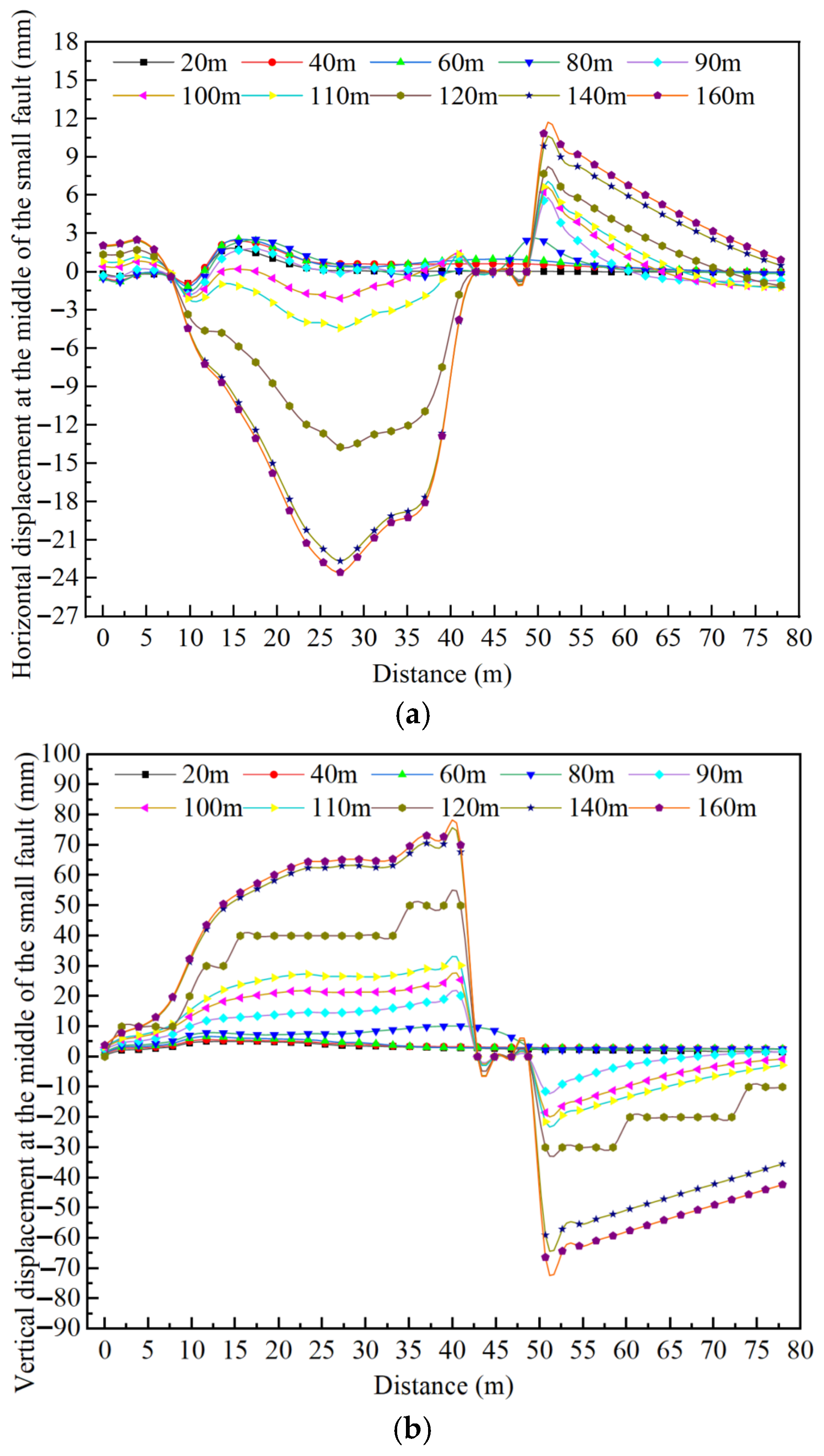
The horizontal and vertical displacement curves within the minor fault are created as the working face progresses by placing the displacement survey line at the center of the minor fault, extending from the aquifer to the base of the coal seam, as shown in
Figure 5. The upper and lower plates of the minor fault are squeezed as a result of in situ stress from mining operations, as shown by the horizontal displacement curve of the center portion of the fault in
Figure 5a. The lower segment of the minor fault has experienced leftward extrusion deformation due to the extraction at the working face, with a maximum distortion of 23.6 mm. The little fault’s upper portion exhibits a maximum extrusion deformation of 10.8 mm to the right. The lower portion shows vertical upward extrusion deformation, while the higher segment shows downward extrusion deformation, according to the vertical displacement curve of the minor fault’s core region in
Figure 5b.
The non-linear variation in both horizontal and vertical displacements within the minor fault (
Figure 5a,b) is primarily governed by the stress redistribution and mechanical response of the weak fault zone during excavation. When the working face advances from 20 m to 40 m, the stress concentration ahead of the face induces compressive deformation in the fault center, leading to horizontal contraction and vertical expansion. Between 40 m and 48 m, the local stress field becomes balanced due to partial stress release and redistribution, resulting in nearly zero displacement. As the excavation continues beyond 48 m, unloading of the fault zone allows lateral expansion and vertical contraction, until the deformation gradually decreases near the fault boundary (around 75 m) due to boundary constraints and stress transfer to the surrounding intact rock.
This non-linear deformation behavior reflects the combined effects of stress concentration, fault-zone weakening, and boundary constraint. The reliability of these simulation results is supported by the consistency of the deformation pattern with previous numerical and experimental studies on excavation–fault interactions, as well as by the validated mechanical parameters and boundary conditions adopted in the model.
4.2. The Evolution Law of Stress Field Under Different Advancing Distances
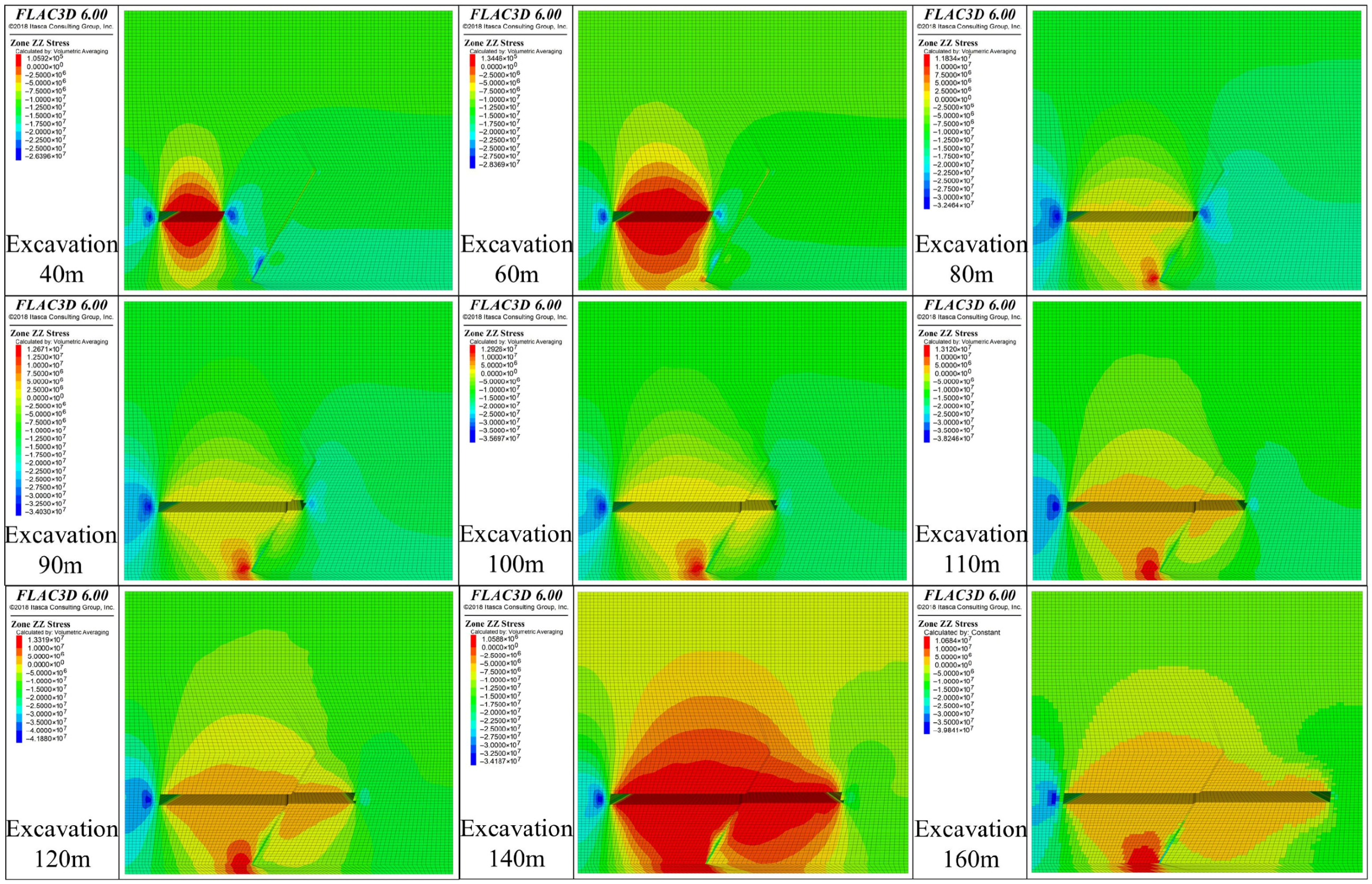
The floor stress field’s dynamic evolution at various working face advancing distances is shown in
Figure 6. Small flaws drastically alter the distribution pattern of the floor stress field by decreasing stress transmission interfaces. Stress concentration takes place in the lower regions of small faults during mining operations at the working face, and these faults partially obstruct stress transport. Stress concentration occurs at the interface between the minor fault and the aquifer when the working face progresses to 60 m because the minor fault is directly beneath it. The problem of stress concentration is made worse by the ongoing development of the working face.
Clear stress nephograms in the upper and lower fault plates are seen after the working face has advanced to 110 m and penetrated 30 m into the tiny fault. The extent of the floor and roof is wider, and the stress on the minor fault’s upper plate is more concentrated.
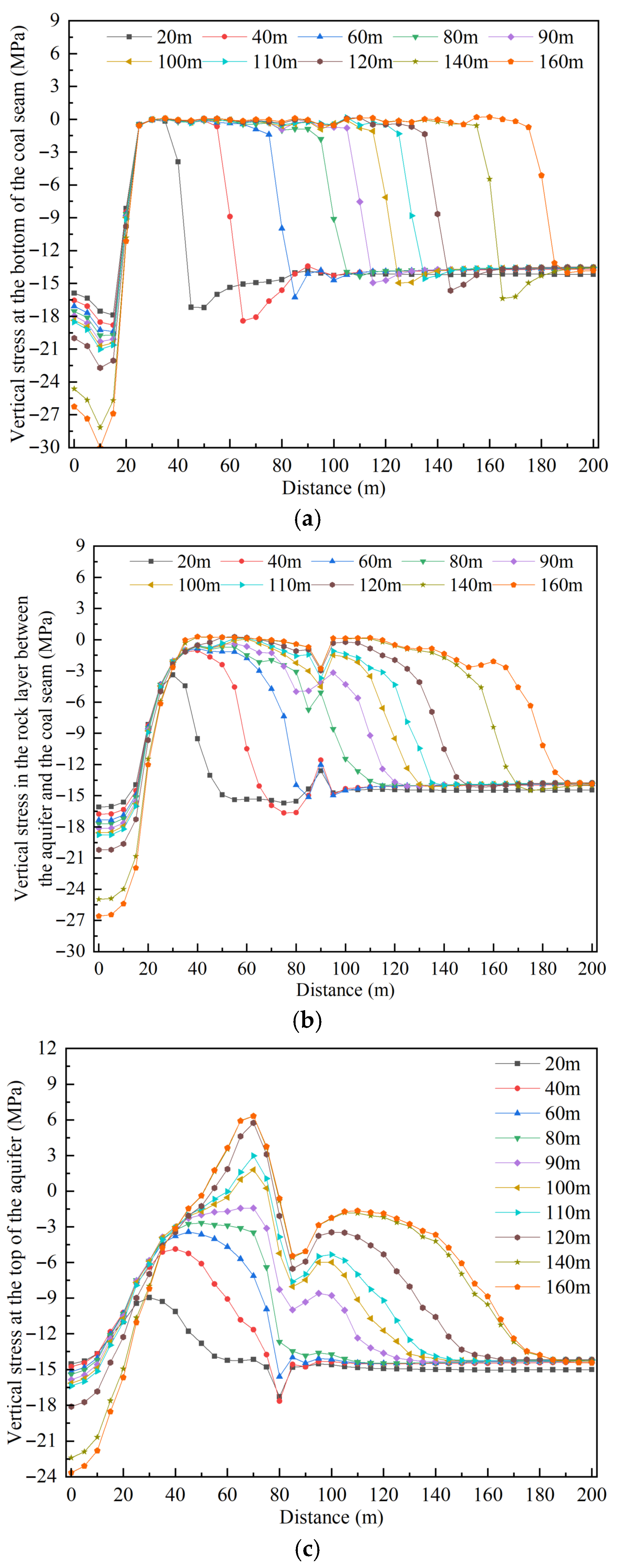
In order to get the stress variation curves of the floor strata across numerous levels influenced by minor faults, stress measurement lines are positioned at the base of the coal seam, between the aquifer and the coal seam, and at the higher boundary of the aquifer, as shown in
Figure 7. The advance abutment pressure first increases and then decreases before the working face approaches the minor fault, as shown by the vertical stress variation curve at the base of the coal seam in
Figure 7a. The advance abutment pressure approaches the initial rock stress at 80 m as the working face advances; the advance abutment pressure progressively rises as the working face gets farther away from the minor fault. As mining progresses at the working face, the floor stress of the goaf rapidly decreases, with the surrounding rock stress dropping to 1% of its starting value, as shown by the vertical stress variation curve of the aquifer and the intermediate rock layer of the coal seam in
Figure 7b. The tiny fault’s internal stress was lower than that of the nearby rock strata before mining operations disturbed it. The internal tension in the minor fault is also reduced after the mining disruption. After release, stress levels are higher than those seen above the goaf, remaining at 22% of the initial level. The effect of stress concentration on the narrow fault fracture zone could be the main contributing factor. The base of the minor fault’s hanging wall experiences downward vertical stress prior to the advance, as shown by the vertical stress change curve at the aquifer’s apex in
Figure 7c. This shows a notable concentration of stress at the minor fault that exceeds the initial stress of the surrounding rock. The tension at the base of the minor fault’s hanging wall is released as the working face moves forward, and this tension is transformed into an upward vertical stress.
The variation in vertical stress observed in
Figure 7a–c results from the combined effects of stress redistribution, fault-zone weakening, and local unloading–reloading during excavation. When the working face is far from the fault (before 20 m), the overburden stress is mainly borne by intact rock, producing higher compressive stresses (up to −15 MPa). As the excavation approaches the fault, the stress concentration ahead of the face is partially transferred to the surrounding rock, while the fault zone—characterized by lower stiffness and cohesion—cannot sustain the same load, leading to a reduction in vertical stress and even locally tensile (positive) values near the fault interface. After the face crosses the fault, the stress gradually stabilizes as the rock mass on the other side takes over the load-bearing function.
The nonlinear distribution of σ-v is consistent with the classical stress redistribution theory around discontinuities and excavations [
22], where regions of stress concentration and unloading alternate depending on excavation progression and material heterogeneity. The fault thus acts as both a stress-relief and stress-transfer boundary, significantly influencing the vertical stress evolution during the excavation process.
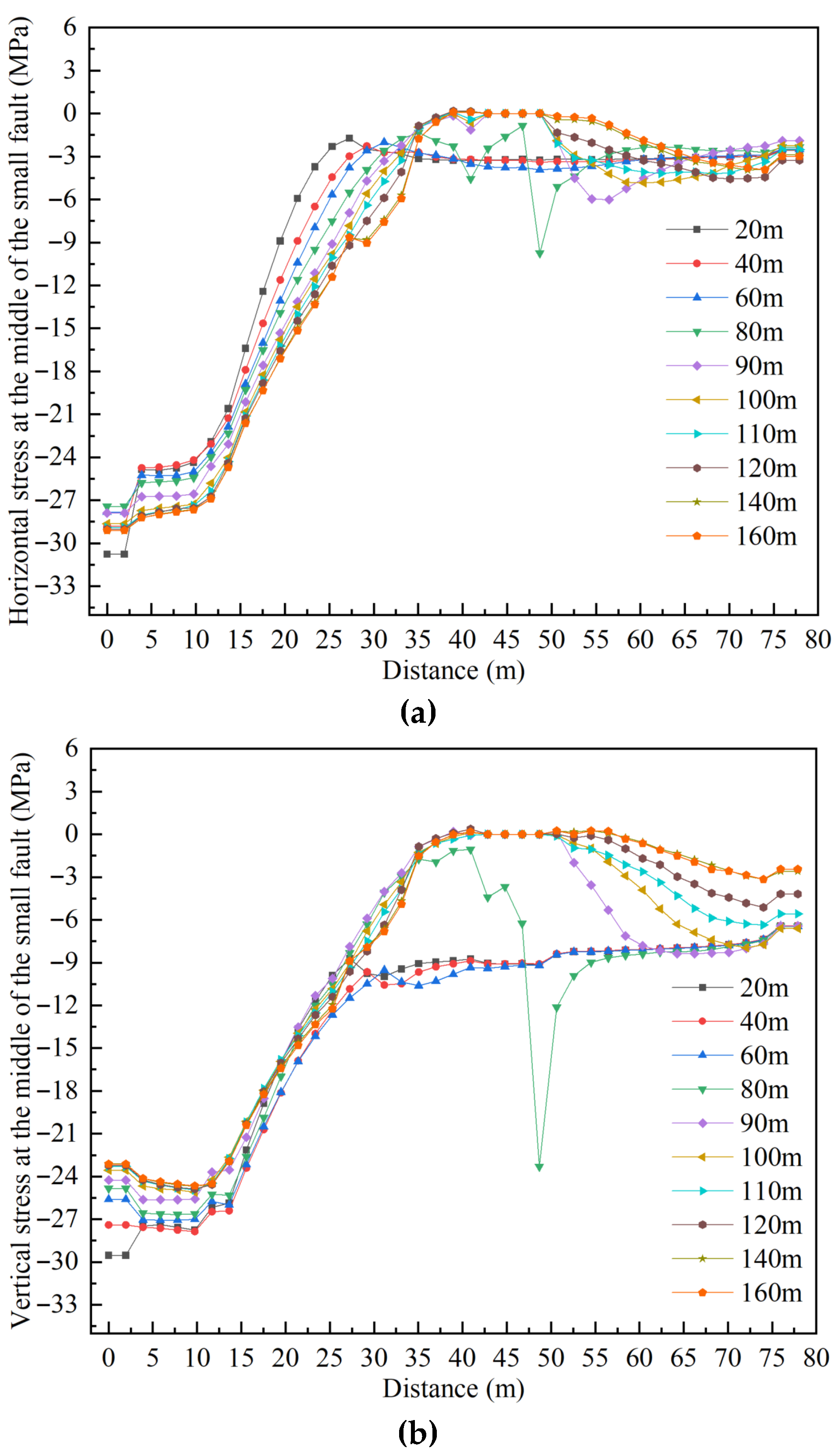
The variation curves of horizontal and vertical stress within the minor fault are acquired while the working face continuously progresses by carefully placing the stress measurement line within the minor fault, extending from the aquifer to the base of the coal seam. As seen in
Figure 8, increased stress is linked to a more restricted fault fracture zone in the initial condition. As the working face progresses, mining disturbances cause the horizontal tension in the lower segment of the minor fault fracture zone to grow, while the top horizontal stress keeps decreasing (
Figure 8a). According to the vertical stress curve in
Figure 8b, mining disturbances have very little effect on the vertical stress in the lower portion of the fracture zone, showing just a slight decrease. On the other hand, after mining disruption, the vertical stress in the upper part of the fracture zone significantly decreased and showed distinct signs of stress release.
Compared with a continuous and intact floor formation, the presence of a small fault significantly modifies the stress distribution and redistribution during coal seam extraction. In a continuous formation, the advance abutment pressure and the stress-relief zone typically form a symmetrical pattern around the mined-out area, and stress transmission to deeper strata remains relatively smooth. In contrast, when a small fault exists, the fault plane acts as a mechanical discontinuity that partially blocks stress transfer. The stress accumulates at the hanging-wall side of the fault, while the footwall side experiences premature stress release and tensile deformation. This asymmetric stress redistribution promotes shear-tensile failure and dilation within the fault fracture zone, thereby increasing its permeability.
In the simulation, the fracture was modeled as a weak zone with reduced normal and shear stiffness rather than a fully open joint. The study line shown in
Figure 8a,b was placed along the wall of the minor fault to examine the stress variation in the adjacent rock mass. The observed non-linear distribution of both vertical and horizontal stresses is mainly controlled by the stress redistribution and mechanical weakening around the fracture zone.
When the excavation face approaches the fault, the stress concentration develops at the intact rock near the fault boundary, while stress relaxation occurs within the weak zone, leading to a gradual reduction in stress magnitude and the appearance of a nearly zero-stress region between 40 and 55 m. This zone represents the transition between the compressive field of the intact rock and the low-stress domain of the fault gouge. As the excavation proceeds beyond the fault, the stress is re-transferred to the rock mass on the opposite side, restoring compressive equilibrium.
The observed pattern agrees with classical elastic-plastic stress redistribution theory [
22], which predicts alternating zones of stress concentration and relaxation around discontinuities and weak interfaces. Therefore, the fracture significantly alters the local stress field by acting as a stress-relief and stress-transfer boundary during excavation.
4.3. The Evolution Law of Plastic Zone Under Different Advancing Distances
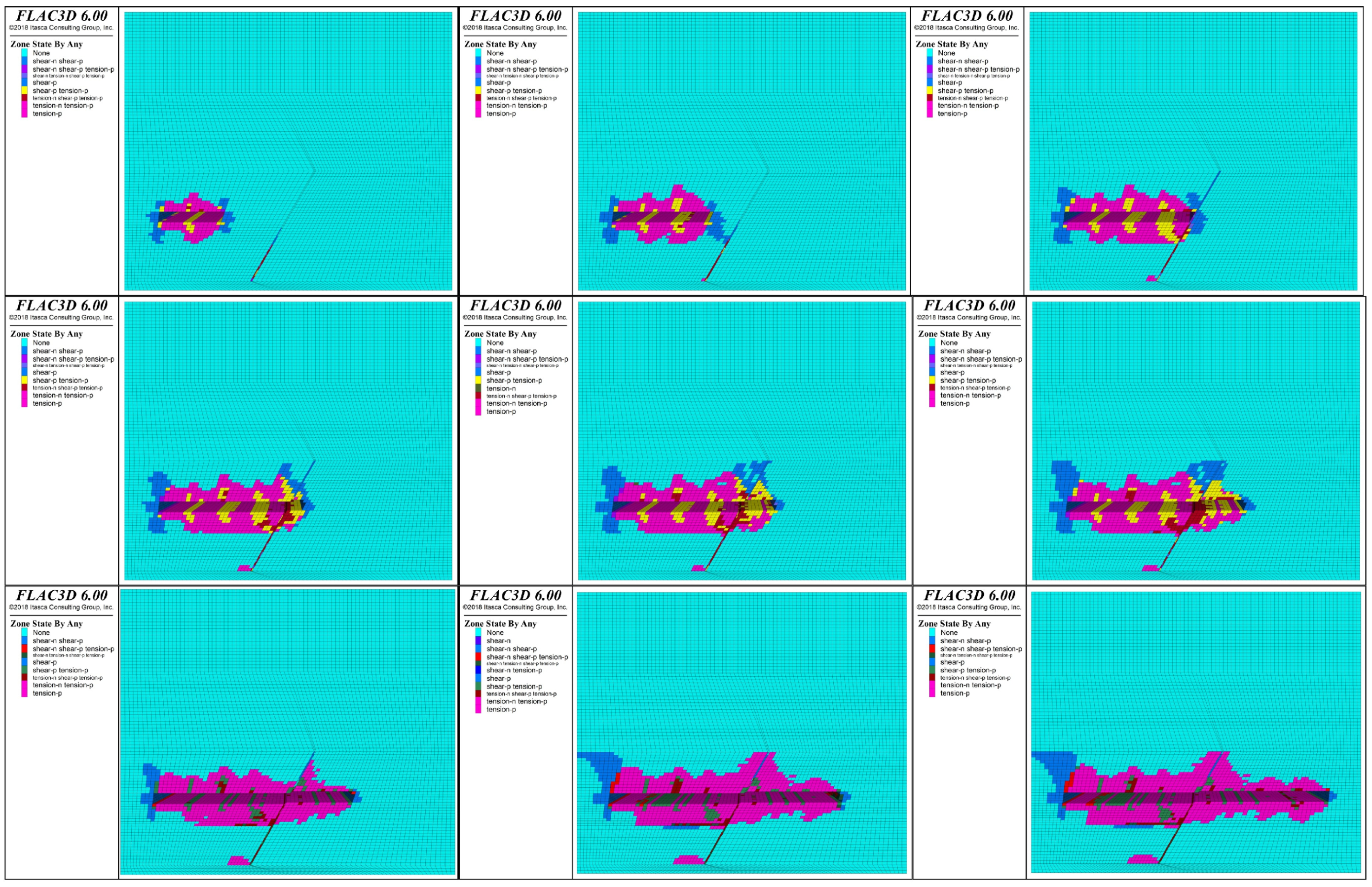
The evolution of the floor’s plastic zone as the working face advances is illustrated in
Figure 9. The study indicates that tensile failure first appears at the base of the hanging wall and continues to expand throughout the mining process, suggesting that fault damage induced by mining initiates at the base and gradually propagates upward. When the working face advances to 40 m, a tensile–shear composite failure occurs at the base of the minor fault fracture zone. At 60 m, the plastic zone rises and penetrates the forward shear failure zone of the floor. When the working face advances to 80 m, the development depth of the plastic zone at the coal seam floor reaches its maximum. Therefore, as mining progresses, the plastic zone at the base of the minor fault continues to expand, although the degree of failure does not further intensify.
4.4. The Evolution Law of Seepage Field Under Different Advancing Distances
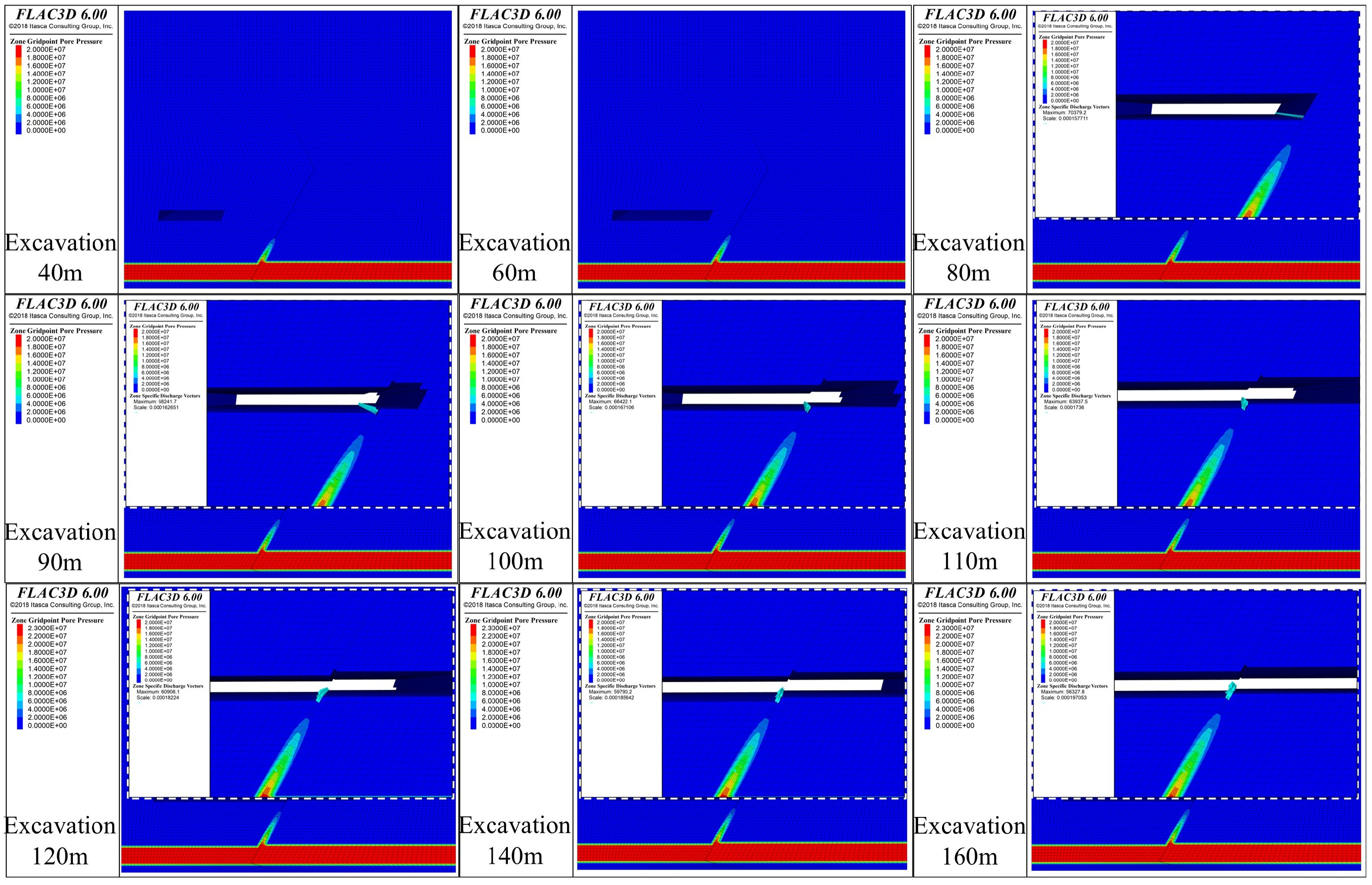
The evolution of the floor seepage field corresponding to various working face advancing distances is shown in
Figure 10. According to the diagram, water from the restricted aquifer in the coal seam floor rises through the minor fault fracture zone as the working face moves forward, increasing the pore water pressure’s effect height. The highly contained water in the coal seam floor is still unable to pass through the small fault fracture zone even after the working face has been extended to 60 m, therefore mining activities are unaffected. At 80 m, the minor fault becomes exposed, exhibiting indications of high-pressure water infiltration. When the working face reaches 120 m, significant high-pressure water infiltration is evident at the minor fault location, signifying that the confined water of the floor has breached the small fault fracture zone barrier, establishing a stable water conduit through the minor fault of the floor.
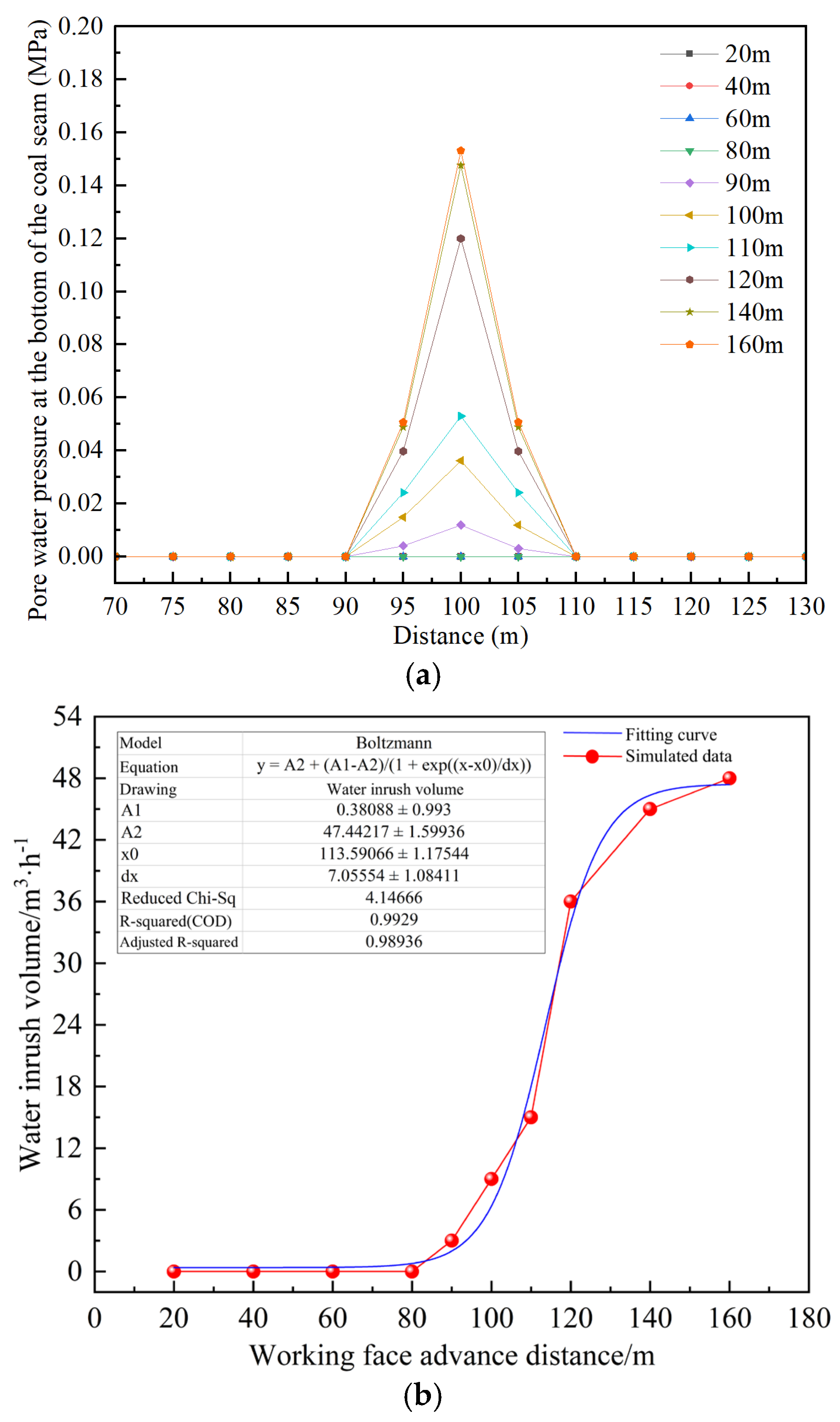
The midpoint of the minor fault and the base of the coal seam are where the pore water pressure measuring line is situated.
Figure 11 illustrates how variations in water influx at the floor and working face across a range of advancing distances are recorded by tracking the cumulative node imbalanced flow at the minor fault site on the working face floor.
Figure 11a illustrates how the effects of mining and the elevated confined water level of the floor activate the minor fault as the working face progresses. The pore water pressure at the small fault point at the base of the coal seam grows progressively as the working face progresses to 120 m. The pore water pressure at the tiny fault location at the base of the coal seam rises quickly as the working face advances to 140 m. The rise in pore water pressure is minimal as the working face reaches 160 m. Three stages of water inrush variation occur as the working face progresses, as shown in
Figure 11b: no water inrush, increasing water inrush, and stable water inrush. The small flaw is visible after the working face has advanced 80 m, and there is still no water inrush on the working face. The pace of water influx is rising as the working face moves forward. The water influx pathway of the floor’s minor fault is effectively established when the working face moves away from the minor fault, as the rate of increase in water influx volume decreases and approaches stability. The water influx rate at the working face reaches 36 m
3/h after it crosses the minor fault by 40 m. The water intake at the working face will continue within a certain range as long as the aquifer’s water pressure and volume remain constant.
In the numerical model, the minor fault is located between 75 m and 115 m, with its center at approximately 95 m. When the excavation face advances to around 80 m, the influence of the fault zone begins to appear, as the stress relief and increased permeability in the surrounding rock allow early signs of water infiltration. However, the fault is not fully intersected until the face reaches approximately 95–100 m, at which point the confined water pressure beneath the floor rapidly transmits through the weak zone, leading to a sharp rise in pore pressure (
Figure 11a).
The delayed increase in water inflow volume (
Figure 11b) observed at 110–120 m is attributed to the gradual formation of a continuous hydraulic channel within the fault zone. Once the face passes the fault and connects the aquifer with the excavation front, the confined water breaks through the fracture barrier, resulting in a stable seepage conduit. The minor discrepancy at 90 m, where water inflow occurs without a significant pore pressure increase, reflects localized seepage through microcracks and does not indicate complete hydraulic connection.
To verify the realism of the simulated inflow, the modeled steady-state discharge rate of 36 m
3/h was compared with field data and reported inflow magnitudes for similar mining and hydrogeological settings. According to Dong F et al. [
13] and Wang Q et al. [
14], measured inflow rates associated with minor-fault activation in Ordovician limestone aquifers of Henan coal mines typically range between 20 m
3/h and 60 m
3/h. The simulated value in this study therefore falls within the observed range, indicating that the coupled fluid–solid model reasonably reproduces the actual hydraulic response of the floor. This comparison supports the reliability of the simulation results and validates that the predicted inflow regime corresponds to realistic field conditions.
5. The Influence of Different Main Controlling Factors on the Activation Seepage of Small Faults in the Floor
5.1. The Influence of Fault Angle on the Activation Seepage of Small Fault in Floor
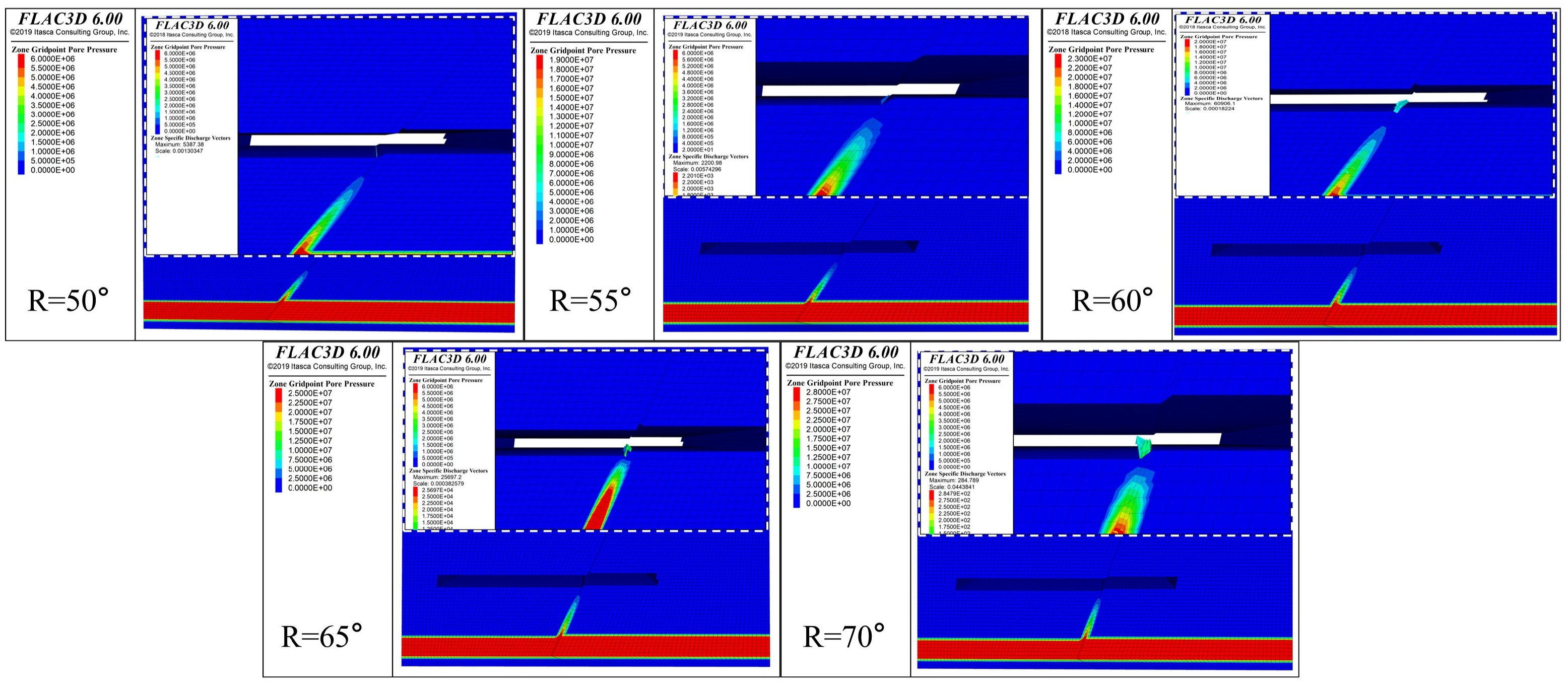
With the aquifer water pressure, the distance between the aquifer and coal seam, and the width of the minor fault fracture zone held constant, this study examines the impact of fault angle on the activation and seepage of minor faults in the floor. The minor fault angles are set at 50°, 55°, 60°, 65°, and 70°, respectively. The differences between each excavation step cannot be compared and examined separately due to the large number of parameters involved in the investigation. To evaluate the impact of coal seam mining on the seepage field of minor faults and surrounding strata, the 120 m advancing face is chosen for a comparison analysis, accounting for small faults with varying angles.
Figure 12 illustrates the impact of a minor fault angle on the seepage field of coal seam mining floors. As the excavation attains a depth of 120 m, the elevation of upward water seepage pressure within the minor fault escalates with the increasing angle of the fault, suggesting that a greater angle correlates with a heightened susceptibility to fault water inrush activation. The force needed to prevent water pressure seepage decreases as the minor fault’s angle increases because the vertical force inside the minor fault fracture zone decreases. This kind of big angle small fault is more vulnerable to water inrush because strong water pressure is more likely to erode the small interstitial material in the small fault fracture zone.
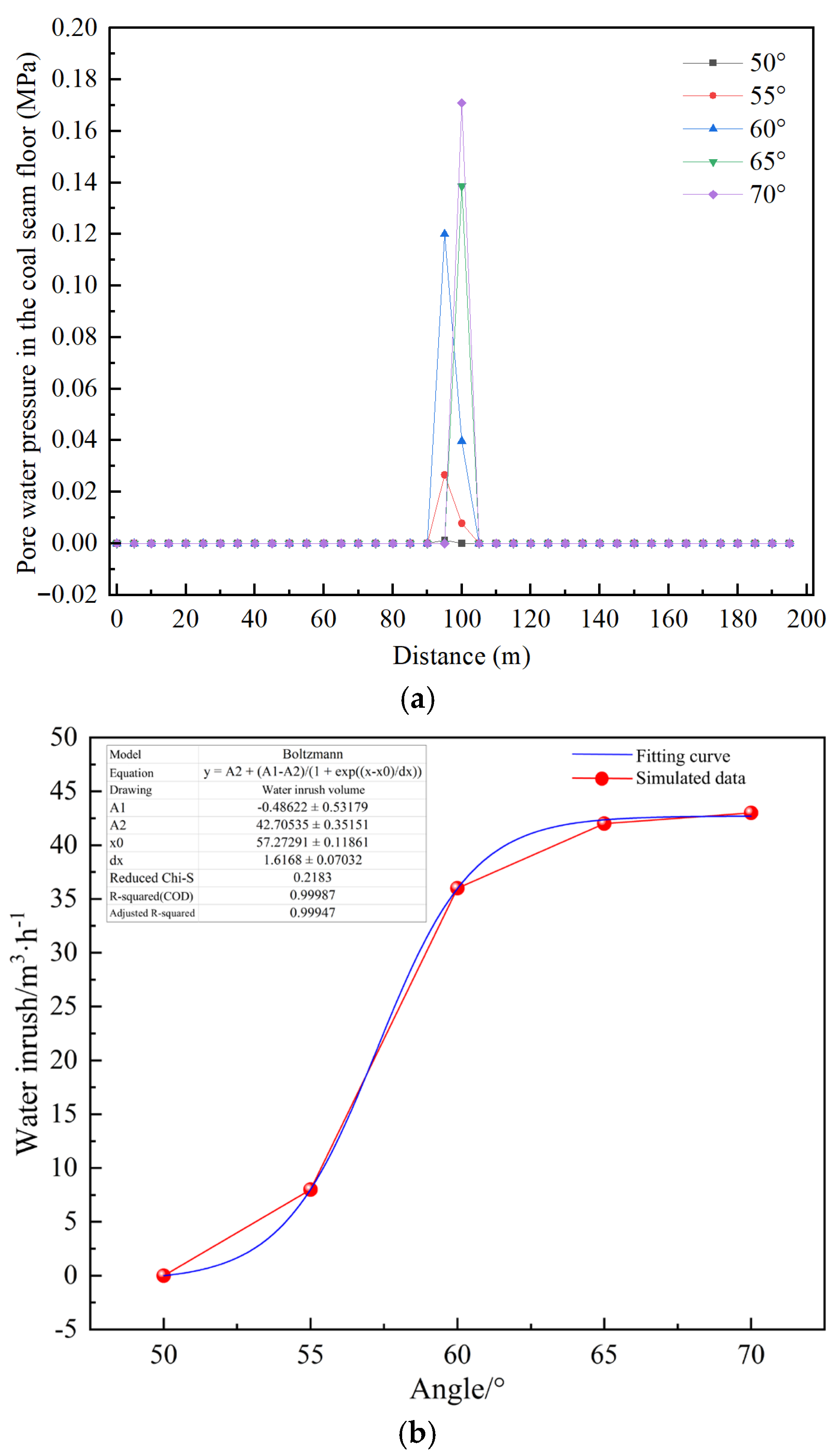
The variations in pore water pressure within the fracture zone at different small fault angles and the working face’s water inrush variation curve are obtained by placing the pore water pressure measurement line at the base of the coal seam and monitoring the cumulative node unbalanced flow at the minor fault site on the working face floor, as shown in
Figure 13. The pore water pressure at the coal seam floor’s minor fault increases with increasing angle, as shown in
Figure 13a. The highest water pressure values are 0.001 MPa, 0.027 MPa, 0.120 MPa, 0.139 MPa, and 0.171 MPa, respectively. The pore water pressure at the coal seam floor’s minor fault significantly increases when the minor fault’s angle is 60° or more. The water inrush volume at the working face is measured at 0 m
3/h, 8 m
3/h, 35 m
3/h, 42 m
3/h, and 43 m
3/h as the minor fault angle increases, as shown in
Figure 13b, which shows a noticeable growing trend in water inrush volume. The Boltzmann equation was used to fit the curve, yielding a 99.9% R2. Water inrush at the working face was found to be related to the small fault angle. The three-stage features of “threshold response-rapid transition-dynamic balance” of water inrush with the change of tiny fault dip angle can be precisely described by the Boltzmann function (S-shaped curve).
The pore pressure in
Figure 13a was measured at the coal seam floor, while the cumulative inflow in
Figure 13b represents the total unbalanced flow at excavation nodes. Hence, minor inflow may occur even when pore pressure remains near zero.
For fault widths of 0.2–0.4 m, the narrow fracture zone cannot form a continuous hydraulic path, resulting in negligible pore pressure rise but slight seepage (~5 m3) from residual water and microcracks. When the width exceeds 0.6 m, fault permeability increases sharply, producing a connected flow channel and rapid growth in pore pressure and inflow.
5.2. The Influence of Fracture Zone Width on the Activation Seepage of Small Fault in Floor
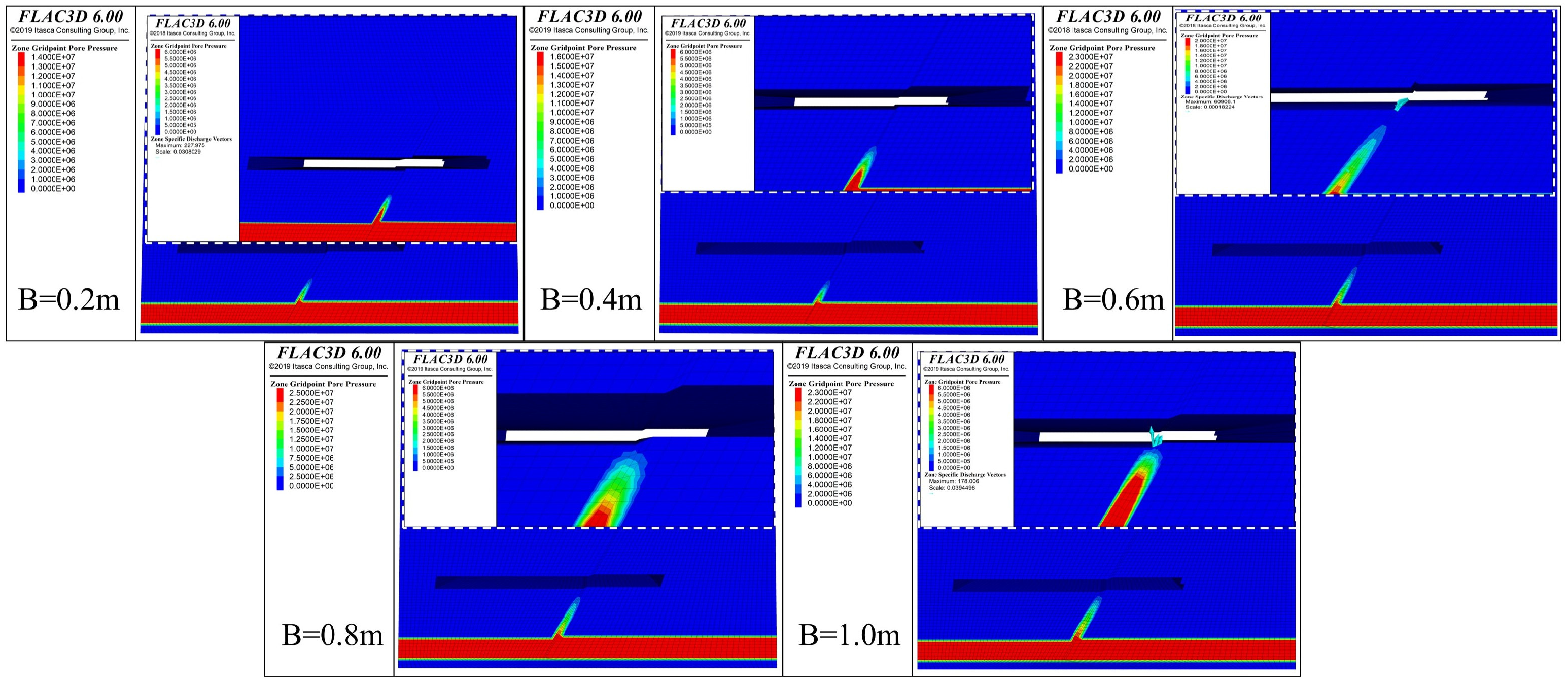
The minor fault angle, the water pressure in the aquifer, and the distance between the aquifer and the coal seam are all kept constant while the fracture zone width is set at 0.2 m, 0.4 m, 0.6 m, 0.8 m, and 1.0 m in order to investigate the effects of fracture zone width on minor fault activation and seepage in the floor. The differences between each excavation step cannot be compared and examined separately due to the large number of parameters involved in the investigation. To investigate the effects of coal seam mining on the seepage field of minor faults and underlying strata across different widths of tiny fault fracture zones, a comparative study is conducted on the 120 m advancing face.
Figure 14 illustrates the impact of the tiny fault fracture zone’s breadth on the seepage field of the coal seam mining floor. Upon reaching an excavation depth of 120 m, the widening of the minor fault fracture zone correlates with an elevation in the upward seepage of water pressure within the fault, suggesting that an enlarged fracture zone is more susceptible to activation and water inrush events. As the minor fault fracture zone widens, its ability to prevent stress transfer rises, but its ability to prevent high-confined water seepage from the floor decreases. The minor fault fracture zone’s thin interstitial material is more susceptible to erosion from high water pressure; hence a wider fracture zone increases the risk of water inrush.
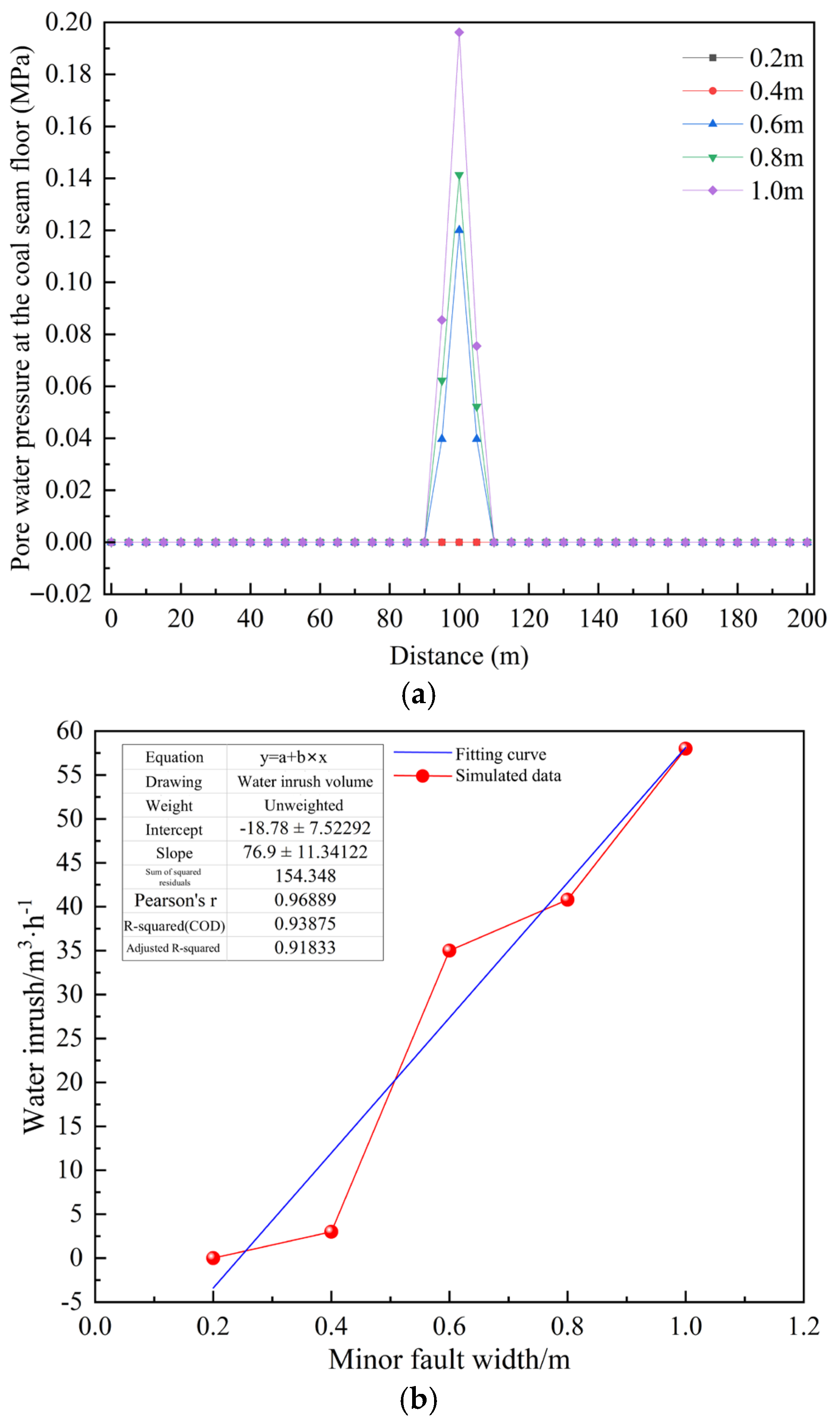
By placing the pore water pressure measurement line at the base of the coal seam and monitoring the cumulative node unbalanced flow at the minor fault location on the working face floor, the pore water pressure and water inrush curve of the minor fault with varying fracture zone widths is displayed in
Figure 15. The pore water pressure of the coal seam floor increases to 0.001 MPa, 0.007 MPa, 0.120 MPa, 0.141 MPa, and 0.196 MPa as the minor fault fracture zone widens, as seen in
Figure 15a. Pore water pressure abruptly increases when the minor fault fracture zone on the coal seam floor is 0.6 m or larger. With values of 0 m
3/h, 3 m
3/h, 35 m
3/h, 41 m
3/h, and 58 m
3/h,
Figure 15b illustrates a linear growth pattern in water inrush at the working face as the minor fault fracture zone widens. A R2 of 91.8% in linear equation fitting demonstrated a correlation between the breadth of the micro fault fracture zone and water inrush at the working face. The main channel for floor water inrush is the minor fault; when the fracture zone widens, the water conduction channel’s cross-sectional area grows, which influences the amount of water inrush at the working face.
5.3. The Influence of Aquifer Water Pressure on the Activation Seepage of Small Faults in the Floor
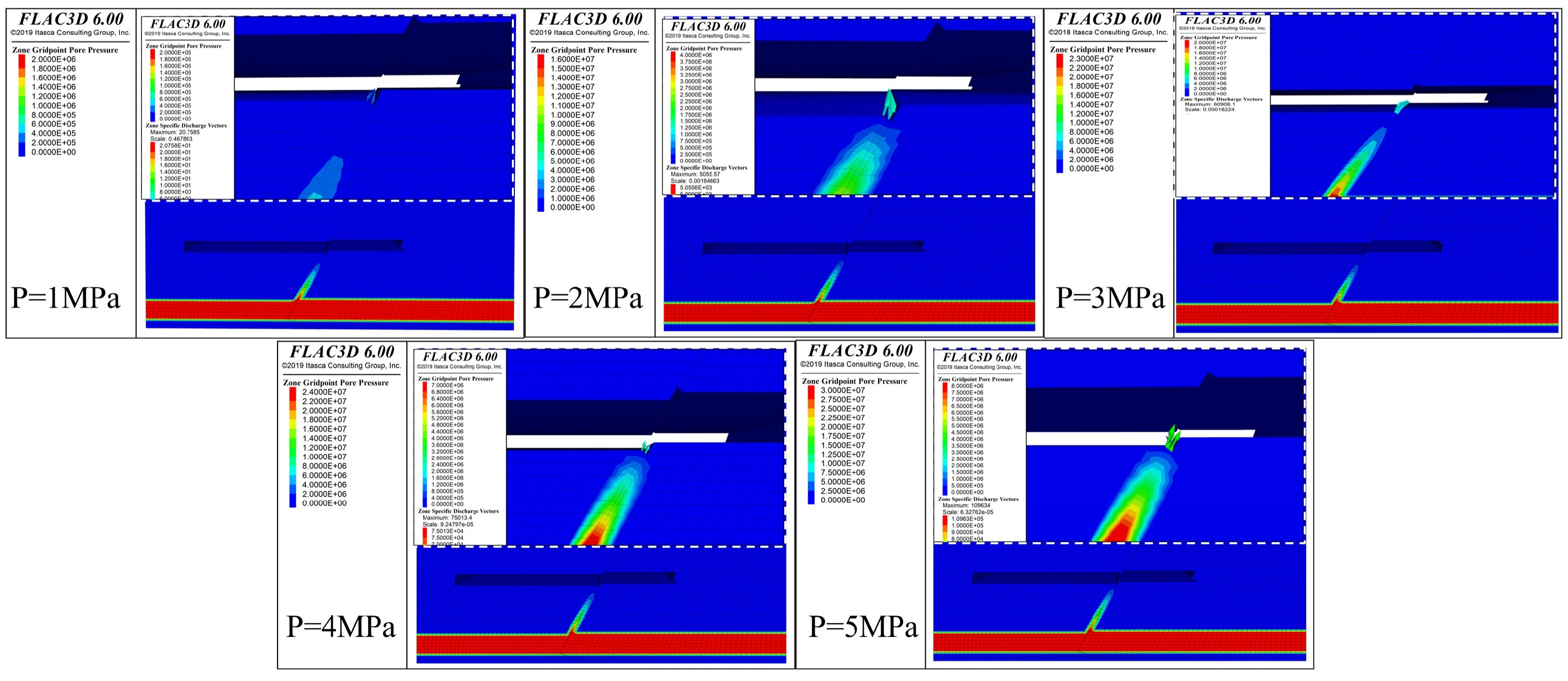
The floor aquifer’s water pressure is set at 1 MPa, 2 MPa, 3 MPa, 4 MPa, and 5 MPa while keeping the angle of minor faults and distance from the coal seam constant in order to investigate the effects of aquifer water pressure on the activation seepage of floor minor faults. The differences between each excavation stage cannot be compared and examined separately due to the large number of elements involved in the investigation. In order to investigate the effects of coal seam mining on the seepage field of minor faults and underlying strata under different aquifer water pressure circumstances, a comparative study is conducted on the 120 m advancing face.
The impact of varying aquifer water pressures on the coal seam mining floor’s seepage field is shown in
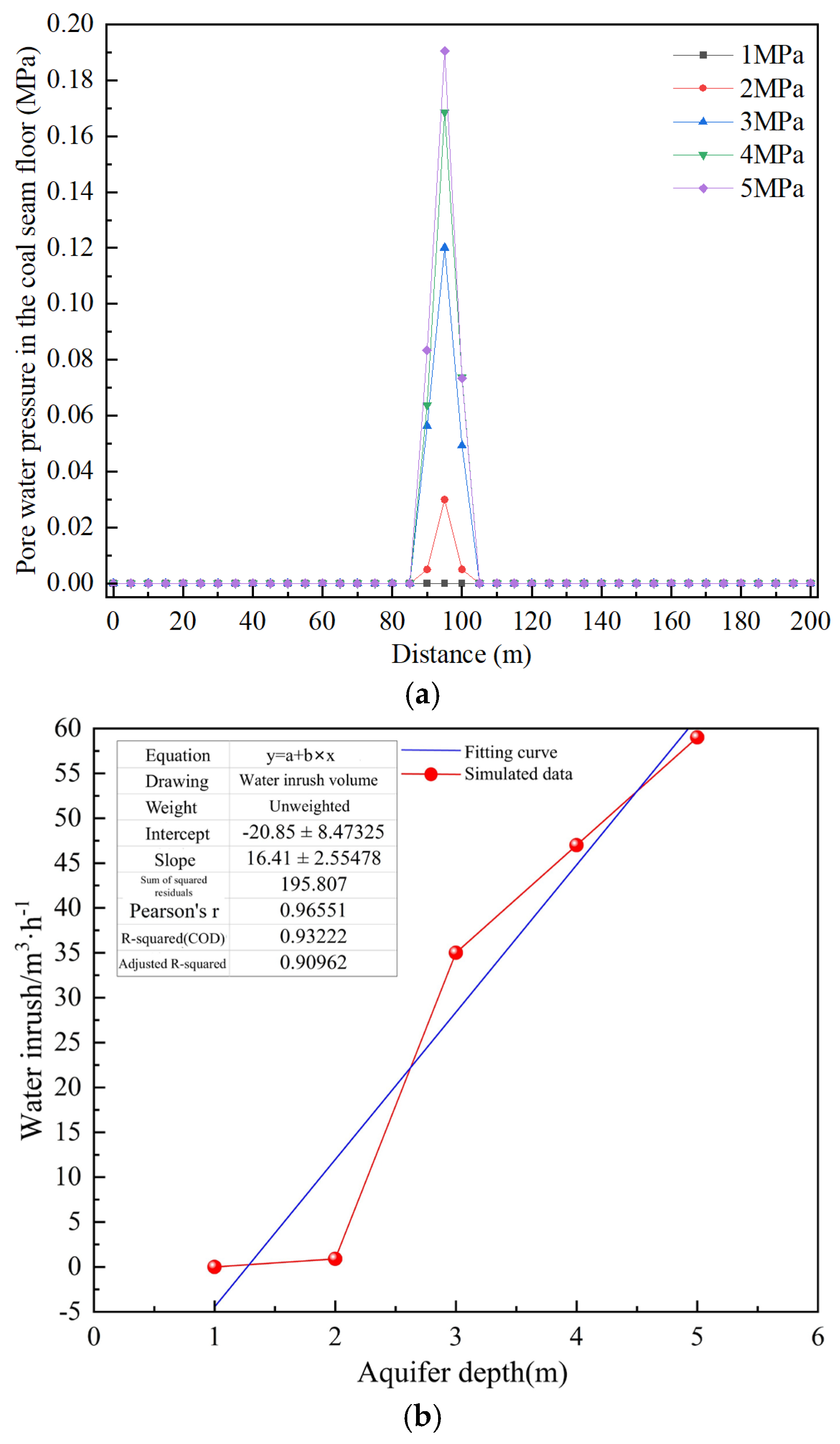
Figure 16. Water will not seep into a minor fault’s floor at a water pressure of 1 MPa. This shows that the floor’s small fault fracture zone can withstand water pressure, maintain a largely stable structure, and withstand damage that could result in the creation of a water inrush channel under the given water pressure conditions. Water infiltration in the floor’s small fault fracture zone is consistent and relatively slow, having little effect on mining activities. When the water pressure reaches 2 and 3 MPa, trailing water inrush occurs. This suggests that the tension applied to the floor’s small fault fracture zone gradually increases as water pressure rises. While the floor retains a degree of stability during the initial phase of mining, the mining process induces stress redistribution and deformation within the minor fault fracture zone. Consequently, certain sections of the floor may fail to withstand hydraulic pressure, resulting in structural failure and subsequent water inrush. Water inrush may have occurred in the initial phase when the water pressure hits 4 MPa and 5 MPa. This suggests that elevated water pressure considerably undermines the structural integrity of the small fault fracture zone in the floor. During the preliminary stage of small fault exposure, reaching its threshold is straightforward, resulting in swift deterioration and the establishment of a water inrush channel, which triggers water inrush events and poses a substantial risk to mining safety. As the water pressure in the floor aquifer increases, the effects of the seepage field in coal seam mining are strengthening, resulting in a heightened danger of water inrush and an earlier occurrence of such events.
The variation curves of the floor’s pore water pressure and the water inrush at the working face under various aquifer water pressure conditions are obtained by placing the pore water pressure measurement line at the base of the coal seam and tracking the cumulative node unbalanced flow at the minor fault on the working face floor, as shown in
Figure 17. The pore water pressure at the minor fault locati0n of the coal seam floor gradually increases as aquifer water pressure rises, as shown in
Figure 17a, which records values of 0.00 MPa, 0.03 MPa, 0.12 MPa, 0.17 MPa, and 0.19 MPa, respectively. In the minor fault’s core zone, the pore water pressure gradually drops from the bottom to the top. There is a positive correlation between the aquifer’s water pressure and the pore water pressure at the same location. The pore water pressure increases as the aquifer’s water pressure increases.
Following mining operations,
Figure 17b shows that the aquifer’s water pressure is insufficient to enter the minor fault fracture zone at water pressures of 1 MPa and 2 MPa. A water inrush occurs at the working face when water pressure exceeds 3 MPa and breaks through the minor fault fracture zone barrier. The water inflow at the operational face rises linearly as the subsurface aquifer’s water pressure rises. This suggests that there is a positive correlation between the amount of water inflow and the water pressure once the aquifer water pressure over the crucial threshold for water inrush.
5.4. The Influence of Aquifer Depth on the Activation Seepage of Small Faults in the Floor
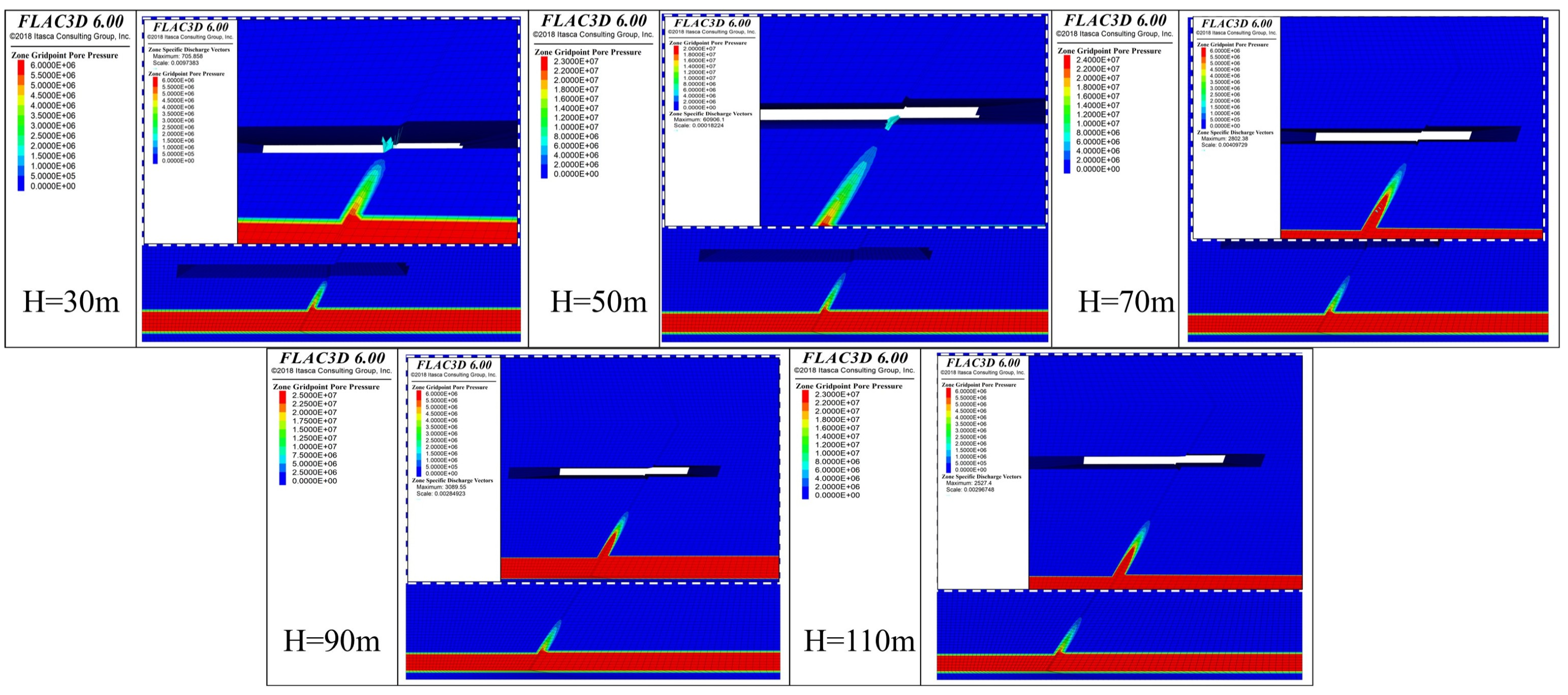
The distances between the aquifer and coal seam are set at 30 m, 50 m, 70 m, 90 m, and 110 m, respectively, in order to investigate the effects of the distance on the activation and seepage of minor faults in the floor while keeping constant parameters for the angle of the minor fault, the width of the minor fault fracture zone, and the water pressure of the aquifer. The differences between each excavation step cannot be compared and examined separately due to the large number of parameters involved in the investigation. The comparison analysis object is chosen to be the 120 m advancing face. Under various aquifer and coal seam spacing conditions, the effect of coal seam mining on the seepage field of minor faults and underlying strata is examined.
The effect of different aquifer and coal seam spacing on the seepage field of the coal seam mining floor is shown in
Figure 18. The pore water pressure cloud graphic indicates that the presence of minor faults complicates the seepage field of the floor. When the separation is minimal, the pore water pressure exhibits an anomalous distribution adjacent to the minor fault. The aquifer is adjacent to the coal seam. The mining activity causes the water body to infiltrate the ground, with the minor fault, acting as a vulnerable zone, serving as a significant conduit for water flow. Pore water pressure increases dramatically and the pressure gradient is large close to the minor fault, which raises the risk coefficient of water inrush greatly.
The floor’s seepage stability may be further undermined by the minor fault’s increased water conductivity, which may also hasten the rapid migration of water towards the mining region. The pore water pressure at the minor fault reduces with increasing distance between the aquifer and the coal seam, yet it remains a substantial region of effect within the seepage field. Although the increased spacing lessens the aquifer’s overall re-charge effect on the floor, the presence of small faults still causes increased pore water pressure in the vicinity, creating a localized pressure concentration anomaly in comparison to the surrounding unbroken rock.
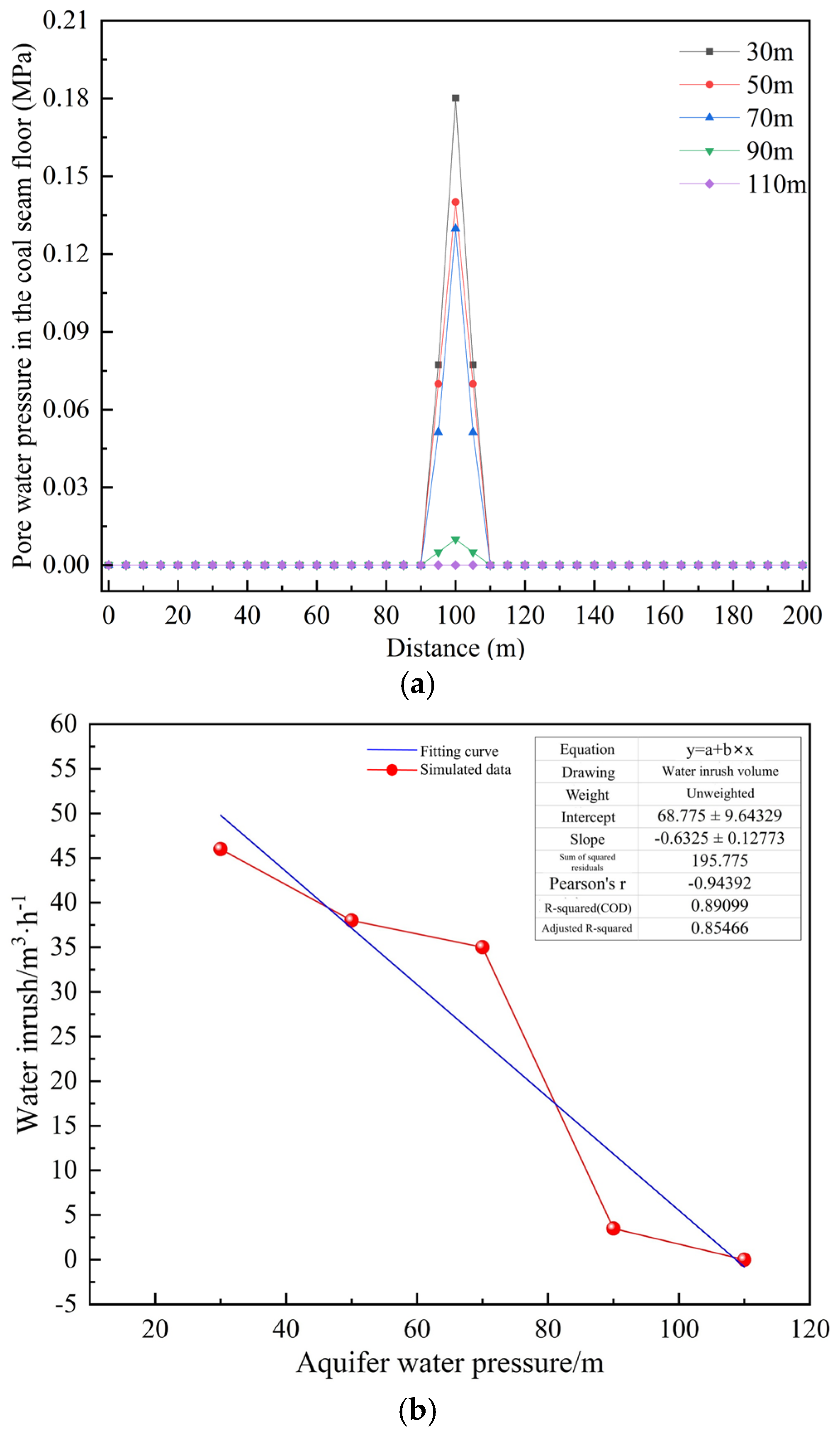
At the base of the coal seam is the pore water pressure measuring line, and at the minor fault position on the working face floor, the cumulative node imbalanced flow is tracked. As shown in
Figure 19, this makes it possible to obtain the floor’s pore water pressure and water inrush curve under various aquifer and coal seam spacing conditions.
The pore water pressure at the minor fault point of the coal seam floor systematically decreases with increasing distance from the aquifuge, as shown in
Figure 19a, where values of 0.18 MPa, 0.14 MPa, 0.13 MPa, 0.01 MPa, and 0.00 MPa are recorded, respectively. A larger potential energy loss during penetration and upon reaching the working face floor under the same water pressure settings results from the water barrier’s increased effectiveness with increasing distance from the aquifuge.
Figure 19b demonstrates that as the distance from the aquiclude increases, the influx of water at the working face gradually decreases. The water inrush at the working face exhibits an inverse relationship with the aquifuge thickness when the thickness is less than 90 m. Aquifuge thickness greater than 110 m will prevent groundwater inrush.
It should be noted that the critical spacing thresholds identified in this study (approximately 90 m for the onset of water inrush and 110 m as a safe separation distance) are obtained under a specific set of geological and hydromechanical conditions, including a minor fault dip of 60°, a fracture-zone width of 0.6 m, and an aquifer pressure of 3 MPa. Variations in these parameters may alter the critical distances to some extent. Therefore, the quantitative values presented here should be regarded as representative for the studied section rather than universal design criteria. When applied to other deposits or geological settings, these thresholds should be recalibrated based on local structural, lithological, and hydraulic conditions.
6. Sensitivity Analysis of Influencing Factors of Floor Lagging Water Inrush Induced by Small Faults in Working Face
The dip angle of the minor faults, the width of the fracture zone, the water pressure inside the floor aquifer, and the intervening distance between the floor aquifer and the coal seam are the five main factors that control the infiltration of water from the floor due to minor faulting at the working face. The grey correlation analysis method is used to assess the impact of each factor on the floor lagging water inrush caused by small faults in order to ascertain the degree of influence exerted by the aforementioned factors on floor lagging water inrush resulting from minor faults and to provide a theoretical basis for water prevention and control in the extraction of confined aquifer coal seams.
Ranking the degree of correlation between the many factors affecting the system’s development and overall state is the basic idea behind the gray correlation analysis approach. A higher degree of correlation indicates a bigger influence of this component on the system’s evolution. This approach compensates for the inadequacies of mathematical statistics in system analysis. Fault angle, fracture zone width, floor aquifer water pressure, and the distance between the floor aquifer and the coal seam are the four variable parameters identified using the numerical simulation approach and the theory of single variable analysis. The four components are categorized as subsequences, whereas the water inrush at the working face is recognized as the principal sequence.
Table 2 and
Table 3 present the experimental design and results, respectively.
According to the steps of grey correlation analysis, the parent sequence Z is determined as pore water pressure, and the subsequence is Xi of each influencing factor. The parameters in the sequence are preprocessed, the mean value of each sequence is calculated, and the ratio of each element in the sequence to the mean value of the sequence is obtained, so as to obtain the correlation degree between each element in the processed subsequence and the corresponding element in the parent sequence.
Define the minimum difference min⊿
i (
k) between the mother sequence and the child sequence as m, and the maximum difference max⊿
i (
k) as
M, then we can get:
m = 0.043,
M = 3.01.
The correlation coefficient between each index in the subsequence and the parent sequence can be obtained (
Table 3). Here,
ρ is the resolution coefficient, which is generally between [0, 1]. In this paper,
ρ = 0.5 is taken. Definition:
As shown in
Table 4, the gray correlation degree is found between each index (a factor that affects the subsequence) and the parent sequence (the pore water pressure of small cracks).
In the numerical simulation of delayed activation water inrush, the gray correlation coefficients for minor fault angle, fracture zone width, floor aquifer water pressure, coal seam distance, and working face water inrush quantity are 0.673, 0.710, 0.756, and 0.766, respectively, as shown in
Table 3. The distance between the coal seam and the aquifer, the aquifer’s water pressure, the breadth of the fracture zone, and the angle of the minor faults all have an impact on the delayed water inrush caused by minor faults, ranging from high to low.
7. Discussion
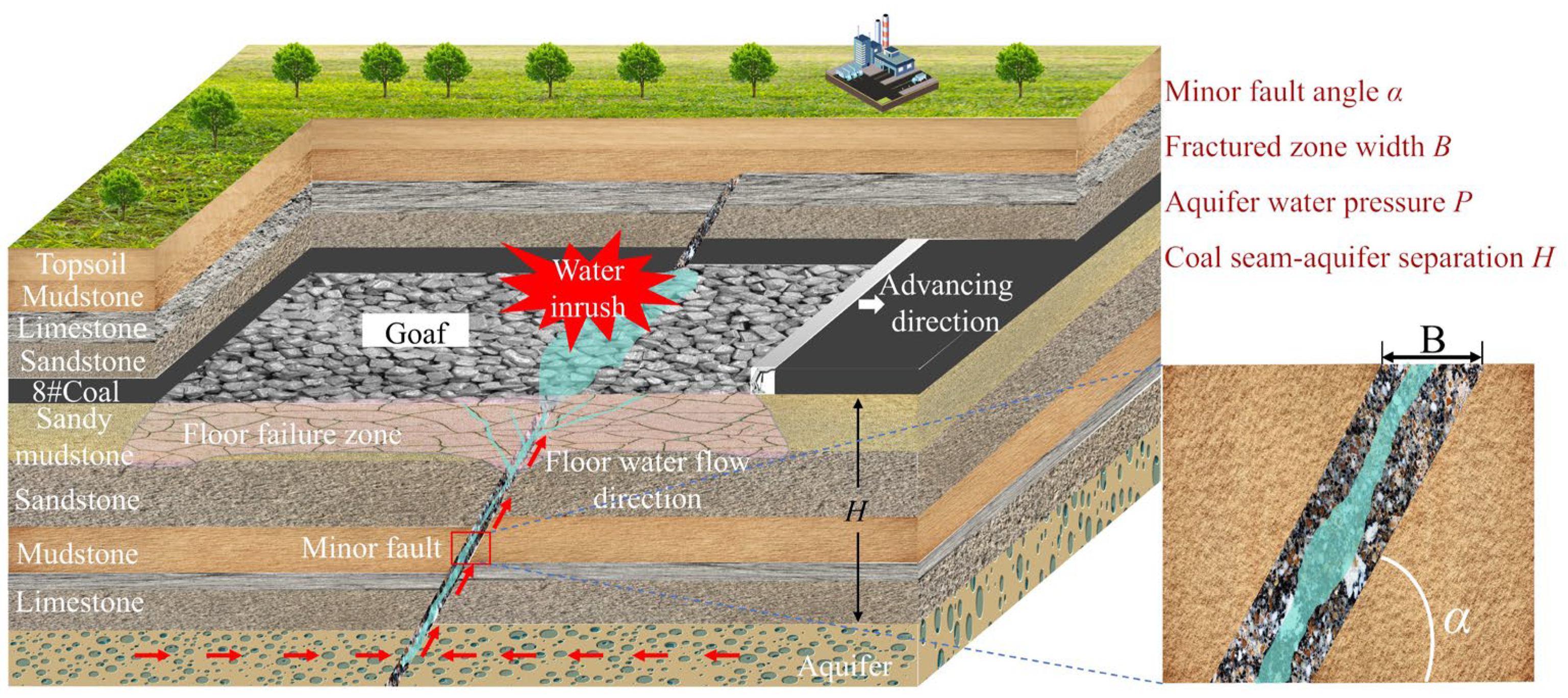
Deep coal mining faces severe risks from delayed water inrush caused by minor faults in floor aquifers. Understanding this mechanism is vital for prevention and control. Based on numerical simulations and multi-factor analysis, this study elucidates the process from fault activation to seepage instability under various geological and hydraulic conditions (
Figure 20).
(1) The influence of small fault angle
Fault angle critically influences delayed water inrush. Steeper faults intersect the coal seam floor over smaller areas, facilitating aquifer water migration and easier reactivation under mining stress, thereby enhancing permeability and inrush risk. Gentler faults have lower reactivation potential and weaker hydraulic connectivity, reducing the hazard.
(2) The influence of small fault fracture zone width
A wider fracture zone implies more fragmented rock, lower strength, and weaker water resistance. Under stress redistribution, it deforms more easily, generating seepage channels and promoting delayed inrush. Narrow, compact zones maintain better integrity and stronger water-blocking capacity.
(3) The influence of water pressure in coal seam floor aquifer
Rising aquifer pressure strengthens the hydraulic gradient and fault permeability, accelerating seepage-induced weakening. Excessive pore pressure causes local tensile failure and fault expansion; when it exceeds the floor’s mechanical resistance, water inrush occurs. High pressure also disturbs the in situ stress field, promoting fault activation.
(4) The influence of coal seam floor aquifer and coal seam spacing
Smaller spacing enhances stress transfer and pore pressure transmission, weakening the floor strata and increasing inrush risk. Greater spacing prolongs the seepage path and mitigates hydraulic coupling, reducing the likelihood of breakthrough.
Collectively, these four factors—fault angle, fracture zone width, aquifer pressure, and aquifer–coal seam spacing—jointly control the timing and intensity of delayed water inrush.
(5) Integrated Discussion
Numerical results confirm that mining alters the mechanical–hydraulic behavior of fault-affected floor strata. Steeper faults, wider fracture zones, and higher aquifer pressures enhance hydraulic connectivity and seepage-driven activation, whereas larger spacing mitigates risk. Grey relational analysis further shows that delayed inrush arises from the coupled action of structural and hydraulic factors rather than any single parameter.
In real mining conditions, roof failure height can reach 6–8 times the coal seam thickness, as described by He Manchao’s key strata theory [
23]. Such large deformations result from discontinuous fracturing and layered separation, which require discrete element or key-strata-based modeling to simulate accurately. The stable roof observed in this study reflects the equivalent continuum assumption, not the actual physical collapse process. The small floor deformation values similarly result from the continuous model and idealized mechanical parameters. Future work will incorporate key strata failure and separation mechanics to better reproduce realistic deformation magnitudes.
The numerical results of this study are quantitatively consistent with previous research on fault activation and floor water inrush under confined aquifer conditions. For instance, Zheng Q et al. [
15] reported that when aquifer water pressure exceeds approximately 3 MPa, the mechanical integrity of the coal seam floor decreases rapidly, triggering hydraulic failure—a trend identical to our findings that indicate water inrush initiation at 3–4 MPa. Similarly, Chang Q et al. [
16] observed that the depth of the plastic zone in fault-affected floors typically ranges from 6 to 8 m, which corresponds closely to the maximum simulated failure depth of 6.5 m in this study. Moreover, Wang Q et al. [
14] documented field water-inrush rates of 20–60 m
3/h in comparable Ordovician aquifers, matching the modeled steady-state inflow of 36 m
3/h obtained here. Minor differences among these studies may arise from variations in rock mechanical parameters, local hydrogeological structures, and boundary conditions. Overall, these comparisons confirm that the proposed coupled fluid–solid model reliably captures the essential mechanisms and magnitudes of fault activation and delayed water inflow observed in practice.
Understanding these interactions is crucial for predictive modeling and water hazard prevention. Future research should incorporate three-dimensional hydro-mechanical coupling and time-dependent permeability evolution to improve the accuracy of inrush prediction and risk assessment in deep mining.
8. Conclusions
The activation and seepage characteristics of minor faults on the floor are examined in detail by the numerical model of coal seam mining, which comprises 17 minor faults and examines the effects of aquifer water pressure, fault angle, fracture zone width, and the distance between the coal seam and aquifer. The extent of influence of each element on the delayed water inrush of the floor caused by minor flaws is examined, and the mechanism underlying this delayed water inrush is elucidated. The primary conclusions are as follows:
(1) The micro-fault structure influences the deformation continuity of the coal seam floor strata, and the upper and lower plates of minor faults exhibit discontinuous deformation in the mining operation at the working face. The coal seam floor exhibits a continuous arching distortion in deformation prior to the working face crossing the tiny fault. The coal seam floor’s deformation is found to be discontinuous throughout the working face excavation at the fault, with the minor fault’s hanging wall exhibiting more distortion than the footwall. The hanging wall’s deformation increases as the working face moves away from the minor fault, while the footwall’s deformation gradually increases as a result of mining activities; however, the overall distortion is still less than that of the hanging wall.
(2) Elevating the minor fault’s angle increases the likelihood of water inrush due to minor fault activation because it reduces horizontal stress on the fault surface. Greater porosity inside the minor fault fracture zone increases the efficiency of water channels, which in turn increases the possibility of minor fault activation; a broader minor fault fracture zone reduces static friction force, which increases the danger of water inrush activation. High water pressure in the aquifer beneath the coal seam increases the ability to break through the barrier of minor fault fracture zones, increasing the chance of activation and water inrush from these faults. Increasing the distance between the aquifer and the coal seam significantly enhances the stability of the floor and reduces the probability of fault activation. However, widening of the fault fracture zone, an increase in its damage-zone thickness rather than its geometric length, has the opposite effect, promoting deformation, permeability growth, and water inflow. Therefore, the influence of the fault’s spatial scale and that of the fracture-zone width should be distinguished: a longer fault does not necessarily imply higher risk, but a broader damage zone directly increases water inrush susceptibility.
(3) The pore water pressure at the minor fault in the coal seam floor was found to have grey correlation coefficients of 0.673, 0.710, 0.756, and 0.766 in respect to the fault angle, fracture zone width, floor aquifer water pressure, and distance between the floor aquifer and coal seam, respectively. The distance between the aquifer and the coal seam, the aquifer’s water pressure, the breadth of the fracture zone, and the angle of the minor fault are the factors that are most and least sensitive to delayed water inrush caused by the minor fault.
(4) In summary, the simulations identified quantitative thresholds for the main controlling factors of delayed water inrush. Water inrush was initiated when the aquifer water pressure exceeded approximately 3–4 MPa, while pressures below 2 MPa maintained floor stability. A fracture-zone width greater than 0.6 m and a fault dip angle above 60° markedly increased permeability and fault activation. The minimum safe distance between the coal seam and the confined aquifer was estimated at about 110 m, below which (≈90 m) hydraulic breakthrough became likely. The sensitivity ranking derived from grey relational analysis confirms that the distance between aquifer and coal seam (0.766) and aquifer water pressure (0.756) exert the greatest influence, followed by fracture-zone width (0.710) and fault angle (0.673). These quantitative indicators provide a practical reference for risk assessment and preventive design in similar mining conditions.




 ,
,