Article

Ride-Sharing Services in Regional Context: Consumer Attitudes and Reuse Intentions in Western Hungary


Vehicle Industry Research Center, Széchenyi István University, 1. Egyetem tér, 9026 Győr, Hungary
*
Author to whom correspondence should be addressed.
Appl. Sci. 2026, 16(2), 1055; https://doi.org/10.3390/app16021055
Submission received: 24 November 2025 / Revised: 8 January 2026 / Accepted: 15 January 2026 / Published: 20 January 2026
(This article belongs to the Special Issue Sustainable Mobility and Transportation (SMTS 2025))

Abstract

This study examines consumer attitudes and experiences related to ride-sharing services in the Western Transdanubia region of Hungary. Despite the growing global popularity of shared mobility solutions, there is little empirical evidence on regional consumer acceptance patterns in the Hungarian context. Based on a structured questionnaire survey involving 500 respondents, this research explores the relationship between satisfaction with past ride-sharing experiences and the intention to reuse such services in the future. The results reveal a high willingness to reuse among those who have already tried ridesharing, yet the correlation analysis shows that satisfaction dimensions alone are not significant predictors of reuse intention. In contrast, attitudinal factors, such as preference over other transport modes, willingness to make recommendations, and perceived accessibility, exhibit strong correlations with acceptance of ride-sharing. The findings emphasise the key role of attitudes and trust in shaping consumer decisions. The paper contributes to the literature by providing regionally grounded empirical insights and offers practical and policy-level recommendations to support the diffusion of sustainable shared mobility services.

1. Introduction

Road transport has become one of the largest and most important economic sectors in recent decades. In addition to freight transport, passenger transport has also experienced tremendous growth. According to some estimates, between 2010 and 2050, freight transport will grow by 60%, while the passenger transport sector will grow by 42%. As a result of the growth in the number of passenger cars and the frequency of travels, the organization of mobility is a problem in most EU member states [1].
Cities are striving to alleviate traffic congestion by developing infrastructure, such as building roundabouts and coordinating traffic lights, but not all obvious solutions can be implemented due to lack of space, and the architectural characteristics of the city must also be taken into account during planning [2]. In today’s modern world, the preservation of green spaces is also an important factor in the design of new junctions. The solution must be found in reducing traffic congestion both within cities and on national roads [3]. With broad cooperation and some compromise, our attitude towards transport today can be changed in the coming years [4]. Instead of owning our own cars, we need to focus on new alternatives that will allow calmer and faster travel in the coming period [5].
With the emergence of car-sharing services in Hungary and around the world, a new mobility alternative is emerging that will have a major impact on both car manufacturers and society. Among the various options available, it is likely that subjective decisions will determine which car-sharing scheme will become widespread and truly popular in each country and city [6]. The choice is influenced by many factors, such as the structure of the settlements, the volume of traffic, and the distance between homes and workplaces. The quality, condition and equipment of the vehicles available for rent also have an impact on the decision [7]. However, according to expectations and analyses, the widespread adoption of car sharing will have numerous advantages [8]. The use of shared cars can reduce the number of vehicles on the road, thereby reducing traffic congestion on highways and in cities [9]. Fewer vehicles on the street will reduce the amount of harmful emissions from road transport, thus improving air quality in cities and ensuring better and healthier living conditions for citizens [10]. With less traffic, road safety should improve, as statistics show that 90% of road accidents are caused by human error, like impatience [11].
In addition to traffic congestion, the increase in air pollution is another major problem caused by the growth in the number of motor vehicles. EU legislation on ambient air quality and the Clean Air for Europe programme (Directive 2008/50/CE) sets health-based limit values for The EU quality for the following air pollutants, among others: particulate matter (PM10, PM2.5), carbon monoxide (CO), nitrogen oxides (NO, NO2) and sulphur dioxide (SO2) [12]. Maximum concentration values for particulate matter are exceeded in more than a third of the air quality zones of the European Union and cannot be met in more than 130 large cities [13]. After energy, transport is the second largest source of greenhouse gas emissions. Mobility accounts for more than a quarter of total greenhouse gas emissions in the European Union, 72% of which comes from road transport, with passenger cars accounting for 60.7% of carbon dioxide emissions [14]. Significant results could be achieved by increasing the utilization of passenger cars, i.e., by more people using a single car for longer distances, but unfortunately, in Europe, the average passenger car carries 1.7 passengers. While ride-sharing services are often promoted as environmentally friendly and efficient alternatives to private car use, recent research suggests a more nuanced picture. Although they can reduce the number of individually driven vehicles, they still produce more emissions per passenger-kilometre and involve higher accident risks compared to public transport or non-motorised travel options. Therefore, while ridesharing contributes to modal shift and convenience, it is not a universal solution to the negative impacts of transportation and should be considered alongside more sustainable alternatives in long-term mobility planning [15].
It is very important to achieve and comply with the limits set by the European Union for harmful substances, because high levels of air pollution caused by freight and passenger transport pose significant health risks [16]. Residents of large cities are even more at risk because the concentration of various harmful substances is even higher on the streets of the inner city [17]. According to estimates, almost three times as many people in the European Union die prematurely as a result of high levels of air pollution caused by transport than in road accidents [18]. The harmful substances emitted by vehicles into the air are responsible for the development of long-term cardiovascular and respiratory diseases [19].
Ride-sharing services are becoming increasingly popular around the world. Despite this, empirical research examining attitudes towards these services at the regional level is still scarce in the Hungarian literature. Recognising this gap, the present study aims to explore the relationship between passenger experiences, satisfaction, and intention to reuse from a regional perspective. This study focusses on the acceptance of ride-sharing in such a regional setting. The scientific novelty of the research lies on the one hand in the fact that it conducts a regional-scale study based on empirical data, which is virtually unheard of in the Hungarian literature. However, the study takes an integrated approach to examine the relationship between passenger experience, satisfaction with the service, and intention to reuse, which is a novel approach in the domestic context.

2. Sustainable Mobility Services

Company managers believe that in the future, providing comprehensive mobility services will be essential for the economic operation of companies, along with car sales. The younger generation is open to a different kind of transport structure [20]. In today’s world, owning a car is no longer necessarily the goal, but rather getting to our destination quickly and comfortably, whether within the city or beyond. Various car-sharing systems offer a possible alternative to this need [21]. One of the biggest advantages of these schemes is undoubtedly that there is no need to maintain your own car, which saves a lot of money: you do not have to buy or service the vehicle, and you do not have to spend money on insurance, fuel, or even parking [22]. They can be more convenient and comfortable than public transport and much cheaper than taxis. Therefore, the development of ridesharing and car-sharing services not only increases the efficiency of vehicles on the road, but also reduces air pollution and traffic congestion [23]. According to one study, the world’s vehicle fleet could be reduced by a third through the introduction and widespread use of new mobility schemes, thereby significantly improving the quality of life in cities. It is estimated that one shared car could replace 5 to 15 privately owned cars, depending on the conditions of use. In recent years, several car-sharing schemes have emerged around the world, including in Hungary, but account for only about 1–4% of passenger kilometres travelled [24]. However, the system is likely to become available in more and more cities in the future. It is therefore essential to promote sustainable mobility and alternative modes of transport among the population, and it is also necessary to raise public awareness of the consequences of road congestion and high air pollution in order to change transport culture and behavioural norms [25].
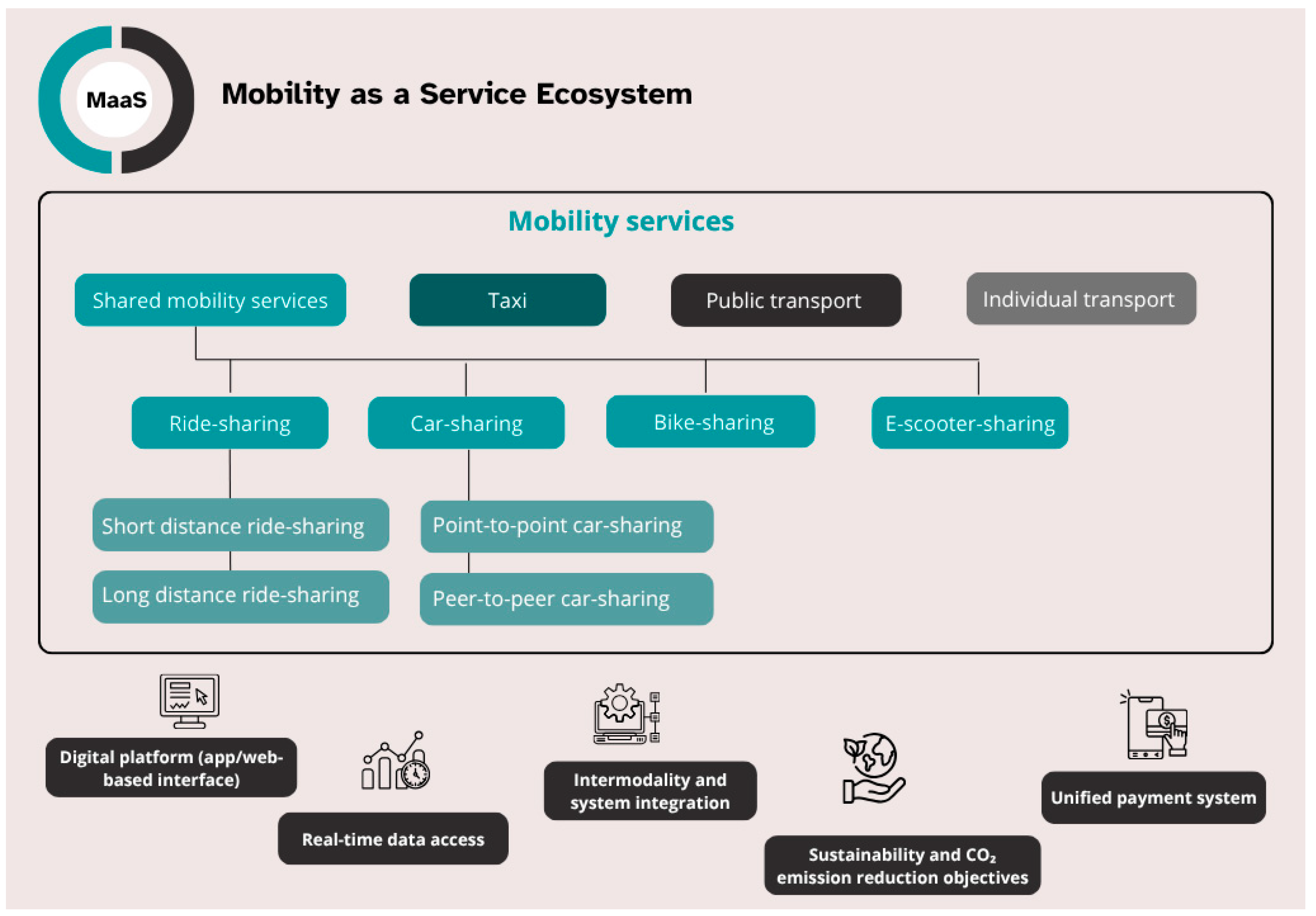
Figure 1 illustrates the structure of the Mobility as a Service (MaaS) ecosystem, emphasising how ridesharing is embedded within a broader network of mobility services. The diagram groups the available transport options into four categories: shared mobility services, taxis, public transport, and individual transport. Within shared mobility, ridesharing (both short- and long-distance), car-sharing (point-to-point and peer-to-peer), and bike-sharing represent the most flexible and demand-responsive solutions. The ecosystem also includes emerging modes such as e-scooter sharing and highlights the importance of digital infrastructure components—such as real-time data access, intermodality, sustainability goals, and unified payment systems—that support the integration of these services. This holistic view reinforces the study’s focus on ridesharing as one potential tool in designing sustainable and user-friendly regional mobility systems.

2.1. Shared Mobility Services and Sustainable MaaS

Ridesharing is a form of shared mobility in which multiple individuals share a car journey, usually because they have a similar origin or destination. It is typically divided into short-distance (urban) and long-distance (intercity or cross-border) applications. Short-distance ridesharing initially emerged as a method to reduce transportation costs and urban congestion. Over time, platforms such as Uber have evolved this model into a tech-enabled on-demand alternative to traditional taxis, often operating in regulatory grey zones. Although convenient, concerns remain regarding the safety, liability, and employment status of drivers [26]. In contrast, long-distance ridesharing enables people who otherwise would travel alone to share trips with passengers, often between cities. The Hungarian platform Oszkár is a leading example of this model. Drivers publish available seats for upcoming trips, and potential passengers can join the journey by paying part of the cost [27]. Ride-sharing apps include rating systems to build trust between users, allowing passengers to review drivers after each trip [28]. Unlike car-sharing, where vehicles are provided by the platform or private owners, ridesharing uses the driver’s personal vehicle, improving cost efficiency and vehicle utilisation [29].
From a sustainability perspective, ridesharing can reduce the number of cars on the road and reduce per capita emissions. However, it also raises concerns about safety, reliability, and the integration of informal mobility into the public transport system. Given its flexibility and low entry barriers, ridesharing is particularly relevant for regional mobility, where public transport options are sparse, and distances are longer, making it an important subject of investigation in this article.
Recent research has extended the MaaS paradigm toward Sustainable MaaS (S-MaaS), positioning MaaS as a transport-systems approach explicitly aligned with sustainability objectives rather than a purely digital-platform or ticketing integration solution. Within this framework, S-MaaS emphasises that performance and sustainability impacts depend on how well demand management and transport supply design are jointly addressed by actors and decision-support processes, not only on the existence of a single app or integrated information layer [30]. Importantly, the S-MaaS literature highlights that the MaaS concept has concrete implications for the transport supply subsystem, which can be analysed through distinct supply components (e.g., institutional/regulatory setting, organisational/service management arrangements, immaterial components such as ITS/data, and material components such as modes and infrastructure). Evidence from advanced operational and pilot MaaS case studies shows that implementation maturity often differs between these supply components, meaning that strong progress in digital integration can coexist with weaker development in governance, service availability, or operational coordination [31].
Consequently, the S-MaaS perspective implies that improving real-world MaaS outcomes requires supply-side interventions (e.g., strengthening governance and partnerships, ensuring sufficient mode/service coverage, and improving operational reliability), rather than relying on awareness-building or technology adoption alone. Complementary demand-oriented S-MaaS work further underscores that robust evaluation of MaaS schemes requires understanding travel choice behaviour through demand analysis and case-based evidence, which helps connect supply configurations to observed or expected user responses [32]. This is particularly relevant for low-density and rural regions, where supply-side constraints and critical-mass requirements can limit diffusion even when consumer awareness and positive attitudes are present.
Recent Italian MaaS experimentations have been reported across diverse territorial contexts, combining pilot surveys and real-world testing to support evidence based MaaS design. These studies explicitly apply evaluation toolkits that include TAM-based acceptance measures alongside revealed and intended preference data collection to assess activation potential and impacts under Italian conditions [33]. Complementary evidence from Milan focusses on MaaS bundle uptake and uses stated-preference choice experiments to quantify preferences and willingness-to-pay for alternative MaaS bundles. This line of experimentation demonstrates how RUM-based designs can operationalise “acceptance” as observable trade-offs and market potential, thus forming pricing and bundle configuration in MaaS deployments [34].

2.2. Acceptance of Mobility Services

The adoption of mobility services indicates how willing people are to use shared modes of transport, such as car sharing or ride sharing. Although shared mobility holds promise for reducing private car use and promoting more sustainable transport, these services are currently still used by a narrow segment of the population, and acceptance varies greatly between countries.
Empirical research has identified a number of factors that influence the acceptance of mobility services. According to a survey conducted in Germany, for example, the most important factor determining the acceptance of shared mobility is how well the service can be integrated into daily life. If a transport solution is compatible with an individual’s daily routine, schedule, and travel needs, it is more likely to be accepted. The same study also found that perceived ease of use improves consumers’ general attitude towards the service [35]. However, in some cases, perceived ease of use did not prove to have a significant effect on the intention to use. For example, in Wang et al. (2020)’s [36] study on ride-sharing services, ease of use alone did not significantly influence intention. According to their findings, personal innovation and environmental awareness had a positive effect on willingness to adopt, while perceived risk, such as safety or comfort concerns, significantly reduced it. This suggests that those who are more open to new technologies and consider environmental protection important are more receptive to new forms of mobility, but that perception of risk can have a major influence on this [36].
The issue of perceived risk and trust is particularly important in mobility services. In shared travel, users often come into close contact with strangers or shared devices, which introduces trust factors [37]. The Pooled Rideshare Acceptance Model (PRAM) framework, which was developed specifically for the acceptance of community ride sharing, has shown that a sense of privacy, personal safety, and general trust in the service are all critical to users’ willingness to accept the service [38]. Until users feel safe and trust the service, practical considerations, such as travel time or cost, are of secondary importance. The results of the PRAM model highlight that the reliability and convenience of the service greatly facilitate acceptance, while security and privacy concerns are barriers. For example, in the study, convenience was one of the strongest positive influences on acceptance intention, while deficiencies in personal safety and privacy factors deterred users [38].
Individual and demographic differences also influence the degree to which people accept these new forms of mobility. According to research, early adopters of car sharing tend to be younger urban dwellers with multiple breadwinners in the household, fewer older family members, and generally fewer cars of their own. In contrast, those who have not yet joined a car-sharing service often live with older family members and already own a car, so they are less motivated to switch. In a Canadian survey, 33% of non-members said they would never use car sharing, while the rest would only consider it if they had better access or lower costs. This shows that as the market expands, the needs and circumstances of new entrants may differ from those of early adopters [39].
Research on the acceptance of mobility services has two main strands: one focusses on technological/operational aspects (e.g., fleet management, route optimisation), while the other focusses on the user side (motivations, attitudes, acceptance patterns). According to a comprehensive literature review, the vast majority of publications on community car sharing deal with operational and economic issues, while fewer studies examine consumer acceptance and user experience [40]. However, in recent years, more and more research has also focused on exploring user factors, including psychological factors such as trust, habits, or environmental attitudes, as well as barriers. Mitropoulos et al. [41] identified 16 different user factors, which they classified into three groups (socio-demographic, geographical environmental, and system-specific factors), and identified five main groups of barriers: economic, technological, business, behavioural, and regulatory factors. These are key considerations, as increasing acceptance requires not only improving technology, but also building user trust, improving convenience, and addressing legal and business framework barriers [41].

2.3. Consumer Attitudes Towards Ride Sharing Services

Examining consumer attitudes towards community ride-sharing services is important because attitudes have a direct impact on usage intentions and, consequently, on actual usage [38]. In general, passengers have a positive attitude towards ride-sharing services if they consider them useful, convenient, and safe, and if they have sufficient trust in the service provider and drivers. In contrast, negative attitudes can be due to mistrust, safety concerns, a sense of violation of privacy, or even the social perception of the service [42].
Research has shown that altruistic attitudes toward the environment alone—that is, when someone considers using carpooling or community taxis solely for environmental benefits—are often insufficient to generate strong positive attitudes. According to a comprehensive literature review, individual environmental awareness alone does not sufficiently support the decision to use ride sharing; economic and convenience factors (such as cost savings or travel comfort) are much more important to passengers [43]. Tan et al. (2022) [44] examined the acceptance of ridesharing among tourists and found that factors such as “consumer literacy” (how familiar passengers are with and know how to use sharing-based services) or “peer-to-peer spillover” (use of other sharing-based services) significantly increased the use of ridesharing. Surprisingly, however, safety reputation (the reputation of a service as safe at a given destination) did not prove to be a determining factor in passengers’ decisions, nor did excessive knowledge—that is, tourists’ attitudes were less influenced by how well they knew the city. Convenience and cost were the most important factors influencing the acceptance of ridesharing [44].
Numerous studies confirm that users—especially women—have stronger fears and concerns about ‘travelling with strangers’ than other forms of travel. Women consistently report higher levels of fear of crime when using community ride-sharing services, and unfortunately real-life cases show that they are more likely to be victims of harassment or assault in such settings [43]. It is important for service providers and regulators to pay attention to security measures (e.g., passenger rating systems, tracking, and emergency alert functions), as these improve the sense of security and, through this, consumer attitudes. Community-based ratings and social profiles are also tools for building trust: many platforms allow passengers and drivers to rate each other and link their profiles to social media, increasing transparency and trust. When users see that others have reported positive experiences or that a driver has a high rating, they develop a positive attitude towards the service [41]. Among the factors that negatively influence attitudes, everyday habits and preferences stand out. Many potential passengers are reluctant to use carpooling because they feel that they would lose the flexibility and freedom that using their own car provides. In one study, for example, the main deterrents identified among students included the need to be able to “change their mind or stop along the way” and a lack of trust in strangers, as well as the convenience of travelling with family members or alone. Another frequently mentioned obstacle is the difficulty of coordinating arrangements—finding a suitable travel companion or driver can be complicated and discouraging for many. All of these factors contribute to the development of a negative or cautious attitude towards ridesharing [43].
A promising methodological direction for measuring potential acceptance of Mobility as a Service (MaaS) is to combine Technology Acceptance Model (TAM) constructs with Random Utility Model (RUM)-based discrete choice approaches. Such integration allows researchers to link psychological determinants of acceptance (e.g., perceived usefulness, ease of use, trust, and related attitudes) to observable choice behaviour in MaaS package or bundle selection. For example, pilot-survey evidence shows that TAM-based motivational measures can be integrated with stated/revealed preference (SP/RP) data to support behavioural modelling of MaaS acceptance beyond purely attitudinal indicators [45]. Similarly, empirical MaaS research has combined TAM-driven structural equation modelling with discrete choice modelling (e.g., multinomial logit) to quantify switch willingness and identify how attitudinal factors translate into choice outcomes under alternative MaaS scenarios [46]. Complementary hybrid choice research further demonstrates that attitudes and other latent psychological components can be incorporated directly into the utility function within choice models (including latent class structures), providing a rigorous bridge between acceptance mechanisms and preference heterogeneity in MaaS subscription decisions [47].
Overall, consumer attitudes toward community ride-sharing services form a complex, multi-factor system. To develop positive attitudes, the service must offer tangible benefits, minimise perceived risks, and increase trust. Appropriate communication and education on the part of service providers is important. If people understand how ridesharing works, see success stories and feel that they have control (e.g., they can choose who they travel with), more favourable attitudes will develop. The COVID-19 pandemic has shown that sudden changes in external circumstances can also change attitudes—for example, the risk of infection has increased reluctance to travel together, while the ease of the pandemic has improved perceptions of services. This suggests that attitudes are not static, but are constantly shaped by personal experiences, social influences, and environmental factors. Decision-makers and companies need to keep this in mind when shaping their strategies, for example, by using incentives, regulation, and marketing to improve the image and reliability of services. According to research to date, a prerequisite for a wider acceptance of ridesharing is that critical psychological barriers—such as mistrust and safety concerns—are reduced while practical benefits are further reinforced. If consumers feel the service is safe, reliable, and convenient, their attitudes will become positive, which will ultimately translate into higher usage rates [38].

3. Materials and Methods

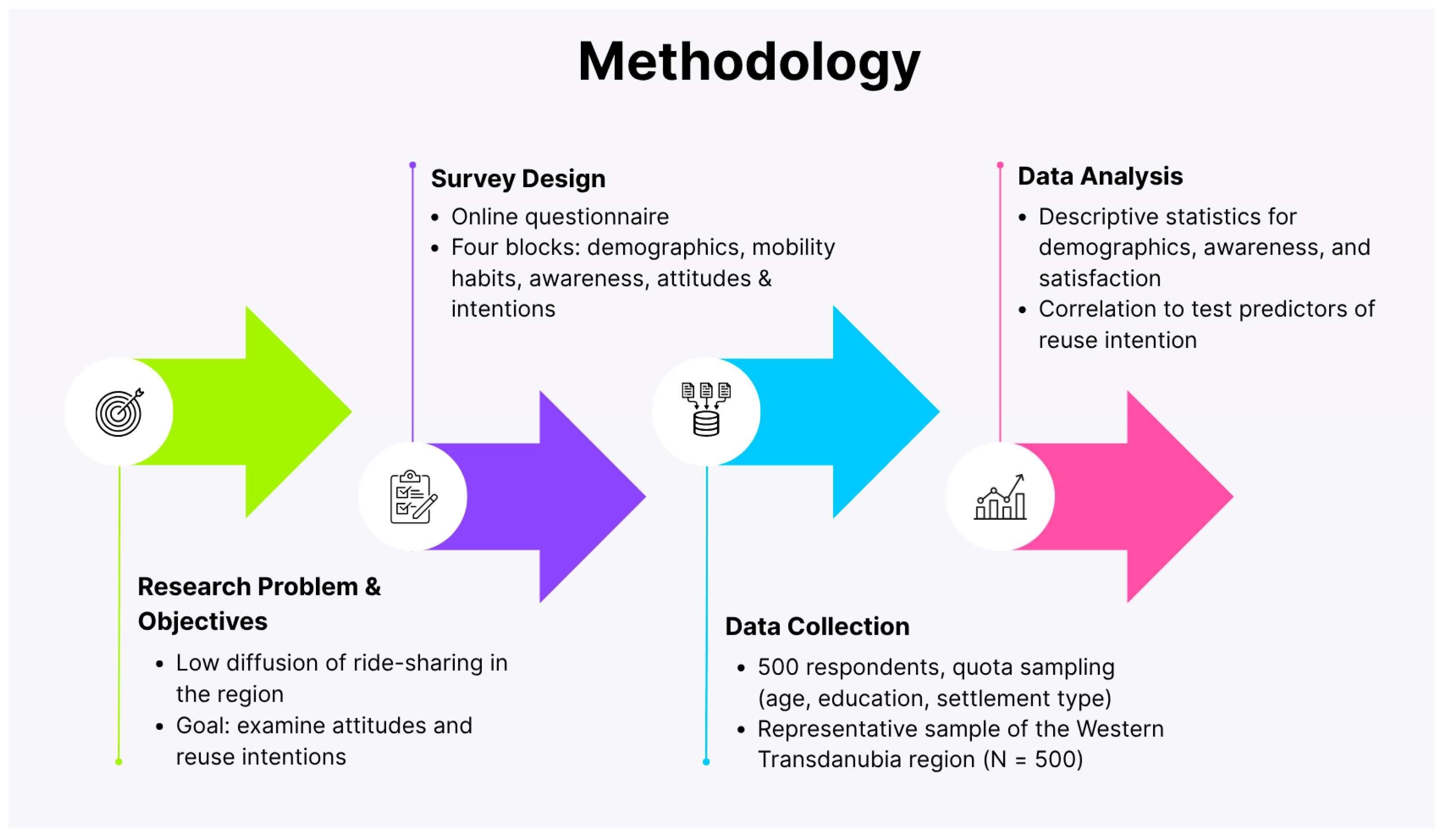
The research process included several stages, beginning with the identification of the research problem and the formulation of research questions, followed by survey development, data collection, and subsequent statistical analyses. To provide a concise overview, the key phases of the methodological approach are summarised in the flowchart below.
Figure 2 illustrates the overall design of the study. The process started with the identification of the research problem and formulation of research questions, which provided the basis for the empirical investigation. The next step was the survey design, where the questionnaire was developed based on previous literature and adapted to the Hungarian context. Data collection was carried out by a professional market research company through an online survey with a representative sample of 500 respondents. The figure also highlights the subsequent steps of data analysis, including descriptive statistics and correlation, which were applied to examine the relationships between awareness, attitudes, satisfaction, and reuse intentions. This structured approach ensured transparency and reliability throughout the research process.

3.1. Case Study Area: Western Transdanubia

The empirical focus of this study is the Western Transdanubia region of Hungary, one of the seven NUTS-2 level regions of the country. It consists of three counties: Győr-Moson-Sopron, Vas, and Zala, and is situated along the Austrian and Slovakian borders. According to Eurostat data, the region had a population of approximately 993,000 in 2023, with a moderate population density of around 83 persons per square kilometre—well below the EU average [48]. Western Transdanubia is characterised by a polycentric settlement structure, including mid-sized urban centres such as Győr, Szombathely and Zalaegerszeg, surrounded by rural and semi-rural areas. The region plays a key role in Hungary’s automotive and manufacturing industries, which contribute to significant commuter flows and intercity travel demands. Despite relatively good road infrastructure and highway connectivity, public transport coverage is uneven, particularly in less urbanised zones [49].
In terms of mobility behaviour, the region is dominated by private car use. Car ownership rates are among the highest in Hungary, and the modal share of sustainable transport, such as rail, bus, or cycling, remains limited outside the city centres [50]. This creates a potential opportunity for flexible mobility solutions such as ridesharing, especially for medium- and long-distance trips, where traditional public transport is less frequent or slower.
Several ride-sharing platforms are active in the region, most notably Oszkár, a Hungarian intercity ride-sharing service operating since 2007. Users can offer or join rides through a mobile app or website, allowing the cost of longer trips to be shared among passengers [51]. International services like BlaBlaCar are also accessible, although their coverage is less localised. On-demand ride-hailing options (e.g., Bolt) are mostly restricted to larger cities like Győr, and car-sharing services (e.g., MOL Limo or ShareNow) are currently not available in the region due to lower population density and operational limitations. Uber is a salient reference point in Hungary because it previously operated in the Hungarian market but later suspended its services following regulatory changes affecting the taxi sector. In addition, many Hungarian consumers may have encountered Uber abroad [52]. Given these characteristics, Western Transdanubia offers a relevant setting for examining user attitudes towards ridesharing as a complementary transport mode. The region’s high dependence on cars, dispersed settlement patterns, and limited public transport coverage make it an ideal case to investigate the potential of ridesharing to support more sustainable and inclusive regional mobility.

3.2. Research Questions, Problem Statement, and Research Significance

This study aims to investigate the acceptance and behavioural intention of using ride-sharing services in the Western Transdanubia region of Hungary, where empirical research on shared mobility is still scarce. Although ridesharing is well established in several countries, its penetration in regional Hungarian contexts remains limited. Therefore, the central research problem is to understand which factors—attitudes, satisfaction, or social perceptions—determine consumer acceptance and intention to reuse these services.
Based on the literature review and the initial results, the following research questions (RQs) were formulated:
  • RQ1: What factors influence consumers’ awareness, attitudes, and satisfaction with ride-sharing services in the Western Transdanubia region?
  • RQ2: How do these attitudes and experiences shape the intention to reuse ride-sharing services in the future?
  • RQ3: What barriers hinder the wider diffusion of ridesharing in the Hungarian context?
The significance of the study lies in its regional focus and empirical contribution. By examining a representative sample, this research provides insights that can inform policymakers and service providers about how to foster acceptance and trust.

3.3. Data Collection

The survey data were collected in 2024 by a professional market research company with experience in mobility-related studies. The company conducted an online questionnaire survey for residents of the Western Transdanubia region (Győr-Moson-Sopron, Vas and Zala counties). Participation was voluntary and anonymous, and respondents were informed of the purpose of the investigation and their rights before data submission. This collaboration with a specialised market research company ensured professional data quality and compliance with ethical standards. The raw questionnaire responses are provided in the Supplementary Materials (Table S1).
The final sample be considered representative of the Western Transdanubia region. Representativeness was ensured through the application of quota sampling based on three key demographic and social criteria: age distribution, educational attainment, and type of settlement (urban vs. rural). These criteria were selected because they are strongly related to mobility patterns and access to transport services, thus ensuring that the sample reflects the main structural characteristics of the regional population. By aligning the quotas with the official regional statistics, the composition of the sample adequately mirrors the broader population. Although the total sample of 500 respondents is representative of the Western Transdanubian population in terms of basic demographics, it is important to acknowledge that the subgroup of ride-sharing users (number of participants ≈ 66) is relatively small. As such, inferential statistical results regarding service satisfaction or reuse intention must be interpreted with caution and serve primarily exploratory purposes.
The questionnaire was structured to first assess awareness and usage (D01–D06), followed by questions regarding user satisfaction (D07–D08) and general attitudes (D11). Questions about experience-based evaluation (D07–D08) were only displayed to respondents who reported previous usage of ride-sharing services, thus ensuring logical flow and internal filtering within the survey software. However, because of the small size of this subgroup, these results should not be overgeneralised.

3.4. Survey Design

The questionnaire instrument was designed by combining items from previous international studies on the acceptance of ride-sharing with region-specific considerations. It contained four main sections:
  • Sociodemographic background;
  • Travel behaviour and mobility habits;
  • Awareness and use of ride-sharing providers;
  • Attitudes, satisfaction, and behavioural intentions.
Table 1 provides an overview of the questionnaire structure, including sample questions and response scales.

3.5. Data Analysis

The data collected were analysed using IBM SPSS Statistics 29.0. software:
  • Descriptive statistics were used to summarise demographic variables, awareness levels, and satisfaction scores.
  • The correlation analysis (Pearson’s r) tested the relationships among attitudinal and behavioural variables.
The overall sample of 500 respondents was representative of the Western Transdanubia region. However, an important methodological issue concerns questions that required prior experience with ride-sharing services. For example, only those respondents who had already used such services could evaluate their satisfaction (comfort, safety, value for money). This naturally reduced the effective sample size for certain analyses. The low number of actual users clearly demonstrates that ridesharing is still in its early diffusion phase in this region. Thus, although the total sample is representative, the reduced subsample size in usage-related questions indicates the limited penetration of ride-sharing services in the Hungarian regional context. This duality strengthens the contribution of the study by showing both the potential and the barriers to acceptance.

3.6. Demographic Characteristics of the Respondents

This chapter presents the sample surveyed in the questionnaire survey based on their demographic characteristics and whether they hold a driver’s licence. The demographic distribution reported in Table 2 broadly corresponds to the population structure of the study area, supporting the representativeness of the sample for Western Transdanubia in terms of the key demographic variables considered.
In terms of demographic characteristics of the representative sample of 500 people participating in the survey, 44.4% of respondents were women and 55.6% were men. In terms of age, the largest group was between 40 and 49 years old (27.4%), followed by the 30–39 age group (22.0%) and the 50–59 age group (22.2%). Young adults, i.e., respondents aged 18–29, account for 17.4%, while the oldest group surveyed (60–65) makes up 11.0% of the sample.
In terms of educational attainment, the largest proportion of respondents surveyed (42.4%) have secondary education with a high school diploma. In addition, a significant proportion have secondary education without a high school diploma but with vocational qualifications (30.2%). The proportion of respondents with higher education is 16.8%, while those with primary education is 10.6%. Looking at the proportion of those with a driving license as a relevant characteristic in terms of mobility habits, it can be seen that the majority of respondents (61.14%) have a valid driver’s license, while 38.86% are not licensed to drive.

4. Results

The following section presents the results of the analysis of the data collected during the investigation, which are related to awareness, use, satisfaction, and attitudes toward ride-sharing services. The results aim to reveal the ‘ current attitudes of the respondents towards this form of public transport and to identify the factors behind acceptance and rejection. The data presented are based on statistical analyses performed using SPSS software.

4.1. Prospective Analysis (Full Sample)

This section reports the prospective, intention-based results for the full survey sample (N = 500), including both respondents with and without recent usage experience. The objective is to describe the’ general awareness of the respondents about mobility-sharing providers and to examine adoption-related perceptions and intentions at the population level, where many evaluations are necessarily based on attitudes and expectations rather than direct use. Consequently, the findings in this section should be interpreted as forward-looking indicators of consumer readiness and acceptance drivers, not as experience-based evaluations of specific services.
Examining the awareness and use of ride-sharing services is of paramount importance in understanding acceptance of the service. Awareness rates allow to draw conclusions about how well this form of mobility has been integrated into the public consciousness, while usage data provide insight into actual consumer behaviour and any barriers to access or attitudes. The purpose of this subchapter is to show the extent to which ride-sharing services are known and used among the population of the Western Transdanubia region of Hungary.
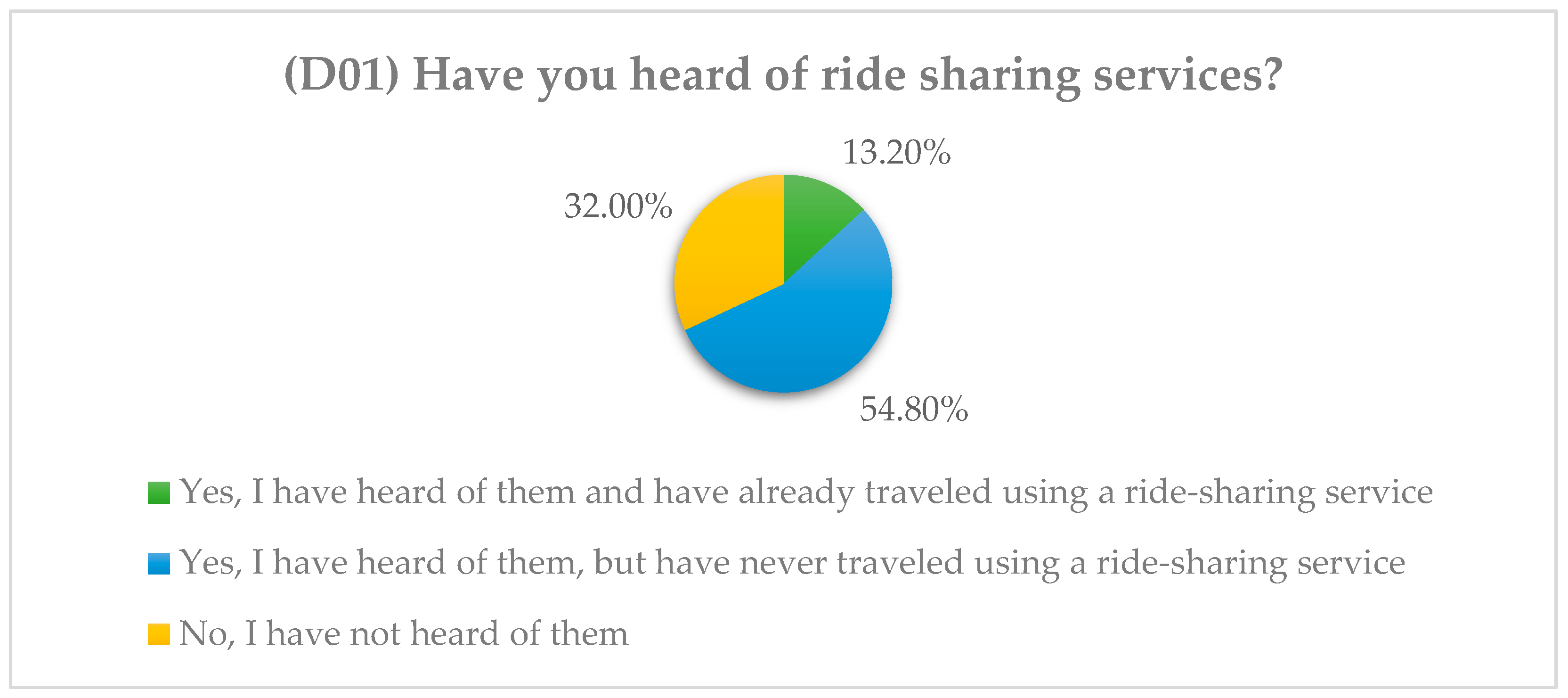
Figure 3 illustrates the awareness of ride-sharing services (n = 500). 13.2% of respondents had not only heard of such services but had also used them before. A further 54.8% are familiar with the concept of ride sharing but have not yet used this type of transport. In contrast, 32.0% of respondents have never heard of such services. Based on the results, it can be said that the majority of the population is aware of the existence of ride sharing, but actual usage remains low. This suggests that acceptance and usage are influenced not only by a lack of information, but also by other factors such as trust, safety, and accessibility.
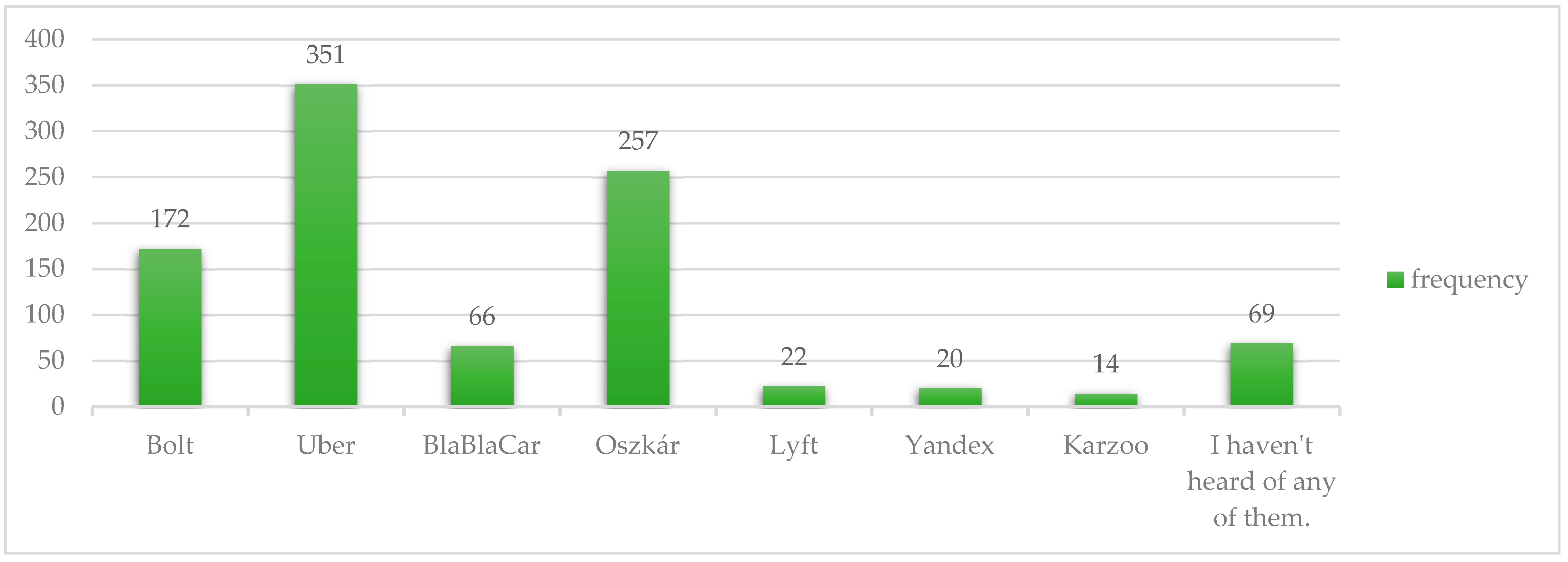
Figure 4 shows the’ awareness of the selected ridesharing and ride-hailing providers of the respondents, indicating whether they have heard about each service brand. This item was designed to assess, in general, how informed Hungarian consumers are about mobility-sharing providers and related service platforms; in Hungary, Bolt, BlaBlaCar and the domestic Oszkár are currently available, while Uber operates only as Uber Taxi, and Lyft, Yandex and Karzoo are not available in the Hungarian market. BlaBlaCar and domestic Oszkár mainly support long-distance (intercity) ridesharing, while Bolt is mainly used for short-distance, urban ride-hailing.
According to the results, Uber remains the best-known brand, mentioned by 351 respondents (over 70% of the sample), which likely reflects its strong legacy brand recognition in Hungary and exposure through international travel, despite its current taxi-only form. The second best-known provider is Oszkár (257 respondents), consistent with the relevance of domestic, intercity ride-sharing solutions. Bolt is also relatively well known (172 respondents), suggesting meaningful awareness of currently accessible app-based ride-hailing. In contrast, BlaBlaCar shows surprisingly low awareness (66 respondents) despite being available in Hungary and internationally prominent, indicating potential under penetration and/or weaker local communication. Awareness of Lyft (22), Yandex (20), and Karzoo (14) is minimal, which is consistent with their lack of Hungarian availability. Finally, 69 respondents (approximately 14%) were not familiar with any listed provider, pointing to a non-trivial awareness gap. Overall, the findings indicate that while the general concept of mobility sharing is recognizable, provider awareness is uneven and shaped by a combination of domestic relevance (Oszkár, Bolt), local availability (BlaBlaCar), and strong global brand salience (Uber), underscoring the need for regionally targeted marketing and consumer education strategies.
Table 3 shows the correlations between the’ attitudes of the respondents toward ride-sharing services based on Pearson’s correlation coefficients.
To reveal the structure behind attitudes towards ride-sharing services, we conducted a Pearson correlation analysis that contained a total of 11 statements that measured preferences, opinions, willingness to recommend, accessibility requirements, and feelings related to safety and social situations. The aim was to identify the types of attitudes that emerge and the relationships between them.
The results show that Items with positive attitudes—such as “I would rather travel by ride sharing than by taxi” (D11_1), “I would rather travel by carpooling than by bus” (D11_2), “I would recommend carpooling to others” (D11_7), and “I would like it to be available to places I usually travel to” (D11_8)—are closely positively correlated with each other. The strongest correlation was between D11_2 and D11_3 (r = 0.656; p < 0.001), suggesting that those who would prefer ride sharing to buses would often prefer it to trains as well. A similarly strong correlation was found between the intention to recommend (D11_7) and the need for accessibility (D11_8) (r = 0.623; p < 0.001), indicating that respondents with a positive attitude would not only support others using the service, but would also prefer to use it themselves if it were available. These attitudes form a coherent positive attitude network.
In contrast, concerns related to safety and the social environment—such as “I don’t consider ride sharing safe” (D11_9) and “I would not like to travel with strangers” (D11_10)—show a significant and moderately strong negative correlation with positive attitudes. The negative correlation between D11_9 and D11_7 (r = −0.375; p < 0.001) indicates that those who do not consider ride sharing safe are less likely to recommend it to others. Similar negative correlations can be observed between D11_10 and items measuring transport preferences (e.g., D11_10—D11_3: r = −0.310; p < 0.001). Furthermore, the two variables measuring trust concerns (D11_9 and D11_10) are also significantly positively correlated (r = 0.403; p < 0.001), suggesting that safety concerns and reservations about travelling with strangers often occur together.
The correlation pattern of the statement “I would like to be a driver for a ride-sharing service” (D11_11) also yielded interesting results. This variable correlated positively with several other items expressing acceptance and openness, such as D11_2 (r = 0.434; p < 0.001), D11_3 (r = 0.416; p < 0.001), D11_7 (r = 0.346; p < 0.001), and D11_8 (r = 0.308; p < 0.001). This means that respondents who were open to ride sharing as passengers would typically be willing to participate in the service as drivers. In contrast, D11_11 correlates negatively with D11_10 (r = −0.255; p < 0.001), meaning that those who would avoid traveling with strangers are less likely to take on the role of driver.
In summary, a bipolar attitude structure clearly emerges from the items in question block D11. On the one hand, there is the group of positive attitudes, which includes preferring and recommending the service, demanding its availability, and willingness to actively participate in the service. On the other hand, there are negative and dismissive attitudes, which are primarily characterised by concerns about safety and social interaction. Based on the results, it can be said that positive attitudes reinforce each other, while trust and safety concerns hinder the acceptance of the service. Therefore, ensuring accessibility alone is not sufficient for the wider spread of ride sharing; it is also essential to increase the user’s sense of security and consciously build social trust.

4.2. Experience-Based Analysis (Sub-Sample)

To avoid conflating prospective intentions with experience-based judgments, this section presents a separate analysis focussing exclusively on respondents who used mobility-sharing services in the last 12 months (n = 66). This sub-sample is the only group with direct, recent experience, and it is used to explore which factors are associated with reuse intention based on actual use. Given the relatively small sub-sample size, results in this section are interpreted as exploratory and should be viewed as indicative patterns rather than definitive, highly generalisable estimates; nevertheless, they provide important insights grounded in real user experience.
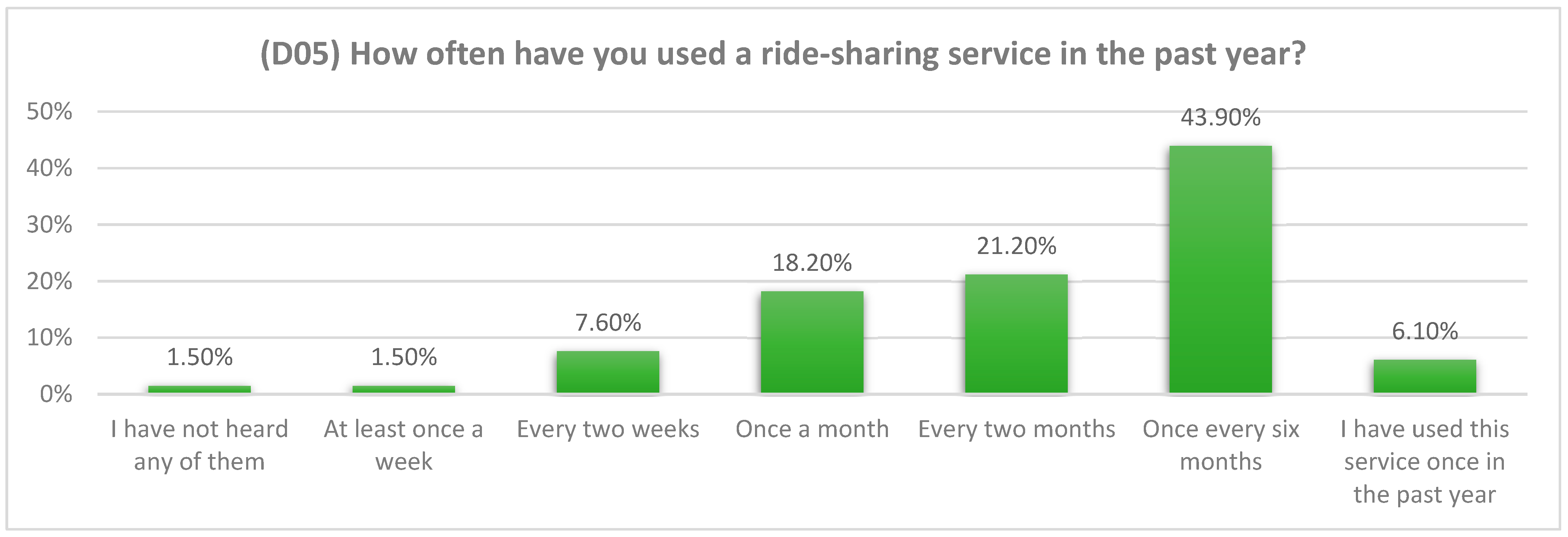
Figure 5 presents the frequency of the use of the ride-sharing service in the last year among those respondents (n = 66) who have already used this service. The results indicate that a large proportion of participants (43.9%) reported not having used ride-sharing services at all during the period examined. Occasional use was also common: 21.2% used such services once in the past year, while 18.2% reported usage approximately once every six months. More frequent use was rare, with only 7.6% indicating monthly use, and just 1.5% using ridesharing on a weekly or bi-weekly basis. These findings clearly show that while awareness of ridesharing exists, actual service penetration in the Western Transdanubia region remains limited and irregular.
The social acceptance and spread of ride-sharing services is closely related to user attitudes. Consequently, in this subchapter, we examine general satisfaction with the service and statements about attitudes by analysing two sets of questions.
Table 4 shows the descriptive statistics results for the dimensions (D07_1) Comfort, (D07_2) Sense of security, (D07_3) Value for money, (D07_4) Travel experience, and (D07_5) Ease of organising the trip in relation to ride-sharing services.
Respondents with previous experience of ride-sharing services (N = 61–62) rated their satisfaction with various aspects of their journey on a five-point Likert scale. The highest average satisfaction was reported on the dimensions of “feeling safe” (M = 4.27; SD = 0.99) and “ease of organising the trip” (M = 4.2; SD = 1.03). This was followed by “comfort” (M = 4.15; SD = 0.94), “travel experience” (M = 4.08; SD = 0.95) and “value for money” (M = 4.06; SD = 1.02).
For all factors examined, the average value exceeded 4, which, according to the scale, reflects a high level of satisfaction. The majority of median and mode values are 4 or 5, meaning that a significant proportion of respondents gave maximum or near-maximum values for each dimension. The relatively low standard deviations (SD ≈ 1) indicate that the respondents’ assessments are relatively uniform, with no significant differences of opinion along the individual factors.
In general, it can be said that those who have already travelled with a ride-sharing service reported overwhelmingly positive experiences, especially in terms of safety and organisation. This supports the assumption that practical experiences with the service are favourable and could potentially contribute to strengthening the intention to use it again.
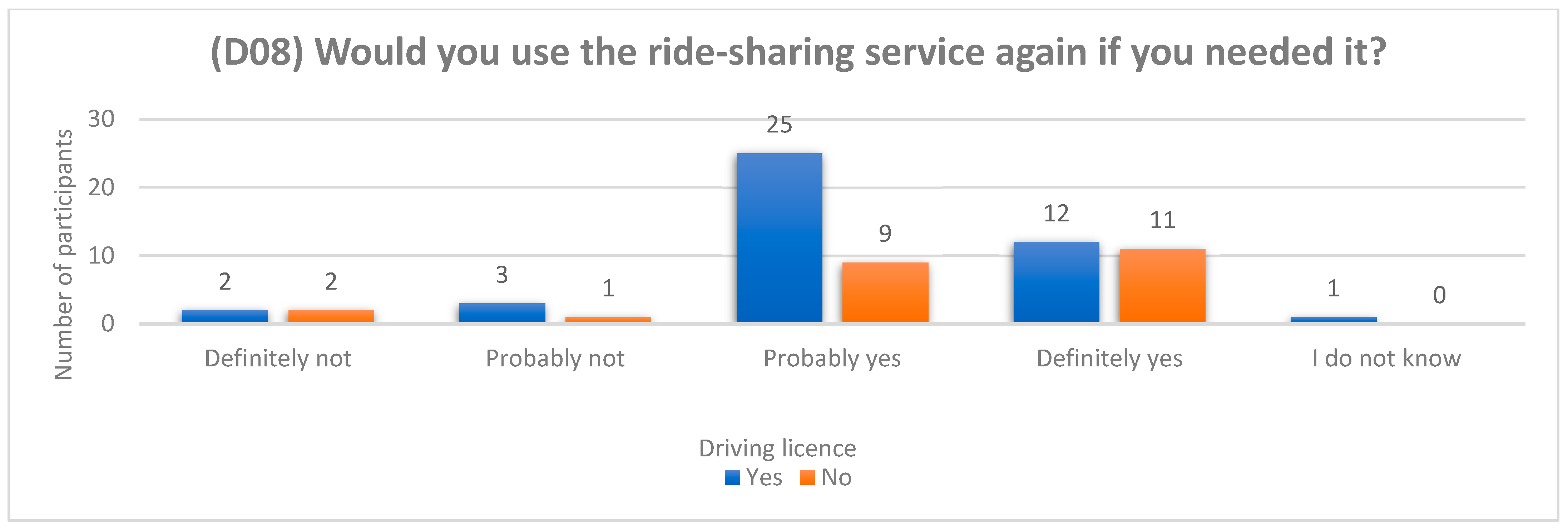
Figure 6 presents the intention to reuse ride-sharing services in the future (n = 66), broken down by the possession of a driving licence among those respondents who have already used such services. The results indicate that a strong majority of both groups—those with and without a licence—are open to reusing ridesharing in the future. Among participants with a driving licence, 25 chose “probably yes” and 12 “definitely yes,” while among those without a licence, 9 chose “probably yes” and 11 “definitely yes.” This adds up to 86% of all respondents showing a positive intention to reuse the service.
In contrast, the proportion of negative responses was minimal: 5 respondents selected “probably not” or “definitely not,” and only one respondent was uncertain. The results highlight that both licenced and unlicensed users reported similarly positive attitudes toward ridesharing, suggesting that the service is seen as a viable mobility option regardless of personal vehicle access. These findings reinforce the potential for broader adoption and regional scaling of ride-sharing services, especially if supported by awareness campaigns and service availability.

5. Discussion

The purpose of this study was to explore the attitudes, experiences and satisfaction levels of users in the Western Transdanubia region, as well as how these factors influence their intention to use ride-sharing services. The significance of the study lies in the fact that there is little empirical research in Hungary on the regional characteristics of the acceptance of ride-sharing services, especially the analysis of the relationship between travel experiences and attitudes. The findings of the empirical research reveal that while the general awareness of ride-sharing services is relatively high in the Western Transdanubia region, actual usage remains limited. Only 13% of respondents had tried such services, and even among them, regular use was rare. However, those with experience reported a high level of satisfaction, especially regarding safety and trip organization. Most notably, over 85% expressed an intention to use ride sharing again, indicating that positive user experiences play a crucial role in fostering acceptance. The correlation analysis further highlighted a clear bipolar attitude structure: positive attitudes—such as preference, recommendation, and openness—are closely interconnected, while concerns about safety and sharing space with strangers form the core of negative attitudes. These results suggest that ride-sharing adoption is not solely a matter of awareness or functional satisfaction but deeply rooted in social trust and personal risk perception. Thus, future efforts to promote ride sharing should focus not only on improving service availability but also on reducing psychological barriers and enhancing users’ sense of safety and control.
In line with the objectives stated in Section 2.2, this section provides a rational answer to each research question by linking the empirical results to the conceptual framework and prior literature. RQ1 asked which factors influence awareness, attitudes, and satisfaction with ridesharing in Western Transdanubia. The results indicate that general awareness is relatively high, while actual use remains limited, suggesting that diffusion is still at an early stage. Attitudinal patterns show a clear polarity between openness/trust-based acceptance and safety/social concerns, while satisfaction among experienced users is generally high—especially regarding perceived safety and trip organisation. RQ2 examined how attitudes and experiences shape the intention of reuse. Among respondents with recent ride-sharing experience, the intention of reuse is highly positive (over 85%), indicating that direct experience is a major enabler of continued use. At the same time, the findings suggest that reuse intention is more strongly associated with the underlying attitude structure (trust and openness) than with satisfaction dimensions alone; given the relatively small experienced sub-sample, these experience-based inferences are interpreted as exploratory. RQ3 focused on barriers to wider diffusion in Hungary. The evidence points to both psychological barriers (trust, safety perceptions, and discomfort with sharing space with strangers) and structural constraints related to service viability outside the capital, including critical-mass requirements and broader regulatory/technological limitations. Together, these barriers help explain why awareness does not automatically translate into regular use.
Although the findings confirm that openness to ride sharing is present among experienced users, the broader expansion of such services in Hungary faces several structural and technological constraints. Currently, Hungarian ridesharing and car-sharing providers are not planning to introduce free-floating systems in smaller cities, as the economic viability of such services depends on reaching a critical mass of users, which is currently only available in the capital. In addition, the integration of autonomous vehicles into these service models is not yet on the agenda, mainly due to the absence of a supportive regulatory framework and the limited availability of self-driving technologies on the consumer market. Without legal clarity and concrete technological implementation, providers are unable to assess user demand or develop reliable business models. As such, while user attitudes toward innovation and mobility services are promising, the actual implementation of advanced solutions such as autonomous ridesharing remains a longer-term prospect, highly dependent on both infrastructural readiness and regulatory developments.
Based on the results, it can be stated that positive attitudes toward the service—such as preference for ride sharing over other modes of transportation, willingness to recommend it, or demand for its availability—are closely related and together strongly indicate the degree of acceptance. In contrast, a lack of safety and the reluctance to travel with strangers have a negative impact on attitudes, confirming the key role of trust and perception of personal risk [35]. The intention of reusing ride-sharing services is extremely high among those who have already tried it, and this is consistent with international studies showing that positive user experiences contribute to the acceptance of ride-sharing services [36,44]. However, the analysis did not support the idea that satisfaction dimensions directly influence the intention to reuse, which differs from the findings of Gangadharaiah et al. (2023) [38], who found that travel experiences strongly predict user willingness. Based on the present study, it is the attitude structure, rather than satisfaction during the trip, that determines the future acceptance of ride sharing. This finding is in line with the conclusion of Ferrero et al. (2018) [40] that the social spread of ride sharing is based not only on functional factors but also on perceived social norms and trust mechanisms.
In particular, although the overall sample size was representative (N = 500), only a small subgroup of respondents (n ≈ 60) reported prior experience with ride-sharing services. As a result, statistical conclusions drawn from these items should be considered exploratory and not generalisable to the broader population, and are best understood in the context of previous research on shared mobility acceptance. Furthermore, the low number of valid responses restricted the application of advanced modelling techniques, such as regression or mediation analysis, which could have more robustly explained the behavioural drivers. Second, the cross-sectional nature of the research does not allow for the precise identification of causal relationships, and biases arising from self-reporting (e.g., social conformity) cannot be ruled out. Third, the research covered only one region, so the results cannot be generalised to the national level. Fourth, the survey did not explicitly distinguish reuse intention for urban ridesharing versus long-distance/intercity ridesharing. Therefore, reuse intention is interpreted at an aggregate level of mobility-sharing, and context-specific differences in determinants could not be fully tested. Future studies should include purpose-specific intention measures for mode and trip (e.g., separate items for urban versus long-distance use) to allow context-sensitive modelling. Finally, although the statements in the questionnaire represent the dimensions related to the service well, they are not always based on internationally validated scales, which reduces the comparability of the results with other studies.

6. Conclusions

The study examined the awareness, attitudes, and intention to reuse carsharing in Western Transdanubia, a less urbanised and car-dependent region. To address external validity explicitly, we distinguish below conclusions that are likely context specific to Western Transdanubia and those that are transferable to other rural or low-density regions.
The results reflect an early diffusion stage. In the region, while nearly 70% of respondents had heard of ride sharing, only about 13% reported actual use in the past year. Provider awareness in Western Transdanubia appears strongly shaped by the local and national service ecosystem and market visibility: awareness is highest for globally salient brands (e.g., Uber) and for domestically relevant services (e.g., Oszkár and Bolt), whereas providers without a Hungarian market presence (e.g., Lyft, Yandex, Karzoo) remain virtually unknown. This pattern underscores that local adoption dynamics are closely tied to the region’s real-world availability of services, the dominance of intercity-oriented solutions relative to dense urban ride-hailing, and the practical constraints of low-density operation (e.g., critical mass and service viability outside major hubs).
Beyond the regional context, the study provides several insights that are likely to be applicable to other low-density and rural areas. A key transferable pattern is the awareness–use gap: being familiar with the concept does not automatically translate into regular use. Furthermore, the results consistently indicate a bipolar attitude structure that can be expected in many rural contexts—an “accepting” segment characterised by openness and trust, versus a “rejecting” segment organised around safety concerns and discomfort with travelling with strangers. Among recent users, reuse intention is strongly positive (over 85%), suggesting that direct experience can be a powerful catalyst for continued adoption even where overall diffusion remains limited. At the same time, satisfaction dimensions (convenience, security, value for money, experience, organizability) did not emerge as significant predictors of reuse intention on their own in this sample, implying that reuse intention may depend more on trust, perceived accessibility, and broader contextual or psychological factors than on satisfaction alone.
This work contributes to one of the first regionally representative empirical analyses of ride-sharing acceptance in Hungary by jointly examining provider awareness, experience-based reuse intention, and the attitudinal mechanisms underlying acceptance. For Western Transdanubia specifically, the findings suggest that ride sharing currently functions more as an occasional mobility option than as an integrated part of daily travel. For similar rural regions in general, the results imply that diffusion strategies should go beyond improving service availability and focus on building trust, reassurance of safety and attitude-based communication that reduces psychological barriers to sharing space with strangers. In practical terms, encouraging users who already participate in informal ride sharing to adopt formal platforms may be a particularly promising pathway to scaling uptake.
Future research should extend this work through longitudinal studies to capture evolving user behaviour, comparative analyses across different regions or countries, and the application of advanced modelling techniques such as structural equation modelling. In addition, exploring the potential impact of technological innovations—including autonomous ridesharing and integration into Mobility-as-a-Service (MaaS) platforms—would provide valuable insights for policymakers and service providers seeking to foster sustainable mobility solutions. Although the study is rooted in the specific regional context of Western Transdanubia, its main concepts and criteria are potentially transferable to other environments. Factors such as trust, safety perceptions, service awareness, and attitudinal preferences are not unique to Hungary but represent broader psychological and behavioural mechanisms that influence the acceptance of shared mobility worldwide. Thus, while infrastructural and cultural differences can shape the extent of adoption, the analytical framework and key findings can inform comparative research and policy discussions in other regional or national settings.

Supplementary Materials

The following supporting information can be downloaded at: https://www.mdpi.com/article/10.3390/app16021055/s1, Table S1: Survey_Responses.

Author Contributions

Conceptualization, D.C. and R.K.; methodology, D.C. and R.K.; software, R.K.; validation, D.C., R.K., F.S. and B.E.B.; formal analysis, R.K.; investigation, B.E.B.; resources, F.S.; data curation, D.C. and R.K.; writing—original draft preparation, D.C. and R.K.; writing—review and editing, D.C.; visualization, R.K.; supervision, F.S. and B.E.B.; project administration, F.S. and B.E.B.; funding acquisition, F.S. and B.E.B. All authors have read and agreed to the published version of the manuscript.

Funding

This research received no external funding.

Institutional Review Board Statement

The study was conducted in accordance with the Declaration of Helsinki and with the Scientific Ethics Code of Széchenyi István University. Participation in the study was voluntary, and all data were collected and analysed anonymously, ensuring that no personally identifiable information was recorded at any stage of the research.

Informed Consent Statement

Informed consent was obtained from all subjects involved in the study. Participation was voluntary, and all responses were anonymized prior to analysis.

Data Availability Statement

The raw questionnaire dataset supporting the findings of this study is available in the Supplementary Materials (Table S1).

Acknowledgments

The publication was created in the framework of the Széchenyi István University’s VHFO/416/2023-EM_SZERZ project entitled “Preparation of digital and self-driving environmental infrastructure developments and related research to reduce carbon emissions and environmental impact” (Green Traffic Cloud).

Conflicts of Interest

The authors declare no conflicts of interest.

References

  1. European Commission. Statistical Pocketbook 2024—EU Transport in Figures—Mobility and Transport; European Commission: Brussels, Belgium, 2024. [Google Scholar]
  2. Mirna, K.; Aleksandra, D.T.; Sanja, S.; Irena, I.O. A theoretical model for optimizing signalized intersection and roundabout distance using microsimulations. Future Transp. 2025, 5, 28. [Google Scholar] [CrossRef]
  3. Ali, C.; Chris, B.; Linjun, X.; Ayotunde, D. Green infrastructures for urban sustainability: Issues, implications, and solutions for underdeveloped areas. Urban For. Urban Green. 2021, 59, 127028. [Google Scholar] [CrossRef]
  4. Nawaf, M.A. Impact assessment of integrating AVs in optimizing urban traffic operations for sustainable transportation planning in Riyadh. World Electr. Veh. J. 2025, 16, 246. [Google Scholar] [CrossRef]
  5. Pedro, U.C.; Juan-Luis, P.Y.; Jose-Luis, P.L. Evaluating traffic control parameters: From efficiency to sustainable development. Smart Cities 2025, 8, 57. [Google Scholar] [CrossRef]
  6. Marco, M.; Gabriele, D.O.; Domenico, C. The environmental benefits of carsharing: The case study of Palermo. Transp. Res. Procedia 2020, 48, 2127–2139. [Google Scholar] [CrossRef]
  7. van der Laan, H.; Correia, G.; van Oort, N.; Keulemans, S.; Lint, M.; Kouwenhoven, M. Driving factors behind station-based car sharing adoption: Discovering distinct user profiles through a latent class cluster analysis. Transp. Policy 2025, 162, 232–241. [Google Scholar] [CrossRef]
  8. Negin, A.; Ludovic, L.; Mahdi, Z. Can dynamic ride-sharing reduce traffic congestion? Transp. Res. Part B Methodol. 2021, 145, 212–246. [Google Scholar] [CrossRef]
  9. Theodoros, A.; Samson, R.J.R. A vehicle ride-sharing algorithm assessing passenger satisfaction according to spatial, temporal, and social behavior context based on real data sources. Future Transp. 2025, 5, 56. [Google Scholar] [CrossRef]
  10. Turoń, K.; Kozłowski, A.; Frączek, P.; Wachnik, A.; Bartczak, P.; Bui, T.M.N. The role of technical car features in managing and promoting new peer-to-peer car-sharing systems: Insights from potential users and strategic implications for service providers. Appl. Sci. 2025, 15, 658. [Google Scholar] [CrossRef]
  11. He, L.; Liu, Q.; Liu, R. Optimizing urban car-sharing systems based on geospatial big data and machine learning: A spatio-temporal rebalancing perspective. Travel Behav. Soc. 2025, 38, 100875. [Google Scholar] [CrossRef]
  12. European Commission. Report from the Commission to the European Parliament, the Council, the European Economic and Social Committee and the Committee of the Regions. In The Fourth Clean Air Outlook; COM/2025/64 Final; European Commission Communication: Brussels, Belgium, 2025. [Google Scholar]
  13. Jan, H.; Leona, V.; Markéta, S.; Philipp, S.; Nina, B.; Ondrej, V. Interim Air Quality Maps of EEA Member and Cooperating Countries for 2023: PM, O3, and NO2 Spatial Estimates; ETC HE Report; European Environment Agency (EEA): Copenhagen, Denmark, 2024. [Google Scholar]
  14. Jiyeon, J.; Yoonmo, K. Analyzing the effects of car sharing services on the reduction of greenhouse gas (GHG) emissions. Sustainability 2018, 10, 539. [Google Scholar] [CrossRef]
  15. Cosimo, M.; Alberto, C.; Lucio, L.; Angelo, L.; Tulia, G. Greenhouse gas emissions and road infrastructure in Europe: A machine learning analysis. Transp. Res. Part D Transp. Environ. 2025, 139, 104602. [Google Scholar] [CrossRef]
  16. Commission of the European Communities. Action Plan for the Deployment of Intelligent Transport Systems in Europe; COM/2008/886 Final; European Commission: Brussels, Belgium, 2008. [Google Scholar]
  17. Barboza, E.P.; Mudu, P.; Cirach, M.; Iriti, T.; Kochanova, S.; Gulliver, J.; Tait, M.; Mueller, N.; Kruize, H.; Mccoy, D.; et al. Environmental health impacts and inequalities in green space and air pollution in six medium-sized European cities. Environ. Res. 2023, 237, 116891. [Google Scholar] [CrossRef]
  18. Bourdrel, T.; Bind, M.A.; Bejot, Y.; Morel, O.; Arnoult, J.F. Cardiovascular effects of air pollution–Effets cardiovasculaires de la pollution de l’air. Arch. Cardiovasc. Dis. 2017, 110, 634–642. [Google Scholar] [CrossRef]
  19. Vîlcu, M.; Stanciu, I.; Mitrache, B.A.; Neagu, C.; Dobrescu, R. Nitrogen dioxide (NO2) pollution monitoring with Sentinel-5P satellite imagery over Europe during the coronavirus pandemic outbreak. Remote Sens. 2020, 12, 3575. [Google Scholar] [CrossRef]
  20. Cohen, A.; Jaffee, M.; Shaheen, S. Innovative mobility—Carsharing outlook. UC Berkeley Transportation Sustainability Research Center. 2018. Available online: https://escholarship.org/uc/item/49j961wb (accessed on 14 January 2026).
  21. Luka, V.; Smole, M.; Gojčič, I.; Simonič, M. An overview of shared mobility operational models in Europe. Appl. Sci. 2025, 15, 4045. [Google Scholar] [CrossRef]
  22. Romero, D.K.; Nikulin, S.; Reuter, H.E.; Schott, L.M.; Sinha, A. The effect of increasing vehicle utilization on the automotive industry. Eur. J. Oper. Res. 2024, 317, 776–792. [Google Scholar] [CrossRef]
  23. Turoń, K. Personalization of the car-sharing fleet selected for commuting to work or for educational purposes—An opportunity to increase the attractiveness of systems in smart cities. Smart Cities 2024, 7, 1670–1705. [Google Scholar] [CrossRef]
  24. Esmaili, Z.S.; D’Adamo, M.; Zucaro, M.C. Carsharing services in sustainable urban transport: An inclusive science map of the field. J. Clean. Prod. 2022, 357, 131981. [Google Scholar] [CrossRef]
  25. Sprei, F.; Hashemi, S.; Emberger, C.; Pütz, S.; Vanhaverbeke, A.; Wesseling, J. Free-floating car-sharing electrification and mode displacement: Travel time and usage patterns from 12 cities in Europe and the United States. Transp. Res. Part D Transp. Environ. 2019, 71, 127–140. [Google Scholar] [CrossRef]
  26. Yu, J.; Wang, Z.; Xu, C.; Wang, D. The competition between taxi services and on-demand ride-sharing services: A service quality perspective. Sustainability 2024, 16, 9877. [Google Scholar] [CrossRef]
  27. Ahmed, F.; Ghafoor, K.; Meghji, A.F.; Baloch, Z. RidePool: A Dynamic Ride-Sharing Application. Pak. J. Eng. Technol. 2025, 8, 1–9. [Google Scholar] [CrossRef]
  28. Abbasi, M.; Mamdoohi, A.R.; Sierpiński, G.; Ciari, F. Usage intention of shared autonomous vehicles with dynamic ride sharing on long-distance trips. Sustainability 2023, 15, 1649. [Google Scholar] [CrossRef]
  29. Chen, Y.; Wang, S.; Liu, J. The optimization model of ride-sharing route for ride hailing considering both system optimization and user fairness. Sustainability 2021, 13, 902. [Google Scholar] [CrossRef]
  30. Vitetta, A. Sustainable Mobility as a Service: Framework and Transport System Models. Information 2022, 13, 346. [Google Scholar] [CrossRef]
  31. Rindone, C. Sustainable Mobility as a Service: Supply Analysis and Test Cases. Information 2022, 13, 351. [Google Scholar] [CrossRef]
  32. Musolino, G. Sustainable Mobility as a Service: Demand Analysis and Case Studies. Information 2022, 13, 376. [Google Scholar] [CrossRef]
  33. Meloni, I.; Musolino, G.; Piras, F.; Rindone, C.; Russo, F.; Sottile, E.; Vitetta, A. Mobility as a Service: Insights from pilot studies across different Italian settings. Transp. Eng. 2024, 18, 100294. [Google Scholar] [CrossRef]
  34. Silvestri, F.; Silvestri, F.; Coppola, P. Mobility as a Service (MaaS) bundle uptake: A case study in Milan, Italy. Eur. Transp. Res. Rev. 2025, 17, 3. [Google Scholar] [CrossRef]
  35. Burghard, U.; Scherrer, A. Sharing vehicles or sharing rides—Psychological factors influencing the acceptance of carsharing and ridepooling in Germany. Energy Policy 2022, 164, 112874. [Google Scholar] [CrossRef]
  36. Wang, Y.; Wang, S.; Wang, J.; Wei, J.; Wang, C. An empirical study of consumers’ intention to use ride-sharing services: Using an extended technology acceptance model. Transportation 2020, 47, 397–415. [Google Scholar] [CrossRef]
  37. Nguyen, T.; Nguyen, H.; Partala, J.; Pirttikangas, S. TrustedMaaS: Transforming trust and transparency Mobility-as-a-Service with blockchain. Future Gener. Comput. Syst. 2023, 149, 606–621. [Google Scholar] [CrossRef]
  38. Gangadharaiah, R.; Brooks, J.O.; Rosopa, P.J.; Su, H.; Boor, L.; Edgar, A.; Jia, Y. The development of the pooled rideshare acceptance model (PRAM). Safety 2023, 9, 61. [Google Scholar] [CrossRef]
  39. Namazu, M.; MacKenzie, D.; Zerriffi, H.; Dowlatabadi, H. Is carsharing for everyone? Understanding the diffusion of carsharing services. Transp. Policy 2018, 63, 189–199. [Google Scholar] [CrossRef]
  40. Ferrero, F.; Perboli, G.; Rosano, M.; Vesco, A. Car-sharing services: An annotated review. Sustain. Cities Soc. 2018, 37, 501–518. [Google Scholar] [CrossRef]
  41. Mitropoulos, L.; Kortsari, A.; Ayfantopoulou, G. A systematic literature review of ride-sharing platforms, user factors and barriers. Eur. Transp. Res. Rev. 2021, 13, 61. [Google Scholar] [CrossRef]
  42. Maruf, T.I.; Manaf, N.H.B.A.; Haque, A.K.M.A.; Maulan, S.B. Factors affecting attitudes towards using ride-sharing apps. Int. J. Bus. Econ. Law 2021, 25, 60–70. [Google Scholar]
  43. Si, H.; Shi, J.; Hua, W.; Cheng, L.; De Vos, J.; Li, W. What influences people to choose ridesharing? An overview of the literature. Transp. Rev. 2023, 43, 1211–1236. [Google Scholar] [CrossRef]
  44. Tan, K.P.S.; Yang, Y.; Li, X.R. Catching a ride in the peer-to-peer economy: Tourists’ acceptance and use of ridesharing services before and during the COVID-19 pandemic. J. Bus. Res. 2022, 151, 504–518. [Google Scholar] [CrossRef]
  45. Rindone, C.; Vitetta, A. Measuring Potential People’s Acceptance of Mobility as a Service: Evidence from Pilot Surveys. Information 2024, 15, 333. [Google Scholar] [CrossRef]
  46. Sunitiyoso, Y.; Belgiawan, P.F.; Rizki, M. Understanding user acceptance of mobility-as-a-service in Jakarta Metropolitan Area (JMA): Influencing factors and behavioural insights. Transp. Res. Interdiscip. Perspect. 2025, 32, 101523. [Google Scholar] [CrossRef]
  47. Kim, S.; Rasouli, S. The influence of latent lifestyle on acceptance of Mobility-as-a-Service (MaaS): A hierarchical latent variable and latent class approach. Transp. Res. Part A Policy Pract. 2022, 159, 304–319. [Google Scholar] [CrossRef]
  48. Eurostat. Population by NUTS 2 Region. 2023. Available online: https://ec.europa.eu/eurostat (accessed on 31 October 2025).
  49. Hungarian Central Statistical Office (HCSO). Regional Statistical Yearbook of Hungary 2021; Hungarian Central Statistical Office (HCSO): Budapest, Hungary, 2021; Available online: https://www.ksh.hu/evkonyvek/2021/teruleti-statisztikai-evkonyv-2021/pdf/terstat_2021_1.pdf (accessed on 14 January 2026).
  50. Páthy, Á.; Tóth, G. Transport and Mobility Patterns in Western Hungary. Reg. Stud. Dev. 2020, 9, 67–80. [Google Scholar]
  51. Oszkár Telekocsi. Utazz Telekocsival, Oszd Meg az Autód! Available online: https://www.oszkar.com (accessed on 31 October 2025).
  52. BlaBlaCar. Share Your Ride, Save Money. Available online: https://www.blablacar.com (accessed on 31 October 2025).
Figure 1. Mobility as a Service Ecosystem (Own edit).
Applsci 16 01055 g001
Figure 2. Research methodology flow chart.
Applsci 16 01055 g002
Figure 3. Awareness of ride-sharing services.
Applsci 16 01055 g003
Figure 4. Awareness of selected ridesharing/ride-hailing providers among respondents.
Applsci 16 01055 g004
Figure 5. Ride-sharing services usage.
Applsci 16 01055 g005
Figure 6. Willingness to use ride-sharing services in the future.
Applsci 16 01055 g006
Table 1. Questionnaire structure.
Question/StatementAnswersType
(D01) Have you heard of ride sharing services?
  • (D01_1) Yes, I have heard of them and have already travelled using a ride-sharong service.
  • (D01_2) Yes, I have heard of them, but have never travelled using a ride-sharing service.
  • (D01_3) No, I have not heard of them.
Single-choice
(D02) Please indicate which of the following travel service providers and companies you have heard of!
  • (D02_1) Bolt
  • (D02_2) Uber
  • (D02_3) BlaBlaCar
  • (D02_4) Öszkár
  • (D02_5) Lyft
  • (D02_6) Yandex
  • (D02_7) Karzoo
  • (D05_1) I have not heard any of them
Multiple-choice
(D05) How often have you used a ride-sharing service in the past year?
  • (D05_2) At least once a week
  • (D05_3) Every two weeks
  • (D05_4) Once a month
  • (D05_5) Every two months
  • (D05_6) Once every six months
  • (D05_7) I have used this service once in the past year
Single-choice
(D07) Please rate your satisfaction with the ride-sharing services and your overall ride-sharing experience on a scale of 1 to 5!
  • (D07_1) Comfort
  • (D07_2) Sensitivity to security
  • (D07_3) Value for money
  • (D07_4) Travel experience
  • (D07_5) Ease of organising the trip
5 point Lickert-scale
1—Not at all satisfied
2
3
4
5—Very satisfied
(D08) Would you use the ride-sharing service again if you needed it?
  • (D08_1) Definitely not
  • (D08_2) Probably not
  • (D08_3) Probably yes
  • (D08_4) Definitely yes
  • (D08_5) I do not know
Single-choice
(D11) Below are some statements about ride-sharing services and other modes of transportation. Please indicate how much you agree with each statement.
  • (D11_1) I prefer to travel with a ride-sharing service than by taxi.
  • (D11_2) I prefer to travel with a ride-sharing service than by bus.
  • (D11_3) I prefer to travel by a ride-sharing service than by train.
  • (D11_4) I prefer to travel by a ride-sharing service than by my own means of transport (car, motorcycle, scooter, bicycle).
  • (D11_5) Taxis are too expensive for longer journeys of more than 20 km.
  • (D11_6) Ride-sharing services are more suitable for longer journeys of more than 20 km, while taxis are better for shorter journeys.
  • (D11_7) I would recommend ride-sharing services to my friends and acquaintances.
  • (D11_8) I would like ride-sharing services to be available to places I travel to.
  • (D11_9) I do not consider ridesharing to be safe.
  • (D11_10) I would not like to share a ride with strangers, either as a driver or a passenger.
  • (D11_11) I would like to be a driver for a ride-sharing service.
Table 2. Demographic characteristics.
Demographic Data of the Respondents
GenderWoman44.40%
Man55.60%
Age18–2917.40%
30–3922.00%
40–4927.40%
50–5922.20%
60–6511.00%
Education8 years of elementary school10.60%
Secondary education without a high school diploma, with vocational qualifications30.20%
Secondary education with a high school diploma42.40%
Higher education16.80%
Driving licenceYes61.14%
No38.86%
Table 3. Correlation Matrix of Attitudes towards Ride-Sharing Services (D11).
D11_1D11_2D11_3D11_4D11_5D11_6D11_7D11_8D11_9D11_10D11_11
D11_1Pearson Correlation1
Sig. (2-tailed)
N
D11_2Pearson Correlation0.573 **1
Sig. (2-tailed)<0.001
N380
D11_3Pearson Correlation0.477 **0.656 **1
Sig. (2-tailed)<0.001<0.001
N376420
D11_4Pearson Correlation0.436 **0.457 **0.471 **1
Sig. (2-tailed)<0.001<0.001<0.001
N378415413
D11_5Pearson Correlation0.321 **0.171 **0.137 **0.0451
Sig. (2-tailed)<0.001<0.0010.0070.370
N360391386392
D11_6Pearson Correlation0.277 **0.228 **0.179 **0.176 **0.241 **1
Sig. (2-tailed)<0.001<0.001<0.001<0.001<0.001
N359387385394378
D11_7Pearson Correlation0.582 **0.638 **0.569 **0.493 **0.224 **0.284 **1
Sig. (2-tailed)<0.001<0.001<0.001<0.001<0.001<0.001
N348372372371351351
D11_8Pearson Correlation0.579 **0.527 **0.514 **0.402 **0.210 **0.261 **0.623 **1
Sig. (2-tailed)<0.001<0.001<0.001<0.001<0.001<0.001<0.001
N346369371365347352352
D11_9Pearson Correlation−0.245 **−0.253 **−0.223 **−0.0560.039−0.016−0.375 **−0.269 **1
Sig. (2-tailed)<0.001<0.001<0.0010.2700.4580.756<0.001<0.001
N355383384386363366350345
D11_10Pearson Correlation−0.275 **−0.303 **−0.310 **−0.198 **−0.0270.017−0.339 **−0.264 **0.403 **1
Sig. (2-tailed)<0.001<0.001<0.001<0.0010.5930.740<0.001<0.001<0.001
N370413409420390386363359387
D11_11Pearson Correlation0.362 **0.434 **0.416 **0.405 **0.0230.0770.346 **0.308 **−0.077−0.255 **1
Sig. (2-tailed)<0.001<0.001<0.001<0.0010.6620.137<0.001<0.0010.143<0.001
N361396397403373371357351366401
**. Correlation is significant at the 0.01 level (2-tailed).
Table 4. Descriptive Statistics of Ride-Sharing Service Satisfaction Dimensions (D07).
ComfortFeeling of SecurityValue for MoneyTravel ExperienceEase of Organising the Trip
N6162626161
Mean4.154.274.064.084.21
Median4.005.004.004.005.00
Mode55555
Std. Deviation0.940.991.020.951.03
Variance0.890.981.040.911.07
Minimum11211
Maximum55555
Disclaimer/Publisher’s Note: The statements, opinions and data contained in all publications are solely those of the individual author(s) and contributor(s) and not of MDPI and/or the editor(s). MDPI and/or the editor(s) disclaim responsibility for any injury to people or property resulting from any ideas, methods, instructions or products referred to in the content.