Enhancing Early Alzheimer’s Disease Detection via Transfer Learning: From Big Structural MRI Datasets to Ethnically Distinct Small Cohorts



Abstract
1. Introduction
2. Datasets and Methodologies
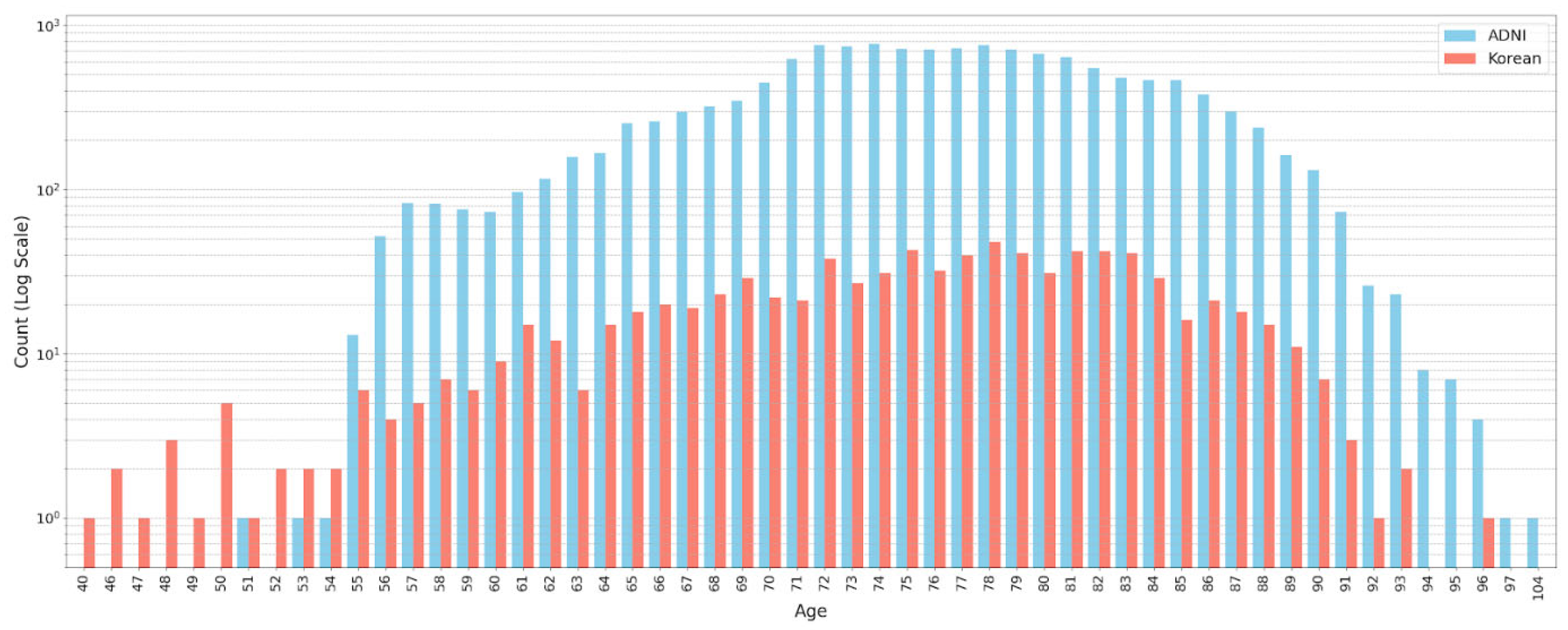
2.1. Data
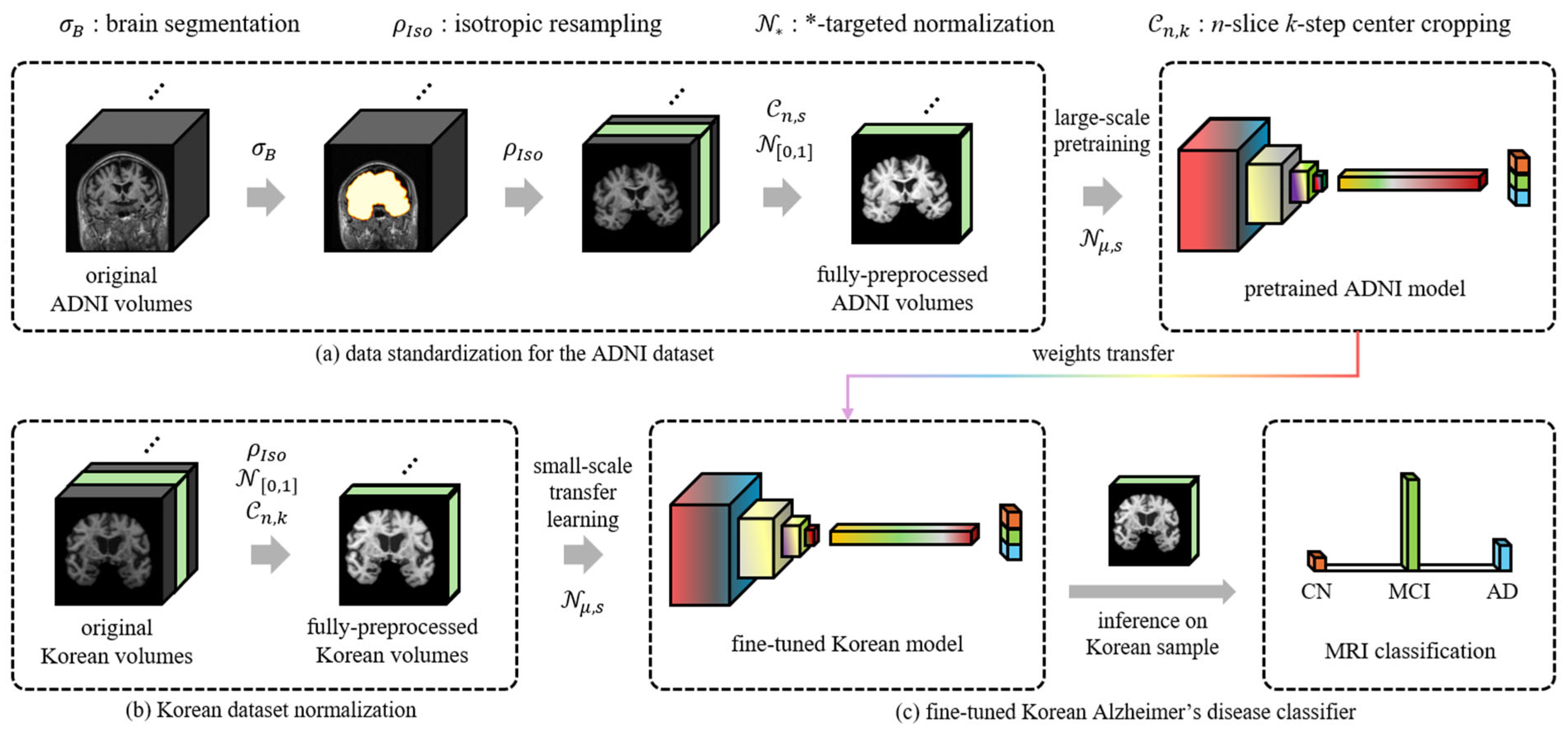
2.2. Data Preprocessing
2.3. Model Selection and Input Normalization
2.4. Large-Scale Pretraining
2.5. Transfer Learning on Small Cohorts
2.6. Performance Metrics
- ;
- ;
- ;
- ;
- ;
- .
3. Results
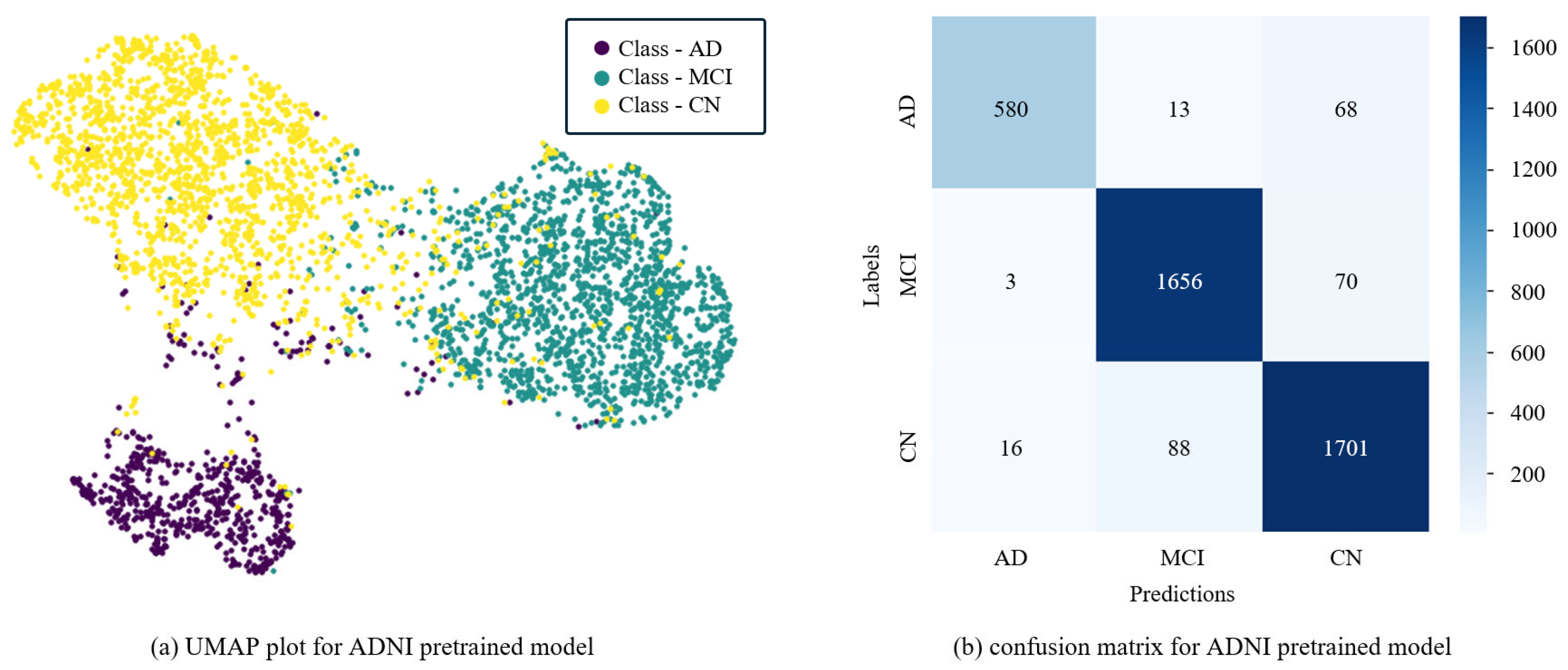
3.1. Baseline Performance
3.2. Transfer Learning Performance on Korean Dataset
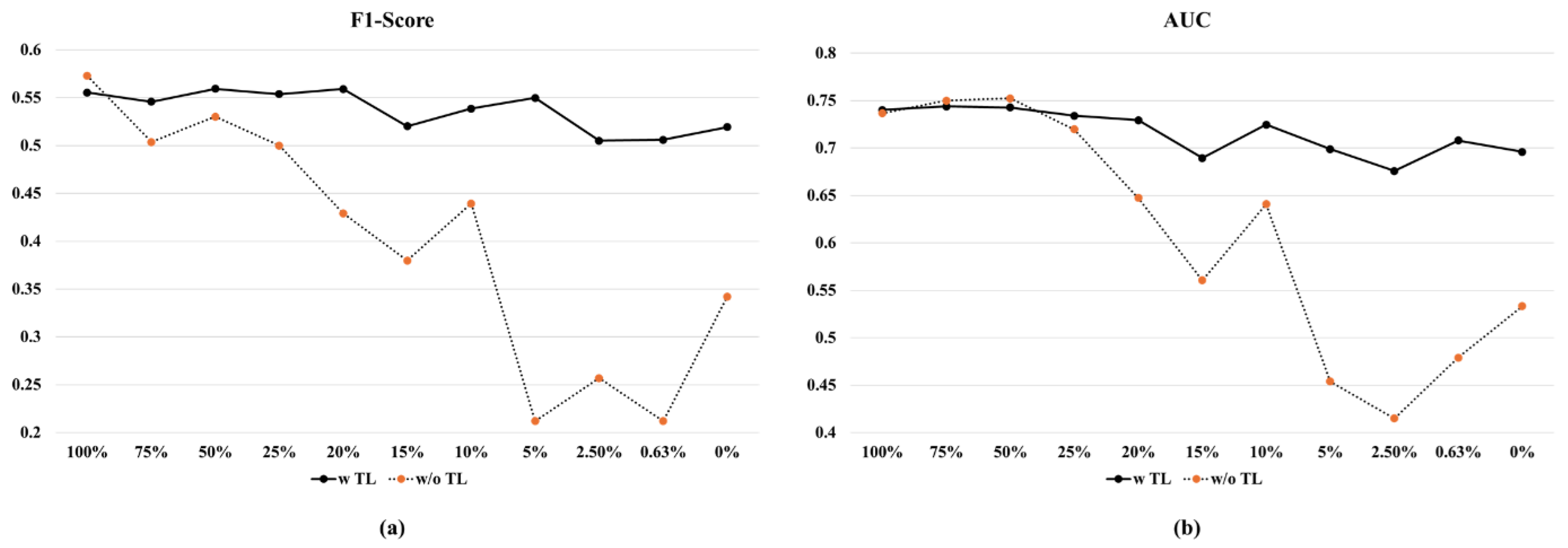
3.3. Evaluating the Robustness of Transfer Learning Across Varying Dataset Sizes
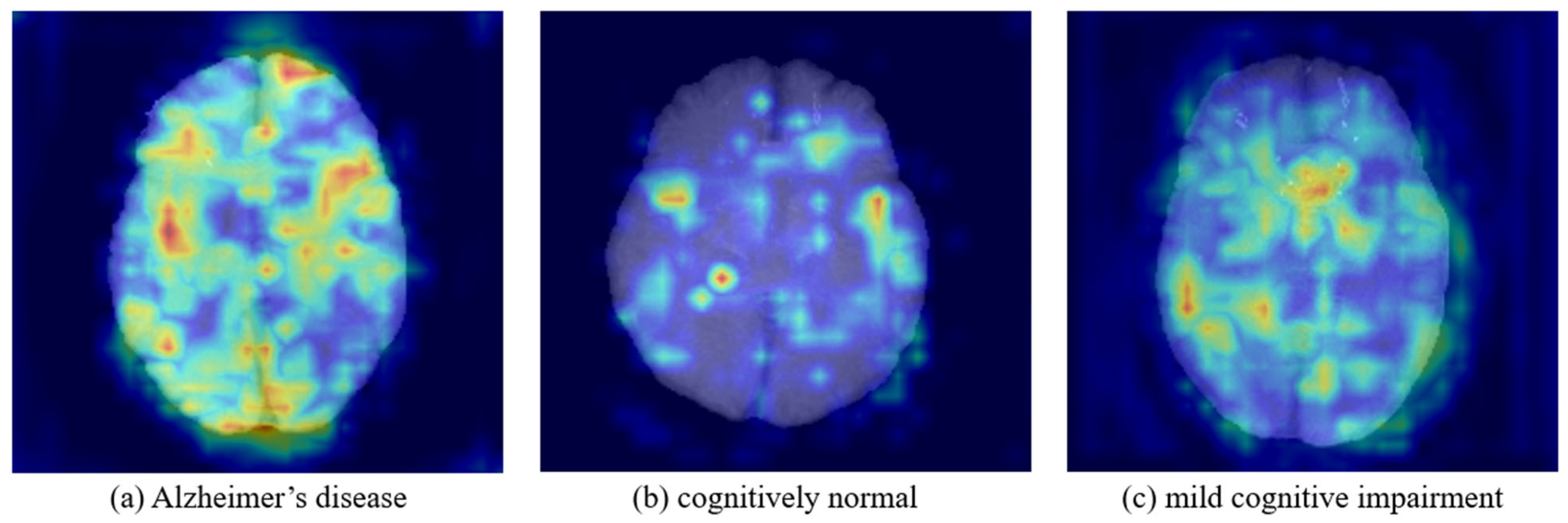
4. Discussion
5. Conclusions
Supplementary Materials
Author Contributions
Funding
Institutional Review Board Statement
Informed Consent Statement
Data Availability Statement
Acknowledgments
Conflicts of Interest
References
- Rajpurkar, P.; Chen, E.; Banerjee, O.; Topol, E.J. AI in health and medicine. Nat. Med. 2022, 28, 31–38. [Google Scholar] [CrossRef]
- Kumar, Y.; Koul, A.; Singla, R.; Ijaz, M.F. Artificial intelligence in disease diagnosis: A systematic literature review, synthesizing framework and future research agenda. J. Ambient. Intell. Humaniz. Comput. 2023, 14, 8459–8486. [Google Scholar] [CrossRef] [PubMed]
- Arya, A.D.; Verma, S.S.; Chakarabarti, P.; Chakrabarti, T.; Elngar, A.A.; Kamali, A.M.; Nami, M. A systematic review on machine learning and deep learning techniques in the effective diagnosis of Alzheimer’s disease. Brain Inform. 2023, 10, 17. [Google Scholar] [CrossRef]
- Cummings, J.L.; Zhou, Y.; Lee, G.; Zhong, K.; Fonseca, J.; Leisgang-Osse, A.M.; Cheng, F. Alzheimer’s disease drug development pipeline: 2025. Alzheimer’s Dement. Transl. Res. Clin. Interv. 2025, 11, e70098. [Google Scholar] [CrossRef]
- Rasmussen, J.; Langerman, H. Alzheimer’s disease—Why we need early diagnosis. Degener. Neurol. Neuromuscul. Dis. 2019, 9, 123–130. [Google Scholar] [CrossRef]
- Ávila-Villanueva, M.; Marcos Dolado, A.; Gómez-Ramírez, J.; Fernández-Blázquez, M. Brain structural and functional changes in cognitive impairment due to Alzheimer’s disease. Front. Psychol. 2022, 13, 886619. [Google Scholar] [CrossRef] [PubMed]
- Planche, V.; Manjon, J.V.; Mansencal, B.; Lanuza, E.; Tourdias, T.; Catheline, G.; Coupé, P. Structural progression of Alzheimer’s disease over decades: The MRI staging scheme. Brain Commun. 2022, 4, fcac109. [Google Scholar] [CrossRef]
- El-Assy, A.M.; Amer, H.M.; Ibrahim, H.M.; Mohamed, M.A. A novel CNN architecture for accurate early detection and classification of Alzheimer’s disease using MRI data. Sci. Rep. 2024, 14, 3463. [Google Scholar] [CrossRef]
- Uyguroğlu, F.; Toygar, Ö.; Demirel, H. CNN-based Alzheimer’s disease classification using fusion of multiple 3D angular orientations. Signal Image Video Process. 2024, 18, 2743–2751. [Google Scholar] [CrossRef]
- Zhou, W.; Yang, Y.; Yu, C.; Liu, J.; Duan, X.; Weng, Z.; Chen, D.; Liang, Q.; Fang, Q.; Zhou, J.; et al. Ensembled deep learning model outperforms human experts in diagnosing biliary atresia from sonographic gallbladder images. Nat. Commun. 2021, 12, 1259. [Google Scholar] [CrossRef] [PubMed]
- Li, M.D.; Huang, Z.R.; Shan, Q.Y.; Chen, S.L.; Zhang, N.; Hu, H.T.; Wang, W. Performance and comparison of artificial intelligence and human experts in the detection and classification of colonic polyps. BMC Gastroenterol. 2022, 22, 517. [Google Scholar] [CrossRef] [PubMed]
- Aung, Y.Y.; Wong, D.C.; Ting, D.S. The promise of artificial intelligence: A review of the opportunities and challenges of artificial intelligence in healthcare. Br. Med. Bull. 2021, 139, 4–15. [Google Scholar] [CrossRef]
- Mueller, S.G.; Weiner, M.W.; Thal, L.J.; Petersen, R.C.; Jack, C.; Jagust, W.; Trojanowski, J.Q.; Toga, A.W.; Beckett, L. The Alzheimer’s disease neuroimaging initiative. Neuroimaging Clin. 2005, 15, 869–877. [Google Scholar] [CrossRef] [PubMed]
- Marcus, D.S.; Wang, T.H.; Parker, J.; Csernansky, J.G.; Morris, J.C.; Buckner, R.L. Open Access Series of Imaging Studies (OASIS): Cross-sectional MRI data in young, middle aged, nondemented, and demented older adults. J. Cogn. Neurosci. 2007, 19, 1498–1507. [Google Scholar] [CrossRef] [PubMed]
- George, A.; Abraham, B.; George, N.; Shine, L.; Ramachandran, S. An Efficient 3D CNN Framework with Attention Mechanisms for Alzheimer’s Disease Classification. Comput. Syst. Sci. Eng. 2023, 47, 2097–2118. [Google Scholar] [CrossRef]
- Ramani, R.; Ganesh, S.S.; Rao, S.S.; Aggarwal, N. Integrated multi-modal 3D-CNN and RNN approach with transfer learning for early detection of Alzheimer’s disease. Iran. J. Sci. Technol. Trans. Electr. Eng. 2025, 49, 383–407. [Google Scholar] [CrossRef]
- Turrisi, R.; Verri, A.; Barla, A. The effect of data augmentation and 3D-CNN depth on Alzheimer’s Disease detection. arXiv 2023, arXiv:2309.07192. [Google Scholar]
- Xie, L.; Das, S.R.; Wisse, L.E.; Ittyerah, R.; de Flores, R.; Shaw, L.M.; Yushkevich, P.A.; Wolk, D.A.; Alzheimer’s Disease Neuroimaging Initiative. Baseline structural MRI and plasma biomarkers predict longitudinal structural atrophy and cognitive decline in early Alzheimer’s disease. Alzheimer’s Res. Ther. 2023, 15, 79. [Google Scholar] [CrossRef]
- Aberathne, I.; Kulasiri, D.; Samarasinghe, S. Detection of Alzheimer’s disease onset using MRI and PET neuroimaging: Longitudinal data analysis and machine learning. Neural Regen. Res. 2023, 18, 2134–2140. [Google Scholar] [CrossRef]
- Golovanevsky, M.; Eickhoff, C.; Singh, R. Multimodal attention-based deep learning for Alzheimer’s disease diagnosis. J. Am. Med. Inform. Assoc. 2022, 29, 2014–2022. [Google Scholar] [CrossRef]
- Chee, M.W.L.; Zheng, H.; Goh, J.O.S.; Park, D.; Sutton, B.P. Brain structure in young and old East Asians and Westerners: Comparisons of structural volume and cortical thickness. J. Cogn. Neurosci. 2011, 23, 1065–1079. [Google Scholar] [CrossRef]
- Yuan, C.; Linn, K.A.; Hubbard, R.A. Algorithmic fairness of machine learning models for Alzheimer disease progression. JAMA Netw. Open 2023, 6, e2342203. [Google Scholar] [CrossRef]
- AI-Hub. Neuroimaging Data for Dementia Diagnosis [Data Set]. AI-Hub. 2021. Available online: https://www.aihub.or.kr/aihubdata/data/view.do?dataSetSn=227 (accessed on 30 January 2025).
- Itzcovich, I. DeepBrain: Brain Image Processing Tools Using Deep Learning Focused on Speed and Accuracy. GitHub. 2018. Available online: https://github.com/iitzco/deepbrain (accessed on 13 May 2025).
- Ronneberger, O.; Fischer, P.; Brox, T. U-net: Convolutional networks for biomedical image segmentation. In International Conference on Medical Image Computing and Computer-Assisted Intervention; Springer International Publishing: Cham, Switzerland, 2015; pp. 234–241. [Google Scholar]
- Warfield, S.K.; Zou, K.H.; Wells, W.M. Simultaneous truth and performance level estimation (STAPLE): An algorithm for the validation of image segmentation. IEEE Trans. Med. Imaging 2004, 23, 903–921. [Google Scholar] [CrossRef]
- Eskildsen, S.F.; Coupé, P.; Fonov, V.; Manjón, J.V.; Leung, K.K.; Guizard, N.; Wassef, S.N.; Østergaard, L.R.; Collins, D.L. Alzheimer’s Disease Neuroimaging Initiative. BEaST: Brain extraction based on nonlocal segmentation technique. NeuroImage 2012, 59, 2362–2373. [Google Scholar] [CrossRef]
- Hara, K.; Kataoka, H.; Satoh, Y. Learning spatio-temporal features with 3d residual networks for action recognition. In Proceedings of the IEEE International Conference on Computer Vision Workshops, Venice, Italy, 22–29 October 2017; IEEE: Piscataway, NJ, USA, 2017; pp. 3154–3160. [Google Scholar]
- Deng, J.; Dong, W.; Socher, R.; Li, L.J.; Li, K.; Fei-Fei, L. Imagenet: A large-scale hierarchical image database. In Proceedings of the 2009 IEEE Conference on Computer Vision and Pattern Recognition, Miami, FL, USA, 20–25 June 2009; IEEE: Piscataway, NJ, USA, 2009; pp. 248–255. [Google Scholar]
- Szegedy, C.; Vanhoucke, V.; Ioffe, S.; Shlens, J.; Wojna, Z. Rethinking the inception architecture for computer vision. In Proceedings of the IEEE Conference on Computer Vision and Pattern Recognition, Las Vegas, NV, USA, 27–30 June 2026; IEEE: Piscataway, NJ, USA, 2016; pp. 2818–2826. [Google Scholar]
- Breiman, L. Random forests. Mach. Learn. 2001, 45, 5–32. [Google Scholar] [CrossRef]
- Cortes, C.; Vapnik, V. Support-vector networks. Mach. Learn. 1995, 20, 273–297. [Google Scholar] [CrossRef]
- Cox, D.R. The regression analysis of binary sequences. J. R. Stat. Soc. Ser. B Stat. Methodol. 1958, 20, 215–232. [Google Scholar] [CrossRef]
- Hon, M.; Khan, N.M. Towards Alzheimer’s disease classification through transfer learning. In Proceedings of the 2017 IEEE International Conference on Bioinformatics and Biomedicine (BIBM), Kansas City, MO, USA, 13–16 November 2017; IEEE: Piscataway, NJ, USA, 2017; pp. 1166–1169. [Google Scholar]
- Simonyan, K.; Zisserman, A. Very deep convolutional networks for large-scale image recognition. arXiv 2014, arXiv:1409.1556. [Google Scholar]
- Liu, S.; Masurkar, A.V.; Rusinek, H.; Chen, J.; Zhang, B.; Zhu, W.; Fernandez-Granda, C.; Razavian, N. Author Correction: Generalizable deep learning model for early Alzheimer’s disease detection from structural MRIs. Sci. Rep. 2023, 13, 16528. [Google Scholar] [CrossRef]
- Beekly, D.L.; Ramos, E.M.; van Belle, G.; Deitrich, W.; Clark, A.D.; Jacka, M.E.; Kukull, W.A. The national Alzheimer’s coordinating center (NACC) database: An Alzheimer disease database. Alzheimer Dis. Assoc. Disord. 2004, 18, 270–277. [Google Scholar]
- Kumar, S.S.; Nandhini, M. Entropy slicing extraction and transfer learning classification for early diagnosis of Alzheimer diseases with sMRI. ACM Trans. Multimed. Comput. Commun. Appl. (TOMM) 2021, 17, 1–22. [Google Scholar] [CrossRef]
- Snyder, H.M.; Asthana, S.; Bain, L.; Brinton, R.; Craft, S.; Dubal, D.B.; Espeland, M.A.; Gatz, M.; Mielke, M.M.; Raber, J.; et al. Sex biology contributions to vulnerability to Alzheimer’s disease: A think tank convened by the Women’s Alzheimer’s Research Initiative. Alzheimer’s Dement. 2016, 12, 1186–1196. [Google Scholar] [CrossRef] [PubMed]
- Dubal, D.B. Sex difference in Alzheimer’s disease: An updated, balanced and emerging perspective on differing vulnerabilities. In Handbook of Clinical Neurology; Elsevier: Amsterdam, The Netherlands, 2020; Volume 175, pp. 261–273. [Google Scholar]
- Abbasi, S.; Lan, H.; Choupan, J.; Sheikh-Bahaei, N.; Pandey, G.; Varghese, B. Deep learning for the harmonization of structural MRI scans: A survey. Biomed. Eng. OnLine 2024, 23, 90. [Google Scholar] [CrossRef] [PubMed]
- Pinto, M.S.; Paolella, R.; Billiet, T.; Van Dyck, P.; Guns, P.J.; Jeurissen, B.; Ribbens, A.; Dekker, A.J.D.; Sijbers, J. Harmonization of brain diffusion MRI: Concepts and methods. Front. Neurosci. 2020, 14, 396. [Google Scholar] [CrossRef] [PubMed]
- Dewey, B.E.; Zhao, C.; Reinhold, J.C.; Carass, A.; Fitzgerald, K.C.; Sotirchos, E.S.; Saidha, S.; Oh, J.; Pham, D.L.; Calabresi, P.A.; et al. DeepHarmony: A deep learning approach to contrast harmonization across scanner changes. Magn. Reson. Imaging 2019, 64, 160–170. [Google Scholar] [CrossRef]
- Han, K.; Wang, Y.; Chen, H.; Chen, X.; Guo, J.; Liu, Z.; Tang, Y.; Xiao, A.; Xu, C.; Xu, Y.; et al. A survey on vision transformer. IEEE Trans. Pattern Anal. Mach. Intell. 2022, 45, 87–110. [Google Scholar] [CrossRef]
- Xu, Y.; Zhang, Q.; Zhang, J.; Tao, D. Vitae: Vision transformer advanced by exploring intrinsic inductive bias. Adv. Neural Inf. Process. Syst. 2021, 34, 28522–28535. [Google Scholar]
- Zhai, X.; Kolesnikov, A.; Houlsby, N.; Beyer, L. Scaling vision transformers. In Proceedings of the IEEE/CVF Conference on Computer Vision and Pattern Recognition, New Orleans, LA, USA, 19–24 June 2022; IEEE: Piscataway, NJ, USA, 2022; pp. 12104–12113. [Google Scholar]
- Ren, S.; Gao, Z.; Hua, T.; Xue, Z.; Tian, Y.; He, S.; Zhao, H. Co-advise: Cross inductive bias distillation. In Proceedings of the IEEE/CVF Conference on Computer Vision and Pattern Recognition, New Orleans, LA, USA, 18–24 June 2022; IEEE: Piscataway, NJ, USA, 2022; pp. 16773–16782. [Google Scholar]
- Gharoun, H.; Momenifar, F.; Chen, F.; Gandomi, A.H. Meta-learning approaches for few-shot learning: A survey of recent advances. ACM Comput. Surv. 2024, 56, 1–41. [Google Scholar] [CrossRef]
- Wang, W.; Zheng, V.W.; Yu, H.; Miao, C. A survey of zero-shot learning: Settings, methods, and applications. ACM Trans. Intell. Syst. Technol. (TIST) 2019, 10, 1–37. [Google Scholar] [CrossRef]



| Dataset | #Patients | #Scans per Class | #Scans per Sex | #Total Scans | ||||
|---|---|---|---|---|---|---|---|---|
| Male | Female | AD | MCI | CN | Male | Female | ||
| ADNI | 981 | 1013 | 2270 | 5895 | 5824 | 7529 | 6460 | 13,989 |
| Korean | N/A | N/A | 311 | 312 | 214 | 249 | 588 | 837 |
| Acc | F1 | F1(AD) | F1(CN) | F1(MCI) | AUC | Precision | Recall | |
|---|---|---|---|---|---|---|---|---|
| 1 mm | 0.9356 | 0.9357 | 0.9230 | 0.9314 | 0.9448 | 0.9849 | 0.9357 | 0.9356 |
| 2 mm | 0.9499 | 0.9498 | 0.9360 | 0.9460 | 0.9590 | 0.9896 | 0.9502 | 0.9499 |
| 3 mm | 0.9435 | 0.9434 | 0.9332 | 0.9512 | 0.9394 | 0.9892 | 0.9441 | 0.9435 |
| Case | Train:Test | Acc | F1 | F1(AD) | F1(CN) | F1(MCI) | AUC | Precision | Recall |
|---|---|---|---|---|---|---|---|---|---|
| (a) | 7:3 | 0.6653 | 0.6595 | 0.7283 | 0.7605 | 0.3965 | 0.7929 | 0.6557 | 0.6653 |
| (b) * | 7:3 | 0.6080 | 0.5999 | 0.6969 | 0.6813 | 0.3500 | 0.7500 | 0.5946 | 0.6080 |
| (c) | 0:7 | 0.5111 | 0.5193 | 0.6371 | 0.5263 | 0.3361 | 0.6961 | 0.5412 | 0.5111 |
| (d) * | 3:7 | 0.5385 | 0.5555 | 0.6077 | 0.5865 | 0.4355 | 0.7403 | 0.6179 | 0.5385 |
| (e) | 8:2 | 0.5500 | 0.4300 | 0.6100 | 0.6500 | 0.0400 | 0.6708 | 0.4400 | 0.4900 |
| (f) | 8:2 | 0.5400 | 0.4200 | 0.6000 | 0.6700 | 0.0000 | 0.6939 | 0.3700 | 0.4900 |
| (g) | 8:2 | 0.5500 | 0.5000 | 0.6000 | 0.6300 | 0.2700 | 0.7101 | 0.5400 | 0.5200 |
| (h) | 8:2 | N/A | N/A | N/A | N/A | N/A | 0.7667 | N/A | N/A |
Disclaimer/Publisher’s Note: The statements, opinions and data contained in all publications are solely those of the individual author(s) and contributor(s) and not of MDPI and/or the editor(s). MDPI and/or the editor(s) disclaim responsibility for any injury to people or property resulting from any ideas, methods, instructions or products referred to in the content. |
© 2026 by the authors. Licensee MDPI, Basel, Switzerland. This article is an open access article distributed under the terms and conditions of the Creative Commons Attribution (CC BY) license.
Share and Cite
Lee, M.; Lee, S.; Seo, H. Enhancing Early Alzheimer’s Disease Detection via Transfer Learning: From Big Structural MRI Datasets to Ethnically Distinct Small Cohorts. Appl. Sci. 2026, 16, 1004. https://doi.org/10.3390/app16021004
Lee M, Lee S, Seo H. Enhancing Early Alzheimer’s Disease Detection via Transfer Learning: From Big Structural MRI Datasets to Ethnically Distinct Small Cohorts. Applied Sciences. 2026; 16(2):1004. https://doi.org/10.3390/app16021004
Chicago/Turabian StyleLee, Minjae, Suwon Lee, and Hyeon Seo. 2026. "Enhancing Early Alzheimer’s Disease Detection via Transfer Learning: From Big Structural MRI Datasets to Ethnically Distinct Small Cohorts" Applied Sciences 16, no. 2: 1004. https://doi.org/10.3390/app16021004
APA StyleLee, M., Lee, S., & Seo, H. (2026). Enhancing Early Alzheimer’s Disease Detection via Transfer Learning: From Big Structural MRI Datasets to Ethnically Distinct Small Cohorts. Applied Sciences, 16(2), 1004. https://doi.org/10.3390/app16021004