1. Introduction
Falls represent one of the most critical safety risks in shared environments, often leading to severe medical complications and substantial social costs, particularly among vulnerable populations such as older adults and children [
1]. In complex multi-person settings—such as detention facilities and nursing homes—limited supervision hinders timely detection and response. In particular, delayed or erroneous detection in these environments can lead to severe consequences, highlighting the need for reliable and robust fall detection systems in real-world deployments. Although recent advances in computer vision have enabled CCTV-based fall detection, ensuring reliable performance in crowded and unconstrained environments remains a significant challenge [
2].
Over the past decade, fall detection research has advanced across wearable sensor-based, vision-based, and skeleton-based paradigms [
1,
3]. These approaches have demonstrated promising performance, with recent deep learning-based skeleton action recognition methods achieving high accuracy on benchmark datasets [
4,
5]. However, the majority of these studies have been conducted in controlled environments or single-person settings, where occlusion is minimal and identity tracking is not required [
5,
6]. While such conditions enable reliable performance, they do not adequately reflect real-world scenarios. In practical surveillance environments, multiple individuals often share the same camera view. In such multi-person settings, spatial crowding, occlusion, and viewpoint limitations not only degrade the quality of pose estimation but also disrupt temporal continuity. These issues lead to joint misdetections, identity switching, and fragmented trajectories, ultimately undermining the reliability of fall detection systems [
7,
8,
9,
10]. Consequently, methods designed for single-person environments often struggle to maintain stable performance when applied to real-world multi-person scenarios.
Recent studies have attempted to mitigate these limitations by incorporating multi-object tracking and occlusion-aware modeling techniques [
7,
8]. Although these approaches improve robustness to some extent, they tend to focus on enhancing individual components, such as detection accuracy or tracking performance. As a result, perception instability and tracking inconsistency are often treated as separate issues rather than being addressed in an integrated manner. However, in real-world multi-person environments, these factors are inherently coupled. Errors arising from pose estimation, identity tracking, and action interpretation do not occur independently; instead, they interact and propagate throughout the detection pipeline. Despite their critical impact, these interactions have not been sufficiently analyzed within a unified framework. Therefore, a systematic understanding of how multiple error factors co-occur and propagate is essential for improving the reliability of fall detection systems in practical applications.
Motivated by this gap, this study introduces an error-centric, system-level analysis that explicitly examines how errors emerge, interact, and propagate across the perception–tracking–interpretation pipeline. We adopt a structural perspective to examine fall detection errors in multi-person environments using real-world video data captured with a monocular RGB camera [
11,
12]. Based on our previous work [
11], this study evaluates four fall detection approaches—ST-GCN-based and ProtoGCN-based skeleton methods, a rule-based method, and a VIRA-GCN-based 3D joint method—using a common dataset and compares their error characteristics and response behaviors from a system-level perspective. In particular, the 3D joint-based approach uses estimated spatial representations derived from monocular pose lifting rather than directly measured depth values. The proposed approach emphasizes a holistic understanding of error propagation mechanisms at the system level, with an emphasis on system-wide interactions. Moving beyond conventional performance evaluation, the analysis is conducted based on a predefined taxonomy of error types. Each video sequence is examined at the frame level to quantitatively assess the occurrence and frequency of errors, while also incorporating qualitative analysis. In particular, multiple error factors—including joint recognition failures, skeleton interference, identity tracking inconsistencies, and confusion with similar activities—are comprehensively considered to identify recurring structural error patterns in multi-person environments.
The main contributions of this study are as follows:
A systematic analysis of fall detection errors in multi-person environments beyond performance-centric evaluation is presented.
A taxonomy of six recurring error types is introduced to characterize interactions among perception, identity tracking, and action interpretation.
Error interactions and propagation across detection pipelines are systematically examined, providing a unified perspective on their underlying mechanisms.
System-level design insights are derived to enhance robustness in real-world multi-person fall detection systems.
The remainder of this paper is organized as follows.
Section 2 reviews related work.
Section 3 presents the experimental setting and error definitions.
Section 4 reports quantitative results and interaction analysis.
Section 5 and
Section 6 discuss implications and conclude the study.
2. Related Works
Research on fall detection has evolved across diverse sensing paradigms and computational modeling approaches, as comprehensively surveyed in recent systematic reviews [
13,
14]. Although substantial progress has been made in improving classification performance, comparatively limited attention has been devoted to understanding failure mechanisms in complex multi-person environments. To clarify the research gap addressed in this study, this section reviews prior work from a unified pipeline perspective, focusing on perception and data representation, action recognition and classification, and multi-person tracking and error propagation.
2.1. Data Modalities and Representation
Fall detection systems rely on various sensing modalities to perceive human motion, which can be broadly categorized into wearable sensor-based and vision-based approaches [
1,
3]. Wearable systems represent motion using inertial signals such as acceleration and angular velocity [
15], whereas vision-based systems utilize RGB or RGB-D image sequences to extract appearance and motion cues from visual data [
3]. Recently, skeleton-based representations have emerged as prominent mid-level features derived from visual inputs through pose estimation. Compared with raw image data, skeleton representations provide a compact and privacy-preserving description of human posture, making them suitable for indoor monitoring environments [
16,
17].
Nevertheless, the reliability of such representations fundamentally depends on the quality of the underlying visual perception. Factors such as occlusion, noise, and viewpoint variation can degrade pose estimation accuracy, thereby directly affecting the quality of the extracted skeleton representations [
7,
18]. This limitation is consistent with findings in related domains. For example, LiDAR-based structural extraction studies have shown that skeleton quality is often governed more by input data conditions—such as noise and occlusion—than by the extraction algorithm itself [
19]. These findings suggest that errors in derived representations frequently originate from degraded perception rather than from isolated modeling deficiencies.
2.2. Action Recognition and Classification
Once motion data are obtained, various computational models are employed for the classification of fall events. Early approaches relied on threshold-based rules and heuristic features that detect abrupt changes in motion patterns associated with falls [
15,
20]. With the advancement of deep learning, spatial–temporal modeling techniques have significantly improved classification performance across different sensing modalities. In particular, skeleton-based action recognition has achieved strong performance through graph convolutional architectures such as ST-GCN [
21], InfoGCN [
4], ProtoGCN [
22], and RA-GCN [
23], particularly on benchmark datasets such as NTU RGB+D [
5,
6]. These models effectively capture spatial and temporal dependencies in human motion.
Despite these advances, most existing approaches have been developed and evaluated under controlled or single-person conditions, where input representations remain relatively stable and reliable. Fall detection datasets such as Le2i [
24], SDUFall [
25], and CAUCAFall [
26] are also primarily constructed under single-person scenarios and therefore do not adequately capture multi-person interactions. These environmental and dataset characteristics result in models that are optimized for relatively ideal input conditions.
In real-world environments, perception quality is often degraded, which makes classification models struggle to distinguish falls from fall-like activities such as sitting or bending and increases false-positive rates [
19,
27,
28]. Skeleton-based models are particularly sensitive to joint estimation noise and temporal inconsistency, which makes them vulnerable to instability in multi-person scenarios. Consequently, classification performance becomes strongly dependent on the quality of upstream perception and tracking processes, highlighting a structural limitation that remains insufficiently addressed in existing studies.
2.3. Multi-Person Tracking and Error Propagation
In real-world surveillance environments, such as nursing homes and rehabilitation facilities, multiple individuals often share a single camera view [
2]. In such settings, spatial crowding and occlusion significantly affect both pose estimation and identity tracking [
7,
8,
29]. Recent studies aim to mitigate these challenges using data association, motion modeling, and occlusion-aware feature learning [
20,
30]. Nevertheless, joint misdetection, partial skeleton loss, identity switching, and trajectory fragmentation remain prevalent, undermining the temporal continuity required for robust action recognition. Although recent tracking methods address missed detections and association failures [
30], maintaining stable trajectories remains difficult in complex multi-person environments.
These limitations extend beyond individual components and affect the entire detection pipeline. Errors arising from degraded perception and unstable tracking accumulate over time, causing the action classifier to receive inconsistent or temporally distorted motion sequences, thereby reducing prediction reliability. Most prior studies focus on optimizing individual components, such as perception accuracy or classification performance [
8,
9,
10]. Recent skeleton-based action recognition models improve spatio-temporal representations by modeling inter-joint relationships and viewpoint variations [
23,
31], while occlusion-aware pose estimation methods enhance joint-level robustness [
32]. However, these approaches generally assume reliable inputs and do not explicitly consider upstream factors such as occlusion, missing keypoints, or identity switching. As a result, they offer limited insight into how early-stage errors influence downstream tracking and classification.
This limitation is more pronounced in fall detection systems, which operate as multi-stage pipelines consisting of sensing, preprocessing, tracking, and classification, where early-stage errors can accumulate and propagate through subsequent stages [
23]. Despite this, few studies systematically examine the interactions among perception degradation, identity inconsistency, and tracking instability in multi-person environments. To address this gap, this study adopts an error-centric perspective. Using real-world videos captured by a monocular RGB camera, we define a taxonomy of six recurring error types and analyze their propagation patterns across ST-GCN-based and ProtoGCN-based skeleton methods, a rule-based method, and a VIRA-GCN-based 3D joint method. By examining the interactions among perception, tracking, and classification at the system level, this study provides a structured understanding of error propagation and failure mechanisms in multi-person fall detection systems.
3. Materials and Methods
This section describes the data configuration and analysis framework used to systematically investigate fall detection errors in multi-person environments. Based on anonymized video data collected from a real detention facility, this study conducts an integrated analysis of fall detection outcomes derived from skeleton-based, rule-based, and 3D joint-based approaches, together with the associated skeleton estimation and tracking performance. Specifically, through fine-grained frame-level analysis, we systematically characterize recurring error patterns and their underlying properties. This analysis enables the diagnosis of perception and tracking limitations in multi-person settings and facilitates the identification of structural error mechanisms commonly observed across diverse systems. All video processing, model inference, and computational analyses were performed using Python 3.7.11, PyTorch 1.11.0, CUDA 11.3, and OpenCV 4.7.0.
3.1. Experimental Environment and Data Collection
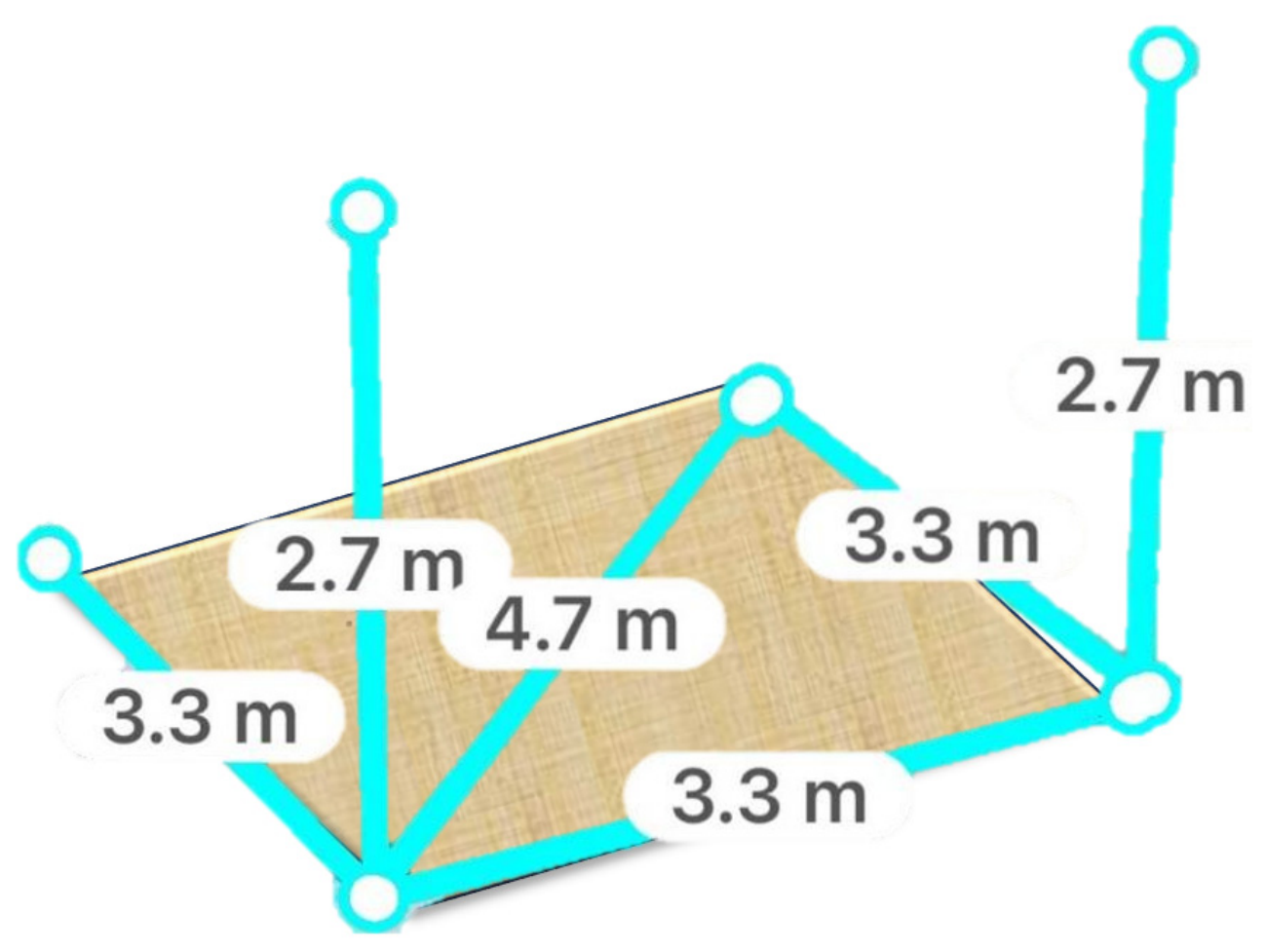
To simulate a real-world residential environment, the experiments were conducted in a studio space configured as a one-room setting. A single consumer-grade CCTV camera was installed to cover the entire indoor area, reflecting practical surveillance conditions characterized by a fixed viewpoint and limited sensing capabilities. The recordings were performed under minimally constrained conditions to reproduce natural scenarios comparable to actual residential settings. Detailed spatial configurations, including the camera’s field of view and the layout of the furniture, are illustrated in the three-dimensional coordinate-based representation shown in
Figure 1.
The experimental setup and video data used in this study are based on the real-world CCTV dataset introduced in [
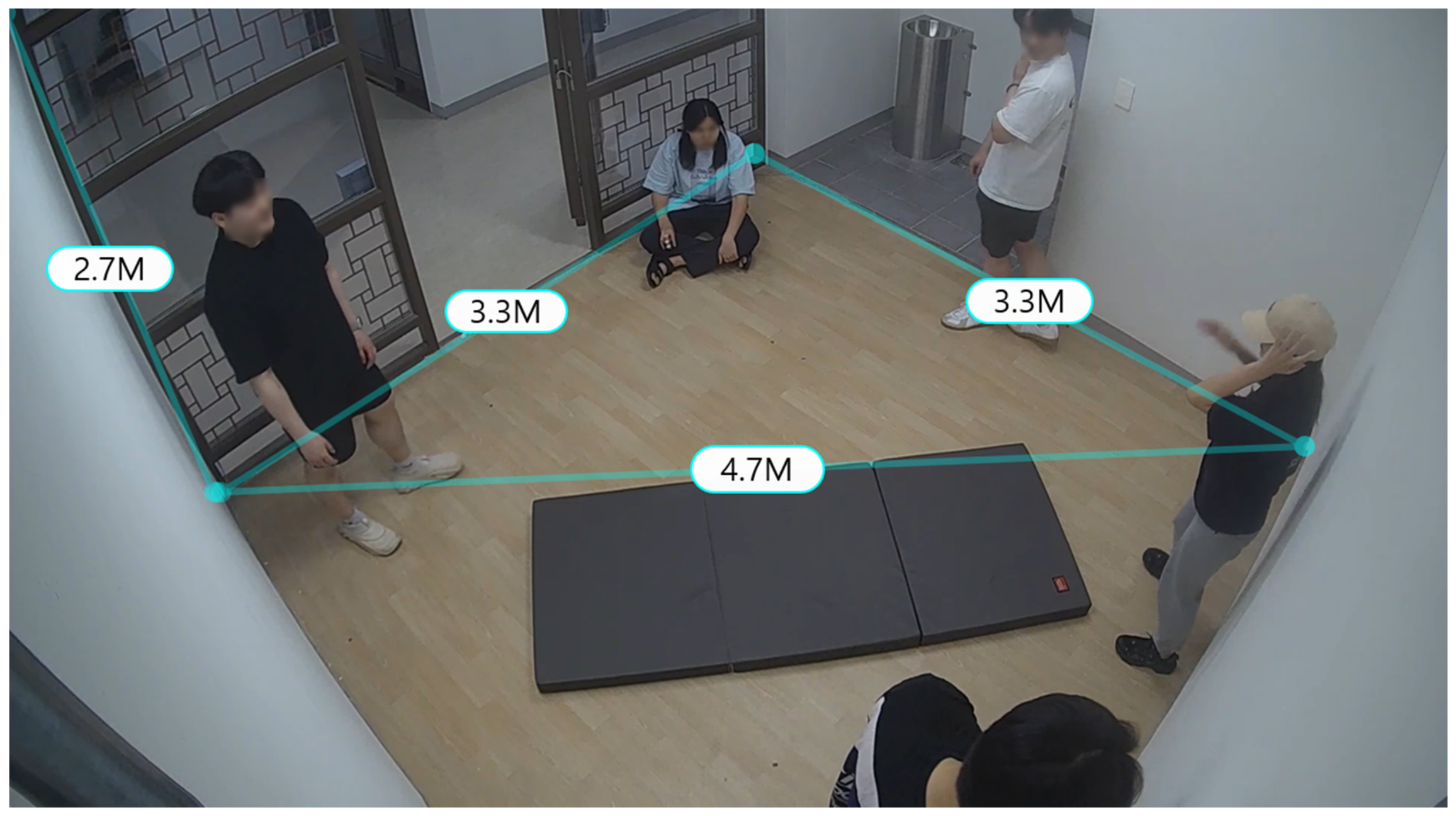
12]. This study utilizes 95 RGB video sequences, comprising 60 fall cases and 35 normal activity cases, collected in a real CCTV environment to analyze fall detection errors in multi-person environments. The dataset incorporates diverse variables—including fall direction, head orientation, fall posture, and sequence length—which reflect observational conditions affecting skeleton estimation, identity tracking, and temporal continuity. All sequences represent multi-person settings, with up to five individuals appearing simultaneously. Within this configuration, a video is labeled as a fall case if at least one individual in the scene experiences a fall.
Figure 2 presents a representative frame from the real-world CCTV environment, illustrating a confined multi-person indoor scenario with multiple individuals in close proximity. In such environments, spatial interactions and partial occlusions frequently occur, introducing ambiguity into skeleton estimation and identity tracking. Consequently, these conditions serve as key factors that increase the likelihood of error propagation across the perception and tracking stages of fall detection systems.
This setup provides a systematic basis for examining error-prone situations in multi-person fall detection. Moreover, consistent with the system-level focus of this study, fall detection is formulated as an event-level task that determines whether a fall occurs within a video, rather than identifying the specific individual who falls.
3.2. Overview of Skeleton-Based and Rule-Based Fall Detection Processes
This section summarizes the fall detection process that generates the detection outcomes and skeleton estimation results analyzed in this study. It describes the processing pipeline used in prior fall detection experiments [
12], from which the video outputs used for qualitative error characterization are derived. This description supports the interpretation of the error patterns discussed in the subsequent sections.
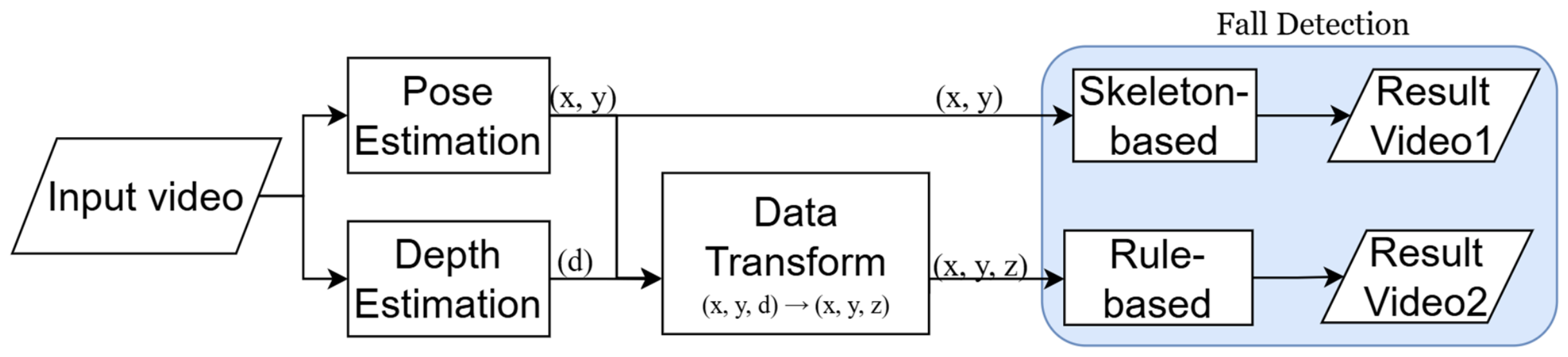
The fall detection process follows the workflow illustrated in
Figure 3. First, in the previously established ST-GCN-based skeleton method and rule-based method [
12], 2D pose estimation was performed on the input video frames using the same RTMO (Real-Time Multi-person One-stage) pose estimation model [
33], and 2D joint coordinates (x, y) were extracted. The detected joints included major body parts such as the head, shoulders, elbows, wrists, hips, knees, and ankles, and their positions were tracked on a frame-by-frame basis. Simultaneously, depth estimation was performed to obtain depth values (d) corresponding to the same pixel coordinates. These values, represented as relative distances in the camera coordinate system, were combined with the 2D pose coordinates to form (x, y, d) data. The combined data were then converted into real-world distance units using the camera’s intrinsic and extrinsic parameters, producing three-dimensional skeleton poses (x, y, z) that represent the spatial positions of each joint.
The extracted coordinates were utilized differently depending on the detection method. The Skeleton-based detection method employed the Spatio-Temporal Graph Convolutional Network (ST-GCN) model [
21]. ST-GCN represents body joints as graph nodes and models both spatial connections between joints and temporal movements as edges, enabling the network to learn spatiotemporal motion patterns. The 2D skeleton sequences were processed through coordinate and motion vector streams, and a frame was classified as a fall when the fall probability exceeded a threshold of 0.8.
The Rule-based method transformed 2D skeleton data into 3D coordinates using the estimated depth information and determined fall events based on symbolic rules. A fall was detected when the vertical position of the neck joint fell below a predefined threshold of 0.19 m and its vertical descent speed exceeded 0.30 m per frame over a fixed time interval. Both methods were applied independently to the same video dataset, and their detailed implementation details and configuration are described in a previous study [
12].
The probability threshold of 0.8 and geometric threshold of 0.19 m used in the rule-based method are based on the experiments from the referenced study. In that study, thresholds such as neck–floor clearance, floor-proximity threshold, and vertical descent threshold were defined, with the floor-proximity threshold of 0.19 m being chosen to maximize performance on the validation set. More detailed information regarding these thresholds can be found in the relevant sections of the referenced study.
3.3. Skeleton-Based Fall Detection Using Prototype-Based Representation Learning
In this section, ProtoGCN [
22], a recent skeleton-based action recognition model, is additionally evaluated to examine its behavior relative to the ST-GCN-based skeleton method under the same multi-person CCTV conditions. ST-GCN is a representative GCN-based model that represents skeleton sequences as graph structures and jointly learns spatial dependencies between joints and temporal dynamics. However, ST-GCN is an early skeleton-based action recognition model proposed in 2018, whereas subsequent skeleton-based models have incorporated graph topology modeling, contrastive learning, and prototype learning. Accordingly, ProtoGCN was added to clarify whether the ST-GCN-based results are specific to an early GCN architecture or reflect common error characteristics of skeleton-based methods in multi-person CCTV environments.
ProtoGCN is a recent GCN-based model for skeleton-based action recognition that introduces prototype-based representation learning to distinguish actions with similar joint trajectories. Skeleton representations describe actions mainly through joint coordinates and do not directly include appearance information or scene context contained in RGB images. Therefore, for fall and fall-like actions, such as sitting, lying down, and bending, subtle motion differences in specific joints may not be sufficiently emphasized within the overall motion sequence. ProtoGCN addresses this limitation using a Prototype Reconstruction Network, which reconstructs skeleton-sequence dynamics as a combination of learnable prototypes. In this process, the memory module stores prototypes representing inter-joint relationship patterns, while the reconstruction module selectively combines prototypes relevant to the input skeleton features to generate enhanced representations. In addition, Motion Topology Enhancement and class-specific contrastive learning strengthen fine-grained inter-joint relationships and inter-class discriminability, thereby forming more discriminative motion representations.
Unlike the bottom-up pose-estimation pipeline approach used for ST-GCN, ProtoGCN extracted 2D joint coordinates through top-down pose estimation. However, both methods used 2D skeleton sequences with the same input dimensionality, and each sequence was constructed by concatenating the 2D joint coordinates extracted from consecutive frames along the temporal axis.
Therefore, the performance differences between the two methods can be interpreted as resulting not from the use of 3D information, but from differences in the pose estimation paradigm used to generate the 2D skeleton sequences and the model structure used to interpret them.
For the ProtoGCN-based evaluation, the fall prediction threshold was fixed at 0.8 to maintain consistency with the ST-GCN-based skeleton method. Based on the preliminary validation results, the temporal window size, stride, and temporal consistency threshold were set to 10, 0, and 5, respectively. These inference-level parameters were used to aggregate clip-level predictions from 2D skeleton sequences into event-level detection outcomes and were kept fixed throughout the final performance evaluation and error-type analysis. The detailed parameter search results are summarized in
Table A1.
3.4. 3D Joint-Based Fall Detection Using Monocular Pose Lifting
In addition to the skeleton-based and rule-based methods described in
Section 3.2, we further examine a VIRA-GCN-based method that uses 3D joint representations estimated from monocular RGB video. VIRA-GCN adopts a representation-level hybrid structure that extends 2D skeleton coordinates into 3D joint representations and jointly learns the spatial relationships among joints and their temporal motion patterns [
32]. While conventional rule-based methods rely on explicit conditions such as joint height and velocity, VIRA-GCN learns fall-related motion characteristics from variations in 3D joint sequences in a data-driven manner. Therefore, VIRA-GCN can be regarded as an intermediate representation that bridges 2D skeleton-based methods and explicit rule-based methods. This formulation enables a comparison of fall detection approaches with different joint representations and decision mechanisms.
The overall process consists of three stages: 2D pose estimation, 3D pose lifting, and graph-based action recognition. First, persons are detected in each frame of the input RGB video, and a top-down 2D pose estimator is then applied to each detected person to extract joint coordinates. The extracted coordinates are linked across consecutive frames to form a 2D skeleton sequence. This sequence is then used as the input to a monocular 3D pose lifting model, which estimates 3D joint representations from 2D joint coordinates. The generated 3D coordinates are not directly measured using a depth sensor; rather, they are estimated by a pre-trained model based on the spatial arrangement and temporal dynamics of 2D joints. The pose lifting model estimates plausible 3D human poses by using human pose priors learned from 3D pose datasets such as Human3.6M. Accordingly, the z-coordinate does not represent the physical distance between the camera and the subject or an absolute depth value. Instead, it represents the relative depth relationship among joints. The input to VIRA-GCN is represented as a sequence of 3D joint coordinates, where each frame consists of 17 joints with x, y, and z coordinates. Finally, the estimated 3D joint sequence is used as the input to VIRA-GCN, where the model learns fall-related motion patterns based on graph structures and temporal variations.
For the VIRA-GCN-based evaluation, the fall prediction threshold was also fixed at 0.8 to maintain consistency with the other learning-based methods. Based on the preliminary validation results, the temporal window size, stride, and temporal consistency threshold were set to 20, 0, and 0, respectively. These inference-level parameters were used to aggregate clip-level predictions from the estimated 3D joint sequences into event-level fall decisions and were kept fixed throughout the final quantitative evaluation and error-type analysis. The detailed parameter search results are summarized in
Table A2.
3.5. Definition of Error Types in Fall Detection
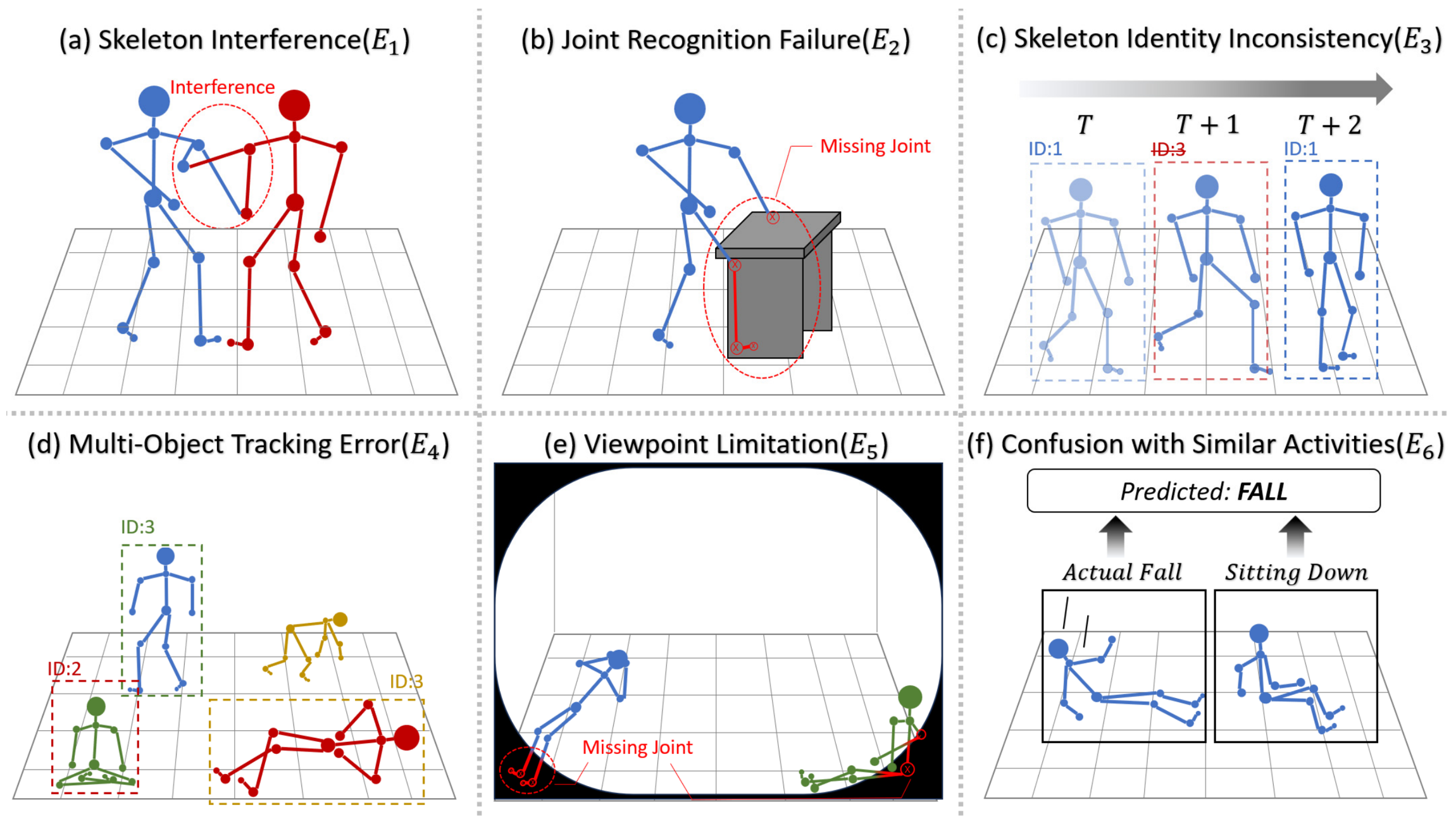
To systematically analyze recurring errors in the fall detection process, the major issues were categorized into six technical error types. These types were derived inductively from repeated observations across the analyzed multi-person video sequences, focusing on error types that consistently recurred during frame-level inspection. The resulting taxonomy, summarized in
Table 1, captures the dominant structural failure modes observed under minimally constrained multi-person conditions, rather than constituting an exhaustive classification of all possible error cases.
Figure 4 presents visual illustrations of each error type, complementing the formal definitions in
Table 1 and clarifying distinctions between conceptually similar cases. Their definitions are provided below.
Error Type 1: Skeleton interference occurs when two or more individuals are in close proximity, causing their joints to overlap or intermingle, thereby producing entangled skeleton structures. In such cases, the estimated skeleton fails to maintain a structurally coherent representation of each individual, leading to abnormal skeleton configurations. This phenomenon typically arises under conditions of spatial crowding, where the pose estimation model is unable to clearly distinguish adjacent body parts. Such interference may lead to posture distortion or unintended temporal identity inconsistency between individuals.
Error Type 2: Joint recognition failure arises when parts of the body are occluded by objects or other people, resulting in missing key joints, structural collapse of the skeleton, and reduced detection accuracy. This error occurs despite the individual remaining within the observable region of the camera and is primarily caused by localized occlusion that disrupts joint-level pose estimation.
Error Type 3: Skeleton ID tracking errors refer to temporal inconsistencies within a single skeleton track, in which the identity assigned to an individual is not consistently maintained across consecutive frames. This may result in the same person being re-labeled as a new identity or intermittently assigned different IDs over time, even in the absence of object-level association failures.
Error Type 4: Multi-object tracking errors refer to association failures occurring at the object-to-skeleton matching stage in multi-person scenes, in which detected bounding boxes and skeleton instances are incorrectly paired. These errors include cross-object ID swaps, duplicated assignments, exclusion of the actual fall subject from tracking, and cases in which multiple individuals are erroneously grouped within a single bounding box and represented as a single tracked entity. Unlike Type 3, which involves temporal identity drift within a single skeleton track, Type 4 arises from incorrect object-level associations during detection and tracking.
Error Type 5: Viewpoint limitations arise when a person falls near the frame boundary or the lower edge of the camera view, resulting in partial recognition of the body and incomplete skeleton data, which may lead to missed detections. Unlike Type 2, this error originates from global observational constraints such as limited field of view or insufficient spatial resolution, rather than localized occlusion by external objects.
Error Type 6: Confusion with similar activities refers to cases in which normal movements—such as sitting down, bending over, or lying down—exhibit pose configurations and temporal motion patterns that partially overlap with those of actual falls, leading the detection model to misclassify them as fall events and generate false positives. This error arises from spatiotemporal similarity between fall and non-fall activities rather than from failures in skeleton estimation or tracking, and is therefore attributable to ambiguity at the action interpretation stage.
Although some error types exhibit similar observable patterns, they are distinguished by their underlying causes and stages of failure. In particular, both E2, referred to as joint recognition failure, and E5, referred to as viewpoint limitation, involve missing joints; however, E2 results from occlusion within the camera’s field of view, whereas E5 occurs when body parts fall outside the observable region, reflecting limitations in the sensing configuration. Similarly, E3, denoted as skeleton ID inconsistency, represents temporal identity inconsistency within a single tracked individual, whereas E4, referred to as multi-object tracking error, arises from incorrect associations among multiple objects. This stage-wise distinction ensures that each error type remains mutually distinguishable despite superficial similarities in observable outcomes.
Among the defined error types, E1 and E2 are primarily related to skeleton formation, E3 and E4 concern identity consistency and multi-object association, E6 pertains to action interpretation, and E5 reflects observational constraints. Together, these error types provide a structured basis for the qualitative analyses presented in the following section and serve as key considerations for enhancing the robustness of fall detection systems in real-world multi-person environments.
4. Experimental Results
This section provides a comprehensive analysis of the fall detection system. To this end, four fall detection approaches were evaluated using the same video dataset, and their performance was compared in terms of Precision, Recall, F1-score, and Accuracy. Their error characteristics were then systematically analyzed based on the six error types defined in
Section 3.5. The analysis also included the outcomes of a frame-by-frame manual inspection of each video with respect to fall direction, head orientation, detection results, and descriptive annotations, as summarized in
Table 2.
To reduce subjectivity in the annotation process, error labeling was conducted based on predefined annotation guidelines. The guidelines provided to the annotators included the definitions of the six error types, labeling criteria, representative examples, and rules for distinguishing closely related categories. In particular, the conceptual distinctions among the error types illustrated in
Figure 4 were used as reference materials, allowing the evaluators to interpret the categories within a shared framework. When a video contained an ambiguous case that was difficult to assign to a single error type, the evaluators jointly reviewed the corresponding sequence, discussed possible interpretations, and reached a consensus on the final label. This consensus-based procedure was adopted to reduce evaluator-dependent variation and improve the consistency and reliability of the annotation results.
In
Table 2, Video denotes the title of the analyzed video, and 1–6 correspond to the six error types defined in
Section 3.5. Fall Direction indicates whether the fall occurred in the forward, backward, or lateral direction, whereas head orientation is defined as the forward-facing direction of the head and serves as a reference for fall direction. In this study, it is approximated from head pose derived from skeleton key points and represented using twelve discrete clockwise directions, labeled from 12 to 11 o’clock. Fall Detection indicates whether a fall event was identified in the corresponding video, and Description provides detailed observations relevant to these factors.
4.1. Quantitative Performance Evaluation Results
In this study, we quantitatively compared skeleton-based (ST-GCN, ProtoGCN), rule-based and 3D joint-based fall detection approaches using the same multi-person video dataset. Performance was evaluated using standard metrics, including Precision, Recall, F1-score, and Accuracy, and the results are summarized in
Table 3.
Most approaches achieved high Recall at the event level. The skeleton-based (ST-GCN), rule-based, and 3D joint-based approaches achieved Recall values of 0.983, 0.983, and 0.967, respectively. In contrast, the skeleton-based (ProtoGCN) approach achieved a lower Recall of 0.817, indicating that it missed a relatively larger number of actual fall events compared with the other approaches.
Clear differences were observed in Precision, F1-score, and Accuracy. Compared with the skeleton-based ST-GCN approach, the skeleton-based ProtoGCN approach achieved higher Precision, with a value of 0.778 compared with 0.641. This result suggests that ProtoGCN more effectively reduced false-positive detections, particularly in cases where normal activities were incorrectly classified as falls. However, this improvement in Precision was accompanied by a decrease in Recall, suggesting that ProtoGCN exhibited a more conservative detection tendency than the original ST-GCN-based skeleton method. Its F1-score and Accuracy were 0.797 and 0.737, respectively, which were higher than those of the skeleton-based (ST-GCN) approach but lower than those of the rule-based approach.
The rule-based approach achieved the most balanced overall performance, with values of 0.808, 0.887, and 0.842, respectively, whereas the skeleton-based (ST-GCN) approach exhibited the lowest scores, with values of 0.641, 0.775, and 0.642. This performance gap reflects the relatively large number of false-positive detections produced by the skeleton-based approach. The 3D joint-based approach obtained slightly higher Precision, F1-score, and Accuracy than the skeleton-based (ST-GCN) approach, with values of 0.651, 0.779, and 0.653, respectively, but the improvements were marginal and the scores remained below those of the rule-based approach.
These results indicate that the VIRA-GCN-based 3D joint method achieved only marginal improvements over the ST-GCN-based 2D skeleton method in Precision, F1-score, and Accuracy. Although monocular pose lifting provided additional spatial information, it did not clearly reduce false positives compared with the ST-GCN-based method. This suggests that 3D joint estimation alone may be insufficient when the upstream 2D pose sequence is unstable. Because the inferred 3D coordinates are not directly measured by a depth sensor, they may still inherit errors such as skeleton interference, missing joints, viewpoint-induced observation limitations, and identity inconsistency.
Event-level confusion matrices for the four approaches are presented in
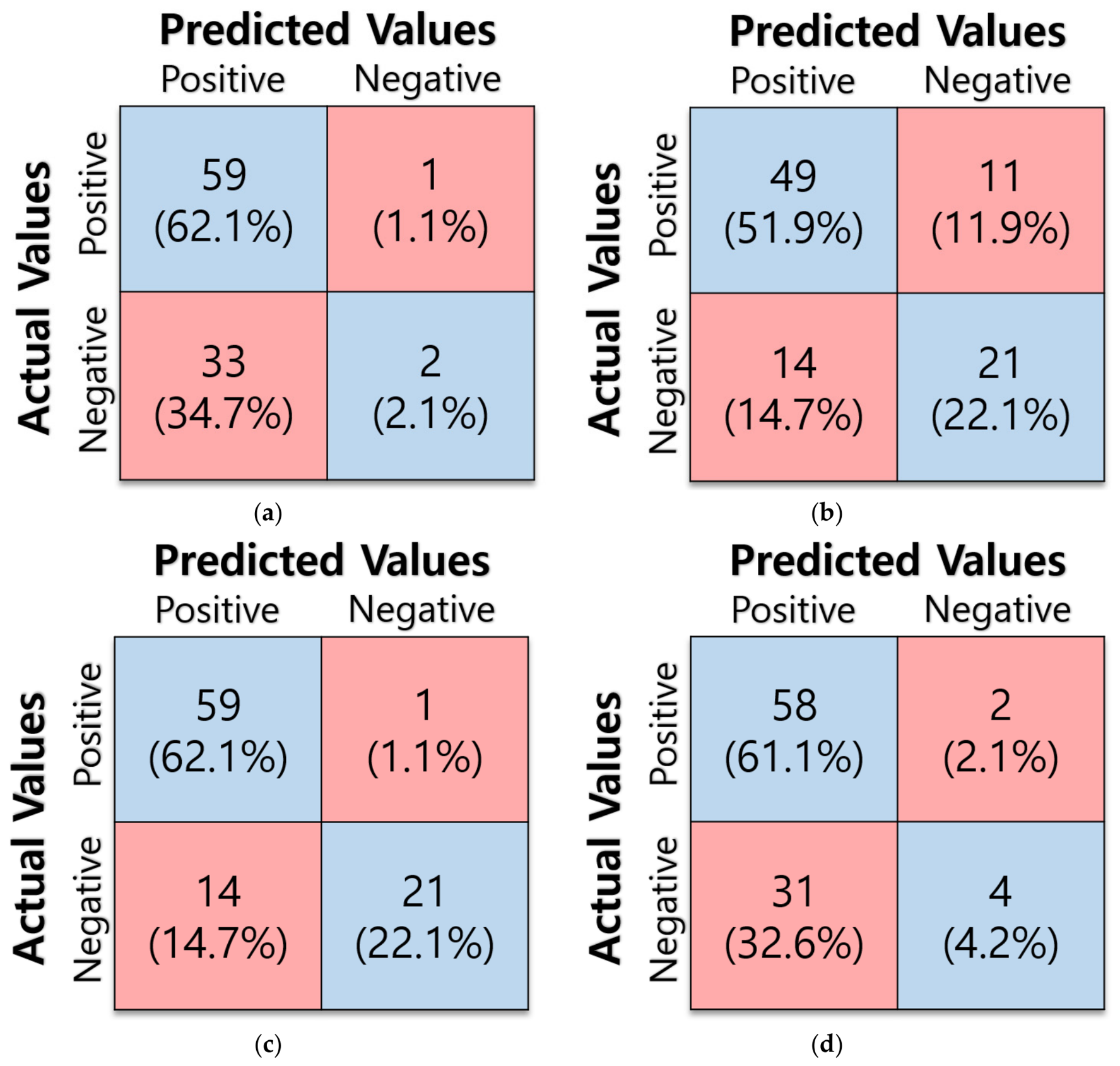
Figure 5. The skeleton-based (ST-GCN) approach correctly detected 59 fall cases but produced 33 false positives and only 2 true negatives, indicating a strong tendency to overclassify normal activities as falls. In contrast, the skeleton-based (ProtoGCN) approach reduced the number of false positives to 14 and increased the number of true negatives to 21, demonstrating improved discrimination of normal activities compared with ST-GCN. However, its true positives decreased to 49 and its false negatives increased to 11, indicating a greater tendency than ST-GCN to miss actual fall events. The rule-based approach correctly detected 59 fall cases while limiting false positives to 14 and securing 21 true negatives, showing a relatively balanced performance between fall detection and normal-activity discrimination. The 3D joint-based approach correctly detected 58 fall cases and limited false negatives to 2; however, it produced 31 false positives and only 4 true negatives, indicating that it still tended to misclassify normal activities as falls.
Although the rule-based approach achieved the highest Precision and Accuracy under the present experimental conditions, this result should be interpreted in light of the dataset size and the limitations of the experimental configuration. To further explain these performance differences, the following section analyzes the frequency distribution of the six error types across the four detection approaches.
4.2. Error Distribution in Multi-Person Fall Detection
The frequency of each error type was compared across the four detection approaches to examine the error patterns associated with the performance differences identified in
Section 4.1.
Table 4 presents the occurrence counts of the six error types defined in
Section 3.5. for each approach. Since multiple error types could be observed in a single video, the frequencies in
Table 4 represent error-type-specific counts rather than mutually exclusive cases.
As shown in
Table 4, the skeleton-based (ST-GCN) and rule-based approaches exhibited similar error distributions. In both approaches, joint recognition failure (
E2) and multi-object tracking association failure (
E4) were the most frequent error types. In the skeleton-based approach, joint recognition failure (
E2) and multi-object tracking association failure (
E4) occurred 41 and 51 times, respectively. In the rule-based approach, the corresponding counts were 41 and 49, respectively. This indicates that both approaches were affected by common upstream errors in skeleton estimation and tracking.
The detection performance, however, differed between the two approaches. Although the rule-based approach showed an error distribution similar to that of the skeleton-based approach, it produced fewer false positives, as shown in
Figure 5. This suggests that the explicit kinematic conditions used in the rule-based approach contributed to suppressing some false-positive detections. Confusion with similar activities (
E6) was also less frequent in the rule-based approach than in the skeleton-based approach, with 6 and 11 occurrences, respectively.
The skeleton-based ProtoGCN approach used the same 2D skeleton sequence representation as the ST-GCN approach but exhibited distinct error characteristics. Compared with ST-GCN, ProtoGCN showed a lower frequency of multi-object tracking association failure (E4), which decreased from 51 to 36 cases. A similar tendency was observed in the 3D joint-based approach, which also used a top-down pose estimation pipeline and showed the same E4 frequency of 36 cases. These results suggest that the top-down pose estimation pipelines used in ProtoGCN and the 3D joint-based approach were associated with a lower frequency of object-to-skeleton association errors than the bottom-up pipeline used in the ST-GCN-based approach under the present experimental conditions. However, ProtoGCN showed higher frequencies of skeleton interference (E1), joint recognition failure (E2), viewpoint-induced observation limitation (E5), and confusion with similar activities (E6) than ST-GCN. Therefore, although the top-down-based ProtoGCN approach appeared to mitigate some tracking association errors, it remained sensitive to pose-level instability and action-level ambiguity in multi-person environments.
The 3D joint-based approach exhibited a distinct error distribution. Skeleton interference (E1) was the most frequent error type, while joint recognition failure (E2) and viewpoint limitations (E5) were also frequently observed. This suggests that errors occurring in the 2D pose estimation stage may propagate into the 3D pose lifting process or be amplified as structural distortions in the estimated 3D joint representation. Because the 3D coordinates used in this method were inferred from 2D skeleton sequences rather than directly measured using a depth sensor, the resulting representation remained dependent on the stability of the upstream 2D pose sequence. Confusion with similar activities (E6) was also more frequent in the 3D joint-based approach than in the other approaches, indicating that the estimated 3D joint representation alone did not provide sufficient robustness for distinguishing falls from fall-like activities under the present multi-person CCTV conditions.
In summary, the skeleton-based (ST-GCN) and rule-based approaches were mainly affected by joint recognition failure (E2) and multi-object tracking association failure (E4). The skeleton-based (ProtoGCN) showed a lower frequency of E4 than ST-GCN, but pose-level and action-level errors were relatively more pronounced. Meanwhile, the 3D joint-based approach showed relatively high frequencies of skeleton interference (E1), viewpoint-induced observation limitation (E5), and confusion with similar activities (E6). A high error frequency, however, does not necessarily imply that the corresponding error type has the greatest impact on misclassification. The next section further analyzes the co-occurrence relationships among error types and the extent to which each error type increases the risk of misclassification.
4.3. Interaction and Coupling Mechanisms Among Error Types
Section 4.2 compares the frequency of each error type; however, frequency alone is insufficient to fully explain the relationships among error types or their influence on misclassification. Therefore, this section analyzes the co-occurrence relationships among error types using the Phi coefficient and evaluates the association between each error type and misclassification risk using the odds ratio.
4.3.1. Error Co-Occurrence Analysis Based on the Phi Coefficient
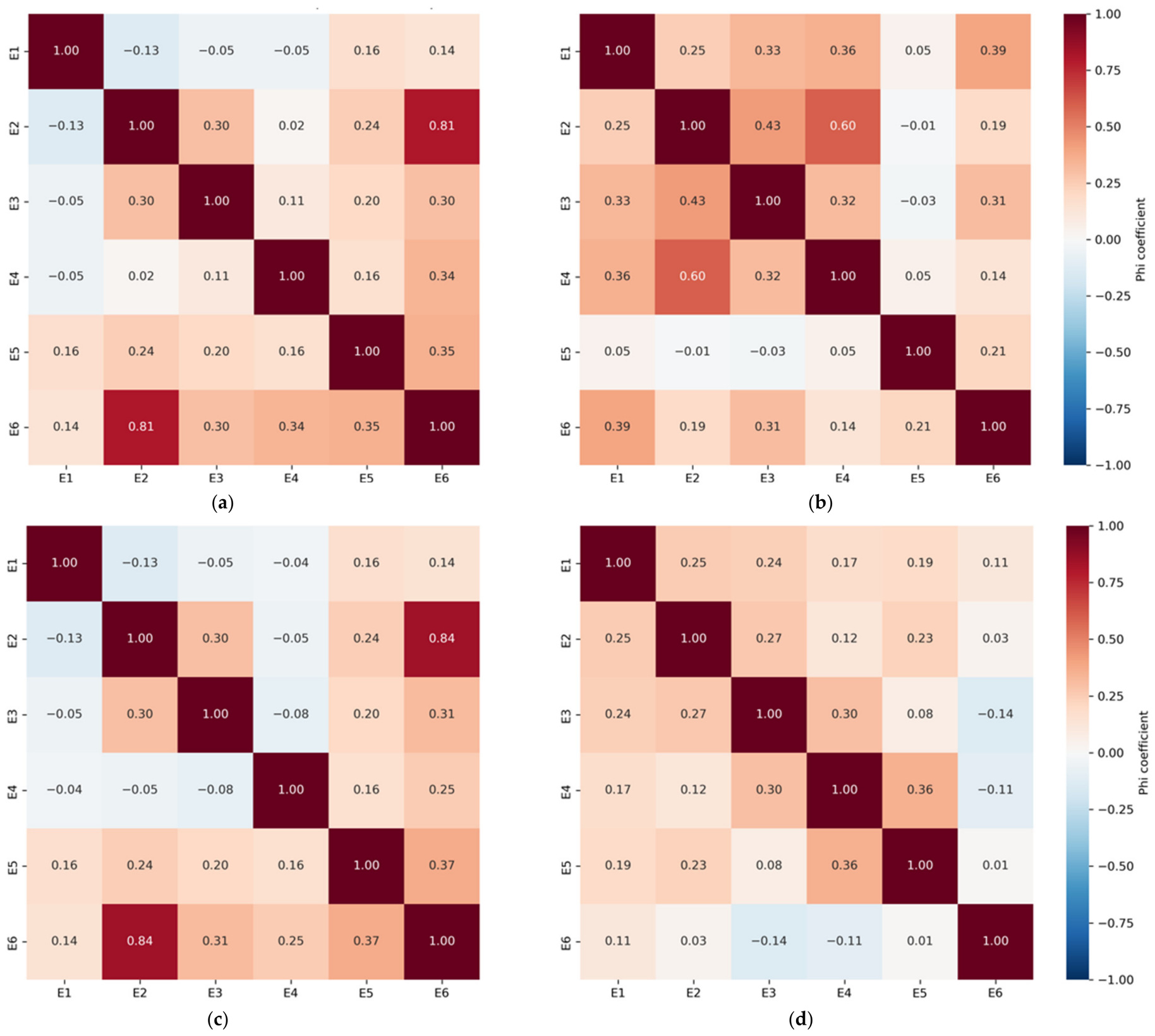
Figure 6 presents the pairwise Phi coefficients among the six error categories across the four detection methods. The Phi coefficient quantifies the association between two binary error categories based on their co-occurrence within the same video, with larger positive values indicating stronger co-occurrence. This analysis complements the frequency-based results by identifying which errors tend to occur together rather than how often each error occurs independently.
The skeleton-based (ST-GCN) and rule-based methods exhibited similar inter-error structures. In both methods, the strongest positive relationship in this analysis was found between joint recognition failure (E2) and confusion with similar activities (E6), with Phi values of 0.81 and 0.84, respectively. This result indicates that joint recognition failure and confusion with fall-like activities frequently appeared together in the same videos. The E2–E6 relationship can therefore be regarded as the most prominent coupling pattern in terms of the Phi coefficient in both methods.
The skeleton-based (ProtoGCN) method exhibited moderate co-occurrence relationships among several error types. No single coupling pattern was dominant. The strongest association was observed between joint recognition failure (E2) and multi-object tracking association failure (E4), with a Phi value of 0.60. This result suggests that inaccurate or missing joint information co-occurred with object-to-skeleton association errors in multi-person scenes. In contrast, viewpoint limitation (E5) showed weak associations with most other error types. These results suggest that joint recognition and tracking association errors were more prominent in the skeleton-based (ProtoGCN) method than viewpoint-related constraints.
In the 3D joint-based method, no specific error pair showed a dominant association. The highest Phi value was observed between multi-object tracking association failure (E4) and viewpoint limitation (E5), with a value of 0.36. This result indicates that object-to-skeleton association errors co-occurred with observation constraints in the 3D joint-based method. These constraints included partial body truncation near the frame boundary and limited visibility. In contrast, the Phi value between joint recognition failure (E2) and confusion with similar activities (E6) was very low, at 0.03. Overall, the error structure of the 3D joint-based method was more closely related to tracking association and viewpoint-related errors than to perception-to-action ambiguity.
4.3.2. Misclassification Risk Analysis Based on Odds Ratios
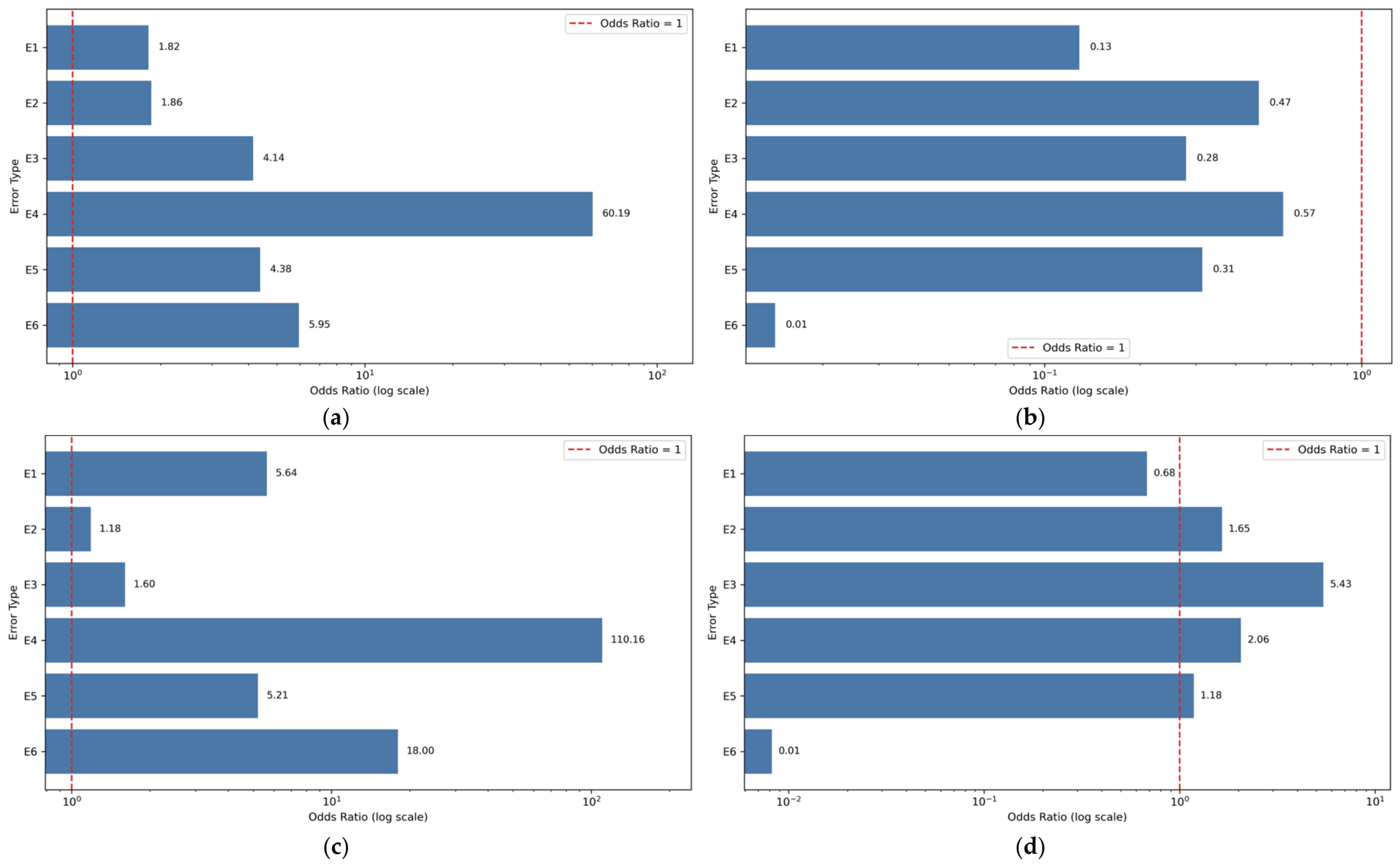
Figure 7 presents the odds ratios between each error type and misclassification risk. An odds ratio greater than 1 indicates a higher likelihood of misclassification when the corresponding error type is present. The four approaches exhibited distinct odds-ratio patterns, with different dominant risk factors.
In the skeleton-based (ST-GCN) and rule-based approaches, multi-object tracking association failure (E4) showed the highest odds ratios, with values of 60.19 and 110.16, respectively. This indicates that E4 was the error type most strongly associated with misclassification in both approaches. In the rule-based approach, confusion with similar activities (E6) also showed a relatively high odds ratio of 18.00, although this value remained substantially lower than that of E4. In multi-person environments, incorrectly linked skeleton trajectories may increase the likelihood of fall-like interpretations.
By contrast, in the skeleton-based (ProtoGCN) approach, all error types had odds ratios below the reference value of 1. Among them, E4 showed the highest odds ratio, but it remained below the reference value. This result indicates that no individual error type was positively associated with misclassification risk in this approach. In the 3D joint-based approach, skeleton ID tracking failure (E3) exceeded the reference value of 1 and represented the most prominent risk factor, with an odds ratio of 5.43. Multi-object tracking association failure (E4), joint recognition failure (E2), and viewpoint-induced observation limitation (E5) also exceeded the reference value.
Overall, these results show that error frequency and error co-occurrence did not necessarily correspond to misclassification risk. Although joint recognition failure (E2) occurred frequently and showed notable co-occurrence patterns, its association with misclassification risk varied across approaches. Multi-object tracking association failure (E4) was the dominant risk factor in the skeleton-based (ST-GCN) and rule-based approaches, whereas no individual error type showed a positive association with misclassification risk in the skeleton-based (ProtoGCN) approach. In the 3D joint-based approach, skeleton ID tracking failure (E3) showed the highest odds ratio, suggesting that identity consistency was more closely associated with misclassification in this approach.
5. Discussion
Fall detection performance in multi-person environments is not determined solely by the accuracy of a single classification model; rather, it is strongly influenced by the stability of the processing pipeline spanning perception, tracking, and interpretation. Although all four approaches detected fall events at the event level, the patterns of false positives and false negatives differed across methods. This finding indicates that fall detection capability and operational stability in the examined multi-person settings are not necessarily equivalent.
The causes of misclassification were not sufficiently explained by the frequency of individual errors alone. In the skeleton-based (ST-GCN) and rule-based approaches, joint recognition failure and multi-object tracking association failure occurred frequently; however, the odds ratio analysis showed that multi-object tracking association failure was the error factor most strongly associated with misclassification. This result suggests that incorrect target association and disrupted trajectory continuity, rather than joint recognition failure itself, are important contributors to incorrect outcomes. In such settings, incorrect skeleton association may increase the likelihood that normal activities are interpreted as falls or that the actual fallen person is excluded from the detection process.
The Phi coefficient analysis also revealed co-occurrence patterns among error types. The strong co-occurrence relationship between joint recognition failure and confusion with similar activities in the skeleton-based (ST-GCN) and rule-based approaches suggests that errors in the perception stage may increase ambiguity in the action interpretation stage. Missing or distorted joints can reduce the semantic clarity of skeleton sequences and make it difficult to distinguish actual falls from fall-like activities such as sitting, bending, or lying down. These perception-level errors may therefore influence downstream tracking and classification rather than merely degrading input quality.
The performance differences among the detection approaches are also related to this error propagation structure. The skeleton-based (ST-GCN) approach directly learns spatiotemporal patterns from 2D skeleton sequences; as a result, unstable skeleton trajectories may contribute to increased false positives. In contrast, the rule-based approach may suppress false positives caused by ambiguous skeleton movements by using explicit kinematic conditions, such as neck joint height and vertical descent velocity. However, the dependence of these conditions on camera geometry, spatial configuration, and threshold settings limits robustness under changes in the operating environment.
The skeleton-based (ProtoGCN) approach used 2D skeleton sequences and had the same input format as ST-GCN, but showed different error characteristics. Compared with ST-GCN, ProtoGCN reduced false positives and mitigated the tendency to overclassify normal activities as falls. However, this was accompanied by an increase in false negatives, indicating a more conservative fall decision pattern. This trade-off suggests that ProtoGCN was more effective in rejecting normal activities, but it was still affected by unstable skeleton information in multi-person CCTV environments. Although some error types occurred more frequently in ProtoGCN than in ST-GCN, all individual error types had odds ratios below the reference value of 1. This suggests that misclassifications in ProtoGCN were not strongly associated with a single error type, but were more likely related to the combined effects of the pose estimation paradigm, tracking association errors, and model-specific decision behavior. Therefore, the ProtoGCN results indicate that fall detection systems should be evaluated not only in terms of model-output performance but also in terms of how upstream perception and tracking errors affect the decision behavior of each model.
The 3D joint-based approach showed only marginal improvements over the ST-GCN-based 2D skeleton method in terms of Precision, F1-score, and Accuracy. Although the estimated 3D joint representation provided additional spatial information, it did not substantially reduce the false-positive tendency observed in the ST-GCN-based method. The 3D joint representations used in this study were not absolute depth values directly measured by a depth sensor, but relative 3D representations estimated from 2D skeleton sequences. This reliance on estimated spatial information limits the analysis, because errors inherited from the 2D skeleton sequence may reduce representation reliability. Accordingly, skeleton interference, missing joints, and viewpoint limitation occurring in the 2D pose stage may carry over through the 3D pose lifting process or be amplified as structural distortions. In particular, temporal skeleton identity inconsistency showed the highest misclassification risk in the 3D joint-based approach, suggesting that temporally inconsistent identity assignment may affect fall-decision reliability even when 3D joint representations are used. This result indicates that relative 3D joint representations alone may not fully address upstream pose and tracking errors in multi-person fall detection.
This study is also limited in terms of dataset scale. Although the analysis was conducted using real CCTV videos collected from multi-person environments, the number of samples remains limited. During the revision process, we reviewed the applicability of several public datasets, including NTU RGB+D 120 [
5], NTU RGB+D [
6], Le2i [
24], CAUCAFall [
25], SDUFall [
26], MPFDD [
34], Sports-1M [
35], and BOMNI [
36]. However, the analysis pipeline used in this study requires multi-person fall scenarios, event-level fall labels, depth or distance information, and camera geometry information. Most public datasets do not simultaneously satisfy these requirements. For example, some datasets provide RGB-D or skeleton data but are not designed for fall-centered multi-person event analysis, whereas others focus on fall detection but do not sufficiently reflect real CCTV-based multi-person environments or provide camera geometry information. Therefore, these datasets were not directly applicable to the 3D joint-based analysis and error propagation analysis conducted in this study. Accordingly, although public datasets were considered as supplementary references, the final analysis was performed using 95 RGB video sequences collected from real multi-person CCTV environments. Further validation using larger and more diverse datasets is required to improve the generalizability of the findings.
Overall, the findings indicate that the observed errors cannot be fully explained by isolated module-level failures, but are instead associated with interactions among perception, tracking, and action interpretation stages. From an implementation perspective, future multi-person fall detection systems should incorporate identity-consistent tracking, pose reliability or joint confidence estimation, confidence-aware decision rules, and temporal consistency to reduce cross-stage error transfer. Module-level monitoring may also be needed to detect early-stage perception or tracking failures before they affect final fall classification. Furthermore, since variations in body type and movement patterns can significantly affect fall detection accuracy, future research should examine how individual physical conditions, such as body composition, muscle strength, and mobility level, influence system performance. These findings indicate that reliable multi-person fall detection requires coordinated system-level design rather than improving a single classifier alone.
6. Conclusions
This study compared skeleton-based (ST-GCN, ProtoGCN), rule-based, and 3D joint-based approaches from a system-level perspective to examine error characteristics and propagation patterns in multi-person fall detection. Although all four approaches detected most fall events at the event level, their false-positive and false-negative patterns differed across methods. This result indicates that conventional performance metrics alone may not sufficiently explain the operational reliability of fall detection systems in multi-person environments.
The findings indicate that detection errors were more closely associated with interactions among the perception, tracking, and action interpretation stages than with the isolated occurrence of individual error types. In particular, the odds ratio analysis identified multi-object tracking association failure as a major factor associated with misclassification, while the Phi coefficient analysis revealed a strong co-occurrence relationship between joint recognition failure and confusion with similar activities. These results suggest that errors can propagate across the detection pipeline rather than remain confined to a single processing stage.
The method-level comparison further demonstrated that each approach exhibited distinct error characteristics. The skeleton-based (ST-GCN) approach was sensitive to unstable skeleton trajectories, which could increase false positives in multi-person scenes. The rule-based approach reduced some false positives by applying explicit kinematic conditions, such as neck joint height and vertical descent velocity, under the present experimental conditions. However, its performance may depend on camera geometry, spatial configuration, and threshold settings. The skeleton-based (ProtoGCN) approach used 2D skeleton sequences as input, as did ST-GCN, but reduced false positives while increasing false negatives. This result indicates that ProtoGCN alleviated the overclassification of normal activities as falls but showed a more conservative decision pattern for actual fall events. These findings suggest that fall decisions in multi-person CCTV environments remain affected by upstream perception and tracking errors, even when a recent skeleton-based action recognition model is used. The 3D joint-based approach provided additional spatial cues, but it did not completely eliminate the influence of upstream pose estimation errors, as the relative 3D representation was estimated from 2D skeleton sequences rather than obtained from direct depth measurements. In addition, temporal skeleton identity inconsistency showed the highest misclassification risk in this approach, suggesting that identity continuity remains important even with 3D joint representations.
This study contributes to an error-centric understanding of fall detection by examining how perception-, tracking-, and interpretation-level errors interact in real-world CCTV RGB videos collected from multi-person settings. Nevertheless, the dataset size was limited, and further validation using larger and more diverse CCTV datasets is required to improve the generalizability of the findings. In addition, because the current dataset provides event-level fall labels rather than person-level fall annotations, this study did not evaluate subject-level event attribution or person-level localization performance. Future work should therefore include datasets with individual-level fall annotations to examine whether the system can correctly identify not only whether a fall occurred but also which person experienced the fall in multi-person scenes. Further threshold sensitivity analysis should also be conducted under expanded multi-person conditions. Future research should investigate methods for reducing cross-stage error transfer by jointly considering pose reliability, identity-consistent tracking, temporal decision consistency, and context-aware action interpretation.
Author Contributions
Conceptualization, H.L., I.-N.W., and J.J.; methodology, H.L.; software, H.L.; validation, H.L., I.-N.W. and J.J.; formal analysis, H.L.; investigation, H.L.; resources, J.J.; data curation, H.L.; writing—original draft preparation, H.L.; writing—review and editing, I.-N.W. and J.J.; visualization, H.L. and I.-N.W.; supervision, I.-N.W. and J.J.; project administration, I.-N.W. and J.J.; funding acquisition, J.J. All authors have read and agreed to the published version of the manuscript.
Funding
This work was supported by the Commercialization Promotion Agency for R&D Outcomes (COMPA) grant funded by the Korean government (Ministry of Science and ICT) (RS-2025-02311988). This research was supported by the MSIT (Ministry of Science and ICT), Korea, under the ITRC (Information Technology Research Center) support program (IITP-2026-RS-2020-II201789), and the Artificial Intelligence Convergence Innovation Human Resources Development (IITP-2026-RS-2023-00254592) supervised by the IITP (Institute for Information & Communications Technology Planning & Evaluation).
Institutional Review Board Statement
The study was conducted in accordance with the Declaration of Helsinki. Ethical review and approval were waived for this study by the Institutional Review Board of Dongguk University (Project identification code: DUIRB2025-12-03(F), date of exemption: 9 January 2026) because the research was commissioned by a national agency for the public interest and utilized fully anonymized and de-identified data, ensuring that no personal identifiable information was accessible to the researchers.
Informed Consent Statement
Written informed consent was obtained from all participants for study participation and for the publication of study images. All images and video frames were de-identified by masking facial regions prior to analysis and publication.
Data Availability Statement
The original contributions presented in this study are included in the article. Further inquiries can be directed to the corresponding author.
Acknowledgments
During the preparation of this manuscript, the authors used ChatGPT (GPT-5 Thinking, OpenAI) for English-language editing and stylistic polishing. The tool was not used for study design, data collection, analysis, or interpretation. The authors have reviewed and edited all AI-assisted text and take full responsibility for the content of this publication.
Conflicts of Interest
The authors declare no conflicts of interest.
Appendix A. Inference-Level Parameter Search for Fall Decision
This appendix summarizes the inference-level temporal aggregation parameters for the ProtoGCN-based skeleton method and the VIRA-GCN-based 3D joint method. These parameters were not used for model training; they were applied only to aggregate clip-level fall predictions into event-level decisions.
For both methods, the fall prediction threshold was fixed at 0.8, following the ST-GCN-based skeleton method. A total of 36 parameter combinations were evaluated by varying the temporal window size across six values: 10, 20, 30, 40, 50, and 60; the stride across two values: 0 and 5; and the temporal consistency threshold across three values: 0, 3, and 5. Precision, Recall, F1-score, and Accuracy were calculated at the event level for each combination. The parameter setting used in the final evaluation was selected based on these metrics.
Table A1 presents the results for the skeleton-based (ProtoGCN) method, and
Table A2 presents those for the 3D joint-based (VIRA-GCN) method.
Table A1.
Preliminary validation results for event-level temporal aggregation in the skeleton-based (ProtoGCN) fall detection method.
Table A1.
Preliminary validation results for event-level temporal aggregation in the skeleton-based (ProtoGCN) fall detection method.
Window
Size | Stride | Temporal Consistency Threshold | Precision | Recall | F1-Score | Accuracy |
|---|
| 10 | 0 | 0 | 0.634408602 | 0.983333333 | 0.77124183 | 0.631578947 |
| 10 | 0 | 3 | 0.643678161 | 0.933333333 | 0.761904762 | 0.631578947 |
| 10 | 0 | 5 | 0.777777778 | 0.816666667 | 0.796747967 | 0.736842105 |
| 10 | 5 | 0 | 0.633333333 | 0.95 | 0.76 | 0.621052632 |
| 10 | 5 | 3 | 0.829268293 | 0.566666667 | 0.673267327 | 0.652631579 |
| 10 | 5 | 5 | 0.909090909 | 0.166666667 | 0.281690141 | 0.463157895 |
| 20 | 0 | 0 | 0.631578947 | 1 | 0.774193548 | 0.631578947 |
| 20 | 0 | 3 | 0.647727273 | 0.95 | 0.77027027 | 0.642105263 |
| 20 | 0 | 5 | 0.625 | 0.666666667 | 0.64516129 | 0.536842105 |
| 20 | 5 | 0 | 0.651685393 | 0.966666667 | 0.77852349 | 0.652631579 |
| 20 | 5 | 3 | 0.357142857 | 0.083333333 | 0.135135135 | 0.326315789 |
| 20 | 5 | 5 | 0 | 0 | 0 | 0.368421053 |
| 30 | 0 | 0 | 0.631578947 | 1 | 0.774193548 | 0.631578947 |
| 30 | 0 | 3 | 0.631578947 | 1 | 0.774193548 | 0.631578947 |
| 30 | 0 | 5 | 0.638297872 | 1 | 0.779220779 | 0.642105263 |
| 30 | 5 | 0 | 0.631578947 | 1 | 0.774193548 | 0.631578947 |
| 30 | 5 | 3 | 0.638297872 | 1 | 0.779220779 | 0.642105263 |
| 30 | 5 | 5 | 0.638297872 | 1 | 0.779220779 | 0.642105263 |
| 40 | 0 | 0 | 0.638297872 | 1 | 0.779220779 | 0.642105263 |
| 40 | 0 | 3 | 0.638297872 | 1 | 0.779220779 | 0.642105263 |
| 40 | 0 | 5 | 0.638297872 | 1 | 0.779220779 | 0.642105263 |
| 40 | 5 | 0 | 0.638297872 | 1 | 0.779220779 | 0.642105263 |
| 40 | 5 | 3 | 0.638297872 | 1 | 0.779220779 | 0.642105263 |
| 40 | 5 | 5 | 0.630434783 | 0.966666667 | 0.763157895 | 0.621052632 |
| 50 | 0 | 0 | 0.638297872 | 1 | 0.779220779 | 0.642105263 |
| 50 | 0 | 3 | 0.638297872 | 1 | 0.779220779 | 0.642105263 |
| 50 | 0 | 5 | 0.638297872 | 1 | 0.779220779 | 0.642105263 |
| 50 | 5 | 0 | 0.638297872 | 1 | 0.779220779 | 0.642105263 |
| 50 | 5 | 3 | 0.630434783 | 0.966666667 | 0.763157895 | 0.621052632 |
| 50 | 5 | 5 | 0.540540541 | 0.666666667 | 0.597014925 | 0.431578947 |
| 60 | 0 | 0 | 0.640449438 | 0.95 | 0.765100671 | 0.631578947 |
| 60 | 0 | 3 | 0.640449438 | 0.95 | 0.765100671 | 0.631578947 |
| 60 | 0 | 5 | 0.627906977 | 0.9 | 0.739726027 | 0.6 |
| 60 | 5 | 0 | 0.640449438 | 0.95 | 0.765100671 | 0.631578947 |
| 60 | 5 | 3 | 0.555555556 | 0.666666667 | 0.606060606 | 0.452631579 |
| 60 | 5 | 5 | 0.243902439 | 0.166666667 | 0.198019802 | 0.147368421 |
Table A2.
Preliminary validation results for event-level temporal aggregation in the 3D joint-based fall detection method.
Table A2.
Preliminary validation results for event-level temporal aggregation in the 3D joint-based fall detection method.
Window
Size | Stride | Temporal Consistency Threshold | Precision | Recall | F1-Score | Accuracy |
|---|
| 10 | 0 | 0 | 0.61627907 | 0.883333333 | 0.726027397 | 0.578947368 |
| 10 | 0 | 3 | 0.563380282 | 0.666666667 | 0.610687023 | 0.463157895 |
| 10 | 0 | 5 | 0.491525424 | 0.483333333 | 0.487394958 | 0.357894737 |
| 10 | 5 | 0 | 0.6 | 0.8 | 0.685714286 | 0.536842105 |
| 10 | 5 | 3 | 0.508196721 | 0.516666667 | 0.512396694 | 0.378947368 |
| 10 | 5 | 5 | 0.351351351 | 0.216666667 | 0.268041237 | 0.252631579 |
| 20 | 0 | 0 | 0.651685393 | 0.966666667 | 0.77852349 | 0.652631579 |
| 20 | 0 | 3 | 0.540983607 | 0.55 | 0.545454545 | 0.421052632 |
| 20 | 0 | 5 | 0.5 | 0.4 | 0.444444444 | 0.368421053 |
| 20 | 5 | 0 | 0.633333333 | 0.95 | 0.76 | 0.621052632 |
| 20 | 5 | 3 | 0.5 | 0.383333333 | 0.433962264 | 0.368421053 |
| 20 | 5 | 5 | 0.347826087 | 0.133333333 | 0.192771084 | 0.294736842 |
| 30 | 0 | 0 | 0.620253165 | 0.816666667 | 0.705035971 | 0.568421053 |
| 30 | 0 | 3 | 0.529411765 | 0.45 | 0.486486486 | 0.4 |
| 30 | 0 | 5 | 0.5 | 0.366666667 | 0.423076923 | 0.368421053 |
| 30 | 5 | 0 | 0.560606061 | 0.616666667 | 0.587301587 | 0.452631579 |
| 30 | 5 | 3 | 0.525 | 0.35 | 0.42 | 0.389473684 |
| 30 | 5 | 5 | 0.5 | 0.216666667 | 0.302325581 | 0.368421053 |
| 40 | 0 | 0 | 0.559322034 | 0.55 | 0.554621849 | 0.442105263 |
| 40 | 0 | 5 | 0.48 | 0.2 | 0.282352941 | 0.357894737 |
| 40 | 0 | 3 | 0.459459459 | 0.283333333 | 0.350515464 | 0.336842105 |
| 40 | 5 | 0 | 0.530612245 | 0.433333333 | 0.47706422 | 0.4 |
| 40 | 5 | 3 | 0.421052632 | 0.133333333 | 0.202531646 | 0.336842105 |
| 40 | 5 | 5 | 0.333333333 | 0.066666667 | 0.111111111 | 0.326315789 |
| 50 | 0 | 0 | 0.557377049 | 0.566666667 | 0.561983471 | 0.442105263 |
| 50 | 0 | 3 | 0.45 | 0.3 | 0.36 | 0.326315789 |
| 50 | 0 | 5 | 0.4 | 0.233333333 | 0.294736842 | 0.294736842 |
| 50 | 5 | 0 | 0.5 | 0.433333333 | 0.464285714 | 0.368421053 |
| 50 | 5 | 3 | 0.304347826 | 0.116666667 | 0.168674699 | 0.273684211 |
| 50 | 5 | 5 | 0.111111111 | 0.033333333 | 0.051282051 | 0.221052632 |
| 60 | 0 | 0 | 0.583333333 | 0.466666667 | 0.518518519 | 0.452631579 |
| 60 | 0 | 3 | 0.46875 | 0.25 | 0.326086957 | 0.347368421 |
| 60 | 0 | 5 | 0.384615385 | 0.166666667 | 0.23255814 | 0.305263158 |
| 60 | 5 | 0 | 0.564102564 | 0.366666667 | 0.444444444 | 0.421052632 |
| 60 | 5 | 3 | 0.238095238 | 0.083333333 | 0.12345679 | 0.252631579 |
| 60 | 5 | 5 | 0 | 0 | 0 | 0.221052632 |
References
- Igual, E.; Medrano, C.; Plaza, I. Challenges, issues and trends in fall detection systems. Biomed. Eng. Online 2013, 12, 66. [Google Scholar] [CrossRef] [Scilit] [PubMed]
- Rougier, V.; Meunier, J.; St-Arnaud, A.; Rousseau, J. Fall detection from human shape and motion history using video surveillance. IEEE Trans. Circuits Syst. Video Technol. 2011, 21, 611–622. [Google Scholar]
- Mubashir, M.; Shao, L.; Seed, L. A survey on fall detection: Principles and approaches. Neurocomputing 2013, 100, 144–152. [Google Scholar] [CrossRef] [Scilit]
- Chi, H.; Wei, Z.; Gong, Y.; Huang, T. InfoGCN: Representation learning for human skeleton-based action recognition. In Proceedings of the 2022 IEEE/CVF Conference on Computer Vision and Pattern Recognition (CVPR); IEEE Computer Society: Washington, DC, USA, 2022; pp. 20133–20142. [Google Scholar]
- Liu, J.; Shahroudy, A.; Perez, M.; Wang, G.; Duan, L.; Kot, A.C. NTU RGB+D 120: A large-scale benchmark for 3D human activity understanding. IEEE Trans. Pattern Anal. Mach. Intell. 2019, 42, 2684–2701. [Google Scholar] [CrossRef] [Scilit] [PubMed]
- Shahroudy, A.; Liu, J.; Ng, T.-T.; Wang, G. NTU RGB+D: A large-scale dataset for 3D human activity analysis. In Proceedings of the 2016 IEEE Conference on Computer Vision and Pattern Recognition (CVPR), Las Vegas, NV, USA, 27–30 June 2016; pp. 1010–1019. [Google Scholar]
- Redondo-Cabrera, C.; López-Sastre, R.J.; Xiang, Y.; Tuytelaars, T.; Savarese, S. Pose Estimation Errors, the Ultimate Diagnosis. In Computer Vision—ECCV 2016; Lecture Notes in Computer Science; Springer: Cham, Switzerland, 2016; Volume 9911, pp. 118–134. [Google Scholar]
- Ciaparrone, G.; Luque Sánchez, F.; Tabik, S.; Troiano, L.; Tagliaferri, R.; Herrera, F. Deep learning in video multi-object tracking: A survey. Neurocomputing 2020, 381, 61–88. [Google Scholar] [CrossRef] [Scilit]
- Guan, Z.; Wang, Z.; Zhang, G.; Li, L.; Zhang, M.; Shi, Z.; Jiang, N. Multi-object tracking review: Retrospective and emerging trend. Artif. Intell. Rev. 2025, 58, 235. [Google Scholar] [CrossRef] [Scilit]
- Rakai, L.; Song, H.; Sun, S.; Zhang, W.; Yang, Y. Data association in multiple object tracking: A survey of recent techniques. Expert Syst. Appl. 2022, 192, 116300. [Google Scholar] [CrossRef] [Scilit]
- Lee, H.; Wang, I.-N.; Jeong, J. Error-Type Analysis for Fall Detection in Multi-Person Environments. In Proceedings of the 26th International Symposium on Advanced Intelligent Systems (ISIS 2025), Cheongju, Republic of Korea, 6–9 November 2025; pp. 562–567. [Google Scholar]
- Xu, Y.; Kim, B.; Wang, I.-N.; Jeong, J. A Neuro-Symbolic Approach to Fall Detection via Monocular Depth Estimation. Appl. Sci. 2026, 16, 1895. [Google Scholar] [CrossRef] [Scilit]
- Tanwar, R.; Nandal, N.; Zamani, M.; Abdul Manaf, A. Pathway of Trends and Technologies in Fall Detection: A Systematic Review. Healthcare 2022, 10, 172. [Google Scholar] [CrossRef] [Scilit] [PubMed]
- Nahian, M.J.A.; Raisa, J.F.; Mahmud, M.; Kaiser, M.S.; Ahad, M.A.R.; Ghosh, T.; Banna, M.H.A.; Hossain, M.S.; Andersson, K. Artificial Intelligence for Elderly Fall Detection: State-of-the-Art Methods, Applications and Challenges. Cogn. Comput. 2026, 18, 12. [Google Scholar] [CrossRef] [Scilit]
- Özdemir, A.T.; Barshan, B. Detecting Falls with Wearable Sensors Using Machine Learning Techniques. Sensors 2014, 14, 10691–10708. [Google Scholar] [CrossRef] [Scilit] [PubMed]
- Asif, U.; Mashford, B.; von Cavallar, S.; Yohanandan, S.; Roy, S.; Tang, J.; Harrer, S. Privacy Preserving Human Fall Detection Using Video Data. In Proceedings of the Machine Learning for Health (ML4H) at NeurIPS Workshop 2019, Vancouver, BC, Canada, 13 December 2019; PMLR: Cambridge, MA, USA, 2020; Volume 116, pp. 39–51. [Google Scholar]
- Noor, N.; Park, I.K. A Lightweight Skeleton-Based 3D-CNN for Real-Time Fall Detection and Action Recognition. In Proceedings of the 2023 IEEE/CVF International Conference on Computer Vision Workshops (ICCVW), Paris, France, 2–6 October 2023; IEEE: New York, NY, USA, 2023; pp. 2179–2188. [Google Scholar]
- Fang, H.-S.; Li, J.; Tang, H.; Xu, C.; Zhu, H.; Xiu, Y.; Li, Y.-L.; Lu, C. AlphaPose: Whole-Body Regional Multi-Person Pose Estimation and Tracking in Real-Time. IEEE Trans. Pattern Anal. Mach. Intell. 2023, 45, 7157–7173. [Google Scholar] [CrossRef] [Scilit] [PubMed]
- Bremer, M.; Rutzinger, M.; Wichmann, V. Derivation of Tree Skeletons and Error Assessment Using LiDAR Point Cloud Data of Varying Quality. ISPRS J. Photogramm. Remote Sens. 2013, 80, 39–50. [Google Scholar] [CrossRef] [Scilit]
- Han, K.; Yang, Q.; Huang, Z. A Two-Stage Fall Recognition Algorithm Based on Human Posture Features. Sensors 2020, 20, 6966. [Google Scholar] [CrossRef] [Scilit] [PubMed]
- Yan, S.; Xiong, Y.; Lin, D. Spatial temporal graph convolutional networks for skeleton-based action recognition. In Proceedings of the AAAI Conference on Artificial Intelligence; AAAI Press: Palo Alto, CA, USA, 2018; pp. 7444–7452. [Google Scholar]
- Liu, J.; Wang, G.; Hu, P.; Duan, L.; Kot, A.C. Revealing key details to see differences: A novel prototypical perspective for skeleton-based action recognition. In Proceedings of the IEEE/CVF Conference on Computer Vision and Pattern Recognition (CVPR), Nashville, TN, USA, 11–15 June 2025. [Google Scholar]
- Song, Y.-F.; Zhang, Z.; Shan, C.; Wang, L. Richly Activated Graph Convolutional Network for Robust Skeleton-Based Action Recognition. IEEE Trans. Circuits Syst. Video Technol. 2021, 31, 1915–1925. [Google Scholar] [CrossRef] [Scilit]
- Charfi, I.; Miteran, J.; Dubois, J.; Atri, M.; Tourki, R. Optimized Spatio-Temporal Descriptors for Real-Time Fall Detection: Comparison of Support Vector Machine and AdaBoost-Based Classification. J. Electron. Imaging 2013, 22, 041106. [Google Scholar] [CrossRef] [Scilit]
- Guerrero, J.C.O.; España, E.M.; Añasco, M.M.; Lopera, J.E.P. Dataset for Human Fall Recognition in an Uncontrolled Environment. Data Brief 2022, 45, 108610. [Google Scholar] [CrossRef] [Scilit] [PubMed]
- Ma, X.; Wang, H.; Xue, B.; Zhou, M.; Ji, B.; Li, Y. Depth-Based Human Fall Detection via Shape Features and Improved Extreme Learning Machine. IEEE J. Biomed. Health Inform. 2014, 18, 1915–1922. [Google Scholar] [CrossRef] [Scilit] [PubMed]
- Abbate, S.; Avvenuti, M.; Cola, G.; Corsini, P.; Light, J.; Vecchio, A. Recognition of False Alarms in Fall Detection Systems. In Proceedings of the 1st IEEE International Workshop on Consumer eHealth Platforms, Services and Applications, Las Vegas, NV, USA, 9 January 2011; pp. 23–28. [Google Scholar]
- Ramirez, H.; Velastin, S.A.; Meza, I.; Fabregas, E.; Makris, D.; Farias, G. Fall Detection and Activity Recognition Using Human Skeleton Features. IEEE Access 2021, 9, 33532–33544. [Google Scholar] [CrossRef] [Scilit]
- Milan, A.; Rezatofighi, S.H.; Dick, A.; Reid, I.; Schindler, K. Online Multi-Target Tracking Using Recurrent Neural Networks. In Proceedings of the AAAI Conference on Artificial Intelligence; AAAI Press: Palo Alto, CA, USA, 2017; pp. 4225–4232. [Google Scholar]
- Du, Y.; Zhao, Z.; Song, Y.; Zhao, Y.; Su, F.; Gong, T. StrongSORT: Make DeepSORT Great Again. IEEE Trans. Multimed. 2023, 25, 8725–8737. [Google Scholar] [CrossRef] [Scilit]
- Zobi, M.; Bolzoni, L.; Tahri, Y.; Oulad Haj Thami, R. Robust 3D Skeletal Joint Fall Detection in Occluded and Rotated Views Using Data Augmentation and Inference-Time Aggregation. Sensors 2025, 25, 6783. [Google Scholar] [CrossRef] [Scilit] [PubMed]
- Song, T.; Peng, Y.; Liu, C.; Qin, A.; Zhao, Y.; Yang, F.; Gao, C. Occlusion-Aware Multi-Person Pose Estimation with Keypoint Grouping and Dual-Prompt Guidance in Crowded Scenes. J. Vis. Commun. Image Represent. 2025, 11, 104545. [Google Scholar] [CrossRef] [Scilit]
- Lu, P.; Jiang, T.; Li, Y.; Li, X.; Chen, K.; Yang, W. RTMO: Towards High-Performance One-Stage Real-Time Multi-Person Pose Estimation. In Proceedings of the IEEE/CVF Conference on Computer Vision and Pattern Recognition (CVPR), Seattle, WA, USA, 16–22 June 2024; pp. 1491–1500. [Google Scholar]
- Liu, L.; Sun, Y.; Li, Y.; Liu, Y. A Hybrid Human Fall Detection Method Based on Modified YOLOv8s and AlphaPose. Sci. Rep. 2025, 15, 2636. [Google Scholar] [CrossRef] [Scilit] [PubMed]
- Karpathy, A.; Toderici, G.; Shetty, S.; Leung, T.; Sukthankar, R.; Fei-Fei, L. Large-Scale Video Classification with Convolutional Neural Networks. In Proceedings of the IEEE Conference on Computer Vision and Pattern Recognition (CVPR), Columbus, OH, USA, 23–28 June 2014; pp. 1725–1732. [Google Scholar]
- Demiröz, B.E.; Arı, İ.; Eroğlu, O.; Salah, A.A.; Akarun, L. Feature-Based Tracking on a Multi-Omnidirectional Camera Dataset. In Proceedings of the 2012 5th International Symposium on Communications, Control and Signal Processing (ISCCSP), Rome, Italy, 2–4 May 2012; pp. 1–5. [Google Scholar]
| Disclaimer/Publisher’s Note: The statements, opinions and data contained in all publications are solely those of the individual author(s) and contributor(s) and not of MDPI and/or the editor(s). MDPI and/or the editor(s) disclaim responsibility for any injury to people or property resulting from any ideas, methods, instructions or products referred to in the content. |