1. Introduction
For millennia, plants have been recognized and used for their therapeutic effects in the treatment of various diseases [
1]. In this context, the
Lamiaceae family comprises numerous aromatic and medicinal plants of considerable scientific, industrial, and commercial importance. Within this family, the genus
Lavandula is particularly valued for its extensive use in perfumery, cosmetics, phytotherapy, aromatherapy, and, increasingly, in food and nutraceutical applications. Native primarily to the Mediterranean region, the genus includes more than 40 species together with numerous subspecies, hybrids, and cultivated forms, reflecting substantial botanical and phytochemical diversity [
2,
3,
4,
5]. Among the most economically important taxa,
Lavandula angustifolia Mill. (true lavender) is widely cultivated because of its adaptability, high-quality essential oil, and recognized value as a source of bioactive compounds. In addition to true lavender,
Lavandula ×
intermedia Emeric ex Loisel. (lavandin), a natural hybrid derived from
Lavandula angustifolia and
Lavandula latifolia Medik., is of considerable agronomic importance due to its vigorous growth, high biomass production, and distinctive phytochemical characteristics.
Although lavender has traditionally been investigated for its essential oil composition, particularly its volatile terpenoid constituents responsible for fragrance and many of its traditional applications, increasing attention has recently been directed toward the non-volatile fraction of the plant. Lavender extracts contain a wide range of phenolic compounds, including hydroxybenzoic acids, hydroxycinnamic acids, flavonoids, and flavones, which contribute to antioxidant, anti-inflammatory, and antimicrobial activities [
3,
6]. Consequently, lavender is increasingly regarded not only as an aromatic crop but also as a valuable source of phytochemically active molecules with potential applications in the pharmaceutical, nutraceutical, cosmetic, and food industries.
The phenolic composition of lavender is influenced by multiple factors, including species identity, genetic background, cultivar, geographical origin, environmental conditions, cultivation practices, developmental stage, harvest period, plant organ, and extraction methodology [
5,
6,
7]. As a result, considerable quantitative and qualitative variability may occur among lavender genotypes. Such variability is of particular interest because differences in phenolic composition may affect both the biological activity and the potential industrial value of lavender-derived products. Previous studies have demonstrated cultivar-dependent variation in phenolic accumulation and have highlighted the potential of phenolic compounds as markers for phytochemical differentiation among lavender taxa [
5,
8]. Similarly, comparative studies on the essential oil fraction of Romanian
Lavandula angustifolia varieties have shown that genotype and year of cultivation significantly influence the chemical composition and biological activity of the plants, further supporting the relevance of genotype-driven variability across both volatile and non-volatile fractions [
9,
10].
The investigated plant material comprised commercially relevant Eastern European lavender germplasm from two distinct taxonomic groups, cultivated and harvested from the same plantation despite the different geographical origins of the genotypes. ‘Moldoveanca 4’ and ‘Sevtopolis’ are cultivars of
Lavandula angustifolia Mill., whereas ‘George 90’ is a genotype of
Lavandula ×
intermedia Emeric ex Loisel. The investigated genotypes originate from different breeding programs and geographic regions, namely the Republic of Moldova, Bulgaria, and Romania, respectively [
2,
3,
11]. ‘Moldoveanca 4’ in particular has been previously characterized in Romanian-grown material with respect to its essential oil composition and antioxidant and antimicrobial potential [
9,
10]. This distinction is particularly relevant because hybridization and genetic background may influence the biosynthesis and accumulation of secondary metabolites, potentially resulting in genotype-specific phytochemical profiles.
Despite the extensive literature on lavender, most studies have focused on essential oil characterization, whereas detailed investigations of phenolic composition remain comparatively less common. Studies integrating chromatographic phenolic profiling with antioxidant assessment in commercially cultivated Eastern European lavender materials are particularly limited. This is especially the case for ‘Moldoveanca 4’, ‘Sevtopolis’, and ‘George 90’. Therefore, an exploratory characterization of these materials may expand the available phytochemical information and provide a basis for future investigations using independent biological replicates and controlled cultivation conditions [
12].
In this context, the present exploratory study aims to characterize and descriptively compare the phenolic profiles of three commercially cultivated lavender materials using HPLC-DAD-ESI+ analysis. A further objective is to determine the DPPH radical-scavenging activity of the extracts as a complementary assessment of their in vitro antioxidant properties. By integrating chromatographic profiling with descriptive data analysis, the study aims to provide a preliminary analytical characterization of three specific lavender extracts obtained from Eastern European cultivars. The observed differences are interpreted as sample-specific analytical patterns rather than evidence of genotype-dependent variation.
3. Discussion
The present study provides a comparative characterization of the phenolic composition and antioxidant activity of three cultivated Eastern European Lavandula genotypes, namely the L. angustifolia cultivars ‘Moldoveanca 4’ and ‘Sevtopolis’ and the L. × intermedia genotype ‘George 90’. Although all three genotypes shared a similar qualitative profile, consisting of fourteen tentatively annotated phenolic compounds, quantitative differences were observed among the analyzed extracts for all compounds.
The observed variability is consistent with previous studies showing that the phenolic composition of lavender is influenced by multiple factors, including genotype, geographical origin, environmental conditions, plant developmental stage, cultivation practices, and extraction methodology. Adaszyńska-Skwirzyńska and Dzięcioł [
5] reported considerable differences in phenolic acids and flavonoids among
L. angustifolia cultivars cultivated in Poland, highlighting the importance of genetic factors in determining the final phytochemical profile. Similarly, Giosanu et al. [
8] emphasized that lavender flowers contain complex mixtures of hydroxybenzoic acids, hydroxycinnamic acids, and flavonoids, whose relative abundance varies substantially among cultivars and growing conditions. These observations are consistent with the quantitative differences observed among the ‘Moldoveanca 4’, ‘Sevtopolis’, and ‘George 90’ extracts, illustrating the descriptive variability among the specific lavender extracts analyzed [
4,
5,
8].
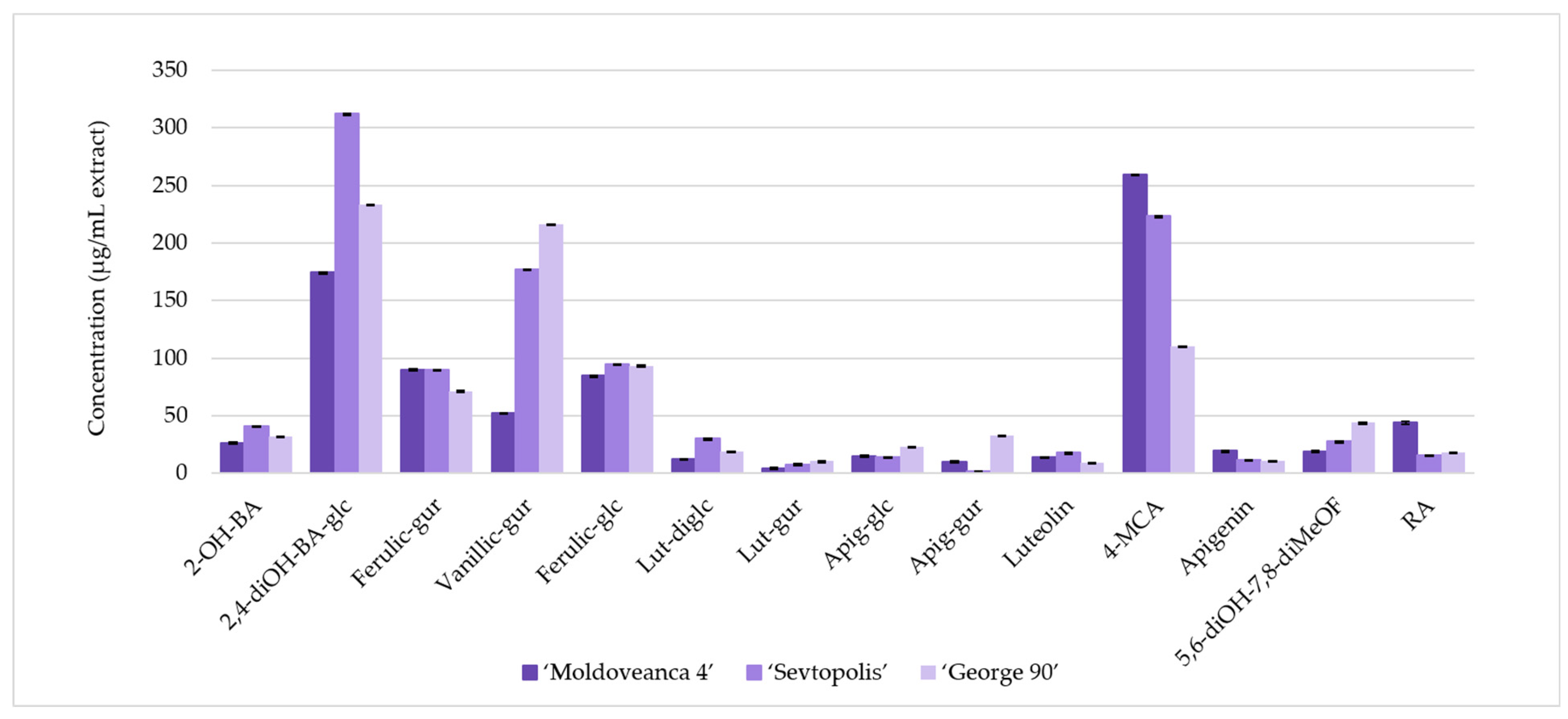
Interestingly, the predominant phenolic compounds tentatively annotated in the present study differed from those most frequently reported for lavender, where rosmarinic acid, caffeic acid derivatives, and luteolin glycosides are often described as major constituents. In the analyzed samples, the highest estimated class-equivalent concentrations were recorded for 2,4-dihydroxybenzoic acid-glucoside, vanillic acid-glucuronide, and 4-methoxycinnamic acid. Rosmarinic acid was also tentatively annotated in all three analyzed samples, although its estimated levels were lower than those of the predominant phenolic compounds. In comparison, Dobros et al. reported rosmarinic acid concentrations ranging from 2.52 to 10.82 mg/g of freeze-dried extract in flower preparations obtained from
L. angustifolia and
L. ×
intermedia cultivars. The reported concentrations varied according to the extraction procedure, ranging from 2.52 to 7.18 mg/g in decoctions, 3.31–10.82 mg/g in ultrasound-assisted extracts, and 3.91–9.17 mg/g in ethanolic macerates [
3]. Similarly, Betlej et al. identified rosmarinic acid as one of the predominant compounds in ethanolic flower extracts from two
L. angustifolia ecotypes, with concentrations ranging from 829.68 to 1229.33 µg/g [
13]. These findings indicate that the reported levels of rosmarinic acid may vary considerably depending on the plant material, extraction procedure, and analytical methodology. Nevertheless, a direct numerical comparison with the present results is limited because our concentrations were expressed in µg/mL extract as class-equivalent estimates, whereas the cited studies reported values relative to the mass of the dried or freeze-dried extract. Moreover, because the three lavender materials investigated in the present study were cultivated at the same location under comparable conditions, the differences observed among them are interpreted as sample-specific analytical patterns. Further studies using independent biological replicates are required to determine whether these differences are associated with genotype.
Among the analyzed extracts, the ‘Sevtopolis’ exhibited the highest cumulative concentration of quantified phenolic compounds (1064.44 ± 1.03 µg/mL extract), followed by ‘George 90’ (924.03 ± 1.13 µg/mL extract) and ‘Moldoveanca 4’ (825.87 ± 2.30 µg/mL extract). This finding illustrates the considerable phytochemical variability that may occur even among closely related lavender materials. Previous investigations on Romanian lavender germplasm similarly reported significant differences in the abundance of phenolic compounds among
L. angustifolia,
L. latifolia, and
L. ×
intermedia genotypes, indicating that phenolic profiles may vary among different
Lavandula species and cultivated materials [
3,
4].
The distribution of phenolic subclasses further showed descriptive differences among the investigated extracts. ‘Moldoveanca 4’ was characterized by the predominance of hydroxycinnamic acid derivatives, accounting for 57.9% of the chromatographic sum, whereas hydroxybenzoic acid derivatives represented the dominant subclass in both ‘Sevtopolis’ and ‘George 90’, accounting for 49.9% and 52.1%, respectively. These descriptive differences indicate distinct phenolic profiles among the specific extracts analyzed. Similar variations in the relative abundance of hydroxybenzoic and hydroxycinnamic acid derivatives have been reported previously among
Lavandula species and cultivars [
4,
5,
8].
Particularly noteworthy was the distribution of the characteristic phenolic compounds associated with each extract. The ‘Moldoveanca 4’ extract showed the highest estimated class-equivalent concentration of 4-methoxycinnamic acid, whereas the ‘Sevtopolis’ extract showed the highest estimated concentration of 2,4-dihydroxybenzoic acid-glucoside. In contrast, ‘George 90’ was characterized by markedly increased concentrations of vanillic acid-glucuronide together with the highest proportion of flavones among the investigated extracts. Within this limited dataset, these compounds contributed to the descriptive differentiation of the analyzed extracts; their potential relevance as phytochemical markers requires confirmation using independent biological replicates and a larger panel of lavender materials. The profile observed for the ‘George 90’ extract represents a sample-specific analytical pattern that requires confirmation using independent biological replicates and a broader comparative dataset [
4].
The flavone derivatives were particularly abundant in the ‘George 90’ extract, accounting for 16.1% of its chromatographic sum. Elevated concentrations of apigenin-glucuronide and 5,6-dihydroxy-7,8-dimethoxyflavone contributed substantially to this profile. Flavones are recognized as important bioactive constituents due to their antioxidant, anti-inflammatory, antimicrobial, and neuroprotective properties, and their accumulation may enhance the functional value of lavender extracts [
4].
Among the analyzed extracts, ‘Sevtopolis’ showed both the highest chromatographic sum of estimated class-equivalent phenolic concentrations and the strongest DPPH radical-scavenging activity. The other two extracts followed the same descending order for these parameters, with ‘George 90’ showing intermediate values and ‘Moldoveanca 4’ the lowest values. This parallel ranking suggests a possible correspondence between the estimated phenolic composition and DPPH activity within the present dataset. However, because only three extracts were analyzed and independent biological replicates were not available, this observation should not be interpreted as evidence of a statistical association or causal relationship. Similar relationships between phenolic abundance and antioxidant activity have been reported for lavender cultivars in previous studies, although the compounds contributing to antioxidant activity may differ among plant materials and extracts [
3,
4].
The cultivar ‘Moldoveanca 4’ displayed the lowest chromatographic sum of the estimated class-equivalent concentrations but the highest proportion of hydroxycinnamic acid derivatives, mainly represented by 4-methoxycinnamic acid. Previous investigations on this cultivar have focused predominantly on essential oil composition, antioxidant capacity, and antimicrobial activity, demonstrating that ‘Moldoveanca 4’ possesses a valuable phytochemical profile despite substantial compositional differences among extraction products. The predominance of hydroxycinnamic acid derivatives observed in the present study suggests that the biological potential of this cultivar may be associated not only with volatile constituents but also with non-volatile phenolic metabolites [
9].
The antioxidant activity determined by the DPPH assay followed the same ranking as the cumulative estimated class-equivalent concentrations of the tentatively annotated phenolic compounds, with ‘Sevtopolis’ exhibiting the highest radical-scavenging activity, followed by ‘George 90’ and ‘Moldoveanca 4’. This agreement suggests that phenolic compounds may contribute to the antioxidant potential of the investigated extracts. The tentatively annotated flavone derivatives, including luteolin- and apigenin-based compounds, may contribute to radical scavenging through hydrogen- or electron-donating mechanisms and stabilization of the resulting radicals. Their antioxidant contribution may vary according to their concentration, hydroxylation and glycosylation patterns, and interactions with other phenolic constituents. Notably, ‘George 90’ contained the highest concentration and proportion of chromatographically quantified flavone derivatives, whereas ‘Sevtopolis’ showed the strongest DPPH activity. This non-parallel pattern suggests that flavone derivatives were not the sole determinants of the observed antioxidant activity, which may instead reflect the combined contribution of several phenolic classes. Numerous studies on Lavandula species have similarly reported positive relationships between phenolic concentration and antioxidant activity measured using DPPH, ABTS, and FRAP assays, which is broadly consistent with the potential contribution of phenolic metabolites observed here.
The main strength of this research lies in providing an integrated preliminary analytical characterization of the phenolic profiles and DPPH radical-scavenging activity of three commercially cultivated Eastern European lavender materials. HPLC-DAD-ESI+ profiling enabled the tentative annotation of fourteen phenolic compounds and the estimation of their class-equivalent concentrations, thereby expanding the limited phytochemical information available for ‘Moldoveanca 4’, ‘Sevtopolis’, and ‘George 90’. The observed differences are interpreted as sample-specific analytical patterns and provide baseline data for future studies incorporating independent biological replicates to investigate potential genotype-related variation. Such studies may further support the evaluation and potential valorization of these lavender materials for food, cosmetic, nutraceutical, and pharmaceutical applications.
Study Limitations
A key limitation of this study is that only one extract was prepared from each lavender material. The three replicate HPLC injections were used exclusively to assess analytical repeatability and do not represent independent biological replicates. Consequently, the observed differences should be regarded as descriptive and specific to the analyzed samples rather than representative of population-level or genotype-dependent variability. In addition, the compound assignments remain tentative because authentic reference standards were not available for all analytes and confirmatory MS/MS data were not obtained. Antioxidant activity was assessed using only one in vitro method, namely the DPPH assay. Future studies should include independent plant samples, separately prepared extraction replicates, confirmatory analytical methods, and complementary antioxidant assays to validate the observed patterns and investigate potential genotype-related differences. In addition, total phenolic content and total flavonoid content were not evaluated using complementary spectrophotometric assays.
4. Materials and Methods
4.1. Plant Material and Extraction
Dried inflorescences from the three
Lavandula genotypes were the plant material used for extraction and analysis in this study. Details regarding the origin, collection, and authentication of the plant material are provided in
Table 5.
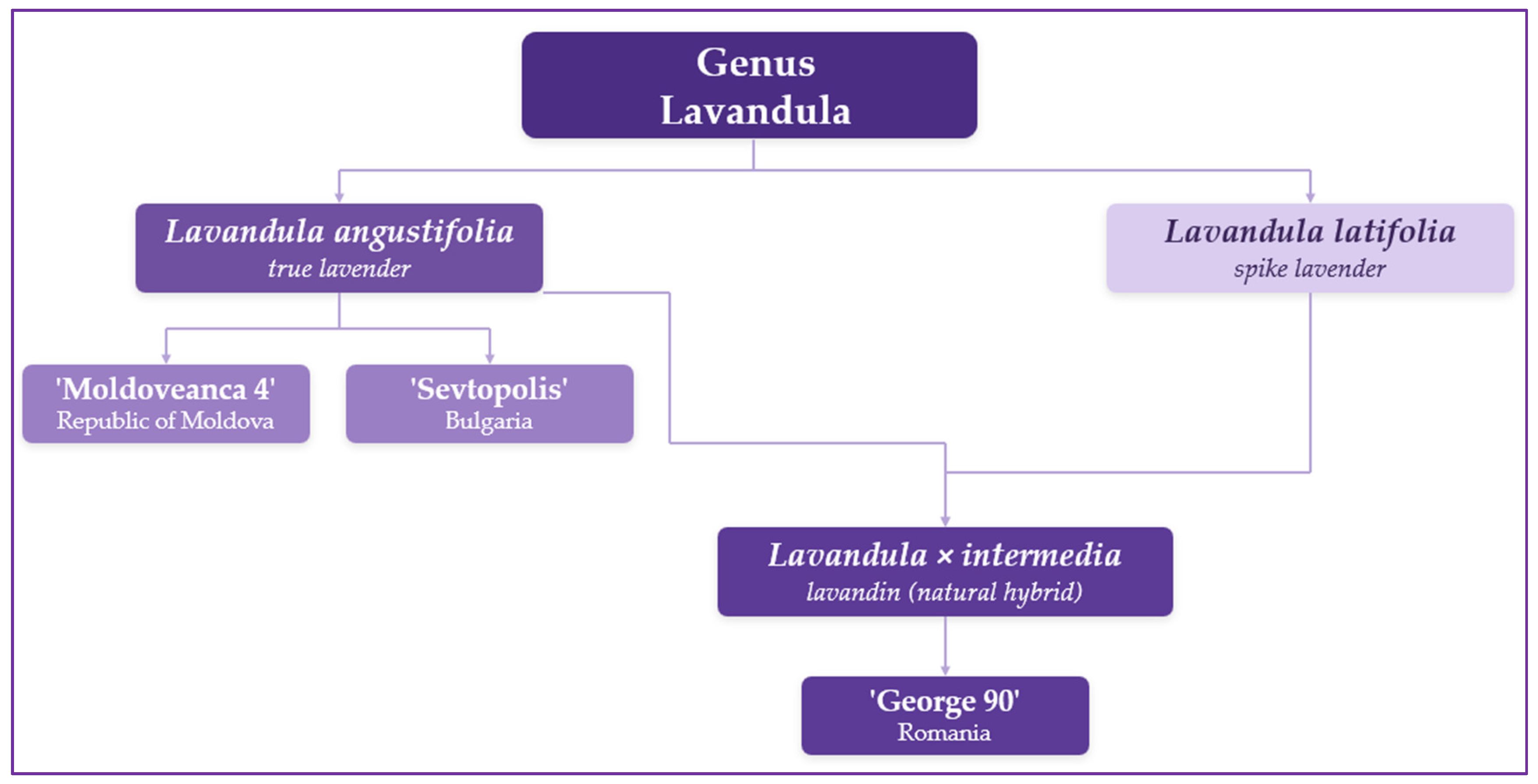
To clarify the botanical classification of the investigated plant material, the taxonomic relationships among the lavender genotypes included in the study are illustrated in
Figure 3.
All three lavender genotypes were cultivated under the same environmental and agronomic conditions in an organically managed perennial crop located on a farm in Botoșani County, Romania (47°41′51″ N, 26°38′53″ E). The plantation was established in 2016, and no fertilizers were applied during the 2025 growing season. The inflorescences were harvested manually in the second half of June 2025, when approximately 50% of the flowers were open. Harvesting was performed on sunny days between 10:00 and 11:30 a.m. After harvesting, the inflorescences were dried at 20 °C. The dried plant material was stored in paper bags under ambient laboratory conditions until extraction.
For the preparation of the extracts, 15 g of dried and powdered inflorescences from each lavender genotype were mixed with 200 mL of 80% ethanol. The samples were soaked for 90 min prior to extraction, according to the procedure recommended by Pan et al. (2003) [
14].
Microwave-assisted extraction was then performed using a domestic microwave oven (CE3260F/CE3260FS), under conditions adapted from Levaya et al. (2022), with a nominal output power of 1100 W [
15]. The suspensions were placed in open glass vessels with a nominal capacity of 300 mL. The microwave oven was operated at power level 1 (10% of total power), corresponding to approximately 110 W. Each irradiation cycle consisted of 10 s of microwave exposure followed by a 50 s pause. A total of 6 cycles was required to reach 55 °C. During each pause, the suspension temperature was measured using a digital thermometer (Testo 108-2, Testo SE & Co. KGaA, Titisee-Neustadt, Germany). After reaching 55 °C, the samples were maintained at this temperature for 3 min using 3 additional intermittent cycles under the same irradiation and pause conditions. The samples were then cooled to room temperature and filtered through Whatman No. 1 filter paper. The final extract volume was measured and adjusted to 200 mL with 80% ethanol to compensate for evaporation. The liquid extracts were stored at approximately 4 °C in amber glass vials and analyzed by HPLC, without prior evaporation or drying.
4.2. HPLC-DAD-ESI+ Conditions
Prior to chromatographic analysis, the lavender extracts were filtered through a Chromafil Xtra nylon 0.45 µm filter (MACHEREY-NAGEL GmbH & Co. KG, Düren, Germany), and 20 µL of each filtered sample was injected into the HPLC system. Analyses were performed using an Agilent 1200 HPLC system (Agilent Technologies, Waldbronn, Germany) coupled to an Agilent 6110 single-quadrupole mass spectrometer (Agilent Technologies, Santa Clara, CA, USA). The system was equipped with a quaternary pump, solvent degasser, autosampler, diode-array detector (DAD), and electrospray ionization source. Chromatographic separation was carried out on a Kinetex XB-C18 column (4.6 × 150 mm, 5 µm; Phenomenex, Torrance, CA, USA). The mobile phase consisted of water containing 0.1% acetic acid as solvent A and acetonitrile containing 0.1% acetic acid as solvent B. Elution was performed using the following gradient program, expressed as solvent B: 0–2 min, 5% B; 2–18 min, 5–40% B; 18–20 min, 40–90% B; 20–24 min, 90% B; 24–25 min, 90–5% B; and 25–30 min, 5% B. The flow rate was 0.5 mL/min, and the column temperature was maintained at 25 °C [
16,
17]. DAD spectral data were recorded in the 200–600 nm range for all detected peaks, and chromatograms were monitored at 280 and 340 nm. Mass spectrometric detection was performed in positive electrospray ionization mode (ESI
+), using full-scan acquisition under the following operating conditions: capillary voltage, 3000 V; source temperature, 350 °C; nitrogen gas flow, 7 L/min; and mass range,
m/
z 120–1200. Data acquisition and interpretation were performed using Agilent ChemStation software, version Rev B.02.01-SR2.
For each genotype, three technical replicate injections (R1–R3) were performed from a single extract, allowing the assessment of analytical repeatability and relative quantitative differences among the analyzed genotype-derived extracts.
4.3. Calibration and Quantification
Five-point external calibration curves were constructed using methanolic solutions of gallic acid, chlorogenic acid, and luteolin (Sigma-Aldrich, St. Louis, MO, USA) as reference standards. The calibration concentrations were 5, 10, 25, 50, and 100 µg/mL for gallic acid; 10, 25, 30, 40, and 50 µg/mL for chlorogenic acid; and 1, 10, 25, 50, and 100 µg/mL for luteolin. The calibration equations were y = 33.624x + 30.680 for gallic acid (R
2 = 0.9978), y = 22.585x − 36.728 for chlorogenic acid (R
2 = 0.9937), and y = 68.857x + 25.113 for luteolin (R
2 = 0.9972), where x represents the standard concentration (µg/mL) and y represents the chromatographic peak area (mAU). The LOD and LOQ values were 0.23 and 0.89 µg/mL for gallic acid, 0.41 and 1.64 µg/mL for chlorogenic acid, and 0.38 and 1.46 µg/mL for luteolin, respectively. Where necessary, the extracts were appropriately diluted to ensure that all chromatographic responses fell within the corresponding calibration ranges. Hydroxybenzoic acid derivatives were quantified as gallic acid equivalents, hydroxycinnamic acid derivatives as chlorogenic acid equivalents, and flavone derivatives as luteolin equivalents. Therefore, the reported values represent class-equivalent concentrations and should not be interpreted as absolute concentrations determined using an authentic standard for each individual compound. The fourteen phenolic compounds were tentatively annotated based on retention behavior, UV–Vis spectral characteristics, protonated molecular ions [M+H]
+, and comparison with data reported in the literature and the Phenol-Explorer database [
18]. As authentic standards were not available for all compounds, the assignments were considered tentative and require further confirmation [
19].
For each extract, the chromatographic sum of phenolic compounds was calculated by adding the class-equivalent concentrations of all fourteen tentatively annotated compounds. The chromatographic sum of flavone derivatives was calculated from the seven flavones quantified as luteolin equivalents: luteolin-diglucoside, luteolin-glucuronide, apigenin-glucoside, apigenin-glucuronide, luteolin, apigenin, and 5,6-dihydroxy-7,8-dimethoxyflavone.
4.4. Determination of Antioxidant Activity by DPPH Assay
The antioxidant activity of lavender extracts was evaluated using the 2,2-diphenyl-1-picrylhydrazyl (DPPH 80 μM) radical scavenging method, following a widely adopted protocol [
20], previously used in combination with HPLC-based phenolic screening for the evaluation of medicinal plant extracts [
21,
22].
Briefly, 100 μL of each extract was mixed with 3.9 mL of freshly prepared DPPH methanolic solution. The reaction mixtures were incubated in the dark at room temperature for 30 min, after which the absorbance was measured at 517 nm using a UV–Vis spectrophotometer (PG Instruments Ltd., Leicestershire, UK). A DPPH solution without extract was used as the control.
The radical scavenging activity was calculated according to the following equation:
where
is the absorbance of the DPPH solution and
is the absorbance of the reaction mixture containing the extract.
Trolox was used as the reference antioxidant and a calibration curve was prepared using standard Trolox solutions. The results were expressed as Trolox equivalents (TE) and calculated from the calibration equation:
where
represents the percentage of DPPH inhibition and
the Trolox concentration (mM). All measurements were performed in triplicate, and the results were expressed as mean ± SD. Antioxidant activity was reported as µmol Trolox equivalents per mL of extract (µmol TE/mL extract).
4.5. Data Presentation and Descriptive Analysis
All results are presented as mean ± standard deviation (SD) of three technical measurements, consisting of replicate injections for HPLC analysis and replicate determinations for the DPPH assay. HPLC results are reported as class-equivalent concentrations (µg/mL extract). The coefficient of variation was calculated as CV (%) = SD/mean × 100. Mean CV values reported for each extract represent the arithmetic mean of the compound-specific CVs across the 14 tentatively annotated compounds. Descriptive calculations and graphical representations were generated using Microsoft Excel.





 ,
,