Article

Evaluating the Effectiveness of the BitCube Cryptosystem for IoHT Security Using a Hesitant Fuzzy AHP–TOPSIS Approach

SAUDI ARAMCO Cybersecurity Chair, Networks and Communications Department, College of Computer Science and Information Technology, Imam Abdulrahman Bin Faisal University, P.O. Box 1982, Dammam 31441, Saudi Arabia
*
Author to whom correspondence should be addressed.
Appl. Sci. 2026, 16(15), 7395; https://doi.org/10.3390/app16157395
Submission received: 3 June 2026 / Revised: 1 July 2026 / Accepted: 14 July 2026 / Published: 23 July 2026

Abstract

The rapid proliferation of the Internet of Healthcare Things (IoHT) has significantly increased the reliance on Wireless Sensor Networks (WSNs) for real-time healthcare monitoring, data collection, and communication. However, ensuring secure, scalable, and efficient data transmission in resource-constrained IoHT environments remains a major challenge, as conventional cryptographic solutions often impose excessive computational and memory overhead. To address this issue, this study investigates the suitability of BitCube, a lightweight cryptosystem inspired by the structural transformations of a Rubik’s Cube, for securing IoHT applications. Designed to provide a balanced combination of confidentiality, integrity, authentication, and operational efficiency, BitCube aims to meet the stringent security and performance requirements of healthcare-oriented sensor networks while maintaining low resource consumption. To systematically evaluate its effectiveness, a Multi-Criteria Decision-Making (MCDM) framework integrating the Hesitant Fuzzy (HF) Analytical Hierarchy Process (AHP) and the Technique for Order Preference by Similarity to Ideal Solution (TOPSIS) is employed. The proposed framework enables the incorporation of uncertainty and expert hesitation in the evaluation process, thereby providing a more realistic assessment of cryptographic alternatives. BitCube is compared with seven existing cryptosystems across multiple criteria, including execution efficiency, memory utilisation, scalability, authentication, and confidentiality. The results indicate that BitCube consistently achieves the highest overall ranking among the evaluated schemes, demonstrating superior suitability for resource-constrained IoHT environments, while the Lightweight Advanced Encryption Standard (AES) emerges as the second-best alternative. Furthermore, validation through comparison with other MCDM techniques reveals only minor variations in the ranking outcomes, confirming the robustness and reliability of the proposed evaluation framework. These findings highlight the potential of BitCube as a promising lightweight cryptographic solution for enhancing security in next-generation IoHT systems.

1. Introduction

The IoHT has emerged as a revolutionary paradigm in modern healthcare which provides seamless connectivity between medical devices, sensors, wearable systems and healthcare applications via the internet. This interconnected ecosystem allows real-time monitoring, early diagnosis, personalised treatment and efficient patient care [1,2,3,4,5]. The IoHT enhances access to healthcare, reduces operational expenses, and improves patient outcomes through remote patient monitoring and continuous health tracking, particularly in remote and underprivileged regions [6,7,8]. In addition, the integration of advanced technologies such as cloud computing, artificial intelligence, and wireless connectivity has improved IoHT functionalities, facilitating intelligent and data-driven healthcare services.
The fast adoption of the IoHT is indicated by its increasing worldwide market (Table 1) [3]. The Internet of Things (IoT) market in the healthcare industry is projected to grow from an estimated United States Dollar (USD) ~44 billion in 2023 to over USD ~170 billion by 2030. The growth is primarily attributable to the high adoption of smart medical devices, wearable technology and smartphones for the continuous monitoring and management of patients’ health.
The IoHT offers many advantages, but its extensive deployment raises severe security and privacy concerns [5,9,10,11,12,13]. This is because healthcare data is very private and the infrastructure is very connected. Medical data is extremely sensitive and when it is leaked it can cause serious issues including a breakdown of trust in healthcare systems, decreased patient safety, and legal issues. IoHT environments are very different from each other and very dynamic. This makes them vulnerable to cyber threats such as data breaches, malware attacks, replay attacks, and insecure communication protocols.
The increasing number of cyberattacks against healthcare infrastructure further emphasises the need for secure IoHT systems [5,14,15,16,17,18,19]. There have been reports of billions of attack attempts on IoHT devices each year. Connected medical devices are frequently the target because of their limited security capabilities. As IoHT systems are directly related to human lives, it is not only a technical requirement but also a societal and ethical requirement to ensure their security. In healthcare, malfunctioning software can seriously jeopardise the health of patients. Possible risks are illustrated by past events such as the Therac-25 accelerator accidents [3,20,21,22,23,24] and the possible re-configuration of pacemakers [4,25,26]. Furthermore, unpredictable behaviour of a drug delivery system can cause serious problems with availability, endangering or even killing patients [5,27,28,29].
The resource-constrained nature of WSNs makes them particularly vulnerable to attacks, which are the backbone of IoHT systems [6,30,31,32,33,34]. Sensor nodes have limited memory and computational and communication bandwidths, which makes the implementation of classical cryptographic techniques difficult. Furthermore, these nodes are usually deployed in open or unattended environments, which makes them vulnerable to physical and network-based attacks [7,35,36,37,38]. These challenges emphasise the necessity of lightweight, efficient, and robust cryptographic solutions for IoHT-enabled WSNs.
The existing cryptography techniques have some limitations in the scenario of the IoHT. Traditional encryption methods such as the AES are very secure but are resource intensive, making them impractical for resource-constrained devices. Key management is difficult, and the computational complexity is high for asymmetric cryptographic algorithms. Lightweight cryptography typically sacrifices some security in exchange for efficiency, for example, by offering limited support for authentication and data integrity [8,39,40,41,42,43,44].
This results in an inherent trade-off between security and performance that continues to be a major research challenge in IoHT systems. A practical deployment involves a trade-off between strong security mechanisms and resource efficiency [45,46]. Existing solutions either provide high security by incurring higher computational costs or provide efficiency by sacrificing protection [47,48]. Thus, none of the existing solutions satisfy the complete requirements of IoHT environments. Therefore, there is a great need for:
  • A lightweight cryptographic framework providing confidentiality, integrity, and authentication;
  • A scalable and efficient solution compatible with resource-constrained WSN nodes;
  • A robust evaluation methodology capable of handling uncertainty and multiple decision criteria;
  • A systematic comparative framework for assessing performance against established cryptographic techniques.
To address these technical gaps is crucial in the development of next-generation secure IoHT systems. To tackle the identified challenges, this study evaluates the efficiency of the BitCube Cryptosystem (BC) [23], which is a lightweight and novel cryptographic architecture, designed specifically for the IoHT-enabled WSNs [6]. The BitCube approach uses structured transformations based on cube operations for strong security with less computational complexity, so it is suitable for constrained environments.
In this MCDM framework, HF AHP and TOPSIS are combined to provide a comprehensive and objective evaluation. The HF AHP–TOPSIS approach was selected because experts often hesitate among multiple assessment values when evaluating IoT cryptographic algorithms across conflicting criteria, such as security, computational efficiency, energy consumption, memory requirements, and scalability. Unlike conventional fuzzy approaches, hesitant fuzzy sets explicitly capture this hesitation by allowing multiple membership values for a single assessment. Compared with other fuzzy sets, the proposed approach offers a better balance between uncertainty representation, computational efficiency, and decision-making accuracy. Therefore, it is well suited for evaluating lightweight cryptographic algorithms in IoT environments. The main contributions of this paper are summarized as follows:
  • The BC is a new cryptographic primitive for IoHT security that goes beyond substitution–permutation structures. It is a lightweight design based on a Rubik’s cube with rotational transformations.
  • Innovative evaluation framework: This is the first use of a hybrid HF AHP–TOPSIS model for cryptosystem evaluation, which enables multi-criteria trade-offs and nuanced handling of uncertainty in IoHT security decision-making.
  • Complete comparative analysis: A comprehensive benchmarking study of BitCube against seven popular lightweight cryptosystems demonstrates its enhanced security strength, scalability, and execution speed in IoHT environments with limited resources.
  • Empirical validation in the context of healthcare: Experimental findings support BitCube’s applicability for IoHT-enabled WSNs and establish it as a workable security solution tailored to the particular limitations of medical sensing equipment.
  • Future-focused adaptability: The work ensures relevance for upcoming IoHT deployments by laying the groundwork to grow BitCube to energy-efficient, real-time, and hardware-level implementations.
The present study is structured around four core research questions to systematically guide the evaluation of the proposed approach. The first step is to compare the performance of the BC [23] with the traditional and lightweight cryptographic algorithms including AES and IoHT-oriented cyphers in terms of various metrics, including security strength, computational efficiency, memory footprint, and general resource demands, to evaluate its suitability for resource-constrained IoHT environments. Second, the study demonstrates that the HF AHP is capable of effectively managing the uncertainty and hesitation of experts during the prioritisation of evaluation criteria and results in more reliable decision-making for cryptographic algorithm selection. Thirdly, it studies the ranking of different cryptographic techniques applying the TOPSIS and determines the relative position of the BC among the competing methods. Finally, the study investigates the practical feasibility of BitCube for deployment in resource-constrained scenarios such as IoHT systems by analysing its overall performance and the trade-offs between security and efficiency metrics.
The remainder of this paper is organized as follows. Section 2 presents the materials and methods employed in this study. Specifically, Section 2.1 reviews the most relevant recent literature, while Section 2.2 describes the BitCube Cryptosystem, including its functional requirements (Section 2.2.1) and hierarchical evaluation structure (Section 2.2.2). Section 2.3 provides a comprehensive description of the proposed methodology, which integrates HF, AHP, and TOPSIS. Section 3 presents the experimental results, sensitivity analysis, and comparative evaluation with alternative decision-making methods. Finally, Section 4 concludes the paper by summarizing the key findings, discussing the implications of the study, and outlining directions for future research.

2. Materials and Methods

2.1. Pertinent Recent Reviews

The cryptographic schemes for WSNs in IoHT environments are categorised into three types: symmetric, asymmetric and hybrid schemes. Each category provides different advantages but their use in the IoHT is limited due to the inherent limitations of sensor nodes such as limited memory, low computational capability, limited bandwidth and energy constraints. These constraints pose significant challenges in the implementation of traditional cryptographic algorithms in resource-limited healthcare settings.
Recent works have thoroughly explored lightweight cryptographic solutions to these challenges. For example, Muhammad Rana et al. (2022) [9] compared the security analysis of modern lightweight cryptographic protocols and classified them into symmetric and asymmetric based on their operational characteristics. Also in 2021, Vishal A. Thakor et al. [10] analysed more than 50 lightweight cryptographic algorithms, including 57 candidates from the National Institute of Standards and Technology (NIST) competition, in terms of implementation cost and performance metrics. More recently, Ansari et al. (2025) [12] have offered a comprehensive survey of 77 peer-reviewed studies published between 2006 and 2025, analysing lightweight block and stream cyphers, hybrid frameworks, and authentication protocols based on quantitative metrics such as entropy, execution time, throughput, and resource utilisation. Gulati et al. (2021) [13] have also emphasised the importance of energy-efficient data aggregation techniques in WSN-based IoT systems, highlighting the need to optimise communication and security mechanisms.
Mishall Al-Zubaidie et al. [14] proposed an integrated framework for healthcare WSNs designed to improve privacy and security by incorporating lightweight cryptographic primitives such as BLAKE2bp hashing, Elliptic Curve Digital Signature Algorithm (ECDSA)-based authentication, homomorphic data aggregation, and pseudonymization techniques. Their work, supported with Automated Validation of Internet Security Protocols and Applications (AVISPA)-based formal verification, showed the need of balancing strong security mechanisms with the strict resource constraints of IoHT devices. However, this approach makes a substantial contribution to the practical security of healthcare, but it has limitations in terms of novelty, scalability and validation of real-world deployment.
We explore the advantages and limitations of existing cryptographic techniques by looking into two significant aspects (Table 2 and Table 3) of the previous research: security requirements and lightweight performance characteristics. Security requirements are usually confidentiality, message authentication, and device authentication. Lightweight features are processing efficiency, execution time, memory requirements, storage requirements, and computational complexity.
Analysis of the existing literature reveals several persistent limitations:
  • High computational cost;
  • Elevated resource consumption;
  • Complex key management systems;
  • Limited support for integrated security services;
  • Vulnerability to advanced cryptanalysis and side-channel attacks;
  • Insufficient adaptability to dynamic IoHT environments.
These limitations make the need for a cryptographic framework that provides a practical balance between lightweight performance and security robustness clear. On the basis of the identified research gap, this paper proposes and analyses the BC, a lightweight and efficient cryptosystem for IoHT-enabled WSNs. Contrary to the conventional and hybrid approaches, BitCube preserves the linear computational complexity and drastically improves the execution time as well as the memory requirements. The proposed approach provides a balanced solution, addressing key security requirements (confidentiality, message authentication and device authentication) without imposing an excessive computational burden. The dynamic transformation-based design improves the resistance against several cryptographic attacks such as ciphertext-only, brute-force, known-plaintext and chosen-plaintext attacks. Compared with the existing methods, BitCube shows higher execution efficiency, lower memory consumption and less operational complexity, which makes it very suitable to deploy in the resource-limited IoHT environment.

2.2. BitCube Cryptosystem

The BC is a new lightweight security mechanism developed specifically for resource-constrained WSNs in IoHT environments [23]. In general, IoHT sensor nodes are highly resource-constrained in terms of memory capacity, computational power and battery life, which makes the implementation of conventional cryptographic techniques a challenge. To overcome such limitations, BitCube offers a symmetric, lightweight and computationally efficient encryption framework for protecting sensed data before they are transmitted over potentially insecure wireless channels [6,7].
The main strength of the BC is its novel design based on the structural transformations of a Rubik’s Cube. Unlike traditional cryptographic algorithms that process data as a linear sequence of bits, BitCube processes data as a three-dimensional cube of bits. Encryption is done using geometric transformations such as rotations of cubes, permutations and neighbour-dependent updates [6,7,8]. These operations give a strong diffusion. This means that local changes will propagate through the whole data structure, so the security is better. This transformation-based approach replaces computationally expensive algebraic operations with lightweight bitwise operations and index manipulations and is therefore well fit for IoHT environments [6].
Another distinctive aspect of BitCube is its dynamic key generation mechanism. The system is based on dynamic key generation using continuous cube transformations, rather than a fixed key schedule. This leads to per-packet unique keys, which improves forward secrecy and greatly increases resistance to various cryptographic attacks [10]. The permutation-based operation combined with the local interaction principle allows efficient data mixing with a low computational load. The operations of BitCube are simple and parallelizable, which makes it a good candidate for deployment on low-power IoHT devices [7].

2.2.1. Functional Requirements

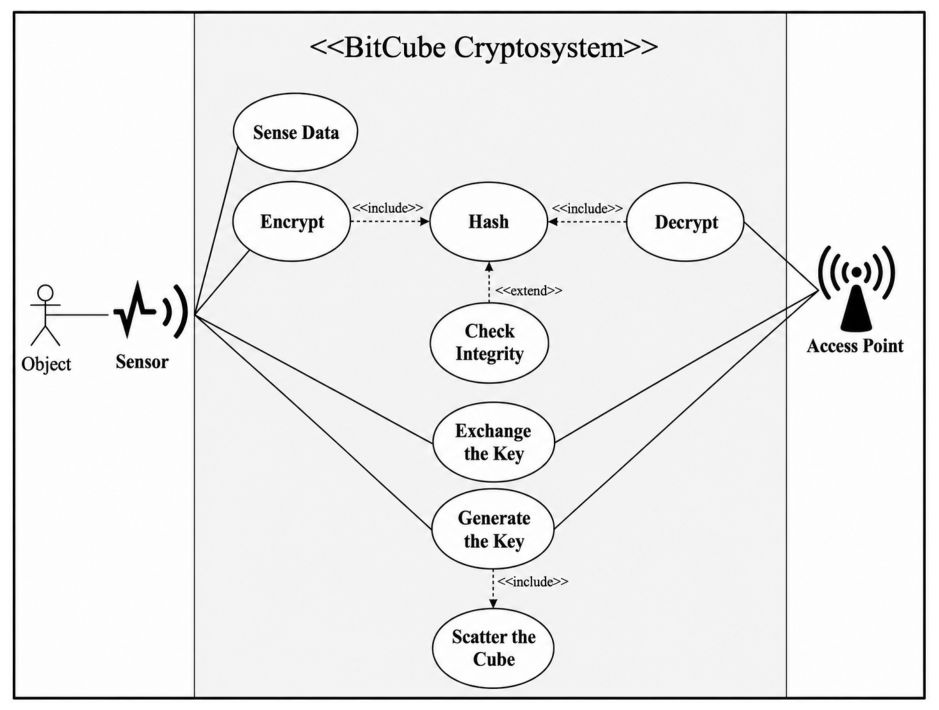
This section defines the functional requirements of the BC. The requirements are derived from the operational workflow between the IoT sensor node and the Access Point (AP). The overall interaction is illustrated in Figure 1: Use case diagram of the BC, which presents the complete functional architecture of the system. As shown in Figure 1, the BC consists of seven primary use cases: sense data, encrypt, decrypt, hash, generate the key, exchange the key, and scatter the cube. These use cases collectively describe the end-to-end secure communication lifecycle—from data acquisition to authenticated decryption. The detailed specification of each use case is presented in Table 4, Table 5, Table 6, Table 7, Table 8, Table 9 and Table 10, including the actors, inputs, stimuli, outputs, and constraints.
  • Overall Functional Architecture: Figure 1 illustrates the overall interaction between the two primary actors of the system: The IoT sensor node and the Access Point (AP). The diagram presents the complete functional workflow required to achieve secure communication in the BC. Within this framework, the sensor node performs sensing, encryption, dynamic key generation, hashing, and initiation of key exchange. The Access Point is responsible for synchronized key generation, decryption, integrity verification, and maintaining cube state consistency. The coordinated interaction between these two entities ensures confidentiality, integrity, and synchronization throughout the communication cycle. The following subsections describe each functional requirement in detail, as specified in Table 4, Table 5, Table 6, Table 7, Table 8, Table 9 and Table 10.
  • Sense Data Use Case: As described in Table 4: Explanation of the sense data use case, sensing represents the initial stage of the secure communication process. The sensor emits microwave signals within its operational range. When an object moves within this range, the emitted signals are reflected back to the sensor. These reflected signals are processed and converted into digital data, forming the plaintext input for the encryption stage. In this use case, the sensor acts as the primary actor. The input consists of reflected microwave signals triggered by object movement within the sensing range. The output is the sensed data in plaintext form. This stage initiates the secure data processing pipeline and prepares the information for cryptographic protection.
  • Encrypt Use Case: The encryption mechanism is detailed in Table 5: Explanation of the encrypt use case. Upon detecting the data, the sensor executes triple-layer encryption utilising 3 dynamically generated 3 Per-Packet Keys (PPKs), where PPK generation is the process of dynamically generating a unique encryption key for each transmitted packet, thereby enhancing forward security and improving resilience against cryptographic attacks. The plaintext is subjected to consecutive XOR operations 3 times, utilising the bit values obtained from the PPKs. This multi-layered XOR technique improves diffusion and fortifies security while maintaining minimal computing cost, making it appropriate for resource-limited IoT devices. In this procedure, the sensor functions as the agent. The inputs comprise the detected plaintext and the 3 PPKs. The stimulus manifests upon the completion of the sensing stage. The output is the ciphertext, which is then sent to the hashing function for integrity assurance. The encryption phase thus guarantees confidentiality before transmission.
  • Decrypt Use Case: The decryption process, described in Table 6: Explanation of the decrypt use case, is performed at the Access Point. Upon receiving the encrypted data, the AP applies the same 3 PPKs in reverse order using XOR operations. Due to the symmetric nature of the XOR operation, this process restores the original plaintext without additional computational complexity. Here, the Access Point acts as the primary entity. The input is the received ciphertext, and the stimulus is the successful reception of encrypted data. The output is the recovered plaintext. Similar to the encryption stage, the decryption process includes hashing for integrity verification. This synchronized mechanism ensures accurate and efficient recovery of the original data.
  • Hash Use Case: Message authentication and integrity verification are defined in Table 7: Explanation of the hash use case. Following encryption, the ciphertext is then processed by a hash function after being concatenated with the subsequent set of 3 PPKs. This results in the generation of a hash value that is attached to the data that is broadcast. During this procedure, the sensor and the AP are both necessary participants. The input is comprised of the ciphertext in conjunction with the subsequent 3 PPKs. This is the output, which is the hash value that was generated and utilised for integrity validation [6]. It is the responsibility of the system owner to be notified by an alert mechanism in the event that the extracted hash does not correspond to the locally generated hash during the verification process. The resilience of the system to tampering, replay assaults, and illegal modifications is improved as a result of this function.
  • Key Exchange Scenario: The key exchange mechanism is described in Table 8: Explanation of the key exchange scenario. Upon generating the BitCube key and the 3 PPKs, the sensor and the AP safely transmit the necessary keying material utilising public key cryptography [38,39]. This guarantees that both parties uphold synchronized cryptographic parameters while safeguarding sensitive information from adversaries. In this scenario, both the sensor and the Access Point function as participants. The input comprises the BitCube key and the 3 PPKs. The stimulus is activated upon the completion of key generation. The result is the creation of shared and synchronized key material, facilitating secure future communication.
  • Derive the Principal Use Case Scenario: Table 9: Explanation of the derive the principal use case scenario provides an explanation of dynamic key generation. Each actor independently generates the identical PPKs through a coordinated method. The middle portion of the first block of XORed ciphertext serves as the input for the cube transformation technique. This component affects the succeeding stage of key evolution, which facilitates the generation of keys in a forward-secure and adaptive manner. This action involves both the AP and the sensor. The input is the central portion of the initial XORed ciphertext. The outcome is the production of three new PPKs. This method encompasses the use case of the cube scattering mechanism, which guarantees that key production is dynamic and perpetually changing.
  • Cube Scattering Mechanism: The cube transformation mechanism is defined in Table 10, which also provides an explanation of the cube scattering mechanism’s use case. The middle bit that was extracted from the initial ciphertext is now used as an input to the dispersal function. The function ultimately generates a new configuration for the cube by modifying the underlying structure of the BitCube model. A modified key state is generated for subsequent encryption cycles as a result of the updated values obtained by each cubicle. In order to preserve synchronization, this function is executed by both the sensor and the AP [39]. This process responds by generating a new cube state that guarantees the unpredictability of future key derivations. The transformation mechanism conceptually resembles the dynamic rotations of a Rubik’s Cube, enhancing randomness while maintaining lightweight implementation characteristics.
The functional requirements depicted in Figure 1 and elaborated in Table 4, Table 5, Table 6, Table 7, Table 8, Table 9 and Table 10 collectively delineate the operating framework of the BC. The design incorporates triple-layer XOR encryption, dynamic key evolution, cube-based structural transformation, secure key exchange, and hash-based message authentication inside a lightweight framework. Collectively, these functional elements facilitate secure, synchronized, and energy-efficient communication between IoT sensor nodes and the Access Point, rendering the BC particularly appropriate for implementation in resource-constrained WSNs.
Breaking the BitCube Key: The BitCube key in the BC can be conceptualized as a Rubik’s Cube. In our cryptosystem, each cubicle of the cube contains a distinct sequence of sixteen bits rather than colours. Employing the Rubik’s Cube principle in cryptography for key generation will yield robust algorithms. This is attributable to the vast amount of combinations arising from the cube’s movement. Utilising statistical theories, we will determine that the number of possibilities of a (3 × 3 × 3) cube is 43,252,003,274,489,856,000, approximately 43 quintillion. The following equation demonstrates the derivation of this number. Augmenting the dimensions of the cube results in an extraordinary multitude of combinations [23].
N u m b e r   o f   C u b e _ C o m b i n a t i o n s = [ ( N u m b e r   o f   p o s i t i o n s   f o r   e a c h   c o r n e r   c u b i c l e ) ! × ( N u m b e r   o f   p o s i t i o n s   f o r   e a c h   e d g e   c u b i c l e ) ! × ( N u m b e r   o f   f l i p p i n g   c o n f i g u r a t i o n s   o f   t h e   e d g e   c u b i c l e s ) × ( N u m b e r   o f   r o t a t i o n s   f o r   e a c h   c o r n e r   c u b i c l e )   ^ ( N u m b e r   o f   p o s i t i o n s   f o r   e a c h   c o r n e r   c u b i c l e ) ] × [ 1 / 3 × 1 / 2 × 1 / 2 ] = [ 8 ! × 12 ! × ( 2 ^ 12 ) × ( 3 ^ 8   ) ] [ 3 × 2 × 2 ] 43   q u i n t i l l i o n

2.2.2. The Hierarchy

The BC offers several notable advantages that make it a promising candidate for securing resource-constrained IoHT environments. It is characterized by low memory requirements, reduced execution time, efficient processing capabilities, and integrated support for authentication and data integrity [8]. In addition, BitCube demonstrates strong resistance against common cryptographic attack models, including brute-force, ciphertext-only, known-plaintext, and chosen-plaintext attacks. Its security is further enhanced through a cube-based dynamic key transformation mechanism, which expands the effective key space and makes key prediction significantly more difficult.
Despite these advantages, BitCube remains a relatively recent cryptographic approach and has not yet undergone the extensive real-world deployment and long-term cryptanalytic scrutiny associated with well-established algorithms such as the AES and ECC [9,10]. Consequently, its assessment should not rely solely on individual performance indicators but instead require a comprehensive evaluation framework that considers multiple performance and security dimensions simultaneously. In this context, the selection of appropriate evaluation criteria is critical when applying the HF AHP in combination with the TOPSIS, as the validity and reliability of the decision-making process depend heavily on the relevance and completeness of the selected criteria.
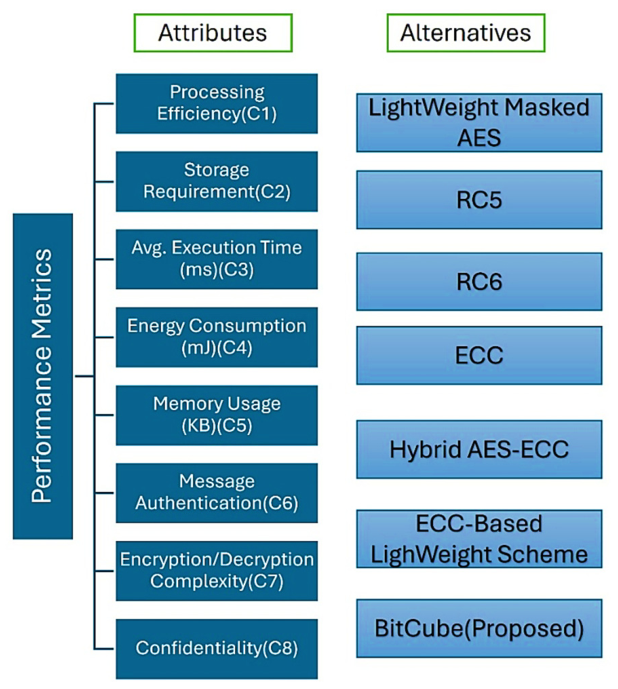
To systematically evaluate the effectiveness of BitCube, a hierarchical decision framework has been developed, as illustrated in Figure 2. The framework structures the evaluation problem into multiple levels comprising evaluation criteria and cryptographic alternatives. Based on prior studies [25,30,31,37], the assessment framework is designed to analyse the suitability of cryptographic algorithms for IoHT-enabled WSNs, where computational resources, energy availability, and storage capacity are inherently limited. The framework incorporates eight key evaluation criteria that collectively capture the most critical performance and security requirements of lightweight cryptographic systems: processing efficiency (C1), storage requirement (C2), average execution time (C3), energy consumption (C4), memory usage (C5), authentication capability (C6), encryption/decryption complexity (C7), and confidentiality (C8). Together, these criteria provide a comprehensive basis for evaluating the practicality, efficiency, and security of cryptographic schemes operating in resource-constrained IoHT environments.
  • Processing Efficiency (C1): Measures the ability of an algorithm to perform cryptographic operations with minimal computational resources [20].
  • Storage Requirement (C2): Indicates the memory space required to store keys, code, and intermediate data [21].
  • Average Execution Time (C3): Time required for encryption/decryption; critical for real-time healthcare applications [22].
  • Energy Consumption (C4): Reflects power usage during execution; important for battery-operated IoHT devices [23].
  • Memory Usage (C5): Captures Random Access Memory (RAM) required during runtime, which must be minimised in sensor nodes [21,22].
  • Message Authentication (C6): Ensures data integrity and verifies the authenticity of transmitted healthcare data [23].
  • Encryption/Decryption Complexity (C7): Represents the computational complexity of cryptographic operations [24].
  • Confidentiality (C8): Ensures that sensitive healthcare data is protected from unauthorised access [24].
These criteria represent significant aspects of IoHT system requirements, balancing computational efficiency with security strength. For example, the processing efficiency and execution time represent the speed of the algorithm operation, and the memory usage and storage requirements reflect the feasibility of deploying the algorithm on constrained sensor nodes. Energy consumption is also important for the extension of the device lifetime, and message authentication and confidentiality are essential for secure and reliable communication of sensitive healthcare data.
The criteria used for assessing the efficacy of the BC in IoHT security were determined by a synthesis of expert opinion and the existing literature. Researchers initially examine previous studies on lightweight cryptography and IoHT security to ascertain frequently utilised performance and security metrics—such as execution time, energy consumption, and confidentiality—that are consistently highlighted as essential in resource-limited healthcare settings [5,6,7,8,9]. The ideas from the literature are subsequently evaluated and enhanced by talks with domain experts, including as cryptographers, healthcare IT specialists, and IoT engineers, who offer practical perspectives on the elements that most significantly impact system adoption in real-world IoHT settings. This dual methodology guarantees that the selected criteria (C1–C8) are both academically substantiated and practically pertinent, striking a balance between the efficiency demands of IoHT devices and the rigorous security standards of healthcare data.
Figure 2 shows the set of alternatives on the other side of the hierarchy. These alternatives include widely used cryptographic algorithms such as Lightweight Masked AES, RC5, RC6, and ECC, as well as more advanced approaches such as Hybrid AES–ECC and ECC-based lightweight schemes:
  • Lightweight Masked AES (A1): A modified AES variant employing masking techniques to enhance resistance against side-channel attacks while reducing resource overhead [16].
  • RC5 (A2): A simple and flexible symmetric cipher offering moderate efficiency but lacking integrated authentication mechanisms [17].
  • RC6 (A3): An enhanced version of RC5 providing stronger security through advanced operations, at a slightly higher computational cost [18].
  • ECC (A4): An asymmetric encryption method delivering high security with smaller key sizes, but incurring a substantial computational cost [19].
  • Hybrid AES–ECC (A5): A combined approach using AES for encryption and ECC for key exchange, achieving strong security at the expense of increased complexity [20].
  • ECC-based Lightweight Scheme (A6): An optimised ECC implementation designed to reduce computational overhead while maintaining strong security for constrained environments [21].
  • BitCube Cryptosystem (Proposed) (A7): A lightweight symmetric encryption method using cube-based transformations and dynamic keys to achieve high security with minimal computational and memory requirements [23].
These alternatives are divided into various types of cryptographic techniques such as symmetric, asymmetric and hybrid models with their respective strengths and limitations. For comparison with these methods, the proposed BC is also presented. The tree structure of Figure 2 gives a clear and systematic representation of the decision-making framework and allows the application of the HF AHP–TOPSIS methodology. The problem is decomposed into attributes and alternatives which allows a more detailed analysis in which each of the cryptographic schemes can be evaluated on several parameters and ranked according to the overall performance in IoHT environments.

2.3. Methodology

Effective decision-making problems, particularly in the security of IoHT, may involve many contradictory criteria and fuzzy expert assessments. It is difficult to choose one ideal solution in these situations without a systematic analytical framework. To deal with this problem, MCDM procedures are widely applied, which provide a systematic and quantitative approach to evaluate alternatives according to several criteria.
The AHP in combination with fuzzy set theory [20] is one of the most effective MCDM strategies for handling subjective decision-making and uncertainty. However, in complex environments such as IoHT, where there are diverging or hesitating expert opinions between multiple values, traditional fuzzy approaches may not fully model this ambiguity. HFS experts communicate multiple preference values at once, better simulating hesitancy and ambiguity. This is crucial in IoHT security, because lightweight efficiency and robust cryptographic protection are complex and context-dependent. The framework supports subjective uncertainty while providing an objective near to the optimum answer by using HF AHP for criteria weighting and TOPSIS for alternative ranking [20]. This methodological option improves the evaluation’s robustness and realism, reflecting healthcare security’s sophisticated decision-making. Therefore, in this study, an advanced HF AHP approach is used, which extends the classical AHP by incorporating HFS, allowing experts to express several possible preferences instead of a single fixed value [21].
Additionally, TOPSIS is utilised to sort the evaluated alternatives in sequence. The best solution is determined by its proximity to the ideal and its distance from the worst-case situation [22]. The integration of HF AHP and TOPSIS provides a robust, transparent and credible evaluation framework which can manage uncertainty and guarantee precise decision-making [22].
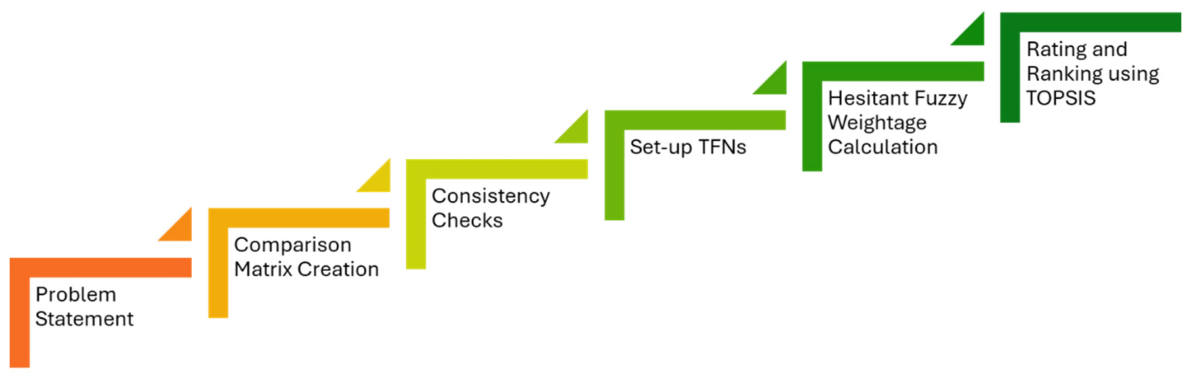
In the application of MCDM, HF AHP is proposed to reduce the uncertainty of individual observations. Barua and Prakash [25] were the first to develop this set theory. The main computational methods applied are fuzzy sets and fuzzy logic to solve problems and multiple criteria from decision-making that are hard to perceive. The fuzzy set theory was very important to ensure that the facts that were not clear or not very clear were true. Figure 3 shows how the HF AHP–TOPSIS can be applied in real life, including all six steps [19].
HF AHP is an improved decision-making system that adds fuzzy numbers to the AHP to better capture expert judgement uncertainty and ambiguity [26]. It is especially beneficial in group decision-making situations where experts may pause between several values when comparing criteria or alternatives. Next, the HF AHP technique is used to establish the priority weights for each criterion. The professionals used the linguistic scale of significance to assess criteria, as human perception is expressed as verbal representations, which are then portrayed in linguistic terms [27].
To understand Triangular Fuzzy Numbers (TFNs), every decision-making professional conducts a pair-wise comparison and assigns comparable values. The TFN is defined by the letters L, M, and U, which stand for lowest (lower), medium (mean), and highest (upper) values, respectively, where the membership function F(x) represents the entity with values ranging from 0 to 1 [23,24,25]. HF TOPSIS was chosen over other MCDM tools like AHP, VIseKriterijumska Optimizacija I Kompromisno Resenje (VIKOR), and Decision-Making Trial and Evaluation Laboratory (DEMATEL) because:
  • It is able to handle hesitancy when picking between several possible answers to the same question, as well as doubt and expert language choices.
  • It handles a large amounts of data, fast and easy computation, and growth.
  • Higher-order deployment in WSNs is based on the estimate of priorities.
The hesitant fuzzy set (HFS) technique enhances traditional fuzzy logic by allowing multiple potential membership values for a single element. Initially proposed by Vicenc Torra [32], it effectively models complex MCDM in scenarios where experts exhibit uncertainty or oscillate between various plausible degrees of conviction. This condition creates an opportunity for cautious value utilisation in assessment, initially addressed in a study [28] and subsequently refined and thoroughly elucidated by Alqarni et al. [29].
K. Sahu et al. [31] suggested a TOPSIS-integrated methodology that yielded effective results. This article presents a strategy aimed at circumventing and clarifying uncertainties, while also addressing the shortcomings frequently linked to the AHP-TOPSIS framework. Likewise, Torra et al. [32] and G. Sun et al. [31,32] employed an identical methodology in their research. The authors validated the reliability of this technique through an objective analysis of the security of healthcare gadgets. Additionally, Xia and Xu [33], as well as Z. Xu and X. Zhang [34], have employed the stated technique to produce credible outcomes regarding the energy solution in their research.
In our research, we employed HF AHP methods to assess the priority of WSN algorithms, then evaluated their HF-TOPSIS approach against alternatives for comparable methods [23,30]. A phase-by-phase methodology, in brief, is discussed below:
Step 1: As shown in Figure 3, the first step in the implemented approach is problem formulation with the hierarchy development of factors.
Step 2: In Table 11, domain experts use linguistic terminology to create accurate and beneficial assessment criteria for the decision-makers.
Step 3: The next step in the HF AHP method evaluation is the adoption of fuzzy wrappers [35] given in Equation (1). A fuzzy wrapper for HF AHP is a computational interface designed to automate or streamline intricate MCDM processes.
O W A ( q 1 , q 2 , q n ) = j = 1 n W j r j
The domain experts evaluate the trapezoidal numbers T ~ = ( q , r , s , t ) by the Equations (2)–(5) after Equation (1).
q = m i n { q L i , q M i , q M i + 1 , q M j , q R j } = q L i
r = m a x { q L i , q M i , q M i + 1 , q M j , q R j } = q R j
s = { q M i , i f i + 1 = j O W A w 2 ( q m j , . . q m i + j 2 ) , i f   i + j   i s   e v e n O W A w 2 ( q m j , . . q m i + j + 1 2 ) , i f   i + j   i s   o d d }
t = { q M i + 1 , i f   i + 1 = j O W A w 2 ( q m j q m j 1 , . . q m ( i + j ) 2 ) , i f   i + j   i s   e v e n O W A w 2 ( q m j , q m j 1 . . q m ( i + j + 1 ) 2 ) , i f   i + j   i s   o d d }
After applying Equations (3)–(5), the domain experts decide the first and second form of weights η, i.e., the number between [0, 1] and from Equations (6) and (7) applied by the domain experts to obtain these numbers.
1st type weights:
( W 1 = ( w 1 1 , w 2 1 , . . w n 1 ) ) :   w 1 1 = η 2 , w 2 1 = η 2 ( 1 η 2 ) , . w n 1 η 2 ( 1 η 2 ) n 2
2nd type weights:
( W 2 = ( w 1 2 , w 2 2 , . . w n 2 ) ) : w 1 2 = η 1 n 1 , w 2 2 = ( 1 η 1 ) η 1 n 1
The numerical form for the highest rank is in the formula η 1 = g ( j 1 ) g 1 s, and η 2 = g ( j 1 ) g 1 . The g and lowest and highest rank factors are shown by i and j, respectively.
Step 4: Equations (8) and (9) are applied by the domain experts after evaluating the entire preceding method to satisfy the remaining comparison matrix factors. Thereafter, domain experts use Equation (10) to defuzzify the matrix to determine the comparison matrix.
A ~ = [ 1 T ~ 1 n T ~ n 1 1 ]
T ~ j i = ( 1 s i j u , 1 s i j m 2 , 1 s i j m 1 , 1 s i j 1 )
μ x = l + 2 m 1 + 2 m 2 + h 6
Step 5: The phase of defuzzification provides correct values. The experts examine the Consistency Ratio (CR) by applying Equations (11) and (12) to analyse the CR of these values.
C I = γ m a x n n 1
C R = C I R I
Step 6: In this step, using Equation (13), the experts assess the geometrical mean of the values.
G ~ i = ( T ~ i 1 T ~ i 2 T ~ i n ) 1 n
Step 7: The most significant criterion in the entire set is evaluated by experts by applying Equation (14).
w ~ i = G ~ 1 ( G ~ 1 G ~ 2 . G ~ n ) 1
Step 8: Examiners analyse the defuzzified values using Equation (15).
μ x = l + 2 m 1 + 2 m 2 + h 6
Step 9: By applying Equation (16), domain experts transform the defuzzified values into normalized values or weights.
w ~ i i j w ~ j
Following the identification of the significance list for the selected attributes, the second methodology utilised is TOPSIS, utilised to evaluate the efficacy of the outcomes acquired. TOPSIS is an excellent MCDM technique for selecting the best desired alternative among the given options. The TOPSIS technique was defined by Lai, et al. [36] in 1994. The TOPSIS process synthesises positive and negative ideals to the solution, identifying the most accurate and effective alternative as the most precise and trustworthy aspect. The least favourable alternative, conversely, is an extraneous aspect. The authors employed the HF AHP–TOPSIS methodology to evaluate and determine the priority of cryptographic algorithms based on WSNs [37]. The TOPSIS method correlates the distance between two linguistic values, L1s and L2s, and executes its calculations. Below, the procedure has been clarified (Equation (17)):
d ( L 1 s , L 2 s ) = | a * a | + | p * p |
where a and a∗ denote the lower parameter and p and p∗ denote the upper parameter with the hesitant fuzzy linguistic values L1s and L2s, respectively.
Step 10: The following terms are described as the starting process:
The following written formulas are applied as ( C = { C 1 , C 2 , . . C E } ) and n criteria ( C = { C 1 , C 2 , . . C n } ) to define the alternatives and criteria in TOPSIS.
Similarly, X is used to show the numeric count of experts in TOPSIS. E x denotes the domain experts.
The equation X ~ l = [ H S i j l ] E × n is used in the TOPSIS technique to represent the HF matrix.
We created the criteria (Table 11) and scored them on a scale from very poor to very good, then used TOPSIS to evaluate and rank the outcomes.
Step 11: By applying the Equation (18) formula, the associated combined matrix is created:
A p i j = m i n { m i n i = 1 X ( m a x H t i j x ) , m a x i = 1 X ( m i n H t i j x ) }   A q i j = m a x { m i n i = 1 X ( m a x H t i j x ) , m a x i = 1 X ( m i n H t i j x ) }
Step 12: The effective factor, where the most effective factor is indicated by Aj, is shown by alpha in the TOPSIS evaluation, and alpha shows the cost-related preferences. In addition, the latest efficient alternatives need high precision for cost-related preferences. The following Equations (19)–(22) are used to define and compare cost as well as effective factors:
B ~ p j + = m a x i = 1 X ( m a x i ( m i n H S i j x ) ) j α b and m i n i = 1 X ( m i n i ( m i n H S i j x ) ) j α c
B ~ q j + = m a x i = 1 X ( m a x i ( m i n H S i j x ) ) j α b and   m i n i = 1 X ( m i n i ( m i n H S i j x ) ) j α c
B ~ p j = m a x i = 1 X ( m a x i ( m i n H S i j x ) ) j α c and m i n i = 1 X ( m i n i ( m i n H S i j x ) ) j α b )
B ~ q j = m a x i = 1 X ( m a x i ( m i n H S i j x ) ) j α c and m i n i = 1 X ( m i n i ( m i n H S i j x ) ) j α b )
Step 13: Domain experts evaluate TOPISIS positive ( K + ) distance components by applying the following Equation (23).
K + = [ d ( x 11 , B ~ 1 + ) + d ( x 12 , B ~ 2 + ) + d ( x 21 , B ~ 1 + ) + d ( x 22 , B ~ 2 + ) + d ( x m 1 , B ~ 1 + ) + d ( x m 2 , B ~ 1 + ) + + d ( x 1 n , B ~ n + ) + d ( x 21 , B ~ n + ) + d ( x m n , B ~ n + ) ]
Similarly, negative ( K ) distance is computed as follows in Equation (24).
K = [ d ( x 11 , B ~ 1 ) + d ( x 12 , B ~ 2 ) + d ( x 21 , B ~ 1 ) + d ( x 22 , B ~ 2 ) + d ( x m 1 , B ~ 1 ) + d ( x m 2 , B ~ 1 ) + + d ( x 1 n , B ~ n ) + d ( x 21 , B ~ n ) + d ( x m n , B ~ n ) ]
Step 14: Experts build and assess the closeness of the positive and negative factors evaluated by Equations (25) and (26).
C S ( A i ) = K i + K i + + K i , i = 1,2 , . m
where
K i + = j = 1 n d ( x i j , B j + ) and K i = j = 1 n d ( x i j , B j )
Step 15: To conclude the evaluation process, the alternatives are ranked based on their calculated performance scores, and the results are presented in tabular form to facilitate a clear comparison of their effectiveness. The subsequent sections provide a comprehensive quantitative assessment of the security performance of medical device cryptographic solutions. This evaluation is conducted using the proposed decision-making framework and offers a detailed analysis of the relative strengths and weaknesses of the considered alternatives across multiple security and performance criteria.

3. Numerical Analysis and Results

A comprehensive comparative analysis was conducted to evaluate the effectiveness and practical utility of the proposed BitCube cryptographic framework in comparison with existing cryptographic solutions [24]. To ensure an objective assessment, a systematic numerical evaluation approach was adopted, providing quantitative insights into the performance, efficiency, and applicability of the considered frameworks. The TOPSIS was employed as the primary ranking mechanism to prioritise competing cryptographic alternatives based on multiple evaluation criteria [40]. The framework for achieving the highest overall score was identified as the most suitable solution, reflecting its superior performance across the selected criteria. To support this evaluation, a hierarchical decision structure was developed, enabling a systematic assessment of existing research contributions. The AHP was applied within a hierarchical framework to ensure a consistent, transparent, and logically structured decision-making process [41,42].
To further enhance the robustness of the evaluation, the HF AHP was incorporated into the proposed methodology. The HF AHP is a widely recognized MCDM technique that effectively handles uncertainty, ambiguity, and hesitation in expert judgments, thereby producing more reliable priority rankings [43]. In this study, the HF AHP was utilised to determine the relative importance of the key evaluation criteria associated with lightweight, secure, and energy-efficient cryptographic frameworks for IoHT environments. By accommodating multiple possible preference values from experts, the proposed approach provides a more realistic representation of human decision-making and establishes a robust decision-support framework for researchers and practitioners working in IoHT security [44].
The analysis was conducted using data obtained from a carefully selected panel of 48 experts representing both academia and industry. The expert group comprised cybersecurity specialists, IoHT architects, and researchers with substantial experience in IoHT-enabled WSNs [36]. A purposive sampling approach was adopted to ensure that all participants possessed relevant and demonstrated domain expertise. Each expert had between 10 and 15 years of professional experience and satisfied clearly defined inclusion criteria, including proven competence in cybersecurity or IoHT applications, prior involvement in related research or system development, and willingness to contribute to structured pairwise comparison evaluations. To enhance transparency, reproducibility, and methodological clarity, Appendix A presents a representative sample of the questionnaire used for expert elicitation, while the complete dataset supporting the analysis has been provided as a Supplementary File accompanying this manuscript [45].
The participating experts completed pairwise comparison matrices for all evaluation criteria and sub-criteria using TFNs and standardized hesitant fuzzy rating scales. This structured assessment process enhanced objectivity and reduced the potential influence of individual bias [38]. To maintain consistency in responses, a dedicated HF AHP evaluation worksheet was provided to all participants. Established methodologies reported in previous studies [36,37,38] were followed, while quantitative performance measures were also incorporated to strengthen the reliability of the evaluation. The resulting dataset comprised expert judgments, aggregated hesitant fuzzy assessments, criterion weights, and performance evaluations of the cryptographic alternatives under consideration [46].
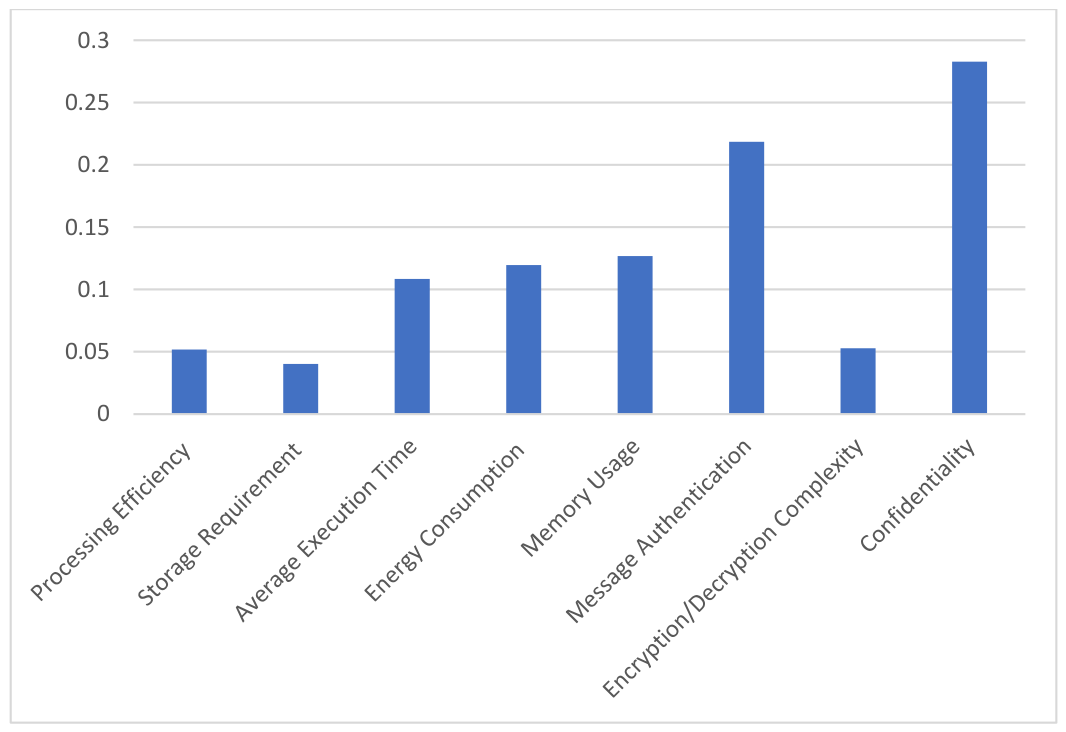
The computational analysis was performed by implementing Equations (1)–(16), which were used to construct the hesitant fuzzy pairwise comparison matrix, perform defuzzification, and derive the normalized criterion weights (Table 12). The hierarchical structure adopted for the evaluation, together with the positioning of the proposed BitCube framework within the decision model, is illustrated in Figure 2. The final criterion weights and the corresponding defuzzified pairwise comparison matrix are presented in Table 13 and Figure 4. The overall ranking process was achieved by integrating expert judgments with the proposed computational framework [47]. To ensure methodological rigor, accuracy, and reproducibility, the AHP calculations were conducted using Super Decisions Version 3.2, while fuzzy computations were performed according to the proposed HF AHP methodology [48].
Subsequently, the HF-TOPSIS methodology was implemented using Equations (17)–(26). The results of this stage are presented in Table 14 (subjective cognition results), Table 15 (normalized fuzzy decision matrix), and Table 16 (weighted normalized decision matrix). The final ranking outcomes, including the closeness coefficients and ranking scores, are reported in Table 17 and illustrated in Figure 5. The results demonstrate that the proposed BitCube framework consistently achieves a highly competitive ranking and emerges as the most suitable alternative among the evaluated cryptographic schemes. These findings validate the effectiveness of the proposed framework in delivering secure, lightweight, and energy-efficient cryptographic protection for resource-constrained IoHT environments.
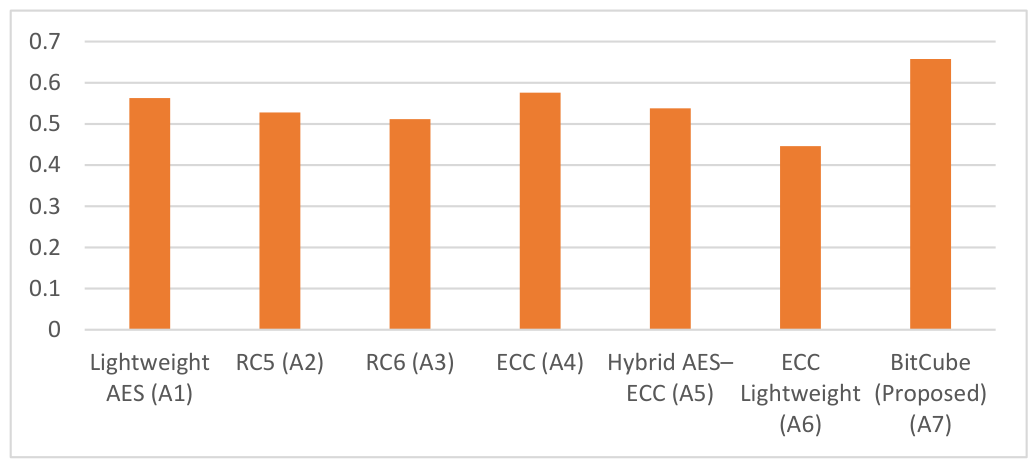
Table 17 presents the final outcomes of the Hesitant Fuzzy AHP–TOPSIS framework by evaluating seven cryptographic alternatives based on their distances from the positive ideal solution (Distance+) and negative ideal solution (Distance), culminating in the computation of the closeness coefficient and final ranking.
The results clearly indicate that the A7 achieves the highest performance with a closeness coefficient of 0.6580, ranking first among all alternatives. This outcome is primarily attributed to its lowest Distance+ value (0.3180) and the highest Distance value (0.6120), indicating that BitCube is the closest to the ideal solution while being farthest from the negative ideal solution. This demonstrates its superior balance across multiple criteria such as processing efficiency, energy efficiency, and confidentiality, which are critical in IoHT environments.
Among the benchmark schemes, A4 ranks second with a closeness coefficient of 0.5760, reflecting its strong cryptographic strength and relatively efficient performance in constrained environments. A1 follows in third place (0.5630), showing competitive efficiency but slightly lower overall balance compared to A4.
A5 occupies the fourth position, indicating that although it provides strong security through hybridization, the additional computational overhead reduces its overall suitability in resource-constrained IoHT settings. A2 and A3 rank fifth and sixth, respectively, reflecting moderate performance but weaker suitability in terms of modern IoHT requirements such as energy efficiency and scalability. A6 ranks last (0.4460), mainly due to its comparatively higher Distance+ and lower Distance values, suggesting weaker overall alignment with the ideal solution in this multi-criteria evaluation context.
The ranking results demonstrate a clear separation between the proposed BitCube Cryptosystem and existing cryptographic methods, highlighting its superior capability in achieving an optimal trade-off among security strength, computational efficiency, and resource constraints. Figure 5 visually reinforces this ranking pattern, showing a consistent dominance of BitCube over competing alternatives.
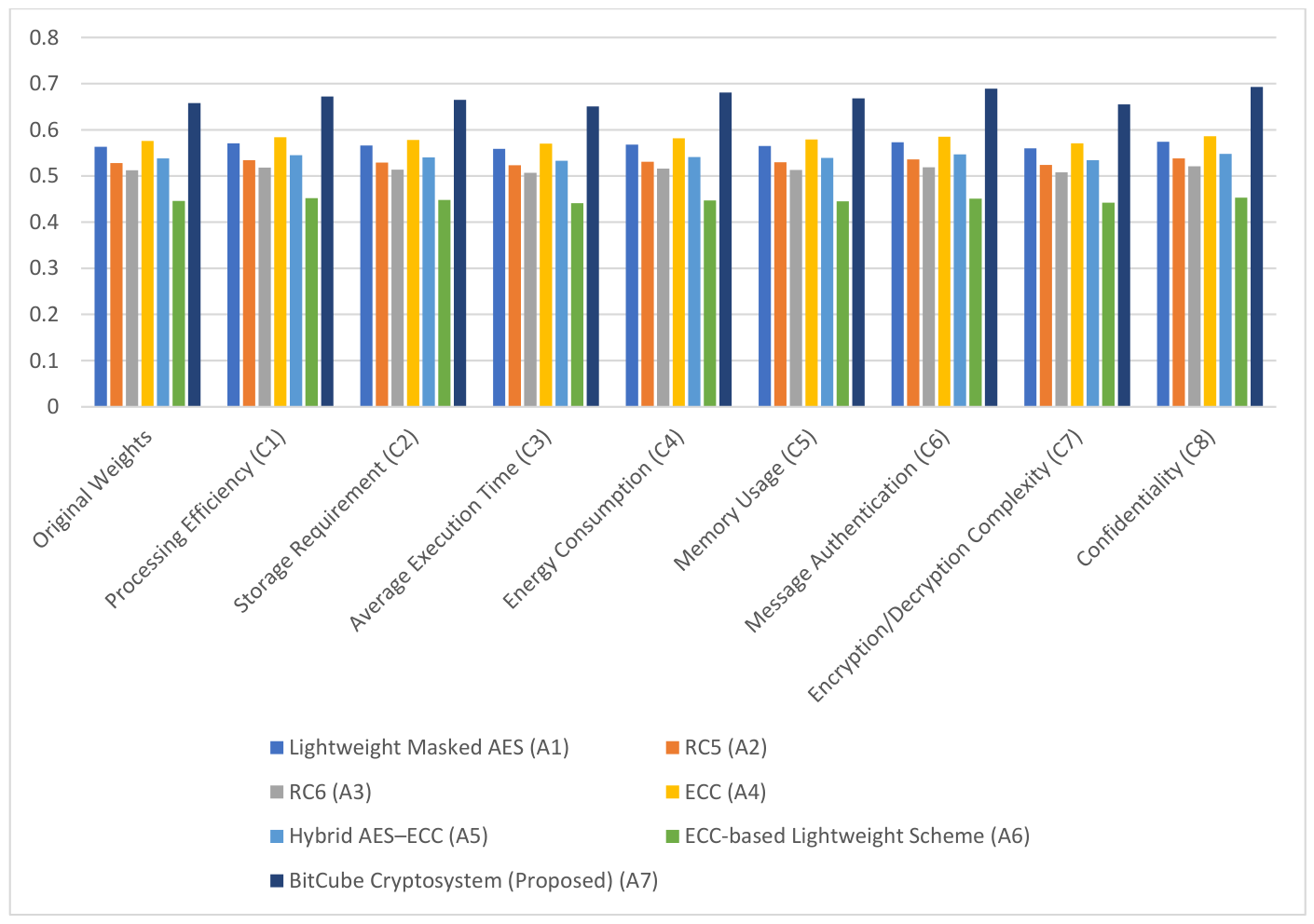
Importantly, the monotonic relationship between Distance+, Distance, and the closeness coefficient confirms the correctness and stability of the TOPSIS computation, thereby validating the robustness of the proposed hesitant fuzzy decision-making framework for IoHT security evaluation. Further, the sensitivity analysis (Table 18 and Figure 6) evaluates the stability of the proposed HF AHP–TOPSIS framework by varying the criterion weights and observing consistent ranking behaviour of all alternatives.
Table 18 presents a comprehensive sensitivity analysis of the proposed HF AHP–TOPSIS framework, evaluating the stability of the ranking results under systematic variation of the individual criterion weights. When the weight of C1 (processing efficiency) is varied, the weights of the remaining criteria are proportionally adjusted to ensure that the total weight remains equal to one. Any increase or decrease in the weight of C1 is balanced by proportionally scaling the weights of C2–C8, thereby maintaining consistency in the overall decision-making framework and preventing ambiguity in the distribution of criterion importance. This analysis serves as an important validation step to examine the robustness, consistency, and reliability of the decision-making model in IoHT environments.
The results demonstrate that the ranking structure remains highly stable across all sensitivity scenarios. In all cases, A7 consistently achieves the highest closeness coefficient, ranging from 0.651 to 0.693, thereby maintaining rank 1 across all perturbations. This confirms that the superiority of BitCube is not dependent on a specific weighting configuration but remains stable under different decision priorities.
From a validation perspective, the observed limited variation in closeness coefficients indicates that the model exhibits low sensitivity to moderate changes in expert preference weights, which is a desirable property in MCDM frameworks. This stability validates the reliability of the HF AHP–TOPSIS approach in handling uncertainty and hesitation in expert judgments, particularly in IoHT security evaluation where subjective assessments are inherently variable.
Among all scenarios, BitCube achieves its highest performance when C8 is emphasized (0.693), followed closely by C6 (0.689) and C4 (0.681). These results further validate that BitCube is especially robust in security-critical conditions, which are the primary requirements in healthcare-oriented sensor networks. Even under the most conservative scenario (variation in average execution time C3), BitCube maintains a strong closeness coefficient of 0.651, confirming its consistent optimal positioning across all tested conditions.
The comparative alternatives (A1–A6) also demonstrate stable but lower performance trends. A4 consistently ranks second, indicating strong cryptographic strength but slightly reduced efficiency in constrained environments. A1 generally occupies the third position, while A5, A2, and A3 follow with moderate performance variations. A6 remains consistently the weakest alternative across all scenarios, validating its comparatively lower suitability for IoHT applications.
Importantly, the narrow spread in closeness coefficient values across all alternatives confirms the internal consistency and numerical stability of the HF AHP–TOPSIS model. This also validates that the proposed decision-making framework does not produce unstable rankings under slight perturbations in weights, thereby reinforcing its applicability for real-world uncertain environments.
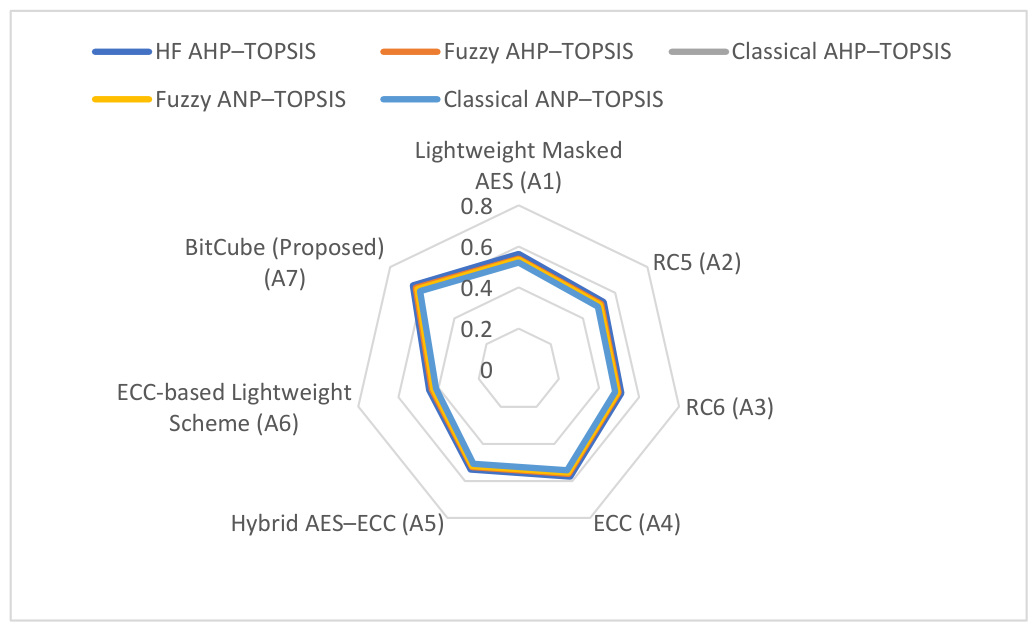
Furthermore, the validation results corroborate the findings from the main TOPSIS evaluation (Table 17), demonstrating convergent validity of the proposed approach. The consistency between baseline rankings and sensitivity-based outcomes confirms that the model is both methodologically sound and decision-robust, making it suitable for evaluating cryptographic systems in resource-constrained IoHT networks. Figure 6 visually supports these observations by illustrating the stability of rankings across all scenarios, clearly showing the persistent dominance of the BitCube Cryptosystem and reinforcing the reliability of the proposed HF AHP–TOPSIS framework. Table 19 presents a comprehensive comparative evaluation of the proposed cryptographic alternatives using five MCDM approaches, namely HF AHP–TOPSIS, Fuzzy AHP–TOPSIS, Classical AHP–TOPSIS, Fuzzy Analytic Network Process (ANP)–TOPSIS, and Classical ANP–TOPSIS.
The main objective of this comparative study is to examine the robustness, consistency, and validation strength of the proposed framework under different decision-making paradigms.
The results clearly show that A7 consistently achieves the highest closeness coefficient across all methods, ranging from 0.6129 to 0.6580, and retains rank 1 in every case. This demonstrates strong method-invariant stability, confirming that the superiority of BitCube is not dependent on a specific MCDM formulation but is consistently observed across both hierarchical (AHP-based) and network-based (ANP-based) structures, as well as fuzzy and classical environments.
To further validate the reliability of the proposed results, a correlation analysis was conducted among the ranking outputs of all MCDM methods. The results show a very high positive correlation (Pearson’s r > 0.97) between HF AHP–TOPSIS and the other approaches, indicating strong agreement in ranking behaviour. Similarly, Spearman’s rank correlation coefficients (ρ > 0.95) confirm that the ordering of alternatives remains highly consistent across all methods. This high correlation confirms the convergent validity of the proposed HF AHP–TOPSIS framework and demonstrates that the ranking stability is statistically robust rather than coincidental.
Among the benchmark schemes, A4 consistently ranks second across all methods, followed by A1. The intermediate alternatives—A5, A2, and A3—show minor variations in closeness coefficients across different MCDM techniques but maintain relatively stable ranking positions. A6 consistently ranks last, reinforcing its limited suitability for IoHT environments.
From a validation standpoint, the high inter-method correlation values (r > 0.97, ρ > 0.95) confirm that the proposed decision model is highly reliable and not sensitive to the choice of MCDM methodology. This strengthens the external validity of the study and confirms that the obtained rankings are both reproducible and stable under different analytical frameworks.
Additionally, the slightly higher discrimination capability observed in the HF AHP–TOPSIS approach demonstrates its improved ability to handle uncertainty and hesitation in expert judgments, leading to more expressive and realistic decision outcomes. Importantly, this enhancement does not alter the ranking structure, further reinforcing the robustness of the model.
Figure 7 visually supports these findings by illustrating the consistent performance trend across all methods, clearly showing the dominance of BitCube and the strong alignment among all MCDM approaches. Overall, the combined evidence from the ranking stability, correlation analysis, and method agreement validates the methodological soundness and practical reliability of the proposed HF AHP–TOPSIS framework for IoHT security evaluation.

4. Conclusions

This study performed a comprehensive review of cryptographic frameworks for IoHT environments, with a special focus on the proposed BC. Through integrating the HF AHP with TOPSIS and extending the analysis to multiple MCDM approaches, the study provided a solid and systematic framework for assessing lightweight, secure, and energy-efficient cryptographic solutions. The combination of expert-driven evaluation, hierarchical modelling, and quantitative analysis offers a reliable and practical decision-support mechanism for the selection of suitable cryptographic techniques for resource-constrained healthcare systems.
The analysis shows that the BitCube framework always received the maximum proximity coefficient at the first evaluation and maintained the top position in the sensitivity analysis and comparing analysis with other MCDM techniques. The results demonstrate that BitCube offers a fair trade-off between processor efficiency, energy consumption, memory usage, security strength and computational complexity. The constancy of the rankings for varied criteria weights and decision-making procedures proves the robustness and usefulness of the evaluation system. The remaining cryptosystems showed moderate to low application in IoHT-enabled WSN scenarios. Lightweight Masked AES and ECC are the second and third most applicable cryptosystems in IoHT-enabled WSN scenarios.
These encouraging results notwithstanding, there are some limitations to the study that should be noted.
  • First, the evaluation is largely based on expert judgements, which are structured and validated by fuzzy logic, but it may be subjectively biased.
  • Second, the performance metrics used in the analysis are simulated or theoretical, not based on real-world deployment data, which may affect the practical generalisation of the results.
  • Third, the criteria we chose are comprehensive but might not account for all emerging requirements such as scalability, interoperability, and resistance to advanced cyber threats.
The research also concentrates on a limited range of cryptographic alternatives that might not cover the whole spectrum of contemporary cryptographic innovations.
These limitations can be mitigated in future work by including real-time experimental validation of the proposed BitCube framework in practical IoHT deployments. Broadening the criteria for evaluation such as key management cost, side-channel resistance, randomness requirements, throughput, code size, and regulatory suitability to cover scalability, adaptability, and resilience to quantum attacks would add depth to the analysis. Furthermore, the employment of advanced decision-making techniques, such as hybrid AI-driven MCDM models or machine learning-based optimisation methods, could enhance the accuracy and automation of the evaluation process. Future research can also explore the applicability of the proposed framework in other domains such as smart grids, industrial IoT, and cyber–physical systems, thereby extending its impact beyond healthcare.
The proposed BC, with the support of a rigorous and validated evaluation framework, is a very effective solution to secure and efficient cryptographic implementation in IoHT environments. Besides the new cryptographic approach, the work proposes a scalable and reliable methodology to evaluate security frameworks in new technological ecosystems.


Supplementary Materials

The following supporting information can be downloaded at https://www.mdpi.com/article/10.3390/app16157395/s1.

Author Contributions

Conceptualization, K.A. and H.E.; methodology, R.A. (Randa Abualrob); software, R.A. (Rawan Alsleebi); validation, R.S. and R.R.; formal analysis, A.A.; investigation, K.A. and H.E.; resources, R.A. (Randa Abualrob) and R.A. (Rawan Alsleebi); data curation, R.S. and R.R.; writing—original draft preparation, K.A., H.E., R.A. (Randa Abualrob) and R.A. (Rawan Alsleebi); writing—review and editing, K.A., H.E., (Randa Abualrob) and R.A. (Randa Abualrob); visualization, R.S. and R.R.; supervision, R.S. and R.R.; project administration, K.A. and H.E.; funding acquisition, K.A. and H.E. All authors have read and agreed to the published version of the manuscript.

Funding

This research received no external funding.

Institutional Review Board Statement

The study was conducted in accordance with the Declaration of Helsinki, and the protocol was approved by the Deanship of Scientific Research (Scientific Ethics Committee), Imam Abdulrahman Bin Faisal University, Dammam, Kingdom of Saudi Arabia.

Informed Consent Statement

Informed consent was obtained from all participants involved in the study.

Data Availability Statement

The original data presented in this study are included in the article/Supplementary Materials. Further inquiries can be directed to the corresponding author.

Conflicts of Interest

The authors declare no conflicts of interest.

Appendix A. Expert Questionnaire Form for IoHT Security Evaluation

Appendix A.1. Purpose of the Study

This study aims to evaluate and rank cryptographic algorithms used in IoHT environments using a HF AHP integrated with the TOPSIS framework.
The objective is to capture expert judgments under uncertainty for assessing key performance, security, and efficiency criteria of lightweight cryptographic schemes, including the proposed BitCube Cryptosystem.

Appendix A.2. Instructions to Experts

You are requested to provide your expert judgments through pairwise comparisons.
  • Use the Saaty scale (1–9) for expressing importance.
  • If the left criterion is more important, assign a value from 1 to 9.
  • If the right criterion is more important, assign the reciprocal value (1/2 to 1/9).
  • Base your judgment on IoHT-enabled WSN environments.
  • Ensure consistency in comparisons across all criteria.

Appendix A.3. Evaluation Criteria

Main Criteria
  • C1: Processing Efficiency
  • C2: Storage Requirement
  • C3: Average Execution Time
  • C4: Energy Consumption
  • C5: Memory Usage
  • C6: Message Authentication Capability
  • C7: Encryption/Decryption Complexity
  • C8: Confidentiality Strength

Appendix A.4. Pairwise Comparison Matrices

Table A1. Pairwise Comparison of Main Criteria.
Comparison9876543211/21/31/41/51/61/71/81/9
C1 vs. C2
C1 vs. C3
C1 vs. C4
C1 vs. C5
C1 vs. C6
C1 vs. C7
C1 vs. C8
C2 vs. C3
C2 vs. C4
C2 vs. C5
C2 vs. C6
C2 vs. C7
C2 vs. C8
C3 vs. C4
C3 vs. C5
C3 vs. C6
C3 vs. C7
C3 vs. C8
C4 vs. C5
C4 vs. C6
C4 vs. C7
C4 vs. C8
C5 vs. C6
C5 vs. C7
C5 vs. C8
C6 vs. C7
C6 vs. C8
C7 vs. C8
(Please fill using Saaty scale).

Appendix A.5. Saaty Scale for Pairwise Comparison (A2)

ScaleMeaning
1Equal importance
3Moderate importance
5Strong importance
7Very strong importance
9Extreme importance
2,4,6,8Intermediate values
Reciprocal valuesOpposite importance

Appendix A.6. Expert Information (Optional)

  • Name: __________________________
  • Designation: ____________________
  • Affiliation: _____________________
  • Experience (Years): _____________
  • Signature: ______________________
  • Date: __________________________

Appendix A.7. Informed Consent Form

Title of Study: Evaluation of Lightweight Cryptographic Algorithms for IoHT Security Using a Hesitant Fuzzy MCDM Framework
Principal Investigator:
Dr. Khalid Alissa
SAUDI ARAMCO Cybersecurity Chair, Networks and Communications Department
College of Computer Science and Information Technology
Imam Abdulrahman Bin Faisal University, Saudi Arabia
Purpose: This study evaluates cryptographic algorithms for IoHT security using a structured decision-making approach.
Participation: Participation involves completing the pairwise comparison questionnaire. Time required: 20–30 min.
Risks and Benefits: No known risks are associated. No direct personal benefit is expected; however, the study contributes to research in cybersecurity and healthcare systems.
Confidentiality: All responses will remain confidential and will be used only for academic research. Data will be anonymized.
Voluntary Participation: Participation is voluntary. You may withdraw at any time without penalty.
Consent Statement: By participating, you confirm that:
  • You understand the study
  • You voluntarily agree to participate
  • You may withdraw at any time
Expert’s Details
  • Name: __________________________
  • Affiliation: _____________________
  • Experience: _____________________
  • Signature: ______________________
  • Date: __________________________

References

  1. Chandak, A.; Chandak, P.; Soni, N. Blockchain Technology in Health Care An Extensive Scoping Review of the Existing Applications, Challenges, and Future Directions. Int. J. Cybersecur. Eng. Innov. 2026, 2026, 37–47. [Google Scholar]
  2. Abdulmalek, S.; Nasir, A.; Jabbar, W.A.; Almuhaya, M.A.; Bairagi, A.K.; Khan, M.A.M.; Kee, S.H. IoT-based healthcare-monitoring system towards improving quality of life: A review. Healthcare 2022, 10, 1993. [Google Scholar] [CrossRef] [PubMed]
  3. Internet of Things in Healthcare Market (2024–2030). Available online: https://www.grandviewresearch.com/industry-analysis/internet-of-things-iot-healthcare-market (accessed on 22 November 2025).
  4. Coventry, L.; Branley, D. Cybersecurity in healthcare: A narrative review of trends, threats and ways forward. Maturitas 2018, 113, 48–52. [Google Scholar] [CrossRef] [PubMed]
  5. Li, S.; Surineni, K.; Prabhakaran, N. Cyber-attacks on hospital systems: A narrative review. Am. J. Geriatr. Psychiatry Open Sci. Educ. Pract. 2025, 7, 30–39. [Google Scholar] [CrossRef]
  6. Trigka, M.; Dritsas, E. Wireless sensor networks: From fundamentals and applications to innovations and future trends. IEEE Access 2025, 13, 96365–96399. [Google Scholar] [CrossRef]
  7. Banković, Z.; Fraga, D.; Moya, J.M.; Vallejo, J.C. Detecting unknown attacks in wireless sensor networks that contain mobile nodes. Sensors 2012, 12, 10834–10850. [Google Scholar] [CrossRef] [PubMed]
  8. Zinabu, N.G.; Marye, Y.W.; Tune, K.K.; Demilew, S.A. Comprehensive analysis of lightweight cryptographic algorithms for battery-limited internet of things devices. Int. J. Distrib. Sens. Netw. 2025, 2025, 9639728. [Google Scholar] [CrossRef]
  9. Rana, M.; Mamun, Q.; Islam, R. Lightweight cryptography in IoT networks: A survey. Future Gener. Comput. Syst. 2022, 129, 77–89. [Google Scholar] [CrossRef]
  10. Thakor, V.A.; Razzaque, M.A.; Khandaker, M.R. Lightweight cryptography algorithms for resource-constrained IoT devices: A review, comparison and research opportunities. IEEE Access 2021, 9, 28177–28193. [Google Scholar] [CrossRef]
  11. Ahmad, M.O.; Siddiqui, S.T. The internet of things for healthcare: Benefits, applications, challenges, use cases and future directions. In Advances in Data and Information Sciences: Proceedings of ICDIS 2021; Springer: Singapore, 2022; pp. 527–537. [Google Scholar]
  12. Ansari, S.A.; Ali, S. A systematic review of lightweight cryptographic schemes for security and privacy in IoT. Discov. Comput. 2025, 28, 266. [Google Scholar] [CrossRef]
  13. Gulati, K.; Boddu, R.S.K.; Kapila, D.; Bangare, S.L.; Chandnani, N.; Saravanan, G.J.M.T.P. A review paper on wireless sensor network techniques in Internet of Things (IoT). Mater. Today Proc. 2022, 51, 161–165. [Google Scholar] [CrossRef]
  14. Al-Zubaidie, M.; Zhang, Z.; Zhang, J. REISCH: Incorporating lightweight and reliable algorithms into healthcare applications of WSNs. Appl. Sci. 2020, 10, 2007. [Google Scholar] [CrossRef]
  15. Sahoo, S.K.; Choudhury, B.B.; Dhal, P.R. A Comprehensive Review of Fuzzy Multiple Criteria Decision-Making (MCDM) Methods: Advancements, Applications, and Future Directions. Spectr. Decis. Mak. Appl. 2027. epub ahead of printing. [Google Scholar] [CrossRef]
  16. Obidallah, W.J. Enhancing healthcare security measures in IoTT applications through a Hesitant Fuzzy-Based integrated approach. AIMS Math. 2024, 9, 9020–9048. [Google Scholar] [CrossRef]
  17. Rivest, R.L. The RC5 encryption algorithm. In International Workshop on Fast Software Encryption; Springer: Berlin/Heidelberg, Germany, 1994; pp. 86–96. [Google Scholar]
  18. Rivest, R.L.; Robshaw, M.J.; Yin, Y.L. RC6 as the AES. In Proceedings of the AES Candidate Conference, New York City, NY, USA, 13–14 April 2000; pp. 337–342. [Google Scholar]
  19. Li, V.C. On engineered cementitious composites (ECC) a review of the material and its applications. J. Adv. Concr. Technol. 2003, 1, 215–230. [Google Scholar] [CrossRef]
  20. Rehman, S.; Talat Bajwa, N.; Shah, M.A.; Aseeri, A.O.; Anjum, A. Hybrid AES-ECC model for the security of data over cloud storage. Electronics 2021, 10, 2673. [Google Scholar] [CrossRef]
  21. Hammi, B.; Fayad, A.; Khatoun, R.; Zeadally, S.; Begriche, Y. A lightweight ECC-based authentication scheme for Internet of Things (IoT). IEEE Syst. J. 2020, 14, 3440–3450. [Google Scholar] [CrossRef]
  22. Rizk, R.; Alkady, Y. Two-phase hybrid cryptography algorithm for wireless sensor networks. J. Electr. Syst. Inf. Technol. 2015, 2, 296–313. [Google Scholar] [CrossRef]
  23. Mohamed, H.E.H.; Abualrob, R.M.; Alsleebi, R.A.; Shareef, R.F.; Rawdhan, R.A.; Alissa, K.A.; Almuhaideb, A.M. IoT Cryptosystem Device, System, Method and Computer Program Product. U.S. Patent 10,952,069, 16 March 2021. [Google Scholar]
  24. Khakzad, S.; Chen, C.; Khakzad, N. A method based on lexicographic optimization and TOPSIS for identifying firefighting strategies in light of domino effects. J. Ind. Saf. 2026, 3, 111–122. [Google Scholar] [CrossRef]
  25. Prakash, C.; Barua, M.K. Integration of AHP-TOPSIS method for prioritizing the solutions of reverse logistics adoption to overcome its barriers under fuzzy environment. J. Manuf. Syst. 2015, 37, 599–615. [Google Scholar] [CrossRef]
  26. Alojaiman, B. A multi-criteria decision-making process for the selection of an efficient and reliable IoHT application. Processes 2023, 11, 1313. [Google Scholar] [CrossRef]
  27. Ranjbar, M.; Effati, S. Group decision making in the analytic hierarchy process by hesitant fuzzy numbers. Sci. Rep. 2023, 13, 21864. [Google Scholar] [CrossRef] [PubMed]
  28. Aliyev, R.; Temizkan, H.; Aliyev, R. Fuzzy analytic hierarchy process-based multi-criteria decision making for universities ranking. Symmetry 2020, 12, 1351. [Google Scholar] [CrossRef]
  29. Alkatheiri, M.S.; Alqarni, M.A.; Chauhdary, S.H. Cyber security framework for smart home energy management systems. Sustain. Energy Technol. Assess. 2021, 46, 101232. [Google Scholar] [CrossRef]
  30. Rana, M.; Mamun, Q.; Islam, R. Enhancing IoHT security: An innovative key management system for lightweight block ciphers. Sensors 2023, 23, 7678. [Google Scholar] [CrossRef] [PubMed]
  31. Sahu, K.; Alzahrani, F.A.; Srivastava, R.K.; Kumar, R. Hesitant fuzzy sets based symmetrical model of decision-making for estimating the durability of web application. Symmetry 2020, 12, 1770. [Google Scholar] [CrossRef]
  32. Torra, V. A review of the construction of hierarchical fuzzy systems. Int. J. Intell. Syst. 2002, 17, 531–543. [Google Scholar] [CrossRef]
  33. Xia, M.; Xu, Z. Hesitant fuzzy information aggregation in decision making. Int. J. Approx. Reason. 2011, 52, 395–407. [Google Scholar] [CrossRef]
  34. Zhang, X.; Xu, Z. Hesitant fuzzy agglomerative hierarchical clustering algorithms. Int. J. Syst. Sci. 2015, 46, 562–576. [Google Scholar]
  35. Chang, K.-H.; Lai, H.-H.; Hung, B.-J. Combining the Fuzzy Analytic Hierarchy Process Method with the Weighted Aggregated Sum Product Assessment Method to Address Internet Platform Selection Problems in an Environment with Incomplete Information. Appl. Sci. 2024, 14, 4390. [Google Scholar] [CrossRef]
  36. Lai, Y.J.; Liu, T.Y.; Hwang, C.L. Topsis for MODM. Eur. J. Oper. Res. 1994, 76, 486–500. [Google Scholar] [CrossRef]
  37. Campbell, S.; Greenwood, M.; Prior, S.; Shearer, T.; Walkem, K.; Young, S.; Bywaters, D.; Walker, K. Purposive sampling: Complex or simple? Research case examples. J. Res. Nurs. 2020, 25, 652–661. [Google Scholar] [CrossRef] [PubMed]
  38. Abd Al-Rahman, S.; Sagheer, A.; Dawood, O. NVLC: New variant lightweight cryptography algorithm for internet of things. In 2018 1st Annual International Conference on Information and Sciences (AiCIS); IEEE: New York, NY, USA, 2018; pp. 176–181. [Google Scholar]
  39. Adams, C.M. Constructing symmetric ciphers using the CAST design procedure. Des. Codes Cryptogr. 1997, 12, 283–316. [Google Scholar] [CrossRef]
  40. Al-Dabbagh, S.S.M.; Sulaiman, A.G.; Al Shaikhli, I.F.T.; Al-Enezi, K.A.; Alenezi, A.Y. Improving the cost factor of DLBCA lightweight block cipher algorithm. Indones. J. Electr. Eng. Comput. Sci. 2018, 10, 786–791. [Google Scholar] [CrossRef]
  41. Yu, W.; Köse, S. A lightweight masked AES implementation for securing IoHT against CPA attacks. IEEE Trans. Circuits Syst. I Regul. Pap. 2017, 64, 2934–2944. [Google Scholar] [CrossRef]
  42. Saravanan, V.; Prakash, M.; Pandi, V.S.; Kavitha, M. Improving healthcare through the internet of health things (ioht): Continuous monitoring of patients, data analytics, and interconnected medical equipment. In 2025 Fourth International Conference on Smart Technologies, Communication and Robotics (STCR); IEEE: New York, NY, USA, 2025; pp. 1–6. [Google Scholar]
  43. Kumar, M.; Kim, C.; Son, Y.; Singh, S.K.; Kim, S. Empowering cyberattack identification in IoHT networks with neighborhood-component-based improvised long short-term memory. IEEE Internet Things J. 2024, 11, 16638–16646. [Google Scholar] [CrossRef]
  44. Camp, J.L. Digital identity. IEEE Technol. Soc. Mag. 2004, 23, 34–41. [Google Scholar] [CrossRef]
  45. Dang, V.A.; Vu Khanh, Q.; Nguyen, V.H.; Nguyen, T.; Nguyen, D.C. Intelligent healthcare: Integration of emerging technologies and Internet of Things for humanity. Sensors 2023, 23, 4200. [Google Scholar] [CrossRef] [PubMed]
  46. Wu, X.; Dong, J.; Bao, W.; Zou, B.; Wang, L.; Wang, H. Augmented intelligence of things for emergency vehicle secure trajectory prediction and task offloading. IEEE Internet Things J. 2024, 11, 36030–36043. [Google Scholar] [CrossRef]
  47. Zhu, B.; Niu, L. A privacy-preserving federated learning scheme with homomorphic encryption and edge computing. Alex. Eng. J. 2025, 118, 11–20. [Google Scholar] [CrossRef]
  48. Zhu, R.; Li, W.; Boukerche, A.; Yang, Q. Energy-aware DRL-based dual-perception fountain codes for resource-constrained UASNs. IEEE Trans. Sustain. Comput. 2026, 11, 111–122. [Google Scholar] [CrossRef]
Figure 1. Use case diagram of the BC.
Applsci 16 07395 g001
Figure 2. Tree structure of cryptographic algorithms in WSNs.
Applsci 16 07395 g002
Figure 3. Step-up diagram of HF AHP–TOPSIS steps.
Applsci 16 07395 g003
Figure 4. Importance of the selected criteria.
Applsci 16 07395 g004
Figure 5. Ranking of the alternatives.
Applsci 16 07395 g005
Figure 6. Graphical representation of the sensitivity analysis.
Applsci 16 07395 g006
Figure 7. Graphical representation of the comparative analysis.
Applsci 16 07395 g007
Table 1. IoT in the healthcare market (2018–2030) (USD billion).
YearNorth AmericaEuropeAsia PacificLatin AmericaMEATotal Market
201832210.5~8
20194331.50.5~12
202054421~16
202186731~25
20221281041~35
202315101252~44
202418121562.5~53
202522151873~65
202626182283.5~79
2027302226104~92
2028352530125~107
2029423035146~127
2030503540157~170
Table 2. Comparison of existing cryptographic algorithms in WSNs.
S. No.ParameterLightweight Masked AESRivest Cipher 5 (RC5)Rivest Cipher 6 (RC6)Elliptic Curve Cryptography (ECC)
1Processing EfficiencyLowModerateModerateLow (for bulk data)
2Storage RequirementSmallSmallSmallSmall
3Avg. Execution Time (ms)2.8–4.51.9–3.22.3–3.88.5–15.0
4Memory Usage (KB)18–2412–1816–2228–40
5Energy Consumption (mJ)1.9–2.71.4–2.11.7–2.45.8–9.5
6Message AuthenticationPartialSupportedNot nativeSupported
7Device AuthenticationSupportedLimitedNot nativeSupported
8ConfidentialityStrongStrongStrongStrong
9Cryptography TypeSymmetricSymmetricSymmetricAsymmetric
10Encryption ComplexityO(n)O(n)O(n)O(n2)
11Decryption ComplexityO(n)O(n)O(n)O(n2)
References[16][17][18][19]
Table 3. Comparison of Proposed/Hybrid Cryptographic Algorithms in WSNs.
S. No.ParameterHybrid AES–ECCECC-Based LightweightTwo-Hop Cluster-Based Authentication (THCA) (Two-Phase)BitCube Cryptosystem
1Processing EfficiencyLowModerateLowHigh
2Storage RequirementMediumMediumHighSmall
3Avg. Execution Time (ms)9.5–18.07.8–14.515.0–25.01.2–1.9
4Memory Usage (KB)35–4830–4240–558–12
5Energy Consumption (mJ)6.5–11.25.2–8.98.5–14.00.9–1.3
6Message AuthenticationMaintainedMaintainedMaintainedMaintained
7Device AuthenticationMaintainedMaintainedMaintainedMaintained
8ConfidentialityStrongStrongStrongStrong
9Cryptography TypeHybridAsymmetricHybridLightweight Symmetric
10Encryption ComplexityO(n2)O(n2)O(n2)O(n)
11Decryption ComplexityO(n2)O(n2)O(n2)O(n)
References[20][21][22][23]
Table 4. Explanation of the sense data use case.
Use Case NameSense Data
ActorsSensor
ExplanationThe sensor transmits microwaves signals inside its range. When an object within the range of the sensor moves, the signals are going to be reflected to the sensor.
InputSignals.
StimulusThe signals are reflected by a movement of an object.
OutputSensed data (plaintext) is going to be sent.
Include-
Table 5. Explanation of the encrypt use case.
Use Case NameEncrypt
ActorsSensor
ExplanationSensor gets the plaintext. Then, the plaintext is XORed 3 times using the bitsValue of the 3 PPKs.
InputSensed data (plaintext) and the 3 PPKs.
StimulusAfter the sensor senses data (plaintext).
OutputAn encrypted data (ciphertext) is produced.
IncludeHash.
Table 6. Explanation of the decrypt use case.
Use Case NameDecrypt
ActorsAccess Point (AP)
ExplanationAP receives the encrypted data. This data is XORed 3 times using the bits value of the 3 PPKs.
InputEncrypted data (ciphertext).
StimulusWhen the Access Point successfully receives the encrypted data.
OutputThe original data (plaintext).
IncludeHash.
Table 7. Explanation of the hash use case.
Use Case NameHash
ActorsSensor, AP
ExplanationBoth the ciphertext and the next 3 PPKs are hashed for message authentication.
InputCiphertext and the next 3 PPKs.
StimulusAfter appending the next 3 PPKs to the ciphertext.
OutputThe hash value is produced.
Include-
ConstraintsIn the integrity check, if the extracted hash does not equal the generated hash, send an email to the owner.
Table 8. Explanation of the key exchange scenario.
Use Case NameKey Exchange Scenario
ActorsSensor, AP
ExplanationPublic key cryptography, the AP exchange, the sensor and the BitCube key with 3 PPKs.
Input3 PPKs and BitCube key.
StimulusOnce the 3 PPKs are produced by the sensor, the procedure of swapping keys starts.
OutputThe three PPKs and the BitCube key are shared by the sensor and the AP.
Include-
Table 9. Explanation of the derive the principal use case scenario.
Use Case NameDerive the Principal
ActorsSensor and AP
Explanation3 PPKs are randomly chosen. Both actors produce an identical key. The actors (sensor and AP) will retrieve the initial ciphertext’s middle 1 bit. These retrieved data will feed the scattering function.
InputThe middle 1 bit of first XORed data (ciphertext).
StimulusAfter actors create the first XORed data.
Output3 PPKs are generated
IncludeMake the cube scattered.
Table 10. Explanation of the use case of the cube scattering mechanism.
Use Case NameCube Scattering Mechanism
ActorsSensor, AP
ExplanationThe middle 1 bit of the initial ciphertext is extracted by actors. The scattering function will use these retrieved bits.
InputCiphertext is the middle one bit of the first data that was XORed together.
StimulusAfter actors produce the first XORed data (ciphertext).
ResponseNew cube shape, and each cubicle will have a different value after scattering.
Include-
Table 11. Linguistic scale for the HF AHP technique.
RankLinguistic TermAbbreviationNumerical Values
10Absolutely High ImportanceAHI(7.000, 9.000, 9.000)
9Steep ImportanceSHI(5.000, 7.000, 9.000)
8Principally High ImportancePHI(3.000, 5.000, 7.000)
7Faintly High ImportanceFHI(1.000, 3.000, 5.000)
6Equally High ImportanceEHI(1.000, 1.000, 3.000)
5Exactly EqualEE(1.000, 1.000, 1.000)
4Equally Low ImportanceELI(0.330, 1.000, 1.000)
3Faintly Low ImportantFLI(0.200, 0.330, 1.000)
2Principally Low ImportancePLI(0.140, 0.200, 0.330)
1Very Low ImportanceVLI(0.110, 0.140, 0.200)
0Absolutely Low ImportanceALI(0.110, 0.110, 0.140)
Table 12. HF pairwise comparison matrix.
Processing Efficiency (C1)Storage Requirement (C2)Average Execution Time (C3)Energy Consumption (C4)Memory Usage (C5)Message Authentication (C6)Encryption/Decryption Complexity (C7)Confidentiality (C8)
Processing Efficiency (C1)(1, 1, 1, 1)(0.012, 0.048, 0.142,0.693)(0.168, 0.331, 0.512, 0.781)(0.145, 0.276, 0.468, 0.702)(0.093, 0.184, 0.351, 0.601)(0.010, 0.052, 0.118, 0.871)(0.021, 0.067, 0.129, 0.402)(0.041, 0.089, 0.176, 0.295)
Storage Requirement (C2)(1, 1, 1, 1)(0.041, 0.092, 0.273, 0.612)(0.021, 0.053, 0.164, 0.821)(0.156, 0.288, 0.402, 0.694)(0.142, 0.251, 0.533, 0.733)(0.091, 0.174, 0.418, 0.603)(0.028, 0.064, 0.152, 0.801)
Average Execution Time (C3)(1, 1, 1, 1)(0.022, 0.061, 0.174, 0.501)(0.131, 0.281, 0.469, 0.702)(0.118, 0.263, 0.521, 0.724)(0.074, 0.151, 0.389, 0.581)(0.033, 0.071, 0.144, 0.309)
Energy Consumption (C4)(1, 1, 1, 1)(0.031, 0.072, 0.186, 0.482)(0.139, 0.286, 0.491, 0.713)(0.128, 0.241, 0.506, 0.709)(0.057, 0.119, 0.264, 0.441)
Memory Usage (C5)(1, 1, 1, 1)(0.168, 0.302, 0.472, 0.684)(0.131, 0.255, 0.463, 0.701)(0.061, 0.124, 0.278, 0.462)
Message Authentication (C6)(1, 1, 1, 1)(0.051, 0.118, 0.233, 0.481)(0.012, 0.045, 0.118, 0.893)
Encryption/Decryption Complexity (C7)(1, 1, 1, 1)(0.148, 0.263, 0.489, 0.712)
Confidentiality (C8)(1, 1, 1, 1)
Table 13. Defuzzified pairwise comparison matrix and normalized weights of criteria.
Processing Efficiency (C1)Storage Requirement (C2)Average Execution Time (C3)Energy Consumption (C4)Memory Usage (C5)Message Authentication (C6)Encryption/Decryption Complexity (C7)Confidentiality (C8)Normalized
Weights
Processing Efficiency (C1)1.0000.3411.2120.4910.7120.2631.1010.3010.0518
Storage Requirement (C2)2.9311.0000.4310.3880.3220.2810.2970.4210.0402
Average Execution Time (C3)0.8252.3211.0000.6210.9120.8040.2180.6110.1084
Energy Consumption (C4)2.0362.5771.6111.0000.8840.2980.4210.7360.1196
Memory Usage (C5)1.4023.1051.0971.1311.0000.9230.6841.0110.1268
Message Authentication (C6)3.8013.5611.2443.3561.0831.0001.1381.4020.2185
Encryption/Decryption Complexity (C7)0.9093.3724.5862.3751.4620.8791.0000.5120.0529
Confidentiality (C8)3.3222.3754.9933.2111.0040.8120.9331.0000.2828
C.R. = 0.0364.
Table 14. Subjective cognition results.
Lightweight Masked AES (A1)RC5 (A2)RC6 (A3)ECC (A4)Hybrid AES–ECC (A5)ECC-based Lightweight Scheme (A6)BitCube Cryptosystem (Proposed) (A7)
Processing Efficiency (C1)3.1820, 5.1820, 7.1022, 8.65102.9100, 4.6410, 6.0011, 6.41502.4450, 4.4540, 6.4540, 7.45404.2280, 5.3270, 6.3720, 7.72202.4450, 4.4540, 6.4540, 7.45401.4500, 3.0700, 4.9100, 5.65000.8220, 2.2730, 4.2730, 6.6530
Storage Requirement (C2)2.8420, 4.8240, 5.8420, 6.45403.1820, 5.1820, 7.1022, 8.65101.4500, 3.0700, 4.9100, 5.65003.1820, 5.1820, 7.1022, 8.65101.4500, 3.0700, 4.9100, 5.65000.8220, 2.2730, 4.2730, 6.65300.4500, 1.8200, 3.9100, 5.4500
Average Execution Time (C3)3.1450, 5.1540, 6.9410, 7.72402.8210, 4.6140, 6.6410, 8.71201.5500, 3.1800, 5.1800, 6.72002.8420, 4.8240, 5.8420, 6.45403.1820, 5.1820, 7.1022, 8.65101.4500, 3.0700, 4.9100, 5.65001.1840, 2.8420, 4.8420, 6.4540
Energy Consumption (C4)1.4500, 3.0700, 4.9100, 5.65000.8220, 2.2730, 4.2730, 6.65301.4500, 3.0700, 4.9100, 5.65000.8220, 2.2730, 4.2730, 6.65304.2280, 5.3270, 6.3720, 7.72202.4450, 4.4540, 6.4540, 7.45401.9150, 3.7430, 5.7350, 7.5120
Memory Usage (C5)3.1820, 5.1820, 7.1022, 8.65103.1820, 5.1820, 7.1022, 8.65103.1820, 5.1820, 7.1022, 8.65103.1820, 5.1820, 7.1022, 8.65101.4500, 3.0700, 4.9100, 5.65003.1820, 5.1820, 7.1022, 8.65101.4500, 3.0700, 4.9100, 5.6500
Message Authentication (C6)2.8210, 4.6140, 6.6410, 8.71201.5500, 3.1800, 5.1800, 6.72002.8420, 4.8240, 5.8420, 6.45402.8210, 4.6140, 6.6410, 8.71201.5500, 3.1800, 5.1800, 6.72002.8420, 4.8240, 5.8420, 6.45403.1820, 5.1820, 7.1022, 8.6510
Encryption/Decryption Complexity (C7)0.8220, 2.2730, 4.2730, 6.65301.4500, 3.0700, 4.9100, 5.65000.8220, 2.2730, 4.2730, 6.65300.8220, 2.2730, 4.2730, 6.65301.4500, 3.0700, 4.9100, 5.65000.8220, 2.2730, 4.2730, 6.65304.2280, 5.3270, 6.3720, 7.7220
Confidentiality (C8)3.1820, 5.1820, 7.1022, 8.65103.1820, 5.1820, 7.1022, 8.65103.1820, 5.1820, 7.1022, 8.65103.1820, 5.1820, 7.1022, 8.65103.1820, 5.1820, 7.1022, 8.65103.1820, 5.1820, 7.1022, 8.65104.9100, 6.1820, 7.4020, 8.9100
Table 15. Normalized fuzzy decision matrix.
Lightweight Masked AES (A1)RC5 (A2)RC6 (A3)ECC (A4)Hybrid AES–ECC (A5)ECC-based Lightweight Scheme (A6)BitCube Cryptosystem (Proposed) (A7)
Processing Efficiency (C1)0.61, 0.74, 0.85, 0.920.52, 0.66, 0.79, 0.880.45, 0.60, 0.74, 0.860.68, 0.79, 0.88, 0.940.50, 0.65, 0.78, 0.890.40, 0.55, 0.69, 0.820.75, 0.86, 0.93, 0.97
Storage Requirement (C2)0.55, 0.68, 0.79, 0.880.48, 0.62, 0.75, 0.860.62, 0.74, 0.85, 0.920.44, 0.58, 0.72, 0.850.63, 0.75, 0.86, 0.930.70, 0.81, 0.90, 0.950.82, 0.90, 0.95, 0.98
Average Execution Time (C3)0.52, 0.66, 0.78, 0.880.58, 0.71, 0.83, 0.910.65, 0.77, 0.87, 0.930.60, 0.72, 0.83, 0.900.50, 0.64, 0.77, 0.870.72, 0.82, 0.90, 0.950.78, 0.86, 0.92, 0.97
Energy Consumption (C4)0.70, 0.80, 0.88, 0.940.75, 0.84, 0.90, 0.950.68, 0.79, 0.87, 0.930.78, 0.86, 0.92, 0.960.60, 0.72, 0.83, 0.900.65, 0.77, 0.86, 0.920.80, 0.88, 0.93, 0.97
Memory Usage (C5)0.62, 0.74, 0.84, 0.910.60, 0.72, 0.83, 0.900.58, 0.70, 0.82, 0.890.63, 0.75, 0.85, 0.920.71, 0.82, 0.89, 0.940.69, 0.80, 0.88, 0.930.85, 0.91, 0.95, 0.98
Message Authentication (C6)0.68, 0.78, 0.87, 0.930.70, 0.80, 0.88, 0.940.72, 0.82, 0.90, 0.950.74, 0.84, 0.91, 0.960.73, 0.83, 0.90, 0.950.75, 0.85, 0.92, 0.960.90, 0.94, 0.97, 0.99
Encryption/Decryption Complexity (C7)0.60, 0.72, 0.83, 0.900.58, 0.70, 0.82, 0.890.62, 0.74, 0.84, 0.910.59, 0.71, 0.83, 0.900.61, 0.73, 0.84, 0.910.63, 0.75, 0.85, 0.920.77, 0.86, 0.92, 0.96
Confidentiality (C8)0.72, 0.82, 0.90, 0.950.74, 0.84, 0.91, 0.960.73, 0.83, 0.90, 0.950.75, 0.85, 0.92, 0.960.76, 0.86, 0.93, 0.970.78, 0.87, 0.93, 0.970.92, 0.95, 0.98, 0.99
Table 16. Weighted normalized decision matrix.
Lightweight Masked AES (A1)RC5 (A2)RC6 (A3)ECC (A4)Hybrid AES–ECC (A5)ECC-based Lightweight Scheme (A6)BitCube Cryptosystem (Proposed) (A7)
Processing Efficiency (C1)0.031, 0.041, 0.056, 0.0700.027, 0.036, 0.051, 0.0660.024, 0.033, 0.048, 0.0640.035, 0.045, 0.058, 0.0730.026, 0.035, 0.050, 0.0660.021, 0.030, 0.044, 0.0610.041, 0.052, 0.065, 0.078
Storage Requirement (C2)0.028, 0.039, 0.052, 0.0680.024, 0.035, 0.048, 0.0650.030, 0.042, 0.056, 0.0710.022, 0.032, 0.045, 0.0620.031, 0.043, 0.057, 0.0740.034, 0.046, 0.060, 0.0760.039, 0.051, 0.064, 0.080
Average Execution Time (C3)0.026, 0.037, 0.051, 0.0670.029, 0.040, 0.054, 0.0700.033, 0.044, 0.058, 0.0730.030, 0.041, 0.055, 0.0690.025, 0.036, 0.050, 0.0650.036, 0.047, 0.060, 0.0750.040, 0.052, 0.065, 0.081
Energy Consumption (C4)0.035, 0.045, 0.058, 0.0730.038, 0.048, 0.061, 0.0750.034, 0.044, 0.057, 0.0720.039, 0.050, 0.063, 0.0770.030, 0.041, 0.054, 0.0690.033, 0.043, 0.056, 0.0710.041, 0.052, 0.065, 0.080
Memory Usage (C5)0.031, 0.041, 0.054, 0.0690.030, 0.040, 0.053, 0.0680.029, 0.039, 0.052, 0.0670.032, 0.042, 0.055, 0.0700.036, 0.047, 0.060, 0.0750.035, 0.045, 0.058, 0.0730.043, 0.054, 0.067, 0.082
Message Authentication (C6)0.038, 0.048, 0.060, 0.0740.039, 0.049, 0.061, 0.0750.040, 0.050, 0.062, 0.0760.041, 0.051, 0.063, 0.0770.040, 0.050, 0.062, 0.0760.041, 0.052, 0.064, 0.0780.048, 0.058, 0.070, 0.084
Encryption/Decryption Complexity (C7)0.029, 0.040, 0.053, 0.0680.028, 0.039, 0.052, 0.0670.030, 0.041, 0.054, 0.0690.028, 0.039, 0.052, 0.0670.029, 0.040, 0.053, 0.0680.031, 0.042, 0.055, 0.0700.038, 0.049, 0.062, 0.077
Confidentiality (C8)0.040, 0.051, 0.063, 0.0770.041, 0.052, 0.064, 0.0780.041, 0.052, 0.064, 0.0780.042, 0.053, 0.065, 0.0790.043, 0.054, 0.066, 0.0800.044, 0.055, 0.067, 0.0810.050, 0.061, 0.073, 0.087
Table 17. Closeness coefficient results and ranking.
AlternativeDistance+DistanceCloseness CoefficientRank
Lightweight AES (A1)0.4120.5310.5633
RC5 (A2)0.4450.4980.5285
RC6 (A3)0.4600.4820.5126
ECC (A4)0.4010.5440.5762
Hybrid AES–ECC (A5)0.4330.5050.5384
ECC Lightweight (A6)0.4980.4010.4467
BitCube (Proposed) (A7)0.3180.6120.6581
Table 18. Sensitivity analysis.
Lightweight Masked AES (A1)RC5 (A2)RC6 (A3)ECC (A4)Hybrid AES–ECC (A5)ECC-based Lightweight Scheme (A6)BitCube Cryptosystem (Proposed) (A7)
Original Weights0.5630.5280.5120.5760.5380.4460.658
Processing Efficiency (C1)0.5710.5340.5180.5840.5450.4520.672
Storage Requirement (C2)0.5660.5290.5140.5780.5400.4480.665
Average Execution Time (C3)0.5590.5230.5070.5700.5330.4410.651
Energy Consumption (C4)0.5680.5310.5160.5820.5410.4470.681
Memory Usage (C5)0.5650.5300.5130.5790.5390.4450.668
Message Authentication (C6)0.5730.5360.5190.5850.5470.4510.689
Encryption/Decryption Complexity (C7)0.5600.5240.5080.5710.5340.4420.655
Confidentiality (C8)0.5740.5380.5210.5860.5480.4530.693
Table 19. Comparative evaluation of cryptographic alternatives using different MCDM Methods.
AlternativesHF AHP–TOPSISFuzzy AHP–TOPSISClassical AHP–TOPSISFuzzy ANP–TOPSISClassical ANP–TOPSIS
Lightweight Masked AES (A1)0.5630.5410.5280.5350.521
RC5 (A2)0.5280.5130.4990.5060.493
RC6 (A3)0.5120.4980.4860.4940.481
ECC (A4)0.5760.5620.5480.5550.542
Hybrid AES–ECC (A5)0.5380.5250.5130.5200.507
ECC-based Lightweight Scheme (A6)0.4460.4330.4190.4260.412
BitCube (Proposed) (A7)0.6580.6400.6220.6300.613
Disclaimer/Publisher’s Note: The statements, opinions and data contained in all publications are solely those of the individual author(s) and contributor(s) and not of MDPI and/or the editor(s). MDPI and/or the editor(s) disclaim responsibility for any injury to people or property resulting from any ideas, methods, instructions or products referred to in the content.