Review

Current Status and Research Evolution of Magnetic Fluid Sealing Technology

1
School of Energy and Electrical Engineering, Qinghai University, Xining 810016, China
2
Engineer School, Qinghai Institute of Technology, Xining 810000, China
3
School of Energy and Power Engineering, Lanzhou University of Technology, Lanzhou 730050, China
4
Key Laboratory of Fluid and Power Machinery of Ministry of Education, Xihua University, Chengdu 610039, China
*
Author to whom correspondence should be addressed.
Appl. Sci. 2026, 16(14), 6836; https://doi.org/10.3390/app16146836
Submission received: 20 April 2026 / Revised: 30 June 2026 / Accepted: 30 June 2026 / Published: 8 July 2026

Abstract

Magnetic fluid seals use magnetic field gradients generated by permanent magnets, pole pieces, and rotating shafts to confine ferrofluid in the sealing gap and form multiple liquid sealing rings. Compared with mechanical and labyrinth seals, they exhibit low wear, high cleanliness, low friction loss, and near-zero leakage, making them suitable for high-vacuum equipment, semiconductor devices, clean robotic joints, and rotary feedthrough systems. This review summarizes the development, theoretical basis, experimental methods, structural design, performance characteristics, failure mechanisms, numerical modeling approaches, and engineering applications of magnetic fluid sealing technology. Quantitative comparisons show that ferrofluid seals generally provide a single-stage pressure-bearing capacity of approximately 10–20 kPa with near-zero leakage and good self-replenishment, whereas magnetic powder seals can reach approximately 50–100 kPa per stage but suffer from higher leakage and poor self-recovery. Under high-speed conditions, centrifugal depletion, viscous heating, carrier-liquid volatilization, and interfacial instability become the dominant causes of performance degradation. The reviewed literature indicates that pole-tooth geometry, magnetic-circuit topology, saturation magnetization, thermal transport, and medium compatibility jointly determine sealing reliability. Future research should focus on high-saturation and low-vapor-pressure ferrofluids, optimized pole-tooth and magnetic-circuit structures, magnetic–flow–thermal coupling, integrated cooling, online monitoring, life prediction, and standardized reliability evaluation.

1. Introduction

Magnetic fluid seals (MFSs) are non-contact sealing devices in which a magnetic field confines ferrofluid within the sealing gap to form a liquid sealing ring. Because of their advantages of low leakage, low wear, and high cleanliness, they have attracted increasing attention in vacuum equipment, semiconductor systems, and other clean rotating machinery [1,2]. At the same time, although MFSs perform well in vacuum and gas-medium sealing, challenges remain in high-speed thermal stability, liquid-medium compatibility, and long-term reliability. Although a number of studies and topic-specific reviews have been reported, most of them focus on individual aspects, such as pressure-bearing theory, pole-tooth optimization, high-speed failure, or selected engineering applications. A more systematic review integrating research evolution, operating principles, structural design, performance characteristics, major failure modes, engineering applications, and intelligent development trends is still needed. Therefore, the aim of this work is to provide a more comprehensive and self-contained review of magnetic fluid sealing technology.
The novelty of this review lies in integrating the state-of-the-art from multiple perspectives, including pressure-resistance theory, magnetic circuit and pole-tooth design, failure mechanisms, comparative sealing characteristics, application development, and intelligent monitoring trends, into a unified review framework. In this way, the manuscript attempts to fill the gap between scattered topic-oriented studies and the need for a stand-alone review that clearly summarizes the current status, key limitations, and future development directions of magnetic fluid sealing technology. Overall, current studies suggest that future progress in MFSs will depend on the coordinated improvement of material properties, structural design, thermal management, reliability evaluation, and condition monitoring.
To further improve the completeness and international coverage of this review, recent international studies are incorporated into the discussion. These studies show that magnetic fluid and magnetorheological fluid sealing research is no longer limited to conventional vacuum rotary feedthroughs but has gradually expanded toward hybrid sealing–lubrication systems, field-controllable rheological interfaces, leakage-channel evolution, durability evaluation, and special engineering applications. For example, recent investigations of eccentric magnetorheological fluid seals and ferrofluid-lubricated rotary lip seals have demonstrated that field-responsive fluids can simultaneously affect pressure capability, friction torque, load capacity, and dynamic stability [3,4]. Therefore, magnetic-fluid-based seals should be evaluated not only in terms of pressure resistance, but also in terms of frictional loss, lubrication behavior, and rotor-dynamic response.
Recent international research has also paid increasing attention to leakage evolution and sealing-medium regulation. Studies on leakage-channel formation in ferrofluid rings have shown that magnetic properties, viscosity, surface tension, pressure jump, and airflow can jointly determine the local rupture and recovery of the liquid sealing barrier [5,6]. In parallel, studies on magnetic fluid preparation, carrier-liquid selection, field-dependent rheology, and magnetic fluids produced by grinding micropowder technology suggest that the performance of sealing media depends not only on saturation magnetization, but also on particle-size distribution, carrier-liquid compatibility, shear-rate response, magnetoviscous behavior, and long-term colloidal stability [7,8,9]. These studies provide useful support for understanding why magnetic fluid seals may fail through local leakage channels, interfacial deformation, medium depletion, or rheological degradation rather than through simple uniform overflow.
In addition to material and leakage studies, recent work has broadened the methodological and application basis of magnetic-fluid-related sealing technologies. Magnetic field exciter optimization, durability testing of magnetorheological fluids, magnetic force calculation methods, and ferrofluid thermofluid modeling provide useful references for magnetic-circuit design, particle-force analysis, and long-term reliability evaluation [10,11,12,13]. At the application level, new magnetic fluid seals for reciprocating motion, embedded rotary magnetic fluid seals, magnetic nano-oil for scroll compressors, and ferrofluid rotating vacuum seals for accelerator-related devices further demonstrate the potential of magnetic-fluid-based sealing in reciprocating shafts, compressor systems, high-vacuum rotating targets, and other special engineering conditions [14,15,16,17]. More recent studies have further emphasized the importance of active replenishment and material-level regulation in magnetic-fluid-based sealing systems. For example, self-replenishing magnetic fluid seals provide a possible route for compensating ferrofluid loss and improving long-term sealing reliability under vacuum, high-speed, or liquid-medium conditions [18]. In addition, studies on ferrofluid microstructure–property relationships, high-field rheology, magnetic-field-mediated droplet deformation, and ferrofluid synthesis indicate that sealing performance is closely related to particle interactions, field-dependent viscosity, interfacial deformation, and colloidal stability [19,20,21,22]. These findings suggest that future magnetic fluid sealing technology will increasingly depend on the integrated regulation of magnetic field distribution, ferrofluid formulation, interfacial stability, active replenishment, and service-condition adaptability.

2. State-of-the-Art and Research Evolution

In recent years, research on MFSs has gradually expanded from basic pressure-resistance analysis to pole-tooth and magnetic-circuit optimization, thermal-failure analysis, and multiphysics coupling [23,24]. Over the past decade, research has mainly progressed in three directions. First, pressure-bearing capacity and pole-tooth geometry have been systematically modeled through simulation-based regression or response surface methods, as represented by the optimization of rectangular pole-tooth structures [23]. Second, high-speed and thermal management issues have become increasingly prominent, with failure mechanisms increasingly linked to temperature rise and ferrofluid ejection [24]. Third, the field has seen application-driven progress toward liquid-environment sealing and magnetic–flow–thermal multiphysics coupling, as represented by studies on lifetime limitations, interfacial stability, and failure-control methods of magnetic fluid seals operating in liquid media [25].
At present, magnetic fluid seals have become relatively mature for vacuum and gas-medium applications [26,27,28]. They exhibit advantages such as low leakage, low wear, high cleanliness, and suitability for rotating feedthrough sealing [26,27,29]. In addition, they have shown promising application potential in high-vacuum equipment, semiconductor clean devices, highly-clean robotic joints, and certain pump shaft and spindle sealing systems [27,28,29,30,31,32,33,34,35]. Nevertheless, magnetic fluid seals (MFSs) still face several limitations in engineering practice. Their single-stage pressure-bearing capacity is relatively limited, so multistage structures are often required under high pressure differences, which increases structural complexity [24,26]. Under high-speed conditions, centrifugal depletion, temperature rise, and carrier-liquid volatilization may cause medium loss and thermal-performance deterioration [36,37,38,39]. In liquid-medium applications, interfacial instability, medium compatibility, and barrier failure become more prominent, thereby restricting long-term reliability [40,41,42]. Moreover, a large shaft diameter, low-temperature service, thermal expansion, and strong multiphysics coupling continue to challenge structural adaptability and operational stability [38,39,42,43]. Meanwhile, research priorities have shifted from the sole pursuit of pressure-bearing capacity toward structural optimization, magnetic fluid material regulation, suppression of thermally induced failure, liquid–liquid interfacial stability, and long-term reliability evaluation [23,28,30,35,36,38,40,44,45].

3. Mechanisms and Advantages

3.1. Principle of Operation and Pressure Resistance Theory

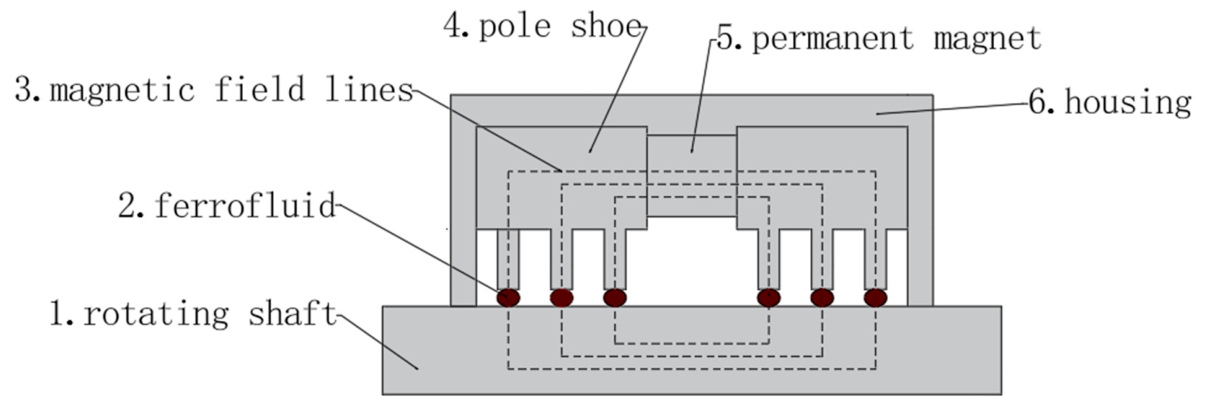
Permanent magnets and pole shoes jointly form the magnetic circuit and establish a high-gradient magnetic field in the shaft–pole shoe clearance, allowing the ferrofluid to be stably confined within the narrow gap as an annular liquid film. In this context, “stable” denotes a normal operating condition in which the pressure difference, rotational speed, temperature rise, and sealing clearance are all within the design range, allowing the sealing film to remain continuous and effective without significant rupture, fluid loss, or interfacial destabilization. When the sealed medium attempts to leak in the axial direction, the liquid film forms an effective barrier through the combined action of magnetic confinement and interfacial tension, thereby realizing the sealing function. In this structure, the rotating shaft acts as the moving mating surface, while the housing serves as the supporting and positioning component. Owing to the absence of direct solid friction, which is typical of conventional contact seals, magnetic fluid seals exhibit the advantages of low wear, low power consumption, high hermeticity, and good suitability for continuous rotary operation. Previous studies have demonstrated that pole-tooth geometry and magnetic-circuit distribution are key factors governing the sealing performance of magnetic fluid seals. Parameters such as tooth width, height, spacing, and tip profile affect the local magnetic reluctance, magnetic flux concentration, and field gradient in the sealing gap, thereby changing the difference between the maximum and minimum magnetic flux density in each sealing stage. In general, a more favorable pole-tooth geometry can strengthen magnetic field concentration near the tooth tips and reduce local weak-field regions, whereas an unfavorable geometry may lead to magnetic leakage, field non-uniformity, or even local magnetic saturation. Since the pressure-bearing capacity of the ferrofluid is directly related to the magnetic field distribution in the gap, these factors ultimately determine the magnetic confinement capability, liquid-ring stability, and sealing pressure resistance. Furthermore, multistage structures improve sealing reliability by distributing the total pressure difference over several successive sealing stages, thereby reducing the load and failure risk of each individual liquid ring [46].
As illustrated in Figure 1, the permanent magnet and the pole shoe together constitute the magnetic circuit and establish a high-gradient magnetic field in the shaft–pole shoe gap, where the ferrofluid is confined to form a liquid sealing ring. The shaft acts as the moving mating surface, while the housing performs the functions of installation and structural support.
The pressure-bearing capacity of a magnetic fluid seal is commonly described by the magnetic pressure difference generated across the ferrofluid interface. It is governed by the balance between magnetic body force and external pressure applied on the sealing liquid column.
The classical expression for a single-stage seal can be written as:
p μ 0 H m i n H m a x M d H μ 0 M s ( H m a x H m i n ) = M s ( B m a x B m i n )
where p represents the maximum pressure difference that the seal can withstand, μ 0 is the permeability of free space, M is the magnetization of the ferrofluid, and M s is the saturation magnetization. H m a x and H m i n correspond to the maximum and minimum magnetic field intensities in the sealing gap, respectively, while B m a x and B m i n denote the corresponding magnetic flux density values.
This expression indicates that the sealing capability is directly proportional to the saturation magnetization of the ferrofluid and the magnetic field gradient across the sealing gap. A larger magnetic field difference leads to a stronger magnetic confinement force, thereby improving the pressure resistance of the seal.
Furthermore, it has been reported that, under ideal additive conditions, the pressure-bearing capacity of a multistage structure approximately satisfies p t o t a l n × p s t a g e [27], where n represents the number of sealing stages. This relationship indicates that each sealing stage contributes an approximately equal portion of the total pressure difference.
The significance of the multistage configuration lies in its ability to divide the total pressure load into several sequential pressure drops across multiple magnetic barriers. As a result, the magnetic force required for each individual stage is reduced, thereby improving overall sealing stability and enhancing the total pressure-bearing capacity of the system.
It should be noted that this additive approximation is valid under ideal conditions, where interactions between adjacent stages are negligible, and the magnetic field distribution remains sufficiently independent between stages.
The pressure-bearing capacity of a magnetic fluid seal is mainly determined by the saturation magnetization of the ferrofluid and the magnetic field strength difference within the sealing gap. In general, a higher saturation magnetization and a larger magnetic field gradient in the gap lead to a stronger magnetic confinement effect on the ferrofluid, thereby improving the stability of the sealing liquid ring. When the magnetic field strength difference falls below a critical value, the magnetic force is no longer sufficient to balance the pressure difference across the sealed medium, and leakage will occur. Under ideal conditions, the pressure-bearing contributions of multistage structures can be approximately superimposed. In contrast, an increase in the sealing gap tends to reduce the sealing capacity because of the increased magnetic reluctance and the weakening of local magnetic induction [47]. From a theoretical perspective, existing analyses of magnetic fluid seals are mainly based on magnetic pressure equilibrium, interfacial force balance, and quasi-static assumptions for the ferrofluid in the sealing gap. In most classical models, the magnetic body force generated by the magnetic field gradient counteracts the pressure difference across the seal, while interfacial tension contributes to maintaining the continuity of the liquid ring. Accordingly, theoretical studies have mainly focused on the relationships among saturation magnetization, magnetic field difference, number of sealing stages, seal clearance, and failure pressure. More recent theoretical work has further extended this framework to magnetic-circuit optimization and field-control seals, showing that the attainable sealing capacity depends not only on Ms and the magnetic field difference, but also on magnetic-circuit topology, permanent-magnet properties, and the degree of stage-to-stage coupling [26,46,47,48,49,50].

3.2. Key Performance Characteristics and Advantages

Depending on the sealed medium and service conditions, magnetic fluid seals are generally classified into vacuum seals, gas seals, and liquid seals. Among the factors governing their performance, two are particularly critical: the development of ferrofluids with high-saturation magnetization, and the design of sealing structures capable of producing sufficiently strong magnetic fields [51]. Compared with conventional mechanical sealing methods, magnetic fluid sealing technology exhibits several prominent performance advantages. First, it provides excellent sealing performance. Second, it offers high operational reliability and can maintain stable sealing effectiveness even under complex working conditions. In cases of severe magnetic field asymmetry, ferrofluids with high magnetic saturation are still capable of sustaining a continuous sealing film, thereby avoiding sealing failure caused by interfacial slip or magnetic-chain rupture [43]. Third, it has a relatively long service life, which can effectively reduce maintenance frequency and operating costs. Fourth, the sealing process is pollution-free and therefore complies with the development requirements of cleanliness and environmental sustainability. Fifth, it can satisfy the stable operating demands of rotating components. Sixth, the viscous friction loss is relatively small, which is beneficial for improving the transmission efficiency of the system. Seventh, under variable-speed conditions, especially when abrupt speed changes occur, the sealing performance is significantly affected by frictional heating and temperature rise. The shaft speed and the magnitude of speed variation are generally positively correlated with frictional heat generation, thereby further aggravating the degradation of sealing performance. Therefore, under high-speed operating conditions, cooling and thermal management design must be incorporated to extend seal service life [52]. In general, magnetic fluid seals exhibit the advantages of high sealing performance, low wear, long service life, low power consumption, and suitability for high-speed operation [53].
To further clarify these advantages, magnetic fluid seals can be compared with conventional mechanical seals, labyrinth seals, and other magnetic sealing media [54].
Comparative studies on different magnetic sealing media have provided particularly detailed insights. Ferrofluids (FF), magnetorheological fluids (MRF), and magnetic powders (MP) exhibit different trade-offs in terms of pressure-bearing capacity, leakage behavior, and recoverability [24].
Detailed information is presented in the following Table 1.
Different sealing technologies differ substantially in terms of the sealing mechanism, leakage control capability, pressure-bearing performance, friction behavior, and service suitability. In order to better position magnetic fluid seals, a brief comparison with mechanical seals, labyrinth seals, and other magnetic sealing media is provided here. Mechanical seals remain important in rotating machinery, but their contact-type nature makes their performance more sensitive to vibration, eccentricity, lubrication conditions, and wear under high-speed operation [55]. Their service behavior is also strongly influenced by material selection, face-structure design, and the matching of operating conditions [56]. Labyrinth seals are more suitable for gas service and high-speed equipment, but their sealing effectiveness is highly dependent on structural clearance, tooth geometry, and operating disturbances, and complete leakage prevention is generally difficult to achieve [57]. In comparison, magnetic fluid seals offer a more distinctive balance of non-contact sealing, low leakage, and clean operation in applications where sealing cleanliness and dynamic reliability are of particular importance.
Recent studies further indicate that the advantages of magnetic-fluid-based seals should be understood from the combined perspectives of pressure capability, friction torque, lubrication behavior, and dynamic stability. Fetisov et al. [3] numerically investigated eccentric magnetorheological fluid seals and found that the external magnetic field can significantly influence load capacity, friction torque, and rotor-dynamic stability. Szczęch [4] studied a rotary lip seal lubricated by ferrofluid and showed that ferrofluid can function as both a sealing and lubricating medium, thereby improving pressure capability while reducing friction torque. These results suggest that magnetic-fluid-based sealing is developing from the traditional “liquid sealing ring” concept toward integrated sealing–lubrication systems.
Magnetic powder seals operate by using a magnetic field to confine nanoscale to microscale magnetic particles, which then form a porous magnetic medium with a certain structural strength in the sealing gap, thereby inhibiting fluid leakage [44].
In addition, recent studies have shown that highly magnetized composite magnetic fluids can form novel field-induced structures in rotary sealing systems, thereby improving the stability of the sealing interface and enhancing both pressure-bearing capacity and leakage suppression. This development reflects the evolving trend of magnetic sealing media from single-ferrofluid systems toward composite systems [58].
For applications requiring high-vacuum and clean operating environments, magnetic fluid seals generally employ multistage pole-tooth structures in combination with dedicated vacuum ferrofluids. In such systems, diester-based ferrofluids with low saturated vapor pressure are commonly adopted, and can be further replaced by perfluoropolyether-based ferrofluids to suppress volatilization further. By means of multistage magnetic field gradient confinement, high-vacuum dynamic sealing under rotary feedthrough conditions can be achieved [59]. The major features of this type of seal include high-vacuum compatibility, low outgassing, and clean operation, which make it particularly suitable for semiconductor manufacturing, vacuum equipment, and precision instrumentation.

3.3. Major Failure Modes

Although magnetic fluid seals exhibit clear advantages in terms of low leakage, low wear, and clean operation, their failure behavior is not triggered by a single factor. Instead, it typically involves a multiphysics coupling process arising from the combined effects of magnetic field, temperature, flow, chemical compatibility, and particles/wear. The major failure modes can be summarized as follows.
(1)
Magnetic field attenuation and magnetic-circuit degradation: Demagnetization of permanent magnets, magnetic saturation of soft magnetic components, and increased clearance caused by assembly deviation can all reduce Bmax−Bmin, thereby directly lowering the pressure-bearing capacity. Existing studies have shown that the material parameters and maximum energy product of permanent magnets correspond to an optimal range for the failure pressure differential [48].
(2)
Centrifugally induced liquid-film instability or structural leakage: The magnetic field gradient confines the ferrofluid within the sealing gap and forms a continuous liquid film. As the shaft speed increases, the centrifugal effect becomes stronger, causing local thinning of the liquid film. Under the combined action of pressure difference, the interfacial force balance may be disrupted, and the interface may eventually rupture, leading to failure of the pressure barrier and the occurrence of structural leakage [36].
(3)
Thermal degradation, volatilization, and surfactant failure: In magnetic fluid seals, the key mechanism associated with thermal expansion is essentially a dynamic process driven by viscous dissipation and regulated by strong multiphysics coupling. Viscous dissipation under high-speed operating conditions causes temperature rise, which, in turn, reduces the magnetization of the ferrofluid and accelerates carrier-liquid evaporation. It may also induce unilateral shrinkage of the sealing gap. On the one hand, this shrinkage can enhance sealing pressure by reducing the leakage channel; on the other hand, it may aggravate the risk of dry friction [37].
(4)
Chemical incompatibility and oxidation: The compatibility, wettability, and interfacial stability between the base liquid and the sealed medium, such as process gas, solvent, or pumped liquid, can significantly affect the service life and sealing performance of magnetic fluid seals under liquid-medium conditions. When compatibility is insufficient, problems such as viscosity variations, surfactant desorption, interfacial instability, and degradation of the sealing barrier may occur [60].
(5)
Mechanical wear and external contamination: Although the sealing ring itself does not primarily rely on hard contact, bearing wear, foreign particles in the gap, or particle migration may still cause wear, scratches, or clearance variations, thereby deteriorating the magnetic field gradient and inducing leakage. For magnetic powder- and MRF-based media, particle motion and chain-structure disruption may additionally introduce risks of wear and blockage. Studies have shown that the failure of magnetic fluid seals in liquid media is essentially the coupled result of external liquid intrusion, destruction of interfacial continuity, and instability of the magnetic fluid barrier [40].
(6)
Fluid ejection and medium depletion (high-speed-dominated failure): At high rotational speeds, centrifugal force can pull the ferrofluid out of the sealing gap, resulting in an “accumulation–ejection” sequence that causes loss of sealing medium and irreversibly reduces the pressure-bearing capacity. In addition, a tangential velocity difference exists at the contact interface between the magnetic fluid and the sealed liquid. This velocity difference increases linearly with shaft speed. As the rotational speed rises, the velocity gradient at the interface becomes more severe, thereby inducing Kelvin–Helmholtz instability, which leads to interfacial destabilization, two-phase mixing, and magnetic fluid depletion [41].
In addition to centrifugal depletion and thermal degradation, recent international studies have emphasized the importance of local leakage-channel formation. Szczęch and Kogut [5] analyzed the influence of magnetic and rheological properties on leakage-channel formation in a ferrofluid ring, showing that saturation magnetization, viscosity, surface tension, pressure jump, and airflow are closely related to the local loss of continuity of the liquid ring. Kogut and Szczęch [6] further investigated leakage-channel parameters in magnetic fluid seals and pointed out that the opening and closure of local gas channels are important for understanding pressure equalization and partial barrier failure. Therefore, leakage in magnetic fluid seals should not be regarded only as uniform overflow, but also as a local and transient process governed by magnetic field distribution, ferrofluid rheology, interfacial deformation, and pressure transmission.
For reciprocating sealing conditions, the failure mechanism becomes even more complex. Matuszewski and Bela [14] proposed new magnetic fluid seal designs for reciprocating motion and indicated that carry-over effects and magnetic fluid film deformation can reduce the amount of ferrofluid remaining in the sealing gap. This suggests that magnetic fluid seals designed for rotary shafts cannot be directly transferred to reciprocating shafts without considering film transport, axial dragging, and replenishment behavior.

3.4. Experimental, Design, and Numerical Research Approaches

In addition to theoretical analyses and application-oriented studies, magnetic fluid seals have also been investigated through experimental validation, structural design optimization, and increasingly sophisticated numerical simulations. These three aspects are essential for connecting fundamental sealing mechanisms with engineering implementation under practical service conditions.
Experimental studies of magnetic fluid seals have mainly focused on validating pressure-bearing capacity, leakage behavior, temperature rises, and dynamic stability under different operating conditions. Typical experimental approaches include static pressure-loading tests, rotary sealing tests, vacuum leakage tests, temperature rise monitoring under high-speed conditions, and long-duration stability tests. Existing experimental platforms have been used to investigate large-shaft-diameter and high-linear-velocity seals, reciprocating vacuum seals, ultra-low-temperature seals, hydraulic-cylinder seals, and pressure-vessel safety-valve seals, thereby providing direct evidence for the effects of speed, temperature, seal clearance, medium compatibility, and structural configuration on sealing performance [43,59,61,62,63,64]. In addition, acoustic-emission-based monitoring and flow-state identification methods have also been introduced as auxiliary experimental tools for evaluating seal state and failure evolution during operation [45,65,66].
From the perspective of seal design, current studies generally improve performance through the coordinated adjustment of pole-tooth geometry, magnetic-circuit configuration, multistage arrangement, seal clearance, and auxiliary sealing structures. Representative design strategies include modular vacuum sealing structures, composite structures combined with labyrinth or brush seals, split-type seals for large-diameter shafts, heating-assisted low-temperature seals, and modular structures for robotic joints [30,31,32,33,34,35,57,61,62,67]. At a finer structural level, non-uniform opposing tooth structures, staggered pole teeth, surface micro-textures, sandwich magnetic circuits, and novel pole-tooth profiles have been reported to improve local flux concentration, suppress weak-field regions, and enhance pressure-bearing capacity and interfacial stability [68,69,70,71,72,73,74]. These design studies indicate that the engineering performance of magnetic fluid seals depends on both the global magnetic-circuit layout and the local pole-tooth topology.
Numerical studies constitute another important branch of current research. Most existing models do not employ classical magnetohydrodynamics in the strict sense of electrically conducting-fluid MHD, but instead use magnetically coupled fluid–thermal or magnetic–flow–thermal multiphysics simulations to describe ferrofluid seal behavior. These numerical approaches have been applied to magnetic-circuit analysis, pressure-bearing prediction, centrifugal depletion, thermal expansion, liquid-medium interface failure, and temperature-dependent sealing mechanisms [36,37,38,40,47,60,68,69,70,71,72,73,74,75,76,77]. More recently, field-control and actively regulated sealing structures have also been analyzed through coupled theoretical and numerical models, showing that external field regulation can change the starting torque, seal capacity, and overall system response [49,50]. Therefore, numerical research has gradually evolved from single magnetic field calculations to multiphysics-coupled simulations of failure, transport, and control processes, which provides an important basis for design optimization, structural refinement, and engineering prediction. At the same time, the predictive capability of these models still depends strongly on constitutive assumptions, interfacial modeling, and experimental validation under realistic service conditions.
Recent experimental and numerical studies have provided additional methodological references for magnetic fluid and magnetorheological fluid sealing research. Kikuchi et al. [11] developed a durability test device for magnetorheological fluids with different rotor geometries and variable magnetic input, which is useful for distinguishing material degradation from mechanical deterioration during long-term operation. Białek and Jędryczka [10] optimized a magnetic field exciter for controlling magnetorheological fluid in a hybrid soft–rigid gripper, demonstrating that a finite-element magnetic-field design can be used to obtain desired shear-stress distributions in MRF-filled functional structures. Although this work is not a sealing device in the strict sense, it provides a useful reference for the design of controllable magnetic circuits in field-responsive sealing systems. Kurgan and Gas [12] compared methods for calculating magnetic forces acting on particles in magnetic fluids, which is helpful for understanding particle-scale magnetic responses in non-uniform magnetic fields.
In numerical modeling, recent studies on ferrofluid and hybrid ferrofluid flows have also broadened the theoretical basis for magnetic fluid sealing. Dhanraj et al. [13] investigated the magnetohydrodynamic behavior of Williamson hybrid ferrofluids under thermal radiation, providing useful information for understanding heat transfer and entropy-generation behavior in magnetically responsive fluid systems. Such studies are relevant to high-speed magnetic fluid seals, where viscous heating, thermal transport, and field-dependent fluid behavior jointly affect seal stability.

3.5. Overall Research Trends

From the perspective of thematic evolution, current research is no longer confined to improving static pressure-bearing capacity alone, but has gradually expanded toward multiple directions, including structural and magnetic-circuit optimization, material and rheological regulation, thermal stability and multiphysics coupling, interface and medium compatibility, as well as reliability and engineering validation. Recent studies have shown that magnetic fluid seal research is gradually shifting from single-structure optimization toward the coordinated regulation of material properties, thermal behavior, and service adaptability. In terms of ferrofluid materials, studies on PEG-modified aqueous Fe3O4 magnetic fluids, thermal transport under sealed high-magnetic-field conditions, and silicone-oil-based ferrofluids with good low-temperature fluidity indicate that viscosity regulation, microstructure-dependent thermal conductivity, and low-temperature rheological properties are important for improving the applicability of magnetic fluids under complex operating conditions [78,79,80]. In addition, investigations of magnetic fluid seals for ethylene glycol coolant media and water environments further demonstrate that carrier-liquid selection, medium compatibility, viscosity, and magnetoviscous effects directly influence sealing stability and long-term reliability in liquid-medium applications [74,76].
Recent international studies also highlight the importance of ferrofluid preparation, carrier-liquid selection, and rheological regulation. Szczęch, Horak, and Tarasevych [7] discussed the preparation of magnetic fluids with selected carrier fluids, indicating that carrier-liquid properties are essential for tailoring ferrofluid behavior to specific operating environments. Tarasevych and Szczęch [8] investigated the effects of shear rate and magnetic field on ferrofluid rheology and showed that dynamic viscosity varies with magnetic flux density and shear conditions. In addition, studies on magnetic fluids produced by grinding micropowder technology suggest that intermediate particle-size magnetic fluids may provide a potential bridge between conventional ferrofluids and magnetorheological fluids, offering new possibilities for improving pressure capacity while controlling friction torque [9]. These findings indicate that future sealing media should be selected not only according to saturation magnetization, but also according to particle-size distribution, carrier-liquid compatibility, field-dependent viscosity, sedimentation stability, and long-term colloidal stability.
More recently, self-replenishing and self-repairing sealing concepts have attracted increasing attention. Szczęch and Raj [18] proposed a magnetic fluid seal with a self-replenishing mechanism, in which a ferrofluid reservoir and magnetic-field-guided replenishment path were used to compensate for fluid loss. This concept is particularly meaningful for vacuum, high-speed, and liquid-medium sealing conditions, where ferrofluid depletion remains one of the key factors limiting long-term reliability.
Structural and magnetic-circuit optimization remain another major research focus. Non-uniform opposing tooth structures, staggered pole teeth, surface micro-textures, sandwich magnetic circuits, and novel pole-tooth profiles have been investigated to improve magnetic field concentration, pressure-bearing capacity, and interface stability [68,69,70,71,72]. Meanwhile, studies on self-healing ferrofluid seals and temperature-dependent sealing mechanisms further suggest that sealing performance is strongly affected by the coupling among pole-tooth geometry, magnetic field distribution, temperature variation, and interfacial recovery behavior [73,77].
Beyond conventional magnetic fluid sealing structures, magnetic fluids have also been extended to related sealing and lubrication systems. For example, they have been used as functional lubricating media in spiral-groove mechanical seals, where cavitation behavior may affect the flow field and sealing performance [81]. Composite magnetic fluids and magnetic nanofluids in rotating seal systems also provide new possibilities for enhancing field-induced structures and improving sealing performance [82]. Overall, these studies indicate that current magnetic fluid seal research is developing toward the integrated optimization of ferrofluid materials, magnetic-circuit topology, pole-tooth geometry, thermal management, and interfacial stability.

3.6. Recent International Progress in Magnetic Fluid and Magnetorheological Sealing Research

Based on the overall trends discussed above, this subsection further summarizes representative recent international and English-language studies related to magnetic fluid and magnetorheological fluid sealing technologies. The first direction is hybrid sealing and lubrication, in which ferrofluid or magnetorheological fluid is used not only to block leakage but also to reduce friction and improve dynamic stability [3,4,16]. The second direction is rheology-controlled leakage suppression, where leakage-channel formation, pressure equalization, and interfacial continuity are analyzed from the combined perspectives of magnetic field distribution, viscosity, surface tension, and pressure transmission [5,6,8]. The third direction is material and carrier-liquid regulation, including the preparation of magnetic fluids with selected carrier liquids, the use of intermediate particle-size magnetic fluids, and the optimization of field-dependent viscosity and colloidal stability [7,8,9,19,20,22]. The fourth direction is the development of active, self-replenishing, and engineering-oriented sealing structures, such as reciprocating magnetic fluid seals, embedded rotary seals, self-replenishing seals, and high-vacuum rotating target seals [14,15,17,18]. Studies on thermal–rheological behavior, ferrofluid droplet emulsions, classical ferrohydrodynamic theory, and low-friction magnetorheological-fluid shaft seals also provide useful theoretical and methodological support for understanding field-dependent flow behavior and low-friction sealing design [83,84,85,86].
Compared with earlier studies that mainly focused on static pressure-bearing capacity, recent work places greater emphasis on friction torque, leakage-channel dynamics, durability testing, field-dependent rheology, ferrofluid replenishment, and engineering adaptability. These developments indicate that future magnetic fluid seals should be designed through an integrated framework combining magnetic-circuit optimization, ferrofluid formulation, interfacial stability control, thermal–fluid coupling, active regulation, and long-term reliability evaluation.
To avoid treating the newly added publications as isolated references, representative international studies related to mechanisms, materials, and research methods are summarized in Table 2. These studies provide theoretical and methodological support for understanding leakage evolution, rheological regulation, interfacial stability, and multiphysics coupling in magnetic-fluid-related sealing systems.

4. Current Applications and Intelligent Development of Magnetic Fluid Seals

4.1. Current Application Areas

Magnetic fluid seals have shown broad application potential in vacuum systems, precision manufacturing equipment, pump and spindle sealing, marine rotating machinery, and special pressure-containing devices. Existing studies suggest that their engineering value is most evident in scenarios requiring high cleanliness, low leakage, and stable dynamic sealing under demanding operating conditions.
Vacuum and semiconductor equipment: In vacuum and semiconductor-related equipment, magnetic fluid seals are mainly valued for their low leakage, clean operation, and adaptability to rotary feedthrough systems. Huang Zhiqiang et al. [27] reviewed the application of magnetic fluid seals in high-temperature vacuum equipment and indicated that leakage-free operation can be achieved under vacuum conditions. Li Junchao et al. [30] investigated the interfacial-instability-induced leakage problem of conventional single-stage magnetic fluid seals in vertical vacuum agitators under severe conditions, including high vacuum, liquid-level disturbance, and spindle rotation, and further optimized the design by introducing a labyrinth pre-swirl mechanism, response surface analysis, and a modular “magnetic isolation ring + dual-magnet-group” structure. Chen Jiazhen [29] established a theoretical analysis framework for SCARA robot magnetic fluid seals and demonstrated that the proposed sealing structure can satisfy the high-cleanliness requirements of semiconductor and microelectronic manufacturing. Overall, this category of applications shows that magnetic fluid seals are particularly suitable for high-vacuum and contamination-sensitive environments.
Pump and spindle sealing: Pump and spindle systems constitute another important application direction for magnetic fluid seals, where sealing performance must be balanced with thermal safety, structural adaptability, and reliability under rotational operation. Long Quanxing et al. [31] proposed and optimized a combined sealing structure featuring an isosceles trapezoidal magnetic fluid seal as the primary seal, assisted by labyrinth and brush seals. Chen et al. [32] investigated the influence of temperature rise on the sealing performance of rotating magnetic fluid seals, indicating that thermal effects under rotary operating conditions can significantly affect magnetic fluid magnetization, sealing pressure capacity, and sealing stability. Wu Chaojun et al. [33] proposed a composite structure combining magnetic fluid sealing with a Stern seal and used the response surface method to optimize sealing parameters for plunger pumps, thereby reducing ferrofluid loss and sudden leakage risk.
For large-diameter and special spindle systems, further structural adaptation has also been reported. Chen Qingyu et al. [34] proposed a split magnetic fluid seal suitable for on-site installation on large-diameter vertical pump shafts and analyzed the effects of pole-tooth geometric parameters and sealing gaps on pressure-bearing performance. Li Zhenggui et al. [35] developed and validated a coupled theoretical model for friction torque and power consumption in turbine main shaft magnetic fluid seals, and identified ΔBsum in the pole-tooth and tooth-slot regions as a key parameter affecting rotational imbalance, sealing pressure difference, and frictional power consumption.
Meng Rui [61] designed a heating-assisted magnetic fluid seal for the main shaft of a continuous freezing crystallizer, thereby improving sealing reliability under ultra-low-temperature conditions. Min Ziqiang et al. [62] employed a split structural design, finite element analysis, orthogonal experimental optimization, and cooling-cavity heat dissipation to address installation difficulties, overheating, and insufficient pressure-bearing capacity in large geotechnical centrifuges. Taken together, these studies indicate that pump and spindle applications are driving magnetic fluid seals toward larger sizes, higher speeds, stronger thermal coupling, and more customized structural designs.
Beyond traditional vacuum feedthroughs and pump shaft seals, magnetic-fluid-based media have also been explored in other rotating and reciprocating engineering systems. Kikuchi, Fukuta, and Motozawa [16] studied the application of magnetic nano-oil in scroll compressors and evaluated its influence on friction and leakage, suggesting that magnetic-fluid-based functional oils may improve both lubrication and sealing performance in compressor systems. Omori et al. [17] reported the use of a ferrofluid rotating vacuum seal in an ILC electron-driven positron source, demonstrating that ferrofluid seals can be applied to high-vacuum rotating targets under demanding accelerator-related service conditions. These applications show that the engineering potential of magnetic fluid seals is not limited to conventional rotary feedthroughs, but can be extended to compressor systems, accelerator devices, and other high-reliability rotating equipment.
Aerospace and marine engineering: From its technological origins to engineering applications, magnetic fluid technology has maintained a close relationship with aerospace and marine systems. NASA historical records show that ferrofluids were first proposed by Papell during research on rocket propellant transport [87], which laid the foundation for later magnetic fluid sealing technology. Subsequent reports indicated the use of ferrofluid pressure seals in prototype aerospace applications [88]. In marine engineering, Matuszewski showed through long-term water environment durability tests that magnetic fluid seals have potential as sealing solutions for ship propulsion systems, with the service life being strongly affected by relative velocity, applied pressure, and interfacial stability between ferrofluid and water [89]. He further proposed a centrifugal magnetic fluid seal suitable for rotating shaft systems with large speed fluctuations, such as ship propeller shafts, and for marine engineering and underwater robotic systems [90]. These studies suggest that magnetic fluid seals are not limited to vacuum equipment, but also possess clear potential in aerospace-derived and water environment rotating shaft systems.
Special equipment and pressure-vessel safety valves: Magnetic fluid seals have also been extended to special equipment and pressure-containing devices where leakage prevention and reliability are critical. Yuan Weilin [91] proposed a magnetic fluid-packing combined seal for reactor agitator shafts to achieve zero leakage and high reliability. Zhu Chaofeng [92] reviewed valve sealing structure optimization and dynamic sealing technologies under high-pressure differential conditions, indicating that improved sealing-pair structures, dynamic sealing strategies, and auxiliary isolation designs can enhance sealing reliability and reduce leakage risk in severe valve-service environments. Hao Fuxiang et al. [63] developed a four-stage magnetic-source magnetic fluid seal structure that was experimentally verified to suppress external leakage in hydraulic cylinders and improve operating efficiency. In addition, Li Zhenggui et al. [64] proposed a novel magnetic fluid sealing structure for pressure-vessel safety valves based on a special magnetic circuit, in which the mechanical end-face seal serves as the primary seal and the magnetic fluid seal acts as a compensating seal. Overall, these studies demonstrate that magnetic fluid seals can play both primary and auxiliary roles in special sealing systems with strict safety and reliability requirements.
Although magnetic fluid seals have shown promising application potential in vacuum equipment, semiconductor manufacturing, pump and spindle systems, aerospace-derived devices, marine rotating shafts, and special pressure-containing equipment, their broader engineering implementation is still constrained by factors such as insufficient interfacial stability in liquid media, centrifugal throw-off under high-speed conditions, carrier-liquid volatilization caused by temperature rises, and the lack of a mature long-term reliability evaluation framework. Therefore, further application-oriented research should continue to strengthen engineering validation under complex service conditions.

4.2. Analysis of Intelligent Development

The intelligent development of magnetic fluid seals is not a separate branch independent of traditional research, but a gradual evolution based on accumulated advances in theoretical analysis, structural design, and engineering application, moving toward digital modeling, online sensing, intelligent identification, and active regulation [63,64]. Existing studies show that magnetic fluid seals have already acquired the foundation for predictive parameter design through multiphysics modeling, and are beginning to evolve from single permanent-magnet structures toward tunable systems with coordinated permanent-magnet and electromagnetic control [28,49,50].
The recent development of active and controllable sealing concepts also supports the intelligent evolution of magnetic fluid seals. Field-regulated magnetorheological-fluid seals, ferrofluid-lubricated hybrid lip seals, and self-replenishing magnetic fluid seals show that sealing performance can be adjusted not only by passive structural design, but also by controlling the magnetic field, fluid supply, and rheological response [3,4,18]. Therefore, future intelligent magnetic fluid seals may integrate magnetic-circuit control, online state monitoring, leakage-channel identification, and active ferrofluid replenishment to achieve more stable long-term operation.
The intelligent development of magnetic fluid seals can be understood at three levels. First, multiphysics-based digital design establishes computable relationships among magnetic fields, flow fields, structural parameters, and sealing performance [28,87,88]. Second, acoustic emission, machine learning, and deep learning support state perception and failure identification for online monitoring, state estimation, and rapid diagnosis [45,65,66]. Third, external field regulation and interfacial design enable active control, self-repair, and multi-parameter optimization, promoting the transition of sealing systems from passive pressure-bearing structures to tunable, recoverable, and application-oriented optimized systems [50,67,74,93,94]. Overall, magnetic fluid seals are showing a clear trend from modeling and analysis toward state perception, parameter optimization, and active regulation, although further progress is still required in mechanism interpretability, data robustness, and validation under real service conditions [65,67].
Representative studies related to structural design, engineering applications, and intelligent development are further summarized in Table 3. These studies indicate that magnetic fluid seals are evolving from passive sealing structures toward application-oriented, recoverable, and intelligent sealing systems.

5. Conclusions and Outlook

In summary, the development of magnetic fluid seals has moved beyond simple proof-of-concept verification and entered a stage in which engineering adaptability and reliability have become the central concerns. The main contradiction in current research is no longer whether magnetic fluid seals can provide effective sealing, but whether they can maintain stable performance under complex service conditions involving high speeds, high pressure differences, liquid media, temperature rises, and long operating durations. Existing studies indicate that the core bottlenecks are concentrated in four aspects: limited single-stage pressure-bearing capacity, insufficient thermal and centrifugal stability at high speeds, inadequate interfacial robustness in liquid-media sealing, and the lack of unified reliability evaluation criteria linking material properties, structural parameters, and service life. Therefore, the future advancement of magnetic fluid seals should not rely on the isolated optimization of a single factor, but on an integrated route that connects material design, structural refinement, multiphysics prediction, and experimental validation. In terms of materials, priority should be given to developing ferrofluids with higher saturation magnetization, lower vapor pressure, improved thermal stability, and better compatibility with liquid media. In terms of structure, more effective multistage pressure-sharing designs, optimized pole-tooth topologies, reduced magnetic-leakage magnetic circuits, and better gap-control strategies are needed to improve local magnetic field concentration and sealing efficiency. For high-speed service, integrated thermal management solutions, such as enhanced heat dissipation, active cooling, and temperature-resistant carrier liquids, should be introduced to suppress thermal deterioration and medium loss. For liquid-medium sealing, future work should strengthen interfacial control strategies by improving wettability regulations, surfactant stability, and interface-compatible structural designs. Meanwhile, more reliable multiphysics numerical models that couple magnetic, flow, thermal, and interfacial effects should be established and validated through systematic experiments under realistic service conditions. Finally, online monitoring, condition identification, and life prediction methods should be further integrated into sealing systems so that magnetic fluid seals can evolve from laboratory-oriented sealing solutions into more reliable, intelligent, and application-oriented engineering technologies.

Author Contributions

Conceptualization, Z.L.; methodology, X.W. and Z.L.; investigation, X.W., S.L., W.M., W.L. and S.W.; formal analysis, X.W., S.L., W.M., W.L. and S.W.; writing—original draft preparation, X.W.; writing—review and editing, Z.L., S.L., W.M., W.L. and S.W.; supervision, Z.L.; funding acquisition, Z.L. All authors have read and agreed to the published version of the manuscript.

Funding

This research was funded by the Natural Science Foundation of Qinghai Province, grant number 2025-ZJ-958M; the Qinghai Province “Kunlun Talents” Talent Introduction Program, grant number 2023-QLGKLYCZX-032; and the Graduate Student Innovation Star Program of Gansu Provincial Universities, grant number 2026CXZX-510.

Institutional Review Board Statement

Not applicable.

Informed Consent Statement

Not applicable.

Data Availability Statement

No new data were created or analyzed in this study. Data sharing is not applicable to this article.

Conflicts of Interest

The authors declare no conflicts of interest.

Nomenclature

Symbols
( p )Pressure difference/pressure-bearing capacity, Pa
( p t o t a l )Total pressure-bearing capacity of a multistage seal, Pa
( p s t a g e )Pressure-bearing capacity of a single sealing stage, Pa
( μ 0 )Permeability of free space, H · m 1
(M)Magnetization of ferrofluid, A · m 1 )
( M s )Saturation magnetization of ferrofluid, A · m 1
( H m a x )Maximum magnetic field intensity in the sealing gap, A · m 1
( H m i n )Minimum magnetic field intensity in the sealing gap, A · m 1
( B m a x )Maximum magnetic flux density in the sealing gap, T
( B m i n )Minimum magnetic flux density in the sealing gap, T
( B )Magnetic flux density difference in the sealing gap, T
(n)Number of sealing stages, –

References

  1. Liu, L.; Guo, Y.; Qi, Z.; Li, D. The sealing pressure variance originated from volume of ferrofluids in magnetic fluid seal. Tribol. Int. 2024, 200, 110148. [Google Scholar] [CrossRef]
  2. Yang, J.; Li, D.; Jin, L. Failure mechanisms of ester-based magnetic fluid seals at high speeds: Thermal dissipation and fluid loss. Magnetochemistry 2025, 11, 18. [Google Scholar] [CrossRef]
  3. Fetisov, A.; Kazakov, Y.; Litovchenko, M. Numerical Analysis of Load Capacity and Friction Torque of Eccentric Magnetorheological Fluid Seals. Lubricants 2026, 14, 190. [Google Scholar] [CrossRef]
  4. Szczęch, M. Research into the Pressure Capability and Friction Torque of a Rotary Lip Seal Lubricated by Ferrofluid. J. Magn. Magn. Mater. 2025, 614, 172759. [Google Scholar] [CrossRef]
  5. Szczęch, M.; Kogut, K. Influence of Magnetic and Rheological Properties on a Leakage Channel in a Fluid Ring in Ferrofluid Seal. IEEE Trans. Magn. 2023, 59, 4600507. [Google Scholar] [CrossRef]
  6. Kogut, K.; Szczęch, M. Study of Leakage Channel Parameters in Magnetic Fluid Seals. Tribologia 2025, 311, 7–16. [Google Scholar] [CrossRef]
  7. Szczęch, M.; Horak, W.; Tarasevych, Y. Preparation of Magnetic Fluids with Selected Carrier Fluids. Tribologia 2026, 315, 92–98. [Google Scholar] [CrossRef]
  8. Tarasevych, Y.; Szczęch, M. Study on the Effect of Shear Rate and Magnetic Field on the Rheological Properties of Ferrofluid. Tribologia 2025, 311, 77–86. [Google Scholar] [CrossRef]
  9. Szczęch, M.; Horak, W. Research on Magnetic Fluid Seals Using Fluids Produced by Grinding Micropowder Technology. Tribologia 2025, 311, 57–66. [Google Scholar] [CrossRef]
  10. Białek, M.; Jędryczka, C. Design and Optimization of a Magnetic Field Exciter for Controlling Magnetorheological Fluid in a Hybrid Soft-Rigid Jaw Gripper. Energies 2023, 16, 2299. [Google Scholar] [CrossRef]
  11. Kikuchi, T.; Abe, I.; Ueshima, Y.; Akaiwa, S.; Tsuji, H. Development of Durability Test Device for Magnetorheological Fluids with Two Types of Rotors and Their Long-Term Torque Characteristics. Actuators 2022, 11, 142. [Google Scholar] [CrossRef]
  12. Kurgan, E.; Gas, P. Methods of Calculation the Magnetic Forces Acting on Particles in Magnetic Fluids. In Proceedings of the 2018 Progress in Applied Electrical Engineering, Koscielisko, Poland, 18–22 June 2018; pp. 1–5. [Google Scholar] [CrossRef]
  13. Dhanraj, T.; Rao, M.E.; Selvi, P.D.; Renuka Devi, R.L.V.; Kiranmaiye, S.; Nagalakshmi, C. The Significance of Magnetized Thermal Radiation on the Magnetohydrodynamic Behavior of Williamson Hybrid Ferrofluids over a Stretching Sheet. Int. J. Thermofluids 2025, 25, 100997. [Google Scholar] [CrossRef]
  14. Matuszewski, L.; Bela, P. New Designs of Magnetic Fluid Seals for Reciprocating Motion. Pol. Marit. Res. 2021, 28, 151–159. [Google Scholar] [CrossRef]
  15. Shi, M.; Yang, X.; Qiu, M.; Liu, Y.; Dou, X.; Huang, Y. Design and Experimental Investigation of Symmetrical Embedded Magnetic Fluid Rotary Seal with Small Gap. Vacuum 2023, 218, 112667. [Google Scholar] [CrossRef]
  16. Kikuchi, T.; Fukuta, M.; Motozawa, M. Basic Study on Application of Magnetic Nano-Oil to Scroll Compressor—Measurement of Friction and Leakage. In Proceedings of the 26th International Compressor Engineering Conference at Purdue, West Lafayette, IN, USA, 10–14 July 2022. [Google Scholar]
  17. Omori, T.; Yokoya, K.; Urakawa, J.; Takahashi, T.; Kuriki, M.; Washio, M.; Kuribayashi, M.; Yamakata, M.; Nakaishi, C. Development of Rotating Target with Ferrofluid Seal for ILC Electron-Driven Positron Source. arXiv 2024, arXiv:2407.00587. [Google Scholar]
  18. Szczęch, M.; Raj, K. Magnetic Fluid Seal with Self-Replenishing Mechanism. J. Magn. Magn. Mater. 2026, 651, 174145. [Google Scholar] [CrossRef]
  19. Ryapolov, P.; Vasilyeva, A.; Kalyuzhnaya, D.; Churaev, A.; Sokolov, E.; Shel’deshova, E. Magnetic Fluids: The Interaction between the Microstructure, Macroscopic Properties, and Dynamics under Different Combinations of External Influences. Nanomaterials 2024, 14, 222. [Google Scholar] [CrossRef] [PubMed]
  20. Čampelj, S. Rheology of Aqueous Ferrofluids: Transition from a Gel-Like Character to a Liquid Character in High Magnetic Fields. ChemEngineering 2023, 7, 81. [Google Scholar] [CrossRef]
  21. Bhattacharjee, D.; Atta, A.; Chakraborty, S. Magnetic Field-Mediated Ferrofluid Droplet Deformation in Extensional Flow. Phys. Fluids 2024, 36, 092020. [Google Scholar] [CrossRef]
  22. Oehlsen, O.; Cervantes, B.; Banerjee, A.; Dacres, H.; Nurunnabi, M.; Uddin, M.J.; Selvaraj, V.; Goudie, M.J.; Handa, H. Approaches on Ferrofluid Synthesis and Applications. ACS Omega 2022, 7, 3134–3150. [Google Scholar] [CrossRef] [PubMed]
  23. Wang, L.; Zhang, Z.; Li, D.; Liang, Z.; Di, N.; Liu, L. Research on parameters optimization of rectangular pole teeth for magnetic fluid seals. Chin. J. Mech. Eng. 2024, 37, 148. [Google Scholar] [CrossRef]
  24. Li, Z.; Li, D. A comparative study of magnetic seals by ferrofluids, magnetorheological fluids and magnetic powders. Front. Mater. 2022, 9, 984761. [Google Scholar] [CrossRef]
  25. Mitamura, Y.; Sekine, K.; Okamoto, E. Magnetic fluid seals working in liquid environments: Factors limiting their life and solution methods. J. Magn. Magn. Mater. 2020, 500, 166293. [Google Scholar] [CrossRef]
  26. Li, D.; Li, Y.; Li, Z.; Wang, Y. Theory analyses and applications of magnetic fluids in sealing. Friction 2023, 11, 1771–1793. [Google Scholar] [CrossRef]
  27. Huang, Z.; Wang, Z.; Li, X.; Gao, Y.; Su, N.; Chen, D.; Che, E.; Dai, Y.; Mo, F. Research progress of magnetic fluid sealing technology in vacuum heat-treatment equipment based on superconducting coils. Vacuum 2024, 61, 79–84. [Google Scholar]
  28. Zeng, Q.F.; Deng, Z.W.; Li, J.C.; Zhang, W.L. Advances in magnetic fluid seal and structures. J. Magn. Magn. Mater. 2024, 603, 172232. [Google Scholar] [CrossRef]
  29. Chen, J. High-Cleanliness Sealing for SCARA Robots in Precision Manufacturing. Master’s Thesis, Guangdong University of Technology, Guangzhou, China, 2023. [Google Scholar]
  30. Li, J.; Zhu, W.; Long, Q.; Wang, P.; Yang, D.; Yan, S.; Wang, H. Design and optimization of magnetic fluid seals for vertical vacuum agitators. Chin. J. Vac. Sci. Technol. 2026, 46, 237–246. [Google Scholar] [CrossRef]
  31. Long, Q.; Zhu, W.; Wang, P.; Yang, Q.; Yan, Z.; Yan, J.; Wang, H. Structural design and geometric parameter optimization of magnetic fluid seals for submersible circulation pumps. J. Mech. Electr. Eng. 2025. advance online publication. Available online: https://link.cnki.net/urlid/33.1088.TH.20251224.1859.006 (accessed on 29 June 2026).
  32. Chen, Y.B.; Li, D.C.; Zhang, Y.J.; Li, Z.K.; Zhou, H.M. The influence of the temperature rise on the sealing performance of the rotating magnetic fluid seal. IEEE Trans. Magn. 2020, 56, 4600510. [Google Scholar] [CrossRef]
  33. Wu, C.; Zhu, W.; Zhang, L.; Yan, Z.; Wang, H.; Zhang, F. Design and optimization of magnetic fluid seals for plunger pumps. Magn. Mater. Devices 2023, 54, 57–66. [Google Scholar]
  34. Chen, Q.; Li, Z.; Shen, C.; Qing, J.; Yan, Z.; Wang, X.; Wang, Q.; Liang, X. Design and simulation of magnetic fluid sealing devices for vertical pumps in the South-to-North Water Diversion Project. Lubr. Eng. 2026. advance online publication. Available online: https://link.cnki.net/urlid/44.1260.th.20260123.1308.002 (accessed on 29 June 2026).
  35. Li, Z.G.; Zhang, J.R.; Li, B.; Liu, X.B.; Yang, F.Y. Investigation of friction power consumption and the performance of a water turbine seal based on the imbalanced rotation of magnetic nanofluids. IOP Conf. Ser. Earth Environ. Sci. 2018, 163, 012030. [Google Scholar] [CrossRef]
  36. Cheng, Q.; Huang, W.; He, Q.; Hu, Y. Centrifugal failure mechanism analysis for ferrofluid seals based on a bidirectional coupled multi-physics model. Tribol. Int. 2024, 200, 110091. [Google Scholar] [CrossRef]
  37. Cheng, Y.; Su, Z.; Zhou, J.; Liu, Z.; Li, D.; Zhang, C.; Xu, J. Calculation of the maximum temperature of diester-based magnetic fluid layers in high-speed seals. Nanomaterials 2023, 13, 1019. [Google Scholar] [PubMed]
  38. Yao, Y.; Chen, Y.B.; Wei, Y.J.; Ni, C.Y.; Li, D.C. The influence of the thermal expansion on the magnetic fluid sealing performance. J. Magn. Magn. Mater. 2022, 564, 169996. [Google Scholar] [CrossRef]
  39. Ge, Y.; Li, D.; Qiao, Y.; Liu, S.; Li, X. Influence mechanism of pole teeth position on the pressure resistance of high-speed magnetic fluid seals based on centrifugal force effects. Tribol. Int. 2026, 216, 111517. [Google Scholar]
  40. Li, X.; Fan, X.; Li, Z.; Zhu, M. Failure mechanism of magnetic fluid seal for sealing liquids. Tribol. Int. 2023, 187, 108700. [Google Scholar] [CrossRef]
  41. Hujun, W. Interface stability of magnetic fluid seal for sealing liquid. J. Phys. Conf. Ser. 2021, 1885, 032008. [Google Scholar] [CrossRef]
  42. Liu, J.; Li, D. Study on viscosity and yield stress of magnetic fluid applied to low temperature magnetic fluid seal. Sci. Rep. 2025, 15, 42958. [Google Scholar] [CrossRef] [PubMed]
  43. Yi, X. Performance Analysis and Experimental Study of Magnetic Fluid Dynamic Seals with Large Shaft Diameter and High Linear Velocity. Ph.D. Thesis, Harbin Institute of Technology, Harbin, China, 2025. [Google Scholar]
  44. Wang, D.; Li, D.; Dong, J.; He, X.; Zhang, Z.; Zang, G. Research on the sealing performance of micro-nano composite magnetic powder to liquid media with different viscosities. J. Magn. Magn. Mater. 2024, 599, 172078. [Google Scholar] [CrossRef]
  45. Chen, N.; Li, D.; Xue, J.; Yin, Y.; Li, Y. Magnetic fluid sealing status estimation based on acoustic emission monitoring. Front. Mater. 2022, 9, 957446. [Google Scholar] [CrossRef]
  46. Li, Z.; Li, D. Pressure capability analysis of magnetic powder seals and pole tooth design by multiparameter optimization. Powder Technol. 2022, 403, 117410. [Google Scholar] [CrossRef]
  47. Chen, F.; Yang, X.; Gao, S. Magnetic circuit design and finite element analysis of ferrofluid seal of engineering machinery hydraulic cylinder. IOP Conf. Ser. Mater. Sci. Eng. 2019, 470, 012040. [Google Scholar] [CrossRef]
  48. Zhang, T.; Li, D.C.; Li, Y.W. Effect of permanent magnet material on failure-pressure of magnetic fluid seal. SN Appl. Sci. 2021, 3, 744. [Google Scholar] [CrossRef]
  49. Liu, J.; Li, D.; Cai, J.; Wang, Z.; Liu, S. Advanced applications of magnet in magnetic fluid seal: A developers’ perspective. J. Magn. Magn. Mater. 2023, 579, 170814. [Google Scholar] [CrossRef]
  50. Liu, J.; Li, D.; Cai, J.; Liu, S.; Zhang, C. Theory analyses and experimental study on starting torque and seal capacity of field-control magnetic fluid seal. Tribol. Int. 2024, 191, 109200. [Google Scholar]
  51. Wu, L.; Sun, D.; Liu, Z.; Wang, H. Introduction to magnetic fluid sealing technology. Hydraul. Pneum. Seals 2015, 35, 70–73. [Google Scholar]
  52. Cheng, J.; Li, Z.G.; Xu, Y.; Li, W.X.; Li, X.R. Study on the unbalanced curl seal failure of the magnetorheological fluid sealing device of the hydraulic turbine main shaft under different speed abrupt conditions. Processes 2021, 9, 1171. [Google Scholar] [CrossRef]
  53. Zeng, Q.; Deng, Z.; Zhang, J.; Jia, Q. Research progress on the principle and technology of magnetic fluid sealing. Lubr. Eng. 2025, 50, 169–181. [Google Scholar]
  54. Feng, J.; Wang, S.; Zhou, X. Application analysis of conventional seals and magnetic fluid seals on water turbine main shafts. J. Mach. Des. 2021, 38, 108–112. [Google Scholar]
  55. Yang, X.; Ma, K. Failure mechanism and improvement strategies of mechanical seals based on conventional mechanical factors and quantum mechanical microscopic perspectives. Sichuan Chem. Ind. 2025, 28, 40–43. [Google Scholar]
  56. Sun, X.; Qin, Y. Structural optimization design analysis of mechanical seals for high-efficiency water pumps. Mech. Manag. Dev. 2025, 40, 207–209. [Google Scholar]
  57. Zhang, T.; Li, D.; Li, Y. Structural design and optimization of combined magnetic liquid seal and labyrinth seal. J. Mech. Eng. 2022, 58, 172–181. [Google Scholar]
  58. Resiga, S.D.; Socoliuc, M.V.; Borbáth, I.; Borbáth, T.; Tripon, S.C.; Balanean, F.; Vékás, L. High magnetization composite magnetic fluid: Structure, magnetorheology and new sealing mechanism in rotating seals. Soft Matter 2024, 20, 6176–6192. [Google Scholar] [CrossRef]
  59. Lei, Y. Numerical and Experimental Study on Reciprocating Magnetic Fluid Seals in Vacuum Environment. Master’s Thesis, Guangxi University of Science and Technology, Liuzhou, China, 2023. [Google Scholar]
  60. Alexander, B.; Georgy, B. Magnetic fluid method for sealing liquid media. E3S Web Conf. 2023, 383, 04081. [Google Scholar] [CrossRef]
  61. Meng, R.; Zhu, W.; Wang, H.; Yan, Z. Design and simulation optimization analysis of magnetic fluid seals for ultra-low-temperature crystallizers. Magn. Mater. Devices 2024, 55, 69–76. [Google Scholar]
  62. Min, Z.; Zhu, W.; Yan, Z.; Wang, H. Research on the structural performance of magnetic fluid seals for large geotechnical centrifuges. Lubr. Eng. 2024, 49, 73–81, 125. [Google Scholar]
  63. Hao, F.; Mu, A. Finite-element analysis and experimental study of magnetic fluid seals in hydraulic cylinders. J. Xi’an Univ. Technol. 2022, 38, 27–31, 47. [Google Scholar] [CrossRef]
  64. Li, Z.; Wang, Z.; Shen, C.; Li, W.; Jiao, Y.; Cheng, C.; Min, J.; Li, Y. Simulation and experimental design of magnetic fluid seal safety valve for pressure vessel. Processes 2024, 12, 2040. [Google Scholar] [CrossRef]
  65. Dai, A.; Xiao, Y.; Li, D.; Xue, J. Status recognition of magnetic fluid seal based on high-order cumulant image and VGG16. Front. Mater. 2022, 9, 929795. [Google Scholar] [CrossRef]
  66. Xue, J.; Xiao, Y.; Li, D. Flow-state identification of oil-based magnetic fluid seal based on acoustic emission technology. Front. Mater. 2022, 9, 930885. [Google Scholar]
  67. Chen, J.; Guan, Y.; Xu, W.; Zhang, T. Structural design and parameter analysis of a modular magnetic fluid rotary seal for robot joints. Vacuum 2023, 212, 112037. [Google Scholar] [CrossRef]
  68. Liu, Y.; Zhu, H.; Wang, T.; Hu, M.; Li, K.; Yuan, Z. Effect of non-uniform opposing tooth structure on the pressure resistance of ferrofluid seals. Vacuum 2026, 246, 115080. [Google Scholar] [CrossRef]
  69. Li, Y.; Yang, X.; Liu, Y.; Qiu, M. Theoretical and experimental study of a large-diameter converging ferrofluid seal structure with staggered pole teeth. Vacuum 2026, 244, 114882. [Google Scholar]
  70. Tian, X.; Zhang, C.; Li, D.; Li, L.; Jin, L.; Chen, Y. The influence of surface micro-texture on the performance of magnetic fluid sealing. Tribol. Int. 2026, 214, 111330. [Google Scholar]
  71. Wang, J.; Wang, L.; Wang, J.; Wang, Q.; Lv, L. Study and optimization on the ferrofluid seal with sandwich magnetic circuit. J. Magn. Magn. Mater. 2025, 634, 173544. [Google Scholar] [CrossRef]
  72. Wang, M.; Gao, L.; Guo, C.; An, Q. Novel pole-tooth profile structure of magnetic fluid seals and finite-element analysis. J. East China Univ. Sci. Technol. (Nat. Sci. Ed.) 2025, 51, 850–856. [Google Scholar]
  73. Yang, X.; Shi, W.; Yang, W.; Hu, Y.; Sun, C. Experimental study of self-healing performance of convergent monolithic embedded ferromagnetic fluid seal. Vacuum 2025, 239, 114352. [Google Scholar] [CrossRef]
  74. Jiang, Y.; Chen, Y.; Lv, L.; Lu, J.; Li, D.; Zhou, H. Multi-parameter optimization of ferrofluid seal pole teeth based on magnetic-flow coupling and taboo genetic algorithm. J. Magn. Magn. Mater. 2023, 587, 171364. [Google Scholar]
  75. Zhang, C.; Tian, X.; Li, D.; Jin, L.; Yu, R.; Yang, J. Research on the nano magnetic fluid seal for ethylene glycol coolant medium. Appl. Mater. Today 2025, 47, 102988. [Google Scholar] [CrossRef]
  76. Li, Z.K.; Li, D.C.; Chen, Y.B.; Yang, Y.L.; Yao, J. Influence of viscosity and magnetoviscous effect on the performance of a magnetic fluid seal in a water environment. Tribol. Trans. 2018, 61, 367–375. [Google Scholar] [CrossRef]
  77. Yang, X.; Dou, X.; Liu, Y.; Xie, G. Influence of temperature on the sealing mechanism and sealing performance for magnetic fluid seal with opposite pole teeth in different environments. Phys. Fluids 2024, 36, 032003. [Google Scholar] [CrossRef]
  78. Zheng, H.; Li, X.; Feng, Y.; Yin, Q. Study on the viscosity/drag reduction effect of PEG in aqueous Fe3O4 magnetic fluid. Smart Mater. Struct. 2026, 35, 035011. [Google Scholar]
  79. Zheng, J.; Chen, Y.; Chen, N.; Li, D.; Zhou, H.; Zhang, Y.; Pan, Q. Correlation between microstructure and macroscopic thermal transport: Mechanism of thermal conductivity variation in ferrofluids in a sealed high magnetic field. Int. J. Therm. Sci. 2026, 224, 110718. [Google Scholar] [CrossRef]
  80. Li, L.; Li, D.; Wang, L.; Liang, Z.; Zhang, Z. Stable silicone oil based ferrofluids with well low-temperature fluidity applied to magnetic fluid seal. J. Magn. Magn. Mater. 2023, 584, 171077. [Google Scholar] [CrossRef]
  81. Liao, W.; Zhang, S.; Zhou, J. Cavitation effect in spiral-groove mechanical seals lubricated by magnetic fluid. Mech. Des. Manuf. Eng. 2025, 54, 117–121. [Google Scholar]
  82. Borbáth, T.; Bica, D.; Potencz, I.; Vékás, L.; Borbáth, I.; Boros, T. Magnetic nanofluids and magnetic composite fluids in rotating seal systems. IOP Conf. Ser. Earth Environ. Sci. 2010, 12, 012105. [Google Scholar] [CrossRef]
  83. Wang, H.; Meng, Y.; Li, Z.; Dong, J.; Cui, H. Steady-State and Dynamic Rheological Properties of a Mineral Oil-Based Ferrofluid. Magnetochemistry 2022, 8, 100. [Google Scholar] [CrossRef]
  84. Capobianchi, P.; Lappa, M.; Oliveira, M.S.N.; Pinho, F.T. Shear Rheology of a Dilute Emulsion of Ferrofluid Droplets Dispersed in a Nonmagnetizable Carrier Fluid under the Influence of a Uniform Magnetic Field. J. Rheol. 2021, 65, 925–941. [Google Scholar] [CrossRef]
  85. Rosensweig, R.E. Ferrohydrodynamics; Dover Publications: Mineola, NY, USA, 2014. [Google Scholar]
  86. Kubik, M. A Magnetorheological Fluid Shaft Seal with Low Friction Torque. Smart Mater. Struct. 2019, 28, 047002. [Google Scholar] [CrossRef]
  87. National Aeronautics and Space Administration. Novel Rocket Fuel Spawned Ferrofluid Industry. Available online: https://www.nasa.gov/history/novel-rocket-fuel-spawned-ferrofluid-industry/ (accessed on 19 April 2026).
  88. Hughes, M.; Redd, A.; Moiseev, N. Development and optimization of EVA space suit ball bearing ferrofluid pressure seals and hybrid A/X race geometry. In Proceedings of the 2020 International Conference on Environmental Systems. 2020. Available online: https://hdl.handle.net/2346/86445 (accessed on 19 April 2026).
  89. Matuszewski, L. Failure of magnetic fluid seals operating in water: Preliminary conclusions. Pol. Marit. Res. 2017, 24, 113–120. [Google Scholar] [CrossRef]
  90. Matuszewski, L. New designs of centrifugal magnetic fluid seals for rotating shafts in marine technology. Pol. Marit. Res. 2019, 26, 33–46. [Google Scholar] [CrossRef]
  91. Yuan, W. Analysis and Research on Magnetic Fluid Dynamic Seals for Reactor Agitator Shafts. Master’s Thesis, Huaiyin Institute of Technology, Huai’an, China, 2023. [Google Scholar]
  92. Zhu, C. Review of valve sealing structure optimization and dynamic sealing technology under high pressure differential conditions. Valves 2025, 6, 686–690. [Google Scholar]
  93. Yang, X.; Li, K.; Zhou, S. Experimental study on self-repairing performance of the interlaced ferrofluid seal. Vacuum 2024, 222, 113029. [Google Scholar] [CrossRef]
  94. Li, L.; Li, D.; Guo, Y. Enhancing the sealing pressure tolerance in magnetic fluid seal by switchable oleophobic-oleophilic wettability on a rotary shaft. Vacuum 2026, 246, 115052. [Google Scholar]
Figure 1. Structure of a magnetic fluid seal.
Applsci 16 06836 g001
Table 1. Comparison of different magnetic sealing media.
TypePressure-Bearing CapacityLeakage BehaviorKey AdvantagesKey Limitations
FF (Ferrofluid)Low (≈10–20 kPa per stage)Near-zero leakageGood self-replenishment, high sealing cleanlinessLimited pressure capacity per stage
MRF (Magnetorheological fluid)MediumGradual leakage increases with pressureSmooth failure behavior, tunable propertiesBubble formation, carrier fluid escape under high pressure
MP (Magnetic powder)High (≈50–100 kPa per stage)Relatively high leakageHigh pressure resistancePoor self-recovery, unstable sealing interface
Table 2. Representative international studies on mechanisms, materials, and research methods of magnetic-fluid-related sealing technologies.
Research
Direction
Representative StudiesMain ContributionRelevance to This Review
Hybrid sealing and lubricationFerrofluid-lubricated rotary lip seals, magnetic nano-oil in scroll compressors, and magnetic-fluid-lubricated mechanical seal systems [4,16,81]Demonstrated that magnetic-fluid-based media can reduce friction torque, improve lubrication behavior, and influence leakage performanceSupports the development of integrated sealing–lubrication systems beyond conventional liquid sealing rings
Magnetorheological fluid sealing and field-responsive controlEccentric MRF seals, magnetic field exciters for MRF control, MRF durability testing, and low-friction MRF shaft seals [3,10,11,86]Clarified the effects of magnetic field on load capacity, friction torque, durability, shear-stress distribution, and controllable sealing behaviorProvides a field-controllable route for adjustable sealing performance and active regulation
Leakage-channel formation and liquid-environment failureLeakage-channel evolution in ferrofluid rings, leakage-channel parameter analysis, liquid-environment magnetic fluid seals, and reciprocating magnetic fluid seals [5,6,14,25]Revealed that leakage may occur through local gas channels, interfacial deformation, pressure equalization, carry-over effects, and liquid-medium instabilityHelps explain partial failure, transient leakage, and service life limitations in liquid or reciprocating sealing environments
Ferrofluid preparation, carrier liquid, and rheologyCarrier-liquid selection, field-dependent ferrofluid rheology, grinding-micropowder magnetic fluids, aqueous ferrofluid rheology, and ferrofluid synthesis [7,8,9,20,22]Showed that carrier fluid, particle-size distribution, shear rate, magnetic field, and colloidal stability strongly affect ferrofluid behaviorProvides guidance for selecting and regulating sealing media under different operating conditions
Microstructure, interfacial deformation, and ferrohydrodynamic theoryMicrostructure–property relationships, ferrofluid droplet deformation, ferrofluid emulsions, and classical ferrohydrodynamic theory [19,21,84,85]Linked particle interactions, magnetic field response, interfacial deformation, and macroscopic flow behaviorProvides theoretical support for understanding field-dependent interface stability and sealing failure
Thermal behavior and multiphysics modelingThermal-rheological behavior, hybrid ferrofluid thermofluid modeling, temperature-dependent mechanisms, and magnetic–flow coupling simulations [13,77,83]Provided insight into heat transfer, entropy generation, temperature-dependent rheology, and field-dependent transport behaviorSupports magnetic–flow–thermal coupling analysis for high-speed and thermally sensitive magnetic fluid seals
Table 3. Application-oriented and intelligent development trends of magnetic-fluid-related sealing technologies.
Development AspectRepresentative EvidenceReview-Level Implication
Structural adaptationEmbedded rotary seals, composite magnetic fluids, sandwich magnetic circuits, micro-textured surfaces, and novel pole-tooth profiles [15,58,68,69,70,71,72,73,74]Magnetic fluid seals evolve from conventional uniform pole-tooth structures toward application-specific magnetic-circuit and interface designs.
Reliability enhancementSelf-replenishing seals, self-healing ferrofluid seals, and wettability-regulated sealing structures [18,73,93,94]Long-term reliability increasingly depends on ferrofluid loss compensation, interfacial recovery, and surface-property regulation.
Application expansionVacuum rotating targets, compressor systems, reciprocating shafts, aerospace-derived devices, and marine rotating shafts [14,15,16,17,87,88,89,90]The application scope is expanding from conventional vacuum rotary feedthroughs to high-vacuum, liquid-medium, reciprocating, and special rotating systems.
Intelligent monitoringAcoustic emission monitoring, flow-state identification, cumulant image recognition, and VGG16-based diagnosis [45,65,66]Magnetic fluid seals are moving toward online condition monitoring, state identification, and predictive maintenance.
Disclaimer/Publisher’s Note: The statements, opinions and data contained in all publications are solely those of the individual author(s) and contributor(s) and not of MDPI and/or the editor(s). MDPI and/or the editor(s) disclaim responsibility for any injury to people or property resulting from any ideas, methods, instructions or products referred to in the content.