Durability and Flexural Response of RC Beams to Freeze–Thaw Cycles: Influence of Air Content


Abstract
1. Introduction
2. Experimental Program
2.1. Test Materials Design
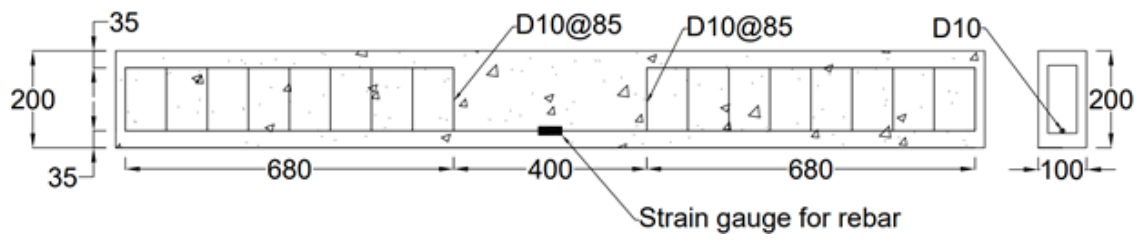
2.2. Reinforced Concrete (RC) Beam Specimen
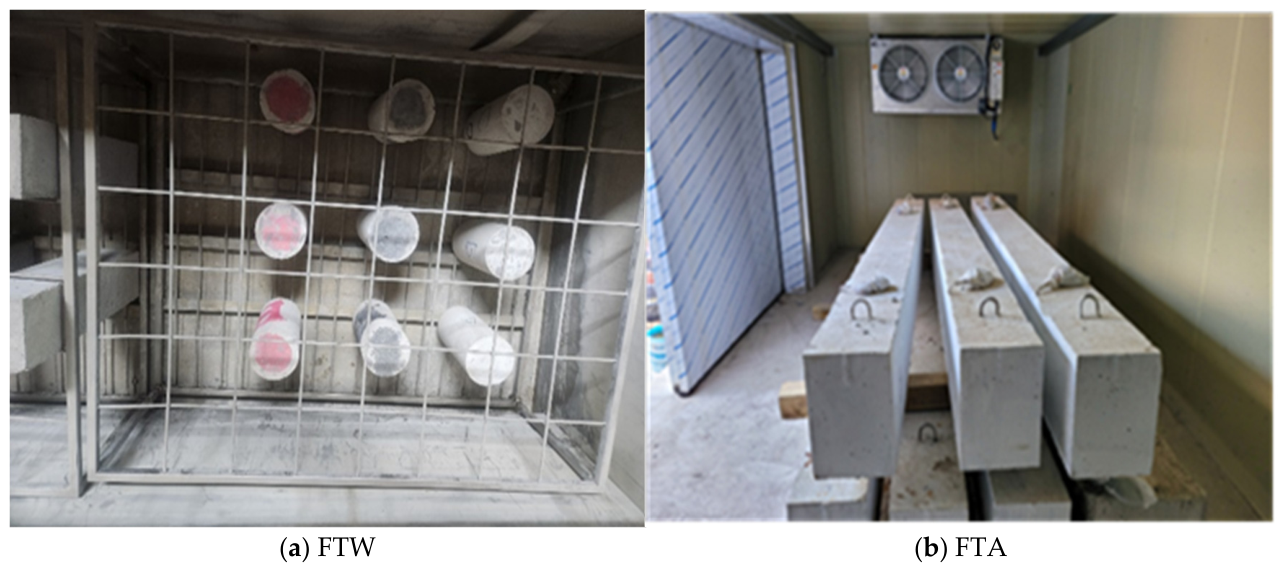
2.3. Preparation of RC Beam Specimen
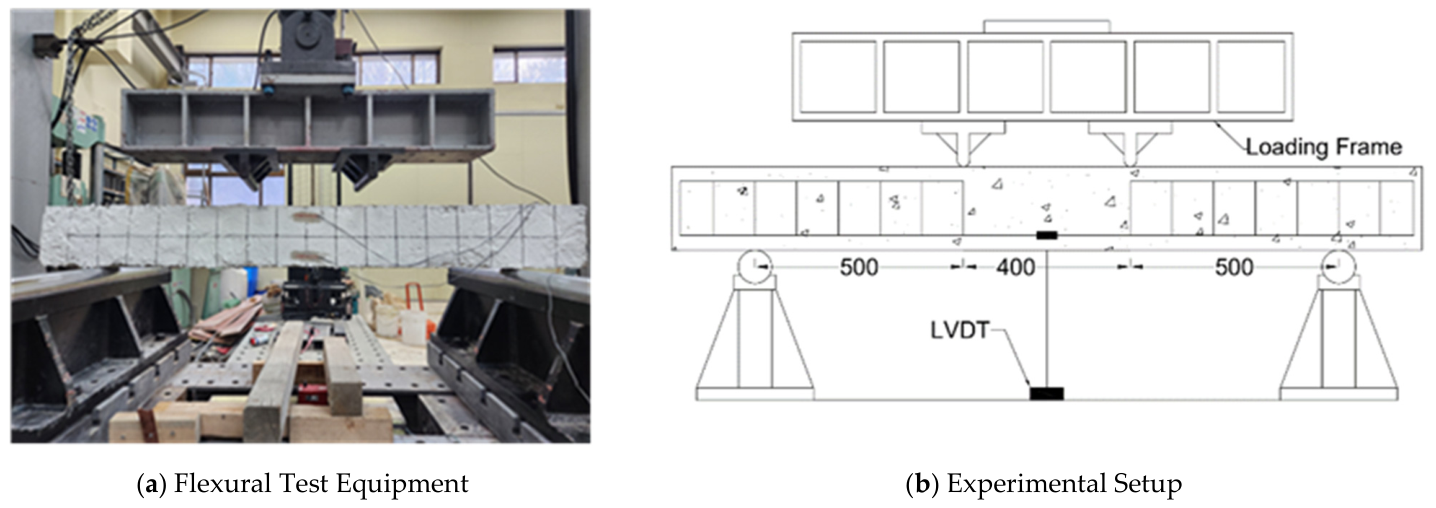
2.4. Flexural Test Setup
3. Materials Test Results
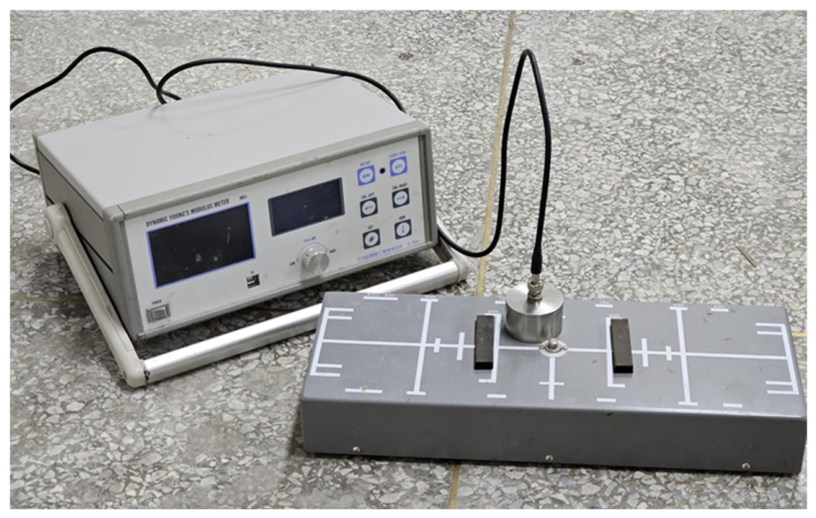
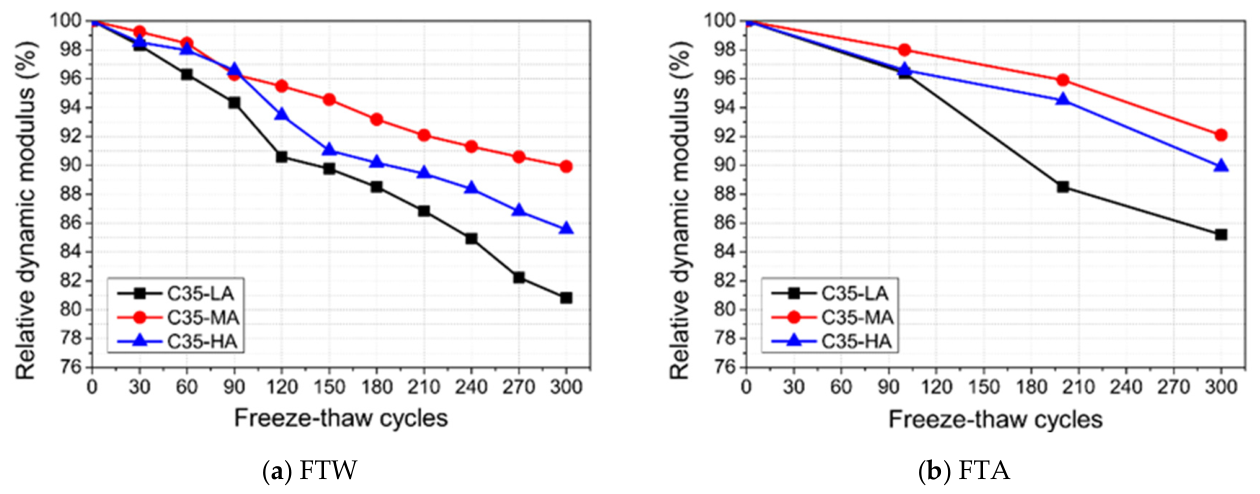
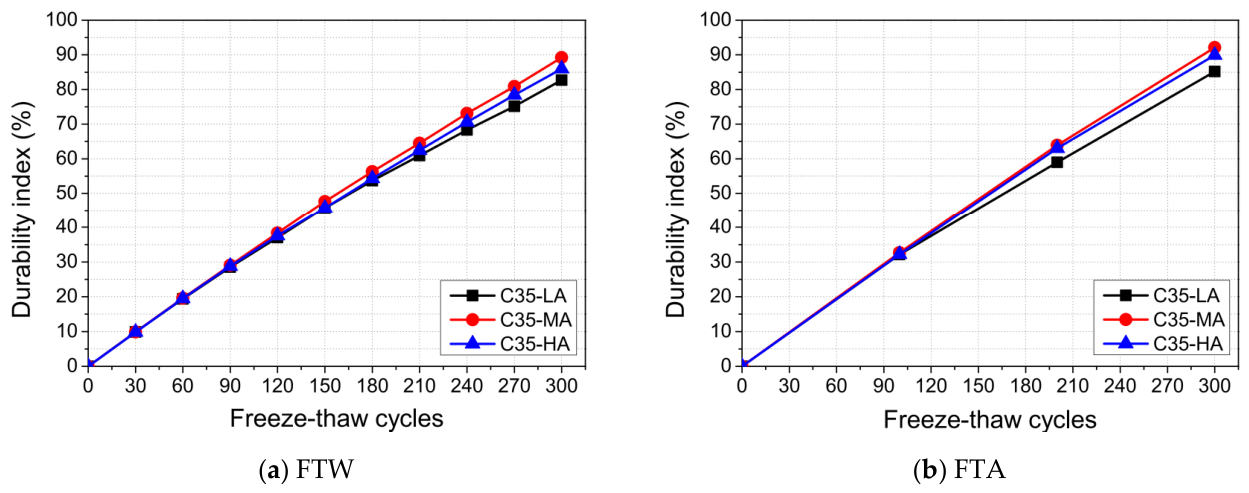
3.1. Comparison of Relative Dynamic Modulus and Durability Index

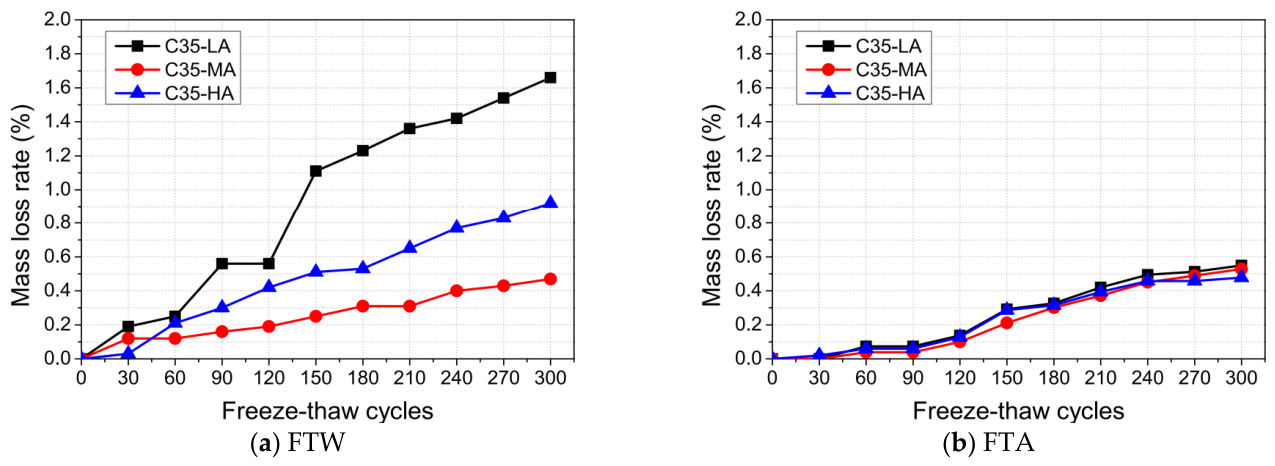
3.2. Comparison of Mass Loss
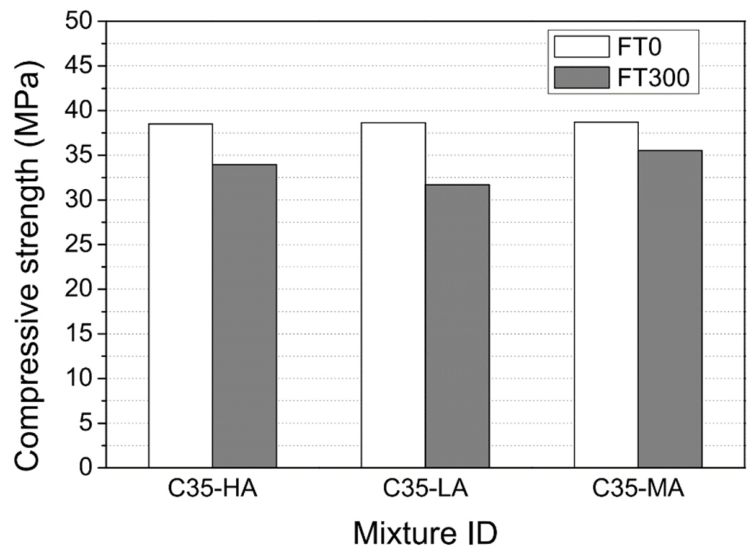
3.3. Compressive Strength Change Due to a New Type of Freezing and Thawing Test
4. Flexural Test Results of RC Beams
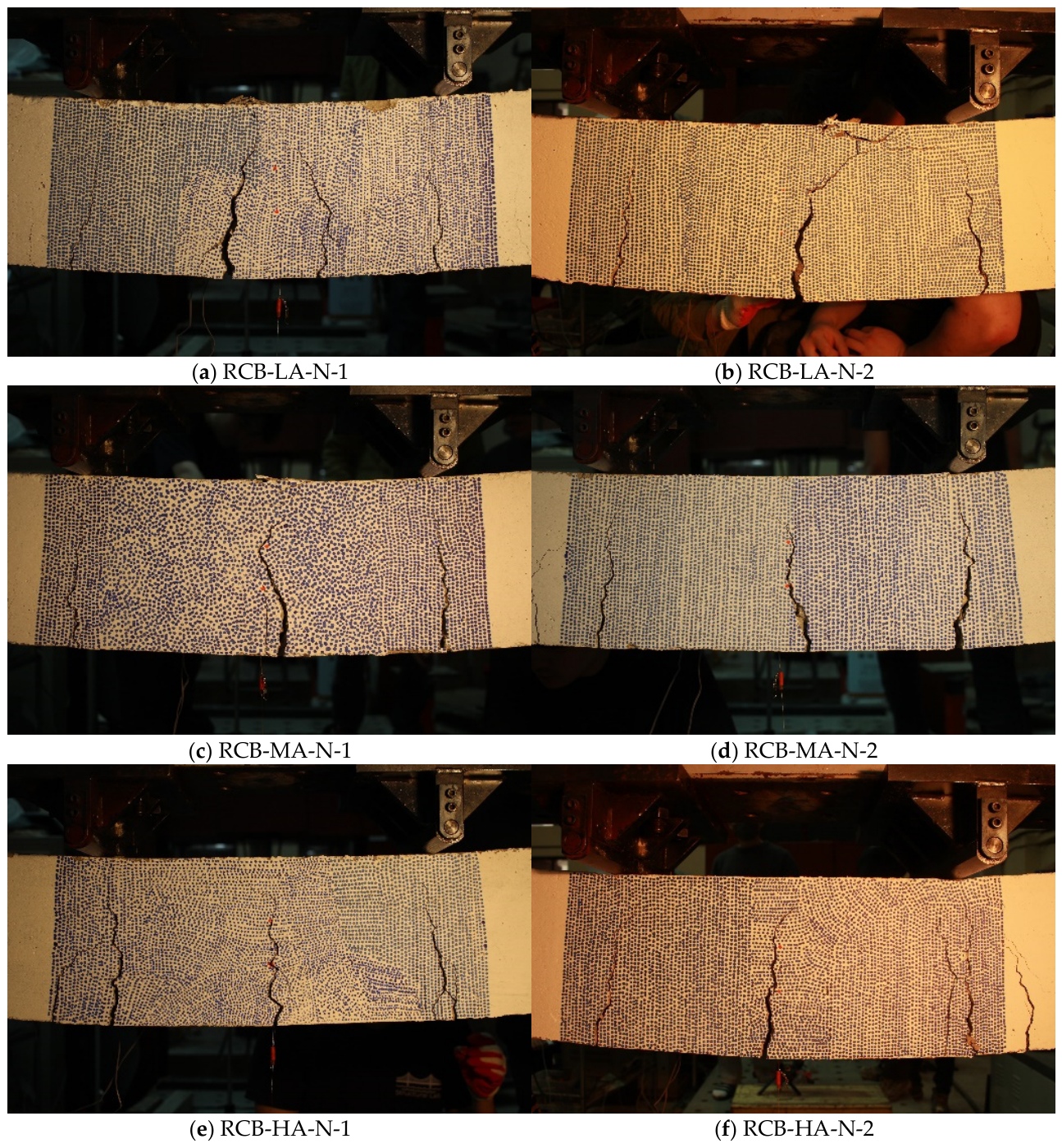
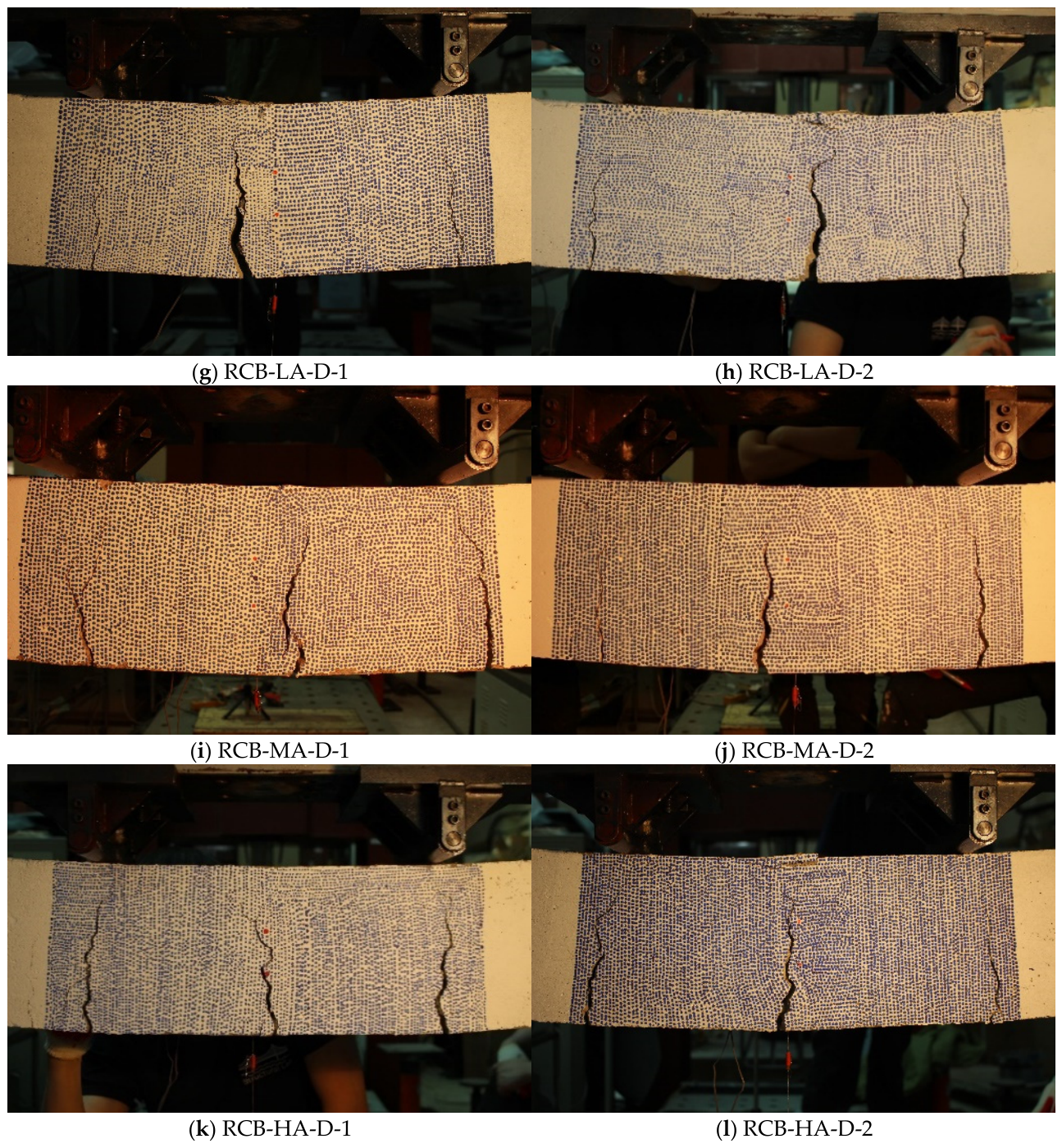
4.1. Failure Modes
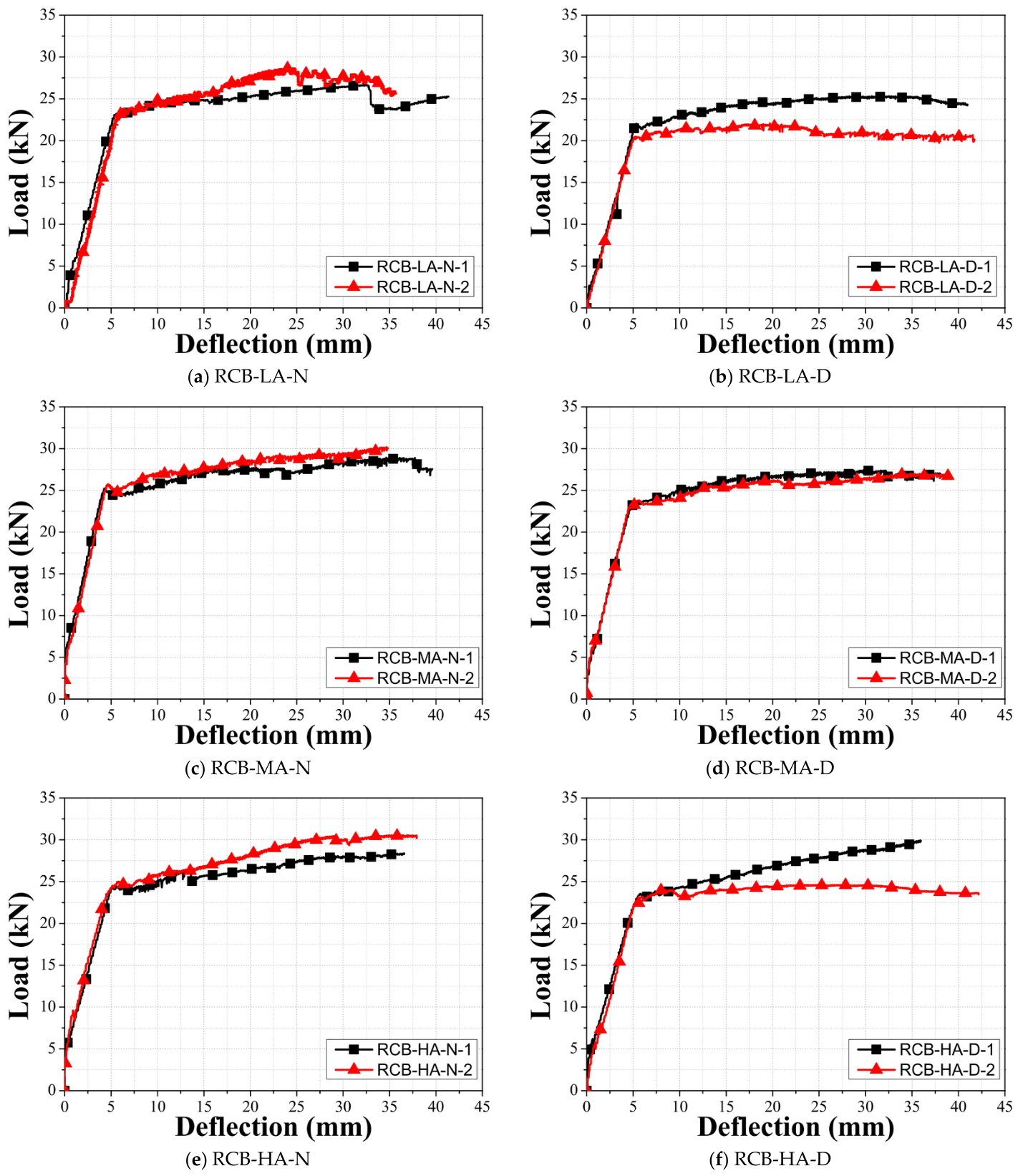
4.2. Load–Deflection Curves
4.3. Energy Absorption Capacity
5. Discussion
6. Conclusions
- Among the three air content levels tested in this study, the concrete with moderate air content, C35-MA, exhibited the highest freeze–thaw resistance. This was confirmed by the relative dynamic modulus of elasticity, durability index, mass loss rate, and compressive strength results. In contrast, the low-air-content concrete, C35-LA, showed the most significant deterioration after freeze–thaw cycles.
- The FTW and FTA test results showed similar trends in freeze–thaw resistance according to air content. However, the degree of deterioration was more pronounced in the FTW test than in the FTA test, indicating that water-based freeze–thaw exposure caused more severe material degradation than air-based freeze–thaw exposure.
- In the flexural tests of RC beams, the low-air-content specimens showed reductions in yield load, yield deflection, and energy absorption capacity after freeze–thaw cycles. This indicates that insufficient air content can negatively affect the flexural performance and ductility of RC beams exposed to freeze–thaw conditions.
- The RC beams with moderate and high air contents exhibited relatively small reductions in flexural performance after freeze–thaw cycles. These results suggest that an appropriate level of air content contributes to maintaining the structural performance of RC beams under freeze–thaw exposure.
- Although freeze–thaw cycles caused noticeable degradation in the material properties of concrete, their influence on the flexural performance of RC beams was relatively limited. This is because the flexural behavior of RC beams is strongly affected by the tensile reinforcement and structural configuration. Therefore, the results should be interpreted as experimental trends, and further studies with a larger number of specimens are required to improve statistical reliability.
Author Contributions
Funding
Institutional Review Board Statement
Informed Consent Statement
Data Availability Statement
Conflicts of Interest
References
- Hung, C.-C.; Tawil, S.E.; Chao, S.-H. A review of developments and challenges for UHPC in structural engineering: Behavior, analysis, and design. J. Struct. Eng. 2021, 147, 03121001. [Google Scholar] [CrossRef]
- Hui, Y. A review of ultra-high performance concrete (UHPC). Int. J. Nat. Resour. Environ. Stud. 2025, 7, 23–33. [Google Scholar] [CrossRef]
- Oesman, M.; Harry, S. Ultra-high performance concrete jacketing with local aggregates for axial strengthening of reinforced concrete columns. J. Adv. Civ. Environ. Eng. 2025, 8, 22–31. [Google Scholar] [CrossRef]
- ASTM C94/C94M-23; Standard Specification for Ready-Mixed Concrete. ASTM International: West Conshohocken, PA, USA, 2023.
- Shah, H.A.; Yuan, Q.; Zuo, S. Air entrainment in fresh concrete and its effects on hardened concrete—A review. Constr. Build. Mater. 2021, 274, 121835. [Google Scholar] [CrossRef]
- Kia, A. Freeze-thaw durability of air-entrained high-strength clogging resistant permeable pavements. Constr. Build. Mater. 2023, 400, 132767. [Google Scholar] [CrossRef]
- Zhe, L.; Feng, Z.-G.; Yao, D.; Li, X.; Ji, H. Freeze-thaw resistance of ultra-high performance concrete: Dependence on concrete composition. Constr. Build. Mater. 2021, 293, 123523. [Google Scholar] [CrossRef]
- Graybeal, B.A.; Hartmann, J.L. Strength and durability of ultra-high performance concrete. In Proceedings of the Concrete Bridge Conference, Orlando, FL, USA, 19 October 2003; pp. 1–20. [Google Scholar]
- Lee, M.-G.; Chiu, C.-T.; Wang, Y.-C. The study of bond strength and bond durability of reactive powder concrete. J. ASTM Int. 2005, 2, 1–10. [Google Scholar] [CrossRef]
- Gu, C.; Sun, W.; Guo, L.; Wang, Q. Effect of curing conditions on the durability of ultra-high performance concrete under flexural load. J. Wuhan Univ. Technol.-Mater. Sci. Ed. 2016, 31, 278–285. [Google Scholar] [CrossRef]
- Wu, C.; Zhang, H.; Wang, D.; Zhou, X.; Wang, N. Study on mechanical and chloride salt freezing-thawing resistance of CSW concrete. Constr. Build. Mater. 2024, 340, 138078. [Google Scholar] [CrossRef]
- Dahmani, L.; Khenane, A.; Kaci, S. Behavior of the reinforced concrete at cryogenic temperatures. Cryogenics 2007, 47, 517–525. [Google Scholar] [CrossRef]
- Jiang, Z.W.; He, B.; Zhu, X.P.; Ren, Q.; Zhang, Y. State-of-the-art review on properties evolution and deterioration mechanism of concrete at cryogenic temperature. Constr. Build. Mater. 2020, 257, 119456. [Google Scholar] [CrossRef]
- Luo, Y.J.; Cui, W.; Song, H.F. Poromechanical microplane model with thermodynamics for deterioration of concrete subjected to freeze-thaw cycles. J. Mater. Civ. Eng. 2020, 32, 04020338. [Google Scholar] [CrossRef]
- Rong, X.-L.; Li, L.; Huang, W.-Y.; Dong, L.-G.; Zheng, S.-S.; Wang, F.; Lu, D.; Wang, J.-Y. Experimental investigation of the seismic resistance of RC beam-column connections after freeze-thaw cycle treatment. Eng. Struct. 2023, 290, 116330. [Google Scholar] [CrossRef]
- Rong, X.-L.; Li, L.; Zheng, S.-S.; Wang, F.; Huang, W.-Y.; Zhang, Y.-X.; Lu, D. Freeze-thaw damage model for concrete considering a nonuniform temperature field. J. Build. Eng. 2023, 72, 106747. [Google Scholar] [CrossRef]
- Wang, J.Y.; Rong, X.L.; Zheng, S.S.; Zhang, Y.X.; Dai, K.Y.; Dong, L.G.; Wang, Z.S. Cyclic behavior of RC beams under artificial climate rapid freeze-thaw environment: A further research. Case Stud. Constr. Mater. 2022, 17, e01589. [Google Scholar] [CrossRef]
- Yin, T.; Zhu, W.; Xu, B.; Zhang, Y.; Gao, W. Deterioration law of flexural performance of RC beams with initial cracks under alternating action of salt freeze-thaw cycles and fatigue. Constr. Build. Mater. 2023, 409, 134052. [Google Scholar] [CrossRef]
- Yang, S.; Chen, X.; Han, M.; Song, J. Effect of sulfate attack, drying-wetting cycles and freezing-thawing cycles on reinforced concrete columns under eccentric loads. Structures 2022, 45, 1864–1877. [Google Scholar] [CrossRef]
- Zhang, Y.; Zheng, S.; Li, L.; Dong, L.; Ji, J.; Ruan, S. Modeling the lateral behavior of freeze-thaw damaged reinforced concrete columns including reinforcement slip and shear effects. Eng. Struct. 2021, 237, 112168. [Google Scholar] [CrossRef]
- Moodi, F.; Norouzi, S.; Dashti, P. Mechanical properties and durability of alkali-activated slag repair mortars containing silica fume against freeze-thaw cycles and salt scaling attack. Adv. Concr. Constr. 2021, 11, 493–505. [Google Scholar] [CrossRef]
- Liu, M.; Xiao, J.; Yang, E.; Su, L. Effect of rubber particles on properties and frost resistance of self-compacting concrete. Adv. Concr. Constr. 2021, 16, 269–276. [Google Scholar] [CrossRef]
- Maruta, H.; Katpady, N.D.; Hazehara, H.; Soeda, M. Performance of paraffin mixed concrete subjected to combined freeze-thaw and chloride environment. Adv. Concr. Constr. 2024, 17, 45–52. [Google Scholar] [CrossRef]
- Suprenant, B.A. Freezing concrete as a construction practice. Cold Reg. Sci. Technol. 1985, 11, 195–197. [Google Scholar] [CrossRef]
- Eldin, N.N.; Senouci, A.B. Measurement and prediction of the strength of rubberized concrete. Cem. Concr. Compos. 1994, 16, 287–298. [Google Scholar] [CrossRef]
- Bu, J.; Xu, H.; Chen, X. Freeze-thaw damage of ultra fine dredged sand concrete based on microstructure characteristics. Case Stud. Constr. Mater. 2024, 21, e03666. [Google Scholar] [CrossRef]
- Oliveira, M.B.; Vazquez, E. The influence of retained moisture in aggregates from recycling on the properties of new hardened concrete. Waste Manag. 1996, 16, 113–117. [Google Scholar] [CrossRef]
- Gokce, A.; Nagataki, S.; Saeki, T.; Hisada, M. Freezing and thawing resistance of air-entrained concrete incorporating recycled coarse aggregate: The role of air content in demolished concrete. Cem. Concr. Res. 2004, 34, 799–806. [Google Scholar] [CrossRef]
- Tuyan, M.; Aghabaglou, A.M.; Ramyar, K. Freeze-thaw resistance, mechanical and transport properties of self-consolidating concrete incorporating coarse recycled concrete aggregate. Mater. Des. 2014, 53, 983–991. [Google Scholar] [CrossRef]
- ASTM C666/C666M-15; Standard Test Method for Resistance of Concrete to Rapid Freezing and Thawing. ASTM International: West Conshohocken, PA, USA, 2015.
- Kim, S.W.; Lee, D.J.; Kim, K.M.; Kim, J.S. An experimental study on the performance of RC beam according to the rapid freezing and thawing test method in the air. J. Korea Inst. Struct. Maint. Insp. 2021, 25, 46–55. [Google Scholar] [CrossRef]
- Rustamov, S.; Kim, S.W.; Kwon, M.H.; Kim, J.S. Mechanical behavior of fiber-reinforced lightweight concrete subjected to repeated freezing and thawing. Constr. Build. Mater. 2021, 273, 121710. [Google Scholar] [CrossRef]
- ASTM C231/C231M-22; Standard Test Method for Air Content of Freshly Mixed Concrete by the Pressure Method. ASTM International: West Conshohocken, PA, USA, 2022.
- ASTM C39/C39M-21; Standard Test Method for Compressive Strength of Cylindrical Concrete Specimens. ASTM International: West Conshohocken, PA, USA, 2021.



| Mixture ID | W | C | W/C | FG | CG | AE | SP |
|---|---|---|---|---|---|---|---|
| C35-LA | 185 | 308 | 0.60 | 806 | 986 | 0 | 0.9 |
| C35-MA | 185 | 370 | 0.50 | 728 | 890 | 0.56 | 1.1 |
| C35-HA | 185 | 411 | 0.45 | 683 | 835 | 3.3 | 2.1 |
| Mixture ID | Air Content of Freshly Mixed Concrete (%) | Slump (mm) | Compressive Strength (MPa) |
|---|---|---|---|
| C35-LA | 1.2 | 130 | 38.63 |
| C35-MA | 5.3 | 180 | 38.71 |
| C35-HA | 9.3 | 220 | 38.51 |
| RC Beam ID | Mixture ID | Freezing and Thawing Cycle (EA) | Air Content of Freshly Mixed Concrete (%) | Number of RC Beams |
|---|---|---|---|---|
| RCB-LA-N | C35-LA | 0 | 1.2 | 2 |
| RCB-LA-D | C35-LA | 300 | 1.2 | 2 |
| RCB-MA-N | C35-MA | 0 | 5.3 | 2 |
| RCB-MA-D | C35-MA | 300 | 5.3 | 2 |
| RCB-HA-N | C35-HA | 0 | 9.3 | 2 |
| RCB-HA-D | C35-HA | 300 | 9.3 | 2 |
| FTW Test | FTA Test | |
|---|---|---|
| Standard | ASTM C666/C666M-15 [30] KS F 2456 (Republic of Korea) | N/A |
| Experimental condition | Rapid Freeze-Thaw in Water | Rapid Freeze-Thaw in Air |
| Freezing and thawing temperatures | 4(±2) °C ↔ −18(±2) °C | 4(±2) °C ↔ −18(±2) °C |
| Time required for one cycle | 2–4 h | 9–10 h |
| Test specimen | Concrete (material) | Concrete (material), RC beam (structure) |
| Damage | Relative dynamic modulus of elasticity, durability factor, mass loss rate | Material: relative dynamic modulus of elasticity, durability factor, mass loss rate, compressive strength/ Structure: failure mode, load–deflection curve, energy absorption capacity |
| Mixture ID | Freezing and Thawing Cycle (EA) | Compressive Strength of Concrete (MPa) | Decrease Rate (%) |
|---|---|---|---|
| C35-LA | 0 | 38.63 | 0 |
| 300 | 31.69 | 17.95 | |
| C35-MA | 0 | 38.71 | 0 |
| 300 | 35.52 | 8.23 | |
| C35-HA | 0 | 38.51 | 0 |
| 300 | 33.95 | 11.83 |
| RC Beam ID | Yield Load (kN) | Yield Deflection (mm) | ||
|---|---|---|---|---|
| Each | Mean ± SD | Each | Mean ± SD | |
| RCB-LA-N-1 | 23.10 | 22.92 ± 0.26 | 5.78 | 5.99 ± 0.30 |
| RCB-LA-N-2 | 22.74 | 6.20 | ||
| RCB-LA-D-1 | 21.91 | 21.00 ± 1.29 | 5.41 | 5.31 ± 0.14 |
| RCB-LA-D-2 | 20.09 | 5.21 | ||
| RCB-MA-N-1 | 24.84 | 24.27 ± 0.81 | 4.43 | 4.54 ± 0.16 |
| RCB-MA-N-2 | 23.69 | 4.65 | ||
| RCB-MA-D-1 | 23.49 | 23.35 ± 0.21 | 4.71 | 4.69 ± 0.03 |
| RCB-MA-D-2 | 23.20 | 4.67 | ||
| RCB-HA-N-1 | 24.12 | 24.54 ± 0.59 | 5.25 | 5.43 ± 0.26 |
| RCB-HA-N-2 | 24.96 | 5.61 | ||
| RCB-HA-D-1 | 23.45 | 23.21 ± 0.35 | 5.55 | 5.39 ± 0.23 |
| RCB-HA-D-2 | 22.95 | 5.23 | ||
| RC Beam ID | Energy Absorption Capacity (kN·mm) | Decrease Rate (%) | ||
|---|---|---|---|---|
| Each | Avg | |||
| RCB-LA-N | 1 | 67.19 | 70.26 | 0 |
| 2 | 73.32 | |||
| RCB-LA-D | 1 | 59.35 | 56.35 | 20 |
| 2 | 53.35 | |||
| RCB-MA-N | 1 | 55.80 | 57.83 | 0 |
| 2 | 59.85 | |||
| RCB-MA-D | 1 | 53.88 | 54.04 | 7 |
| 2 | 54.20 | |||
| RCB-HA-N | 1 | 63.55 | 66.57 | 0 |
| 2 | 69.59 | |||
| RCB-HA-D | 1 | 64.46 | 61.72 | 7 |
| 2 | 58.97 | |||
Disclaimer/Publisher’s Note: The statements, opinions and data contained in all publications are solely those of the individual author(s) and contributor(s) and not of MDPI and/or the editor(s). MDPI and/or the editor(s) disclaim responsibility for any injury to people or property resulting from any ideas, methods, instructions or products referred to in the content. |
© 2026 by the authors. Licensee MDPI, Basel, Switzerland. This article is an open access article distributed under the terms and conditions of the Creative Commons Attribution (CC BY) license.
Share and Cite
Kim, S.; Lee, Y.; Han, D.; Kim, J. Durability and Flexural Response of RC Beams to Freeze–Thaw Cycles: Influence of Air Content. Appl. Sci. 2026, 16, 5513. https://doi.org/10.3390/app16115513
Kim S, Lee Y, Han D, Kim J. Durability and Flexural Response of RC Beams to Freeze–Thaw Cycles: Influence of Air Content. Applied Sciences. 2026; 16(11):5513. https://doi.org/10.3390/app16115513
Chicago/Turabian StyleKim, Sangwoo, Yujeong Lee, Dongyeop Han, and Jinsup Kim. 2026. "Durability and Flexural Response of RC Beams to Freeze–Thaw Cycles: Influence of Air Content" Applied Sciences 16, no. 11: 5513. https://doi.org/10.3390/app16115513
APA StyleKim, S., Lee, Y., Han, D., & Kim, J. (2026). Durability and Flexural Response of RC Beams to Freeze–Thaw Cycles: Influence of Air Content. Applied Sciences, 16(11), 5513. https://doi.org/10.3390/app16115513