
URMIBALI Research Project: Exploring How Digital Documentation Technologies Can Enhance Knowledge and Support the Reuse of Materials in Traditional and Historic Buildings Within an Urban Mining Approach †


Abstract
1. Introduction
1.1. State of the Art
1.2. Aims of the URMIBALI Research Project
2. Methodological Approach and Research Steps
2.1. Methodological Approach
2.1.1. Bottom-Up Approach
2.1.2. Interdisciplinary Approach
2.2. Selected Case Studies in Liège
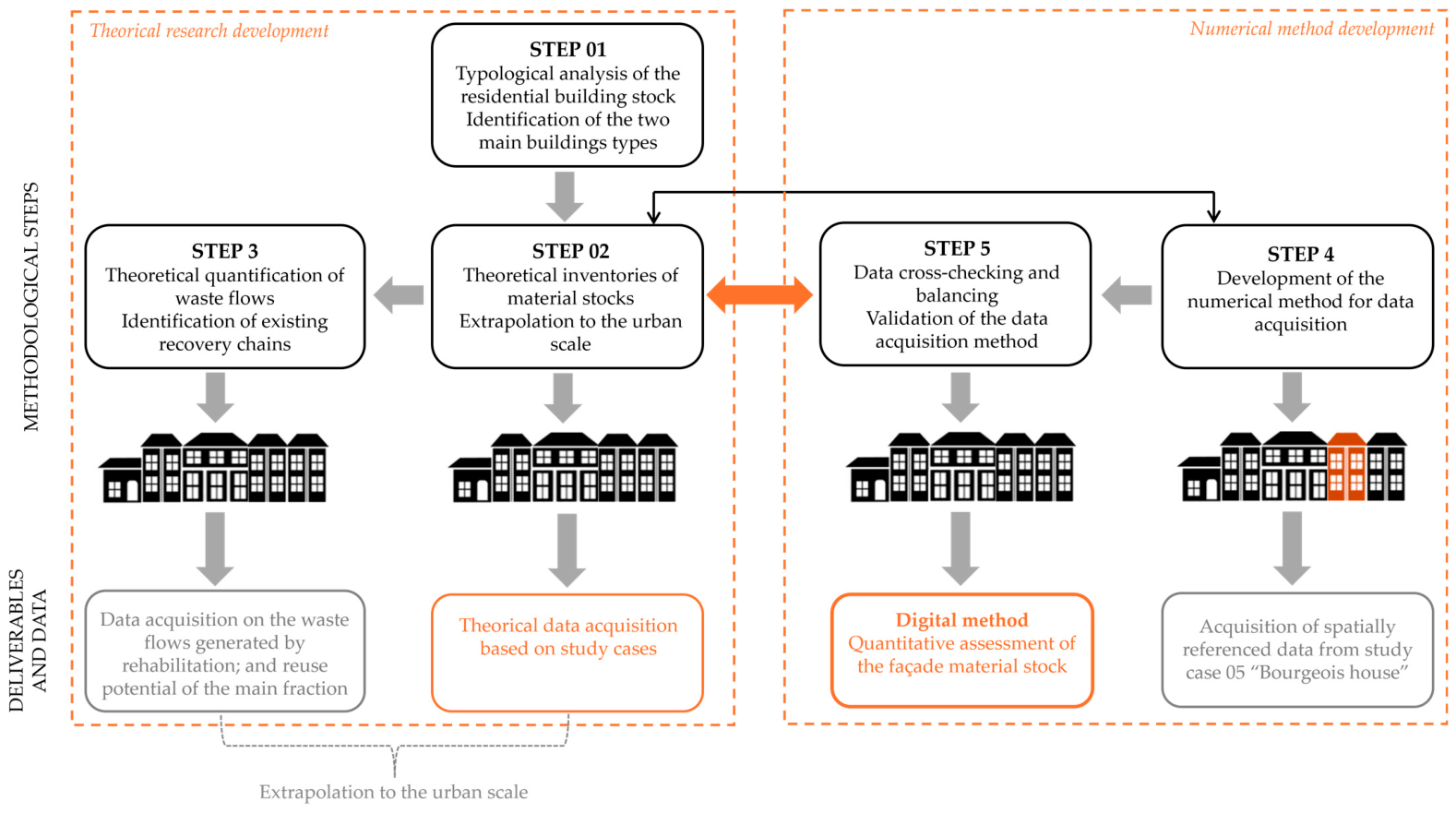
2.3. Research Steps
2.3.1. Typological Analysis and Identification of Main Building Archetypes
2.3.2. Theoretical Quantitative Inventories of Material Deposits in the Six Case Studies
2.3.3. Descriptive Sheets of the Main Buildings Materials Encountered
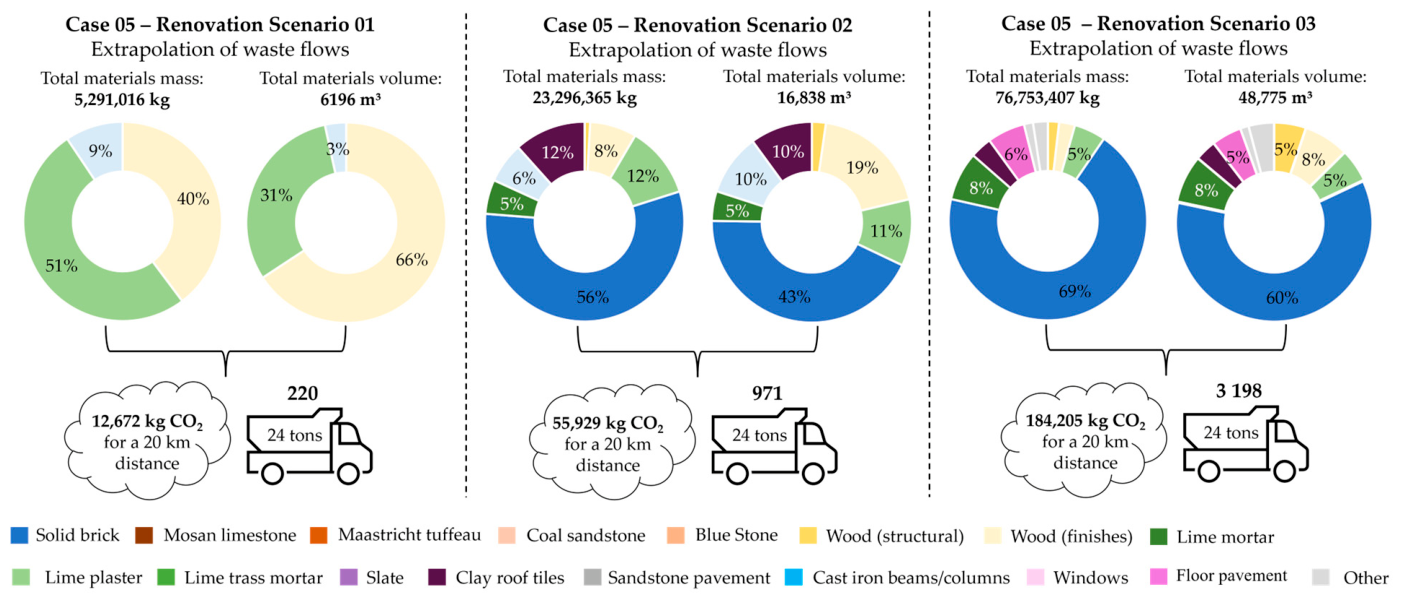
2.3.4. Rehabilitation Scenarios and Theoretical Accounting of the Waste Flows
2.3.5. Extrapolation of the Results to the Urban Scale (Existing Deposit and Waste Flows)
2.3.6. Development of the Digital Method for Rapid Data Acquisition
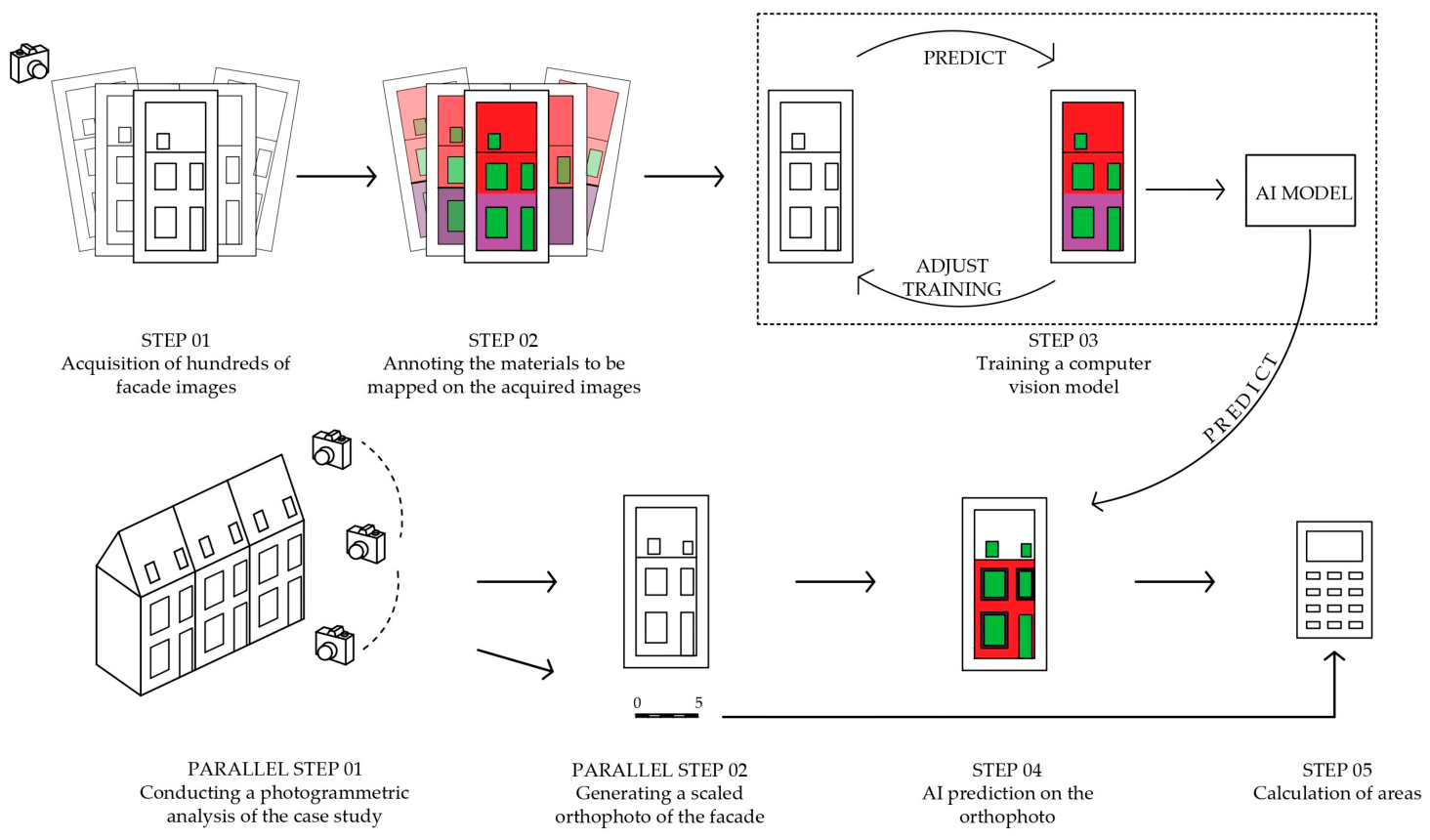
- Data collection for AI model training and evaluation
- 2.
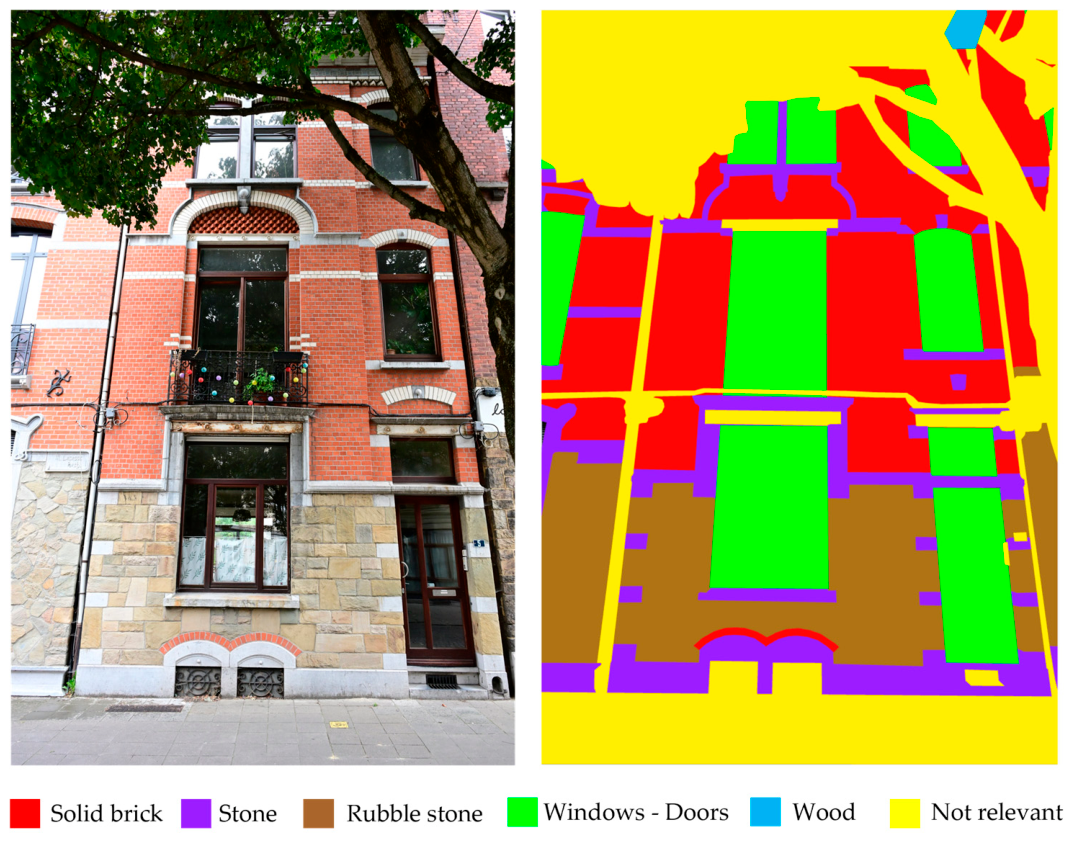
- Data processing for AI training
- 3.
- Training the AI model to recognize materials and calculate surface areas
- 4.
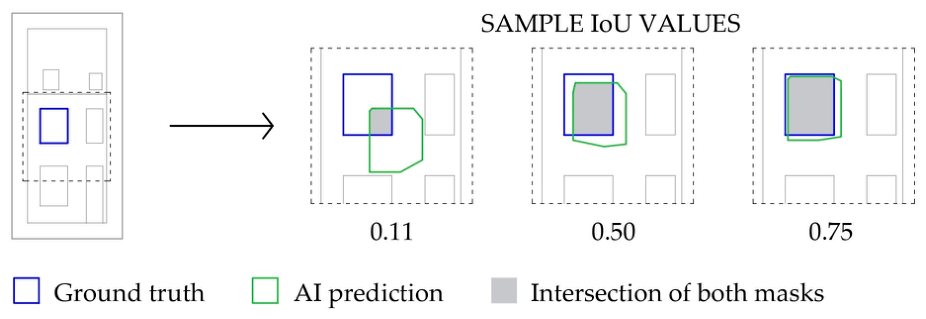
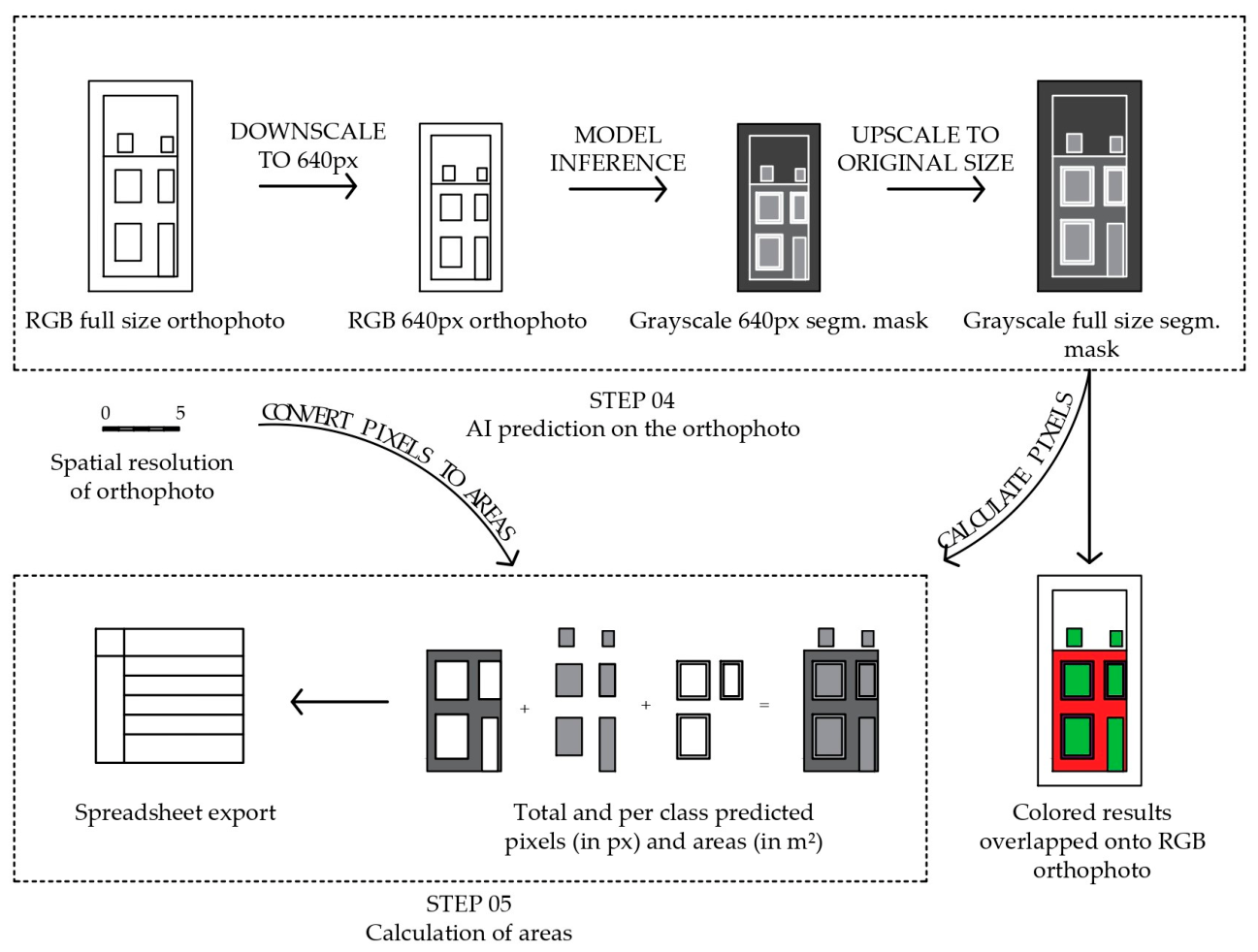
- AI model predictions and surface verification
- 5.
- For each image, we then calculated the surface area of every detected class.
3. Results
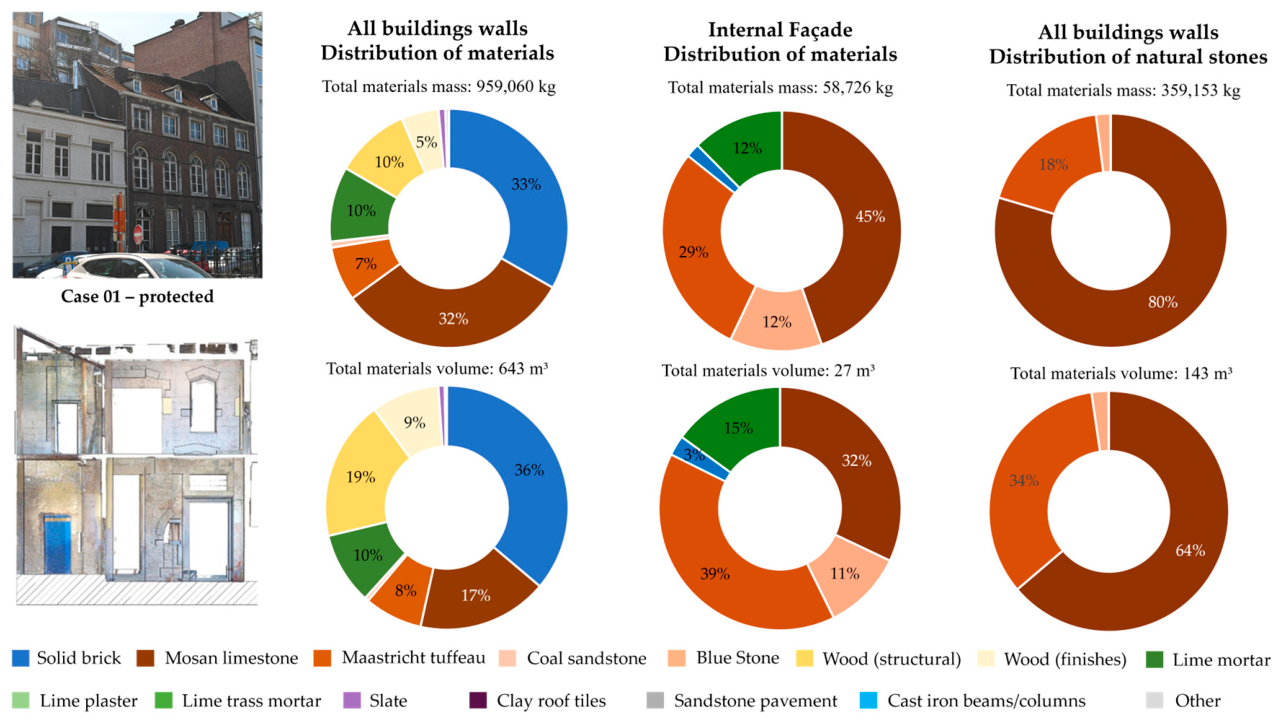
3.1. Inventories of Existing Material Deposits
3.2. Waste Flow Estimation
3.3. Extrapolation at the Urban Scale for Case 05
3.4. Data Acquired from the Digital Method
4. Discussion
4.1. Limits of Theoretical Inventories
4.2. Comparison Between Theoretical and Digital Data
4.3. Transferability of the Digital Method to Other Building Types
4.4. Future Research Perspectives
5. Conclusions
Author Contributions
Funding
Institutional Review Board Statement
Informed Consent Statement
Data Availability Statement
Acknowledgments
Conflicts of Interest
References
- BPIE. Buildings Should Be at the Heart of the European Green Deal. Here’s Why. [Discussion Paper]. 2019, p. 2. Available online: https://www.bpie.eu/wp-content/uploads/2019/12/EU-Green-Deal-buildings_BPIE_Discussionpaper_Dec2019.pdf (accessed on 1 October 2024).
- Von der Leyen, U. Le Choix de l’Europe—Orientations Politiques pour la Prochaine Commission Européenne 2024–2029; Parlement Européen: Strasbourg, France, 2024; p. 41. Available online: https://commission.europa.eu/document/download/e6cd4328-673c-4e7a-8683-f63ffb2cf648_fr?filename=Political%20Guidelines%202024-2029_FR.pdf (accessed on 19 June 2026).
- Economidou, M.; Atanasiu, B.; Staniaszek, D.; Maio, J.; Nolte, I.; Rapf, O.; Laustsen, J.; Ruyssevelt, P.; Strong, D.; Zinetti, S. Europe’s Buildings Under the Microscope. A Country-by-Country Review of the Energy Performance of Buildings; Buildings Performance Institute Europe (BPIE): Brussels, Belgium, 2011. [Google Scholar]
- Ajustement à L’objectif 55’: Rendre les Bâtiments Situés dans l’UE Plus Verts. (n.d.). Consilium. Available online: https://www.consilium.europa.eu/fr/infographics/fit-for-55-making-buildings-in-the-eu-greener/ (accessed on 29 April 2026).
- Leonardon, P.; Jimenez, C.; Favre, B.; Senior, G. Prospective de Consommation de Matériaux pour la Rénovation Énergétique BBC des Bâtiments Résidentiels aux Horizons 2035 et 2050; ADEME: Angers, France, 2019; p. 139. [Google Scholar]
- Directive (EU) 2018/844 of the European Parliament and of the Council of 30 May 2018 Amending Directive 2010/31/EU on the Energy Performance of Buildings and Directive 2012/27/EU on Energy Efficiency (Text with EEA Relevance), CONSIL, EP, 156 OJ L. 2018. Available online: http://data.europa.eu/eli/dir/2018/844/oj (accessed on 1 October 2024).
- Européen Commission. Une Vague de Rénovations pour l’Europe: Verdir nos Bâtiments, créer des Emplois, Améliorer la Qualité de vie; [Communication de la commission au parlement européen, au conseil, au comité économique et social européen et au comité des régions]; Commission Européenne: Brussels, Belgium, 2020; p. 32. [Google Scholar]
- Commission Européenne. Renovation Wave. (n.d.). Available online: https://energy.ec.europa.eu/topics/energy-efficiency/energy-performance-buildings/renovation-wave_en (accessed on 29 April 2026).
- Directive (UE) 2024/1275 du Parlement Européen et du Conseil du 24 Avril 2024 sur la Performance Énergétique des Bâtiments (Refonte), 68 (2024). Available online: http://data.europa.eu/eli/dir/2024/1275/oj (accessed on 1 October 2024).
- Statbel. Report: Cadastral Statistics of the Building Stock, Belgium and Regions (Built-Up Area); Statbel: Bruxelles, Belgium, 2020. [Google Scholar]
- Cassilde, S. Report: Performance Énergétique du Parc de Bâtiments Résidentiels en Wallonie; Centre d’Etudes en Habitat Durable de Wallonie: Charleroi, Belgium, 2019; p. 145. [Google Scholar]
- Troi, A. Historic buildings and city centres—The potential impact of conservation compatible energy refurbishment on climate protection and living conditions. In Proceedings of the International Conference Energy Management in Cultural Heritage, Dubrovnik, Croatia, 6–8 April 2011. [Google Scholar]
- Helin, E.; Frankignoulle, P.; Jacob, G.; Donnay, D.; Raschevitch-Georges, S.; Dechenne-Lion, N. Visages Urbains de Liège Depuis 1830; Crédit Communal de Belgique & Homme et Ville, Ed.; Crédit Communal: Brussels, Belgium, 1997. [Google Scholar]
- Stiernon, D.; Trachte, S.; De Bouw, M.; Dubois, S.; Vanhellemont, Y. Heritage Value Combined with Energy and Sustainable Retrofit: Representative Types of Old Walloon Dwellings Built Before 1914. In Proceedings of the CISBAT 2017 International Conference—Future Buildings & Districts—Energy Efficiency from Nano to Urban Scale, Lausanne, Suisse, 6–8 September 2017. [Google Scholar] [CrossRef]
- Statbel. Census 2011—Logements, Logements Classiques Selon la Période de Construction. 2011. Available online: https://census2011.be/download/downloads_fr.html (accessed on 1 October 2024).
- Anfrie, M.; Majcher, M.; Kryvobokov, M. Chiffres-clés du Logement en Wallonie—Quatrième Édition [Rapport de Recherche]; Centre d’Études en Habitat Durable de Wallonie (CEHD): Charleroi, Belgium, 2019. [Google Scholar]
- Hasselsteen, L.; Damgaard, A.; Otovic, A.P.; Birgisdóttir, H.; Kanafani, K. Tracing resource flows and reducing environmental impacts during construction: Assessment framework for on-site waste efficiency. J. Clean. Prod. 2025, 521, 146243. [Google Scholar] [CrossRef]
- Pomponi, F.; Moncaster, A. Circular economy for the built environment: A research framework. J. Clean. Prod. 2017, 143, 710–718. [Google Scholar] [CrossRef]
- Douguet, E.; Wagner, F. Les Impacts Environnementaux du Réemploi dans le Secteur de la Construction (FCRBE—FutuREuse Booklet 01). 2021. Available online: https://www.envirobatgrandest.fr/document/les-impacts-environnementaux-du-reemploi-dans-le-secteur-de-la-construction/ (accessed on 1 October 2024).
- Opalis. (n.d.). Available online: https://opalis.eu/en (accessed on 16 April 2026).
- Cornermat. (n.d.). Available online: https://www.cornermat.be/-2 (accessed on 5 May 2026).
- BatiTerre. (n.d.). Available online: https://www.batiterre.be/ (accessed on 5 May 2026).
- MOBIUS—Réemploi Construction France. (n.d.). MOBIUS Réemploi. Available online: https://www.mobius-reemploi.fr (accessed on 5 May 2026).
- Cycle Up. Le Concept Cycle Up: Une Gestion Globale de vos Ressources Circulaires. (n.d.). Available online: https://cycle-up.fr/ (accessed on 5 May 2026).
- Gobbo, E.; Maghsoudi Nia, E.; Straub, A.; Stephan, A. Exploring the Effective Reuse Rate of Reused Materials and Elements in the Construction Sector. J. Build. Eng. 2024, 98, 111344. [Google Scholar] [CrossRef]
- Trachte, S.; Bos, M. Projet Feder BBSM: Rapport Scientifique WP9—Recommandations pour le Renforcement de la Circularité des Matières dans le Secteur de la Construction en Région de Bruxelles-Capitale. 2021. Available online: https://orbi.uliege.be/handle/2268/289120 (accessed on 1 October 2024).
- Ghyoot, M. Objectif Réemploi: Pistes D’action pour Développer le Secteur du Réemploi des Éléments de Construction en Région de Bruxelles-Capitale; Vrije Universiteit Brussel: Ixelles, Belgium, 2017. [Google Scholar]
- Poncelet, F.; Vrijders, J. Cadre Technique des Matériaux de Réemploi: Comment Justifier les Performances Techniques des Matériaux de Réemploi? Vrije Universiteit Brussel: Ixelles, Belgium, 2021. [Google Scholar]
- ISO 20887:2020; Développement Durable dans les Bâtiments et Ouvrages de Génie Civil—Conception pour la Démontabilité et L’adaptabilité—Principes, Exigences et Recommandations (Version NBN ISO 20887:2021) [Norme Belge]. ISO: Geneva, Switzerland, 2020. Available online: https://edu.nbn.be/data/r/platform/eduportal/edu-collection?clear=20,0&session=10919368384524 (accessed on 1 March 2025).
- Commission Européenne. Communication de la Comission au Parlement Européen, au Conseil, au Comité Économique et Social Européen et au Comité des Régions: Faire des Produits Durables la Norme (Communication de La Commission Au Parlement Européen, Au Conseil, Au Comité Économique et Social Européen et Au Comité Des Régions COM (2022)); Commission Européenne: Brussels, Belgium, 2022. [Google Scholar]
- Seys, S.; Rotor. WP7—Vers un Dépassement des Freins Réglementaires au Réemploi des Éléments de Construction: Un Meilleur Cadre pour le Réemploi de Produits, pas D’obligation de Marquage CE et un Système D’évaluation ad Hoc [Rapport de Recherche]; Vrije Universiteit Brussel: Ixelles, Belgium, 2017. [Google Scholar]
- Lachat, A. Le Réemploi Appliqué au Domaine de la Construction: Principe, Impact Environnemental et Mesure dans le Cadre d’une Économie Circulaire (Number 2022ENPC0009). Ph.D. Thesis, École des Ponts ParisTech, Champs-sur-Marne, France, 2022. Available online: https://pastel.hal.science/tel-04011357 (accessed on 1 March 2025).
- Brunner, P.H.; Rechberger, H. Practical Handbook of Material Flow Analysis; CRC Press: Boca Raton, FL, USA, 2004. [Google Scholar]
- Gobbo, E. Understanding Urban Stocks; Brussels Environment: Bruxelles, Belgium, 2021. [Google Scholar]
- Tanguy, A. Le Métabolisme Urbain Dans la Transition Écologique. 2019. Available online: https://www.sciencepresse.qc.ca/opinions/liride/2019/05/30/metabolisme-urbain-transition-ecologique (accessed on 19 June 2026).
- Gobbo, E. La Ville Comme Réserve de Matériaux: Comprendre les Études de Gisement Urbain. September 2021. Available online: https://vb.nweurope.eu/media/15811/bookletfcrbefr-6_metabolisme_urbain.pdf (accessed on 19 June 2026).
- Romnée, A.; Vrijders, J. Vers une Économie Circulaire dans la Construction: Introduction aux Principes de l’économie Circulaire dans le Secteur de la Construction. September 2018. Available online: https://www.buildwise.be/fr/publications/innovation-papers/28/ (accessed on 19 June 2026).
- Gobbo, E.; Trachte, S.; Massart, C. Energy retrofit scenarios: Material flows and circularity. IOP Conf. Ser. Earth Environ. Sci. 2019, 225, 012029. [Google Scholar] [CrossRef]
- Stephan, A.; Athanassiadis, A. Towards a more circular construction sector: Estimating and spatialising current and future non-structural material replacement flows to maintain urban building stocks. Resour. Conserv. Recycl. 2018, 129, 248–262. [Google Scholar] [CrossRef]
- Augiseau, V.; Barles, S. Studying construction materials flows and stock: A review. Resour. Conserv. Recycl. 2017, 123, 153–164. [Google Scholar] [CrossRef]
- Ajayebi, A.; Hopkinson, P.; Zhou, K.; Lam, D.; Chen, H.-M.; Wang, Y. Spatiotemporal model to quantify stocks of building structural products for a prospective circular economy. Resour. Conserv. Recycl. 2020, 162, 105026. [Google Scholar] [CrossRef]
- Nordby, A.S.; Berge, B.; Hakonsen, F.; Hestnes, A.G. Criteria for salvageability: The reuse of bricks. Build. Res. Inf. 2009, 37, 55–67. [Google Scholar] [CrossRef]
- Gobbo, E.; Trachte, S.; Massart, C. Influence of energy retrofit on material flows: Comparison between various strategies. J. Phys. Conf. Ser. 2019, 1343, 012175. [Google Scholar] [CrossRef]
- Okuyama, A. (n.d.). Deep Learning Approach to Floor Area and Building Material Stocks Estimation Using Aerial & Street View Image. Available online: https://engrxiv.org/preprint/view/3604/version/5043 (accessed on 19 June 2026).
- Arbabi, H.; Lanau, M.; Xinyi, L.; Meyers, G.; Dai, M.; Mayfield, M.; Densley Tingley, D. A scalable data collection, characterization, and accounting framework for urban material stocks. J. Ind. Ecol. 2022, 26, 58–71. [Google Scholar] [PubMed]
- Boutet, S. L’intégration des Nouvelles Technologies et de L’intelligence Artificielle dans la Conservation du Patrimoine bâti pour Détecter la Présence de Pathologies; Université de Liège: Liège, Belgium, 2025. [Google Scholar]
- Bagieu, C.; Macher, H. Numérisation 3D du Patrimoine Bâti: Acquisition des Données, Nuages de Points et Livrables. Le Moniteur. 2023. Available online: https://boutique.lemoniteur.fr/produit/27/9782281146363/numerisation-3d-du-patrimoine-bati (accessed on 19 June 2026).
- Héno, R.; Chandelier, L. Numérisation 3D de Bâtiments—Cas des Édifices Remarquables. ISTE Editions. 2014. Available online: https://books.google.be/books?hl=fr&lr=&id=Zo5mDwAAQBAJ&oi=fnd&pg=PA5&dq=Num%C3%A9risation+3D+de+b%C3%A2timents&ots=8myBj4Sjrf&sig=wufQV2O7tW6G8lP9MHqM4i2Pkck&redir_esc=y#v=onepage&q=Num%C3%A9risation%203D%20de%20b%C3%A2timents&f=false (accessed on 19 June 2026).
- Luhmann, T.; Robson, S.; Kyle, S.; Boehm, J. Close-Range Photogrammetry and 3D Imaging; Walter de Gruyter GmbH: Berlin, Germany, 2019. [Google Scholar]
- Hallot, P.; Mathys, A.; Jouan, P. Cours de Documentation et Modélisation du Patrimoine Tangible, Documentation et Modélisation du Patrimoine; Université de Liège: Liège, Belgium, 2022. [Google Scholar]
- Dubois, S.; Desarnaud, J.; Vanhellemont, Y.; De Bouw, M.; Stiernon, D.; Trachte, S. Contribution of photogrammetry and sensor networks to the energy diagnosis of occupied historical buildings. In Preventive Conservation—From Climate and Damage Monitoring to a Systemic and Integrated Approach, 1st ed.; Vandesande, A., Verstrynge, E., Van Balen, K., Eds.; CRC Press: Boca Raton, FL, USA, 2020; pp. 145–152. [Google Scholar] [CrossRef]
- Gökçen Akkurt, G.; Aste, N.; Borderon, J.; Buda, A.; Calzolari, M.; Chung, D.; Costanzo, V.; Del Pero, C.; Evola, G.; Huerto-Cardenas, H.E.; et al. Dynamic thermal and hygrometric simulation of historical buildings: Critical factors and possible solutions. Renew. Sustain. Energy Rev. 2020, 118, 109509. [Google Scholar] [CrossRef]
- Moropoulou, A.; Labropoulos, K.C.; Delegou, E.T.; Karoglou, M.; Bakolas, A. Non-destructive techniques as a tool for the protection of built cultural heritage. Constr. Build. Mater. 2013, 48, 1222–1239. [Google Scholar] [CrossRef]
- Wyard, C.; Marion, R.; Hallot, E. WaRM: A Roof Material Spectral Library for Wallonia, Belgium. Data 2023, 8, 59. [Google Scholar] [CrossRef]
- Homayouni, S. Caractérisation des Scènes Urbaines par Analyse des Images Hyperspectrales. Doctoral Dissertation, Télécom ParisTech, Paris, France, 2005. [Google Scholar]
- Revel, C. Apport de la Prise en Compte de la Variabilité Intra-Classe dans les Méthodes de Démélange Hyperspectral pour L’imagerie Urbaine. Ph.D. Dissertation, Université Toulouse 3 Paul Sabatier, Toulouse, France, 2016. [Google Scholar]
- Cavalli, R.M.; Pascucci, S.; Pignatti, S. Hyperspectral remote sensing data to map hazardous materials in a rural and industrial district: The Podgorica dwellings case studies. In 2009 First Workshop on Hyperspectral Image and Signal Processing: Evolution in Remote Sensing; IEEE: New York, NY, USA, 2009. [Google Scholar] [CrossRef]
- Heiden, U.; Roessner, S.; Segl, K.; Kaufmann, H. Analysis of spectral signatures of urban surfaces for their identification using hyperspectral HyMap data. In IEEE/ISPRS Joint Workshop on Remote Sensing and Data Fusion over Urban Areas (Cat. No.01EX482); IEEE: New York, NY, USA, 2001; pp. 173–177. [Google Scholar] [CrossRef]
- Raghu, D.; Bucher, M.J.J.; De Wolf, C. Towards a ‘resource cadastre’ for a circular economy—Urban-scale building material detection using street view imagery and computer vision. Resour. Conserv. Recycl. 2023, 198, 107140. [Google Scholar]
- Honic, M.; Ferschin, P.; Breitfuss, D.; Cencic, O.; Gourlis, G.; Kovacic, I.; De Wolf, C. Framework for the assessment of the existing building stock through BIM and GIS. Dev. Built Environ. 2023, 13, 100110. [Google Scholar]
- Chen, X.; Ding, X.; Ye, Y. Mapping sense of place as a measurable urban identity: Using street view images and machine learning to identify building façade materials. Urban Anal. City Sci. 2025, 52, 965–984. [Google Scholar]
- Rashidi, A.; Sigari, M.H.; Maghiar, M.; Citrin, D. An Analogy between Various Machine-learning Techniques for Detecting Construction Materials in Digital Images. KSCE J. Civ. Eng. 2016, 20, 1178–1188. [Google Scholar] [CrossRef]
- Guo, J.; Liu, P.; Xiao, B.; Deng, L.; Wang, Q. Surface defect detection of civil structures using images: Review from data perspective. Autom. Constr. 2024, 158, 105186. [Google Scholar] [CrossRef]
- Wang, S.; Han, J. Automated detection of exterior cladding material in urban area from street view images using deep learning. J. Build. Eng. 2024, 96, 110466. [Google Scholar] [CrossRef]
- Dubois, S.; Desarnaud, J.; de Bouw, M. Reality Capture Technologies as a Support for Efficient Energy Diagnosis and Simulation of Heritage Buildings: The Case of the ‘Alte Schäfflerei’ in Benediktbeuern. 2022. Available online: https://www.researchgate.net/publication/362888605_Reality_capture_technologies_as_a_support_for_efficient_energy_diagnosis_and_simulation_of_heritage_buildings_the_case_of_the_'Alte_Schafflerei'_in_Benediktbeuern (accessed on 19 June 2026).
- Sloopwijzer—Artificiële Intelligentie Helpt Selectief Slopen | MVO Vlaanderen. (n.d.). Available online: https://www.mvovlaanderen.be/nl/inspiratie/sloopwijzer-artifici%C3%ABle-intelligentie-helpt-selectief-slopen (accessed on 16 April 2026).
- Trachte, S.; Noël, O.; Hallot, P.; Sosnowska, P.; Schreurs, A.; Romboux, A. URMIBALI project: How can digital documentation technologies can be a support for urban mining and reuse of building materials? A new method for data acquisition on traditional residential buildings in Liège. J. Phys. Conf. Ser. 2025, 3140, 162016. [Google Scholar] [CrossRef]
- Dechenne-Lion, N.; Donnay, D.; Frankignoulle, P.; Helin, E.; Jacob, G.; Raschevitch-Georges, S.; Eleb-Vidal, M.; Debarre-Blanchard, A. Architecture de la vie Privée: Maisons et Mentalités: XVIIe-XIXe Siècles. 1989. Available online: https://books.google.nl/books/about/Architectures_de_la_vie_priv%C3%A9e.html?id=AipUAAAAMAAJ&redir_esc=y (accessed on 19 June 2026).
- Houbrechts, D. Le Logis en Pans de Bois dans les Villes du Bassin de la Meuse Moyenne (XVe-XVlIe Siècle): Apport de L’archéologie du Bâti. Bull. Monum. 2007, 165, 175–194. Available online: https://www.persee.fr/doc/bulmo_0007-473x_2007_num_165_2_1440 (accessed on 19 June 2026).
- Liénard, A.; Sosnowska, P. L’hôtel de Donceel à Liège (XVIe-XXe siècle): Analyse Architecturale et Archéologique du Bâti. Bull. CRMSF 2024, 39. Available online: https://hdl.handle.net/2268/317201 (accessed on 19 June 2026).
- Thierry, C. Liège; Éditions Mardaga: Sprimont, Belgium, 2004. [Google Scholar]
- Xhayet, G.; Péters, A.; Pirot, P. (n.d.). Liège Avant la Grande Guerre. Province de Liège. Available online: https://www.provincedeliege.be/sites/default/files/media/524/EPL%20-%20Dossier%2014-18%20-%2006%20-%20Li%C3%A8ge%20avant%20la%20Grande%20Guerre.pdf (accessed on 1 October 2024).
- Ville de Liége: Réglement sur les Batisses et Constructions Diverses, Adopté en Séance du Conseil Communal du 30 août 1839 (1839). Available online: https://donum.uliege.be/handle/2268.1/4145 (accessed on 1 October 2024).
- Règlement sur les Bâtisses et les Logements Adopté en Séance du Conseil Communal du 20 juin 1879 (1879). Available online: http://hdl.handle.net/2268.1/4141 (accessed on 1 October 2024).
- Le Bati Bruxellois Source de Nouveaux Matériaux. (n.d.). BBSM. Available online: https://www.bbsm.brussels/en/home/ (accessed on 29 April 2026).
- Stiernon, D.; Trachte, S.; Dubois, S.; Desarnaud, J. A method for the retrofitting of pre-1914 Walloon dwellings with heritage value. J. Phys. Conf. Ser. 2019, 1343, 012179. [Google Scholar] [CrossRef]
- Kints, C. La Rénovation Énergétique et Durable des Logements Wallons: Analyse du bâti Existant et Mise en Évidence de Typologies de Logements Prioritaires; (Agence Internationale de l’Energie, Solar Heating & Cooling, Task 37). MRW-DGTRE; Architecture & Climat, UCL: London, UK, 2008. [Google Scholar]
- Project Interreg FCRBE. Reuse Toolkit: Material Sheets. 9 November 2021. Available online: https://vb.nweurope.eu/projects/project-search/fcrbe-facilitating-the-circulation-of-reclaimed-building-elements-in-northwestern-europe/news/reuse-toolkit-material-sheets/ (accessed on 1 March 2025).
- Durmisevic, E. Reversible building design. In Designing for the Circular Economy, 1st ed.; Charter, M., Ed.; Routledge: Oxfordshire, UK, 2018; pp. 344–359. [Google Scholar] [CrossRef]
- Munaro, M.R.; Tavares, S.F. Design for adaptability and disassembly: Guidelines for building deconstruction. Constr. Innov. 2025, 25, 665–687. [Google Scholar] [CrossRef]
- Gobbo, E.; Trachte, S. Building as Material Deposit: Material Balances and “Recoverability” into Retrofitting Processes. PLEA 2016 “Sustainable Architecture and Urban Design—Passive and Low Energy Architecture. 2016. Available online: https://orbi.uliege.be/handle/2268/289743 (accessed on 1 March 2025).
- BAMB—Buildings as Material Banks (BAMB2020). (n.d.). BAMB. Available online: https://www.bamb2020.eu/ (accessed on 10 June 2026).
- Trachte, S.; Stiernon, D. P-Renewal Project: A Reflexive Contribution to the Evolution of Energy Performance Standards for the Renovation of Historic Buildings. Heritage 2024, 7, 1539–1568. [Google Scholar] [CrossRef]
- Trachte, S.; Stiernon, D. Based on the Reflexive Process of the Standard EN 16883, How Can the Energy Retrofitting of Historic and Traditional Residential Buildings Be Supported? Decision-Making Tools Provided by the “P-Renewal” Research Project. EEHB 2024. 2024. Available online: https://orbi.uliege.be/handle/2268/323223 (accessed on 1 March 2025).
- EN 16883:2017; Conservation of Cultural Heritage, in Guidelines for Improving the Energy Performance of Historic Buildings (Norme Européenne). Comité Européen de Normalisation: Bruxelles, Belgium, 2017.
- TOTEM. (n.d.). Available online: https://www.totem-building.be/ (accessed on 5 March 2025).
- Agence Wallonne du Patrimoine (SPW—Territoire, Logement, Patrimoine, Énergie—Agence Wallonne du Patrimoine). (n.d.). SPW-DGO4: Inventaire Régional du Patrimoine Culturel Immobilier. Available online: https://geoportail.wallonie.be/catalogue/a25cdf65-d35b-4883-beaf-5f89713726db.html#Informations (accessed on 1 March 2025).
- Hastings, R. Lessons from Exemplary Housing Renovations (Task 37 Advanced Housing Renovation with Solar and Conservation). 2010. Available online: http://mojo.iea-shc.org/Data/Sites/1/publications/Lessons_from_Case_Studies.pdf (accessed on 1 March 2025).
- Posani, M.; Veiga, M.; Freitas, V. Historic buildings resilience: A view over envelope energy retrofit possibilities. In Proceedings of the 8th ICBR-International Conference on Building Resilience, Lisbon, Portugal, 14–16 November 2018. [Google Scholar]
- De Boeck, L.; Verbeke, S.; Audenaert, A.; Mesmaeker, L. Improving the energy performance of residential buildings: A literature review. Renew. Sustain. Energy Rev. 2015, 52, 960–975. [Google Scholar] [CrossRef]
- Evrard, A.; Trachte, S.; Hermand, C.; Bouillard, P.; Herde, A. Sustainable retrofitting of dwellings in Brussels Capital Region: Five scenarios of evolution using a multi-scale and multi-criteria pre-assessment tool. In Proceedings of the PLEA 2016 Los Angeles—32th International Conference on Passive and Low Energy Architecture. Cities, Buildings, People: Towards Regenerative Environments, Los Angeles, CA, USA, 11–13 July 2016. [Google Scholar]
- LEHR. LowEnergyHousing Retrofit. 2007–2010. (n.d.). Belspo. Available online: https://www.belspo.be/belspo/Fedra/proj.asp?l=de&COD=P2%2F06 (accessed on 29 April 2026).
- Solar Heating & Cooling Programme-International Energy Agency (with Troi, A.). IEA SHC—Task 59—Renovating Historic Buildings Towards Zero Energy. 2017. Available online: https://task59.iea-shc.org/ (accessed on 1 March 2025).
- Solar Heating & Cooling Programme-International Energy Agency (with Troi, A.). EBC Annex 76/SHC Task 59 Renovating Historic Buildings Towards Zero Energy. 2017. Available online: https://www.iea-ebc.org/projects/project?AnnexID=76 (accessed on 1 March 2025).
- Trachte, S.; Arnaud, E.; Galan, A.; Aristide, A. Assessing Sustainable Retrofit of the old Dwellings Stock in Brussels Capital Region. PLEA2014 ‘Sustainable Habitat for Developping Societies’. 2014. Available online: https://orbi.uliege.be/handle/2268/289735 (accessed on 1 March 2025).
- COZEB. (n.d.). Report: Cost-Optimal Energy Performance Levels for Wallonia; 2012–2013, 2013–2015, 2015–2018. SPW DGO4. Available online: https://energie.wallonie.be/home/performance-energetique-des-batiments/pour-les-professionnels--outils-formations-et-agrements/outils/autres-outils-pratiques/etude-cost-optimum-cozeb-1.html (accessed on 1 March 2025).
- Data Delivery Division: Commander des Données Patrimoniales. (n.d.). SPF Finances. Available online: https://finances.belgium.be/fr/E-services/commander-donnees-patrimoniales (accessed on 5 May 2026).
- Westoby, M.J.; Brasington, J.; Glasser, N.F.; Hambrey, M.J.; Reynolds, J.M. ‘Structure-from-Motion’ photogrammetry: A low-cost, effective tool for geoscience applications. Geomorphology 2012, 179, 300–314. [Google Scholar] [CrossRef]
- Alessandri, L.; Baiocchi, V.; Del Pizzo, S.; Rolfo, M.F.; Troisi, S. Photogrammetric survey with fisheye lens for the characterization of the la sassa cave. Int. Arch. Photogramm. Remote Sens. Spat. Inf. Sci. 2019, XLII-2-W9, 25–32. [Google Scholar] [CrossRef]
- Perfetti, L.; Polari, C.; Fassi, F. Fisheye photogrammetry: Tests and methodologies for the survey of narrow spaces. Int. Arch. Photogramm. Remote Sens. Spat. Inf. Sci. 2017, XLII-2-W3, 573–580. [Google Scholar] [CrossRef]
- Joseph, V.R.; Vakayil, A. SPlit: An Optimal Method for Data Splitting. Technometrics 2022, 64, 166–176. [Google Scholar] [CrossRef]
- ISSeP—Remote Sensing and Geodata. (n.d.). ISSeP. Available online: https://www.issep.be/en/remote-sensing-and-geodata/ (accessed on 7 May 2026).






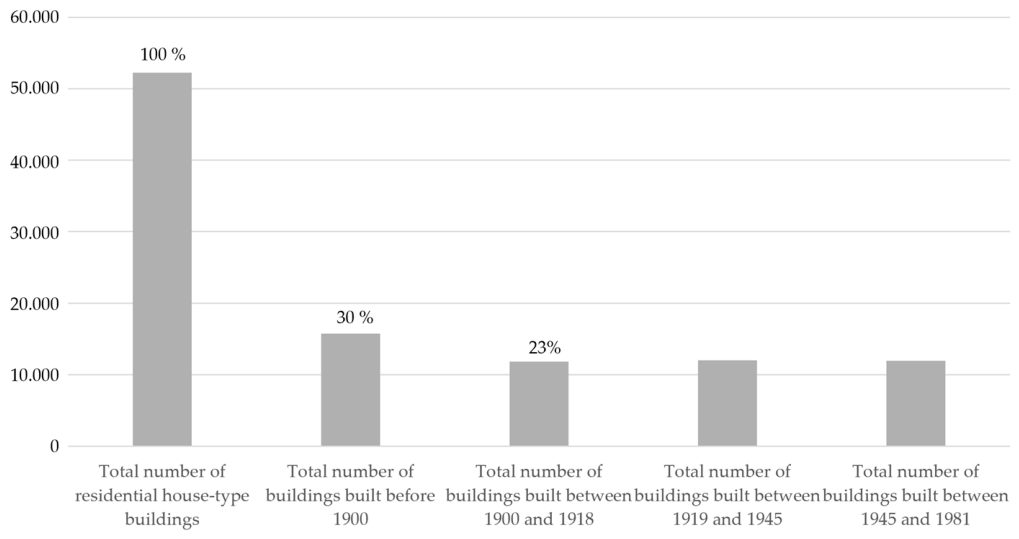
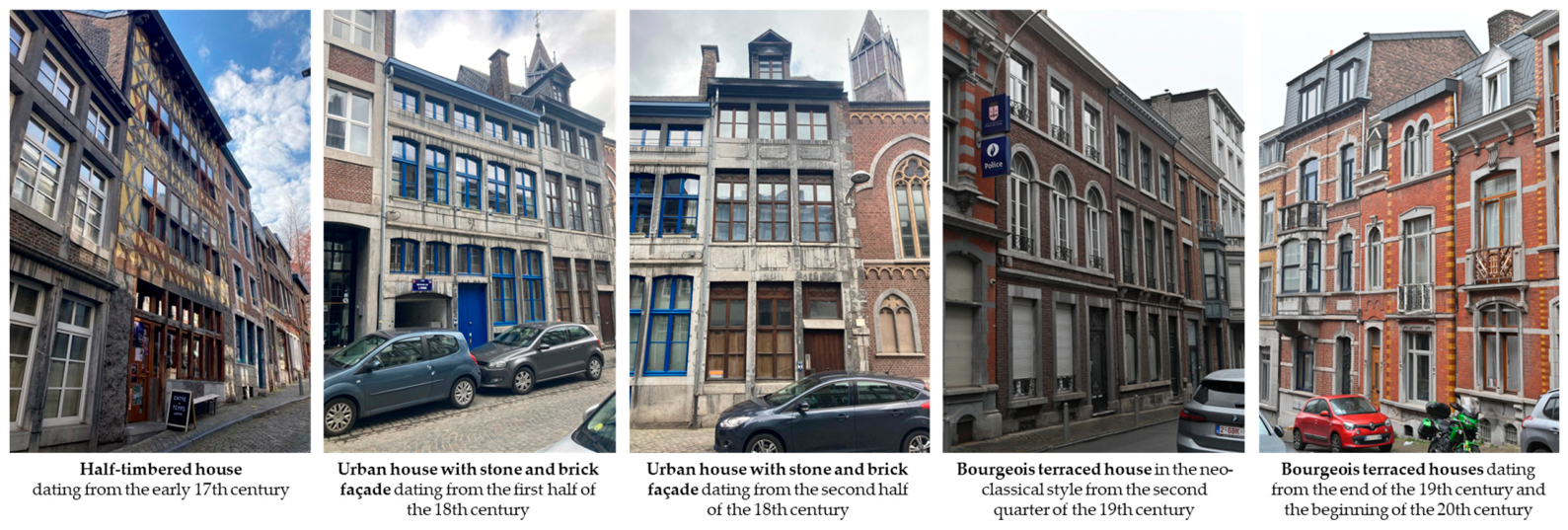
| Case Study | Architectural, Occupancy, Structural, and Constructive Characteristics and Listed Elements |
|---|---|
Case 01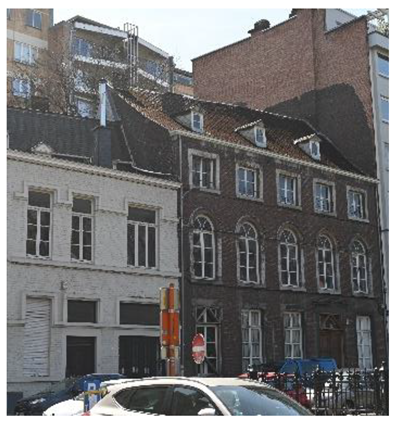 Two listed houses from 13th, 14th, and 16th c. Two listed houses from 13th, 14th, and 16th c.Facade dimensions: 26 × 8 m Floor area: 278 m2 | Architectural characteristics Infirmary erected in 14th c., with two storeys and a rectangular two-cell plan, and built primarily from Mosan limestone blocks. Rear elevation facing the courtyard retaining medieval remains; mid-19th-c. alterations, including partial one-storey raising, extension by one bay, and reconstruction of the street façade into two independent elevations. Accordingly, 19th c. works mainly in brick with structural stone elements (base course, doorway, and window openings). Occupancy Previously dedicated to care functions, including infirmaries and dormitories, they are currently unoccupied. Structural system Combination between stone/brick load-bearing and timber framing walls and wood-framed floor and roof. Main materials Brick masonry, Mosan limestone, Maastricht tuffeau, and wood (mainly hardwood such as oak). Listed elements The entire building is listed. |
Case 02 Fortified house from 16th c. Fortified house from 16th c.Facade dimensions: 16 × 8 m Floor area: around 190 m2 | Architectural characteristics Detached fortified house dated 1512, located at the end of a paved courtyard; based on a rectangular plan with two storeys. Main south-facing façade with two large bays; crossed windows preserved only on the upper floor. Turret present on the southwest corner. Gable roof covered with tiles. Occupancy Residential occupancy for the main part of the building; currently unoccupied. Structural system Brick load-bearing wall (facade and interiors) and wood-framed floor and roof. Main materials Brick masonry, Mosan limestone, and wood (mainly hardwood such as oak). Listed elements All facades are listed, including the turret. |
Case 03 Mansion/residence dating from 16th c. Mansion/residence dating from 16th c.Facade dimensions: 11 × 10 m Floor area: 159 m2 | Architectural characteristics Building dating from 16th to 20th c.; originally 16th c. timber-framed structure and heavily modified in late 17th c. (partial reconstruction and petrification of the timber frame). Front façade (likely late 18th c.) with three storeys and five bays, combining Meuse limestone structural elements with brick masonry; rear façade (17th c.) using the same materials but with a different bay rhythm. Gable end characterized by a timber frame with brick infill. Occupancy Residential occupancy for the main part of the building. Structural system Brick load-bearing walls, timber framing walls, and wood-framed floor and roof. Main materials Brick masonry, Mosan limestone, and wood (mainly hardwood such as oak). Listed elements Front and rear facades, half-timbered gable wall, roof, and entrance porch are listed. |
Case 04 Building from 13th c. Building from 13th c.Facade dimensions: 39 × 15 m Floor area: 152 m2 | Architectural characteristics Priory in 13th c.; military hospital in 18th c.; military barracks in 19th c.; educational facility occupied since early 21st c. Buildings belonging to the former conventional structures, likely dating from 14th c.; four levels organized into seven bays; major alterations in 17th or 18th c. Ground-floor façade in limestone masonry; upper storeys in fired-clay brick Occupancy First religious, then military, and finally, educational. Structural system Combination between stone/brick load-bearing wall and wood-framed floor and roof. Main materials Brick masonry, Mosan limestone (corner quoins, window surrounds, sills, stringcourses, and pediment), Maastricht tuffeau (vaults in the chapter house), and wood (mainly hardwood such as oak). |
Case 05 Bourgeois-type house from 19th c. Bourgeois-type house from 19th c.Facade dimensions: 8 × 13 m Floor area: 59 m2 | Architectural characteristics Built in 1895; minor alterations in 1922 (ground-floor openings on main façade) and spatial reorganization in the 1960s–1970s. Façades in brick masonry coated with brick-colored cement render, with Meuse limestone elements and decorative features. Front façade organized into three equal bays with a door and large openings. Projecting cornice supported by painted wooden brackets. Occupancy Residential Structural system Brick load-bearing wall and wood-framed floor and roof. Main materials Brick masonry, Mosan limestone, and wood (mainly softwood such as spruce). |
Case 06 Military building from late 19th c. Military building from late 19th c.Facade dimensions: 25 × 11 m Floor area: 198 m2 | Architectural characteristics Built in 1898; intended for military use; very few alterations; retains materials and construction systems characteristic of late 19th c. practices. Brick masonry with stone architectural elements and cast-iron columns and beams on the ground floor, structuring the openings. Modifications limited to changes in façade openings, replacement of window frames and doors, and interior refurbishments. Occupancy Previously used for military purposes; currently unoccupied, with a housing rehabilitation project underway. Structural system Combination between brick load-bearing wall and cast-iron structures. Main materials Brick masonry, Mosan limestone (plinth, sills, corner quoins), Belgian blue stone, and cast-iron structure. |
| Designation | Piece | Width [m] | Height [m] | Surface [m2] | Total Surface [m2] |
|---|---|---|---|---|---|
| Façade wall | 1 | 7.92 | 3.06 | 24.24 | 7.25 |
| Windows | −2 | 1.11 | 2.52 | −5.59 | |
| Door | −1 | 1.60 | 3.24 | −5.18 | |
| Stone framing—windows | −2 | / | / | −3.98 | |
| Stone framing—door | −1 | / | / | −2.23 |
| Component | Layers | Layer Description | Layer Thickness | Sublayers | Materials | Proportion in the Layer |
|---|---|---|---|---|---|---|
| Front façade Ground floor Fa Fr Gf | Li | Internal finishing | 0.03 | 1 | Plaster coating | 1 |
| Ls | Structural | 0.36 | 2 | Brick masonry | 0.9 | |
| 3 | Lime mortar | 0.1 | ||||
| Le | External finishing | / | 4 | / | / |
| Front Façade | Basement | Ground Floor | First Floor | Second and Attic Floor |
|---|---|---|---|---|
| Thickness of the wall according to the floor level | 48 to 60 cm | 36 to 48 cm | 36 cm | 24 cm |
| Material | Material Status | Density kg/m3 | Surface Area m2 | Thickness m | Proportion in the Layer |
|---|---|---|---|---|---|
| Plaster coating | Original | 1500 | 18 | 0.05 | 1 |
| Brick masonry | Original | 1800 | 18 | 0.48 | 0.9 |
| Lime mortar | Original | 1600 | 18 | 0.48 | 0.1 |
| / | / | / | / | / | / |
| Material | Material Nature | Waste Fraction | Waste Class | Eurocode |
|---|---|---|---|---|
| Plaster coating | Gypsum/Lime | Plaster | 2 | 17 08 02 |
| Brick masonry | Clay brick | Inert brick | 3 | 17 01 02 |
| Lime mortar | Lime | Mortar | 2 | 17 05 04 |
| / | / | / | / | / |
| Type of Assembly | Reversibility | Simplicity of Disassembly | Speed of Disassembly | Ease of Handling |
|---|---|---|---|---|
| Connection by lime mortar | Reversible with small damages | Simple | Rather slow disassembly | Very easy for brick and small elements |
| Connection by cement mortar | Non-reversible | / | / | / |
| Glued or coated | Non-reversible | / | / | / |
| Mechanical connection with screws | Reversible with small damages | Simple | Speedy, but time required for connection removal | Very easy in general, but dependent on the material dimension and density |
| Mechanical connection with nails and staples | Reversible with damages | Simple | ||
| Free-standing, without connection | Reversible | Very simple | Very speedy |
| Material or Element | Nature | Lifetime (Year) | Robustness to Disassembly | Size, Mass, and Modularity | Existence of Reuse Sector |
|---|---|---|---|---|---|
| Brick | Homogeneous | >100 | Very robust | Small size, light, modular | Yes |
| Wood beam | Homogeneous | >100 | Robust | Large size, heavy, modular | Yes |
| Wood lathing | Homogeneous | 60 to 120 | Not robust | Small size, light, modular | No |
| Sill, natural stone | Homogeneous | >100 | Very robust | Large size, very heavy, not modular | Yes |
| Front Façade | Rear Façade | Pitched Roof | Windows | Slab on Cellar | |
|---|---|---|---|---|---|
| Case 03 | |||||
| Description | Brick masonry with lime mortar. Presence of natural stone. | Brick masonry with lime mortar. Presence of natural stone. | Wooden structure (oak) of five trusses and rafters Wooden battens Slate | Wood frames Single glazing | Wooden floor on joists (ground-supported) Concrete slab beneath the floor in some areas |
| State of conservation | Listed façade with normal aging state, without degradations. | Listed façade with normal aging state, without degradations. | Listed original wood frame in good condition (some woods show wear and deformation), lack of watertightness | Single glazing, window frames in poor condition, lack of airtightness | Floor with normal aging state, without degradation |
| U-value (W/m2K) | 1.26 For a thickness of 0.38 m | 1.26 For a thickness of 0.38 m | 4.5 | 5.38 | 2.63 |
| Case 05 | |||||
| Description | Brick masonry with lime mortar. Presence of natural stone. | Brick masonry with lime mortar. | Wooden structure and rafters Rain-proof layer Wooden lathing Clay roof tiles | Wood frames Simple glazing | Vaulted brick floors. Leveling layer with lime mortar and sand. Cement tile flooring |
| State of conservation | Façade with normal aging state, without degradation. | Façades frame with small degradations. | Wooden structure and covering in good condition | Single glazing, window frames in poor condition, lack of airtightness | Slab with normal aging state, without degradation |
| U-value (W/m2K) | 1.30 For a thickness of 0.36 m | 1.30 For a thickness of 0.36 m | 4.5 | 5.38 | 1.00 |
| Walls | Scenario 01 | Scenario 02 | Scenario 03 |
|---|---|---|---|
| Case 03 | |||
| Front façade | No works | Removal of external finishes Internal insulation (spandrel height) and new finishes | Removal of external finishes Internal insulation (full height) and new finishes |
| Rear façade | No works | Removal of external finishes Internal insulation (spandrel height) and new finishes | Removal of external finishes Internal insulation (full height) and new finishes |
| East façade | Removal of external finishes Internal insulation (full height) and new finishes | Removal of external finishes Internal insulation (full height) and new finishes | Removal of external finishes Internal insulation (full height) and new finishes |
| Pitched roof | Removal of the roof covering (reused). Removal of the wooden lathing Insulation between rafters, with vapor barrier and new layer, rain-barrier membrane, and internal finishes | Removal of the roof covering and wooden lathing. Removal of the wooden structure (30%) Insulation between rafters with vapor barrier and new covering, lathing, rain-barrier membrane, and internal finishes | Removal of the roof covering and wooden lathing. Removal of the wooden structure (50%) External insulation between the wooden frame and the new covering, lathing, rain-barrier membrane, and internal finishes |
| Windows | Replacement of existing frames with high-performance double-glazed wood frames | Replacement of existing frames with high-performance double-glazed wood frames | Replacement of existing frames with high-performance double-glazed wood frames |
| Slab (on ground) | No works | No works | Removal of the wood floor (reused) Insulation between joists + vapor barrier |
| Case 05 | |||
| Front Façade | No works | No Works | Removal of internal finishing and internal insulation (spandrel height) with new finishes |
| Rear Façade | Removal of external finishes External insulation and new finishes | Removal of external finishes Window bay enlargement (30%) External insulation and new finishes | Complete demolition of the rear façade and new façade with wood frame and finishes |
| Pitched Roof | Removal of the roof covering (reused). Removal of the wooden lathing Insulation between rafters, with vapor barrier and new layer, rain-barrier membrane, and internal finishes | Removal of the roof covering and wooden lathing. Removal of the wooden structure (30%) Insulation between rafters with vapor barrier and new covering, lathing, rain-barrier membrane, and internal finishes | Removal of the roof covering and wooden lathing. Removal of the wooden structure (50%) External insulation between the wooden frame and the new covering, lathing, rain-barrier membrane, and internal finishes |
| Windows | Replacement of existing frames with high-performance double-glazed wood frames | Replacement of existing frames with high-performance double-glazed wood frames | Replacement of existing frames with high-performance double-glazed wood frames |
| Slab (on cellar) | No works | No works | Removal of floor finishes and leveling mortar and rigid insulation with new dry screed board |
| Built Area | 40 < m2 < 85 | |||||
|---|---|---|---|---|---|---|
| Construction period | bef. 1850 | 1850–1874 | 1875–1899 | 1900–1918 | aft. 1918 | |
| Nb of facades | Nb of floors | |||||
| 2 facades | +2 | 1145 parcels | 3755 parcels | 5452 parcels | ||
| +3 | Case 05 1347 parcels | |||||
| 3 facades | +2 | 139 parcels | 274 parcels | 365 parcels | ||
| +3 | ||||||
| Type of Tools | Speed, Precision, and Cost | Raw Data Collected | Data Processed | Information Obtained |
|---|---|---|---|---|
| Image sensor Drone and camera | Medium speed High precision Low cost | Images Videos | High-precision mesh, orthophotos, and a 3D model. | A precise view of the materials used and an understanding of the wall’s overall relief and texture. |
| Terrestrial LiDAR sensor Leica BLK | Low speed High precision Medium cost | High-precision point cloud | Image showing reflected-light intensity and sectional views within the point cloud for generating plans and cross-sections. | Visualization of the materials present and production of plans and sections for potential quantity surveys. |
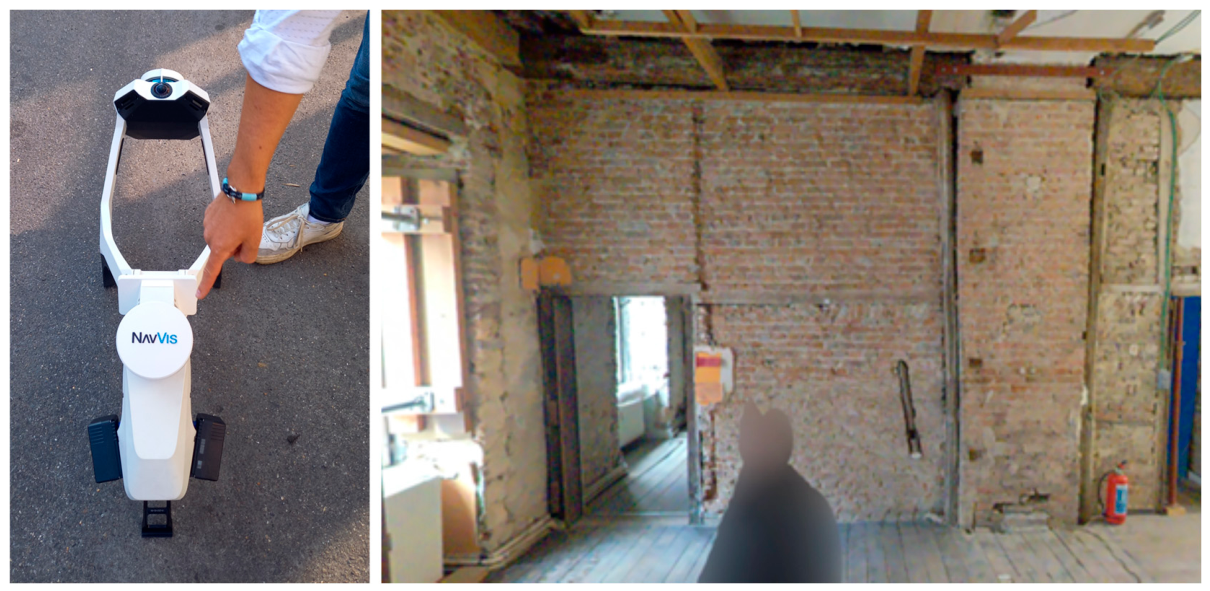
| Image and SLAM sensor NAVVIS VLX | High speed Medium precision High cost | Point cloud 360° panoramic images | Color or intensity images, model navigation, and generation of sections and cross-sections. | Lower-accuracy visualization of materials and assemblies, and production of plans and sections for potential quantity surveys. |
| Total | Windows | Wood | Brick | Rubble Stone | Stone | ||
|---|---|---|---|---|---|---|---|
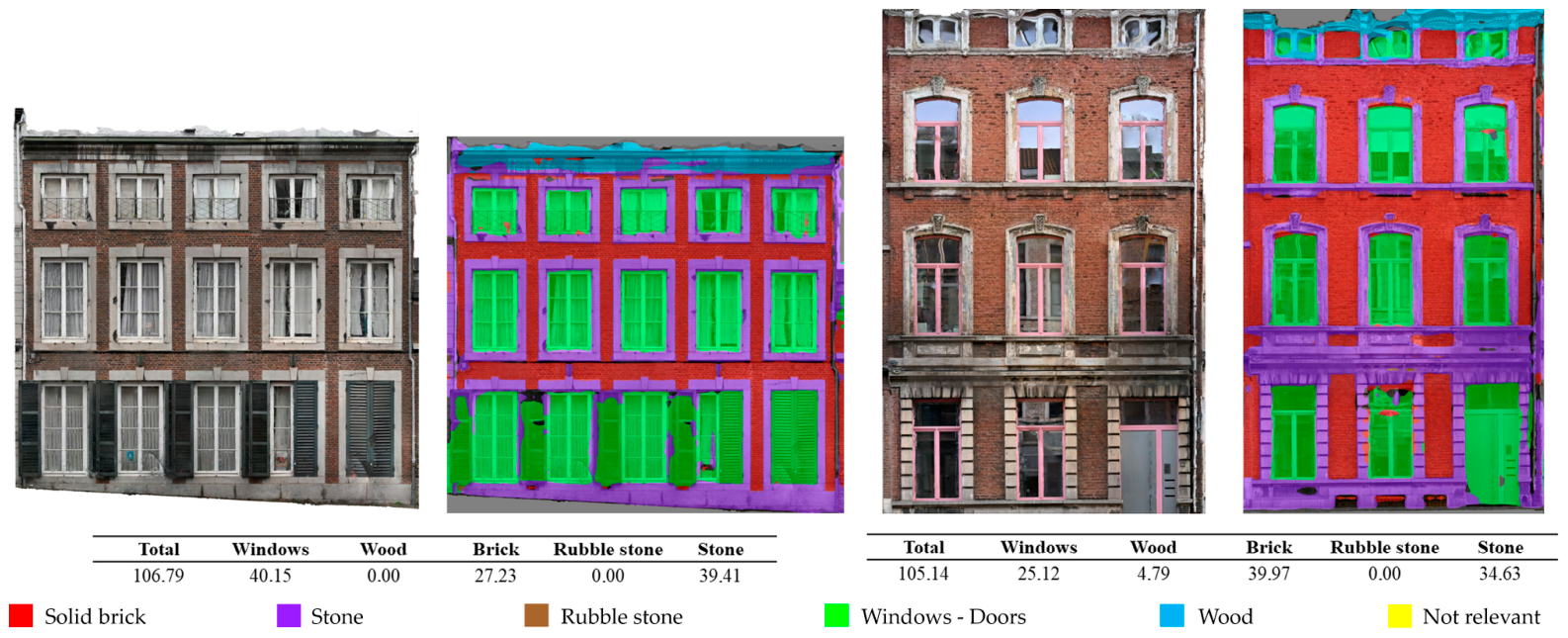
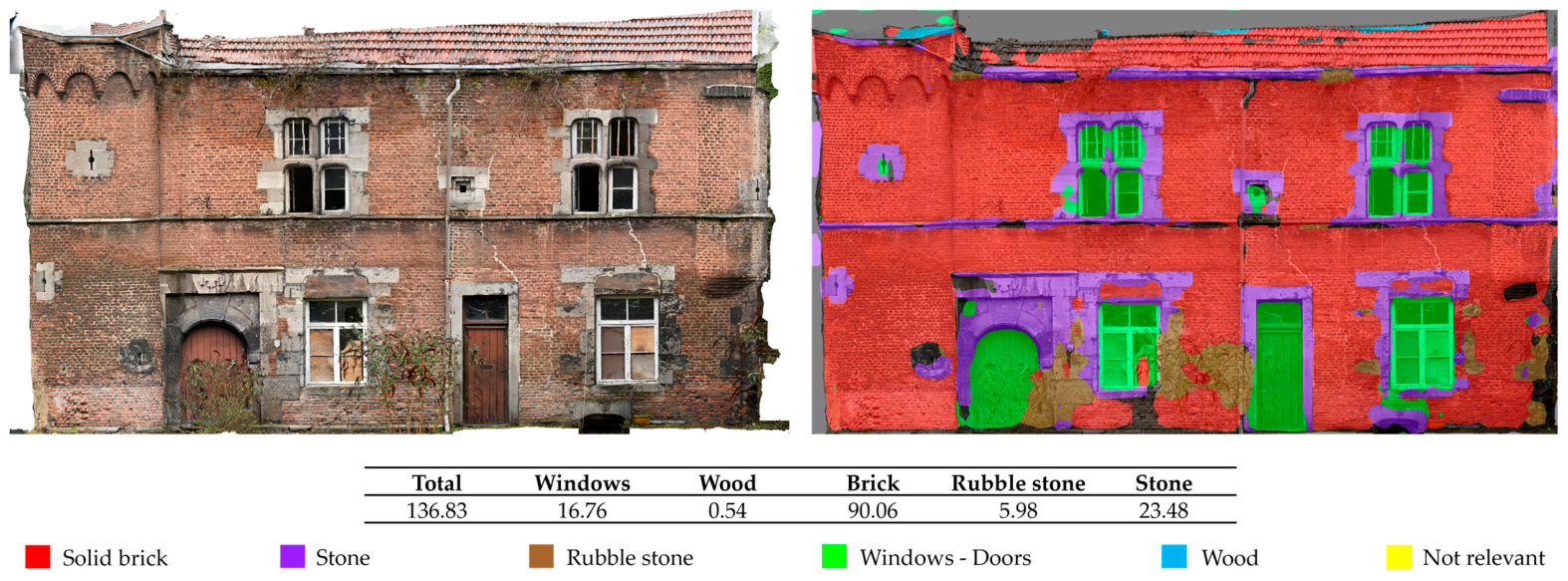
| Case 03 | Areas from inventory | 106.79 | 40.15 | 0.00 | 27.23 | 0.00 | 39.41 |
| Areas calculated by the AI model | 110.30 | 44.61 | 6.15 | 22.44 | 0.00 | 37.05 | |
| Difference in % | −3% | −11% | 100% | 18% | / | 6% | |
| Case 05 | Areas from inventory | 105.14 | 25.12 | 4.79 | 39.97 | 0.00 | 34.63 |
| Areas calculated by the AI model | 103.59 | 27.76 | 4.54 | 35.46 | 0.03 | 35.8 | |
| Difference in % | 1% | −11% | −6% | 11% | / | −3% |
Disclaimer/Publisher’s Note: The statements, opinions and data contained in all publications are solely those of the individual author(s) and contributor(s) and not of MDPI and/or the editor(s). MDPI and/or the editor(s) disclaim responsibility for any injury to people or property resulting from any ideas, methods, instructions or products referred to in the content. |
© 2026 by the authors. Licensee MDPI, Basel, Switzerland. This article is an open access article distributed under the terms and conditions of the Creative Commons Attribution (CC BY) license.
Share and Cite
Trachte, S.; Noël, O.; Boutet, S.; Sosnowska, P.; Hallot, P. URMIBALI Research Project: Exploring How Digital Documentation Technologies Can Enhance Knowledge and Support the Reuse of Materials in Traditional and Historic Buildings Within an Urban Mining Approach. Appl. Sci. 2026, 16, 6527. https://doi.org/10.3390/app16136527
Trachte S, Noël O, Boutet S, Sosnowska P, Hallot P. URMIBALI Research Project: Exploring How Digital Documentation Technologies Can Enhance Knowledge and Support the Reuse of Materials in Traditional and Historic Buildings Within an Urban Mining Approach. Applied Sciences. 2026; 16(13):6527. https://doi.org/10.3390/app16136527
Chicago/Turabian StyleTrachte, Sophie, Ophélie Noël, Simon Boutet, Philippe Sosnowska, and Pierre Hallot. 2026. "URMIBALI Research Project: Exploring How Digital Documentation Technologies Can Enhance Knowledge and Support the Reuse of Materials in Traditional and Historic Buildings Within an Urban Mining Approach" Applied Sciences 16, no. 13: 6527. https://doi.org/10.3390/app16136527
APA StyleTrachte, S., Noël, O., Boutet, S., Sosnowska, P., & Hallot, P. (2026). URMIBALI Research Project: Exploring How Digital Documentation Technologies Can Enhance Knowledge and Support the Reuse of Materials in Traditional and Historic Buildings Within an Urban Mining Approach. Applied Sciences, 16(13), 6527. https://doi.org/10.3390/app16136527