1. Introduction
Functional foods are defined as food products that provide health benefits beyond basic nutritional value, contributing to the prevention of chronic diseases and improvement of physiological functions [
1,
2]. Their efficacy depends not only on the presence of bioactive compounds but also on their stability, concentration, and interactions within the food matrix [
1,
2,
3,
4]. In this context, plant-based foods have gained increasing attention due to their nutritional value, sustainability, and consumer acceptance [
5].
Hummus, a traditional spread based on chickpeas (
Cicer arietinum L.), represents a nutritionally dense food rich in plant proteins, dietary fiber, and unsaturated fatty acids [
3,
4,
5,
6,
7,
8,
9,
10]. Regular consumption of chickpeas and hummus has been associated with improved diet quality, enhanced glycemic control, and increased satiety [
11,
12]. In addition, chickpea-derived bioactive compounds, such as phenolics and peptides, exhibit antioxidant activity, contributing to the functional properties of the product [
13]. Despite these advantages, hummus is a highly perishable product due to its relatively high water activity and nutrient-rich composition, which favor microbial growth and physicochemical instability [
14,
15,
16]. Moreover, the presence of unsaturated lipids makes it particularly susceptible to oxidative degradation, which negatively affects sensory quality and nutritional value during storage [
17,
18]. Therefore, improving oxidative stability while maintaining product quality remains a key challenge in hummus production.
Black cumin seed oil (
Nigella sativa) is recognized for its high content of bioactive compounds, including thymoquinone, phenolic compounds, and essential fatty acids, which exhibit antioxidant and antimicrobial properties [
19,
20,
21]. The fatty acid profile of this oil is dominated by polyunsaturated fatty acids, particularly linoleic acid, which has been associated with beneficial effects on cardiovascular health and metabolic regulation [
22,
23,
24,
25,
26]. In addition, cold-pressed oils retain natural antioxidants that may contribute to improved oxidative stability in food systems [
27,
28]. However, their behavior in complex matrices such as oil-in-water emulsions is influenced by interfacial interactions and environmental conditions, making oxidation processes more complex [
29]. Consumer demand for clean-label and plant-based functional foods has significantly increased, particularly for products associated with the Mediterranean dietary pattern and minimally processed formulations [
11,
14,
16]. Hummus is widely perceived as a natural and healthy product due to its traditional composition and the absence of synthetic additives [
30,
31]. However, despite its increasing market popularity, hummus remains a technologically challenging product because of its relatively short shelf life, high water activity, susceptibility to microbial spoilage, and oxidative instability during storage [
32]. The technological stability of hummus largely depends on the interactions between chickpeas, tahini, oils, and acidic ingredients, which collectively influence emulsion stability, oxidation processes, texture, and overall product quality during storage [
33]. Therefore, there is increasing industrial interest in the incorporation of natural bioactive ingredients capable of improving both functional and oxidative stability while maintaining clean-label characteristics and consumer acceptability.
In parallel with product development, rapid and reliable analytical techniques are required for food quality assessment. Near-infrared (NIR) spectroscopy is a widely used non-destructive method based on the absorption of electromagnetic radiation by molecular bonds such as C–H, O–H, and N–H [
34,
35]. It enables fast prediction of key compositional parameters, including fat, protein, and moisture content, without extensive sample preparation [
33]. Although NIR spectroscopy has been successfully applied in various food systems, its application in complex plant-based spreads enriched with bioactive oils remains insufficiently explored.
Therefore, the aim of this study was to develop a functional hummus enriched with black cumin seed oil (BSO) and to evaluate its physicochemical properties and oxidative stability during storage. Additionally, the applicability of NIR spectroscopy for rapid and non-destructive quality assessment of such systems was investigated.
2. Materials and Methods
2.1. Method for Hummus Preparation
In the preparation of hummus formulations, the following ingredients were included: boiled chickpeas, the cooking water of the chickpeas, tahini, organic apple cider vinegar, Himalayan pink salt, and cold-pressed oils. The hummus formulations were prepared through a multistep process. Chickpea grains were initially hydrated by soaking in water for approximately 8 h, followed by boiling for around 2.5 h until a soft texture was achieved. After cooking, a portion of the cooking liquid (aquafaba) was retained for further use in the formulation. The hummus matrix consisted of cooked chickpeas, aquafaba, tahini, salt, and organic apple cider vinegar, while the lipid phase was prepared using different proportions of cold-pressed olive oil and cold-pressed black cumin seed oil. Five formulations were produced in total. The control formulation (HC) contained olive oil as the sole lipid source, whereas in formulations HBSO4, HBSO6, HBSO8, and HBSO12, black cumin seed oil replaced part of the oil phase at levels of 4%, 6%, 8%, and 12%, respectively. The selected substitution levels were chosen to allow evaluation of a gradual incorporation of black cumin seed oil while maintaining product stability and sensory acceptability. In addition, the levels were kept within a range consistent with reported dietary intake of black cumin seed oil, which is generally considered safe at low daily consumption levels [
11]. Mohammed et al. [
36] further reported thymoquinone content in
Nigella sativa oil and its relevance in non-toxic dosage ranges, supporting the use of low inclusion levels in food applications.
After weighing, all ingredients were mixed using an industrial mixer in order to obtain the characteristic smooth and creamy consistency of hummus. The final product was packed into 200 g glass jars fitted with screw metal lids. Prior to use, the jars and lids were washed with warm water and detergent, rinsed with distilled water, and additionally sanitized under UV light exposure. Immediately after filling, the containers were sealed. Pasteurization was carried out in a water bath at 63–65 °C for 30 min. Following thermal treatment, the samples were stored under refrigerated conditions (4 ± 1 °C), and analyses were performed on storage days 0, 7, 14, and 21.
Olive oil was used as the sole lipid source in the control sample (HC, 0%), while in the experimental samples, black cumin seed oil (BSO) was incorporated by proportionally reducing the olive oil content at concentrations of 4% (HBSO4), 6% (HBSO6), 8% (HBSO8), and 12% (HBSO12). All ingredients were blended until a homogeneous paste was obtained, as in the study of Delinikolova and Jankuloska [
37]. The final product was packaged in 200 g glass jars, sealed with lids, subjected to thermal treatment at 63–65 °C for 30 min (measured from the moment the target temperature inside the product was reached), and stored at 4 °C during the monitoring period.
Experiment Progress and Oil Substitution in the Humus Spread
The aim of this study was to investigate the effect of partial replacement of olive oil with black cumin seed oil on the physicochemical profile of hummus. The substitution was performed within the oil fraction of the formulation, while the total amount of added oil remained constant. Five different formulations were prepared, in which black cumin seed oil replaced olive oil at levels of 4, 6, 8, and 12% of the total oil component. The control sample contained only olive oil (0% v/v of BSO), while in the other samples, a corresponding portion of olive oil was replaced with black cumin seed oil. All other ingredients were kept constant to ensure that the only variable affecting the fatty acid composition was the ratio of the two oils.
The total oil content in the formulation was maintained at 6.8% per batch. All hummus samples were prepared according to the procedure described in
Section 2.1. After preparation, samples were stored under refrigerated conditions until further chemical, microbiological, and spectroscopic analyses were performed.
2.2. Chemical Composition Analysis
2.2.1. Determination of Total Fats and Fatty Acid Composition in a Hummus Sample
The fats in the hummus sample were determined using a modified Soxhlet method. From the homogenized sample, 10 g of hummus were weighed into a glass flask, after which 45 mL of boiling distilled water and 55 mL of 25% hydrochloric acid (HCl) were added. The mixture was hydrolyzed by boiling over a moderate flame for 20–30 min.
After cooling, the sample was filtered, and the solid residue was rinsed several times with hot distilled water. The residue was dried at 103–105 °C until a constant mass was achieved. The dried filter with the residue was formed into a rectangular packet and transferred into the Soxhlet apparatus. In the extraction flask, 150 mL of petroleum ether was added, and the extraction was carried out for at least 4 h. After completion, the petroleum ether was removed by predistillation, and the extraction flask with the extracted fats was dried at 103–105 °C for 30 min. Then, the flask was cooled in a desiccator, and its mass was measured. Fat content in humus samples was determined by acid hydrolysis followed by Soxhlet extraction (Weibull–Stold method), in accordance with the official method AOAC 922.06 [
38] and ISO 8262-1 [
39], following the laboratory procedure described by Trajković et al. [
40].
Fatty Acid Composition Analysis
The fatty acid composition of the hummus lipid fraction was determined according to ISO 12966-4:2015 [
41], following preparation of fatty acid methyl esters (FAMEs) in accordance with ISO 12966-2:2017 [
42]. FAMEs were analyzed using gas chromatography with a flame ionization detector (GC-FID). Separation was performed on a capillary column (100 m × 0.25 mm × 0.20 µm) with a highly polar stationary phase (100% cyanopropyl polysiloxane, CP-Sil 88 or equivalent). Hydrogen was used as the carrier gas at a flow rate of approximately 1.0 mL/min. The injector and detector temperatures were set at 250 °C. Samples were injected in split mode (1:100), with an injection volume of 1 µL.
The oven temperature program was as follows: initial temperature 120 °C (held for 1 min), increased to 175 °C at 10 °C/min (held for 10 min), followed by an increase to 240 °C at 3–4 °C/min with a final holding time of 7–15 min. Individual fatty acids were identified by comparison of retention times with certified FAME standards (C8–C24). Results were expressed as relative percentages (%) of total identified fatty acids.
2.2.2. Protein, Moisture, and Ash Determination
The protein content of hummus was determined using the Kjeldahl method [
43,
44], which is a standard reference method for nitrogen determination in food systems. The nitrogen content was converted to protein using a factor of 6.25, which is commonly applied for composite food products to ensure comparability with published data. It is acknowledged that the use of a universal conversion factor may introduce some uncertainty in plant-based matrices due to differences in amino acid composition and non-protein nitrogen content [
42]. However, no universally accepted specific conversion factor exists for hummus as a mixed matrix; therefore, the standard factor 6.25 was considered appropriate [
43].
Moisture content was determined (according to the AOAC 925.10) by oven drying at 105 °C until constant weight was achieved [
45]. Due to the presence of proteins and carbohydrates capable of binding water, the ethanol–sand modification of the method was applied. Approximately 3–5 g of the homogenized hummus sample was weighed into previously dried and weighed aluminum dishes with lids. About 30 g of washed and ignited sand and 15 mL of 96% ethanol were added to each dish. The mixture was evaporated twice on a water bath at 50–60 °C in order to facilitate water removal and prevent sample crust formation. After pre-evaporation, the dishes were transferred to a drying oven and dried at 105 ± 2 °C until constant mass was achieved (approximately 1.5 h). Following drying, the dishes were cooled in a desiccator for approximately 1 h and weighed with an accuracy of ±0.001 g.
Ash content was determined by incineration in a muffle furnace at 550 °C until a white/grey residue was obtained [
40,
45,
46]. For the analysis, approximately 5 g of homogenized sample was transferred into porcelain crucibles previously ignited and weighed to a constant mass. The samples were first subjected to preliminary carbonization over a low flame in order to reduce excessive smoke formation, after which complete incineration was performed in a muffle furnace at 550 ± 25 °C until a light grey residue and constant mass were obtained. Following incineration, the crucibles were cooled in a desiccator and weighed with an analytical precision of ±0.001 g.
All analyses were performed in duplicate, and results were expressed on a fresh weight basis.
2.2.3. Determination of Carbohydrates in a Hummus Sample (Calculative Method)
The carbohydrate content of hummus samples was determined by calculation as the difference between the total sample mass and the sum of the previously determined major components, according to the approach proposed by [
47]. The calculation included the experimentally determined values for moisture, protein, fat, and ash content.
The carbohydrate content was calculated using the equation:
The results were expressed as the mass percentage (%) of total carbohydrates in fresh hummus samples.
2.2.4. Determination of Dietary Fiber Content in a Hummus Sample
The dietary fiber content in the hummus sample was determined according to the standard enzymatic–gravimetric method AOAC 991.43 [
48]. From the homogenized sample, 8–10 g of hummus were weighed into an aluminum dish for drying, after which the sample was dried at 105 °C for 4 h. From the dried sample, 1 g was weighed into two previously measured 250 mL glass beakers—one for determining proteins and the other for determining ash. The sample was subjected to enzymatic digestion with the successive application of α-amylase, protease, and amyloglucosidase, in order to remove starch and proteins. First, the sample was incubated with thermostable α-amylase in MES–Tris buffer (pH 8.2) at 100 °C for 30 min for starch degradation. Afterward, protease was added, and the mixture was incubated at 60 °C for 30 min for protein hydrolysis. Finally, amyloglucosidase was added, and the mixture was again incubated at 60 °C for 30 min for the conversion of the remaining starch into glucose. After completion of the enzymatic digestion, the mixture was filtered through a glass filtration crucible of the Gooch type (P2), previously ignited in a furnace together with approximately 1 g of celite.
The insoluble dietary fibers (
IDF) remained on the filter, after which they were dried at 105 °C to constant mass, cooled in a desiccator, and weighed. The dried residue from one of the crucibles was used to determine protein content (ensuring that celite was not included), while the other crucible with the dried residue was ignited at 525 °C to determine the ash content. The filtrate was precipitated with 95% ethanol (fourfold volume) at 60 °C, left to stand for 1 h, filtered, dried, and weighed to determine the soluble dietary fibers (
SDF). The total dietary fibers (
TDF) were obtained as the sum of the soluble and insoluble fractions:
The results were expressed as mass percentage (% TDF, SDF, IDF) in the fresh hummus sample, after subtracting the ash and protein contents from the residues.
2.2.5. Determination of Peroxide Value According to Wheeler
The peroxide value in the extracted lipid fraction from hummus was determined according to the Wheeler method, which is based on the liberation of iodine through the reaction of peroxides with iodide in an acidic medium, after which the released iodine is titrated with sodium thiosulfate. Concentrated glacial acetic acid and chloroform were freshly mixed in a 3:2 ratio to prepare the peroxide reagent. A saturated potassium iodide solution (freshly prepared, 1.5 g KI per 1 mL distilled water), a 1% starch solution as an indicator, and 0.01 M sodium thiosulfate were also used in the procedure. Then, 1 g of the extracted oil was weighed into a 100 mL Erlenmeyer flask with a stopper, after which 10 mL of the peroxide reagent and 0.2 mL of freshly prepared potassium iodide solution were added. The mixture was gently shaken for one minute and then left to stand in the dark for one minute. Subsequently, 20 mL of distilled water and several drops of starch indicator were added, resulting in a violet coloration. The titration was performed with 0.01 M sodium thiosulfate until the color completely disappeared. A blank determination was carried out simultaneously.
The peroxide value was calculated according to the following expression:
where:
A—volume of sodium thiosulfate used for the sample (mL),
B—volume used for the blank (mL),
m—mass of the oil sample (g).
The factor 5 corresponds to the standard recommended sample mass of 5 g for this method; if a different mass is used, the value is corrected proportionally.
For obtaining the lipid fraction required for peroxide value determination, exactly 5 g of homogenized hummus was weighed into a 25 mL centrifuge tube with a cap. To the sample, 15 mL of hexane was added, and the mixture was shaken for 1 min. Then, 10 mL of 2-propanol (isopropanol) was added, and the mixture was shaken again for 1 min. The tube was left to stand for 30 min and then centrifuged for 10 min at 3000 rpm. The upper clear liquid layer (lipid phase) was carefully transferred into a pre-weighed Erlenmeyer flask. The hexane was removed using a rotary evaporator until fully evaporated, and the remaining lipid fraction was dried in an oven at 105 °C for 1 h. After cooling in a desiccator, the flask was weighed, and the difference in mass represented the exact quantity of oil used for the determination of the peroxide value.
After the extraction, the procedure continued according to the Wheeler method as described above.
2.3. Physicochemical Properties
Determination of Water Activity (aw) in a Hummus Sample
The water activity (aw) of the hummus sample was determined using a Novasina water activity meter (Lachen, Switzerland). Prior to measurement, the device was calibrated with standard salts of known aw values (~0.75 at 25 °C), in accordance with the manufacturer’s instructions.
An appropriate amount of homogenized hummus sample was placed in the measuring chamber of the device, ensuring that the sample covered the bottom of the sample cup in an even layer, without air bubbles or voids. The chamber lid was closed, and the device automatically monitored the stabilization of the water activity. Once a stable signal was achieved, the aw value was recorded. The results were expressed as the water activity (aw) of the fresh hummus sample.
2.4. Spectroscopic Analysis
Near-infrared (NIR) spectra of hummus samples were recorded in order to obtain spectral information related to their chemical composition. Prepared hummus spread samples were recorded with the benchtop NIR device AvaSpec-NIR256-2.5-HSC-EVO (Avantes Inc., Lafayette, LA, USA). The wavelength range of the instrument is 1000–2500 nm, and the AvaSoft-Basic software v. 8.12 (Avantes, Apeldororn, The Netherlands) was used for spectra analysis. Each hummus sample was scanned three times in order to reduce instrumental noise and improve repeatability. The obtained spectra were presented as absorbance values as a function of wavelength.
Raw spectra contained overlapping bands and background variations typical of complex food matrices; therefore, spectral pre-processing was required before further analysis. Common pre-processing techniques such as smoothing, normalization, and derivative transformation were applied to minimize the influence of scattering effects and baseline shifts and to enhance spectral features relevant to chemical composition [
32].
2.5. Data Analysis and Chemometry
Three softwares were used for data analysis: (i) XLStat v. 2021.5 (Addinsoft, New York, NY, USA)—for the data analysis, (ii) Orange software v. 3.40 (Bioinformatics Laboratory, Faculty of Computer and Information Science, University of Ljubljana, Ljubljana, Slovenia)—for data visualisation, and (iii) the Unscrambler X 10.5.1 (CAMO, Oslo, Norway) for chemometric modelling. All measurements were conducted in triplicate, and data are presented as mean ± standard deviation. Prior to ANOVA, assumptions of normality and homogeneity of variance were verified using Shapiro–Wilk and Levene’s tests, respectively. Where significant effects were detected (p < 0.05), A two-way factorial ANOVA was performed using storage time (Day) and BSO concentration as fixed factors. When significant effects were detected, pairwise comparisons were performed using Tukey’s HSD post hoc test. Tukey’s method was selected because it is appropriate for balanced factorial experimental designs and controls family-wise type-I error. In cases of minor deviations, the robustness of the statistical methods was considered acceptable due to the balanced experimental design.
Factorial ANOVA was used to assess the main and interaction effects of the investigated factors, while the Linear Mixed Model (LMM) was applied to account for potential within-sample variability across storage time.
The effects of BSO addition and storage time on the chemical composition of hummus were analyzed using a two-way factorial analysis of variance (factorial ANOVA). The experiment included two factors: (i) BSO concentration (% v/v): 0, 4, 6, 8, 12, and (ii) storage time (days): 1, 7, 14, 21.
Dependent variables included physicochemical parameters and nutritional properties. The factorial ANOVA model assessed the main effects of each factor and their interaction effect (BSO × storage time) on each response variable. Also, data were analyzed using LMM to account for the fixed effects of storage time (Day) and oil concentration (BSO), as well as their interactions. The Type III Sum of Squares with Satterthwaite’s approximation for degrees of freedom was used to determine the significance of the fixed effects. The use of LMM for this study is due to the longitudinal structure of the dataset, allowing for more reliable estimation of fixed effects in the presence of repeated measurements across storage time.
Due to the complexity of spectral data obtained by NIR spectroscopy, multivariate statistical methods were applied to extract meaningful information and to establish relationships between spectral data and physicochemical parameters of the samples. This approach ensures comparability among variables and facilitates the identification of dominant factors contributing to sample differentiation. Principal Component Analysis (PCA) was performed using the Pearson correlation matrix to ensure that all physicochemical parameters were equally weighted regardless of their units of measurement (standardization to 1/SD).
For quantitative modelling, partial least squares (PLS) regression was applied to correlate NIR spectra (1020–2450 nm) with reference analytical values obtained by classical chemical methods and internally validated using cross-validation (leave-one-out). The optimal number of latent variables was selected based on the lowest cross-validation error. Leave-one-out cross-validation was selected due to the relatively limited dataset size, providing an internally consistent evaluation of model performance while minimizing the risk of overfitting. Calibration models were developed using a set of samples with known composition, and their performance was evaluated by calculating statistical parameters [
49] such as the coefficient of determination (R
2), root mean square error of calibration and validation (RMSE), Range error ratio (RER), and Ratio of Standard Error of Performance and Standard Deviation (RPD).
3. Results
By knowing the proportion of humus components (
Section 2.1), it is possible to calculate the energy and nutritional composition using the USDA Food Composition Database, FCDB (
https://fdc.nal.usda.gov/download-datasets), accessed on 15 March 2026. Based on the ingredients, the basic hummus dip (0% of added BSO) would contain following information: energy (864 kJ/100 g), total fat (12.6 g/100 g), saturated fatty acids (1.7 g/100 g), ratio of saturated to total fat (13.7%), energy derived from saturated fatty acids (64 kJ/100 g), salt (0.8 g/100 g), fiber (5.2 g/100 g), and protein (6.7 g/100 g). All values were expressed per 100 g of product and were used as input parameters for the Nutri-Score algorithm. However, an extremely important change occurs in the proportion of fatty acids, which is listed in
Table 1.
Black cumin seed oil lowers Monounsaturated fatty acids (MUFA) (oleic drop) and raises polyunsaturated fatty acids (PUFA) (linoleic boost ~65%), with minor SFA adjustment; other macros unchanged (according to calculation by use of FCDB). More black cumin seed oil shifts the fat profile toward higher PUFA and lower MUFA, with SFA staying fairly similar.
Values use USDA-derived profiles (tahini contributes ~40% fat, olive 56%); low substitution levels cause negligible shifts in per 100 g due to dilution across total mass. When the relative proportion of PUFAs increases in the diet (for example, by adding more PUFA-rich oils such as flaxseed, fish oil, or certain seed oils), this changes the overall fatty acid composition of the consumed fats. MUFAs may also decline if PUFAs replace a portion of them [
24,
36]. Higher PUFA intake is associated with health benefits, including anti-inflammatory actions and potential improvements in markers associated with chronic disease risk. Some types of PUFAs, notably omega-3 fatty acids (a subclass of PUFAs), are linked to reduced cardiovascular risk and modulate metabolic and inflammatory pathways [
24,
50].
In order to determine the changes in samples in which the oil component was partially replaced with black cumin seed oil, a factorial ANOVA was conducted. Thus,
Table 2 shows the factorial ANOVA data for basic physicochemical parameters.
The results (
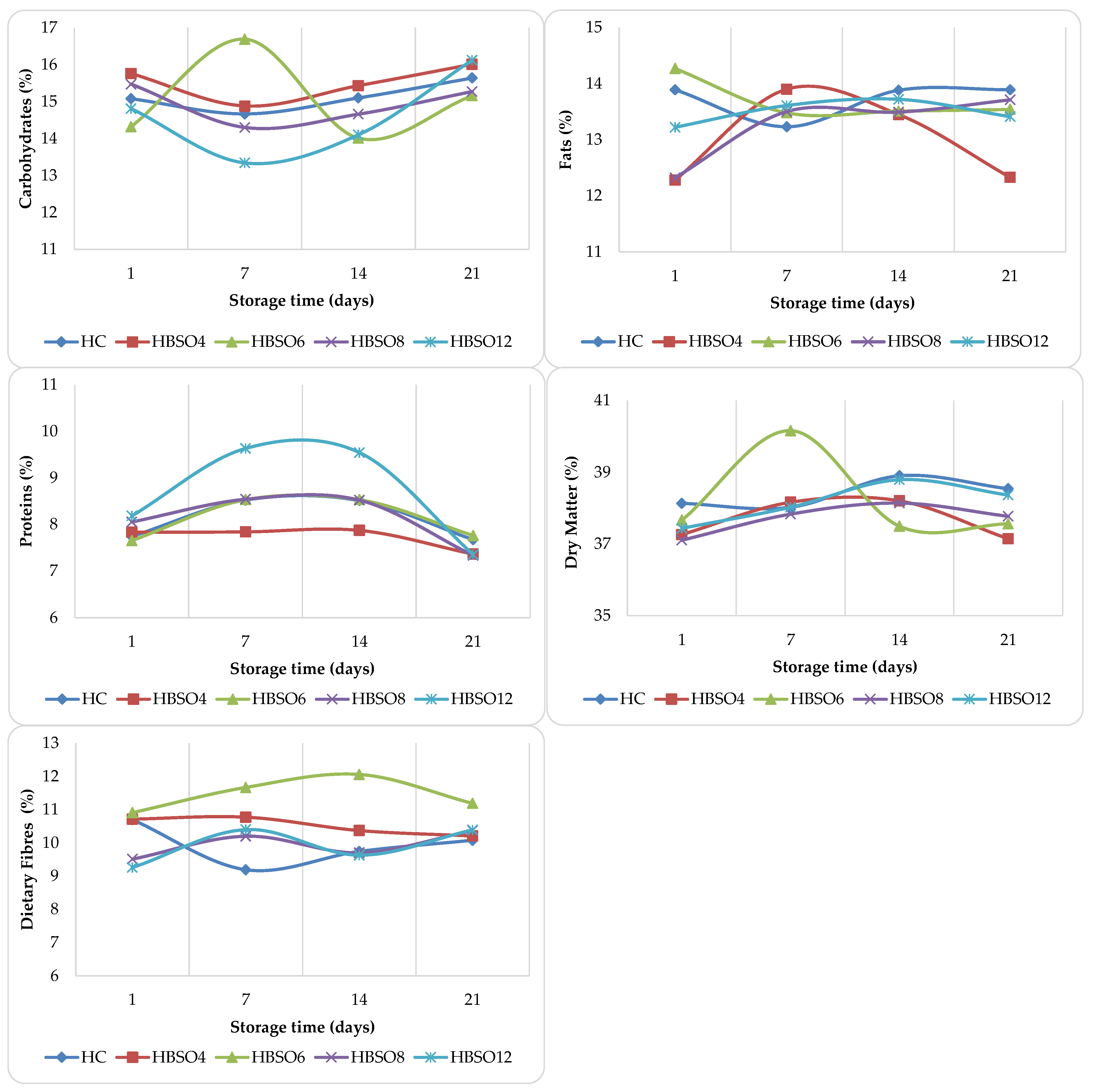
Table 2) indicate that the incorporation of BSO does not significantly affect the structural stability of the hummus matrix, suggesting good technological compatibility with the base formulation. Visualization of time as a function of the variables is presented in
Figure A1. The formulations exhibited different temporal dynamics during storage (1–21 days), indicating that different BSO concentrations have an influence on the stability behavior of the hummus matrix. This is further supported by the physicochemical and nutritional composition of hummus spreads enriched with different concentrations of black cumin seed oil (BSO) during a 21-day storage period, which demonstrates nutritional stability. The macronutrient profile (fat, protein, and carbohydrate) remained remarkably stable across all formulations. Although minor statistical differences were observed (
p < 0.05), these can be attributed to the inherent variability of the semi-industrial batch processing rather than systematic degradation. For example, the dry matter content fluctuated within a narrow range (37.1% to 40.16%), confirming the robustness of the hummus emulsion even with high BSO incorporation rates (up to 12%
v/
v). The addition of BSO did not lead to a linear decrease in fat or protein content, suggesting that the black cumin seed oil was well integrated into the chickpea and tahini matrix without causing phase separation. Protein levels showed a slight increase in the middle of storage (days 7 and 14) in several batches, which may be related to the stabilization of nitrogen compounds in the presence of the antioxidant BSO. Dietary fiber remained consistent (~9–12%), which is crucial for the functional identity of the product. The stability of dry matter and fiber content indicates that no significant syneresis (water loss) occurred during 21 days of refrigerated storage, which is a common challenge in pilot production.
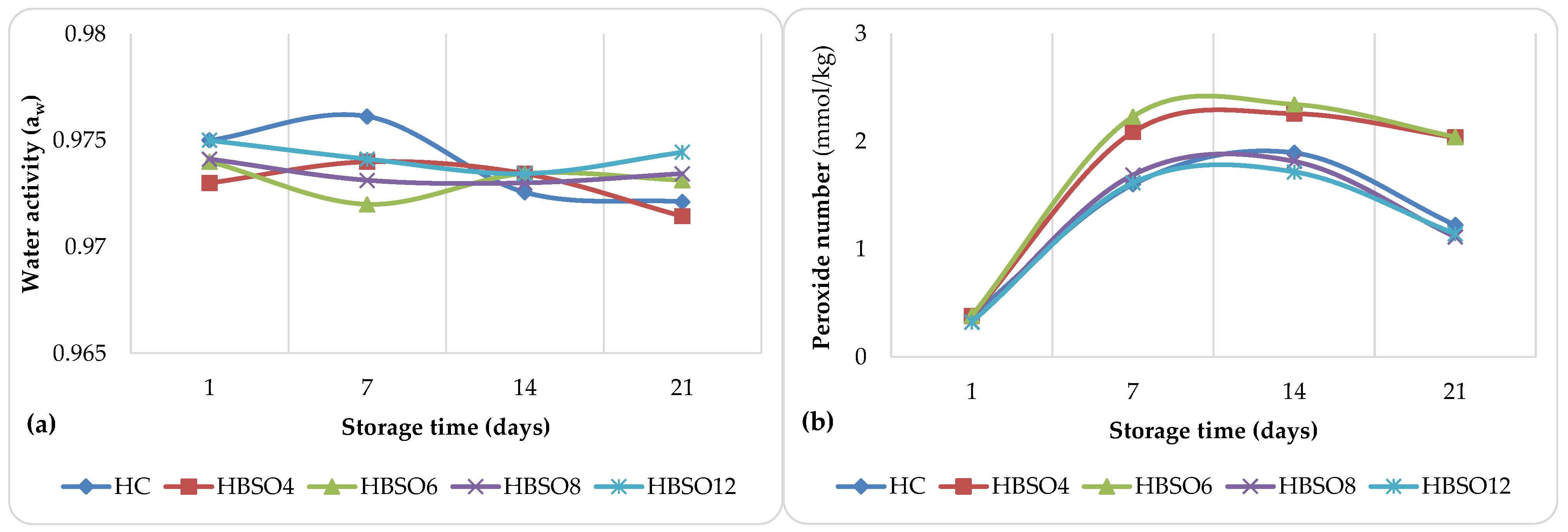
Changes in peroxide value and water activity, depending on the added BSO fraction, but also over the monitored time (0 to 21 days), are shown in
Figure 1.
Data presented in
Figure 1 represent semi-industrial batches (HC: Control; HBSO: BSO-enriched samples), and unlike strictly controlled laboratory conditions, these results reflect real variations in the production process (homogenization, filling, cooling). A clear jump in the peroxide number is visible after day 7 in all samples, which indicates the beginning of primary lipid oxidation. It is interesting that the samples with BSO (especially HBSO8 and HBSO12) show a trend of stabilization or even a slight decrease of PN towards the 21st day compared to the 14th day. This can be interpreted as the transition of primary oxidation products (peroxides) to secondary ones, but also as a potential antioxidant effect of black cumin that slows down further spoilage. The stability of water activity shows that the values remained in a very narrow and stable range (0.971–0.976), which indicates that, despite the addition of oil and storage, the humus emulsion system remains stable, which is crucial for microbiological safety. The decrease in peroxide value observed in samples with higher BSO addition during later storage stages may be explained by the dynamic nature of lipid oxidation. Peroxide value reflects the concentration of primary oxidation products, mainly lipid hydroperoxides, which are inherently unstable and may subsequently decompose into secondary oxidation compounds such as aldehydes, ketones, and alcohols. Therefore, a reduction in peroxide value does not necessarily indicate inhibition of oxidation, but may also reflect the conversion of primary oxidation products into secondary species.
At the same time, BSO contains bioactive compounds with antioxidant potential that may influence radical scavenging activity and delay oxidative propagation reactions during storage. The coexistence of polyunsaturated fatty acids and antioxidant constituents may contribute to the observed time-dependent oxidation behavior. Similar oxidation mechanisms and the dual role of hydroperoxide formation and decomposition have been described in the study of Fagoaga et al. [
51] on edible oil oxidation and oxidative stability. However, since oxidation kinetics and molecular interface distribution were not directly evaluated in this study, the proposed mechanism should be considered interpretative and requires further investigation. The complexity of the humus matrix in semi-commercial production is evident in the variability (error bars) in samples on days 7 and 14, as even the smallest change in the components used will show a certain change.
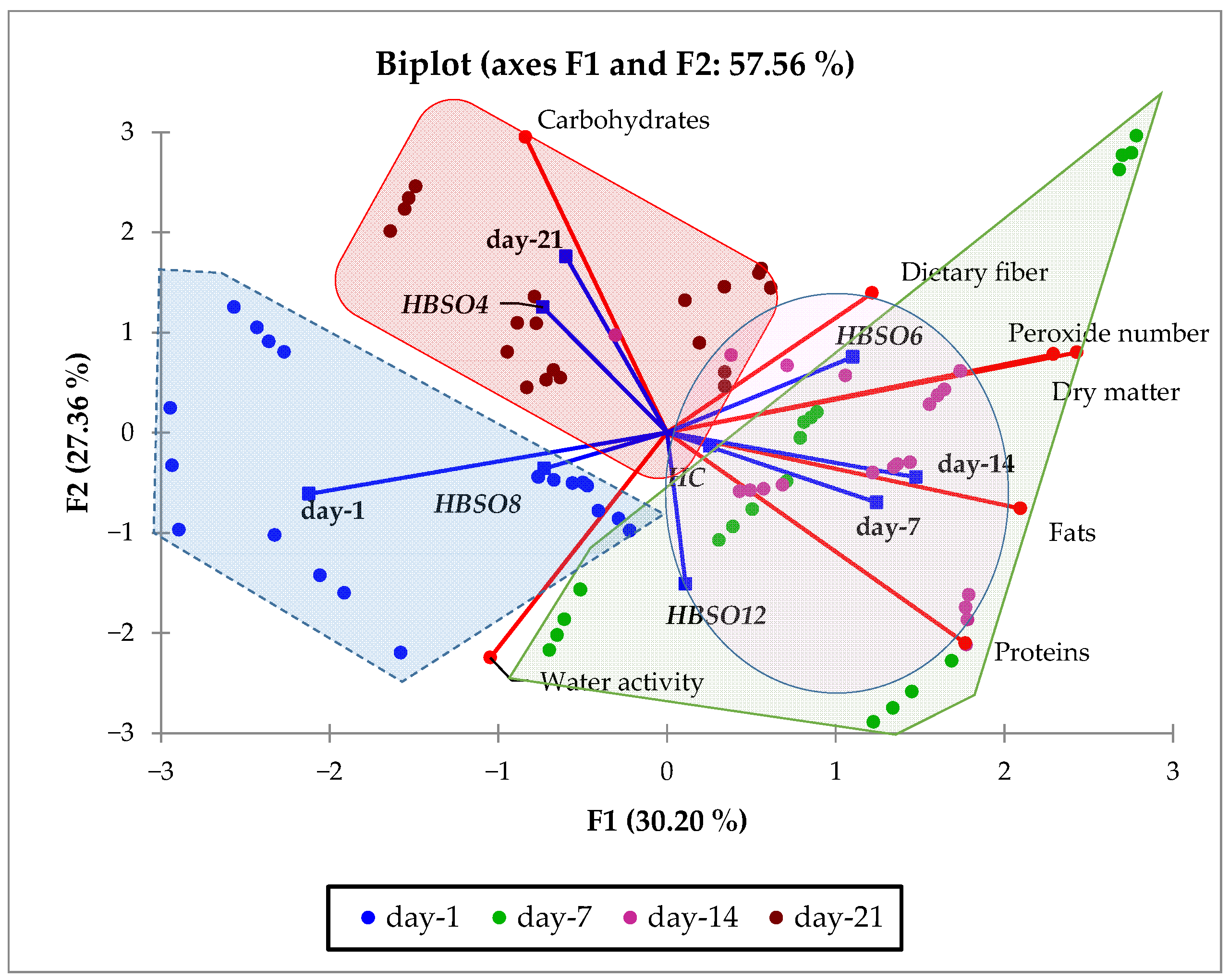
The PCA biplot (
Figure 2) illustrates the relationship between physicochemical parameters and hummus samples during storage.
The PCA biplot explained 57.56% of the total variability, with F1 and F2 accounting for 30.20% and 27.36%, respectively. The first principal component (F1) primarily described storage-related physicochemical changes and effectively discriminated samples according to storage duration, showing a progressive migration from the negative F1 region (day-1 samples) toward the positive F1 region (day-14 and day-21 samples). This separation was mainly associated with positive loadings of Peroxide Number, Dry Matter, Fats, and Dietary Fiber, whereas Water Activity and Carbohydrates were positioned toward the negative F1 region. The dominance of storage time along F1 therefore suggests that oxidative processes, moisture redistribution, and compositional changes were the main factors governing sample differentiation during storage. The second principal component (F2) reflected formulation-dependent variability among hummus samples containing different BSO levels. Positive F2 loadings were more strongly associated with Carbohydrates and Dietary Fiber, whereas negative F2 values were associated with Water Activity and Proteins. Differences in clustering behavior among HBSO4, HBSO8, and HBSO12 samples indicate that BSO addition contributed to secondary compositional differentiation, although storage time remained the dominant source of variability. The close orientation of Peroxide Number and Dry Matter vectors suggests that lipid oxidation and moisture-related changes occurred simultaneously during storage. In contrast, the opposite orientation of Water Activity indicates an inverse relationship between moisture availability and oxidative progression in the analyzed samples.
The clustering trend also indicated compositional differences among BSO treatments. HBSO6 samples showed a stronger association with peroxide value and dietary fiber vectors, whereas HBSO4 samples were more closely related to carbohydrate-associated loadings. HBSO12 samples were positioned closer to the negative PC2 region, suggesting association with water activity and protein-related variation.
PCA results show that storage time was the dominant factor affecting physicochemical changes, while BSO concentration contributed to the secondary compositional differentiation among sample groups.
The Linear Mixed Model (
Table 3) revealed that the interaction between storage time and BSO incorporation (day*Added BSO) had a highly significant impact (
p < 0.0001) on all observed variables. This indicates that the inclusion of black seed oil fundamentally alters the kinetic degradation and stability profile of the hummus matrix over the 21-day period. While the individual effect of ‘day’ was most prominent for peroxide number (
F = 73.06) and proteins (
F = 11.32), the interaction effect showed the highest
F-values for dry matter (244.68) and carbohydrates (113.51), highlighting the complex structural and chemical reorganization of the enriched semi-industrial batches during storage.
Figure 1 and
Table 2 are the calibration framework that will be linked to the NIR spectra in order to base the prediction models on a stable and defined matrix because NIR spectroscopy is based on the interaction of radiation in the wavelength range approximately 780–2500 nm with molecular vibrations, mainly those associated with O–H, C–H, and N–H bonds [
34,
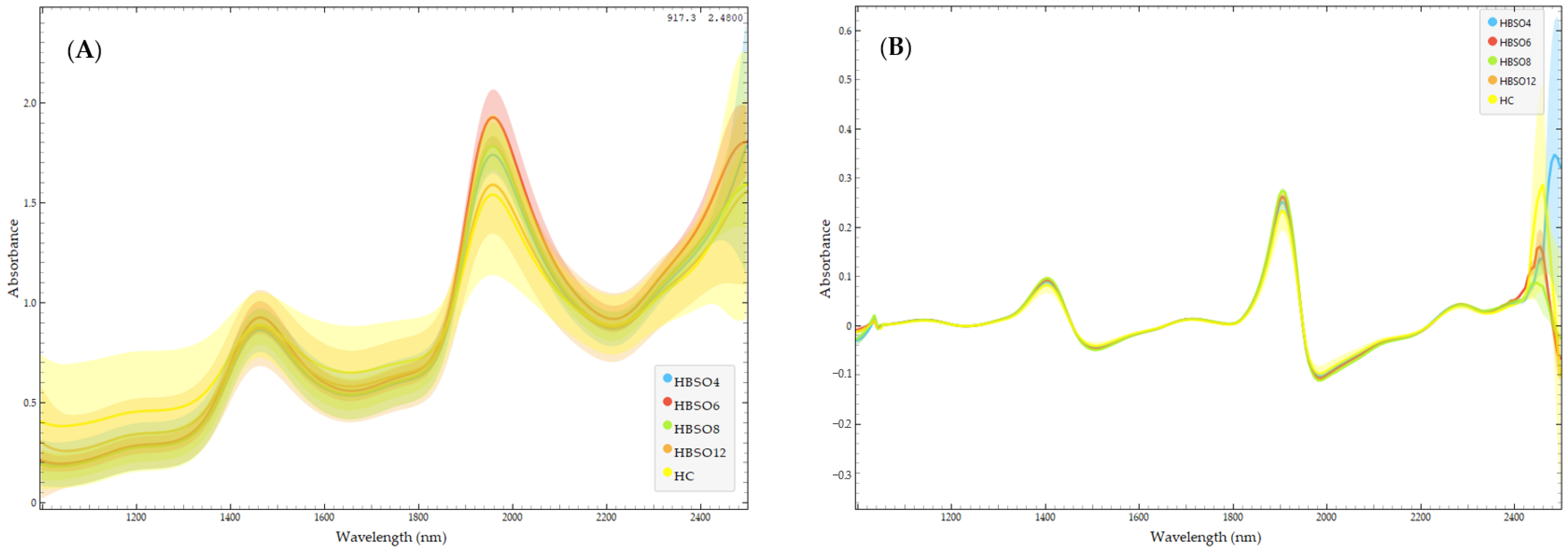
35]. These bonds are characteristic of water, lipids, proteins, and carbohydrates present in hummus spread samples. Specific spectra, in raw and pre-processed form of hummus spreads with different concentrations of BSO, are presented in
Figure 3.
The obtained NIR spectra (
Figure 2) showed a similar trend in the chemical structure as well as some differences among the samples. Row NIR spectra (
Figure 3A) of hummus samples (1020–2450 nm) show characteristic absorption bands associated with water and lipids. The band around 1450 nm is attributed to the first overtone of O–H vibrations, while the dominant maximum at 1900–2000 nm corresponds to combinational O–H vibrations and reflects the content and state of water in the samples. Absorption in the region of 1700–1800 nm is associated with C–H vibrations of lipids, with differences between the spectra indicating changes in the composition of the oil phase due to the replacement of olive oil with black cumin oil. The region of 2100–2300 nm represents complex combinational vibrations and is most sensitive to overall changes in the chemical composition and structure of the matrix. Due to the complexity of the spectral data, multivariate statistical analysis was applied. This allows a better interpretation of the samples; therefore, Principal Component Analysis (PCA) and Partial Least Squares (PLS) regression were chosen as the multivariate tools [
29]. PCA was used to evaluate similarities and differences among samples, whereas PLS regression was performed to correlate NIR spectral data with the previously determined physicochemical and nutritional variables. The performance parameters are presented in
Table 4.
The results of PLS models, developed based on NIR spectra, showed variable predictive ability depending on the observed parameter. Cross-validation confirmed the stability of the developed models, with no significant overfitting observed between calibration and validation results. High accuracy of the model was achieved for fats, carbohydrates, proteins, and dietary fibers (R2 = 0.994–0.997) with low RMSE values and RPD between 2.0 and 2.3. Peroxide number as a critical parameter of quality control and safety showed good predictive ability (RPD = 3.4; RER = 10.7), which indicates the potential of the NIR method for monitoring oxidative changes during storage. Models for monitoring the proportion of olive oil replacement with BSO and measurement days (1–21 days) showed moderate accuracy (R2 = 0.768–0.895), while the weakest predictive ability was observed for water activity (aw) (R2 < 0.5; RPD = 0.1) and dry matter (RPD = 1.1).
The limited predictive performance of the
aw model may be attributed to the indirect nature of NIR spectroscopy, in which water activity is estimated from broad and overlapping water-related bands rather than measured directly. NIR can be effective for
aw prediction in some systems, but the relationship between spectra and
aw is often matrix-dependent and may be non-linear because
aw reflects water state and water–matrix interactions rather than only bulk water content. Therefore, limited predictive performance may arise when spectral water bands overlap strongly or when the sample matrix reduces sensitivity to aw-related changes [
52,
53]. Regarding the low RPD value for dry matter in hummus, this is largely determined by moisture content, which produces very strong and broad O–H absorption bands in the NIR region. These water-related bands dominate the spectrum and can mask the spectral contributions of other dry matter components such as proteins, carbohydrates, and dietary fiber, leading to spectral interference and reduced sensitivity to dry matter variation. Also, the presence of oil introduces additional C–H absorption bands that overlap with water and other spectral features, further complicating the dry matter signal. The limited range of dry matter variation within the investigated sample set may reduce the ability of the calibration model to capture a robust relationship between spectral features and dry matter [
53]. The slope and intercept values indicate deviations from ideal linearity in most models, especially for water activity (
aw) and BSO.
It should be noted that the high coefficients of determination (R
2) observed for several parameters may be partially influenced by the relatively narrow variability of the dataset. Therefore, while the models demonstrate strong internal consistency, their predictive performance should be interpreted with caution, particularly in the absence of external validation using independent sample sets obtained under different conditions. For some observed parameters, the high R
2 values indicate that the models successfully capture the variability present in the dataset. However, it should be noted that the natural analytical range of these parameters in hummus is relatively narrow, which inherently increases the apparent goodness of fit. Added are two additional parameters, RER and RPD. RPD in the range of 1.4–2 is rated as approximate prediction ability, while values >2.0 are an implication for good (quality control) and very good predictive models [
54]. The RER values for good quantitative prediction should be higher than 8 [
23]. Therefore, while R
2 confirms strong internal consistency of the models, it should not be interpreted as a direct indicator of predictive robustness. Instead, the results demonstrate that the models are suitable for describing trends and relationships within the dataset, whereas their quantitative predictive ability may be limited by the low variability of the reference measurements.
4. Discussion
The results of this study demonstrate that partial substitution of olive oil with black cumin seed oil did not significantly alter the overall macronutrient composition of hummus, indicating that the structural integrity of the emulsion system remained stable. Similar findings have been reported in studies investigating the incorporation of functional ingredients into hummus and other plant-based spreads, where the matrix exhibited high tolerance to compositional modifications [
6,
8,
17].
The observed shift in fatty acid composition, characterized by an increase in polyunsaturated fatty acids and a reduction in monounsaturated fatty acids, is consistent with the known lipid profile of
Nigella sativa oil [
20,
22]. This modification may be nutritionally beneficial, as increased intake of polyunsaturated fatty acids has been associated with improved cardiovascular health, reduced inflammation, and modulation of metabolic processes [
24,
25,
26]. However, a higher proportion of polyunsaturated fatty acids also increases susceptibility to oxidative degradation, particularly in complex food systems [
29]. The increase in peroxide value observed after day 7 confirms the initiation of primary lipid oxidation processes, which is typical for emulsified systems rich in unsaturated lipids [
18,
29,
39]. Nevertheless, the partial stabilization of peroxide values in samples with higher levels of black cumin seed oil during later storage stages suggests a potential antioxidant effect of its bioactive compounds. This observation is in agreement with previous studies reporting the protective role of phenolic compounds and thymoquinone in reducing lipid oxidation in food systems [
20,
21]. Water activity remained stable throughout the storage period, indicating that the incorporation of black cumin seed oil did not affect moisture distribution or induce syneresis. This is particularly important for the microbiological stability of hummus, as water activity is a critical factor controlling microbial growth [
14,
15,
16]. The stability of this parameter suggests that the formulation and processing conditions were adequate to maintain product consistency. A sensory evaluation of hummus samples enriched with cold-pressed black cumin seed oil has been previously reported by Delinikolova and Jankuloska [
37], who investigated consumer acceptability within a similar range of incorporation levels. The results of the present study indicate the most favorable formulation only within the investigated concentration range (4–12%) and should not be interpreted as a universally optimal level of black cumin seed oil incorporation. Sensory acceptability and overall product optimization require further combined evaluation of both physicochemical and sensory parameters.
Multivariate analysis provided additional insight into the relationships between compositional changes and storage conditions. Principal component analysis (PCA) revealed clear separation of samples based on storage time and oil composition, confirming that oxidation and moisture-related changes were the main drivers of variability. Similar clustering patterns have been reported in studies applying chemometric techniques to complex food matrices [
32,
40].
The results of partial least squares (PLS) regression demonstrated that NIR spectroscopy is highly effective in predicting parameters with strong spectral signatures, such as fat, protein, and dietary fiber content, which are associated with C–H and N–H bond vibrations [
34,
35,
36,
37]. High coefficients of determination (R
2 > 0.99) confirm the robustness of the developed models within the studied range. However, the poor predictive performance for water activity is expected, as this parameter is governed by thermodynamic interactions rather than direct molecular absorption features detectable in the NIR region [
35,
55]. Although the predictive models showed high internal consistency, it should be noted that the relatively narrow variability of the dataset may contribute to elevated R
2 values. Therefore, the absence of an independent external validation set represents a limitation that should be considered when interpreting the results. Therefore, while the models are suitable for trend analysis and comparative evaluation, their predictive performance should be further validated using a broader range of samples and industrial-scale conditions.
Furthermore, the study was conducted under semi-controlled conditions, which may limit the direct transferability of the results to large-scale industrial production. Additionally, the relatively limited sample size and controlled variability of the dataset may influence the generalization of the obtained results.
Overall, the results confirm that the incorporation of black cumin seed oil can improve the functional and oxidative characteristics of hummus, while NIR spectroscopy provides a rapid and reliable tool for monitoring compositional changes and storage stability. This combination represents a promising approach for the development and quality control of functional plant-based foods.




 ,
,