1. Introduction
In clay soils, seedbed preparation becomes increasingly difficult as moisture content rises. With increasing moisture, clay soils develop a plastic consistency and become sticky, adhering to tillage equipment [
1,
2]. When these soils dry, they form large clods that are difficult to break down due to their aggregated structure. These clods reduce seed–soil contact, thereby negatively affecting field emergence and yield [
3]. Field emergence rates may drop to as low as 40%. Breaking down these clods requires additional energy and labor [
4].
Drainage problems in such soils arise due to their high cohesion, low permeability, and water retention capacity, as well as the influence of factors such as topography and climate. In poorly drained areas, groundwater negatively affects seed germination and root development. These adverse effects can be mitigated through drainage improvements or appropriate tillage practices [
5]. Ridge sowing can be used to protect seeds from excess water, enabling crop yields comparable to those obtained under conventional tillage systems [
6,
7,
8].
However, maintaining ridge stability is difficult, especially in regions with frequent and irregular rainfall. Studies defining listers in terms of shape and size for forming stable ridges in heavy soils are limited in the literature.
Multiple tillage operations are often required to break down the resulting clods [
3]. A tiller is commonly used to reduce the need for repeated field operations. Faced with this challenge, the preferred method of tilling the soil negatively affects soil aggregate stability. Although soil can break up in a single pass with a rotary tiller, in moist and clay soils, the soil’s plastic consistency can cause it to adhere to the tiller blades, resulting in operational blockage. The literature does not sufficiently address solutions to these challenges encountered in moist, clayey, and high-rainfall regions [
9].
Inadequate seed–soil contact may require reseeding due to poor germination or seed decay under moist soil conditions. This results in increased energy consumption, time requirements, labor input, and workforce inefficiencies, as well as seed loss, while reducing effective field utilization and machinery efficiency. In addition, soil compaction increases with repeated field traffic.
In regions with frequent and irregular rainfall, soil conditions can change rapidly, thereby shortening the suitable tillage window and forcing farmers to make decisions within a limited timeframe. In areas where drainage, reclamation, or structural improvement is not feasible, the use of appropriate machinery represents a practical solution. Although integrated tillage–sowing systems have been proposed in the literature, most of these systems are designed for relatively uniform soil conditions (e.g., sandy or loamy soils) and their performance under heavy clayey conditions remains limited or insufficiently documented. Furthermore, commercially available machines often lack clear specification regarding their operational soil conditions and differ significantly in working unit configurations, which limits their applicability and comparability. Therefore, integrated solutions enabling both tillage and sowing in a single pass remain limited, particularly under heavy soil conditions [
10].
This study aims to develop a seedbed preparation unit for sowing in poorly drained clay soils that can protect seeds from groundwater. The developed prototype incorporates a lister designed to enhance ridge stability and prevent large soil masses from being overturned. A tiller design that enhances soil fragmentation and can operate even in soils under plastic consistency has also been implemented. The operational performance of the machine was evaluated in terms of field emergence rate, soil fragmentation, ridge stability, fuel consumption, and operating time, and compared with conventional sowing methods.
2. Materials and Methods
The experiments were conducted in Karacalı Neighborhood, Terme District, at coordinates 41.21 N, 36.85 E and an altitude of 14.39 m. The soil in the experimental area had a clayey texture, consisting of 50.47% clay, 21.08% silt, and 28.45% sand.
The experimental area located in Samsun has a humid Black Sea climate. According to long-term meteorological records, the annual average precipitation is approximately 730–760 mm, with rainfall distributed throughout the year and relatively higher precipitation during autumn and winter. Mean annual air temperature is around 14–15 °C [
11]. Soil temperature showed seasonal fluctuations, reaching lower values during winter and higher values during summer, which may have affected soil biological activity and plant growth during the experimental period.
In the field trials, a prototype sowing machine, a conventional pneumatic sowing machine, a moldboard plow, and a disc harrow were used. Soybean (Glycine max) was sown in the trials.
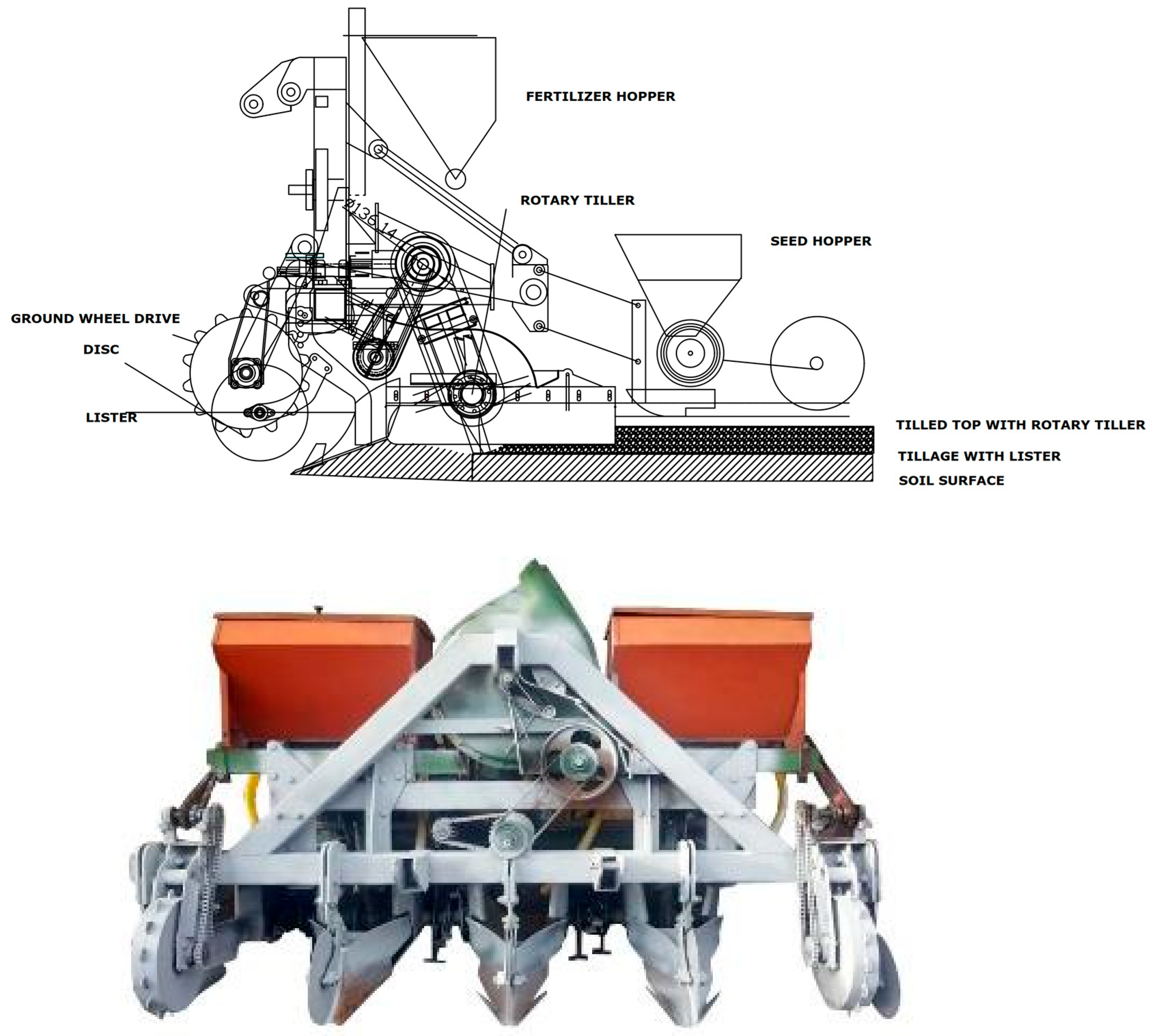
The prototype sowing machine consists of a lister, rotary tiller, precision sowing unit, and fertilizer unit mounted on a chassis. The machine sequentially applies fertilizer to the soil, creates ridges with the lister, tills only the top of the ridges to a width of 10 cm with the tiller, and then sows the seeds with the sowing unit. These operations are carried out functionally and kinematically in a single pass. The machine is designed to operate in four rows with a row spacing of 70 cm. The lister creates ridges 15–20 cm in height, while the rotary tiller operates to a depth of 10 cm. The sowing unit places seeds at a depth of 5 cm.
Table 1 presents some technical specifications of the tractor used in the trials. The prototype sowing machine was designed to be compatible with this tractor. In the prototype sowing machine, power is transmitted from the tractor PTO shaft to the tilling and sowing units via a belt-pulley mechanism.
A lister was designed to cut and break large soil aggregates under heavy soil conditions while maintaining ridge stability. The blades mounted on the tiller were designed in a shape and structure that enhance soil fragmentation and minimize the effects of soil adhesion under moist conditions. Furthermore, the tiller reduces power requirements by tilling only a narrow strip sufficient for sowing seeds on the ridge. A sowing and fertilizing unit was also mounted on the chassis. The machine is capable of performing both tillage and sowing on the ridge in a single pass under both wet and dry conditions.
Listerine containers are commercially available in various shapes and sizes. The initial lister body was designed based on parametric measurements used in plow design, including cutting, loading and setting angles [
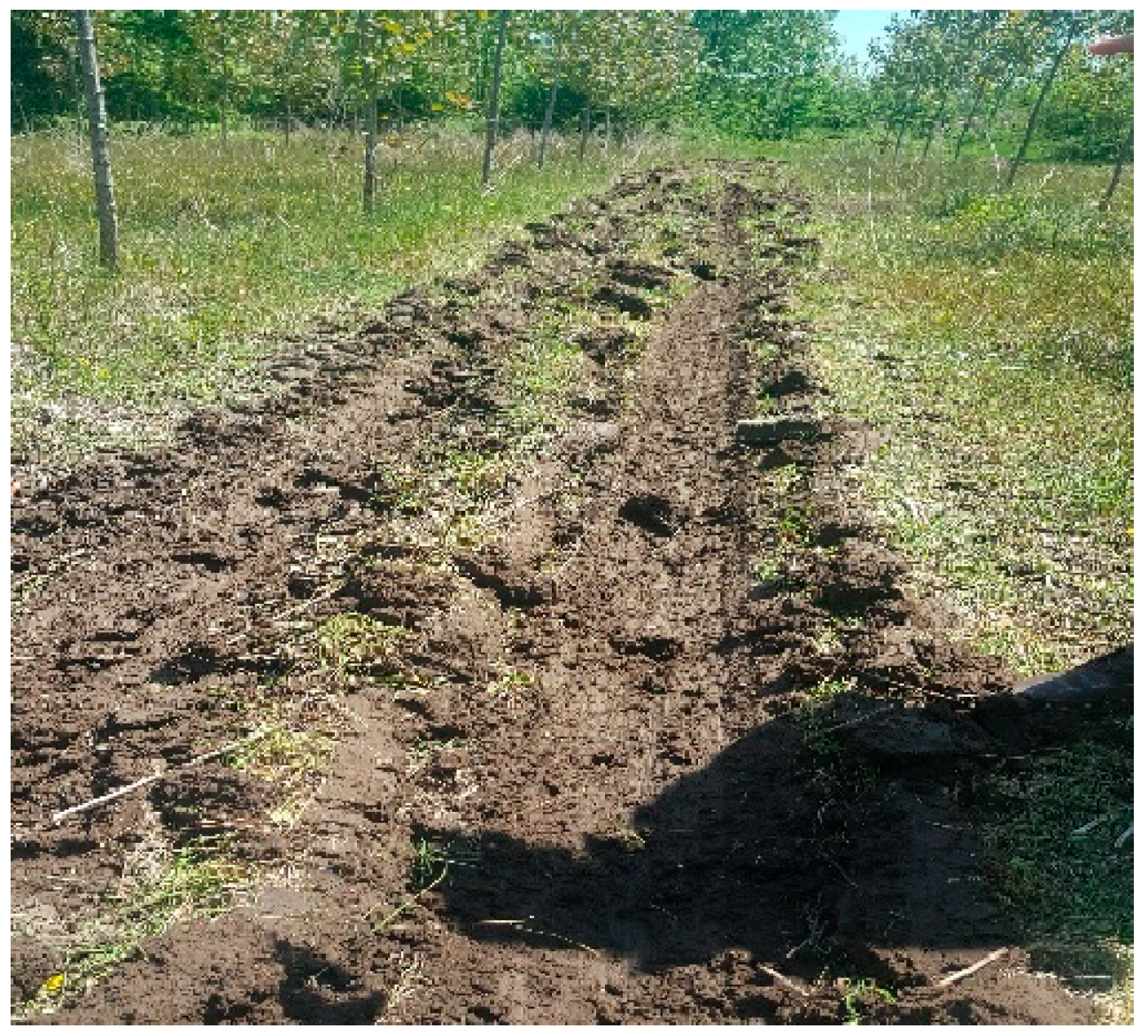
12]. However, ridge formation under field conditions was not successful with this initial design (
Figure 1). Therefore, multiple trials were conducted by adjusting the lister’s setting angle, and the optimum angle was determined. Due to the clayey soil structure, large soil masses were overturned, preventing the formation of a stable ridge profile. It was found that a ridge slope angle of 45° was required to maintain long-term ridge stability.
Since soybean (
Glycine max) was selected for this study, a row spacing of 70 cm and a ridge height of 15–20 cm were adopted (
Figure 2).
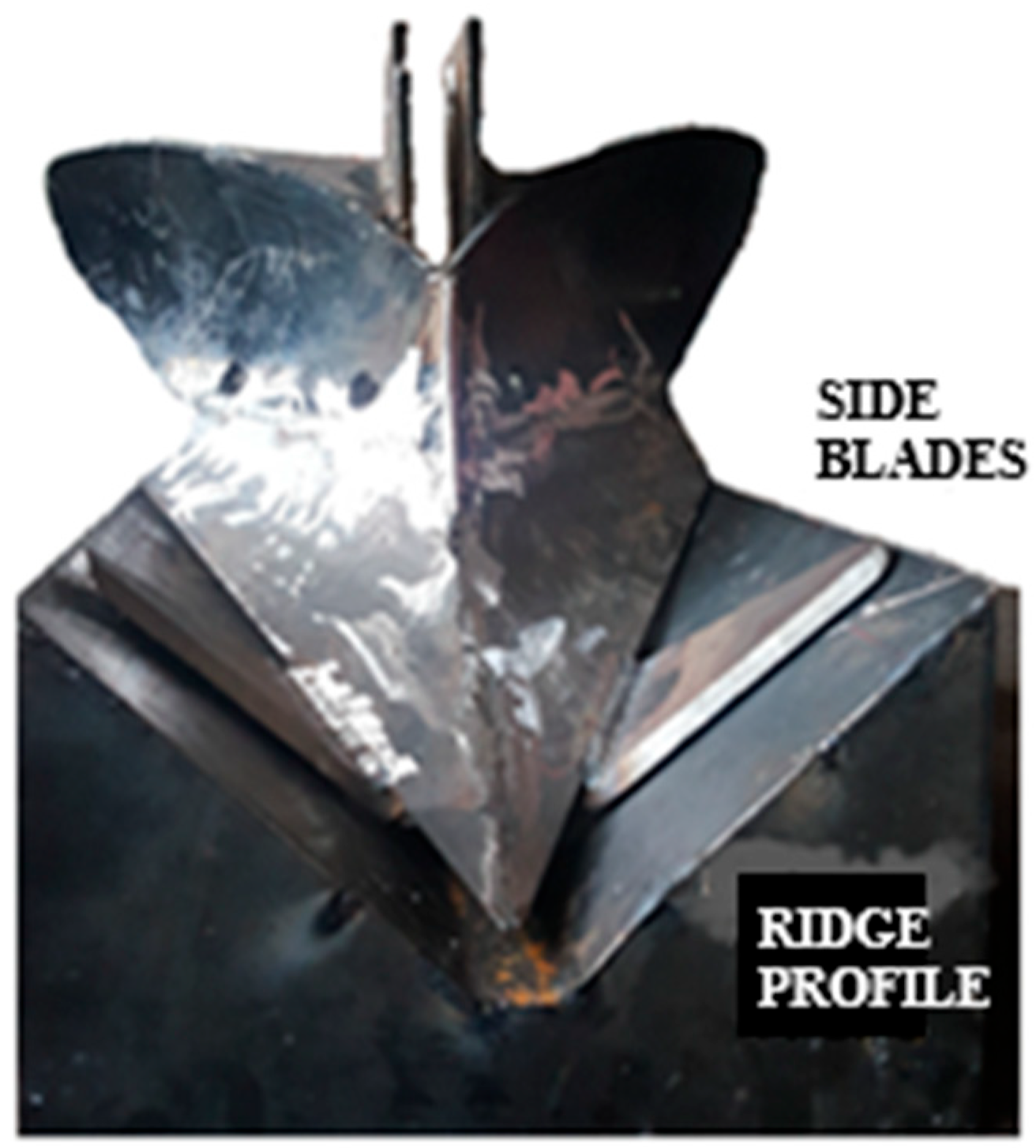
A metal mold was fabricated according to the determined ridge profile dimensions and used to create the lister profile. The lister was manufactured from st 37 steel. Side-cutting blades were fitted to cut large clods formed due to adhesion in clay soils. Since these blades were designed with a 45° angle, they also contributed to shaping the ridge profile (
Figure 3). The blades were made of 5 mm-thick Hardox 450 steel to provide impact absorption and durability. Finally, the working width is approximately 400 mm, including cutting (≅20°), loading (≅20°), and setting (≅30° angles, gradually decreasing towards the ear tip), and the height from the ground is 360 mm.
Due to the excessive weed growth in the area, a disc cutter was installed in front of the lister to prevent weed entanglement and to split the soil into two.
Because clay soil becomes hard when dry and plastic when wet, it was foreseen that the seedbed would require tillage with a rotary tiller. However, due to the adhesive nature of the soil under plastic conditions, tillage depth was limited to 100 mm in order to reduce power requirements.
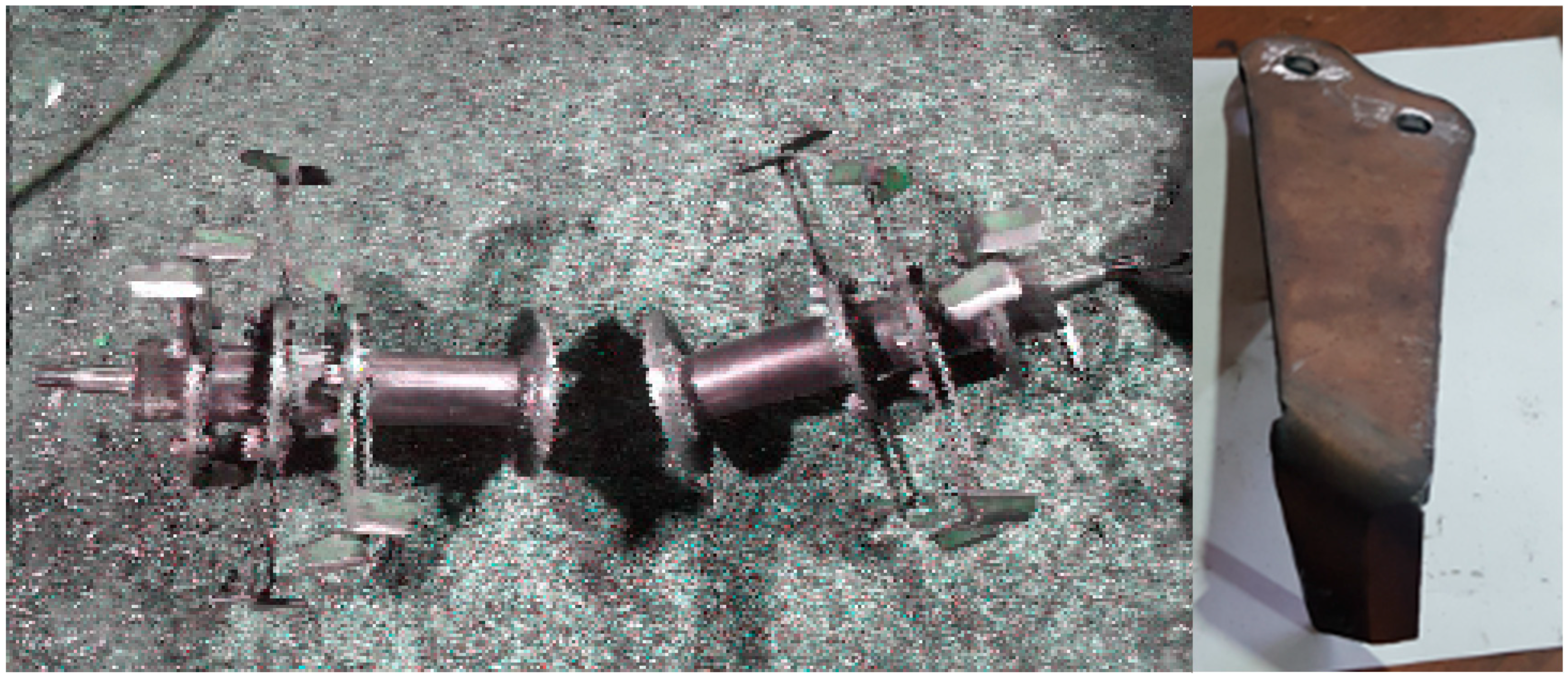
The soil tiller was constructed using two bodies from a pre-existing inter-row tiller. These bodies were mounted on a shaft with a diameter of 350 mm and a length of 2800 mm, and adapted to operate across four rows. For this purpose, a rotor with a length of 380 mm was manufactured. Each row consists of three flanges spaced 65 mm apart, designed to till only the zone where seeds are to be sown.
To prevent soil clogging between the tiller blades, the blades were mounted on the flanges at a 180° angle in an alternating reciprocally on the left–right arrangement and in pairs to increase the cutting width. Each flange carries four blades mounted helically to reduce vibration. In total, 12 blades are used per ridge for effective soil fragmentation. The blades were manufactured in an L-shape (
Figure 4). The blades were designed with a 10° clearance angle to reduce adhesion and friction between the blade and soil and were bent at 90° to provide a cutting width of 40 mm. The 10° clearance angle was selected in accordance with recommendations in the literature [
12] on rotary tiller design and soil–tool interaction studies. Therefore, the final blade geometry was determined by considering both literature-based design guidelines and field-based mechanical constraints, rather than through a parametric optimization study. The blades were sharpened and formed at an angle of 21°. The blade material was selected based on preliminary field tests under clay soil conditions, where conventional materials exhibited deformation and failure. They were made from 5 mm-thick Hardox 450 steel for impact absorption and durability.
The rotary tiller was enclosed with a sheet metal casing. Additionally, a chain-type guard was installed in place of a conventional cover to further reduce soil adhesion. The rotary tiller is powered by the PTO shaft.
Four commercially available pneumatic precision sowing units were mounted on the chassis behind the rotary tiller. A flat-bladed fan was used to generate vacuum pressure in these units. Two fertilizer hoppers were installed, one on the right and one on the left. Fertilizer was applied in front of the tiller and mixed into the soil during tillage. The sowing and fertilizing units on the right side were driven by the right wheel, while those on the left side by the left wheel.
The chassis was redesigned to match the dimensions of the tiller, and all machine components were mounted onto the main chassis. The main chassis measured 3000 × 120 × 120 mm. The empty weight of the prototype machine was 1300 kg. The center of gravity of each unit was considered individually to determine the overall center of gravity of the machine, which was positioned as close as possible to the tractor’s rear axle to prevent tilting. Furthermore, the tractor’s tractive capacity was taken into account in the design of the sowing machine. The transferred load was determined to be 928 kg based on the center of gravity calculations. The front axle load corresponded to 48% of the tractor’s total weight.
Field trials were conducted to evaluate the performance of the prototype machine. For this purpose, some physicomechanical soil properties, tractor fuel consumption, and time requirements were measured, along with agronomic parameters such as field emergence rate, seed germination time, and germination rate index.
To take advantage of early harvesting, sowing was carried out in two periods: the conventional sowing period (May–June) and the early sowing period (April). In addition, to observe the effect of autumn tillage under these soil conditions, two different tillage methods were applied: autumn tillage and no autumn tillage.
Soil samples were collected at two different times and at two depths (0–10 cm and 10–20 cm), with three replications each condition, both before and after tillage, to determine soil moisture content, bulk density, and porosity. Bulk density and moisture content were calculated according to Blake and Hartge [
13], while porosity was determined according to Doğan and Çarman [
14]. A hand-push soil penetrometer (Eijkelkamp) was used to measure soil penetration resistance. Penetration resistance measurements were taken at depths of 0–5, 5–10, and 10–20 cm following [
15]. Particle size distribution was determined using a vibrating sieve set according to [
16]. The seven distributions obtained (<1, 1–2, 2–4, 4–6.3, 6.3–8, 10–50, and >50 mm) were then grouped into four categories (<1 mm, 1 < x < 10 mm, 10 < x < 50 mm and >50 mm) based on appropriate seedbed particle size classifications reported in the literature.
To determine the field emergence rate (FES), mean germination time (MGT), and germination rate index (GRI), soybean sprouts were counted over a 30-day period by monitoring four randomly selected 1 m-long strips from four different rows in each plot throughout the germination period. Calculations were performed using the equations of [
17,
18].
Three different sowing methods were applied in the field trials. The first was conventional sowing, which involved spring plowing to a depth of 20 cm using a moldboard plow, followed by three times disc harrow tillage operations, and sowing with a precision sowing machine. The second method consisted of autumn plowing to a depth of 20 cm using a moldboard plow, followed by direct sowing with the prototype sowing machine. The third method involved direct sowing with the prototype sowing machine without tillage.
The experimental layout consisted of 24 plots, each measuring 10 × 5 m, arranged in eight rows. Statistical analyses of the experimental data were performed using SPSS v21 Base software. In order to determine the effect of these factors, the experiment was arranged in a randomized block design. The results were compared using the least significant difference (LSD) test.
3. Results
Design modifications were based on methodological and planned field observations conducted under severe soil conditions. In the initial lister trials, ridge formation was not successful due to the presence of large clods. In subsequent trials, the lister dimensions were modified. However, changing only the lister dimensions and angle proved insufficient. To prevent the overturning of large aggregate masses, side-cutter blades were mounted at a 45° angle to the base iron of the lister. This configuration enabled cutting at a 45° angle and contributed to maintaining ridge stability by forming a slope.
By adjusting the clearance angle and sharpening angle of the rotary tiller blades, soil adhesion was reduced, allowing continuous operation without clogging. During testing, some blades failed; therefore, they were remanufactured using Hardox 450 steel to increase their strength.
The prototype sowing machine was manufactured according to these design parameters. Thanks to appropriate material selection, accurate calculation of the machine’s dimensional strength, and proper manufacturing processes, no deterioration occurred during field trials.
The prototype machine, measuring 3000 × 2347 × 1642 mm and weighing 1300 kg, was finalized to be operable with an 85 HP tractor without rearing. No additional power requirements or rearing issues were observed during the trials. The final configuration of the prototype, incorporating improvements from preliminary trials, is shown in
Figure 5.
After sowing, no statistically significant differences were found among the different sowing methods in terms of soil bulk density and porosity (
Table 2). The maximum bulk density obtained during the study period was 1.26 g cm
−3. Porosity values did not fall below 54.01%.
In the first sowing period, statistically significant differences in penetration resistance were observed across all depths, while in the second sowing period, significant differences among sowing methods were found only at a depth of 5 cm (
p < 0.05) (
Table 3). The highest penetration value measured during the study did not exceed 0.61 MPa. The lowest penetration resistance values were observed in plots subjected to autumn tillage, whereas the highest values after sowing were recorded under conventional sowing. Overall, the penetration resistance values obtained in this study remained below 3 MPa.
In the first sowing period, the difference in particle size distribution among sowing methods was found to be statistically significant (
p < 0.05) (
Table 4). In sowing with the prototype machine, the proportion of particles larger than 50 mm did not exceed 6.62%, whereas in conventional sowing, particles larger than 50 mm constituted 55.49% of the total distribution. For the 1–50 mm particle size range, the percentages were 91.45% for the prototype machine, 92.12% for the prototype machine following autumn tillage, and 43.52% for conventional sowing. Furthermore, particles smaller than 1 mm did not exceed 3.40% in this study.
In the second sowing period, statistically significant differences were observed among sowing methods for particle size distributions larger than 50 mm and within the 1–10 mm range (p < 0.05). The proportion of particles larger than 50 mm was 21.45% for the prototype machine, 28.23% for the prototype machine following autumn tillage, and 43.94% for conventional sowing. Particles smaller than 1 mm did not exceed 1.79%. The proportion of particles within the 1–50 mm range was 70.32% for the prototype machine, 76.92% for the prototype machine following autumn tillage, and 54.2% for conventional sowing.
Regarding average germination time in the first sowing period, germination occurred in 25.47 days under conventional sowing, followed by 25.80 days with the prototype machine after autumn tillage, and 26.02 days with direct sowing using the prototype machine (
Table 5).
In the second sowing period, average germination time was 11.7 days under conventional sowing, followed by 15.28 days with the prototype machine after autumn soil tillage, and 15.34 days with direct sowing using the prototype machine.
Regarding the germination rate index, differences among sowing applications in the first sowing period were statistically significant (p < 0.05). The highest germination rate index was obtained in sowing with the prototype machine. It was 0.36 units m−1 day in prototype machine sowing after autumn tillage and 0.37 units m−1 day in direct sowing with the prototype machine sowing, whereas the lowest value was observed in conventional sowing at 0.16 units m−1 day.
In the second sowing period, the germination rate index was 0.29 units m−1 day for prototype machine sowing after autumn tillage and 0.34 units m−1 day for direct sowing with the prototype machine. The highest germination rate index was obtained under conventional sowing at 0.35 units m−1 day.
Field emergence rates showed a statistically significant difference (p > 0.05) among sowing practices during the first sowing period. The highest field emergence rates were 75.68% for prototype machine sowing after autumn tillage and 78.80% for direct sowing with the prototype machine, whereas this value remained 32.56% under conventional sowing. In this method, 67.44% of the seeds failed to germinate. In this study, autumn tillage did not create a significant difference between prototype machine treatments, and the difference was not statistically significant (p > 0.05).
In the second sowing period, the highest field emergence rate was 62.06% for prototype machine sowing after autumn tillage and 58.29% for direct sowing with the prototype machine, while it remained 34.42% under conventional sowing.
The difference among sowing methods in terms of fuel consumption was statistically significant (
p > 0.05) (
Table 6). Fuel consumption values were 13.21 L da
−1 for conventional sowing, 15.13 L da
−1 for prototype machine sowing after autumn tillage, and 5.26 L da
−1 for direct sowing with the prototype machine. When compared to traditional planting and autumn tillage sowing with prototype machine, it was observed that planting with the prototype machine consumed approximately 2.51 (13.21/5.26) and 2.87 (15.13/5.26) times less fuel, respectively.
The average working time was 0.69 h da−1 for conventional sowing, 0.42 h da−1 for prototype machine sowing after autumn tillage, and 0.21 h da−1 for direct sowing with the prototype machine.
4. Discussion
Despite the inherent characteristics of heavy soil conditions such as high cohesion, water retention capacity, low permeability, and plastic consistency, improvements in ridge stability and shape can be attributed to the lister design. The achievement of a soil particle size distribution (1–50 mm), considered suitable for plant development [
19], at high proportions (91.45–92.12%) using the prototype machine demonstrates that the limitations of heavy clay soils were effectively mitigated and shows a clear improvement compared to conventional sowing. In addition, the low proportion of particles smaller than 1 mm indicates that excessive fragmentation did not occur, thereby preserving soil structure. The fragmentation performance of the prototype machine was approximately twice as high as that of conventional sowing. Furthermore, the increased soil fragmentation observed with early tillage between the two sowing periods suggests that the prototype is functional thanks to the advantages provided by its design.
The fact that bulk density and porosity values remained within ranges that do not adversely affect root and plant development [
20,
21,
22,
23] further highlights the contributions of the design.
Soybean germination typically occurs within 6–7 days [
24]. The extended average germination times (25 days) observed during the first sowing period is a result of the rainy climatic conditions. Rainfall occurred on nine separate days after sowing, during which no emergence was observed. Increased soil moisture and decreased temperature due to rainfall are considered the primary factors causing this delay.
In the second sowing period, emergence occurred in 11 days under conventional sowing and in 15 days with the prototype machine. Emergence times were shorter compared to the first sowing period, likely due to higher soil temperatures.
The highest germination rate index was obtained in early sowing with the prototype machine, demonstrating the effectiveness of the design.
The high field emergence values, which are crucial for yield and seed consumption, represent a key indicator of the success of the machine design and indicate that the machine works more effectively under these soil conditions. The machine, which performs tillage and sowing simultaneously, demonstrates that drainage and rainfall-related constraints can be mitigated under heavy soil conditions. Moreover, the results showed that autumn tillage did not significantly influence the outcomes and demonstrated that this machine eliminates the need for plowing, thereby reducing labor and energy requirements.
However, between the two sowing periods, field sprout emergence rates decrease by 20.34% for sowing with the prototype machine and by 26.04% for sowing with the prototype machine following autumn tillage. In contrast, the difference in field emergence between the two sowing periods was smaller under conventional sowing.
Following operations in the second sowing period, soil moisture decreased substantially due to the lack of rainfall, which contributed to reduced emergence. Since soil moisture content, bulk density, and compaction conditions were similar between the two sowing periods, these factors are unlikely to explain the observed differences in field emergence. The first sowing occurred at the end of April, while the second sowing was at the end of May, which indicates that germination likely took place under different environmental conditions.
Temperature is known to be an important factor affecting seed germination; therefore, differences in thermal conditions between the two periods may have influenced germination dynamics and soil–seed interactions. In addition, the interaction between temperature and rainfall timing may have affected the effectiveness of post-sowing precipitation events.
Therefore, the observed differences in field emergence are considered to be associated with overall environmental variability during the germination period rather than soil physical properties alone.
The design’s significance and necessity is further underscored by the observed reductions in fuel consumption. In this study, ridge sowing with the prototype machine yielded a fuel saving of 0.99 L da
−1, representing a more substantial efficiency gain than that reported by [
25]. Furthermore, the design demonstrated superior labor efficiency through a reduction in average working time, achieving a savings of 0.18 h da
−1 relative to the same previous findings.
While conservation, reduced tillage, and ridge tillage practices have been implemented across diverse soil textures using various machinery configurations [
10], research specifically addressing clayey and poorly drained soils remains limited. However, sufficient data has not been provided regarding the soil conditions in which these machines can operate effectively and the parameters that can be used to evaluate their performance. In contrast, this study systematically determined and presented the performance parameters of a machine that can be used in clayey soil conditions with high moisture content.
Moreover, investigations into single-machine systems are almost nonexistent. This study aimed to develop an economical solution tailored to such environments; the findings suggest that the proposed system offers a viable advancement for reduced tillage practices.
5. Conclusions
This research involved the design and empirical evaluation of a specialized ridge-sowing machine engineered to enable effective sowing in clay soils characterized by drainage problems and high rainfall conditions. Based on the design and development process, the machine was found to be suitable for operation in this soil type. Field trials demonstrated that the machine performed satisfactorily in ridge formation, tillage, fertilization, and sowing operations.
The prototype machine features a lister specifically designed to mitigate soil-adhesion forces prevalent in clayey profiles with high groundwater levels and to cut and invert soil strips into appropriate sizes without forming large clods.
Empirical results indicate that the developed machine enhanced seed protection against waterlogging and improved soil fragmentation, and increased field emergence, fuel savings, and labor and workforce savings compared to traditional sowing methods. Furthermore, the study revealed that the machine’s performance parameters, such as field capacity, were within acceptable limits for agricultural production. Observations confirmed that challenges, specifically soil adhesion and compaction inherent in processing clayey soils, were significantly mitigated thanks to the machine’s design features.
In this study, the field emergence rate increased by a factor of 2.37. Despite the heavy clay structure and high variability in soil moisture, the machine enabled early sowing, allowing for seed germination before soil desiccation.
The prototype machine demonstrated a 60.18% reduction in fuel consumption and a 69.56% decrease in operational time compared to conventional sowing methods. Beyond these efficiencies, the prototype significantly improved soil quality; while conventional sowing resulted in inadequate soil fragmentation, the prototype achieved a superior soil particle distribution of 91.45%. This optimized seedbed environment directly facilitated enhanced seed emergence.
Field emergence rates remained consistent between the standalone prototype and the prototype utilized after autumn tillage; however, the former demonstrated superior economic efficiency regarding fuel consumption and labor requirements. The machine’s single-pass capability effectively streamlined the sowing process, proving particularly advantageous for mitigating operational constraints such as seasonal sowing delays and high groundwater levels.
The entire machine features a modular design, characterized by demountable and interchangeable components. Both the tiller and sowing units are readily available on the market, allowing for cost-effective maintenance and easy replacement.
In conclusion, the developed ridge sowing system is particularly suitable for heavy-textured soils with poor drainage, offering significant potential to enhance production efficiency. By improving field emergence, this machine contributes to economic stability and sustainable rural development. The newly developed lister, specifically designed with an optimized rotary tiller system and integrated into a single unit, represents a significant contribution to the scientific literature. However, further studies across diverse soil texture conditions are necessary for a more comprehensive evaluation of the machine’s performance.