Agricultural AI Agents: Architecture Design, Business Processes, Key Technologies, and Future Challenges


Abstract
1. Introduction
1.1. Research Background: From Smart Agriculture to Agricultural AI Agents
1.2. Proposal of the Agricultural AI Agent Concept
1.3. Essential Differences Between Agricultural AI Agents and Traditional Systems
1.4. Key Challenges Currently Facing Agricultural AI Agents
1.5. Review Scope and Methodological Framework
2. Overview of Agricultural AI Agents: Classification System and System Architecture
2.1. Classification of Agricultural AI Agents
2.1.1. Virtual Agricultural AI Agents
- 1.
- Processing and analyzing massive agricultural dataIntelligent decision-making begins with data. Agricultural production involves multi-source heterogeneous data related to soil, weather, crops, and field operations. Multimodal sensor fusion, environmental perception, and crop status monitoring technologies provide an important foundation for agricultural data collection [14,16,17]. At the data collection stage, Goodrich et al. proposed a sequential gap reduction algorithm to optimize soil sensor placement in fields. They also used genetic algorithms to optimize the flight scanning paths of multi-agent unmanned aerial vehicles, supporting spatial data collection in large-scale farmland [18]. Betalo et al. developed a task scheduling and resource sharing framework based on multi-agent deep reinforcement learning for data collection and processing in multi-UAV-assisted wireless sensor networks, improving the efficiency of large-scale sensor–node data collection [19]. At the data management stage, Zou and Quan proposed a grid-based resource management and scheduling strategy for AIoT, supporting the unified management and task scheduling of heterogeneous agricultural data resources [20]. Gonzalez-Briones et al. developed a cloud-based multi-agent system that uses wireless sensor networks to collect potato crop data for knowledge discovery and decision-making, thereby supporting precision irrigation. This work verifies the technical feasibility of virtual agents in agricultural data processing and engineering applications [21].
- 2.
- Data–knowledge dual-driven agricultural decision-making mechanismData acquisition is only the first step; the core capability of agricultural AI agents lies in transforming data into executable decisions. Agyeman et al. developed an irrigation scheduler that combines machine learning, model predictive control, and multi-agent principles, achieving 7–23% water savings and improving irrigation efficiency by 10–35% [22]. For knowledge-driven decision-making, Ge et al. proposed a recommendation model integrating knowledge graphs and case-based reasoning to predict fertilization amounts with strong interpretability and transferability [23]. Lin et al. further developed a spatiotemporal knowledge-graph-based reasoning method for rice fertilization decisions [24]. Recent advances in large language models and intelligent decision-making technologies are accelerating the transition from rule-driven to model-driven agricultural decision-making [1,25]. For example, Chen et al. developed the “Fu Xi Brain” autonomous agricultural intelligence system by integrating agricultural IoT and generative large models, improving efficiency through dynamic optimization and full-modal alignment training [11]. Collectively, the existing literature illustrates the evolution of agricultural AI agents from data perception and knowledge understanding to autonomous decision-making.
- 3.
- Providing intuitive information services and decision suggestionsEven highly accurate decisions may have limited practical value if users cannot understand or apply them. Virtual AI agents convert complex analytical results into farmer-friendly suggestions through natural language interaction. Zhang et al. developed Chat Demeter, which receives leaf images and returns disease diagnosis results and treatment suggestions with an accuracy of 99.50% [26]. Anand et al. proposed the SEEDS system, which integrates RAG, knowledge graphs, and OpenAI embedding models to provide precise pest and disease control suggestions [27]. Owiti and Kipkebut further developed a RAG-based intelligent agent with quantized fine-tuned language models for real-time, low-cost, and multilingual agricultural advice in resource-constrained areas [28]. Jayarathna and Hettige developed a MaSMT-based multi-agent communication system that supports the shift from question-answering services to intelligent consultation through role collaboration and knowledge enhancement [29]. The existing literature demonstrates that virtual AI agents serve not only as decision generators but also as semantic interfaces connecting agricultural knowledge with end farmers.
- 4.
- Cross-domain resource scheduling and multi-machine collaborative controlAfter decisions are generated, multiple physical devices often need to collaborate during execution, with virtual agricultural AI agents serving as the “coordination center”. Skobelev et al. proposed a unified multi-agent software and information environment to support crop variety selection, rotation planning, agricultural technology formulation, and adaptive scheduling of machinery and material resources [30]. To address fuzzy time windows and matching constraints in heterogeneous agricultural robot scheduling, Guo et al. developed a multi-objective scheduling model and a hierarchical learning large-neighborhood search algorithm, enabling joint scheduling under uncertain service times [31]. Jo and Son further proposed a path-planning and coordination algorithm for multiple unmanned ground vehicles with heterogeneous tasks in smart farms, improving productivity, efficiency, and robustness through task-priority scheduling [32].The virtual agricultural AI agent forms a complete functional chain through data aggregation, decision reasoning, information services, and collaborative scheduling, constituting the “brain” and “nerve center” of the agricultural AI agent system. Although they do not directly touch the soil and crops, they drive the efficient operation of the “perception–decision–execution” closed loop, providing core cognitive support for the intelligent transformation of agriculture. The reviewed studies indicate that the functions of virtual AI agents have extended from simple information processing to the fine organization and flexible arrangement of physical execution ends, achieving a deep transformation from “static decision schemes” to “dynamic operation flows”.
2.1.2. Embodied Agricultural AI Agents
- 1.
- Direct interaction with the agricultural field environment and execution of physical operations.The core value of embodied AI agents lies in their physical execution capability, which enables them to directly interact with agricultural field environments and perform physical tasks beyond the scope of virtual AI agents [35,36]. Jia et al. conducted a systematic review of AI-driven tractor–implement collaborative control and proposed a collaborative control framework integrating agronomic constraints and mechanical dynamics, providing theoretical support for autonomous farm systems [37]. Salah et al. proposed a hybrid-control multi-agent collaborative system that combines pickers’ manual skills with robotic precision and navigation capabilities, optimizing the time and cost of apple harvesting through automated fruit-box transportation [38]. Ma et al.’s LSTM-PPO-Weeding framework further integrates mobility and operational control through memory-enhanced reinforcement learning, reducing the average weeding time by up to 74% in greenhouse experiments [39].
- 2.
- Replacing manual labor for high-intensity, repetitive, or hazardous field operations.The shortage of agricultural labor is becoming increasingly severe, and embodied AI agents have become an important technical path for replacing manual labor in high-intensity, repetitive, and time-sensitive field operations [9,34]. Jo and Son proposed the CBS-HT path-planning algorithm, which assigns priorities according to machine type and operation area. In orchard tests, this method reduced the driving distance of high-priority robots by 13.5% and task time by 13.2%, thereby improving the efficiency of multi-agent operations [40]. Manasherov and Degani proposed an autonomous, multi-agent drone pollination system that jointly optimizes task time and flight distance through target allocation, inventory replenishment, and safe trajectory planning. Their experiments in peach and pear orchards, as well as real drone tests, verified the feasibility of replacing manual pollination [41]. Moreover, Li et al. applied multi-agent reinforcement learning to task planning for multi-arm picking robots, effectively alleviating labor shortages in fruit-picking scenarios [42].
- 3.
- Variable operations and precise execution in precision agriculture.Variable operations are a core requirement of precision agriculture and an important goal of autonomous agricultural machinery. They aim to dynamically adjust operation parameters, such as fertilizer amount, pesticide dosage, and sowing density, according to the spatial variability of soil, crops, pests, and diseases, thereby enabling site-specific and demand-based management [14,36,43]. Embodied AI agents serve as the execution carriers for this requirement. Goral et al. proposed a multi-agent visual system for automatic orchard spraying based on Xception and NasNetLarge, achieving recognition accuracies of 96.88–100% on real orchard image datasets and providing perceptual support for precise spraying [44]. Ankit et al. developed a centralized, multi-agent collaboration framework that optimizes heterogeneous deployment of drones and ground robots through heuristic decision-making, enhancing collaborative operation in automated agricultural scenarios [45]. Li et al. designed a multi-region path-planning framework for precise fertilizer application by improving the DDQN algorithm, demonstrating the potential of deep reinforcement learning in variable-rate operations [46].
- 4.
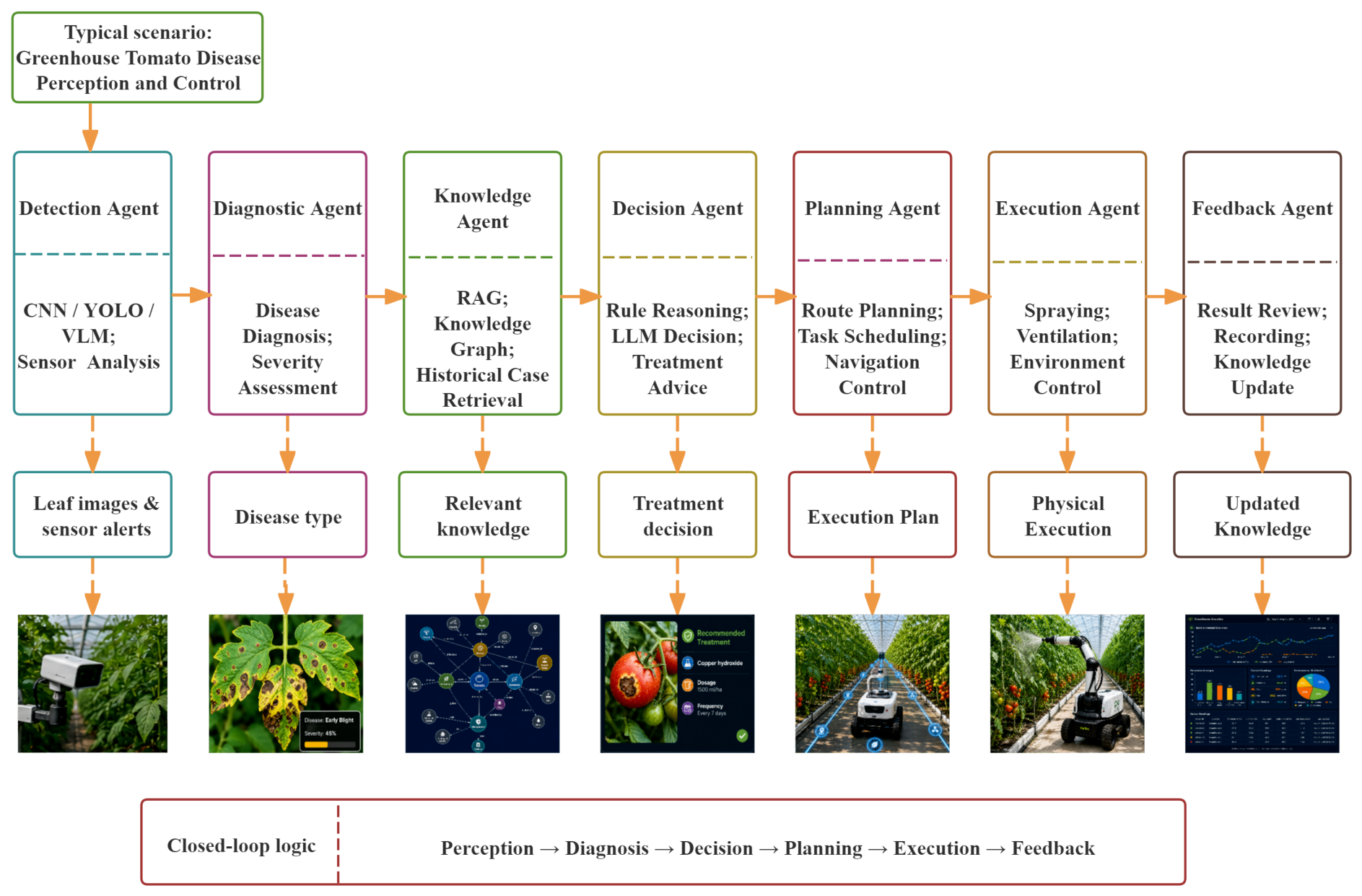
- Collaborating with virtual agents.Embodied AI agents do not operate independently but collaborate with virtual agents to form a complete intelligent agricultural system. Murad et al. proposed a four-agent collaboration framework in which the perception agent collects environmental data, the decision-making agent generates operation strategies, and the embodied execution device completes task implementation. This framework reflects a “perception–decision–execution” closed-loop collaboration mechanism [10]. Chen et al.’s “Fu Xi Brain” system further extends this collaboration toward full autonomy by integrating a “sky–ground–human–machine” multi-source data collection system with an intelligent decision-making system. In corn planting experiments at Dahewan Farm in Inner Mongolia, this framework achieved an autonomous decision-making accuracy of 89.7% throughout the production cycle, demonstrating the potential of deep collaboration between virtual and embodied AI agents in agricultural autonomous operations [11].
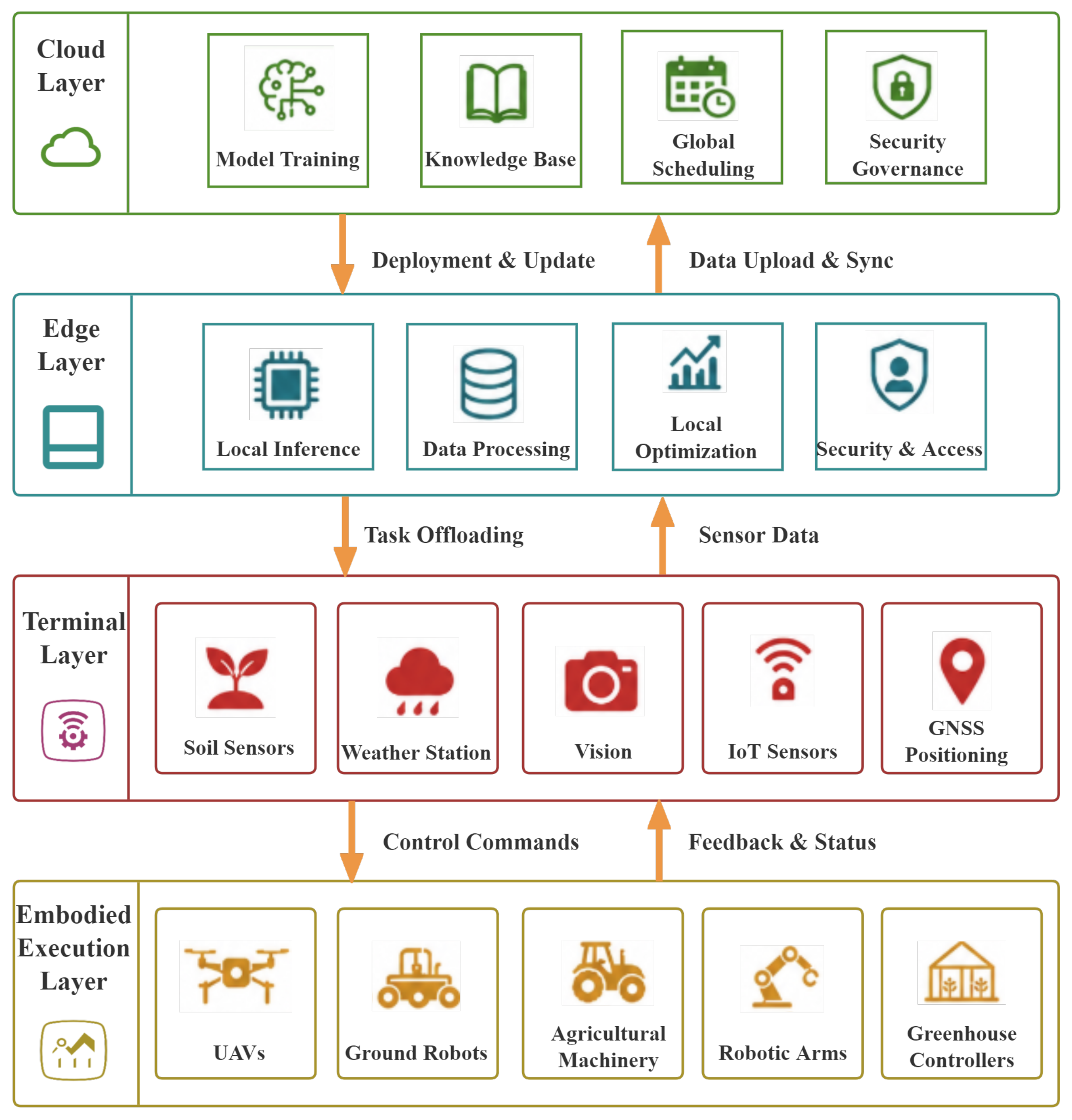
2.2. System Architecture of Agricultural AI Agents
2.2.1. Infrastructure Layer
2.2.2. Intelligent Agent Management Layer
2.2.3. Agent Collaboration Layer
2.2.4. Application Layer
3. Typical Business Operations and Required Model Capabilities of Agricultural AI Agents
3.1. Perception and State Understanding
3.1.1. Crop Detection and Phenotype Analysis
3.1.2. Pest and Disease Identification
3.1.3. Environmental Sensing
3.2. Knowledge Memory and Experience Management
3.2.1. Land Parcel Archive Management and Knowledge Base Construction
3.2.2. Knowledge Retrieval and Intelligent Question Answering
3.2.3. Historical Tracking and Traceability
3.3. Reasoning Decisions and Task Planning
3.3.1. Irrigation Decision
3.3.2. Fertilizer and Pesticide Application Decision-Making
3.3.3. Greenhouse Regulation
3.4. Collaborative Execution and Resource Scheduling
3.4.1. Tractor Scheduling and Path Planning
3.4.2. Equipment Interconnection and Heterogeneous Collaboration
3.4.3. Closed-Loop Operations and Collaborative Optimization
3.5. Summary: Transition from Single-Point Technology Breakthrough to Full-Chain Business Closed-Loop
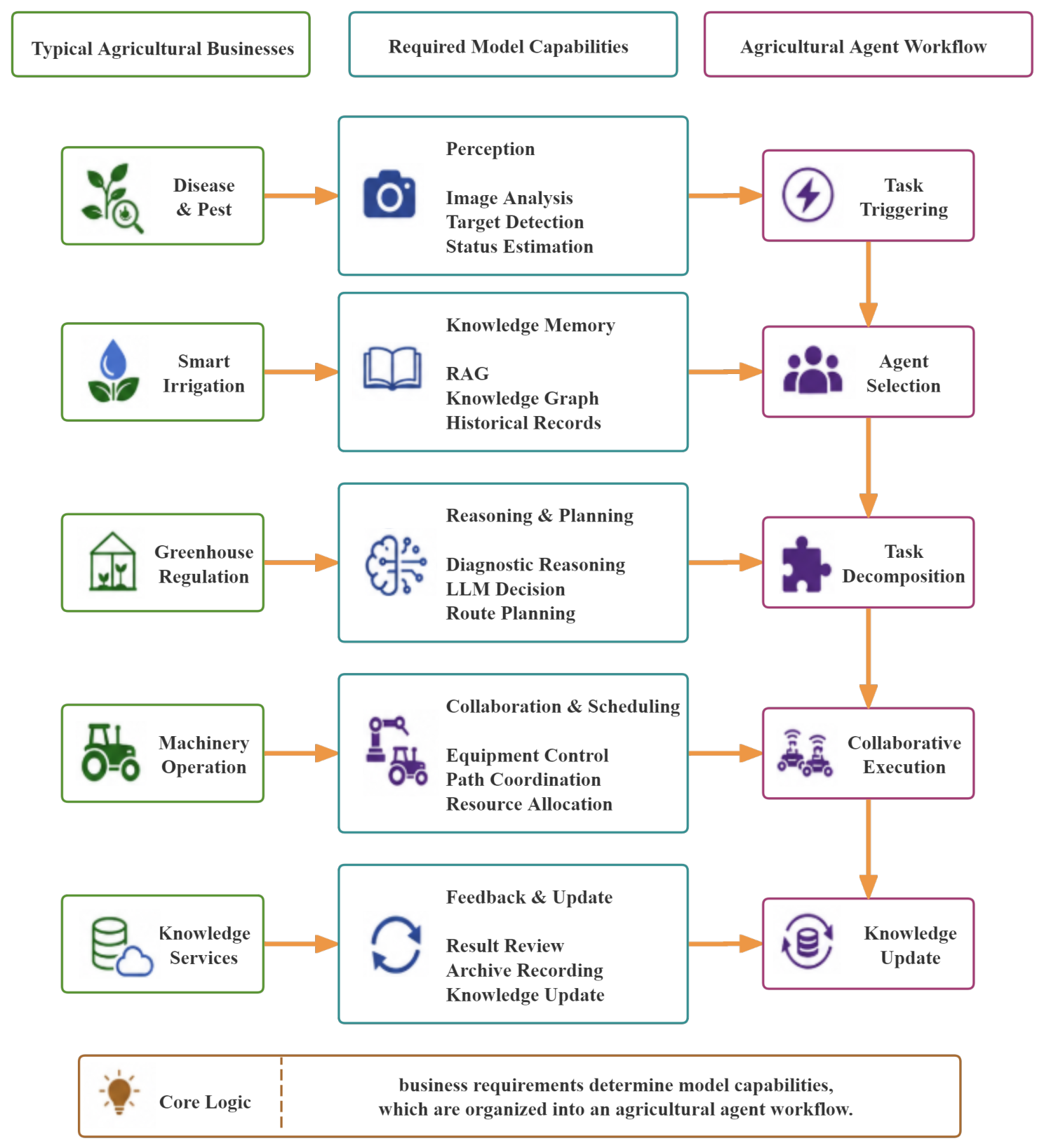
4. Workflow Examples of Agricultural AI Agents: Full-Process Task Organization Based on Model Capabilities Required for Typical Tasks
4.1. Model Capability Requirements for Typical Agricultural Tasks
4.2. Task Triggering: From Business Needs to Agent Task Generation
4.3. Agent Selection and Capability Matching: From Model Capabilities to Role Division
4.4. Dynamic Task Orchestration and Matching: The Concatenation of Recognition, Diagnosis, Decision-Making, Planning, and Execution
4.5. Collaborative Execution: From Intelligent Decision-Making to Physical Agricultural Operations
4.6. Result Feedback and Knowledge Update: From Single Tasks to a Continuous Optimization Loop
4.7. Summary: A Reusable Workflow Paradigm for All Agricultural Businesses
5. Key Technologies of Agricultural AI Agents
5.1. Goal Understanding and Agent Selection
5.1.1. Intent Understanding
5.1.2. Agent Modeling
5.1.3. Agent Selection
5.2. Multi-Agent Collaboration and Consensus Mechanisms
5.2.1. Protocol Communication
5.2.2. Conflict Resolution
5.2.3. Trust Management
5.3. Multi-Agent Scheduling and Workflow Orchestration
5.3.1. Workflow Orchestration
5.3.2. Resource Scheduling
5.3.3. State Synchronization
6. Future Outlook for Agricultural Agents
6.1. Data Extraction Issues
6.1.1. Challenges in Multimodal Agricultural Data Collection
6.1.2. Challenges in Agricultural Knowledge Extraction and Structuring
6.1.3. Issues of Data Standardization and Sharing
6.2. Model Generalization Issues
6.2.1. Insufficient Cross-Scenario Task Generalization
6.2.2. Insufficient Adaptability to Small-Sample and Long-Tail Tasks
6.2.3. Insufficient Continuous Learning and Transfer Learning Capacity
6.3. Multi-Agent Collaboration Issues
6.3.1. Collaboration Efficiency and Communication Overhead
6.3.2. Stability Issues in Heterogeneous Agent Collaboration
6.3.3. Fault Recovery and Robust Collaboration Issues
6.4. Hardware–Software Coordination Issues
6.4.1. Adaptation Issues of Cloud–Edge–End Coordination Architecture
6.4.2. Embodied Deployment Issues on Agricultural Equipment
6.4.3. Issues of Real-Time Computing and Energy Constraints
6.5. Security and Trust Issues
6.5.1. Data Privacy and Data Property Protection Issues
6.5.2. Interpretability and Human–Machine Collaborative Supervision Issues
6.5.3. Regulatory Compliance and Decision Traceability Issues
6.5.4. Security Governance and Trust Evaluation Mechanism Issues
6.6. Practical Deployment Barriers
7. Summary
Author Contributions
Funding
Institutional Review Board Statement
Informed Consent Statement
Data Availability Statement
Conflicts of Interest
References
- Ge, C.; Zhang, G.; Wang, Y.; Shao, D.; Song, X.; Wang, Z. Research Status and Development Trends of Artificial Intelligence in Smart Agriculture. Agriculture 2025, 15, 2247. [Google Scholar] [CrossRef]
- Zhu, Y.; Zhang, S.; Tang, S.; Gao, Q. Research Progress and Applications of Artificial Intelligence in Agricultural Equipment. Agriculture 2025, 15, 1703. [Google Scholar] [CrossRef]
- Jiang, L.; Xu, B.; Husnain, N.; Wang, Q. Overview of Agricultural Machinery Automation Technology for Sustainable Agriculture. Agronomy 2025, 15, 1471. [Google Scholar] [CrossRef]
- Duan, Y.; Han, W.; Guo, P.; Wei, X. YOLOv8-GDCI: Research on the Phytophthora Blight Detection Method of Different Parts of Chili Based on Improved YOLOv8 Model. Agronomy 2024, 14, 2734. [Google Scholar] [CrossRef]
- Wu, J.; Li, C.; Pan, X.; Wang, X.; Zhao, X.; Gao, Y.; Yang, S.; Zhai, C. Model for Detecting Boom Height Based on an Ultrasonic Sensor for the Whole Growth Cycle of Wheat. Agriculture 2024, 14, 21. [Google Scholar] [CrossRef]
- Wu, J.; Yang, S.; Gao, Y.; Pan, X.; Zou, W.; Wei, Y.; Zhai, C.; Chen, L. Optimization of a Boom Height Ultrasonic Detecting Model for the Whole Growth Cycle of Wheat: Affected by the Oscillation of the Three-Section Boom of the Sprayer. Agriculture 2024, 14, 1733. [Google Scholar] [CrossRef]
- Yin, S.; Xi, Y.; Zhang, X.; Sun, C.; Mao, Q. Foundation Models in Agriculture: A Comprehensive Review. Agriculture 2025, 15, 847. [Google Scholar] [CrossRef]
- Zhang, R.; Zhu, H.; Chang, Q.; Mao, Q. A Comprehensive Review of Digital Twins Technology in Agriculture. Agriculture 2025, 15, 903. [Google Scholar] [CrossRef]
- Zhao, J.; Fan, S.; Zhang, B.; Wang, A.; Zhang, L.; Zhu, Q. Research Status and Development Trends of Deep Reinforcement Learning in the Intelligent Transformation of Agricultural Machinery. Agriculture 2025, 15, 1223. [Google Scholar] [CrossRef]
- Murad, M.; Ahmed, M.; Din, N.U.; Shahid, M.F.; Siddiqui, S.; Byers, D.; Tanveer, M.H.; Voicu, R.C. Agentic AI Framework to Automate Traditional Farming for Smart Agriculture. Agriengineering 2026, 8, 8. [Google Scholar] [CrossRef]
- Chen, H.; Hou, G.; Hua, C.; Wang, S.; Chen, Z.; Zhang, Y. Agricultural autonomous decision-making system “Fuxi Brain” Based on generative large model fusion internet of things. Comput. Electron. Agric. 2026, 244, 111454. [Google Scholar] [CrossRef]
- Qin, S.; Zhang, S.; Zhong, W.; He, Z. Control Algorithms for Intelligent Agriculture: Applications, Challenges, and Future Directions. Processes 2025, 13, 3061. [Google Scholar] [CrossRef]
- Wu, Y.; Chen, L.; Yang, N.; Sun, Z. Research Progress of Deep Learning-Based Artificial Intelligence Technology in Pest and Disease Detection and Control. Agriculture 2025, 15, 2077. [Google Scholar] [CrossRef]
- Wang, Y.; Zhang, Z.; Jia, W.; Ou, M.; Dong, X.; Dai, S. A Review of Environmental Sensing Technologies for Targeted Spraying in Orchards. Horticulturae 2025, 11, 551. [Google Scholar] [CrossRef]
- Zhao, Y.; Liang, J.; Chen, B.; Deng, X.; Zhang, Y.; Xiong, Z.; Pan, M.; Meng, X. Applications Research Progress and Prospects of Multi-Agent Large Language Models in Agricultural. Smart Agric. 2025, 7, 37–51. [Google Scholar] [CrossRef]
- Zhang, Y.; Zhang, B.; Shen, C.; Liu, H.; Huang, J.; Tian, K.; Tang, Z. Review of the field environmental sensing methods based on multi-sensor information fusion technology. Int. J. Agric. Biol. Eng. 2024, 17, 1–13. [Google Scholar] [CrossRef]
- Wan, L.; Li, H.; Li, C.; Wang, A.; Yang, Y.; Wang, P. Hyperspectral Sensing of Plant Diseases: Principle and Methods. Agronomy 2022, 12, 1451. [Google Scholar] [CrossRef]
- Goodrich, P.; Betancourt, O.; Arias, A.C.; Zohdi, T. Placement and drone flight path mapping of agricultural soil sensors using machine learning. Comput. Electron. Agric. 2023, 205, 107591. [Google Scholar] [CrossRef]
- Betalo, M.L.; Leng, S.; Abishu, H.N.; Dharejo, F.A.; Seid, A.M.; Erbad, A.; Naqvi, R.A.; Zhou, L.; Guizani, M. Multi-Agent Deep Reinforcement Learning-Based Task Scheduling and Resource Sharing for O-RAN-Empowered Multi-UAV-Assisted Wireless Sensor Networks. IEEE Trans. Veh. Technol. 2024, 73, 9247–9261. [Google Scholar] [CrossRef]
- Zou, Y.; Quan, L. Resource management and scheduling policy based on grid for AIoT. Mod. Phys. Lett. B 2017, 31, 1740066. [Google Scholar] [CrossRef]
- Gonzalez-Briones, A.; Mezquita, Y.; Castellanos-Garzon, J.A.; Prieto, J.; Corchado, J.M. Intelligent multi-agent system for water reduction in automotive irrigation processes. Procedia Comput. 2019, 151, 971–976. [Google Scholar] [CrossRef]
- Agyeman, B.T.; Naouri, M.; Appels, W.M.; Liu, J.; Shah, S.L. Learning-based multi-agent MPC for irrigation scheduling. Control Eng. Pract. 2024, 147, 105908. [Google Scholar] [CrossRef]
- Ge, W.; Zhou, J.; Zheng, P.; Yuan, L.; Rottok, L.T. A recommendation model of rice fertilization using knowledge graph and case-based reasoning. Comput. Electron. Agric. 2024, 219, 108751. [Google Scholar] [CrossRef]
- Lin, Y.; Li, D.; Peng, P.; Liang, J.; Ding, F.; Jin, X.; Zeng, Z. A reasoning method for rice fertilization strategy based on spatiotemporal knowledge graph. Trans. GIS 2024, 28, 902–924. [Google Scholar] [CrossRef]
- Li, K.; Shi, J.; Hu, C.; Xue, W. The Intelligentization Process of Agricultural Greenhouse: A Review of Control Strategies and Modeling Techniques. Agriculture 2025, 15, 2135. [Google Scholar] [CrossRef]
- Zhang, S. Chat Demeter: A multi-agent system for plant disease diagnosis integrating CNN-transformer models. Front. Plant Sci. 2026, 16, 1695227. [Google Scholar] [CrossRef]
- Anand, A.; Shen, J.; Cremers, A.B.; Jacobs, M. Algorithms in the orchard: An embedding-based expert answering system for apple rust. Smart Agric. Technol. 2025, 12, 101069. [Google Scholar] [CrossRef]
- Owiti, T.; Kipkebut, A. Enhancing AI-Driven Farming Advisory in Kenya with Efficient RAG Agents via Quantized Fine-Tuned Language Models. In Proceedings of the Sixth Workshop on African Natural Language Processing, AFRICANLP 2025; Association for Computational Linguistics: Stroudsburg, PA, USA, 2025; pp. 24–30. [Google Scholar] [CrossRef]
- Jayarathna, H.M.H.R.; Hettige, B. AgriCom: A Communication Platform for Agriculture Sector. In Proceedings of the 2013 8th IEEE International Conference on Industrial and Information Systems (ICIIS); IEEE: New York, NY, USA, 2013; pp. 439–444. [Google Scholar] [CrossRef]
- Skobelev, P.; Mayorov, I.; Simonova, E.; Laryukhin, V.; Yalovenko, O. Vertical and Horizontal Negotiations of Multi-Agent Planning Services in a Multi-Service Platform for Crop Managing. In Proceedings of the 2019 XXI International Conference Complex Systems: Control and Modeling Problems (CSCMP); IEEE: New York, NY, USA, 2019; pp. 78–83. [Google Scholar] [CrossRef]
- Guo, H.; Pan, Q.; Sang, H.; Miao, Z.; Zhang, W. AHLLNS: An Automated Algorithm for Multi-Objective Heterogeneous Agricultural Robot Operation Scheduling Problems. IEEE Trans. Autom. Sci. Eng. 2026, 23, 5096–5109. [Google Scholar] [CrossRef]
- Jo, Y.; Son, H.I. A Path Planning and Coordination Algorithm for Heterogeneous Tasks of Multi-UGV in Smart Farm: Work in Progress. In Proceedings of the 2022 22nd International Conference on Control, Automation and Systems (ICCAS 2022); IEEE: New York, NY, USA, 2022; pp. 1387–1390. [Google Scholar] [CrossRef]
- Wu, H.; Wang, X.; Chen, X.; Zhang, Y.; Zhang, Y. Review on Key Technologies for Autonomous Navigation in Field Agricultural Machinery. Agriculture 2025, 15, 1297. [Google Scholar] [CrossRef]
- Jin, Y.; Liu, J.; Xu, Z.; Yuan, S.; Li, P.; Wang, J. Development status and trend of agricultural robot technology. Int. J. Agric. Biol. Eng. 2021, 14, 1–19. [Google Scholar] [CrossRef]
- Chen, Z.; Yin, J.; Farhan, S.M.; Liu, L.; Zhang, D.; Zhou, M.; Cheng, J. A comprehensive review of obstacle avoidance for autonomous agricultural machinery in multi-ope rational environment. Artif. Intell. Agric. 2026, 16, 139–163. [Google Scholar] [CrossRef]
- Wu, M.; Liu, S.; Li, Z.; Ou, M.; Dai, S.; Dong, X.; Wang, X.; Jiang, L.; Jia, W. A Review of Intelligent Orchard Sprayer Technologies: Perception, Control, and System Integration. Horticulturae 2025, 11, 668. [Google Scholar] [CrossRef]
- Jia, H.; Chen, W.; Su, Z.; Sun, Y.; Qian, Z.; Huang, L. AI-Driven Cooperative Control for Autonomous Tractors and Implements: A Comprehensive Review. Agriengineering 2025, 7, 394. [Google Scholar] [CrossRef]
- Salah, K.; Chen, X.; Neshatian, K.; Pretty, C. A Hybrid Control Multi-Agent Cooperative System for Autonomous Bin Transport during Apple Harvest. In Proceedings of the 2018 13th IEEE Conference on Industrial Electronics and Applications (ICIEA 2018); IEEE: New York, NY, USA, 2018; pp. 644–649. [Google Scholar] [CrossRef]
- Ma, S.; Li, R.; Cong, S.; Nie, X.; Khan, R.A.I.; Yu, C.; Zhou, W.; Hu, H.; Fang, H.; Shang, H. Autonomous Weeding Robots: Coordinating Locomotion and Manipulation via Long Short-Term Memory-Proximal Policy Optimization Reinforcement Learning. IEEE Trans. Autom. Sci. Eng. 2026, 23, 6473–6486. [Google Scholar] [CrossRef]
- Jo, Y.; Son, H.I. CBS-HT: Prioritized Safe Interval Path-Planning Algorithm for Heterogeneous Agricultural Robot Team. IEEE Access 2025, 13, 146630–146648. [Google Scholar] [CrossRef]
- Manasherov, O.; Degani, A. Multi-Agent target allocation and safe trajectory planning for artificial pollination tasks. Smart Agric. Technol. 2024, 8, 100461. [Google Scholar] [CrossRef]
- Li, T.; Xie, F.; Qiu, Q.; Feng, Q. Multi-Arm Robot Task Planning for Fruit Harvesting Using Multi-Agent Reinforcement Learning. In Proceedings of the 2023 IEEE/RSJ International Conference on Intelligent Robots and Systems, IROS; IEEE: New York, NY, USA, 2023; pp. 4176–4183. [Google Scholar] [CrossRef]
- Ma, Z.; Wang, X.; Chen, X.; Hu, B.; Li, J. Advances in Crop Row Detection for Agricultural Robots: Methods, Performance Indicators, and Scene Adaptability. Agriculture 2025, 15, 2151. [Google Scholar] [CrossRef]
- Goral, P.; Pawlowski, P.; Piniarski, K.; Dabrowski, A. Multi-Agent Vision System for Supporting Autonomous Orchard Spraying. Electronics 2024, 13, 494. [Google Scholar] [CrossRef]
- Ankit, K.; Kolathaya, S.N.Y.; Ghose, D. Multi-Agent Collaborative Framework for Automated Agriculture. In Proceedings of the 2021 15th International Conference on Advanced Computing and Applications (ACOMP 2021); IEEE: New York, NY, USA, 2021; pp. 30–37. [Google Scholar] [CrossRef]
- Li, J.; Zhang, W.; Ren, J.; Yu, W.; Wang, G.; Ding, P.; Wang, J.; Zhang, X. A Multi-Area Task Path-Planning Algorithm for Agricultural Drones Based on Improved Double Deep Q-Learning Net. Agriculture 2024, 14, 1294. [Google Scholar] [CrossRef]
- Morchid, A.; El Alami, R.; Raezah, A.A.; Sabbar, Y. Applications of internet of things (IoT) and sensors technology to increase food security and agricultural Sustainability: Benefits and challenges. Ain Shams Eng. J. 2024, 15, 102509. [Google Scholar] [CrossRef]
- Zhao, T.; Zhang, P.; Hou, H. The Agricultural Irrigation District Information System based on Multi-Agent and GSM. Appl. Mech. Mater. 2013, 433, 1853–1856. [Google Scholar] [CrossRef]
- Ikidid, A.; El Fazziki, A.; Sadgal, M. Smart Collective Irrigation: Agent and Internet of Things based system. In Proceedings of the 13th International Conference on Management of Digital Ecosystems, MEDES 2021; Association for Computing Machinery: New York, NY, USA, 2020; pp. 100–106. [Google Scholar] [CrossRef]
- Kalyani, Y.; Collier, R. The Role of Multi-Agents in Digital Twin Implementation: Short Survey. ACM Comput. Surv. 2025, 57, 72. [Google Scholar] [CrossRef]
- Kalyani, Y.; Collier, R. Towards a New Architecture: Multi-agent Based Cloud-Fog-Edge Computing and Digital Twin for Smart Agriculture. In Proceedings of the Intelligent Distributed Computing XV, IDC 2022; Springer: Cham Switzerland, 2023; Volume 1089, pp. 111–117. [Google Scholar] [CrossRef]
- Kalyani, Y.; Vorster, L.; Whetton, R.; Collier, R. Application Scenarios of Digital Twins for Smart Crop Farming through Cloud-Fog-Edge Infrastructure. Future Internet 2024, 16, 100. [Google Scholar] [CrossRef]
- Skobelev, P.O.; Simonova, E.V.; Smirnov, S.V.; Budaev, D.S.; Voshchuk, G.Y.; Morokov, A.L. Development of a Knowledge Base in the “Smart Farming” System for Agricultural Enterprise Management. Procedia Comput. Sci. 2019, 150, 154–161. [Google Scholar] [CrossRef]
- Ramanathan, G.; Vachtsevanou, D.; Garcia, K.; Lemee, J.; Burattini, S.; Bekta, K.; Mayer, S. Semantic Knowledge for Autonomous Smart Farming. IFAC-Pap. 2022, 55, 217–222. [Google Scholar] [CrossRef]
- Kahneman, D. Thinking, Fast and Slow; Farrar, Straus and Giroux: New York, NY, USA, 2011. [Google Scholar]
- Yang, B.; Zhang, Y.; Chen, Y.; Feng, L.; Xu, X.; Aierken, N.; Li, S. AgriAgent: Contract-Driven Planning and Capability-Aware Tool Orchestration in Real-World Agriculture. arXiv 2026, arXiv:2601.08308. [Google Scholar] [CrossRef]
- Harman, H.; Sklar, E.I. Challenges for Multi-Agent Based Agricultural Workforce Management. In Proceedings of the Multi-Agent-Based Simulation XXIII, MABS 2022; Springer: Cham, Switzerland, 2023; Volume 13743, pp. 121–133. [Google Scholar] [CrossRef]
- Harman, H.; Sklar, E.I. Multi-agent task allocation for harvest management. Front. Robot. AI 2022, 9, 864745. [Google Scholar] [CrossRef]
- Guo, W.; Li, W.; Zhong, Y.; Lodewijks, G.; Shen, W. Agent-based Negotiation Framework for Agricultural Supply Chain Supported by Third Party Logistics. In Proceedings of the 2016 IEEE 20th International Conference on Computer Supported Cooperative Work in Design (CSCWD); IEEE: New York, NY, USA, 2016; pp. 584–589. [Google Scholar] [CrossRef]
- Yu, P.; Teng, F.; Zhu, W.; Shen, C.; Chen, Z.; Song, J. Cloud–edge–device collaborative computing in smart agriculture: Architectures, applications, and future perspectives. Front. Plant Sci. 2025, 16, 1668545. [Google Scholar] [CrossRef]
- Zhu, A.; Zeng, Z.; Guo, S.; Lu, H.; Ma, M.; Zhou, Z. Game-theoretic robotic offloading via multi-agent learning for agricultural applications in heterogeneous networks. Comput. Electron. Agric. 2023, 211, 108017. [Google Scholar] [CrossRef]
- Islam, A.; Ghose, M. GSAgri: Green and Secure Agriculture through efficient task offloading and scheduling under IoT-enabled energy-harvesting multi-access edge computing framework. Expert Syst. Appl. 2025, 284, 127814. [Google Scholar] [CrossRef]
- Tan, H.; Zhang, Q.; Li, M.; Liu, X.; Hu, L. Dynamic resource allocation in smart agricultural IoT using reinforcement learning and 6g edge computing. EURASIP J. Wirel. Commun. Netw. 2026, 2026, 23. [Google Scholar] [CrossRef]
- Jogeshwar, B.K.; Sevil, H.E.; Haghshenas-Jaryani, M. Multi-Agent Coverage Planning for Agricultural Soil and Crop Monitoring. In Proceedings of the ASME 2025 International Mechanical Engineering Congress and Exposition, IMECE2025; ASME: New York, NY, USA, 2025; Volume 5. [Google Scholar] [CrossRef]
- Salazar, R.; Carlos Rangel, J.; Pinzon, C.; Rodriguez, A. Irrigation System through Intelligent Agents Implemented with Arduino Technology. ADCAIJ-Adv. Distrib. Comput. Artif. Intell. J. 2013, 2, 29–36. [Google Scholar] [CrossRef]
- Liu, Y.; Yan, H.; Zhang, C.; Zhang, J.; Wang, G.; Zhang, D.; Bao, R.; Han, Y. Application of Irrigation Decision-Making Methods for Smart Irrigation Systems: A Review. Irrig. Drain. 2026. [Google Scholar] [CrossRef]
- Seralathan, P.; Edward, A.S. Reinforcement learning based dynamic vegetation index formulation for rice crop stress detection using satellite and mobile imagery. Sci. Rep. 2025, 16, 3447. [Google Scholar] [CrossRef]
- Bahri, O.; Mourhir, A.; Papageorgiou, E.I. Integrating fuzzy cognitive maps and multi-agent systems for sustainable agriculture. EURO-Mediterr. J. Environ. Integr. 2020, 5, 7. [Google Scholar] [CrossRef]
- Xu, J.; Liu, H.; Shen, Y. Image and Point Cloud-Based Neural Network Models and Applications in Agricultural Nursery Plant Protection Tasks. Agronomy 2025, 15, 2147. [Google Scholar] [CrossRef]
- Ghazal, S.; Munir, A.; Qureshi, W.S. Computer vision in smart agriculture and precision farming: Techniques and applications. Artif. Intell. Agric. 2024, 13, 64–83. [Google Scholar] [CrossRef]
- Weyler, J.; Laebe, T.; Magistri, F.; Behley, J.; Stachniss, C. Towards Domain Generalization in Crop and Weed Segmentation for Precision Farming Robots. IEEE Robot. Autom. Lett. 2023, 8, 3310–3317. [Google Scholar] [CrossRef]
- Angarano, S.; Martini, M.; Navone, A.; Chiaberge, M. Domain Generalization for Crop Segmentation with Standardized Ensemble Knowledge Distillation. In Proceedings of the 2024 IEEE/CVF Conference on Computer Vision and Pattern Recognition Workshops, CVPRW; IEEE: New York, NY, USA, 2024; pp. 5450–5459. [Google Scholar] [CrossRef]
- Ning, Y.; Junjie, Y.; Aiying, W.; Jian, T.; Rongbiao, Z.; Liangliang, X.; Fangyu, S.; Kwabena, O.P. A rapid rice blast detection and identification method based on crop disease spores’ diffraction fingerprint texture. J. Sci. Food Agric. 2020, 100, 3608–3621. [Google Scholar] [CrossRef]
- Ali, N.; Ullah, M.; Mohammed, A.; Bais, A.; Berraies, S.; Ruan, Y.; Cuthbert, R.D.; Sangha, J.S. Advancing Fusarium Head Blight Detection in Wheat Crop: A Review and Future Directions to Sustainable Agriculture. IEEE Trans. Consum. Electron. 2025, 71, 7473–7491. [Google Scholar] [CrossRef]
- Bhujade, V.G.; Shrawne, S.C.; Sambhe, V.K. Implementation and Performance Evaluation of Deep Learning Models for Disease Classification and Severity Estimation of Coffee Leaves. In Proceedings of the Advanced Network Technologies and Intelligent Computing, ANTIC 2023, PT III; Springer: Cham, Switzerland, 2024; Volume 2092, pp. 3–19. [Google Scholar] [CrossRef]
- Mostafa, S.A.; Hazeem, A.A.; Khaleefahand, S.H.; Mustapha, A.; Darman, R. A Collaborative Multi-agent System for Oil Palm Pests and Diseases Global Situation Awareness. In Proceedings of the Future Technologies Conference (FTC) 2018, VOL 1; Springer: Cham, Switzerland, 2019; Volume 880, pp. 763–775. [Google Scholar] [CrossRef]
- Zhou, J.W.; Zou, X.M.; Song, S.H.; Chen, G.H. Quantum Dots Applied to Methodology on Detection of Pesticide and Veterinary Drug Residues. J. Agric. Food Chem. 2018, 66, 1307–1319. [Google Scholar] [CrossRef]
- Wang, P.; Li, H.; Hassan, M.M.; Guo, Z.; Zhang, Z.Z.; Chen, Q. Fabricating an Acetylcholinesterase Modulated UCNPs-Cu2+ Fluorescence Biosensor for Ultrasensitive Detection of Organophosphorus Pesticides-Diazinon in Food. J. Agric. Food Chem. 2019, 67, 4071–4079. [Google Scholar] [CrossRef] [PubMed]
- Chen, Z.; Sun, Y.; Shi, J.; Zhang, W.; Zhang, X.; Huang, X.; Zou, X.; Li, Z.; Wei, R. Facile synthesis of Au@Ag core-shell nanorod with bimetallic synergistic effect for SERS detection of thiabendazole in fruit juice. Food Chem. 2022, 370, 131276. [Google Scholar] [CrossRef]
- Wang, L.; Haruna, S.A.; Ahmad, W.; Wu, J.; Chen, Q.; Ouyang, Q. Tunable multiplexed fluorescence biosensing platform for simultaneous and selective detection of paraquat and carbendazim pesticides. Food Chem. 2022, 388, 132950. [Google Scholar] [CrossRef] [PubMed]
- Aheto, J.H.; Huang, X.; Wang, C.; Tian, X.; Yi, R.; Yuena, W. Fabrication and evaluation of chitosan modified filter paper for chlorpyrifos detection in wheat by surface-enhanced Raman spectroscopy. J. Sci. Food Agric. 2022, 102, 7323–7330. [Google Scholar] [CrossRef]
- Guo, Z.; Wu, X.; Jayan, H.; Yin, L.; Xue, S.; El-Seedi, H.R.; Zou, X. Recent developments and applications of surface enhanced Raman scattering spectroscopy in safety detection of fruits and vegetables. Food Chem. 2024, 434, 137469. [Google Scholar] [CrossRef] [PubMed]
- Marimuthu, M.; Xu, K.; Song, W.; Chen, Q.; Wen, H. Safeguarding food safety: Nanomaterials-based fluorescent sensors for pesticide tracing. Food Chem. 2025, 463, 141288. [Google Scholar] [CrossRef]
- Awais, M.; Li, W.; Hussain, S.; Cheema, M.J.M.; Li, W.; Song, R.; Liu, C. Comparative Evaluation of Land Surface Temperature Images from Unmanned Aerial Vehicle and Satellite Observation for Agricultural Areas Using In Situ Data. Agriculture 2022, 12, 184. [Google Scholar] [CrossRef]
- Oudendag, D.; Hoogendoorn, M.; Jongeneel, R. Agent-Based Modeling of Farming Behavior: A Case Study for Milk Quota Abolishment. In Proceedings of the Modern Advances in Applied Intelligence, IEA/AIE 2014, PT I; Springer: Cham, Switzerland, 2014; Volume 8481, pp. 11–20. [Google Scholar] [CrossRef]
- Ito, J. Impediments to efficient land reallocation in agriculture: Multi-agent simulation model of transaction costs and farm retirement. Land Degrad. Dev. 2024, 35, 1553–1566. [Google Scholar] [CrossRef]
- Berger, T. Agent-based spatial models applied to agriculture: A simulation tool for technology diffusion, resource use changes and policy analysis. Agric. Econ. 2001, 25, 245–260. [Google Scholar] [CrossRef]
- Imane, B.; El Miloud, J.; Abdelmajid, B.; Mohammed, T.A. Agent Mining Framework for Analyzing Moroccan Olive Oil Datasets. Int. J. Adv. Comput. Sci. Appl. 2020, 11, 638–646. [Google Scholar] [CrossRef]
- Singh, A.; Sharma, A. A Framework for Semantics and Agent Based Personalized Information Retrieval in Agriculture. In Proceedings of the 2015 2nd International Conference on Computing for Sustainable Global Development (INDIACOM); IEEE: New York, NY, USA, 2015; pp. 929–931. [Google Scholar]
- Nguyen, V.G.N.; Drogoul, A.; Huynh, H.X. Toward an Agent-based Multi-scale Recommendation System for Brown Plant Hopper Control. In Proceedings of the 2012 Sixth Uksim/Amss European Symposium on Computer Modelling and Simulation (EMS); IEEE: New York, NY, USA, 2012; pp. 9–14. [Google Scholar] [CrossRef]
- Akbar, N.A.; Dembani, R.; Lenzitti, B.; Tegolo, D. RAG-Driven Memory Architectures in Conversational LLMs-A Literature Review with Insights Into Emerging Agriculture Data Sharing. IEEE Access 2025, 13, 123855–123880. [Google Scholar] [CrossRef]
- Song, Y.; Lv, C.; Liu, J. Quality and safety traceability system of agricultural products based on Multi-agent. J. Intell. Fuzzy Syst. 2018, 35, 2731–2740. [Google Scholar] [CrossRef]
- Su, X.; Duan, S.; Guo, S.; Liu, H. Evolutionary Games in the Agricultural Product Quality and Safety Information System: A Multiagent Simulation Approach. Complexity 2018, 7684185. [Google Scholar] [CrossRef]
- Ding, C.; Wang, L.; Chen, X.; Yang, H.; Huang, L.; Song, X. A Blockchain-Based Wide-Area Agricultural Machinery Resource Scheduling System. Appl. Eng. Agric. 2023, 39, 1–12. [Google Scholar] [CrossRef]
- Zhang, P.; Li, N.; Han, H. An Evolutionary Game Study of Multi-Agent Collaborative Disaster Relief Mechanisms for Agricultural Natural Disasters in China. Sustainability 2025, 17, 7194. [Google Scholar] [CrossRef]
- Jimenez, A.F.; Cardenas, P.F.; Canales, A.; Jimenez, F.; Portacio, A. A survey on intelligent agents and multi-agents for irrigation scheduling. Comput. Electron. Agric. 2020, 176, 105474. [Google Scholar] [CrossRef]
- Ma, Y.W.; Shi, J.Q.; Chen, J.L.; Hsu, C.C.; Chuang, C.H. Integration Agricultural Knowledge and Internet of Things for Multi-Agent Deficit Irrigation Control. In Proceedings of the 2019 21st International Conference on Advanced Communication Technology (ICACT): ICT for 4th Industrial Revolution; IEEE: New York, NY, USA, 2019; pp. 299–304. [Google Scholar] [CrossRef]
- Khorshidi, M.S.; Izady, A.; Nikoo, M.R.; Al-Maktoumi, A.; Chen, M.; Gandomi, A.H. An Agent-based Framework for Transition from Traditional to Advanced Water Supply Systems in Arid Regions. Water Resour. Manag. 2024, 38, 2565–2579. [Google Scholar] [CrossRef]
- Dong, J.; Dong, H.; Sun, S.; Liu, J.; Zhang, J.; Jia, C.; Wang, Y. Agricultural water-carbon footprint regulation based on DNDC model and multi-agent model fusion gradient boosting algorithm. Eur. J. Agron. 2026, 172, 127867. [Google Scholar] [CrossRef]
- Zhai, Z.; Martinez Ortega, J.F.; Lucas Martinez, N.; Rodriguez-Molina, J. A Mission Planning Approach for Precision Farming Systems Based on Multi-Objective Optimization. Sensors 2018, 18, 1795. [Google Scholar] [CrossRef]
- Nagarsheth, S.; Agbossou, K.; Henao, N.; Bendouma, M. The Advancements in Agricultural Greenhouse Technologies: An Energy Management Perspective. Sustainability 2025, 17, 3407. [Google Scholar] [CrossRef]
- Hindi, I.; Alsharkawi, A.; Al-Ajlouni, M.; Qarallah, B. Enhancing autonomous agriculture control systems in greenhouses for sustainable resource usage using deep learning techniques. PLoS ONE 2026, 21, e0344946. [Google Scholar] [CrossRef] [PubMed]
- Taha, M.F.; Mao, H.; Zhang, Z.; Elmasry, G.; Awad, M.A.; Abdalla, A.; Mousa, S.; Elwakeel, A.E.; Elsherbiny, O. Emerging Technologies for Precision Crop Management Towards Agriculture 5.0: A Comprehensive Overview. Agriculture 2025, 15, 582. [Google Scholar] [CrossRef]
- Xiang, R.; Ma, P.; Gong, L.; Tian, M.; Li, R.; Fei, H.; Yi, H. ASS-DQN: A deep reinforcement learning approach for path planning in multi-machine cooperative operations. Smart Agric. Technol. 2026, 13, 101887. [Google Scholar] [CrossRef]
- Lee, H.; Bae, J.; Patil, A.; Park, M.; Nguyen, V. Heuristic Approaches for Coordinating Collaborative Heterogeneous Robotic Systems in Harvesting Automation with Size Constraints. Sensors 2025, 25, 6443. [Google Scholar] [CrossRef] [PubMed]
- Gallou, J.; Lippi, M.; Palmieri, J.; Gasparri, A.; Marino, A. A Human-Centered Task Allocation and Scheduling Framework for Multi-Human-Multi-Robot Collaboration in Precision Agriculture Settings. IEEE Trans. Autom. Sci. Eng. 2025, 22, 20126–20145. [Google Scholar] [CrossRef]
- Jo, Y.; Son, H.I. Field Evaluation of a Prioritized Path-Planning Algorithm for Heterogeneous Agricultural Tasks of Multi-UGVs. In Proceedings of the 2024 IEEE International Conference on Robotics and Automation (ICRA 2024); IEEE: New York, NY, USA, 2024; pp. 11891–11897. [Google Scholar] [CrossRef]
- Tang, R.; Tang, J.; Talip, M.S.A.; Aridas, N.K.; Xu, X. Enhanced multi agent coordination algorithm for drone swarm patrolling in durian orchards. Sci. Rep. 2025, 15, 9139. [Google Scholar] [CrossRef]
- Ge, G.; Sun, M.; Xue, Y.; Pavlova, S. Transformer-Based Soft Actor-Critic for UAV Path Planning in Precision Agriculture IoT Networks. Sensors 2025, 25, 7463. [Google Scholar] [CrossRef]
- Yu, Y.; Li, Z.; Dai, B.; Pan, J.; Xu, L. High-Precision Mapping and Real-Time Localization for Agricultural Machinery Sheds and Farm Access Roads Environments. Agriculture 2025, 15, 2248. [Google Scholar] [CrossRef]
- Nivetha, R.; Sriharipriya, K.C.; Balusamy, B. Self-Supervised Learning Graphical Neural Network Driven Prediction Model for Path-Planning and Navigation in Smart Sustainable Agriculture. IEEE Access 2025, 13, 151235–151257. [Google Scholar] [CrossRef]
- Ahmed, S.; Qiu, B.; Ahmad, F.; Kong, C.W.; Xin, H. A State-of-the-Art Analysis of Obstacle Avoidance Methods from the Perspective of an Agricultural Sprayer UAV’s Operation Scenario. Agronomy 2021, 11, 1069. [Google Scholar] [CrossRef]
- Yao, X.; Cui, Y.; Xu, G.; Fan, S.; Wei, H. Research on Intelligent Management of Collaborative Relation in Agricultural Products Logistics. In Proceedings of the ICICTA: 2009 Second International Conference on Intelligent Computation Technology and Automation, VOL III, PROCEEDINGS; IEEE: New York, NY, USA, 2009; pp. 963–966. [Google Scholar] [CrossRef]
- Goel, A.; Zobel, C.; Jones, E. A multi-agent system for supporting the electronic contracting of food grains. Comput. Electron. Agric. 2005, 48, 123–137. [Google Scholar] [CrossRef]
- Qian, Y.C.; Miao, Z.H.; Zhou, J.; Zhu, X.J. Leader-follower consensus of nonlinear agricultural multiagents using distributed adaptive protocols. Adv. Manuf. 2025, 13, 901–910. [Google Scholar] [CrossRef]
- Sang, J.; Ma, D.; Xie, X.; Hu, X. Group-aggregation of Hierarchical Containment Control for Homogeneous Multi-agent Systems in Precision Agriculture. Int. J. Control Autom. Syst. 2024, 22, 1400–1408. [Google Scholar] [CrossRef]
- Munteanu, S.; Sudacevschi, V.; Ababii, V.; Carbune, V.; Borozan, O.; Alexei, V. Self-Organizing Multi-Agent Collaborative Decision-Making System. In Proceedings of the 2025 International Conference on Electromechanical and Energy Systems, SIELMEN; IEEE: New York, NY, USA, 2025; pp. 314–319. [Google Scholar] [CrossRef]
- Wang, B.; Du, X.; Wang, Y.; Mao, H. Multi-machine collaboration realization conditions and precise and efficient production mode of intelligent agricultural machinery. Int. J. Agric. Biol. Eng. 2024, 17, 27–36. [Google Scholar] [CrossRef]
- Khan, Z.; Shen, Y.; Liu, H. ObjectDetection in Agriculture: A Comprehensive Review of Methods, Applications, Challenges, and Future Directions. Agriculture 2025, 15, 1351. [Google Scholar] [CrossRef]
- Gao, X.; Gao, J.; Qureshi, W. Applications, Trends, and Challenges of Precision Weed Control Technologies Based on Deep Learning and Machine Vision. Agronomy 2025, 15, 1954. [Google Scholar] [CrossRef]
- Zhu, X.; Chikangaise, P.; Shi, W.; Chen, W.H.; Yuan, S. Review of Intelligent Sprinkler Irrigation Technologies for Remote Autonomous System. Int. J. Agric. Biol. Eng. 2018, 11, 23–30. [Google Scholar] [CrossRef]
- Jiang, Q.; Shen, Y.; Liu, H.; Khan, Z.; Sun, H.; Huang, Y. A Hybrid Path Planning Algorithm for Orchard Robots Based on an Improved D* Lite Algorithm. Agriculture 2025, 15, 1698. [Google Scholar] [CrossRef]
- Xie, B.; Jin, Y.; Faheem, M. Research Progress of Autonomous Navigation Technology for Multi-Agricultural Scenes. Comput. Electron. Agric. 2023, 211, 107963. [Google Scholar] [CrossRef]
- Liu, J.; Abbas, I.; Noor, R. Development of Deep Learning-Based Variable Rate Agrochemical Spraying System for Targeted Weeds Control in Strawberry Crop. Agronomy 2021, 11, 1480. [Google Scholar] [CrossRef]
- Li, Y.; Wang, J.; Yuan, Z.; Zhang, H. Agent Technology for Agricultural Intelligence: Methodological Framework and Applications. Electronics 2026, 15, 1547. [Google Scholar] [CrossRef]
- Ju, C.; Kim, J.; Seol, J.; Son, H.I. A review on multirobot systems in agriculture. Comput. Electron. Agric. 2022, 202, 107336. [Google Scholar] [CrossRef]
- Park, Y.; Son, H.I. Visual Scene Understanding-Based Task Planning for an Efficient Multipurpose Agricultural Robot System. IEEE Robot. Autom. Lett. 2025, 10, 13241–13248. [Google Scholar] [CrossRef]
- Zuzuárregui, M.A.; Toslak, M.M.; Carpin, S. One For All: LLM-based Heterogeneous Mission Planning in Precision Agriculture. IFAC-PapersOnLine 2025, 59, 344–349. [Google Scholar] [CrossRef]
- Gassen, E.; Meckel, D.; Oladimeji, O.; Berns, K. Ontologies for Autonomous Agricultural Robots and Implements. In Proceedings of the 2025 5th International Conference on Electrical, Computer, Communications and Mechatronics Engineering (ICECCME); IEEE: New York, NY, USA, 2025; pp. 1–5. [Google Scholar] [CrossRef]
- Thudumu, S.; Fisher, J. OpenAg: Democratizing Agricultural Intelligence. arXiv 2025, arXiv:2506.04571. [Google Scholar] [CrossRef]
- Li, L.-X.; Sang, H.-Y.; Zhang, D. An integrated task and path planning approach for intelligent coordination of agricultural robots. Expert Syst. Appl. 2026, 302, 130602. [Google Scholar] [CrossRef]
- Dembani, R.; Karvelas, I.; Akbar, N.A.; Rizou, S.; Tegolo, D.; Fountas, S. Agricultural data privacy and federated learning: A review of challenges and opportunities. Comput. Electron. Agric. 2025, 232, 110048. [Google Scholar] [CrossRef]
- Campoverde-Molina, M.; Luján-Mora, S. Cybersecurity in smart agriculture: A systematic literature review. Comput. Secur. 2025, 150, 104284. [Google Scholar] [CrossRef]
- Cantonjos, N.A.P.; Biswas, A. AgroAskAI: A Multi-Agentic AI Framework for Supporting Smallholder Farmers’ Enquiries Globally. Proc. AAAI Conf. Artif. Intell. 2026, 40, 40217–40223. [Google Scholar] [CrossRef]
- Ke, Y.; Yu, X.; Du, H.; Chapman, S.; Huang, H. Dynamic Orchestration of Multi-agent System for Real-World Multi-image Agricultural VQA. In Proceedings of the Australasian Database Conference; Springer: Singapore, 2025; pp. 153–165. [Google Scholar] [CrossRef]
- Li, T.; Xie, F.; Zhao, Z.; Zhao, H.; Guo, X.; Feng, Q. A multi-arm robot system for efficient apple harvesting: Perception, task plan and control. Comput. Electron. Agric. 2023, 211, 107979. [Google Scholar] [CrossRef]
- Xie, F.; Guo, Z.; Li, T.; Feng, Q.; Zhao, C. Dynamic Task Planning for Multi-Arm Harvesting Robots Under Multiple Constraints Using Deep Reinforcement Learning. Horticulturae 2025, 11, 88. [Google Scholar] [CrossRef]
- Guo, Z.; Fu, H.; Wu, J.; Han, W.; Huang, W.; Zheng, W.; Li, T. Dynamic Task Planning for Multi-Arm Apple-Harvesting Robots Using LSTM-PPO Reinforcement Learning Algorithm. Agriculture 2025, 15, 588. [Google Scholar] [CrossRef]
- Gutiérrez Cejudo, J.; Enguix Andrés, F.; Lujak, M.; Carrascosa Casamayor, C.; Fernandez, A.; Hernández López, L. Towards Agrirobot Digital Twins: Agri-RO5—A Multi-Agent Architecture for Dynamic Fleet Simulation. Electronics 2024, 13, 80. [Google Scholar] [CrossRef]
- Chojka, A.; Adão, T.; Pascoal, D.; Silva, N.; Peres, E.; Morais, R. AI Agent-Based Sensor Monitoring for IoT-Enabled Precision Agriculture: A Case Study in Workflow Automation. Procedia Comput. Sci. 2026, 278, 700–708. [Google Scholar] [CrossRef]
- Cao, R.; Li, S.; Ji, Y.; Zhang, Z.; Xu, H.; Zhang, M.; Li, M.; Li, H. Task assignment of multiple agricultural machinery cooperation based on improved ant colony algorithm. Comput. Electron. Agric. 2021, 182, 105993. [Google Scholar] [CrossRef]
- Subeesh, A.; Chauhan, N. Agricultural digital twin for smart farming: A review. Green Technol. Sustain. 2026, 4, 100299. [Google Scholar] [CrossRef]
- Santilli, M.; Carpio, R.F.; Gasparri, A. A Framework for Tasks Allocation and Scheduling in Precision Agriculture Settings. In Proceedings of the 2021 20th International Conference on Advanced Robotics (ICAR); IEEE: New York, NY, USA, 2021; pp. 996–1002. [Google Scholar] [CrossRef]
- Xiong, G.; Guo, J.; Parsons, K.; Nagai, Y.; Sumi, T.; Orlik, P.; Li, J. UAV Aided Smart Agriculture Networks: A Multi-Agent Reinforcement Learning Approach. In Proceedings of the ICC 2025—IEEE International Conference on Communications; IEEE: New York, NY, USA, 2025; pp. 3075–3081. [Google Scholar] [CrossRef]
- Bhat, M.H.; da Silva Rickiel, F.; Sameer, B.; Aeshna, S.; Moore, K.J. Precision Agriculture Through a Real-Time Systems Perspective: A Narrative Review. Agronomy 2026, 16, 552. [Google Scholar] [CrossRef]
- Tsaousidis, M.; Kalampokas, T.; Vrochidou, E.; Papakostas, G.A. AI-Enabled Digital Twins in Agriculture. AI 2026, 7, 108. [Google Scholar] [CrossRef]
- Li, H.; Wu, H.; Li, Q.; Zhao, C. A review on enhancing agricultural intelligence with large language models. Artif. Intell. Agric. 2025, 15, 671–685. [Google Scholar] [CrossRef]
- Zaiwen, F.; Duo, X.; Fang, T.; Hongyu, Z.; Wanli, L.; Hui, P.; Shanmei, L.; Hanzun, L.; Huidong, J.; Yuan, H.; et al. Key technologies and development trends of intelligent decision-making large models for facility agriculture. Trans. Chin. Soc. Agric. Eng. 2025, 41, 50–61. [Google Scholar] [CrossRef]
- Grosse, M.; Honda, K.; Thies, P.; Specht, C. Discrete Event Simulation Based on a Multi-Agent System for Japanese Rice Harvesting Operations. Agriculture 2025, 15, 1745. [Google Scholar] [CrossRef]
- Kitouni, I.; Benmerzoug, D.; Lezzar, F. Smart Agricultural Enterprise System Based on Integration of Internet of Things and Agent Technology. J. Organ. End User Comput. 2018, 30, 64–82. [Google Scholar] [CrossRef]
- Díaz, J.; Quiñonez, Y.; De-la Hoz-Franco, E.; Butt-Aziz, S.; Mercado, T.; Salcedo, D. Information and Communication Technologies Used in Precision Agriculture: A Systematic Review. AgriEngineering 2025, 7, 167. [Google Scholar] [CrossRef]
- Ragu, N.; Teo, J. Object Detection and Classification Using Few-Shot Learning in Smart Agriculture: A Scoping Mini Review. Front. Sustain. Food Syst. 2023, 6, 1039299. [Google Scholar] [CrossRef]
- Zhang, D.; Pan, F.; Diao, Q.; Feng, X.; Li, W.; Wang, J. Seeding Crop Detection Framework Using Prototypical Network Method in UAV Images. Agriculture 2021, 12, 26. [Google Scholar] [CrossRef]
- Gong, R.; Zhang, H.; Li, G.; He, J. Edge Computing-Enabled Smart Agriculture: Technical Architectures, Practical Evolution, and Bottleneck Breakthroughs. Sensors 2025, 25, 5302. [Google Scholar] [CrossRef]
- Omotayo, A.O.; Adediran, S.A.; Omotoso, A.B.; Olagunju, K.O.; Omotayo, O.P. Artificial intelligence in agriculture: Ethics, impact possibilities, and pathways for policy. Comput. Electron. Agric. 2025, 239, 110927. [Google Scholar] [CrossRef]
- Barbedo, J.G.A.; da Silva, M.S.; Cazzolato, M.T.; Valem, L.P.; Tinós, R.; Romero, R.A.F.; Murta, L.O.; de Jesus Holanda, A.; Felipe, J.C.; Pinheiro, J.B.; et al. Explainability and privacy in AI-enabled crop monitoring: Trends and future directions in soybean research. Comput. Electron. Agric. 2026, 243, 111392. [Google Scholar] [CrossRef]





| Agent Type | Core Mechanism | Advantages | Limitations | System Role |
|---|---|---|---|---|
| Virtual Agricultural Agents | Data processing, knowledge reasoning, multi-agent collaboration | Strong adaptability, outstanding decision-support capability, high collaborative scalability | Lack of physical execution capability and dependence on data quality | Consultation service agents, planning agents, collaborative scheduling hubs |
| Embodied Agricultural Agents | Coupling of perception, physical execution | Direct interaction with field environments, autonomous operation capability | Constrained by hardware and environmental conditions | Agricultural robots, precision operation executors, task execution entities |
| Framework | Focus | Planning | Collaboration | Explainability |
|---|---|---|---|---|
| AgriAgent | Real-world agricultural agents | Contract-driven planning | Tool orchestration | High: task contracts |
| Fuxi Brain | Autonomous decision-making | Intelligent scheduling | Task coordination | Medium: decision support |
| Proposed Architecture | Four-layer system architecture | Workflow-based planning | Dedicated collaboration layer | High: traceable workflows |
| Domain | Key Technology | Advantages | Limitations | References |
|---|---|---|---|---|
| Target Understanding and Agent Selection | Natural Language Understanding, Vision, Task-based Selection | Enables task goal understanding, visual scene reasoning | Precision issues, inconsistent in complex environments | [1,4] |
| Multi-agent Cooperation and Consensus Mechanism | Consistency Control, Cooperative Mechanisms, Multi-agent Learning | Ensures task coordination and stability | High computation and communication costs | [9,12] |
| Multi-agent Scheduling and Workflow Orchestration | Path Planning, Task Assignment, Workflow Coordination | Optimizes resource use and task allocation | High complexity under dynamic conditions | [2,3,5] |
| Category | Technology | Advantages | Disadvantages | References |
|---|---|---|---|---|
| Intent Understanding | Scene Perception, Language Conversion, Hierarchical Planning | Suitable for complex tasks, lowers automation barrier | Dependent on recognition quality, complex systems | [56,127,128] |
| Agent Modeling | Task Complexity, Multi-modal Perception, Knowledge Graphs | Clarifies task difficulty, enhances accuracy | Evaluation errors, hardware needs, data inconsistency | [15,56] |
| Agent Selection | Task-based Selection, Adaptive Scheduling, Multi-Agent Cooperation | Matches agents, dynamic adjustment, boosts efficiency | Evaluation errors, unpredictable results, high cost | [9,12,127] |
| Technology Category | Technology | Advantages | Limitations | References |
|---|---|---|---|---|
| Protocol Communication | Ontologies, Knowledge Graphs | Facilitates semantic exchange and system interoperability | Increases knowledge engineering costs, data inconsistency issues | [15,96] |
| Conflict Resolution | Constraint Optimization, Task Allocation, Path Generation | Resolves path collisions and task coordination | High computational complexity, difficult to adapt in dynamic environments | [126,131] |
| Trust Management | Federated Learning, Explainability, Cybersecurity | Improves data quality, enhances system transparency | Affected by data heterogeneity, device computing power differences | [132,133] |
| Category | Technology | Advantages | Limitations | References |
|---|---|---|---|---|
| Workflow Orchestration | Task chain orchestration, reflective process chain | Adaptable to changes, continuous task execution | Limited by incomplete tools, scenario-specific designs | [56,135] |
| Resource Scheduling | Collaborative scheduling, cloud–edge–device integration | Improves efficiency and resource management | Struggles with environmental variability, mixed scenarios | [62,63,141] |
| State Synchronization | Digital twin, process-state consistency | Ensures real-time adaptation and coherence | Data inconsistency, wireless synchronization challenges | [60,142] |
Disclaimer/Publisher’s Note: The statements, opinions and data contained in all publications are solely those of the individual author(s) and contributor(s) and not of MDPI and/or the editor(s). MDPI and/or the editor(s) disclaim responsibility for any injury to people or property resulting from any ideas, methods, instructions or products referred to in the content. |
© 2026 by the authors. Licensee MDPI, Basel, Switzerland. This article is an open access article distributed under the terms and conditions of the Creative Commons Attribution (CC BY) license.
Share and Cite
Song, X.; Han, L.; Zhu, Y.; Wei, Q.; Yang, Z.; Jiang, X. Agricultural AI Agents: Architecture Design, Business Processes, Key Technologies, and Future Challenges. Appl. Sci. 2026, 16, 5389. https://doi.org/10.3390/app16115389
Song X, Han L, Zhu Y, Wei Q, Yang Z, Jiang X. Agricultural AI Agents: Architecture Design, Business Processes, Key Technologies, and Future Challenges. Applied Sciences. 2026; 16(11):5389. https://doi.org/10.3390/app16115389
Chicago/Turabian StyleSong, Xuehua, Li Han, Yi Zhu, Qianxiang Wei, Zijun Yang, and Xiaoming Jiang. 2026. "Agricultural AI Agents: Architecture Design, Business Processes, Key Technologies, and Future Challenges" Applied Sciences 16, no. 11: 5389. https://doi.org/10.3390/app16115389
APA StyleSong, X., Han, L., Zhu, Y., Wei, Q., Yang, Z., & Jiang, X. (2026). Agricultural AI Agents: Architecture Design, Business Processes, Key Technologies, and Future Challenges. Applied Sciences, 16(11), 5389. https://doi.org/10.3390/app16115389