Application of TRIZ Methodological Tools for Wearable Device Design Using Low-Cost Off-the-Shelf Sensors
 , , ,
, , ,  ,
,  ,
,  ,
,  and
and
Abstract
1. Introduction
2. Background
- Analysis of the technical system: This is the first step; it involves breaking down the technical system into its components and functions. The system’s behavior, problems, and current limitations are analyzed.
- Technical contradiction identification: This step involves identifying the technical contradictions, which are situations where improving one characteristic of the system leads to the worsening of another. According to TRIZ, resolving these contradictions is key to innovation and the methodology provides specific tools to address them.
- Inventive principles: Here, the 40 inventive principles of TRIZ are applied to resolve the identified technical contradictions. Each principle offers a possible strategy for overcoming the problems without compromising other aspects of the system. These principles are designed to inspire innovative and out-of-the-box solutions.
- Development of a conceptual solution: In this step, the selected inventive principles are used to generate a conceptual solution that addresses the identified problem. Initial models or prototypes of the solution are developed. This is a critical step in the methodology, as it translates the abstract ideas of the principles into a specific and concrete design.
3. Using TRIZ to Design a Wearable Device Based on a Generic Off-the-Shelf Wireless IMU Solution
- Identification of the generic device: This step involves selecting the generic device, which serves as the baseline for the subsequent analysis.
- Designer/user requirements analysis: A thorough analysis of both the designer’s specifications and the end-user’s needs are conducted to establish the functional and technical requirements of the device.
- Application of TRIZ principles: TRIZ inventive principles are applied to address the identified contradictions, proposing innovative solutions to optimize device performance.
- Prototype and proof of concept: A prototype is developed based on the TRIZ-derived solutions, and proof-of-concept testing is conducted to validate the feasibility and functionality of the proposed design.
- Final user evaluation: The prototype undergoes user testing, and feedback is collected to refine and optimize the design, ensuring it meets user expectations and performance requirements.
- Final wearable device presentation: The final iteration of the wearable device for deployment or further development.
3.1. Identification of the Generic Device
3.2. Designer/User Requirements Analysis
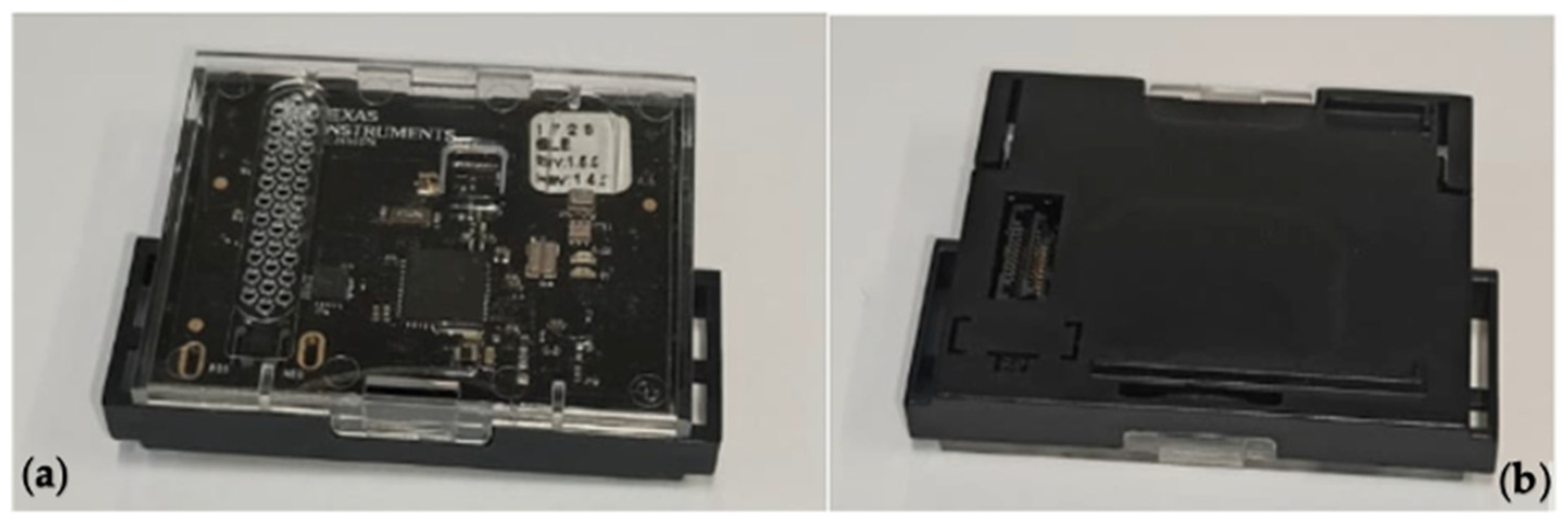
- It is made of two pieces of rigid plastic, one of them transparent.
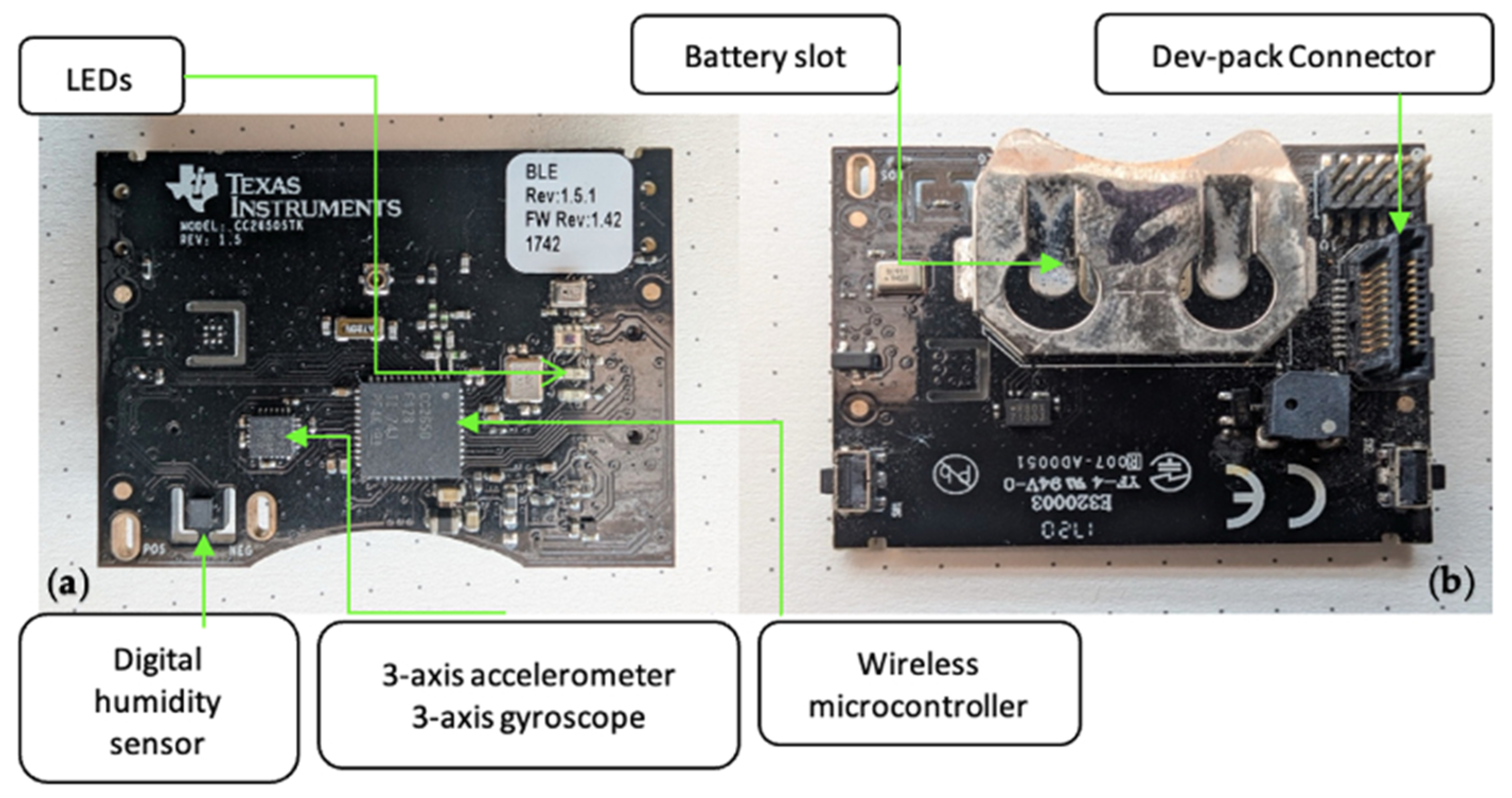
- Allows visibility of the SensorTag and its operational LEDs.
- Access to the Devpack expansion connector.
- It has openings to allow proper operation of sensors like humidity.
- It is necessary to open the case and remove the SensorTag to replace the battery.
- Its main function is to protect the sensor and it was not designed to allow the SensorTag to be used as a wearable device.
- (1)
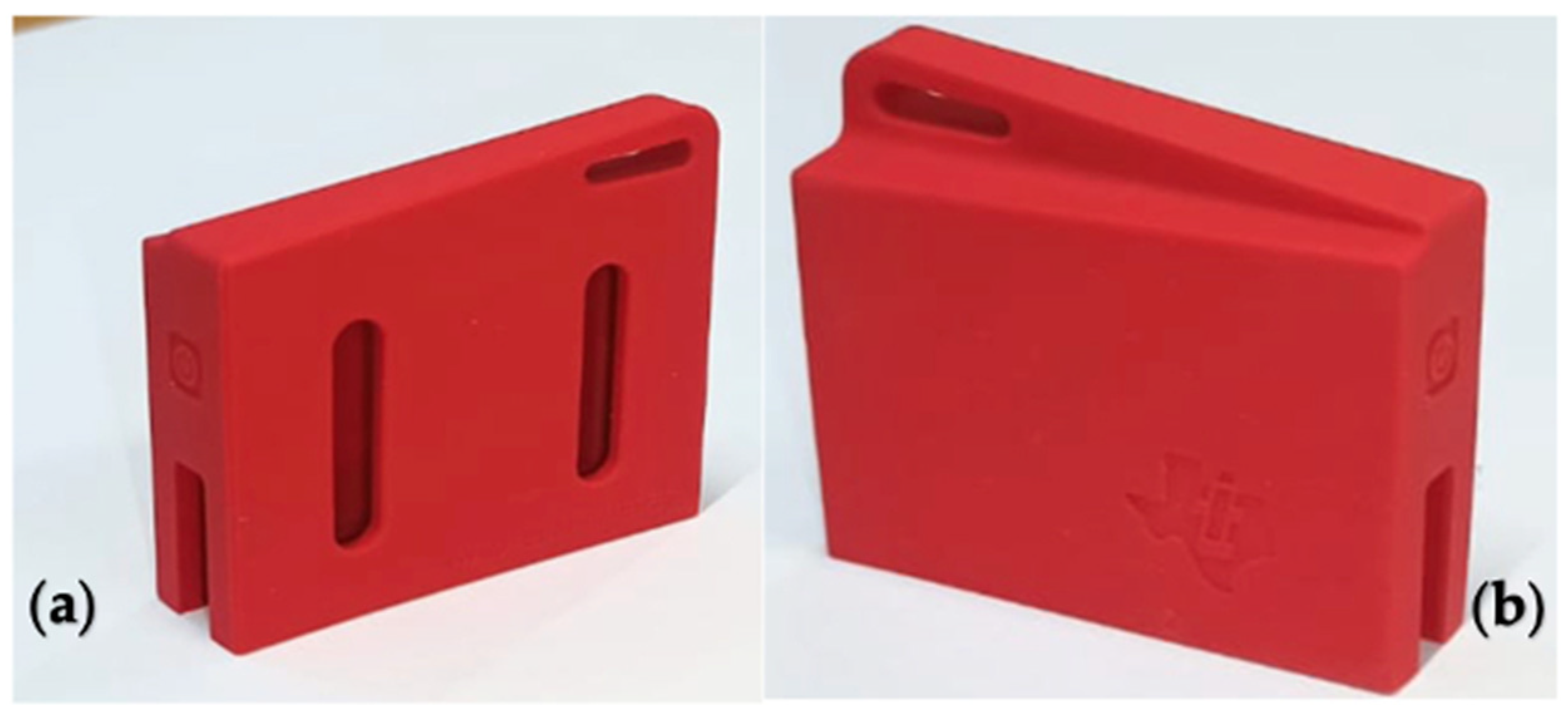
- It is made of a flexible rubber-like material.
- (2)
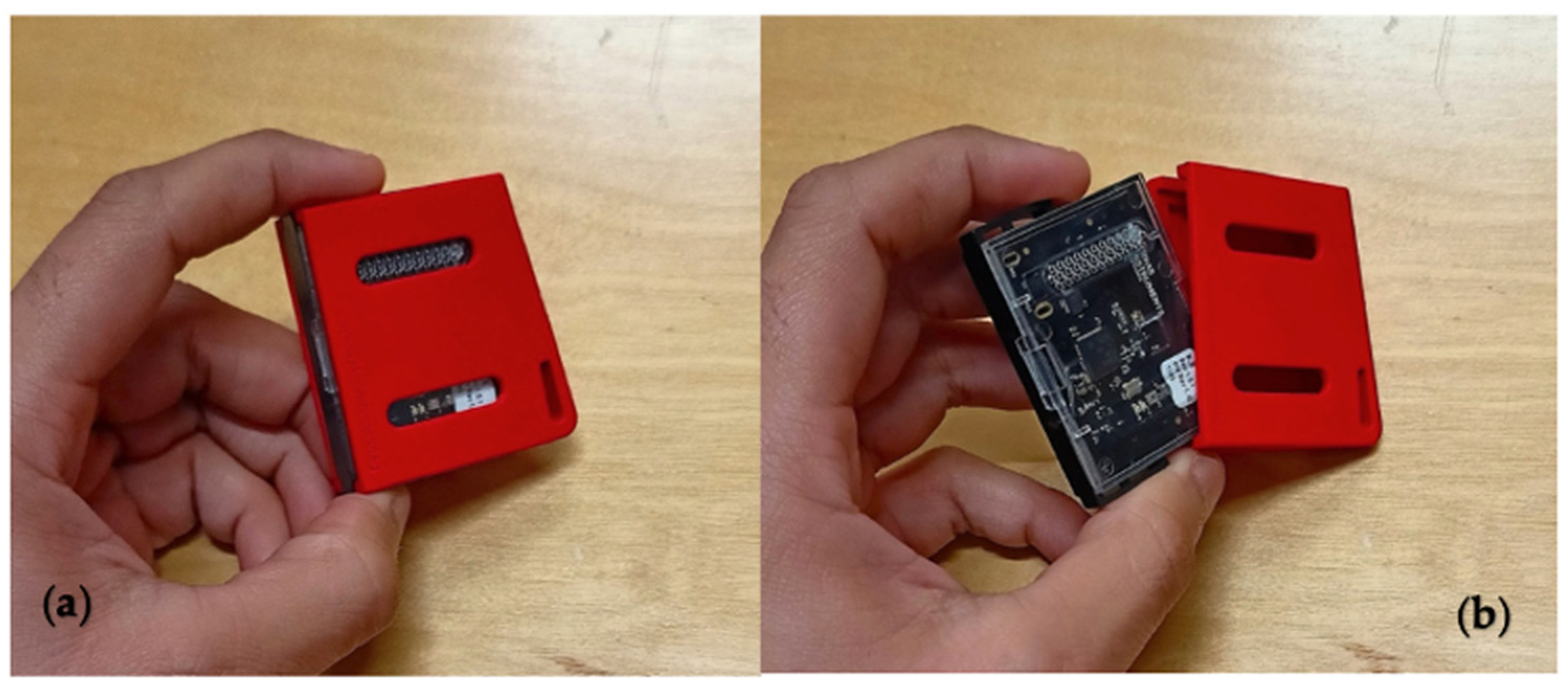
- The rigid housing containing the SensorTag must be inserted in the sleeve providing an additional layer of protection.
- (3)
- Allows visibility of the SensorTag and its operation LEDS.
- (4)
- The Devpack expansion connector becomes fully enclosed and is not readily accessible when using the sleeve.
- (5)
- It has openings to allow proper operation of sensors like humidity.
- (6)
- It increases the complexity of the battery replacement procedure.
- (7)
- The sleeve does not provide any mechanism to avoid non-intended slippage or removal of the plastic housing.
- The device must have a fastening mechanism that securely attaches it to the user’s leg.
- The device housing and the fastening mechanism must ensure that the sensor’s position is maintained despite user movement.
- The device must include a dedicated access point for efficient battery extraction.
- The strip of the fastening mechanism should accommodate muscle contraction.
- The device housing must restrict children’s access to the sensor.
- The fit between the SensorTag and the housing must be tight, such that internal bouncing of the SensorTag within the housing is non-existent.
- The designed device housing must provide additional protection compared to the commercial housing.
- The strap of the fastening mechanism must be comfortable for the user (avoiding uncomfortable tension caused when using Velcro).
- The strap must allow for adjusting the diameter for different extremities.
- Once attached, the device must allow visibility of the operational LEDs.
3.3. Application of TRIZ Principles
3.3.1. Identification of the Technical System and Problem Definition
3.3.2. Contradiction Analysis
- Weight of the object.
- Size, volume, or area.
- Speed.
- Force.
- Temperature.
- Stress, strain.
- Durability, Reliability.
- Precision.
- Complexity.
- Time of action or process.
3.3.3. Application of TRIZ Inventive Principles
- Advanced Systematic Inventive Thinking (ASIT) is based on a closed world assumption, which restricts the solution space to existing system components and explicitly avoids the introduction of new elements. It employs five transformation operators (unification, multiplication, division, removal, and breaking symmetry) to generate solutions through internal modifications of the system. This approach does not explicitly incorporate contradiction modeling or parameter-based mapping between problems and solution strategies [50].
- Unified Structured Inventive Thinking (USIT) provides a unified problem-solving framework that replaces the classical TRIZ knowledge base (e.g., contradiction matrix and the 40 inventive principles) with a structured process based on object–attribute–function analysis. It emphasizes detailed problem definition and employs a reduced set of solution operators (typically five), combined with systematic solution generation procedures. Unlike classical TRIZ, it does not rely on predefined inventive principles nor on formal contradiction mapping [51].
- TRIZ 10 is a heuristic simplification that reduces the original set of 40 inventive principles to a smaller subset of frequently used strategies (e.g., segmentation, dynamization, and local quality). This approach facilitates rapid idea generation but does not provide a structured problem-solving process or a formal mechanism for linking specific contradictions to solution principles [52].
3.3.4. Solution Generation
3.4. Prototyping and Proof of Concept
3.5. Final User Evaluation
Recruitment and Ethical Considerations
3.6. Final Wearable Device Presentation
4. Results
4.1. Identification of the Technical System and Problem Definition
4.2. Contradiction Analysis
- C1.
- If the feature of “adding a fastening mechanism” is addressed by “placing Velcro in the long openings of the sleeve”, then the following features, “fit between the sleeve and the rigid plastic case, probability of slippage of the plastic case containing the SensorTag”, become worse. The contradiction reveals itself.
- C2.
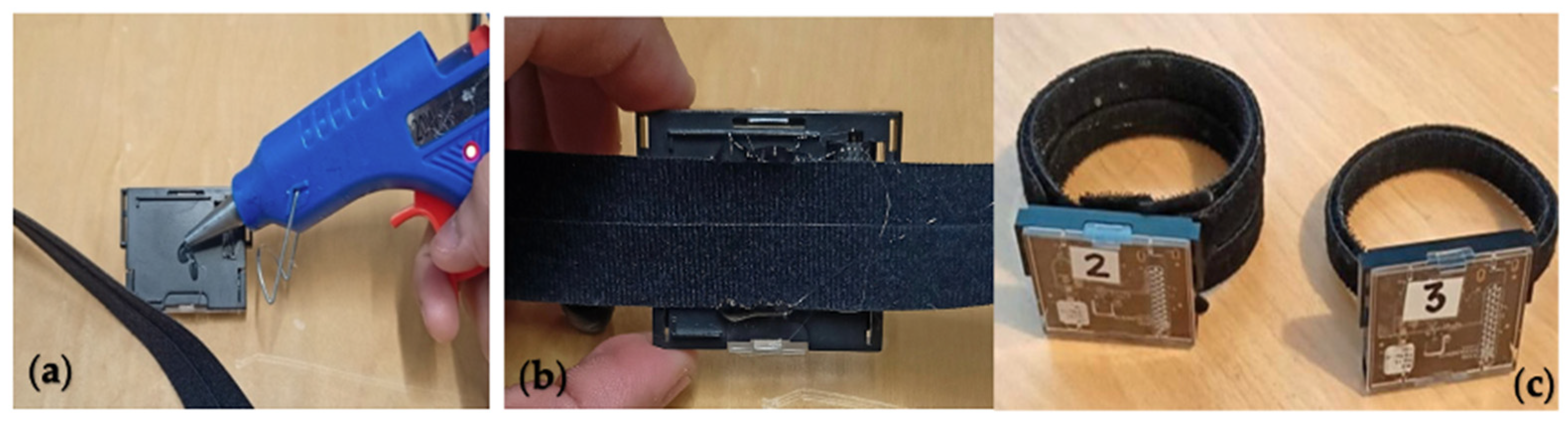
- If the feature of “the device housing does not consider a fastening mechanism” is addressed by “glue a Velcro strip with hot silicone on the back of the rigid plastic housing”, then the following feature, “probability of accidental damage of the SensorTag caused by falls”, becomes worse (as the housing–Velcro bond is not durable) The contradiction reveals itself.
- C3.
- If the feature of “improving the ease of battery replacement” is addressed by “making the device housing easier to remove or modify (for example modifying the housings by cutting and/or drilling)”, then the following feature, “the protection of the sensor”, becomes worse. The contradiction reveals itself.
- C4.
- If the feature of “maintain the integrity of the sensor by preventing direct handling” is addressed by “establish explicit handling restrictions for the user in order to maintain its integrity”, then the following feature, “ease of use”, becomes worse. The contradiction reveals itself.
- C5.
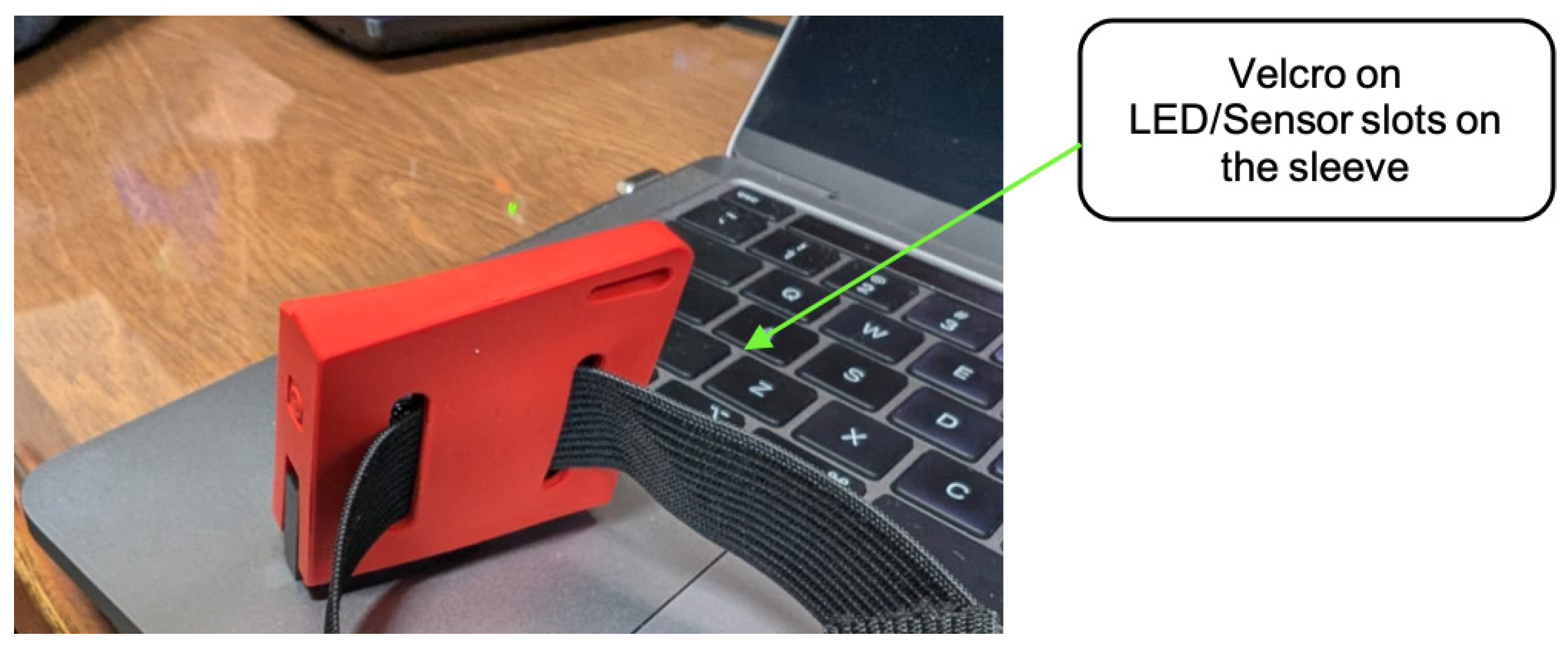
- If the feature “of facilitating the contrast of movements when using video recording” is addressed by “using the commercial red sleeve”, then the following feature, “functionality of the device housing”, becomes worse. The contradiction reveals itself.
4.3. Inventive Principles
- #11 Cavitation;
- #10 Preliminary action;
- #1 Segmentation;
- #16 Partial or excessive actions.
4.4. Prototype and Proof of Concept
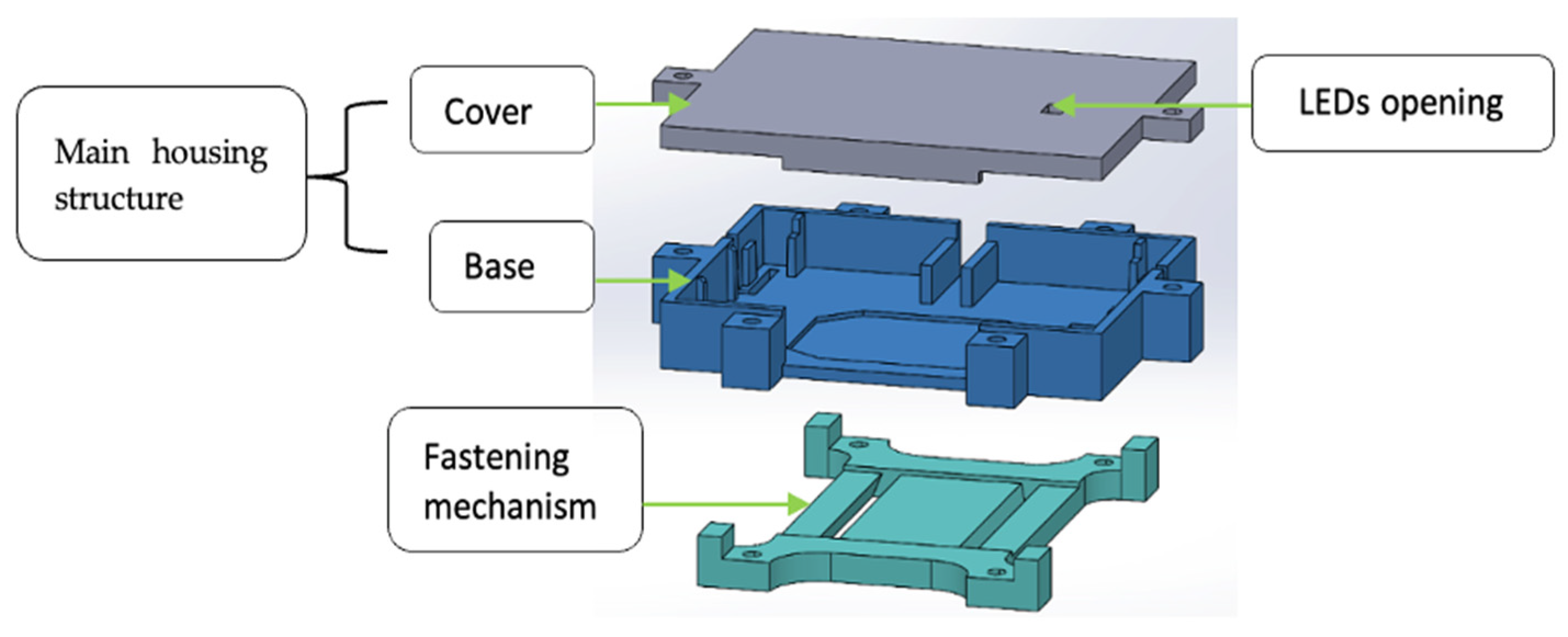
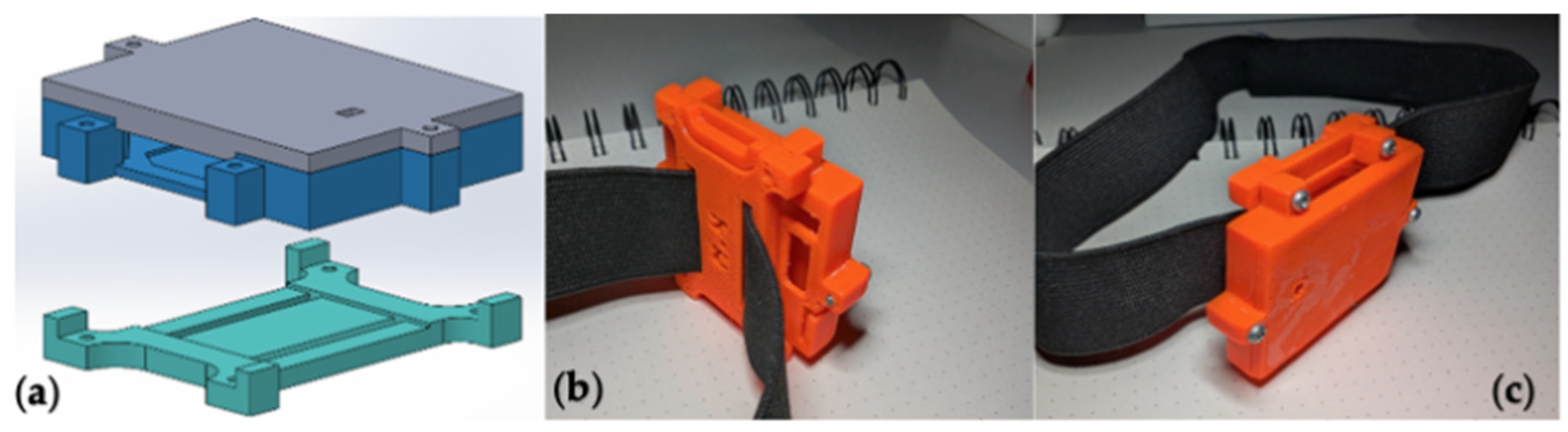
- For C1 principle “#1 Segmentation”: The fastening function was separated from the protective enclosure to avoid deformation and loss of fit. This was implemented by introducing a dedicated fastening module that operates independently from the main housing structure (see Figure 9), improving attachment stability without compromising sensor protection.
- For C2 principle “#17 Another dimension”: The limitation of unreliable attachment methods was addressed by introducing a dedicated structural interface for fastening. This was implemented through a fastening frame with specialized holes for straps, which properly guides and secures the fastening mechanism, preventing slippage and improving integration between components (see Figure 10).
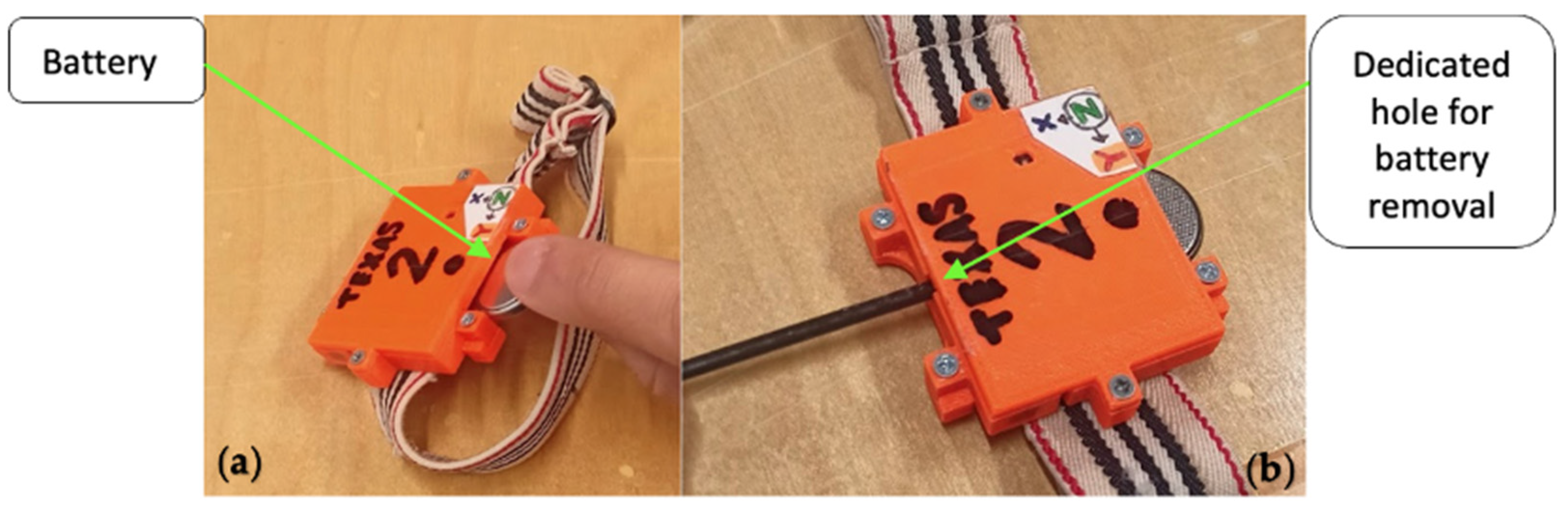
- For C3 principle “#17 Another dimension”: The conflict between ease of battery replacement and sensor protection was addressed by introducing alternative access paths within the housing geometry. This was implemented by incorporating openings that allow battery insertion and extraction without disassembling the device, preserving enclosure integrity (see Figure 11).
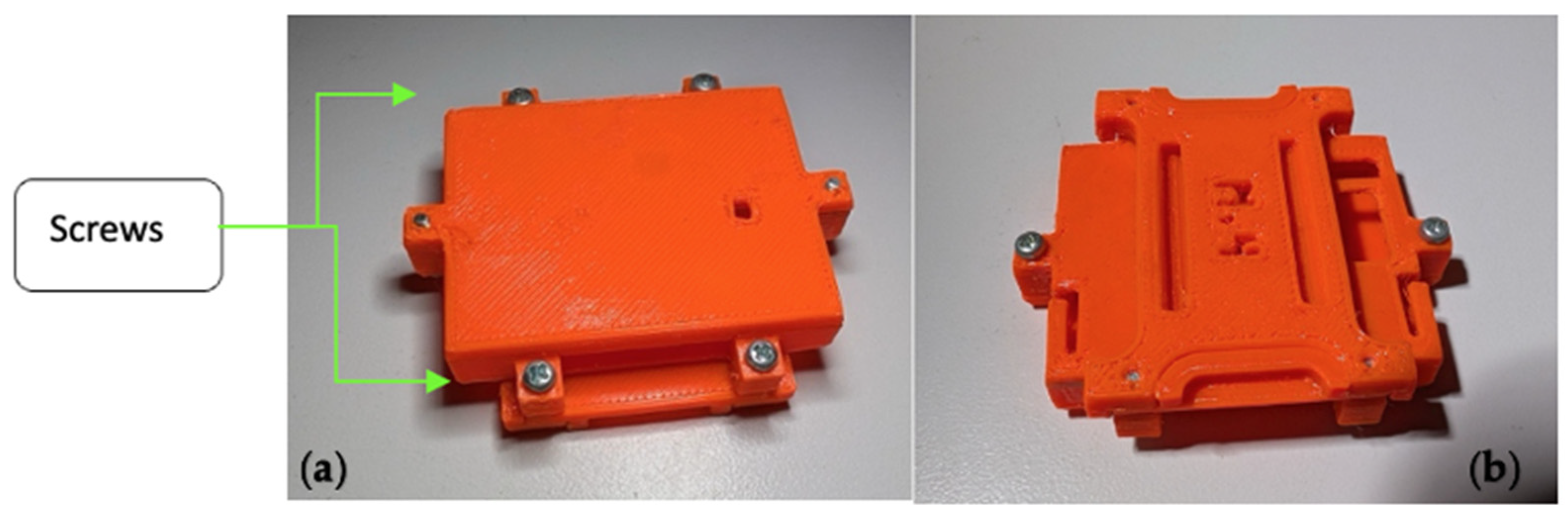
- For C4 principle “#40 Composite materials”: The need to maintain sensor integrity while allowing controlled access was addressed by combining different structural elements and materials within the housing. This was implemented through a modular assembly forming the main housing structure (cover and base) (Figure 9), reinforced with metal screws, which improves structural resistance and limits unintended access while maintaining accessibility for maintenance (see Figure 12).
- For C5 principle “#3 Local quality”: The need to enhance visibility during motion tracking was addressed by modifying a local property of the system without affecting its structural performance. In this context, color was identified as the most relevant attribute to adapt. Although the contradiction matrix suggested principle #3, the specific implementation aligns more directly with principle “#32 Color change”, which was incorporated as a complementary interpretation. This was implemented by selecting a high-contrast orange color for the housing, improving visual tracking during video-based analysis (see Figure 12).
4.5. User Evaluation and Fulfillment of Designer Requirements
4.5.1. Experimental Procedure
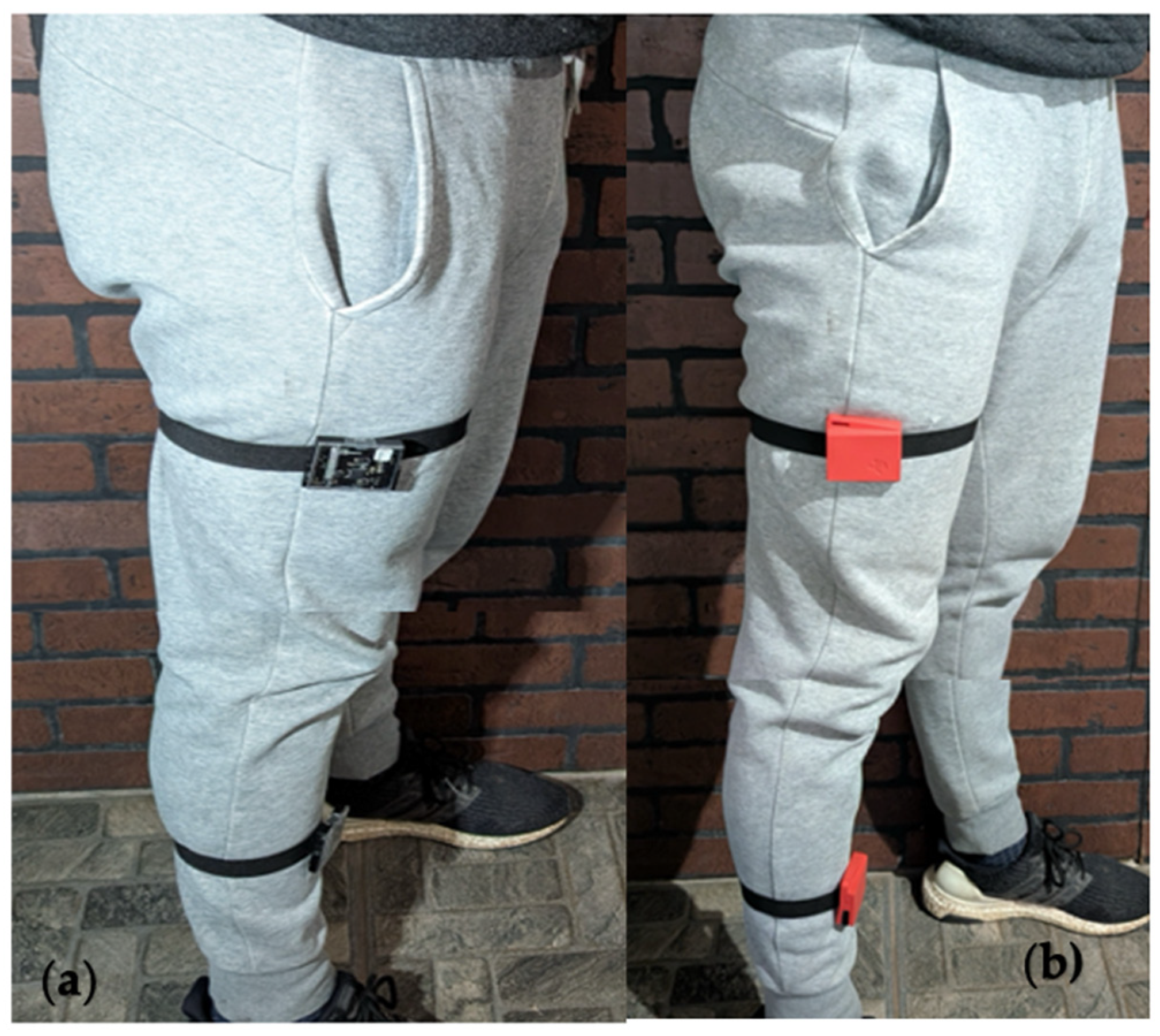
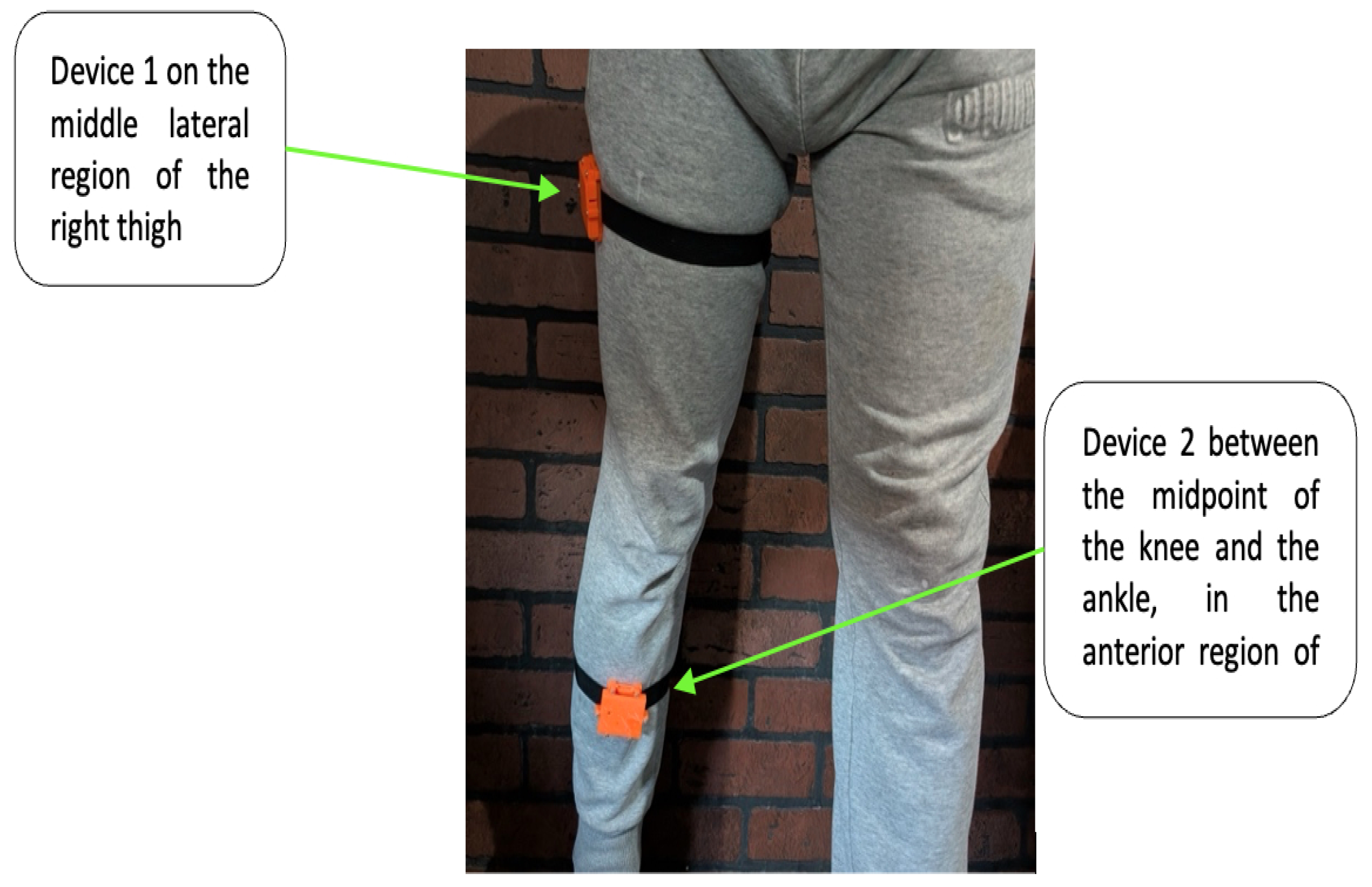
- Placement instructions: It was required that each participant autonomously collocated two wearable sensors in specific positions of a body extremity (e.g., a leg). This is a typical usage scenario when collecting movement-related data, e.g., see [58]. Placement instructions were verbally provided aided by images showing specific placement examples to aid correct interpretation of the instructions. An example of the graphical aids used is shown in Figure 13. This figure shows the intended placement of two wearable sensors to capture movement data for one leg. Sensor 1 was placed on the middle lateral region of the right thigh, and sensor 2 was positioned between the midpoint of the knee and the ankle, in the anterior region of the leg.
- Exercises instructions: To simulate a real physiotherapy scenario, users were instructed to perform a series of typical rehabilitation exercises, e.g., [59]. Instructions to perform the exercises were provided in printed form and reinforced with practical in situ examples to facilitate understanding. The exercises considered in the study were walking warm-up, single-leg balance, quadriceps stretching, heel raises, side-lying hip abduction, standing hip abduction, and squats.
4.5.2. User Satisfaction
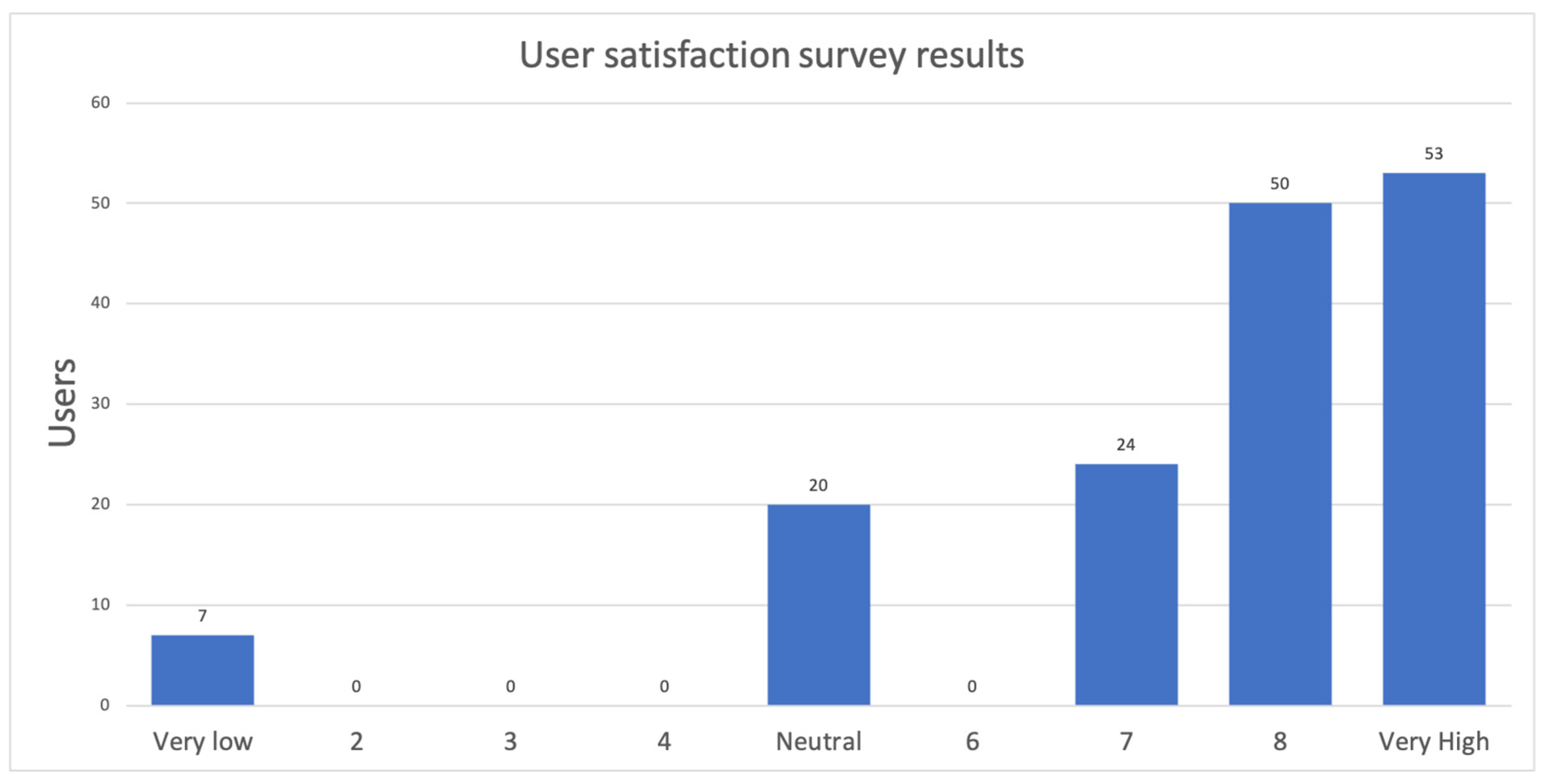
- Difficulty in using the device;
- Discomfort when using the device;
- Stability of the device on the body.
4.5.3. Fulfillment of Designer Requirements
- The device must have a fastening mechanism that securely attaches it to the user’s leg. The new design features a fastening mechanism with slots specifically sized to fit various commercial smartwatch straps. This compatibility allows for the selection of straps based on the specific requirements of the location where the sensor is to be placed. In this case, long and elastic straps were chosen, ensuring a secure and comfortable attachment of the sensor to the leg.
- The device housing and the fastening mechanism must ensure that the sensor’s position is maintained despite user movement: The dimensions and shape of the fastening mechanism prevent slipping between the housing and the strap, while the use of elastic straps ensures that the casing stays in place during user movements. These features were validated through a satisfaction evaluation, which demonstrated that users do not need to worry about keeping the device in the correct position during exercises.
- The device must include a dedicated access point for efficient battery extraction: The integration of dedicated openings for battery insertion and removal at the base of the device housing allows users to access the battery without disassembling the housing. As shown in Figure 11, the battery can be readily replaced when necessary.
- The strip of the fastening mechanism should accommodate muscle contraction: Since the fastening mechanism was designed to be compatible with smartwatch straps, flexible or elastic straps were selected and used. During the exercises performed by the users, it was confirmed that the selected strap, attached to the fastening mechanism, successfully withstands muscle contractions, such as those involved in squats and quadriceps stretches.
- The device housing must restrict children’s access to the sensor: The level of protection against intentional tampering was increased by incorporating screws, as shown in Figure 12, which make access more difficult for children.
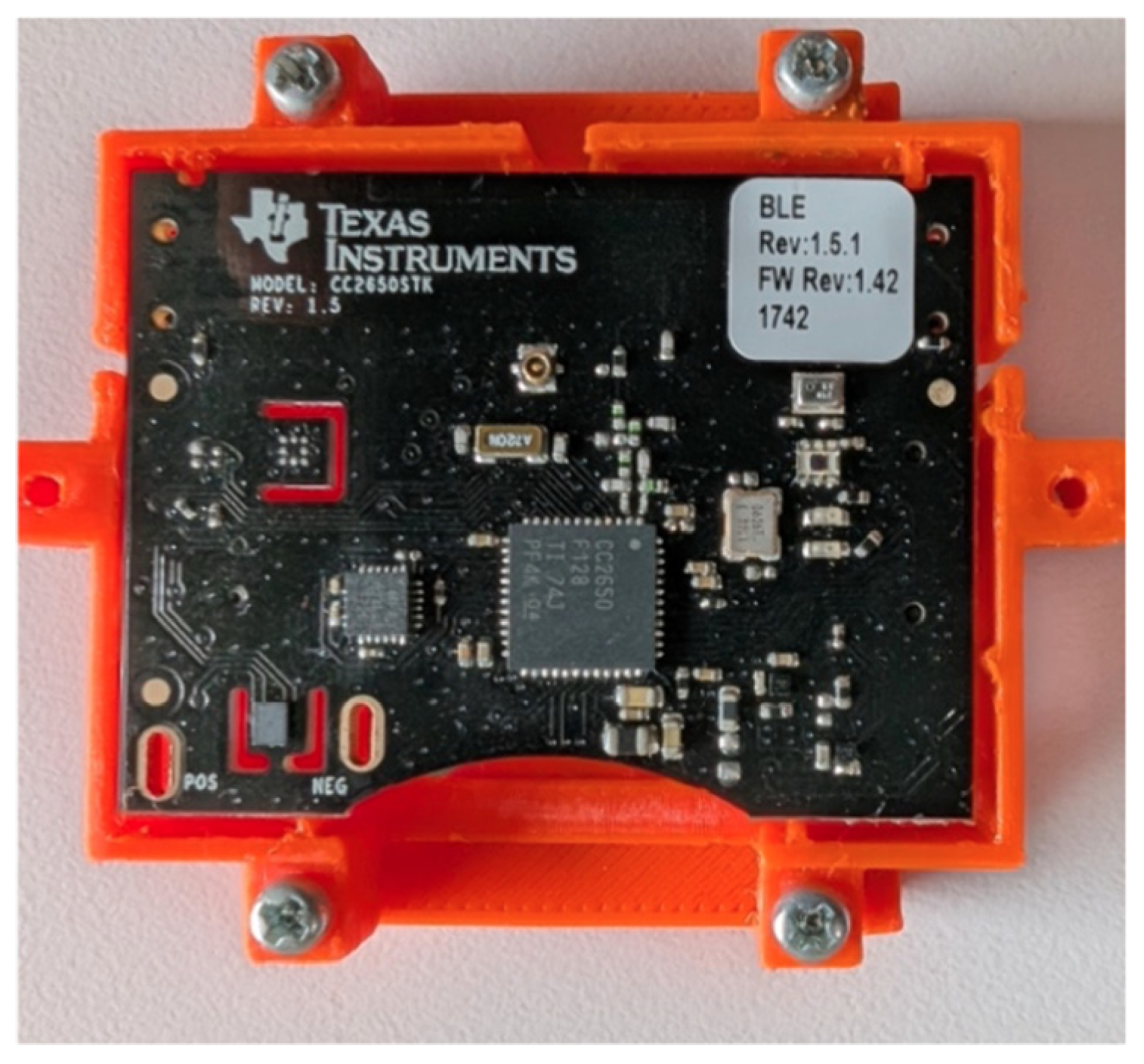
- The fit between the device housing and the SensorTag must be tight, such that internal bouncing of the SensorTag within the housing is non-existent: The shape and dimensions of the device housing cover and base are based on the original commercial housing of the sensor, ensuring a tight fit for the sensor, as shown in Figure 15.
- The designed device housing must provide additional protection compared to the commercial housing: The thickness of the device housing walls was increased (compared to the original housing) and the use of screws as an assembly method was incorporated. These changes increased the level of protection of the sensor against shocks and drops.
- The strap of the fastening mechanism must be comfortable for the user (avoiding uncomfortable tension caused when using Velcro): The satisfaction measurement corroborated the comfort of the selected elastic strap on the measured leg.
- The strap must allow for adjusting the diameter for different extremities: The compatibility of the fastening mechanism with commercial straps allows the use of straps of varying lengths and materials, facilitating placement on different parts of the limbs and accommodating diverse body types. Furthermore, it is noted that the selected strap was successfully used by all 153 users who participated in the satisfaction evaluation.
- Once attached, the device housing must allow visibility of the operational LEDs: The segmentation of the designed device housing includes an opening in the cover (see Figure 9) for continuous monitoring of the functioning LEDs, allowing control over the connection and verification of whether the sensor is on or off.
5. Discussion
6. Conclusions
Supplementary Materials
Author Contributions
Funding
Institutional Review Board Statement
Data Availability Statement
Acknowledgments
Conflicts of Interest
References
- World Health Organization. Rehabilitation in Health Systems: Guide for Action; World Health Organization: Geneva, Switzerland, 2017. [Google Scholar]
- Kabir, P.; Zareinejad, M.; Talebi, H.A.; Soleimanifar, M. An inflatable soft wearable knee rehabilitation device: Design, fabrication, control and preliminary evaluation. Mechatronics 2024, 102, 103233. [Google Scholar] [CrossRef]
- López-Liria, R.; Vega-Ramírez, F.; Catalán-Matamoros, D.; Padilla Góngora, D.; Martínez-Cortés, M.; Mesa-Ruiz, A. [Home care rehabilitation and physiotherapy in knee prosthesis]. An. Sist. Sanit. Navar. 2012, 35, 99–113. [Google Scholar] [CrossRef]
- Banihani, J.; Choukou, M.A. A home-based hand rehabilitation platform for hemiplegic patients after stroke: A feasibility study. Heliyon 2024, 10, e35565. [Google Scholar] [CrossRef]
- Pan, H.; Wang, H.; Li, D.; Zhu, K.; Gao, Y.; Yin, R.; Shull, P.B. Automated, IMU-based spine angle estimation and IMU location identification for telerehabilitation. J. Neuroeng. Rehabil. 2024, 21, 96. [Google Scholar] [CrossRef]
- Bell, K.M.; Onyeukwu, C.; McClincy, M.P.; Allen, M.; Bechard, L.; Mukherjee, A.; Hartman, R.A.; Smith, C.; Lynch, A.D.; Irrgang, J.J. Verification of a portable motion tracking system for remote management of physical rehabilitation of the knee. Sensors 2019, 19, 1021. [Google Scholar] [CrossRef]
- Cottam, D.S.; Campbell, A.C.; Davey, P.C.; Kent, P.; Elliott, B.C.; Alderson, J.A. Measurement of uni-planar and sport specific trunk motion using magneto-inertial measurement units: The concurrent validity of Noraxon and Xsens systems relative to a retro-reflective system. Gait Posture 2022, 92, 129–134. [Google Scholar] [CrossRef]
- Zhu, X.; Jia, F.; Kong, L.; Zhang, H.; Zhang, S.; Zhang, Y.; Wang, L. Daily walking kinematic characteristics of the elderly in different residential settings: Experimental study on Chinese community-living elderly and long-term nursing home residents. Aging Clin. Exp. Res. 2023, 35, 2531–2542. [Google Scholar] [CrossRef]
- Serena, R.S.; Hinterwimmer, F.; Burgkart, R.; von Eisenhart-Rothe, R.; Rueckert, D. The use of artificial intelligence and wearable inertial measurement units in medicine: Systematic review. JMIR Mhealth Uhealth 2025, 13, e60521. [Google Scholar] [CrossRef]
- Brito, A.V.; Fonseca, P.; Costa, M.J.; Cardoso, R.; Santos, C.C.; Fernandez-Fernandez, J.; Fernandes, R.J. The influence of kinematics on tennis serve speed: An in-depth analysis using Xsens MVN Biomech Link technology. Bioengineering 2024, 11, 971. [Google Scholar] [CrossRef]
- Iluk, A. Flight Controller as a Low-Cost IMU Sensor for Human Motion Measurement. Sensors 2023, 23, 2342. [Google Scholar] [CrossRef]
- Espitia-Mora, L.A.; Vélez-Guerrero, M.A.; Callejas-Cuervo, M. Development of a Low-Cost Markerless Optical Motion Capture System for Gait Analysis and Anthropometric Parameter Quantification. Sensors 2024, 24, 3371. [Google Scholar] [CrossRef]
- Yin, M.; Li, J.; Wang, T. A Low-Cost Inertial Measurement Unit Motion Capture System for Operation Posture Collection and Recognition. Sensors 2024, 24, 686. [Google Scholar] [CrossRef]
- Voisard, C.; de l’Escalopier, N.; Ricard, D.; Oudre, L. Automatic gait events detection with inertial measurement units: Healthy subjects and moderate to severe impaired patients. J. Neuroeng. Rehabil. 2024, 21, 104. [Google Scholar] [CrossRef]
- Wudhiphan, W.; Suthisoontrin, T.; Vanijkachorn, P.; Visutsak, P. An IoT-based multi-sensory intelligent device for bedridden elderly monitoring. ECTI-CIT. Trans. 2024, 18, 136–146. [Google Scholar]
- Sumaiya, M.N.; Vachanamruth, G.S.; Naveen, V.; Varshitha, C.; Yashaswini, V.P. Wearable sleeve for physiotherapy assessment using ESP32 and IMU sensor. In Computational Intelligence and Deep Learning Methods for Neuro-Rehabilitation Applications; Hemanth, D.J., Ed.; Academic Press: Cambridge, MA, USA, 2024; pp. 101–119. [Google Scholar]
- Bhongade, A.; Gupta, R.; Gandhi, T.K.; Ap, P. Intelligent single IMU sensor module for gait temporal parameter estimation. TechRxiv 2024. [Google Scholar] [CrossRef] [PubMed]
- Camomilla, V.; Bergamini, E.; Fantozzi, S.; Vannozzi, G. Trends Supporting the In-Field Use of Wearable Inertial Sensors for Sport Performance Evaluation: A Systematic Review. Sensors 2018, 18, 873. [Google Scholar] [CrossRef]
- Francés-Morcillo, L.; Morer-Camo, P.; Rodríguez-Ferradas, M.I.; Cazón-Martín, A. Wearable Design Requirements Identification and Evaluation. Sensors 2020, 20, 2599. [Google Scholar] [CrossRef]
- Cnytskyy, I.; Hlinenko, L.; Yakovenko, Y.; Horbay, O.; Koda, E.; Rusakov, K.; Yankiv, V.; Humenuyk, R.; Polyansky, P.; Berezovetskyi, S.; et al. Problem-oriented modelling for biomedical engineering systems. Appl. Sci. 2022, 12, 7466. [Google Scholar] [CrossRef]
- Ördek, B.; Russo, D.; Spreafico, C. FMEA-TRIZ Analysis of Reused Ti6Al4V Powder in SLM. Procedia CIRP 2025, 136, 32–37. [Google Scholar]
- Bertoncelli, T.; Gronauer, B.; Nähler, H. TRIZ Barcamp exercise: Ideas for wearable defibrillators. In New Opportunities for Innovation Breakthroughs for Developing Countries and Emerging Economies, Proceedings of the 19th International TRIZ Future Conference (TFC), Marrakesh, Morocco; Springer: Cham, Switzerland, 2019; pp. 257–265. [Google Scholar]
- Rong, H.; Liu, W.; Li, J.; Zhou, Z. Product innovation design process combined Kano and TRIZ with AD: Case study. PLoS ONE 2024, 19, e0296980. [Google Scholar] [CrossRef]
- Ng, P.K.; Prasetio, M.D.; Liew, K.W.; Lim, B.K.; Oktafiani, A.; Salma, S.A.; Safrudin, Y.N. A TRIZ-inspired conceptual development of a roof tile transportation and inspection system. Buildings 2022, 12, 1456. [Google Scholar] [CrossRef]
- Gräbe, H.-G. Systems, resources, and systemic development in TRIZ. In Systematic Innovation Partnerships with Artificial Intelligence and Information Technology; Springer: Cham, Switzerland, 2022; pp. 96–108. [Google Scholar]
- Komarudin, K.; Suherman, S.; Vidákovich, T. The RMS teaching model with brainstorming technique and student digital literacy as predictors of mathematical literacy. Heliyon 2024, 10, e33877. [Google Scholar] [CrossRef]
- Shen, D.; Yao, X.; Bao, D.; Yu, Y. for Content categorization for memory retrieval: A method evaluating design performance. PLoS ONE 2023, 18, e0280459. [Google Scholar] [CrossRef]
- Sari, E.M.; Irawan, A.P.; Wibowo, M.A.; Siregar, J.P.; Tamin, R.Z.; Praja, A.K.A.; Dewi, M.P. Challenge and Awareness for Implemented Integrated Project Delivery (IPD) in Indonesian Projects. Buildings 2023, 13, 262. [Google Scholar] [CrossRef]
- Nolan, V. Whatever happened to Synectic. Creat. Innov. Manag. 2003, 12, 24–27. [Google Scholar] [CrossRef]
- Ekmekci, I.; Nebati, E.E. TRIZ methodology and applications. Procedia Comput. Sci. 2019, 158, 303–315. [Google Scholar] [CrossRef]
- Tang, S.; Wan, S.; Li, X.; Ding, G.; Qi, X. Design of multi-task scene image acquisition system in a spacecraft based on TRIZ. In Advances in Mechanical Design: ICMD 2023; Mechanisms and Machine Science; Tan, J., Liu, Y., Huang, H.Z., Yu, J., Wang, Z., Eds.; Springer: Singapore, 2024; Volume 155, pp. 16–24. [Google Scholar]
- Zhang, Y.; Sun, Z.; Liu, P. Application of TRIZ theory in power electronic circuits. In Proceedings of 2023 International Conference on Wireless Power Transfer (ICWPT2023); Lecture Notes in Electrical Engineering; Cai, C., Qu, X., Mai, R., Zhang, P., Chai, W., Wu, S., Eds.; Springer: Singapore, 2024; Volume 1159, pp. 44–53. [Google Scholar]
- Sojka, V.; Lepsik, P. Tools of Theory of Inventive Problem Solving Used for Process Improvement—A Systematic Literature Review. Processes 2025, 13, 226. [Google Scholar] [CrossRef]
- Shao, P.; Tan, R.; Peng, Q.; Zhang, L.; Wang, K.; Dong, Y. Problem-solving in product innovation based on the Cynefin framework-aided TRIZ. Appl. Sci. 2022, 12, 4157. [Google Scholar]
- Harthik, T.; Kawatkar, A.; Bharani, R. Application of TRIZ methodology in enhancing product life cycle of an automotive diesel engine. In WCX SAE World Congress Experience; SAE Tech Paper; SAE International: Warrendale, PA, USA, 2024. [Google Scholar] [CrossRef]
- Dhalmahapatra, K.; Verma, A.; Maiti, J. An integrated TRIZ coupled safety function deployment and capital budgeting methodology for occupational safety improvement: A case of manufacturing industry. Process Saf. Environ. Prot. 2022, 165, 31–45. [Google Scholar]
- Gao, C.; Guo, L.; Gao, F.; Yang, B. Innovation design of medical equipment based on TRIZ. Technol. Health Care 2015, 23, S269–S276. [Google Scholar] [CrossRef] [PubMed]
- Santoso, G.; Ammarullah, M.I.; Sugiharto, S.; Hidayat, T.; Khoeron, S.; Bayuseno, A.P.; Jamari, J. TRIZ-based method for developing a conceptual laparoscopic surgeon’s chair. Cogent Eng. 2024, 11, 2298786. [Google Scholar] [CrossRef]
- Rahim, Z.A.; Iqbal, M.S.; Abu Bakar, N. A systematic approach to design and develop patented stimuli-responsive polymers for biomedicine applications: TRIZ–patent literature review methodology. J. Chem. Technol. Biotechnol. 2025, 100, 2512–2521. [Google Scholar] [CrossRef]
- Ekmekci, I.; Koksal, M. TRIZ methodology and an application example for product development. Procedia Soc. Behav. Sci. 2015, 195, 2689–2698. [Google Scholar] [CrossRef]
- Panagiotou, C.; Faliagka, E.; Antonopoulos, C.P.; Voros, N. Multidisciplinary ML Techniques on Gesture Recognition for People with Disabilities in a Smart Home Environment. AI 2025, 6, 17. [Google Scholar] [CrossRef]
- Alexan, A.; Alexan, A.; Oniga, S. SoC based IoT sensor network hub for activity recognition using ML.net framework. In 2020 IEEE 26th International Symposium for Design and Technology in Electronic Packaging (SIITME); IEEE: Piscataway, NJ, USA, 2020; pp. 184–187. [Google Scholar]
- González-Cañete, F.J.; Casilari, E. Consumption Analysis of Smartphone based Fall Detection Systems with Multiple External Wireless Sensors. Sensors 2020, 20, 622. [Google Scholar] [CrossRef]
- Alexan, A.; Alexan, A.; Oniga, S.; Pap, I.A. Assisted living personal tracker framework. In 2018 IEEE International Conference on Automation, Quality and Testing, Robotics (AQTR); IEEE: Piscataway, NJ, USA, 2018; pp. 1–4. [Google Scholar]
- Sighvatsson, H.; Guðmundsson, K.S.; Árnason, S.S.; Sighvatsdóttir, Á.G.; Andersen, K.; Þorbergsson, H. Wearable heart monitor. In 2021 International Conference on Biomedical Innovations and Applications (BIA); IEEE: Piscataway, NJ, USA, 2022; pp. 13–17. [Google Scholar]
- Casilari, E.; Santoyo-Ramón, J.A.; Cano-García, J.M. Analysis of a smartphone-based architecture with multiple mobility sensors for fall detection. PLoS ONE 2016, 11, e0168069. [Google Scholar]
- McLeod, K.; Girchenko, L.; Spenler, P.; Spachos, P. A smartphone-based wellness assessment using mobile sensors. In 2018 IEEE Global Conference on Signal and Information Processing (GlobalSIP); IEEE: Piscataway, NJ, USA, 2018; pp. 454–458. [Google Scholar]
- Sun, H.; Lu, Z.; Chen, C.L.; Cao, J.; Tan, Z. Accurate human gesture sensing with coarse-grained RF signatures. IEEE Access 2019, 7, 81227–81245. [Google Scholar] [CrossRef]
- Malvik, T.O. TRIZ as an innovation tool for opportunity management and Lean Construction. Procedia Comput. Sci. 2025, 256, 1459–1466. [Google Scholar] [CrossRef]
- Reich, Y.; Hatchuel, A.; Shai, O.; Subrahmanian, E. A theoretical analysis of creativity methods in engineering design: Casting and improving ASIT within C–K theory. J. Eng. Des. 2012, 23, 137–158. [Google Scholar] [CrossRef]
- Feng, L.; Niu, Y.; Liu, Z.; Wang, J.; Zhang, K. Discovering Technology Opportunity by Keyword-Based Patent Analysis: A Hybrid Approach of Morphology Analysis and USIT. Sustainability 2020, 12, 136. [Google Scholar]
- Cano-Moreno, J.D.; Cabanellas-Becerra, J.M. TRIZ10. The decalogue of technical creativity. DYNA 2018, 93, 586. [Google Scholar] [CrossRef]
- Cortes Robles, G. (Ed.) TRIZ in Latin America: Case Studies; Springer: Cham, Switzerland, 2023. [Google Scholar]
- Hassanijajini, H.; Hassanimohebi, Z.; Gardoni, M. Preparation of Archi-TRIZ matrix for accelerating innovation in building design process. Int. J. Des. Manag. Prof. Pract. 2024, 19, 35–53. [Google Scholar] [CrossRef]
- Yao, K.C.; Chen, L.Y.; Li, K.Y.; Chang, Y.N.; Xu, J.R.; Huang, W.L.; Ho, W.S. An innovative design for cleansing, deodorization, and pest control in drain covers: Application of the TRIZ method and human factors engineering. Machines 2024, 12, 621. [Google Scholar] [CrossRef]
- Gdoura, R.; Houssin, R.; Chibane, H.; Dhouib, D.; Coulibaly, A. A new TRIZ-based approach to design an innovative production system by integrating lean tools and functionalities. In World Conference of AI-Powered Innovation and Inventive Design. TFC 2024; Cavallucci, D., Brad, S., Livotov, P., Eds.; Springer: Cham, Switzerland, 2025; Volume 736, p. 2. [Google Scholar]
- Mamedov, A.; Dinc, A.; Behbehani, H.; Al Quoud, T.; Alotaibi, O.; Alotaibi, M.; Alqallaf, S. Application of theory of inventive problem solving (TRIZ) and quality function deployment (QFD) methodologies for design and manufacturing of a regenerative braking system. Eng. Sci. 2024, 31, 1263. [Google Scholar] [CrossRef]
- Kobsar, D.; Ferber, R. Wearable Sensor Data to Track Subject-Specific Movement Patterns Related to Clinical Outcomes Using a Machine Learning Approach. Sensors 2018, 18, 2828. [Google Scholar] [CrossRef]
- Naderi, A.; Fallah Mohammadi, M.; Heidaralizadeh, A.; Moen, M.H. Effects of integrating lower-leg exercises into a multimodal therapeutic approach on medial tibial stress syndrome management among recreational runners: A randomized controlled study. Orthop. J. Sports Med. 2025, 13. [Google Scholar] [CrossRef]
- Parmanto, B.; Lewis, A.N., Jr.; Graham, K.M.; Bertolet, M.H. Development of the Telehealth Usability Questionnaire (TUQ). Int. J. Telerehabilitation 2016, 8, 3–10. [Google Scholar] [CrossRef] [PubMed]
- Mejía González, E.A.; Castro-Pérez, M.Á.; Villarreal-Reyes, S.; Camargo-Wilson, C.; Cano-Gutiérrez, J.C.; Galaviz Mosqueda, G.A.; Ramírez-Ríos, L.Y.; Olguín-Tiznado, J.E. Psychometric Properties and Initial Validation of the Usability Questionnaire for Rehabilitation Wearable Devices in Telerehabilitation. Int. J. Telerehabilitation, 2026; in process.
- Yao, K.-C.; Cheng, C.-N.; Li, K.-Y.; Xu, J.-R.; Huang, W.-L.; Ho, W.-S.; Liao, C.-W.; Yang, S.-C.; Hsiao, H.-L.; Lin, Y.-C.; et al. Sustainable Hygiene Solutions: Developing a Foot-Operated Door Mechanism for Communal Spaces Using TRIZ and Universal Design Principles. Sustainability 2024, 16, 8415. [Google Scholar] [CrossRef]
- Zuo, B.; Liu, X.; Wang, H.; Fan, C. TRIZ-Based Design, Finite Element Simulation, and Experimentation of a Linear Motor for Cleaning Machines. Adv. Mech. Eng. 2025, 17, 16878132251400181. [Google Scholar] [CrossRef]
- Ang, M.C.; Ng, K.W. Minimising Printed Circuit Board Assembly Time Using the Bees Algorithm with TRIZ-Inspired Operators. In Advanced Manufacturing Systems and Technologies; Springer: Cham, Switzerland, 2023. [Google Scholar]
- Trapp, S.; Warschat, J. LLM-based Extraction of Contradictions from Patents. arXiv 2024, arXiv:2403.14258. [Google Scholar] [CrossRef]
- Rahardjo, B.; Winnyarto, S.T.; Tjendra, V. Integration of green lean six sigma and TRIZ methodology for sustainable green manufacturing: A case study in plywood industry. Int. J. Lean Six Sigma 2025, 16, 1394–1414. [Google Scholar] [CrossRef]
- Wang, C.-N.; Shiue, N.-C.; Phan, V.-T.; Hong, D.-Q. A TRIZ-Based Experimental Design Approach to Enhance Wave Soldering Efficiency in Electronics Manufacturing Processes. Processes 2025, 13, 3733. [Google Scholar] [CrossRef]
- Ge, S.; Huang, S.; Song, X.; Sun, Y.; Wang, N.; Qi, K.; Zhao, X.; Li, J.; Cui, Y. Comparing TRIZ and Brainstorming in Human–Agent Design Collaboration: Effects on Cognitive Processes and Performance. Artif. Intell. Eng. Des. Anal. Manuf. (AIEDAM) 2025, 39, e21. [Google Scholar] [CrossRef]
- Čok, V.; Samsa, L.; Brojan, M.; Tavčar, J.; Vukašinović, N. Case Study: Is There a Space for TRIZ in the Era of ChatGPT? Proc. Des. Soc. 2025, 5, 871–880. [Google Scholar] [CrossRef]
- Song, D.; Liu, L.; Zhu, T.; Zhang, S.; Huang, Y. B-FMEA-TRIZ model for scheme decision in conceptual product design: A study on upper-limb hemiplegia rehabilitation exoskeleton. Heliyon 2024, 10, e30684. [Google Scholar] [CrossRef] [PubMed]
- Chang, C.P.; Lin, Y.H. Applying TRIZ to Improve the Structure of Walkers. Appl. Mech. Mater. 2014, 487, 366–369. [Google Scholar] [CrossRef]
- Shie, A.-J.; Wu, W.-F.; Yang, M.; Wan, X.; Li, H. Design and process optimization of combined medical and elderly care services: An integrated service blueprint–TRIZ model. Front. Public Health 2022, 10, 965443. [Google Scholar] [CrossRef]
- Ramírez-Ríos, L.Y.; Camargo-Wilson, C.; Olguín-Tiznado, J.E.; López-Barreras, J.A.; Inzunza-González, E.; García-Alcaraz, J.L. Design of a modular plantar orthosis system through the application of TRIZ methodology tools. Appl. Sci. 2021, 11, 2051. [Google Scholar] [CrossRef]
- Schöfer, M.; Maranzana, N.; Aoussat, A.; Gazoa, C.; Bersano, G. The Value of TRIZ and Its Derivatives for Interdisciplinary Group Problem Solving. Procedia Eng. 2015, 131, 894–903. [Google Scholar] [CrossRef]
- Nakagawa, T. A New Paradigm of Creative Problem Solving: Integration of TRIZ with USIT. Procedia Eng. 2011, 9, 52–63. [Google Scholar] [CrossRef]
- Gusarov, S.; Sapelnikova, S.; Valdes, J.J.; Hu, A.; Stoyanov, S.R. Integrating the Theory of Inventive Problem Solving with Large Language Models: Enhancing Reasoning for Innovation in Materials Science at the Molecular Scale. ChemEngineering 2026, 10, 54. [Google Scholar] [CrossRef]



| Technical System Name (TS) | Wearable IMU-Based Device |
|---|---|
| Primary objective of the TS | Use of the SensorTag as a wearable device. |
| Main elements that make up the TS and their functions | |
| ELEMENT NAME | FUNCTION |
| 1. Sensor (SensorTag Texas instruments) | Collect and transmit signals from IMUs |
| 2. Device housing | Protect the sensor from the medium and serve as a frame for the fastening solution. |
| 3. Fastening solution | Keep the device secure and usable (sensor and housing) and attached to the limb, minimizing possible slight movement or slip (arm, leg, ankle, etc.) |
| Description of TS operation: | |
| The device is fastened to the measurement limb using the Velcro strips to acquire and transmit signals to the processing system | |
| Features to be improved or eliminated | |
| |
| Formulation of the Contradiction |
|---|
| (a) Feature to be reduced, eliminated or neutralized: |
| The sleeve does not consider a fastening mechanism. |
| (b) Specify the methods used to mitigate, eliminate, or neutralize this characteristic: |
| Velcro strip added to the sleeve of the commercial housing |
| (c) Mention which characteristic worsens under the conditions made to solve the following problems: |
| Worsens the fit between the sleeve and the rigid plastic case, increases the probability of slippage of the plastic case containing the SensorTag. |
| (d) Formulate the technical contradiction as follows: |
| Contradiction 1 (C1): |
| If the feature of |
| adding a fastening mechanism, |
| is addressed by |
| placing Velcro in the long openings of the sleeve, |
| then the following features, |
| fit between the sleeve and the rigid plastic case, probability of slippage of the plastic case containing the SensorTag, |
| becomes worse. The contradiction reveals itself. |
| Feature Negatively Affected | #1 Weight of Moving Object | #2 Weight of a Stationary Object | … | #27 Reliability | |
|---|---|---|---|---|---|
| Feature to Improve | |||||
| #1 Weight of a moving Object | … | ||||
| #2 Weight of a non-moving object. | … | ||||
| ⋮ | ⋮ | ⋮ | ⋮ | ||
| #35 Adaptability | … | #11, #10, #1, #16 | |||
| Feature Negatively Affected | C2: #27 Reliability | C3: #27 Reliability | C4: #33 Ease of Use | C5: #15 Durability of a Moving Object | |
|---|---|---|---|---|---|
| Feature to Improve | |||||
| C2: #33 Convenience of use | #17, #27, #8, #40 | ||||
| C3: #33 Convenience of use | #17, #27, #8, #40 | ||||
| C4: #27 Reliability | #27, #17, #40 | ||||
| C5: #33 Convenience of use | #29, #3, #8, #25 | ||||
| Contra-Diction | Principle Number (Provided by TRIZ) | Description (Provided by TRIZ) | Selection Rationale | Solution and Its Application (Proposed by the Designer) |
|---|---|---|---|---|
| C1 | #1 Segmentation | Divide an object into independent parts | Selected because it enforces the separation of conflicting functions, avoiding structural interference between fastening and protection. This led to rejecting integrated solutions and separating fastening from the enclosure. | A dedicated fastening module is separated from the main housing structure, preventing deformation of the protective enclosure and improving attachment stability. |
| C2 | #17 Another dimension | Introduce additional spatial or structural dimensions | Selected because it enables the transition from a surface-based attachment (adhesive Velcro) to a three-dimensional mechanical interface within the fastening mechanism, improving reliability without modifying the main housing. | A dedicated fastening frame with specialized holes for straps is incorporated, enabling secure attachment without altering the main housing. |
| C3 | #17 Another dimension | Introduce additional spatial or structural dimensions | Selected because it enables the introduction of an alternative spatial pathway for accessing internal components without modifying the primary structural interface, resolving the conflict between accessibility and protection. | Openings are incorporated into the housing geometry to allow battery insertion and extraction without disassembling the device. |
| C4 | #40 Composite materials | Combine materials to enhance system performance | Selected because it enables the integration of different structural components and fastening methods to achieve both protection and controlled accessibility, avoiding reliance on user constraints. | The housing is implemented as a structured assembly (e.g., cover and base) reinforced with metal screws, improving resistance, preventing unintended access, and maintaining controlled disassembly. |
| C5 | #3 Local quality (+ #32 Color change) | Adapt system properties locally / modify color for functionality | Selected because it enables localized modification of system properties without affecting overall structural performance. Principle 3 guided the strategy, while principle #32 (Color change) was incorporated as a complementary implementation to enhance visibility. | The housing color is changed to high-contrast orange to improve visibility during video-based motion analysis. |
| Variable | Category or Range | Mean ± SD or N (%) |
|---|---|---|
| Age (years) | ≤20 | 62 (40.52) |
| 20 s | 60 (39.22) | |
| 30 s | 24 (15.69) | |
| ≥40 | 7 (4.58) | |
| Range (18–48) | 24 ± 7.51 | |
| Gender | Man | 109 (71.24) |
| Woman | 44 (28.76) | |
| Have you suffered any injury | No | 94 (61.44) |
| Yes | 59 (38.56) |
| Aspect | This Work | TRIZ—Hardware-Focused Studies [62,63] | TRIZ—Software-Focused Studies [64,65] | TRIZ—Process-Focused Studies [66,67] | Conceptual TRIZ Studies [68,69] |
|---|---|---|---|---|---|
| Primary objective | System-level improvement of a wearable rehabilitation device | Improvement of a specific physical component | Improvement of signal processing or algorithms | Improvement of technical or organizational processes | Illustration of TRIZ application |
| System scope | System-level (user–device–physical interface) | Component-level | Algorithm-level | Process-level | Conceptual |
| Main improvement target | Stability, comfort, repeatability, and robustness of sensor placement | Mechanical structure or mounting | Accuracy, noise reduction, computational efficiency | Yield, efficiency, reliability | Idea generation |
| Use of TRIZ | Central design framework guiding the full redesign process | Problem-solving tool | Optimization tool | Analytical tool | Theoretical framework |
| Type of contradictions addressed | Technical and use-related contradictions (e.g., fixation vs. comfort, stability vs. ease of placement) | Technical contradictions | Technical contradictions | Technical contradictions | Often implicit |
| User-centered considerations | Explicit and integral to the design process | Limited or secondary | Absent | Absent | Limited |
| Physical prototyping | Yes, iterative prototyping | Sometimes | No | No | No |
| Experimental validation | Yes, under real usage conditions | Laboratory testing | Simulation or offline datasets | Process metrics | Not applicable |
| Signal quality improvement | Indirect, via improved physical stability and repeatable placement, with qualitative gyroscope signal evidence | Direct (sensor or housing redesign) | Direct (filtering or algorithmic approaches) | Not applicable | Not applicable |
| Generality of the solution | Applicable to off-the-shelf wearable sensing devices | Component-specific applicability | Algorithm-level applicability | Process-level applicability | Conceptual-level applicability |
| Outcome | Validated wearable system with improved usability and signal robustness | Improved component | Improved algorithm | Improved process | Conceptual proposal |
Disclaimer/Publisher’s Note: The statements, opinions and data contained in all publications are solely those of the individual author(s) and contributor(s) and not of MDPI and/or the editor(s). MDPI and/or the editor(s) disclaim responsibility for any injury to people or property resulting from any ideas, methods, instructions or products referred to in the content. |
© 2026 by the authors. Licensee MDPI, Basel, Switzerland. This article is an open access article distributed under the terms and conditions of the Creative Commons Attribution (CC BY) license.
Share and Cite
Mejía-González, E.A.; Castro-Perez, M.A.; Villarreal-Reyes, S.; Olguín-Tiznado, J.E.; Galaviz-Mosqueda, A.; Camargo-Wilson, C.; Cano-Gutiérrez, J.C.; García-Alcaraz, J.L.; Rodríguez-Serrato, C. Application of TRIZ Methodological Tools for Wearable Device Design Using Low-Cost Off-the-Shelf Sensors. Appl. Sci. 2026, 16, 5270. https://doi.org/10.3390/app16115270
Mejía-González EA, Castro-Perez MA, Villarreal-Reyes S, Olguín-Tiznado JE, Galaviz-Mosqueda A, Camargo-Wilson C, Cano-Gutiérrez JC, García-Alcaraz JL, Rodríguez-Serrato C. Application of TRIZ Methodological Tools for Wearable Device Design Using Low-Cost Off-the-Shelf Sensors. Applied Sciences. 2026; 16(11):5270. https://doi.org/10.3390/app16115270
Chicago/Turabian StyleMejía-González, Efrain Atenogenes, Miguel Angel Castro-Perez, Salvador Villarreal-Reyes, Jesús Everardo Olguín-Tiznado, Alejandro Galaviz-Mosqueda, Claudia Camargo-Wilson, Julio César Cano-Gutiérrez, Jorge Luis García-Alcaraz, and Cecilia Rodríguez-Serrato. 2026. "Application of TRIZ Methodological Tools for Wearable Device Design Using Low-Cost Off-the-Shelf Sensors" Applied Sciences 16, no. 11: 5270. https://doi.org/10.3390/app16115270
APA StyleMejía-González, E. A., Castro-Perez, M. A., Villarreal-Reyes, S., Olguín-Tiznado, J. E., Galaviz-Mosqueda, A., Camargo-Wilson, C., Cano-Gutiérrez, J. C., García-Alcaraz, J. L., & Rodríguez-Serrato, C. (2026). Application of TRIZ Methodological Tools for Wearable Device Design Using Low-Cost Off-the-Shelf Sensors. Applied Sciences, 16(11), 5270. https://doi.org/10.3390/app16115270