A Digitalized Quality-Management Framework and Automation-Ready Compliance Architecture for Cybersecurity Testing Laboratories: An ISO/IEC 17025:2017 Crosswalk and Exploratory Case Study

Featured Application
Abstract
1. Introduction
1.1. Research Gap, Scope, and Contributions
1.2. Background and Related Work
1.2.1. Maintenance Engineering, Quality, and Resilience
1.2.2. Industrial Cybersecurity Standards: IEC 62443 Series
1.2.3. EU Cyber Resilience Act and Regulatory Context
1.2.4. ISO/IEC 17025 in Cybersecurity Testing
1.2.5. Digitalized Laboratory Systems and Compliance Automation
1.2.6. Quality-Management Positioning and Test-Automation Maturity
1.2.7. Focused Literature Positioning Across Adjacent Automation Domains
2. Materials and Methods
2.1. Research Design
2.2. Data Analysis
2.2.1. Dataset Preparation and Anonymization
- ETSI TS 103 701 assessment workbook [44] (EN 303 645 aligned), including an Implementation Conformance Statement (ICS) view, an assessment view with verdicts per test case and per test group, and a reviewed “final review” version.
- IEC 62443 programme audit action plan: A nonconformity-driven improvement log (NCR-based) capturing findings and corrective actions related to methodology completeness, TRF/report integrity, and evidence traceability.
- ISO/IEC 17025 internal audit report: Internal audit scope, nonconformities, corrective actions, and closure dates used as a proxy for management-system “maintenance” responsiveness.
- Laboratory method and toolchain governance artefacts (ISO/IEC 17025 clause instantiations), including a method selection/verification/validation procedure, a method validation form, a controlled list of cybersecurity test methods, and a Used Computer Master List supporting controlled toolchains.
2.2.2. Quantitative Analysis
- Applicability/claim status (claimed: yes/no/blank for conditional not applicable);
- Requirement type (mandatory vs. recommended; conditional flags);
- Support indicator (evidence present vs. not);
- Verdict at test group level (PASS/FAIL/INCONCLUSIVE/NO = explicitly not claimed/NA = not applicable);
- Reviewer comment presence (notes and review columns).
- Conformity Statement Ambiguity Index (CSAI): Measures how often a conformity statement cannot be made because decision rules and evidence are insufficient [45].
- Verdict transition counts (draft → reviewed): A transition matrix capturing how many provisions changed from INCONCLUSIVE/FAIL to PASS (or remained unresolved).
- Evidence traceability ratio (ETSI review items): Proportion of reviewer-flagged items where the final review explicitly references concrete evidence artefacts (e.g., document references, captures) [46].
2.2.3. Qualitative Analysis
- Method governance and validation depth (method selection, verification, validation, and deviations);
- Technical records and traceability (what evidence supports each verdict, how it is referenced);
- Reporting integrity and decision rules (how verdicts are derived and stated);
- Nonconforming work/corrective action (how gaps are tracked and closed).
- Plan: Scope definition, requirement selection, decision rules, and milestones;
- Do: Controlled execution, toolchain baselines, and evidence collection;
- Check: Peer review, consistency checks, and re-evaluation triggers;
- Act: Corrective actions, template updates, and governance refinements.
2.2.4. Within-Case Baseline, Statistical Descriptors, and Sensitivity Analysis
| Algorithm 1. CSAI and verdict transition calculation. |
| Input: provision rows p = 1...68; draft_verdict[p]; reviewed_verdict[p]; applicable_claimed[p]. Initialise C = 0; I_draft = 0; I_review = 0; transition_count[(x,y)] = 0. For each provision p: transition_count[(draft_verdict[p], reviewed_verdict[p])] + = 1. If applicable_claimed[p] is true: C + = 1; if draft_verdict[p] = INCONCLUSIVE then I_draft + = 1; if reviewed_verdict[p] = INCONCLUSIVE then I_review + = 1. Return CSAI_draft = I_draft/C, CSAI_review = I_review/C, and transition_count. |
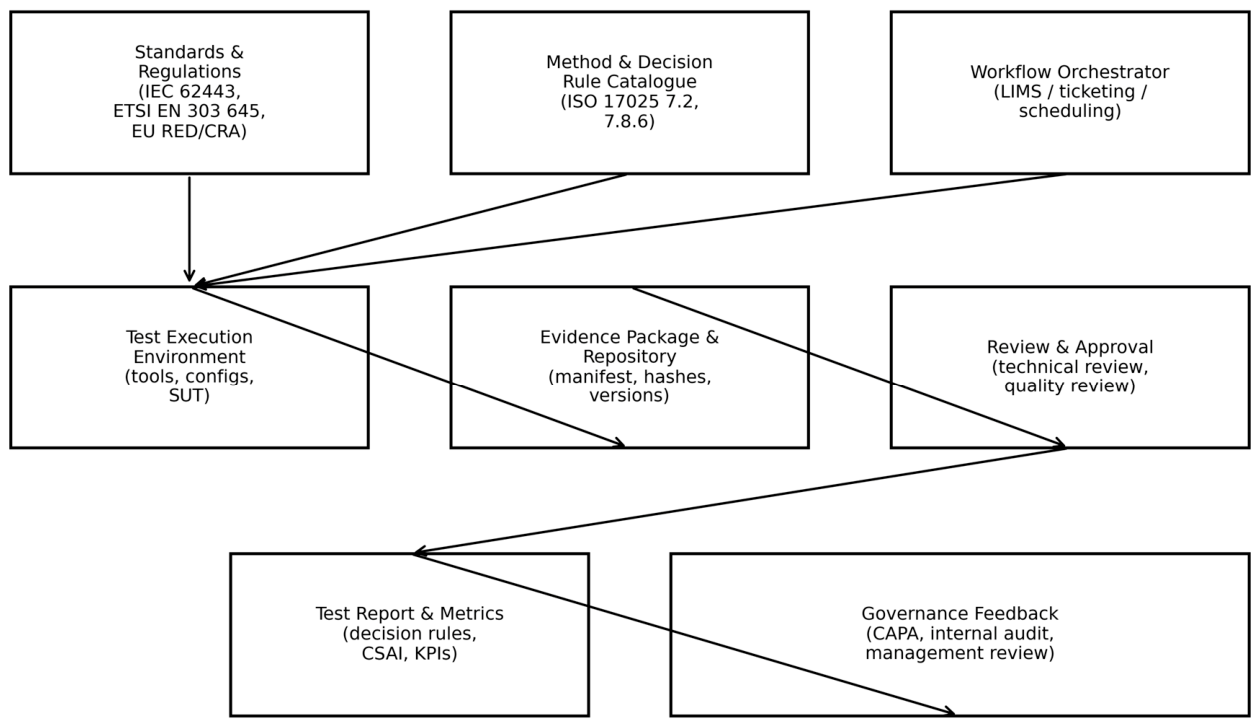
2.3. Digitised Workflow Blueprint and Evidence Traceability Model
2.4. Reference Compliance-As-Code Implementation Pattern
3. Results
3.1. Coverage of ISO/IEC 17025 Requirements with Cybersecurity Artefacts
- Method identification and control: A controlled List of Methods assigns internal identifiers to cybersecurity activities (e.g., ETSI/RED-aligned testing, IEC 62443 process/product assessments, and vulnerability testing/pentesting). This supports repeatability by anchoring each project to a defined method baseline rather than relying on informal “test approach” narratives.
- Method verification/validation governance: A formal method procedure explicitly requires validation depth proportional to changes in scope and deviations and recognises performance characteristics relevant to cybersecurity testing (e.g., robustness, repeatability/reproducibility, and uncertainty in results interpretation).
- Toolchain control: The presence of a Used Computer Master List and authorised usage records provides a lightweight mechanism to document test environment identity and software update state—critical in cybersecurity testing where scanner versions, firmware images, and tool configurations can change outcomes.
- Project workflow integration: The RED/ETSI/IEC 62443 work instruction includes explicit steps from application evaluation to conformity assessment, report packaging, and technical review/closeout. This creates a direct governance bridge between ISO/IEC 17025 management controls and cybersecurity assurance deliverables.
3.2. ETSI TS 103 701 (EN 303 645 Aligned) Assessment Outcomes
3.2.1. Dataset Structure
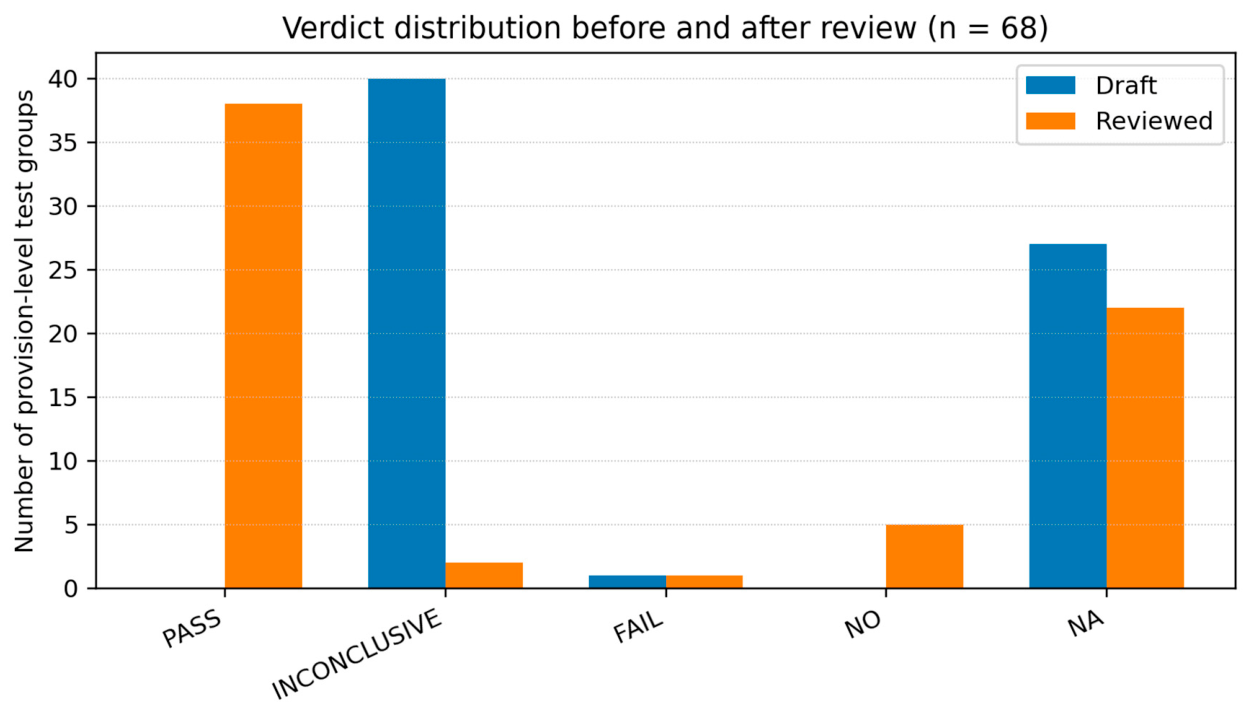
3.2.2. Draft vs. Reviewed Verdict Distributions
3.2.3. Verdict Transition Analysis
3.2.4. Ambiguity Reduction Indicator
3.2.5. Reviewer Comments and Evidence Traceability
- Approximately ~75% referenced IXIT updates (documentation additions to support repeatable testing);
- Approximately ~83% referenced specific evidence artefacts (e.g., named documents, captures), indicating strengthened traceability.
3.3. IEC 62443 Audit Action Plan Results
- Methodology/workflow incompleteness (NCR 3-dominant): The methodology was in draft status and missing explicit steps (e.g., identifying requirements in scope and maturity level for the chosen certification scenario).
- Scope and scenario definition errors (NCR 4-dominant): Plan of Evaluation contained incorrect/ambiguous certification scenarios, indicating insufficient control of the “Plan” stage and its downstream impact on reporting and conformity interpretation.
- TRF/report integrity issues (NCR 4- and NCR 5-dominant): Report numbering conflicts, combining multiple certification scenarios into one report and modifying template sections not intended for modification, directly affecting comparability and credibility of conformity statements.
- Evidence traceability requirements: Repeated emphasis that evidence must be described with sufficient metadata (type/version/chapter/date), consistent with ISO/IEC 17025 expectations for technical records and reproducibility.
3.4. ISO/IEC 17025 Internal Audit Findings as Governance “Maintenance” Signals
4. Discussion
4.1. Why the Results Support ISO/IEC 17025 Operationalisation for Cybersecurity Testing
- Tool-driven measurements (scanner outputs, captures, and logs);
- Expert judgement (triage, exploitability interpretation, and applicability decisions);
- Rapidly changing methods (tool versions, threat patterns);
- Conditional applicability (requirements depend on architecture, configuration, and interfaces).
4.2. Decision Rules as the Primary Lever for Ambiguity Reduction
- “INCONCLUSIVE” is not a failure of testing; it is a controlled quality state, where evidence expectations are recognised but not met, preserving an INCONCLUSIVE outcome prevents false passes and enables later reassessment without reconstructing the context.
- “Not applicable” and “not claimed” require strict constraints. Mandatory expectations cannot be de-risked by re-labelling them as “unclaimed.” This boundary condition is precisely where formal decision rules add value: they make the line between “out of scope” and “nonconforming” explicit and auditable. In practice, this argues for a decision-rule structure that is standard-aware (ETSI/EN 303 645, EN 18031 [52,53,54], IEC 62443) and interface-aware (ICS/IXIT conditions), and that explicitly encodes when NA is permissible.
4.3. Traceability and Comparability: Why Controlled Toolchains and Evidence Packages Matter
- Report template misfit for qualitative cybersecurity tests (e.g., references to uncertainty estimation where qualitative PASS/FAIL is used; confusion between outsourced vs. externalised work terminology), which can introduce interpretive noise and inconsistent reporting expectations (Clause 7.8.3).
- Weak amendment and re-issuance traceability, where a re-issued report retains the original identifier instead of using a unique identifier and explicit linkage, reducing auditability over time (Clause 7.8.8).
- Incomplete governance records for external service providers, notably cloud hosting, which creates both confidentiality risk and reproducibility ambiguity when the execution environment is externalised (Clause 6.6.2).
- Document control sensitivity points, including periodic review and consistent revision-state identification, which directly affects whether a given test was executed under the correct controlled method and template revision (Clauses 8.2/8.3—points sensibles).
4.4. The Assurance Maintenance Loop as a Cyber-Maintenance Control System
- Plan (scope, decision rules, and risk model): Assessment findings show that when decision rules are under-specified and conformity statements are blurred with client self-declarations, the entire assurance chain becomes fragile (Clauses 7.1.3 and 7.8.6). The same applies to risk and opportunity management: missing cyber-specific risks (e.g., IT system operational blockage, data quality/non-quality, and external equipment integrity/security) and the absence of residual-risk treatment or periodic re-evaluation limit the management system’s ability to anticipate and prevent governance failures (Clause 8.5).
- Do (controlled execution and technical records): Execution quality depends on controlled templates, fit-for-purpose reporting for qualitative outcomes, controlled external provider interfaces (including cloud services), and disciplined technical records. The findings around reporting content and external provider records indicate that “doing” in cyber labs includes maintaining the trust boundary around tooling, environments, and outsourced/externalised components.
- Check (review, internal audit, and inter-lab validity mechanisms): The ETSI dataset demonstrates that completeness checks and peer review materially change outcomes (INCONCLUSIVE → PASS) by resolving ambiguity rather than by adding tests. The assessment dataset reinforces that “Check” must also include fit-for-purpose validity mechanisms: qualitative PASS/FAIL domains require different inter-lab comparison criteria than quantitative measurement domains, and a participation plan is expected (Clause 7.7.2). Additionally, competence assurance in this stage includes demonstrable auditor competence and relevant cybersecurity testing expertise for the internal audit function (Clause 8.8.2—points sensibles).
- Act (corrective actions as governance maintenance actions): Nonconformity action plans (programme level) and internal audit corrective actions are the “maintenance actions” that update procedures, templates, decision rules, competence records, and risk registers. The key maintenance property is closure with verification—the governance analogue of restoring availability after downtime. The assessment process also makes closure timeliness explicit (action plan submission and evidence windows), which can be treated as a measurable maintenance parameter.
4.5. Proposed Measurable Cyber-Maintenance Indicators
- Conformity Statement Ambiguity Index (CSAI): Rate of INCONCLUSIVE outcomes among claimed items. Interpretation: Evidence/decision-rule maturity; reflects “assurance uptime.”
- Scope Misclassification Count: Number of mandatory requirements incorrectly marked NA/unclaimed (or moved outside of the scope without an auditable rule). Interpretation: Decision-rule boundary failures with direct compliance impact.
- Decision Rule Coverage Ratio: Share of projects/reports in which the decision rule is explicitly documented, traceable to the applicable specification, and applied consistently across provisions (contract review → report). Motivation: Assessment findings explicitly flag decision-rule ambiguity and the need to align conformity reporting with ILAC-style expectations (Clauses 7.1.3 and 7.8.6).
- Evidence Traceability Ratio: Share of provisions whose verdict includes explicit references to versioned artefacts (captures/logs/config snapshots/tool versions). Interpretation: Reproducibility and audit readiness; predictor of comparability across labs/time.
- Report Amendment Integrity Rate: Proportion of amended/re-issued reports that use a unique identifier and explicit linkage to the original report they replace. Motivation: Assessment findings show that weak amendment traceability degrades longitudinal comparability and audit defensibility (Clause 7.8.8).
- External Service Governance Coverage: Share of externally provided services (including cloud hosting) with documented evaluation, risk treatment, and retained records. Motivation: Assessment findings show governance records may omit cloud providers despite their security and confidentiality implications (Clause 6.6.2).
- Corrective Action Lead Time: Time from NCR creation to verified closure (internal audit + programme action plans). Interpretation: Governance MTTR; measures how quickly the lab restores “assurance availability.”
4.6. Limitations and Future Work
5. Conclusions
Author Contributions
Funding
Institutional Review Board Statement
Informed Consent Statement
Data Availability Statement
Acknowledgments
Conflicts of Interest
Abbreviations
| Abbreviation | Definition |
| CRA | Cyber Resilience Act |
| RED | Radio Equipment Directive |
| IEC | International Electrotechnical Commission |
| ISO/IEC | International Organization for Standardization/International Electrotechnical Commission |
| ILAC | International Laboratory Accreditation Cooperation |
| ETSI | European Telecommunications Standards Institute |
| IACS | Industrial Automation and Control Systems |
| IoT | Internet of Things |
| IIoT | Industrial Internet of Things |
| PDCA | Plan-Do-Check-Act |
| RCM | Reliability-Centered Maintenance |
| ICS | Implementation Conformance Statement |
| IXIT | Implementation eXtra Information for Testing |
| NCR | Nonconformity Report |
| TRF | Test Report Form |
| ITSEF | IT Security Evaluation Facility |
| EUCC | European Cybersecurity Certification Scheme |
| IECEE | IEC System of Conformity Assessment Schemes for Electrotechnical Equipment and Components |
| CAPA | Corrective and Preventive Action |
| CSAI | Conformity Statement Ambiguity Index |
| LIMS | Laboratory Information Management System |
| OSCAL | Open Security Controls Assessment Language |
| SUT | System Under Test |
| NA | Not Applicable |
| NO | Not Claimed |
References
- IEC 62443-3-3:2013; Industrial Communication Networks—Network and System Security—Part 3-3: System Security Requirements and Security Levels, Edition 1.0. International Electrotechnical Commission (IEC): Geneva, Switzerland, 2013.
- ISO/IEC 17025:2017; General Requirements for the Competence of Testing and Calibration Laboratories. International Organization for Standardization: Geneva, Switzerland, 2017. Available online: https://www.iso.org/standard/66912.html (accessed on 15 February 2026).
- Smith, A.; Hinchcliffe, G.R. RCM3: Risk-Based Reliability Centered Maintenance; Momentum Press: New York, NY, USA, 2014. [Google Scholar]
- Molęda, M.; Małysiak-Mrozek, B.; Ding, W.; Sunderam, V.; Mrozek, D. From Corrective to Predictive Maintenance—A Review of Maintenance Approaches for the Power Industry. Sensors 2023, 23, 5970. [Google Scholar] [CrossRef] [PubMed]
- European Union. Directive 2014/53/EU of the European Parliament and of the Council of 16 April 2014 on the Harmonisation of the Laws of the Member States Relating to the Making Available on the Market of Radio Equipment (Radio Equipment Directive). Official Journal of the European Union. 2014. Available online: https://eur-lex.europa.eu/eli/dir/2014/53/oj/eng (accessed on 15 February 2026).
- European Commission. Commission Delegated Regulation (EU) 2022/30 of 29 October 2021 Supplementing Directive 2014/53/EU with Regard to the Application of the Essential Requirements Referred to in Article 3(3)(d), (e) and (f). Official Journal of the European Union. 2022. Available online: https://eur-lex.europa.eu/eli/reg_del/2022/30/oj/eng (accessed on 15 February 2026).
- European Commission. Commission Implementing Decision (EU) 2025/138 of 28 January 2025 Amending Implementing Decision (EU) 2022/2191 as Regards Harmonised Standards in Support of the Essential Requirements of Directive 2014/53/EU That Relate to Cybersecurity. Official Journal of the European Union. 2025. Available online: https://eur-lex.europa.eu/eli/dec_impl/2025/138/oj/eng (accessed on 15 February 2026).
- European Union. Regulation (EU) 2024/2847 of the European Parliament and of the Council of 23 October 2024 on Horizontal Cybersecurity Requirements for Products with Digital Elements (Cyber Resilience Act). Official Journal of the European Union. 2024. Available online: https://eur-lex.europa.eu/eli/reg/2024/2847/oj/eng (accessed on 15 February 2026).
- Santana, C.C.; Loureiro, L. A risk management approach for testing and calibration laboratories. Accred. Qual. Assur. 2022, 27, 57–70. [Google Scholar] [CrossRef]
- IEC 62443-2-1:2010; Industrial Communication Networks—Network and System Security—Part 2-1: Establishing an Industrial Automation and Control System Security Program. International Electrotechnical Commission (IEC): Geneva, Switzerland, 2010.
- International Society of Automation (ISA). ISA/IEC 62443 Series of Standards. Available online: https://www.isa.org/standards-and-publications/isa-standards/isa-iec-62443-series-of-standards (accessed on 15 February 2026).
- ETSI EN 303 645 V2.1.1 (2020-06); Cyber Security for Consumer Internet of Things: Baseline Requirements. ETSI: Sophia Antipolis, France, 2020. Available online: https://www.etsi.org/deliver/etsi_en/303600_303699/303645/02.01.01_60/en_303645v020101p.pdf (accessed on 15 February 2026).
- EUROLAB AISBL. Guidelines for the Management of Digitalised Systems in Laboratories Accredited to ISO/IEC 17025; Technical Report No. 01/2024; EUROLAB AISBL: Brussels, Belgium, 2024; Available online: https://www.assotic.it/wp-content/uploads/2024/10/Guidelines-for-the-management-of-digitalised-systems-in-laboratories-accredited-to-ISO-IEC-17025.pdf (accessed on 14 March 2026).
- Perrett, V.; Wilson, C. A cyber resilience analysis case study of an industrial operational technology environment. Environ. Syst. Decis. 2023, 43, 178–190. [Google Scholar] [CrossRef]
- IEC 60300-3-11:2009; Dependability Management—Part 3-11: Application Guide—Reliability Centred Maintenance. International Electrotechnical Commission: Geneva, Switzerland, 2009.
- Leoni, L.; De Carlo, F.; Paltrinieri, N.; Sgarbossa, F.; BahooToroody, A. On risk-based maintenance: A comprehensive review of three approaches to quantify and prioritise maintenance actions. J. Loss Prev. Process Ind. 2021, 72, 104555. [Google Scholar] [CrossRef]
- Werbińska-Wojciechowska, S.; Winiarska, K. Maintenance Performance in the Age of Industry 4.0: A Bibliometric Performance Analysis and a Systematic Literature Review. Sensors 2023, 23, 1409. [Google Scholar] [CrossRef] [PubMed]
- Cortés-Leal, A.; Cárdenas, C.; Del-Valle-Soto, C. Maintenance 5.0: Towards a Worker-in-the-Loop Framework for Resilient Smart Manufacturing. Appl. Sci. 2022, 12, 11330. [Google Scholar] [CrossRef]
- Maglaras, L. From Mean Time to Failure to Mean Time to Attack/Compromise: Incorporating Reliability into Cybersecurity. Computers 2022, 11, 159. [Google Scholar] [CrossRef]
- IEC 62443-4-1:2018; Security for Industrial Automation and Control Systems—Part 4-1: Secure Product Development Lifecycle Requirements. IEC: Geneva, Switzerland, 2018.
- IEC TR 62443-2-3:2015; Security for Industrial Automation and Control Systems—Part 2-3: Patch Management in the IACS Environment. IEC: Geneva, Switzerland, 2015.
- European Parliament and Council. Regulation (EU) 2024/2847 of the European Parliament and of the Council of 23 October 2024 on Horizontal Cybersecurity Requirements for Products with Digital Elements and Amending Regulations (EU) No 168/2013 and (EU) 2019/1020 and Directive (EU) 2020/1828 (Cyber Resilience Act); L_202402847; Official Journal of the European Union: Brussels, Belgium, 2024. [Google Scholar]
- European Commission. Cyber Resilience Act; European Commission: Brussels, Belgium, 2024; Available online: https://digital-strategy.ec.europa.eu/en/policies/cyber-resilience-act (accessed on 15 February 2026).
- European Commission. Cyber Resilience Act: Reporting Obligations. Available online: https://digital-strategy.ec.europa.eu/en/policies/cra-reporting (accessed on 4 March 2026).
- International Laboratory Accreditation Cooperation (ILAC). ILAC-G8:09/2019 Guidelines on Decision Rules and Statements of Conformity; ILAC: Sydney, Australia, 2019; Available online: https://ilac.org/publications-and-resources/ilac-guidance-series/ (accessed on 14 March 2026).
- ISO/IEC 13528:2022; Statistical Methods for Use in Proficiency Testing by Interlaboratory Comparison. International Organization for Standardization: Geneva, Switzerland, 2022.
- European Commission. Commission Implementing Regulation (EU) 2024/482 of 31 January 2024 Laying Down Rules for the Application of Regulation (EU) 2019/881 as Regards the Adoption of the European Common Criteria-Based Cybersecurity Certification Scheme (EUCC); L_202400482; Official Journal of the European Union: Brussels, Belgium, 2024. [Google Scholar]
- ISO/IEC 19896-3:2018; IT Security Techniques—Competence Requirements for Information Security Testers and Evaluators—Part 3: Knowledge, Skills and Effectiveness Requirements for ISO/IEC 15408 Evaluators. International Organization for Standardization: Geneva, Switzerland, 2018.
- SP 800-82 Rev. 3; Guide to Operational Technology (OT) Security. National Institute of Standards and Technology (NIST): Gaithersburg, MD, USA, 2023. [CrossRef]
- National Institute of Standards and Technology (NIST). Open Security Controls Assessment Language (OSCAL). Available online: https://pages.nist.gov/OSCAL/ (accessed on 4 March 2026).
- Zakharchenko, A. Integrating Continuous Compliance into DevSecOps Pipelines: A Data Engineering Perspective. Software 2026, 5, 6. [Google Scholar] [CrossRef]
- Castellanos Ardila, J.P.; Gallina, B.; Muram, F.U. Compliance checking of software processes: A systematic literature review. J. Softw. Evol. Process 2022, 34, e2440. [Google Scholar] [CrossRef]
- Fenz, S.; Neubauer, T. Ontology-based information security compliance determination and control selection on the example of ISO 27002. Inf. Comput. Secur. 2018, 26, 551–567. [Google Scholar] [CrossRef]
- Wang, Y.; Mäntylä, M.V.; Liu, Z.; Markkula, J. Test automation maturity improves product quality-Quantitative study of open source projects using continuous integration. J. Syst. Softw. 2022, 191, 111259. [Google Scholar] [CrossRef]
- Barradas, J.; Sampaio, P. ISO 9001 and ISO/IEC 17025: Which is the best option for a laboratory of metrology? The Portuguese experience. Int. J. Qual. Reliab. Manag. 2017, 34, 406–417. [Google Scholar] [CrossRef]
- de Jesus, L.N.; Penteado, R.B.; Malheiros, F.C.; Castillo, L.A.M.; de Almeida, L.F.M. The conception and initial years of a quality management system based on ISO/IEC 17025: An action research. Accred. Qual. Assur. 2023, 28, 147–157. [Google Scholar] [CrossRef]
- Panagiotidou, E.; Chountalas, P.T.; Magoutas, A.I.; Georgakellos, D.A.; Lagodimos, A.G. Systematic Identification and Validation of Critical Success Factors for ISO/IEC 17025 Implementation. Adm. Sci. 2025, 15, 60. [Google Scholar] [CrossRef]
- Amaral Cejas, O.; Azeem, M.I.; Abualhaija, S.; Briand, L.C. NLP-Based Automated Compliance Checking of Data Processing Agreements Against GDPR. IEEE Trans. Softw. Eng. 2023, 49, 4282–4303. [Google Scholar] [CrossRef]
- Anim, J.; Robaldo, L.; Wyner, A.Z. A SHACL-Based Approach for Enhancing Automated Compliance Checking with RDF Data. Information 2024, 15, 759. [Google Scholar] [CrossRef]
- Krichen, M. A Survey on Formal Verification and Validation Techniques for Internet of Things. Appl. Sci. 2023, 13, 8122. [Google Scholar] [CrossRef]
- Mayr-Dorn, C.; Vierhauser, M.; Bichler, S.; Keplinger, F.; Cleland-Huang, J.; Egyed, A.; Mehofer, T. ProCon: An automated process-centric quality constraints checking framework. J. Syst. Softw. 2023, 202, 111727. [Google Scholar] [CrossRef]
- Oscal-Compass. Compliance-Trestle: An Opinionated Tooling Platform for Managing Compliance as Code Using NIST OSCAL. Available online: https://github.com/oscal-compass/compliance-trestle (accessed on 15 March 2026).
- Defenseunicorns-Labs. Lula1: The Cloud-Native Compliance Engine. Available online: https://github.com/defenseunicorns-labs/lula1 (accessed on 15 March 2026).
- ETSI TS 103 701 V1.1.1; Cyber Security for Consumer Internet of Things: Conformance Assessment of Baseline Requirements. European Telecommunications Standards Institute: Sophia Antipolis, France, 2021.
- JCGM 106:2012; Evaluation of Measurement Data—The Role of Measurement Uncertainty in Conformity Assessment. Joint Committee for Guides in Metrology: Sèvres, France, 2012.
- ISO 9000:2015; Quality Management Systems—Fundamentals and Vocabulary. International Organization for Standardization: Geneva, Switzerland, 2015.
- Kuckartz, U.; Rädiker, S. Qualitative Content Analysis: Methods, Practice and Software; SAGE Publications: London, UK, 2023. [Google Scholar]
- ISO/IEC 27001:2022; Information Security, Cybersecurity and Privacy Protection—Information Security Management Systems—Requirements. International Organization for Standardization: Geneva, Switzerland, 2022.
- Scarfone, K.; Souppaya, M.; Cody, A.; Orebaugh, A. Technical Guide to Information Security Testing and Assessment; NIST Special Publication 800-115; National Institute of Standards and Technology: Gaithersburg, MD, USA, 2008. Available online: https://csrc.nist.gov/pubs/sp/800/115/final (accessed on 19 April 2026).
- IECEE 02:2020; Scheme of the IECEE for Mutual Recognition of Test Certificates for Electrotechnical Equipment and Components (CB Scheme)—Rules of Procedure. International Electrotechnical Commission: Geneva, Switzerland, 2020. Available online: https://www.document-center.com/standards/show/IECEE-02 (accessed on 19 April 2026).
- ISO/IEC 27004:2016; Information Technology—Security Techniques—Information Security Management—Monitoring, Measurement, Analysis and Evaluation. International Organization for Standardization: Geneva, Switzerland, 2016.
- EN 18031-1:2024; Common Security Requirements for Radio Equipment—Part 1: Internet Connected Radio Equipment. CEN-CENELEC: Brussels, Belgium, 2024.
- EN 18031-2:2024; Common Security Requirements for Radio Equipment—Part 2: Radio Equipment Processing Data, Namely Internet Connected Radio Equipment, Childcare Radio Equipment, Toys Radio Equipment and Wearable Radio Equipment. CEN-CENELEC: Brussels, Belgium, 2024.
- EN 18031-3:2024; Common Security Requirements for Radio Equipment—Part 3: Internet connected Radio Equipment Processing Virtual Money or Monetary Value. CEN-CENELEC: Brussels, Belgium, 2024.



| Approach Stream | Representative Sources | Primary Automation Focus | What It Supports Well | Limitation for Accredited Cybersecurity Labs |
|---|---|---|---|---|
| Accredited laboratory quality systems | [13,36,37] | Digital records, validation, audit trails, success factors | General ISO/IEC 17025 governance and system implementation | Usually not focused on cybersecurity toolchains, qualitative verdict logic, or machine-readable evidence links |
| Generic LIMS-centred digitization | [13,35,36] | Workflow, samples, records, approvals | Operational record control and audit trails | Often document-centric; limited treatment of decision rules, evidence bundles, and evolving test scripts as controlled methods |
| Software-process compliance checking | [32,41] | Rule checking against process models and trace links | Timely detection of missing QA steps and process deviations | Does not directly address accreditation sign-off, report issuance, or externally provided services |
| Ontology/NLP/semantic automated compliance checking | [33,38,39] | Formal control representation, semantic reasoning, text-to-rule mapping | Machine-assisted compliance determination and requirement extraction | Usually optimises rule matching, not laboratory method control or auditable reviewer responsibility |
| Machine-readable control frameworks/compliance-as-code | [30,42,43] | Structured control catalogues, schema validation, CI-supported compliance artefacts | Interoperable machine-readable plans, assessments, and evidence metadata | Strong on representation, weaker on how qualitative conformity judgements are governed under ISO/IEC 17025 |
| Proposed framework | This paper | Accreditation-aware evidence architecture with explicit automation boundary | Links machine-readable artefacts, evidence bundles, review states, and ISO/IEC 17025 governance | Currently demonstrated as a single-laboratory exploratory case; predictive validity remains future work |
| Analysed Artefact | Type | Period Covered | Role in Analysis | Anonymization Level |
|---|---|---|---|---|
| ETSI TS 103 701 workbook | Project-level conformity assessment workbook | 2023–2025 case study snapshot; exact project dates suppressed | Verdict distribution, CSAI, transition matrix, and evidence-traceability subset | Client/product identifiers removed; standard requirement IDs retained |
| IEC 62443 programme action plan | Corrective-action and nonconformity log | 2023–2025 case study snapshot; exact project dates suppressed | Qualitative analysis of governance failure modes, scope errors, report integrity, and evidence traceability | Organisation-specific names removed; NCR grouping retained |
| ISO/IEC 17025 internal audit report | Laboratory governance record | 2024–2025 accreditation cycle; exact dates suppressed | Clause-linked analysis of governance drift, corrective actions, and management-system maintenance signals | Personal names removed; roles and clause topics retained |
| Method and toolchain governance artefacts | Controlled procedures, method lists, validation forms, and tool registers | 2023–2025 controlled-document snapshot | Clause-to-artefact crosswalk and automation-ready architecture extraction | Internal identifiers generalised; sensitive customer and tool details removed |
| Workflow Stage | Digitised/Automatable Elements (Evidence Outputs) | Manual/Expert Activities | ISO/IEC 17025 Clause Anchor |
|---|---|---|---|
| (1) Scope & test planning | Controlled test plan template; scope ticket; mapping to scheme requirements; versioned inputs (ICS/IXIT, SUT identification). | Define testing objectives and constraints; agree acceptance criteria; approve scope changes. | 7.1, 7.2 |
| (2) Method selection & decision rules | Versioned method list; decision-rule catalogue; traceable link between requirement, test method, and decision rule ID. | Select fit-for-purpose methods; define judgement criteria where automation is insufficient; approve decision-rule deviations. | 7.2, 7.8.6 |
| (3) Environment provisioning & toolchain control | Tool registry; tool version capture; configuration scripts; environment baselines; access control and change logs. | Approve toolchain updates; validate new tool versions; ensure competence for specialised tools. | 6.2, 6.4, 7.11 |
| (4) Test execution | Automated test scripts (where applicable); raw logs; timestamped results; linkage to SUT and configuration baseline. | Exploratory testing; interpret ambiguous tool outputs; manage safety and operational constraints during testing. | 7.2, 7.5 |
| (5) Evidence packaging & traceability | Evidence package (manifest + hashes); stored artefacts (logs, screenshots, configs); immutable identifiers for audit retrieval. | Select relevant evidence; ensure completeness and relevance; document rationale for exclusions. | 7.5, 7.11, 8.4 |
| (6) Technical review & nonconforming-work handling | Review checklist; reviewer comments; change-log between draft and reviewed verdicts; nonconformance records. | Peer review; resolve inconsistencies; decide on re-testing or additional evidence generation. | 7.7, 7.10 |
| (7) Report generation & issuance | Templated reporting; automatic insertion of verdict tables, evidence IDs, and toolchain metadata; controlled report versions. | Write interpretive narrative; sign-off; apply decision rules and communicate limitations to customers. | 7.8, 7.8.6 |
| (8) Governance feedback and continuous improvement | CAPA register; internal audit findings; management review minutes; metrics dashboard (e.g., CSAI). | Prioritise improvements; allocate resources; update procedures and competence plans. | 8.7–8.9 |
| Verdict Category | Draft Assessment | Reviewed Assessment |
|---|---|---|
| PASS | 0 | 38 |
| INCONCLUSIVE | 40 | 2 |
| FAIL | 1 | 1 |
| NO (explicitly not claimed) | 0 | 5 |
| NA (not applicable) | 27 | 22 |
| Total | 68 | 68 |
| Transition | Count |
|---|---|
| INCONCLUSIVE → PASS | 37 |
| FAIL → PASS | 1 |
| INCONCLUSIVE → INCONCLUSIVE | 2 |
| INCONCLUSIVE → FAIL | 1 |
| NA → NA | 22 |
| NA → NO | 5 |
| Total | 68 |
Disclaimer/Publisher’s Note: The statements, opinions and data contained in all publications are solely those of the individual author(s) and contributor(s) and not of MDPI and/or the editor(s). MDPI and/or the editor(s) disclaim responsibility for any injury to people or property resulting from any ideas, methods, instructions or products referred to in the content. |
© 2026 by the authors. Licensee MDPI, Basel, Switzerland. This article is an open access article distributed under the terms and conditions of the Creative Commons Attribution (CC BY) license.
Share and Cite
Gatri, A.; Lübeck, D.; Kilic, M. A Digitalized Quality-Management Framework and Automation-Ready Compliance Architecture for Cybersecurity Testing Laboratories: An ISO/IEC 17025:2017 Crosswalk and Exploratory Case Study. Appl. Sci. 2026, 16, 5271. https://doi.org/10.3390/app16115271
Gatri A, Lübeck D, Kilic M. A Digitalized Quality-Management Framework and Automation-Ready Compliance Architecture for Cybersecurity Testing Laboratories: An ISO/IEC 17025:2017 Crosswalk and Exploratory Case Study. Applied Sciences. 2026; 16(11):5271. https://doi.org/10.3390/app16115271
Chicago/Turabian StyleGatri, Aymen, David Lübeck, and Mukayil Kilic. 2026. "A Digitalized Quality-Management Framework and Automation-Ready Compliance Architecture for Cybersecurity Testing Laboratories: An ISO/IEC 17025:2017 Crosswalk and Exploratory Case Study" Applied Sciences 16, no. 11: 5271. https://doi.org/10.3390/app16115271
APA StyleGatri, A., Lübeck, D., & Kilic, M. (2026). A Digitalized Quality-Management Framework and Automation-Ready Compliance Architecture for Cybersecurity Testing Laboratories: An ISO/IEC 17025:2017 Crosswalk and Exploratory Case Study. Applied Sciences, 16(11), 5271. https://doi.org/10.3390/app16115271