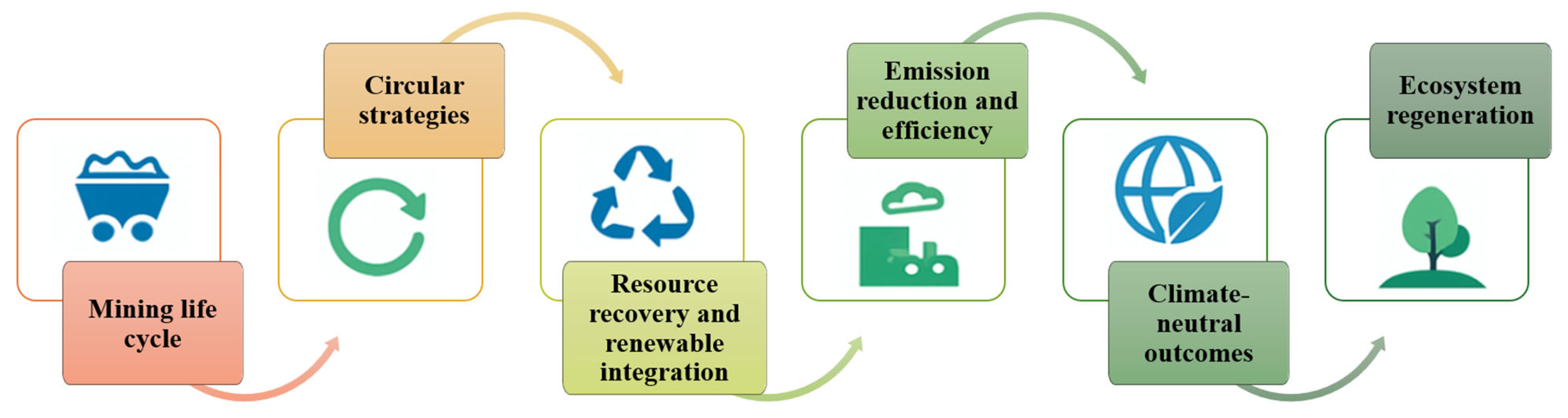
1. Introduction
Mining has been a cornerstone of the global economy for a very long time. It furnishes essential raw materials for infrastructure, energy, and emerging technologies. More recently, it has become clear that the traditional mining model is exerting increasing pressure on the environment and the climate. The mining industry is responsible for approximately 4 to 7% of global greenhouse gas emissions (GHG) and contributes to the degradation of ecosystems and the generation of large amounts of waste [
1,
2].
Mining activities are putting pressure on ecosystems, but at the very same time, there are other pressures on the mining sector. The energy and digital transitions are creating a growing demand for critical raw materials (lithium, cobalt, or rare earth elements)—a situation that is increasing the pressure on mining systems [
3,
4]. This presents a seemingly paradoxical tension: on the one hand, mining is a prerequisite for decarbonization, and on the other, it greatly contributes to climate change.
In this setting, climate neutrality cannot be achieved without a fundamental transformation of how resources are extracted and used. Therefore, the circular economy (CE) is an important framework in this effort [
5].
CE proposes a paradigm shift. Specifically, materials are no longer considered waste, but rather resources that must be kept in circulation for as long as possible. In the mining sector, this translates primarily into optimizing extraction. Added to this are the recovery of materials from waste and tailings, and the reuse of water and energy [
1,
6]. Research and implementation efforts regarding CE in mining appear to focus primarily on the recovery of mining waste and the integration of circular value chains [
7,
8].
Implementing CE concepts is not exactly straightforward. Some initiatives remain limited to waste management and fail to fully address the entire life cycle of the mining system in all its dimensions. de Torre de Palacios and Espí Rodríguez [
9] discuss in their paper how the CE is often overestimated in mining. They argue that not all material flows can be efficiently reintegrated into the cycle, and that some of the waste generated by these activities cannot be valorized economically or ecologically. Nevertheless, mining waste can be processed and used as a secondary source of metals, a fact that underscores the need to recover and reuse it [
10].
When it comes to sustainability, the concept of restoration is also a topic of discussion [
11,
12]. The latter focuses on restoring ecosystems and even designing systems that have a positive impact on the environment.
In this study, the mining life cycle is conceptualized as an integrated system that encompasses the successive stages of resource extraction, processing, material circulation, waste and tailings management. Mine closure and the downstream recovery and reintegration of secondary resources within wider industrial value chains are also viewed as constituent parts.
Because the various stages of mining activities are treated separately, the literature on the subject is relatively fragmented. There is also a certain lack of conceptual frameworks that comprehensively and explicitly address CE in conjunction with climate neutrality goals and restorative practices in the mining sector.
Based on this, the present paper addresses several research questions:
Q1—How could CE models transform mining systems?
Q2—What circular strategies could be applied throughout the life cycle of mining activities?
Q3—Can these strategies contribute to reducing emissions and achieving climate neutrality, and if so, how?
2. Methodology on Mining Activities and Circular Economy
2.1. Review Methodology
This paper adopts a structured narrative literature review, complemented by a descriptive bibliometric overview, to examine how CE models are discussed in relation to mining systems and the climate-neutral transition. This approach was selected because the topic spans technical, environmental, economic, and governance dimensions and includes heterogeneous evidence ranging from conceptual papers to review and case-study contributions. The review was designed to address the three research questions stated above and to support the conceptual framework developed later in the paper.
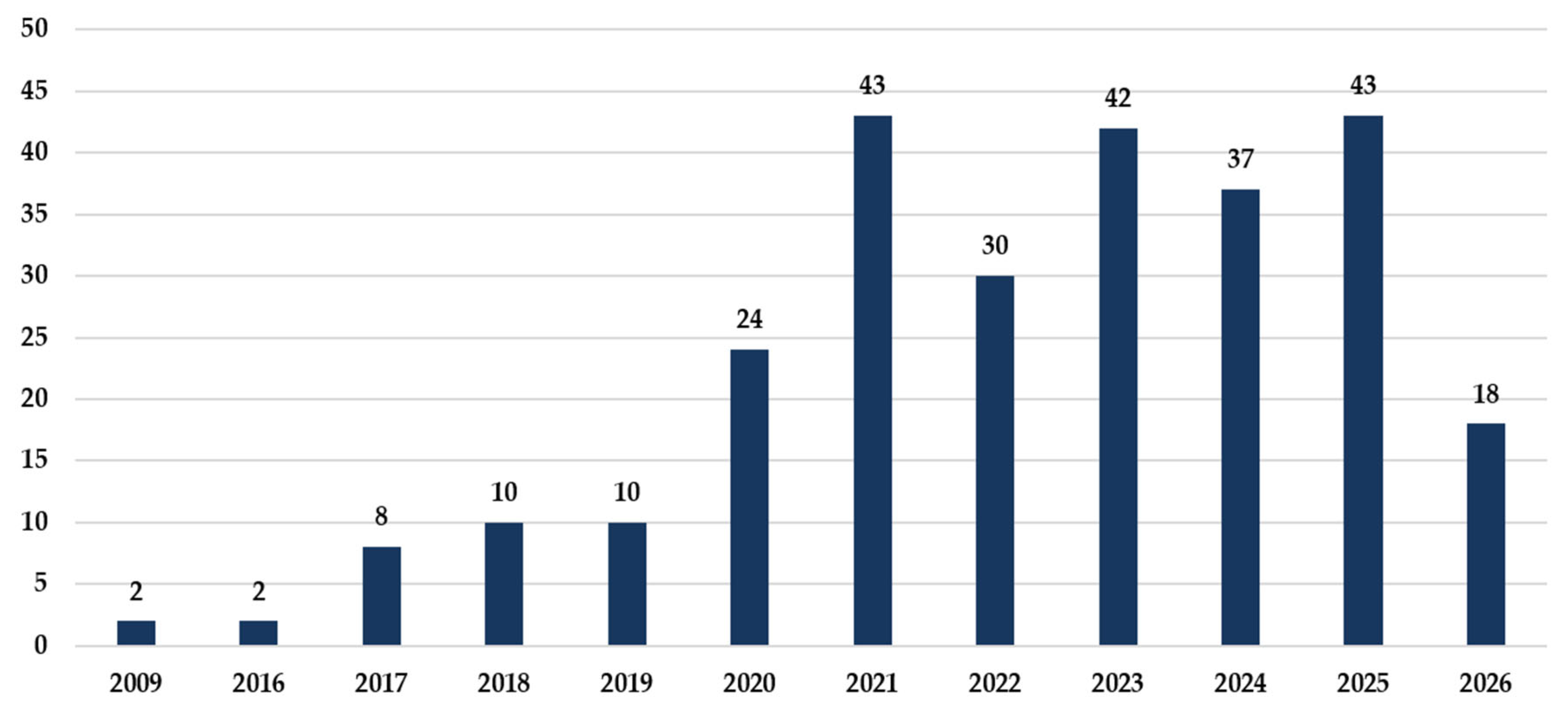
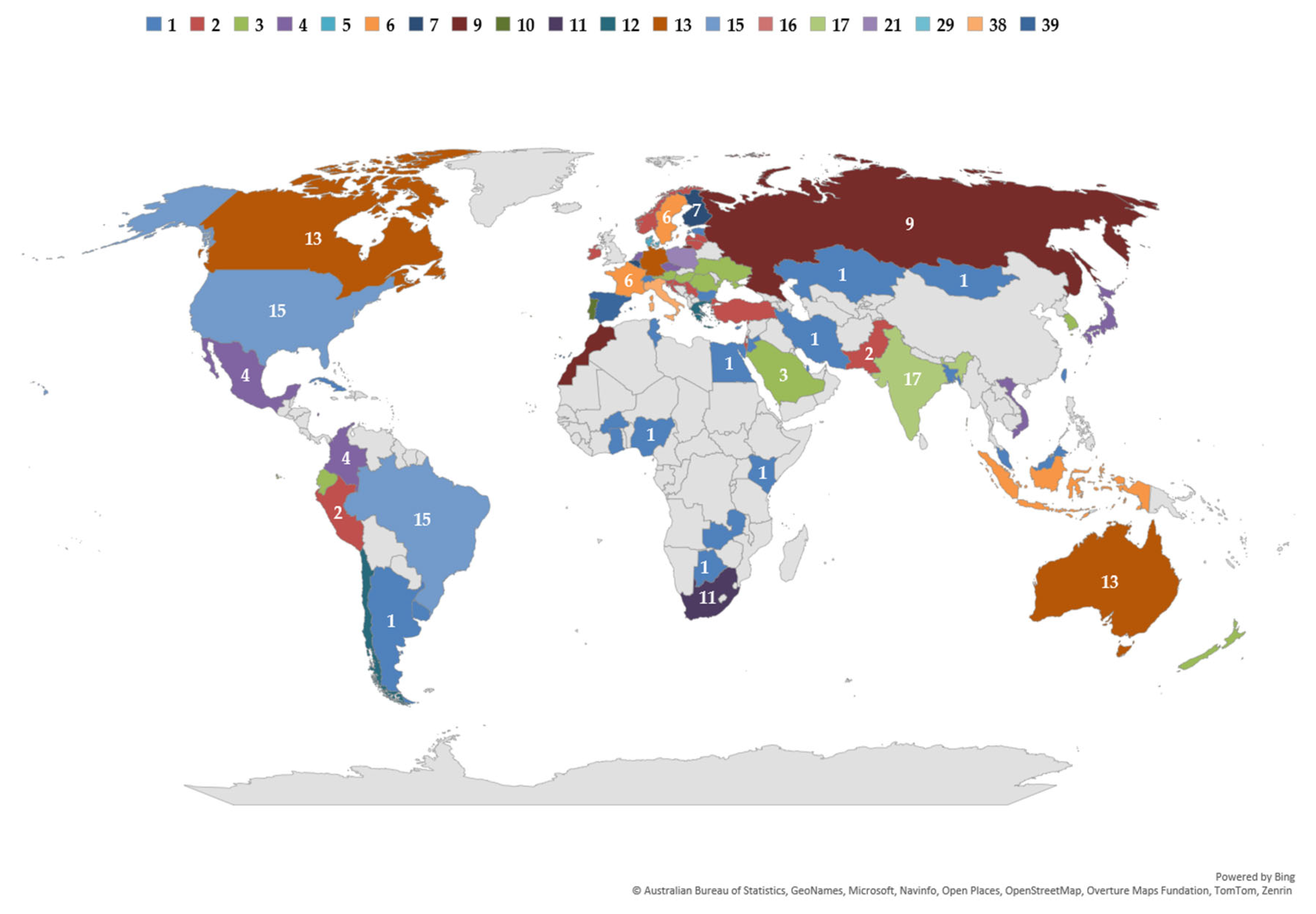
The bibliographic search underlying
Figure 1 and
Figure 2 was conducted in the Web of Science Core Collection on 11 April 2026.
The following search string was used in the Web of Science Core Collection database: (“circular economy” OR “resource recovery” OR “waste valorization” OR “industrial symbiosis”) AND (“mining” OR “mine tailings” OR “mineral processing” OR “critical raw materials”) AND (“decarbonization” OR “climate neutrality” OR “low-carbon mining”). To improve coverage, complementary searches were also performed in Scopus and Google Scholar for cross-validation of highly cited and recent publications. The search was restricted to English-language journal articles and review papers. Conference papers, editorials, notes, and publications outside the thematic scope of mining systems were excluded.
The screening process was carried out in two stages. First, titles, abstracts, and keywords were examined in order to remove records that were not directly concerned with circular practices in mining or with the relationship between circularity and climate-neutral transition. Second, the full texts of the remaining studies were reviewed for conceptual relevance and analytical quality. Studies were retained when they addressed at least one of the following dimensions: circular strategies across the mining life cycle, decarbonization pathways, resource recovery and material efficiency, or the economic, social, and governance conditions of implementation. Duplicate records were removed before screening. Studies were excluded if they focused exclusively on non-mining industrial sectors, lacked relevance to CE implementation, or did not address sustainability or decarbonization dimensions. If the authors wish to further strengthen transparency, the final manuscript may also report the number of records identified, screened, assessed in full text, and included in the final corpus.
The selected studies were analyzed through thematic coding rather than statistical aggregation because the literature is highly heterogeneous in terms of methods, commodities, geographic focus, and performance indicators. Evidence was grouped according to the main stages of the mining life cycle (extraction, processing, waste management, water and energy management, and mine closure/regeneration) and then interpreted in relation to decarbonization mechanisms and broader sustainability outcomes. The publication trend and country distribution shown in
Figure 1 and
Figure 2 were used to contextualize the evolution of the field and not as direct measures of practical impact.
This review has several limitations. Because the analysis relies primarily on the Web of Science Core Collection, relevant studies indexed in other databases may not have been captured. The English-language restriction may also underrepresent regional literature. In addition, no meta-analysis was attempted, since the retrieved studies use different system boundaries, metrics, and case contexts. Nevertheless, the structured search, screening, and thematic synthesis procedure increases the transparency of the review and provides a robust basis for the integrative framework proposed in this paper.
Due to the conceptual and heterogeneous nature of the reviewed studies, a formal quantitative quality appraisal tool was not fully applicable. Nevertheless, studies were evaluated according to conceptual relevance, methodological transparency, analytical consistency, and direct contribution to CE and climate-neutral mining discussions.
2.2. Circular Mining Systems—How Has It Developed, and What Is the Current Status?
Attention in the circularization of the mining sector has grown considerably over the past two decades. As shown in
Figure 1, the steady acceleration in research appears to have begun sometime after 2015–2016. This is likely due in part to the strengthening of the global agenda on sustainable development and the adoption of initiatives such as the European Commission’s Circular Economy Action Plan [
13]. As Cotrina-Teatino and Marquina-Araujo [
1] also note in their study, this period marks a transition from isolated studies (the initial period), focused on mining waste management, toward more integrated approaches (the stable and growth period), which seek to reconnect the entire resource life cycle.
Among the earliest contributions regarding the visibility of the CE in the mining sector are studies focusing on resource management [
14] and the reuse of waste [
15]. Subsequently, research contributions have steadily increased in the field of waste management [
16,
17], as well as in methods for recovering resources from waste [
18].
After 2020, there was a gradual diversification of the topics addressed, with CE increasingly being analyzed in conjunction with decarbonization and energy efficiency. This shift reflects the growing pressure exerted by global climate goals, including those outlined in the Paris Agreement [
19]. The latter requires significant reductions in emissions across all industrial sectors, including mining. As a result, circularity has begun to be treated as a tool for achieving climate neutrality [
20,
21,
22].
The geographical distribution (
Figure 2) of research also appears to be a relevant factor. Most studies seem to be concentrated in regions with intensive mining activity and advanced sustainability policies. In Europe, for example, the focus is particularly on integrating CE into industrial policies and reducing dependence on imports of critical raw materials [
23,
24,
25]. In China, on the other hand, research seems more oriented toward resource efficiency and waste recovery [
26,
27,
28]. Australia, another example, focuses on optimizing mining operations and reducing environmental impact [
29,
30]. This diversity reflects not only economic and political differences but also the specific nature of available resources and the industrial context.
Despite the rapid growth of the literature, important differences remain regarding the actual feasibility and scalability of CE implementation in mining. While several studies emphasize technological opportunities for waste recovery and process optimization, others argue that economic volatility, low-grade resources, and infrastructure limitations. This divergence suggests that CE implementation remains highly context-dependent.
Research in the mining sector appears to be maturing gradually, in line with CE concepts. The evolution is shifting from a focus on impact management toward strategies aimed at optimizing resource flows. However, there remains a need to develop conceptual models that unify the various existing perspectives so as to provide a framework applicable on a large scale. Building on these trends, the following section examines how CE strategies are concretely implemented across mining activities.
2.3. Circular Economy Strategies in Mining Activities—A Short Introduction
CE strategies cannot be applied punctually in mining activities. They require a systematic rethinking of the entire chain, from extraction to regeneration. Global resource extraction has risen alarmingly in recent decades. It is reported that global resource consumption has increased from 23.7 to 70.1 trillion tons (from 1970 to 2010) [
31]. It is also estimated that this consumption will double by 2060 [
8].
Thus, CE strategies, during the extraction phase, focus on reducing the material and energy intensity of operations [
32]. These practices aim to maximize reuse, recycling, and regeneration to extend the life cycle of materials as much as possible. Solutions considered with a direct impact on reducing emissions include the electrification of mining equipment [
8,
33] and the optimization of drilling and transport processes [
34,
35]. Digitalization and smart mining technologies are being considered to enable more precise exploitation, with the potential to limit the volume of waste rock extracted [
36].
The integration of life cycle assessments (LCAs) is considered necessary for analyzing the environmental impact of byproducts generated during mineral processing [
37]. LCAs suggest that optimizing the extraction phase could reduce the carbon footprint of the entire mining system, especially when combined with the integration of renewable energy sources [
38,
39].
After the extraction phase, the focus shifts to resource efficiency and material recovery during the processing phase [
40]. Concentration and refining processes are energy-intensive. At the same time, they also result in significant material losses. For this reason, CE promotes the recirculation of internal streams, the reuse of reagents and water, and the optimization of separation technologies [
10,
41,
42].
The management of waste and mine tailings is likely the most extensively studied area in the literature on the CE in mining. These streams have long been treated as worthless residues. Circular approaches reconceptualize them as secondary sources of raw materials [
43,
44,
45]. Waste rock piles and tailings ponds contain high amounts of critical metals, which can be recovered using appropriate technologies [
46,
47]. Also, waste materials can be used in construction or other industrial applications [
48,
49], thereby reducing the need for primary extraction. This shift from “waste” to “resource” is considered one of the most important contributions of CE to the mining sector.
Water and energy management is emerging as another essential pillar of circularity [
50,
51]. Mining systems are increasingly adopting closed-loop models, in which water is recirculated and reused in technological processes [
52,
53]. This helps reduce the strain on local water resources. At the same time, the integration of renewable energy (solar, wind, or green hydrogen) is becoming more common, especially in regions where energy costs are high [
54,
55,
56].
In terms of mine closure and land restoration, this is perhaps the key point of intersection between CE and regenerative approaches. Whereas in the past, mine closure was treated as a minimal legal obligation, today there is a growing trend toward transforming these spaces into functional ecosystems or even alternative economic resources [
57,
58]. Practices include: soil restoration, reintroducing biodiversity, or reusing mining infrastructure for other economic activities [
59,
60,
61]. In respect to it, circularity no longer means merely closing material loops, but also regenerating the natural capital affected by extractive activities.
A recent study [
62] also suggests that intelligent monitoring and multi-source data integration methods may support more robust performance assessment frameworks in complex industrial systems, particularly in relation to sustainability monitoring and dynamic system evaluation. Beyond process-level optimization, CE strategies in mining also involve system-level approaches. These include full lifecycle circularity, where circular principles are embedded from mine design to closure, as well as industrial symbiosis, where mining waste streams are utilized by other industries [
32,
63]. In addition, cross-industry resource integration enables the transfer of materials between sectors, extending resource value beyond the boundaries of the mining system. These approaches reflect a transition from isolated technical solutions to integrated circular systems.
From the above, we can infer that CE in mining is not a universal solution. Rather, it is a set of interconnected measures applied throughout the entire life cycle.
However, it appears that the implementation of circular strategies remains somewhat uneven. There is a tendency to focus on ad hoc solutions, particularly in the field of waste management, without fully embedding circular principles in the early stages of mine design and operation. This absence of integration constrains the transformative potential of CE and stresses the need for systemic approaches capable of linking resource efficiency, decarbonization, and ecosystem restoration within a coherent framework.
3. Climate-Neutral and Low-Carbon Pathways in Mining
On the subject of climate neutrality in the mining sector, the argument inevitably becomes complex and sometimes even contradictory. On the one side, mining is critical to the global energy transition. It provides the raw materials needed for numerous activities and technologies. On the other hand, it remains an energy-intensive sector and is responsible for a significant volume of GHG emissions [
64]. In the literature, there are attempts to answer a rather uncomfortable question: can mining truly become climate-neutral, or are we talking instead about a relative reduction in its impact?
The concept of climate neutrality generally refers to achieving a balance between GHG emissions and their removal from the atmosphere, resulting in a net-zero climate impact [
65]. According to the Intergovernmental Panel on Climate Change (IPCC) [
66], this involves not only reducing emissions but also compensating for residual emissions through carbon sinks or technological removal solutions. It is important to distinguish climate neutrality from related concepts such as carbon neutrality and net-zero emissions. While carbon neutrality typically refers to offsetting CO
2 emissions only, net-zero emissions encompass all GHGs and require deep emission reductions across the entire value chain. Climate neutrality, in contrast, integrates both emission reductions and broader systemic transformations, including resource efficiency and circularity.
From the perspective of energy efficiency and the electrification of mining processes, studies indicate that integrating renewable energy into mining operations, combined with the electrification of equipment, may reduce direct emissions. In this regard, Onifade et al. [
67] emphasize that achieving sustainability in the mining sector fundamentally depends on reducing energy consumption and emissions generated during operational processes through the adoption of green mining technologies. This perspective is predominantly technological. It does not fully account for the role of CE strategies, which can also contribute to reducing emissions by decreasing the need for primary extraction. In a similar approach, Igogo et al. [
55] consider the decarbonization of mining from an energy perspective. Integration of renewable energy sources is critical to achieving emissions reductions. The authors stress that the mining industry is heavily reliant on fossil fuels and is marked by high energy consumption. As a result, the adoption of renewable energy sources is a prerequisite for reducing emissions. They also point out that the implementation of these solutions is constrained by technical and operational limitations, particularly in remote mines, where reliance on diesel remains high.
CE strategies may contribute to climate neutrality through both direct and indirect decarbonization mechanisms. Direct mechanisms include elements such as electrification, renewable energy integration, energy efficiency improvements, and optimization of operational processes. Indirect mechanisms involve reducing the demand for primary extraction through waste recovery, secondary material use, industrial symbiosis, and increased material circularity. Direct mechanisms may contribute primarily to reducing operational emissions, whereas indirect mechanisms could reduce emissions embedded across the broader mining value chain.
While Igogo et al. [
55] discuss decarbonization in mining from the perspective of integrating renewable energy, Enemuo and Ogunmodimu [
68] advocate a more comprehensive strategy based on combining multiple approaches. This view suggests that the transition to climate-neutral mining is a systemic process involving the integration of multiple solutions, even those related to CE. They underline that the transition of the mining sector towards sustainability calls for a combination of strategies. These involve integrating renewable energy, improving energy efficiency, and implementing carbon capture technologies. In this sense, the authors note that there is no single solution, but rather a range of possible approaches, depending on the technological and economic context.
At the same time, Kinnunen et al. [
10] address the issue of emissions more indirectly. They emphasize the recovery of mining waste as a strategy to reduce the need for primary extraction. From this perspective, emissions reductions do not necessarily stem from optimizing existing processes, but rather from avoiding future processes. In other words, if metals can be recovered from tailings or secondary streams, the pressure on primary extraction decreases, and with it, the associated emissions.
Renewable energy systems integration in mining operations remains highly site-dependent. Solar energy may be particularly suitable for arid regions with high irradiation, whereas the potential of wind energy depends on local climatic conditions. In remote mining operations, power supply intermittency and storage requirements remain major technical challenges. At the same time, green hydrogen deployment is currently constrained by infrastructure costs and technological maturity.
An interesting difference in approach emerges. While some authors focus on the “internal decarbonization” of the mining system, others propose “systemic decarbonization,” based on reducing the need for extraction. Although most studies agree that decarbonization in mining requires technological modernization, disagreement persists regarding the relative importance of CE strategies compared with direct energy transition measures. Some authors prioritize electrification and renewable energy integration, whereas others argue that reducing primary extraction through secondary resource recovery may generate more systemic long-term benefits.
A similar perspective is also found in the study by Mitrašinović et al. [
69]. Here, the authors argue that the concept of “zero-waste mining” is not merely a waste management strategy, but also a tool for indirectly reducing emissions. They emphasize that mining processes generate over 90% of global waste, and the reuse of these waste streams can help reduce the material and energy intensity of the economy. In this regard, they suggest that climate neutrality cannot be achieved without a drastic reduction in material losses.
The effectiveness of circular strategies depends strongly on system-wide economic and technological conditions. Ryter et al. [
70] indicate that material efficiency strategies such as recycling can partially offset primary production, with approximately 0.5 kilotons of mine production displaced per kiloton of scrap supply increase on average. They argued that even under best-case scenarios combining high recycling rates and best available technologies, total sectoral emissions are still projected to increase by around 25% by 2040 compared to 2018 due to demand growth and declining ore grades. At the same time, only limited mitigation effects of approximately 10% below 2018 emission levels are achievable under optimal technological assumptions.
On the other hand, Khan and Magweregwede [
71] take a more integrated approach to the issue. They emphasize that decarbonization strategies must be aligned with CE strategies in order to have a real impact. The authors note that simply electrifying mining operations is not sufficient unless it is accompanied by an optimization of material flows and a reduction in resource consumption. Interestingly, they point out that some green technologies may have limited or even contradictory effects in the absence of a circular approach, due to increased demand for raw materials.
These ideas are supported by other studies in the literature. They highlight the fact that emissions associated with the mining sector are not generated exclusively by direct operations, but are distributed throughout the entire value chain. LCA reveals that the footprint extends beyond the extraction phase. It also encompasses the transportation, processing, and use of materials [
72].
The concept of decarbonization pathways is beginning to emerge. These pathways set out possible trajectories for reducing emissions over time. They often involve a combination of measures. It includes electrification, the integration of renewable energy, digitalization, process optimization, and, more and more, the implementation of CE strategies. Even so, there continues to be a lack of consensus regarding the pace and feasibility of these transitions, particularly given the high costs and technological uncertainties.
Climate neutrality in mining is not something that can be achieved through a single measure or technology. On the contrary, it requires a combination of technical solutions, circular strategies, and structural changes. In this sense, CE serves a dual function. On the one hand, it helps reduce emissions directly through efficiency and reuse. On the other hand, it remodels the relationship between extraction and consumption, laying the groundwork for a truly sustainable transition to industrial systems.
4. Resource Recovery and Material Efficiency in Circular Mining Systems
One of the most concrete and tangible aspects of the CE in the mining sector involves resource recovery and material efficiency. While the previous phases concentrate on process optimization or emissions reduction, the issue here is much more directly linked to the physical flows of materials and how they can be reintegrated into the system. At its core, CE calls for a shift in perspective: what was once considered waste becomes a secondary resource with economic potential.
Mining waste consists of substantial concentrations of valuable metals, sometimes comparable to those found in primary deposits. For instance, Kinnunen et al. [
10] note that these waste streams can provide significant sources of critical raw materials. They stress that the waste contains high concentrations of many critical metals. This insight fundamentally changes how mining is seen, turning waste from environmental liabilities into potential assets.
At the same time, Cotrina-Teatino and Marquina-Araujo [
1] point out that the recovery of mining waste is one of the most advanced areas of CE in mining, but its implementation remains fragmented and dependent on economic and technological factors. Interestingly, they note that while the technical potential for recovery is high, economic feasibility is often limited by processing costs and the volatility of raw material markets.
This tension between potential and implementation is also reflected in other studies. Mitrašinović et al. [
69] suggest that a transition to a zero-waste mining model could significantly reduce material losses. However, they note that achieving this goal requires not only advanced recovery technologies but also a reorganization of the entire value chain, including how extraction and processing operations are designed.
Resource recovery strategies should not be limited to the waste management stage. Instead, they should be incorporated from the project design phase onward. This is important because it changes the focus from reactive-driven solutions to proactive approaches. Resource recovery, of course, is not a universal solution. In many cases, metal concentrations in waste can be low, and the recovery processes are energy-intensive. This raises questions about the true sustainability of these practices. It is therefore important to conduct integrated assessments that simultaneously weigh the benefits and costs from both economic and environmental perspectives.
Literature also reveals disagreement concerning the overall sustainability of resource recovery practices. While many studies describe mining waste as an important secondary resource, other authors caution that recovery processes themselves may become energy-intensive and economically unfeasible, particularly when dealing with low-grade residues. As a result, the environmental benefits of recovery may vary considerably depending on technological efficiency and local operating conditions.
The feasibility of tailings valorization varies considerably depending on several factors. Among them we mention mineral composition, particle size distribution, metal concentration, geochemical stability, and the availability of suitable recovery technologies. Sulfide-rich tailings, for example, may present different recovery opportunities and environmental risks compared to oxide or silicate-based residues.
Recovery of resources and material efficiency are, in other words, a central building block of the journey towards circular mining. Their effective implementation depends, however, on the integration of appropriate technologies, economic conditions, and the adoption of a systemic perspective on the entire value chain. Without this integration, there is a risk that CE strategies will remain limited to isolated initiatives, without a significant impact on the sector’s overall sustainability.
5. Economic and Social Dimensions of Circular Mining Systems
Beyond technical and environmental considerations, the transition to a CE is deeply influenced by economic and social factors [
2,
73]. In many cases, these factors become decisive in the actual implementation of these strategies. CE holds the promise of more efficient utilization of resources and a reduction in dependence on primary extraction. In practice, the situation is more nuanced.
From an economic standpoint, one of the challenges is the high upfront costs [
8,
73]. Implementing technologies for material recovery, waste reuse, or process optimization requires significant investment [
32,
74]. The benefits are expected to materialize in the long term.
In this regard, mining companies operate in an environment characterized by volatile commodity prices, which directly influences investment decisions and limits the adoption of solutions with long-term benefits [
75]. At the same time, given the growing demand for critical raw materials, the recovery of secondary resources can become a significant economic opportunity, particularly when market conditions are favorable [
76].
In the mining sector, the CE is not simply about optimizing existing processes, but also about creating entirely new material flows. This demands collaboration between industry, recyclers, public authorities, and other economic sectors [
77]. Without these interconnections, many circular strategies will remain isolated efforts without a meaningful impact on a large scale.
On the social front, things become even more sensitive. Mining activities have always had a strong impact on local communities, and the introduction of circular models does not automatically change this reality [
45,
78]. In some instances, these approaches can bring benefits such as reducing environmental impact, creating new jobs, or reusing affected land [
8]. But there are also risks, especially when the transition includes automation or structural changes in industry, which can lead to the loss of traditional jobs. A concept that is increasingly being discussed is that of social acceptance [
79]. It is not sufficient for a solution to be technically effective or economically feasible; it must also be accepted by the affected communities. In this regard, transparency, public engagement, and the equitable distribution of benefits are of paramount importance. Without these, even the “greenest” projects can face opposition.
The economic and social dimensions seem to suggest that the transition to circular mining is not merely a matter of technology, but a systemic issue. It is a question of how costs and benefits are distributed (who gains and who loses in this process) and of the sector’s capacity to adapt to a model that is more complex but also more sustainable. Without a balanced approach, there is a risk that CE will continue to be more of a theoretical concept than a reality put into practice on a large scale.
In
Table 1, we have summarized the CE strategies considered important and impactful in mining systems.
6. Importance of the Circular Economy in Mining Systems and Its Role in the Climate-Neutral Transition
CE has become one of the key drivers for transforming the mining sector [
7,
32,
73,
77]. This is all the more pertinent in light of ever-increasing pressures related to climate change, resource depletion, and massive waste generation. The classic linear model is no longer sustainable in the long-term, specifically in a sector that substantially contributes to global emissions and environmental degradation. In this regard, CE suggests a shift toward closed-loop, regenerative, and resource-efficient systems.
The value of the CE in mining comes primarily from its ability to transform waste streams into valuable resources. Mining waste, such as waste rock piles or tailings ponds, often has lots of metals and minerals that can be recovered and put back into the economic cycle. This not only reduces the need for primary extraction but also contributes to mitigating environmental impacts, including soil and water pollution. In this sense, the CE facilitates a shift from a “waste management” mindset to one of “resource recovery” [
8].
At the same time, circular models directly contribute to increasing resource efficiency throughout the entire life cycle of mining activities. By reusing water, optimizing energy consumption, and recycling materials, mining operations can significantly reduce both natural resource consumption and operational costs. For example, in many mining operations, energy represents a major cost component, and the integration of circular systems that reduce losses can have significant economic and environmental benefits.
Moreover, CE plays a vital role in the transition to climate-neutral mining systems [
97]. Reducing primary extraction and increasing the recovery of secondary materials lowers energy demand and, with it, emissions associated with mining processes. Furthermore, integration of renewable energy and closed-loop water and material systems contributes to reducing the carbon footprint of operations. In this way, circularity does not function in isolation but in synergy with decarbonization strategies, providing the foundation for more efficient and lower-emission mining systems.
A further important point relates to the systemic nature of CE. Its implementation in mining implies not only the adoption of new technologies but also the reorganization of the entire value chain [
98]. From mine design to mine closure and land reclamation, CE extends responsibility beyond the extraction phase to include downstream processes and the reuse of materials at the end of their life cycle. In this way, mining is no longer an isolated sector but becomes part of a broader system of material circulation. This systemic perspective highlights that the CE in mining extends beyond internal efficiency improvements toward broader interconnections with other industrial sectors.
Lastly, the significance of CE is also demonstrated by its potential to contribute to the sector’s long-term sustainability. Through reducing dependence on virgin resources and repurposing previously extracted materials, the mining industry can more productively fulfill the growing demand for critical raw materials needed for the global energy transition. Simultaneously, embracing circular models can alleviate the social and environmental pressures associated with opening new mines, thereby promoting greater social acceptance of mining activities. CE is not just a complementary strategy for the mining sector, but an integral direction for its transformation. By embracing the principles of reuse, recycling, and regeneration, mining can move from an extractive and linear model toward one that is both sustainable and compatible with climate neutrality goals.
CE strategies implementation in mining systems is strongly influenced by regional policy frameworks, technological maturity, and economic conditions. In the European Union, circularity is increasingly supported through policies related to critical raw materials, industrial decarbonization, and the Circular Economy Action Plan [
24,
25]. In contrast, countries with resource-intensive economies, such as Australia and China, tend to focus more strongly on operational efficiency, resource recovery, and supply security [
99,
100]. Developing economies may face additional barriers related to infrastructure, investment capacity, and technological access, which can limit the large-scale implementation of advanced circular systems. As a result, the transition toward circular and climate-neutral mining systems is likely to follow different trajectories depending on regional and national contexts.
Although quantitative comparisons remain difficult due to differences in system boundaries and methodologies across studies, the literature generally suggests that circular strategies may contribute to emission reduction through lower primary extraction demand, reduced energy consumption, and increased material efficiency. However, the relative contribution of each mechanism remains highly context-dependent and insufficiently standardized in current research.
7. Circular Economy Models Applied in Mining Systems
The application of the CE in the mining sector is no longer merely a theoretical concept but is beginning to take shape through a series of concrete models implemented at various stages of the mining life cycle. However, the literature shows that these models are not uniform but reflect different approaches to how circularity can be integrated into mining.
One of the most common examples is the recovery of mining waste, particularly from tailings ponds. In this regard, Kursunoglu [
46] emphasizes that these deposits contain significant quantities of critical metals that can be recovered and reintegrated into the economic cycle, transforming waste into secondary resources. In contrast, Mancini et al. [
44] approach the issue from a broader perspective, arguing that the recovery of materials from secondary streams is not only an environmental solution but also a strategic one for the security of raw material supply.
Practical examples of tailings reprocessing have already been reported in several mining regions. In Chile, tailings deposits are increasingly being reconsidered as secondary sources of critical raw materials and copper through reprocessing and valorization initiatives [
101,
102]. Similar approaches have also been discussed in Australia, where copper tailings are being evaluated for cobalt recovery within circular mining strategies [
103,
104].
Another important model is that of closed-loop systems for water and materials. Mudd [
105] highlights the fact that water management is becoming a critical factor in mining, particularly in regions affected by water stress, and that water reuse can significantly reduce environmental impact. On the other hand, from Vargas et al. [
50] and Upadhyay et al. [
2], we can argue that material efficiency and reducing processing losses are equally important. Hence, it is worth pointing out that circularity should be integrated from the very early stages of the value chain. In this instance, the perspective difference is quite subtle: while some authors focus on water resources, others expand the discussion to encompass the overall efficiency of the system.
The integrated use of renewable energy in mining operations is yet another pertinent example, at the intersection of circularity and decarbonization. Igogo et al. [
55] suggest that the use of renewable sources could help reduce the carbon footprint of mining. This could contribute to the transition toward low-carbon systems. In contrast, Oluokun et al. [
106] suggest that this transition requires a combination of solutions and cannot be achieved through a single intervention, suggesting that the integration of renewable energy must be supported by additional measures, such as energy efficiency or process optimization. Thus, while some authors emphasize specific solutions, others advocate for a systemic approach.
Another increasingly discussed model is the reuse and regeneration of mining sites after operations have ceased. Mine closure is a critical phase with significant social and environmental implications, and land regeneration can help mitigate the long-term impact [
57,
107]. At the same time, the importance of social acceptance and community involvement in these processes is emphasized, arguing that the success of regeneration depends not only on technical solutions but also on how benefits are distributed. This difference underlines the fact that circular models are not merely technical, but deeply social.
Mine closure and regeneration extend beyond conventional remediation practices. They are increasingly emphasizing ecosystem restoration, long-term environmental stability, and the reintegration of post-mining landscapes into new economic and ecological functions. In this context, regenerative approaches are progressively oriented toward restoring biodiversity, improving soil and water quality, and facilitating the adaptive reuse of mining infrastructure within broader sustainability and regional development strategies.
Alongside this, the concept of industrial symbiosis is also gaining traction in the literature. Waste streams from one sector can be turned into resources for another, creating interconnected economic systems. When implemented in mining, this model implies the use of mineral residues in industries such as construction or cement manufacturing [
49,
80,
108]. Nevertheless, it is notable that the adoption of these systems is hampered by logistical and economic factors, which suggests that, although promising, industrial symbiosis remains difficult to scale.
A broader perspective on circular mining systems emphasizes full lifecycle integration, where circular strategies are incorporated at the design stage and maintained throughout extraction, processing, and closure. In this context, circularity is no longer limited to waste management but becomes a system-wide principle guiding material flows across the entire value chain. This also includes cross-sector collaboration, where mining outputs are linked with other industrial systems, creating interconnected resource networks.
An emerging tendency is the use of digitalization in mining operations. Although it is not always directly associated with the CE, Flores-Castañeda et al. [
109] point out that the use of data and smart technologies can reduce material losses and optimize processes, thereby indirectly contributing to resource efficiency. Digitization, however, while useful, cannot replace traditional circular strategies; rather, it complements them.
Additional examples include the use of mining residues in cement and construction industries, demonstrating the growing implementation of industrial symbiosis approaches across different sectors [
110,
111].
Upon analyzing these perspectives, we observe that there is no single model of a CE applicable to the mining sector. Some authors emphasize material recovery, others resource efficiency or the social dimension, and the differences between these approaches reflect the sector’s complexity. It is precisely this diversity that suggests the transition to circular mining will not follow a single path, but will most likely involve a combination of models tailored to the specific context of each mine.
8. Gaps Identified in the Literature
The literature on CE in the mining sector remains fragmented and lacks integration across system boundaries. This makes it hard to understand the ideas and to actually use them. There are studies now, especially from 2018 to 2020, but they do not fully explore what the CE is all about.
One important problem is that CE is not part of the whole mining process. Existing research remains predominantly focused on downstream waste management. They treat these as solutions, not as part of the whole process. CE is used to fix problems after they happen, not to prevent them from the start. This means we do not get the benefits of CE.
The lack of consensus regarding the real transformative capacity of the CE in mining is another important issue. While some studies present circularity as a pathway toward climate-neutral mining systems, others argue that many circular practices remain technologically immature, economically uncertain, or difficult to scale beyond pilot applications.
Another issue is that the economy and climate neutrality goals are not well-connected. The literature discusses a lot about reducing carbon. The focus is mostly on technology, and does not consider how the CE can help reduce emissions by using new resources and making the most of what we have.
Strategies are often viewed from either an environmental view or an economic one. It would be recommended to look at both at the same time. In addition, it is also necessary to consider how it affects the whole community. Aspects such as the acceptance of the community, the way they are affected, and who benefits from these strategies are important. At the moment, they appear not to have studied enough. This makes it difficult to find solutions that would be feasible to adopt worldwide.
There are not enough case studies to prove that circular models work. Some studies only treat conceptual ideas, which makes one wonder if they can really be used in industries, especially in places with limited technology or infrastructure.
A recurring limitation in the literature is the tendency to overestimate the benefits of CE. While it is good to use resources that are already available, we need to think about the high costs, the unpredictability of the market, and whether it is really profitable. Without information, it is easy to get the wrong idea about how well these models work.
We also noticed that no framework combines CE, decarbonization, and regenerative approaches into one plan. Even when these things are discussed separately, it is not fully understandable how they depend on each other. Because the three of them are all connected, we should study them together to really understand how they work. Literature also reflects a tension between technological optimism and practical implementation realities. This suggests that future research should move beyond conceptual promotion of CE and focus more critically on feasibility, trade-offs, and long-term systemic impacts.
9. Conceptual Framework for Circular and Climate-Neutral Mining Systems
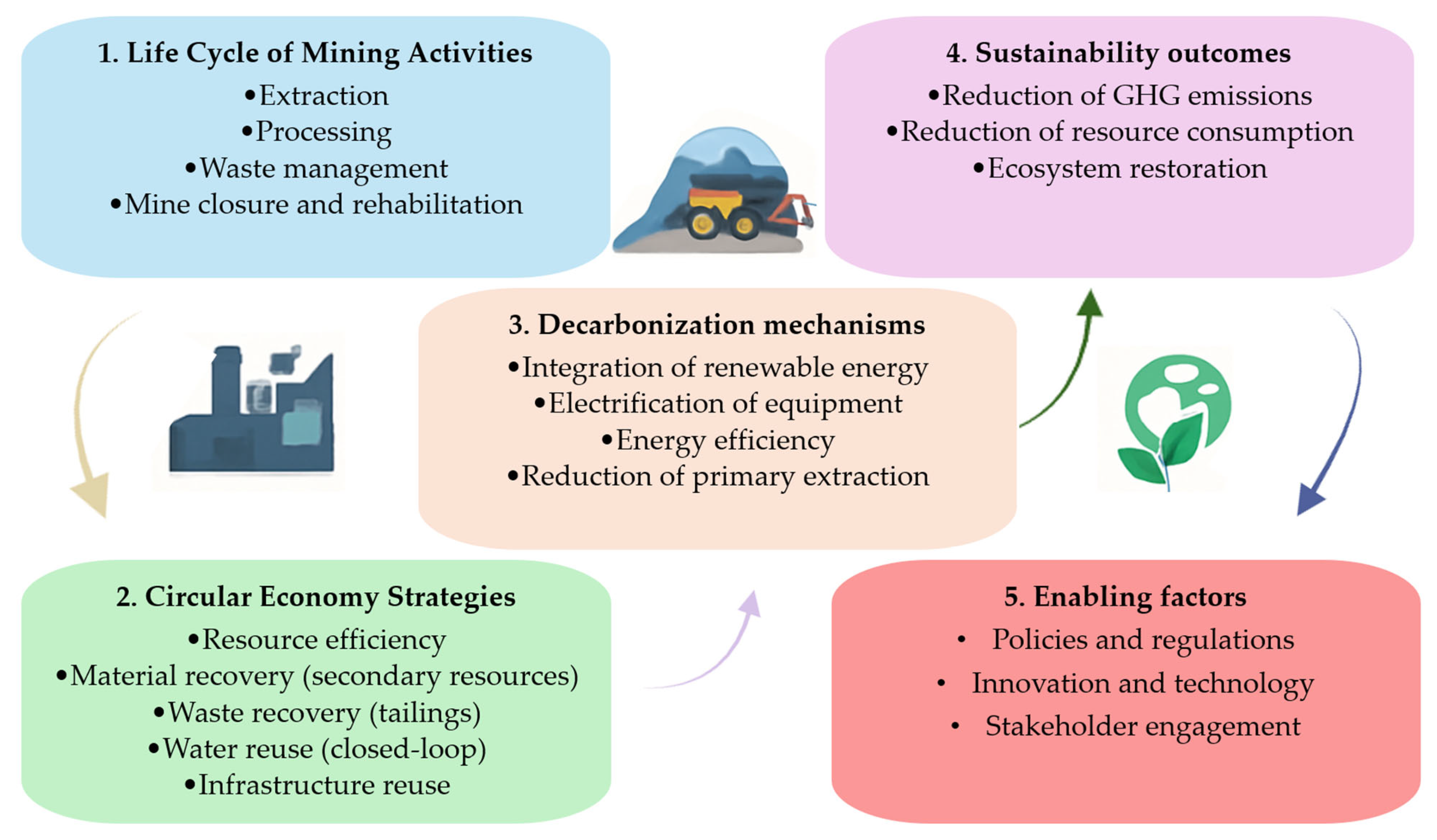
On the basis of a literature review, it appears that although there are several studies addressing the CE, decarbonization, or sustainability in the mining sector, most often these dimensions are treated separately or only partially combined. In this context, there is a need for a theoretical framework that would integrate these perspectives into a coherent approach capable of capturing the true complexity of mining systems. The conceptual model proposed in
Figure 3 is grounded in the idea that the mining sector should evolve from a linear, extraction-centered model toward a circular and regenerative system, in which material, energy, and water flows are integrated throughout the entire life cycle of operations. This approach suggests a more systemic view, where each stage is interconnected and adds to the overall performance of the system. The framework is further strengthened by introducing a causal linkage mechanism, where CE strategies act as intermediate drivers that transform operational mining activities into measurable decarbonization outcomes. This mechanism clarifies how material recovery and efficiency improvements translate into reduced energy demand and lower emissions across the system. In addition to internal process optimization, the framework incorporates external system linkages such as industrial symbiosis and cross-sector resource integration, thereby extending circularity beyond the boundaries of individual mining operations.
In this context, digital monitoring systems and data-fusion approaches may improve the evaluation of circularity and decarbonization performance across mining operations by enabling more integrated and adaptive assessment processes [
62].
The first dimension of the framework is the mining life cycle, which includes extraction, processing, waste management, and mine closure. In the suggested framework, these stages are no longer seen as sequential and independent. Rather, they are interdependent, with decisions taken in the early phases impacting directly on performance in later stages. For instance, improving extraction processes can greatly lower the amount of waste generated, thereby influencing the necessity of further interventions.
The second element is related to CE strategies, which are embedded in each stage of the life cycle. They include resource use optimization in the extraction phase, material and energy efficiency improvements in processing, waste recycling, and recovery of materials from secondary streams, as well as infrastructure reuse and ecosystem restoration in the closure phase. In doing so, the model captures the shift from a waste-disposal-oriented approach to one focused on retaining the value of resources within the system.
The third pillar of the conceptual frame links the CE to climate neutrality targets. It integrates mechanisms such as the usage of renewable energy, the electrification of equipment, improved energy efficiency, and the decrease in primary extraction via the usage of secondary resources. All of these elements demonstrate that circularity does not work in isolation, but directly assists in reducing GHG emissions and helping to achieve decarbonization goals.
The last dimension of the model is made up of sustainability outcomes, which include environmental, economic, and social impacts. From an environmental point of view, the model contributes to reducing emissions, resource consumption, and the regeneration of affected ecosystems. From an economic perspective, the utilization of secondary resources and increased process efficiency can create new opportunities for value creation. From a social perspective, the shift to circular models can contribute to improved social acceptance and the promotion of more equitable forms of resource use. Still, these benefits depend on how the transition processes are conducted.
A core part of the proposed conceptual framework is the cross-cutting factors that have an impact on its implementation. These factors include the regulatory framework and public policies, the state of technological development, and the participation of relevant stakeholders, including local communities and industry. They can either accelerate or, conversely, hinder the transition to circular and climate-neutral mining systems. The proposed framework underlines that the CE should not be perceived as a set of isolated solutions, but rather as an integrated mechanism enabling a fundamental transformation of the mining sector. By connecting circular strategies with decarbonization mechanisms and sustainability targets, the model serves as a basis for developing more efficient, resilient, and regeneration-focused mining systems. The framework is intended to support system-level interpretation rather than represent a fixed operational model, allowing adaptation to different mining contexts and resource systems.
To further clarify the practical operationalization of the proposed framework,
Figure 4 presents a simplified implementation pathway linking mining activities, circular interventions, decarbonization mechanisms, and sustainability outcomes.
Unlike previous reviews that primarily focus on isolated aspects of CE in mining, this study integrates material recovery, decarbonization pathways, and regenerative approaches into a unified interpretative structure, highlighting their interdependencies across the mining life cycle.
The application of the framework could be structured in three steps: (1) mapping material and energy flows across the mining life cycle; (2) identifying suitable circular strategies for each stage; (3) aligning these strategies with decarbonization and sustainability targets.
For instance, in the case of a generic copper mining operation, the framework could be applied by integrating resource recovery from tailings with renewable energy use in processing stages, while simultaneously planning closure strategies focused on ecosystem regeneration. This illustrates how the framework can guide decision-making across the entire life cycle.
We acknowledge that the proposed framework remains conceptual and requires future empirical validation through case studies and quantitative modeling to assess its applicability across different mining contexts.
10. Synthesis of Most Relevant Findings
The CE has the potential to transform mining systems. It is unlikely to deliver impact unless it is systematically approached. If it is treated as a set of isolated solutions, then its effects will be limited at best. In contrast, integrating it across multiple dimensions and adopting a systematic approach will make its effects gradually visible. Integrating circular strategies throughout the entire life cycle, in parallel with decarbonization mechanisms, is necessary to contribute to a real reduction in emissions and resource consumption. In
Table 2, the proposed performance indicators that can contribute to these processes.
The performance indicators presented in
Table 2 were derived through qualitative synthesis of indicators commonly reported in CE, mining sustainability, and industrial ecology literature. The selection was guided by their relevance to material flows, energy efficiency, and ecosystem restoration, as well as their recurrence across multiple reviewed studies. While not exhaustive, these indicators are intended to provide a preliminary operationalization of CE performance in mining systems.
The integration of intelligent monitoring tools and multi-dimensional data analysis may further improve the reliability and real-time assessment of circular mining performance indicators [
62].
The proposed indicators are intended as illustrative metrics for evaluating circularity and decarbonization performance in mining systems. Their calculation may require operational production data, life cycle inventory datasets, environmental monitoring systems, and sustainability reporting metrics. Future work should further standardize these indicators and align them with existing industrial reporting.
Furthermore, the transition to circular and climate-neutral mining depends on several factors. These are not limited to technology alone but must also include economic, social, and institutional factors. Also, the long-term scalability of many circular strategies remains uncertain due to economic and technological constraints. The future of the mining sector cannot be defined by a single solution. It could rather be defined by the ability to effectively combine circularity, resource efficiency, and ecosystem restoration into a coherent and widely applicable model. The main contribution of this review lies in integrating fragmented CE strategies into a coherent system-level interpretation linked to decarbonization and climate neutrality pathways in mining systems.
Limitations
This study has several limitations that should be acknowledged. First, the analysis is based primarily on a structured literature review and does not include quantitative modeling or empirical validation of the proposed framework. Second, the reviewed studies differ considerably in terms of system boundaries, methodologies, commodities, and regional focus, which limits direct comparability. Also, the conceptual framework proposed in this paper has not yet been tested through practical implementation case studies or industrial pilot applications. In addition, the rapidly evolving nature of mining technologies and policy frameworks may influence the long-term applicability of some circular strategies discussed in the review. Despite these limitations, the study provides an integrative perspective intended to support future research and strategic development in circular and climate-neutral mining systems.
11. Conclusions
In the present analysis, we have sought to bring to the fore the fact that the transformation of mining systems from a linear model to a circular and climate-neutral one is no longer simply an option, but a necessity. By integrating CE principles throughout the entire life cycle of mining activities, it may be possible to reduce environmental impact and improve resource efficiency. The two core ways this is achieved are by turning waste into resources and optimizing the flows of materials, water, and energy.
CE models may support the gradual transformation of mining systems in order to positively contribute to climate neutrality goals. In order to reduce the mining sector’s carbon footprint, it is imperative to both reduce primary extraction and utilize secondary resources. Their application has the potential to create additional economic value, but their implementation continues to depend on factors such as market conditions, technological readiness, and the regulatory framework.
Transition toward circular and climate-neutral mining remains associated with important uncertainties and implementation barriers. Many circular technologies are still at an early stage of development, while large scale deployment is often constrained by high capital costs, infrastructure limitations, and market volatility. In addition, the recovery of low-grade resources may become energy-intensive and economically inefficient under certain operational conditions, potentially limiting the environmental benefits of circular practices. As a result, CE effective implementation in mining systems is likely to remain highly context-dependent, varying according to resource quality, technological maturity, regulatory frameworks, and regional economic conditions.
The transition to circularity in this sector is deeply systemic. Numerous stakeholders play a decisive role in making this transition. Among these are economic viability, accompanied by social acceptance and public policies. Therefore, it is necessary to align environmental performance with economic value creation and social responsibility.
Through the proposed conceptual framework, we aim to provide a more structured view of how circular strategies could be aligned with decarbonization mechanisms. By correlating the stages of the life cycle with these dimensions, the transition toward more efficient, resilient, and regeneration-oriented mining systems could be facilitated.
Future research should focus on the empirical validation of CE frameworks across different mining contexts. Particular attention should be given to the development of quantitative models capable of evaluating material circularity, energy efficiency, and life cycle emissions simultaneously. Additional research is also needed on industrial symbiosis pilot projects, especially those integrating mining residues into construction and manufacturing sectors. Furthermore, future studies should investigate intelligent monitoring systems and digital data integration tools capable of supporting real-time performance assessment in circular mining systems. Another important direction involves evaluating the economic feasibility of recovering low-grade secondary resources under different market and technological conditions.





 ,
,