Review

Renewable Energy Integration in Emerging Electricity Grids: Technologies, Challenges, and System-Level Perspectives

Dipartimento Energia “Galileo Ferraris”, Politecnico di Torino, 10129 Turin, Italy
*
Authors to whom correspondence should be addressed.
Appl. Sci. 2026, 16(10), 5124; https://doi.org/10.3390/app16105124
Submission received: 10 April 2026 / Revised: 6 May 2026 / Accepted: 14 May 2026 / Published: 21 May 2026

Abstract

The rapid growth of renewable energy is driving a profound transformation of electricity grids toward architectures characterized by high shares of inverter-based generation, increased decentralization, and extensive digitalization. While wind and solar technologies have matured at the component level, their large-scale integration introduces technical, operational, and institutional challenges that extend beyond conventional power-system design paradigms. This review provides an integrated synthesis of the technologies, control strategies, and management processes that enable renewable energy integration into emerging electricity grids. Key challenges are analyzed across multiple timescales: fast frequency and voltage dynamics in low-inertia systems (milliseconds to seconds), forecasting, optimization, and automated control (real-time to near-real-time), and long-term planning of transmission, storage, and flexibility resources (years to decades). The synthesis covers grid-forming and grid-following inverter control, with quantitative comparison across short-circuit-ratio regimes; HVDC and HVAC transmission technologies; energy storage systems, including emerging electrochemical and mechanical solutions; smart-grid digitalization through EMS, SCADA, and digital twins; artificial intelligence and machine-learning deployments at major transmission system operators; sector coupling involving hydrogen and carbon capture; and cybersecurity considerations. Real-world case studies are used to illustrate practical lessons, with explicit attention to the brownfield–greenfield distinction between modernization of legacy systems and the design of new networks in developing regions. The review concludes by identifying key research and development priorities for achieving reliable, resilient, and economically efficient high-renewable energy systems.

1. Introduction

The global energy transition is driving an unprecedented transformation of electricity systems. The installation of using Renewable Energy Sources (RES) has dramatically increased due to the rapid reduction in both wind and solar technology prices along with established climate policy commitments, national energy security interests, and consistent technological innovation strategies. As a result, electricity grids are evolving from systems dominated by centrally dispatched synchronous generators toward architectures characterized by inverter-based generation, distributed energy resources, and increasingly complex operational and institutional requirements. This change results in different physical behaviors, control needs, and socio-technical context with respect to traditional power systems. While renewable energy technologies have matured rapidly at the component level, their large-scale integration poses challenges that extend well beyond generation adequacy. The variability of solar and wind electricity generation creates a challenge for the operation of a power system at many time scales due to erratic and uncertain generation patterns from both forecasting and normal operation. At very short time scales (i.e., on the order of seconds to minutes), inverter replacement of synchronous generators lowers the natural inertia and fault current of the power system, which changes how frequency and voltage are stabilized and creates a challenge for protection schemes designed for one-way power flow.
Additionally, unit commitment, economic dispatch and reserve provisioning are affected by forecasting error and variability over time spans of hours to seasons. At planning horizons spanning years to decades, the spatial distribution of renewable resources, together with the need for transmission reinforcement, energy storage deployment, and demand-side flexibility, gives rise to complex and interdependent infrastructure investment decisions. Addressing these challenges requires a shift from traditional integration paradigms toward coordinated portfolios of technologies, control strategies, and institutional arrangements. Power electronic converters are no longer passive interfaces but increasingly active participants in grid stability through grid-forming control, fast frequency response, and advanced voltage regulation. Energy storage systems, demand-side management, and flexible loads provide additional degrees of freedom for balancing supply and demand across multiple time scales. Concurrently, the development of high-voltage direct current (HVDC) transmission lines will assist with the efficient long-distance transfer of electricity generated from renewable resources, including offshore locations. New advanced digital technologies are also leading to real-time capabilities for monitoring, forecasting and optimizing an increasingly decentralized electrical system. Finally, there is an ever-increasing coupling of the electricity sector with the transport, heating and industrial sectors through electrification and the production of hydrogen, thereby changing the dynamics of our systems and significantly increasing the integration challenges. There has been increasing literature in the individual areas of integration of renewable energy such as forecasting schemes, control of inverters, storage technology, market dynamics, and regulation design. Nevertheless, most available research is limited to particular technologies, time scales or geographical areas and it is hard to obtain a comprehensive picture of how emerging electricity grids operate as complex socio-technical systems. The higher the renewable penetration, the more significant the interactions between technologies, control layers, and institutional structures are, and what is effective when implemented in isolation might not be effective once implemented at scale.
This makes a comprehensive synthesis bridging the technical, operational, and institutional dimensions of renewable energy integration necessary. Such a synthesis should clearly take into consideration the changing role of power electronics, the rise of converter-based power systems, integration of distributed and flexible resources, and the implications of grid codes, standards, and cybersecurity demands. It should also be able to rely on practical experience of implementation to supplement theoretical analysis and simulation-based research. This review will serve this purpose and offer a unified discussion of the renewable energy integration and control in emerging electricity grids. The article analyzes the enabling technologies and management approaches on the various levels, such as smart grid infrastructures, advanced forecasting and optimization, grid-forming inverter control, transmission expansion, pathways to sector coupling, and regulatory measures. Practical challenges and successful integration tactics are demonstrated with the help of real-world case studies, and the new research directions can be seen in converter-dominated system stability, mass-scale coordination of distributed resources, and long-term flexibility.
Several reviews have appeared in recent years on individual aspects of renewable energy integration—including power-electronic converter control, energy storage technologies, smart-grid digitalization, sector coupling, and AI applications. The contribution of the present work, with respect to this body of literature, lies in three converging directions. First, this review explicitly integrates the multiple timescales of integration challenges—sub-second dynamics, real-time control, and multi-year planning—into a unified analytical framework, with particular attention to cross-scale couplings that single-topic reviews tend to underemphasize. Second, it bridges technological analysis with the perspective of operational deployment by reporting concrete examples of AI- and digital-twin-based tools already in production at major transmission system operators. It further provides quantitative comparisons of emerging integration solutions—including grid-forming versus grid-following control across short-circuit-ratio regimes, alternative storage chemistries, and HVDC versus HVAC transmission corridors–based on recent field data and benchmarking studies, rather than relying solely on conceptual descriptions. Third, the review explicitly distinguishes between the brownfield context of advanced economies, characterized by retrofit constraints on legacy infrastructure, and the greenfield context of developing regions, where renewable-oriented architectures can be designed from the outset. The implications of this dichotomy for research and development priorities are systematically discussed in the concluding sections. The objective is to provide both a technically rigorous and pragmatically grounded reference for researchers, system operators, and policy designers engaged in the integration of high shares of renewable energy into electricity grids.
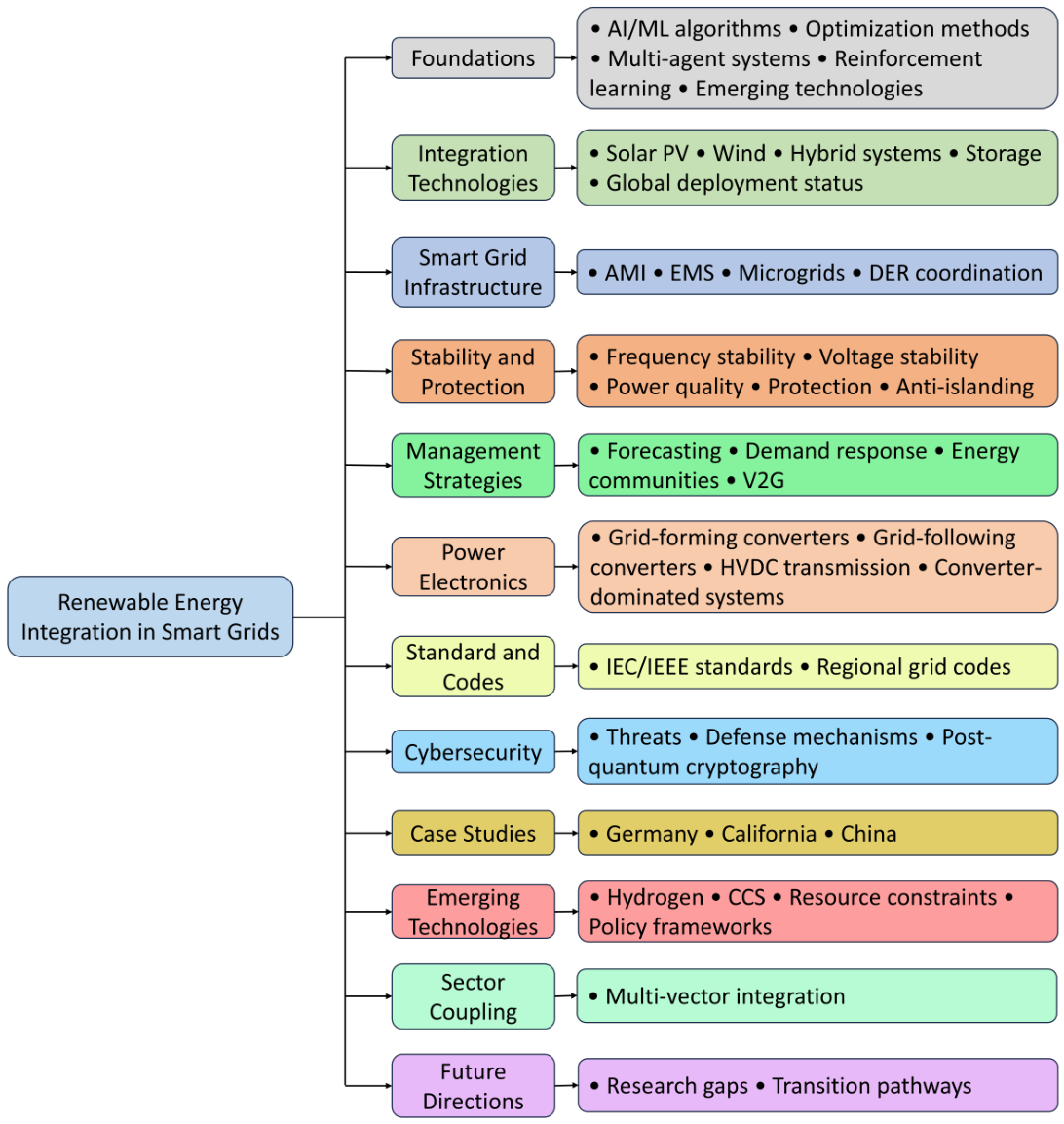
The remainder of the paper is organized as follows. Section 2 outlines artificial intelligence, machine learning, and optimization methods that are applicable in the contemporary operation of the power system. Section 3 and Section 4 discuss the problems of renewable energy integration and smart grid technologies, respectively. Section 5 addresses stability, power quality and protection in low-inertia and converter-dominated systems. Section 6 examines management strategies, such as forecasting, demand-side flexibility, and vehicle-to-grid integration. Section 7 examines the contribution of power electronics and power transmission technologies. Section 8 and Section 9 address standards, grid codes, and cybersecurity considerations. Section 10 is a reflection on practical applications, and Section 11 is on sector coupling and new technologies. Finally, Section 12 summarizes key findings and outlines future research directions. Figure 1 provides a visual roadmap of these thematic areas and their interconnections.

2. Foundations: Smart Technologies for Renewable Integration

To have success with integrating variable renewable energy sources into electrical grids requires advanced computing and communication technologies that offer intelligent and adaptable system management. This section focuses on the foundational smart technologies that will improve the operation of the grid, including: Artificial Intelligence/Machine Learning Methods; Optimization Algorithms; Multi-Agent Systems; Reinforcement Learning Techniques; Emerging Technologies that will improve the capabilities of the grid in the coming years.

2.1. Artificial Intelligence and Machine Learning for Power Systems

With the growth of renewable energy deployment within the power sector, there is a need for AI and ML methods that can help address not only the complexity of these systems but also the uncertainty associated with them. Both methods are highly effective in finding patterns within large volumes of data, making predictions with an uncertain input, and optimizing decision making in high-dimensional spaces; therefore, the use of these technologies will only be more necessary as power grids continue adding millions of distributed measurement devices (sensors), various actuators to represent electrical loads, and multiple decisions for the operators to make.
Numerous power systems studies have shown that deep learning architectures have performed particularly well in power systems. For example, LSTM-based deep learning models have been found to outperform traditional approaches for short-term load forecasting as evidenced by multiple recent comparative studies performed using real-world data sets. Specifically, a recent experimental study illustrated that the LSTM model produced a mean absolute percentage error (MAPE) of approximately 2.9%, which is a reduction of nearly 60% over the MAPE of 7.0% using an autoregressive integrated moving average (ARIMA) model for the same day-ahead load forecasting study [1]. Capturing temporal dependencies between current and past values of each input is one of the key advantages of using LSTM networks via advanced metering infrastructure data sets. For real-time dispatch and control, deep learning frameworks have been demonstrated to operate within unified control schemes with control periods on the order of four seconds, enabling near-real-time decision-making suitable for managing fast renewable generation dynamics [2]. Deep reinforcement learning extends these capabilities by enabling control agents to learn effective operational policies through direct interaction with the power system environment. In voltage control applications, deep reinforcement learning-based approaches have demonstrated strong autonomous regulation capabilities in large-scale simulation studies. In particular, a DDPG-based agent was shown to resolve voltage violations within a single control action in nearly all tested operating scenarios on a realistic transmission system model, highlighting the potential of such methods for fast and reliable voltage regulation in renewable-rich power grids [3]. Machine learning is also transforming power system protection, with modern schemes achieving fault detection accuracies exceeding 95 percent [4], and state estimation, where advanced dynamic state estimation frameworks have been shown to better capture nonlinear and time-varying measurement–state relationships than traditional static estimators, particularly in systems with high penetration of renewable and power-electronics-interfaced generation [5]. An analysis of deep learning methods available for predicting renewables has produced a detailed taxonomy of deep learning architectures that include recurrent architectures, deep belief networks, and convolutional architectures [6]. Each type of architecture has its own advantages related to specific types of forecasting horizons and different types of data. Convolutional networks excel at extracting spatial patterns from meteorological grids, while recurrent architectures capture temporal dynamics. Despite these successes, challenges remain including model interpretability, substantial data requirements, and adversarial robustness concerns that must be addressed for critical infrastructure deployment.
Beyond academic case studies, AI and ML methods have transitioned to operational deployment in several large transmission and distribution system operators, providing concrete evidence of their practical impact on power-system operation. The UK Electricity System Operator (NESO, formerly National Grid ESO), in collaboration with The Alan Turing Institute, has deployed a multi-model ensemble of random-forest and gradient-boosting algorithms for solar generation forecasting, achieving an improvement in control-room forecast accuracy of approximately 33% relative to baseline statistical methods, with measurable benefits in reduced reserve procurement and balancing costs. The same operator has subsequently deployed a machine-learning-based effective inertia metering and forecasting solution that supports real-time situational awareness, short-term operational decisions, and long-term investment assessments related to synchronous compensator and flywheel procurement [7].
At the European pan-continental level, ENTSO-E reports several TSO-level AI deployments at technology readiness levels (TRLs) of 7–8, including TenneT’s GridOptions tool for day-ahead congestion management through topological remedial actions, RTE’s AI assistant ORIGAMI for operator decision support, and ČEPS’s AI-based network model error detection and transmission loss prediction systems [7]. In the United States, comparable initiatives include AI-driven smart-grid software developed by Duke Energy in collaboration with Amazon Web Services for demand forecasting and grid-upgrade planning, as well as AI-based extreme-weather management tools explored by the PJM regional transmission organization.
Recent benchmarking efforts on ENTSO-E transparency-platform data—for instance, using isolation-forest and LSTM autoencoder models applied to wind and solar forecast errors in the German grid—indicate that anomaly-detection techniques can systematically identify operationally relevant deviations that escape traditional statistical screening. This is particularly significant given that, in a system with on the order of 140 GW of installed wind and solar capacity, even a 5% forecast error corresponds to an imbalance of approximately 7 GW, thereby triggering costly balancing actions [7].
These deployments illustrate that AI in power systems has moved beyond proof-of-concept research into a phase of incremental but tangible adoption, with system operators increasingly treating ML-based tools as complementary components of the existing EMS/SCADA control-room ecosystem rather than as replacements for established physics-based methods. The longer-term consolidation of these tools requires addressing challenges related to model auditability, regulatory compliance under emerging frameworks such as the EU AI Act, training-data quality and granularity, and cybersecurity of cyber–physical AI pipelines, all of which are recognized as priorities in the most recent strategic roadmaps of European TSOs [7].

2.2. Optimization Algorithms for Resource Scheduling and Control

Optimization algorithms complement machine learning by providing mathematically rigorous methods for finding optimal solutions to resource scheduling and control problems. While machine learning excels at pattern recognition and prediction, optimization methods are essential for problems requiring exact or near-optimal solutions subject to constraints. In power systems, optimization problems occur from the very low levels (fast control actions) to the very high level (long-term planning), and since large amounts of renewable energy sources have now entered these systems, there is a need to provide advanced optimization methods that can accommodate uncertainty, multi-objectives, and rapid computation. Metaheuristic-based algorithms are becoming more popular in the performance-based optimization of power systems, due to their large flexibility and ease of use in solving NP-hard (non-convex) optimization problems without the gradient information needed typically for standard optimization methods (e.g., gradient/Newton). Particle Swarm Optimization (PSO) algorithms have been applied successfully to a wide variety of power system applications, including economic dispatch, unit commitment, optimal power flows, and distributed energy resource sizing [8]. Studies and reviews of PSO provide an extensive body of research into the different algorithmic developments; binary encodings, different neighborhood topologies, and different methods of hybridization, and various multi-swarm architectures have all been researched in an attempt to find that balance between exploration-exploitation, which is the key to accessing metaheuristic optimization solutions to the large size solution space and at the same time refining promising solution candidates. Despite challenges such as sensitivity to parameter tuning and the risk of premature convergence, the conceptual simplicity and moderate computational requirements of metaheuristics have contributed to their widespread adoption. Several comparative studies of different metaheuristic approaches have been conducted to allow us to understand the relative strengths of various methods (genetic algorithms, simulated annealing, ant colony optimization, etc.) as well as the appropriateness of each for certain types of power system optimization problems [9]. Genetic algorithms can help to maintain population diversity so that the whole solution space is explored broadly, while simulated annealing has implemented a probabilistic mechanism for escaping local optimal solutions. Recent evidence has shown that ant colony optimization is particularly successful when dealing with discrete and combinatorial optimization problems. The effectiveness of any one optimization algorithm relates strongly to the individual characteristics of the problem under consideration—this is consistent with the no-free-lunch theorem. Economic dispatch and unit commitment are two well-known classical optimization problems that have become increasingly more difficult to solve due to the growing number of renewable energy sources being integrated into the overall energy system. The problem of economic dispatch and unit commitment involves making decisions about which generators (or committed plants) will operate, and at what level, while at the same time meeting technical requirements associated with ramping, reserves, peak demand, etc. With high penetration of renewable energy sources into the overall energy system, we have new sources of variability and uncertainty associated with forecasts and associated operational characteristics. To account for these uncertainties, we will need to use more frequent re-optimizations, and account for uncertainty as part of the decision-making process. Because of these mixed-integer nonlinear problem formulations, metaheuristic optimization techniques present a practical way to find solutions to these problems in an acceptable amount of time. Optimization algorithms in microgrids and distributed energy systems must work together multiple types of different resources such as generation units and storage systems while considering multiple time-varying aspects like electricity prices and generation forecasts for renewable energy sources. Successful examples of these types of hybrid systems are found within energy management systems that use multi-agent coordination and particle swarm optimization to implement real-world solutions [10]. In addition to helping operators minimize operating costs and emissions, increase system reliability, and accommodate distributed decision-making architectures for improved scalability and local autonomy, these systems offer multiple operational objectives. Furthermore, integrating forecasting with optimization has given rise to systems designed for proactive management of the energy system. Energy management systems that combine data-based forecasting models with metaheuristic optimization methodologies show improvements in operational performance, when compared to sequential solutions, which view the forecasting and optimization process as separate [11]. By formally considering the interdependencies of forecast uncertainty with operational decision making, integrated systems are able to increase the robustness and adaptive capability of system operations. In the world of energy management within microgrids, multi-objective optimization has become more prevalent as system operators have evolved into requiring the balancing of many different competing objectives, many of which cannot be reduced to a single scalar value. Examples of these types of multi-objective optimization objectives for microgrid energy management include minimizing system operating costs; reducing total emissions; increasing total system reliability; providing equitable access to all resources; and many more. Multi-objective metaheuristic algorithms generate Pareto-optimal solution sets that represent trade-offs among these competing goals, enabling decision-makers to select solutions aligned with operational priorities and policy considerations [12]. In practical power system applications, efficient implementations are capable of producing representative Pareto fronts for problems involving a limited number of key objectives, reflecting the typical scope of multi-objective formulations encountered in energy management and scheduling studies [12].

2.3. Multi-Agent Systems and Game-Theoretic Approaches

The evolution of power systems towards increasingly decentralized architectures that consist of millions of freely making autonomous decisions requires multi-agent systems and game-theoretic frameworks to understand, model and support the management of these complex systems. Conceptually, multi-agent frameworks work in all cases to model the underlying aspects of independence (autonomy), limited physical resources (limited information), and conflicting behaviors (conflicting objectives) amongst the different system users (e.g., participants are independent entities that control some device etc.). For example, in a microgrid setting, multi-agent systems can coordinate the operation of distributed generation resources, storage devices, and controllable loads with no requirement for a centralized control authority or the sharing of all informative data [10]. Each agent is a representative of a specific resource or stakeholder, and makes their decisions based on localized information and the information received from neighboring agents. Cooperative game theory supports the process of fairly distributing benefits amongst the participating agents when they cooperate towards achieving a common desired outcome, while non-cooperative game theory is used to model the strategic interactions between agents when they are pursuing their personal interest. The characteristics of the corresponding incentive structure utilized in the design (e.g., pricing signals, contracts, or regulations) determines whether or not decentralized decision-making will generate socially desirable results or degenerate into inefficient equilibria. The scalability benefits of multi-agent techniques are very important for systems like distribution networks where there are many distributed energy sources. Instead of creating one huge optimization problem which may be impossible or too complicated to solve, or that would require revealing personal information from all participants, multi-agent systems break this down into smaller parts so each one can be solved simultaneously; agents do this by communicating iteratively and sharing some information about what decisions they are making based upon their own actions/decisions and adjusting those plans according to the actions/decisions of other agents to converge at least close to an equilibria (optimal solution) depending upon how the protocols were designed, thereby providing a theoretical basis for real world applications. Multi-agent frameworks also create a mathematical model and analytical ability to develop new energy market opportunities such as peer-to-peer trading, and energy communities where prosumers (producers and consumers) can transact directly with one another without involving the traditional utility (or distribution) design as an intermediary. Game theory provides analysis of the conditions necessary for these market types to function efficiently, as well as provide insight into when regulation or innovation in mechanistic design may be necessary due to excessive failure in these markets. A potential direction to pursue integration of blockchain technology and artificial intelligence to enable prosumer participation in smart grid solutions incorporates utilizing a distributed ledger for approval of all transactions created through trusted transactions by an intelligent agent that has provided optimized decision making [13]. Blockchain provides a transparent, tamper-resistant platform for energy transactions, while artificial intelligence algorithms enable optimal control of distributed resources in response to market signals and grid conditions.

2.4. Reinforcement Learning for Sequential Decision-Making

Reinforcement learning lies at the intersection of machine learning and optimization, enabling agents to learn optimal sequential decision-making policies through interaction with their environment. In contrast to supervised learning, which requires that the agent receives labeled training examples, reinforcement-learning agents will only receive feedback in the form of a reward for performing an action, or punishment for failing to perform an action. This feedback may come from other agents in similar environments. This capability is valuable in power systems where optimal strategies may not be known in advance, where system dynamics are too complex to model accurately, or where conditions require adaptive policies. Unit commitment applications demonstrate reinforcement learning potential for core power system optimization [14]. Traditional formulations result in mixed-integer linear programs that become computationally challenging for large systems with tight time constraints. A combination of reinforcement learning agents and tree search techniques has been shown to result in significant cost savings in stochastic unit commitment scenarios, where expected operating costs are lower compared to reserve-constrained mixed-integer programming methods, while also improving reliability in benchmark systems [14]. By integrating tree search techniques with reinforcement learning, agents can use model-based planning techniques to consider future consequences of actions while simultaneously using their learned value function to influence decision-making. A major benefit of using reinforcement learning for power scheduling in grids with high levels of renewable energy is that it provides agents with the capability to develop adaptive policies that achieve both economic and environmental objectives under uncertainty and variability in renewable generation [15]. Instead of relying solely on point forecasts and deterministic optimization, agents learn to develop robust generation resource balance against forecasting error and unexpected events. Multi-agent reinforcement learning provides for distributed decision-making by enabling several different agents (each controlling one or more resources) to coordinate actions with one another to meet system-level objectives, therefore aligning nicely with the physical structure of power systems. As a means of safely deploying these techniques within safety-critical infrastructure, there has been an increasing focus on safe reinforcement learning methods. Classic reinforcement learning methodologies require all possible actions to be explored and learned through trial and error. This presents some difficulties within power systems, since there are many actions that can lead to equipment failure or system outage. Therefore, safe reinforcement learning methods ensure that an agent will never violate safety constraints (operational limits) during exploration or execution of any actions [16]. Research has shown that this type of approach is applicable in the control of multiple energy systems (electricity, heating and cooling) in “smart districts,” where the interdependence and coupling of these systems create complex operational constraints that must be satisfied while achieving the optimal operational cost and efficiency. The combination of ensemble prediction models and safe deep reinforcement learning provides accurate forecasts and real-time control policies that can adapt to changing conditions while guaranteeing safety. Sample efficiency (i.e., the number of trials necessary to learn an effective policy) is still a significant challenge, especially when learning occurs in physical systems. Using approaches for transfer learning by using the knowledge gained through either simulation or from similar problems will also help reduce the amount of data required. Model-based reinforcement learning, which explicitly learns system dynamics models, achieves better sample efficiency than purely model-free approaches by enabling planning and simulation within learned models. The maturation of these techniques is gradually making reinforcement learning more practical for operational power system deployment.
Table 1 compares the main artificial intelligence and optimization approaches applied in modern power systems, highlighting their strengths, limitations, and typical performance.

2.5. Emerging Technologies and Future Directions

Beyond the widespread applications of existing machine-learning and optimization techniques, several emerging technologies are expected to further reshape the operational capabilities of future grids. Large language models, in particular, have recently been investigated for power-system applications, including operator decision support, technical-document analysis, and natural-language interfaces to control-room data. Their potential role, along with current limitations as a longer-term research avenue, is discussed in Section 12.
Quantum computing is sometimes cited as a potential future enabler of grid operation; however, its near-term and long-term implications should be clearly distinguished. In the near term, the most concrete impact concerns cryptography. The prospect that sufficiently advanced quantum computers may eventually compromise currently deployed asymmetric-key cryptographic schemes has motivated active development of post-quantum cryptography, including quantum-resistant hybrid encryption approaches for IoT-enabled smart grids, as discussed in Section 9 [17]. Standardization efforts such as the NIST post-quantum cryptography process are currently defining migration pathways for existing systems. In this domain, deployment is primarily a matter of standardization and gradual replacement of cryptographic primitives, on a timescale of years rather than decades. In the longer term, the application of quantum algorithms to combinatorial optimization problems relevant to power-system operation—including unit commitment, optimal power flow, and transmission expansion planning—has been explored in proof-of-concept studies. However, practical deployment depends on the availability of fault-tolerant quantum hardware at scales that remain beyond current technological capabilities, rendering these applications significantly more speculative than near-term cryptographic use cases. Quantum-inspired classical algorithms, which translate concepts from quantum computing into implementations on conventional hardware, may offer intermediate benefits while scalable quantum computers remain unavailable. The distinction between these categories is essential and should not be overlooked when assessing the realistic role of quantum technologies in the power sector.
Materials discovery using artificial intelligence is one such application of machine learning that is likely to have an indirect but substantial effect on renewable energy systems [18]. Materials with superior characteristics for batteries, solar panels, catalytic converters, or electronic power devices will facilitate the energy transition by increasing efficiency, decreasing cost, or extending the life of these technologies. Chemical structure and chemical composition can be used to predict the property types of materials far more quickly than traditional simulation techniques can, allowing rapid testing and evaluation of a very large number of chemical compounds from which to select for conversion to an experimental production process. Continued progress in sensors, communications, and computing will result in an ecosystem that creates the operational landscape for the future grid. By using edge computing, latency will be reduced and bandwidth usage will be lessened. Neuromorphic computing architecture will provide more efficient implementations of neural network inference. Digital twin technology creates real-time virtual representations of actual physical grid infrastructure that facilitates predictive maintenance, scenario planning, and operational optimization capabilities. The ongoing development and combination of these technologies will continue to provide increased intelligence on the grid and provide greater ability to manage increasing levels of renewable power generation.

3. Renewable Energy Integration

As distributed energy resources and advanced control capabilities increasingly drive a fast transition from passive to active distribution systems, this change is often viewed as a paradigm shift in how the grid operates [19]. Integrating renewable energy sources into the grid will thereby be seen as the ultimate goal of the energy transition while being the greatest challenge in doing so. In this section of the report, we will describe each of the principal renewable technologies (solar PV and wind) along with hybrid configurations (generation + storage) in terms of their technical characteristics, effects on the grid, and integration solutions. Finally, a review of the status of renewable deployment globally will be presented, highlighting regional variation, strategies that have helped lead to successful implementation of renewable projects, and lessons learned from the leading markets.

3.1. Solar Photovoltaic Integration

Solar photovoltaic systems have significantly dropped in price and expanded rapidly to become a form of energy production that is well-established. In many areas around the world, they are now cheaper than other new ways to produce electricity. However, there are a number of integration issues that exist that are unique to photovoltaics. These include variability caused by both weather and the sun’s position throughout the day, highly distributed deployment across millions of small-scale systems, as well as the use of power electronics such as inverters to connect them to the power grid, which introduce integration challenges fundamentally different from those associated with conventional synchronous generation. The increased use of solar photovoltaics has had an immediate impact on local distribution networks that were originally designed for one-way power flow from utility substations to end users. When the photovoltaic systems inject power into the local system, the flow of electricity will be in the opposite direction of what was initially intended, creating a potential for voltage rise on distribution feeders rather than voltage drops across distance from a substation. This is even more apparent in low-voltage networks characterized by high resistance-to-reactance ratios, where voltage magnitude is highly sensitive to real and reactive power injections. Simulations of actual residential distribution systems demonstrate that, as the percentage of photovoltaic generation connected to the network increases, there is an increased likelihood of exceeding voltage levels in violation of standards without an appropriate set of control techniques in place; hence causing operational and electrical service quality problems for consumers [20]. Hosting capacity represents a systematic methodology for evaluating how much distributed generation can be integrated into an electric distribution system without exceeding operational constraints such as voltage thresholds, thermal ratings, and protection coordination. Hosting capacity studies have identified that allowable photovoltaic (PV) penetration on various distribution feeders differs significantly and is dependent primarily on feeder topology, electrical characteristics of the feeder, PV placement of the PV system, and the effects of diversity. Assessments have therefore demonstrated a need to utilize feeder-specific evaluations versus generic penetration limits for planning the integration of PV systems into the distribution system [21]. Smart inverter technologies offer viable solutions for providing effective alternatives to upgrading costly infrastructure to manage voltage while also providing greater hosting capacities for PV systems in distribution networks. Newer inverters now have the capability to dynamically adjust real and reactive power output based upon local distribution system voltage measurements; therefore allowing for the use of control strategies in response to local voltage measurements that were not previously achievable with older grid-friendly inverter technology. The application of distributed Volt/VAr control in PV inverters has been demonstrated to effectively mitigate overvoltage conditions, as demonstrated by the ability to maintain voltage magnitudes within the acceptable range without any centralized coordination [20]. Complementary strategies such as Volt/Watt control curtail real power output when voltage exceeds predefined thresholds, offering an additional mechanism to prevent violations when reactive power capability alone is insufficient. The optimization of inverter dispatch using network-wide approaches in addition to local control is shown to enhance performance further. Optimizing the real and reactive power injection of inverters across a feeder reduces distribution network losses while maintaining acceptable voltage profiles and, when compared to purely local control methods, results in better performing residential distribution systems [22]. In distributed optimization architecture, inverters utilize local measurements and communicate only on a limited basis to provide results that closely resemble those provided by a centralized solution and therefore are more easily scalable and practical to deploy. Another key consideration of working with high levels of photovoltaic penetration is power quality outside of voltage magnitude in steady state conditions. Inverter-based resources are recognized as contributors to harmonic and supraharmonic distortion; while narrow prescriptions generally require that individual units meet applicable emissions standards, the collective operation of many units creates the potential for excessive levels of distortion, resonance interactions, and elevated levels of electromagnetic interference in distribution systems. The results of comprehensive reviews evaluating waveform distortion across the frequency spectrum from a few kHz to hundreds of kHz highlight the complexities associated with emission, propagation, and interaction mechanisms that occur with power electronic converters and establish the importance of proper modeling, measurement, and standardization methodologies to ensure that power quality remains acceptable with high levels of photovoltaic penetration [23]. One of the main issues associated with protection coordination is the way that legacy protection systems are relying on high fault currents that are generated from synchronous machines to achieve rapid detection of faults. Conversely, inverter-based photovoltaic systems limit their contribution of fault current to values that are very close to their rated value (in order to protect the power electronics), which has the effect of decreasing the sensitivity of the relays that they are connected to and changing the direction of fault current in networks where power flow is bi-directional. Adaptive protection, that is designed to adjust settings as a function of network configuration and/or operating conditions is being explored as a possible solution; however, this will require improved communication systems and intelligent devices that are capable of providing protection. Another aspect of the protection challenge of photovoltaics that is specifically associated with distributed photovoltaic generation is the challenge of detecting islanding. When portions of a distribution network become electrically isolated from the main grid, inverter-based generators may continue energizing the islanded section, posing safety risks to personnel and equipment. As a result, grid codes require photovoltaic systems to detect an islanding condition and cease to supply energy to the islanded load within a specified time period. Passive detection techniques based on measuring the local voltage and frequency are very easy to implement, but can suffer from having detection zones that do not detect an island condition for specific conditions of balance between load and generation. Therefore, while active detection techniques perturb the output of the inverters, they serve to reduce the size of the non-detection zones. Active methods reduce these zones by intentionally perturbing inverter output, while hybrid approaches combine passive and active techniques to achieve reliable detection with minimal impact on power quality. The evolution of photovoltaic grid connection practice is reflected in international standards and grid codes. An example of this is the latest version of the IEEE 1547-2018, which provides requirements for both interconnection and interoperability of distributed energy sources, as well as advancing a number of inverter functionality features to enhance grid stability through ride-through voltage and frequency support, dynamic reactive power support, and frequency-watt control during a disturbance [24]. Additionally, the IEC 61727 [25] sets forth complementary international specifications regarding the limits for harmonics, anti-islanding system performance, and characteristics of interfaces associated with PV systems connected to low voltage and medium voltage networks. Harmonizing national regulations with these international standards will promote widespread deployment of technology with a consistent baseline for minimum performance and safety requirements.

3.2. Wind Energy Integration

Wind energy can present several different types of obstacles to integration when compared to solar photovoltaics. Both solar and wind have variability associated with weather impacting their production, and both rely on power electronic interfaces; however, the size of installations for wind energy generation is larger than that for solar energy generation. On average, wind generation occurs in individual installations that can be measured in megawatts (MW) on the order of magnitude range from 10 s of MW to 100 s of MW, at/through a single location. Hence, wind integration issues occur primarily at the transmission system level. As a result, wind integration challenges primarily manifest at the transmission system level, although wind farms connected to weak networks may also introduce local operational issues analogous to those observed in distribution systems with high photovoltaic penetration. Wind power forecasting has emerged as one of the most mature and operationally critical applications of data-driven methods for renewable integration. Due to the variability inherent to wind power generation, it will require accurate wind power forecasts at multiple time horizons (e.g., minutes for automatic generation control, and hours and days before unit commitment and reserve planning). LSTM-based recurrent neural network models applied to ultra-short-term wind forecasts have achieved significant improvements in accuracy compared to conventional statistical and traditional neural network methods. Notably, these improvements indicate that RNN architecture is well suited for identifying short-term temporal dependencies present in wind generation [26]. Hybrid forecasting techniques that use both time-series decomposition techniques (like empirical mode decomposition) and machine-learning models together have provided greatly improved robustness when it comes to forecasting under non-stationary (variable) wind conditions. By decomposing the wind speed/time-power series into multiple components based on the temporal scale; each of these components is then modeled separately, which allows them to better identify the effects of different atmospheric phenomena, generally always from the very small-scale fluctuations caused by turbulence to the larger-scale fluctuations caused by synoptic weather systems. The results of case studies show that hybrid forecasting improves both forecasting performance and forecasting consistency compared to using a single direct forecasting model, particularly during transitions between regimes typically associated with wind energy generation [27]. The benefits of more accurate wind forecasting extend beyond just more accurate forecasts; they extend to all system-level benefits. Having more reliable forecast information will allow system operators to operate generation resources/schedule generation resources more effectively. Additionally, it will reduce the reliance on conservatively maintained reserves to deal with variability and uncertainty arising from high levels of wind penetration. Also, it is anticipated that as the amount of wind integration increases, the level of operating and balancing cost will increase similarly. Thus indicating the importance of superior/advanced forecasting and control methods to help mitigate these issues [28]. The interaction of wind generation and the dynamic behavior of power systems has implications for the frequency stability of power systems. With the replacement of traditional synchronous generating units with wind generation, system inertia as a whole has decreased resulting in higher rates of change of frequency after disturbances. Furthermore, modern wind turbine technology utilizes power electronics for advanced controls, which allows the rapid adjustment of active power output based on frequency deviations (synthetic inertia). Simulation modeling has demonstrated that wind turbine synthetic inertia can help to lower the initial rate of change of frequency and raise the frequency nadir, both of which can increase system security and provide additional time for primary frequency control actions to be accomplished [29]. However, providing synthetic inertia through wind turbines requires using kinetic energy from the rotating blades, which creates tradeoffs regarding energy capture, mechanical loading, and availability of inertial response. Finally, at the wind farm level, there are additional optimization challenges and opportunities created through turbine-turbine aerodynamic interactions. For instance, turbine wake effects (when downstream turbines operate under disturbed airflow conditions as created by upstream turbines) can significantly decrease overall farm efficiency under certain wind conditions. The use of advanced wind farm control strategies that manage turbine-to-turbine interaction (such as active yaw scaling through intentional yaw misalignment) have demonstrated improved overall energy capture from the farm and reduced fatigue loading (on both upstream and downstream turbines). These approaches require accurate wake modeling and real-time adaptation to changing atmospheric conditions, reflecting the increasing sophistication of wind power plants as actively controlled, system-integrated resources rather than passive generators. Overall, the integration of wind energy into modern electricity grids increasingly relies on coordinated forecasting, control, and optimization strategies that operate across multiple temporal and spatial scales. Continued advances in data availability, modeling techniques, and control architectures are enabling wind power plants to contribute not only energy but also flexibility and ancillary services, supporting reliable operation of renewable-rich power systems.

3.3. Hybrid Systems and Energy Storage

The limitations and synergies between existing renewable energy technologies have increased the interest in hybrid systems of renewable generation coupled with energy storage. By colocating storage with renewable generation, hybrid systems can smooth out renewable power output, reduce curtailments of renewable energy, improve the utilization of grid connection assets, and provide additional grid services that are often difficult or impossible to deliver with only generating resources. Additionally, a major contributing factor for this transition toward hybrid systems is the dramatic fall in lithium-ion battery costs, approximately 85 to 90 percent between 2010 and 2023 [30], which has made hybrid renewable energy generation plus storage commercially viable for an ever-growing number of applications. In the case of grid-connected prosumer and microgrid energy systems, the design of the storage system must account for a variety of operational limitations and objectives. Studies examining the integration of photovoltaic and battery systems have determined that optimal sizes and operations of these systems are heavily dependent on local load profiles and on local photovoltaic energy generation data, as well as on the limits associated with grid connections (e.g., injection limits) [31]. In particular, stringent injection limits tend to shift optimal storage utilization toward maximizing on-site consumption rather than exporting energy to the grid, significantly influencing both battery sizing and operational strategies. Battery energy storage systems (BESS) have evolved from niche off-grid applications to mainstream grid-scale resources providing diverse services to consumers daily. Batteries have the ability to provide a wide range of services at the same time because of their fast response time, bidirectional power flow, modularity, and locational flexibility [32]. Due to the large amount of investment in BESS, their most common use today for short-term and medium-term applications is by lithium ion batteries due to their efficiency and reliability for providing intra-day balancing of energy generation from solar (using the daily profile) (e.g., typically about two to four hours of use) [33]. While performance metrics such as efficiency and cycle life depend on chemistry, depth of discharge, and operating conditions, continued technological improvements have significantly expanded the range of stationary storage use cases. Effective utilization of battery storage requires control and scheduling strategies capable of balancing multiple value streams while respecting operational constraints, including state-of-charge limits, power ratings, and degradation considerations. The framework above can be evaluated using a multi-objective optimization tool and proves that batteries may work effectively together in providing needed reliability to the electric grid, reducing the amount of peak load on electric grids and providing economic benefits to the grid operator. The major challenge for control systems is to develop control methods that manage trade-offs across conflicting objectives (in an uncertain environment) when using batteries and battery storage for applications that have varying renewable energy sources [12]. In addition to using batteries, long-duration storage solutions are becoming a part of hybrid systems in order to allow for the variability of renewable energy sources over long periods of time, when electrochemical storage cannot provide a return on investment. Power-to-hydrogen pathways enable the conversion of surplus renewable electricity to hydrogen using electrolysis. This technology allows for the separation of power and energy storage capacities, essentially decoupling them from one another. Subsequently, hydrogen can provide for renewable electricity generation, be used as an energy source for industrial applications such as steel and ammonia production, or power heavy, long-haul transportation. However, the efficiency of electricity-to-hydrogen-to-electricity pathways is significantly lower than other technologies, typically around 30% round trip efficiency, primarily due to losses incurred during conversion and storage [34]. Nevertheless, the lower cost of energy capacity makes hydrogen a potential energy storage solution for seasonal and long term needs within decarbonized electricity systems. Hybrid systems are also able to leverage innovative strategies for deploying energy storage. Mobile utility-scale battery energy storage systems, mounted on trailers or containerized platforms, offer flexibility by allowing storage assets to be temporarily deployed to locations experiencing network congestion, maintenance outages, or seasonal demand peaks [35]. Although the operation of mobile energy storage systems is inherently more complex than that of stationary storage systems, mobile energy storage can provide deferred value to a grid operator if permanent upgrades to facilities are needed in the future, and help improve grid resiliency during emergency events. Vehicle-to-grid (V2G) technologies represent another emerging dimension of hybrid energy systems, enabling electric vehicles to act as distributed storage resources through bidirectional charging. V2G works by allowing EVs to serve the electricity grid as distributed storage resources, thus providing a two-way power flow via bi-directional EV charging. The magnitude of the aggregated storage potential of fleets of EVs can be quite significant, particularly in markets that have achieved high levels of EV adoption (i.e., 10–20% share or more), although realizing that potential will require overcoming many technical, economic, and behavioral barriers. For example, in order to achieve widespread V2G deployment, V2G stakeholder groups must work together to address the need for standardized communication protocols between EVs and electricity grids, manage the rate of battery degradation from vehicle use for the V2G application, and develop incentive mechanisms that fairly compensate vehicle owners while ensuring user convenience in their use of their EVs [36]. Pilot deployments demonstrate technical feasibility, and the value proposition of vehicle-to-grid integration is expected to strengthen as electric vehicle penetration continues to grow. In general terms, hybrid renewable energy systems that are designed to integrate generation, storage, and advanced control strategies will play a key role in the design of modern electrical power systems. These systems combine complementary technologies that operate across a range of timeframes to provide increased flexibility, reliability, and economic efficiency, as well as facilitate the reliable operation of electrical grids when high amounts of variable renewable energy are being provided.
To summarize the main characteristics of renewable generation and hybrid systems, Table 2 provides a comparative overview of technologies, their operational features, and integration challenges.
Beyond lithium-ion BESS and hydrogen, several alternative storage technologies are gaining attention as complements to or substitutes for the dominant lithium-ion chemistry, particularly for medium- and long-duration applications where the cost and cycle-life characteristics of Li-ion become less favorable [38].
Vanadium redox flow batteries (VRFBs) decouple energy capacity from rated power: the rated power is determined by the active electrochemical cell area, while the energy capacity scales independently with the volume of the external electrolyte tanks. This architectural decoupling makes VRFBs particularly well suited to long-duration applications (typically 4–10 h and beyond), and supports cycle lives in excess of 10,000 charge–discharge cycles with limited capacity fade over a 15–20 year service horizon [38]. Round-trip AC-to-AC efficiencies are typically reported in the range of 65–85%, with energy density (15–35 Wh/kg) substantially below that of Li-ion batteries—a fact that limits VRFB applicability where compactness is a primary requirement, but is largely irrelevant in stationary deployments. The principal commercial constraint remains the cost of vanadium and the capital cost of the membrane and stack, although recent VRFB market growth (estimated at compound annual growth rates above 15% to 2030) and ongoing research on alternative electrolyte chemistries are progressively addressing these issues.
Sodium–sulfur (NaS) batteries are high-temperature electrochemical devices in which molten sodium and molten sulfur electrodes operate at approximately 300–350 °C, separated by a beta-alumina solid electrolyte. NaS batteries achieve relatively high round-trip efficiencies (75–86%) and energy densities (typically 150–240 Wh/kg), with cycle lives in the range of 4500–7300 cycles and design lifetimes of 15–20 years [38]. They have a substantial deployment record in stationary applications, with multi-MW installations operating worldwide for renewable firming, peak shaving, and ancillary services. The high operating temperature, however, requires continuous thermal management and imposes safety constraints that have historically conditioned the deployment of this technology, and the recent discontinuation of large-scale manufacturing by the principal supplier introduces additional uncertainty regarding its medium-term role in new projects.
Compressed air energy storage (CAES) is a mechanical storage technology in which off-peak electricity is used to compress air into an underground reservoir—typically a salt cavern—and the stored energy is recovered by expanding the compressed air through a turbine during discharge. Conventional diabatic CAES systems achieve round-trip efficiencies of 40–55% and require fossil-fuel combustion for reheating during expansion. Advanced adiabatic CAES (AA-CAES) and liquid air energy storage (LAES) variants under development aim to recover the heat of compression internally, eliminating fossil-fuel input and improving efficiency [38]. CAES offers very long discharge durations (8–24 h and beyond), low self-discharge, and project lifetimes of up to several decades, but its deployment is constrained by the availability of suitable underground geology, which has so far limited large-scale commercial diffusion to the two long-standing plants in Huntorf (Germany) and McIntosh (USA).
Gravity energy storage (GES), in both its solid (S-GES) and pumped-piston (P-GES) variants, has recently re-emerged as a candidate for utility-scale applications. The principle exploits the conversion between electrical energy and gravitational potential energy by lifting and lowering a heavy mass—such as concrete blocks, mine cars, or weighted pistons—within a vertical structure. Reported round-trip efficiencies vary substantially across designs, with values in the 75–85% range claimed for the most mature systems, and field-pilot data from systems such as Gravitricity in the United Kingdom suggesting sub-second response times suitable for grid frequency support [39]. The first commercial-scale solid gravity plant was commissioned in China in 2023 (Energy Vault, 25 MW/100 MWh), confirming the technical feasibility of the concept at relevant scale, although the long-term cost competitiveness against pumped hydroelectric storage and CAES still has to be demonstrated through extensive operational experience.
The four technologies discussed above complement the lithium-ion batteries and hydrogen pathways already introduced in this section. Each addresses a specific niche in terms of discharge duration, geographical adaptability, and capital cost trade-offs. Consequently, the optimal storage portfolio for a given high-renewable system is expected to combine multiple technologies rather than rely on a single dominant chemistry [38]. Table 3 summarizes the principal characteristics of all storage technologies discussed in this section.

3.4. Global Status and Deployment

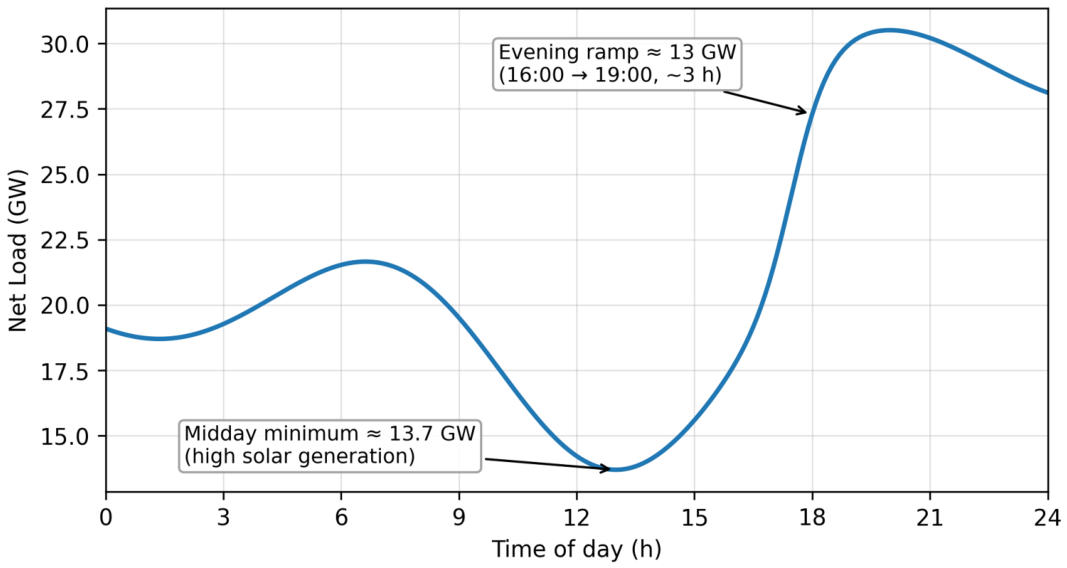
The installation of renewable energy has grown rapidly over the last 20 years, and this has been attributed to a combination of continuing government support, innovation in technology and decreasing costs for renewable energy solutions. It is important to understand where deployment is at as of this time period, along with the methods different markets have implemented for how they are going to integrate large-scale renewable energy, and the different approaches that are being taken by different regions around the world in order to understand what opportunities and challenges there are with respect to how the world is going to make room for integrating large amounts of renewable energy into their energy systems. China represents the world’s largest renewable energy market in absolute terms and illustrates the scale at which coordinated infrastructure and system planning can enable rapid transitions. Scenario-based analyses indicate that the combined optimization of photovoltaic and wind resource siting, ultra-high-voltage transmission expansion, energy storage deployment, and demand-side flexibility could increase annual renewable electricity generation from approximately 9 PWh to 15 PWh, while simultaneously reducing average carbon abatement costs from around 97 USD per tonne of CO2 to single-digit values in highly optimized configurations [41]. These results clearly demonstrate the economic and system-wide advantages of integrated system and infrastructure planning when it comes to the potential for creating very large amounts of renewable energy solutions, although it should be noted that these results are based solely on theoretical analyses and not on the actual physical performance of the respective systems. China’s latest growth pattern for installing new energy sources such as both wind and solar imply that it is possible to build out large amounts of renewable energy very quickly but also exposes integration challenges related to regional imbalances between resource-rich areas and major load centers, transmission congestion, and the need for continued market and regulatory reform. The German energy transition, or “Energiewende,” demonstrates how industrialized nations with rigorous standards of reliability and limited expansion of domestic transmission networks will integrate renewable energy sources into their electrical grid. Analyses of the transition to renewable resources in Germany find that inadequate expansion of transmission systems—especially to transport wind power generated in northern Germany to southern Germany where it is consumed—creates increasing levels of curtailment and underutilization of renewable resources [42]. While storage and demand-side flexibility contribute to system balancing, the German experience demonstrates that transmission expansion remains a critical complement to generation growth, as temporal and spatial mismatches cannot be economically resolved through storage alone. This system design results in an effective mix of investment in transmission infrastructure, flexible demand-side response options, and standard storage to provide appropriate signals for operational and investment decisions for the delivery of renewable electricity. System-level analyses of the European power system similarly indicate that early and coordinated decarbonization strategies, integrating renewable deployment with transmission expansion and sector coupling, can significantly reduce long-term system costs compared to delayed or fragmented transitions [43]. California offers a widely cited illustration of solar integration challenges in a large, complex power system. The state’s “duck curve” phenomenon—characterized by deep midday net-load minima followed by steep evening ramps on the order of tens of gigawatts over a few hours—has become emblematic of operational challenges at high solar penetration [44].
More than a decade after its original characterization, the duck-curve phenomenon has not disappeared but has instead deepened. Continued solar capacity expansion has progressively shifted the CAISO spring net-load profile from the original “duck” shape towards an increasingly pronounced canyon-like configuration, with midday net load occasionally approaching values close to zero.
According to recent operational statistics, total CAISO curtailment of utility-scale wind and solar generation reached 3.4 million MWh in 2024, representing a 29% increase over 2023. Over the same period, battery storage capacity in the CAISO footprint expanded from 8.0 GW at the end of 2023 to 11.6 GW at the end of 2024 [45].
The rapid build-up of battery capacity has begun to reshape the evening ramp by displacing gas-fired peaking generation and by storing midday solar surpluses for evening discharge. However, curtailment levels during periods of low spring demand have continued to increase in absolute terms. Comparable patterns are now emerging in other systems with high solar penetration, notably in ERCOT (Texas).
The duck curve therefore illustrates not a transient phenomenon that has been resolved, but rather a structural reconfiguration of net-load profiles that continues to evolve as renewable penetration increases and as flexibility resources progressively absorb the resulting variability.
This net-load shape reflects periods of substantial solar overgeneration during daylight hours and rapid increases in conventional generation requirements during the evening. In response to these challenges, California has taken a coordinated approach, which includes large-scale deployment of batteries, encouraging demand response through time-based pricing, and changes to the market rules to better value flexibility of the system, etc. These efforts demonstrate that managing renewable energy penetration at high levels will require a holistic approach to integrating generation, energy storage, demand response, transmission, and market design, rather than relying on one technology alone. Across these diverse regional experiences, several common lessons emerge.
  • Transmission infrastructure consistently appears as either a key enabler or a binding constraint for renewable integration, with inadequate capacity leading to curtailment and inefficient resource utilization.
  • Effective integration requires the coordination of multiple time frames (real-time balancing to long-term investment planning), and requires institutional frameworks that align incentives and provide for information sharing;
  • No single technology provides a universal solution; rather, the most effective strategy appears to be the development of portfolios of complementary strategies for integrating renewables, including: forecasting, flexible generation, storage, demand response, transmission, and market mechanisms.
  • A stable policy and/or long-term commitment is critical to attracting private investment in renewable development as well as in the complementary infrastructure and system capabilities that allow an electrical system to operate reliably with a high penetration of renewable resources.
Figure 2 illustrates the characteristic California duck curve in the net load profile. The curve shows a pronounced midday minimum of approximately 13–14.5 GW, driven by high solar photovoltaic generation during peak daylight hours. As solar output rapidly declines in the late afternoon while electricity demand increases, the system experiences a steep evening ramp of about 13 GW over roughly three hours. The characteristics of this duck curve demonstrate two principal concerns for power system operators:
  • Meeting high-ramp requirements over a short time frame;
  • Dealing with periods of excess generation (which are likely to be greater than 10% of total demand) during the peak period of solar generation.
Therefore, the duck curve highlights the importance of developing a more flexible system to provide the necessary resources to meet these challenges, including fast-ramping resources, energy storage, demand-side response, and improved system coordination.
The global picture outlined above masks a fundamental dichotomy that strongly conditions the deployment of renewable energy technologies and the design of integration strategies. On the one hand, advanced economies operate predominantly brownfield power systems—long-established meshed networks designed around centralized synchronous generation—in which the integration of renewables is largely a problem of retrofit, involving the accommodation of new technologies on legacy infrastructure and the progressive replacement or repurposing of existing assets.
On the other hand, several emerging economies—most notably across sub-Saharan Africa, where approximately 750 million people still lacked access to electricity in 2023 [46]—face a substantially different challenge, in which large portions of the network are effectively greenfield, either to be built from scratch or to be re-architected as electrification progresses. The technical, economic, and institutional priorities, the typical timescales, and the relative balance between decentralized and centralized solutions differ significantly between these two settings, as discussed in detail in Section 12.

4. Smart Grid Technologies

To transform electricity grids for large amounts of renewable energy, a substantial amount of work is necessary not only in changing existing generation and storage technology but in upgrading all existing grid infrastructure and operations. This section looks at some of the main technologies making up smart grids that allow for real-time management of modern and complex power systems such as Advanced Metering Infrastructure, Energy Management Systems, Distributed Energy Resources and microgrids; and Demand Response programs. All these technologies work together to form the sensory, communicative, and control-based enablement of millions of devices working together and acting quickly in response to changing conditions in the power system.

4.1. Advanced Metering Infrastructure

The advanced metering infrastructure (AMI) serves as the basic data collection system which enables smart grid technologies and active management of electrical power grids. Smart meters function as digital instruments which measure electricity usage with high accuracy while they transmit data to utility companies through multiple network types such as cellular systems, power line communication, and mesh radio technologies. AMI technology provides utilities with continuous access to customer electricity usage data which enables them to monitor and analyze consumption patterns throughout their entire service area. This capability stands in contrast to traditional electric meters which require manual assessments and only present customers with monthly usage summaries. The advanced metering system enables utilities to reach higher operational levels while customers gain new possibilities through its increased monitoring capabilities. The collection of detailed consumption information helps system operators to create better load predictions which enable them to detect outages and restore power faster while decreasing non-technical losses and boosting their efficiency with demand response implementation. The AMI system supports time-based pricing through time-of-use tariffs which allow customers to modify their energy use according to changing electricity costs while field tests show that these pricing systems can deliver substantial results in peak demand reduction according to specific tariff conditions and customer participation rates [47]. The utility companies can use automatic outage detection through meter communication loss to pinpoint affected areas and start power restoration work faster than they could with standard methods which depend on customers reporting outages. Large quantities of data are generated by advanced metering systems, creating new possibilities while introducing new challenges. Each advanced metering system must manage three properties of the data generated by the system: high volume of data generated, rapid processing of this volume, and multiple types of data that must all be managed and analyzed. The advanced analytic functions that use metering data can identify unusual usage patterns, identify energy waste and create energy conservation program opportunities through grouping customers, as well as improving distribution system model calibration for both planning and field work tasks [47]. The full consumption datasets do provide valuable details regarding how energy is being used, but they also create enormous risks regarding individual privacy protections and cybersecurity defense. The high-resolution metering technology generates detailed information about household activities, how households operate, and how often households are occupied. This level of detail creates a need for individuals to implement very strong personal privacy protective measures. In addition, implementing privacy-preserving methods that use aggregated data, anonymized data, and differential privacy methods allow for preserving the privacy of data from individual accounts while also providing the value of using this data for analysis. The security of metering and communication systems requires equal attention because any existing vulnerabilities can be used by attackers to create large-scale power disruptions and load manipulation. The AMI architecture needs secure communication protocols and encryption methods and network segmentation and intrusion detection systems to protect against emerging threats. The AMI deployment communication systems need to establish a proper balance between coverage requirements and latency needs and bandwidth requirements and system reliability needs and cost constraints which apply to both urban environments and remote rural areas. As a result, hybrid communication architectures combining multiple technologies are increasingly adopted to enhance resilience and ensure reliable operation under a wide range of conditions.

4.2. Energy Management Systems

The system uses computational intelligence to manage distributed energy resources and improve operational performance while handling specific conditions. The systems operate between building-level management systems which optimize HVAC and lighting and utility-scale systems which manage multiple megawatts of generation and storage and flexible loads. Increasing complexity with high renewable penetration has elevated energy management from cost optimization to critical enabler of reliable operations. Hierarchical architectures have emerged as a scalable approach for coordinating distributed resources without computationally intractable centralized optimization. These architectures implement three control levels: primary control at subsecond to second timescales for voltage and frequency regulation, secondary control at minute timescales for economic dispatch and power flow optimization, and tertiary control at 15-min to hour timescales for day-ahead scheduling and wholesale market coordination [48]. The process of decomposition through time and organizational levels enables distributed decision-making because each level needs its specific information and decision-making power to function. The implementation of hierarchical management shows its effectiveness in managing networked microgrids through its ability to coordinate autonomous systems which function independently and through their collaborative power-sharing. Utilizing this hierarchical structure to manage networked microgrids is an example of how to coordinate the operation of autonomous systems that are both operating in isolation and coordinating collaboratively (exchanging power). All of the microgrids in a multigrid configuration autonomously operate at the local level while also coordinating with each other (figuring out how to optimally exchange power with the other microgrids) with the underlying/main grid at the higher level. At the same time, all microgrids in a multigrid configuration will have the ability to independently optimize themselves in accordance with their own locally defined optimization objectives (minimizing cost, minimizing emissions, maximizing reliability) while respecting the underlying limitations of the network and also coordinating with neighboring microgrids in order to provide maximum benefit at the overall system level. The hierarchical structure of multigrids is able to accommodate the diversity of ownership, purpose, and availability of information found among the constituents of distributed systems. This structure accommodates heterogeneous ownership, objectives, and information availability characterizing distributed systems. Integration of deep learning forecasting with metaheuristic optimization creates effective energy management frameworks for high renewable penetration [11]. The forecasting method uses neural networks which were trained on historical data to predict upcoming renewable energy production and electricity demand and power price developments. Optimization determines resource scheduling minimizing costs or other objectives while satisfying constraints. Key innovation is co-design, where forecasting is trained not solely to minimize prediction error but to minimize impact of forecast errors on operational decisions. This objective-oriented forecasting recognizes different error types have varying consequences, and forecasting should prioritize accuracy in dimensions most affecting decision quality. Virtual energy storage concepts allow for the management of flexible resources by providing a common framework for all forms of flexible resources. Instead of treating batteries, thermal storage, and demand flexibility as three different types of resources to manage, the virtual energy storage framework provides an opportunity to aggregate these individual types of flexible resources into a common, equivalent representation based upon capacity, charge rate and discharge rate, as well as efficiency [40] to enable the battery scheduling algorithms to coordinate a large number of flexible resources with multiple attributes thus streamlining implementation and providing a means for enabling standardized interfaces. Inclusion of stochastic islanding constraints ensures systems maintain sufficient resources to operate autonomously if disconnected, critical for resilience with variable renewable generation. Multi-criteria decision analysis frameworks provide structured approaches for problems involving conflicting objectives that cannot be reduced to a single metric. The design of hybrid renewable systems requires designers to create either stand-alone systems or grid-connected systems while they need to manage budget constraints together with their need to maintain system reliability and environmental sustainability and achieve energy independence and system resilience which are vital operational requirements [49]. The frameworks establish problem structure through their identification of decision variables and constraints and objective functions which enable the application of techniques that create and assess different solutions. Pareto optimization produces non-dominated solutions which represent designs where all objectives require trade-offs because improving one objective results in adverse effects on another objective and decision-makers can use this method to analyze trade-offs which help them choose solutions that match their main priorities. Transparency, making trade-offs explicit rather than obscuring them through arbitrary weighting, has made multi-criteria decision analysis increasingly popular for complex energy system design and planning.

4.3. Distributed Energy Resources and Microgrids

The proliferation of distributed energy resources (DERs)—including generation, storage, and controllable loads connected at distribution voltage levels—has fundamentally altered power system operation and enabled new grid architectures. A type of power grid that has emerged from these new architectures is the microgrid, which can be defined as a group of distributed energy resources and consumers of energy that have been coordinated in operation so as to work independently from the utility grid when the microgrid is disconnected (a state referred to as “islanded”) from the utility grid. By enabling a microgrid to operate in an islanded state, a microgrid provides greater levels of resilience in the event of an upstream electric outage and provides the opportunity for the facility/owner of a microgrid to optimize operational performance based on cost, emissions or any other metric when operating connected to the utility grid. Microgrids span a wide range of scales and applications, from single-building installations to community-scale systems serving neighborhoods or towns. Campus microgrids supporting universities, hospitals, or military bases typically combine on-site generation, such as natural gas units or combined heat and power systems, with solar photovoltaics, battery storage, and building energy management systems controlling flexible loads. Industrial microgrids combine process loads with both generation and storage systems which typically use cogeneration and waste heat recovery to reach operational effectiveness that central supply systems cannot deliver. Remote and island microgrids provide electricity access where grid connection is technically or economically infeasible, historically relying on diesel generation but increasingly incorporating renewable energy and storage to reduce fuel consumption and emissions. Microgrid control requirements are greatly influenced by operational modes. While connected to the grid, the microgrid acts as either an importer or an exporter; therefore, it obtains voltage and frequency references from the main electric utility grid. During operation without connection to the grid (island mode), a microgrid must autonomously control voltage, frequency, and also balance generation and real-time loads, while also making the transition between the two modes of operation without any outside assistance. The ability to detect the loss of connection to the electric utility grid and transition from connected to island mode is what differentiates true microgrids from simple distributed generation resources and gives them their resiliency value. Real-world demonstrations have shown that microgrids can maintain power supply to critical loads for periods ranging from several hours to multiple days during extended upstream outages, highlighting their role as a resilience-enhancing architecture rather than merely a local optimization solution [50]. Microgrid systems demonstrate their full potential through their ability to provide essential services during major weather events and widespread network failures while surrounding grid infrastructure experienced prolonged outages. The evolution of control architectures for microgrids has progressed rapidly as systems have grown more complex. Decentralized primary control techniques (e.g., droop) allow distributed generators to share their loads proportionately without the need for high-bandwidth communications. Secondary control layers, typically implemented through communication-based coordination, restore voltage and frequency to nominal values while preserving the stability benefits of primary control. Tertiary controls operate on a longer timeframe to optimize economical dispatch and enable the exchange of power with the “main grid” when connected to it. Virtual power plant concepts extend microgrid principles by aggregating geographically dispersed DERs and presenting them as a single controllable entity. They will then facilitate the coordinated operation of large numbers of small-scale DERs (e.g., rooftop solar arrays, batteries, flexible commercial loads, and EV charging infrastructure) to enable them to participate in wholesale energy markets and provide power system services at a scale that would be impossible if only using individual resources alone [51]. Aggregation creates value through diversification, reducing net variability, and through scale, allowing distributed resources to meet minimum participation thresholds in organized markets.

4.4. Demand Response and Load Flexibility

Demand response (DR)—the intentional modification of electricity consumption patterns in response to price signals, grid conditions, or direct control—constitutes a critical flexibility resource for managing variability introduced by high shares of renewable generation. Unlike supply-side resources that adjust generation to meet fixed demand, demand response aligns consumption more closely with available generation, reducing reliance on peaking plants and enhancing overall system efficiency. Demand response programs can be classified as either incentive-based or price-based. Examples of incentive-based programs include direct load control of customer-owned equipment, interruptible load arrangements with large customers, and capacity-style programs where a participant agrees to reduce their consumption by a stated amount when needed. Examples of price-based programs include time-of-use rates that provide customers with different price levels throughout the day, critical peak pricing where customers receive a higher price for power during critical peak hours (only while the events occur), and real-time pricing which updates the prices every hour. The effectiveness of demand response programs depends on customer behavior, automation, and how quickly customers can respond to the needs of the power system. Studies show that customers typically do not respond strongly to price signals; however, when there is some ability to respond, demand elasticity, which is the amount that demand responds to price signals, can vary widely by customer class, program design, and how quickly the program gets enacted [52]. Industrial and commercial customers generally offer greater flexibility than residential customers, while responses planned in advance tend to be more substantial than same-day or real-time adjustments. Demand response has the potential to provide other ancillary services such as frequency regulation and operating reserves in addition to peak load reduction and is capable of providing a comparable level of regulation service as traditional generation resources by enabling fast, electronically controlled load response to frequency deviations. This capability is dependent upon the use of sophisticated control systems designed to coordinate and control many distributed loads while adhering to customer preferences and the limitations imposed by the local distribution network. Residential demand response poses unique challenges for both reliability and effectiveness as the individual loads are small in size relative to the aggregation necessary for demand response to have a meaningful impact on command load. Because of this, a number of factors may limit customer participation in residential demand response including inconvenience, lack of automation, and fatigue or reduced effectiveness due to frequency of response. Technologies that enhance the effectiveness of residential demand response include smart thermostats, home energy management systems, and behind-the-meter storage that allow for automated responses to and the decoupling of load flexibility from immediate customer participation. Integrating demand response with advanced metering infrastructure (AMI) and dispatch to distribution management systems provides the opportunity for closed-loop control, which provides operators the ability to observe the actual responses and adjust the dispatch strategy. Coordinated demand response with local voltage and thermal constraints represents the next major hurdle bridging transmission system operation with distribution system operation. Advanced demand response frameworks create reliability and efficiency improvements while enabling large-scale renewable energy integration through their system-wide flexibility valuation which considers both system needs and location requirements.

4.5. Operational Architectures: EMS, SCADA, and Digital Twins

Beyond field-level technologies such as smart metering, demand-side management, and standardized communication protocols, the operation of modern power systems with high renewable penetration relies on integrated digital architectures at the control-room and supervisory level. Two long-established components—Supervisory Control and Data Acquisition (SCADA) systems and Energy Management Systems (EMS)—provide the backbone of real-time monitoring and dispatch in transmission and distribution networks, with characteristic update rates ranging from seconds to minutes for SCADA telemetry and from minutes to tens of minutes for EMS state estimation and dispatch optimization. SCADA platforms acquire field measurements via remote terminal units (RTUs) and intelligent electronic devices (IEDs) that increasingly communicate over IEC 61850-based protocols, while EMS platforms perform topology processing, state estimation, security-constrained optimal power flow, and contingency analysis on top of the SCADA data layer [53].
Digital twin (DT) technology represents a more recent layer of digitalization that complements, rather than replaces, the established EMS/SCADA infrastructure. A digital twin is generally defined as a dynamic, bidirectionally coupled virtual replica of a physical asset, populated with live sensor data and capable of simulating, optimizing, and predicting the behavior of the corresponding physical system over relevant timescales [54]. In the context of power systems with high renewable penetration, digital twins enable several functions that go beyond the steady-state and quasi-steady-state nature of traditional EMS tools. They support faster-than-real-time predictive simulations of dynamic phenomena—including short-term voltage instability, low-inertia frequency events, and inverter-based oscillations—that can be used by control-room operators to anticipate and pre-empt contingencies before they materialize. They allow virtual testing of control scenarios and contingency strategies in a safe simulation environment, reducing the operational risk associated with novel control schemes such as grid-forming inverter coordination, large-scale BESS frequency support, or sector-coupling pilots. They also provide a high-fidelity platform for renewable generation forecasting, where digital twins of wind farms and PV plants ingest meteorological forecasts, real-time SCADA data, and component-level degradation models to produce short-horizon power-output forecasts that have been reported in the literature to improve accuracy by 25–35% relative to baseline statistical methods [54].
A particularly relevant emerging application is the use of digital twins for the proactive identification of network overloads and thermal limit violations under high variability of renewable injections, an operational challenge that becomes more frequent and less predictable as inverter-based generation displaces dispatchable conventional plants. Digital twin platforms with sub-second latency, deployed at substation or distribution-system-operator level, can compute look-ahead power flows on representative time horizons of 5 to 30 min, enabling pre-emptive switching, generation curtailment decisions, or demand-response activation. Recent reviews highlight that the realistic deployment of digital twins for grid-wide operational management is constrained by several practical issues, including the availability and integration of real-time measurement data across multiple network levels, computational performance under tight latency requirements for stability-critical applications, the modularity and interoperability of platforms developed by different vendors, and cybersecurity considerations specific to bidirectional cyber–physical coupling [54]. The integration of digital twin frameworks with Building Information Modeling (BIM) approaches and extended-reality (XR) interfaces, originally developed in the context of building and infrastructure management, has been proposed as a promising avenue for richer operator-facing visualization and for cross-domain coordination between electrical, thermal, and built-environment systems [55].
Several large-scale deployments are progressively bringing these concepts from research to practice. The European TwinEU initiative, launched in 2023, aims to develop an interoperable digital twin of the pan-European electricity grid through eight pilot schemes coordinated across eleven member states; comparable initiatives are underway in Australia, Japan, and the United States. Despite this acceleration, the field remains in a transitional phase: most published case studies still focus on individual assets or local networks, and a generally accepted reference architecture for utility-scale digital twins of transmission and distribution systems has yet to emerge [54]. The progressive maturation of digital twin platforms, in conjunction with the established EMS/SCADA layers and with the AI-based forecasting and optimization tools discussed in Section 2, is expected to provide one of the principal enablers of secure operation under increasing shares of variable renewable energy.

5. Grid Stability, Power Quality, and Protection

Inverter-based renewable energy resources create a power system dynamism which functions differently from traditional synchronous generators. This section identifies technical challenges associated with frequency stability, voltage stability, power quality, and protection systems as electric grids move towards higher renewable energy penetration levels. This analysis will include an overview of the characteristics of these technical challenges, along with examples of how these challenges are being addressed through various solutions in development or currently being implemented.

5.1. Frequency Stability and Inertia

Frequency stability is the degree to which a power system can maintain acceptable frequency levels following large disturbances, and it represents one of the most fundamental conditions for reliable grid operation. In conventional power systems, the rotating masses of synchronous generators provide inertia, which inherently resists sudden frequency changes and grants time for primary and secondary control actions to respond when an imbalance between generation and load occurs.
The relationship between the active power imbalance and the resulting frequency dynamics is described by the swing equation. In per-unit form, for an aggregated power system, it can be written as follows:
2 H d f ( t ) d t = P m ( t ) P e ( t ) D · Δ f ( t )
where f ( t ) is the system frequency in per-unit form, P m and P e are the per-unit mechanical (generation) and electrical (load) powers, respectively, Δ f = f f nom is the frequency deviation from the nominal value, D is the load-damping coefficient, and H is the equivalent system inertia constant, measured in seconds and defined as the ratio between the kinetic energy stored in rotating machinery at synchronous speed and the rated apparent power of the system [56,57].
Equation (1) provides the standard analytical framework for assessing the immediate frequency response of a system to a power imbalance Δ P = P m P e . In the instants immediately following a disturbance, when the load damping term and primary control actions have not yet engaged, the rate of change of frequency (RoCoF) reduces to
RoCoF = d f d t t 0 + = Δ P 2 H f nom
where the factor f nom converts the per-unit derivative into Hz/s. Equation (2) shows explicitly that, for a given power imbalance, the initial RoCoF is inversely proportional to the equivalent inertia constant H, providing the analytical foundation for the qualitative trend depicted in Figure 3.
The same relation also clarifies why the displacement of synchronous generators by inverter-based resources, which lack intrinsic kinetic energy storage, accelerates frequency dynamics. As the share of inverter-based generation increases, the equivalent inertia H of the system decreases, leading to higher initial RoCoF for an identical disturbance.
Figure 3 illustrates the inverse relationship between the rate of change of frequency (RoCoF) and the system inertia constant H, as predicted by first-order swing-equation analysis for a given power imbalance. The figure provides an illustrative example of how decreasing aggregate inertia leads to faster frequency excursions following disturbances, increasing the likelihood of approaching or exceeding protection relay thresholds in converter-dominated power systems. The values shown are representative of inertia ranges commonly discussed in the literature and are intended to convey qualitative trends rather than the response of a specific system. This behavior highlights a key challenge of low-inertia operation, whereby the displacement of synchronous generation by inverter-based resources accelerates frequency dynamics and reduces the time available for effective control and protection coordination [56,57]. The swing equation indicates that the system’s inertia level inversely affects the frequency response to disturbances; the greater the inertia level, the slower the frequency changes. According to Tielens and Van Hertem [56], lower inertia results in higher rates of frequency changes, making it more likely that protection systems and emergency controls will activate before remediation can stabilize the system. Thus, inverter-based resources’ high penetration will contribute to more rapid frequency dynamics than conventional synchronous generation, reducing control measures’ response times.
As an illustrative example, consider a sudden generation loss of Δ P = 0.05 p.u. on the system base—a contingency representative of the outage of a large generating unit. With a system inertia constant typical of conventional grids ( H = 6 s) and f nom = 50 Hz, Equation (2) yields an initial RoCoF of approximately 0.21 Hz/s, which is comfortably below the protection thresholds commonly set in the range 1.0 1.5 Hz/s [58].
The same disturbance applied to a converter-dominated configuration with H = 2 s would yield an initial RoCoF close to 0.63 Hz/s—a threefold increase that significantly reduces the time available for protection coordination and primary frequency control to act. For larger disturbances, this value can quickly approach or exceed typical protection settings. This simple example highlights how the qualitative trend illustrated in Figure 3 translates into concrete operational consequences as system inertia decreases.
It is important to note that Equation (1) represents a first-order, single-mass aggregated model that captures the average frequency response of a synchronous area, but does not account for local frequency variations, electromechanical oscillations between machines, or the fast control dynamics of inverter-based resources. More detailed assessments of frequency stability in low-inertia systems require multi-machine models, electromagnetic transient simulations, and explicit representation of converter control loops [57,58], particularly when the share of inverter-based resources approaches or exceeds the threshold at which converter dynamics become comparable in timescale to electromechanical phenomena.
Low-inertia system analyses overwhelmingly show that a lack of inertia leads to a greater rate of change in frequency and a lower frequency minimum following significant disturbance events, raising the risk of cascading protection actions and long-term outages [57]. When significant synchronous generation is replaced by large amounts of inverter-based renewable generation without compensatory measures, these effects become much more severe. As frequency excursions increase in magnitude and frequency, it will be difficult to coordinate the system response, emphasizing the need for adequate levels of inertial support. Recent reviews that combine operational experience with simulation studies establish preliminary guidelines which determine the needed inertia for contemporary power systems. The system needs to maintain an aggregate inertia level of several seconds which typically ranges between 4 and 10 s in order to sustain frequency stability during actual disturbance events according to study [58]. Systems that operate with extremely low inertia levels experience greater blackout danger during major operational emergencies because their standard protection and control systems lack sufficient speed to stop frequency decreases.
The control methods of inverter-based resources enable them to partially compensate for the inertia deficit by emulating an inertial response through dedicated control mechanisms. Wind turbines and solar inverters can be configured to deliver synthetic inertia by rapidly adjusting active power output in response to frequency deviations, thereby reducing the initial rate of change of frequency. Unlike physical inertia, synthetic inertia depends on stored kinetic or electrical energy and operates within control restrictions, energy limits, and thermal constraints. Reviews indicate that virtual inertia contributions from inverter-based resources typically correspond to effective inertia constants on the order of 2 to 4 s , providing meaningful but incomplete compensation for the loss of synchronous-machine inertia [58].
A clear distinction should be drawn between synthetic inertia and fast frequency response (FFR), as the two concepts are often conflated in the literature but provide different services. Synthetic inertia targets the very first instants after a disturbance, when the contribution scales with d f / d t and provides a synchronizing torque that limits the initial RoCoF. Fast frequency response, by contrast, is a fast active-power injection proportional to the frequency deviation Δ f , which contributes to a damping torque and acts to improve the minimum instantaneous frequency (frequency nadir) reached during the disturbance [59]. The two services are complementary: a system that combines both can simultaneously limit the RoCoF and arrest the nadir, whereas the deployment of either one in isolation only addresses part of the problem.
Type-3 (DFIG) and Type-4 (full-converter) wind turbines can deliver synthetic inertia by extracting kinetic energy from the rotating mass of the rotor and the blades. Field-trial data and grid-code-based deployments—for example in the Australian National Electricity Market and in Hydro-Québec’s transmission system—indicate that a typical synthetic-inertia response from a wind turbine consists of an active-power boost of 5– 10 % of nameplate capacity, sustained for a few seconds (typically 5– 10 s ), with a ramp-up time below 2 s after frequency-event detection [59]. The duration of this contribution is intrinsically limited by the kinetic energy that can be extracted from the rotor without driving its speed below stable operating limits, and is therefore much shorter than the equivalent contribution of a synchronous machine of similar rating. A further well-documented limitation is the secondary frequency dip that can occur during the speed-recovery phase, when the wind turbine temporarily reduces its active-power output to recover its optimum rotor speed: if not properly coordinated with other resources, this recovery can cause a second frequency excursion that may be more severe than the original disturbance [59]. Photovoltaic systems do not have any rotating reserve and can therefore provide synthetic inertia only through the combination of additional energy storage or controlled curtailment to maintain a power reserve, both of which entail an economic cost.
Battery energy storage systems (BESS) overcome several of the intrinsic limitations of wind-based synthetic inertia. Modern grid-scale BESSs deliver active-power adjustments in well below 100 ms , can sustain the response for the duration permitted by their state of charge (SoC), and avoid the secondary frequency dip associated with rotor-speed recovery [32,59]. The control of BESSs for frequency support is typically organized hierarchically. At the device level, primary frequency control is implemented through droop control—a proportional response to frequency deviation that emulates the steady-state characteristics of a synchronous-machine governor—and through virtual synchronous machine (VSM) control schemes, which additionally emulate the dynamic behavior of the swing equation by adjusting the inverter active-power output as a function of both Δ f and d f / d t [60]. At the system level, BESS contributions are coordinated with the secondary control loops of the area control system, including automatic generation control (AGC), and with the dispatch instructions of tertiary control, in order to restore the BESS state of charge to a target value once the disturbance has been mitigated [48]. Several practical issues constrain the BESS contribution to frequency control: the trade-off between active-power capability and energy reserve at the design stage, the need to manage the SoC envelope to preserve continuous availability, the impact of frequent partial cycling on battery degradation, and—for VSM control specifically—the sensitivity of stability margins to the tuning of virtual inertia and damping parameters, which can interact with the dynamic characteristics of neighboring resources [60]. The coordinated deployment of synthetic inertia from wind turbines and FFR from BESS, in combination with the residual synchronous inertia provided by the remaining conventional generation fleet, is therefore the configuration generally considered most effective for ensuring frequency stability in high-IBR systems [38,59].
Table 4 summarizes the main stability challenges in converter-dominated power systems and the corresponding mitigation strategies.

5.2. Voltage Stability

Voltage stability—the ability of a power system to maintain acceptable voltage levels across the network following disturbances—represents another fundamental stability concern that is increasingly influenced by high penetrations of inverter-based renewable generation. Unlike frequency, which is nearly uniform across synchronously connected systems, voltage is inherently local and spatially variable, leading to stability characteristics that can differ significantly across network locations. The distribution networks experience voltage management difficulties from high levels of distributed photovoltaic generation which create distinct challenges when compared to transmission systems. Active power injection from distributed resources causes voltage rise along feeders especially during periods of high generation and low local demand. For radial distribution feeders, the voltage deviation can be approximated by the relationship
Δ V = ( R · P + X · Q ) / V base
where Δ V is the voltage change, R and X are the feeder resistance and reactance, P and Q are the active and reactive power injections, and V base is the base voltage. This expression highlights that in distribution systems—where resistance often exceeds reactance—active power injections can have a dominant influence on voltage magnitude, in contrast to transmission systems where reactive power plays a more prominent role. The research focuses on distributed voltage control methods which use inverter-based resources to control voltage fluctuations in electrical systems that have a high distribution of renewable energy output. Methods that implement multiple inverters to adjust their output of both active and reactive power based on local measurements with limited communication can greatly reduce voltage fluctuations and therefore maximize the amount of renewable energy used. Consensus-based and other distributed algorithms offer scalable solutions that avoid the computational complexity and communication requirements of centralized optimization, making them well suited to large distribution networks with many controllable devices. Metaheuristic optimization techniques offer an additional set of tools for voltage stability analysis and planning purposes. There are many types of algorithms such as particle swarm optimization, genetic algorithms, and differential evolution, which are very well suited to search for the best control settings and/or best network configurations to maintain voltage stability for a wide range of operating scenarios, such as contingencies, renewable generation long-term variability, load variability and others. These are typically too computationally demanding to be implemented in real time; however, they play a vital role in the conducting of offline analysis and in the development of robust voltage control planning. As synchronous generation continues to be replaced by inverter-based resources, voltage stability and reactive power management is becoming increasingly important. Synchronous generators have large reactive power capabilities that can be used across wide ranges of operation. In contrast, inverter-based resources have limits on simultaneous delivery of active and reactive power due to strict power rating and thermal limits. Modern grid codes therefore require inverters to provide significant reactive power support over specified operating ranges, ensuring that distributed resources contribute to voltage regulation rather than exacerbating instability. Accurately representing these constraints is essential for realistic voltage stability assessment and control design. Long-term voltage stability involves slower dynamics associated with load tap changers, generator excitation systems, and load behavior under sustained voltage deviations. The interaction of these slower processes with fast inverter-based controls necessitates advanced time-domain simulation tools capable of capturing both transmission- and distribution-level dynamics. Development of co-simulation platforms that refer to both transmission and distribution models represents a major opportunity in the voltage stability analysis of high penetration distributed/inverter-interfaced generation power systems.

5.3. Power Quality

Power quality encompasses a range of phenomena—including harmonic and interharmonic distortion, voltage flicker, unbalance, and transient disturbances—that affect equipment performance and the quality of electrical service. With the growth of power electronic converters associated with renewable energy generation, battery storage, and electric vehicle charging, there are now new sources of power quality disturbance; however, there are also enhanced capabilities for mitigating these disturbances through faster and more adaptable forms of control. The most common type of harmonic distortion is created when power electronic converters draw or inject non-sinusoidal current waveforms into the electrical system, creating frequency components at integer multiples of the fundamental frequency (e.g., frequencies of 60 Hz, 120 Hz, etc.). In terms of compliance to the harmonic emission limits, many modern inverter-based resources are designed to meet the relevant emission limits at the device level. However, when a large number of converters operate simultaneously, their cumulative effect upon network impedances can lead to higher overall levels of distortion at the point of common coupling, especially in weakly coupled electrical networks. In addition to traditional low-order harmonic components, modern converter technologies also create distortion in the so-called supraharmonic frequency range, which typically covers frequencies from several kilohertz to tens of kilohertz and coincides closely with converter switching frequencies and control methodology [23]. This type of distortion has the potential to create resonance in the electrical system and to create interference with sensitive electrical devices, leading to different issues than those considered by harmonic standards. Power electronic converters with active power quality control systems or dedicated active filters can effectively reduce both harmonic and interharmonic distortion through their active power quality control system. Active filtering approaches which detect distortion elements in real-time and deliver compensating currents, enable significant waveform quality enhancement compared to systems without compensation, while avoiding the tuning requirements and operational limitations that passive filters impose [61]. Advances in digital signal processing and sensing technologies have made such adaptive approaches increasingly practical for deployment in distribution networks with high concentrations of inverter-based resources. Another major power quality issue associated with variable generation from renewables is voltage flicker. Voltage flicker is defined as rapid fluctuations in voltage amplitude that can result in noticeable fluctuation of light sources experienced by customers as annoying. Voltage flicker occurs as a result of rapid fluctuations in active power output due to either shifting clouds or wind gusts and can occur on electric power systems with limited short-circuit strength. Voltage flicker is measured using standardized indices that measure short-term and long-term severity of voltage flicker, with specific thresholds for each set by international standard setting bodies. Examples of mitigation options to limit voltage flicker include controlling the rate at which renewable resources can be ramped up or down (called ramp-rate limiting of renewables) and using coordinated control of energy storage devices or flexible loads to dampen rapid fluctuations in power output and concurrently balance the negative effects of those fluctuations on both energy capture and operational flexibility. Battery energy storage systems provide power quality management functions which extend beyond their ability to reduce harmonic disturbances. The voltage control capability of battery inverters together with their flicker reduction and unbalance correction function enables them to deliver multiple power quality services which support energy management. While frequent operation for power quality support introduces additional cycling and degradation considerations, appropriate control strategies can balance service provision against lifecycle impacts, enabling batteries to contribute effectively to both power quality and system flexibility objectives.

5.4. Protection Coordination and Anti-Islanding

Current protection systems developed to work on radial distribution systems that have one-directional delivery of electric power will all have to be modified to address the increasing quantity of distributed generation connected to these systems. The principal reason for this is the differences in how synchronous machines provide fault currents in comparison to inverter-based resources. Generally speaking, synchronous generators are capable of producing fault currents well above their rated capacity for several cycles after a fault occurs; this characteristic is one reason that conventional overcurrent protection systems can reliably detect faults and coordinate between devices. In contrast, inverter-based resources are typically set to limit the amount of electrical current supplied during a fault to approximately 1.1–1.2 times their rated current; this is done to comply with both grid codes and to meet equipment protection requirements [25]. This reduced fault current magnitude can compromise the sensitivity and selectivity of traditional protection devices. When distributed generation provides bidirectional power flows, this makes it even more difficult to coordinate protection for both radial-type distribution systems and distributed generation located on radial-type distribution systems. In these cases, fault currents are produced from multiple sources and from more than one direction causing problems with the assumptions made about the direction of the current flow and the location of the fault using traditional radial-type protection systems. Faults located between a substation and a distributed generator can result in current contributions flowing both toward and away from the fault, challenging relay coordination based on current magnitude and direction alone. Adaptive protection strategies, which dynamically adjust protection settings based on network topology and real-time operating conditions, offer a promising approach to maintaining coordination under these evolving conditions, albeit at the cost of increased communication and computational complexity. Anti-islanding protection entails the ability to protect the main electrical network from an unintentional island created by distributed generators that continue to provide electricity to customers when disconnected from the larger electrical grid system. The presence of unintentional islands creates a risk for utility workers and can create equipment damage when reconnecting to the larger electrical grid creates phase displacement; therefore, network codes and regulations require that the electrical generation associated with distributed generators must detect when an island exists (i.e., when the distributed generator output exceeds the local load) and automatically disconnect from the electrical network within the time limits specified by applicable network codes [24,25]. Passive islanding protection methods monitor voltage, frequency, and other electrical parameters locally for abnormal conditions that indicate the formation of an island and can be applied without the need for complex controls. While simple to implement and benign under normal operation, these methods suffer from non-detection zones when local generation closely matches local load. Using active anti-islanding techniques can decrease the number of non-detection zones. These systems cause an unintended change in conditions which they can then measure to see how the system responds. The technique can include using frequency drift, impedance, or phase shift. These techniques utilize the differing dynamic reactions of a grid-connected system versus an islanded system. Active anti-islanding methods are capable of being fast and reliable, however, the disturbance created from the injected signal could degrade power quality or cause nuisance tripping with weak grids. A hybrid anti-islanding solution uses both continuous passive monitoring along with an active search algorithm such that the use of active anti-islanding is minimized while producing robust and reliable island detection methods over a wide range of operating conditions. Coordinating the anti-islanding function among multiple distributed generators remains an important and ongoing area of research as the density of distributed generation continues to increase.

6. Management Strategies for Renewable-Based Grids

Power systems with high renewable penetration require advanced operational management solutions that use multiple timeframes to manage different system resources. The section describes important management methods which include forecasting methods that enable proactive system operation and demand-side management strategies which create flexibility to handle fluctuating energy production together with energy communities and peer-to-peer trading platforms that connect their distributed members and vehicle-to-grid systems which use electric vehicle batteries as shared storage systems.

6.1. Renewable Energy and Load Forecasting

Load forecasting and renewable energy forecasting are essential to developing operational management strategies for high-renewable power systems. Accurate forecasts facilitate proactive decision making at multiple timescales, such as making minute-ahead adjustments for automatic generation control and day and week-ahead plans for unit commitment, reserve allocation, and market participation. The benefits of improved forecasting result in lower operational uncertainty, improved efficiency in scheduling, lower curtailment rates, and better overall economic transactions to support increased amounts of variable renewable generation. Forecasting of photovoltaic and wind power has developed into an established research area that spans a wide range of methods from physical models and numerical weather prediction to advanced data-driven techniques and deep learning. A detailed overview of both forecasting methodologies and their accuracy across various timescales and weather conditions, as well as their operational and economic impacts, is provided in the recent review of Di Leo et al. [62]. In practice, forecasting frameworks are increasingly incorporating meteorological data along with historical operational data to represent both the broad-scale weather influences and the local system behavior. The weather forecasting numerical models together with statistical and machine learning methods have improved wind power forecasting accuracy. In representative case studies, long short-term memory networks, which use recurrent neural network architectures, have shown better performance than traditional neural network models for capturing time-based relationships in ultra-short-term wind power forecasting [26]. These architectures process sequential meteorological and historical power data through memory mechanisms that selectively retain relevant information, enabling more accurate representation of multi-timescale wind dynamics. Hybrid forecasting approaches further enhance robustness under non-stationary conditions by decomposing wind speed or power time series into components associated with different temporal scales. The method uses empirical mode decomposition and wavelet transforms to extract three different components, which are subsequently predicted through dedicated forecasting models before they undergo recombination. The research demonstrates that hybrid forecasting methods achieve better results than direct single-stage forecasting methods, especially when predicting unpredictable weather patterns and transitional periods [27]. The improved robustness of these approaches comes at the cost of increased computational complexity, highlighting a trade-off between forecasting accuracy and implementation effort. Forecasting solar photovoltaic power generation is particularly challenging due to the strong diurnal cycle and rapid variability of solar irradiance caused by clouds. For long-term forecasting, numerical weather prediction is the primary source of forecast information, while short-term and intra-hour predictions increasingly use high-resolution satellite imagery, sky cameras, and local sensors. Recent deep learning frameworks integrating multi-source data have demonstrated strong performance in intra-hour photovoltaic forecasting on large real-world datasets, supporting applications such as real-time voltage control and ramp mitigation [63]. In both solar and wind applications, evaluation of the quality (performance) of forecast models is typically done using several metrics (indicators or measurements). These are Root Mean Square Error (RMSE), Mean Absolute Error (MAE), and Mean Absolute Percentage Error (MAPE). Each of these measures actual forecast performance differently; RMSE emphasizes large errors, MAE provides a linear manner of measuring overall error, and MAPE allows for comparison of forecasts across different scales but has limitations when the actual values get close to zero in magnitude. In recent years, the use of ensemble methodologies has increased to help improve forecast robustness by combining multiple forecast models into one because it reduces the error related to the uncertainty of using a single forecaster that may be poor at forecasting in extreme weather patterns and in specific types of operating conditions [64]. Overall, the continued integration of forecasting into operational decision-making, including tighter coupling with optimization and control frameworks, represents a key enabler for managing uncertainty and variability in renewable-based power systems.

6.2. Demand-Side Management and Flexibility

The approach of demand-side management uses particular methods and technologies to achieve three goals which include better system operation and cost reduction and increased use of renewable energy. Instead of making changes to how much power is produced by generators based on the amount of electricity used, demand-side management matches electricity used to the amount of electricity being generated. This will help utilities reduce the need for or reliance on peaking capacity and create a more flexible electric system. Demand response (DR) programs can be classified as either incentive-based either price-based. Incentive-based programs are forms of direct load control, interruptible loads, or capacity-type commitments, and price-based programs include implementing variable price for electricity at different times of the day (i.e., time-of-use rates, critical peak pricing, real-time pricing). By giving customers economic signals or directly controlling their electricity load, DR programs allow customers to be encouraged to move or reduce their electric usage during high-demand (from the system perspective) or high-cost periods. Demand response programs are effective when they have certain factors come together in a customer that can be driven by automation and the ability for their loads to shift in time or flexible with respect to the timing. Empirical studies that are summarized in the literature show that electricity demand has a limited amount of responsiveness to price signals, but the responsiveness varies substantially depending on the specific class of customer and program characteristics, as well as the time period of interest [52]. Generally, commercial and industrial customers provide more potential for providing flexible demand response than residential customers due to their ability to control their processes, while residential demand response programs can gain significant benefit from the availability of automation technologies that will allow them to automate their response, reducing the amount of active involvement required of the customer. In addition to the ability to reduce peak demand, demand response can also provide other valuable ancillary services to an electric utility, including operating reserves and frequency regulation. Fast responding electronically controlled loads can adjust their demand for electricity on time scales that are similar to those of traditional electric generation resources, thus assisting with the stability and balancing of the entire electric system. The achievement of this potential requires the existence of advanced control systems that have the capability of coordinating a large number of distributed loads while still respecting the preferences and comfort level of the customer. A major challenge to residential demand response is that the individual size of load is relatively small and that aggregation from large populations must take place in order to provide a sufficient amount of demand response. Another hindrance is that customers may be unengaged due to inconvenience, lack of knowledge, or fatigue from having to respond frequently to events. Also, enabling technologies such as smart thermostats, home energy management systems, and behind-the-meter storage solutions can mitigate these issues by allowing for automatic and decoupled response to demand fluctuations from customer action. The integration of demand response with advanced metering infrastructure and distribution management systems enables closed-loop control strategies. This is accomplished by providing real-time visibility into load response event data, allowing for more effective decision-making regarding dispatch and improving the reliability and predictability of demand-response capacity. As participation grows, coordination with local distribution network constraints becomes increasingly important, as simultaneous responses from many participants may otherwise create voltage or thermal issues. Distribution-aware demand response frameworks, potentially incorporating locational price signals, represent an important frontier in aligning transmission-level system needs with distribution-level operational constraints.

6.3. Energy Communities and Peer-to-Peer Trading

Energy communities are collaborative groups of consumers and prosumers that optimize their local energy production, consumption, and exchange, made possible by advances in distributed generation, energy storage, and digital platforms. They can range from very small cooperatives at the neighborhood level to larger associations that span towns or regions. Members have diverse motivations related to economic, environmental, and social objectives (e.g., maximizing self-consumption of renewable energy, increasing energy autonomy, enhancing engagement with their communities to achieve common sustainability goals). Blockchain technology combined with artificial intelligence has been proposed as a promising enabler of peer-to-peer energy trading within energy communities. Hua et al. [13] have reported that using a decentralized method of documentation via blockchain technology allows for the storage of energy transactions transparently and without risk of being changed or modified once entered. This reduces the need for third-party sources, such as utilities or operators of the market, to verify or execute energy transactions. Additionally, the implementation of smart contracts on blockchain provides automated execution of energy transactions based upon predefined criteria, while also allowing AI algorithms to enhance individual energy trading strategies based upon individual energy generation abilities, forecasts of consumption by the individual, and conditions of the local market at that time. By integrating blockchain-based transaction platforms with AI-driven optimization, scalable peer-to-peer trading architectures can be created that redefine distribution networks as active platforms for local energy trading versus passive systems for energy delivery. Peer-to-peer trading of energy offers tremendous potential, but also introduces important technical and regulatory issues. Local energy exchanges must comply with the physical limitations (constraint) of the distribution network, which would include voltage limits, thermal limits, and transformer capacities, which are features that would not be applicable to bilateral transactions. In order for these schemes to be successfully implemented, the community trading mechanism and the distribution system must be coordinated with enough time so that the distribution system operator can evolve their role into an active market facilitator. To facilitate this transition, appropriate regulation must define each party’s role and responsibilities, ensure cost-recovery through network service provision, and protect non-participating customers from being subsidized by customers that have participated in the community trading scheme. From an economic standpoint, the value of energy communities extends beyond just energy costs; they can also provide value in terms of system resilience, support for deployment of renewables, and local economic development. Distributing generation and storage within energy communities improve the reliability and continuity of service provided during outages caused by upstream facilities. They also provide important flexibility service to the wider electricity grid from an end-user perspective. While the quantification of these benefits is inherently context-dependent, real-world pilot projects demonstrate that coordinated community operation can deliver tangible value streams that are not accessible to individual participants acting independently. Both virtual power plants and the aggregation framework can be thought of as ways to coordinate grid services instead of facilitating direct peer-to-peer transactions. Tian et al. [51] offer an example of control strategies that can coordinate geographically distributed distributed energy resources, which result from renewable generation and energy storage, as well as fleets of electric public transportation, to provide grid services such as frequency regulation, voltage support, and load shifting. By aggregating many small resources into a unified control entity, virtual power plants enable participation in system-level optimization and market mechanisms that were historically accessible only to large centralized assets.

6.4. Vehicle-to-Grid Integration

Due to their large battery capacity, ability to charge two ways, and predictable usage patterns, electric vehicles (EVs) are a rapidly increasing category of distributed energy resources. When electric vehicles are paired with the proper communication and control systems, they can provide flexibility services that support renewable energy generation; these include demand response, enhancement of self-consumption, and participation in aggregated grid services. To maximize the vehicle-to-grid benefits, sophisticated management strategies must consider multiple factors concurrently—such as transportation needs, the state of charge of the battery, individual user preferences, and overall objectives of the power distribution system. Empirical studies of real-world usage patterns provide insight into the need to capture the variability in user behavior across different electric vehicle owners. An example of this variability can be seen in the research conducted by Giordano et al. [65], wherein they assessed 215 electric vehicle users in terms of their electrical usage profile. They identified several distinct groups of users who exhibited different behavior regarding energy usage and their impact on the feasibility or value of operating an electric vehicle in vehicle-to-home or vehicle-to-grid configurations. Their results highlight that optimal control strategies must combine forecasting of photovoltaic production with prediction of vehicle availability, supported by adaptive updates based on real-time conditions. The key technical enablers for deploying vehicle-to-grid technology are bidirectional charging equipment, standardized communications protocols, and advanced battery management systems. Standardized protocols (e.g., ISO 15118 [66]) define the communication interfaces between electric vehicles and chargepoints, allowing for smart charging, demand response and bidirectional exchange of energy. In addition, by integrating with home and building energy management systems, users can enable coordinated optimization of vehicle charging, on-site energy storage, renewable generation and flexible loads. The economic viability of participating in vehicle-to-grid will depend on providing adequate compensation mechanisms that consider battery degradation, user inconvenience and infrastructure costs. Battery degradation occurs due to both calendar effects (time) and cycling (how many times the battery has been charged). This type of degradation is affected by several factors including battery temperature, state of charge and battery charging patterns. While unmanaged battery charging patterns lead to more rapid degradation of battery systems, it has been recently discovered through research that purposefully managing battery charge, keeping batteries within an acceptable operating window and avoiding excessive temperature, can reduce or prevent some forms of degradation. Therefore, vehicle-to-grid control strategies must consider the long-term health of the battery when providing services to the power grid. Aggregating electric vehicle fleets is key to their effective participation in grid services. Coordinated fleets, such as electric buses operating on fixed routes and schedules, offer particularly attractive resources due to their predictable availability and centralized charging infrastructure. These fleet-based implementations provide valuable insights into scalable vehicle-to-grid coordination, serving as precursors to broader deployment involving privately owned vehicles. When considering the extension of V2G participation by privately owned electric vehicles there are additional difficulties associated with the use characteristics of privately owned vehicles, the acceptance of customer participation and the availability of bidirectional charging infrastructure. Market and regulatory frameworks for vehicle-to-grid integration remain under active development in most jurisdictions. Key questions include the ownership of flexibility services, allocation of revenues, liability for battery impacts, and consumer protection. A critical prerequisite for the success of V2G technologies at scale is the establishment of clear contractual agreements and standardized regulatory structures that allow for continued innovation whilst providing protections for participants.
The flexibility resources available to support the operation of high-renewable systems can be conceptually grouped into three broad categories: (i) capacity-based resources, which provide energy or power reserves through dedicated assets (battery and other electrochemical storage, thermal storage, pumped hydro, and hydrogen-based long-duration storage); (ii) time-shifting resources, which reschedule existing demand or generation across hours or days through demand-side management, dynamic tariffs, and controllable loads such as electric vehicles and heat pumps; and (iii) service-based resources, which contribute fast active- and reactive-power responses to grid disturbances through ancillary-service markets, including frequency containment, fast frequency response, and voltage control by inverter-based resources.
Table 5 summarizes the principal characteristics of the main flexibility technologies, organized along these three categories, considering response time, duration, and efficiency.

7. Power Electronics and Transmission

Power electronics serve as the critical interface between renewable energy sources and the electrical grid, converting the variable DC output of solar panels or the variable-frequency AC from wind turbines into grid-compatible electricity. As power electronic devices continue to play an increasing role in providing the link between generation and load, understanding their technologies and capabilities; their limitations; and the control methods employed to control them will be essential to the design and operation of the grid. In this section, we will describe the evolution of power electronics in the provision of converter-based solutions to the electricity grid and will also discuss technical aspects of power electronics pertaining to grid codes and the use of HVDC transmission to facilitate renewable integration, as well as the fundamental issues related to the operation of power systems whose generating resources are predominantly converter-based.

7.1. Grid-Forming Versus Grid-Following Inverter Control

The control philosophy which inverter-based resources implement establishes their entire system which operates on electrical grid connections and their total capacity to maintain system stability. Renewable energy systems have historically used grid-following control because this method enables inverters to follow an external voltage and frequency reference point for current injection. The approach functions effectively when inverter-based generation accounts for a minimal portion of overall capacity while synchronous generators maintain system strength. Grid-following inverters operate as controlled current sources. The control systems of these devices use phase-locked loops for measuring grid voltage phase and frequency because they operate under the assumption that these parameters exist as fixed values. This assumption becomes a major issue when renewable resources increase while system strength decreases. Phase-locked loops create dynamic behavior that disturbs weak grid systems which results in oscillation and synchronization breakdowns and system instability Moreover, grid-following inverters are inherently unable to establish voltage and frequency autonomously, limiting their suitability for islanded operation and black-start scenarios. Grid-forming inverters constitute an innovative approach to inverter control. Instead of relying on an externally imposed reference like conventional inverters, grid-forming converters behave as controlled voltage sources by using their internal control loops to set their own voltage magnitude and frequency. This capability enables autonomous operation in islanded microgrids, supports black-start functionality, and improves stability in weak or low-inertia systems. Moreover, grid-forming control takes advantage of the transition of inverter-based resources from passive participants in maintaining grid stability to active contributors, thereby addressing numerous fundamental deficiencies that existed in grid-following methods. The development and execution of grid-forming control strategies have produced multiple control techniques which include virtual synchronous machine control for synchronous generator simulation and droop-based control for creating frequency–power and voltage–reactive power relationships and virtual oscillator control for achieving synchronization through nonlinear oscillator dynamics. The comprehensive reviews demonstrate that grid-forming converters enable better frequency performance and synchronization capabilities and create larger stability margins for low-strength grids than systems that rely only on grid-following control [67].
Grid codes of today continually evolve to encompass standards for inverters that provide grid-supporting functions normally provided by synchronous generators. As a result, requirements for fault ride-through, fast frequency support, voltage control across all ranges of operation, and black-start capability are beginning to filter through into the interconnection standards.
The dynamic performance differences between grid-forming and grid-following control should be assessed quantitatively rather than treated as a binary opposition. Recent comparative studies based on RMS, EMT, and small-signal analyses indicate that properly tuned grid-following inverters can achieve dynamic performance comparable to that of grid-forming inverters across a wide range of operating conditions [68]. Significant differences in dynamic behavior become apparent only at very low post-contingency short-circuit ratios, typically below approximately 1.2, where grid-forming control retains stability margins that grid-following control cannot match through PLL bandwidth tuning alone [68]. Even within this regime, grid-forming control is not intrinsically immune to instability: poorly tuned grid-forming inverters can exhibit oscillatory behavior, while well-tuned ones may still encounter transient stability issues during severe faults due to the limited overcurrent capability inherent to all power-electronic converters [60,68]. A representative quantitative comparison of grid-forming and grid-following control under different grid-strength conditions is summarized in Table 6, drawing on recent reviews and benchmarking studies [60,67,68,69]. The values reported should be interpreted as indicative ranges rather than as absolute thresholds, since the actual performance of any specific deployment depends on detailed control tuning, network topology, and the dynamics of neighboring resources.
The most effective approach to allocate grid-forming and grid-following resources is therefore contingent upon system-specific attributes such as network topology, short-circuit ratio, inertia, and economic factors. Strategic deployments of grid-forming should be based on these specific system parameters rather than on uniform penetration thresholds, and the future high-IBR power system is expected to rely on a balanced mix of both control philosophies, with each technology contributing where its strengths are most valuable [68]. The rising number of grid-forming converters requires control systems to coordinate their operations through multiple units in order to prevent negative effects. Hierarchical control architectures, which use primary grid-forming control at the device level together with secondary and tertiary systems for voltage restoration and economic dispatch, have shown success in resource coordination. Communication requirements, stability margins, and controller interoperability remain active research areas as grid-forming inverters transition from microgrid applications to large-scale transmission systems [70].
A comparison of key grid technologies, including inverter control strategies and HVDC transmission, is provided in Table 7.

7.2. High-Voltage Direct Current Transmission

From a specialized technology, High-Voltage Direct Current (HVDC) has grown to become a pivotal element in the majority of contemporary electrical systems, especially for long-distance transmissions, interconnection of asynchronous AC networks, and for facilitating the integration of renewable energy sources that cannot be connected to existing AC networks due to their geographical location. The utilities that are faced with these technical challenges will find it increasingly attractive from a cost standpoint to utilize HVDC solutions for long distances, submarine cable connections, and in areas requiring a large amount of precise power flow control or weakly connected AC systems. Initially, all of the installations utilizing HVDC technology were composed of line-commutated converters based upon thyristor technology. While these systems remain cost-effective for very high-power, long-distance transmission, their reliance on strong AC systems for commutation, substantial reactive power consumption, and harmonic generation limit their suitability for renewable integration. VSC HVDC technologies, which are based on insulated-gate bipolar transistors and utilize advanced modulation methods, overcome many of these limitations by allowing independent control of both active and reactive power, providing black-start capabilities and providing compatibility with weak AC systems. The main benefit of HVDC transmission systems comes from their ability to operate without needing to meet the particular requirements which AC systems impose for power stability and operational synchronization and for handling reactive power throughout the transmission path.
For long-distance applications, The power transfer capability of HVDC systems can exceed that of equivalent HVAC systems by approximately 30–40%, with substantially lower line losses owing to the elimination of reactive power flows and skin-effect losses [71].
The benefits of this system increase in importance as the transmission distance becomes longer. HVDC technology is well suited to the integration of offshore wind energy. Submarine AC cables that are more than 50–80 km in length experience significant limitations due to capacitive charging currents, which require significant amounts of reactive power compensation and limit available transmission capacity. As a result, HVDC submarine cables do not experience these limitations and can transmit power over several hundred kilometers, allowing the development of offshore wind in deeper water where the wind resources are the strongest. Although offshore HVDC converter platforms represent a large investment in terms of capital, they provide system topologies and control functions that are not possible with AC technology. The new transmission system advancement through multi-terminal and meshed HVDC grid development enables operators to direct power through multiple AC system connections while facing new challenges which affect DC system protection and control coordination and voltage stability management throughout the system [71,72]. Multi-terminal HVDC setups provide better power routing options together with double the system redundancy and operational flexibility through their improved operational capabilities above point-to-point system design. The main technical difficulties encompass two tasks which involve quick DC fault detection and fault interruption and protection system operation between terminals and development of control methods which keep DC voltage and power flow at balanced levels. The industry has made progress in solving these problems through DC circuit breaker technology and modular multilevel converter design but the adoption of these systems faces obstacles due to their high costs and complicated operational requirements. Economic factors determine the extent to which HVDC technology will gain acceptance. The expenses of converter stations which exceed those of AC substations need to be balanced through decreased transmission line expenses and lower operational losses and improved system flexibility.
Indicative break-even distances at which HVDC becomes economically preferable are commonly cited in the range of 500–800 km for overhead lines and 50–100 km for submarine cables, although actual thresholds depend strongly on project-specific factors such as terrain, permitting constraints, and required system services [73].
VSC-HVDC systems provide extra controllability together with grid-support capabilities which make them a better choice for renewable integration projects because they can support operational needs which exceed AC system capabilities.
Table 8 summarizes the main technical and economic differences between HVDC and HVAC transmission, drawing on recent reviews and project experience [71,72,73]. The reported ranges should be interpreted as indicative values that depend strongly on project-specific factors such as conductor type and bundling, voltage class, terrain, regulatory environment, and selected converter technology (LCC, VSC, or modular multilevel—MMC).
Beyond the headline figures of break-even distance and transmission losses, several practical deployment considerations strongly influence the technology choice for a specific project. Right-of-way (ROW) requirements are typically smaller for HVDC overhead lines than for equivalent HVAC corridors carrying the same power, due to the use of two conductors instead of three and to the absence of reactive-power-related compensation needs along the line [72,73]. This advantage becomes especially relevant in densely populated regions or environmentally sensitive areas, where permitting and public-acceptance constraints can extend project timelines significantly. On the other hand, HVDC requires expensive converter stations at both terminals, with footprint and capital cost that scale with rated power and that have no direct equivalent in HVAC schemes—a fixed overhead that must be amortized over the project lifetime [73]. Operational considerations also differ substantially. HVDC links offer fully controllable, fast, and bidirectional power-flow management, an attribute particularly valuable for relieving congestion in meshed AC networks and for damping inter-area oscillations through ancillary control loops [72,73]. Conversely, fault management in DC networks is intrinsically more challenging than in AC: the absence of natural current zero-crossings makes DC circuit breakers technically demanding and significantly more expensive than their AC counterparts, which has historically limited the deployment of multi-terminal HVDC schemes [71,72]. The maturation of MMC-based VSC-HVDC technology and the recent commercial availability of hybrid mechanical-electronic DC circuit breakers are progressively addressing these constraints, opening realistic prospects for meshed offshore HVDC grids and for hybrid AC/DC corridors capable of carrying very high renewable energy shares across long distances [73].

7.3. Converter-Dominated Power Systems

With the shift toward more inverter-based solar power plants and the use of high-voltage DC (HVDC) transmission lines, the power grid is going through a change where there’s an increasing amount of power flow taking place by means of power electronics, instead of by traditional synchronous machines. This change fundamentally modifies the way that the power grid functions: it will change how the system responds dynamically, how the stability of the system is maintained, how faults occur, and how to control the system. Therefore, it is now essential to understand the different types of physical interactions (and control interactions) that exist in converter-based systems when ensuring their reliable operation as the global shift to a renewable energy system advances. Stability characteristics for converter systems are very different from those of traditional synchronous-generating systems, according to Hatziargyriou et al. [69]. The relevant dynamic range increases significantly, covering a wide variety of time scales; from electromagnetic transients on the order of microseconds to electrical control dynamics on the order of milliseconds through electromechanical dynamics on the order of seconds. This increased variety of relevant time scales corresponds to the failure of conventional stability-analysis methodologies (which were developed based on electromechanical phenomena occurring at the slower rates associated with synchronous generating machines) and suggests that new methods will need to be developed to evaluate system stability and protect the equipment. The rising importance of quick converter-based dynamics leads to the emergence of fresh stability phenomena. Converter-dominated systems experience stability challenges which result from fast control interactions, network resonances, and impedance-based phenomena in addition to traditional rotor-angle and voltage stability problems. The effects may occur at frequencies which extend from below the fundamental frequency to several tens or even hundreds of hertz and in some situations continue into the kilohertz range based on the switching behavior of converters and the characteristics of the network [69]. Oscillatory modes which existed before as well damped by synchronous generator inertia and excitation systems will now need active converter control design to become adequately damped or stable. Grid connection strength plays a critical role in determining the stability of converter-dominated systems. Connection strength is commonly characterized by the short-circuit ratio (SCR), which relates the available short-circuit power at the point of connection to the rated power of the converter-based resource. Strong grids which typically have SCR values above 10 deliver stiff voltage conditions which enable inverter-based resources to operate stably. Weak grids which usually have SCR values below 2 create major obstacles for grid-following converters which depend on phase-locked loops to achieve synchronization and control interaction and stability. As synchronous generation is displaced and short-circuit levels decline, maintaining stable operation increasingly requires advanced control strategies capable of operating robustly under weak grid conditions. The emergence of subsynchronous and low-frequency oscillations poses a new challenge for power systems that operate with converter technology. The oscillations occur due to three different interaction types which include converter control loop interactions with network impedances and multiple converters working together in close proximity and the interactions between converters and HVDC systems. The fast and highly programmable nature of power electronic control can inadvertently inject energy at resonant frequencies, sustaining or amplifying oscillations if not properly damped. Mitigation strategies include careful tuning of control bandwidths, active damping controllers capable of detecting and suppressing oscillatory behavior, and network design practices that avoid unfavorable resonance conditions [69]. Converter-dominated systems show distinct fault behavior which sets them apart from traditional grids. The limited fault current from inverter-based resources makes conventional overcurrent protection methods more challenging to use because inverter resources do not contribute sufficient current for protection systems. Developing protection philosophies and stability analysis frameworks specifically tailored to converter-dominated operation, rather than adaptations of legacy approaches, is increasingly recognized as a research and operational priority. Currently, during the transition to increased use of renewable energy resources, many power alternating current (AC) distribution systems are being designed in hybrid mode, with both synchronous machines and inverters contributing substantial amounts of energy. The synchronous and inverter-based generation mix determines the system operating characteristics, which will change dynamically as the instantaneous generation mix varies, impacting the system inertia, short-circuit current levels, and various stability parameters in the electric power system. These variations require significant investment in advanced monitoring, modeling, and real-time adaptive control strategies to adjust the operation and protection settings of the electric power system. The shift from synchronous-dominated to converter-dominated generation in electric power systems has broader implications than the purely technical, including economics and institutions. In addition to investments in renewable generation and transmission infrastructure, investments need to be made in improvements to modeling tools, control systems, and protection devices. While the added complexity of these investments is an issue, their long-term benefits are substantial, such as: increased controllability; decreased wear on mechanical components; and improved flexibility in the operation of the electrical grid. As converter-based technologies and control methods mature, the converter-based architecture of future electric power systems will provide a highly flexible, resilient, and efficient electrical grid.

8. Standards and Grid Codes

Standards and grid codes are critically important for power systems with high levels of inverter-based resources, as they ensure system reliability, compatibility, and interoperability across regions. The process of integrating renewable energy sources into electricity grids requires well-defined technical standards and grid codes which establish performance standards and testing methods and interconnection procedures for all energy generation and transmission and distribution systems. The international standards and regional grid codes have developed new requirements which cause different regulatory frameworks to conflict with each other through their interlinked power systems. International standards deliver the necessary technical requirements which enable equipment and systems to operate between different markets while simultaneously lowering expenses through economies of scale and enabling technology transfer. The IEC 61850 standard for communication networks and systems in substations has emerged as a cornerstone of smart grid communication architectures. The IEC 61850 establishes the object-oriented data models and communication protocols and configuration languages required for systems to operate together in automation and protection and control functions [53]. Semantic interoperability extends beyond substation-to-substation communication to the building-grid interface, where Building Information Modeling (BIM) and grid operation rely on fundamentally different ontologies. Recent analysis of BIM-based Digital Twin integration for electrical systems in smart buildings reveals persistent semantic misalignment between IFC (ISO 16739 [74], building domain) and CIM (IEC 61968/61970, power systems domain [75,76]) data models [55], a challenge that becomes increasingly critical as buildings transition from passive loads to active grid participants providing flexibility services. The standard enables various communication services through its support of Generic Object-Oriented Substation Events (GOOSE) messaging which delivers time-critical protection functions with communication latencies of few milliseconds and Sampled Values messaging for fast measurement data transmission and Manufacturing Message Specification protocols for slow monitoring and supervisory control use. The IEEE 1547 standard for interconnection and interoperability of distributed energy resources establishes comprehensive technical requirements governing the electrical interface between distributed generation, storage, and loads and utility distribution systems. The 2018 revision represents a significant evolution from earlier versions by explicitly requiring distributed energy resources to provide active grid support functions. The system provides three critical capabilities which include voltage regulation through reactive power control and frequency support through active power modulation and fault ride-through capability during voltage and frequency disturbances [24]. The standard requires inverters to supply reactive power which equals at least 44% of their rated active power to ensure that inverter-based resources can effectively regulate voltage across multiple operational scenarios. The IEC 61727 [25] standard establishes specific technology-based requirements to evaluate photovoltaic systems at their utility interconnection point which the IEEE 1547 standard does not cover. The standard IEC 61727 establishes requirements which photovoltaic inverters must follow to control harmonic current emissions and implement anti-islanding detection and restrict DC current injection according to their specific operational features. The integration of distributed photovoltaic generation into distribution networks requires safe and reliable implementation which both standards IEEE 1547 and IEC 61727 provide through their common framework. The grid codes for high-voltage connected generation within ENTSO-E stipulate specific requirements regarding voltage and frequency, as well as certain operating parameters to support system stability with high amounts of renewable generation. The grid codes set different operating parameters depending on both the generation type and the interconnection category, but there is a clear movement towards requiring inverter-based resources to provide fast frequency response and support the grid. Studies and technical assessments often consider synthetic inertia and fast frequency response capabilities corresponding to virtual inertia constants on the order of a few seconds, although such values should be understood as indicative parameters explored in analysis rather than uniform regulatory mandates [58]. The North American Electric Reliability Corporation (NERC) created North American grid codes which establish requirements for both reactive power capability and essential reliability services together with voltage and frequency ride-through requirements. The different regions demonstrate commonalities from basic system physics together with distinct variations that arise from specific operational conditions and historical system attributes and regulatory frameworks that guide the operations [57]. European systems require stricter frequency response standards because their total inertia level falls below what North American systems use, while Australian grid codes have evolved rapidly in response to very high renewable penetration and experience with major system disturbances. The evolving grid codes and standards have major economic implications. The costs associated with compliance may include retrofitting existing generation or control systems; updating protection/communication infrastructure; and improving monitoring and control capability. Each jurisdiction has its own regulatory frameworks that determine how costs are allocated and recovered, which also influence the speed of implementing new requirements. Therefore, effective coordination of technical standardization with regulatory policy is imperative for the development of grid codes that continue to promote the reliability of electrical systems and facilitate the integration of renewables without excessively burdening deployment. In summary, standards and grid codes form an important link between the technological capabilities of electrical systems and their reliability at the system level. As electric systems move toward an increasing quantity of inverter-based technology and more interconnected operation, the ongoing harmonization of standards; clarity of requirements; and ability to adapt to changing system needs will be critical to promote a reliable, flexible and cost-effective transition to new sources of energy.

9. Cybersecurity and Privacy

The increasing digitalization and interconnection of power systems expands the attack surface for cyber threats, with potential consequences including disruption of grid reliability, manipulation of market operations, and exposure of sensitive customer data. This section explores the evolving cyber threat landscape for power systems, defense mechanisms currently being deployed to protect against cyber attacks, privacy considerations for customer data, and the emerging threat of quantum computing to cryptographic security.
The cybersecurity considerations discussed in this section are not abstract; they apply directly to the communication infrastructures introduced earlier in this review—including the advanced metering infrastructure (AMI) discussed in Section 4.1, the IEC 61850-based substation and field communications outlined in Section 8, and the EMS, SCADA, and digital-twin platforms presented in Section 4.5—each of which exposes a distinct attack surface that must be properly characterized and protected. The threats addressed below should therefore be understood as a cross-cutting layer that permeates the entire smart-grid stack, rather than as an isolated topic. Accordingly, effective mitigation strategies must span device-level, protocol-level, and system-architecture-level countermeasures.
Power systems face different cyber threats from nation-state actors who try to disrupt essential infrastructure and from financial criminals who aim to breach market operations and steal customer information. The 2015 cyber attack on Ukraine’s power grid which caused outages that affected 225,000 customers for several hours proved that attackers can disrupt grid control systems through planned simultaneous operations [77]. Mo and colleagues [77] documented that cyber–physical attacks which use the interaction between information systems and physical systems lead to cascading failures whose effects surpass those of infected computer systems. Modern power systems have a wide attack surface that includes all their essential components from generation control systems to customer-facing applications. Each security component requires specific protective measures to defend its unique security flaws. The rising connection between operational technology networks that manage physical operations and information technology networks that enable business operations creates security risks because attackers can use weaker protected IT systems to access vital OT systems. The comprehensive analysis of cyber-attacks against smart grids according to reference [78] has identified three distinct threat types which include denial-of-service attacks that create communication channel and computing resource overloads and data integrity attacks that disrupt measurement and control signal operations and false data injection attacks which use state estimation to hide actual system conditions. The sophistication of attacks continues to increase, with advanced persistent threats employing multi-stage campaigns that establish footholds, escalate privileges, and achieve objectives over extended periods while evading detection. Cyber–physical power systems use defense measures that operate through multiple security layers to prevent attacks while their systems detect threats and take action against them. The network segmentation method protects essential control systems through its design which separates them from networks showing lower trust security levels, thereby reducing the ability of attackers who succeed in breaking perimeter security systems to conduct lateral attacks. The system uses intrusion detection systems to watch network traffic and track system performance, which helps identify security breaches through detection of abnormal patterns, but the system faces challenges because signature-based systems generate many false alarms and attackers create their techniques to imitate normal operations. Cyber–physical security research testbed facilities provide researchers with safe environments to study attack scenarios without endangering actual infrastructure according to reference [79]. The testbeds established by Hahn et al. [79] according to their analysis combine operational power system equipment with highly accurate simulators and network infrastructure elements to create a testing environment which enables testing of attack scenarios and security countermeasures. Testbed research generates insights which utilities use to develop new technologies and improve their operational procedures. The systems which handle authentication together with access control procedures establish boundaries which protect control systems and confidential information from access by unauthorized users and systems. Multi-factor authentication which combines passwords with tokens and biometrics delivers better security than using passwords by itself. The system employs role-based access control to restrict user access rights which enables users to perform their job duties while safeguarding the organization from insider threats and reducing the damage potential from stolen credentials. The upcoming development of quantum computers which will break current public key cryptography systems represents a long-term security threat to grid infrastructure. Mosca [80] demonstrated through his analysis that Shor’s algorithm can factor large numbers and solve discrete logarithm problems at polynomial speed on quantum computers which possess sufficient processing power, thus rendering RSA and elliptic curve cryptography vulnerable to attack. While practical quantum computers with this capability may be a decade or more away, the long operational lifetime of power system equipment and the need for security to persist for years or decades creates urgency for post-quantum cryptography deployment. The recent developments in post-quantum cryptography have proven it can be implemented effectively into smart grids, however, it has also exposed many of the challenges associated with that implementation. Lattice-based, code-based, and hash-based cryptographic algorithms can all resist current known quantum attacks [17]. Quantum-resistant hybrid encryption algorithms for IoT applications provide high levels of security but at the cost of additional processing overhead which, while manageable for the majority of applications, could create problems for resource-constrained devices like smart meters and distribution automation devices. The NIST post-quantum cryptography standardization process is identifying algorithms suitable for standardization and deployment. The selected algorithms provide security protection while maintaining operational efficiency and installation difficulty across all application areas. The transition from existing systems to post-quantum cryptography needs detailed planning to maintain secure operations throughout the entire migration period.

10. Case Studies and Real-World Implementations

The real-world implementation of technologies to integrate renewable energy sources reveals important insights into the performance of those technologies; they also give us a better understanding of how economically viable an approach to using these sources of energy may be and will show us what types of institutional challenges exist in achieving this type of energy integration. The experiences from using renewable energy have yielded case studies that show how integration challenges occur, how various options interact when deployed at scale, and which combinations of technologies and/or policies have been successful in real-world environments. Germany’s Energiewende is one of the most researched models for national transitions to renewable energy. In their model-based analysis of Germany’s transition, Zerrahn and Schill [42] find that insufficient reinforcements to the transmission system result in increased curtailing of renewable energy and less use of wind power due to the inability to send power from resource-rich areas in the north of Germany to the demand centers in southern Germany. The German experience indicates that storage cannot solve the issue of integrating renewable energy in a cost-effective manner when dealing with both temporal and geographical mismatches between production and consumption of electricity. Instead, least-cost integration strategies consistently favor a portfolio approach combining transmission expansion, storage deployment, demand-side flexibility, and market-based coordination mechanisms. California provides a widely cited example of operational challenges associated with high solar photovoltaic penetration through the so-called “duck curve”. Denholm et al. [44] conducted detailed production cost modeling which showed that increased solar deployment results in net load drops during midday hours. The study emphasizes that the duck curve is primarily an illustrative diagnostic rather than a direct measure of curtailment, and shows that curtailment outcomes depend strongly on operational assumptions, minimum generation constraints, transmission limits, and available flexibility resources. Importantly, the analysis demonstrates that coordinated deployment of multiple flexibility options—including storage, demand response, export capability, and enhanced operational practices—can substantially reduce overgeneration and enable higher solar penetration without compromising system reliability. China’s rapid renewable energy expansion illustrates both the potential scale of deployment and the integration challenges that arise when capacity additions outpace grid development. Scenario-based analysis by Wang et al. [41] shows that coordinated optimization of wind and solar deployment with ultra-high-voltage transmission infrastructure could substantially increase renewable electricity production while reducing system-level decarbonization costs. The field experience from initial project implementation periods shows that regions with low transmission capacity and operational inflexibility will experience high rates of renewable energy curtailment. The solution to the problems required subsequent funding for transmission upgrades and better dispatch coordination and market changes. High-voltage direct current (HVDC) transmission projects connecting remote renewable resources to load centers demonstrate the technical maturity of long-distance power transfer solutions. The HVDC literature [71] shows that operational HVDC corridors function as effective power systems which allow remote areas with concentrated renewable energy resources to operate at full capacity while maintaining power system stability and required reactive power for long-distance AC transmission. Power electronics-based transmission systems have been proven through both onshore ultra-high-voltage DC links and offshore HVDC wind power connections to function as essential components which enable the large-scale incorporation of renewable energy sources into electrical grids. Microgrid deployments in regions exposed to extreme weather events provide valuable evidence of resilience benefits from distributed renewable generation and storage. Real-world microgrid projects [50] have many instances of where systems supplying critical loads have continued to operate during extended outages of the main grid for many hours to days depending on available generation resources and storage capacity, and load prioritization strategies. The experiences gained from these projects demonstrate the ability of microgrids to be not only platforms for integrating renewable resources but also tools for enhancing resiliency and preparedness for emergencies. Across these diverse case studies, several common lessons emerge. First of all, integration challenges are geographically specific—dependent upon things like the mix of resources, network topology, operational practices and the regulatory context. Secondly, there is no one technology that serves as a universal solution; rather successful integration encompasses coordinated groups of transmission, storage, flexible demand, advanced controls, and market mechanisms. Thirdly, early identification of constraints to integration and proactive planning for infrastructure will dramatically reduce long-term costs and risk of curtailment. Finally, real-world experience shows that having an appropriate institutional framework in place will support the translation of technological capabilities into reliable and economically efficient operations for systems.
The case studies discussed above offer valuable empirical insights; however, their direct transferability to other jurisdictions should not be assumed. Each example reflects a specific combination of resource endowment, market structure, regulatory tradition, public-acceptance baseline, and capital-cost environment which, taken together, determine the technical and economic feasibility of the adopted integration strategy.
Solutions that have proven cost-effective in advanced economies—characterized by mature wholesale markets, well-developed transmission networks, and access to low-cost capital—such as the German Energiewende’s reliance on extensive cross-border interconnection, or Australia’s deployment of large-scale BESS in a system with high penetration of distributed solar generation, may exhibit substantially different cost–benefit ratios when applied to systems with weaker grid infrastructure, smaller market size, or higher financing costs.
The reported levelized costs of integration measures, residual curtailment levels, and ancillary-service procurement strategies described in the literature for these reference systems should therefore be interpreted as boundary references rather than universally applicable benchmarks. Meaningful adaptation of these solutions to other jurisdictions requires explicit consideration of local resource profiles, the maturity of the regulatory framework, the effective cost of capital faced by project developers, and the institutional capacity to operate increasingly complex integrated systems—all of which can vary by an order of magnitude across the range of contexts addressed in this review.

11. Sector Coupling and Emerging Technologies

Decarbonizing our energy systems isn’t limited to generating electricity. It also includes transportation, heating, industry, and all other industries that have used fossil fuels for energy in the past. One way to achieve greater decarbonization is by coupling different sectors’ energy systems together; this includes electrifying or creating electric power in ways that integrate with other types of energy systems such as hydrogen production, thermal storage, and coordinating digitally. By coupling these different forms of energy systems together, we can create more opportunities for decarbonization, while adding more flexibility to our systems. In this section, we will discuss some of the technologies and infrastructures expected to drive the next wave of energy transition.

11.1. Hydrogen Production and Integration

Hydrogen systems offer multiple pathways for decarbonization, including long-duration energy storage, fuel substitution in hard-to-electrify sectors, and utilization of renewable electricity that would otherwise be curtailed. Comprehensive reviews of hydrogen energy systems [37] document all technology options which include electrolysis and reforming for production and compressed hydrogen and liquefied hydrogen for storage and pipelines and transport for distribution and fuel cells and combustion and industrial feedstocks for end-use applications. Electricity-to-hydrogen-to-electricity pathways exhibit substantially lower round-trip efficiencies than electrochemical battery storage, typically on the order of 30–40% when accounting for losses in electrolysis, compression, storage, and re-electrification [34,37]. Hydrogen remains a preferred solution for long-duration and seasonal storage applications because it provides low energy capacity costs and functions to separate energy storage capacity from power capacity requirements. The process of renewable-powered electrolysis for green hydrogen production creates a flexible electrical load which enables the accumulation of surplus renewable generation to produce storable and transportable energy carriers. The system complexity of integrating photovoltaics and electrolyzers and compressors and hydrogen storage systems necessitates advanced monitoring and fault detection system development to ensure the secure and dependable operation of commercial-scale hydrogen installations [81]. Hydrogen serves as an essential industrial feedstock which extends beyond energy storage because it fulfills traditional steelmaking and ammonia synthesis and chemical manufacturing needs which will probably surpass power-sector requirements in future demand. Value-chain optimization studies combining hydrogen production with carbon capture and utilization highlight strong interdependencies across sectors and underscore the importance of coordinated planning for cost-effective decarbonization [34].
The technical and economic viability of green hydrogen at the scales required for deep decarbonization remains subject to significant uncertainty and should not be taken for granted at this stage. Current production costs for green hydrogen via water electrolysis fall in the range of approximately 3.8–11.9 USD/kg H2, well above the 1.5–3.0 USD/kg of natural-gas-derived hydrogen with carbon capture and the 1–2 USD/kg of unabated grey hydrogen [82].
The IEA Net Zero Emissions Scenario projects the cost of low-emissions hydrogen production from renewable electricity to decrease to approximately 2–9 USD/kg by 2030—roughly half of present values—but this projection is conditional on the realization of the required deployment trajectory, which in turn depends on substantial policy support and demand-side commitments that, as of 2024, lag behind the announced supply-side targets [82].
Beyond the levelized cost of hydrogen production, the role of hydrogen as a long-duration storage medium in the power sector is further constrained by the relatively low round-trip electricity-to-electricity efficiency of approximately 30–45% achievable with current electrolysis–storage–fuel cell or electrolysis–storage–turbine chains. Additional infrastructure requirements—including high-pressure or geological storage, dedicated pipelines, and refueling networks—represent further barriers, as they lack direct analogues in incumbent fossil-fuel value chains.
Material constraints also represent a critical limitation. In particular, the availability of platinum-group metals such as iridium, required for proton-exchange-membrane (PEM) electrolysers, poses a significant supply-chain risk, as projected demand under 2030 deployment scenarios exceeds current production by orders of magnitude. These constraints have not yet been fully mitigated by ongoing research and development efforts.
For these reasons, hydrogen is best understood as a complementary pathway to direct electrification rather than a universal substitute. Its strongest near-term value proposition lies in hard-to-electrify industrial processes—such as steel production, ammonia synthesis, and refining—as well as in long-distance transport modes for which direct electrification is technically impractical. In the power sector, its role is likely to remain limited to seasonal balancing and to specific niche applications where its complementarity with other flexibility options can be demonstrated on a case-by-case basis [46,82].

11.2. Carbon Capture and Utilization

The deployment of renewable energy is enhanced with the use of carbon capture, utilization and storage (CCUS) technologies because they will allow emissions to be reduced from existing fossil fuel and industrial infrastructure. Reviews of CCS development and deployment [83] trace the evolution of capture technologies from early industrial applications to large-scale demonstration projects. Technology readiness assessments and facility databases [84] document operational experience across post-combustion, pre-combustion, and oxy-fuel capture approaches. The primary barrier to implementing CCUS is the energy penalty from carbon capture processes (ranging typically from 15% to 30% of the electric generation of a typical power plant, based on the carbon capture technology applied and on the conditions under which each technology operates) [83,84]. The energy penalty creates a trade-off between generation efficiency and reducing greenhouse gas emissions requiring the optimization of CCUS development, deployment, and operation from a systems perspective. The integration of CCS with hydrogen production or Bioenergy with CCS (BECCS) will create potential opportunities for achieving low or potentially net-negative carbon emissions. Achieving low or potentially net-negative emissions may be essential to satisfying increasingly stringent climate change objectives.
Carbon capture and storage (CCS) technologies face a comparable, and in several respects more severe, viability gap. As of 2024, global commercial CCS capacity stands at approximately 50 MtCO2/year, compared to an IEA Net Zero Emissions target of approximately 1.2 GtCO2/year by 2030—a deployment gap of roughly twenty-four-fold over the next half-decade [46].
Capture costs in the power sector remain in the range of approximately 50–120 USD/tCO2 for post-combustion retrofit configurations on coal- and gas-fired plants. Detailed engineering studies for natural-gas combined-cycle retrofits indicate costs of approximately 86–132 USD/tCO2, depending on natural gas prices [46]. These figures are substantially higher than the carbon prices currently observed in major emission trading systems and exceed the value of the most generous deployment-stage subsidies available in advanced economies. As a consequence, CCS retrofits to power-generation assets generally do not achieve economic viability in the absence of tailored policy support.
The most recent IEA scenarios reflect this difficulty by progressively reducing the projected contribution of CCUS to global decarbonization. In the World Energy Outlook 2024, CCUS accounts for less than 5% of total emission reductions by 2050 in the Net Zero Emissions Scenario [46].
From the perspective of this review, CCS is therefore best understood as a candidate technology for residual decarbonization in industrial sectors with concentrated CO2 streams—such as cement, ammonia, steel, and ethanol production—and as a contributor to the abatement of legacy fossil-fired generation in jurisdictions where retirement is institutionally or socially constrained, rather than as a primary pathway for power-sector decarbonization in systems where renewable-based alternatives are cost-competitive.
The framing of hydrogen and CCS as components of long-term flexibility in this review should therefore be interpreted in a conditional sense: each can play a meaningful role within an integrated decarbonization portfolio, but neither resolves, in isolation, the technical and economic challenges of deep decarbonization at the timescales typically considered in policy roadmaps.

11.3. Resource Constraints and Sustainability

When implementing large-scale deployment of renewable energy technologies, questions arise about resource availability, land use, and long-term sustainability. Energy return on investment (EROI) analyses offer a methodology to assess the gross energy potential and the net energy that will be available to society after accounting for the inputs (energy) required to deploy and operate the technologies. Using a multi-constraint grid-cell methodology that explicitly accounts for land availability, conversion efficiency, and minimum EROI requirements, Dupont et al. estimate a global net solar energy potential spanning a wide range, from approximately 165 to 1089 EJ yr−1, depending on the assumed minimum EROI threshold [85]. These scenario-based results emphasize that while solar energy is abundant in principle, the fraction that can be sustainably harvested at acceptable net-energy returns is highly dependent on technological assumptions, spatial constraints, and societal energy requirements. Learning-curve analyses indicate that renewable technologies will continue to see cost reductions; however, uncertainties related to material availability, manufacturing scalability, and evolving policy environments may constrain the pace of deployment [86].

11.4. Policy and Innovation Dynamics

The regulatory structure and improvement drive contribute importantly to the rate and direction of the energy transition. Empirical analyses of renewable energy policy design and innovation outcomes in emerging economies [87] highlight the importance of stable policy signals, technology transfer mechanisms, and capacity-building programs for enabling sustained deployment and domestic industrial development. Digitization also provides ways of creating new market structures and ways for consumers to participate in these markets. The convergence of blockchain technology and artificial intelligence may enable increased prosumer participation and the development of decentralized energy markets [13]. By offering a transparent and tamper-resistant means of recording peer-to-peer energy transactions, distributed ledger technology can be used to establish a database for managing energy transactions among peers. AI algorithms will provide tools for optimizing decision-making (both individual and collective) within these decentralized energy markets. Both of these technologies may provide a basis for developing new organizations and business models that complement traditional utility-focused models, assuming regulation evolves to create and maintain system reliability, protect consumers, and allocate costs equitably.

12. Conclusions and Future Directions

The transition toward electricity systems dominated by renewable energy sources represents one of the most profound technical, economic, and institutional transformations in the history of power systems. This review has consolidated existing research across the essential components of the energy transition, including smart enabling technologies, system stability and protection, operational management strategies, sector coupling pathways, regulatory frameworks, cybersecurity concerns, and practical implementation experiences. Taken together, these perspectives highlight both the substantial progress achieved to date and the increasing complexity associated with high penetrations of variable renewable energy sources. The technical integration of solar and wind power on a large scale has fundamentally changed how the power system behaves on many different time scales. The displacement of synchronous generators by inverter-based resources reduces natural inertia and accelerates frequency dynamics, with characteristic response times shifting from several seconds toward sub-second regimes in converter-dominated systems [56,57]. Simulation-based and analytical studies indicate that such reductions in inertia can lead to significantly higher rates of change of frequency and deeper frequency nadirs under severe contingencies, in some cases amounting to degradations on the order of several tens of percent in extreme low-inertia scenarios [56,57]. The ongoing developments concerning grid-forming inverter control, synthetic inertia related to wind plants, and fast frequency response from battery energy storage systems have shown the potential to partially mitigate these effects, by reducing RoCoF and improving frequency nadirs from realistic disturbances, though the degree of benefit realized still highly depends on both system configuration and assumptions regarding controls [29,58]. Renewable energy sources, such as wind and solar, face challenges from their natural variability and uncertainty in predicting when they will generate electricity over the course of the daily operational cycle. Thus, we will need to implement progressively more complex mechanisms for forecasting, optimizing, and coordinating these resources as time moves forward into the future. For instance, machine learning (ML) and deep learning techniques used in actual applications have demonstrated the ability to reduce short-term load and renewable forecasts by about 15 percent to 30 percent when compared to traditional statistical forecasting methods [1,6]. The dataset and system characteristics determine which improvements will occur but the results show how data-driven forecasting methods can decrease balancing needs while improving system efficiency for power grids that use more renewable energy sources. Demand-side management and load flexibility further contribute to operational resilience, with empirical studies indicating that demand response programs can unlock flexibility potentials corresponding to roughly 10–20% of peak load in mature systems, while observed peak demand reductions on the order of 5–15% have been achieved under time-of-use pricing and advanced metering deployments in representative settings [52]. At planning time scales, experience across multiple regions confirms the central role of transmission infrastructure as both an enabler and a potential bottleneck for renewable integration. The direct transmission enhancement requirements from Germany’s Energiewende show that the country must increase its transmission capacity to stop renewable power generation from being curtailed beyond 5% of wind potential during certain years and regions because this problem creates financial losses and results in the waste of free energy resources [42]. In California, production cost studies have documented the characteristic “duck curve” behavior associated with high solar penetration, including midday net-load minima on the order of 13–15 GW and steep evening ramping requirements of comparable magnitude over time windows of a few hours [44]. The individual examples of the California production-cost studies and the German renewable curtailment highlight the need to employ coordinated sets of flexible resources, including storage, demand response, and improved transmission capacity, to address operational challenges presented by concentrated photovoltaic installations. The economic dimension of renewable integration extends well beyond the levelized cost of electricity generation. The rising integration costs, which stem from renewable energy sources, result from increased system needs to manage unpredictable energy production and network capacity limitations. The integration cost framework proposed in the literature decomposes these effects into profile, balancing, and grid-related components, with review studies indicating that profile-related effects often dominate at higher penetration levels, while balancing and grid-related costs typically remain in the single- to double-digit €/MWh range in many systems [88]. Importantly, the magnitude and relative importance of these cost components remain highly system-specific and depend strongly on assumptions regarding system adaptation, flexibility options, and market design.
Figure 4 summarizes the essential elements of the relationship by showing how various parts of integration costs—profile effects and balancing needs and grid-related expenses—become more significant when renewable energy sources reach higher levels of usage. Rather than representing quantitative results for a specific power system, the figure highlights qualitative trends consistent with the integration cost framework discussed in the literature [88], emphasizing the diminishing effectiveness of incremental renewable additions in the absence of complementary investments in flexibility, infrastructure, and coordinated system planning. Outside of the power sector, the review emphasizes how growing the role of sector coupling is an essential pathway to achieve deeper levels of decarbonization. Power-to-hydrogen systems, electrification of transport and electrification of industrial processes all offer new ways to utilize excess renewable generation while providing flexibility over longer periods of time. Although converting electricity to hydrogen then back into electricity typically exhibits relatively low round-trip efficiencies (around 30–40%), they can be attractive solutions for seasonal energy storage as well as decarbonizing different sectors because of their low cost for energy, high capacity, and many uses across all types of end-users/sectors [34,37]. The success of transition processes depends on institutional and regulatory frameworks which serve as essential success factors. The grid codes and technical standards have been updated to mandate inverter-based resources to deliver grid-supporting functions which were previously provided by synchronous generators through voltage regulation and frequency support and fault ride-through capability [24,25]. System operators need to change their market designs so they can properly assess the value of system flexibility and location-specific grid services and fast-responding resources needed in systems which depend heavily on variable generation. The cybersecurity requirements of this environment become more complex because the rise of digital technologies increases attack vulnerabilities which affect generation facilities and network systems and market distribution systems and operational cybersecurity breaches have shown that cyber–physical attacks create essential service outages when organizations fail to execute effective countermeasures [77]. The future research initiatives need to address three different fields which are technical aspects, operational practices, and institutional structures. The main research priorities need to develop advanced forecasting techniques which include probabilistic and ensemble methods, next-generation energy storage technologies beyond lithium-ion batteries, robust grid-forming control strategies for fully converter-dominated systems, and improved modeling tools capable of capturing interactions across multiple time scales. At the same time, continued investigation of market design, regulatory alignment, and sector coupling mechanisms will be essential to translate technological capability into reliable, economically efficient, and socially acceptable power system operation. Key research gaps identified through this review include: (i) the lack of validated frameworks for stability assessment in fully converter-dominated systems operating without synchronous generation; (ii) insufficient understanding of the interactions between grid-forming and grid-following inverters at high penetration levels; (iii) the need for scalable coordination mechanisms for millions of distributed energy resources; (iv) immature market designs that fail to adequately value flexibility, location, and fast response; and (v) the absence of standardized approaches for managing cybersecurity risks across increasingly interconnected and digitalized grid architectures.
Among the longer-term avenues for AI-enabled grid operation, large language models (LLMs) have begun to receive attention from transmission system operators and research groups. Early applications include operator decision support, on-line analysis of technical documentation, news-monitoring assistants for situational awareness, and conversational interfaces to historical SCADA data. The integration of LLMs into the safety-critical context of grid operations, however, raises non-trivial issues related to auditability, traceability, hallucination control, and alignment with strict reliability-certification frameworks. These challenges are likely to delay the deployment of LLM-based agents in time-critical control loops, even as their use in advisory and back-office workflows continues to expand. Their incorporation into the future digital ecosystem of power systems therefore appears more plausible as a complement to established physics-based and statistical-learning tools, rather than as a replacement. In this sense, LLM-based approaches can be understood as a natural extension of the AI deployments already discussed in Section 2.1.
Achieving the next phase of the energy transition will require closer coordination between researchers, industry, and policymakers—particularly in developing integrated planning frameworks, adaptive regulatory mechanisms, and cross-sectoral flexibility solutions that match the pace and complexity of the technological transformation. Overall, the synthesis presented in this review shows that renewable energy integration creates significant technical and economic obstacles which can be overcome through advanced smart technologies and infrastructure development and institutional reforms.
Table 9 provides a synthetic mapping between timescales, operational challenges, and corresponding technological solutions for renewable-based power systems.
To create a reliable sustainable electricity system which depends on renewable energy sources we need to shift our focus from optimizing individual components to understanding how all elements of generation, networks, storage, demand-side resources, and market mechanisms function together.
A further consideration that conditions the practical interpretation of these research priorities is the marked dichotomy between brownfield and greenfield contexts of renewable energy integration. In advanced economies—where transmission and distribution networks were built around large synchronous generators over the course of the twentieth century—the dominant challenge is to retrofit a mature, capital-intensive infrastructure to accommodate increasing shares of inverter-based generation, declining system inertia, and active prosumers. In this brownfield setting, the technical priorities discussed throughout this review (grid-forming inverter deployment, synthetic inertia and BESS frequency support, HVDC reinforcement of long corridors, EMS/SCADA modernization through digital twins) are inherently incremental, must be coordinated with regulatory frameworks developed for earlier system architectures, and proceed under significant constraints related to legacy asset stranded value, public acceptance of new infrastructure, and grid-code evolution.
The greenfield perspective is substantially different. Across sub-Saharan Africa, parts of South Asia, and several developing regions where electrification rates remain well below universal access, large portions of the future network are still to be designed and built. The most recent IEA assessments indicate that achieving universal access by 2030 in the Net Zero Emissions Scenario would require approximately 90% of new connections to rely on renewable resources, with mini-grids accounting for roughly 30% and stand-alone solar home systems for about 25% of additional access [46]. In such contexts, the architectural choices that established economies are now struggling to retrofit—including distributed generation, multi-vector coupling, modular storage, and dispatch-aware demand management—can, in principle, be embedded into the network from the outset, enabling a form of technological leapfrogging analogous to the well-documented transition from fixed-line to mobile telecommunications.
The constraints, however, are of a different nature: they are dominated by financing gaps and the cost of capital (which the IEA estimates to be up to four times higher in low-income countries than in advanced economies for comparable transmission and distribution projects [46]), by institutional capacity and regulatory maturity, and by the bankability of small and decentralized projects rather than by the technical maturity of the underlying technologies.
Recognizing this dichotomy reframes the research and deployment priorities discussed in this review. Several of the priorities articulated here, while structurally familiar from earlier literature on renewable integration, take on substantially different meanings in the two settings. Improved forecasting and grid-code evolution (Section 6 and Section 8) serve as tools to integrate increasing shares of variable generation into existing markets in brownfield contexts, but become instruments to design markets and grid codes from scratch—and to embed renewable-friendly assumptions into them—in greenfield contexts, where regulatory blank slates can be leveraged to avoid the path dependencies that characterize advanced economies. Sector coupling (Section 11) appears in advanced economies as a long-term strategy for decarbonizing hard-to-electrify sectors, whereas in greenfield contexts it can be conceived from the outset as an organizing principle of new energy infrastructure.
Storage technology selection (Section 3.3) also reflects different trade-offs: long-duration storage to hedge seasonal variability is increasingly relevant for brownfield systems with high renewable penetration, whereas short- to medium-duration battery storage constitutes the backbone of off-grid and mini-grid deployments in greenfield systems. The transferability of integration solutions, regulatory frameworks, and the case studies presented in Section 10 should therefore be assessed with explicit recognition of which of these two settings the target context belongs to.
We consider the explicit articulation of this brownfield–greenfield dichotomy, and its implications for the prioritization and adaptation of integration strategies, to be one of the key contributions of this review relative to the existing literature, which often focuses on individual technologies or single regional contexts.


Author Contributions

Conceptualization, P.D.L.; investigation, P.D.L.; resources, P.D.L.; writing—original draft preparation, P.D.L. and G.M.; writing—review and editing, P.D.L. and G.M. and A.C.; visualization, P.D.L. and G.M.; supervision, P.D.L. and F.S. All authors have read and agreed to the published version of the manuscript.

Funding

This research received no external funding.

Institutional Review Board Statement

Not applicable.

Informed Consent Statement

Not applicable.

Data Availability Statement

No new data were created or analyzed in this study. Data sharing is not applicable to this article.

Conflicts of Interest

The authors declare no conflicts of interest.

References

  1. Zhou, R.; Zhang, X. Short-term power load forecasting based on ARIMA-LSTM. J. Phys. Conf. Ser. 2024, 2803, 012002. [Google Scholar] [CrossRef]
  2. Yin, L.; Yu, T.; Zhang, X.; Yang, B. Relaxed deep learning for real-time economic generation dispatch and control with unified time scale. Energy 2018, 149, 11–23. [Google Scholar] [CrossRef]
  3. Duan, J.; Shi, D.; Diao, R.; Li, H.; Wang, Z.; Zhang, B.; Bian, D.; Yi, Z. Deep-Reinforcement-Learning-Based Autonomous Voltage Control for Power Grid Operations. IEEE Trans. Power Syst. 2020, 35, 814–817. [Google Scholar] [CrossRef]
  4. Mishra, D.P.; Samantaray, S.R.; Joos, G. A combined wavelet and data-mining based intelligent protection scheme for microgrid. IEEE Trans. Smart Grid 2016, 7, 2295–2304. [Google Scholar] [CrossRef]
  5. Zhao, J.; Netto, M.; Huang, Z.; Yu, S.S.; Gomez-Exposito, A.; Wang, S.; Kamwa, I.; Akhlaghi, S.; Mili, L.; Terzija, V.; et al. Roles of dynamic state estimation in power system modeling, monitoring and operation. IEEE Trans. Power Syst. 2021, 36, 2462–2472. [Google Scholar] [CrossRef]
  6. Wang, H.; Lei, Z.; Zhang, X.; Zhou, B.; Peng, J. A review of deep learning for renewable energy forecasting. Energy Convers. Manag. 2019, 198, 111799. [Google Scholar] [CrossRef]
  7. ENTSO-E. Artificial Intelligence (AI). 2025. Available online: https://www.entsoe.eu/technopedia/techsheets/artificial-intelligence-ai/ (accessed on 2 May 2026).
  8. Shami, T.M.; El-Saleh, A.A.; Alswaitti, M.; Al-Tashi, Q.; Summakieh, M.A.; Mirjalili, S. Particle Swarm Optimization: A Comprehensive Survey. IEEE Access 2022, 10, 10031–10061. [Google Scholar] [CrossRef]
  9. Yang, X.S. Nature-Inspired Metaheuristic Algorithms; Luniver Press: Bristol, UK, 2010. [Google Scholar]
  10. Li, C.; Jia, X.; Zhou, Y.; Li, X. A microgrids energy management model based on multi-agent system using adaptive weight and chaotic search particle swarm optimization considering demand response. J. Clean. Prod. 2020, 262, 121247. [Google Scholar] [CrossRef]
  11. Kim, H.J.; Kim, M.K. A novel deep learning-based forecasting model optimized by heuristic algorithm for energy management of microgrid. Appl. Energy 2023, 332, 120525. [Google Scholar] [CrossRef]
  12. Kumar, R.P.; Karthikeyan, G. A multi-objective optimization solution for distributed generation energy management in microgrids with hybrid energy sources and battery storage system. J. Energy Storage 2024, 75, 109702. [Google Scholar] [CrossRef]
  13. Hua, W.; Chen, Y.; Qadrdan, M.; Jiang, J.; Sun, H.; Wu, J. Applications of blockchain and artificial intelligence technologies for enabling prosumers in smart grids: A review. Renew. Sustain. Energy Rev. 2022, 161, 112308. [Google Scholar] [CrossRef]
  14. de Mars, P.; O’Sullivan, A. Applying reinforcement learning and tree search to the unit commitment problem. Appl. Energy 2021, 302, 117519. [Google Scholar] [CrossRef]
  15. Ebrie, A.S.; Kim, Y.J. Reinforcement learning-based optimization for power scheduling in a renewable energy connected grid. Renew. Energy 2024, 230, 120886. [Google Scholar] [CrossRef]
  16. Alabi, T.M.; Agbajor, F.D.; Yang, Z.; Lu, L.; Ogungbile, A.J. Real-time automatic control of multi-energy system for smart district community: A coupling ensemble prediction model and safe deep reinforcement learning. Energy 2024, 304, 132209. [Google Scholar] [CrossRef]
  17. Xiong, J.; Shen, L.; Liu, Y.; Fang, X. Enhancing IoT security in smart grids with quantum-resistant hybrid encryption. Sci. Rep. 2025, 15, 3. [Google Scholar] [CrossRef]
  18. Merchant, A.; Batzner, S.; Schoenholz, S.S.; Aykol, M.; Cheon, G.; Cubuk, E.D. Scaling deep learning for materials discovery. Nature 2023, 624, 80–85. [Google Scholar] [CrossRef] [PubMed]
  19. Chicco, G.; Ciocia, A.; Colella, P.; Leo, P.D.; Mazza, A.; Musumeci, S.; Pons, E.; Russo, A.; Spertino, F. Introduction—Advances and Challenges in Active Distribution Systems. In Planning and Operation of Active Distribution Networks; Lecture Notes in Electrical Engineering; Springer: Cham, Switzerland, 2022; Volume 826, pp. 1–42. [Google Scholar] [CrossRef]
  20. Jahangiri, P.; Aliprantis, D. Distributed Volt/VAr control by PV inverters. IEEE Trans. Power Syst. 2013, 28, 3429–3439. [Google Scholar] [CrossRef]
  21. Rylander, M.; Smith, J.; Sunderman, W. Streamlined method for determining distribution system hosting capacity. IEEE Trans. Ind. Appl. 2016, 52, 105–111. [Google Scholar] [CrossRef]
  22. Dall’Anese, E.; Dhople, S.V.; Giannakis, G.B. Optimal dispatch of photovoltaic inverters in residential distribution systems. IEEE Trans. Sustain. Energy 2014, 5, 487–497. [Google Scholar] [CrossRef]
  23. Rönnberg, S.K.; Bollen, M.H.; Amaris, H.; Chang, G.W.; Gu, I.Y.; Kocewiak, Ł.H.; Meyer, J.; Olofsson, M.; Ribeiro, P.F.; Desmet, J. On waveform distortion in the frequency range of 2 kHz–150 kHz—Review and research challenges. Electr. Power Syst. Res. 2017, 150, 1–10. [Google Scholar] [CrossRef]
  24. IEEE 1547-2018; IEEE Standard for Interconnection and Interoperability of Distributed Energy Resources with Associated Electric Power Systems Interfaces. IEEE: Piscataway, NJ, USA, 2018.
  25. IEC 61727; Photovoltaic (PV) Systems—Characteristics of the Utility Interface. International Electrotechnical Commission: Geneva, Switzerland, 2004.
  26. Li, J.; Geng, D.; Zhang, P.; Meng, X.; Liang, Z.; Fan, G. Ultra-Short Term Wind Power Forecasting Based on LSTM Neural Network. In 2019 IEEE 3rd International Electrical and Energy Conference, CIEEC 2019; IEEE: Piscataway, NJ, USA, 2019; pp. 1815–1818. [Google Scholar] [CrossRef]
  27. Zeng, J.; Zhang, C.; Xie, N.; Yang, P.; Xu, C.; Zhang, Z. A Hybrid Model for Short-Term Wind Power Forecasting Based on MIV, Tversky Model and GA-BP Neural Network. MATEC Web Conf. 2016, 70, 10002. [Google Scholar] [CrossRef]
  28. Gao, Y.; Ma, S.; Wang, T.; Wang, T.; Gong, Y.; Peng, F.; Tsunekawa, A. Assessing the wind energy potential of China in considering its variability/intermittency. Energy Convers. Manag. 2020, 226, 113580. [Google Scholar] [CrossRef]
  29. Gonzalez-Longatt, F.M. Effects of the synthetic inertia from wind power on the total system inertia: Simulation study. In 2nd International Symposium on Environment Friendly Energies and Applications, EFEA 2012; IEEE: Piscataway, NJ, USA, 2012; pp. 389–395. [Google Scholar] [CrossRef]
  30. IEA. Batteries and Secure Energy Transitions—Analysis; IEA: Paris, France, 2024. [Google Scholar]
  31. Ciocia, A.; Amato, A.; Di Leo, P.; Fichera, S.; Malgaroli, G.; Spertino, F.; Tzanova, S. Self-Consumption and Self-Sufficiency in Photovoltaic Systems: Effect of Grid Limitation and Storage Installation. Energies 2021, 14, 1591. [Google Scholar] [CrossRef]
  32. Samantaray, S.; Kayal, P. Capacity assessment and scheduling of battery storage systems for performance and reliability improvement of solar energy enhanced distribution systems. J. Energy Storage 2023, 66, 107479. [Google Scholar] [CrossRef]
  33. Emrani, A.; Berrada, A. A comprehensive review on techno-economic assessment of hybrid energy storage systems integrated with renewable energy. J. Energy Storage 2024, 84, 111010. [Google Scholar] [CrossRef]
  34. Quarton, C.; Samsatli, S. The value of hydrogen and carbon capture, storage and utilisation in decarbonising energy: Insights from integrated value chain optimisation. Appl. Energy 2020, 257, 113936. [Google Scholar] [CrossRef]
  35. Saboori, H.; Jadid, S. Optimal scheduling of mobile utility-scale battery energy storage systems in electric power distribution networks. J. Energy Storage 2020, 31, 101615. [Google Scholar] [CrossRef]
  36. Ahmad, G.; Hassan, A.; Islam, A.; Shafiullah, M.; Abido, M.A.; Al-Dhaifallah, M. Distributed Control Strategies for Microgrids: A Critical Review of Technologies and Challenges. IEEE Access 2025, 13, 60702–60719. [Google Scholar] [CrossRef]
  37. Yue, M.; Lambert, H.; Pahon, E.; Roche, R.; Jemei, S.; Hissel, D. Hydrogen energy systems: A critical review of technologies, applications, trends and challenges. Renew. Sustain. Energy Rev. 2021, 146, 111180. [Google Scholar] [CrossRef]
  38. Kebede, A.A.; Kalogiannis, T.; Van Mierlo, J.; Berecibar, M. A comprehensive review of stationary energy storage devices for large scale renewable energy sources grid integration. Renew. Sustain. Energy Rev. 2022, 159, 112213. [Google Scholar] [CrossRef]
  39. Tong, W.; Lu, Z.; Chen, W.; Han, M.; Zhao, G.; Wang, X.; Deng, Z. Solid gravity energy storage: A review. J. Energy Storage 2022, 53, 105226. [Google Scholar] [CrossRef]
  40. Bustos, R.; Marín, L.G.; Navas-Fonseca, A.; Reyes-Chamorro, L.; Sáez, D. Hierarchical energy management system for multi-microgrid coordination with demand-side management. Appl. Energy 2023, 342, 121145. [Google Scholar] [CrossRef]
  41. Wang, Y.; Wang, R.; Tanaka, K.; Ciais, P.; Penuelas, J.; Balkanski, Y.; Sardans, J.; Hauglustaine, D.; Liu, W.; Xing, X.; et al. Accelerating the energy transition towards photovoltaic and wind in China. Nature 2023, 619, 761–767. [Google Scholar] [CrossRef]
  42. Zerrahn, A.; Schill, W.P. Long-run power storage requirements for high shares of renewables: Review and a new model. Renew. Sustain. Energy Rev. 2017, 79, 1518–1534. [Google Scholar] [CrossRef]
  43. Victoria, M.; Zhu, K.; Brown, T.; Andresen, G.B.; Greiner, M. Early decarbonisation of the European energy system pays off. Nat. Commun. 2020, 11, 6223. [Google Scholar] [CrossRef]
  44. Denholm, P.; O’Connell, M.; Brinkman, G.; Jorgenson, J. Overgeneration from Solar Energy in California: A Field Guide to the Duck Chart. 2015. Available online: https://docs.nlr.gov/docs/fy16osti/65023.pdf (accessed on 26 February 2026).
  45. U.S. Energy Information Administration (EIA). Solar and Wind Power Curtailments Are Increasing in California. Today in Energy Article. 28 May 2025. Available online: https://www.eia.gov/todayinenergy/detail.php?id=65364 (accessed on 2 May 2026).
  46. IEA. World Energy Outlook 2024. 2024. Available online: https://www.iea.org/reports/world-energy-outlook-2024 (accessed on 2 May 2026).
  47. Bansal, P.; Singh, A. Smart metering in smart grid framework: A review. In 2016 Fourth International Conference on Parallel, Distributed and Grid Computing (PDGC); IEEE: Piscataway, NJ, USA, 2016; pp. 174–176. [Google Scholar] [CrossRef]
  48. Yassim, H.; Abdullah, M.N.; Gan, C.; Ahmed, A. A review of hierarchical energy management system in networked microgrids for optimal inter-microgrid power exchange. Electr. Power Syst. Res. 2024, 231, 110329. [Google Scholar] [CrossRef]
  49. Khare, V.; Nema, S.; Baredar, P. Solar–wind hybrid renewable energy system: A review. Renew. Sustain. Energy Rev. 2016, 58, 23–33. [Google Scholar] [CrossRef]
  50. Barnes, M.; Kondoh, J.; Asano, H.; Oyarzabal, J.; Ventakaramanan, G.; Lasseter, R.; Green, T. Real-World MicroGrids-An Overview. In 2007 IEEE International Conference on System of Systems Engineering; IEEE: Piscataway, NJ, USA, 2007; Volume 1, pp. 1–8. [Google Scholar] [CrossRef]
  51. Tian, Z.; Wang, Z.; Chong, D.; Wang, J.; Yan, J. Coordinated control strategy assessment of a virtual power plant based on electric public transportation. J. Energy Storage 2023, 59, 106380. [Google Scholar] [CrossRef]
  52. Faria, P.; Vale, Z. Demand Response in Smart Grids. Energies 2023, 16, 863. [Google Scholar] [CrossRef]
  53. IEC 61850-7-1:2011; Communication Networks and Systems for Power Utility Automation—Part 7-1: Basic Communication Structure—Principles and Models. International Electrotechnical Commission: Geneva, Switzerland, 2011.
  54. Song, Z.; Hackl, C.M.; Anand, A.; Thommessen, A.; Petzschmann, J.; Kamel, O.; Braunbehrens, R.; Kaifel, A.; Roos, C.; Hauptmann, S. Digital Twins for the Future Power System: An Overview and a Future Perspective. Sustainability 2023, 15, 5259. [Google Scholar] [CrossRef]
  55. Di Leo, P.; Zucco, M.; Del Giudice, M. BIM-Based Digital Twin and Extended Reality for Electrical Maintenance in Smart Buildings: A Structured Review with Implementation Evidence. Appl. Sci. 2026, 16, 3685. [Google Scholar] [CrossRef]
  56. Tielens, P.; Hertem, D.V. The relevance of inertia in power systems. Renew. Sustain. Energy Rev. 2016, 55, 999–1009. [Google Scholar] [CrossRef]
  57. Milano, F.; Dorfler, F.; Hug, G.; Hill, D.J.; Verbič, G. Foundations and Challenges of Low-Inertia Systems (Invited Paper). In Power Systems Computation Conference; IEEE: Piscataway, NJ, USA, 2018. [Google Scholar] [CrossRef]
  58. Ayamolowo, O.J.; Manditereza, P.; Kusakana, K. An overview of inertia requirement in modern renewable energy sourced grid: Challenges and way forward. J. Electr. Syst. Inf. Technol. 2022, 9, 11. [Google Scholar] [CrossRef]
  59. Eriksson, R.; Modig, N.; Elkington, K. Synthetic inertia versus fast frequency response: A definition. IET Renew. Power Gener. 2018, 12, 507–514. [Google Scholar] [CrossRef]
  60. Baeckeland, N.; Chatterjee, D.; Lu, M.; Johnson, B.; Seo, G.S. Overcurrent Limiting in Grid-Forming Inverters: A Comprehensive Review and Discussion. IEEE Trans. Power Electron. 2024, 39, 14493–14517. [Google Scholar] [CrossRef]
  61. Bollen, M.H.; Gu, I.Y.H. Signal Processing of Power Quality Disturbances; John Wiley & Sons: Hoboken, NJ, USA, 2005; pp. 1–861. [Google Scholar] [CrossRef]
  62. Di Leo, P.; Ciocia, A.; Malgaroli, G.; Spertino, F. Advancements and Challenges in Photovoltaic Power Forecasting: A Comprehensive Review. Energies 2025, 18, 2108. [Google Scholar] [CrossRef]
  63. Yao, T.; Wang, J.; Wu, H.; Zhang, P.; Li, S.; Xu, K.; Liu, X.; Chi, X. Intra-Hour Photovoltaic Generation Forecasting Based on Multi-Source Data and Deep Learning Methods. IEEE Trans. Sustain. Energy 2022, 13, 607–618. [Google Scholar] [CrossRef]
  64. AlKandari, M.; Ahmad, I. Solar power generation forecasting using ensemble approach based on deep learning and statistical methods. Appl. Comput. Inform. 2024, 20, 231–250. [Google Scholar] [CrossRef]
  65. Giordano, F.; Ciocia, A.; Di Leo, P.; Mazza, A.; Spertino, F.; Tenconi, A.; Vaschetto, S. Vehicle-to-Home Usage Scenarios for Self-Consumption Improvement of a Residential Prosumer with Photovoltaic Roof. IEEE Trans. Ind. Appl. 2020, 56, 2945–2956. [Google Scholar] [CrossRef]
  66. ISO 15118-20:2022; Road Vehicles—Vehicle to Grid Communication Interface—Part 20: 2nd Generation Network Layer and Application Layer Requirements. International Organization for Standardization: Geneva, Switzerland, 2022.
  67. Rosso, R.; Wang, X.; Liserre, M.; Lu, X.; Engelken, S. Grid-Forming Converters: Control Approaches, Grid-Synchronization, and Future Trends—A Review. IEEE Open J. Ind. Appl. 2021, 2, 93–109. [Google Scholar] [CrossRef]
  68. Ospina, L.D.P.; Ramasubramanian, D. Grid-Forming and Grid-Following inverters: A dynamic performance evaluation using RMS, EMT and small-signal analysis. CIGRE Sci. Eng. 2025, 37, 1–31. Available online: https://cse.cigre.org/cse-n037/grid-forming-and-grid-following-inverters-a-dynamic-performance-evaluation-using-rms-emt-and-small-signal-analysis.html (accessed on 17 February 2026).
  69. Hatziargyriou, N.; Milanovic, J.; Rahmann, C.; Ajjarapu, V.; Canizares, C.; Erlich, I.; Hill, D.; Hiskens, I.; Kamwa, I.; Pal, B.; et al. Definition and Classification of Power System Stability—Revisited & Extended. IEEE Trans. Power Syst. 2021, 36, 3271–3281. [Google Scholar] [CrossRef]
  70. Rocabert, J.; Luna, A.; Blaabjerg, F.; Rodríguez, P. Control of power converters in AC microgrids. IEEE Trans. Power Electron. 2012, 27, 4734–4749. [Google Scholar] [CrossRef]
  71. van Hertem, D.; Gomis-Bellmunt, O.; Liang, J. HVDC Grids for Transmission of Electrical Energy: Offshore Grids and a Future Supergrid; John Wiley & Sons: Hoboken, NJ, USA, 2016; pp. 1–481. [Google Scholar]
  72. Hertem, D.V.; Ghandhari, M. Multi-terminal VSC HVDC for the European supergrid: Obstacles. Renew. Sustain. Energy Rev. 2010, 14, 3156–3163. [Google Scholar] [CrossRef]
  73. Alassi, A.; Bañales, S.; Ellabban, O.; Adam, G.; MacIver, C. HVDC Transmission: Technology Review, Market Trends and Future Outlook. Renew. Sustain. Energy Rev. 2019, 112, 530–554. [Google Scholar] [CrossRef]
  74. ISO 16739-1:2024; Industry Foundation Classes (IFC) for Data Sharing in the Construction and Facility Management Industries—Part 1: Data Schema. International Organization for Standardization: Geneva, Switzerland, 2024.
  75. IEC 61968-11:2013; Application Integration at Electric Utilities—System Interfaces for Distribution Management—Part 11: Common Information Model (CIM) Extensions for Distribution. International Electrotechnical Commission: Geneva, Switzerland, 2013.
  76. IEC 61970-301:2020+AMD1:2022 CSV; Energy Management System Application Program Interface (EMS-API)—Part 301: Common Information Model (CIM) Base. International Electrotechnical Commission: Geneva, Switzerland, 2022.
  77. Mo, Y.; Kim, T.H.J.; Brancik, K.; Dickinson, D.; Lee, H.; Perrig, A.; Sinopoli, B. Cyber-physical security of a smart grid infrastructure. Proc. IEEE 2012, 100, 195–209. [Google Scholar] [CrossRef]
  78. Ghiasi, M.; Dehghani, M.; Niknam, T.; Kavousi-Fard, A.; Siano, P.; Alhelou, H.H. Cyber-Attack Detection and Cyber-Security Enhancement in Smart DC-Microgrid Based on Blockchain Technology and Hilbert Huang Transform. IEEE Access 2021, 9, 29429–29440. [Google Scholar] [CrossRef]
  79. Hahn, A.; Kregel, B.; Govindarasu, M.; Fitzpatrick, J.; Adnan, R.; Sridhar, S.; Higdon, M. Development of the PowerCyber SCADA security testbed. In CSIIRW ’10: Proceedings of the Sixth Annual Workshop on Cyber Security and Information Intelligence Research; Association for Computing Machinery: New York, NY, USA, 2010. [Google Scholar] [CrossRef]
  80. Mosca, M. Cybersecurity in an era with quantum computers: Will we be ready? IEEE Secur. Priv. 2018, 16, 38–41. [Google Scholar] [CrossRef]
  81. Kheirrouz, M.; Melino, F.; Ancona, M.A. Fault detection and diagnosis methods for green hydrogen production: A review. Int. J. Hydrogen Energy 2022, 47, 27747–27774. [Google Scholar] [CrossRef]
  82. International Energy Agency (IEA). Global Hydrogen Review 2024. 2 October 2024. Available online: https://www.iea.org/reports/global-hydrogen-review-2024 (accessed on 2 May 2026).
  83. Ma, J.; Li, L.; Wang, H.; Du, Y.; Ma, J.; Zhang, X.; Wang, Z. Carbon Capture and Storage: History and the Road Ahead. Engineering 2022, 14, 33–43. [Google Scholar] [CrossRef]
  84. Global CCS Institute. Global Status of CCS 2022; Global CCS Institute: Melbourne, Australia, 2022. [Google Scholar]
  85. Dupont, E.; Koppelaar, R.; Jeanmart, H. Global available solar energy under physical and energy return on investment constraints. Appl. Energy 2020, 257, 113968. [Google Scholar] [CrossRef]
  86. Bolinger, M.; Wiser, R.; O’Shaughnessy, E. Levelized cost-based learning analysis of utility-scale wind and solar in the United States. iScience 2022, 25, 104378. [Google Scholar] [CrossRef] [PubMed]
  87. Samant, S.; Thakur-Wernz, P.; Hatfield, D.E. Does the focus of renewable energy policy impact the nature of innovation? Evidence from emerging economies. Energy Policy 2020, 137, 111119. [Google Scholar] [CrossRef]
  88. Hirth, L.; Ueckerdt, F.; Edenhofer, O. Integration costs revisited—An economic framework for wind and solar variability. Renew. Energy 2015, 74, 925–939. [Google Scholar] [CrossRef]
Figure 1. Hierarchical Structure of Renewable Energy Integration Topics.
Applsci 16 05124 g001
Figure 2. California Duck Curve Phenomenon (Data source: Reference [44]).
Applsci 16 05124 g002
Figure 3. Illustrative relationship between the rate of change of frequency (RoCoF) and the system inertia constant H, conceptually derived from the swing equation, as discussed in [56,57].
Applsci 16 05124 g003
Figure 4. Conceptual illustration of the nonlinear relationship between renewable energy penetration and system integration costs, highlighting the increasing contribution of profile, balancing, and grid-related cost components at high penetration levels.
Applsci 16 05124 g004
Table 1. AI and optimization methods in power systems.
MethodApplicationAdvantagesLimitationsPerformanceRefs.
LSTMLoad/RES forecastingCaptures temporal dependenciesData intensiveMAPE ∼2.9% vs. 7% ARIMA[1,6]
Deep RL (DDPG)Voltage controlAdaptive controlSafety constraintsNear 100% violation resolution[3]
Safe RL + tree searchUnit commitment, power schedulingAdaptive policies under uncertainty, constraint satisfactionSample efficiency, sim-to-real transferCost savings vs. MILP in stochastic scenarios[14,15,16]
PSODispatch, OPFSimple, flexibleLocal minimaWidely used in OPF[8,9]
Multi-agent systemsMicrogrid controlScalabilityCoordination complexityDistributed optimality[10,13]
Table 2. Comparison of renewable integration technologies.
TechnologyScaleVariabilityGrid LevelServicesChallengesTypical ValuesRefs.
Solar PVkW–GWHigh, diurnalDistributionVolt/VAr, Volt/WattOvervoltage, reverse power flowHosting capacity feeder-dependent[20,21,24]
Wind10 MW–GWMedium–highTransmissionSynthetic inertiaForecast uncertainty, wake effectsImproved forecasting with LSTM[26,27,29]
PV + BESSkW–100 MWSmoothedBothFFR, peak shavingDegradation, sizing2–4 h storage[31,32,33]
HydrogenMW–GWVery lowSystemLong-term storageLow efficiency∼30–40% efficiency[34,37]
Table 3. Comparison of energy storage technologies.
TechnologyRound-Trip EfficiencyTypical Discharge DurationCycle Life (Cycles)Energy Density (Wh/kg)Geographical/Site ConstraintsNotes &
Sources
Lithium-ion BESS85–95%1–6 h3000–10,000150–250None; modular[38,40]
Vanadium redox flow (VRFB)65–85%4–10 h and beyond>10,00015–35None; modular[38]
Sodium–sulfur (NaS)75–86%6–8 h4500–7300150–240Thermal management; siting constraints[38]
Compressed air (CAES)40–55% (diabatic), 60–70% (AA-CAES)8–24 h and beyond>10,00030–60Underground cavern required[38]
Gravity energy storage (GES)75–85% (claimed; mostly pre-commercial)4–12 h>10,000<10 (low; energy/mass)Vertical shaft or tower height required[39]
Pumped hydro storage (PHS)70–85%6–24 h>50 year lifetime<1Two-reservoir topography required[38]
Hydrogen energy storage30–45% (electricity-to-electricity)Days to seasonal>20 year lifetimeVery high (gravimetric)Storage cavern or tanks[38,40]
Table 4. Stability challenges and mitigation strategies.
IssueCauseImpactMitigationTypical ValuesRefs.
Low inertiaHigh RES penetrationHigh RoCoFSynthetic inertia, BESS4–10 s inertia[56,57,58]
Voltage riseDistributed PVOvervoltageVolt/VAr control Δ V R P + X Q [20,22]
HarmonicsPower electronicsDistortionActive filteringkHz range[23,61]
Protection issuesLow fault currentRelay malfunctionAdaptive protection1.1–1.2 pu[24,25]
Table 5. Flexibility technologies for renewable-based grids.
CategoryTechnologyResponse TimeDurationEfficiencyApplicationsTypical ValuesRefs.
Capacity-basedBESSms–sHours85–95%Frequency support, peak shaving2–4 h duration[32,33]
Capacity-basedHydrogenh–daysSeasonal30–40%Long-term storageSeasonal balancing[34,37]
Time-shiftingDemand responsemin–hVariablePeak reduction, load shifting5–15% peak reduction[52]
Time shiftingV2Gs–minHours80–90%Distributed storageEffective with EV > 10–20%[36,65]
Table 6. Quantitative comparison of grid-forming (GFM) and grid-following (GFL) inverter control across grid strength regimes.
Performance AttributeGrid-Following (GFL)Grid-Forming (GFM)Notes & Sources
Operating principleControlled current source synchronized via PLLControlled voltage source with internal angle reference (no PLL required)[67,70]
Stable operation in strong grid (SCR > 5 )Mature, well-establishedDemonstrated equivalent performance[68,69]
Stable operation in weak grid ( 1.2 < SCR < 3 )Achievable with proper PLL bandwidth tuning (typically below 5–10 Hz)Achievable, with advantages in damping margin[68]
Stable operation at very low SCR (post-contingency SCR < 1.2 )Marginal; oscillations may emerge from PLL dynamicsGenerally feasible if properly tuned; poor tuning can still cause oscillations[68]
Inertial response capabilityNone intrinsically; requires explicit fast frequency response loopInherent in control structure (e.g., VSM, droop); equivalent inertia constants of 2–4 s commonly reported[58,67]
Black-start capabilityNot availableAvailable (requires sufficient DC-side energy)[67,70]
Fault current contributionLimited to ∼1.1–1.5 p.u. by current control loopLimited to ∼1.1–2.0 p.u. by current saturation (transitions from voltage-source to current-limited mode under severe faults)[25,60]
Fault ride-through under voltage dipsMature; relies on reactive current injection per grid codesActive research; control modes under saturation are still being standardized[24,60]
Control complexity and tuning sensitivityModerate; PLL is dominant tuning parameterHigher; multiple parameters (virtual inertia, damping, virtual impedance) interact[60,68]
Suitability for islanded operationLimited (cannot establish reference)Native[67,70]
Maturity and field deploymentIndustry standard for variable RESLimited but growing field deployment, mostly in BESS and microgrids[60,67]
Table 7. Comparison of grid technologies.
TechnologyAdvantagesLimitationsApplicationsTypical ValuesRefs.
Grid-followingMature and simpleNo grid support capabilityStrong gridsSCR > 10[67]
Grid-formingProvides stability supportComplex control designLow-inertia systems2–4 s virtual inertia[58,67]
HVDCEfficient long-distance transmissionHigh capital costOffshore, interconnections300–600 km break-even[71,72]
Table 8. Indicative comparison of HVDC and HVAC transmission systems for long-distance bulk power transfer.
AttributeHVACHVDCNotes & Sources
Conductors required (point-to-point)Typically 3 (three-phase)Typically 2 (bipolar)[72,73]
Reactive power compensation along the lineRequired (shunt reactors, series capacitors, STATCOM)Not required[73]
Skin effect and corona lossesSignificant; increase with frequency and voltageLower (no skin effect; reduced corona)[73]
Total transmission losses (long distances)Approximately 5–8% per 1000 km (overhead)Approximately 3–5% per 1000 km (overhead, including converter losses)[73]
Break-even distance (overhead)Approximately 500–800 km[73]
Break-even distance (submarine cable)Approximately 50–100 km[72,73]
Power transfer per unit ROWLower (limited by reactive losses and stability margins)Up to 30–40% higher than equivalent HVAC[72,73]
Synchronous couplingRequired (frequency must match across regions)Not required (asynchronous interconnection possible)[71,73]
Power flow controllabilityLimited (depends on line impedance and voltage angles, unless FACTS devices are added)Fully controllable, fast, bidirectional[72,73]
Fault interruptionMature (AC zero-crossings)Technically challenging; DC circuit breakers expensive and recent[71,72]
Black-start supportStandard with synchronous machinesAvailable with VSC-HVDC technology[72,73]
Capital cost—converter stationsNot requiredSignificant fixed cost[73]
Suitability for offshore wind integrationLimited beyond ∼80 km (submarine)Standard solution for distant offshore wind[72,73]
Table 9. Technologies and solutions across timescales.
TimescaleProblemSolutionTechnologiesRefs.
ms–sFrequency stabilityFast responseBESS, synthetic inertia[29,58]
min–hDispatchOptimizationDemand response, EMS[11,52]
hours–daysVariabilityStorageBESS, V2G[33,65]
seasonalEnergy mismatchLong-term storageHydrogen[34,37]
Disclaimer/Publisher’s Note: The statements, opinions and data contained in all publications are solely those of the individual author(s) and contributor(s) and not of MDPI and/or the editor(s). MDPI and/or the editor(s) disclaim responsibility for any injury to people or property resulting from any ideas, methods, instructions or products referred to in the content.