Kinetics of Wheat–Oat Dough Degradation Under Non-Traditional Farinographic Parameters Linked to Baking Trial Results

Abstract
1. Introduction
2. Materials and Methods
2.1. Materials
2.1.1. Control Wheat Flour
2.1.2. Preparation of Oat Forms and Binary Mixtures
Oat Material Processing
- Wholegrain flour (WFL): Dehulled grains milled using an ultra-centrifugal mill (ZM 100, Retsch GmbH, Haan, Germany) to granulation ≤500 µm.
- Diastatic malt flour (DMF): Grains soaked in distilled water for 12 h, germinated at 25 °C for 3 days in darkness with daily rinsing, air-dried at 40 °C to 12% moisture, and milled as above.
- Milled flakes (FLA): Commercial fine oat flakes (Mlyn Štúrovo, Štúrovo, Slovakia) disintegrated using the same ultra-centrifugal mill as the dehulled oat grains.
- Oat bran (BRA): Commercial bran purchased from a retail shop (Country Life, Prague, Czech Republic).
2.2. Methods
2.2.1. Flour Analytical Characterization
2.2.2. Farinograph Analysis and the Dough Curve Modeling
Proposed Descriptive Framework
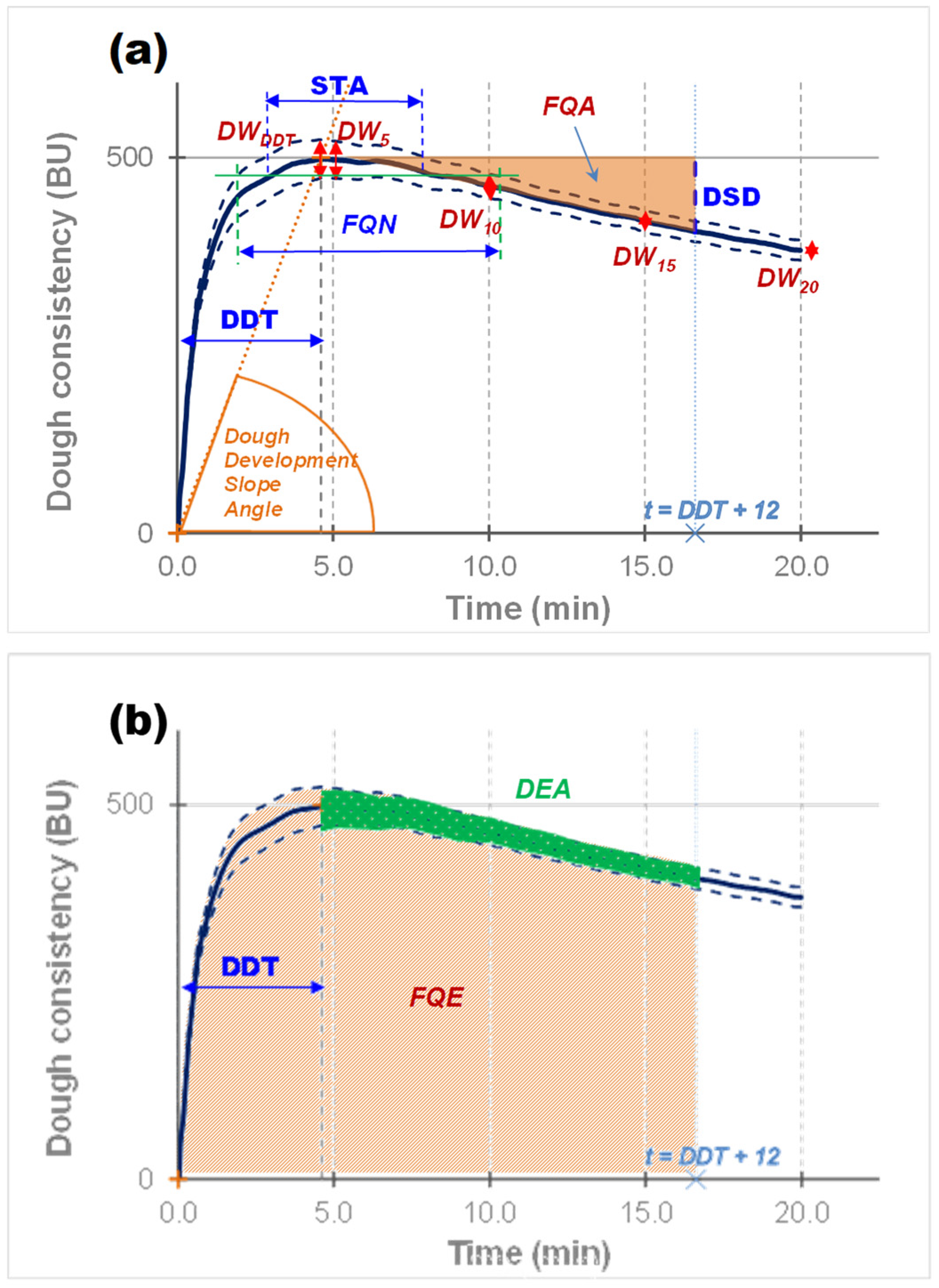
Standard Farinograph Parameters
- Water absorption (WAB, % of flour weight): Volume of water required to reach consistency 500 Brabender unit, BU.
- Dough development time (DDT, min): From the proof beginning, time to reach maximal consistency.
- Stability (STA, min): Time the curve remains above or at 500 BU.
- Dough softening degree (DSD, BU): Drop in the dough consistency 12 min after the DDT.

Kinetic Modeling of Dough Development
Time-Resolved Dough Elasticity (DWt and FELt)
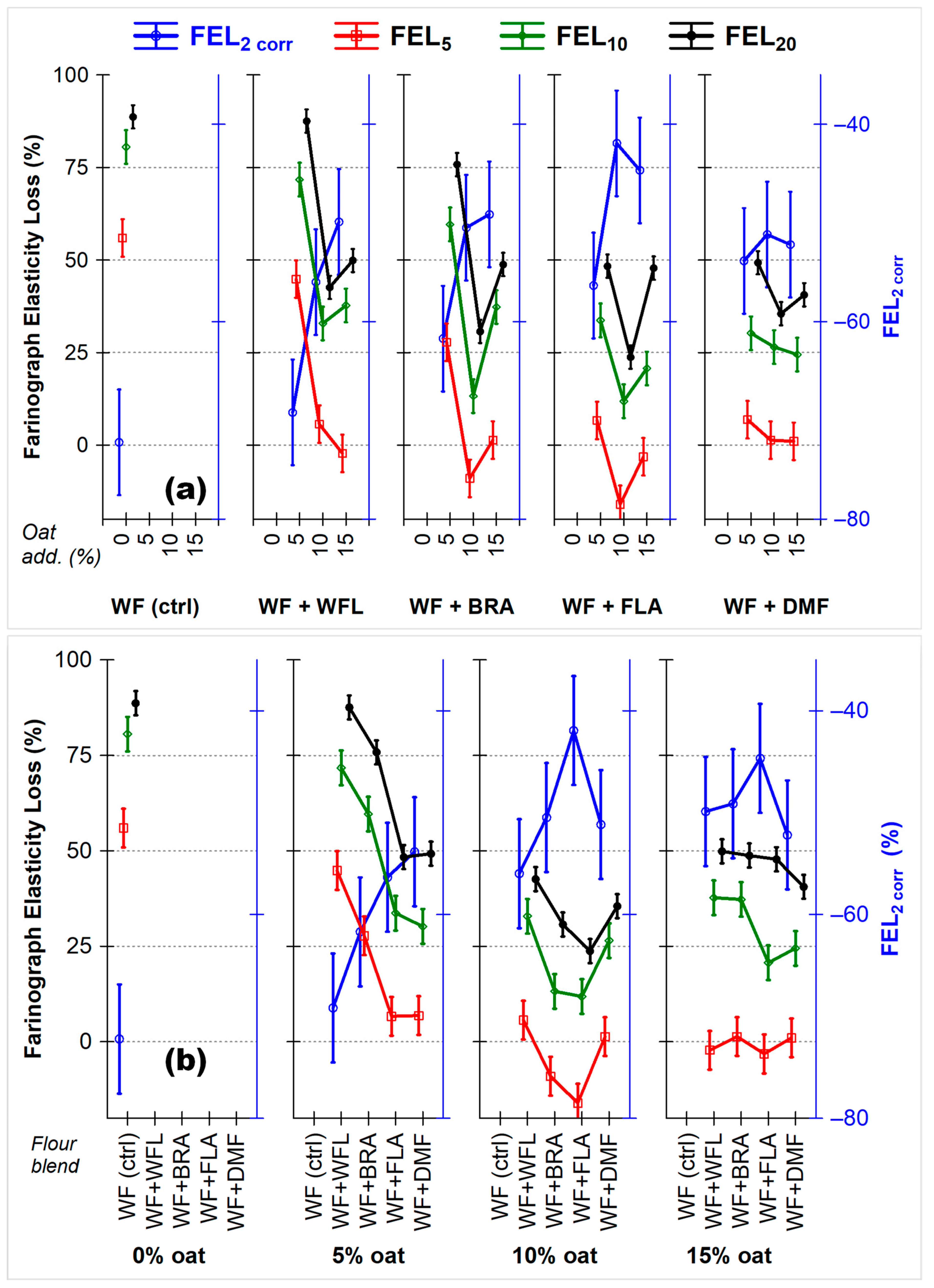
- Negative FEL index (≤0%): Indicates delayed hydration and slow dough development; optimal curve width is reached only after prolonged kneading.
- Low FEL index (0–15%): Represents superior elasticity and high gluten stability. The matrix resists mechanical stress, making the flour suitable for frozen-dough or long-fermentation processes.
- Medium FEL index (15–30%): Characteristic of standard bread-making wheat; structural weakening remains within acceptable bakery limits.
- High FEL index (>35%): Signifies rapid degradation of the gluten network and a transition to a predominantly plastic state. This results in reduced gas retention, lower loaf volume, and lateral spreading during baking.
- REt < 100% (pre-DDT): Pre-development stage with ongoing hydration.
- REt = 100% (at DDT): Point of peak elasticity and maximum structural integrity.
- REt < 100% (post-DDT): Signifies ‘gluten fatigue’ and progressive breakdown of the protein skeleton, often accompanied by the release of previously bound water.
Integrated Areas DEA and FQE
Pseudo-Loss Factor tan δ
- tan1 δ = DWDDT/STA: Describes network formation and overall quality.
- tan2 δ = DSD/STA: Reflects the breakdown phase.
2.2.3. Farinograph Quality Area (FQA)
2.2.4. Bread Preparation and Quality Evaluation
- Specific volume: Determined by the rapeseed displacement method (internal repeatability ±15 cm3·100 g−1).
- Shape descriptor (‘vaulting’, ’arching’): Measured using a digital caliper to determine the loaf height and diameter, enabling subsequent calculation of the height-to-diameter ratio (for standard wheat buns, the optimal range is 0.60–0.65).
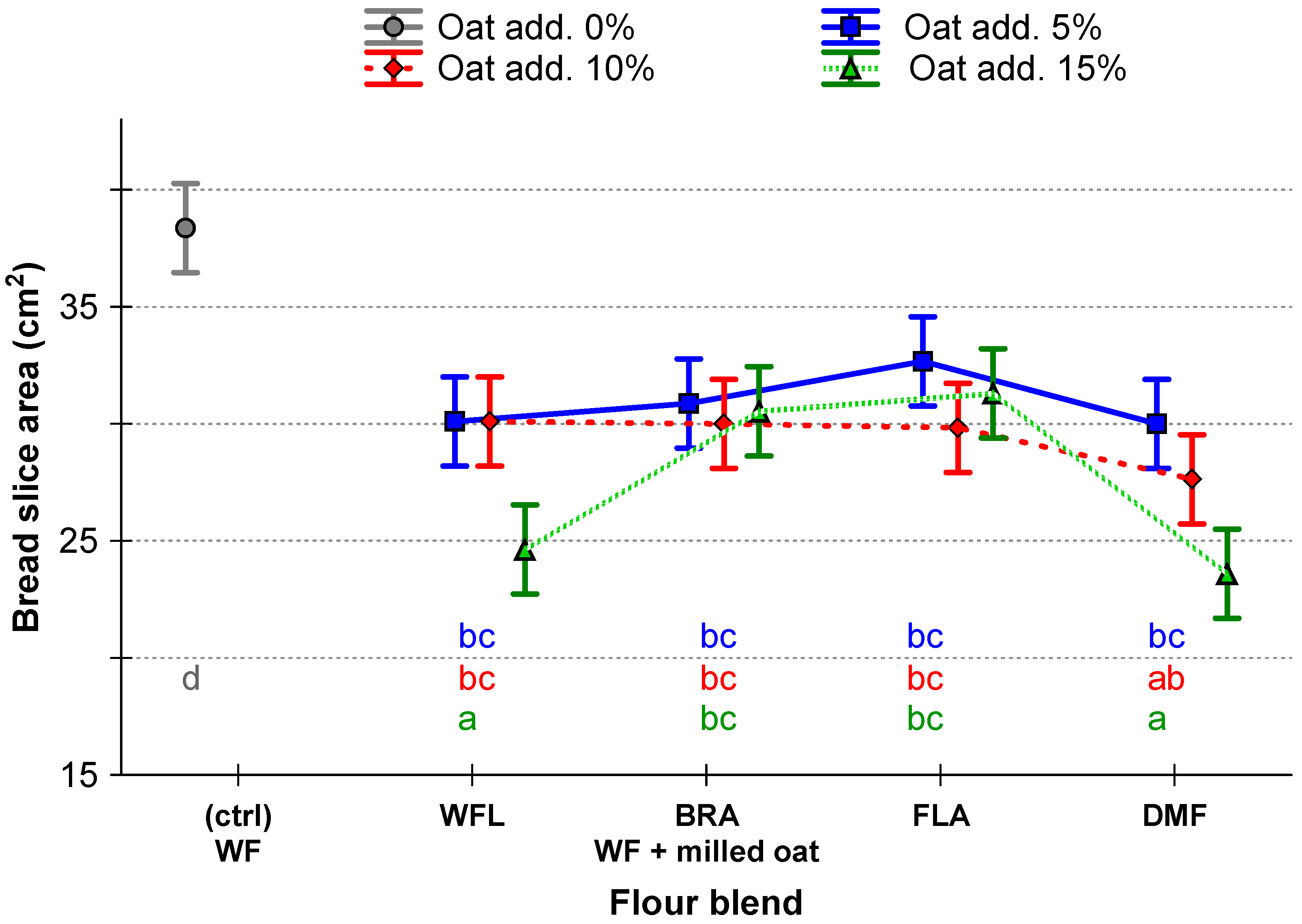
- Bread slice area: After the bread had cooled and after the above two characteristics had been measured, one bun from each variant was cut vertically with a finely serrated knife and scanned in a printed format on a standard office multifunction device at 200 × 200 dpi. The slice area was then determined using a digital planimeter Plancom KP-92N (Koizumi, Osaka, Japan; [46]).
2.2.5. Statistical Analysis
- Using the standard farinograph parameters (WAB, DDT, STA, DSD, FQA);
- Also incorporating the innovative characteristics (DW, FEL, DEA, FQE, Energy) to evaluate their discriminative power and their functionality in classifying the 13 tested samples.
3. Results
3.1. Analytical Characteristics of the Binary Blends Tested
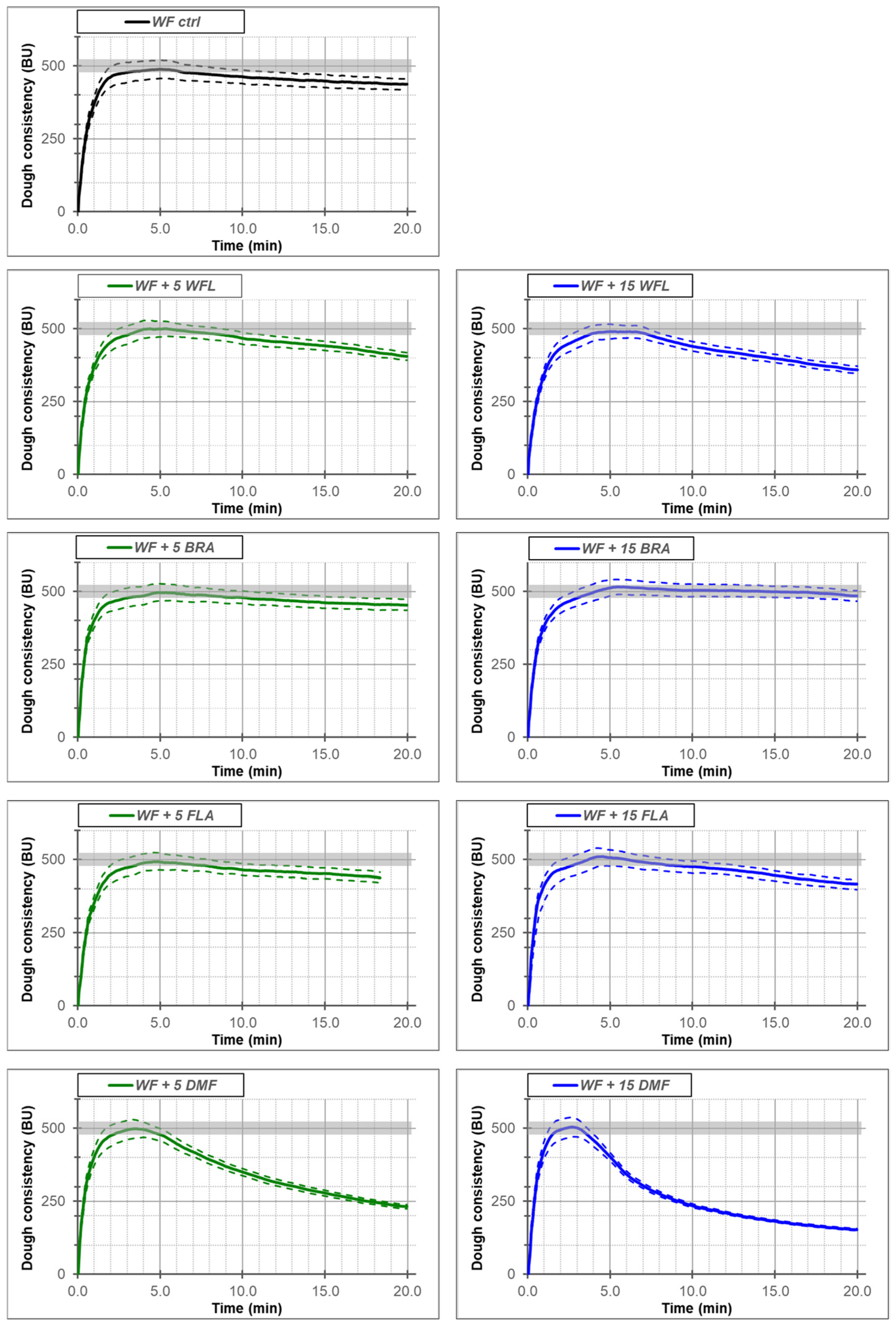
3.2. Farinograph Mixing Profile Under Four Forms of Milled Oat
3.3. Impact of Oat Forms on Standard Mixing Profiles and Network Stability
3.4. Time-Resolved Dough Width and Elasticity Kinetics
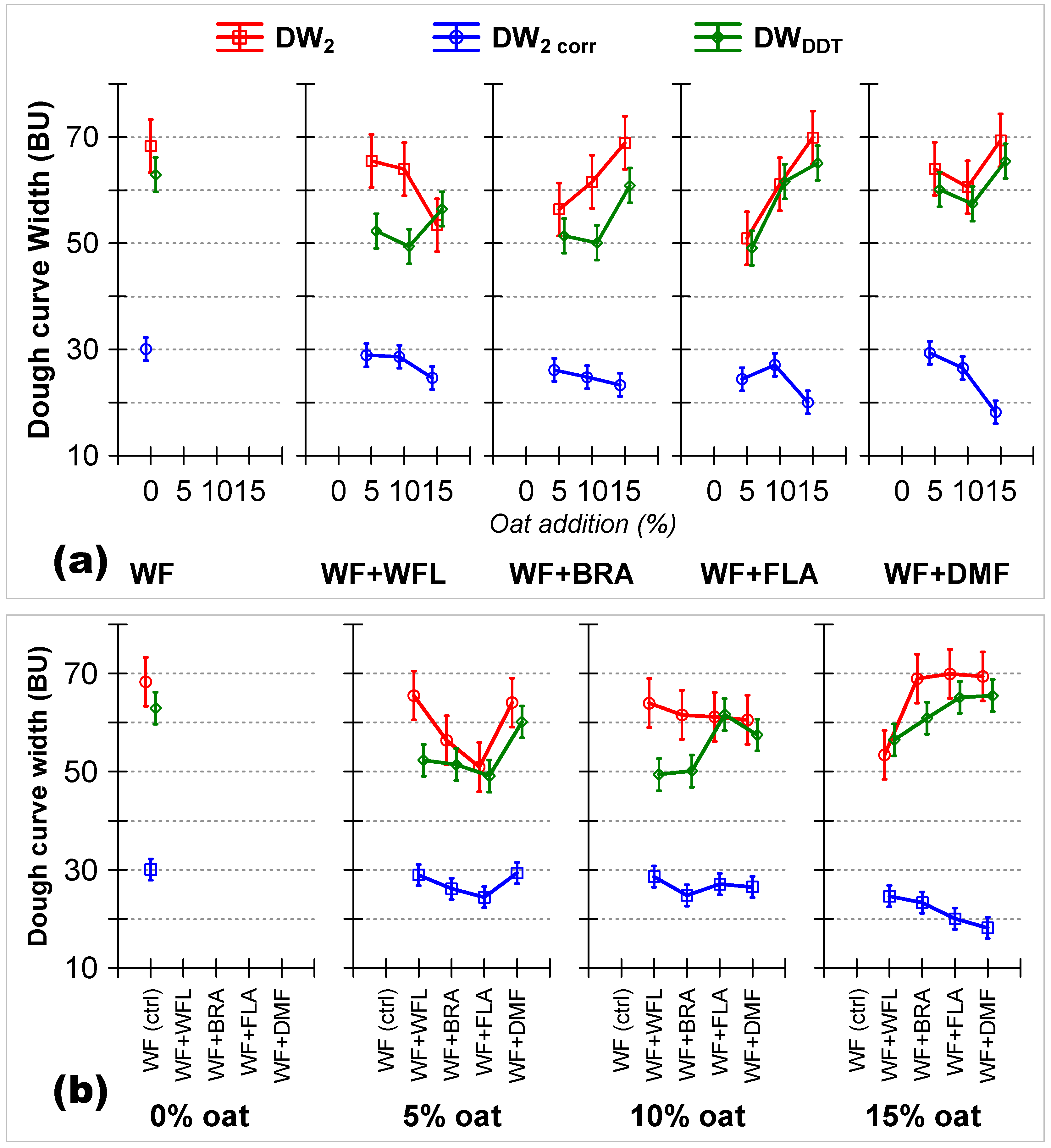
3.4.1. Dynamics of Dough Curve Width (DW)
- DW2 verified the potential to predict dough elasticity in optimum (DWDDT);
- Oat forms WFL, BRA, and FLA indicated a technological limit for wheat flour substitution close to 10 wt.%;
- At 5–10% substitution, wheat flour interacted with milled oat particles and partially buffered their weakening effect. At 15% substitution, oats in the forms of WFL and DMF exhibited the softest but most structurally destructive impact.

- High stability: WF, 10WFL, and 10FLA, all retaining 35–38 BU at 20 min.
- Moderate decline: All BRA blends and 15WFL, with DW20 values ranging from 15 to 29 BU.
- Severe degradation: 15FLA and 15DMF, where DW20 decreased to 8 BU and 7 BU, respectively.
3.4.2. Farinograph Elasticity Loss (FEL)
- WFL blends: Values remained moderate at 5% and 10%. A substantial rise in FEL across all time points was observed only at 15% substitution, indicating accelerated post-peak elastic decline.
- BRA blends: A ‘stabilizing window’ was identified at 10% substitution, where FEL reached a local minimum during the 5–20 min interval. At 15%, FEL increased due to intensified mechanical interference. This structural stability at the 10% level correlates with the previously observed maintenance of the Gluten Index (Table 1), suggesting that fiber-induced water competition only becomes detrimental to the protein network at higher substitution levels (15%).
- FLA blends: FEL increased almost linearly with substitution, showing a pronounced elevation of late-stage indices (FEL10, FEL20) at the 15% level.
- DMF blends: Exhibited the steepest rise in FEL across all substitution levels. The combination of strongly negative FEL2 corr and maximal late-stage FEL values (at 15% DMF) reflects a rapid structural collapse.
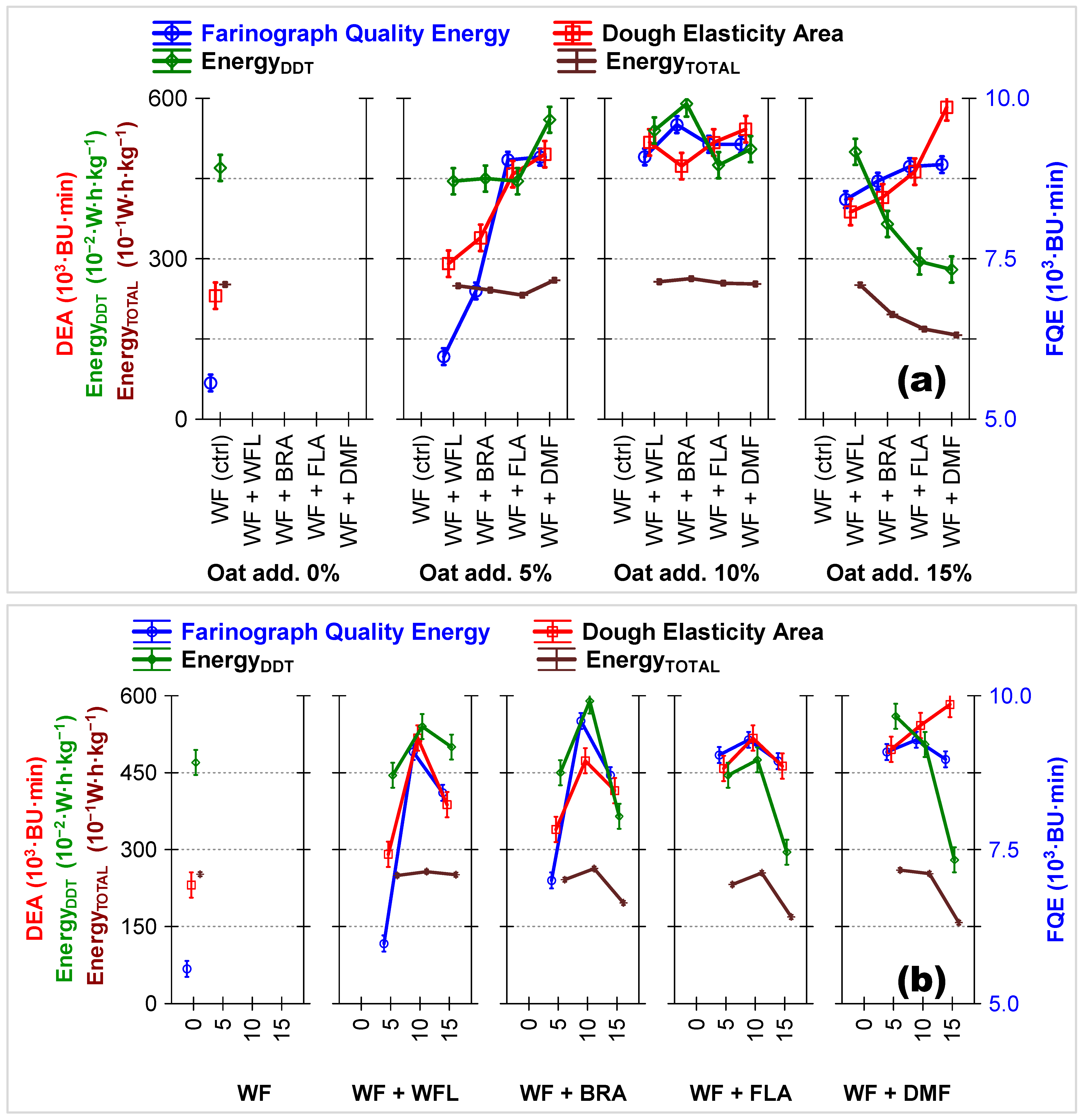
3.4.3. Integrated Areas and Energy Parameters
Energy Demand and Total Input (FQE)
3.5. Effect of Milled Oat on Laboratory Baking Trial Results
3.5.1. Specific Volume and Bread Geometry
3.5.2. Bread Slice Area
3.6. Statistical Relationships and Correlation Analysis
3.6.1. Effect of Variability Factors: F1—Oat Form and F2—Oat Addition Level
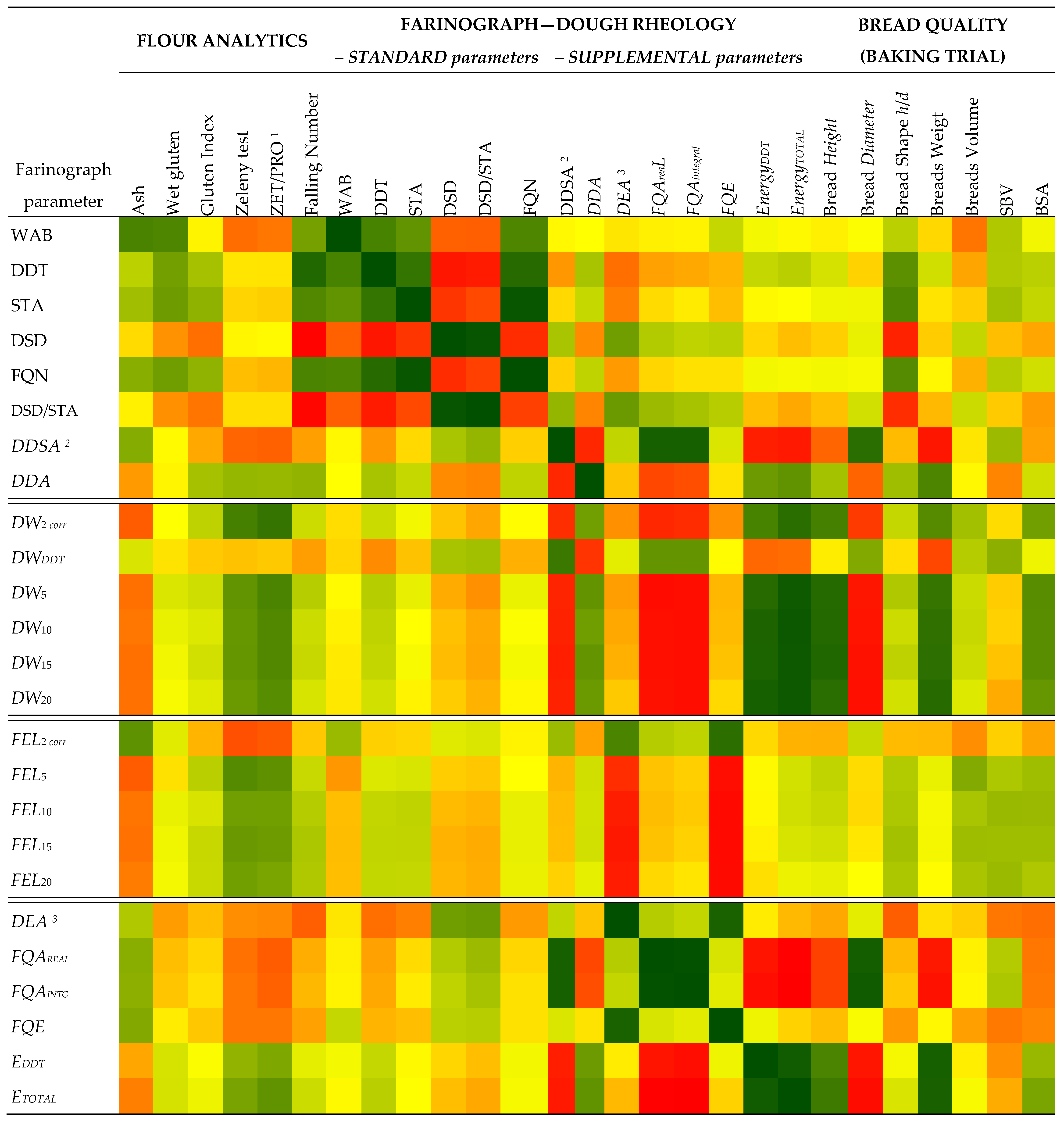
- Correlation analysis (Table 6) revealed that both the oat form (F1) and oat addition level (F2) significantly influenced the analytical flour quality, dough rheology, and bread characteristics. The comprehensive interrelationships between these parameters are visually summarized in the correlation heatmap (Figure 7), where distinct structural domains reflect the impact of oat fortification.
- Analytical parameters (Table 6a): The oat form (F1) was strongly negatively associated only with the Falling Number (r = −0.71 ***), reflecting the specific enzymatic activity of DMF. In contrast, the substitution level (F2) progressively increased the flour ash (r = 0.87 ***) and significantly reduced the protein quality indicators, such as the Zeleny test (r = −0.93 ***) and Gluten Index (r = −0.52 **).
- Standard farinograph parameters (Table 6b): These were more closely linked to the oat form than to the substitution level. F1 positively influenced DSD (r = 0.60 **) and the DSD/STA ratio (r = 0.62 ***), while showing negative relationships with DDT (r = −0.64 ***) and STA (r = −0.46 *). The substitution level (F2) primarily determined the water absorption (r = 0.51 **) and DDA (r = 0.64 ***).
- Supplementary descriptors (Table 6c): The innovative descriptors provided deeper mechanistic insights. Both F1 and F2 factors were highly negatively correlated with the dough curve width (DW2–DW20) and positively with farinograph quality energy (FQE; r = 0.71 *** and 0.61 ***, respectively). As indicated by the correlation heatmap (Figure 7), the progressive narrowing of the dough-width envelope (quantified via FEL) provides a high-resolution indicator of the transition from a viscoelastic to a predominantly plastic state. This kinetic descriptor offers a more sensitive diagnostic tool for structural fatigue than conventional stability metrics, particularly in systems where enzymatic activity or fiber interference disrupts the integrity of the gluten–starch matrix.
- Baking trial results (Table 6d): Both factors significantly impaired bread geometry. The Oat form (factor F1) showed the strongest negative impact on the specific bread volume (r = −0.54 **) and bread slice area (r = −0.61 ***). The oat addition level (factor F2) correlated negatively with the bread weight (r = −0.60 **) and bread height (r = −0.52 **).
3.6.2. Statistical Similarity and Descriptor Redundancy
3.6.3. Correlation Analysis and Statistical Similarity of 13 Tested Samples
|
|
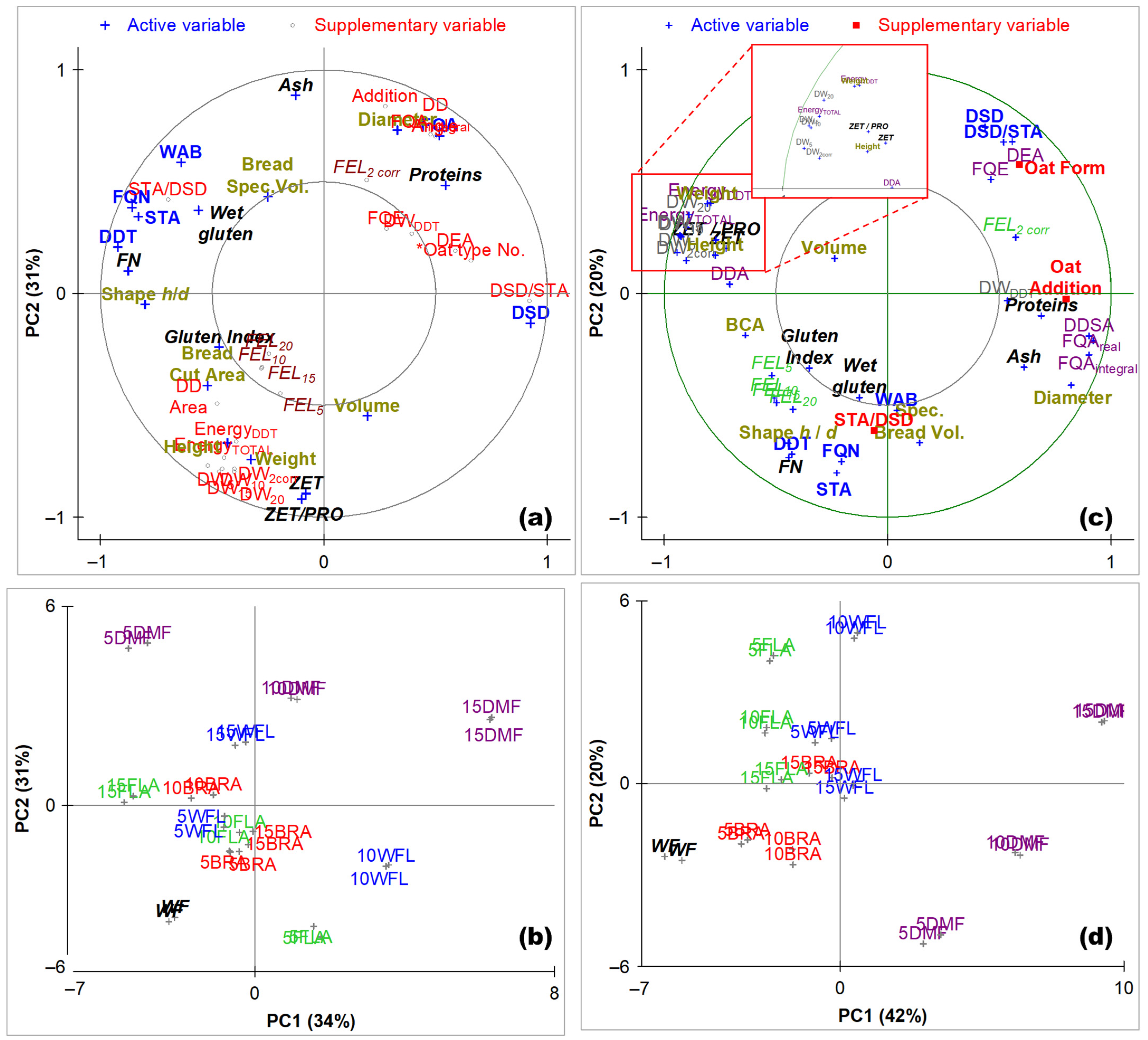
3.6.4. Data Exploration by Principal Components
PCA Based on the Standard Farinograph Features
PCA Based on the Extended Farinograph Profiles
4. Discussion
4.1. Nutritional Enrichment vs. Structural Integrity
4.2. Kinetics of Viscoelastic Degradation, DW, and FEL as Diagnostic Tools
4.3. The ‘Pseudostabilization’ Paradox of Oat Bran
4.4. Energy Demand and Processing Implications, FQE and DEA
Implications for Scale-Up
- First, adjustment of the formulation and kneading protocols for oat-fortified systems.
- →
- Second, the dough temperature should be controlled.
- →
- Limiting specific mechanical energy once FEL begins to increase steeply, preventing thermal acceleration of enzymatic softening. Since α-amylase activity is highly temperature-dependent (as reflected by the low Falling Number in Table 1), the frictional heat generated by the increased FQE requirement creates a synergistic effect that accelerates the matrix collapse [51].
- Third, controlled operation with enzyme-active blends is necessary.
- →
- A blend such as DMF may require shorter development times or targeted enzyme control (e.g., a thermal or pH-based one) to limit the exposure of the gluten–starch matrix to peak α-amylolytic and proteolytic activity (Table 1, Table 2, Table 3, Table 4 and Table 5; Figure 3, Figure 4, Figure 5 and Figure 8), which is consistent with observations that germination-derived enzymes amplify dough weakening under prolonged mechanical input [51,53].
4.5. Predictive Value of Non-Traditional Farinograph Indices DW, FEL, FQA, DEA, FQE
5. Conclusions
Supplementary Materials
Author Contributions
Funding
Institutional Review Board Statement
Informed Consent Statement
Data Availability Statement
Conflicts of Interest
Abbreviations
| WF | wheat flour |
| WFL | wholegrain oat flour |
| BRA | oat bran |
| FLA | oat flakes |
| DMF | diastatic malt flour (here, the oat one) |
| TDF | total dietary fiber |
| PRO | protein content |
| ZET | Zeleny sedimentation test and/or value (volume of the sediment) |
| WAB | (farinograph) water absorption |
| DDT | dough development time |
| STA | stability of dough consistency |
| DSD | dough softening degree |
| FQN | farinograph quality number |
| BU | Brabender unit |
| DW | dough (curve) width, evaluated at the defined times of the farinograph test (DW2, DWDDT, DW5, DW10, DW15, DW20) |
| DW2 corr | dough width at 2 min of the farinograph test, trigonometrically corrected |
| DDSA | dough development slope angle (alternatively αp) |
| DDA | dough development area |
| FEL | farinograph elasticity loss in relation to the dough elasticity at DDT, evaluated at the same 5 time-points of the farinograph test as the DW (when dough elasticity ≈ dough curve—farinogram width) |
| RE | relative elasticity |
| FQA | farinograph quality area |
| FQAREAL | farinograph quality area, calculated automatically by the company’s software Brabender MetaBridge® v. 3.4 |
| FQAINTEGRAL | farinograph quality area, integrated from the data series in MS Excel (BU·min) |
| DEA | dough elasticity area |
| FQE | farinograph quality energy, integrated from the data series in MS Excel (BU·min) |
| EnergyDDT | energy input from farinograph test beginning to DDT, recorded automatically by the company’s software, Brabender MetaBridge® v. 3.4 |
| EnergyTOTAL | total energy input through the entire farinograph test, recorded automatically by the company’s software, Brabender MetaBridge® v. 3.4 |
| G′ | storage modulus (elastic component) |
| G″ | loss modulus (viscous component) |
| tan δ | loss tangent (tangent of phase angle; G″/G′) |
| PCA | principal component analysis |
| ANOVA | analysis of variance |
| HSD | honestly significant difference |
| SBV | specific bread volume |
| BSA | bread slice area |
| h/d | height-to-diameter ratio of the small round bread (bread shape, ‘vaulting’) |
| AOAC | Association of Official Analytical Collaboration |
| AACC | American Association of Cereal Chemists |
| ICC | International Association for Cereal Science and Technology |
| ISO | International Organization for Standardization |
| MSZ | Hungarian National Standard |
References
- Borrelli, G.M.; Ficco, D.B.M. Cereals and Cereal-Based Foods: Nutritional, Phytochemical Characterization and Processing Technologies. Foods 2025, 14, 1234. [Google Scholar] [CrossRef]
- Nocente, F.; Gazza, L. Technological Development in Wholegrain Food Processing. Foods 2025, 14, 2009. [Google Scholar] [CrossRef]
- Paudel, D.; Dhungana, B.; Caffe, M.; Krishnan, P. A Review of Health-Beneficial Properties of Oats. Foods 2021, 10, 2591. [Google Scholar] [CrossRef]
- Qi, X.; Tester, R. The Health Benefits of Wheat versus Oats. Cereal Chem. 2024, 101, 926–936. [Google Scholar] [CrossRef]
- Klümpen, L.; Mantri, A.; Philipps, M.; Seel, W.; Schlautmann, L.; Yaghmour, M.H.; Wiemann, V.; Stoffel-Wagner, B.; Coenen, M.; Weinhold, L.; et al. Cholesterol-Lowering Effects of Oats Induced by Microbially Produced Phenolic Metabolites in Metabolic Syndrome: A Randomized Controlled Trial. Nat. Commun. 2026, 17, 598. [Google Scholar] [CrossRef] [PubMed]
- Reiners, S.; Hebestreit, S.; Wedekind, L.; Kiehntopf, M.; Klink, A.; Rummler, S.; Glei, M.; Lorkowski, S.; Schlörmann, W.; Dawczynski, C. Effect of a Regular Consumption of Traditional and Roasted Oat and Barley Flakes on Blood Lipids and Glucose Metabolism–A Randomized Crossover Trial. Front. Nutr. 2023, 10, 1095245. [Google Scholar] [CrossRef] [PubMed]
- Yang, Z.; Xie, C.; Bao, Y.; Liu, F.; Wang, H.; Wang, Y. Oat: Current State and Challenges in Plant-Based Food Applications. Trends Food Sci. Technol. 2023, 134, 56–71. [Google Scholar] [CrossRef]
- Xu, R.; Ye, H.; Zeng, D.; Zhang, H.; Xu, X.; Wu, F. Oat Flour and β-Glucan Regulate the Quality of Cereal Flour and Cereal Products: Unveiling Novel Physicochemical Insights with Future Perspectives. Int. J. Biol. Macromol. 2025, 307, 142362. [Google Scholar] [CrossRef]
- Astiz, V.; Guardianelli, L.M.; Salinas, M.V.; Brites, C.; Puppo, M.C. High β-Glucans Oats for Healthy Wheat Breads: Physicochemical Properties of Dough and Breads. Foods 2022, 12, 170. [Google Scholar] [CrossRef]
- Flander, L.; Salmenkallio-Marttila, M.; Suortti, T.; Autio, K. Optimization of Ingredients and Baking Process for Improved Wholemeal Oat Bread Quality. LWT-Food Sci. Technol. 2007, 40, 860–870. [Google Scholar] [CrossRef]
- Cappelli, A.; Oliva, N.; Cini, E. A Systematic Review of Gluten-Free Dough and Bread: Dough Rheology, Bread Characteristics, and Improvement Strategies. Appl. Sci. 2020, 10, 6559. [Google Scholar] [CrossRef]
- Kaukovirta-Norja, A.; Lehtinen, P. Traditional and Modern Oat-Based Foods. In Technology of Functional Cereal Products; Elsevier: Amsterdam, The Netherlands, 2008; pp. 215–232. [Google Scholar]
- Hüttner, E.K.; Bello, F.D.; Arendt, E.K. Rheological Properties and Bread Making Performance of Commercial Wholegrain Oat Flours. J. Cereal Sci. 2010, 52, 65–71. [Google Scholar] [CrossRef]
- Jurkaninová, L.; Švec, I.; Gavurníková, S.; Sluková, M.; Hozlár, P.; Havrlentová, M. Analytical Characterisation of Oat-Enriched Binary Composites of Wheat Flour and Their Processing Behaviour in Bread Making. Analytica 2026, 7, 10. [Google Scholar] [CrossRef]
- Londono, D.M.; Gilissen, L.J.W.J.; Visser, R.G.F.; Smulders, M.J.M.; Hamer, R.J. Understanding the Role of Oat β-Glucan in Oat-Based Dough Systems. J. Cereal Sci. 2015, 62, 1–7. [Google Scholar] [CrossRef]
- Azie, C.O.; Solomou, K.; Alyassin, M.; Campbell, G.M. Investigating Effects of Bran Particle Size on Dough Rheology Using a Modelling Approach Based on the Chopin Mixolab. J. Cereal Sci. 2026, 127, 104345. [Google Scholar] [CrossRef]
- Dai, B.; Yin, J.; Xu, H.; Zhang, Z.; Duan, Y.; Hu, K.; Cai, M.; Zhang, H. Impact of Sprouted Oat Flour on the Physicochemical Properties of Wheat Dough and the Quality Characteristics of Steamed Buns. J. Cereal Sci. 2026, 127, 104348. [Google Scholar] [CrossRef]
- Mäkinen, O.E.; Arendt, E.K. Oat Malt as a Baking Ingredient—A Comparative Study of the Impact of Oat, Barley and Wheat Malts on Bread and Dough Properties. J. Cereal Sci. 2012, 56, 747–753. [Google Scholar] [CrossRef]
- Sergiacomo, A.; Bresciani, A.; Gallio, F.; Varetto, P.; Marti, A. Sprouted Oats (Avena Sativa L.) in Baked Goods: From the Rheological Properties of Dough to the Physical Properties of Biscuits. Food Bioproc. Tech. 2024, 17, 4094–4105. [Google Scholar] [CrossRef]
- de Beer, T. Quality Assessment of Wheat Flour, Dough, and Bread. In ICC Handbook of 21st Century Cereal Science and Technology; Elsevier: Amsterdam, The Netherlands, 2023; pp. 225–233. [Google Scholar]
- Parenti, O.; Guerrini, L.; Mompin, S.B.; Toldrà, M.; Zanoni, B. The Determination of Bread Dough Readiness during Kneading of Wheat Flour: A Review of the Available Methods. J. Food Eng. 2021, 309, 110692. [Google Scholar] [CrossRef]
- Iacovino, S.; Trivisonno, M.C.; Messia, M.C.; Cuomo, F.; Lopez, F.; Marconi, E. Combination of Empirical and Fundamental Rheology for the Characterization of Dough from Wheat Flours with Different Extraction Rate. Food Hydrocoll. 2024, 148, 109446. [Google Scholar] [CrossRef]
- Sestili, F.; Yazar, G. Wheat Flour Quality Assessment by Fundamental Non-Linear Rheological Methods: A Critical Review. Foods 2023, 12, 3353. [Google Scholar] [CrossRef]
- Migliori, M.; Correra, S. Modelling of Dough Formation Process and Structure Evolution during Farinograph Test. Int. J. Food Sci. Technol. 2013, 48, 121–127. [Google Scholar] [CrossRef]
- Yazar, G.; Duvarci, O.; Tavman, S.; Kokini, J.L. Non-Linear Rheological Properties of Soft Wheat Flour Dough at Different Stages of Farinograph Mixing. Appl. Rheol. 2016, 26, 52508. [Google Scholar] [CrossRef]
- Yazar, G.; Duvarci, O.C.; Tavman, S.; Kokini, J.L. LAOS Behavior of the Two Main Gluten Fractions: Gliadin and Glutenin. J. Cereal Sci. 2017, 77, 201–210. [Google Scholar] [CrossRef]
- MSZ 6383:2012; Búzafinomliszt (Wheat Flour). MSZT: Budapest, Hungary, 2012.
- Della Valle, G.; Dufour, M.; Hugon, F.; Chiron, H.; Saulnier, L.; Kansou, K. Rheology of Wheat Flour Dough at Mixing. Curr. Opin. Food Sci. 2022, 47, 100873. [Google Scholar] [CrossRef]
- Suprabha Raj, A.; Badgujar, C.M.; Lollato, R.; Prasad, P.V.V.; Siliveru, K. Predicting Rheological Properties of Wheat Dough from Flour Properties Using NIR Coupled with Artificial Neural Network. J. ASABE 2024, 67, 1023–1035. [Google Scholar] [CrossRef]
- Bock, J.E. The Farinograph: Understanding Farinograph Curves. In The Farinograph Handbook; Elsevier: Amsterdam, The Netherlands, 2022; pp. 33–41. [Google Scholar]
- Miś, A.; Nawrocka, A.; Dziki, D. Behaviour of Dietary Fibre Supplements During Bread Dough Development Evaluated Using Novel Farinograph Curve Analysis. Food Bioproc. Tech. 2017, 10, 1031–1041. [Google Scholar] [CrossRef]
- Tudor, P.; Voicu, G.; Constantin, G.-A.; Stefan, E.-M.; Munteanu, M.-G.; Stefan, V. Aspects Regarding the Representation of Farinographic Curve to Assess Wheat Flour Dough by Mathematical Equations. INMATEH Agric. Eng. 2021, 64, 385–392. [Google Scholar] [CrossRef]
- ISO 5530-1:2013; Wheat Flour—Physical Characteristics of Doughs. ISO: Geneva, Switzerland, 2013.
- ISO 5529:2010; Wheat—Determination of the Sedimentation Index—Zeleny Test. ISO: Geneva, Switzerland, 2010.
- AACC Approved Method 38-12.01; Wet Gluten, Dry Gluten, Water-Binding Capacity, and Gluten Index. Cereals & Grains Association: St. Paul, MN, USA, 1999.
- AOAC. AOAC Official Method 925.10; AOAC: Rockville, MD, USA, 2023. [Google Scholar]
- AOAC International. AOAC Official Method 923.03: Ash of Flour; AOAC: Gaithersburg, MD, USA, 2023. [Google Scholar]
- AOAC. AOAC Official Method 991.43; AOAC: Rockville, MD, USA, 2023. [Google Scholar]
- AACC International. AACC Approved Method 38-12.02: Wet Gluten, Dry Gluten, Water Binding Capacity, and Gluten Index; AACC: St. Paul, MN, USA, 2011. [Google Scholar]
- Hellin, P.; Escarnot, E.; Mingeot, D.; Gofflot, S.; Sinnaeve, G.; Lateur, M.; Godin, B. Multiyear Evaluation of the Agronomical and Technological Properties of a Panel of Spelt Varieties under Different Cropping Environments. J. Cereal Sci. 2023, 109, 103615. [Google Scholar] [CrossRef]
- AACC International. AACC Approved Method 56-81.03: Determination of Falling Number; AACC: St. Paul, MN, USA, 2011. [Google Scholar]
- ICC 115/1; Method for Determination of the Water Absorption of Wheat Flour and of Rheological Properties of Doughs by Means of the Brabender Farinograph. ICC: Vienna, Austria, 1992.
- Stojceska, V.; Butler, F. Digitization of Farinogram Plots and Estimation of Mixing Stability. J. Cereal Sci. 2008, 48, 729–733. [Google Scholar] [CrossRef]
- Dobraszczyk, B.J.; Morgenstern, M.P. Rheology and the Breadmaking Process. J. Cereal Sci. 2003, 38, 229–245. [Google Scholar] [CrossRef]
- Hrušková, M.; Švec, I.; Jirsa, O. Correlation between Milling and Baking Parameters of Wheat Varieties. J. Food Eng. 2006, 77, 439–444. [Google Scholar] [CrossRef]
- Švec, I.; Hrušková, M. Image Analysis Testing of Bread with Non-Traditional Plant Raw Materials. In Proceedings of the 8th International Congress Flour—Bread; Koceva Komlenić, D., Jukić, M., Planinić, M., Hasenay, S., Lukinac Čačić, J., Eds.; Josip Juraj Strossmayer University of Osijek, Faculty of Food Technology Osijek: Osijek, Croatia, 2016; pp. 1–10. [Google Scholar]
- Wang, J.; Rosell, C.M.; Benedito de Barber, C. Effect of the Addition of Different Fibres on Wheat Dough Performance and Bread Quality. Food Chem. 2002, 79, 221–226. [Google Scholar] [CrossRef]
- Gan, Z.; Ellis, P.R.; Schofield, J.D. Gas Cell Stabilisation and Gas Retention in Wheat Bread Dough. J. Cereal Sci. 1995, 21, 215–230. [Google Scholar] [CrossRef]
- Noort, M.W.J.; van Haaster, D.; Hemery, Y.; Schols, H.A.; Hamer, R.J. The Effect of Particle Size of Wheat Bran Fractions on Bread Quality—Evidence for Fibre–Protein Interactions. J. Cereal Sci. 2010, 52, 59–64. [Google Scholar] [CrossRef]
- Bock, J.E.; Damodaran, S. Bran-Induced Changes in Water Structure and Gluten Conformation in Model Gluten Dough Studied by Fourier Transform Infrared Spectroscopy. Food Hydrocoll. 2013, 31, 146–155. [Google Scholar] [CrossRef]
- Naumenko, N.; Potoroko, I.; Kalinina, I.; Fatkullin, R.; Ivanisova, E. The Influence of the Use of Whole Grain Flour from Sprouted Wheat Grain on the Rheological and Microstructural Properties of Dough and Bread. Int. J. Food Sci. 2021, 2021, 7548759. [Google Scholar] [CrossRef]
- Ichinose, Y.; Takata, K.; Kuwabara, T.; Iriki, N.; Abiko, T.; Yamauchi, H. Effects of Increase in α-Amylase and Endo-Protease Activities during Germination on the Breadmaking Quality of Wheat. Food Sci. Technol. Res. 2001, 7, 214–219. [Google Scholar] [CrossRef]
- Al-Ansi, W.; Zhang, Y.; Alkawry, T.A.A.; Al-Adeeb, A.; Mahdi, A.A.; Al-Maqtari, Q.A.; Ahmed, A.; Mushtaq, B.S.; Fan, M.; Li, Y.; et al. Influence of Germination on Bread-Making Behaviors, Functional and Shelf-Life Properties, and Overall Quality of Highland Barley Bread. LWT 2022, 159, 113200. [Google Scholar] [CrossRef]
- Marti, A.; Cardone, G.; Pagani, M.A.; Casiraghi, M.C. Flour from Sprouted Wheat as a New Ingredient in Bread-Making. LWT 2018, 89, 237–243. [Google Scholar] [CrossRef]
- Zhou, Y.; Dhital, S.; Zhao, C.; Ye, F.; Chen, J.; Zhao, G. Dietary Fiber-Gluten Protein Interaction in Wheat Flour Dough: Analysis, Consequences and Proposed Mechanisms. Food Hydrocoll. 2021, 111, 106203. [Google Scholar] [CrossRef]
- Yazar, G.; Kokini, J.L.; Smith, B. Impact of Endogenous Lipids on Mechanical Properties of Wheat Gluten Fractions, Gliadin and Glutenin, under Small, Medium, and Large Deformations. Lipidology 2024, 1, 30–51. [Google Scholar] [CrossRef]
- Li, Z.; Gao, W.; Liang, J.; Fan, H.; Yang, Y.; Suo, B.; Ai, Z. Mechanism Underlying the Weakening Effect of β-Glucan on the Gluten System. Food Chem. 2023, 420, 136002. [Google Scholar] [CrossRef]
- Wang, L.; Ye, F.; Li, S.; Wei, F.; Chen, J.; Zhao, G. Wheat Flour Enriched with Oat β -Glucan: A Study of Hydration, Rheological and Fermentation Properties of Dough. J. Cereal Sci. 2017, 75, 143–150. [Google Scholar] [CrossRef]
- Skendi, A.; Papageorgiou, M.; Biliaderis, C.G. Effect of Barley β-Glucan Molecular Size and Level on Wheat Dough Rheological Properties. J. Food Eng. 2009, 91, 594–601. [Google Scholar] [CrossRef]
- Diósi, G.; Móré, M.; Sipos, P. Role of the Farinograph Test in the Wheat Flour Quality Determination. Acta Univ. Sapientiae Aliment. 2015, 8, 104–110. [Google Scholar] [CrossRef]



| Flour Blend | Oat Add. (%) | Flour Ash (%) | Wet Gluten (%) | Total Dietary Fiber (%) | Gluten Index (1) | Zeleny Test (mL) | ZET/PRO 1 (1) | Falling Number (s) | |||||||
|---|---|---|---|---|---|---|---|---|---|---|---|---|---|---|---|
| WF | 0 | 0.70 | a | 34.9 | e | 3.45 | a | 97 | c | 40 | f | 2.69 | f | 482 | f |
| WF + WFL | 5 | 0.77 | b | 33.2 | c | 3.71 | abc | 97 | c | 38 | ef | 2.58 | ef | 439 | cd |
| 10 | 0.83 | c | 32.1 | bh | 3.92 | abcd | 92 | c | 36 | cd | 2.41 | cd | 431 | cd | |
| 15 | 0.90 | de | 42.3 | h | 4.31 | bcdef | 54 | a | 34 | ab | 2.35 | bc | 420 | c | |
| WF + BRA | 5 | 0.81 | c | 36.6 | f | 4.18 | abcde | 96 | c | 37 | cd | 2.46 | cd | 467 | ef |
| 10 | 0.93 | f | 36.5 | f | 5.90 | jkl | 97 | c | 35 | bc | 2.35 | bc | 469 | ef | |
| 15 | 1.02 | g | 41.1 | g | 6.56 | kl | 93 | c | 33 | a | 2.23 | a | 448 | de | |
| WF + FLA | 5 | 0.76 | b | 33.6 | cd | 3.69 | ab | 99 | c | 38 | de | 2.51 | de | 469 | ef |
| 10 | 0.84 | c | 33.5 | c | 4.11 | abcde | 95 | c | 35 | bc | 2.41 | cd | 439 | cd | |
| 15 | 0.91 | ef | 33.4 | c | 4.50 | cdef | 95 | c | 34 | ab | 2.28 | ab | 453 | de | |
| WF + DMF | 5 | 0.76 | b | 33.8 | cde | 3.63 | ab | 92 | c | 40 | f | 2.68 | f | 270 | b |
| 10 | 0.82 | c | 34.5 | de | 3.95 | abcd | 75 | b | 36 | cd | 2.47 | d | 214 | a | |
| 15 | 0.88 | d | 30.0 | a | 4.38 | bcdef | 74 | b | 34 | ab | 2.25 | ab | 196 | a | |
| Flour Blend | Oat Add. (%) | WAB 1 (wt.%) | DDSA 2 | DDT 3 (min) | STA 4 (min) | DSD 5 (BU) | FQN 6 (mm) | DSD/STA 7 Index (1) | |||||||
|---|---|---|---|---|---|---|---|---|---|---|---|---|---|---|---|
| WF | 0 | 56.5 | bc | 64° | bcd | 4.80 | bc | 7.30 | f | 47 | bc | 103 | e | 6.4 | abc |
| WF + WFL | 5 | 57.6 | e | 62° | abc | 5.40 | cde | 6.05 | de | 76 | d | 97 | de | 12.6 | abcd |
| 10 | 58.8 | g | 59° | a | 4.80 | bc | 5.31 | cd | 100 | e | 93 | cde | 18.7 | cd | |
| 15 | 59.9 | h | 66° | de | 5.10 | bcde | 4.69 | c | 111 | f | 83 | c | 23.7 | d | |
| WF + BRA | 5 | 57.3 | de | 64° | bcd | 5.05 | bcd | 8.30 | g | 40 | b | 130 | f | 4.8 | ab |
| 10 | 59.2 | g | 61° | ab | 5.95 | e | 8.35 | g | 17 | a | 163 | g | 2.0 | a | |
| 15 | 61.0 | i | 70° | ef | 5.75 | de | 13.05 | h | 21 | a | 197 | h | 1.6 | a | |
| WF + FLA | 5 | 57.3 | de | 63° | abcd | 4.65 | bc | 6.35 | e | 48 | bc | 104 | e | 7.5 | abc |
| 10 | 58.3 | f | 65° | cd | 4.60 | bc | 5.25 | cd | 58 | c | 94 | cde | 11.0 | abcd | |
| 15 | 58.8 | g | 73° | fg | 4.45 | b | 4.62 | c | 75 | d | 87 | cd | 16.3 | bcd | |
| WF + DMF | 5 | 56.9 | cd | 63° | abcd | 3.55 | a | 3.41 | b | 223 | g | 55 | b | 65.2 | e |
| 10 | 56.2 | ab | 66° | cd | 3.00 | a | 2.35 | a | 292 | h | 42 | a | 124.7 | f | |
| 15 | 55.8 | a | 75° | g | 2.75 | a | 2.15 | a | 321 | i | 37 | a | 149.2 | g | |
| Flour Blend | Oat Add. (%) | DW2 corr (BU) | DWDDT (BU) | DW5 (BU) | DW10 (BU) | DW15 (BU) | DW20 (BU) | ||||||
|---|---|---|---|---|---|---|---|---|---|---|---|---|---|
| WF | 0 | 30 | d | 63 | cd | 62 | i | 48 | h | 44 | i | 37 | e |
| WF + WFL | 5 | 29 | cd | 52 | ab | 54 | def | 41 | fg | 33 | fg | 27 | cd |
| 10 | 29 | cd | 49 | a | 57 | fgh | 43 | fg | 40 | h | 38 | e | |
| 15 | 25 | bcd | 56 | abc | 53 | de | 37 | e | 31 | ef | 29 | d | |
| WF + BRA | 5 | 26 | cd | 51 | a | 51 | de | 32 | d | 29 | de | 26 | cd |
| 10 | 25 | bcd | 50 | a | 55 | efg | 43 | fg | 39 | h | 35 | e | |
| 15 | 23 | abc | 61 | cd | 44 | c | 25 | c | 19 | c | 15 | b | |
| WF + FLA | 5 | 24 | bcd | 49 | a | 50 | d | 30 | d | 28 | d | 25 | c |
| 10 | 27 | cd | 62 | cd | 58 | gh | 41 | fg | 38 | h | 35 | e | |
| 15 | 20 | ab | 65 | d | 36 | b | 18 | b | 11 | b | 8 | a | |
| WF + DMF | 5 | 29 | d | 60 | bcd | 59 | hi | 44 | gh | 39 | h | 39 | e |
| 10 | 27 | cd | 57 | abcd | 53 | def | 40 | ef | 34 | g | 29 | d | |
| 15 | 18 | a | 65 | d | 29 | a | 13 | a | 8 | a | 7 | a | |
| Flour Blend | Oat Add. (%) | Variable Group | |||||||||||||
|---|---|---|---|---|---|---|---|---|---|---|---|---|---|---|---|
| ① | ② | ③ | ④ | ||||||||||||
| 1 FQAREAL (cm2) | 2 FQAINTEGRAL (BU·min) | 2 DEA (BU·min) | 1 EnergyDDT (W·h·kg−1) | 2 DDA (BU·min) | 1 EnergyTOTAL (W·h·kg−1) | 2 FQE (BU·min) | |||||||||
| WF | 0 | 4 | cd | 393 | bc | 231 | a | 4.70 | c | 362 | ab | 25.20 | ef | 5565 | a |
| WF + WFL | 5 | 5 | de | 444 | bc | 291 | ab | 4.45 | c | 370 | ab | 24.95 | ef | 5975 | b |
| 10 | 2 | ab | 198 | ab | 518 | fg | 5.40 | de | 427 | b | 25.70 | fg | 9087 | fg | |
| 15 | 5 | de | 340 | bc | 388 | cd | 5.00 | cd | 322 | ab | 25.10 | ef | 8424 | d | |
| WF + BRA | 5 | 6 | ef | 529 | c | 339 | bc | 4.50 | c | 384 | ab | 24.15 | de | 6999 | c |
| 10 | 1 | a | 13 | a | 473 | ef | 5.90 | e | 385 | ab | 26.30 | g | 9591 | h | |
| 15 | 24 | g | 1560 | d | 415 | de | 3.65 | b | 317 | ab | 19.60 | c | 8711 | de | |
| WF + FLA | 5 | 8 | f | 602 | c | 458 | ef | 4.45 | c | 439 | b | 23.20 | d | 9038 | efg |
| 10 | 4 | bcd | 341 | bc | 517 | fg | 4.75 | c | 358 | ab | 25.45 | fg | 9284 | gh | |
| 15 | 38 | h | 2165 | e | 463 | ef | 2.95 | a | 273 | a | 16.85 | b | 8939 | ef | |
| WF + DMF | 5 | 3 | abc | 232 | ab | 496 | fg | 5.60 | de | 336 | ab | 26.00 | fg | 9085 | fg |
| 10 | 5 | de | 336 | bc | 542 | gh | 5.05 | cd | 349 | ab | 25.30 | fg | 9285 | gh | |
| 15 | 46 | i | 2499 | f | 583 | h | 2.80 | a | 243 | a | 15.75 | a | 8968 | efg | |
| Flour Blend | Oat Add. (%) | Specific Bread Volume (cm3·100 g−1) | Bread Shape h/d Ratio 1 (1) | Bread Slice Area (cm2) | |||
|---|---|---|---|---|---|---|---|
| WF | 0 | 330 | ef | 0.66 | g | 38.37 | d |
| WF + WFL | 5 | 317 | def | 0.47 | bcdef | 30.10 | bc |
| 10 | 283 | abc | 0.45 | abcde | 30.10 | bc | |
| 15 | 312 | cdef | 0.44 | abcd | 24.63 | a | |
| WF + BRA | 5 | 289 | bcd | 0.57 | fg | 30.87 | bc |
| 10 | 287 | bc | 0.55 | defg | 30.00 | bc | |
| 15 | 333 | f | 0.57 | fg | 30.53 | bc | |
| WF + FLA | 5 | 255 | a | 0.57 | fg | 32.67 | bc |
| 10 | 293 | bcd | 0.56 | efg | 29.83 | bc | |
| 15 | 313 | cdef | 0.53 | cdef | 31.30 | bc | |
| WF + DMF | 5 | 267 | ab | 0.43 | abc | 30.00 | bc |
| 10 | 285 | abc | 0.35 | ab | 27.63 | ab | |
| 15 | 301 | cde | 0.33 | a | 23.60 | a | |
| (a) Analytical features of flour | |||||||
| Variable | Ash | Wet Gluten | Gluten Index | Zeleny Test (ZET) | ZET/PRO 1 | Falling Number | |
| F1—Oat Form | 0.12 ns | −0.38 ns | −0.10 ns | −0.17 ns | 0.13 ns | −0.71 *** | |
| F2—Oat Addition | 0.87 *** | 0.24 ns | −0.52 ** | −0.93 *** | −0.59 ** | −0.24 ns | |
| (b) Standard farinograph parameters of dough | |||||||
| Variable | Water Absorption | Dough Development Slope Angle | Dough Development Time (DDT) | Stability (of Dough Consistency; STA) | Quality Ratio DSD/STA | Dough Softening Degree | Farinograph Quality Number |
| Oat Form | −0.27 ns | 0.39 * | −0.64 *** | −0.46 * | 0.62 *** | 0.60 ** | −0.41 * |
| Oat Addition | 0.51 ** | 0.64 *** | −0.08 ns | −0.07 ns | 0.27 ns | 0.22 ns | 0.02 ns |
| (c) Supplementary farinograph features of dough | |||||||
| (ca) Dough Curve Width | |||||||
| Variable | DW2 corr 2 | DWDDT | DW5 | DW10 | DW15 | DW20 | |
| Oat Form | −0.45 * | 0.21 ns | −0.45 * | −0.45 * | −0.44 * | −0.36 ns | |
| Oat Addition | −0.72 *** | 0.32 ns | −0.67 *** | −0.62 *** | −0.66 *** | −0.61 *** | |
| (cb) Farinograph elasticity loss | |||||||
| Variable | FEL2 corr 2 | FEL5 | FEL10 | FEL15 | FEL20 | ||
| Oat Form | −0.41 * | −0.45 * | −0.45 * | −0.44 * | −0.36 ns | ||
| Oat Addition | −0.65 *** | −0.67 *** | −0.62 *** | −0.66 *** | −0.61 *** | ||
| (cc) Farinograph areas and energies | |||||||
| Variable | Dough Development Area | EnergyDDT | Dough Elasticity Area | FQAREAL | FQAINTEGRAL | EnergyTOTAL | Farinograph Quality Energy |
| Oat Form | −0.31 ns | −0.21 ns | 0.80 *** | 0.37 ns | 0.34 ns | −0.34 ns | 0.71 *** |
| Oat Addition | −0.54 ** | −0.44 ** | 0.55 ** | 0.61 *** | 0.58 ** | −0.58 ** | 0.61 *** |
| (d) Bread features | |||||||
| Variable | Bread Height h | Bread Diameter d | Bread Shape h/d | Breads Weight 2 | Breads Volume 2 | Specific Bread Volume | Bread Slice Area |
| Oat Form | −0.45 * | 0.32 ns | −0.54 ** | −0.16 ns | −0.03 ns | −0.54 ** | −0.61 *** |
| Oat Addition | −0.52 ** | 0.50 ** | −0.43 * | −0.60 ** | −0.53 ** | 0.23 ns | −0.42 * |
| Variable (N = 36) | WF | 5WFL, 5BRA, 5FLA, 5DMF | 10WFL, 10BRA, 10FLA, 10DMF | 15WFL, 15BRA, 15FLA, 15DMF |
|---|---|---|---|---|
| WF | – | min. 0.99420, max. 0.99963 | min. 0.99308, max. 0.99431 | min. 0.99244, max. 0.99527 |
| 5WFL 5BRA 5FLA 5DMF | min. 0.99420, max. 0.99963 | min. 0.99663, max. 0.99957 | min. 0.99577, max. 0.99994 | min. 0.99529, max. 0.99993 |
| 10WFL 10BRA 10FLA 10DMF | min. 0.99308, max. 0.99431 | min. 0.99577, max. 0.99994 | min. 0.99885, max. 0.99998 | min. 0.99851, max. 0.99991 |
| 15WFL 15BRA 15FLA 15DMF | min. 0.99244, max. 0.99527 | min. 0.99529, max. 0.99993 | min. 0.99851, max. 0.99991 | min. 0.99847, max. 0.99986 |
| Variable (N = 36) | 15DMF | 15FLA | 15BRA | 15WFL | 10DMF | 10FLA | 10BRA | 10WFL | 5DMF | 5FLA | 5BRA | 5WFL |
|---|---|---|---|---|---|---|---|---|---|---|---|---|
| WF | 65% | 68% | 69% | 67% | 66% | 67% | 66% | 67% | 67% | 68% | 73% | 84% |
| 5WFL | 69% | 72% | 73% | 71% | 70% | 71% | 70% | 71% | 71% | 72% | 77% | |
| 5BRA | 74% | 83% | 84% | 81% | 75% | 81% | 80% | 81% | 78% | 83% | ||
| 5FLA | 78% | 90% | 88% | 88% | 79% | 91% | 88% | 90% | 82% | |||
| 5DMF | 85% | 83% | 80% | 82% | 89% | 83% | 80% | 84% | ||||
| 10WFL | 80% | 89% | 85% | 88% | 81% | 96% | 87% | |||||
| 10BRA | 77% | 86% | 86% | 87% | 78% | 89% | ||||||
| 10FLA | 79% | 89% | 86% | 88% | 80% | |||||||
| 10DMF | 89% | 80% | 78% | 80% | ||||||||
| 15WFL | 79% | 88% | 86% | |||||||||
| 15BRA | 77% | 88% | 60–70% | 70–80% | 80–90% | 90–100% | ||||||
| 15FLA | 79% |
Disclaimer/Publisher’s Note: The statements, opinions and data contained in all publications are solely those of the individual author(s) and contributor(s) and not of MDPI and/or the editor(s). MDPI and/or the editor(s) disclaim responsibility for any injury to people or property resulting from any ideas, methods, instructions or products referred to in the content. |
© 2026 by the authors. Licensee MDPI, Basel, Switzerland. This article is an open access article distributed under the terms and conditions of the Creative Commons Attribution (CC BY) license.
Share and Cite
Švec, I.; Jurkaninová, L.; Gavurníková, S.; Havrlentová, M. Kinetics of Wheat–Oat Dough Degradation Under Non-Traditional Farinographic Parameters Linked to Baking Trial Results. Appl. Sci. 2026, 16, 5043. https://doi.org/10.3390/app16105043
Švec I, Jurkaninová L, Gavurníková S, Havrlentová M. Kinetics of Wheat–Oat Dough Degradation Under Non-Traditional Farinographic Parameters Linked to Baking Trial Results. Applied Sciences. 2026; 16(10):5043. https://doi.org/10.3390/app16105043
Chicago/Turabian StyleŠvec, Ivan, Lucie Jurkaninová, Soňa Gavurníková, and Michaela Havrlentová. 2026. "Kinetics of Wheat–Oat Dough Degradation Under Non-Traditional Farinographic Parameters Linked to Baking Trial Results" Applied Sciences 16, no. 10: 5043. https://doi.org/10.3390/app16105043
APA StyleŠvec, I., Jurkaninová, L., Gavurníková, S., & Havrlentová, M. (2026). Kinetics of Wheat–Oat Dough Degradation Under Non-Traditional Farinographic Parameters Linked to Baking Trial Results. Applied Sciences, 16(10), 5043. https://doi.org/10.3390/app16105043