Review

A Review of Synergistic Acoustic Mechanisms in Porous Media: Microfluidic Insights for Geo-Energy Applications


Ocean College, Zhejiang University, Zhoushan 316021, China
*
Author to whom correspondence should be addressed.
Appl. Sci. 2026, 16(10), 4949; https://doi.org/10.3390/app16104949
Submission received: 30 March 2026 / Revised: 9 May 2026 / Accepted: 14 May 2026 / Published: 15 May 2026
(This article belongs to the Section Fluid Science and Technology)

Abstract

Geothermal energy extraction, hydrocarbon recovery, and CO2 geological sequestration are frequently hindered by interfacial barriers and slow mass transfer. While high-power ultrasound offers a sustainable, purely physical method for reservoir stimulation, its field effectiveness remains debated because traditional macroscopic experiments fail to isolate mechanisms like acoustic streaming and cavitation. This review systematically examines acoustic mechanisms in porous media via microfluidic visualization, focusing on pore-scale fluid dynamics during enhanced oil recovery, hydrate dissociation, and CO2 sequestration. Microscopic evidence reveals that fluid transport mechanisms depend heavily on pore geometry and local acoustic intensity. In wider channels, nonlinear acoustic flow provides sustained, directed convection to strip away concentration boundary layers; in narrow throats, microjets and pulsed stresses generated by transient cavitation are responsible for physically breaking capillary barriers. The spatiotemporal synergy of these mechanisms is critical for multiphase fluid transport in tight porous networks. Pore geometry serves not only as the application context but also as a core physical variable. To translate microfluidic results into reservoir-scale applications, future research must address two-dimensional simplifications, thermodynamic discrepancies under high-temperature and high-pressure conditions, and bubble cluster interactions, alongside the development of adaptive frequency-modulated control and multiscale computational models.

1. Introduction

The sustainable development of geo-energy systems—encompassing hydrocarbon recovery, geothermal energy extraction, natural gas hydrate production, and CO2 geological sequestration—faces a widespread bottleneck of interfacial barriers and slow mass transfer rates.
Whether recovering residual crude oil, extracting natural gas hydrates, or conducting CO2 geological sequestration, these processes are severely constrained by interfacial barriers and slow mass transfer rates [1]. Traditional solutions to overcome these capillary and diffusion limitations rely heavily on injecting a large volume of chemical reagents, such as surfactants and polymers. However, driven by increasingly stringent environmental regulations, the industry urgently requires cleaner, sustainable alternatives.
High-power ultrasound has emerged as a highly promising green enhanced recovery technology [2]. Relying entirely on physical wave dynamics, acoustic intervention can alter in-situ fluid mechanics without introducing any polluting chemical additives [3], offering an environmentally benign pathway for reservoir stimulation [4,5]. This review focuses on pore-scale microfluidic visualization evidence rather than core-scale or field-scale outcomes, identified through searches of Web of Science and Scopus using terms including ‘acoustic streaming porous media’, ‘microfluidic cavitation EOR’, ‘ultrasound hydrate dissociation’, and ‘acoustic CO2 mass transfer’, with priority given to quantitative visualization studies.
Although near-wellbore acoustic stimulation has been field-tested since the 1960s [6], highly variable outcomes have sustained an ongoing debate regarding its macroscopic efficacy [7]. While production increases following ultrasonic treatment have been reported across reservoir lithologies [8,9], numerous field trials have simultaneously yielded negligible or statistically insignificant response [10]. Laboratory core-flooding experiments generally confirmed that acoustic irradiation improves displacement efficiency [11]; however, the magnitude of improvement varies significantly, and optimal operating conditions lack reproducibility across independent studies [12,13]. While geological heterogeneity partially explains this inconsistency, the fundamental challenge remains unresolved: the underlying physical mechanisms have yet to be definitively established.
Because traditional core-flooding experiments only measure macroscopic recovery at the outlet, they cannot isolate the specific physical mechanisms responsible for improved yield. When a sandstone plug saturated with crude oil is placed in an acoustic field and oil recovery increases, that observation is compatible with at least three distinct phenomena. Acoustic oscillations could have temporarily reduced oil viscosity by disrupting asphaltene aggregation, improving the mobility ratio [12]. The wave propagation could have generated steady acoustic streaming—a time-averaged flow that advects fluid through the pore network without requiring an additional pressure gradient [14]. Alternatively, if the local acoustic pressure exceeded the nucleation threshold, transient cavitation could have generated microsecond pressure pulses sufficient to detach oil ganglia from pore walls held by capillary forces [15]. These are not merely variants of a single mechanism; they predict entirely different frequency dependencies, power thresholds, responses to pore geometry, and optimal operating conditions.
This mechanistic ambiguity extends to acoustic applications beyond oil recovery. Research on ultrasound-assisted methane hydrate dissociation documents large reductions in nucleation induction time and substantial increases in gas conversion rate [16]. However, the relative contributions of cavitation-induced nucleation, acoustic streaming-enhanced mass transfer, and simple thermal effects from probe heating are rarely decoupled in the bulk experimental data. Studies of CO2 dissolution in a saline aquifer face a similar situation: while improved dissolution rates are easily measured [17], the physical link between acoustic power input and the mass transfer coefficient has not been systematically characterized across operating conditions.
Over the past fifteen years, microfluidic platforms have revolutionized this field by enabling direct, pore-scale visualization of fluid dynamics during acoustic excitation [18]. Etched glass chips with controlled pore geometries, PDMS channels with throat widths down to tens of micrometers, and high-speed cameras operating at tens of thousands of frames per second have collectively produced a body of visual evidence previously unavailable [19,20,21]. It is now possible to observe, in real time, how a bubble collapses near a pore throat and subsequent interfacial deformation [22]; how a streaming vortex develops around an oscillating gas inclusion and its convective reach into the surrounding pore space [23]; and how asphaltene deposits respond to vibration over time [13,24]. These direct observations replace drawn inferences from bulk data, allowing researchers to specifically map which mechanism operates under distinct thermodynamic and geometric conditions [25].
Crucially, the accumulated visualization evidence suggests that the dominant fluid mechanism is not fixed by frequency or power alone but shifts fundamentally depending on the geometry of confinement and local acoustic intensity [26]. In wide channels under mild excitation, the response is primarily driven by acoustic streaming [14,27]. However, as pore throats narrow and local acoustic pressure intensifies, the fluid response transitions. Bubble dynamics become heavily nonlinear [28], and bubble collapse in confined geometries concentrates energy differently than in unconfined liquid—the surrounding walls restrict the asymmetric rebound [29], directing high-velocity microjets into the solid-fluid interface rather than dissipating energy radially [30].
This critical transition from vibration-dominated to cavitation-dominated behavior, and its profound dependence on pore geometry [31], is the central thread of this review. Because these regimes frequently overlap with the heterogeneous pore size distribution of real reservoir rocks, understanding their spatiotemporal synergy is essential. Section 2 establishes the physical framework for acoustic mechanisms in porous media—progressing from linear poroelastic effects and molecular-scale viscosity changes to nonlinear streaming and transient cavitation dynamics—with particular emphasis on how confinement modifies behavior at each level. Section 3 then draws on microfluidic visualization studies across three distinct geo-energy applications to evaluate how direct pore-scale observation bridges the gap between theoretical mechanisms and macroscopic reservoir phenomena.
The evidence reviewed in Section 3 operates on two distinct levels. A universal finding holds across all three geo-energy domains: pore geometry and local acoustic intensity jointly determine the dominant mechanism. Streaming governs transport in wide, low-intensity environments; cavitation governs rupture at tight, high-intensity constrictions. Each domain further imposes constraints specific to its own thermodynamic and interfacial conditions, including viscoelastic suppression in heavy crude, diffusion-limited water-film growth in hydrates, and resonance-frequency shift in supercritical CO2. Results grounded in these domain-specific conditions should not be extrapolated to other systems without targeted validation.

2. Acoustic Mechanisms in Porous Media

2.1. Linear Acoustic Mechanisms

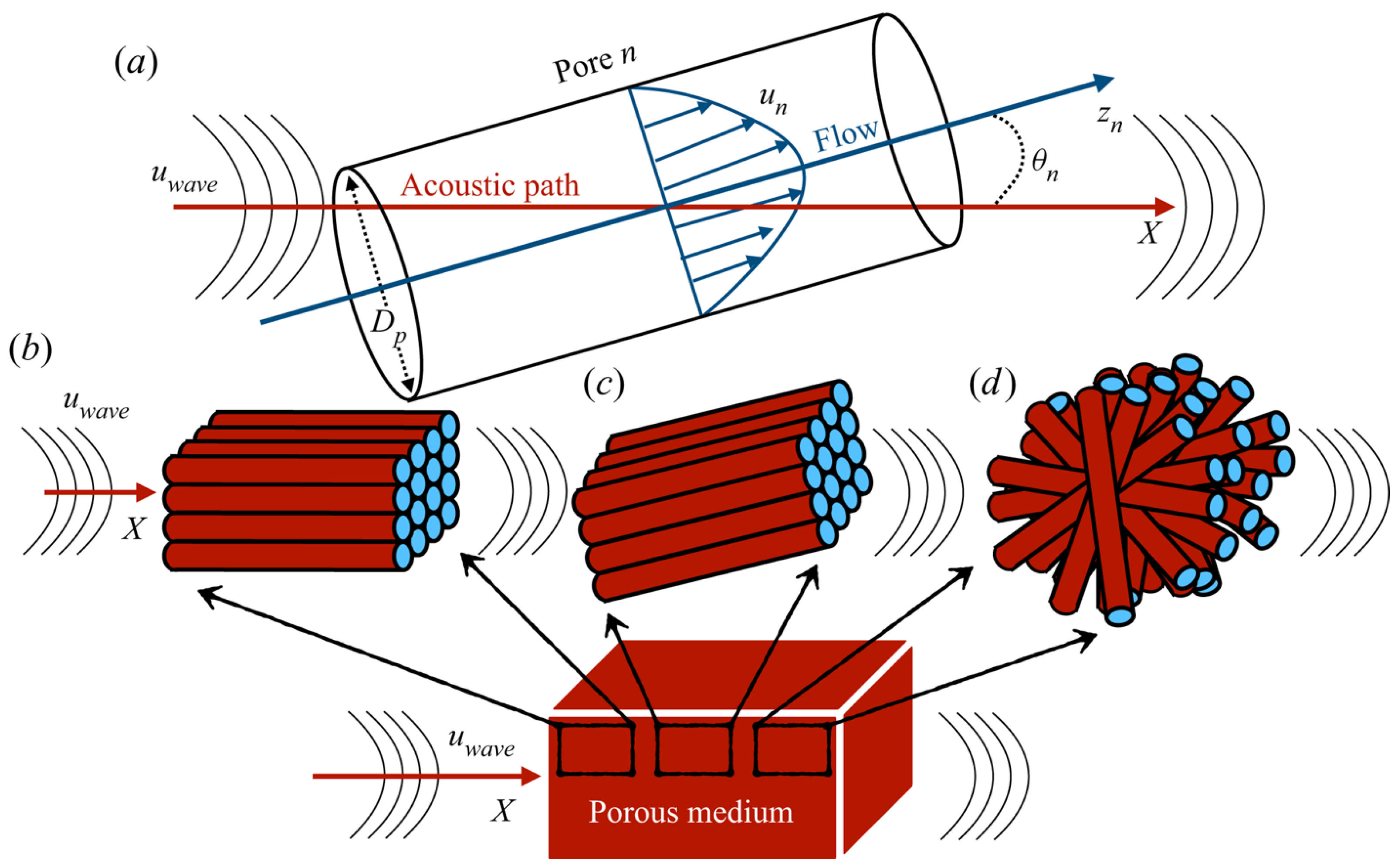
In the linear acoustic regime, ultrasound operates below the transient cavitation threshold, and the primary mechanical response manifests as reversible solid-fluid relative motion [32]. When an elastic wave traverses a porous skeleton, the inherent mismatch in compressibility and inertia between the solid matrix and the saturating fluid establishes an oscillating pressure gradient [33]. This gradient induces periodic relative displacement and micro-seepage without triggering interfacial rupture. Within this regime, the acoustic energy is primarily partitioned and exchanged reversibly among framework strain energy, fluid kinetic energy, and viscous dissipation, as schematically illustrated in Figure 1 [14].
While classical poroelasticity assumes a smooth, continuous transition from low-frequency viscous-dominated flow to high-frequency inertial-dominated flow [2], the geometric heterogeneity of real geological formations fundamentally complicates this idealized dispersive framework. Specifically, the assumption of isolated single-scale relaxation breaks down in multiscale porous networks. Sun et al. [34] proposed, using the BIPS (Biot, inter-patch, and squirt) model, that fluid redistribution mechanisms are not strictly frequency-segregated. Instead, macroscopic Biot wave-induced flow, mesoscopic inter-patch pressure equilibration, and microscopic squirt flow—the transverse injection of fluid from compliant micro-fractures into stiffer main pores—can be activated simultaneously under a single acoustic excitation. This theoretical overlap was subsequently validated by Shi et al. [35] using broadband sandstone experiments. Their results demonstrate that across the ultrasonic spectrum, the system remains in a continuously oscillating, non-equilibrium state characterized by intense local phase lags, rather than approaching the quasi-static pressure equilibrium assumed in simplified models.
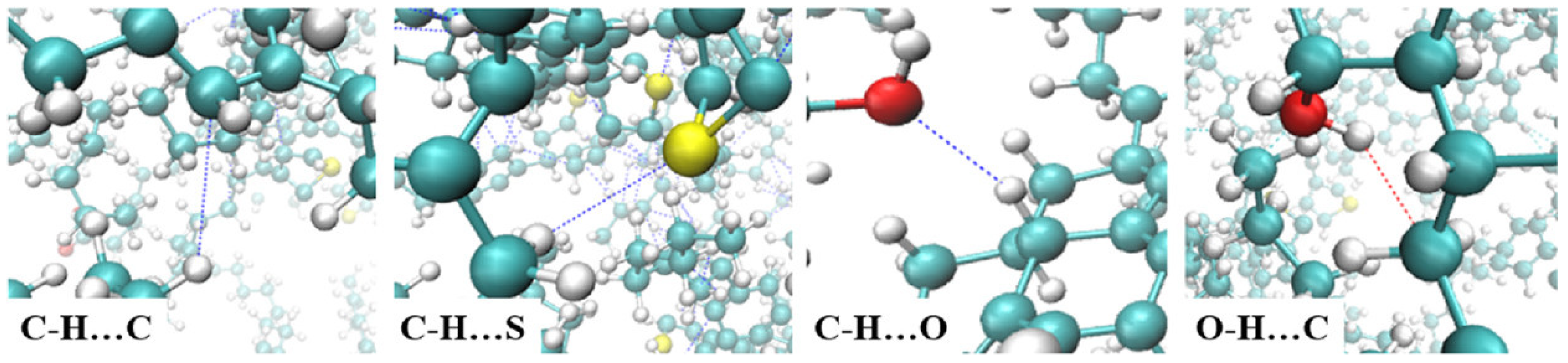
At the microstructural and molecular levels, this sustained mechanical oscillation drives reversible rheological rearrangement in complex fluids. While Razavifar et al. [12] visually demonstrated that acoustic shear and oscillatory stresses temporarily reduce the characteristic size of heavily entangled asphaltene aggregates, Zhang et al. [27] elucidated the underlying molecular origin. Molecular dynamics simulations reveal that this viscosity reduction arises from acoustic perturbation of the hydrogen bond network, which redistributes occupancy states and shortens the lifetime of intermolecular interactions, without inducing irreversible covalent bond cleavage. Figure 2 illustrates the hydrogen bond configurations between heavy oil and viscosity reducer molecules underlying this reversible disruption mechanism.
The persistence of this acoustically altered state is, however, strongly dependent on ambient conditions. Although Qajar et al. [36] observed a rapid viscosity recovery to the initial unperturbed state once the acoustic field was removed, Nguele and Okawa [37] demonstrated that the final amplitude of this rebound is strictly modulated by ambient gas saturation and acoustic frequency. This indicates that linear acoustic intervention constitutes a dynamic mechanical equilibrium deeply coupled to the fluid’s immediate thermodynamic environment, rather than a permanent structural modification of the pore fluid.

2.2. Nonlinear Acoustic Regime

As the intensity of the applied acoustic field increases, the small-perturbation assumption breaks down, and the nonlinear convective acceleration term in the Navier–Stokes equations ceases to average to zero over a wave cycle [33]. This generates a non-negligible second-order Reynolds stress. After periodic time-averaging, this stress manifests as an effective body force, transforming the originally time-symmetric reciprocal oscillations into directed steady streaming [38]. Manor et al. [14] demonstrated, through mathematical homogenization of the local drift velocity into an equivalent macroscopic Darcy flow, theoretically proving that steady net transport could be established without an external pressure gradient. However, this upscaling approximation inherently assumes a stable Stokes regime and a geometrically invariant permeability tensor [28]. Dubrovski et al. [28] challenged this linear extrapolation by demonstrating that when the local oscillatory Reynolds number exceeds Re_osc = 10, the unidirectional decoupling between the acoustic wave field and the mean flow breaks down entirely. Under these conditions, strong bidirectional coupling causes momentum transport to deviate entirely from classical low-Reynolds-number scaling laws [39], rendering macroscopic Darcy equivalents invalid.
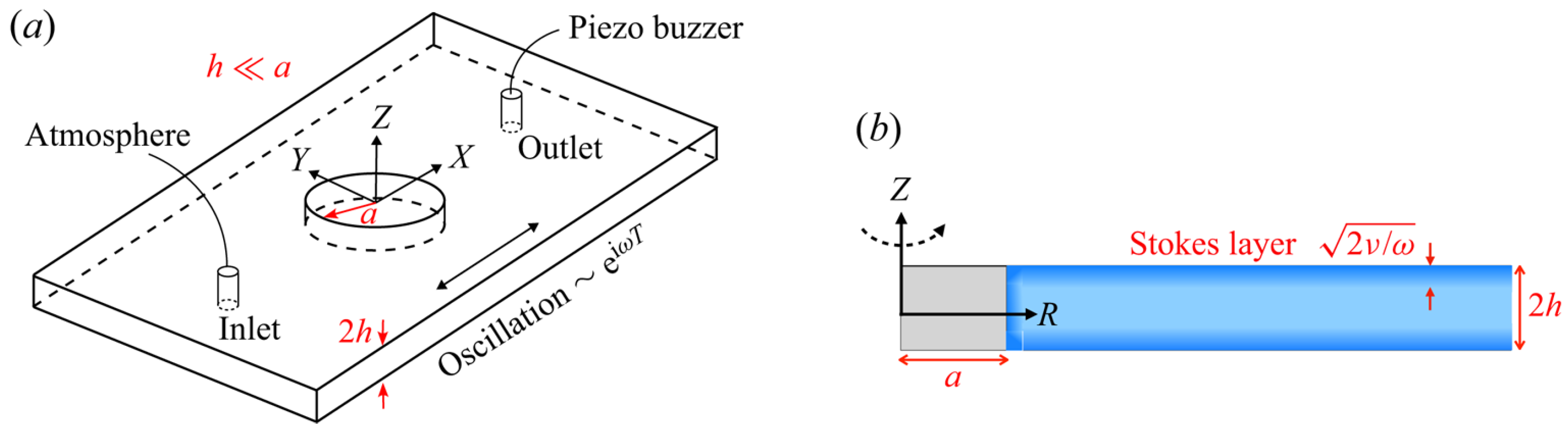
Furthermore, the spatial homogeneity assumed in traditional volume-averaging is disrupted by local pore topology, which enforces a distinct spatial partitioning of streaming modes. Kolesnik et al. [40] observed the coexistence of boundary-layer shear-driven Rayleigh streaming and attenuation-driven Eckart streaming in diffraction fields. Rayleigh streaming is highly dependent on local wall curvature: vorticity generated at the solid boundary diffuses into the bulk, driving inner and outer recirculation vortices within a thickness scaling with δ v = 2 ν / ω (viscous boundary layer thickness). In contrast, Eckart streaming is governed by the direct dissipation of acoustic momentum into the bulk fluid, scaling with the body-wave attenuation coefficient. This spatial partitioning implies that in strongly attenuating media—such as high-viscosity heavy oil reservoirs—Eckart streaming dominates long-range transport in the primary channels, while Rayleigh streaming governs near-wall advective mixing.
The topological complexity of the solid framework further intensifies this spatial inhomogeneity. Zhong et al. [41] proved that when the characteristic pore curvature radius R c approaches the viscous boundary layer thickness δ v , momentum flux is no longer smoothly distributed. Instead, it becomes intensely localized at geometric constrictions, inducing strong centrifugal jets. The abrupt curvature change forces momentum dissipation to rearrange within an extremely narrow confined space, resulting in a nonlinear amplification of the local time-averaged velocity as R c / δ v increases. Additionally, given that natural fracture apertures can extend to the millimeter scale, three-dimensional flow topology often dominates. Consequently, two-dimensional depth-averaged experimental projections inherently obscure the flow reversal occurring along the transverse axis [42], and this omission can introduce order-of-magnitude errors when extrapolating laboratory microfluidic results to the reservoir scale. Figure 3 demonstrates this three-dimensional flow complexity, showing how the theory predicts flow reversal across the channel depth—a feature entirely masked in 2D imaging.
The fluid constitutive behavior introduces a final layer of complexity that classical theories fail to capture. In contrast to Newtonian assumptions, Vargas et al. [43] established that in viscoelastic fluids—governed by the dimensionless Deborah number D e = λ ω (where λ is the fluid relaxation time and ω is the angular frequency)—the competition between elastic energy storage and viscous dissipation dictates the boundary layer dynamics. When the relaxation time of the fluid approaches the acoustic period, elastic resistance strongly opposes the establishment of steady shear. As a result, steady streaming theories derived for Newtonian, water-based systems cannot reliably predict the non-monotonic flow intensities and modified vortex topologies observed in heavy viscoelastic crude oils.

2.3. Transient Cavitation Dynamics

The onset of transient cavitation transitions the dominant mechanism from time-averaged momentum transport to impulse-driven inertial collapse [44]. Based on the Harvey nuclei model, heterogeneous nucleation is strictly constrained by the crevice radius and the local contact angle. Sviridov et al. [44] experimentally confirmed this geometric dependence, demonstrating that mesoporous particles with specific nanoscale surface roughness serve as preferential cavitation nucleation sites. However, Saint-Michel et al. [45] demonstrated that this geometric nucleation picture fails in yield-stress fluids (e.g., cement paste or heavy oil), where macroscopic yield stress and plastic viscosity drastically increase high-frequency attenuation. Rather than acting as passive hosts, such viscoplastic systems exert rheological suppression sufficient to prevent gas nuclei from reaching the inertial collapse threshold.
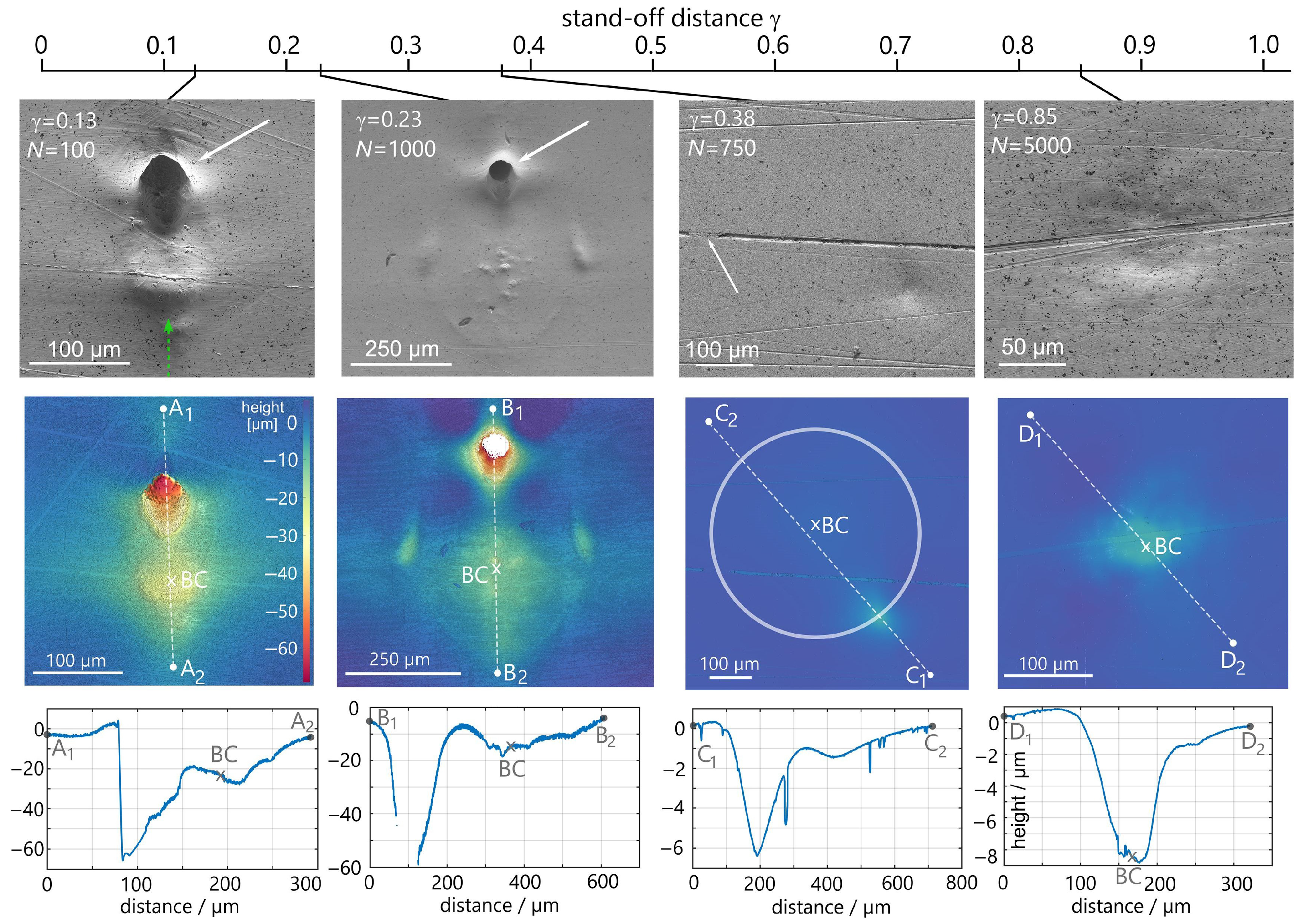
For nuclei that survive and undergo inertial collapse near a solid boundary, the assumption of spherical symmetry breaks down. Zeng et al. [30] identified the dimensionless stand-off distance γ = d / R max (where d is the distance from the bubble center to the wall and R max is the maximum bubble radius) as the primary control parameter governing topological inversion. When γ < 1, a high-speed microjet (150–300 m/s) is driven toward the wall [46]. Reuter et al. [47] extended this model by revealing that the subsequent rebound phase radiates pressure pulses capable of spatial self-focusing within tight pore geometries. Figure 4 illustrates how the stand-off distance governs the transition between needle jet and regular jet regimes.
Ultimately, transient cavitation in porous media operates as a spatially localized, impulsive forcing mechanism [15,48,49]. Instead of relying on a time-averaged permeability shift, this impulsive forcing physically ruptures the static meniscus of the non-wetting phase and replaces the diffusion-limited near-wall region with intense advective mixing.

2.4. Synergistic Mechanisms in Confined Spaces

In the confined architecture of porous media, no single acoustic mechanism operating in isolation is sufficient to achieve effective fluid mobilization [50,51]. While steady acoustic streaming excels at providing continuous convective flux to strip concentration boundary layers over extended distances [52], its time-averaged viscous forcing lacks the stress extrema required to overcome capillary pinning or yield-stress barriers at pronounced geometric constrictions. Conversely, while transient cavitation delivers the requisite impulsive loads to rupture static menisci [53], its spatial footprint is confined to the vicinity of the collapse event, rendering it incapable of sustaining macroscopic transport. Effective phase redistribution and fluid mobilization therefore require multi-scale synergistic coupling: the long-range advective transport driven by nonlinear streaming must be integrated with the discontinuous impulsive forcing of transient cavitation.
Under a volume-averaged framework, the streaming component of this synergy is organized into directional convection governed by a Darcy-type momentum balance [54]. In soft porous matter, compressibility-mediated transport pathways remain operative even when Darcy resistance suppresses conventional pressure-driven streaming. This continuous driving force sustains directed mass transfer, displacing suspended species beyond the diffusion-limited regime without requiring an external pressure gradient.
Conversely, the cavitation component in confined pores is governed by geometric volume restriction, which thereby modifies the classical Blake threshold instability. Leonov and Akhatov [26] established that in a rigid microscopic cell, bubble expansion couples directly into compression of the surrounding liquid. This confinement limits the unbounded explosive growth characteristic of bulk liquids, restricting the bubble to an abrupt expansion toward a finite radius. Consequently, the confined bubble acts not as a source of long-range volumetric expansion, but as a spatially anchored in-situ micro-pump.
Eventually, effective ultrasonic fluid mobilization in tight porous networks arises from the spatiotemporal complementarity of these two mechanisms. Steady streaming continuously disrupts local concentration boundary layers and advects mobilized phases along the pore walls, while transient cavitation ruptures yield-stress barriers and capillary bridges at geometric constrictions. Together, this integration of steady convective transport and transient localized impact establishes the critical mechanical pathway for multiphase flow enhancement. Table 1 summarizes the multiscale acoustic mechanisms discussed above, organized by increasing acoustic intensity.

3. Microfluidic Visualization Across Geo-Energy Scenarios

3.1. Liquid–Liquid Interfaces: Overcoming Capillary Barriers in EOR

The studies reviewed below span direct microfluidic visualization, bulk reactor experiments, and mechanistic models. Core-scale and field-scale outcomes are included only where they directly support or challenge the pore-scale picture. Unless noted otherwise, the cited results were obtained at ambient temperature and near-atmospheric pressure in idealized 2D geometries. Their quantitative transferability to reservoir conditions should be assessed alongside the scaling limitations identified in Section 4.
Residual oil trapped in pore throats following conventional waterflooding represents a recoverable resource several times greater than that accessible through primary and secondary recovery combined. The trapping is primarily capillary in origin: once a discontinuous oil ganglion is stranded at a constriction, the pressure drop required to remobilize it scales with the local capillary entry pressure rather than the bulk permeability of the formation. Ultrasound acts via at least three distinct physical mechanisms: viscosity reduction in the continuous oil phase, convection driven by acoustic streaming, and the impulsive stress generated by cavitation collapse at the constriction. Microfluidic visualization studies over the past decade have progressively disentangled these competing effects; the following subsection synthesizes this pore-scale evidence to evaluate their relative contributions under representative geo-energy conditions [55].
The rheological response of crude oil to acoustic irradiation has been documented across numerous studies, yielding qualitatively consistent findings. Hamidi et al. [10] demonstrated that ultrasonic treatment produces measurable shear-thinning in oils spanning a wide range of initial viscosities, the magnitude of which scales nonlinearly with power density. Mousavi et al. [11] extended similar measurements to heavier crudes and noted that viscosity recovers toward its initial value once the field is removed. This observation is consistent with the interpretation that acoustic oscillations temporarily disrupt asphaltene aggregate structure without altering covalent bonding. The practical relevance lies in the capillary number C a . In sandstone reservoirs, C a under waterflood conditions is typically on the order of 10 7 to 10 6 , well below the threshold at which viscous forces begin to overcome capillary trapping [11]. Even a temporary viscosity reduction of 20–40% during an acoustic pulse can shift this mobility ratio sufficiently to allow oil ganglia to migrate through throats where they would otherwise remain pinned. However, whether this rheological shift constitutes the dominant mobilization mechanism, or whether it primarily facilitates the more energetic cavitation-driven processes, remains an open question.
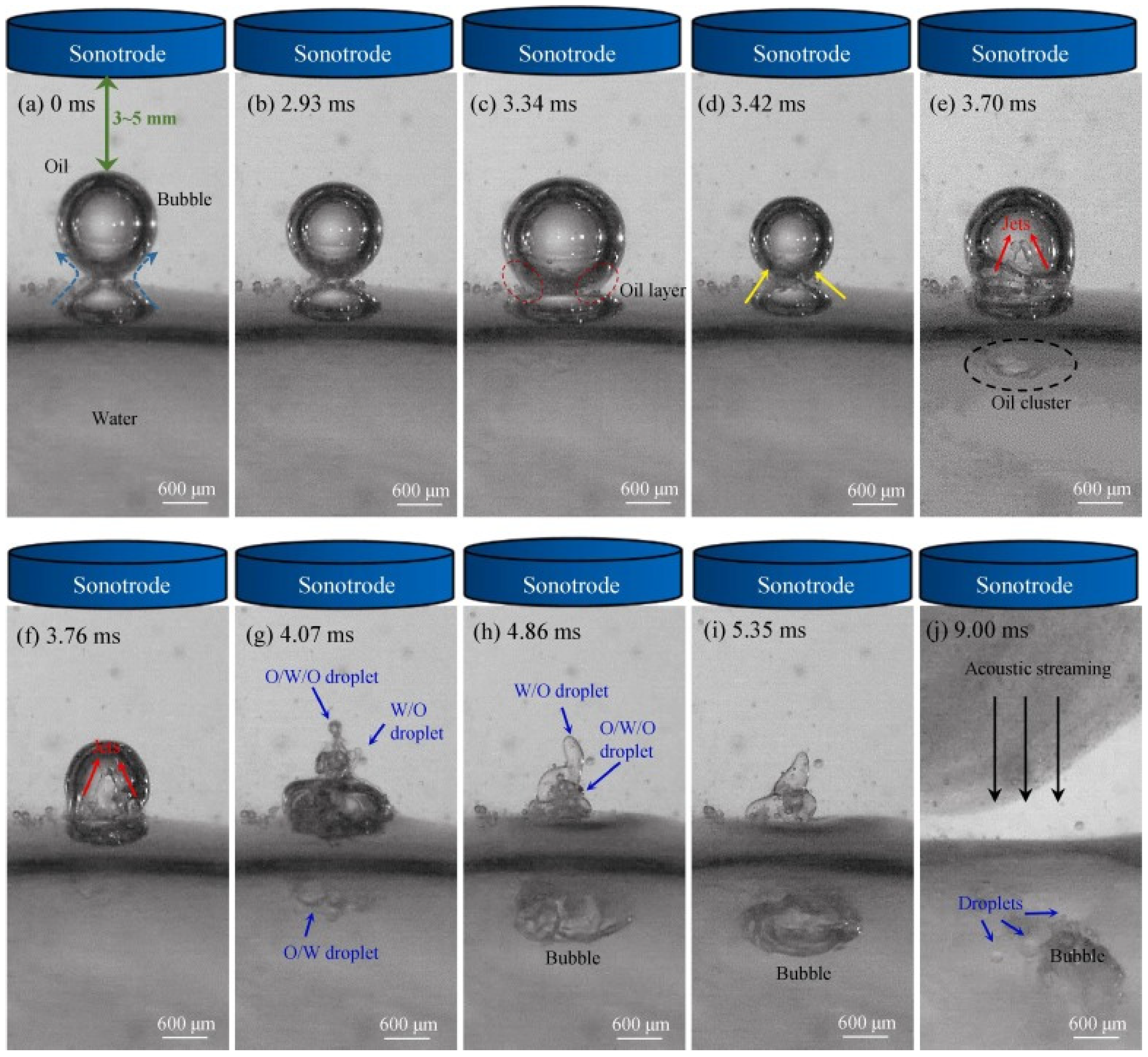
The most detailed pore-scale visualization of acoustic emulsification to date was reported by Wu et al. [56], who utilized high-speed imaging at 100,000 fps to observe individual bubbles interacting with a sunflower oil–water interface under 24 kHz excitation. Their central finding is that bubble behavior depends strongly on bubble size relative to the Minnaert resonance radius, R res . At 24 kHz in the oil phase ( ρ 0 = 892 kg/m3, σ = 33 mN/m), the resonance radius is R res 145 µm. Bubbles larger than this threshold migrated toward the oil–water interface under the primary Bjerknes force and, upon collapse, produced twin liquid jets at roughly 1.7 m/s that penetrated the interface to generate mixed-phase droplets. Conversely, smaller bubbles (∼95 µm) migrated in the opposite direction, rising into the oil phase and deforming the interface into a funnel-like geometry; aqueous droplets were subsequently sheared from this deformed interface without violent collapse. Wu et al. [56] also identified a third mode: large, irregular oscillations of bubbles located far from the primary cavitation zone, which exerted dynamic stresses in the 1–500 kPa range. The authors argue that this chaotic oscillation mode accounts for a substantial portion of the total emulsification—a conclusion that challenges the conventional assumption that inertial collapse is the primary driver of emulsification. Figure 5 captures this sequence at 100,000 fps, showing the microjet penetrating the oil–water interface and generating mixed-phase droplets.
Extending the analysis to the pore-network scale, Vahdanikia et al. [57] combined 20 kHz probe-type ultrasound with biosurfactant-stabilized emulsions in a 2D glass network, reporting a recovery factor of 86.9%, compared to roughly 40% for seawater flooding alone. Simultaneously, the interfacial tension dropped from 61 to 28.96 mN/m. One practical finding from this study merits close attention: the best-performing emulsion—prepared using Thiobacillus Ferrooxidans biosurfactant—exhibited a viscosity of 520.5 cP, which is an order of magnitude higher than that of the original crude oil (50 cP). Under conventional reservoir engineering principles, injecting a highly viscous displacing fluid should severely degrade the mobility ratio and hinder recovery. The authors attribute the apparent contradiction to the dominance of interfacial tension reduction over macroscopic mobility effects at the pore scale. Specifically, when the emulsion droplets are sufficiently numerous and stable to traverse pore throats without coalescing, the elevated bulk viscosity of the emulsion ceases to be the controlling factor. However, whether this microscale dominance holds in larger, more heterogeneous 3D rock matrices remains unaddressed [57].
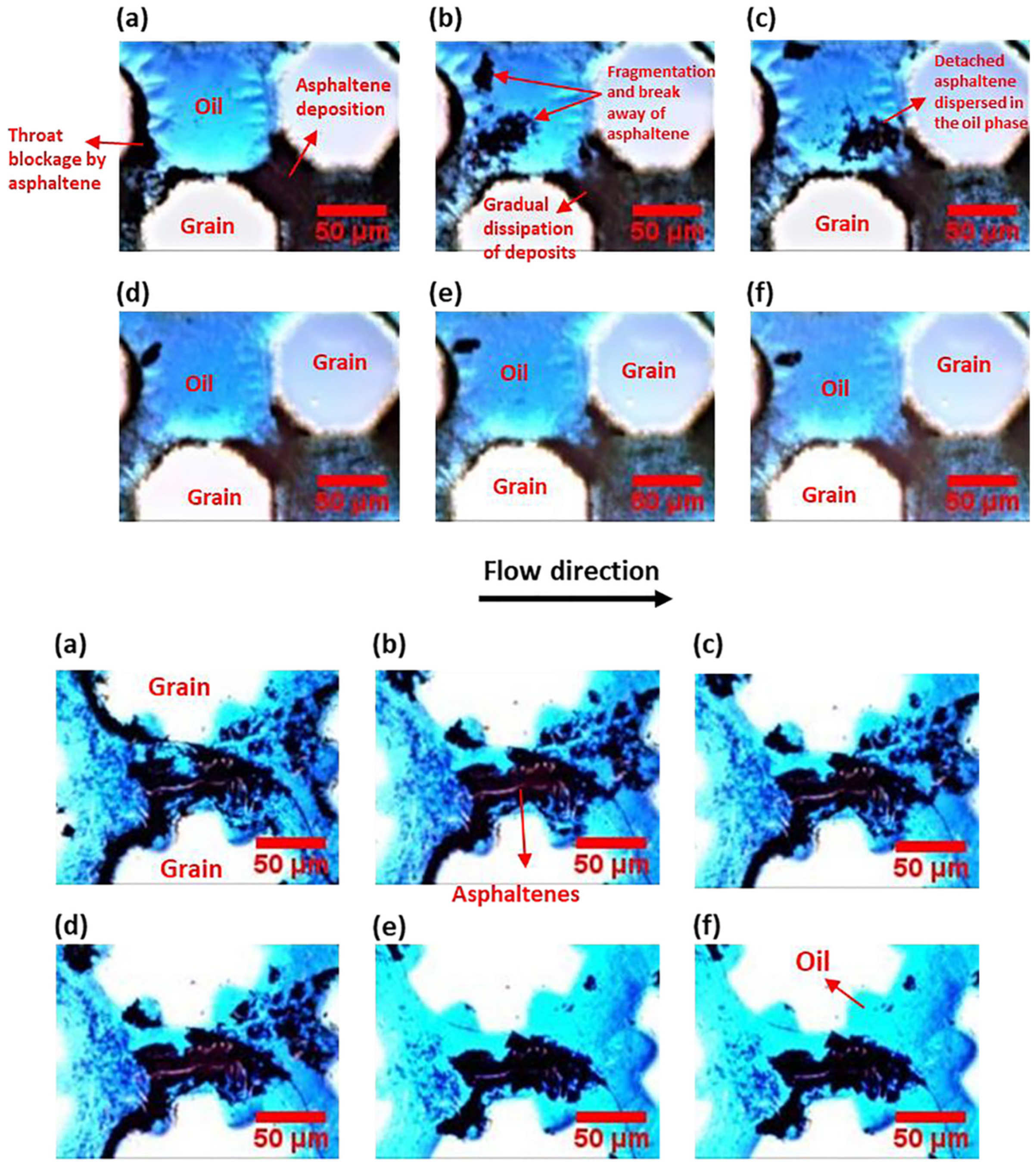
The influence of pore geometry on acoustic mobilization is profound and highly nonlinear. Otumudia et al. [7] systematically tested five 2D glass micromodels—varying in pore shape (circular, square, triangular), throat diameter (200 and 300 µm), and coordination number (3 and 4)—by tracking asphaltene removal over two hours at 20 kHz excitation at varying power levels (400 to 1000 W). Locally, the 300 µm circular model cleared 59% of deposits within five minutes, although the overall macroscopic removal reached only 15.6% due to downstream re-trapping. The 200 µm models exhibited negligible changes during this initial interval, but accelerated after 20–30 min. The authors attribute the early rapid removal in wide channels to acoustic vibration and near-wall streaming, which efficiently shears weakly adhered deposits. The delayed response in tight-throat models is ascribed to the required incubation time for cavitation-enhanced collapse in confined spaces, where the restricted volume eventually focuses the bubble expansion energy to direct onto the deposit surface.
While this physical interpretation aligns well with confined bubble dynamics, the empirical data highlight a critical limitation: increasing the acoustic power by a factor of 2.5 (from 400 to 1000 W) improved total removal by only 15–27%. This marginal gain suggests that beyond a specific intensity threshold, the majority of the additional acoustic energy dissipates as heat rather than performing useful mechanical work on the interfaces. Furthermore, geometric topology proved to be a dominant variable. The triangular model (T), despite featuring the same 300 µm throats as the best-performing circular model, yielded a fourfold lower removal rate (6.1%). This severe underperformance is linked to its lower coordination number and the prevalence of dead-end pores, where neither streaming nor cavitation shockwaves can efficiently dislodge trapped material [58]. If topological connectivity constrains acoustic remediation more decisively than absolute throat size, this finding carries significant implications for screening candidate reservoirs for ultrasonic stimulation. As shown in Figure 6, the early rapid clearance in C-1 and the persistent dead-end trapping in T directly visualize this topological dependence.
Approaching the problem from a fluid conditioning perspective, Hong et al. [59] shifted focus from optimizing the acoustic field to structurally preparing the incoming fluid prior to sonication. Using a needle-in-glass-capillary junction operating at C a   10−3 and R e 400—where the glass surface promotes stable water-in-oil wetting and reproducible droplet formation—they generated highly monodisperse oil droplets before feeding them into a 100 W downstream ultrasonic zone. By pre-fragmenting the fluid, the droplets presented a vastly expanded specific interfacial area compared to bulk oil, allowing them to couple far more efficiently with the localized cavitation field. Following sonication, the mean droplet diameter further decreased from 3.90 µm to 3.04 µm, achieving this dispersion with an energy saving of roughly 36 kJ—effectively a 2.5-fold improvement in energy efficiency. This pre-conditioning approach suggests that the standard field practice of exposing bulk oil directly to an acoustic field may be suboptimal for emulsification-driven recovery, and that interfacial area engineering upstream of the acoustic zone warrants further investigation.

3.2. Solid–Liquid Interfaces: Disruption of Hydrate Skeletons and Scaling

During the depressurization-induced dissociation of methane hydrates, the released water does not drain from the crystal surface but instead accumulates to form a progressively thickening liquid film [20]. This water layer progressively retards further decomposition by increasing the mass-transfer resistance for methane migrating to the bulk phase. Yang et al. [60] quantified this phenomenon directly in a glass microfluidic chip (40 µm channel depth, permeability 2.5 Darcy), tracking individual hydrate crystals under controlled isothermal depressurization at 274.15 K. Under purely static conditions, the baseline crystal dissociation rate was 3.3 × 10⁻³%/s. As the surrounding water layer grew from 20 to 53 µm, this rate decreased by approximately 45%. Rather than acting as a passive byproduct, the accumulated water throttles the dissociation kinetics.
These experiments also revealed a self-promotion mechanism [60]. Upon the heterogeneous nucleation of a gas bubble directly on the hydrate crystal surface, the localized dissociation rate accelerated to 9.2 × 10⁻²%/s—approximately 28 times the static baseline. The authors’ analysis indicates that the growing bubble directly extracted methane from the hydrate lattice, generating a localized fugacity gradient that dynamically drove decomposition. However, once buoyancy forces detached the bubble from the surface, the water layer reformed and the rate plummeted by 91% within a few hundred seconds. This enhancement is therefore transient, governed by the contact time between the growing bubble and the crystal surface.
A more pronounced kinetic enhancement was observed during gas slug migration through the pore network under depressurization. Direct contact between a gas slug and a hydrate crystal eliminated the intervening water film, thereby shifting the rate-limiting step from aqueous diffusion to interfacial reaction and driving the dissociation rate to 1.51 × 10⁻¹%/s. Notably, local topological constrictions in the microfluidic geometry (e.g., a 31 µm throat) occasionally blocked slug migration [60]. Crystals isolated behind these capillary barriers dissociated roughly two orders of magnitude more slowly. The throat geometry alone determined whether the favorable contact condition was established. This constitutes direct pore-scale visualization of the transport-limited dissociation mechanism that theoretical models have long invoked but seldom been able to confirm experimentally.
Investigating hydrate phase behavior in a sandstone-representative microfluidic chip (grain size 40–700 µm, mean pore diameter ~270 µm, porosity ~40%, channel height 30 µm), Wang et al. [61] identified five distinct crystal morphologies: massive blocks, dendritic vein networks, isolated point aggregates, thin membranes spanning pore throats, and shell structures with concentric banding around residual gas pockets. The distribution of these morphologies correlated strongly with local fluid saturation: vein and block morphologies dominated in water-saturated pores, while membranes and point aggregates formed preferentially in gas-phase regions. Furthermore, Wang et al. [61] demonstrated that systems containing a free gas phase dissociated approximately 12 times faster than strictly aqueous systems where methane existed only in dissolved form. Consistent with Yang et al. [60], the presence of a free gas interface maintains the thermodynamic fugacity gradient near its maximum, whereas purely aqueous environments quickly saturate, collapsing the driving force. However, whether this 12-fold kinetic acceleration applies uniformly across different crystal morphologies—particularly when comparing compact massive blocks to thin membranes—remains an unresolved question requiring targeted investigation [62].
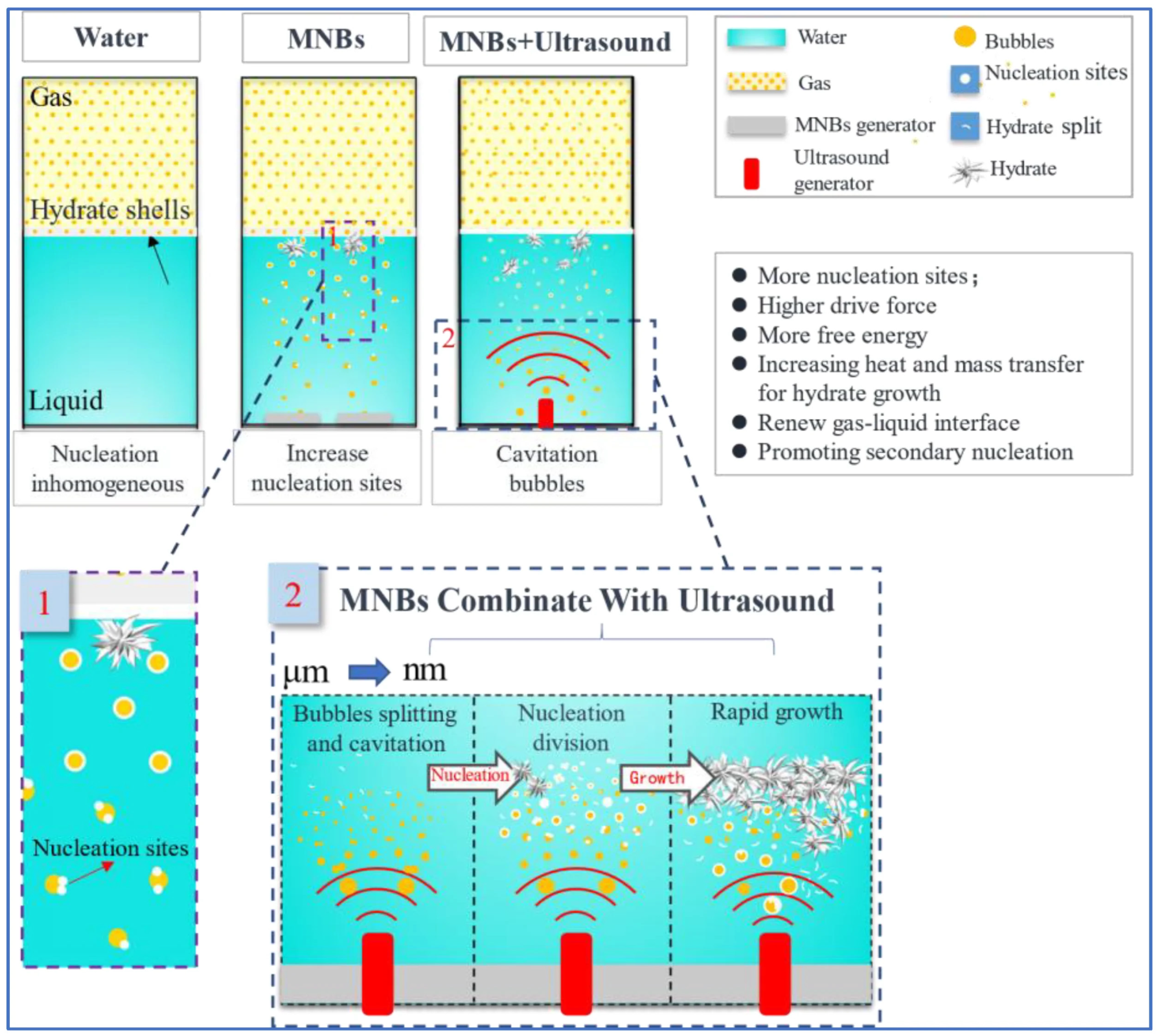
Shifting from microscale dissociation to macroscopic formation, Cheng et al. [16] quantified the impact of 20 kHz intermittent ultrasound on methane hydrate nucleation induction times in a 0.64 L reactor. Acoustic excitation at 375 W reduced the induction period from 860 min to just 7.5 min, simultaneously reducing the specific energy consumption from 29.55 to 5.23 kWh/mol. This extreme acceleration is driven by a dual synergistic mechanism: cavitation collapse generates extreme local pressure and temperature transients that overcome the nucleation energy barrier, while the collapsing bubbles themselves serve as heterogeneous nucleation sites. Concurrently, acoustic shockwaves physically fracture the hydrate shells that typically encapsulate unreacted gas bubbles, dispersing fragment crystals into bulk liquid to seed secondary nucleation. This synergy between cavitation-induced nucleation and mechanically driven shell fragmentation conceptually aligns with the micro-nano bubble (MNB) and ultrasound combined framework proposed by Jing et al. [63], as depicted in Figure 7, which illustrates how bubble splitting renews the gas–liquid interface and promotes secondary nucleation. At the macroscopic scale, this contrast is stark: without ultrasound, the hydrate advances as a connected solid layer climbing the vessel wall; with 375 W ultrasound, a dispersed slurry of fine crystals is produced within 10 min.
Furthermore, integrating acoustic irradiation with mechanical gas sparging yielded synergistic improvement at lower acoustic power intensities. A combined 300 W acoustic field with bubbling achieved a gas convection rate 5.2 times higher than ultrasound alone and 6.2 times higher than bubbling alone [16]. The acoustic field effectively shears the sparger bubbles into sub-millimeter fragments, exponentially increasing the interfacial area, while the injected bubbles act as pre-existing cavitation nuclei, lowering the acoustic power threshold required for inertial collapse. Moreover, a power ceiling was observed by the authors but not fully explained: exceeding 375 W actually prolonged the induction time [16]. This inversion is most likely attributable to severe resistive heating from the ultrasonic sonotrode, which raises the bulk liquid temperature and degrades the thermodynamic undercooling required for nucleation. Consequently, this 375 W optimum is an engineering artifact of the specific reactor’s thermal management, not a material property.
Interpreting these macroscopic reactor results through a single-bubble cavitation lens is fundamentally inadequate when dealing with dense bubble populations. As established by Maeda and Colonius [64], the interacting pressure fields of multiple bubbles dictate collective dynamics that deviate significantly from isolated bubble models. They introduced the dimensionless cloud interaction parameter,   B 0 :
B 0 = β R c 2 R b 0 2 = N b R b 0 R c
where β is the void fraction of the cloud,   R c its radius, R b 0 the individual bubble equilibrium radius, and N b bubble count. When B 0 1, the bubbles oscillate in phase, and the collapse propagates inward as a bubbly shockwave, concentrating the released energy near the cloud’s geometric center. Conversely, when B 0 1, bubbles behave largely independently. Although the 335 kHz frequency and pressure conditions used by Maeda and Colonius [64] preclude the direct quantitative porting of B 0 values to the 20 kHz system of Cheng et al. [16], the theoretical framework provides a critical qualitative insight: the spatial distribution of cavitation activity within a hydrate reactor is not uniform. It is governed by local bubble density and cluster topology in ways that bulk acoustic power metrics fail to capture, explaining why simple power escalation does not yield proportional kinetic enhancements.

3.3. Gas–Liquid Interfaces: Convective Mass Transfer in CO2 Sequestration

Moreno Soto et al. [65] attached individual CO2 bubbles to hydrophobic microcavities on a silicon substrate inside a sealed 1 L chamber containing supersaturated solution, then applied ultrasound at frequencies between 20 and 160 kHz to measure individual bubble growth rates. Under purely passive diffusion, a bubble growing from a 50 to 150 µm radius required approximately 70 s. However, at 50 kHz and 2 kPa acoustic pressure—near the bubble’s Minnaert resonance frequency—the same growth was achieved in just 2 s. The mass transfer enhancement factor, defined as the ratio of acoustic to purely diffusive mass transfer coefficients E = k / k 0 , reached approximately 100. This relationship with pressure amplitude followed a nonlinear scaling:
  E = k k 0 = 1 + α P a P 0 n
where α and n 1.5 are empirical fitting parameters. The nonlinear exponent indicates that the mass transfer gain increases with acoustic pressure. More notably, this enhancement is strictly resonance-dependent: detuning the frequency by even 20% causes the enhancement to diminish almost entirely. Off-resonance, the bubble oscillates weakly, interfacial microstreaming becomes negligible, and the concentration boundary layer, i.e., the CO2-saturated water film that slows further dissolution, rebuilds. The driving mechanism is therefore not generalized acoustic agitation, but rather the time-averaged streaming flow driven by resonant volume oscillation, which continuously sweeps away the saturated boundary layer and circulates fresh, undersaturated water into direct contact with the bubble surface.
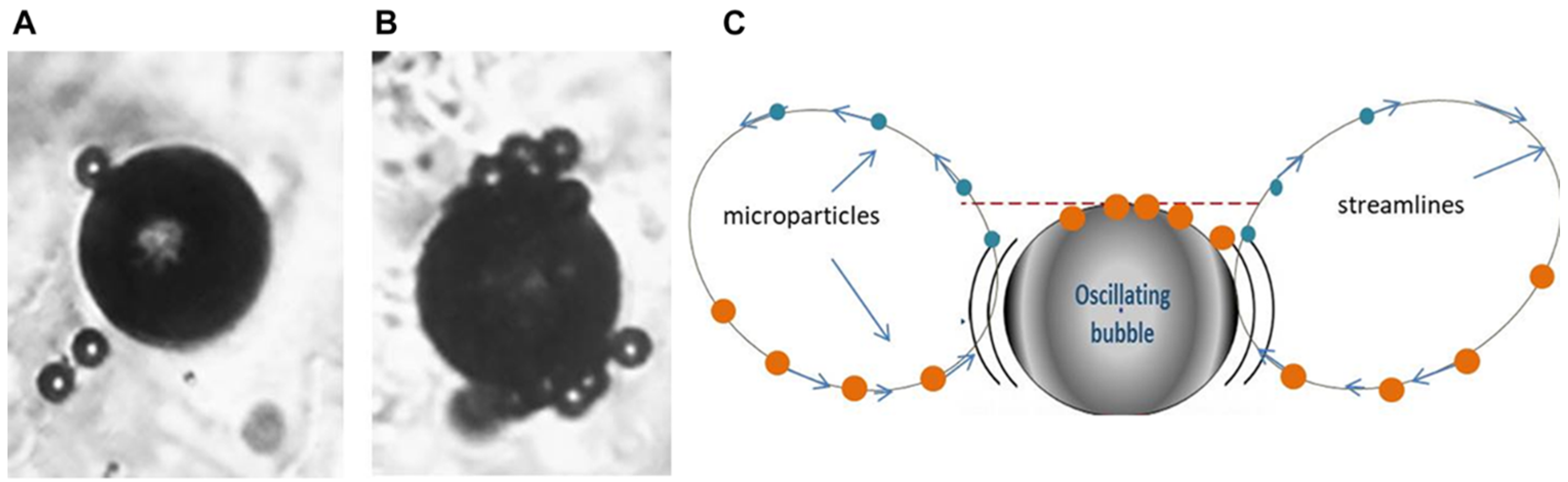
In an acoustic field, a bubble is rarely spatially static. It migrates under the primary Bjerknes force, moving toward pressure antinodes if sub-resonant, and toward pressure nodes if super-resonant. González et al. [66] exploited this phenomenon to position a single 80–200 µm bubble at a pressure node in a 500 × 100 µm2 PDMS chip driven at 1 MHz. Once stationary, the bubble acts as a local acoustic lens: the standing wave scatters off the gas–liquid interface, generating a strong acoustic radiation force gradient in the bubble’s immediate vicinity. When 10 µm polystyrene particles were introduced into the flow, they spiraled inward toward the bubble surface and were captured with over 90% efficiency within 5 s. Figure 8 shows both individual particle adhesion and cluster formation on the bubble surface.
This trapping is described by the Gor’kov acoustic radiation potential, U r a d   :
  U r a d = 4 π 3 R p 3 f 1 κ p 2 2 ρ l c 2 f 2 ρ u 2 4
where R p is the particle radius, f 1 and f 2 monopole and dipole scattering coefficients, and p , u local pressure and velocity. Particles migrate toward minima of U r a d . Zhou et al. [67] advanced this spatial positioning into three dimensions using a Fresnel lens to generate a focused pressure minimum surrounded by high-intensity acoustic walls. Bubbles larger than the resonance radius were pulled into this center. By sweeping the frequency between 900 and 1100 kHz, the researchers shifted the acoustic bottle beam axially, translating a trapped 160 µm bubble at velocities up to 0.14 m/s with approximately 10 µm positional accuracy. However, whether this level of spatial control can be maintained within the geometric confinement and tortuosity of a natural porous medium remains unaddressed by either study.
The enhancement factors reported by Moreno Soto et al. [65] were obtained at a fixed frequency with bubbles held at a roughly constant size. In an actual sequestration scenario, the bubble shrinks continuously as CO2 dissolves into the brine. Because the Minnaert resonance frequency scales inversely with bubble radius, a transducer tuned to a 150 µm bubble becomes substantially off-resonance once that bubble has shrunk to 80 µm, causing the acoustic enhancement to decline sharply. Peñas et al. [68] designed an experiment to test whether dynamic frequency sweeping could compensate for this size evolution.
Using a similar 1 L chamber setup with CO2 bubbles (20–160 µm radius) on a silicon substrate, they cycled each bubble through repeated growth and dissolution phases while sweeping the transducer frequency between 25 and 125 kHz. The primary metric was the time gain—the reduction in dissolution time achieved by the acoustic field relative to passive diffusion over a full cycle. At a fixed frequency, the gain was only positive during the brief window when the instantaneous bubble size crossed resonance. However, employing a co-directional sweep (decreasing frequency as the bubble grows, increasing as it shrinks) allows the system to continuously track the evolving resonance condition. This tracking yielded a time gain of 60–70 s at 2.5 kPa over a full dissolution cycle, approximately 30% greater than the optimal fixed-frequency result at the same acoustic pressure.
Crucially, the sweep direction is not interchangeable. A counter-directional sweep, in which the frequency and bubble radius evolve in opposing directions relative to the resonance condition, consistently underperformed and occasionally yielded zero gain. Peñas et al. [68] attribute this to the asymmetric transient response of the bubble’s oscillation amplitude when passing through resonance from above versus below. The optimal sweep period was found to be approximately 1 s: fast enough to track the evolving resonance condition, yet slow enough to allow the streaming flow to clear the concentration boundary layer before the frequency shifts. While this was carefully calibrated for a single bubble at a specific supersaturation level, whether identical sweep parameters remain effective for a broad bubble size distribution or varying CO2 concentrations remains an open question.
The mechanical nature of the gas–liquid interface introduces further complexities. Memoli et al. [69] measured the acoustic response of polymer-shelled microbubbles (1–10 µm) in a microfluidic flow cell using high-speed imaging (500,000 fps) and laser Doppler vibrometry. They found that a 10 nm polymer coating shifted the resonance frequency downward by up to 30%, reduced the quality factor from ~10 to ~5, and increased damping by a factor of 2–3. In the context of CO2 sequestration, salts dissolved in the displaced brine, organic matter, and potentially residual surfactants from injection operations can all adsorb onto the CO2 bubble–brine interface, altering its mechanical response. Because the baseline enhancement factors were measured in idealized conditions [65], it remains unknown whether such high mass-transfer gains persist in contaminated, high-salinity brines.
Extrapolating isolated single-bubble dynamics directly to porous media is inherently limited in its applicability. Ozcelik et al. [70] investigated a more complex geometry—a 200 × 50 µm2 PDMS microchannel with multiple sidewall nucleation cavities—and found that multi-bubble configurations generated streaming topologies fundamentally different from isolated bubble predictions. When multiple bubbles oscillate simultaneously, secondary Bjerknes forces drive coalescence or mutual repulsion depending on their relative sizes and phase relationship, resulting in chaotic and irregular advective flow patterns. During geologic CO2 injection, any representative volume element will contain hundreds of bubbles of varying sizes. Single-bubble mass transfer models cannot be linearly superimposed to predict the aggregate behavior, and the existing experimental literature lacks the requisite data to build a unified multi-bubble model.
A fundamental thermodynamic barrier limits the direct application of these microfluidic results to deep geological sequestration. At the target conditions of saline aquifers (typically exceeding 7.4 MPa and 31 °C), CO2 exists in a supercritical state. At 10 MPa, the density of supercritical CO2 reaches 700–800 kg/m3, which is comparable to the surrounding brine, and its interfacial tension drops from ~25 mN/m at atmospheric conditions to a few mN/m. Both parameters govern the oscillation dynamics upon which acoustic enhancement relies. The Minnaert resonance framework fundamentally assumes a compressible gas inclusion with a density much lower than the host liquid; this defining contrast largely vanishes in the supercritical state. The reduced acoustic impedance mismatch between supercritical CO2 and water alters how the acoustic field scatters off the interface, degrading the efficiency of volume oscillations. The empirical mass transfer correlation E = k / k 0 = 1 + α P a / P 0 n derived by Moreno Soto et al. [65] was fitted to near-ideal gas behavior at atmospheric pressure. Extending this relationship to supercritical conditions requires, at a minimum, revising the equation of state or modifying the boundary conditions within the Rayleigh–Plesset framework. Yet neither has been attempted in the literature, leaving a significant and currently unquantified scalability gap between current laboratory observations and field implementation [17].
Table 2 compiles representative microfluidic visualization studies across the three geo-energy scenarios examined in this review, providing a comparative overview of experimental setups, interfacial actions, and quantitative gains.

4. Discussion

The microfluidic evidence assembled in this review has considerably sharpened our understanding of pore-scale acoustic mechanisms. However, clarifying the laboratory picture is not equivalent to solving the macroscopic field problems. Three structural gaps separate current experimental knowledge from the thermodynamic and geometric realities of reservoir-scale acoustic stimulation. Each of these scaling challenges must be carefully examined to guide future field applications.

4.1. Dimensional Reduction

Virtually every quantitative visualization result discussed in this review derives from two-dimensional (2D) glass or PDMS micro-models operating at room temperature and near-atmospheric pressure [17,20,70,71]. This rigorously controlled geometry is precisely what renders microfluidic measurements interpretable; however, it is also what causes them to deviate systematically from the conditions of real reservoir rock. Natural porous media feature complex three-dimensional connectivity, chemically heterogeneous surfaces, and permeability structures that create strong preferential flow paths. Acoustic streaming in such a complex 3D network does not organize into the clean vortex patterns observed in idealized single-channel geometries. Out-of-plane flow reversals, which 2D imaging entirely misses, may substantially modify net macroscopic transport [72].
For hydrate-bearing sediments, this dimensional reduction carries an additional consequence. As solid hydrate dissociates, the crystalline structure providing grain cementation disappears, local pore pressure rises, and the effective stress on the rock skeleton dynamically shifts. A rigid, idealized glass micromodel simply cannot reproduce this dynamic chemo–mechanical feedback [73]. Consequently, whether acoustic-enhanced dissociation safely accelerates gas recovery or inadvertently exacerbates geomechanical failure risks (e.g., wellbore instability or sand production) remains not yet systematically characterized under realistic reservoir conditions at the pore scale.

4.2. Thermodynamic Discrepancies

A further geometric idealization shared by all current microfluidic systems is the assumption of morphologically smooth pore walls. As pore size decreases, nanoscale surface roughness, mineral grain protrusions, and clay platelet geometries become increasingly important: rough surfaces preferentially seed cavitation nuclei at surface crevices, and alter streaming vortex topology near the wall in ways that smooth-wall analytical models cannot capture. Whether this surface complexity systematically enhances or attenuates acoustic fluid mobilization relative to smooth-wall predictions remains an open question, and its resolution will require pore-scale experiments conducted in chemically and morphologically realistic rough-wall geometries rather than the idealized glass or PDMS channels employed to date.
Real reservoirs operate under high-pressure, high-temperature (HPHT) conditions, typically exceeding 10 MPa and 100 °C. Under these conditions, injected CO2 exists in a supercritical state: its density becomes comparable to that of the surrounding brine, and its interfacial tension drops to a few millinewtons per meter. The acoustic impedance mismatch between the two phases diminishes sharply, thereby altering how the acoustic field scatters at the interface and how efficiently bubble volume oscillations are driven [74].
Resonance models calibrated at atmospheric pressure cannot be extrapolated to this regime without a revised physical framework. The Minnaert resonance frequency depends on ambient pressure and gas density in ways that fundamentally invert under supercritical conditions: what is a compressible, low-density gas inclusion at ambient pressure becomes a near-liquid-density phase with substantially reduced acoustic impedance contrast. To date, no published study has applied acoustic forcing to CO2 dissolution at true reservoir conditions. An analogous thermodynamic gap exists for EOR applications, where the in-situ viscosity, phase behavior, and asphaltene aggregation state of heavy crudes at HPHT conditions differ substantially from those of room-temperature laboratory analogs.

4.3. Bubble Population Dynamics

Near-wellbore acoustic treatment generates dense bubble populations rather than the isolated single bubbles typically examined in microfluidic studies [47,64]. When the local void fraction is high and bubble cloud radius is large relative to the individual bubble size, bubbles oscillate coherently rather than independently. Under these collective dynamics, cavitation collapse propagates inward as a bubbly shockwave, thereby concentrating the released energy near the geometric center of the cloud. Furthermore, a high void fraction exponentially increases acoustic attenuation, severely limiting the penetration depth of the acoustic field into the deeper formation.
Currently, neither the single-bubble analytical frameworks dominating the microfluidic literature nor the bulk wave propagation models used in macroscopic reservoir simulation adequately describe this intermediate meso-scale regime. The spatial distribution of cavitation activity inside a real near-wellbore treatment zone is ultimately governed by local bubble density, clustering, and pore size in ways that total acoustic power input metrics completely fail to capture. This meso-scale disconnect is a fundamental reason why historical field results have proven so inconsistent, even when laboratory analogs appeared highly promising.

5. Conclusions

5.1. Synthesis of Mechanisms

Acoustic fluid mobilization in porous media is not governed by a single, isolated effect. Nonlinear acoustic streaming provides continuous directional convection along pore walls, thinning concentration boundary layers and advecting mobilized phases away from reactive surfaces. While it operates effectively at relatively low acoustic intensities, streaming alone lacks the peak stress required to displace a ganglion or deposit rigidly pinned by capillary forces at a throat constriction [32]. Transient cavitation fulfills this vital role. Bubble collapse near a solid boundary generates high-velocity microjets and shockwaves whose localized impulsive stress is sufficient to rupture static menisci that time-averaged streaming cannot overcome.
The fundamental link uniting both mechanisms is their acute sensitivity to pore geometry. Geometric confinement modifies bubble dynamics, shifts resonance conditions, and concentrates collapse energy in ways that free-liquid models fail to predict. Consequently, pore geometry is not merely the application context; it is a primary physical variable governing the acoustic response.

5.2. Future Directions

To move the field forward and bridge the severe gap between laboratory observation and field implementation, three distinct research trajectories must be pursued. These trajectories also encode near-term field design guidance: wide-channel formations favor low-frequency Eckart streaming, whereas tight-throat formations require intensities at or above the Blake threshold and benefit from adaptive rather than fixed-frequency operation; viscoelastic heavy crude reservoirs must satisfy De ≪ 1 to sustain directed streaming; and supercritical CO2 applications require a modified Rayleigh–Plesset framework with a real-fluid equation of state, as the Minnaert resonance model ceases to apply under reservoir conditions.
  • Experimental Re-creation of Reservoir Thermodynamics: All the enhancement factors and mechanistic observations reviewed above derive from two-dimensional glass or PDMS geometries at room temperature and near-atmospheric pressure—the very constraints that render microfluidic measurements interpretable, but that simultaneously cause them to deviate from real reservoir rock in three-dimensional pore connectivity, chemically heterogeneous mineral surfaces, and preferential-flow-path topology; whether the ordered streaming vortices and collapse sequences captured in single-channel chips survive translation to geologically realistic 3D networks remains unestablished. Every quantitative visualization must eventually be validated at realistic conditions. Silicon and sapphire substrates are capable of withstanding true reservoir pressures and temperatures, and advanced fabrication methods for three-dimensional pore networks within these materials now exist. Utilizing these platforms, coupled with miniaturized, in-situ hydrophones to directly measure intra-pore acoustic pressure, rather than inferring it from external transducer specifications, will provide the critical thermodynamic and geomechanical data that ambient-condition 2D chips simply cannot yield.
  • Adaptive, Real-Time Acoustic Control: Every acoustic parameter optimized in the laboratory was calibrated against conditions that diverge fundamentally from those encountered in the subsurface: CO2 exists in a supercritical state where acoustic impedance contrast diminishes sharply and the Minnaert resonance framework no longer applies; heavy crude viscosity and asphaltene aggregation are governed by in-situ HPHT conditions rather than ambient-temperature laboratory analogs; and hydrate phase behavior couples to formation pressure in ways no room-temperature microfluidic chip can reproduce. Fixed-frequency sonication is a static response to a highly dynamic process. As CO2 dissolves, hydrate dissociates, or emulsions evolve, the resonance characteristics of the in-situ bubble population continuously shift. Acoustic parameters optimized at the onset of treatment quickly become inefficient. Implementing adaptive frequency-sweeping algorithms that actively track evolving resonance conditions in real-time could sustain maximum mass-transfer efficiency. However, achieving this requires the integration of downhole sensing and dynamic control capabilities that do not yet exist in acoustic reservoir tools.
  • Meso-Scale Computational Upscaling: All the visualization evidence assembled in this review captures isolated bubbles or small populations in idealized geometries; near-wellbore acoustic treatment, by contrast, generates dense bubble clouds that oscillate coherently, collapse inward as collective shockwaves concentrating energy at the cloud center, and attenuate the acoustic field exponentially with void fraction—a collective regime that single-bubble analytical frameworks and Darcy-scale simulators alike are structurally unable to describe. While pore-scale models (e.g., Navier–Stokes coupled with Rayleigh–Plesset dynamics) reproduce microfluidic observations with reasonable fidelity, and Darcy-scale simulators handle macroscopic flow, a validated framework bridging these two extremes remains absent. Building this multiscale bridge requires integrating meso-scale Pore Network Models (PNMs) to mathematically capture the topological re-trapping and collective bubble-cloud attenuation that dictate net transport [75]. Developing this intermediate upscaling framework is the central unresolved computational challenge in the field.
The microfluidic evidence reviewed here has considerably clarified the fundamental mechanisms of acoustic stimulation. Simultaneously, it has revealed the extent to which the field-relevant physics remains unmeasured. Laboratory demonstrations of massive mass-transfer enhancements in single-bubble or idealized pore-throat geometries are genuine physical effects. However, whether these localized enhancements persist with comparable magnitude at extreme pressures, temperatures, and dimensional scales of actual subsurface operations remains an open question. Recognizing this boundary is essential for accurately defining the limits of current knowledge and designing the next generation of rigorous, field-representative experiments.

Author Contributions

Conceptualization, H.G. and J.C.; methodology, H.G.; investigation, Z.T., S.L. and X.C.; resources, J.C.; writing—original draft preparation, H.G. and Z.T.; writing—review and editing, H.G., S.L. and X.C.; visualization, Z.T. and S.L.; supervision, H.G. and J.C.; project administration, J.C.; funding acquisition, J.C. All authors have read and agreed to the published version of the manuscript.

Funding

This research was funded by the Research Funds for the Central Universities, grant number 226-2024-00162; the Research Program of Donghai Laboratory, grant number 20233194; and the Zhejiang Provincial Natural Science Foundation of China, grant number LMS26D060004.

Data Availability Statement

No new data were created or analyzed in this study. Data sharing is not applicable to this article.

Conflicts of Interest

The authors declare no conflicts of interest. The funders had no role in the design of the study; in the collection, analyses, or interpretation of data; in the writing of the manuscript; or in the decision to publish the results.

Abbreviations

The following abbreviations are used in this manuscript:
BIPSBiot, Inter-patch, and Squirt
CaCapillary number
DeDeborah number
EOREnhanced oil recovery
HPHTHigh-pressure, high-temperature
MNBMicro-nano bubble
PDMSPolydimethylsiloxane
PNMPore network model

References

  1. Datta, S.S.; Battiato, I.; Fernø, M.A.; Juanes, R.; Parsa, S.; Prigiobbe, V.; Santanach-Carreras, E.; Song, W.; Biswal, S.L.; Sinton, D. Lab on a Chip for a Low-Carbon Future. Lab. Chip 2023, 23, 1358–1375. [Google Scholar] [CrossRef]
  2. Chandrasekaran, S.N.; Näsholm, S.P.; Holm, S. Wave Equations for Porous Media Described by the Biot Model. J. Acoust. Soc. Am. 2022, 151, 2576–2586. [Google Scholar] [CrossRef]
  3. Rezaei Dehshibi, R.; Mohebbi, A.; Riazi, M.; Niakousari, M. Experimental Investigation on the Effect of Ultrasonic Waves on Reducing Asphaltene Deposition and Improving Oil Recovery under Temperature Control. Ultrason. Sonochem. 2018, 45, 204–212. [Google Scholar] [CrossRef]
  4. Mierez, J.; AlTammar, M.J.; Alruwaili, K.M.; Alfaraj, R.T. Recent Advances of Ultrasound Applications in the Oil and Gas Industry. Ultrason. Sonochem. 2024, 103, 106767. [Google Scholar] [CrossRef]
  5. Nieves, E.; Vite, G.; Kozina, A.; Olguin, L.F. Ultrasound-Assisted Production and Optimization of Mini-Emulsions in a Microfluidic Chip in Continuous-Flow. Ultrason. Sonochem. 2021, 74, 105556. [Google Scholar] [CrossRef] [PubMed]
  6. Ehsani, M.; Akbari, M.; Khalili, Y. A Comprehensive Review of Ultrasonic-Assisted Oil Recovery: Principles Applications and Future Prospects. J. Chem. Pet. Eng. 2025, 59, 81–113. [Google Scholar] [CrossRef]
  7. Otumudia, E.; Hamidi, H.; Jadhawar, P.; Wu, K. Effects of Reservoir Rock Pore Geometries and Ultrasonic Parameters on the Removal of Asphaltene Deposition under Ultrasonic Waves. Ultrason. Sonochem. 2022, 83, 105949. [Google Scholar] [CrossRef] [PubMed]
  8. Mullakaev, M.S.; Abramov, V.O.; Abramova, A.V. Development of Ultrasonic Equipment and Technology for Well Stimulation and Enhanced Oil Recovery. J. Pet. Sci. Eng. 2015, 125, 201–208. [Google Scholar] [CrossRef]
  9. Abramov, V.O.; Mullakaev, M.S.; Abramova, A.V.; Esipov, I.B.; Mason, T.J. Ultrasonic Technology for Enhanced Oil Recovery from Failing Oil Wells and the Equipment for Its Implemention. Ultrason. Sonochem. 2013, 20, 1289–1295. [Google Scholar] [CrossRef]
  10. Hamidi, H.; Sharifi Haddad, A.; Wisdom Otumudia, E.; Rafati, R.; Mohammadian, E.; Azdarpour, A.; Giles Pilcher, W.; Wilhelm Fuehrmann, P.; Ricardo Sosa, L.; Cota, N.; et al. Recent Applications of Ultrasonic Waves in Improved Oil Recovery: A Review of Techniques and Results. Ultrasonics 2021, 110, 106288. [Google Scholar] [CrossRef]
  11. Mousavi, S.M.R.; Najafi, I.; Ghazanfari, M.H.; Amani, M. Comparison of Ultrasonic Wave Radiation Effects on Asphaltene Aggregation in Toluene–Pentane Mixture Between Heavy and Extra Heavy Crude Oils. J. Energy Resour. Technol. 2012, 134, 022001. [Google Scholar] [CrossRef]
  12. Razavifar, M.; Qajar, J.; Riazi, M. Experimental Study on Pore-Scale Mechanisms of Ultrasonic-Assisted Heavy Oil Recovery with Solvent Effects. J. Pet. Sci. Eng. 2022, 214, 110553. [Google Scholar] [CrossRef]
  13. Razavifar, M.; Roozbahani, A.; Raoof, A.; Qajar, J. Impact of Ultrasonic Waves on Physicochemical Characteristics of Subsurface Fluid-Rock Systems: A Review on Mechanisms, Synergistic Effects, and Applications. Chem. Eng. Process. Process Intensif. 2025, 216, 110471. [Google Scholar] [CrossRef]
  14. Manor, O. Acoustic Flow in Porous Media. J. Fluid Mech. 2021, 920, A11. [Google Scholar] [CrossRef]
  15. Shim, W.; Park, R.; Seo, J.; Kim, W. Mechanisms of Oil Droplet Detachment by Cavitation Bubbles in Ultrasonic Cleaning. Ultrason. Sonochem. 2026, 124, 107726. [Google Scholar] [CrossRef]
  16. Cheng, C.; Wang, Z.; Xiao, Y.; Song, T.; Jin, T.; Shi, J.; Liu, J.; Zhu, S.; Qi, T.; Hu, W.; et al. Synergistic Effect of Ultrasound Combined with Bubble Enhanced Rapid Nucleation and Growth of Methane Hydrate. Fuel 2024, 360, 130483. [Google Scholar] [CrossRef]
  17. Song, Y.; Zhao, C.; Chen, M.; Chi, Y.; Zhang, Y.; Zhao, J. Pore-Scale Visualization Study on CO2 Displacement of Brine in Micromodels with Circular and Square Cross Sections. Int. J. Greenh. Gas Control 2020, 95, 102958. [Google Scholar] [CrossRef]
  18. Dawaymeh, F.; Ayoub, E.; Khaleel, M.; Alamoodi, N. Insights into the Application of Microfluidic Platforms in Enhanced Oil Recovery. Petroleum 2025, 11, 422–439. [Google Scholar] [CrossRef]
  19. Rezaei Dehshibi, R.; Mohebbi, A.; Riazi, M.; Danafar, F. Visualization Study of the Effects of Oil Type and Model Geometry on Oil Recovery under Ultrasonic Irradiation in a Glass Micro-Model. Fuel 2019, 239, 709–716. [Google Scholar] [CrossRef]
  20. Feng, Y.; Han, Y.; Jia, Y.; Lv, X.; Li, Q.; Liu, Y.; Zhang, L.; Zhao, J.; Yang, L.; Song, Y. Visual Study of Methane Hydrate Kinetics in a Microfluidic Chip: Effect of the Resins Extracted from the Crude Oil. Fuel 2024, 359, 130276. [Google Scholar] [CrossRef]
  21. Rabaud, D.; Thibault, P.; Raven, J.-P.; Hugon, O.; Lacot, E.; Marmottant, P. Manipulation of Confined Bubbles in a Thin Microchannel: Drag and Acoustic Bjerknes Forces. Phys. Fluids 2011, 23, 042003. [Google Scholar] [CrossRef]
  22. Mur, J.; Agrež, V.; Ohl, C.-D.; Petkovšek, R. Cavitation Erosion from Single Acoustically Driven Bubbles. Ultrason. Sonochem. 2026, 125, 107740. [Google Scholar] [CrossRef]
  23. Cha, B.; Lee, S.H.; Iqrar, S.A.; Yi, H.-G.; Kim, J.; Park, J. Rapid Acoustofluidic Mixing by Ultrasonic Surface Acoustic Wave-Induced Acoustic Streaming Flow. Ultrason. Sonochem. 2023, 99, 106575. [Google Scholar] [CrossRef]
  24. Wang, J.; Sun, J.; Shi, J.; Bao, B. Visualization Investigation of Fluid Transport in Multiscale Porous Media for CO2 -EOR Based on Microfluidic Technology. Lab Chip 2025, 25, 1981–1992. [Google Scholar] [CrossRef]
  25. Godary, T.; Binkley, B.; Liu, Z.; Awoyemi, O.; Overby, A.; Yuliantoro, H.; Fike, B.J.; Anderson, S.; Li, P. Acoustofluidics: Technology Advances and Applications from 2022 to 2024. Anal. Chem. 2025, 97, 6847–6870. [Google Scholar] [CrossRef]
  26. Leonov, K.; Akhatov, I. Towards a Theory of Dynamics of a Single Cavitation Bubble in a Rigid Micro-Confinement. Int. J. Multiph. Flow 2020, 130, 103369. [Google Scholar] [CrossRef]
  27. Zhang, S.; Li, Q.; Xie, Q.; Zhu, H.; Xu, W.; Liu, Z. Mechanism Analysis of Heavy Oil Viscosity Reduction by Ultrasound and Viscosity Reducers Based on Molecular Dynamics Simulation. ACS Omega 2022, 7, 36137–36149. [Google Scholar] [CrossRef]
  28. Dubrovski, O.; Friend, J.; Manor, O. Theory of Acoustic Streaming for Arbitrary Reynolds Number Flow. J. Fluid Mech. 2023, 975, A4. [Google Scholar] [CrossRef]
  29. Deng, Y.; Gao, W.; Liu, X.; Dong, L.; Wang, Y. Impact of Induced Shock Waves on Cavitation Bubble Collapse Dynamics and Load Characteristics. Phys. Fluids 2024, 36, 084125. [Google Scholar] [CrossRef]
  30. Zeng, Q.; An, H.; Ohl, C.-D. Wall Shear Stress from Jetting Cavitation Bubbles: Influence of the Stand-off Distance and Liquid Viscosity. J. Fluid Mech. 2022, 932, A14. [Google Scholar] [CrossRef]
  31. Iida, Y.; Yasui, K.; Tuziuti, T.; Sivakumar, M.; Endo, Y. Ultrasonic Cavitation in Microspace. Chem. Commun. 2004, 20, 2280. [Google Scholar] [CrossRef] [PubMed]
  32. Price, S.E.N.; Hansen, R.; Gjennestad, M.A. A Volume-Averaged Model for Acoustic Streaming Induced by Focused Ultrasound in Soft Porous Media. J. Acoust. Soc. Am. 2023, 154, 334–345. [Google Scholar] [CrossRef]
  33. Tong, L.H.; Liu, Y.S.; Geng, D.X.; Lai, S.K. Nonlinear Wave Propagation in Porous Materials Based on the Biot Theory. J. Acoust. Soc. Am. 2017, 142, 756–770. [Google Scholar] [CrossRef]
  34. Sun, W. On the Theory of Biot-Patchy-Squirt Mechanism for Wave Propagation in Partially Saturated Double-Porosity Medium. Phys. Fluids 2021, 33, 076603. [Google Scholar] [CrossRef]
  35. Shi, Z.; He, X.; Chen, D.; Wang, X. Seismic Wave Dispersion and Attenuation Resulting from Multiscale Wave-Induced Fluid Flow in Partially Saturated Porous Media. Geophys. J. Int. 2023, 236, 1172–1182. [Google Scholar] [CrossRef]
  36. Qajar, J.; Razavifar, M.; Riazi, M. A Mechanistic Study of the Synergistic and Counter Effects of Ultrasonic and Solvent Treatment on the Rheology and Asphaltene Structure of Heavy Crude Oil. Chem. Eng. Process.-Process Intensif. 2024, 195, 109619. [Google Scholar] [CrossRef]
  37. Nguele, R.; Okawa, H. Effect of Ultrasound Irradiation on Asphaltene Aggregation and Implications to Rheological Behavior of Bitumen. Ultrason. Sonochem. 2021, 80, 105811. [Google Scholar] [CrossRef]
  38. Li, S.; Cui, W.; Baasch, T.; Wang, B.; Gong, Z. Eckart Streaming with Nonlinear High-Order Harmonics: An Example at Gigahertz. Phys. Rev. Fluids 2024, 9, 084201. [Google Scholar] [CrossRef]
  39. Das, P.K.; Bhethanabotla, V.R. Extra Stress-Mediated Acoustic Streaming in a Surface Acoustic Wave Driven Microchannel Filled with Second-Order Fluids. Phys. Rev. Fluids 2022, 7, 074404. [Google Scholar] [CrossRef]
  40. Kolesnik, K.; Hashemzadeh, P.; Peng, D.; Stamp, M.E.M.; Tong, W.; Rajagopal, V.; Miansari, M.; Collins, D.J. Periodic Rayleigh Streaming Vortices and Eckart Flow Arising from Traveling-Wave-Based Diffractive Acoustic Fields. Phys. Rev. E 2021, 104, 045104. [Google Scholar] [CrossRef] [PubMed]
  41. Zhong, G.; Liu, Y.; Guo, X.; Royon, L.; Brunet, P. Vibration-Induced Streaming Flow near a Sharp Edge: Flow Structure and Instabilities in a Large Span of Forcing Amplitude. Phys. Rev. E 2023, 107, 025102. [Google Scholar] [CrossRef]
  42. Zhang, X.; Rallabandi, B. Three-Dimensional Streaming around an Obstacle in a Hele-Shaw Cell. J. Fluid Mech. 2023, 961, A35. [Google Scholar] [CrossRef]
  43. Vargas, C.; Campos-Silva, I.; Méndez, F.; Arcos, J.; Bautista, O. Acoustic Streaming in Maxwell Fluids Generated by Standing Waves in Two-Dimensional Microchannels. J. Fluid Mech. 2022, 933, A59. [Google Scholar] [CrossRef]
  44. Sviridov, A.; Mazina, S.; Ostapenko, A.; Nikolaev, A.; Timoshenko, V. Antibacterial Effect of Acoustic Cavitation Promoted by Mesoporous Silicon Nanoparticles. Int. J. Mol. Sci. 2023, 24, 1065. [Google Scholar] [CrossRef]
  45. Saint-Michel, B.; Garbin, V. Acoustic Bubble Dynamics in a Yield-Stress Fluid. Soft Matter 2020, 16, 10405–10418. [Google Scholar] [CrossRef]
  46. Zhao, F.; Yan, Q.; Cheng, D. Numerical Study on the Desorption Processes of Oil Droplets inside Oil-Contaminated Sand under Cavitation Micro-Jets. Ultrason. Sonochem. 2021, 78, 105745. [Google Scholar] [CrossRef]
  47. Reuter, F.; Deiter, C.; Ohl, C.-D. Cavitation Erosion by Shockwave Self-Focusing of a Single Bubble. Ultrason. Sonochem. 2022, 90, 106131. [Google Scholar] [CrossRef]
  48. Ma, Y.; Zhang, G.; Ma, T. Interaction of Two Bubbles with Distortion in an Acoustic Field. Ultrason. Sonochem. 2022, 84, 105953. [Google Scholar] [CrossRef]
  49. Hong, S.; Son, G. Numerical Modelling of Acoustic Cavitation Threshold in Water with Non-Condensable Bubble Nuclei. Ultrason. Sonochem. 2022, 83, 105932. [Google Scholar] [CrossRef]
  50. Mano, T.; Grutman, T.; Ilovitsh, T. Versatile Ultrasound-Compatible Microfluidic Platform for In Vitro Microvasculature Flow Research and Imaging Optimization. ACS Omega 2023, 8, 47667–47677. [Google Scholar] [CrossRef]
  51. Zhang, C.; Guo, X.; Royon, L.; Brunet, P. Unveiling of the Mechanisms of Acoustic Streaming Induced by Sharp Edges. Phys. Rev. E 2020, 102, 043110. [Google Scholar] [CrossRef]
  52. Cui, J.; Zhang, Z.; Liu, X.; Liu, L.; Peng, J. Studies on Viscosity Reduction and Structural Change of Crude Oil Treated with Acoustic Cavitation. Fuel 2020, 263, 116638. [Google Scholar] [CrossRef]
  53. Zhang, X.; Li, F.; Wang, C.; Mo, R.; Hu, J.; Guo, J.; Lin, S. Effects of Translational Motion on the Bjerknes Forces of Bubbles Activated by Strong Acoustic Waves. Ultrasonics 2022, 126, 106809. [Google Scholar] [CrossRef]
  54. Raghavan, R. Theory for Acoustic Streaming in Soft Porous Matter and Its Applications to Ultrasound-Enhanced Convective Delivery. J. Ther. Ultrasound 2018, 6, 6. [Google Scholar] [CrossRef]
  55. Yeh, H.-L.; Juárez, J.J. Oil Phase Displacement by Acoustic Streaming in a Reservoir-on-a-Chip. Microfluid. Nanofluidics 2019, 23, 113. [Google Scholar] [CrossRef]
  56. Wu, W.H.; Eskin, D.G.; Priyadarshi, A.; Subroto, T.; Tzanakis, I.; Zhai, W. New Insights into the Mechanisms of Ultrasonic Emulsification in the Oil–Water System and the Role of Gas Bubbles. Ultrason. Sonochem. 2021, 73, 105501. [Google Scholar] [CrossRef]
  57. Vahdanikia, N.; Divandari, H.; Hemmati-Sarapardeh, A.; Nait Amar, M.; Schaffie, M.; Ranjbar, M. Integrating New Emerging Technologies for Enhanced Oil Recovery: Ultrasonic, Microorganism, and Emulsion. J. Pet. Sci. Eng. 2020, 192, 107229. [Google Scholar] [CrossRef]
  58. Otumudia, E.; Hamidi, H.; Jadhawar, P.; Wu, K. Effects of Ultrasound on the Removal of Emulsion Plugging in Oil Reservoirs. Colloids Surf. Physicochem. Eng. Asp. 2023, 676, 132289. [Google Scholar] [CrossRef]
  59. Hong, H.; Lee, E.; Hwangbo, S.; Doh, I. Oil-in-Water Segmented Flow in the Optimized Microfluidic System for Surfactant-Free Ultrasonic Emulsification. Sci. Rep. 2025, 15, 23792. [Google Scholar] [CrossRef]
  60. Yang, J.; Liu, Y.; Xu, Q.; Liu, Z.; Dai, X.; Shi, L.; Luo, K.H. Pore-Scale Visualization of Hydrate Dissociation and Mass Transfer during Depressurization Using Microfluidic Experiments. Fuel 2024, 368, 131519. [Google Scholar] [CrossRef]
  61. Wang, Y.; Yang, J.; Wang, P.; Zhu, J.; Chen, Y.J. Impact of Multiphasic Pore-Scale Interactions on Gas Hydrate Formation and Dissociation Characteristics and Kinetics: A Microfluidic Study. Lab. Chip 2025, 25, 3741–3765. [Google Scholar] [CrossRef]
  62. Liu, Z.; Xu, Q.; Yang, J.; Shi, L. Pore-Scale Modeling of Methane Hydrate Dissociation Using a Multiphase Micro-Continuum Framework. Energies 2023, 16, 7599. [Google Scholar] [CrossRef]
  63. Jing, Z.; Lin, Y.; Cheng, C.; Li, X.; Liu, J.; Jin, T.; Hu, W.; Ma, Y.; Zhao, J.; Wang, S. Fast Formation of Hydrate Induced by Micro-Nano Bubbles: A Review of Current Status. Processes 2023, 11, 1019. [Google Scholar] [CrossRef]
  64. Maeda, K.; Colonius, T. Bubble Cloud Dynamics in an Ultrasound Field. J. Fluid Mech. 2019, 862, 1105–1134. [Google Scholar] [CrossRef]
  65. Moreno Soto, Á.; Peñas, P.; Lajoinie, G.; Lohse, D.; Van Der Meer, D. Ultrasound-Enhanced Mass Transfer during Single-Bubble Diffusive Growth. Phys. Rev. Fluids 2020, 5, 063605. [Google Scholar] [CrossRef]
  66. González, I.; Candil, M.; Luzuriaga, J. Acoustophoretic Trapping of Particles by Bubbles in Microfluidics. Front. Phys. 2023, 11, 1062433. [Google Scholar] [CrossRef]
  67. Zhou, Q.; Li, M.; Fu, C.; Ren, X.; Xu, Z.; Liu, X. Precise Micro-Particle and Bubble Manipulation by Tunable Ultrasonic Bottle Beams. Ultrason. Sonochem. 2021, 75, 105602. [Google Scholar] [CrossRef]
  68. Peñas, P.; Moreno Soto, Á.; Lohse, D.; Lajoinie, G.; van der Meer, D. Ultrasound-Enhanced Mass Transfer during the Growth and Dissolution of Surface Gas Bubbles. Int. J. Heat Mass Transf. 2021, 174, 121069. [Google Scholar] [CrossRef]
  69. Memoli, G.; Baxter, K.O.; Jones, H.G.; Mingard, K.P.; Zeqiri, B. Acoustofluidic Measurements on Polymer-Coated Microbubbles: Primary and Secondary Bjerknes Forces. Micromachines 2018, 9, 404. [Google Scholar] [CrossRef]
  70. Ozcelik, A.; Ahmed, D.; Xie, Y.; Nama, N.; Qu, Z.; Nawaz, A.A.; Huang, T.J. An Acoustofluidic Micromixer via Bubble Inception and Cavitation from Microchannel Sidewalls. Anal. Chem. 2014, 86, 5083–5088. [Google Scholar] [CrossRef]
  71. Li, X.; Wang, C.; Liang, S.; Guo, X.; Sun, Q. Experimental Visualization of Cyclopentane Hydrate Dissociation Behavior in a Microfluidic Chip. Chem. Eng. Sci. 2020, 227, 115937. [Google Scholar] [CrossRef]
  72. Xiang, K.; Qin, L.; Huang, S.; Song, H.; Bazhenov, V.; Bellucci, V.; Birnšteinová, S.; de Wijn, R.; Koliyadu, J.C.P.; Koua, F.H.M.; et al. Ultrasonic Cavitation Shock Wave Exfoliation Dynamics of 2D Materials Revealed in Situ by MHz XFEL Imaging and Multiphysics Modeling. Sci. Adv. 2025, 11, eady9558. [Google Scholar] [CrossRef] [PubMed]
  73. Zhang, Q.; Yao, H.; Jian, Z.; Li, M.; Wu, Z.; Zhang, L.; Shen, S.; Yang, L.; Zhao, J.; Song, Y. Gas–Water Flow Behavior during Hydrate Dissociation Using a Developed 2.5D Microfluidic Chip. Energy Fuels 2023, 37, 11996–12006. [Google Scholar] [CrossRef]
  74. Marin, A.; Rossi, M.; Rallabandi, B.; Wang, C.; Hilgenfeldt, S.; Kähler, C.J. Three-Dimensional Phenomena in Microbubble Acoustic Streaming. Phys. Rev. Appl. 2015, 3, 041001. [Google Scholar] [CrossRef]
  75. Zhang, J.; Song, Z.; Zhou, K.; Li, Q.; Jiao, H.; Yin, Z. Pore-Scale Analysis of the Permeability and Effective Thermal Conductivity of Hydrate-Bearing Sediments Based on a High-Pressure Microfluidics Approach. Energy Fuels 2024, 38, 22192–22204. [Google Scholar] [CrossRef]
Figure 1. Schematic illustration of acoustic streaming generation in a porous medium: (a) a single pore aligned at an angle relative to the path of the acoustic wave; (b) parallel pores aligned with the direction of the propagating acoustic wave; (c) parallel pores aligned perpendicular to the propagating acoustic wave; and (d) randomly oriented pores. The primary oscillatory flow interacts with pore boundaries to produce a time-averaged secondary streaming flow through nonlinear Reynolds stress effects. This mechanism enables net mass transport without an external pressure gradient. Reproduced with permission from Ref. [14].
Applsci 16 04949 g001
Figure 2. Hydrogen bond between heavy oil and viscosity reducer molecules. The dashed lines represent hydrogen bonds, and “...” indicates hydrogen bonding interactions. Color coding for atoms: cyan, carbon; white, hydrogen; red, oxygen; and yellow, sulfur.Reproduced with permission from Ref. [27].
Applsci 16 04949 g002
Figure 3. Experimental setup and theoretical model for three-dimensional streaming around a cylinder in a Hele-Shaw cell. (a) A piezo buzzer drives oscillatory flow through a microchannel with depth 2h much smaller than the cylinder radius a. (b) Side view showing Stokes layers with thickness near the walls and cylinder surface. The theory predicts flow reversal across the channel depth—a feature entirely masked in 2D imaging. Reproduced with permission from Ref. [42].
Applsci 16 04949 g003
Figure 4. Surface damage morphology as a function of stand-off distance γ. Top row: high-speed images of bubble collapse at different γ values. Bottom row: corresponding erosion patterns on metal surfaces. The transition from needle jet regime to regular jet regime fundamentally changes the energy focusing mechanism and thus the erosive potential. Reproduced with permission from Ref. [47].
Applsci 16 04949 g004
Figure 5. High-speed image sequence (100,000 fps) showing a 573 µm bubble at the oil–water interface collapsing under 24 kHz ultrasound. Frames (e,f) capture the ~1.7 m/s microjet penetrating the interface and generating O/W/O and W/O droplets. The colored arrows indicate the directions of bubble interfacial motion, microjet ejection, and acoustic streaming. Reproduced with permission from Ref. [56].
Applsci 16 04949 g005
Figure 6. Pore-scale image sequences comparing asphaltene removal in circular ((top panels, af); C-1, 300 µm throat) and triangular ((bottom panels, af); T, 300 µm throat) micromodels at t = 0, 5, and 120 min under 1000 W, 20 kHz irradiation. The early rapid clearance in C-1 and the persistent dead-end trapping in T are clearly visible. Reproduced with permission from Ref. [7].
Applsci 16 04949 g006
Figure 7. Schematic diagram illustrating the mechanism of ultrasound combined with micro-nano bubbles (MNBs) for reinforced hydrate formation. The acoustic field drives bubble splitting, renews the gas–liquid interface, and promotes secondary nucleation through hydrate shell fragmentation. Reproduced with permission from Ref. [63].
Applsci 16 04949 g007
Figure 8. Acoustophoretic trapping of microparticles by a stationary oscillating bubble. (A) Microscopic image of a single 20 µm particle adhered to a 100 µm microbubble. (B) Cluster of particles firmly trapped on the surface of a 200 µm bubble under ultrasonic actuation. (C) Schematic representation of the trapping mechanism, illustrating how localized acoustic streaming vortices entrain and deposit particles onto the gas–liquid interface. Reproduced with permission from Ref. [66].
Applsci 16 04949 g008
Table 1. Multiscale acoustic mechanisms in porous media, ordered by increasing acoustic intensity.
MechanismScaleTrigger ThresholdDominant EffectReference
[Linear] Poroelastic Oscillationmm–cmPₐP0Biot, squirt: simultaneous activation[2]
[Linear] Viscosity Reductionnm–µmSub-threshold; acoustic shearViscosity drops; H-bonds disrupted[12]
[Nonlinear] Rayleigh Streaming1–100 µmRe ≪ 1;
Rc ~ δᵥ
Near-wall boundary layer stripped[40]
[Nonlinear] Eckart Streamingmm–cmHigh-µ;
Reosc < 10
Bulk convection; long-range transport[38,40]
[Nonlinear] Streaming Breakdown10–500 µmReosc > 10;
Rc/δᵥ increases
Constriction jets; Darcy invalid[28]
[Nonlinear] Viscoelastic SuppressionBL thicknessDe ~ 1;
λ ~ Tₐ
Streaming intensity non-monotonic[43]
[Cavitation] Heterogeneous Nucleationnm–µmPₐ > Blake;
surface crevice
Nuclei seeded at defects[44]
[Cavitation] Transient Microjetµm; µsγ < 1;
Pₐ > Blake
150–300 m/s wall-directed jet[30]
Note on Table 1 symbols: Reosc is the oscillatory Reynolds number, measuring the relative importance of inertial to viscous forces under acoustic oscillation; De is the Deborah number, characterizing the competition between elastic energy storage and viscous dissipation in viscoelastic fluids; Ca is the capillary number, representing the ratio of viscous to capillary forces at the pore scale; γ is the dimensionless stand-off distance between a cavitation bubble center and the nearest solid wall.
Table 2. Representative laboratory visualization and reactor studies across geo-energy scenarios.
ApplicationReferenceSetupInterfacial ActionQuantitative Gain
EOR Emulsification[56]Container|24 kHz, 200 W
  • R/Rres = 3.95: 1.7 m/s microjets
  • R/Rres = 0.66: funnel deformation
  • Droplet size: −66%
  • Coarsening rate: −21%
EOR Asphaltene removal[7]2D Glass|20 kHz, 1000 W
  • 300 µm: asphaltene fragmentation
  • 200 µm: delayed onset
  • Z = 3: dead-end trapping
  • Removal rate: 6–16%
  • Power doubled; gain below 27%
EOR Pre-breakup [59]Glass capillary, Ca ~ 10−3|100 W
  • Monodisperse droplets formed
  • Enhanced acoustic coupling
  • Droplet size: −22.9%
  • Energy saved: 36 kJ
  • Efficiency: 2.5-fold gain
Hydrate Dissociation[60]Glass micromodel, 2.5 D|Depressurization
  • Self-promotion: rate 28-fold
  • Gas slug strips water layer
  • Rate: two orders gained
  • Water layer growth: −45%
Hydrate Nucleation[16]SS vessel|20 kHz, 375 W
  • Wall layer disperses to slurry
  • Bubbles seed secondary nucleation
  • Induction time: −99%
  • Conversion: 5.2-fold gain
  • Energy: −82.3%
CO2 Mass transfer[65]Si substrate|20–160 kHz, 5 kPa
  • CO2 boundary layer stripped
  • Growth time cut to 2 s
  • E = k/k0: 100-fold gain
  • Exponent n ~ 1.5
CO2 Freq. sweep[68]Si substrate|25–125 kHz sweep
  • Co-sweep tracks resonance shift
  • Counter-sweep yields zero gain
  • Efficiency: 30% gain
  • Time gain: 60–70 s
Disclaimer/Publisher’s Note: The statements, opinions and data contained in all publications are solely those of the individual author(s) and contributor(s) and not of MDPI and/or the editor(s). MDPI and/or the editor(s) disclaim responsibility for any injury to people or property resulting from any ideas, methods, instructions or products referred to in the content.