Article

Occurrence, Controlling Factors, and Probabilistic Health Risks of Heavy Metal(loid)s in Shallow Groundwater from an Agricultural Region of Eastern China


1
China Coal Technology and Engineering Group Xi’an Research Institute (Group) Co., Ltd., Xi’an 710077, China
2
School of Resources and Civil Engineering, Suzhou University, Suzhou 234000, China
3
School of Earth and Environment, Anhui University of Science & Technology, Huainan 232001, China
*
Author to whom correspondence should be addressed.
Appl. Sci. 2026, 16(10), 4927; https://doi.org/10.3390/app16104927
Submission received: 8 April 2026 / Revised: 5 May 2026 / Accepted: 12 May 2026 / Published: 15 May 2026

Abstract

Heavy metal(loid) contamination in shallow groundwater poses increasing risks to drinking water safety and human health in agricultural plain areas. In this study, 39 shallow groundwater samples collected from rural wells in Huaiyuan County, northern Anhui Plain, China, were analyzed for seven heavy metal(loid)s (Cr, Mn, Co, Ni, Zn, As, and Mo). The mean concentrations followed the order Mn > Ni > Cr > Zn > Mo > As > Co, and all elements exhibited high spatial variability (CV > 100%). Exceedances of the Chinese Class III groundwater quality standard were observed for Cr, Mn, Ni, As, and Mo, with Ni (43.6%) and Mn (38.5%) showing the highest exceedance rates. Multivariate statistical analyses revealed that groundwater heavy metal(loid)s were mainly controlled by two dominant factors: (i) a transition-metal enrichment factor related to lithogenic background and diffuse anthropogenic disturbance, and (ii) a localized factor controlling the co-occurrence of As and Mo. Human health risk assessment indicated that Co and Mo were the major contributors to non-carcinogenic risk, whereas As dominated the carcinogenic risk. Monte Carlo simulation showed that children faced the highest non-carcinogenic risk, with a mean HI exceeding the safety threshold and an exceedance probability of 28.2%. For carcinogenic risk, As posed a substantial threat, and the exceedance probabilities of total carcinogenic risk reached 67.8%, 66.1%, and 37.0% for adult females, adult males, and children, respectively. These findings demonstrate that shallow groundwater in the study area is affected by both natural hydrogeochemical processes and localized external disturbance and that As, Co, and Mo should be prioritized in groundwater risk management.

1. Introduction

Groundwater is a vital source of drinking water and agricultural irrigation in many agricultural plain regions, and its quality is therefore closely linked to both ecological security and public health [1,2,3]. Compared with surface water, groundwater is characterized by slow renewal, concealed contamination pathways, and limited self-purification capacity, making it particularly vulnerable to long-term environmental deterioration once polluted [4,5]. Among the various groundwater contaminants, heavy metal(loid)s have attracted increasing attention because of their high toxicity, persistence, non-biodegradability, and bioaccumulative nature [6,7,8]. Long-term exposure to groundwater contaminated by heavy metal(loid)s may lead to a wide range of adverse health effects, including neurological disorders, kidney damage, developmental abnormalities, and increased cancer risk [9,10]. Therefore, identifying the occurrence, sources, and potential health risks of heavy metal(loid)s in groundwater is of great importance for safeguarding drinking water safety and supporting regional water resource management.
The occurrence and behavior of heavy metal(loid)s in groundwater are generally controlled by the combined effects of natural geological processes and anthropogenic activities [11]. On the one hand, natural hydrogeochemical processes such as mineral weathering and dissolution, water-rock interaction, redox fluctuations, and adsorption–desorption reactions can significantly influence the release, migration, and accumulation of heavy metal(loid)s in aquifer systems [12]. On the other hand, human activities, including agricultural fertilization, pesticide application, industrial discharge, domestic sewage infiltration, and other surface-derived inputs, may further contribute to groundwater contamination [13]. Owing to the complexity of these controlling factors, it is often difficult to distinguish the dominant sources and mechanisms of groundwater heavy metal(loid)s using concentration data alone [14]. In this context, multivariate statistical methods, such as correlation analysis, hierarchical cluster analysis (HCA), and principal component analysis (PCA), have been widely applied to identify potential sources, reveal inter-element relationships, and interpret the hydrogeochemical controls of groundwater contamination [15,16]. However, most existing studies focus primarily on concentration characteristics or source identification, while the integration of hydrogeochemical processes with probabilistic human health risk assessment remains limited, particularly in agricultural plain settings with complex human–natural interactions.
In addition to source identification, evaluating the potential impacts of groundwater contaminants on human health is another essential aspect of groundwater quality assessment [17]. Since pollutants in groundwater can enter the human body through multiple exposure pathways, particularly direct ingestion and dermal contact, concentration levels alone cannot fully reflect their actual health implications [18,19]. Human health risk assessment (HHRA) provides an effective framework for quantitatively estimating both non-carcinogenic and carcinogenic risks associated with contaminant exposure. In recent years, HHRA has been extensively used to assess the health effects of heavy metal(loid)s in groundwater, soil, and other environmental media [20]. Previous studies have shown that even when the concentrations of certain elements do not substantially exceed drinking water standards, chronic exposure may still pose potential health risks, especially to sensitive populations such as children [21]. Therefore, integrating groundwater contamination characteristics with exposure-based risk evaluation is essential for identifying priority pollutants and vulnerable populations. However, conventional HHRA is commonly conducted using deterministic point estimates for key input parameters, such as contaminant concentrations, drinking water intake rate, body weight, exposure frequency, and exposed skin area. This deterministic approach may fail to adequately capture the variability and uncertainty inherent in real-world exposure conditions, thereby potentially leading to underestimation or overestimation of health risks [22]. To address this limitation, Monte Carlo simulation (MCS) has increasingly been incorporated into HHRA models in recent years [23,24]. By assigning probability distributions (e.g., lognormal, triangular, or uniform distributions) to key exposure parameters and performing repeated random sampling, MCS enables a more realistic characterization of risk distributions and improves the robustness of risk estimation [25,26]. Compared with traditional deterministic methods, the integration of MCS with HHRA can better account for both the variability of contaminant concentrations and the uncertainty of exposure parameters, thereby enhancing the scientific reliability and credibility of groundwater health risk assessment [27].
The northern Anhui Plain is a typical agricultural region in eastern China, where groundwater serves as a major source of drinking water and irrigation [28]. Huaiyuan County, located in Bengbu City within this plain, relies heavily on shallow groundwater for daily water use and agricultural production. The region is characterized by Quaternary alluvial–lacustrine deposits, a shallow groundwater table, and intensive agricultural activities, which together may enhance the mobilization and input of heavy metal(loid)s. Such hydrogeological and land-use conditions are widely observed in agricultural plains worldwide, making this area representative for studying groundwater contamination under coupled natural and anthropogenic influences. Under the combined influence of local geological background and intensive agricultural activities, shallow groundwater in this area may be vulnerable to heavy metal(loid) contamination. Nevertheless, systematic studies on the concentration characteristics, controlling factors, and probabilistic health risks of heavy metal(loid)s in shallow groundwater in this region remain limited. In particular, there is still a lack of integrated research combining multivariate statistical analysis with probabilistic human health risk assessment. In this study, seven elements (Cr, Mn, Co, Ni, Zn, As, and Mo) were selected based on their frequent occurrence in groundwater systems and potential health relevance, as indicated by regional monitoring data. Other common metals of concern (e.g., Hg and Sb) were either below detection limits or showed low variability in the study area and were therefore not considered dominant contributors in this work. Therefore, this study investigated shallow groundwater in Huaiyuan County, northern Anhui Plain, with the following objectives: (1) to characterize the concentration levels and exceedance status of heavy metal(loid)s in shallow groundwater; (2) to identify their major sources and controlling factors using multivariate statistical methods; and (3) to quantitatively assess the non-carcinogenic and carcinogenic health risks for different exposed populations by integrating HHRA with MCS. The findings of this study are expected to provide scientific support for groundwater pollution control, drinking water safety protection, and sustainable groundwater resource management in agricultural plain areas.

2. Materials and Methods

2.1. Study Area

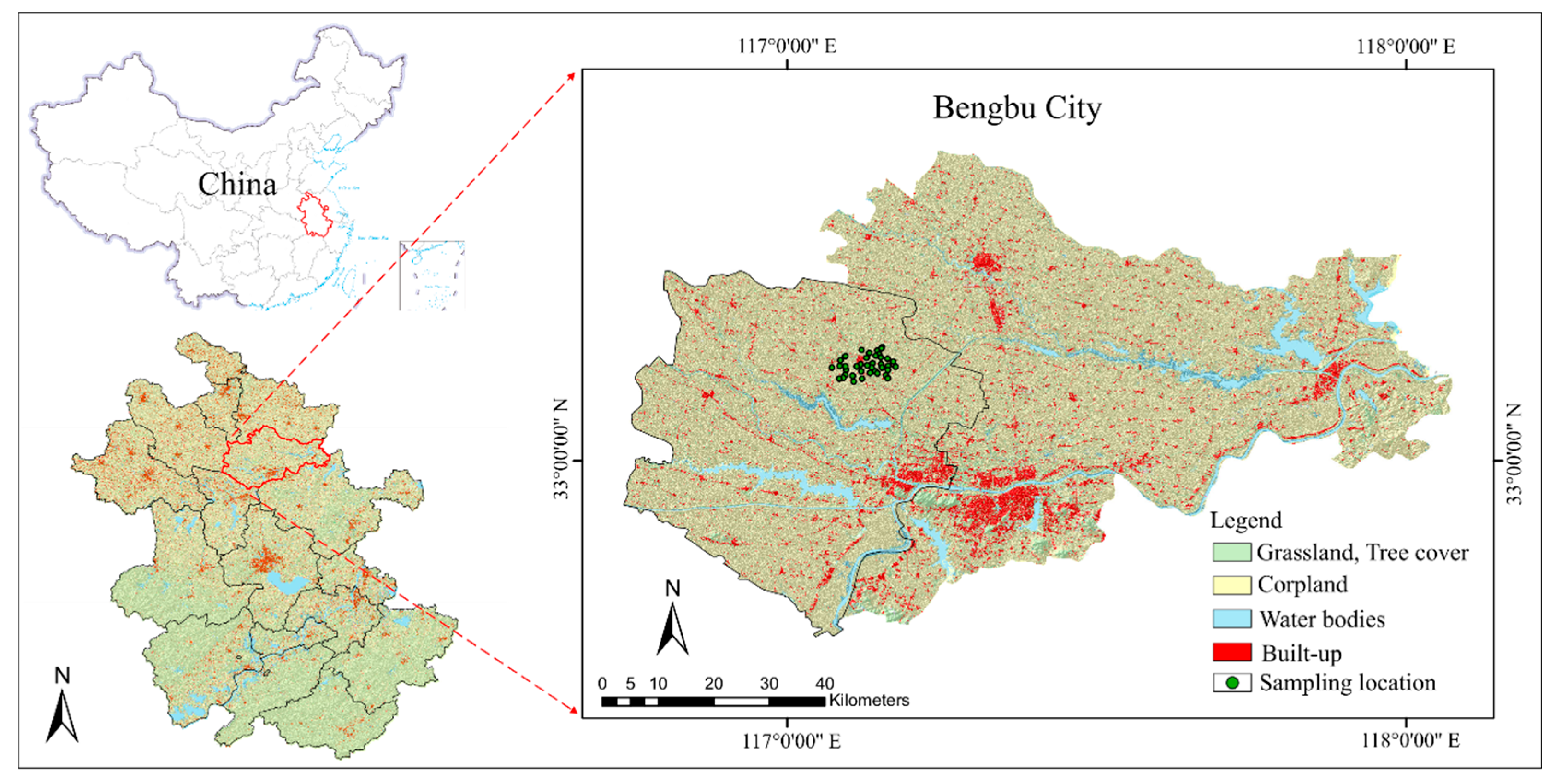
The study area is located in Bengbu City, situated in the northern Anhui Plain of China (Figure 1). It lies within the transitional zone between the subtropical and warm temperate regions and is characterized by a warm temperate semi-humid monsoon climate. The region experiences four distinct seasons, with a mean annual temperature of approximately 15.4 °C and an average annual precipitation of about 900 mm. Precipitation is unevenly distributed throughout the year, with the majority occurring between July and September. According to the occurrence and lithological characteristics of aquifers, four main types of groundwater systems are identified in the study area: unconsolidated porous aquifers, clastic rock pore–fracture aquifers, carbonate fissure–karst aquifers, and bedrock fissure aquifers. Among these, the unconsolidated porous aquifer is the most important groundwater-bearing unit, primarily composed of sand, gravel, and medium–fine sand, and serves as the main source of water supply in the region.

2.2. Sample Collection and Analysis

2.2.1. Sample Collection

A total of 39 shallow groundwater samples were collected on 25 October 2025, from domestic wells and agricultural irrigation wells located in rural townships (Figure 1). Due to the limited availability and accessibility of wells in the study area, all accessible wells were sampled, which are considered to reasonably represent the spatial variability of shallow groundwater in this region. The sampling was conducted during a relatively stable hydrological period, which is suitable for assessing the baseline characteristics of groundwater quality.
Prior to preservation, groundwater samples were filtered through a portable filtration unit equipped with 0.45 μm membrane filters. The filtered samples were then transferred into pre-cleaned polyethylene bottles. To preserve dissolved metal(loid) concentrations, ultrapure nitric acid (5%) was added to the samples to adjust the pH to below 2. All samples were stored in a vehicle-mounted refrigerator at approximately 4 °C during fieldwork and subsequently transported to the laboratory for further analysis.

2.2.2. Analytical Methods

The concentrations of Cr, Mn, Co, Ni, Zn, As, and Mo in groundwater samples were determined using an inductively coupled plasma mass spectrometer (ICP–MS; Shimadzu ICPMS-2030LF, Kyoto, Japan). The analytical recoveries for these elements were 97.3%, 93.6%, 95.1%, 89.9%, 99.5%, 99.6%, and 94.6%, respectively. During analysis, the deviation between the measured values of standard reference materials and their certified values was maintained within 2%. Each sample was analyzed in triplicate, and the average value was reported. Quality assurance and quality control procedures were conducted in accordance with the Chinese Groundwater Quality Standard (GB/T 14848–2017 [29]). Therefore, the analytical results met the quality control requirements. All measurements were conducted at the Key Laboratory of Mine Water Resource Utilization of Anhui Higher Education Institutes, Suzhou University.

2.3. Data Analysis

2.3.1. Multivariate Statistical Analysis

Multivariate statistical methods, including Pearson correlation analysis, hierarchical cluster analysis (HCA), and principal component analysis (PCA), were employed to identify the relationships among heavy metal(loid)s and to preliminarily infer their potential sources in shallow groundwater.
Pearson correlation analysis was used to evaluate the strength and significance of relationships between variables. Hierarchical cluster analysis was conducted using the Ward’s linkage method with Euclidean distance as the similarity measure, allowing for the classification of both variables and samples into distinct groups based on their geochemical characteristics. Principal component analysis was applied to reduce data dimensionality and to extract the main controlling factors influencing groundwater chemistry. Prior to PCA, the dataset was standardized using z-score normalization to eliminate the effects of different units and magnitudes among variables. The suitability of the data for PCA was assessed using the Kaiser–Meyer–Olkin (KMO) test and Bartlett’s test of sphericity. Components with eigenvalues greater than 1 were retained according to the Kaiser criterion, and varimax rotation was applied to enhance the interpretability of factor loadings. All statistical analyses were performed using the Python (version 3.10) programming language, primarily based on libraries such as pandas (version 2.1.0), scikit-learn (version 1.3.0), and scipy (version 1.11.2).

2.3.2. Monte Carlo Human Health Risk Assessment (MC-HHRA)

In the study area, human exposure to heavy metal(loid)s in groundwater occurs primarily through direct ingestion of drinking water and dermal contact during water use. Accordingly, the average daily dose (ADD) of each contaminant was estimated for both pathways, including the ingestion dose ( A D D i n g e s t ) and dermal absorption dose ( A D D d e r m a l ), following the methodology recommended by the United States Environmental Protection Agency (US EPA). The average daily dose through drinking water ingestion was calculated as
A D D i n g e s t = ( C × I R × E F × E D ) / ( B W × A T )
where C is the concentration of the contaminant in groundwater (mg/L), I R is the ingestion rate (L/day), E F is the exposure frequency (days/year), E D is the exposure duration (years), B W is the body weight (kg), and A T is the averaging time (days). The average daily dose through dermal contact was calculated as
A D D d e r m a l = ( C × S A × K p × E T × E F × E D × C F ) / ( B W × A T )
where S A is the exposed skin surface area (cm2), K p is the dermal permeability coefficient (cm/h), E T is the exposure time (h/day), and C F is the unit conversion factor (L/cm3). The definitions of E F , E D , B W , and A T are the same as those described above. The values of all exposure parameters used in this study are summarized in Table 1.
Carcinogenic Risk Assessment
Human health risks associated with heavy metal(loid) exposure were evaluated in terms of both carcinogenic and non-carcinogenic effects. Based on the toxicological parameters adopted in this study, As and Cr were included in the carcinogenic risk assessment, whereas Mn, Co, Ni, Zn, and Mo were evaluated for non-carcinogenic risk. The carcinogenic risk (CR) represents the incremental probability of an individual developing cancer over a lifetime as a result of exposure to carcinogenic contaminants. For each carcinogenic element, the risk associated with the ingestion and dermal pathways was estimated as follows:
C R i n g e s t = A D D i n g e s t × S F i n g e s t
C R d e r m a l = A D D d e r m a l × S F d e r m a l
where C R i n g e s t and C R d e r m a l denote the carcinogenic risks via ingestion and dermal exposure, respectively, and S F i n g e s t and S F d e r m a l are the corresponding carcinogenic slope factors. The slope factor values for individual heavy metal(loid)s are listed in Table 2.
The total carcinogenic risk (TCR) was calculated as the sum of carcinogenic risks from all carcinogenic elements across the two exposure pathways:
T C R = i = 1 n ( C R i n g e s t , i + C R d e r m a l , i )
According to the US EPA guidelines, a carcinogenic risk lower than 1 × 10⁻⁶ is generally considered negligible, whereas a value greater than 1 × 10⁻⁴ indicates an unacceptable carcinogenic risk. Values between 1 × 10⁻⁶ and 1 × 10⁻⁴ are generally interpreted as indicating a potential carcinogenic risk.
Non-Carcinogenic Risk Assessment
The non-carcinogenic risk posed by each heavy metal(loid) was assessed using the hazard quotient (HQ), which was calculated as
H Q i = A D D i / R f i
where H Q i is the hazard quotient for contaminant i , A D D i is the total average daily dose of contaminant i , and R f i is the corresponding reference dose [mg/(kg·day)]. The reference dose values used in this study are provided in Table 2.
An H Q i value lower than 1 indicates that the non-carcinogenic risk is within the acceptable range, whereas H Q i ≥ 1 suggests the possibility of adverse non-carcinogenic health effects.
To evaluate the cumulative non-carcinogenic risk from multiple heavy metal(loid)s, the hazard index (HI) was calculated as the sum of the hazard quotients for all contaminants:
H I = H Q i = A D D i / R f i
An HI value greater than or equal to 1 indicates that the combined non-carcinogenic risk may be unacceptable, while HI < 1 suggests an acceptable level of overall non-carcinogenic risk.

3. Results and Discussions

3.1. Characteristics of Heavy Metal(loid) Concentrations

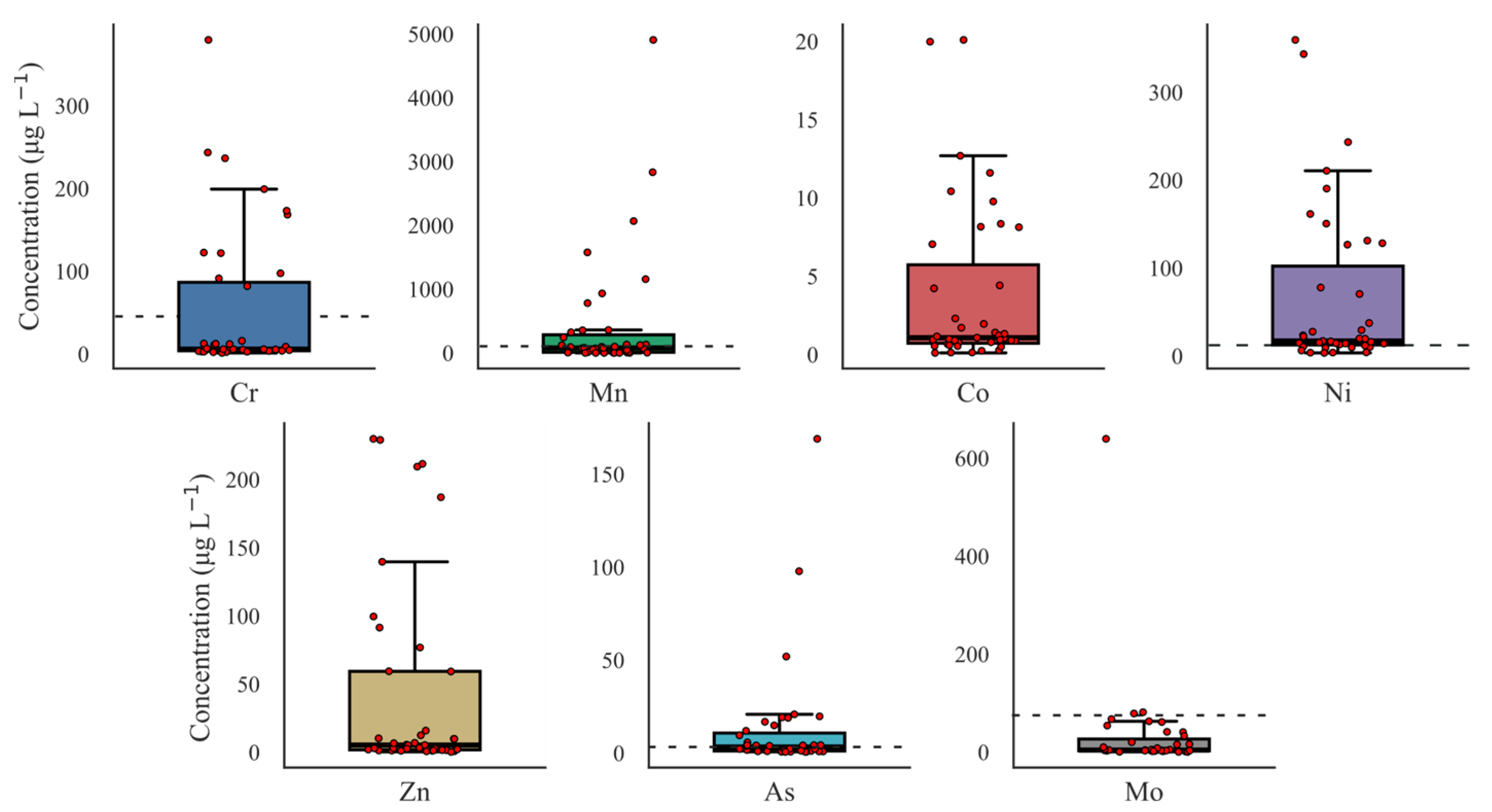
The statistical characteristics of heavy metal(loid) concentrations in groundwater from the study area are summarized in Table 3 and Figure 2. The average concentrations followed the order: Mn (433.3 μg/L) > Ni (66.4 μg/L) > Cr (53.2 μg/L) > Zn (43.9 μg/L) > Mo (33.3 μg/L) > As (13.1 μg/L) > Co (3.8 μg/L). All heavy metal(loid)s exhibited high variability, with coefficients of variation (CVs) exceeding 100%. Particularly high variability was observed for Mo, As, and Mn, with CV values reaching 304%, 233%, and 218%, respectively, indicating strong spatial heterogeneity in their groundwater concentrations. Compared with the Class III groundwater quality standard for drinking purposes in China, exceedances were observed for several elements. Specifically, 28.2%, 38.5%, 43.6%, 25.6%, and 7.7% of the samples exceeded the permissible limits for Cr, Mn, Ni, As, and Mo, respectively. In contrast, no exceedances were detected for Co and Zn in any of the groundwater samples.
The elevated concentrations and large coefficients of variation observed for several elements suggest significant spatial heterogeneity in groundwater chemistry within the study area. In particular, the relatively high mean concentrations of Mn, Ni, and Cr, together with their notable exceedance rates, indicate potential contamination risks in shallow groundwater. Based on the descriptive statistics alone, it is difficult to definitively attribute the observed variability to specific processes; however, the patterns observed may be preliminarily associated with the combined influence of natural geochemical processes and anthropogenic activities. High Mn concentrations in groundwater are commonly associated with reductive dissolution of Mn-bearing minerals under reducing conditions, whereas elevated levels of Ni and Cr may be influenced by both geogenic sources and human activities such as agricultural practices and rural domestic activities. The relatively high CV values of Mo and As further imply localized enrichment processes, possibly controlled by hydrogeochemical conditions and lithological characteristics of the aquifer. Nevertheless, these interpretations remain speculative at this stage and require further verification. Therefore, subsequent analyses combining multivariate statistical methods with hydrogeochemical indicators are employed to better constrain the potential controlling factors and sources of these elements.

3.2. Multivariate Statistical Analysis

3.2.1. Correlation Analysis

The Pearson correlation coefficients among the heavy metal(loid)s in groundwater are presented in Table 4. Significant positive correlations were observed between Cr and all other elements, suggesting that Cr may share similar controlling factors with other metal(loid)s in the groundwater system. In addition, Mn exhibited significant positive correlations with Co, Ni, and Zn, indicating potential similarities in their sources or geochemical behavior. Significant positive relationships were also observed between Co and Ni, Zn and As, and Ni with both Zn and As, while As showed a significant positive correlation with Mo. These correlations suggest that certain elements may be influenced by common sources or hydrogeochemical processes in the aquifer. Overall, the observed correlation patterns imply that multiple heavy metal(loid)s in the groundwater may originate from similar geochemical processes or anthropogenic activities.

3.2.2. Hierarchical Cluster Analysis

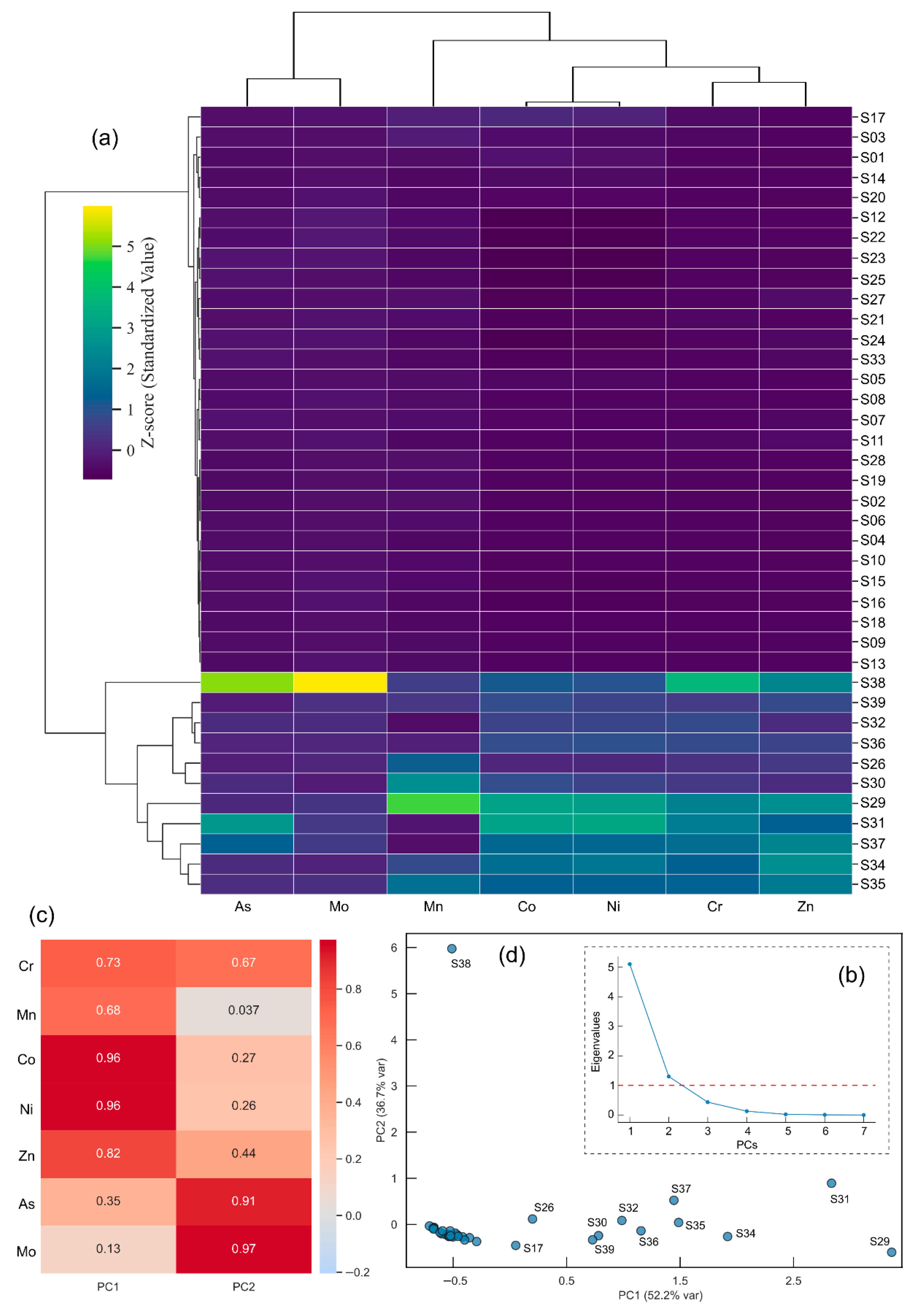
The results of hierarchical cluster analysis (HCA) are shown in Figure 3a. From the perspective of variable clustering, the seven heavy metal(loid)s can be broadly grouped into two major clusters. The first cluster consists of As and Co, whereas the second cluster includes the remaining elements. The clustering of groundwater samples also reveals two distinct groups. The first group comprises 11 samples (S26, S29–S32, and S34–S39) characterized by relatively high concentrations of heavy metal(loid)s, while the remaining samples form the second group with comparatively lower concentrations. This clustering pattern suggests differences in groundwater chemical characteristics among sampling locations, with certain samples showing relatively elevated concentrations.

3.2.3. Principal Component Analysis

Prior to principal component analysis (PCA), the suitability of the dataset was evaluated using the Kaiser–Meyer–Olkin (KMO) test and Bartlett’s test of sphericity. The results yielded KMO = 0.71 and p < 0.001, indicating that the dataset is appropriate for multivariate statistical analysis. Based on the eigenvalue > 1 criterion, two principal components (PC1 and PC2) were extracted, explaining 52.2% and 36.7% of the total variance, respectively. The cumulative variance contribution reached 88.9%, suggesting that these two components adequately represent the majority of the information contained in the dataset (Figure 3b). As shown in the loading plot (Figure 3c), the seven elements can be mainly explained by two principal components, which together reflect the combined influence of metal enrichment processes and hydrogeochemical mobilization mechanisms.
PC1 is strongly positively loaded by Co (0.96), Ni (0.96), and Zn (0.82), with additional contributions from Cr (0.73) and Mn (0.68). This component can therefore be interpreted as a composite metal-enrichment factor, mainly representing the co-enrichment behavior of transition metal(loid)s in groundwater. This interpretation is strongly supported by the correlation analysis (Table 4), in which Co, Ni, Zn, Cr, and Mn all show significant positive correlations with one another (r = 0.56–0.99, p < 0.001), indicating a high degree of geochemical coherence. In particular, the nearly perfect correlation between Co and Ni (r = 0.99) suggests that these two elements are likely governed by very similar source pathways or release mechanisms. The elevated mean concentrations and exceedance rates of Cr (53.2 μg/L, 28.2%), Mn (433.3 μg/L, 38.5%), and Ni (66.4 μg/L, 43.6%) (Table 3) further indicate that PC1 captures the major heavy-metal contamination pattern in the study area. The relatively moderate variability and widespread occurrence of these elements suggest that PC1 reflects a broad-scale enrichment pattern, likely influenced by regional background conditions and diffuse inputs associated with land use in the study area.
In contrast, PC2 is dominated by As (0.91) and Mo (0.97), with a moderate contribution from Cr (0.67), suggesting that this component reflects a distinct hydrogeochemical control compared with PC1. The very strong correlation between As and Mo (r = 0.91, p < 0.001) (Table 4), together with their extremely high coefficients of variation (233% for As and 304% for Mo), indicates that their distribution is highly heterogeneous and likely controlled by site-specific geochemical processes rather than by uniform regional input. This is further supported by their exceedance rates, with 25.6% of samples exceeding the limit for As and 7.7% for Mo (Table 3), indicating that their enrichment is confined to a subset of locations. Considering that the groundwater samples were collected from domestic and agricultural wells in rural areas, the elevated As concentrations may be partly associated with land-use-related inputs (e.g., agricultural activities). However, given the lack of additional hydrogeochemical indicators, the relative contributions of anthropogenic inputs and natural background sources cannot be clearly distinguished. Therefore, PC2 is interpreted as a localized As–Mo enrichment factor reflecting site-specific accumulation of these elements in groundwater.
The sample score plot (Figure 3d) further supports this distinction. Sample S38 exhibits the highest PC2 score, indicating a localized enrichment of As and Mo. In contrast, samples with high PC1 scores are more broadly distributed and correspond to generally elevated concentrations of transition metals. This difference highlights the contrast between widespread enrichment (PC1) and localized enrichment (PC2) patterns in the study area.

3.3. Human Health Risk Assessment

3.3.1. Non-Carcinogenic Risks

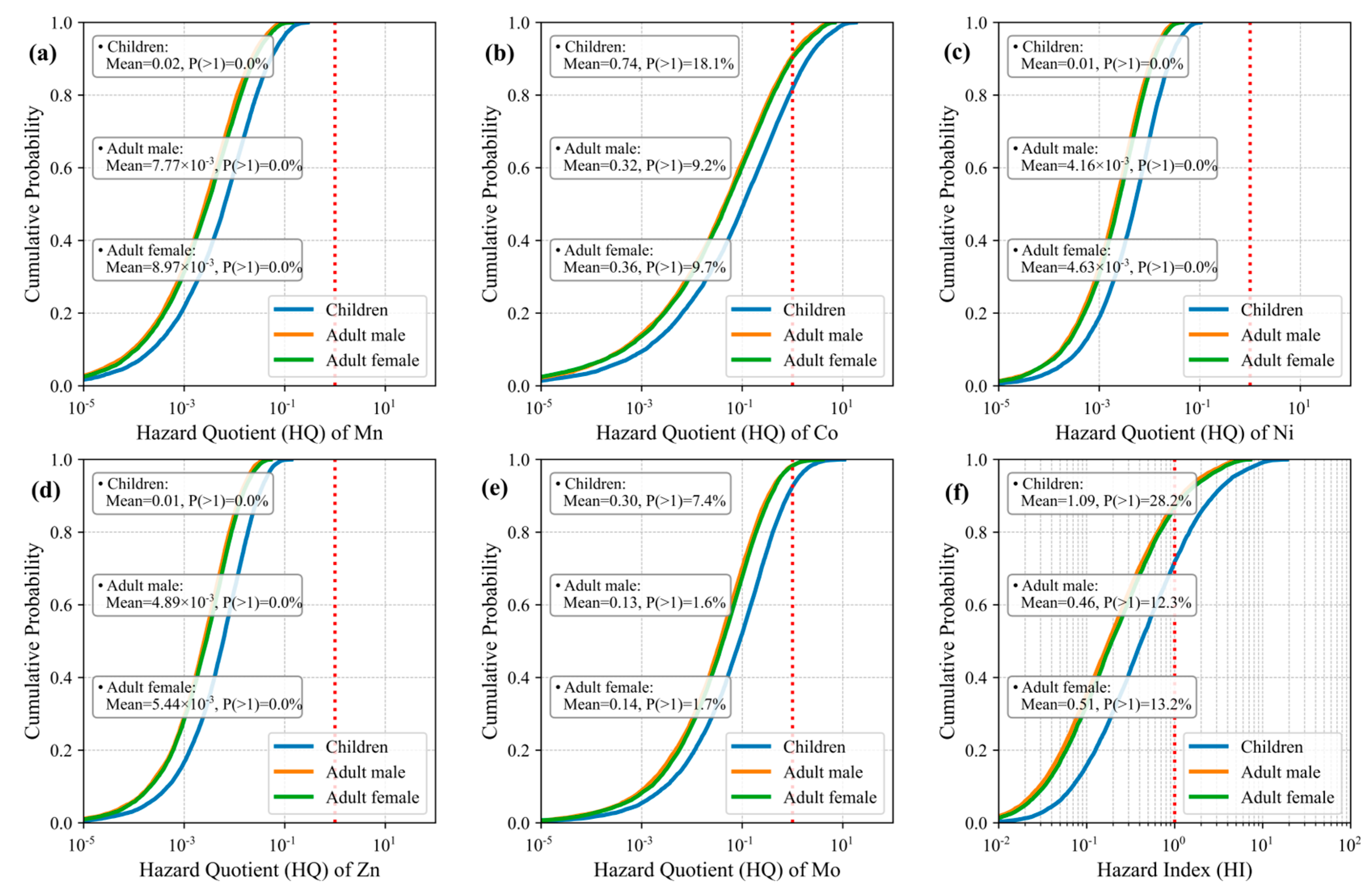
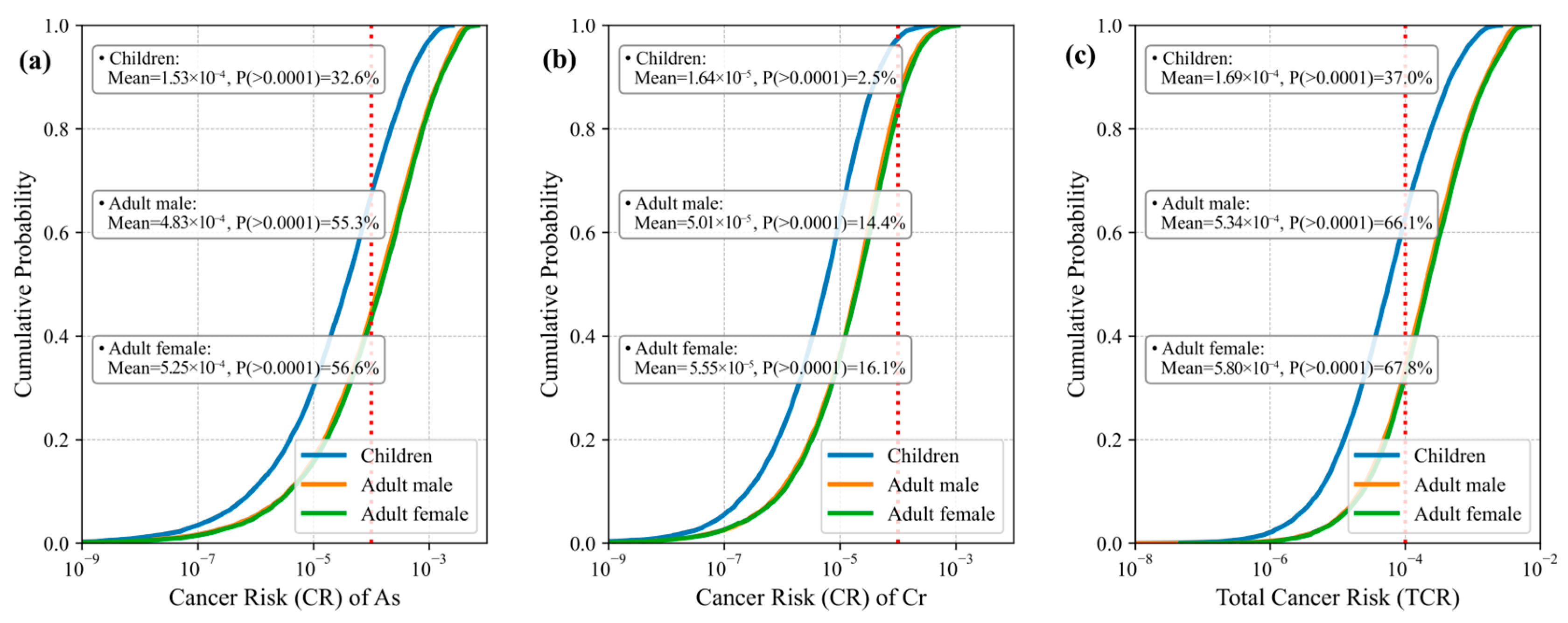
To more accurately quantify the uncertainty associated with health risk assessment, Monte Carlo simulation (MCS) with 10,000 iterations was performed on the input parameters of the HHRA model. The probabilistic distributions of the simulated risk outcomes are presented in Figure 4 and Figure 5.
As shown in Figure 4a,c,d, the mean hazard quotient (HQ) values of Mn, Ni, and Zn for all exposed groups were far below the safety threshold (HQ = 1), indicating that these three elements are unlikely to pose significant non-carcinogenic risks through either ingestion or dermal exposure. In contrast, Co and Mo exhibited relatively greater contributions to non-carcinogenic risk. The mean HQ values of Co were 0.74, 0.36, and 0.32 for children, adult females, and adult males, respectively, with corresponding probabilities of exceeding the safety threshold (HQ > 1) of 18.1%, 9.7%, and 9.2% (Figure 4b). Similarly, the probabilities of Mo-related HQ exceeding the threshold were 7.4%, 1.7%, and 1.6% for children, adult females, and adult males, respectively (Figure 4e). At the level of total non-carcinogenic risk (Figure 4f), the mean hazard index (HI) values were 1.09 for children, 0.46 for adult females, and 0.51 for adult males, with corresponding exceedance probabilities (HI > 1) of 28.2%, 13.2%, and 12.3%, respectively. These results suggest that combined exposure to multiple heavy metal(loid)s in groundwater may pose a measurable non-carcinogenic health threat to local residents, particularly to children, who appear to be the most vulnerable population due to their higher exposure sensitivity.

3.3.2. Carcinogenic Risks

The carcinogenic risks (CR) associated with As and Cr are shown in Figure 5. Among the two carcinogenic elements, As exhibited a pronounced carcinogenic effect across all exposed groups (Figure 5a). The mean CR values of As were 1.53 × 10⁻⁴, 4.83 × 10⁻⁴, and 5.25 × 10⁻⁴ for children, adult males, and adult females, respectively. The corresponding probabilities of exceeding the acceptable carcinogenic risk threshold (1 × 10⁻⁴) reached 32.6%, 55.3%, and 56.6%, respectively. By comparison, the carcinogenic risk posed by Cr was relatively lower (Figure 5b). Its mean CR values were 1.64 × 10⁻⁵, 5.01 × 10⁻⁵, and 5.55 × 10⁻⁵ for children, adult males, and adult females, respectively. Although these average values remained within the generally acceptable range, the probabilities of exceeding the threshold were still 2.5%, 14.4%, and 16.1%, respectively.
With respect to the total carcinogenic risk (TCR) (Figure 5c), adults showed markedly higher carcinogenic risk than children, primarily due to their longer cumulative exposure duration. Among the three exposed groups, adult females exhibited the highest probability of TCR exceedance (67.8%), followed by adult males (66.1%) and children (37.0%). These findings indicate that carcinogenic risk, particularly that associated with As exposure, represents a major health concern in the study area.

4. Conclusions

This study investigated the occurrence, controlling factors, and human health risks of heavy metal(loid)s in shallow groundwater from the northern Anhui Plain. The main conclusions are summarized as follows:
(1)
Shallow groundwater exhibited marked heavy metal(loid) enrichment and strong spatial heterogeneity, with Ni, Mn, Cr, and As representing the major pollutants of concern.
(2)
The distribution of heavy metal(loid)s was primarily governed by two coupled controls: transition-metal enrichment related to lithogenic background and external disturbance, and localized enrichment driving As–Mo co-occurrence.
(3)
Probabilistic health risk assessment indicated that children were the most vulnerable to non-carcinogenic effects, whereas As dominated the carcinogenic risk across exposed populations.
These findings suggest that long-term use of shallow groundwater in the study area may pose a potential human health threat and that As, Co, Mo, Cr, and Ni should be prioritized in future groundwater monitoring and risk management.

Author Contributions

Conceptualization, L.H. and J.M.; methodology, L.H. and J.M.; validation, E.X. and K.C.; investigation, L.H.; writing—original draft preparation, L.H. and J.M.; writing—review and editing, L.H., J.M. and K.C. All authors have read and agreed to the published version of the manuscript.

Funding

This research was funded by the National Innovation and Entrepreneurship Training Program for College Students (202510379057); the University–Enterprise Collaborative Research Project of Suzhou University (2025xhx091); the Research Innovation Platform Project of Suzhou University (2024PT04) and Key Scientific Research Project of Suzhou University (2025yzd09).

Institutional Review Board Statement

Not applicable.

Informed Consent Statement

Not applicable.

Data Availability Statement

The original contributions presented in this study are included in the article. Further inquiries can be directed to the corresponding author.

Conflicts of Interest

Author Lei Han was eployed by the company CCTEG Xi’an Research Institute (Group) Co., Ltd. The remaining authors declare that the research was conducted in the absence of any commercial or financial relationships that could be construed as a potential conflict of interest.

References

  1. Ghoto, S.M.; Abbasi, H.; Memon, S.A.; Brohi, K.M.; Chhachhar, R.; Ghanghlo, A.A. Mapping and Assessing Impacts of Land Use Land Cover and Climate Conditions on Groundwater Quality Using RS & GIS. Appl. Water Sci. 2025, 15, 53. [Google Scholar] [CrossRef] [Scilit]
  2. Schroeter, S.A.; Orme, A.M.; Lehmann, K.; Lehmann, R.; Chaudhari, N.M.; Küsel, K.; Wang, H.; Hildebrandt, A.; Totsche, K.U.; Trumbore, S.; et al. Hydroclimatic Extremes Threaten Groundwater Quality and Stability. Nat. Commun. 2025, 16, 720. [Google Scholar] [CrossRef] [Scilit]
  3. Singh, A.; Cutting, N.G.; Kaur, S.; Biwalkar, N. Assessing Groundwater Quality and Suitability for Agricultural Use in Punjab, India: A Spatial and Temporal Analysis. Environ. Monit. Assess. 2025, 197, 132. [Google Scholar] [CrossRef] [Scilit] [PubMed]
  4. Derdour, A.; Baz, M.; Alzaed, A.; Bojer, A.K.; Ghoneim, S.S.M. Groundwater Quality Assessment Using Few-Shot Learning with Prototypical, Siamese, and Matching Networks. J. Water Process Eng. 2025, 75, 108003. [Google Scholar] [CrossRef] [Scilit]
  5. Yao, R.; Zhang, Y.; Sun, Z.; Zhao, X.; Zhang, H.; Zhang, X.; Luo, M.; Uddin, M.G.; Wang, Y.; Wang, Y. A Novel Grid-Based Technique for Quantifying Groundwater Quality under Land Use/Land Cover Changes to Support Improved Groundwater Management. J. Hydrol. 2025, 662, 133955. [Google Scholar] [CrossRef] [Scilit]
  6. Guron, B.K.; Kalkal, S.; Mehra, R. Carcinogenic and Noncarcinogenic Risk Assessment Due to Heavy Metals in Groundwater Using Probabilistic Approach. Water Environ. Res. 2025, 97, e70176. [Google Scholar] [CrossRef] [Scilit] [PubMed]
  7. Jiang, J.; Chen, J.; Ou, X.; Luo, H.; Wang, S. Prediction of Heavy Metal Contamination in Soil-Groundwater Systems at Contaminated Sites. Environ. Technol. 2025, 46, 3011–3023. [Google Scholar] [CrossRef] [Scilit]
  8. Prusty, P.; Mohakud, S.K.; Mandal, A.R.; Parray, K.A.; Farooq, S.H. Assessment of Heavy Metal Contaminations in Groundwater and Surface Water Resources of Sukinda Valley, Odisha, India. Geol. J. 2026, 61, 275–289. [Google Scholar] [CrossRef] [Scilit]
  9. Yu, Q.; Liu, H.; Lv, G.; Liu, X.; Wang, L.; Mei, L.; Liao, L. Evaluating Carbon/Hydroxyapatite’s Efficacy in Removing Heavy Metals from Groundwater. Water 2025, 17, 914. [Google Scholar] [CrossRef] [Scilit]
  10. Zhang, C.; Dong, H.; Dong, J.; Li, L.; Li, X.; Zhang, H. Fate of Lead-Zinc Reaction Products with Different Types of nZVI during Aging in Simulated Groundwater and Heavy Metal Release under Dynamic Environmental Conditions. J. Hazard. Mater. 2025, 495, 138922. [Google Scholar] [CrossRef] [Scilit]
  11. Sun, Z.; Deng, Q.; Zhang, L.; Song, L.; Zhao, H.; Liu, J.; Wu, X.; Mu, J. Hydrogeochemical Analysis and Tracing of Heavy Metal Contamination in Groundwater Using Self-Organizing Mapping. Environ. Geochem. Health 2025, 47, 225. [Google Scholar] [CrossRef] [Scilit] [PubMed]
  12. Li, Z.; Alemu, C.; Yang, F.; Wei, C. Integrated PMF-GeoDetector Approach for Source Apportionment and Spatial Drivers of Heavy Metals in Coupled Surface-Groundwater Systems. Environ. Earth Sci. 2025, 84, 611. [Google Scholar] [CrossRef] [Scilit]
  13. Deng, J.; Yu, J.; Zhang, B.; Zhao, H.; Zhao, Z.; Chen, Y.; Pu, S. Source-Pathway-Sink Analysis and Health Risk Zoning of Heavy Metal Groundwater Pollution in Karst Chemical Park. Environ. Pollut. 2025, 382, 126716. [Google Scholar] [CrossRef] [Scilit] [PubMed]
  14. Laaraj, M.; Ait Brahim, Y.; Mesnage, V.; Bensalem, F.; Lahmidi, I.; Mliyeh, M.M.; Fattasse, H.; Arari, K.; Benaabidate, L. Heavy Metal Contamination of Sediments in the Inaouène Watershed (Morocco): Indices, Statistical Methods, and Contributions to Sustainable Environmental Management. Sustainability 2025, 17, 4668. [Google Scholar] [CrossRef] [Scilit]
  15. Hossain, M.I.; Alam, M.M.; Tasnim, S.M.; Chowdhury, T.A.; Rahaman, M.; Aldalbahi, A.; Hasnat, M.A. Hydrogeochemical Investigation of the Groundwater Quality Controlling Processes Involved in North-Western Bangladesh Using Statistical Approaches. Appl. Water Sci. 2025, 15, 164. [Google Scholar] [CrossRef] [Scilit]
  16. Srivastava, S.; Malik, A. Drinking Water Quality Assessment through Multivariate Statistical Approach and Formulated PCA-Based Contamination Index. J. Contam. Hydrol. 2026, 276, 104764. [Google Scholar] [CrossRef] [Scilit]
  17. Anwar, M.; Shirazi, S.A.; Mazhar, U. Spatial Distribution and Health Risk Assessment of Groundwater Pollution in Kotlakhpat Industrial Complex, Lahore. Water Air Soil Pollut. 2024, 235, 157. [Google Scholar] [CrossRef] [Scilit]
  18. Deng, J.; Yang, G.; Yan, X.; Du, J.; Tang, Q.; Yu, C.; Pu, S. Quality Evaluation and Health Risk Assessment of Karst Groundwater in Southwest China. Sci. Total Environ. 2024, 946, 174371. [Google Scholar] [CrossRef] [Scilit]
  19. Sanad, H.; Moussadek, R.; Dakak, H.; Zouahri, A.; Oueld Lhaj, M.; Mouhir, L. Ecological and Health Risk Assessment of Heavy Metals in Groundwater within an Agricultural Ecosystem Using GIS and Multivariate Statistical Analysis (MSA): A Case Study of the Mnasra Region, Gharb Plain, Morocco. Water 2024, 16, 2417. [Google Scholar] [CrossRef] [Scilit]
  20. Meng, L.; Wang, Y.; Zuo, R.; Xing, L.; Zhang, Z.; Yang, X.; Li, Q.; Liu, J.; Feng, L.; Wang, Y. Multidimensional Characterization of the Groundwater Contamination and the Health Risk in an Industrial Park: A Combined Multivariate Statistics, Source Apportionment, and Monte Carlo Simulation Approach. Ecotoxicol. Environ. Saf. 2025, 308, 119493. [Google Scholar] [CrossRef] [Scilit]
  21. Yadav, S.K.; Attry, B.; Shukla, S.; Dutta, S.; Sharma, K.; Rajak, R.; Gupta, A.; Baruah, B.; Ranjan, R.K. Distribution, Toxicity Load and Risk Assessment of Heavy Metals in the Groundwater of Dhemaji, Assam, India. Chemosphere 2024, 358, 141979. [Google Scholar] [CrossRef] [Scilit]
  22. Chen, K.; Liu, Q.; Yang, T.; Ju, Q.; Hou, X.; Gao, W.; Jiang, S. Groundwater Pollution Source Identification and Health Risk Assessment in the North Anhui Plain, Eastern China: Insights from Positive Matrix Factorization and Monte Carlo Simulation. Sci. Total Environ. 2023, 895, 165186. [Google Scholar] [CrossRef] [Scilit]
  23. Han, J.; Cui, X.; Qin, W.; Liu, Y. Source Apportionment and Health Risk of Heavy Metals and Inorganic Nitrogen in Groundwater of a Coastal Plain, China. Water Environ. Res. 2026, 98, e70365. [Google Scholar] [CrossRef] [Scilit]
  24. Jahan, A.; Rai, N.; Khan, M.U. Groundwater Contamination Characterization and Source Apportionment of Heavy Metals and Associated Source-Specific Health Risk Appraisal Using Monte Carlo Simulation Coupled with PCA-MLR and PMF Models in the Middle Gangetic Basin, India. Expo. Health 2025, 17, 775–806. [Google Scholar] [CrossRef] [Scilit]
  25. Li, S.; Shuai, H.; Yu, H.; Liu, Y.; Jing, Y.; Kong, Y.; Liu, Y.; Wu, D. Source Apportionment and Health Risk Assessment of Heavy Metals in Groundwater in the Core Area of Central-South Hunan: A Combined APCS-MLR/PMF and Monte Carlo Approach. Sustainability 2026, 18, 1225. [Google Scholar] [CrossRef] [Scilit]
  26. Vesković, J.; Onjia, A. Two-Dimensional Monte Carlo Simulation Coupled with Multilinear Regression Modeling of Source-Specific Health Risks from Groundwater. J. Hazard. Mater. 2025, 488, 137309. [Google Scholar] [CrossRef] [Scilit] [PubMed]
  27. Wei, D.; Yang, S.; Zou, L.; Torres-Martínez, J.A.; Zheng, Y.; Hu, Q.; Zhang, Y. Appraisal of Potential Toxic Elements Pollution, Sources Apportionment, and Health Risks in Groundwater from a Coastal Area of SE China. J. Environ. Manag. 2025, 377, 124691. [Google Scholar] [CrossRef] [Scilit]
  28. Chen, K.; Liu, Q.; Wang, Z.; Ma, J.; Chen, W. Microbial Community Characteristics in a Major Groundwater Supply Source of a Water-Scarce City in North Anhui, China: Composition and Driving Factors. J. Contam. Hydrol. 2026, 279, 104926. [Google Scholar] [CrossRef] [Scilit]
  29. GB/T 14848–2017; Standard for Groundwater Quality. Standards Press of China (SPC): Beijing, China, 2017.
Figure 1. Location of the study area.
Applsci 16 04927 g001
Figure 2. Boxplots of heavy metal(loid) concentrations in groundwater, with horizontal lines indicating the corresponding standard limits.
Applsci 16 04927 g002
Figure 3. Results of hierarchical cluster analysis (HCA) and principal component analysis (PCA): (a) clustering of samples and variables; (b) scree plot of eigenvalues; (c) variable loading plot of principal components; and (d) score scatter plot of samples in the principal component space.
Applsci 16 04927 g003
Figure 4. Probability distributions of non-carcinogenic risks for different populations: (a) HQ of Mn, (b) HQ of Co, (c) HQ of Ni, (d) HQ of Zn, (e) HQ of Mo, and (f) total hazard index (HI).
Applsci 16 04927 g004
Figure 5. Probability distributions of carcinogenic risks for different populations: (a) CR of As, (b) CR of Cr, and (c) total cancer risk (TCR).
Applsci 16 04927 g005
Table 1. Parameter interpretation in the HHRA model and corresponding reference value statistics used in Monte Carlo simulations [25,26].
ParametersUnitsDistributionsChildrenAdult MaleAdult Female
IRL/dBeta-PERT(0.809, 0.88, 1.414)(1.325, 2.000, 2.938)(1.125, 1.713, 2.55)
EFd/yTriangular(180, 345, 365)
EDyearUniform(0, 10)(0, 40)(0, 40)
BWkgLog-Normal(26.5, 1.96)(73.1, 8.72)(57.59, 8.03)
ATdayPoint365 × ED
SAcm2Beta-PERT(3400, 7923, 16,100)(14,000, 17,000, 20,000)(13,000, 15,000, 18,000)
ETh/dayBeta-PERT(0.083, 0.15, 0.2)(0.12, 0.167, 0.3)(0.12, 0.183, 0.317)
CFL/cm3Point0.001
Note: Values in parentheses denote the distribution parameters: mean and standard deviation for the lognormal distribution; minimum, mode, and maximum for the triangular distribution; minimum, most likely, and maximum for the beta distribution; and minimum and maximum for the uniform distribution.
Table 2. Reference values of slope factors (SF), reference doses (Rf) and dermal permeability coefficients (Kp) for carcinogenic and non-carcinogenic risk assessment of seven heavy metal(loid)s [6,8,13,17].
Heavy Metal(loid)sSFingestSFdermalRfingestRfdermalKp
mg/(kg·day)mg/(kg·day)mg/(kg·day)mg/(kg·day)cm/h
CRAs1.53.660.00030.00030.001
Cr0.50.50.0030.0000750.002
NCRMn//0.140.00560.001
Co//0.030.030.001
Ni//0.020.00080.0002
Zn//0.30.060.0006
Mo//0.0050.0050.001
Table 3. Descriptive statistics of groundwater HMs concentrations of the study area.
Statistics
(n = 39)
CrMnCoNiZnAsMo
ug/Lug/Lug/Lug/Lug/Lug/Lug/L
Permissible concentration<50<100<50<20<1000<10<70
Mean53.2433.33.866.443.913.133.3
Min1.30.00.13.40.20.60.4
Max379.44906.920.1359.5229.8169.0639.3
Coefficient of variation165%218%136%139%165%233%304%
Exceedance rate28.2%38.5%0%43.6%0%25.6%7.7%
Note: Permissible concentration references the Class III water of the Chinese Groundwater Quality Standard (GB/T 14848–2017).
Table 4. Correlation analysis results.
CrMnCoNiZnAs
Mn0.56 *
Co0.88 *0.67 *
Ni0.87 *0.65 *0.99 *
Zn0.93 *0.64 *0.89 *0.90 *
As0.85 *0.180.59 *0.58 *0.64 *
Mo0.76 *0.200.380.370.55 *0.91 *
Note: “*” indicates a significant correlation between the two elements at the α level of 0.001.
Disclaimer/Publisher’s Note: The statements, opinions and data contained in all publications are solely those of the individual author(s) and contributor(s) and not of MDPI and/or the editor(s). MDPI and/or the editor(s) disclaim responsibility for any injury to people or property resulting from any ideas, methods, instructions or products referred to in the content.