1. Introduction
Access to reliable electricity remains challenging for many remote and geographically isolated communities [
1,
2]. Recent studies continue to show that access to electricity has significant socio-economic effects on rural households and remains closely linked to poverty reduction, productivity, and development resilience in emerging and underdeveloped economies [
3,
4]. Extending the main grid to remote locations is often economically prohibitive and technically difficult, which makes local generation-based solutions a practical alternative [
2,
5]. In Panama, national electrification coverage is high, yet the remaining unelectrified share is concentrated in small, dispersed communities where logistics, transport constraints, and environmental sensitivity make conventional electrification strategies difficult to implement [
6,
7].
Hybrid renewable energy systems (HRESs) combining renewable generation, conventional backup (typically diesel), and battery storage have become a common approach to accelerate rural electrification while reducing fuel consumption and operational risk [
8,
9,
10]. In the literature, the sizing and techno-economic assessment of off-grid HRES is frequently carried out using dedicated simulation tools and software packages (e.g., HOMER and iHOGA), as well as optimization-based formulations [
11,
12]. Numerous studies report case-based evaluations of PV–diesel–battery combinations and compare outcomes in terms of cost, reliability, and renewable penetration [
13,
14,
15,
16]. Recent research also shows that standalone microgrid sizing increasingly incorporates integrated cost–benefit assessment, multiple storage options, and advanced optimization approaches [
10,
16].
Despite the availability of software tools, optimization-based models remain useful when the full transparency of assumptions, explicit control of constraints, and flexible definition of objective functions are required. In particular, multi-objective formulations allow the systematic exploration of trade-offs between economic performance and reliability metrics that are often treated as fixed constraints in single-objective studies. In this work, we consider two objectives: the levelized cost of energy (LCOE) and the expected energy not served (EENS). The sizing problem is formulated as a mixed-integer model over an hourly time horizon (8760 h), and the Pareto set is approximated via an
-constraint approach [
17,
18].
The contribution of this paper is therefore an applied ex ante versus ex post assessment of a real HRES deployed in a remote coastal community (La Miel, Panama), for which one year of measured demand and operational data are available (2019–2020). Unlike studies based only on simulated optimal configurations, this work compares optimized sizing results with the installed system, the real first-year operation, and the ex ante feasibility study. The community was previously supplied by diesel generators only, with fuel delivery constraints due to waterway transportation and seasonal access limitations. By evaluating multiple technology configurations—diesel-only, PV +diesel, PV+batteries, and PV+diesel+batteries—the paper provides a consistent techno-economic benchmark and identifies the practical factors that explain the gap between optimized planning and real-world performance in isolated mini-grids [
12,
19].
The remainder of the paper is organized as follows.
Section 2 presents the mathematical model and objective functions.
Section 3 describes the solution approach.
Section 4 reports the optimization results and compares them with real operation. Finally,
Section 5 summarizes the conclusions and outlines directions for future work.
2. Mathematical Model
This section presents the mathematical formulation used to size the hybrid renewable energy system. The system is modeled as a single-node isolated mini-grid, where distribution network constraints are neglected due to the short line lengths and limited spatial extent of the community. The formulation focuses on the techno-economic sizing of generation and storage technologies over an hourly time horizon (8760 h), using measured demand and resource data.
The set of candidate technologies includes photovoltaic (PV) generation, diesel generators, and electrochemical storage based on lead-acid batteries. The model determines both the installed capacities of each technology and their hourly operation, subject to power balance, technical constraints, and reliability requirements.
The main technical and economic parameters used in the optimization model are summarized in
Table 1. These values were obtained from project documentation, technical reports, and regulatory sources, and correspond to the technologies considered in the studied mini-grid.
2.1. Bi-Objective Formulation
The sizing problem is formulated as a bi-objective optimization problem. The two objective functions are: (i) the levelized cost of energy (LCOE), representing the average discounted cost of electricity supplied to the load over the project lifetime, and (ii) the expected energy not served (EENS), which quantifies the fraction of demand that cannot be supplied due to capacity or operational limitations.
The LCOE is evaluated over a planning horizon of
years and includes investment costs, fixed operation and maintenance costs, and variable operating costs associated with fuel consumption. A discount rate of
is applied, together with an annual escalation rate of 1% for operation and maintenance costs. The LCOE is expressed as
where
represents the total investment cost incurred at year zero,
the fixed operation and maintenance costs,
the variable operating costs, and
the electrical energy supplied to the load.
The second objective function is the expected energy not served (EENS), defined as
where
denotes the power not served at hour
t and
is the corresponding demand. EENS is expressed as a percentage of the annual demand and is used as a reliability indicator for isolated systems.
Rather than treating reliability as a fixed hard constraint from the outset, EENS is explicitly considered a second objective in order to explore trade-offs between economic performance and supply reliability. The Pareto front is approximated through an
-constraint approach [
17,
18]. In this approach, the bi-objective problem is transformed into a sequence of single-objective problems in which LCOE is minimized while imposing an upper bound on EENS:
subject to
where
is progressively reduced in order to generate solutions with different reliability levels. In this way, the decision-maker can evaluate the cost increase associated with tighter supply reliability requirements.
2.2. Investment and Operating Costs
The total investment cost includes the installation costs of generation and storage technologies. For generation technologies, the investment cost is proportional to the installed capacity, while for battery storage it is proportional to the nominal energy capacity. In addition, the cost of battery charge controllers is explicitly considered:
where
is the unit investment cost of generation technology
,
is its installed capacity,
is the unit investment cost of battery storage,
is the nominal battery energy capacity,
is the unit cost of the charge controller, and
is the number of charge controllers installed.
Fixed operation and maintenance costs are assumed proportional to the installed PV capacity, while variable costs for diesel generation depend on fuel consumption. For batteries, no explicit variable operating cost is considered; instead, battery aging is tracked through an equivalent full cycle counter.
The variable fuel cost is computed from hourly diesel consumption as
where
is the unit fuel price and
is the diesel fuel consumption at hour
t.
2.3. Battery Modeling and Lifetime Approximation
Battery operation is modeled through an hourly energy balance that accounts for charging and discharging efficiencies:
where
is the energy stored in the battery at hour
t, and
and
are the charging and discharging powers, respectively. For simplicity, symmetric efficiencies are assumed, i.e.,
.
The state of charge (SoC) is constrained between minimum and maximum limits:
An end-of-horizon condition is also imposed in order to avoid artificial depletion of the battery at the end of the annual simulation horizon:
Battery aging is approximated using an equivalent full cycle counter. The total energy processed by the battery over the study horizon is accumulated and normalized by the nominal battery capacity:
This simplified approach does not explicitly represent the effect of depth of discharge, temperature, or charge/discharge rate on degradation. However, it provides a tractable approximation for long-horizon planning studies, especially when detailed electrochemical and thermal data from field operation are not available. In the present study, the cycle-counting approach is used as a screening indicator to verify that the expected number of annual equivalent cycles remains compatible with the manufacturer-recommended lifetime range for the selected lead-acid technology [
20]. A more detailed degradation model would certainly improve physical realism, but it would also increase model complexity and require operating data that were not available for all scenarios considered.
2.4. Fuel Consumption and Diesel Operating Constraints
Diesel generator fuel consumption is modeled using a linear approximation based on the generated power and the nominal capacity of the unit:
where
a and
b are fuel consumption coefficients and
is a binary variable indicating generator operation.
The output power of the diesel generator is constrained by its minimum and maximum operating limits:
These constraints reflect the fact that diesel units cannot operate stably below a technical minimum loading level and cannot exceed their installed capacity.
2.5. Photovoltaic Generation Constraints
Photovoltaic generation is bounded by the installed capacity and the available solar resource. The hourly PV output is constrained as
where
is the installed photovoltaic capacity,
is the irradiance at hour
t,
is the ambient temperature,
is the PV temperature coefficient, and
is the nominal operating cell temperature. Curtailment is implicitly allowed through the excess energy variable when renewable production exceeds the instantaneous demand and storage capability.
2.6. Power Balance and Unmet Demand
At each hour, the balance between supplied power, charging demand, unmet demand, and curtailed energy must be satisfied:
where
and
are the PV and diesel generation at hour
t, respectively;
and
are the battery discharging and charging powers;
is the power not served;
is the demand; and
represents excess renewable generation that cannot be directly used or stored. This variable allows the model to represent curtailed energy when the storage capacity or charging power is insufficient.
2.7. Charge Controller Constraint and Reliability Penalty
The battery charge controller must be able to handle the power directed to the storage system. Its required power rating is determined from the maximum charging condition considered in the optimization. In practical terms, this limits the power that can be transferred from the generators to the battery and is reflected in the investment cost of the balance-of-system components.
The cost of energy not served is introduced as a penalty term in the objective function. This penalty does not represent a market-based value of lost load but rather a regulatory and social proxy reflecting the high impact of supply interruptions in isolated communities. Penalty values are selected based on national regulatory references and previous studies, and are varied parametrically to explore feasible solutions with different reliability levels.
2.8. Model Characteristics
The optimization determines the installed capacities of PV, diesel generation, and battery storage, as well as their hourly operation. The resulting formulation is a mixed-integer nonlinear programming (MINLP) problem, mainly due to binary diesel commitment variables and nonlinear expressions associated with PV production, energy balances, and cost calculations.
3. Solution Approach
The optimization problem formulated in
Section 2 results in a mixed-integer nonlinear programming (MINLP) problem. The nonlinearity arises mainly from the battery energy balance, photovoltaic generation constraints, and cost expressions, while integer variables are introduced to represent the on/off operation of diesel generators. Due to this structure, a decomposition-based solution strategy is adopted.
The model is implemented in the AIMMS optimization environment and solved using a combination of commercial solvers. Mixed-integer linear programming (MILP) subproblems are handled by CPLEX 12.9, while nonlinear programming (NLP) subproblems are solved using CONOPT 4.0. The coordination between discrete and continuous decisions is performed through an outer approximation (OA) algorithm [
21], which is suitable for MINLP problems combining binary commitment variables with nonlinear operating constraints.
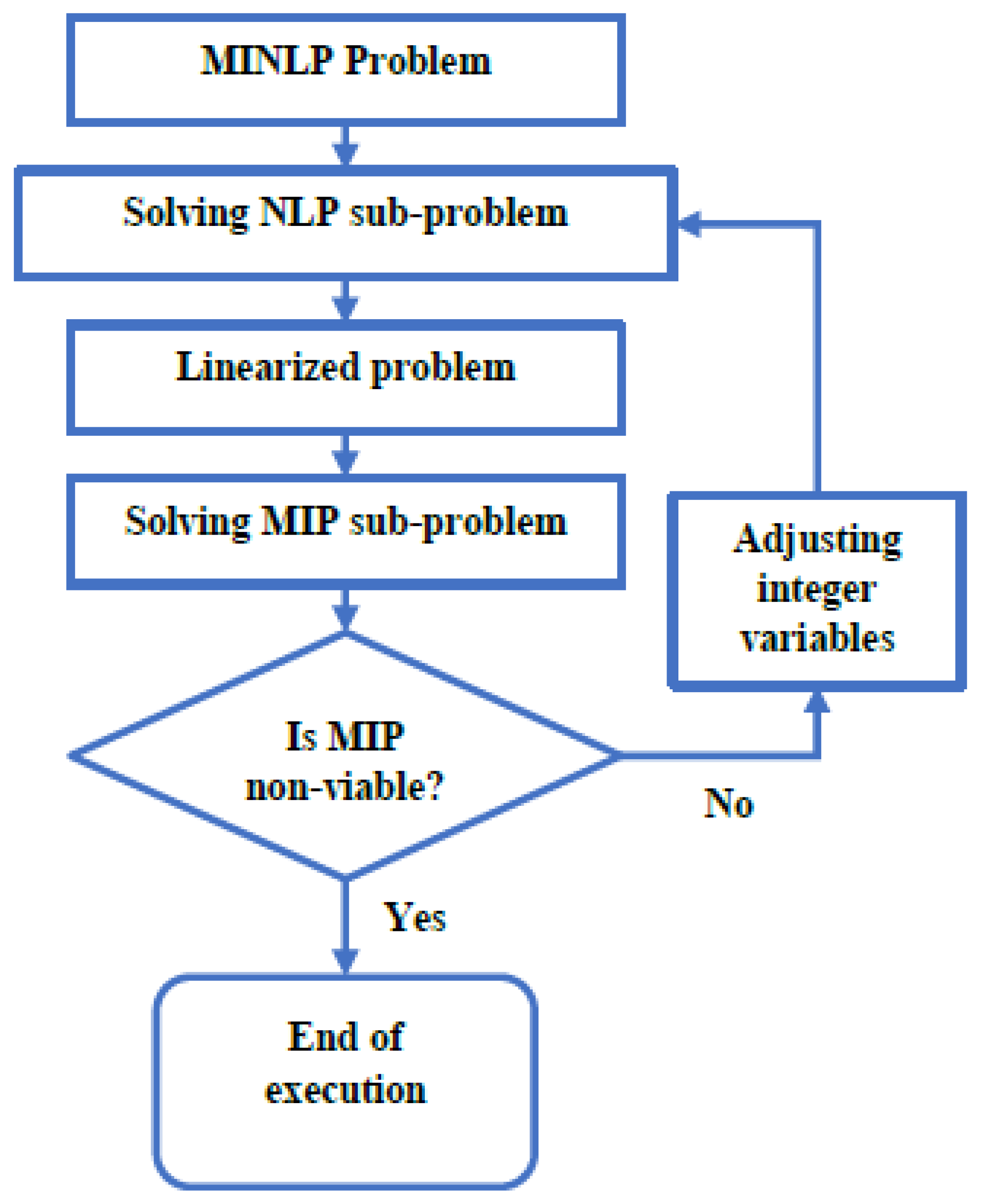
The adopted solution procedure follows the standard OA framework. First, the original MINLP is relaxed and solved as a nonlinear programming problem, treating integer variables as continuous within their bounds. This provides an initial feasible point for the continuous variables. Next, the nonlinear constraints are linearized around the current solution, and the resulting linear approximations are incorporated into a master MILP problem. Solving the MILP yields updated values for the integer variables, particularly those associated with diesel generator commitment.
Once the binary decisions are fixed, the original nonlinear model is solved again as an NLP subproblem in order to update the continuous operating variables, such as generation dispatch, charging and discharging powers, and battery state of charge. The solution obtained from this NLP is then used to construct a new linearization, which is added to the master MILP problem in the following iteration. To avoid cycling, integer cuts are introduced whenever necessary so that previously explored discrete solutions are excluded from subsequent iterations.
This iterative sequence between the MILP master problem and the NLP subproblem is repeated until the stopping criteria of the OA algorithm are satisfied. In practical terms, the iterative process ends when no further improvement is obtained in the objective function and the generated MILP master problem can no longer provide a better feasible discrete solution. The general workflow of the adopted solution approach is illustrated in
Figure 1.
Convergence and Computational Aspects
Convergence tolerances were selected in AIMMS to ensure consistency between successive iterations of the outer approximation algorithm and to guarantee feasibility of the nonlinear subproblems. For the case study presented in this paper, the optimization converged for all evaluated scenarios. The required computational effort depended on the selected system configuration and on the imposed reliability level through the -constraint.
To provide additional information on the computational performance of the implemented model,
Table 2 reports the execution time obtained for the evaluated configurations, together with the penalty assigned to energy not served (ENS) and the resulting expected energy not served (EENS). The simulations were carried out on a laptop equipped with an Intel(R) Core(TM) i5-8300H CPU at 2.30 GHz and 16 GB of RAM. As expected, computation time increases with the complexity of the configuration and, in general, with stricter reliability requirements, particularly when PV, diesel generation, and batteries are simultaneously included.
The shortest execution times correspond to the diesel-only case and to configurations with fewer active technology interactions. In contrast, the hybrid PV+diesel+battery case requires the longest computation times because the model simultaneously determines capacity sizing, diesel unit commitment, battery operation, and reliability-constrained dispatch. Nevertheless, all scenarios converged successfully, and the computational burden remained compatible with planning studies of small isolated mini-grids.
Given the limited size of the system and the single-node representation, the computational requirements remain tractable despite the hourly time resolution over a full year. The adopted solution approach is therefore suitable for planning studies of small isolated mini-grids in which both capacity sizing and operational constraints must be considered simultaneously.
Although the implemented OA procedure proved adequate for the scale of the present application, larger systems or formulations including uncertainty, network representation, or more detailed battery degradation models would likely require additional computational enhancements or alternative decomposition strategies.
4. Results and Discussion
4.1. Case Study and Evaluated Configurations
This section presents the results obtained from the optimization model and compares them with the performance of the real hybrid renewable energy system installed in La Miel during its first year of operation. La Miel is a small coastal community located in Eastern Panama, characterized by geographical isolation and limited accessibility. Electricity supply in the community is provided through a standalone mini-grid, without connection to the national transmission network.
Four system configurations are evaluated within the optimization framework: (A) diesel-only, (B) photovoltaic (PV) generation combined with diesel backup, (C) PV generation combined with battery storage, and (D) a fully hybrid PV+diesel+battery system. In addition, the installed system currently operating in La Miel (Case E) is included as a benchmark for ex post validation and comparison with optimized solutions.
The location of the community and its coastal surroundings are shown in
Figure 2. The different system configurations evaluated in the optimization and their correspondence with the real installation are summarized in
Table 3.
4.2. Demand Characterization
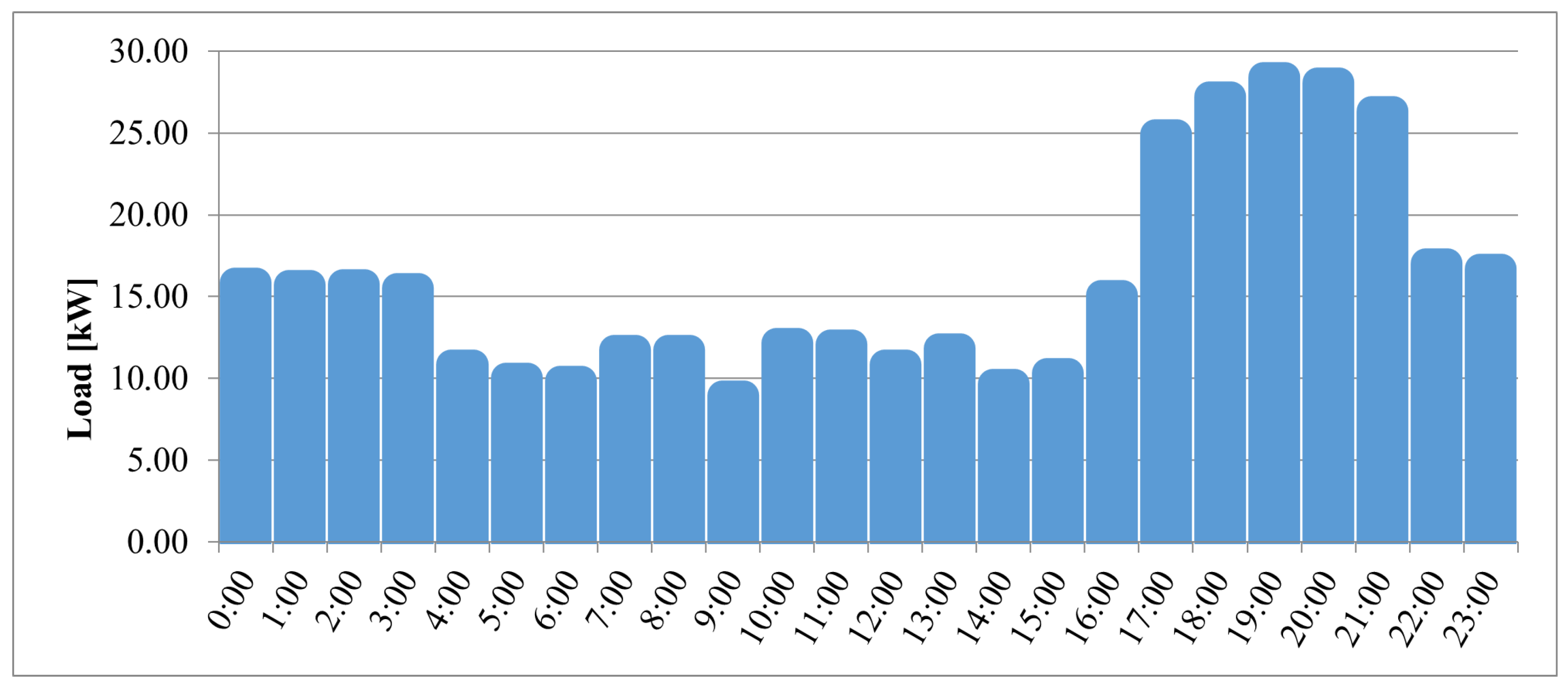
The analysis is based on one year of measured electricity demand recorded at the La Miel mini-grid. The annual electricity consumption during the study period amounted to 132,578 kWh, with a maximum hourly demand of 28.4 kW. This demand profile reflects the typical consumption patterns of small isolated coastal communities, where electricity use is concentrated during evening and nighttime hours.
Figure 3 illustrates the measured load profile corresponding to the day with the highest recorded demand. The pronounced nighttime peak is mainly associated with residential consumption and community services, and plays a key role in determining the required generation and storage capacities.
This demand pattern strongly influences the sizing of generation and storage technologies, particularly the required battery energy capacity and the extent of nighttime diesel operation. As a result, the load profile constitutes a critical input for the assessment of cost–reliability trade-offs discussed in the following subsections.
4.3. Optimization Results and Cost–Reliability Trade-Offs
Table 4 summarizes the main techno-economic results obtained for the evaluated system configurations, including levelized cost of energy (LCOE), expected energy not served (EENS), renewable penetration, diesel consumption, and installed capacities. These results provide the numerical basis for evaluating the trade-off between economic performance and supply reliability across the different configurations.
The diesel-only configuration (Case A) serves as a baseline and yields the highest LCOE, equal to 56.58 cents-USD/kWh, reflecting the strong dependence on fuel delivery and the absence of renewable contribution. This result is particularly relevant in the context of La Miel, where diesel logistics are constrained by maritime transport and seasonal accessibility. In contrast, introducing photovoltaic generation in combination with diesel backup (Case B) reduces the LCOE to 50.67 cents-USD/kWh while maintaining a very low EENS value (0.02%). This reduction is mainly explained by partial fuel displacement, although the achievable renewable penetration remains limited due to the absence of storage.
A different behavior is observed for the PV + batteries configuration (Case C). Although this option completely eliminates diesel consumption and reaches a renewable penetration of 99.8%, it leads to the highest installed PV and battery capacities among the optimized solutions. As a result, the corresponding LCOE rises to 60.42 cents-USD/kWh for EENS = 0.21%. This outcome reflects the mismatch between the local load profile and the solar resource availability: because the highest demand occurs during evening and nighttime hours, a fully renewable solution requires substantial storage capacity and additional photovoltaic oversizing in order to achieve acceptable reliability levels. Therefore, under the present cost assumptions, the purely renewable configuration becomes economically less attractive than hybrid alternatives.
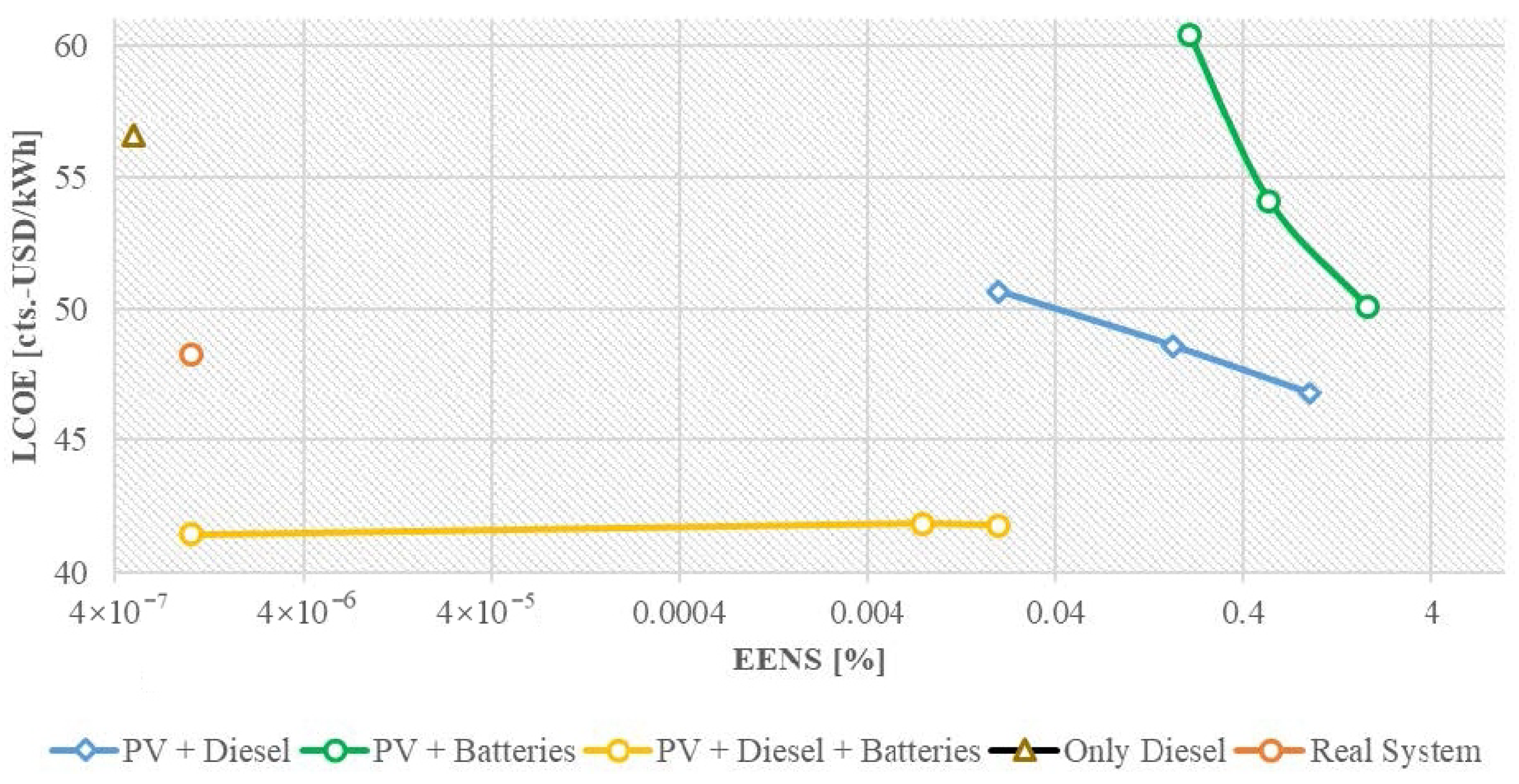
Figure 4 shows the trade-off between LCOE and EENS obtained for the different system configurations. For clarity, the EENS axis is represented on a logarithmic scale in order to distinguish solutions clustered near zero unmet demand. The figure shows that Cases B and C exhibit the expected increase in LCOE as the reliability requirement becomes more stringent. In both cases, reducing EENS implies additional investment in installed capacity, which increases total system cost. By contrast, the hybrid PV + diesel + batteries configuration (Case D) exhibits the most favorable balance between cost and reliability. For near-zero EENS values, this configuration achieves an LCOE in the range of 41.4–41.8 cents-USD/kWh, corresponding to a cost reduction of approximately 26.8% relative to the diesel-only baseline.
The superior performance of Case D can be explained by the complementarity between technologies. Photovoltaic generation reduces fuel consumption during daytime hours, battery storage shifts part of the renewable contribution toward the evening demand period, and diesel generation remains available as firm backup during prolonged low-resource or high-demand periods. This combination avoids the excessive oversizing required in the fully renewable configuration while substantially reducing fuel dependence relative to Cases A and B. In other words, Case D captures most of the economic benefit of renewable integration without incurring the full storage burden associated with a diesel-free solution.
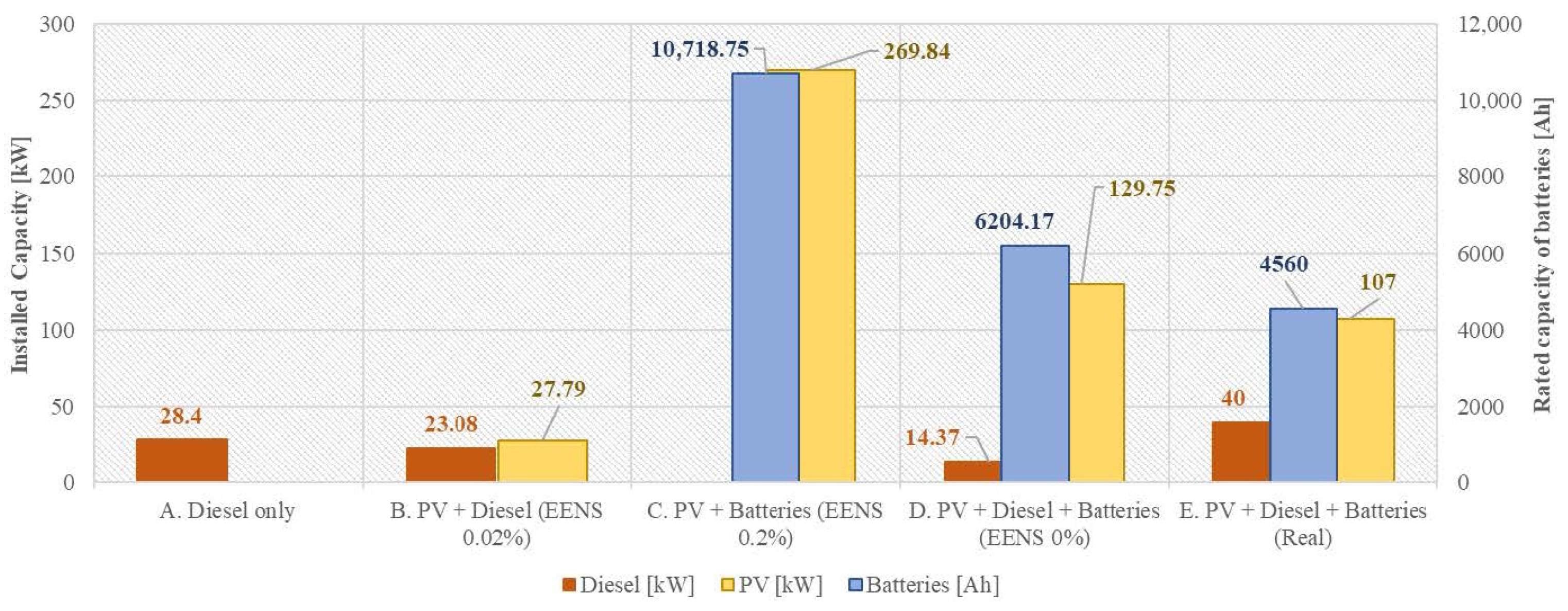
Figure 5 complements this interpretation by showing the installed generation and storage capacities corresponding to the optimized configurations and the real system. The figure makes clear that the fully renewable Case C requires the largest PV and battery capacities, whereas Case D achieves a more balanced design. This confirms that the favorable position of Case D in the Pareto front is not only a numerical result but also the consequence of a more efficient allocation of generation and storage resources under the specific demand and solar conditions of La Miel.
4.4. Comparison with the Real Installed System
The performance of the real hybrid system installed in La Miel (Case E) is compared against the optimized configurations obtained from the planning model. The installed system achieves zero energy not served (EENS = 0%), thus fully satisfying the reliability requirement but with a levelized cost of energy of 48.3 cents-USD/kWh. This value is approximately 14.3% higher than the LCOE obtained for the optimized hybrid configuration (Case D) under equivalent reliability conditions.
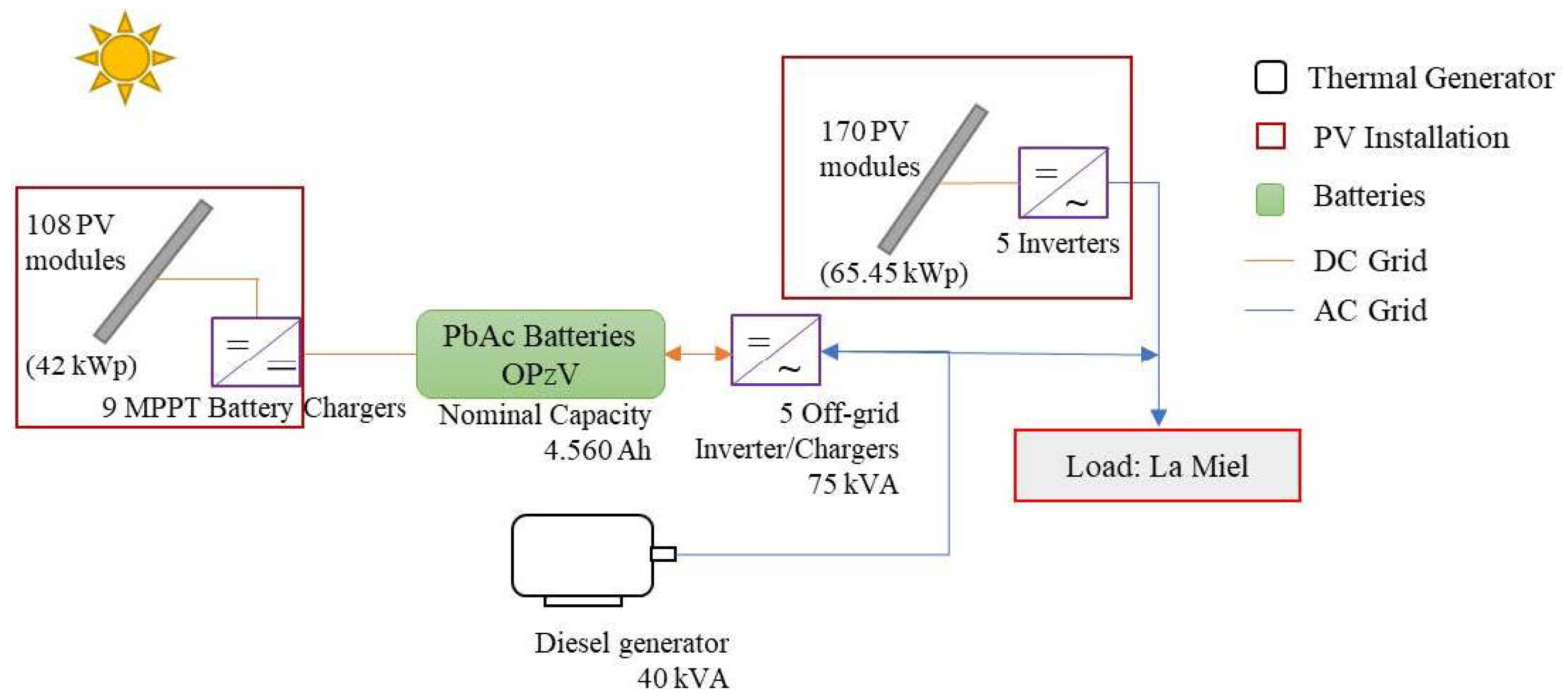
A simplified schematic of the installed hybrid system is shown in
Figure 6. While the optimization suggests a photovoltaic capacity of approximately 130 kWp and a battery capacity of 297.81 kWh, the real installation consists of 107 kWp of PV and a nominal battery capacity of 4560 Ah at 48 V, equivalent to 218.88 kWh. The installed diesel generator also differs from the optimized solution: whereas the optimization indicates that a nominal capacity close to 30 kW would be sufficient, the real system uses a 40 kVA unit.
Several factors explain the observed differences between optimized and real system performance. First, actual electricity consumption during the first year of operation reached 138,125 kWh, representing an increase of approximately 4.0% relative to the demand assumed in the optimization model. This additional consumption is mainly associated with auxiliary loads, including air-conditioning equipment required to control temperature and humidity in the battery room, which were not considered in the initial demand projections.
Second, operational constraints imposed in the real system limit the minimum allowable battery state of charge (SoC) to 60%, whereas the optimization allows deeper discharges in some scenarios. This conservative constraint was implemented to avoid voltage fluctuations and to comply with technical service quality standards in force in Panama. As a consequence, the effective usable battery capacity in the real system is reduced, leading to increased reliance on diesel generation and a higher resulting LCOE. Although the simplified battery lifetime model does not explicitly account for temperature-dependent degradation, the operational impact of battery-room air conditioning is indirectly reflected in the higher real electricity demand and in the more conservative operating constraints adopted in practice. In addition, although detailed battery safety analysis is beyond the scope of this techno-economic planning study, recent research on battery thermal runaway and fire-risk mitigation confirms that thermal management and safe operating conditions are relevant aspects for real-world storage deployment [
22].
Third, the real installation incorporates additional design margins in the selection of the diesel generator and other balance-of-system components. Although this oversizing improves robustness and operational flexibility under uncertain field conditions, it also increases capital costs relative to the optimized solution. Therefore, the 14.3% LCOE gap between Case D and Case E should not be attributed to a single cause but rather to the combined effect of: (i) stricter operational constraints on battery utilization, which appear to be the most influential factor; (ii) demand growth and auxiliary loads not accounted for in the original planning assumptions; and (iii) conservative equipment sizing adopted in the real project to ensure service continuity and power quality.
A direct comparison between the optimized hybrid configuration and the real installed system is provided in
Table 5. This comparison highlights that optimization results should be interpreted as a lower-cost planning benchmark under idealized operational assumptions, whereas real implementation requires additional margins to accommodate technical constraints, uncertainty, and robustness requirements.
4.5. Operational Behavior and Renewable Contribution
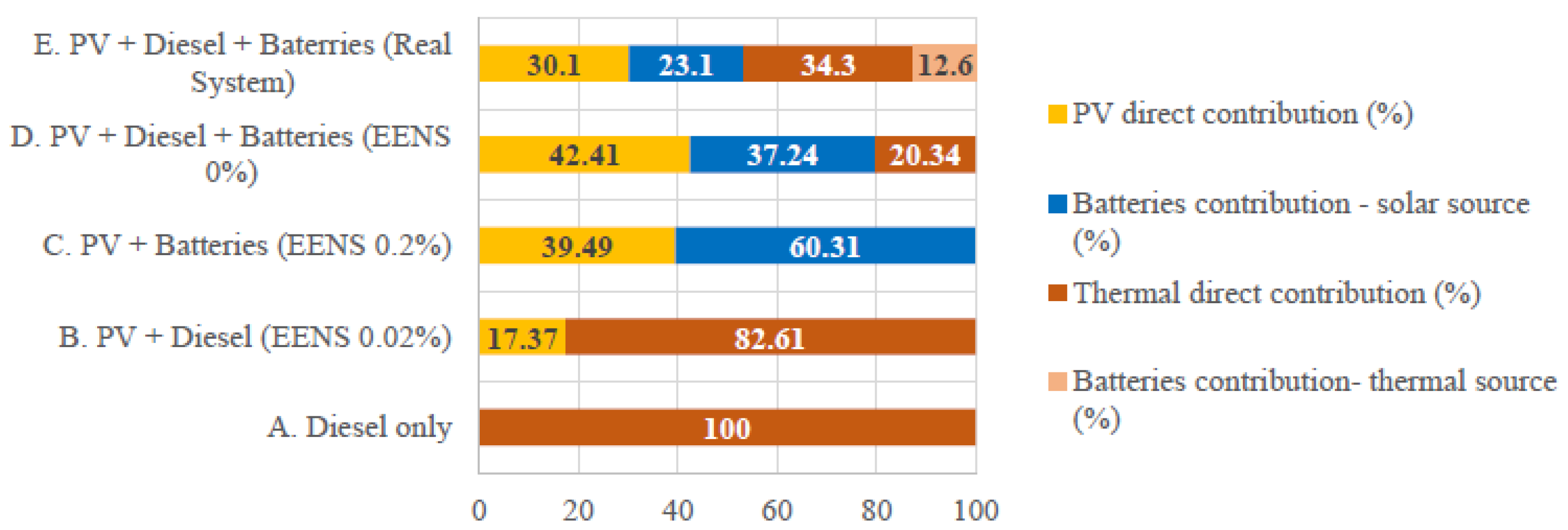
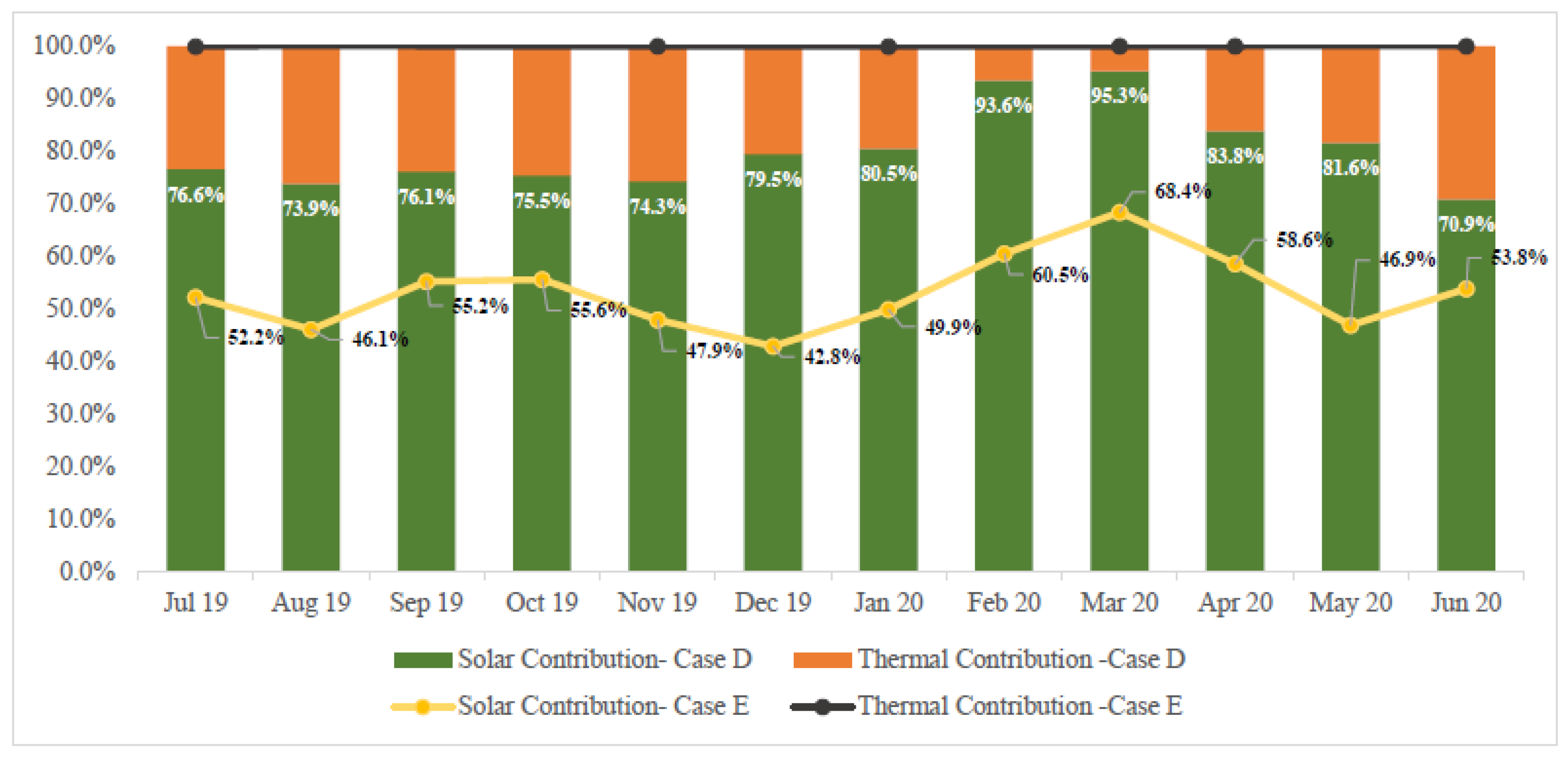
The annual renewable penetration achieved by the real hybrid system installed in La Miel is 53.2%, with a maximum monthly contribution of 68.4% observed in March 2020. In contrast, the optimized hybrid configuration (Case D) reaches an average renewable penetration of 79.6% over the year, with monthly values exceeding 95% under favorable solar conditions. These differences reflect both the sizing decisions obtained from the optimization and the operational constraints imposed in the real system.
The annual contribution of each energy source for the optimized configurations and the real system is summarized in
Figure 7. The optimized solutions exhibit a substantially higher share of photovoltaic generation, while the real system relies more heavily on diesel generation to ensure supply reliability, particularly during nighttime hours and periods of reduced solar availability.
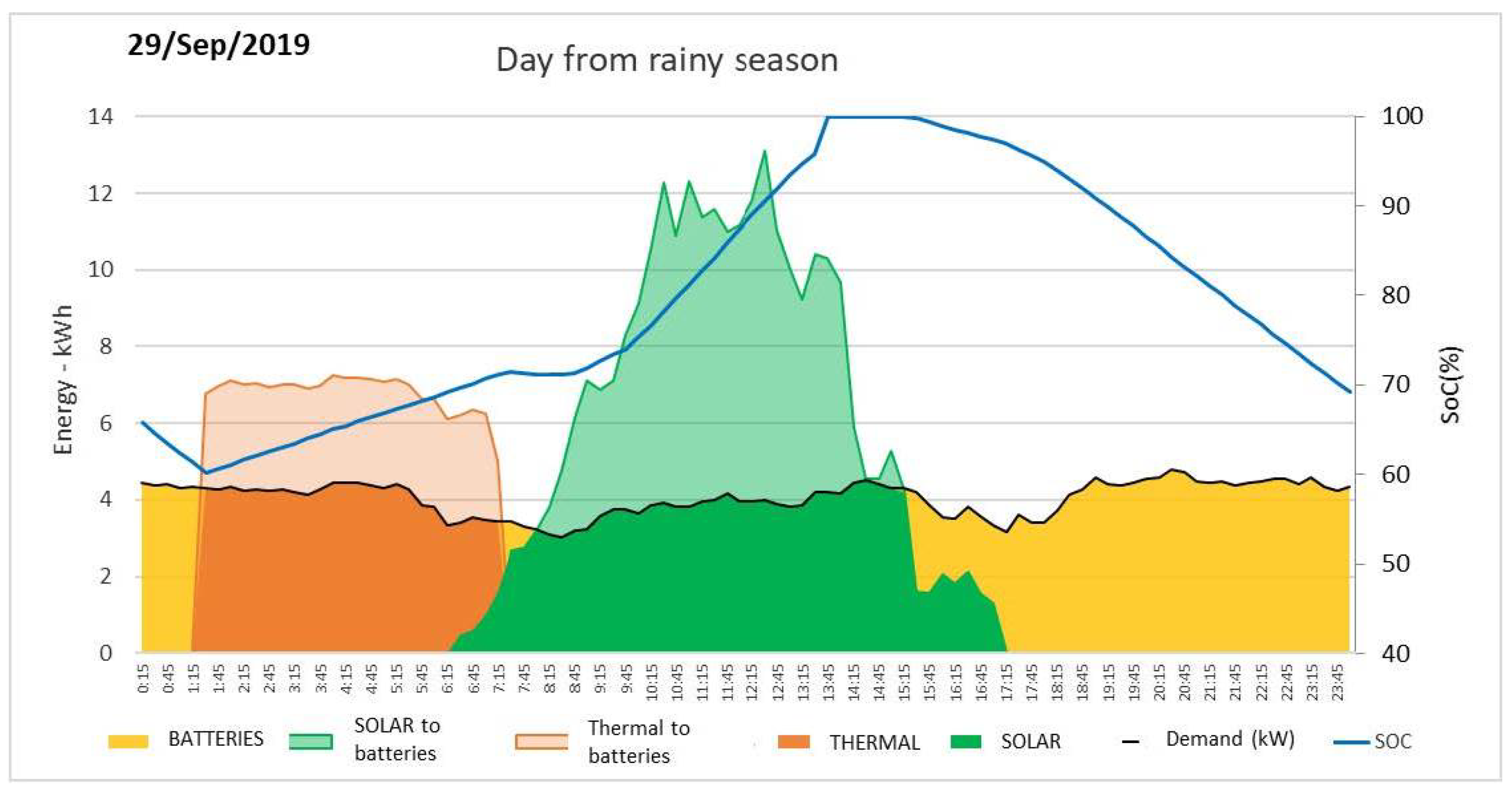
Figure 8 illustrates the hourly operation of the real system during a representative rainy-season day. The figure highlights the interaction between photovoltaic generation, diesel generator dispatch, and battery state of charge, as well as the operational limitations on battery usage. In particular, the minimum state-of-charge constraint imposed in the real installation restricts the depth of battery discharge, leading to increased diesel operation during evening and nighttime periods.
Monthly variations in renewable and thermal generation for the optimized hybrid configuration and the real system are compared in
Figure 9. The results show that seasonal effects and operational constraints amplify the role of diesel generation in the real system during months with lower solar resource availability. In contrast, the optimized configuration exploits deeper battery cycling and higher installed PV capacity to maintain a high renewable share throughout the year.
4.6. Ex Ante Versus Ex Post Assessment
A comparison between the ex ante feasibility study, the optimization results, and the ex post performance of the installed system reveals notable discrepancies in both demand and generation assumptions. The feasibility study assumed an annual electricity consumption of 118,990 kWh, which is approximately 10% lower than the demand considered in the optimization and observed during real operation. This underestimation directly affects the sizing of generation and storage components and leads to optimistic cost projections.
Similarly, expected photovoltaic generation differed significantly between ex ante estimates and ex post simulation and operation. Differences exceeding 20% were observed, reflecting uncertainties associated with solar resource assessment, system losses, and real operating conditions. These deviations highlight the sensitivity of isolated hybrid systems to input assumptions commonly adopted during early-stage feasibility analyses. These observations are consistent with recent studies on hybrid renewable and standalone microgrid systems, which emphasize that sizing results and cost effectiveness are highly dependent on local demand profiles, resource assumptions, storage operation, and reliability requirements [
10,
11,
16].
The comparison between optimized and real performance indicates that optimization models provide a lower bound for achievable system costs under idealized assumptions. However, real-world implementation requires conservative design choices that account for demand growth, operational constraints, equipment availability, and compliance with technical service quality standards. As a result, the installed system prioritizes robustness and reliability over strict economic optimality.
Overall, the ex ante versus ex post assessment underscores the importance of incorporating realistic demand projections, operational constraints, and uncertainty margins during the planning stage of isolated mini-grids. While optimization-based approaches are valuable tools for guiding system design, their results should be interpreted as reference benchmarks rather than exact predictors of real operational performance.
5. Conclusions
This paper presented a techno-economic optimization framework for hybrid renewable energy systems in isolated mini-grids and applied it to the case of La Miel, Panama. The study combined a bi-objective sizing model with one year of measured demand and operational data, enabling a direct comparison between optimized planning results and the first-year performance of the real installed system.
The results show that hybrid PV+diesel+battery configurations provide the most favorable compromise between cost and reliability for the studied community. In particular, the optimized hybrid solution achieved a reduction in levelized cost of energy of approximately 27% relative to the diesel-only baseline while maintaining near-zero expected energy not served. By contrast, the fully renewable PV+battery configuration required substantially larger photovoltaic and storage capacities, making it less attractive under the assumed cost and reliability conditions.
A central contribution of the work is the ex ante versus ex post assessment of the hybrid system. The comparison with the real installation showed that actual system costs are higher than those predicted by the optimization model, even when equivalent reliability levels are achieved. This performance gap is mainly explained by stricter operational constraints on battery utilization, demand growth and auxiliary loads not included in the initial planning assumptions, and conservative equipment sizing adopted to improve robustness and power quality in field operation.
These findings confirm that optimization-based approaches are valuable tools for planning isolated mini-grids, but their results should be interpreted as benchmark solutions under simplified assumptions rather than exact predictors of real operational performance. Therefore, one of the main practical implications of this study is that realistic operating constraints and implementation margins should be incorporated as early as possible in the planning stage.
Future work will focus on extending the proposed framework to include uncertainty, more detailed battery degradation mechanisms, and alternative storage and control strategies to further improve the realism and practical applicability of planning models for isolated hybrid renewable systems.
Author Contributions
Conceptualization, J.A.D.-N.; methodology, J.A.D.-N.; software, L.V.-B.; validation, J.L.A.-G.; formal analysis, L.V.-B.; investigation, L.V.-B.; resources, M.P.; data curation, M.P.; writing—original draft preparation, L.V.-B.; writing—review and editing, J.A.D.-N.; visualization, J.L.A.-G.; supervision, J.A.D.-N. and J.L.A.-G. All authors have read and agreed to the published version of the manuscript.
Funding
This research received no external funding.
Institutional Review Board Statement
Not applicable.
Informed Consent Statement
Not applicable.
Data Availability Statement
The data that support the findings of this study are available from the authors upon reasonable request.
Acknowledgments
The authors gratefully acknowledge Island Power S.A. (IPSA) for providing operational data from the real project, which made it possible to perform the ex-post analysis and comparison presented in this study.
Conflicts of Interest
Author Manuel Pino is employed by the company Island Power, S.A.—IPSA. The remaining authors declare that the research was conducted in the absence of any commercial or financial relationships that could be construed as a potential conflict of interest.
References
- Chaurey, A.; Ranganathan, M.; Mohanty, P. Electricity access for geographically disadvantaged rural communities—Technology and policy insights. Energy Policy 2004, 32, 1693–1705. [Google Scholar] [CrossRef] [Scilit]
- van Ruijven, B.J.; Schers, J.; van Vuuren, D.P. Model-based scenarios for rural electrification in developing countries. Energy 2012, 38, 386–397. [Google Scholar] [CrossRef] [Scilit]
- Gashaye, A.T.; Liu, H.; Li, J. The effect of access to electricity on rural households of underdeveloped countries: Evidence from Ethiopia. Energy Policy 2025, 199, 114531. [Google Scholar] [CrossRef] [Scilit]
- Asghar, N.; Amjad, M.A.; Rehman, H.U.; Munir, M.; Alhajj, R. Achieving sustainable development resilience: Poverty reduction through affordable access to electricity in developing economies. J. Clean. Prod. 2022, 376, 134040. [Google Scholar] [CrossRef] [Scilit]
- Ankel-Peters, J.; Bensch, G.; Moull, K.; Rauschenbach, M.; Sievert, M. Cost-effectiveness of rural energy access strategies. Energy Policy 2025, 203, 114633. [Google Scholar] [CrossRef] [Scilit]
- Secretaría Nacional de Energía de Panamá. Plan Energético Nacional 2015–2050, 2015. Available online: https://www.senacyt.gob.pa/wp-content/uploads/2018/12/3.-Plan-Energetico-Nacional-2015-2050-1.pdf (accessed on 8 February 2026).
- Organización Latinoamericana de Energía (OLADE). Sistema de Información Energética de Latinoamérica y el Caribe (sieLAC), 2026. Available online: https://sielac.olacde.org (accessed on 8 February 2026).
- Dawoud, S.M.; Lin, X.; Okba, M.I. Hybrid renewable microgrid optimization techniques: A review. Renew. Sustain. Energy Rev. 2018, 82, 2039–2052. [Google Scholar] [CrossRef] [Scilit]
- Twaha, S.; Ramli, M.A. A review of optimization approaches for hybrid distributed energy generation systems: Off-grid and grid-connected systems. Sustain. Cities Soc. 2018, 41, 320–331. [Google Scholar] [CrossRef] [Scilit]
- Giedraityte, A.; Rimkevicius, S.; Marciukaitis, M.; Radziukynas, V.; Bakas, R. Hybrid Renewable Energy Systems—A Review of Optimization Approaches and Future Challenges. Appl. Sci. 2025, 15, 1744. [Google Scholar] [CrossRef] [Scilit]
- Hoarcă, I.C.; Bizon, N.; Şorlei, I.S.; Thounthong, P. Sizing Design for a Hybrid Renewable Power System Using HOMER and iHOGA Simulators. Energies 2023, 16, 1926. [Google Scholar] [CrossRef] [Scilit]
- Seane, T.B.; Samikannu, R.; Bader, T. A review of modeling and simulation tools for microgrids based on solar photovoltaics. Front. Energy Res. 2022, 10, 772561. [Google Scholar] [CrossRef] [Scilit]
- Theo, W.L.; Lim, J.S.; Ho, W.S.; Hashim, H.; Lee, C.T. Review of distributed generation system planning and optimisation techniques: Comparison of numerical and mathematical modelling methods. Renew. Sustain. Energy Rev. 2017, 67, 531–573. [Google Scholar] [CrossRef] [Scilit]
- Ali Saleh, A.; Mohammad Faridun, N.T.; Mohd Rafi, A.; Azralmukmin, A.; Makbul, A.R. Optimization and sensitivity analysis of standalone hybrid energy systems for rural electrification: A case study of Iraq. Renew. Energy 2019, 138, 775–792. [Google Scholar] [CrossRef] [Scilit]
- Soumya, M.; Barun, K.D.; Najmul, H. Optimum sizing of a stand-alone hybrid energy system for rural electrification in Bangladesh. J. Clean. Prod. 2018, 200, 12–27. [Google Scholar] [CrossRef] [Scilit]
- Zhou, J.; Xu, Z. Optimal sizing design and integrated cost-benefit assessment of stand-alone microgrid system with different energy storage employing chameleon swarm algorithm: A rural case in Northeast China. Renew. Energy 2023, 202, 1110–1137. [Google Scholar] [CrossRef] [Scilit]
- Dufo-López, R.; Bernal-Agustín, J.L. Multi-objective design of PV–wind–diesel–hydrogen–battery systems. Renew. Energy 2008, 33, 2559–2572. [Google Scholar] [CrossRef] [Scilit]
- Cooper, K.; Hunter, S.; Nagaraj, K. An epsilon-constraint method for integer-ordered bi-objective simulation optimization. In Proceedings of the 2017 Winter Simulation Conference, Las Vegas, NV, USA, 3–6 December 2017. [Google Scholar] [CrossRef] [Scilit]
- Hirsch, A.; Parag, Y.; Guerrero, J. Microgrids: A review of technologies, key drivers, and outstanding issues. Renew. Sustain. Energy Rev. 2018, 90, 402–411. [Google Scholar] [CrossRef] [Scilit]
- Dufo-López, R.; Lujano-Rojas, J.M.; Bernal-Agustín, J.L. Comparison of different lead–acid battery lifetime prediction models. Appl. Energy 2014, 115, 242–253. [Google Scholar] [CrossRef] [Scilit]
- Duran, M.A.; Grossmann, I.E. An outer-approximation algorithm for a class of mixed-integer nonlinear programs. Math. Program. 1986, 36, 307–339. [Google Scholar] [CrossRef] [Scilit]
- Chen, Y.; Zhu, M.; Chen, M. Comprehensive experimental research on wrapping materials influences on the thermal runaway of lithium-ion batteries. Emerg. Manag. Sci. Technol. 2025, 5, e007. [Google Scholar] [CrossRef] [Scilit]
| Disclaimer/Publisher’s Note: The statements, opinions and data contained in all publications are solely those of the individual author(s) and contributor(s) and not of MDPI and/or the editor(s). MDPI and/or the editor(s) disclaim responsibility for any injury to people or property resulting from any ideas, methods, instructions or products referred to in the content. |




 ,
,