1. Introduction
Over recent decades, the landscape of competitive sports has undergone a rapid and dynamic evolution, characterised by an increasing emphasis on performance enhancement at the expense of the sport’s inherent compensatory function [
1]. This shift has intensified the demand for comprehensive monitoring of biomechanical parameters crucial for effective training management, injury prevention, and performance optimisation. Among these parameters, postural control—defined as the ability to maintain bodily stability and balance—represents a key determinant of athletic performance, particularly in disciplines requiring rapid changes of movement direction, precise coordination, and explosive strength [
2]. Balance is fundamental to efficient motor execution and injury prevention. Impaired postural control, especially under high-load conditions and frequent directional changes, increases the risk of overload injuries, predominantly in the lower limbs, with foot-related injuries accounting for up to 20% of all sports-related traumas [
3,
4,
5]. Repetitive sport-specific movement patterns contribute to functional asymmetries in plantar pressure distribution, subsequently affecting postural control, centre-of-mass alignment, and force transmission throughout the kinetic chain [
6,
7]. Moreover, shifts in the centre of pressure (CoP) during balance tasks are linked to the activation of musculature beyond the foot complex, highlighting the integrated relationship between local (distal) and global (proximal) mechanisms of postural stability [
8]. Despite these risks, athletes often prioritise performance outcomes over preventive strategies, creating a paradox wherein functional efficiency may coexist with progressive overload of the musculoskeletal system. This phenomenon illustrates the prevailing dominance of performance-oriented training stimuli over compensatory and restorative components.
Elite athletic performance emerges from the coordinated interaction of multiple motor abilities—strength, speed, agility, and endurance [
9]—supported by efficient energy utilisation and stable control of the centre of mass, both essential for optimising movement economy under load [
10]. Given that the foot serves as the primary support interface between the body and the ground, plantar-pressure analysis provides valuable insight into functional impairments and postural stability. Contemporary pressure-measurement technologies allow precise assessment of muscular imbalances and asymmetries of the lower limbs. Stabilometric analyses remain among the most widely used approaches for quantifying postural stability and rely on the tracking of CoP or centre of gravity (CoG) trajectories over time [
11]. Parameters such as displacement path, amplitude, directional deviations, velocity, and range of CoP movement offer objective evaluation of postural performance and adaptive mechanisms in athletes during load conditions [
12]. Complementary to stabilometry, baropodometry utilises pressure-sensing platforms to assess plantar pressure distribution during static and dynamic tasks. By analysing the ground reaction forces acting between the body and the support surface, baropodometric evaluation improves understanding of how external load influences posture and movement efficiency in both every day and sport-specific environments [
13].
The aim of this study was to examine the effect of long-term, sport-specific unilateral loading on plantar pressure distribution and centre of pressure (CoP) behaviour in athletes compared with non-athletes using static baropodometric assessment. It was hypothesised that athletes would demonstrate subtle alterations in plantar loading symmetry and CoP displacement patterns reflecting adaptive, predominantly subclinical changes in postural control associated with prolonged athletic training.
2. Materials and Methods
We conducted an observational, cross-sectional study analysing data obtained from a representative subsample of athletes and non-athletes at a single time point. The athletic group consisted of individuals with at least five years of continuous high-level sport participation in handball, basketball, or volleyball, enabling the assessment of long-term sport-specific loading effects on plantar pressure distribution and postural stability.
2.1. Participants
A total of 120 respondents were initially considered for inclusion in the study; however, following a purposive sampling procedure, only 88 participants who fully met the predefined selection criteria and complied with the inclusion criteria were ultimately enrolled in the final analysis. The study included 88 male participants (age: 22.47 ± 1.02), recruited from a faculty of sports and from non-sport-oriented university programmes. The inclusion of male participants only was intended to reduce variability related to sex-specific differences in foot morphology and postural control; however, this choice may limit the generalizability of the findings, which should be addressed in future studies including female athletes. Although stratified sampling was not applied, the final sample was balanced with respect to academic year, as it consisted exclusively of second- and third-year students, ensuring comparable academic load as verified through curriculum analysis. Inclusion criteria consisted of written informed consent, a minimum of two years of continuous study within the respective academic programme, and, for athletes, regular engagement in high-performance sport with documented training history of at least five years. Individuals from non-sport fields were included only if they had no history of competitive or performance-level sports participation. Exclusion criteria comprised refusal to participate, any lower-limb injury within the last 12 months, diagnosed or suspected musculoskeletal disorders, and neurological diseases that could influence postural stability or plantar pressure distribution.
Based on these criteria, participants were assigned to two groups: the sport group (“S”; n = 46; age: 22.70 ± 1.05) and the non-sport group (“NS”; n = 42; age: 22.21 ± 0.92) (
Table 1). Although a statistically significant age difference between groups was observed (
p = 0.031), the absolute difference was small and unlikely to be of practical relevance; therefore, the groups were considered age-comparable for the purposes of the present analysis. The defining characteristic of the sport group was long-term and repeated exposure to high physical load exceeding levels typical for the non-athletic population. Given that their postural and locomotor systems had been regularly exposed to intensive loading for at least five years, it was assumed that this prolonged training stimulus could have led to structural or functional adaptations, particularly in the foot complex and centre of pressure (CoP) behaviour.
The study protocol was approved by the Ethics Committee of the University of Prešov (ECUP062024PO) and conducted in accordance with the Declaration of Helsinki (1975, revised 2013). All participants were informed about the purpose of the study, the nature of the procedures, their right to withdraw at any time, and provided written informed consent.
2.2. Research Tools
The study was conducted as a comparative analysis of two groups—athletes and non-athletes—with the aim of comparing plantar pressure distribution and postural stability between individuals with distinct levels of long-term sports activity. Prior to postural assessment, anthropometric parameters including body height, body weight, lower-limb length, and BMI were recorded and served as baseline reference variables for the interpretation of postural characteristics. Postural diagnostics were performed using the FreeMed Maxi baropodometric platform (Sensor Medica, Via Bruno Pontecorvo, 1300012 Guidonia Montecelio (RM), Italy), a validated instrument commonly used for quantitative assessment of plantar pressure distribution and quiet-stance stability. The platform enables precise measurement of CoP displacement in the mediolateral (M/L) and anteroposterior (A/P) directions, expressed in millimetres, providing detailed information on postural control and biomechanical loading patterns of the lower limbs under static conditions.
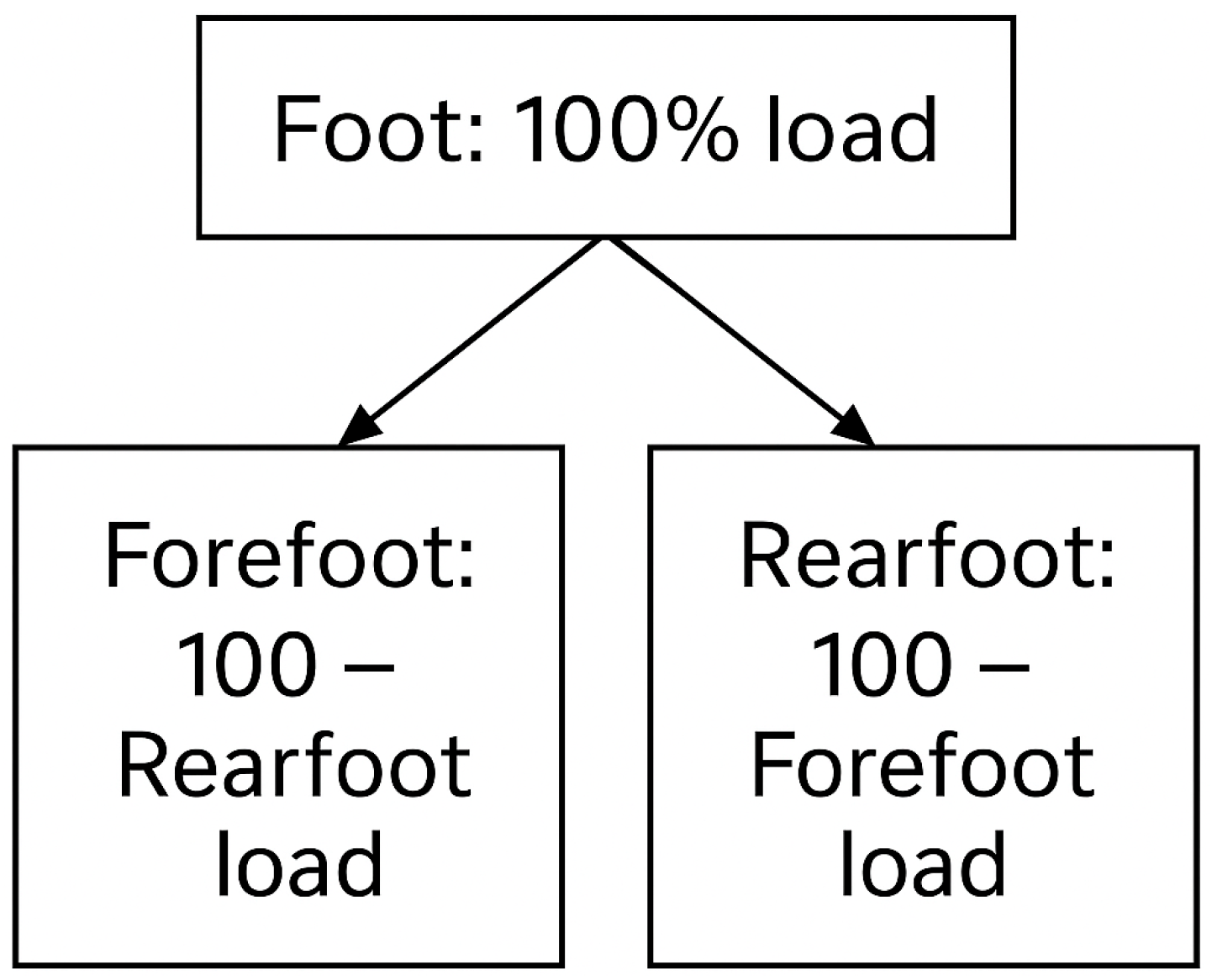
The conceptual model of plantar loading applied in this study divides the total load (100%) between the forefoot and rearfoot, representing the relative contribution of each region to overall plantar pressure. Forefoot load is expressed as the numerical difference between 100 and rearfoot load, and, conversely, rearfoot load is expressed as the difference between 100 and forefoot load, reflecting their complementary relationship (
Figure 1). Although both components show identical variance, differences in their means and medians indicate an asymmetric pattern of plantar pressure distribution. Postural parameters were further evaluated through the analysis of CoP displacement in M/L and A/P directions, which allowed precise characterisation of postural stability strategies. Special attention was given to the normalised anteroposterior position of the CoP, expressed as a percentage of the distance between the heel and the total lower-limb length. This variable reflects the average anterior projection of the body’s centre of mass during quiet standing. In the context of postural assessment, values between approximately 12% and 18% of limb length are generally considered physiologically normative for the A/P CoP position.
2.3. Design
The analysis of centre-of-pressure (CoP) displacement and postural deviations was conducted at the Clinical Centre for Rehabilitation and Podiatry–Fyziopoint, Prešov, Slovakia. Each athlete underwent an individual assessment session during which all measurements and data collection procedures were carried out. The total duration of the examination was approximately 30 min. Demographic and anamnestic variables, including age, sex, identification data, and detailed sport and injury history, were recorded at the beginning of the session. Subsequently, anthropometric measurements (body height and weight) were obtained and used to calculate body mass index (BMI). These steps were followed by biometric examinations, which served as the basis for subsequent analysis of postural and movement parameters. Testing took place under standardised laboratory conditions. Each participant stood on the FreeMed Maxi diagnostic baropodometric platform, with automatic calibration and coordinate-system centralisation performed prior to data acquisition (
Supplementary Material S1). The measurement protocol consisted of a fixed 10-s interval at a sampling frequency of 100 Hz. Plantar-pressure distribution, including forefoot/rearfoot loading, was assessed barefoot and without prior instruction on optimal stance to prevent conscious postural correction. Participants were instructed to maintain a maximally stable upright position throughout the trial. Symmetric and physiologically normal load distribution was defined as a 50%–50% division of body weight between the right and left lower limb, with an acceptable deviation of ±3%. Within each foot, optimal loading was considered to be 45% on the forefoot (toes and metatarsal region) and 55% on the rearfoot (heel and tarsal region), again with a tolerance limit of ±3%. Values exceeding these thresholds were classified as non-physiological and interpreted as pathological load distribution in accordance with the FreeSTEP protocol V.1.6.004 (
Supplementary Material S2).
In the subsequent phase, we focused on CoP deviations in the anteroposterior (A/P) and mediolateral (M/L) directions, expressed in millimetres. The platform continuously registered micromovements of the CoP during quiet stance, and the data were visualised in real time in graphical format. Optimal postural organisation was characterised by a centrally positioned CoP without marked shifts in either the A/P (forefoot/rearfoot) or M/L (left/right) axes. Static analysis included monitoring of CoP coordinates in two orthogonal planes:
CoPₓ (anteroposterior coordinate), representing forward–backward displacement, where higher values indicate greater forefoot loading.
CoPᵧ (mediolateral coordinate), representing lateral displacement, with positive values indicating a shift to the right and negative values indicating a shift to the left.
A/P CoP deviations greater than 5 mm were interpreted as indicators of postural overload in the sagittal plane, whereas M/L deviations exceeding 5 mm were considered signs of impaired balance control in the frontal plane (FreeSTEP Protocol V.1.6.004;
Supplementary Material S2). In baropodometric analysis using the FreeMed Maxi platform, CoP position is further interpreted within four quadrants defined by the intersection of the A/P and M/L axes. Quadrant classification, combined with quantitative CoP metrics, provides a detailed understanding of plantar-load distribution and substantially enhances the diagnostic value of postural assessment within the context of this research. Specifically, Quadrant I corresponds to an anterior–right CoP displacement, Quadrant II to an anterior–left displacement, Quadrant III to a posterior–left displacement, and Quadrant IV to a posterior–right displacement.
2.4. Statistical Analysis
Data processing and statistical analysis were performed using SPSS (Statistica 13.5.0.17-Slovak version) and Statistica (Slovak version). Both descriptive and analytical statistical procedures were applied. For each group (sport/non-sport), data normality was assessed using the Shapiro–Wilk test to ensure the appropriate selection of statistical tests for hypothesis verification. Statistical hypotheses were evaluated through multiple procedures depending on the nature and distribution of the analysed variables. In cases where normality assumptions were met, the parametric Student’s t-test was used to assess homogeneity of variances between the compared groups; this test is based on the ratio of two variances and determines whether the observed differences are statistically significant under the assumptions of normally distributed data and independence of observations. When normality criteria were not satisfied, the Mann–Whitney U test served as the non-parametric alternative to the t-test. Effect size estimation for differences between the two groups was calculated using Cohen’s d, allowing interpretation of the magnitude and practical relevance of group differences. Statistical significance was evaluated at the α = 0.05 level using the standard p-value criterion.
4. Discussion
The primary aim of this study was to determine how long-term, sport-specific loading associated with elite athletic participation influences the biomechanical distribution of plantar pressure forces assessed through static baropodometry. Our findings indicate that the sport group exhibited greater asymmetry in the loading of the entire foot as well as its partial segments (forefoot and rearfoot). Nevertheless, these differences did not reach statistical significance (total foot: mean diff. = +3.131, p = 0.560; forefoot: mean diff. = −2.414, p = 0.085; rearfoot: mean diff. = +2.413, p = 0.085). This trend suggests that long-term athletic loading may induce mild imbalances in plantar pressure distribution, yet these remain within physiological adaptive limits typically observed in trained athletes.
Conversely, non-athletes demonstrated smaller differences in plantar pressure distribution (total foot: mean diff. = −2.472,
p = 0.024; forefoot: mean diff. = +0.983,
p = 0.359; rearfoot: mean diff. = −1.317,
p = 0.085), potentially indicating a higher degree of postural stability in this population. These findings support claims that repetitive sport-specific movement patterns may influence postural control and standing mechanics in athletes, even if the resulting changes do not consistently achieve statistical significance. The possible influence of athletic footwear on the measured outcomes cannot be excluded, as long-term use of sport-specific shoes may affect foot mechanics, muscle activation, and plantar pressure distribution during standing [
14]. Our results are consistent with previous research reporting that athletes frequently demonstrate sport-specific plantar pressure profiles, often characterised by greater forefoot loading in static or quasi-static conditions. Hawrylak et al. (2021) identified increased forefoot loading among football players and emphasised the impact of sport-specific requirements on plantar pressure patterns [
15]. Similarly, Feka et al. (2018) found that athletes tend to preferentially load the forefoot regardless of sport type, which reflects characteristic adaptations of the locomotor system [
6]. However, it should be noted that the sport group in the present study consisted of athletes from different sport disciplines, each characterised by distinct movement patterns and loading demands. This heterogeneity may have attenuated sport-specific effects and represents a limitation when interpreting group-level differences. The statistically significant difference in overall plantar loading observed in non-athletes (
p = 0.024) suggests that even minor asymmetries may signal a lower level of motor adaptation in untrained individuals. By contrast, repeated unilateral loading in athletes likely promotes functional equilibrium that mitigates asymmetry without producing pathological deviations.
Analysis of CoP displacement revealed that both groups demonstrated signs of postural overload in the anteroposterior (A/P) direction, indicating increased sagittal plane demands during quiet standing (NS: 10.010 ± 0.028; S: 10.124 ± 0.151). The higher values observed in the sport group (
p < 0.001) may represent an adaptive anterior–posterior shift in the centre of mass associated with long-term sport participation and the specific activation of stabilising muscle groups. This phenomenon can be interpreted as a neuromuscular adaptation in which postural and synergistic muscles of the lower limbs are selectively recruited [
15]. Increased sport-specific physical demands and heightened sensorimotor requirements likely contribute to this pattern [
16,
17]. Moreover, the characteristics of CoP displacement vary depending on sport type [
18,
19] and are influenced by the activity of the calf and plantar muscles, which play a crucial stabilising role in the sagittal plane [
20].
In the mediolateral (M/L) direction, CoP displacement did not show significant deviations in either group (
p = 0.891), indicating preserved lateral stability. No clear laterality patterns were observed between groups, contrasting with findings by Grabara et al. and Eils et al., who reported increased lateral loading among athletes, particularly football players [
21,
22]. These discrepancies may reflect the fundamentally different nature of static versus dynamic loading; whereas asymmetries tend to manifest during repetitive unilateral movements, ground-reaction force distribution may remain largely balanced under static conditions. Additional factors, including methodological differences, variations in training history, or sport-specific mechanical demands, may also contribute to these divergent findings. Furthermore, it remains unclear whether static plantar pressure measurements reflect only momentary loading patterns or represent a stabilised morpho-functional signature resulting from long-term sport-specific behaviour. Takeda (2017) noted that visual feedback during static standing may normalise CoP values and minimise inter-group differences, highlighting the importance of sensory input in postural control assessment [
23].
Normalised CoP position (NS: 10.245%; S: 10.103%) confirmed a mildly posterior projection of the centre of mass, which may reflect long-term sport-related adaptation associated with preferential rearfoot loading during quiet stance [
24,
25]. Since the physiological A/P CoP range lies between 12–18% of lower-limb length, lower values indicate increased heel loading, reduced forefoot activation, and less dynamic postural strategies, potentially reflecting sport-specific adaptation or compensatory mechanisms [
6].
Across all participants, CoP was located in quadrant III (Q3), corresponding to the posterolateral region of the left lower limb. This pattern suggests dominant rearfoot loading on the left side, associated with preferential left-heel support or reduced forefoot stability. A more pronounced posterior-left CoP shift in the frontal plane is in line with observations by Rohan et al. (2017), who attributed such patterns to functional asymmetry and dominant stabilising function of the left limb [
25]. These findings may reflect long-term unilateral sports loading, asymmetric motor adaptation, or compensatory postural strategies, highlighting the relevance of quadrant-based CoP analysis as an essential indicator of balance and load distribution in athletic populations.
4.1. Limitations of the Study
Several methodological limitations may have contributed to the absence of statistically significant differences in some parameters, potentially due to sample size or inherent variability in baropodometric measurements. De Blasiis et al. (2023) emphasised that the high variability of static baropodometric and stabilometric indicators may limit the ability to detect subtle intergroup differences [
11]. In addition, the possible influence of long-term use of sport-specific footwear cannot be excluded, as habitual footwear may affect foot mechanics, muscle activation, and plantar pressure distribution, even during barefoot static assessments. Another limitation stems from the cross-sectional design, which precludes establishing causal relationships—namely, whether sport participation induces the observed changes in plantar pressure distribution or whether individuals with particular loading patterns are more likely to engage in specific sports. Longitudinal studies are therefore needed to track the development of these parameters over time and to explore their association with injury risk and postural adaptation. Future research should therefore incorporate longitudinal designs, sport-specific subgroup comparisons, and dynamic plantar pressure analyses during functional tasks to better capture adaptive mechanisms related to different athletic demands. Finally, the study sample consisted exclusively of university students, which may limit the generalisability of the findings to other age groups or athletic populations with different training backgrounds.
4.2. Practical Implications
The findings of this study contribute to a deeper understanding of mechanisms underlying CoP behaviour, which represents a critical indicator of postural stability—one of the key determinants of athletic performance. The implementation of baropodometric diagnostic tools may enhance the precision of stability assessment, optimise training load, and support injury prevention strategies. Further research into the relationship between CoP parameters and the development of postural stability is warranted, particularly in sports with high demands on balance and sensorimotor control.
5. Conclusions
This study investigated the effects of long-term, sport-specific unilateral loading on plantar pressure distribution and postural mechanics using static baropodometric assessment. The results indicate that athletes exhibited greater asymmetry in plantar loading both at the whole-foot level and within partial segments (forefoot and rearfoot) compared with non-athletes, although these differences generally did not reach statistical significance. Anteroposterior centre-of-pressure displacement revealed postural overload in the sagittal plane in both groups, with significantly higher values observed in athletes, while mediolateral displacement remained minimal and non-significant, indicating preserved frontal-plane stability. Normalised CoP position suggested a slightly more posterior loading strategy in athletes, consistent with subtle sport-related postural adaptations. Collectively, these findings partially support the study hypothesis, demonstrating that long-term unilateral sports loading is associated with mild, predominantly subclinical alterations in plantar pressure distribution and CoP behaviour rather than overt pathological deviations. These adaptations appear to reflect functional responses to prolonged sport-specific demands and may be influenced by training exposure, sport characteristics, and individual biomechanical factors.




 ,
,