A One Health Approach to Climate-Driven Infectious Diseases in Sub-Saharan Africa: Strengthening Cross-Sectoral Responses for Resilient Health Systems

Abstract
1. Introduction
2. Materials and Methods
2.1. Search Strategy
2.2. Eligibility Criteria
2.3. Study Selection Process
3. Results
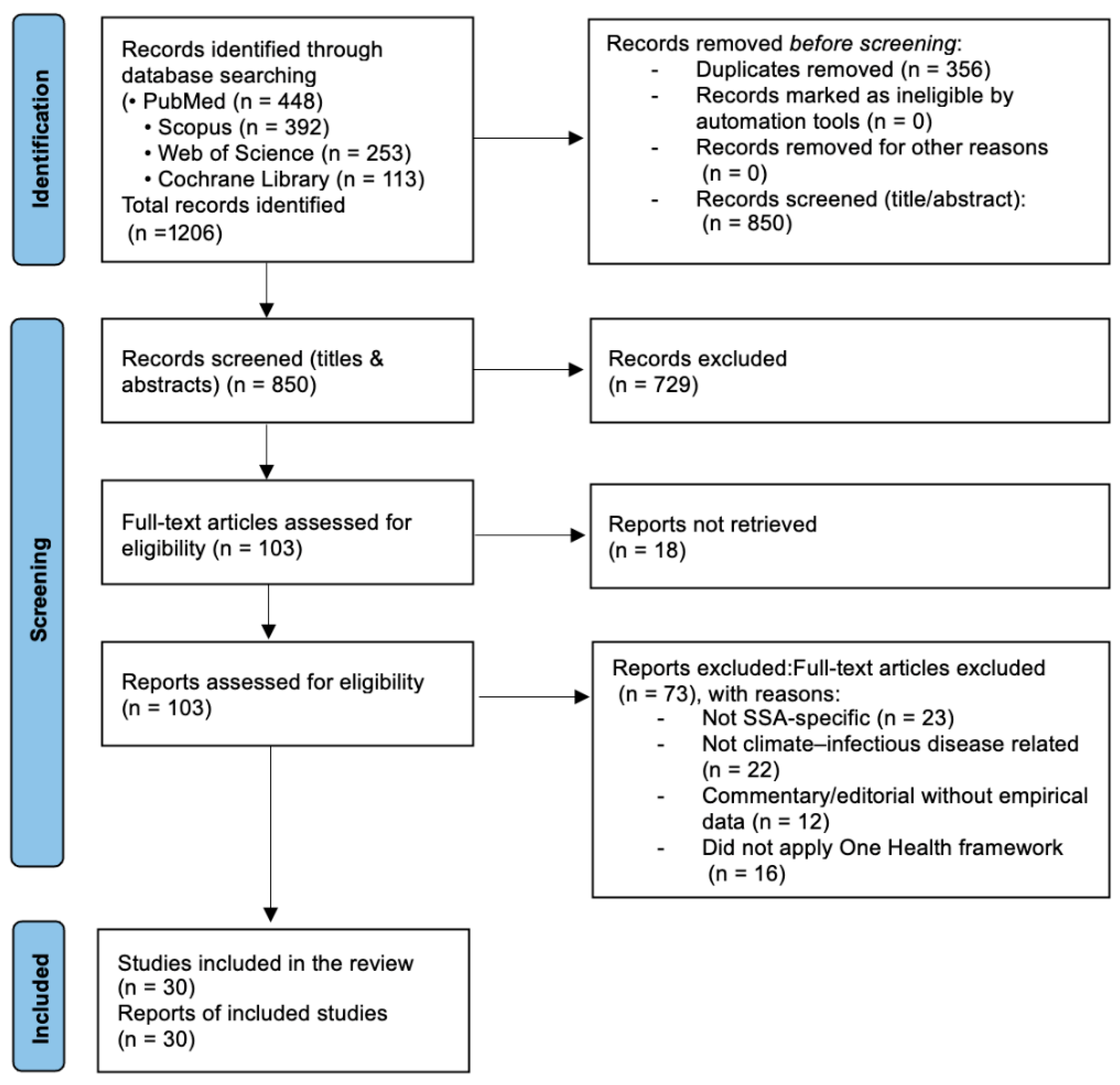
3.1. Study Selection and Characteristics
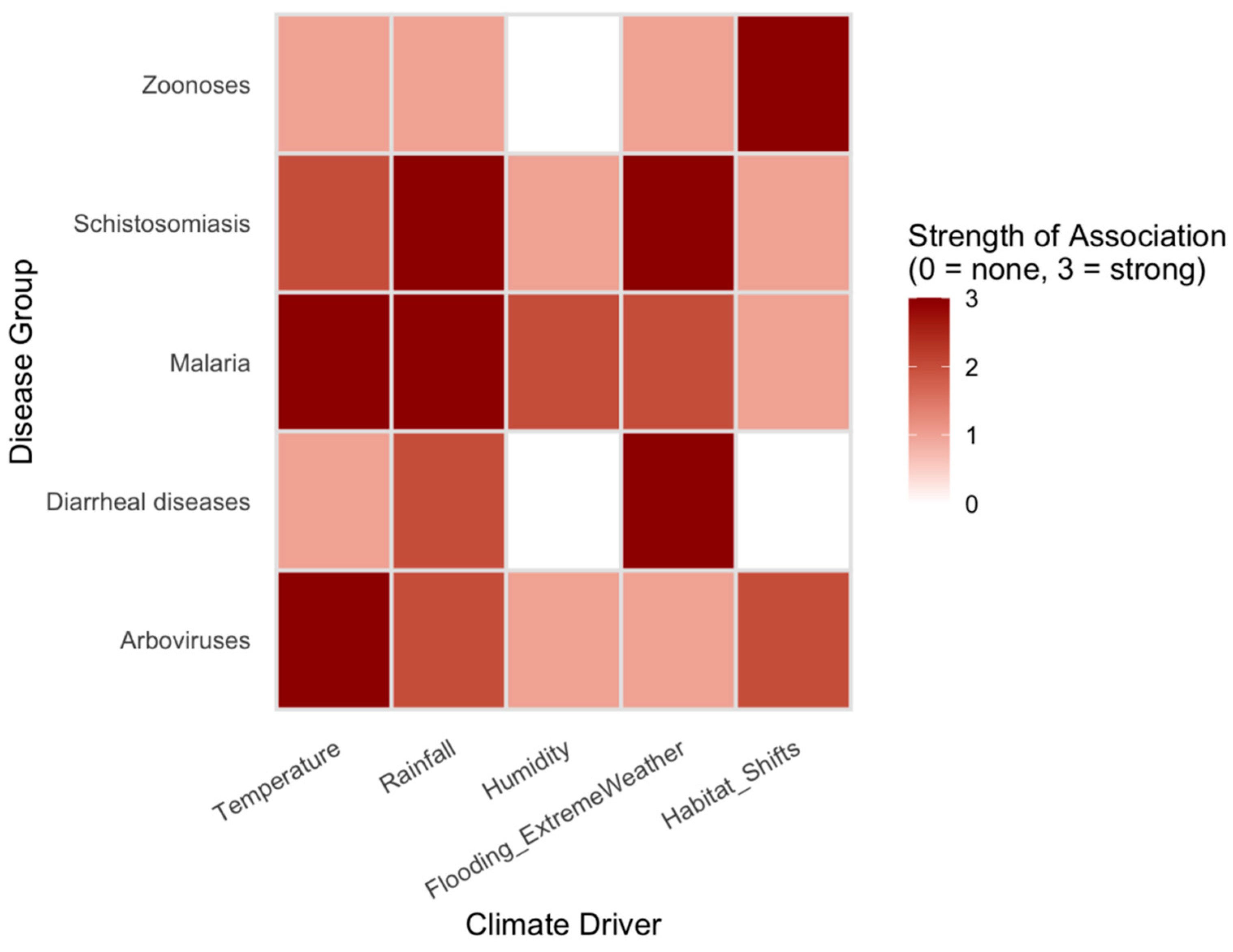
3.2. Climate Drivers and Disease Associations
3.2.1. Malaria and Vector-Borne Transmission
3.2.2. Arboviral Diseases
3.2.3. Schistosomiasis
3.2.4. Zoonotic Infections
3.2.5. Waterborne Diseases
3.2.6. Conflicting Evidence and Uncertainties
3.3. One Health Approaches
3.4. Disease Burden Patterns
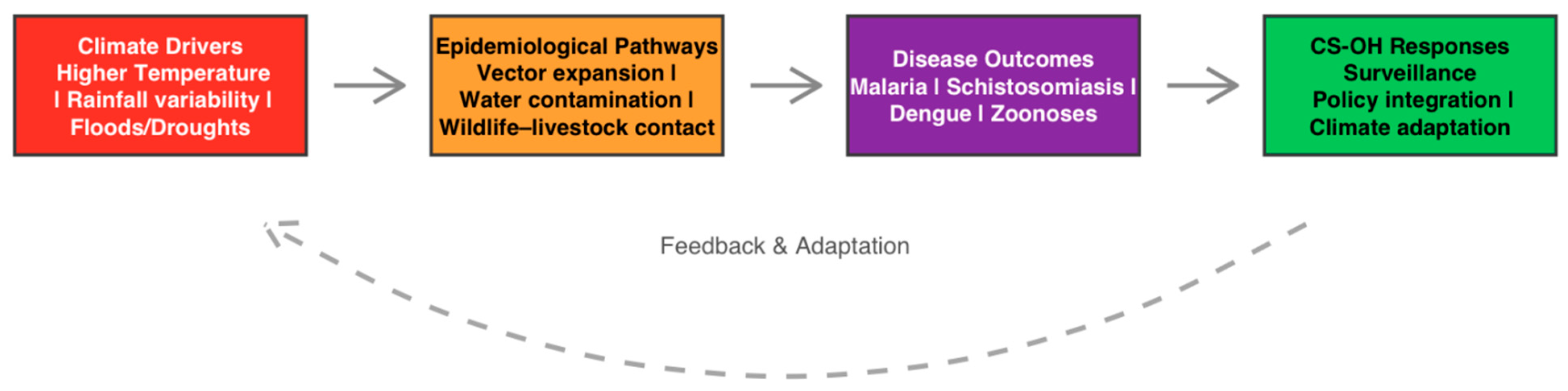
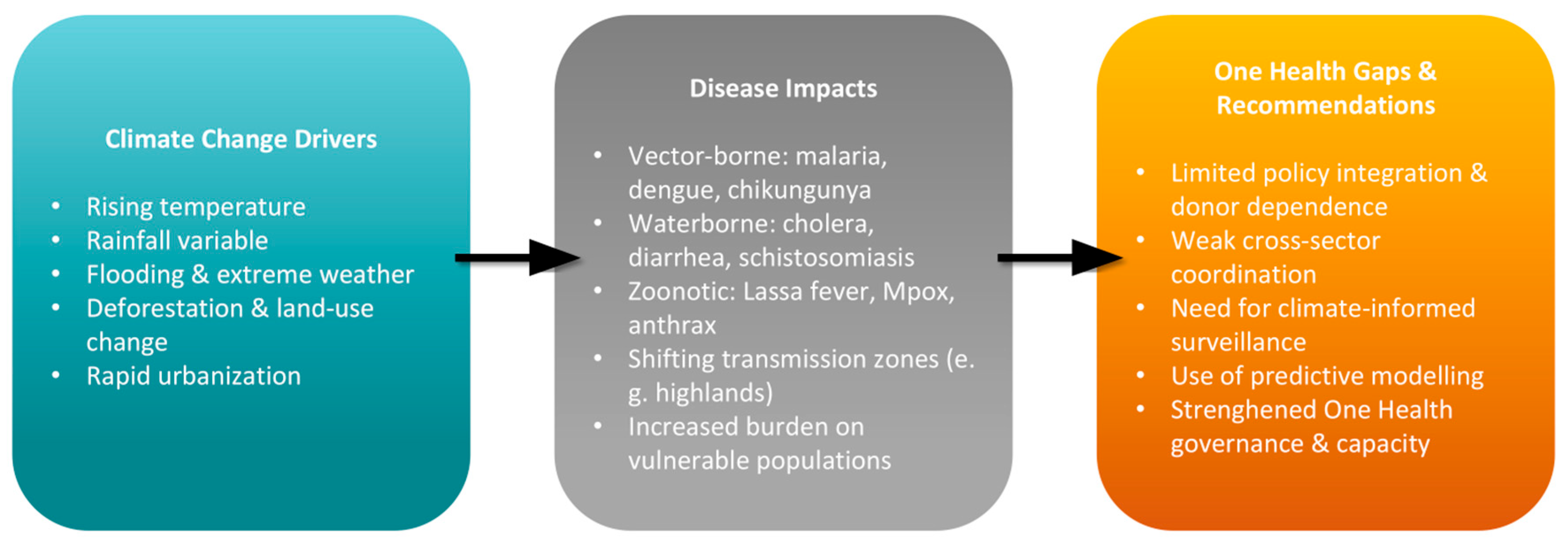
3.5. Synthesis of Findings
4. Discussion
4.1. Contribution to Existing Evidence and Knowledge Gaps
4.2. Regional and Institutional Insights
4.3. Policy and Practice Implications
- Institutionalization of One Health governance through national legislation and inter-ministerial coordination mechanisms.
- Integration of climate-informed surveillance and predictive modelling into disease-control strategies.
- Domestic financing and capacity building to reduce dependence on external donors; and
- Community engagement and equity-focused interventions to ensure inclusivity in resilience planning.
4.4. Policy Gaps, Barriers, and Opportunities
4.5. Limitations of This Review
4.6. Areas for Future Research
5. Conclusions
Supplementary Materials
Author Contributions
Funding
Data Availability Statement
Acknowledgments
Conflicts of Interest
Abbreviations
| CS-OH | Climate-Smart One Health |
| COVID-19 | Coronavirus Disease 2019 |
| COPD | Chronic Obstructive Pulmonary Disease |
| DALYs | Disability-Adjusted Life Years |
| ECOWAS | Economic Community of West African States |
| HDI | Human Development Index |
| OH | One Health |
| PRISMA | Preferred Reporting Items for Systematic Reviews and Meta-Analyses |
| SMC | Seasonal Malaria Chemoprevention |
| SPAR | State Party Self-Assessment Annual Reporting |
| SSA | Sub-Saharan Africa |
References
- Romanello, M.; McGushin, A.; Napoli, C.D.; Drummond, P.; Hughes, N.; Jamart, L.; Kennard, H.; Lampard, P.; Rodriguez, B.S.; Arnell, N.; et al. The 2021 report of the Lancet Countdown on health and climate change: Code red for a healthy future. Lancet 2021, 398, 1619–1662. [Google Scholar] [CrossRef] [Scilit] [PubMed]
- Pescaroli, G.; Alexander, D. Understanding Compound, Interconnected, Interacting, and Cascading Risks: A Holistic Framework. Risk Anal. 2018, 38, 2245–2257. [Google Scholar] [CrossRef] [Scilit] [PubMed]
- Intergovernmental Panel on Climate Change (IPCC). The Ocean and Cryosphere in a Changing Climate: Special Report of the Intergovernmental Panel on Climate Change; Cambridge University Press: Cambridge, UK, 2022; ISBN 978-1-009-15797-1. [Google Scholar]
- Nova, N.; Athni, T.S.; Childs, M.L.; Mandle, L.; Mordecai, E.A. Global Change and Emerging Infectious Diseases. Annu. Rev. Resour. Econ. 2022, 14, 333–354. [Google Scholar] [CrossRef] [Scilit] [PubMed]
- IPCC. Chapter 9: Africa. Intergovernmental Panel on Climate Change. Available online: https://www.ipcc.ch/report/ar6/wg2/chapter/chapter-9/ (accessed on 12 September 2025).
- Taguela, T.N.; Akinsanola, A.A.; Adeliyi, T.E.; Rhoades, A.; Nazarian, R.H. Understanding drivers and uncertainty in projected African precipitation. npj Clim. Atmos. Sci. 2025, 8, 222. [Google Scholar] [CrossRef] [Scilit]
- World Malaria Report 2023. Available online: https://www.who.int/teams/global-malaria-programme/reports/world-malaria-report-2023 (accessed on 16 October 2025).
- Megersa, D.M.; Luo, X.-S. Effects of Climate Change on Malaria Risk to Human Health: A Review. Atmosphere 2025, 16, 71. [Google Scholar] [CrossRef] [Scilit]
- Yang, G.-J.; Bergquist, R. Potential Impact of Climate Change on Schistosomiasis: A Global Assessment Attempt. Trop. Med. Infect. Dis. 2018, 3, 117. [Google Scholar] [CrossRef] [Scilit]
- Levia, D.F.; Bergquist, R.; Meydani, A.; Hu, Y.; Hannah, D.M. Hydrological Extremes Heighten Vulnerability to Schistosomiasis. Earth’s Future 2024, 12, e2024EF004659. [Google Scholar] [CrossRef] [Scilit]
- Fanzo, J.C.; Downs, S.M. Climate change and nutrition-associated diseases. Nat. Rev. Dis. Primers 2021, 7, 90. [Google Scholar] [CrossRef] [Scilit]
- Wang, P.; Asare, E.; Pitzer, V.E.; Dubrow, R.; Chen, K. Associations between long-term drought and diarrhea among children under five in low- and middle-income countries. Nat. Commun. 2022, 13, 3661. [Google Scholar] [CrossRef] [Scilit]
- Kaneza, D.; Andegiorgish, A.K.; Kubahoniyesu, T. Prevalence and associated factors of diarrhea among children under five years of age in the Western Province of Rwanda: Analysis of the Rwanda Demographic and Health Survey (RDHS) 2019–2020. PAMJ-One Health 2025, 16, 7. [Google Scholar]
- Morales, F.; Montserrat-de la Paz, S.; Leon, M.J.; Rivero-Pino, F. Effects of Malnutrition on the Immune System and Infection and the Role of Nutritional Strategies Regarding Improvements in Children’s Health Status: A Literature Review. Nutrients 2023, 16, 1. [Google Scholar] [CrossRef] [Scilit]
- Fatima, S.H.; Judge, M.A.; Le Souëf, P.N.; Bradshaw, C.J. Impact of climate change on diarrhoea risk in low- and middle-income countries. Environ. Res. 2025, 285, 122412. [Google Scholar] [CrossRef] [Scilit]
- Al Wazni, A.B.; Chapman, M.V.; Ansong, D.; Tawfik, L. Climate Change, Fragility, and Child Mortality; Understanding the Role of Water Access and Diarrheal Disease Amongst Children Under Five During the MDG Era. J. Prev. 2023, 44, 409–419. [Google Scholar] [CrossRef] [Scilit]
- Ghai, R.R.; Wallace, R.M.; Kile, J.C.; Shoemaker, T.R.; Vieira, A.R.; Negron, M.E.; Shadomy, S.V.; Sinclair, J.R.; Goryoka, G.W.; Salyer, S.J.; et al. A generalizable one health framework for the control of zoonotic diseases. Sci. Rep. 2022, 12, 8588. [Google Scholar] [CrossRef] [Scilit] [PubMed]
- Calistri, P.; Iannetti, S.; Danzetta, M.L.; Narcisi, V.; Cito, F.; Sabatino, D.D.; Bruno, R.; Sauro, F.; Atzeni, M.; Carvelli, A.; et al. The components of “One World—One Health” approach. Transbound. Emerg. Dis. 2013, 60, 4–13. [Google Scholar] [CrossRef] [Scilit] [PubMed]
- Otu, A.; Effa, E.; Meseko, C.; Cadmus, S.; Ochu, C.; Athingo, R.; Namisango, E.; Ogoina, D.; Okonofua, F.; Ebenso, B. Africa needs to prioritize One Health approaches that focus on the environment, animal health and human health. Nat. Med. 2021, 27, 943–946. [Google Scholar] [CrossRef] [Scilit]
- Fasina, F.O.; Fasanmi, O.G.; Makonnen, Y.J.; Bebay, C.; Bett, B.; Roesel, K. The one health landscape in Sub-Saharan African countries. One Health 2021, 13, 100325. [Google Scholar] [CrossRef] [Scilit]
- Mak, S.; Thomas, A. Steps for Conducting a Scoping Review. J. Grad. Med. Educ. 2022, 14, 565–567. [Google Scholar] [CrossRef] [Scilit]
- Tricco, A.C.; Lillie, E.; Zarin, W.; O’Brien, K.K.; Colquhoun, H.; Levac, D.; Moher, D.; Peters, M.D.J.; Horsley, T.; Weeks, L.; et al. PRISMA Extension for Scoping Reviews (PRISMA-ScR): Checklist and Explanation. Ann. Intern. Med. 2018, 169, 467–473. [Google Scholar] [CrossRef] [Scilit] [PubMed]
- Munn, Z.; Peters, M.D.J.; Stern, C.; Tufanaru, C.; McArthur, A.; Aromataris, E. Systematic review or scoping review? Guidance for authors when choosing between a systematic or scoping review approach. BMC Med. Res. Methodol. 2018, 18, 143. [Google Scholar] [CrossRef]
- Falagas, M.E.; Pitsouni, E.I.; Malietzis, G.A.; Pappas, G. Comparison of PubMed, Scopus, Web of Science, and Google Scholar: Strengths and weaknesses. FASEB J. 2008, 22, 338–342. [Google Scholar] [CrossRef] [Scilit] [PubMed]
- Bramer, W.M.; Rethlefsen, M.L.; Kleijnen, J.; Franco, O.H. Optimal database combinations for literature searches in systematic reviews: A prospective exploratory study. Syst. Rev. 2017, 6, 245. [Google Scholar] [CrossRef] [Scilit]
- Alharbi, A.; Stevenson, M. Refining Boolean queries to identify relevant studies for systematic review updates. J. Am. Med. Inf. Assoc. 2020, 27, 1658–1666. [Google Scholar] [CrossRef] [Scilit] [PubMed]
- Jüni, P.; Holenstein, F.; Sterne, J.; Bartlett, C.; Egger, M. Direction and impact of language bias in meta-analyses of controlled trials: Empirical study. Int. J. Epidemiol. 2002, 31, 115–123. [Google Scholar] [CrossRef] [Scilit]
- Greenhalgh, T.; Peacock, R. Effectiveness and efficiency of search methods in systematic reviews of complex evidence: Audit of primary sources. BMJ 2005, 331, 1064–1065. [Google Scholar] [CrossRef] [Scilit]
- WHO Regional Office for Africa. Climate and Health in Africa Outlook Report 2023; WHO: Brazzaville, Republic of Congo, 2023. [Google Scholar]
- Alimi, Y.; Wabacha, J. Strengthening coordination and collaboration of one health approach for zoonotic diseases in Africa. One Health Outlook 2023, 5, 10. [Google Scholar] [CrossRef] [Scilit] [PubMed]
- Mamabolo, M.; Machalaba, C.; Zantsi, S.; Rostal, M.K.; Karesh, W.B.; Thompson, P.N.; Chaminuka, P. One Health Economics approach to prevention and control of zoonotic and animal diseases—Considerations for South Africa. One Health Outlook 2025, 7, 30. [Google Scholar] [CrossRef] [Scilit]
- Tepa-Yotto, G.T.; Tonnang, H.E.Z.; Yeboah, S.; Osae, M.Y.; Gariba, A.A.; Dalaa, M.; Adomaa, F.O.; Damba, O.T.; Kyere, R.; Moutouama, F.T.; et al. Implementation Outline of Climate-Smart One Health: A System-Thinking Approach. Sustainability 2024, 16, 6652. [Google Scholar] [CrossRef] [Scilit]
- Elton, L.; Haider, N.; Kock, R.; Thomason, M.J.; Tembo, J.; Arruda, L.B.; Ntoumi, F.; Zumla, A.; McHugh, T.D.; And the PANDORA-ID-NET consortium. Zoonotic disease preparedness in sub-Saharan African countries. One Health Outlook 2021, 3, 5. [Google Scholar] [CrossRef] [Scilit]
- Adekiya, T.A.; Aruleba, R.T.; Oyinloye, B.E.; Okosun, K.O.; Kappo, A.P. The Effect of Climate Change and the Snail-Schistosome Cycle in Transmission and Bio-Control of Schistosomiasis in Sub-Saharan Africa. Int. J. Environ. Res. Public Health 2020, 17, 181. [Google Scholar] [CrossRef] [Scilit]
- Yao, T.; Yang, X.; Ye, H.; Wang, Y.; Yu, X.; Huang, Y.; Xu, M. Spatiotemporal patterns and climate-induced macroeconomic burden of malaria in sub-Saharan Africa. BMC Public Health 2025, 25, 1975. [Google Scholar] [CrossRef] [Scilit]
- Ryan, S.J.; Lippi, C.A.; Zermoglio, F. Shifting transmission risk for malaria in Africa with climate change: A framework for planning and intervention. Malar. J. 2020, 19, 170. [Google Scholar] [CrossRef] [Scilit] [PubMed]
- Xu, M.; Hu, Y.-X.; Lu, S.-N.; Idris, M.A.; Zhou, S.-D.; Yang, J.; Feng, X.-N.; Huang, Y.-M.; Xu, X.; Chen, Y.; et al. Seasonal malaria chemoprevention in Africa and China’s upgraded role as a contributor: A scoping review. Infect. Dis. Poverty 2023, 12, 63. [Google Scholar] [CrossRef] [Scilit] [PubMed]
- Stensgaard, A.-S.; Vounatsou, P.; Sengupta, M.E.; Utzinger, J. Schistosomes, snails and climate change: Current trends and future expectations. Acta Trop. 2019, 190, 257–268. [Google Scholar] [CrossRef] [Scilit]
- Omuse, E.R.; Machekano, H.; Sokame, B.M.; Mutyambai, D.M.; Dubois, T.; Subramanian, S.; Chidawanyika, F. One Health interventions and challenges under rural African smallholder farmer settings: A scoping review. One Health 2025, 20, 100959. [Google Scholar] [CrossRef] [Scilit] [PubMed]
- Asare, K.K.; Mohammed, M.-D.W.; Aboagye, Y.O.; Arndts, K.; Ritter, M. Impact of Climate Change on Schistosomiasis Transmission and Distribution—Scoping Review. Int. J. Environ. Res. Public Health 2025, 22, 812. [Google Scholar] [CrossRef] [Scilit]
- Hounkpatin, H.; Nieto-Sanchez, C.; Castellano Pleguezuelo, V.; Polman, K.; Marchal, B. How are health systems in sub-Saharan Africa adapting to protect human health from climate change threats? A scoping review and case study. Lancet Planet. Health 2024, 8 (Suppl. 1), S10. [Google Scholar] [CrossRef] [Scilit]
- Ahmed, T.; Tahir, M.F.; Boden, L.; Kingston, T. Future directions for One Health research: Regional and sectoral gaps. One Health 2023, 17, 100584. [Google Scholar] [CrossRef] [Scilit]
- Zhang, R.; Tang, X.; Liu, J.; Visbeck, M.; Guo, H.; Murray, V.; Mcgillycuddy, C.; Ke, B.; Kalonji, G.; Zhai, P.; et al. From concept to action: A united, holistic and One Health approach to respond to the climate change crisis. Infect. Dis. Poverty 2022, 11, 17. [Google Scholar] [CrossRef] [Scilit]
- Carugati, M.; Kilonzo, K.G.; Crump, J.A. Fever, bacterial zoonoses, and One Health in sub-Saharan Africa. Clin. Med. 2019, 19, 375–380. [Google Scholar] [CrossRef] [Scilit]
- Tabo, Z.; Kalinda, C.; Breuer, L.; Albrecht, C. Exploring the interplay between climate change and schistosomiasis transmission dynamics. Infect. Dis. Model. 2024, 9, 158–176. [Google Scholar] [CrossRef] [Scilit] [PubMed]
- Klepac, P.; Hsieh, J.L.; Ducker, C.L.; Assoum, M.; Booth, M.; Byrne, I.; Dodson, S.; Martin, D.L.; Turner, C.M.R.; van Daalen, K.R.; et al. Climate change, malaria and neglected tropical diseases: A scoping review. Trans. R. Soc. Trop. Med. Hyg. 2024, 118, 561–579. [Google Scholar] [CrossRef] [Scilit]
- Mordecai, E.A.; Ryan, S.J.; Caldwell, J.M.; Shah, M.M.; LaBeaud, A.D. Climate change could shift disease burden from malaria to arboviruses in Africa. Lancet Planet Health 2020, 4, e416–e423. [Google Scholar] [CrossRef] [Scilit]
- Agyarko, R.K.D.; Kithinji, D.; Nsarhaza, K.B. Climate Change and the Rise of Emerging and Re-Emerging Infectious Diseases in Africa: A Literature Review. Int. J. Environ. Res. Public Health 2025, 22, 903. [Google Scholar] [CrossRef] [Scilit]
- Leal Filho, W.; May, J.; May, M.; Nagy, G.J. Climate change and malaria: Some recent trends of malaria incidence rates and average annual temperature in selected sub-Saharan African countries from 2000 to 2018. Malar. J. 2023, 22, 248. [Google Scholar] [CrossRef] [Scilit]
- Opoku, S.K.; Filho, W.L.; Hubert, F.; Adejumo, O. Climate Change and Health Preparedness in Africa: Analysing Trends in Six African Countries. Int. J. Environ. Res. Public Health 2021, 18, 4672. [Google Scholar] [CrossRef] [Scilit]
- Cham, D.; Barrow, A.; Shah-Rohlfs, R.; Standley, C.J. Can global health security frameworks measure One Health implementation in West Africa? A mixed-methods study. BMC Public Health 2024, 24, 2113. [Google Scholar] [CrossRef] [Scilit] [PubMed]
- Agache, I.; Hernandez, M.L.; Radbel, J.M.; Renz, H.; Akdis, C.A. An Overview of Climate Changes and Its Effects on Health: From Mechanisms to One Health. J. Allergy Clin. Immunol. Pract. 2025, 13, 253–264. [Google Scholar] [CrossRef] [Scilit]
- Gozlan, R.E.; Bommarito, C.; Caballero-Huertas, M.; Givens, J.; Mortillaro, J.-M.; Pepey, E.; Ralaiarison, R.P.; Senff, P.; Combe, M. A One-Health approach to non-native species, aquaculture, and food security. Water Biol. Secur. 2024, 3, 100250. [Google Scholar] [CrossRef] [Scilit]
- Anisuzzaman; Hossain, S.; Hatta, T.; Labony, S.S.; Kwofie, K.D.; Kawada, H.; Tsuji, N.; Alim, A. Chapter Two—Food- and vector-borne parasitic zoonoses: Global burden and impacts. In Advances in Parasitology; Rollinson, D., Stothard, R., Eds.; Academic Press: Cambridge, MA, USA, 2023; Volume 120, pp. 87–136. [Google Scholar]
- Marrana, M. Epidemiology of disease through the interactions between humans, domestic animals, and wildlife. In One Health; Prata, J.C., Ribeiro, A.I., Rocha-Santos, T., Eds.; Academic Press: London, UK, 2022; pp. 73–111. [Google Scholar]
- Edward, M.; Heniedy, A.M.; Saminu, A.; Mary, J.J.F.; Ahmed, D.A.; Engmann, S.T.; Onyeaghala, C.; Shah, S. Climate change and contagion: The emerging threat of zoonotic diseases in Africa. Infect. Ecol. Epidemiol. 2025, 15, 2441534. [Google Scholar] [CrossRef] [Scilit] [PubMed]
- Massengo, N.R.B.; Tinto, B.; Simonin, Y. One Health Approach to Arbovirus Control in Africa: Interests, Challenges, and Difficulties. Microorganisms 2023, 11, 1496. [Google Scholar] [CrossRef] [Scilit]
- Delrieu, M.; Martinet, J.-P.; O’Connor, O.; Viennet, E.; Menkes, C.; Burtet-Sarramegna, V.; Frentiu, F.D.; Dupont-Rouzeyrol, M. Temperature and transmission of chikungunya, dengue, and Zika viruses: A systematic review of experimental studies on Aedes aegypti and Aedes albopictus. Curr. Res. Parasitol. Vector-Borne Dis. 2023, 4, 100139. [Google Scholar] [CrossRef] [Scilit]
- Lupu, A.; Gavrilovici, C.; Lupu, V.V.; Cianga, A.L.; Cernomaz, A.T.; Starcea, I.M.; Mihai, C.M.; Tarca, E.; Mocanu, A.; Fotea, S. Helicobacter pylori Infection in Children: A Possible Reason for Headache? Diagnostics 2023, 13, 1293. [Google Scholar] [CrossRef] [Scilit] [PubMed]
- Cormier, S.A.; Yamamoto, A.; Short, K.R.; Vu, L.; Suk, W.A. Environmental Impacts on COVID-19: Mechanisms of Increased Susceptibility. Ann. Glob. Health 2022, 88, 94. [Google Scholar] [CrossRef] [Scilit] [PubMed]
- Milici, A.; Talavera, K. TRP Channels as Cellular Targets of Particulate Matter. Int. J. Mol. Sci. 2021, 22, 2783. [Google Scholar] [CrossRef] [Scilit]
- Zheng, J. Molecular Mechanism of TRP Channels. Compr. Physiol. 2013, 3, 221–242. [Google Scholar] [CrossRef] [Scilit]
- Romero-Mesones, C.; de Homdedeu, M.; Soler-Segovia, D.; Gómez-Ollés, C.; Espejo-Castellanos, D.; Ojanguren, I.; Saez-Gimenez, B.; Cruz, M.-J.; Munoz, X. The Impact of the Reduction in Environmental Pollution during COVID-19 Lockdown on Healthy Individuals. Toxics 2024, 12, 492. [Google Scholar] [CrossRef] [Scilit]
- Africa CDC. Climate Change and Health: Strategic Framework 2025; Africa CDC: Addis Ababa, Ethiopia, 2025. [Google Scholar]
- Brink, N.; Mansoor, K.; Swiers, J.; Lakhoo, D.P.; Parker, C.; Nakstad, B.; Sawry, S.; Aunan, K.; Otto, I.M.; Chersich, M.F. Scoping Review of Climate Change Adaptation Interventions for Health: Implications for Policy and Practice. Int. J. Environ. Res. Public Health 2024, 21, 1565. [Google Scholar] [CrossRef] [Scilit] [PubMed]
- Kaburi, B.B.; Wyss, K.; Kenu, E.; Asiedu-Bekoe, F.; Hauri, A.M.; Laryea, D.O.; Klett-Tammen, C.J.; Leone, F.; Walter, C.; Krause, G. Facilitators and Barriers in the Implementation of a Digital Surveillance and Outbreak Response System in Ghana Before and During the COVID-19 Pandemic: Qualitative Analysis of Stakeholder Interviews. JMIR Form. Res. 2023, 7, e45715. [Google Scholar] [CrossRef] [Scilit]
- Richards, S.; Knight-Jones, T.; Angombe, S.; Becker, J.; Bukachi, S.; Chirenda, J.; Araujo, L.; De Nys, H.; Desta, H.; Fafetine, J.; et al. Towards Institutionalization of One Health in Eastern and Southern Africa. One Health Cases 2024, ohcs20240007. [Google Scholar] [CrossRef] [Scilit]
- Gashema, P.; Sesonga, P.; Iradukunda, P.G.; Muvunyi, R.; Mugisha, J.C.; Ndayisenga, J.; Musafiri, T.; Habimana, R.; Bigirimana, R.; Kabanda, A.; et al. Enhancing Global Health Security in Sub-Saharan Africa: The case for integrated One Health surveillance against zoonotic diseases and environmental threats. One Health 2025, 21, 101136. [Google Scholar] [CrossRef] [Scilit] [PubMed]




| Criterion | Inclusion Criteria | Exclusion Criteria |
|---|---|---|
| Publication type and date | Peer-reviewed articles published between January 2019 and July 2025 | Articles published before 2019 |
| Language | English-language publications | Non-English-language studies |
| Geographic focus | Focus on Sub-Saharan Africa | No relevance to SSA or studies without regional focus |
| Topic scope | Discussion of both climate change and infectious diseases | Studies addressing only climate change or only disease burden |
| Conceptual framework | Explicit use or evaluation of a One Health or cross-sectoral framework | Articles lacking One Health perspective or interdisciplinary linkage |
| Availability | Full-text access available | Abstracts only or conference proceedings |
| NO. | Author(s), Year | Title | Country/Region | Focus Area | Key Findings |
|---|---|---|---|---|---|
| 1 | Elton et al., 2021 [33]. | Zoonotic disease preparedness in sub-Saharan African countries | SSA | Zoonotic disease preparedness | Assessment of 44 SSA countries using WHO JEE data. Mean preparedness score 2.35/5, Southern Africa highest. Veterinary workforce strongest (2.76), response mechanisms weakest (1.84). Top priority zoonoses: rabies, HPAI, anthrax, brucellosis. Highlights coordination and funding gaps; urges integrated One Health response. |
| 2 | Fasina et al., 2021 [20]. | The OH landscape in Sub-Saharan African countries | SSA | OH initiatives | Scoping analysis of existing One Health (OH) initiatives in SSA. Finds uneven geographic and stakeholder distribution, with dominance of donor-driven projects and weak national ownership. Identifies need for national OH roadmaps, monitoring and evaluation frameworks, and outcome-oriented approaches to improve sustainability and policy integration. |
| 3 | Adekiya et al., 2020 [34]. | Effect of Climate Change on the Snail-Schistosome Cycle and Schistosomiasis | SSA | Climate change & schistosomiasis | Climate change may increase schistosomiasis risk; snail distribution affected; need predictive models and improved control strategies |
| 4 | Alimi & Wabacha, 2023 [30]. | Strengthening coordination and collaboration of One Health for zoonotic diseases | Africa (AU Member States) | OH coordination | Policy review of AU Member States’ OH coordination structures. Reports that many countries lack formal OH platforms; establishment of the AU OH Coordinating Group is a regional milestone. Stresses importance of political commitment, institutional support, and long-term financing to operationalize OH frameworks for zoonotic-disease control. |
| 5 | Yao et al., 2025 [35]. | Spatiotemporal patterns and climate-induced macroeconomic burden of malaria | SSA | Malaria & climate change | Malaria mortality decreased, but climate contributes 60% of economic burden; East Africa most affected; temperature rise increases cases and deaths; resource allocation needed |
| 6 | Ryan et al., 2020 [36]. | Shifting transmission risk for malaria in Africa with climate change: a framework for planning and intervention | Africa | Malaria & climate change | Climate change shifts malaria risk zones; Eastern Africa most affected; population at risk may increase by 75.9 million by 2080; guides intervention planning. |
| 7 | Xu et al., 2023 [37]. | Seasonal malaria chemoprevention in Africa and China’s upgraded role as a contributor | Africa & China | Malaria prevention (SMC) | Scoping review of 68 studies and WHO data (2012–2021). SMC coverage grew to 45 M children; efficacy 74% in under-5s. Notes poor adherence and limited cycles; China supports via SPAQ-CO supply and training. Recommends stronger international partnerships and flexible WHO guidelines. |
| 8 | Stensgaard et al., 2019 [38]. | Expectations: Climate change and schistosomiasis | Africa | Schistosomiasis & climate change | Model-based review predicting that climate change will likely redistribute, rather than expand, schistosomiasis transmission zones. Indicates S. haematobium more temperature-sensitive than S. mansoni. Identifies major knowledge gaps and calls for refined predictive models and targeted regional interventions. |
| 9 | Omuse et al., 2025 [39]. | One Health interventions and challenges under rural African smallholder farmer settings: A scoping review | Africa | One Health in smallholder settings | One Health initiatives improve health and ecosystem outcomes but face governance, coordination, and resource challenges; need standardized evaluation framework and focus on food security under climate change. |
| 10 | Mamabolo et al., 2025 [31]. | One Health Economics approach to prevention and control of zoonotic and animal diseases | South Africa | OH, Economics | Economic integration in One Health reduces costs of disease; coordination and multi-sectoral engagement recommended |
| 11 | Tepa-Yotto et al., 2024 [32]. | Implementation Outline of Climate-Smart One Health | Ghana | CS-OH | CS-OH framework integrates climate adaptation across human, animal, plant, and environmental health |
| 12 | Asare et al., 2025 [40]. | Impact of Climate Change on Schistosomiasis Transmission | SSA, Southeast Asia, South America | Climate Change, Disease Transmission | Climate change shifts schistosomiasis risk areas: adaptation strategies can reduce transmission |
| 13 | Hounkpatin et al., 2024 [41]. | How are health systems in sub-Saharan Africa adapting to climate change? | SSA (Case: Benin) | Health Systems, Climate Adaptation | Health systems adapting in 7 domains; need for locally responsive planning beyond international agendas |
| 14 | Ahmed et al., 2023 [42]. | Future directions for One Health research: Regional and sectoral gaps | Global | One Health research gaps | One Health research priorities vary by region; surveillance dominates in lower HDI countries, policy in higher HDI countries; highlights gaps in environmental and sustainable food systems research |
| 15 | Zhang et al., 2022 [43]. | From concept to action: a united, holistic and One Health approach to respond to the climate change crisis | Global | Climate change & OH | Calls for integrated, holistic action linking climate adaptation and OH; emphasizes international cooperation for climate-resilient strategies |
| 16 | Carugati et al., 2019 [44]. | Fever, bacterial zoonoses, and One Health in sub-Saharan Africa | SSA | Zoonotic diseases | Bacterial zoonoses (brucellosis, leptospirosis, Q fever, rickettsioses) contribute significantly to febrile illness; One Health strategies targeting humans and animals improve outcomes |
| 17 | Tabo et al., 2024 [45]. | Exploring the interplay between climate change and schistosomiasis transmission dynamics | East Africa (Uganda, Kenya, Tanzania) | Climate & disease modeling | Temperature and rainfall strongly affect schistosomiasis transmission; climate-sensitive interventions are needed; projections to 2050 highlight key control factors |
| 18 | Klepac et al., 2024 [46]. | Climate change, malaria and neglected tropical diseases: a scoping review | Global | Climate change & NTDs | Climate effects on malaria and NTDs vary by disease and location; mitigation and adaptation strategies are underrepresented; need for standardized, collaborative modeling to predict impacts |
| 19 | Mordecai et al., 2020 [47]. | Climate change could shift disease burden from malaria to arboviruses in Africa | SSA | Vector-borne diseases; Climate change | Warming temperatures may reduce malaria suitability while increasing risk for Aedes-transmitted arboviruses (dengue, chikungunya). Highlights need to adjust public health focus toward emerging arboviruses. |
| 20 | Agyarko et al., 2025 [48]. | Climate Change and the Rise of Emerging and Re-Emerging Infectious Diseases in Africa: A Literature Review | Africa (focus on West & Central Africa) | Emerging/re-emerging infectious diseases; Climate change | Climate change drives outbreaks of Ebola, Lassa fever, dengue, malaria, cholera. Emphasizes OH and multisectoral strategies for resilient interventions. |
| 21 | Leal Filho et al., 2023 [49]. | Climate change and malaria: some recent trends of malaria incidence rates and average annual temperature in selected SSA countries from 2000 to 2018 | Nigeria, Ethiopia, South Africa, Kenya, Uganda, Ghana, Mozambique, Zambia, Zimbabwe | Malaria incidence trends; Climate variability | Empirical time-series analysis correlating malaria incidence with temperature and rainfall. Identifies heterogeneous relationships—positive in East/Central Africa, inverse in some Southern African sites. Despite overall declines in incidence, climate variability increases vulnerability among sensitive populations. Suggests need for region-specific adaptation strategies. |
| 22 | Opoku et al., 2021 [50]. | Climate Change and Health Preparedness in Africa: Analysing Trends in Six African Countries | Ghana, Nigeria, South Africa, Namibia, Ethiopia, Kenya | Health system preparedness; Climate change | Health professionals perceive significant climate impacts. Inadequate resources highlight need for improved infrastructure, emergency response, policies, and training. |
| 23 | Cham, Barrow, Shah-Rohlfs & Standley, 2024 [51]. | Can global health security frameworks measure One Health implementation in West Africa? A mixed-methods study | West Africa (ECOWAS countries) | OH implementation; Health security frameworks | Quantitative analysis showed no significant link between OH implementation and global health security metrics (SPAR, JEE). Qualitative data highlighted that countries with existing OH platforms scored better and revealed gaps in monitoring and evaluation. Emphasizes need for tailored metrics to track OH progress in the region. |
| 24 | Agache et al., 2025 [52]. | An Overview of Climate Changes and Its Effects on Health: From Mechanisms to One Health | Multi-region (Romania, USA, Germany, Tanzania, Switzerland) | Climate change; OH; Health adaptation | Review highlights One Health, exposomic approaches, and resilient responses as central to addressing climate change impacts on health. Stresses importance of identifying high-risk individuals and implementing mitigation/adaptation strategies. |
| 25 | Gozlan et al., 2024 [53]. | A One-Health approach to non-native species, aquaculture, and food security | France (focus on global applications) | OH; Aquaculture; Food security; Invasive species | Non-native species affect ecosystems, food security, and disease risk. One Health approach integrates human, animal, and environmental health to manage invasive species while considering their potential use for food security in low- and middle-income countries. |
| 26 | Anisuzzaman, Hossain, Hatta & Labony, 2023 [54]. | Food- and vector-borne parasitic zoonoses: Global burden and impacts | Global | Parasitic zoonoses; Climate & socio-economic drivers | Approximately 25% of the global population suffers from parasitic infections. Climate change, urbanization, and trade increase emergence/re-emergence. Highlights the high burden of food- and vector-borne zoonotic parasitic diseases and their contribution to global Disability-Adjusted Life Years (DALYs) (~60 million). |
| 27 | Marrana, 2022 [55]. | Epidemiology of disease through the interactions between humans, domestic animals, and wildlife | Global | Zoonotic disease emergence; Human–animal–environment interactions | Rising frequency and size of zoonotic outbreaks linked to agricultural expansion, urbanization, globalization, climate change, and antimicrobial resistance. Emphasizes the importance of understanding spillover mechanisms and pathogen evolution for pandemic prevention. |
| 28 | Edward et al., 2025 [56]. | Climate change and contagion: the emerging threat of zoonotic diseases in Africa | Africa | Zoonotic diseases; Climate change | Climate change and urbanization increase zoonotic disease risks. Mitigation requires surveillance, early detection, vaccination, sustainable land use, community health systems, vector control, and international cooperation. |
| 29 | Massengo et al., 2023 [57]. | One Health Approach to Arbovirus Control in Africa: Interests, Challenges, and Difficulties. | Africa | Arboviral diseases; One Health | Perspective and review (71 studies, 2009–2023). Highlights Africa’s vulnerability to dengue, chikungunya, RVF, YFV, and CCHF. Identifies climate change, urbanization, and weak surveillance as key drivers. Emphasizes the One Health approach for integrated vector, animal, and human surveillance, but notes poor coordination and limited diagnostic capacity as major barriers. |
| 30 | Delrieu et al., 2023 [58]. | Temperature and transmission of chikungunya, dengue, and Zika viruses: A systematic review of experimental studies on Aedes aegypti and Aedes albopictus | Global | Arboviral transmission; temperature effects | Systematic review of 34 laboratory studies showing infection, dissemination, and transmission rates for dengue, chikungunya, and Zika increase between 26–32 °C, with little or no transmission below 20 °C. Confirms strong temperature dependence of arboviral spread. |
| Disease Group | Main Climate Drivers | General Impact Trend | Indicative CS-OH Response |
|---|---|---|---|
| Vector-borne | Increased temperature, rainfall variability | Expanded transmission zones and longer seasons | Integrated surveillance and vector control |
| Water-borne | Flooding, rainfall extremes | Redistributed or expanded endemic areas | Water, sanitation, and habitat management |
| Zoonotic | Land-use change, warming | Persistent hotspots and emerging spillovers | Veterinary vaccination and cross-sector coordination |
| Arboviral | Increased temperature, humidity | Increased Aedes vector suitability | Early warning and diagnostic capacity building |
| Environmental/non-communicable | Heat waves, pollution, extreme weather | Higher cardiovascular and respiratory risk | Climate-resilient planning and health adaptation |
Disclaimer/Publisher’s Note: The statements, opinions and data contained in all publications are solely those of the individual author(s) and contributor(s) and not of MDPI and/or the editor(s). MDPI and/or the editor(s) disclaim responsibility for any injury to people or property resulting from any ideas, methods, instructions or products referred to in the content. |
© 2025 by the authors. Licensee MDPI, Basel, Switzerland. This article is an open access article distributed under the terms and conditions of the Creative Commons Attribution (CC BY) license.
Share and Cite
Monden, M.; Hassanin, R.; Sackeyfio, H.; Wolf, F. A One Health Approach to Climate-Driven Infectious Diseases in Sub-Saharan Africa: Strengthening Cross-Sectoral Responses for Resilient Health Systems. Appl. Sci. 2026, 16, 261. https://doi.org/10.3390/app16010261
Monden M, Hassanin R, Sackeyfio H, Wolf F. A One Health Approach to Climate-Driven Infectious Diseases in Sub-Saharan Africa: Strengthening Cross-Sectoral Responses for Resilient Health Systems. Applied Sciences. 2026; 16(1):261. https://doi.org/10.3390/app16010261
Chicago/Turabian StyleMonden, Mercy, Reem Hassanin, Hannah Sackeyfio, and Franziska Wolf. 2026. "A One Health Approach to Climate-Driven Infectious Diseases in Sub-Saharan Africa: Strengthening Cross-Sectoral Responses for Resilient Health Systems" Applied Sciences 16, no. 1: 261. https://doi.org/10.3390/app16010261
APA StyleMonden, M., Hassanin, R., Sackeyfio, H., & Wolf, F. (2026). A One Health Approach to Climate-Driven Infectious Diseases in Sub-Saharan Africa: Strengthening Cross-Sectoral Responses for Resilient Health Systems. Applied Sciences, 16(1), 261. https://doi.org/10.3390/app16010261