1. Introduction
Wind power, as a clean and renewable energy source, is significant for mitigating climate change and boosting global initiatives to achieve carbon neutrality [
1]. Over the past few years, the number of wind power programs has rapidly expanded, leading to a notable increase in the proportion of renewable energy in the world’s overall energy structure [
2]. According to the Global Wind Energy Council’s Global Wind Report 2025 [
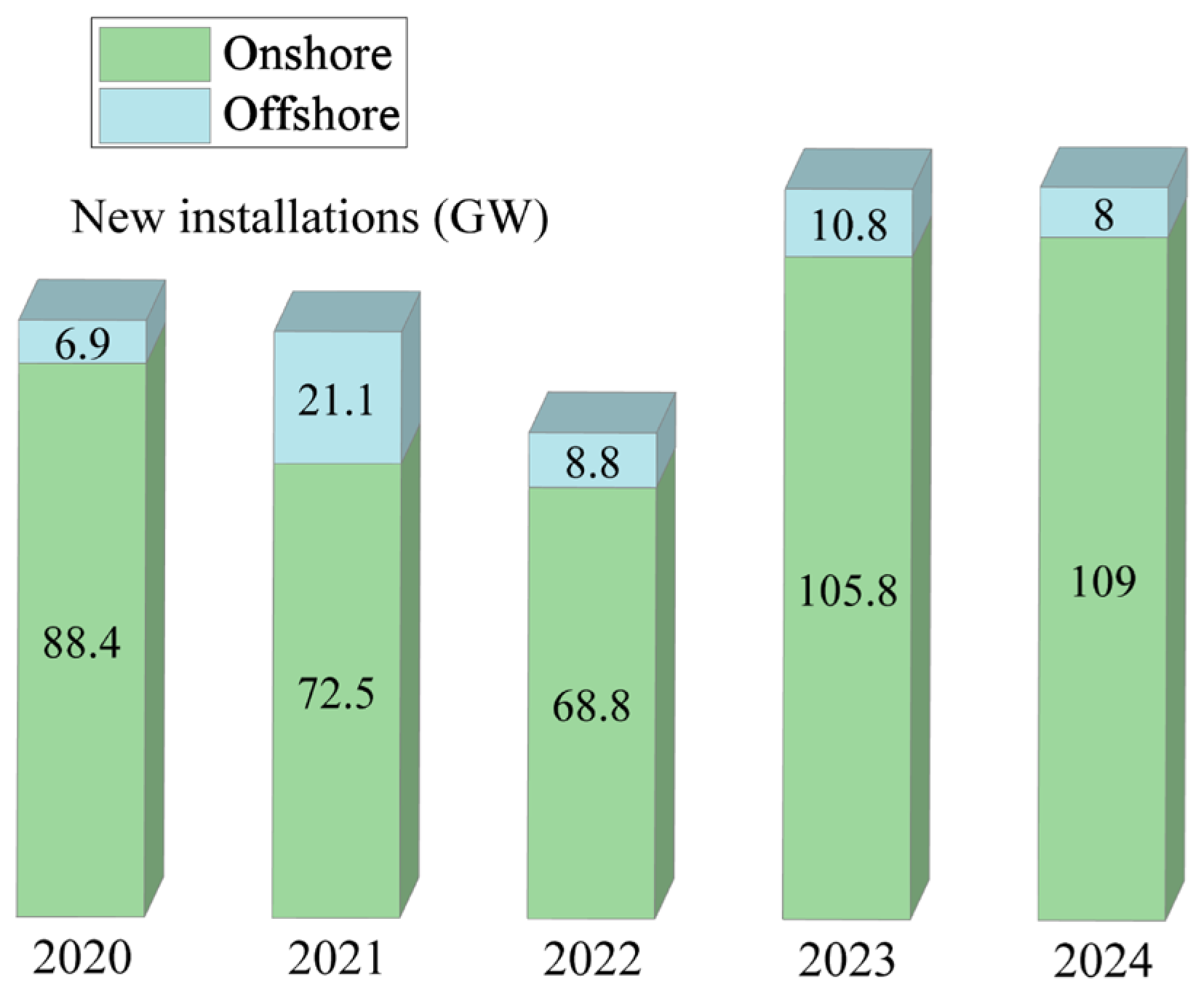
3], newly installed global wind capacity reached a record 117 GW in 2024, while cumulative grid-connected offshore wind capacity reached 83.2 GW (
Figure 1). The offshore wind industry is projected to grow at a compound annual growth rate of 21% over the next decade (2025–2034), demonstrating strong long-term potential.
Compared to onshore wind power, offshore wind power operates with higher efficiency owing to higher wind speeds and stability. However, the expansion of offshore wind capacity is faced with significant obstacles, including delays in grid infrastructure development and the inherent volatility and intermittency of wind power [
4]. Both factors threaten grid stability, which is a persistent issue for the sector.
Hydrogen, as an emerging energy carrier, has distinct advantages due to its high energy density and ease of storage. The combination of offshore wind power and water electrolysis technology for hydrogen generation offers three key advantages [
5,
6]:
- (1)
Wind energy, characterized as an “immediate” energy source, can be converted into hydrogen. When stored long-term as high-pressure gas or cryogenic liquid, this conversion incurs only slight energy loss.
- (2)
The process of hydrogen production can alleviate grid instability due to wind variability. Functioning as a “peak-shaving and valley-filling” asset, it also mitigates curtailed wind energy [
7].
- (3)
Hydrogen transportation via ships or repurposed oil and gas pipelines is feasible. This would not only lessen the need for expensive submarine cables [
8] but also facilitate the development of large-scale deep-sea wind initiatives.
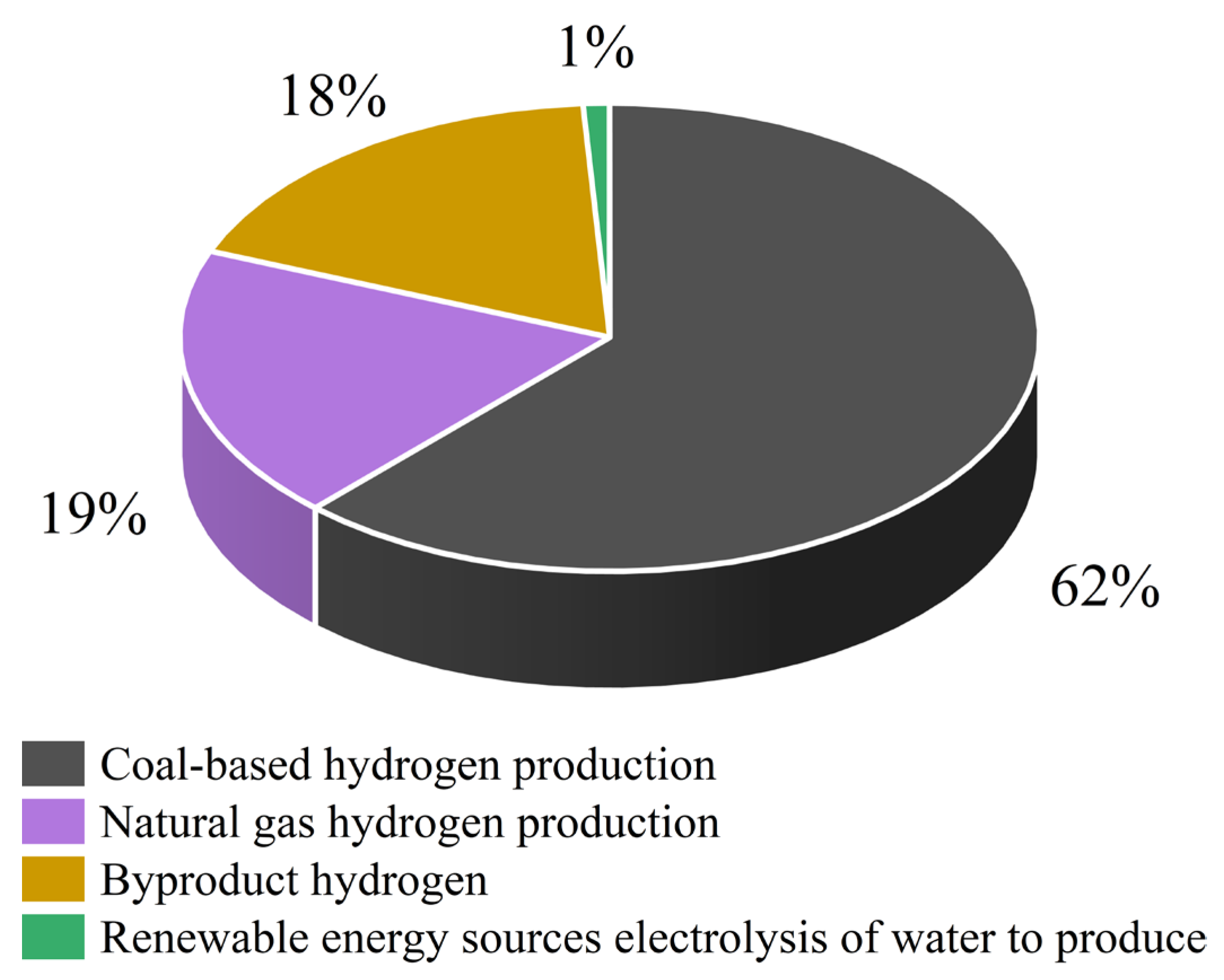
By the end of 2024, global hydrogen production reached approximately 150 million tons per year, which is a 2.9% year-on-year increase. Currently, about 62% of hydrogen is produced as “grey hydrogen” from fossil fuels, 19% is produced from natural gas reforming, 18% is produced from industrial by-products, and only 1% is produced as “green hydrogen” derived from renewable energy [
9] (
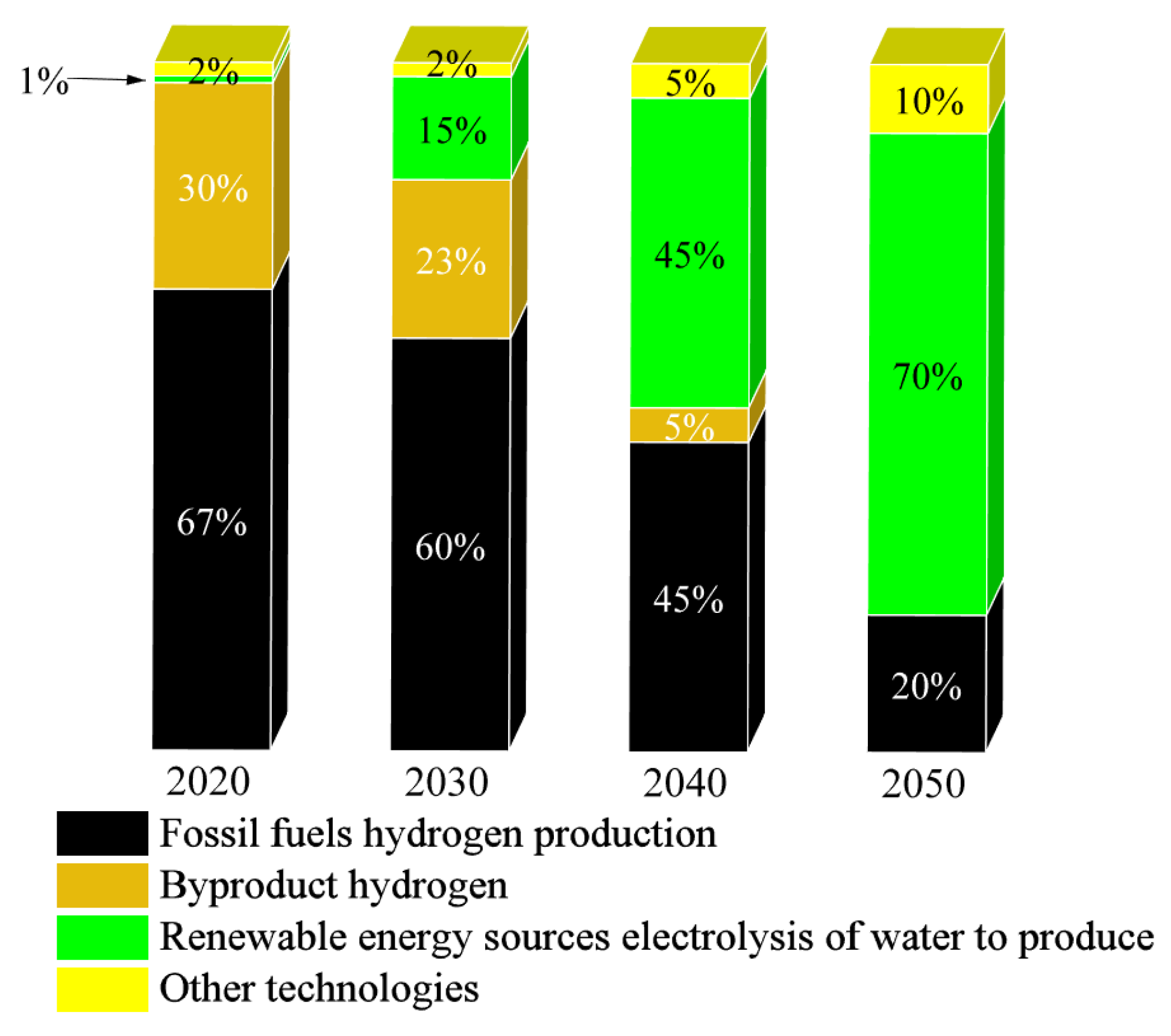
Figure 2). With the global push for carbon neutrality, green hydrogen is projected to account for 15% of total production by 2030 and over 70% by 2050 [
10] (
Figure 3). This significant expectation of growth highlights the urgency and enormous market potential of developing green hydrogen technologies such as offshore wind power for hydrogen production.
This paper details research focusing on the offshore conversion of wind power to hydrogen. Through global case studies, we review three technical routes and their characteristics, and identify current challenges, including immature electrolysis technology, high production costs, and storage and transportation bottlenecks. We propose directions for future development paths to support technological innovation and large-scale applications. The innovation of this research lies in the systematic integration of global engineering cases with the techno-economic analysis of three technical routes, thereby recognizing that offshore distance and installed capacity are the core decision-making factors to select technical routes. Compared with existing reviews, this paper further includes an integrated analysis framework for resolving bottleneck issues and outlining future development directions, providing a clear roadmap for subsequent related research, development work, and investment decisions.
2. Engineering Cases of Offshore Wind-to-Hydrogen Production
As indicated in the
China Hydrogen Energy Development Report (2025) [
11], by the end of 2024, global annual production of renewable hydrogen via electrolysis surpassed 250,000 tons. Notably, in 2024 alone, this increase reached 70,000 tons, marking a 42% year-on-year growth. Furthermore, the International Hydrogen Energy Commission’s
Global Green Hydrogen Energy Development Report (2025) [
12] indicates that global electrolyzer capacity surpassed 30 GW by mid-2025, driven mainly by large-scale offshore projects in China, the United States, and Europe.
Table 1 summarizes current leading offshore wind-to-hydrogen projects.
Table 1 presents details of ten representative global offshore wind-to-hydrogen projects, which can be divided according to three technical approaches: hydrogen production via offshore distributed wind power, hydrogen production via offshore centralized distributed wind power, and hydrogen production from offshore wind power transported to onshore locations. Among these pathways, three projects use the first method, three use the second method, and four use the third method, indicating a relatively balanced distribution across the approaches.
In terms of installed capacity, projects under development are significantly larger in scale than those already in operation. For example, the PosHYdon project, located in the Netherlands, was the world’s very first offshore wind-to-hydrogen initiative, with an installed capacity of just 1 MW. In contrast, another Dutch project, NortH2, which is set to roll out by 2030, is projected to have an installed capacity of 4000 MW. This shift reflects a trend in the industry toward large-scale deployment and the establishment of base-type projects.
From the perspective of water electrolysis methodologies, half of the projects documented in
Table 1 use ALK electrolysis technology, 40% rely on PEM technology, and only 10% adopt SOEC technology for high-temperature electrolysis processes. At present, ALK technology has the highest maturity, and is known for its lowest cost and longest lifespan. However, this technology requires regular replacement of alkaline solutions, which undoubtedly increases maintenance costs for offshore wind power hydrogen production. Moreover, alkaline electrolyzers are not capable of rapid start-up and shutdown, and their adaptability to the volatility of wind power is weak; therefore, they are more commonly used in scenarios with stable working conditions, such as onshore hydrogen production. In addition, alkaline electrolyzers are large and heavy, which is disadvantageous in marine missions [
20]. By contrast, the minimum operating load of PEM technology is only 5–10%, and it has the capability of rapid start-up and shutdown, which can effectively match the volatility characteristics of renewable energy. It is particularly suitable for scenarios of renewable hydrogen energy production. However, the current cost is relatively high, and its service life is far shorter than that of alkaline electrolyzers [
21,
22]. In the case studies included, only Norway’s Deep Purple project is exploring SOEC technology. Among all electrolysis technologies, SOEC technology has the highest efficiency. It does not require precious metal catalysts, so its potential cost may be much lower. Moreover, the electrolyte, electrode, and bipolar plate components are all made of ceramic materials, which could better resist corrosion by the marine environment. However, SOEC technology requires a high-temperature environment (500–1000 °C), and a stable heat source cannot be obtained in the marine environment. Despite its potential for high efficiency, it cannot be applied on a large scale at present [
23,
24].
Europe leads multi-technology exploration, with a focus on PEM and deep-sea centralized projects. In contrast, China relies mainly on ALK technology and onshore hydrogen production, offering rapid scaling but less technological diversity. As PEM costs decrease and offshore wind projects extend into deeper waters, centralized PEM-based hydrogen production is likely to become mainstream. For China, accelerating PEM localization will be critical to enhancing adaptability to offshore wind fluctuations.
The above cases not only demonstrate the distribution of technical routes but also reveal the different strategic thinking and development models adopted by various countries in developing the offshore wind power-to-hydrogen industry. To more clearly compare the differences between these models,
Table 2 lists representative projects in terms of different dimensions, such as core strategies, technical adaptability, commercialization stages, and system integration.
3. Technical Routes for Offshore Wind-to-Hydrogen Production
Case analysis reveals that all three technical routes are being actively explored, with applications distributed relatively evenly across projects. This balance indicates that each pathway has distinct advantages and suitable scenarios at the current stage, while also highlighting that the industry has not yet converged on a single dominant approach. Instead, the industry remains in a state of parallel exploration across multiple paths.
3.1. Classification of Technical Routes
As outlined above, offshore wind-to-hydrogen production is mainly divided into three categories: offshore distributed wind power hydrogen production, offshore centralized wind power hydrogen production, and offshore wind power for onshore hydrogen production [
25,
26].
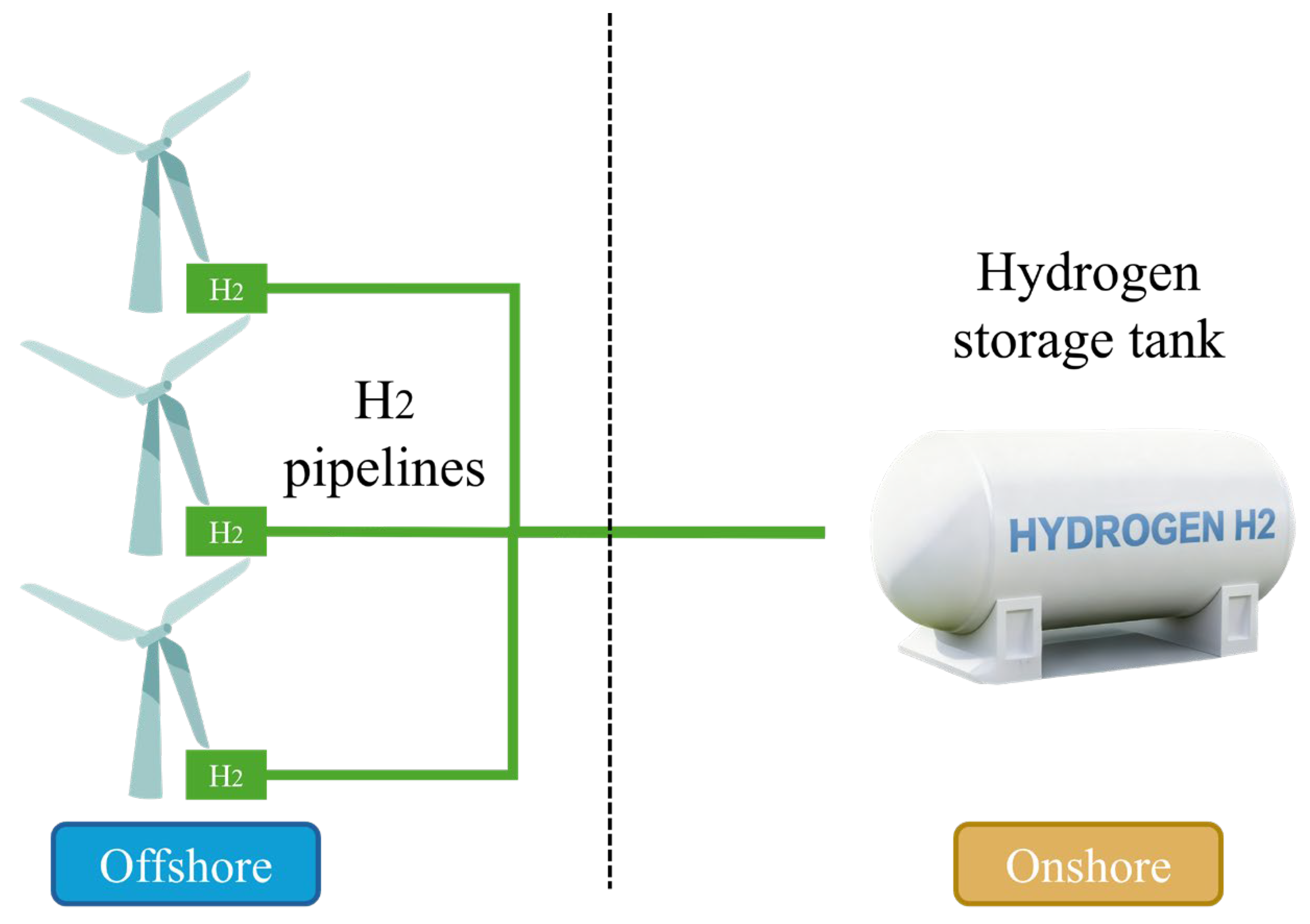
The first approach, the offshore distributed wind-to-hydrogen system, is illustrated in
Figure 4. In this configuration, each wind turbine’s floating platform is equipped with dedicated electrolysis units. After wind turbines capture offshore wind energy and convert it into electrical energy, instead of transmitting it through a long-distance grid connection, the electrical energy is directly input into the electrolysis device on the platform. The hydrogen produced is then transported to onshore storage via hydrogen pipelines [
27]. The advantage of this technical route is that each electrolyzer and wind turbine is paired and independent of the other. The unitized design ensures that when any electrolyzer cannot operate due to a malfunction of the wind turbine or when the power generation is lower than the minimum operating level of the electrolyzer, other electrolyzers and wind turbines can still produce hydrogen, which greatly improves the stability and fault tolerance of the system. However, this operating mode has two key problems. First, the offshore wind power platform itself is in a dynamic operating state. Wind turbines generate continuous vibrations when capturing wind energy, while electrolysis devices (especially proton-exchange membrane electrolyzers, which have high requirements for operational stability) are extremely sensitive to vibrations and tilt angles [
28]. Long-term vibrations may cause loosening of the internal electrode structure of the electrolyzer and electrolyte leakage, significantly reducing the service life of the equipment [
29]. Second, the costs of laying and maintaining hydrogen pipelines remain high. Complex hydrogen pipelines result in high laying costs, and in the event of a leak, not only are the repair costs high, but there may also be a risk of marine environmental pollution, further increasing maintenance costs. The economic viability of this hydrogen production mode needs further verification and optimization.
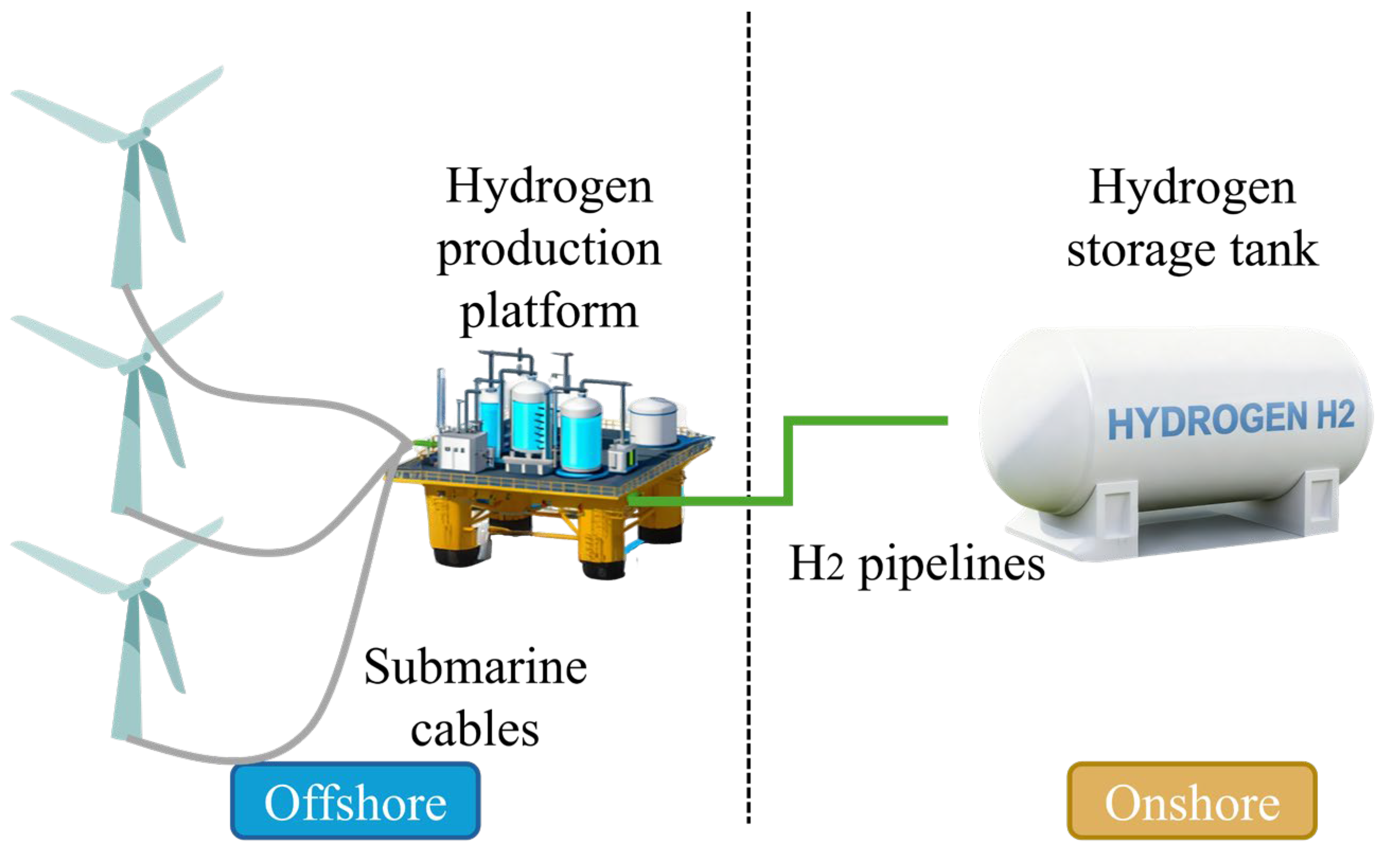
Next is the offshore centralized wind-to-hydrogen system. The hydrogen production process is completed on independent floating platforms or dedicated hydrogen production ships; a typical system configuration is shown in
Figure 5. In this technical architecture, the electrical energy generated by each wind turbine in the offshore wind farm is first collected and transmitted to the offshore substation through the collector system. AC power is converted into DC power by the converter equipment in the substation; then, the low-loss long-distance transmission of electrical energy is realized by means of large-capacity high-voltage direct current (HVDC) cables [
30,
31], which is finally supplied to the water electrolysis hydrogen production device carried by the floating hydrogen production platform. The produced high-purity hydrogen is then transported to onshore storage, processing, or application terminals through dedicated hydrogen pipelines or ships. This system scheme has significant technical and economic advantages: First, compared with the distributed offshore wind power-to-hydrogen system, this method can be deployed in far-reaching sea areas, making full use of richer wind energy resources and more stable wind directions in offshore areas [
32]. Second, the centralized hydrogen production layout eliminates the cost of supporting booster equipment for each turbine in the distributed system, simplifies the topology of the offshore power system, and reduces the difficulty of equipment maintenance [
33]. Third, this system has good resource integration. It can rely on the infrastructure of existing offshore oil and gas platforms for transformation and upgrading, converting them into hydrogen production platforms, and effectively reusing the platform’s pile foundations, power transmission channels, personnel operation and maintenance facilities, etc., which significantly reduces the initial investment and construction cycle of the project [
34]. This scheme enables large-scale wind-to-hydrogen production in far-offshore areas and represents a promising direction for the future development of the offshore hydrogen production industry.
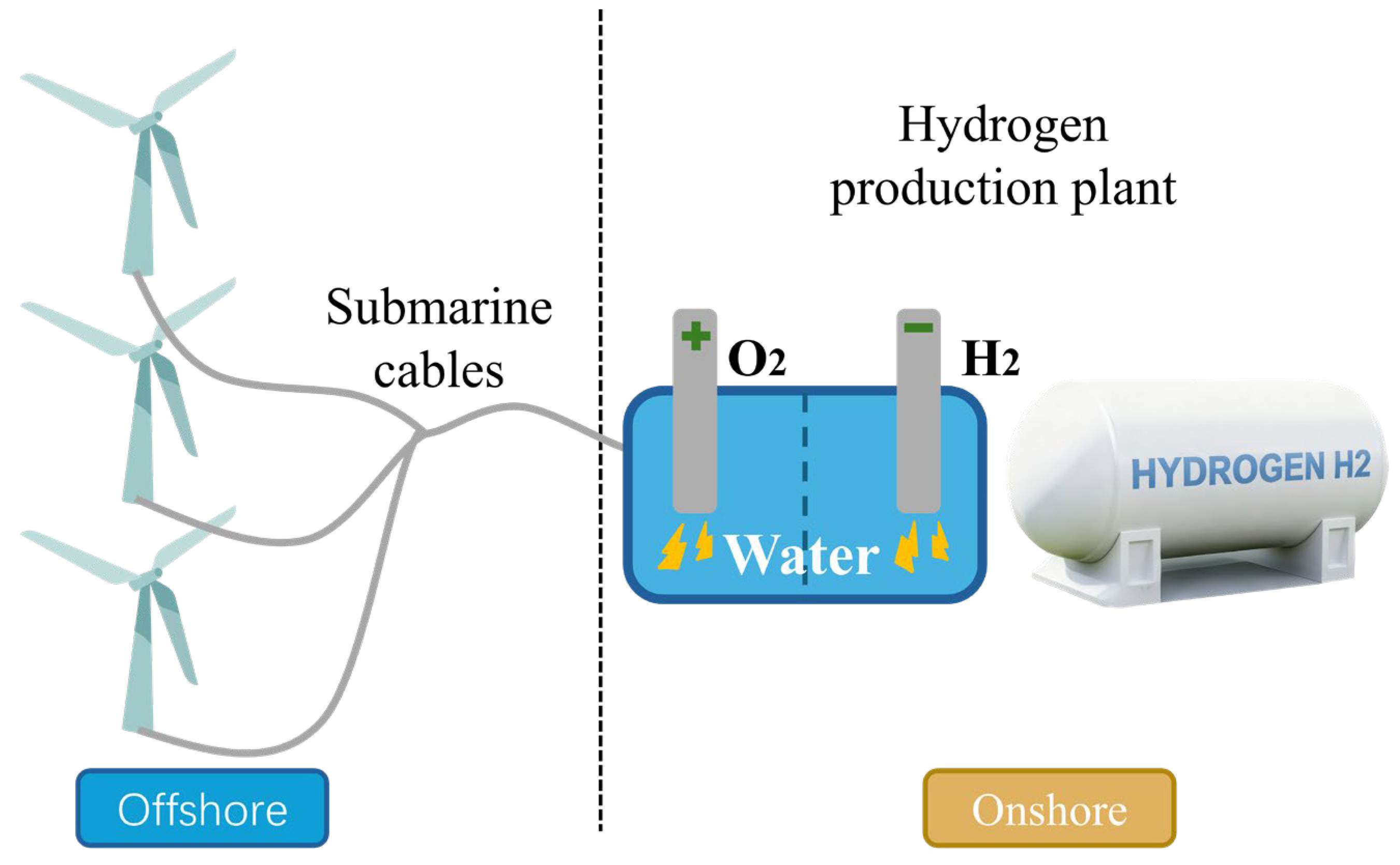
The third route is the onshore hydrogen production system powered by offshore wind power (
Figure 6). The electricity generated by offshore wind turbines is first transmitted via submarine AC cables to an offshore substation. After voltage boosting and conversion to high-voltage direct current (HVDC), the electricity is delivered through high-voltage cables to onshore electrolyzers. This system demonstrates significant technical advantages: First, all core hydrogen production equipment is deployed on land. Compared with offshore hydrogen production models, this reduces the difficulty of offshore hoisting during equipment installation and makes daily maintenance more convenient. Second, the layout of onshore sites is not restricted by marine space resources, making it easy to flexibly expand equipment capacity according to the scale of hydrogen production. As such, a coordinated layout can be achieved with existing industrial parks or hydrogen energy infrastructure [
35]. Third, this system absorbs surplus wind power to produce hydrogen during low-load periods of the power grid and performs energy feedback through hydrogen fuel cell power generation or hydrogen chemical utilization during peak periods, forming an effective buffer mechanism to regulate peak power grid demands [
36]. However, this system’s economic efficiency is significantly affected by the offshore distance. As the distance to the offshore wind farm increases, the material and laying costs of submarine cables also increase. At the same time, the construction scale of offshore booster stations needs to be expanded to meet the insulation and heat dissipation requirements of long-distance power transmission. In addition, during the transmission of electricity through submarine cables, the loss rate increases with transmission distance and current intensity. The superposition of these two factors results in rising hydrogen production costs per kilowatt-hour of the system.
Based on systematically sorting the architectures and characteristics of the three types of technical paths, to further assist in the scientific selection and optimal configuration of technical paths, this paper presents a multi-criteria comparison framework covering four dimensions: technical performance, economy, operational reliability, and environmental adaptability (
Table 3). This framework aims to integrate key variables and provide a structured decision-making basis for the optimal selection of paths in different application scenarios.
3.2. Comparison of Technical and Economic Efficiency of Energy Transmission Methods
This section compares the economic efficiency of cable power transmission and pipeline hydrogen transmission from the perspective of energy delivery, which is an important basis for selecting specific technical routes.
Selecting an optimal technical route is primarily determined from a techno-economic perspective. To enhance hydrogen storage and the advantages of low cost and high technology readiness, high-pressure gas cylinder storage is adopted as the baseline for all three routes. Other innovative storage technologies, such as liquid hydrogen and ammonia, are excluded due to their complex implementation and high costs at sea. Since the storage method is consistent, the cost comparison effectively hinges on the mode of energy conveyance—namely, the relative economics of transmitting electricity versus transporting hydrogen [
39]. In terms of hydrogen transportation, scholars Hu et al. [
37] constructed techno-economic models for four technical routes: high-voltage AC, flexible DC, PEM hydrogen production + pipeline transportation, and alkaline electrolytic hydrogen production + pipeline transportation. They analyzed the impact of three offshore wind farm parameters (installed capacity, offshore distance, and capacity factor) and future technological advancements in electrolysis equipment and seawater desalination on energy transmission costs. The research results show that the unit energy transmission cost of offshore wind power is negatively correlated with the installed capacity and capacity factor and positively correlated with offshore distance. Therefore, the current power transmission scheme is superior to the hydrogen production and transportation scheme. For wind farms with a short offshore distance, those with a smaller installed capacity are more likely to be suitable for hydrogen production and transportation; for wind farms with a larger installed capacity, the farther the offshore distance, the more favorable they are for hydrogen production and transportation. In the future, reducing the power consumption of seawater desalination will be critical to improve the economy of hydrogen production and transportation schemes. When a 200 MW wind farm with an offshore distance exceeding 200 km produces hydrogen by directly electrolyzing seawater, the transmission cost per unit of energy along the hydrogen transportation scheme is lower than that of the power transmission scheme. Scholars Jang et al. [
38] conducted a study to address the lack of comparative research on offshore wind power-to-hydrogen schemes. To determine the most economical method for connecting offshore wind farms to hydrogen production facilities, they performed a techno-economic analysis of three technical routes: distributed hydrogen production, centralized hydrogen production, and onshore hydrogen production. During their research, net present value calculation, sensitivity analysis, and Monte Carlo simulations were used as comparative methods, with the analysis conducted on a hypothetical 160 MW wind farm located 50 km off the coast. Since the cost of seawater desalination was not directly considered in the paper, it was ultimately concluded that the costs of distributed, centralized, and onshore hydrogen production were 13.81 USD/kg H
2, 13.85 USD/kg H
2, and 14.58 USD/kg H
2, respectively. Among them, the distributed hydrogen production scheme is the most competitive because it does not require expensive high-voltage direct current cables and offshore substations.
Based on the conclusions of the three studies, it is clear that offshore distance and installed capacity are the core factors that should determine the selection of technical routes for offshore wind power-to-hydrogen production. The specific impact mechanisms and optimization paths are as follows:
Impact of offshore distance: There is a significant difference in cost between submarine cables and hydrogen pipelines, and the offshore distance directly determines the laying length of these two types of facilities; this has a key impact on the economy of each route.
Impact of installed capacity: An increased installed capacity can reduce the unit fixed cost of offshore wind power-to-hydrogen projects through the scale effect, thereby improving the overall revenue level of projects.
Therefore, during project planning, it is necessary to first calculate a reasonable offshore distance based on the wind resource endowment of the target sea area. An appropriate technical route for hydrogen production should be selected on this basis, and the layout design of the wind farm and configuration of the electrolyzer should be further optimized. This will ultimately maximize the economy of the offshore wind power-to-hydrogen project.
The techno-economic analyses from these studies reveal not only average cost figures but also significant performance variability. For instance, Monte Carlo simulations [
38] show that under scenarios with ±20% wind power fluctuation and ±30% electricity price volatility, the levelized cost of hydrogen (LCOH) confidence interval (95%) can vary by up to ±4 USD/kg H
2. This uncertainty underscores that technical route selection cannot rely on static cost estimates alone but must incorporate probabilistic assessments of wind resource intermittency and market price risks. Consequently, offshore distance and installed capacity remain the core but not exclusive factors; system adaptability to operational variability is equally critical for long-term economic viability.
4. Bottlenecks in Offshore Wind-to-Hydrogen Production
4.1. The Need for Breakthroughs in Water Electrolysis and Adaptation Technologies
Wind power generation exhibits characteristics of intermittency, volatility, and randomness. Its intraday power output fluctuates drastically, with variations ranging from 0% to 100% under extreme conditions [
40,
41]. Moreover, the safe and efficient operation of hydrogen production systems is highly dependent on a stable and continuous power supply. Currently, ALK, the most cost-effective technology, has notable limitations. The load adjustment range of alkaline electrolyzers is limited to 20–100%, and their response to rapid start–stop or variable loads is relatively poor; thus, ALK is not well adapted to the unstable operating conditions of offshore wind power [
42]. PEM hydrogen production technology has become the mainstream pathway in the international hydrogen industry, owing to its advantages, including fast response characteristics and high efficiency. However, PEM electrolyzers rely on precious-metal catalysts such as iridium, which results in high system costs [
43]. In addition, when deployed in offshore environments, they exhibit relatively high failure rates: electrodes and mechanical components are extremely vulnerable to seawater corrosion, resulting in a short service life. These factors currently represent major barriers restricting the large-scale industrial application of PEM technology in offshore wind-to-hydrogen projects.
4.2. High Costs Across the Entire Project Life Cycle
Electricity is a key factor in the cost of hydrogen production via water electrolysis. Estimates from the China New Energy Network suggest that electricity typically represents 40–60% of total costs [
44]. Under current technical conditions, using alkaline electrolyzers to produce 1 cubic meter of hydrogen requires a comprehensive power consumption system of approximately 4.5–5.5 kWh. Given the existence of phased bottlenecks in hydrogen production processes, significant reductions in this energy demand are unlikely in the short term. Therefore, the electricity price level has become a core factor determining the cost of power consumption. In addition to electricity prices, different electrolysis technologies also have an impact on LCOH. Alkaline electrolysis (ALK) is approximately 9–15 USD/kg H
2; proton exchange membrane (PEM), 12–20 USD/kg H
2; and solid oxide (SOEC), 15–25 USD/kg H
2. Moreover, offshore wind-to-hydrogen projects require a continuous and substantial supply of freshwater for electrolysis. Conventional seawater desalination technologies, however, present major challenges in terms of energy intensity. Their operation remains heavily dependent on fossil fuels, resulting in high costs for desalinated water, typically in the range of USD 5–10 per ton.
Submarine cables are the main channels of power transmission in offshore wind-to-hydrogen projects and account for a considerable proportion of the total project investment. HVDC cables are even more expensive owing to their stringent requirements for materials and manufacturing processes. In terms of materials, high-purity copper is required as the conductor to ensure low resistance and efficient power transmission. In terms of manufacturing processes, HVDC cable production involves multiple complex procedures, each requiring high-precision equipment and strict quality control. These factors collectively result in the unit price of HVDC cables reaching CNY 8–13 million per km.
As offshore wind power resources in coastal areas are gradually developing and becoming saturated, wind power development is shifting toward far-offshore areas. However, these environments bring substantial technical and economic challenges that lead to a significant increase in project costs [
45]. For projects located more than 30 km offshore, construction difficulty increases exponentially. Advanced and more powerful offshore construction platforms are needed to withstand harsh sea conditions, significantly increasing equipment rental costs. In addition, long distances from the shore increase the time and expenses associated with transporting construction materials, further increasing construction costs.
4.3. Lag in Storage and Transportation Technologies and Facilities
Owing to its small molecular size and chemical activity, hydrogen exhibits high permeability and embrittlement, which places extremely high demands on the selection and performance of pipeline materials. Although large-scale hydrogen pipeline transportation has entered the demonstration stage, the problem of material performance degradation due to hydrogen embrittlement has not yet been effectively resolved, and protective technologies are still in the exploration stage [
46]. Hydrogen storage technologies also face significant challenges. Liquid hydrogen storage requires maintaining an extremely low temperature environment of −253 °C, resulting in high energy consumption costs and poor economic efficiency [
47]. Solid-state hydrogen storage materials offer the advantage of high volumetric density, but large-scale commercialization has not yet been achieved. These technical bottlenecks in both storage and transportation continue to hinder the industrial development of offshore wind-to-hydrogen projects [
48].
Table 4 summarizes the challenges and impacts faced by offshore wind power-to-hydrogen.
5. Outlook for Hydrogen Production from Offshore Wind Power
Although
Section 4 points out the severe challenges currently faced, it is precisely these bottlenecks that indicate the direction of future development. This section will explore breakthrough prospects in four key areas: electrolyzer technology, system efficiency, seawater utilization, and storage and transportation facilities.
5.1. Upgrading Electrolyzer Technology
For ALK electrolyzers, research should prioritize the development of wide-load adjustment technologies that are capable of adapting to the volatility of wind power. Key goals include overcoming the current limitation of low-load operations below 20%, enhancing rapid start–stop performance, and improving variable load response speed by optimizing electrode materials and diaphragm performance. This can reduce the difficulty of adapting to fluctuating wind power conditions. For PEM electrolyzers, efforts should focus on reducing dependence on precious-metal catalysts. This can be accomplished by lowering iridium loading through modifications to the catalyst structure design and the carrier. A collaborative team from the German Aerospace Center and the Spanish Institute of Materials Science recently developed a novel double-perovskite catalyst, Sr
2CaIrO
6, which successfully reduced anode iridium loading to 0.2 mg/cm
2 [
49]. In addition, research should be strengthened on seawater corrosion resistance, with emphasis on developing electrode and equipment materials resistant to salt spray and vibration, thereby extending the service life of PEM electrolyzers in marine environments. Scholar Achitaev et al. [
50] proposed an improved vector control scheme for AC-DC converters, which enhanced the traditional phase-locked loop controller. The study found that when the gain of the PID controller changed, the voltage in the DC link also changed, while hydrogen production was maintained, thereby extending the service life of PEMEC. For SOEC technology, the focus should be on improving the performance of high-temperature materials, such as developing electrolyte and electrode materials that are resistant to high temperatures and performance attenuation, reducing dependence on extreme working conditions, and accelerating progress from laboratory-scale research to industrial demonstration projects.
5.2. Optimizing Energy Utilization Efficiency
Optimizing renewable energy storage systems has unique strategic importance [
51]. Advanced energy storage systems and energy management technologies play a critical role in mitigating the inherent instability of wind power. Optimal allocation of operating power across different stages of the wind-to-hydrogen process enables wind energy to be converted into hydrogen during off-peak hours and utilized during periods of peak demand. This time-shifted conversion results in effective management of energy production and storage across different time scales, reduces greenhouse gas emissions, and promotes the widespread integration of renewable energy sources [
52].
To further improve system performance, intelligent offshore wind-to-hydrogen control systems should be developed. These systems can dynamically adjust electrolyzer operating parameters based on real-time wind power input, thereby achieving higher conversion efficiency and maximizing equipment utilization. In addition, expanding the use of waste heat recovery technologies could enhance overall system efficiency. For example, waste heat generated during hydrogen production could be repurposed for seawater desalination or other auxiliary processes, ultimately reducing the energy consumption per unit of hydrogen produced.
5.3. Technological Innovation in Seawater Utilization
Using seawater directly for electrolysis has revolutionary potential, but it is still in the stage of basic laboratory research and faces severe economic and environmental challenges. Many scholars are working hard to tackle this technology.
Scholars Bao et al. [
53] reported a novel natural seawater electrolysis cathode. The Pt/WO
2 catalyst forms a hydrogen tungsten bronze (H
xWO
γ) phase in situ by continuously inserting hydrogen into water, creating a dynamic local acid-like environment near active Pt sites. This environment promotes HER in seawater splitting and neutralizes OH
− to inhibit precipitation, enabling the cathode to maintain stability for over 500 h at 100 mA/cm
2 in direct seawater electrolysis. Scholars Xie et al. [
54] built a kilowatt-level floating system (integrating UPS with current conversion) using “hydrophobic PTFE membrane + concentrated KOH” aqueous electrolysis technology. Laboratory and 10-day tests at Xinghua Bay showed >240 h stable H
2 production in waves (0~0.9 m, 0~15 m/s), with ~5.0 kWh/Nm
3 energy consumption and >99.9% purity. Waves enhanced mass transfer (no component damage), enabling offshore wind-to-hydrogen conversion. The team also prepared a flexible gel electrolyte with good ionic conductivity and water-capturing performance for direct seawater electrolysis [
55]. Simulations revealed the migration process of water in the gel electrolyte, and the results showed that the migration of water molecules in the gel is mainly driven by the concentration gradient and depends on the bonding and dissociation of hydrogen bonds between water molecules and chromophores. This system uses untreated real seawater, with a current density of 250 mA/cm
2, and operates stably for more than 400 h. Scholars Zhao et al. [
56] performed parallel SOEC stack (4 cells) tests with deionized/seawater vapor: seawater accelerated degradation (2×) and increased Ni loss. Cl
−-mediated Ni migration/loss is key to SOEC seawater H
2 usage.
For direct seawater electrolysis-based hydrogen production (with no desalination step) to become feasible in the future, breakthroughs must be achieved in three core aspects: catalyst selectivity, equipment durability, and system management [
57].
5.4. Improvement of Storage and Transportation Technologies and Facilities
Future efforts should focus on developing low-cost, highly safe hydrogen storage technologies across multiple pathways. For high-pressure gaseous hydrogen storage, lightweight and high-strength materials, such as carbon fiber composites, should be developed to reduce the manufacturing cost and weight of hydrogen storage tanks, while enabling higher storage pressures and greater hydrogen capacity. For liquid hydrogen storage, the thermal insulation design of storage tanks should be optimized by adopting new thermal insulation materials, such as nano-insulation composites, to reduce heat loss and lower energy consumption during liquefaction and storage. For solid-state hydrogen storage, research and development should be accelerated on high-performance hydrogen storage materials, including metal hydrides and chemical hydrides; thus, the storage density and cycle life can be improved, and large-scale application enabled [
58,
59,
60].
For hydrogen transportation, addressing the persistent problem of hydrogen embrittlement is critical. Overcoming this challenge will require the development of hydrogen embrittlement-resistant pipeline materials and optimized design and manufacturing processes to enhance pipeline safety and reliability. Meanwhile, diversified hydrogen transportation methods should be explored, such as hydrogen blending transportation using existing oil and gas pipelines, to reduce infrastructure construction costs and expand delivery options.
Table 5 details promising solutions and development trends from four key directions: electrolyzer upgrading, energy efficiency optimization, seawater utilization, and storage and transportation facilities.
6. Conclusions
This paper provides a comprehensive review of offshore wind-to-hydrogen technology, examining its technical routes, engineering practices, economic efficiency, and key challenges. Current global developments reveal a significant trend toward large-scale and base-oriented projects. Europe has undertaken more diverse technological explorations, focusing on PEM electrolysis technology and centralized hydrogen production in far-offshore areas. By contrast, China mainly relies on mature ALK technology, prioritizing onshore hydrogen production from offshore wind power. Although this approach has advantages in terms of scale, limitations remain regarding technological diversity and adaptability to far-offshore areas.
Offshore wind-to-hydrogen technology faces multiple bottlenecks. Electrolysis technologies capable of fully accommodating wind power fluctuations remain underdeveloped. Investment in equipment, electricity supply, and transmission cables accounts for a relatively high proportion of project life-cycle costs. Furthermore, hydrogen storage and transportation technologies continue to encounter technical challenges, including hydrogen embrittlement in pipelines, high energy consumption in liquid hydrogen storage and transportation, and insufficient large-scale commercialization of solid-state hydrogen storage.
Future developments will concentrate on advances in three key areas: breakthroughs in core technologies, improvements in system efficiency, and the establishment of a robust industrial ecosystem. Priorities include the development of wide-load electrolyzers, low-precious-metal catalysts, and corrosion-resistant materials; improvements in efficiency through intelligent control systems and waste heat recovery; innovation in direct seawater electrolysis technology; and the practical application of high-pressure, low-temperature, and solid-state hydrogen storage technologies, as well as safer hydrogen pipeline transport. Through collaborative innovation and integrated demonstration in multiple fields, offshore wind-to-hydrogen is expected to move rapidly toward large-scale deployment and commercial application, thereby providing critical support for the realization of a global zero-carbon energy system.
Author Contributions
Conceptualization, H.J., L.X. and B.X.; methodology, H.J. and W.C.; software, W.C.; formal analysis, W.C.; data curation, L.X., W.C. and D.G.; writing—original draft preparation, H.J., W.C. and B.X.; writing—review and editing, H.J., L.X., D.G. and B.X.; funding acquisition, H.J. and L.X. All authors have read and agreed to the published version of the manuscript.
Funding
This research received no external funding.
Institutional Review Board Statement
Not applicable.
Informed Consent Statement
Not applicable.
Data Availability Statement
The original contributions presented in this study are included in the article. Further inquiries can be directed to the corresponding author.
Conflicts of Interest
The authors declare no conflicts of interest.
References
- Feng, S.; Wang, W.; Wang, Z.; Song, Z.; Yang, Q.; Wang, B. Global wind-power generation capacity in the context of climate change. Engineering 2024, 51, 86–97. [Google Scholar] [CrossRef]
- Ji, Z.; Qin, J.; Cheng, K.; Zhang, S.; Wang, Z. A comprehensive evaluation of ducted fan hybrid engines integrated with fuel cells for sustainable aviation. Renew. Sustain. Energy Rev. 2023, 185, 113567. [Google Scholar] [CrossRef]
- Global Wind Energy Council. Global Wind Energy Report 2025; GWEC: Brussels, Belgium, 2025. [Google Scholar]
- Ren, G.; Liu, J.; Wan, J.; Guo, Y.; Yu, D. Overview of wind power intermittency: Impacts, measurements, and mitigation solutions. Appl. Energy 2017, 204, 47–65. [Google Scholar] [CrossRef]
- He, Q.; Shen, Y. Development status of technology for wind-hydrogen coupled energy storage system. Therm. Power Gener. 2021, 50, 9–17. [Google Scholar]
- Balaji, R.K.; You, F. Sailing towards sustainability: Offshore wind’s green hydrogen potential for decarbonization in coastal USA. Energy Environ. Sci. 2024, 17, 6138–6156. [Google Scholar] [CrossRef]
- Eladl, A.A.; Fawzy, S.; Abd-Raboh, E.E.; Elmitwally, A.; Agundis-Tinajero, G.; Guerrero, J.M.; Hassan, M.A. A comprehensive review on wind power spillage: Reasons, minimization techniques, real applications, challenges, and future trends. Electr. Power Syst. Res. 2024, 226, 109915. [Google Scholar] [CrossRef]
- Schell, K.R.; Claro, J.; Guikema, S.D. Probabilistic cost prediction for submarine power cable projects. Int. J. Electr. Power Energy Syst. 2017, 90, 1–9. [Google Scholar] [CrossRef]
- Obanor, E.I.; Dirisu, J.O.; Kilanko, O.O.; Salawu, E.Y.; Ajayi, O.O. Progress in green hydrogen adoption in the African context. Front. Energy Res. 2024, 12, 1429118. [Google Scholar] [CrossRef]
- Tuluhong, A.; Chang, Q.; Xie, L.; Xu, Z.; Song, T. Current status of green hydrogen production technology: A review. Sustainability 2024, 16, 9070. [Google Scholar] [CrossRef]
- National Energy Administration. China Hydrogen Energy Development Report (2025); National Energy Administration: Beijing, China, 2025. [Google Scholar]
- International Renewable Energy Agency. Global Green Hydrogen Development Report 2025; IRENA: Masdar City, United Arab Emirates, 2025. [Google Scholar]
- The “posHYdon” Project of Netherland. Available online: https://poshydon.com/en/home-en/ (accessed on 26 November 2025).
- The “NortH2” Project of Netherland. Available online: https://www.north2.eu (accessed on 26 November 2025).
- The “Dolphyn” Project of UK. Available online: https://www.dolphynhydrogen.com/ (accessed on 26 November 2025).
- Lee, J.; Choi, Y.; Che, S.; Choi, M.; Chang, D. Integrated design evaluation of propulsion, electric power, and re-liquefaction system for large-scale liquefied hydrogen tanker. Int. J. Hydrogen Energy 2022, 47, 4120–4135. [Google Scholar] [CrossRef]
- Li, X.; Yuan, L. Development Status and Suggestions of Offshore Wind Power Hydrogen Production Technology. Power Gener. Technol. 2022, 43, 198–206. [Google Scholar]
- People’s Government of Jiangsu Province. The 850,000-Kilowatt Dafeng Offshore Wind Power Project of Jiangsu Guoxin Has Fully Started Construction. Jiangsu Provincial People’s Government. 13 March 2025. Available online: https://www.jiangsu.gov.cn/art/2025/3/13/art_60085_11515812.html (accessed on 26 November 2025).
- Jilin Electric Power Co., Ltd. Announcement on the Investment and Construction of the Integrated Green Hydrogen Production, Storage, Transportation, Refueling and Utilization Demonstration Project (Phase I) in Yancheng, Shanghai Securities News·China Securities Net. 28 August 2024. Available online: https://m.10jqka.com.cn/sn/20240828/49029689.shtml (accessed on 26 November 2025).
- Emam, A.S.; Hamdan, M.O.; Abu-Nabah, B.A.; Elnajjar, E. A review on recent trends, challenges, and innovations in alkaline water electrolysis. Int. J. Hydrogen Energy 2024, 64, 599–625. [Google Scholar] [CrossRef]
- Wilberforce, T.; Olabi, A.G.; Imran, M.; Sayed, E.T.; Abdelkareem, M.A. System modelling and performance assessment of green hydrogen production by integrating proton exchange membrane electrolyser with wind turbine. Int. J. Hydrogen Energy 2023, 48, 12089–12111. [Google Scholar] [CrossRef]
- Qureshi, F.; Asif, M.; Khan, A.; Husain, A.; Aldawsari, H.; Yusuf, M.; Verma, S.K.; Khan, M.Y. Sustainable energy prospects: Advancements in green hydrogen production through proton exchange membrane water electrolysis. Int. J. Hydrogen Energy 2025, 141, 954–978. [Google Scholar] [CrossRef]
- Zhou, J.; Ji, C.; Li, R.; Song, X.; Wu, K.; Cheng, Y. Development status of water electrolysis hydrogen production technology and its application progress in the new power system. High Volt. Eng. 2025, 51, 2096–2113. [Google Scholar]
- Liu, Z.; Han, B.; Zhao, Y.; Hu, F.; Liu, W.; Guan, W.; Singhal, S.C. Reversible cycling performance of a flat-tube solid oxide cell for seawater electrolysis. Energy Convers. Manag. 2022, 258, 115543. [Google Scholar] [CrossRef]
- Taylor, M.; Strezov, V.; Best, R.; Pettit, J.; Cho, H.; Hammerle, M.; Beringen, E. Offshore renewable hydrogen potential in Australia: A techno-economic and legal review. Int. J. Hydrogen Energy 2025, 152, 149923. [Google Scholar] [CrossRef]
- Wang, Y.; Dong, G.; Yu, J.; Qin, C.; Feng, Y.; Deng, Y.; Zhang, M. In-situ green hydrogen production from offshore wind farms, a prospective review. Renew. Energy 2025, 239, 122099. [Google Scholar] [CrossRef]
- Oni, B.A.; Sanni, S.E.; Misiani, A.N. Green hydrogen production in offshore environments: A comprehensive review, current challenges, economics and future-prospects. Int. J. Hydrogen Energy 2025, 125, 277–309. [Google Scholar] [CrossRef]
- Chen, R.; Yang, H.; Sun, Y.; Zou, J.; Sun, B.; Xu, J. Natural Frequency of Monopile Supported Offshore Wind Turbine Structures Under Long-Term Cyclic Loading. Appl. Sci. 2025, 15, 8143. [Google Scholar] [CrossRef]
- Akpolat, A.N.; Dursun, E.; Yang, Y. Performance Analysis of a PEMFC-Based Grid-Connected Distributed Generation System. Appl. Sci. 2023, 13, 3521. [Google Scholar] [CrossRef]
- Baniamerian, Z.; Garvey, S.; Rouse, J.; Mehdipour, R.; Cárdenas, B. Integrated energy storage and transmission solutions: Evaluating hydrogen, ammonia, and compressed air for offshore wind power delivery. J. Energy Storage 2025, 118, 116254. [Google Scholar] [CrossRef]
- Ligęza, K.; Łaciak, M.; Ligęza, B. Centralized Offshore Hydrogen Production from Wind Farms in the Baltic Sea Area—A Study Case for Poland. Energies 2023, 16, 6301. [Google Scholar] [CrossRef]
- Chen, S.; Xiao, X.; Li, Z.; Ouyang, L. The perspective of offshore wind power: Based hydrogen production, hydrogen storage, and hydrogen transportation. Mater. Today 2025, 90, 800–814. [Google Scholar] [CrossRef]
- Lucas, T.R.; Ferreira, A.F.; Pereira, R.S.; Alves, M. Hydrogen production from the WindFloat Atlantic offshore wind farm: A techno-economic analysis. Appl. Energy 2022, 310, 118481. [Google Scholar] [CrossRef]
- Franika, R.V.; Ridwan, M.K.; Perdana, A. Techno-economic analysis of utilization offshore platform in the java sea to produce hydrogen with offshore wind turbine-based energy sources. J. Phys. Conf. Ser. 2024, 28, 012029. [Google Scholar] [CrossRef]
- Tahir, M.M.; Abbas, A.; Dickson, R. Green hydrogen and chemical production from solar energy in Pakistan: A geospatial, techno-economic, and environmental assessment. Int. J. Hydrogen Energy 2025, 116, 613–626. [Google Scholar] [CrossRef]
- Calado, G.; Castro, R. Hydrogen production from offshore wind parks: Current situation and future perspectives. Appl. Sci. 2021, 11, 5561. [Google Scholar] [CrossRef]
- Hu, X.; Yuan, X.; Li, B.; Ge, Y.; Lin, R. Techno-Economic Comparison between Power Transmission and Hydrogen Production and Transportation for Offshore-Wind. In Proceedings of the 2022 2nd International Conference on Electrical Engineering and Control Science (IC2ECS), Nanjing, China, 16–18 December 2022. [Google Scholar]
- Jang, D.; Kim, K.; Kim, K.-H.; Kang, S. Techno-economic analysis and Monte Carlo simulation for green hydrogen production using offshore wind power plant. Energy Convers. Manag. 2022, 263, 115695. [Google Scholar] [CrossRef]
- Zhang, X.; Abid, I. Cost-effective hydrogen transport: Analyzing the economics of hydrogen storage systems. Int. J. Hydrogen Energy 2025, 137, 360–366. [Google Scholar] [CrossRef]
- Ramakrishnan, S.; Delpisheh, M.; Convery, C.; Niblett, D.; Vinothkannan, M.; Mamlouk, M. Offshore green hydrogen production from wind energy: Critical review and perspective. Renew. Sustain. Energy Rev. 2024, 195, 114320. [Google Scholar] [CrossRef]
- Eniola, V.; Cimorelli, J.; Niezrecki, C.; Willis, D.; Jin, X. Investigating the impact of wind speed variability on optimal sizing of hybrid wind-hydrogen microgrids for reliable power supply. Int. J. Hydrogen Energy 2025, 106, 834–849. [Google Scholar] [CrossRef]
- Zheng, F.; Yuan, B.; Cai, Y.; Xiang, H.; Tang, C.; Meng, L.; Du, L.; Zhang, X.; Jiao, F.; Aoki, Y.; et al. Machine learning tailored anodes for efficient hydrogen energy generation in proton-conducting solid oxide electrolysis cells. Nano-Micro Lett. 2025, 17, 274. [Google Scholar] [CrossRef]
- Wang, J.; Wen, J.; Wang, J.; Yang, B.; Jiang, L. Water electrolyzer operation scheduling for green hydrogen production: A review. Renew. Sustain. Energy Rev. 2024, 203, 114779. [Google Scholar] [CrossRef]
- What Proportion Does the Electricity Cost Account for in Hydrogen Production by Water Electrolysis? China Neng Yuan [China Energy Portal], 2021. Available online: http://www.china-nengyuan.com/baike/6687.html (accessed on 26 November 2025).
- Johnson, N.; Liebreich, M.; Kammen, D.M.; Ekins, P.; McKenna, R.; Staffell, I. Realistic roles for hydrogen in the future energy transition. Nat. Rev. Clean Technol. 2025, 1, 351–371. [Google Scholar] [CrossRef]
- Ibáñez-Rioja, A.; Puranen, P.; Järvinen, L.; Kosonen, A.; Ruuskanen, V.; Hynynen, K.; Ahola, J.; Kauranen, V. Baseload hydrogen supply from an off-grid solar PV–wind power–battery–water electrolyzer plant. Energy 2025, 322, 135304. [Google Scholar] [CrossRef]
- Nicol, B.C.; Bordbar, G.N.; Gianluca, V. Assessment of offshore liquid hydrogen production from wind power for ship refueling. Int. J. Hydrogen Energy 2022, 47, 1279–1291. [Google Scholar] [CrossRef]
- Wang, X.; Cheng, T.; Hong, H.; Guo, H.; Lin, X.; Yang, X.; Nie, B.; Hu, Z.; Zou, J. Challenges and opportunities in hydrogen storage and transportation: A comprehensive review. Renew. Sustain. Energy Rev. 2025, 219, 115881. [Google Scholar] [CrossRef]
- Shi, W.; Shen, T.; Xing, C.; Sun, K.; Yan, Q.; Niu, W.; Yang, X.; Li, J.; Wei, C.; Wang, R.; et al. Ultrastable supported oxygen evolution electrocatalyst formed by ripening-induced embedding. Science 2025, 387, 791–796. [Google Scholar] [CrossRef]
- Achitaev, A.; Suvorov, A.; Ilyushin, P.; Volkova, I.; Kan, K.; Suslov, K. Life extension of AC-DC converters for hydrogen electrolysers operating as part of offshore wind turbines. Int. J. Hydrogen Energy 2024, 51, 137–159. [Google Scholar] [CrossRef]
- Yilmaz, F. Design and performance analysis of hydro and wind-based power and hydrogen generation system for sustainable development. Sustain. Energy Technol. Assess. 2024, 64, 103742. [Google Scholar] [CrossRef]
- Amirkhalili, S.A.; Zahedi, A.; Ghaffarinezhad, A.; Kanani, B. Design and evaluation of a hybrid wind/hydrogen/fuel cell energy system for sustainable off-grid power supply. Int. J. Hydrogen Energy 2025, 100, 1456–1482. [Google Scholar] [CrossRef]
- Bao, D.; Huang, L.; Gao, Y.; Davey, K.; Zheng, Y.; Qiao, S.-Z. Dynamic Creation of a Local Acid-like Environment for Hydrogen Evolution Reaction in Natural Seawater. J. Am. Chem. Soc. 2024, 146, 34711–34719. [Google Scholar] [CrossRef]
- Liu, T.; Zhao, Z.; Tang, W.; Chen, Y.; Lan, C.; Zhu, L.; Jiang, W.; Wu, Y.; Wang, Y.; Yang, Z.; et al. In-situ direct seawater electrolysis using floating platform in ocean with uncontrollable wave motion. Nat. Commun. 2024, 15, 5305. [Google Scholar] [CrossRef]
- Tang, W.; Zhao, Z.; Yang, D.; Liu, Y.; Zhu, L.; Wu, Y.; Lan, C.; Jiang, W.; Wu, Y.; Liu, T.; et al. A gel electrolyte-based direct seawater electrolysis. Energy Environ. Sci. 2025, 18, 7048–7059. [Google Scholar] [CrossRef]
- Liu, Z.; Wu, A.; Sang, J.; Han, B.; Zhang, Y.; Guan, W. Degradation of solid oxide electrolysis stacks in seawater and deionized water electrolysis. J. Power Sources 2025, 661, 238627. [Google Scholar] [CrossRef]
- Kumar, R.; Sharma, A.; Kumar, P.; S, K.K.; Albert, H.M.; Agrawal, A.P.; R, G.R.; Challa, B.; Rambabu, G.V.; Kumar, A. Advanced Materials and System Innovations for Seawater Electrolysis in Hybrid Renewable Energy Systems: Toward Sustainable Hydrogen Production. Chem. Phys. Impact 2025, 11, 100972. [Google Scholar] [CrossRef]
- Yang, M.; Hunger, R.; Berrettoni, S.; Sprecher, B.; Wang, B. A review of hydrogen storage and transport technologies. Clean Energy 2023, 7, 190–216. [Google Scholar] [CrossRef]
- Jaber, M.; Yahya, A.; Arif, A.F.; Jaber, H.; Alkhedher, M. Burst pressure performance comparison of type V hydrogen tanks: Evaluating various shapes and materials. Int. J. Hydrogen Energy 2024, 81, 906–917. [Google Scholar] [CrossRef]
- Ciotta, M.; Tassinari, C.; Zacharias, L.G.L.; van der Zwaan, B.; Peyerl, D. Hydrogen storage in depleted offshore gas fields in Brazil: Potential and implications for energy security. Int. J. Hydrogen Energy 2023, 48, 39967–39980. [Google Scholar] [CrossRef]
| Disclaimer/Publisher’s Note: The statements, opinions and data contained in all publications are solely those of the individual author(s) and contributor(s) and not of MDPI and/or the editor(s). MDPI and/or the editor(s) disclaim responsibility for any injury to people or property resulting from any ideas, methods, instructions or products referred to in the content. |