Optimization of Stocking Density of Eisenia fetida in Bioconversion Process of Pulp and Paper Mill Sludge (PPMS) and Its Population Dynamics


Abstract
1. Introduction
2. Materials and Methods
2.1. Collection of Pulp and Paper Mill Sludge (PPMS) and Eisenia fetida
2.2. Vermicomposting Experiment
2.3. Chemical Analysis of Vermicompost Samples
2.4. Bioassay of Vermicompost
2.5. Determination of Growth Performance of Eisenia fetida
2.6. Determination of Reproductive Performance of Eisenia fetida
2.7. Data Analysis
3. Results and Discussion
3.1. Effect of Different Population Densities on Physicochemical Properties of Vermicompost
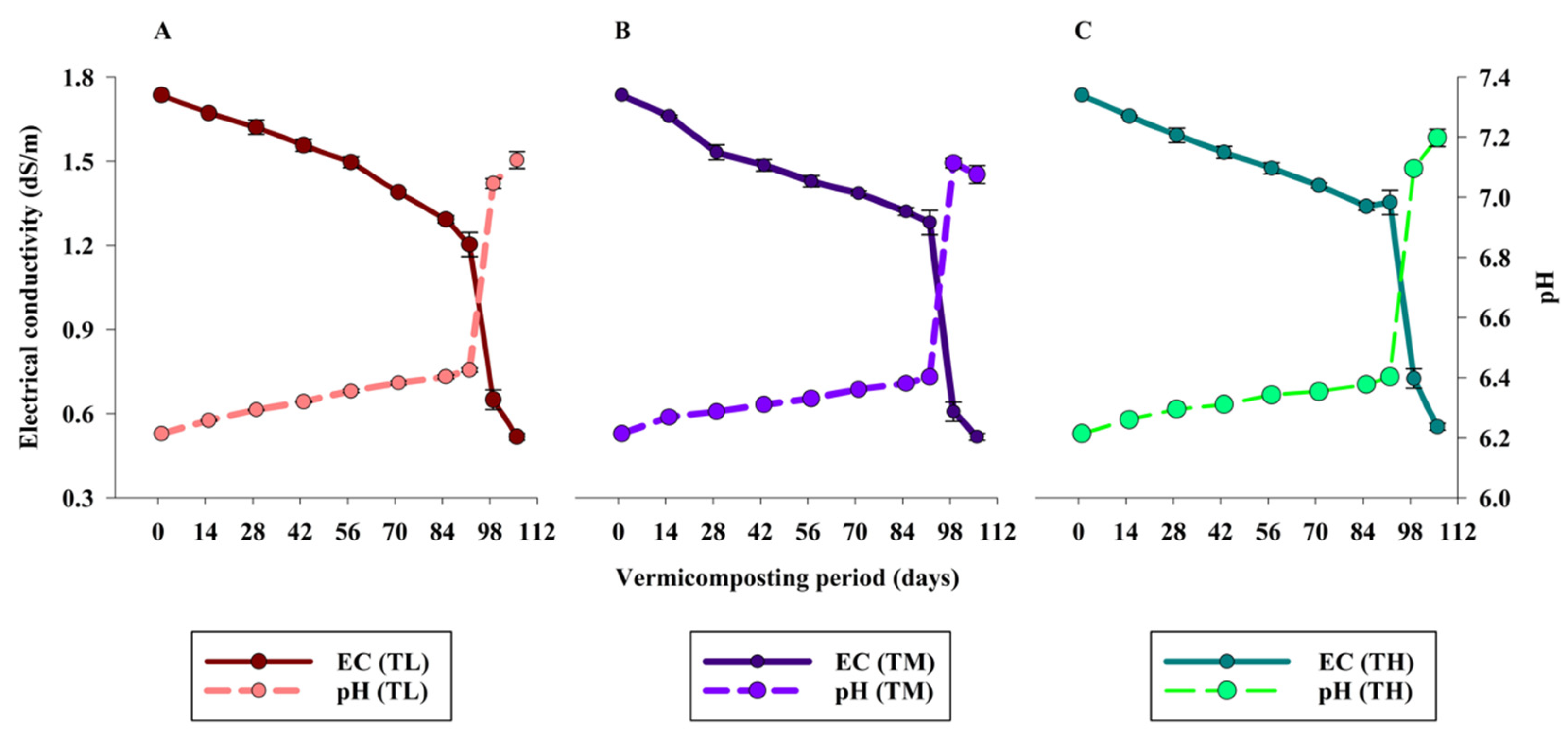
3.1.1. pH
3.1.2. Organic Matter (OM) Content
3.1.3. Total Nitrogen, Phosphorus, Potassium, and Carbon
3.2. Bioassay of Vermicompost
3.2.1. Final Germination Percentage (FGP)
3.2.2. Germination Index (GI)
3.2.3. Coefficient of Velocity of Germination (CVG)
3.2.4. First and Last Days of Germination (FDG and LDG)
3.2.5. Germination Rate Index (GRI)
3.2.6. Mean Germination Time
3.2.7. Germination Energy (GE)
3.2.8. Time Spread of Germination (TSG)
3.3. Data on Growth Parameters of Seedling
3.3.1. Average Root Length (RL)
3.3.2. Average Shoot Length (SL)
3.3.3. Seedling Vigor Index (SVI)
3.4. Potential Use of Eisenia fetida in Degradation and Release of Metals During Vermicomposting
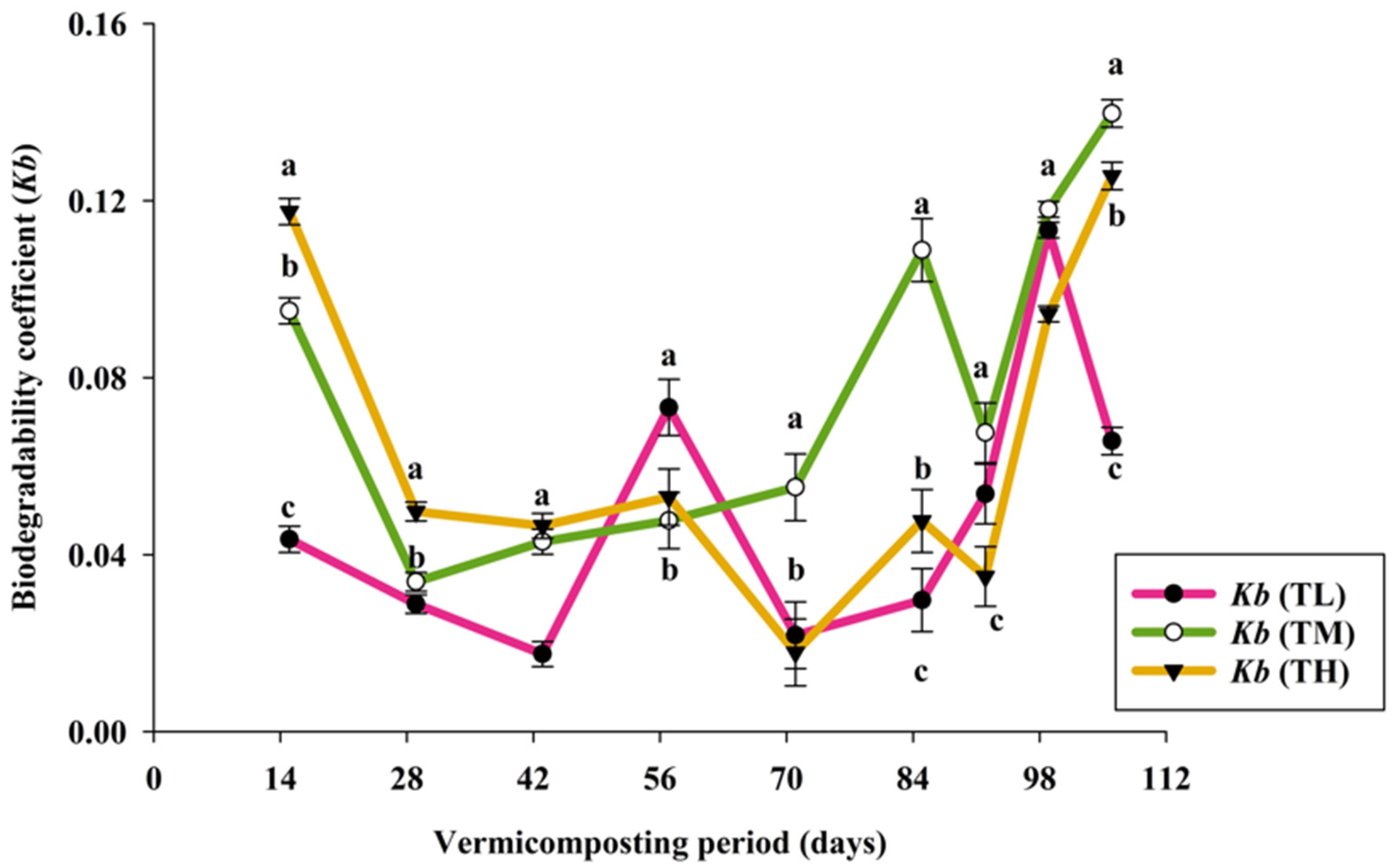
3.5. Impact of Different Stocking Densities of Eisenia fetida on Vermicomposting and Production of Vermicompost
3.6. Growth Performances of Eisenia fetida
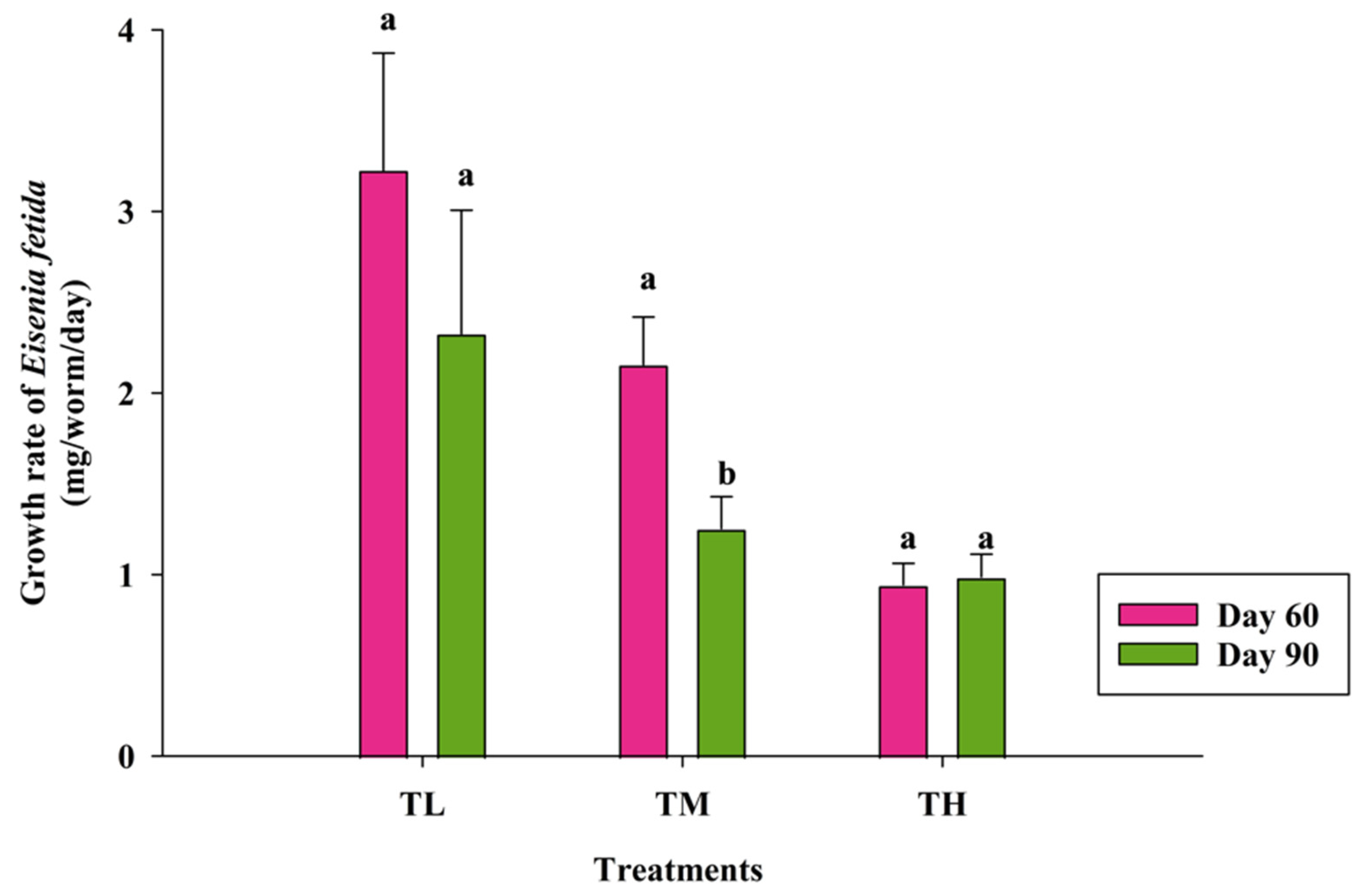
3.6.1. Growth Rate of Eisenia fetida
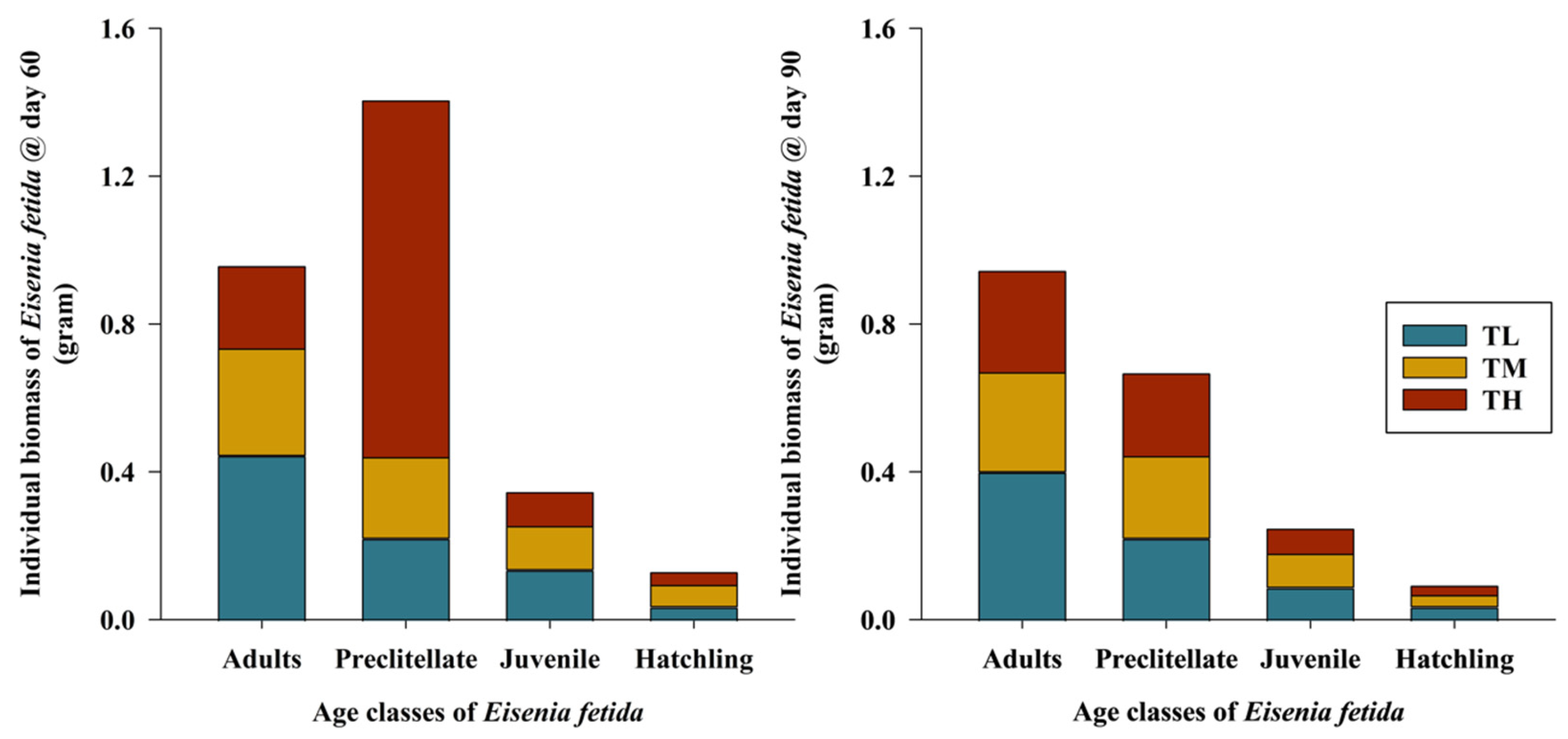
3.6.2. Biomass Gain of Eisenia fetida
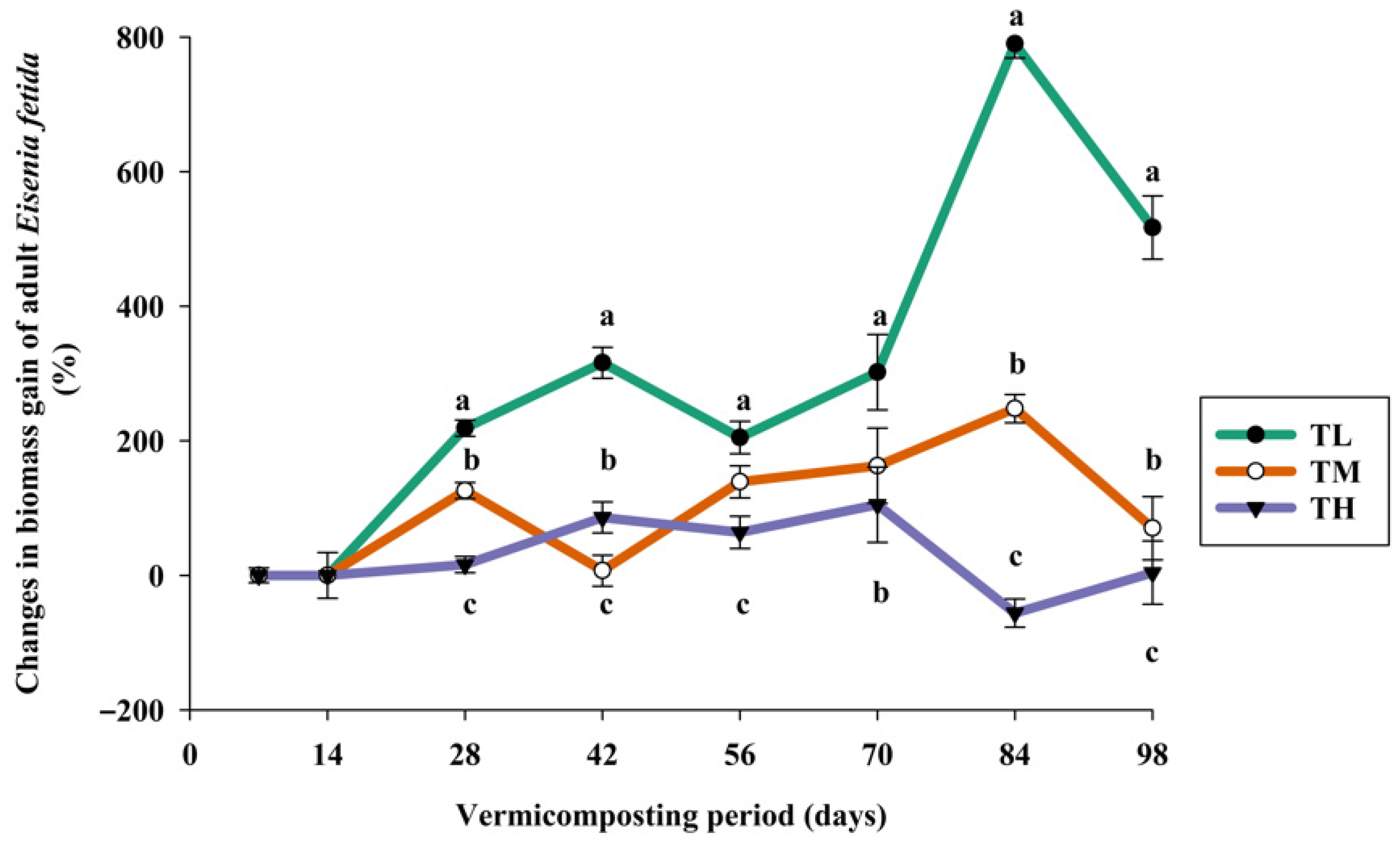
3.6.3. Growth Pattern of Adult Eisenia fetida in Gaining Biomass
3.7. Reproductive Performance of Eisenia fetida
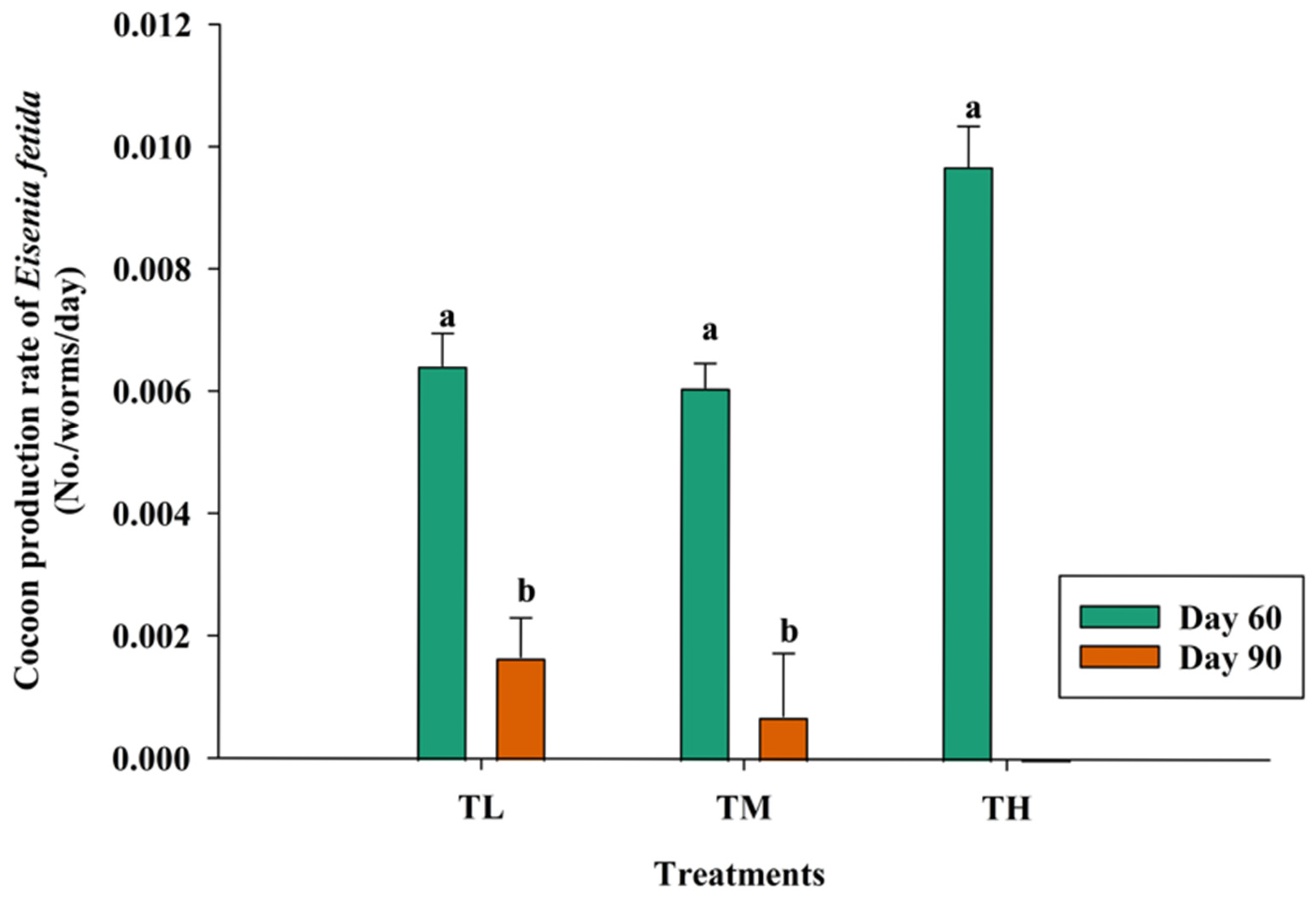
3.7.1. Production of Cocoon
3.7.2. Hatching Success of Cocoons
4. Conclusions
5. Limitation of This Study and Future Directions
Author Contributions
Funding
Institutional Review Board Statement
Informed Consent Statement
Data Availability Statement
Acknowledgments
Conflicts of Interest
Abbreviations
| PPMS | Pulp and paper mill sludge |
| Mg | Megagram (ton) |
| CBPPL | Corner Brook Pulp and Paper Mill Limited |
| NL | Newfoundland and Labrador |
| NPK | Nitrogen, phosphorus, and potassium |
| OM | Organic matter |
| EC | Electrical conductivity |
| D | Decomposition percentage |
| Kb | Biodegradability coefficient |
| RSG | Relative seed germination |
| RRG | Relative radical growth |
| GI | Germination index |
| FGP | Final germination percentage |
| SVI | Seedling vigor index |
| CVG | Coefficient of velocity of germination |
| MGT | Mean germination time |
| GRI | Germination rate index |
| GE | Germination energy |
| TSG | Time spread of germination |
| G | Growth rate |
| BMG | Biomass gain per unit waste |
| R | Worm reproduction rate |
| C | Carbon |
| CCME | Canadian Council of Ministers of the Environment |
| SD | Standard deviation |
| TL | Treatment—Low stocking density |
| TM | Treatment—Medium stocking density |
| TH | Treatment—High stocking density |
References
- Statista Research Department. Global Market Size of Paper and Pulp 2021–2029. Statista. 2023. Available online: https://www.statista.com/statistics/1073451/global-market-value-pulp-and-paper/ (accessed on 4 August 2025).
- Turner, T.; Wheeler, R.; Oliver, I.W. Evaluating land application of pulp and paper mill sludge: A review. J. Environ. Manag. 2022, 317, 115439. [Google Scholar] [CrossRef] [PubMed]
- Haile, A.; Gelebo, G.G.; Tesfaye, T. Pulp and paper mill wastes: Utilizations and prospects for high value-added biomaterials. Bio-Resour. Bioprocess 2021, 8, 35. [Google Scholar] [CrossRef] [PubMed]
- Environment Canada. Wastepaper Recycling in Canada. 1991. Available online: https://publications.gc.ca/collections/collection_2023/eccc/en40/En40-204-2-1991-eng.pdf (accessed on 23 September 2025).
- Government of Canada. Modernization of the Pulp and Paper Effluent Regulations—Updated Detailed Proposal for Consultation—January 2024. Available online: https://www.canada.ca/en/environment-climate-change/services/managing-pollution/sources-industry/pulp-paper-effluent/modernization-proposal.html (accessed on 17 October 2025).
- Norrie, J.; Fierro, A. Paper Sludge as Soil Conditioners. In Handbook of Soil Conditioners; CRC Press: Boca Raton, FL, USA, 2020; pp. 97–118. [Google Scholar]
- Nordahl, S.L.; Preble, C.V.; Kirchstetter, T.W.; Scown, C.D. Greenhouse Gas and Air Pollutant Emissions from Composting. Environ. Sci. Technol. 2023, 57, 2235–2247. [Google Scholar] [CrossRef] [PubMed]
- Santana, N.A.; Jacques, R.J.S.; Antoniolli, Z.I.; Martínez-Cordeiro, H.; Domínguez, J. Changes in the chemical and biological characteristics of grape marc vermicompost during a two-year production period. Appl. Soil Ecol. 2020, 154, 103587. [Google Scholar] [CrossRef]
- Lim, S.L.; Wu, T.Y. Characterization of matured vermicompost derived from valorization of palm oil mill byproduct. J. Agric. Food Chem. 2016, 64, 1761–1769. [Google Scholar] [CrossRef]
- Campanati, C.; Willer, D.; Schubert, J.; Aldridge, D.C. Sustainable Intensification of Aquaculture through Nutrient Recycling and Circular Economies: More Fish, Less Waste, Blue Growth. Rev. Fish. Sci. Aquac. 2022, 30, 143–169. [Google Scholar] [CrossRef]
- Khatua, C.; Sengupta, S.; Balla, V.K.; Kundu, B.; Chakraborti, A.; Tripathi, S. Dynamics of organic matter decomposition during vermicomposting of banana stem waste using Eisenia fetida. Waste Manag. 2018, 79, 287–295. [Google Scholar] [CrossRef]
- Rehman, S.; De Castro, F.; Marini, P.; Aprile, A.; Benedetti, M.; Fanizzi, F.P. Vermibiochar: A Novel Approach for Reducing the Environmental Impact of Heavy Metals Contamination in Agricultural Land. Sustainability 2023, 15, 9380. [Google Scholar] [CrossRef]
- Usta, A.N.; Guven, H. Vermicomposting organic waste with Eisenia fetida using a continuous f low-through reactor: Investigating five distinct waste mixtures. J. Environ. Chem. Eng. 2024, 12, 114384. [Google Scholar] [CrossRef]
- Kaur, T. Vermicomposting: An effective option for recycling organic wastes. In Organic Agriculture; Intech Open: London, UK, 2020. [Google Scholar] [CrossRef]
- Bhambore, N. Municipal Solid Waste Management: Challenges, Opportunity and Best Practices in Developing Countries. In A Vision for Environmental Sustainability: Overcoming Waste Management Challenges in Developing Countries; Mandpe, A., Shah, M.P., Paliya, S., Eds.; Springer: Berlin/Heidelberg, Germany, 2025; pp. 1–24. [Google Scholar] [CrossRef]
- Yuvaraj, A.; Thangaraj, R.; Ravindran, B.; Chang, S.W.; Karmegam, N. Centrality of cattle solid wastes in vermicomposting technology—A cleaner resource recovery and biowaste recycling option for agricultural and environmental sustainability. Environ. Pollut. 2021, 268, 115688. [Google Scholar] [CrossRef]
- Thangappan, V.; Suji, S. Creating and Describing Briquettes from Cattle Manure by Utilizing Sawdust as a Binding Agent, Contrasted with the use of Cow Dung. In Case Studies on Holistic Medical Interventions; CRC Press: Boca Raton, FL, USA, 2024; pp. 941–947. [Google Scholar]
- Sannigrahi, A.K. Management of hazardous paper mill wastes for sustainable agriculture. In Handbook of Environmental Materials Management; Hussain, C.M., Ed.; Springer: New York, NY, USA, 2018; pp. 1–23. [Google Scholar] [CrossRef]
- Devi, J.; Pegu, R.; Mondal, H.; Roy, R.; Sundar, B.S. Earthworm stocking density regulates microbial community structure and fatty acid profiles during vermicomposting of lignocellulosic waste: Unraveling the microbe-metal and mineralization-humification interactions. Bioresour. Technol. 2023, 367, 128305. [Google Scholar] [CrossRef] [PubMed]
- Sahariah, B.; Goswami, L.; Kim, K.H.; Bhattacharyya, P.; Bhattacharya, S.S. Metal remediation and biodegradation potential of earthworm species on municipal solid waste: A parallel analysis between Metaphire posthuma and Eisenia fetida. Bioresour. Technol. 2015, 180, 230–236. [Google Scholar] [CrossRef] [PubMed]
- Hajam, Y.A.; Kumar, R.; Kumar, A. Environmental waste management strategies and vermi transformation for sustainable development. Environ. Chall. 2023, 13, 100747. [Google Scholar] [CrossRef]
- Unuofin, F.O.; Mnkeni, P.N. Optimization of Eisenia fetida stocking density for the bioconversion of rock phosphate enriched cow dung–wastepaper mixtures. Waste Manag. 2014, 34, 2000–2006. [Google Scholar] [CrossRef]
- Katagi, T.; Ose, K. Toxicity, bioaccumulation and metabolism of pesticides in the earthworm. J. Pestic. Sci. 2015, 40, 69–81. [Google Scholar] [CrossRef]
- Sannigrahi, A.K. Efficiency of Perionyx excavatus in vermicomposting of Thatched grass in comparison to Eisenia foetida in Assam. J. Indian Soc. Soil Sci. 2015, 13, 23–27. [Google Scholar]
- Enebe, M.; Erasmus, M. Vermicomposting technology -A perspective on vermicompost production technologies, limitations and prospects. J. Environ. Manag. 2023, 345, 118585. [Google Scholar] [CrossRef]
- Kong, Y.; Zhang, J.; Zhang, X.; Gao, X.; Yin, J.; Wang, G.; Li, J.; Li, G.; Cui, Z.; Yuan, J. Applicability and limitation of compost maturity evaluation indicators: A review. Chem. Eng. J. 2024, 489, 151386. [Google Scholar] [CrossRef]
- Sadia, M.; Hossain, M.; Islam, M.; Akter, T.; Shaha, D. Growth and reproduction performances of earthworm (Perionyx excavatus) fed with different organic waste materials. J. Adv. Vet. Anim. Res. 2020, 7, 331–337. [Google Scholar] [CrossRef]
- Badhwar, V.K.; Sukhwinderpal, S.; Balihar, S. Biotransformation of paper mill sludge and tea waste with cow dung using vermicomposting. Bioresour. Technol. 2020, 318, 124097. [Google Scholar] [CrossRef]
- Harwood, M.; Thompson, C.; Burton, S. Compost Moisture. 2009. Available online: https://peaceforage.bc.ca/wp-content/uploads/2021/06/FF_48_Compost_Moisture.pdf (accessed on 24 July 2025).
- Rodrigues, C.I.D.; Brito, L.M.; Nunes, L.J.R. Soil Carbon Sequestration in the Context of Climate Change Mitigation: A Review. Soil Syst. 2023, 7, 64. [Google Scholar] [CrossRef]
- Ruiz, T.E.; Febles, G.; Alonso, J. A scientific contribution to legume studies during the fifty years of the Institute of Animal Science. Cuba. J. Agric. Sci. 2016, 49, 2. [Google Scholar]
- Liu, S.; Wang, W.; Lu, H.; Shu, Q.; Zhang, Y.; Chen, Q. New perspectives on physiological, biochemical and bioactive components during germination of edible seeds: A review. Trends Food Sci. Technol. 2022, 123, 187–197. [Google Scholar] [CrossRef]
- Ali, M.H.; Sobze, J.M.; Pham, T.H.; Nadeem, M.; Liu, C.; Galagedara, L.; Cheema, M.; Thomas, R. Carbon nanoparticles functionalized with carboxylic acid improved the germination and seedling vigor in upland boreal forest species. Nanomaterials 2020, 10, 176. [Google Scholar] [CrossRef] [PubMed]
- Guarrasi, V.; Leto, L.; Vecchio, L.D.; Guaitini, C.; Cirlini, M.; Chiancone, B. Sumac (Rhus coriaria L.) sprouts: From in vitro seed germination to phenolic content and antioxidant activity for biotechnological application. Plant Cell Tissue Organ Cult. 2024, 157, 69. [Google Scholar] [CrossRef]
- Moraru, P.I.; Rusu, T.; Mintas, O.S. Trial Protocol for Evaluating Platforms for Growing Microgreens in Hydroponic Conditions. Foods 2022, 11, 1327. [Google Scholar] [CrossRef]
- Devjani, M.; Sahoo, K.; Sannigrahi, A. Impact of Eisenia fetida populations on bioconversion of paper mill solid wastes. Int. J. Recycl. Org. Waste Agric. 2019, 8, 189–193. [Google Scholar] [CrossRef]
- Viji, J.; Neelanarayanan, P. Efficacy of Lignocellulolytic Fungi on the Biodegradation of Paddy Straw. Int. J. Environ. Res. 2015, 9, 225–232. [Google Scholar]
- Srivastava, V.; Ismail, S.A.; Singh, P.; Singh, R.P. Urban solid waste management in the developing world with emphasis on India: Challenges and opportunities. Rev. Environ. Sci. Biotechnol. 2015, 14, 317–337. [Google Scholar] [CrossRef]
- Vidal, A.; Blouin, M.; Lubbers, I.; Capowiez, Y.; Sanchez-Hernandez, J.C.; Calogiuri, T.; van Groenigen, J.W. Chapter One—The role of earthworms in agronomy: Consensus, novel insights and remaining challenges. Adv. Agron. 2023, 181, 1–78. [Google Scholar] [CrossRef]
- Liu, S.; Wang, J.; Pu, S.; Blagodatskaya, E.; Kuzyakov, Y.; Razavi, B.S. Impact of manure on soil biochemical properties: A global synthesis. Sci. Total Environ. 2020, 745, 141003. [Google Scholar] [CrossRef] [PubMed]
- Yaqoob, H.; Teoh, Y.H.; Ud Din, Z.; Sabah, N.U.; Jamil, M.A.; Mujtaba, M.A.; Abid, A. The potential of sustainable biogas production from biomass waste for power generation in Pakistan. J. Clean. Prod. 2021, 307, 127250. [Google Scholar] [CrossRef]
- Song, X.; Li, H.; Song, J.; Chen, W.; Shi, L. Biochar/vermicompost promotes Hybrid Pennisetum plant growth and soil enzyme activity in saline soils. Plant Physiol. Biochem. 2022, 183, 96–110. [Google Scholar] [CrossRef]
- Kumar, V.; Verma, P. Pulp-paper industry sludge waste biorefinery for sustainable energy and value-added products development: A systematic valorization towards waste management. J. Environ. Manag. 2024, 352, 120052. [Google Scholar] [CrossRef] [PubMed]
- Lirikum, K.L.N.; Thyug, L.; Lobeno, M. Vermicomposting: An eco-friendly approach for waste management and nutrient enhancement. Trop. Ecol. 2022, 63, 325–337. [Google Scholar] [CrossRef]
- Ghosh, S.; Goswami, A.J.; Ghosh, G.K.; Pramanik, P. Quantifying the relative role of phytase and phosphatase enzymes in phosphorus mineralization during vermicomposting of fibrous tea factory waste. Ecol. Eng. 2018, 116, 97–103. [Google Scholar] [CrossRef]
- Gong, X.; Cai, L.; Li, S.; Chang, S.X.; Sun, X.; An, Z. Bamboo biochar amendment improves the growth and reproduction of Eisenia fetida and the quality of green waste vermicompost. J. Ecotoxicol. Environ. Saf. 2018, 156, 197–204. [Google Scholar] [CrossRef]
- Bao, X.; Hou, X.; Duan, W.; Yin, B.; Ren, J.; Wang, Y.; Liu, X.; Gu, L.; Zhen, W. Screening and evaluation of drought resistance traits of winter wheat in the North China Plain. Front. Plant Sci. 2023, 14, 1194759. [Google Scholar] [CrossRef]
- Regnier, L.L.P.; Salatino, M.L.F. Assessment of different seedling production techniques of Euterpe edulis. Adv. J. Grad. Res. 2020, 8, 40–50. [Google Scholar] [CrossRef]
- Imran, M.; Abo-Elyousr, K.A.M.; Mousa, M.A.A.; Saad, M.M. A study on the synergetic effect of Bacillus amyloliquefaciens and dipotassium phosphate on Alternaria solani causing early blight disease of tomato. Eur. J. Plant Pathol. 2022, 162, 63–77. [Google Scholar] [CrossRef]
- Yuvaraj, A.; Karmegam, N.; Ravindran, B.; Chang, S.W.; Awasthi, M.K.; Kannan, S.; Thangaraj, R. Recycling of leather industrial sludge through vermitechnology for a cleaner environment—A review. Ind. Crops Prod. 2020, 155, 112791. [Google Scholar] [CrossRef]
- Zhang, T.; Fan, S.; Xiang, Y.; Zhang, S.; Wang, J.; Sun, Q. Non-destructive analysis of germination percentage, germination energy and simple vigour index on wheat seeds during storage by Vis/NIR and SWIR hyperspectral imaging. Spectrochim. Acta. Part A Mol. Biomol. Spectrosc. 2020, 239, 118488. [Google Scholar] [CrossRef] [PubMed]
- Van Groenigen, J.W.; Van Groenigen, K.J.; Koopmans, G.F.; Stokkermans, L.; Vos, H.M.J.; Lubbers, I.M. How fertile are earthworm casts? A meta-analysis. Geoderma 2019, 338, 525–535. [Google Scholar] [CrossRef]
- Šrut, M.; Menke, S.; Höckner, M.; Sommer, S. Earthworms and cadmium—Heavy metal resistant gut bacteria as indicators for heavy metal pollution in soils? Ecotoxicol. Environ. Saf. 2019, 171, 843–853. [Google Scholar] [CrossRef]
- Awasthi, M.K.; Pandey, A.K.; Bundela, P.S.; Wong, J.W.; Li, R.; Zhang, Z. Co-composting of gelatin industry sludge combined with organic fraction of municipal solid waste and poultry waste employing zeolite mixed with enriched nitrifying bacterial consortium. Bioresour. Technol. 2016, 213, 181–189. [Google Scholar] [CrossRef]
- Su, C.; Jiang, L.Q.; Zhang, W.J. A review on heavy metal contamination in the soil worldwide: Situation, impact and remediation techniques. Environ. Skept. Crit. 2014, 3, 24–38. [Google Scholar]
- Zhang, R.; Zhou, L.; Zhang, F.; Ding, Y.; Gao, J.; Yan, H.; Shao, W. Heavy metal pollution and assessment in the tidal flat sediments of Haizhou Bay, China. Mar. Pollut. Bull. 2013, 74, 403–412. [Google Scholar] [CrossRef]
- Karmegam, N.; Vijayan, P.; Prakash, M.; Paul, J.A.J. Vermicomposting of paper industry sludge with cow dung and green manure plants using Eisenia fetida: A viable option for cleaner and enriched vermicompost production. J. Clean. Prod. 2019, 228, 718–728. [Google Scholar] [CrossRef]
- Monroy, F.; Aira, M.; Dominguez, J.; Velando, A. Seasonal population dynamics of Eisenia fetida (Savigny, 1826) (Oligochaeta, Lumbricidae) in the field. Comptes Rendus Biol. 2006, 329, 912–915. [Google Scholar] [CrossRef]
- Soobhany, N. Insight into the recovery of nutrients from organic solid waste through biochemical conversion processes for fertilizer production: A review. J. Clean. Prod. 2019, 241, 118413. [Google Scholar] [CrossRef]
- Waqas, M.; Hashim, S.; Humphries, U.W.; Ahmad, S.; Noor, R.; Shoaib, M.; Naseem, A.; Hlaing, P.T.; Lin, H.A. Composting Processes for Agricultural Waste Management: A Comprehensive Review. Processes 2023, 11, 731. [Google Scholar] [CrossRef]
- Han, J.; Dong, Y.; Zhang, M. Chemical fertilizer reduction with organic fertilizer effectively improve soil fertility and microbial community from newly cultivated land in the Loess Plateau of China. Appl. Soil Ecol. 2021, 165, 103966. [Google Scholar] [CrossRef]
- Köninger, J.; Lugato, E.; Panagos, P.; Kochupillai, M.; Orgiazzi, A.; Briones, M.J.I. Manure management and soil biodiversity: Towards more sustainable food systems in the EU. Agric. Syst. 2021, 194, 103251. [Google Scholar] [CrossRef]
- Li, R.; Yin, J.; Wang, W.; Li, Y.; Zhang, Z. Transformation of phosphorus during drying and roasting of sewage sludge. Waste Manag. 2014, 34, 1211–1216. [Google Scholar] [CrossRef]
- Tran, H.D. Vermicomposting of spent mushroom compost using perionyxexkavatus and artificial nutrient compound. Int. J. Agric. Resour. 2016, 2, 101–109. [Google Scholar]
- Awiszus, S.; Meissner, K.; Reyer, S.; Müller, J. Utilization of digestate in a convective hot air dryer with integrated nitrogen recovery. Landtechnik 2018, 73, 106–114. [Google Scholar] [CrossRef]
- Teferedegn, G.D.; Ayele, C. Life cycle patterns of epigeic earthworm species (Eisenia fetida, Eisenia andrei, and Dendrobaena veneta) in a blend of brewery sludge and cow dung. Int. J. Zool. 2024, 2024, 6615245. [Google Scholar] [CrossRef]
- Degefe, G.; Gizaw, C.A. Comparative evaluation of growth and reproductive performance of Eisenia fetida in various agro-industrial wastes blended with horse manure in Ethiopia. J. Appl. Nat. Sci. 2025, 17, 690–696. [Google Scholar] [CrossRef]
- Mupambwa, H.A.; Mnkeni, P.N.S. Eisenia fetida Stocking density optimization for enhanced bioconversion of fly ash enriched vermicompost. J. Environ. Qual. 2016, 45, 1087–1095. [Google Scholar] [CrossRef]
- Coulibaly, S.; Ndegwa, P.; Ayiania, M.; Zoro, I. Growth, reproduction, and life cycle of Eudrilus eugeniae in cocoa and cashew residues. Appl. Soil Ecol. 2019, 143, 153–160. [Google Scholar] [CrossRef]
- Ngwasiri, P.N.; Ambindei, W.A.; Adanmengwi, V.A.; Ngwi, P.; Mah, A.T.; Ngangmou, N.T.; Fonmboh, D.J.; Ngwabie, N.M.; Ngassoum, M.B.; Aba, E.R. A review paper on agro-food waste and food by-product valorization into value-added products for application in the food industry: Opportunities and challenges for Cameroon bioeconomy. Asian J. Biotechnol. Bioresour. Technol. 2022, 9, 32–61. [Google Scholar] [CrossRef]
- Nath, S.I.; Chaudhuri, P.S. Effect of rubber leaf litter diet on growth and reproduction of five tropical species of earthworm under laboratory conditions. J. Appl. Biosci. 2012, 38, 151–155. [Google Scholar]
- Biruntha, M. Growth and reproduction of Perionyx excavatus in different organic wastes. Int. J. Curr. Microbiol. Appl. Sci. 2013, 2, 28–35. [Google Scholar]
- Bhat, S.A.; Singh, J.; Vig, A.P. Earthworms as Organic Waste Managers and Biofertilizer Producers. Waste Biomass Valoration 2018, 9, 1073–1086. [Google Scholar] [CrossRef]
- Singh, A.; Karmegam, N.; Singh, G.S.; Bhadauria, T.; Chang, S.W.; Awasthi, M.K.; Sudhakar, S.; Arunachalam, K.D.; Biruntha, M.; Ravindran, B. Earthworms and vermicompost: An eco-friendly approach for repaying nature’s debt. Environ. Geochem. Health 2020, 42, 1617–1642. [Google Scholar] [CrossRef]



| Parameter | PPMS |
|---|---|
| Moisture content—MC (%) | 74.9 ± 1.23 |
| pH | 6.7 ± 0.21 |
| Electrical conductivity—EC (dS/m) | 0.53 ± 0.01 |
| Organic matter—OM (%) | 75.5 ± 2.17 |
| Total nitrogen (%) | 1.34 ± 0.00 |
| Total carbon (%) | 46.6 ± 0.00 |
| Total phosphorous (%) | 0.69 ± 0.00 |
| Total potassium (%) | 0.57 ± 0.00 |
| Total calcium (%) | 2.62 ± 0.00 |
| Total sodium (%) | 0.09 ± 0.00 |
| Total iron (%) | 0.29 ± 0.00 |
| C:N | 34.8 ± 1.80 |
| Treatment | Total Carbon (%) | Total Nitrogen (%) | Total Phosphorus (%) | Total Potassium (%) | ||||||||
|---|---|---|---|---|---|---|---|---|---|---|---|---|
| Day 01 | Day 60 | Day 90 | Day 01 | Day 60 | Day 90 | Day 01 | Day 60 | Day 90 | Day 01 | Day 60 | Day 90 | |
| TL | 46.6 ± 0.00 | 45.6 ± 0.00 a | 44.1 ± 0.00 a | 1.34 ± 0.00 | 1.47 ± 0.00 a | 1.53 ± 0.00 a | 0.69 ± 0.00 | 0.74 ± 0.00 b | 0.83 ± 0.00 b | 0.57 ± 0.00 | 0.60 ± 0.00 b | 0.68 ± 0.00 b |
| TM | 46.6 ± 0.00 | 43.9 ± 0.01 c | 44.0 ± 0.02 a | 1.34 ± 0.00 | 1.48 ± 0.04 a | 1.55 ± 0.04 a | 0.69 ± 0.00 | 0.80 ± 0.01 a | 0.85 ± 0.01 a | 0.57 ± 0.00 | 0.64 ± 0.01 a | 0.70 ± 0.01 a |
| TH | 46.6 ± 0.00 | 45.8 ± 0.01 b | 43.9 ± 0.01 a | 1.34 ± 0.00 | 1.46 ± 0.02 a | 1.52 ± 0.02 a | 0.69 ± 0.00 | 0.74 ± 0.01 b | 0.81 ± 0.01 c | 0.57 ± 0.00 | 0.60 ± 0.01 b | 0.66 ± 0.01 c |
| Chemical Parameter | Day 1 (PPMS) | TL | TM | TH | |||
|---|---|---|---|---|---|---|---|
| Day 60 | Day 90 | Day 60 | Day 90 | Day 60 | Day 90 | ||
| C:N | 34.78 ± 1.8 | 31.04 ± 1.8 a | 28.77 ± 1.7 a | 29.7 ± 1.7 b | 28.33 ± 1.8 a | 31.4 ± 1.6 a | 29.07 ± 1.7 a |
| C:P | 67.54 ± 2.1 | 59.23 ± 2.0 a | 53.35 ± 2.1 a | 53.54 ± 2.0 b | 51.94 ± 2.1 a | 61.61 ± 2.3 a | 54.28 ± 2.1 a |
| Total Calcium (%) | 2.62 ± 0.00 | 2.65 ± 0.00 c | 2.89 ± 0.00 c | 2.91 ± 0.00 b | 3.17 ± 0.00 a | 2.95 ± 0.00 a | 3.13 ± 0.00 b |
| Total Magnesium (%) | 0.31 ± 0.00 | 0.34 ± 0.00 b | 0.38 ± 0.00 b | 0.32 ± 0.00 c | 0.39 ± 0.00 a | 0.35 ± 0.00 a | 0.38 ± 0.00 b |
| Total Iron (%) | 0.29 ± 0.00 | 0.29 ± 0.00 b | 0.29 ± 0.00 c | 0.35 ± 0.00 a | 0.36 ± 0.00 b | 0.35 ± 0.00 a | 0.36 ± 0.00 a |
| Total Copper (%) | 0.004 ± 0.00 | 0.004 ± 0.00 b | 0.005 ± 0.00 a | 0.005 ± 0.00 a | 0.005 ± 0.00 a | 0.005 ± 0.00 a | 0.005 ± 0.00 a |
| Total Manganese (%) | 0.51 ± 0.00 | 0.52 ± 0.00 c | 0.52 ± 0.00 b | 0.63 ± 0.00 a | 0.63 ± 0.00 a | 0.62 ± 0.00 b | 0.63 ± 0.00 a |
| Total Zinc (%) | 0.044 ± 0.00 | 0.045 ± 0.00 c | 0.048 ± 0.00 c | 0.49 ± 0.00 b | 0.53 ± 0.00 a | 0.49 ± 0.00 b | 0.53 ± 0.00 a |
| Total Boron (%) | 0.005 ± 0.00 | 0.006 ± 0.00 a | 0.006 ± 0.00 a | 0.006 ± 0.00 a | 0.006 ± 1.05 a | 0.006 ± 0.00 a | 0.006 ± 0.00 a |
| Total Sodium (%) | 0.085 ± 0.00 | 0.0781 ± 0.00 c | 0.0821 ± 0.00 c | 0.088 ± 0.00 a | 0.093 ± 0.00 a | 0.086 ± 0.00 b | 0.088 ± 0.00 b |
| Soluble Salts (dS/m) | 0.616 ± 0.00 | 2.67 ± 0.00 a | 2.82 ± 0.00 a | 2.56 ± 0.00 b | 2.72 ± 0.00 b | 2.51 ± 0.00 c | 2.62 ± 0.00 c |
| Treatment | FGP | FDG | LDG | CVG ± SE | GE | GRI ± SE | GI ± SE | TSG | MGT ± SE | RL ± SE | SL ± SE | SVI ± SE |
|---|---|---|---|---|---|---|---|---|---|---|---|---|
| % | Days | Days | - | % | %/Day | - | Days | Days | cm | cm | - | |
| TL | 98.3 | 1 | 3 | 65.3 ± 1.50 a | 98.3 | 15.4 ± 0.20 a | 185.3 ± 2.73 b | 2 | 1.5 ± 0.04 c | 7.8 ± 0.65 b | 4.8 ± 0.65 a | 4.42 ± 0.00 b |
| TM | 100.0 | 1 | 3 | 66.0 ± 1.48 a | 100.0 | 15.5 ± 0.33 a | 189.7 ± 0.67 a | 2 | 1.5 ± 0.03 c | 8.1 ± 0.66 b | 4.9 ± 0.66 a | 4.85 ± 0.00 a |
| TH | 98.1 | 1 | 3 | 65.2 ± 0.00 a | 98.1 | 15.1 ± 0.00 b | 182.7 ± 0.00 b | 2 | 1.5 ± 0.00 c | 7.6 ± 0.00 c | 4.3 ± 0.00 b | 4.25 ± 0.00 c |
| PPMS | 93.3 | 1 | 3 | 56.7± 2.02 c | 93.3 | 12.7 ± 0.40 d | 172.3 ± 2.91 c | 2 | 1.8 ± 0.06 a | 6.4 ± 0.07 d | 2.5 ± 0.07 d | 2.36 ± 0.00 e |
| DI-Water | 95.0 | 1 | 3 | 61.3 ± 1.03 b | 95.0 | 13.9 ± 0.45 d | 178.0 ± 5.51 b | 2 | 1.6 ± 0.03 b | 9.2 ± 0.10 a | 2.8 ± 0.10 c | 2.69 ± 0.00 d |
| Treatments—Bioassay | RSG (%) | RRG (%) | RGI (%) |
|---|---|---|---|
| TL | 101.8 ± 1.01 b | 87.7 ± 0.76 b | 89.2 ± 0.87 b |
| TM | 105.3 ± 0.94 a | 89.4 ± 0.81 a | 94.1 ± 0.91 a |
| TH | 100.0 ± 0.96 b | 85.8 ± 0.85 c | 85.8 ± 0.93 c |
| Initial PPMS | 98.2 ± 1.03 b | 70.2 ± 0.79 d | 69.0 ± 0.94 d |
| Metal | Significance (Days 1 and 60) | PPMS (Day 01) | TL (mg/kg) | TM (mg/kg) | TH (mg/kg) | Significance (Among Treatments) | CCME Standard (mg/kg) | ||
|---|---|---|---|---|---|---|---|---|---|
| AA & A | B | ||||||||
| Aluminum | Al | p < 0.001 | 2610 ± 81.5 | 5276.7 ± 176.5 a | 5360.1 ± 136.5 a | 5320.2 ± 180.1 a | p > 0.05 | - | - |
| Cadmium | Cd | p < 0.004 | 1.8 ± 0.00 | 2.9 ± 0.00 a | 2.9 ± 0.15 a | 2.6 ± 0.12 b | p < 0.004 | 03 | 20 |
| Arsenic | As | p < 0.002 | 1 ± 0.02 | 1.7 ± 0.33 a | 2.01 ± 0.00 a | 1.7 ± 0.33 a | p > 0.05 | 13 | 75 |
| Iron | Fe | p < 0.047 | 2880 ± 18.5 | 2886.3 ± 26.9 b | 3528.7 ± 32.1 a | 3528.7 ± 32.1 a | p < 0.031 | - | - |
| Lead | Pb | p < 0.004 | 15.7 ± 0.17 | 18.3 ± 0.36 a | 18.7 ± 0.43 a | 19.1 ± 0.38 a | p > 0.05 | 150 | 500 |
| Thallium | Tl | p > 0.05 | 0.1 ± 0.00 | 0.2 ± 0.00 a | 0.1 ± 0.03 b | 0.1 ± 0.00 b | p > 0.05 | 01 | ** |
| Tin | Sn | p < 0.008 | 2 ± 0.00 | 2.4 ± 0.00 b | 2.3 ± 0.00 b | 3.5 ± 0.00 a | p < 0.006 | - | - |
| Boron | B | p < 0.000 | 65 ± 0.52 | 21.3 ± 0.76 a | 22.3 ± 0.98 a | 22.3 ± 0.87 a | p > 0.05 | - | - |
| Cobalt | Co | p < 0.006 | 8.4 ± 0.31 | 5.1 ± 0.00 a | 5.1 ± 0.00 a | 4.7 ± 0.00 b | p < 0.004 | 34 | 150 |
| Copper | Cu | p < 0.000 | 77 ± 2.65 | 54.7 ± 1.18 a | 56.3 ± 1.35 a | 53 ± 1.34 a | p > 0.05 | 400 | 757 |
| Manganese | Mn | p < 0.002 | 10,600.2 ± 145.5 | 7823.3 ± 215.5 a | 7913.3 ± 210.61 a | 7070.4 ± 212.4 b | p < 0.000 | - | - |
| Nickel | Ni | p < 0.000 | 66 ± 0.5 | 20.4 ± 0.00 a | 19.7 ± 0.03 b | 18.3 ± 0.00 c | p < 0.000 | 62 | 180 |
| Strontium | Sr | p < 0.006 | 165 ± 6.5 | 90.3 ± 2.38 a | 94.3 ± 2.36 a | 84 ± 2.34 b | p < 0.045 | - | - |
| Barium | Ba | p < 0.047 | 527 ± 6.3 | 412 ± 15.01 a | 424.7 ± 15.34 a | 394.7 ± 15.21 b | p < 0.046 | - | - |
| Chromium | Cr | p < 0.007 | 36 ± 1.23 | 30.3 ± 1.03 a | 30.3 ± 0.88 a | 32 ± 1.01 a | p > 0.05 | 210 | 1060 |
| Molybdenum | Mo | p < 0.005 | 8 ± 0.45 | 7.3 ± 0.33 a | 7.3 ± 0.33 a | 7.2 ± 0.33 a | p > 0.05 | 05 | 20 |
| Silver | Ag | p > 0.05 | 1.8 ± 0.11 | 1.7 ± 0.03 a | 1.7 ± 0.03 a | 1.6 ± 0.03 b | p < 0.004 | - | - |
| Uranium | U | p > 0.05 | 1.9 ± 0.22 | 1.7 ± 0.01 a | 1.6 ± 0.00 b | 1.8 ± 0.00 a | p < 0.001 | - | - |
| Vanadium | V | p < 0.004 | 16 ± 0.35 | 13.7 ± 0.67 b | 14.3 ± 0.33 a | 13.7 ± 0.33 b | p < 0.004 | 130 | ** |
| Zinc | Zn | p > 0.05 | 422 ± 6.9 | 422 ± 11.2 a | 422 ± 11.2 a | 422 ± 11.2 a | p > 0.05 | 700 | 1850 |
| Treatment | 60 Days | 90 Days | ||||
|---|---|---|---|---|---|---|
| Amount (g) | Decomposition Rate (g/Worm) | Decomposition Rate (g/Worm/Day) | Amount (g) | Decomposition Rate (g/Worm) | Decomposition Rate (g/Worm/Day) | |
| TL | 4989.0 ± 73.93 a | 13.03 ± 0.9 a | 0.22 ± 0.02 a | 4931.9 ± 265.8 a | 10.47 ± 0.7 a | 0.12 ± 0.00 a |
| TM | 4845.1 ± 17.31 b | 10.20 ± 0.7 b | 0.17 ± 0.02 b | 4387.1 ± 108.9 b | 7.26 ± 0.8 b | 0.08 ± 0.00 b |
| TH | 4927.5 ± 54.94 a | 5.56 ± 0.2 c | 0.01 ± 0.02 c | 4398.0 ± 184.9 b | 6.85 ± 0.6 b | 0.08 ± 0.00 b |
| Treatment | Earthworm (No/Bed) | Period of Vermicomposting (Days) | Vermicompost Produced (%) (mean ± SD) | Non-Compost Portion (%) (mean ± SD) | Earthworms Harvested (Nos.) | Earthworms Harvested (Weight—g) | |||||||||
|---|---|---|---|---|---|---|---|---|---|---|---|---|---|---|---|
| Adult | Preclitellate | Juvenile | Hatchlings | Total (Nos.) | Cocoons | Adult | Preclitellate | Juvenile | Hatchlings | Total (Weight—g) | |||||
| 60 Days | |||||||||||||||
| TL | 8 | 60 | 66.13 ± 0.00 b | 33.87 ± 0.00 b | 56 | 83 | 102 | 142 | 383 | 21 | 24.872 | 18.283 | 13.778 | 4.950 | 61.883 |
| TM | 15 | 60 | 68.79 ± 0.00 a | 31.21 ± 0.00 c | 75 | 55 | 162 | 183 | 475 | 27 | 21.615 | 11.951 | 18.814 | 10.379 | 62.759 |
| TH | 22 | 60 | 65.19 ± 0.00 c | 34.81 ± 0.00 a | 95 | 23 | 270 | 499 | 887 | 55 | 21.172 | 22.205 | 24.819 | 17.394 | 85.590 |
| 90 Days | |||||||||||||||
| TL | 8 | 90 | 71.54 ± 2.42 a | 28.46 ± 1.97 a | 84 | 17 | 166 | 204 | 471 | 6 | 33.597 | 3.745 | 22.423 | 7.111 | 66.876 |
| TM | 15 | 90 | 71.03 ± 1.62 a | 28.97 ± 1.62 a | 46 | 13 | 188 | 357 | 604 | 3 | 12.286 | 2.863 | 21.834 | 10.445 | 47.428 |
| TH | 22 | 90 | 66.50 ± 4.02 a | 33.50 ± 4.02 a | 42 | 14 | 167 | 420 | 643 | 0 | 11.549 | 3.134 | 15.351 | 10.848 | 40.882 |
| Treatment | Earthworm (No/Bed) | Initial Weight (g) | Period of Vermicomposting (Days) | Average Mature Weight/EW (mean ± SD) | Growth Rate (g/Worm) | Growth Rate (mg/Worm) | Growth Rate (mg/Worm/Day) | Cocoon Production Rate (Cocoon/Worm) | Cocoon Production Rate (Cocoon/Worm/Day) |
|---|---|---|---|---|---|---|---|---|---|
| 60 Days | |||||||||
| TL | 8 | 5.980 | 60 | 0.7475 ± 0.31 a | 0.19 ± 0.04 a | 161.574 a | 3.23 ± 0.65 a | 0.3857 ± 0.31 b | 0.0064 ± 0.01 b |
| TM | 15 | 9.615 | 60 | 0.6410 ± 0.44 b | 0.13 ± 002 b | 123.704 b | 2.16 ± 0.26 b | 0.3643 ± 0.24 b | 0.0061 ± 0.00 b |
| TH | 22 | 11.402 | 60 | 0.5183 ± 0.52 c | 0.05 ± 0.01 c | 96.494 c | 0.94 ± 0.12 c | 0.5818 ± 0.39 a | 0.0097 ± 0.01 a |
| 90 days | |||||||||
| TL | 8 | 5.980 | 90 | 0.7475 ± 0.31 a | 0.14 ± 0.04 a | 141.99 ± 0.44 a | 2.33 ± 0.68 a | 0.099± 0.04 a | 0.0017 ± 0.01 a |
| TM | 15 | 9.615 | 90 | 0.6410 ± 0.44 b | 0.08 ± 001 b | 78.52 ± 0.44 b | 1.25 ± 0.17 b | 0.042 ± 0.06 b | 0.0007 ± 0.00 b |
| TH | 22 | 11.402 | 90 | 0.5183 ± 0.52 c | 0.06 ± 0.01 b | 63.58 ± 0.44 c | 0.99 ± 0.12 c | 0.000 ± 0.00 c | 0.0000 ± 0.00 c |
| Treatment | Average Initial Weight | Maximum Weight Achieved | Maximum Weight Found | Average Final Weight (g)—Adult | Weight Gain (%)—Adult | ||
|---|---|---|---|---|---|---|---|
| (g) | (g) | (Week) | 60 Days | 90 Days | 60 Days | 90 Days | |
| TL | 5.98 ± 0.00 | 5.32 ± 0.00 | Week 13 | 24.87 ± 0.00 | 33.59 ± 0.00 | 315.94 ± 13.5 a | 461.83 ± 18.5 a |
| TM | 9.62 ± 0.01 | 33.51 ± 0.00 | Week 13 | 21.62 ± 0.00 | 12.29 ± 0.00 | 124.80 ± 11.3 b | 27.78 ± 1.5 b |
| TH | 11.40 ± 0.01 | 21.17 ± 0.00 | Week 8 | 21.17 ± 0.00 | 11.55 ± 0.00 | 85.69 ± 1.5 c | 1.29 ± 0.5 c |
| Treatment | Cocoons Tested | Total No. of Hatched Cocoons (mean ± SD) | Hatching Success (%) | No. of Hatchlings Emerged | Hatchling/Cocoon |
|---|---|---|---|---|---|
| TL | 10 | 8.67 ± 0.58 a | 86.7 ± 5.8 a | 41.0 ± 3.00 a | 4.1 ± 0.1 a |
| TM | 10 | 8.33 ± 0.58 a | 83.3 ± 5.8 a | 38.3 ± 1.53 a | 3.8 ± 0.1 b |
| TH | 10 | 8.67 ± 0.58 a | 86.7 ± 5.8 a | 41.7 ± 2.08 a | 4.2 ± 0.0 a |
Disclaimer/Publisher’s Note: The statements, opinions and data contained in all publications are solely those of the individual author(s) and contributor(s) and not of MDPI and/or the editor(s). MDPI and/or the editor(s) disclaim responsibility for any injury to people or property resulting from any ideas, methods, instructions or products referred to in the content. |
© 2025 by the authors. Licensee MDPI, Basel, Switzerland. This article is an open access article distributed under the terms and conditions of the Creative Commons Attribution (CC BY) license.
Share and Cite
Subramaniam, D.; Krishnapillai, M.; Galagedara, L.; Manful, C.F. Optimization of Stocking Density of Eisenia fetida in Bioconversion Process of Pulp and Paper Mill Sludge (PPMS) and Its Population Dynamics. Appl. Sci. 2026, 16, 195. https://doi.org/10.3390/app16010195
Subramaniam D, Krishnapillai M, Galagedara L, Manful CF. Optimization of Stocking Density of Eisenia fetida in Bioconversion Process of Pulp and Paper Mill Sludge (PPMS) and Its Population Dynamics. Applied Sciences. 2026; 16(1):195. https://doi.org/10.3390/app16010195
Chicago/Turabian StyleSubramaniam, Dasinaa, Manokararajah Krishnapillai, Lakshman Galagedara, and Charles F. Manful. 2026. "Optimization of Stocking Density of Eisenia fetida in Bioconversion Process of Pulp and Paper Mill Sludge (PPMS) and Its Population Dynamics" Applied Sciences 16, no. 1: 195. https://doi.org/10.3390/app16010195
APA StyleSubramaniam, D., Krishnapillai, M., Galagedara, L., & Manful, C. F. (2026). Optimization of Stocking Density of Eisenia fetida in Bioconversion Process of Pulp and Paper Mill Sludge (PPMS) and Its Population Dynamics. Applied Sciences, 16(1), 195. https://doi.org/10.3390/app16010195