Exploring Chemistry in Virtual Reality: A Comparative Analysis of VR Simulations for Chemistry Education
 , , and
Abstract
1. Introduction
2. Methodology
2.1. Literature and Software Search Strategy
2.2. Inclusion and Exclusion Criteria
2.3. Screening and Selection Procedure
2.4. Quality Assessment
2.5. Evaluation Framework
3. Virtual Reality Simulation in Chemistry Education
4. Advantages of VR Simulations in Chemical Education
5. Challenges in Implementing VR Applications for Chemistry Education
6. Comparative Analysis of VR Applications in Chemistry Education
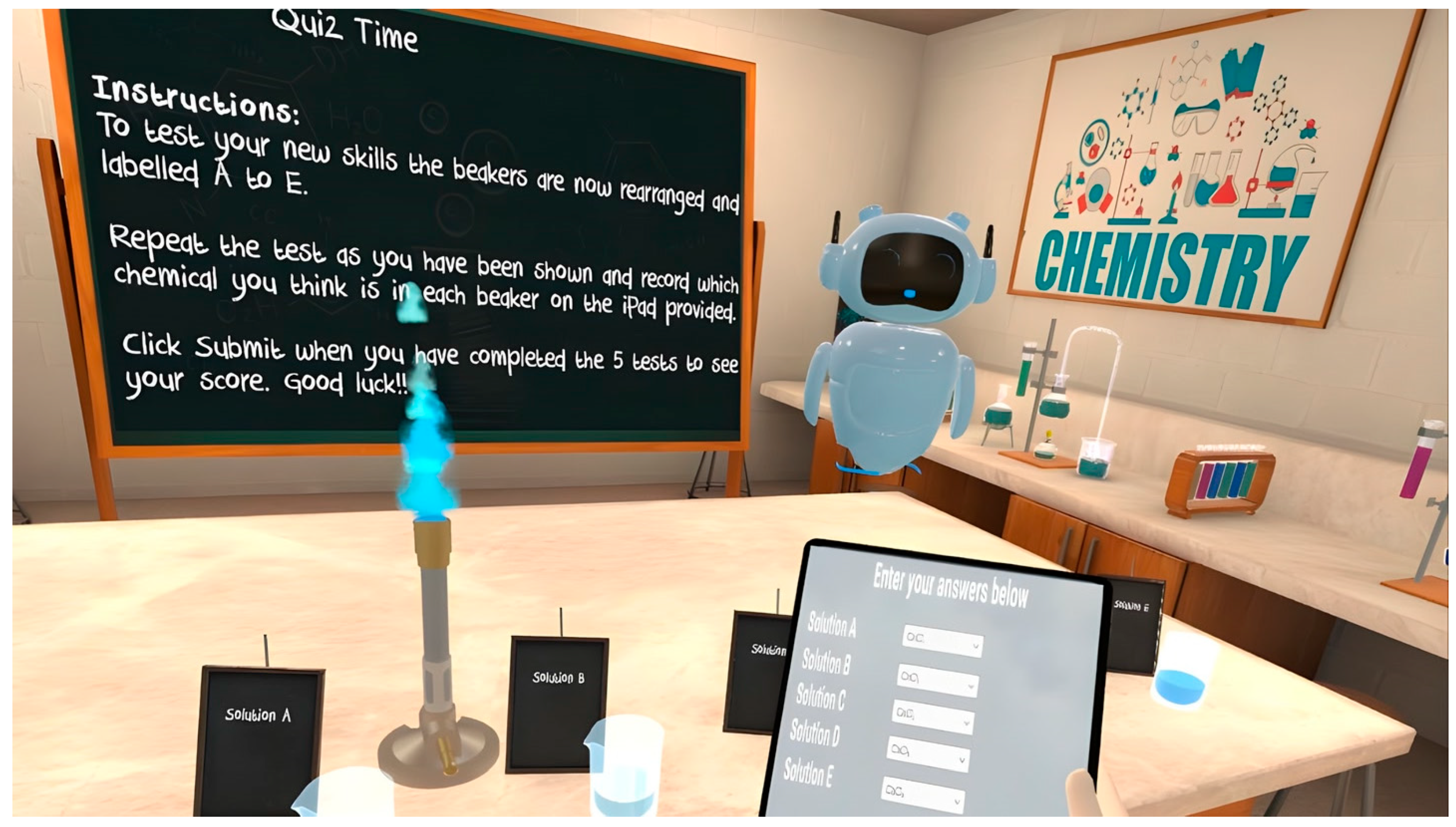
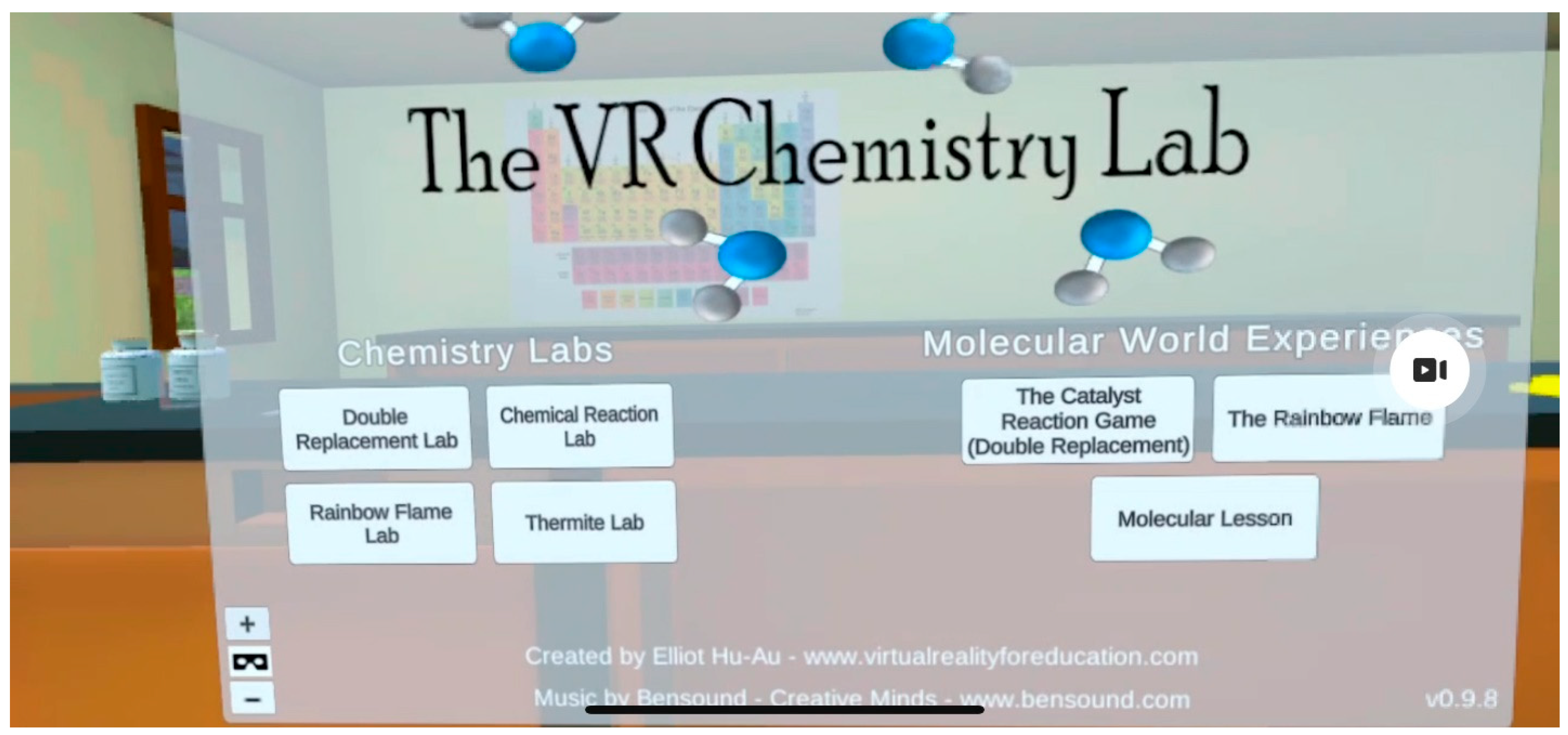
6.1. The VR Chemistry Lab
6.2. Chemistry Lab VR
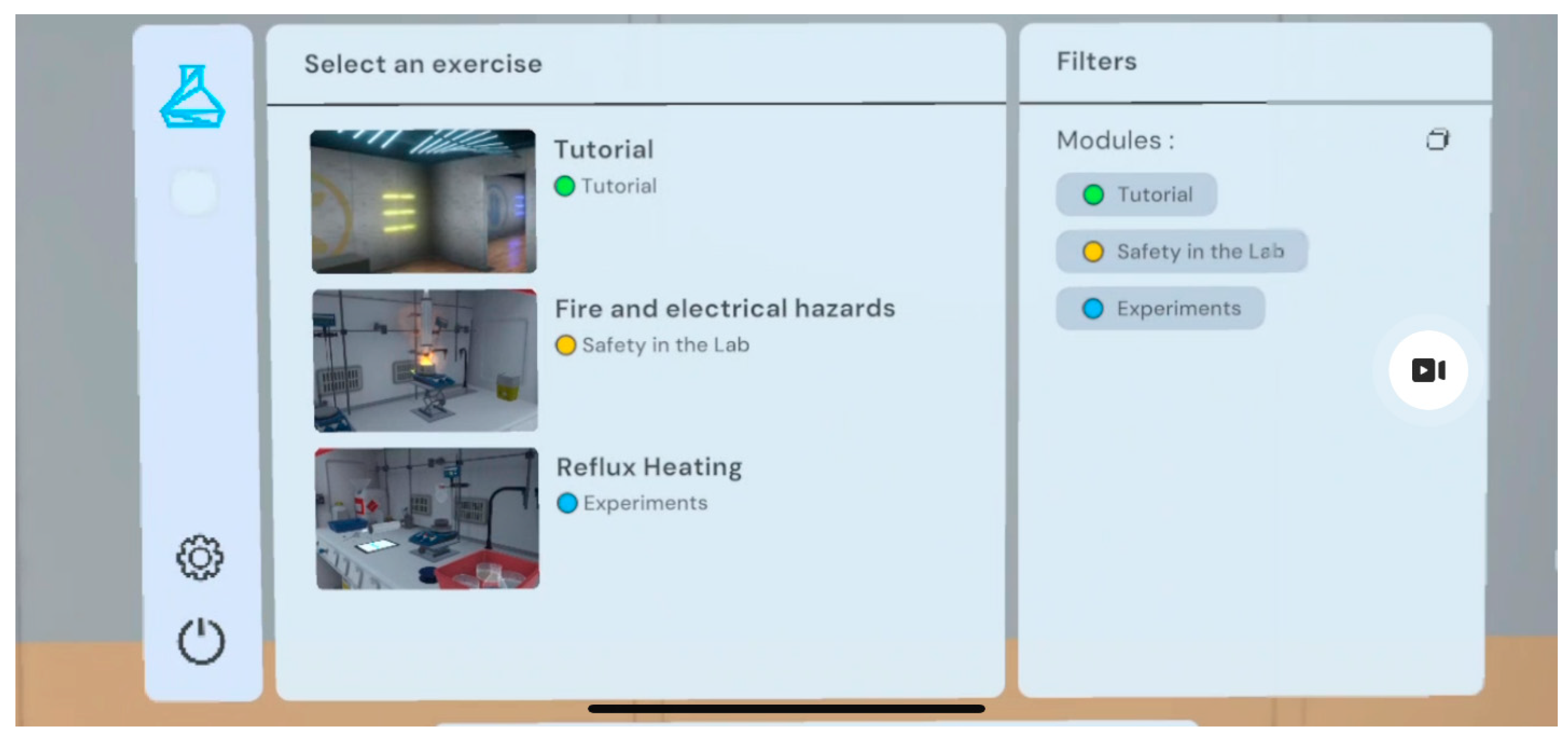
6.3. MIMBUS Chemistry
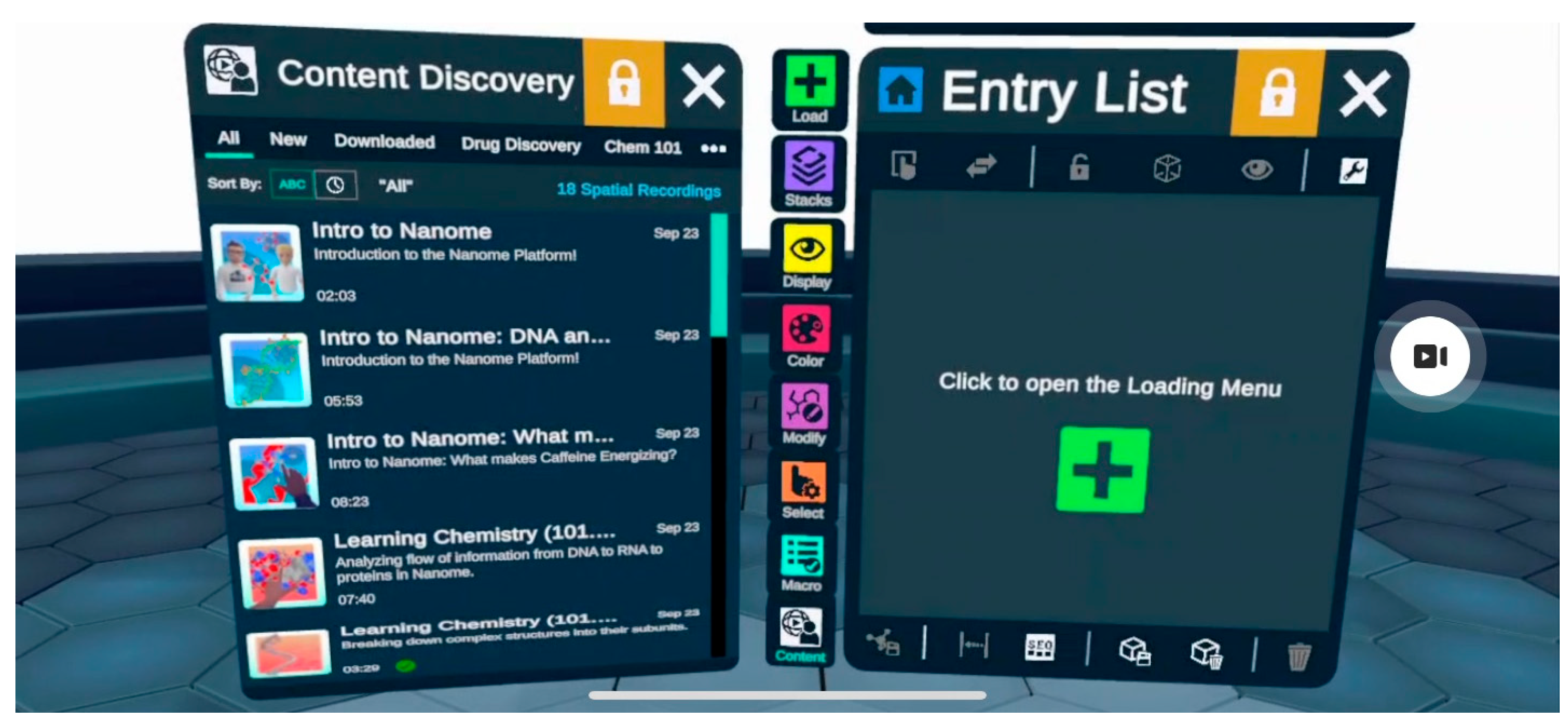
6.4. Nanome
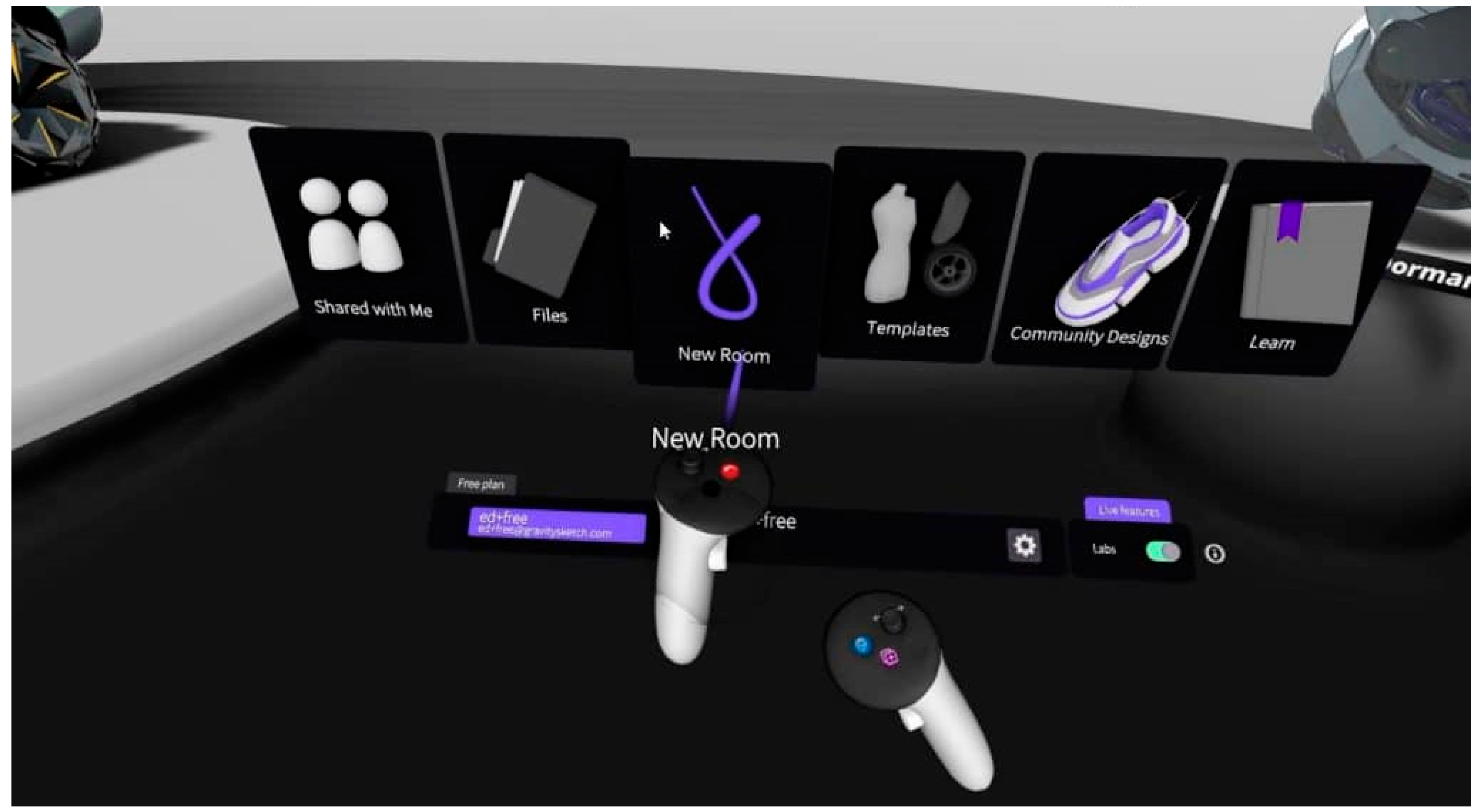
6.5. Gravity Sketch
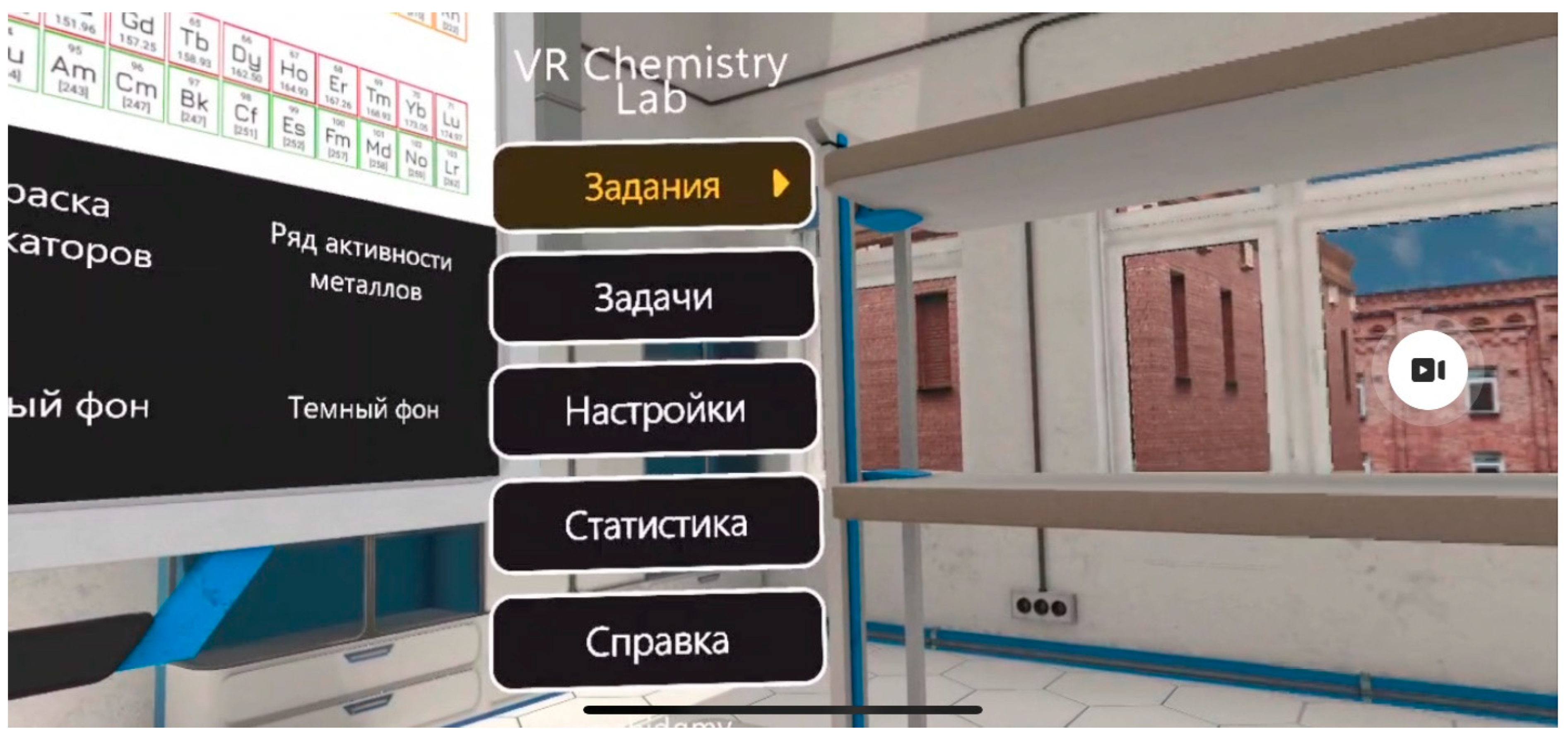
6.6. VR Chemistry Lab (In Russian)
7. Theoretical Frameworks and Pedagogical Approaches in VR-Based Chemistry
8. Future Directions in VR for Chemistry Education
9. Conclusions
Funding
Data Availability Statement
Acknowledgments
Conflicts of Interest
References
- Al Farsi, G.; Yusof, A.B.M.; Romli, A.; Tawafak, R.M.; Malik, S.I.; Jabbar, J.; Rsuli, M.E.B. A Review of Virtual Reality Applications in an Educational Domain. Int. J. Interact. Mob. Technol. 2021, 15, 99. [Google Scholar] [CrossRef]
- Lo, C.K.; Ng, D.T.K.; Ng, F. Observing Mathematical Properties in the Virtual World: An Exploratory Study of Online Independent Learning of Locus Concepts. Int. J. Sci. Math. Educ. 2024, 22, 37–58. [Google Scholar] [CrossRef]
- van Dinther, R.; de Putter, L.; Pepin, B. Features of Immersive Virtual Reality to Support Meaningful Chemistry Education. J. Chem. Educ. 2023, 100, 1537–1546. [Google Scholar] [CrossRef]
- Griffin, C.S.; Loughran, S.; Kelly, B.; Healy, E.; Lambe, G.; van Rossum, A.; Murphy, B.; Moore, E.; Burke, C.; Morrin, A.; et al. Virtual laboratories complement but should not replace face-to-face classes: Perceptions of life science students at Dundalk Institute of Technology, Ireland. Adv. Physiol. Educ. 2025, 49, 314–330. [Google Scholar] [CrossRef]
- Freeman, S.; Eddy, S.L.; McDonough, M.; Smith, M.K.; Okoroafor, N.; Jordt, H.; Wenderoth, M.P. Active learning increases student performance in science, engineering, and mathematics. Proc. Natl. Acad. Sci. USA 2014, 111, 8410–8415. [Google Scholar] [CrossRef]
- Ramachandran, R.; Rodriguez, M.C. Student Perspectives on Remote Learning in a Large Organic Chemistry Lecture Course. J. Chem. Educ. 2020, 97, 2565–2572. [Google Scholar] [CrossRef]
- Chavez, B.; Bayona, S. Virtual Reality in the Learning Process. Adv. Intell. Syst. Comput. 2018, 746, 1345–1356. [Google Scholar] [CrossRef]
- Köroğlu, M. Pioneering virtual assessments: Augmented reality and virtual reality adoption among teachers. Educ. Inf. Technol. 2024, 30, 9901–9948. [Google Scholar] [CrossRef]
- Pierdicca, R.; Frontoni, E.; Puggioni, M.P.; Malinverni, E.S.; Paolanti, M. Evaluating Augmented and Virtual Reality in Education Through a User-Centered Comparative Study. In Advances in Computational Intelligence and Robotics; IGI Global Scientific Publishing: Hershey, PA, USA, 2020; pp. 229–261. [Google Scholar] [CrossRef]
- Pirker, J.; Dengel, A.; Holly, M.; Safikhani, S. Virtual Reality in Computer Science Education: A Systematic Review. In Proceedings of the 26th ACM Symposium on Virtual Reality Software and Technology, Ottawa, OT, Canada, 1–4 November 2020; pp. 1–8. [Google Scholar]
- Rahman, H.; Wahid, S.A.; Ahmad, F.; Ali, N. Game-based learning in metaverse: Virtual chemistry classroom for chemical bonding for remote education. Educ. Inf. Technol. 2024, 29, 19595–19619. [Google Scholar] [CrossRef]
- Raja, M.; Priya, G.G.L. Conceptual Origins, Technological Advancements, and Impacts of Using Virtual Reality Technology in Education. Webology 2021, 18, 116–134. [Google Scholar] [CrossRef]
- Patnode, K.; Demchuk, Z.; Johnson, S.; Voronov, A.; Rasulev, B. Computational Protein–Ligand Docking and Experimental Study of Bioplastic Films from Soybean Protein, Zein, and Natural Modifiers. ACS Sustain. Chem. Eng. 2021, 9, 10740–10748. [Google Scholar] [CrossRef]
- Patnode, K.; Rasulev, B.; Voronov, A. Synergistic Behavior of Plant Proteins and Biobased Latexes in Bioplastic Food Packaging Materials: Experimental and Machine Learning Study. ACS Appl. Mater. Inter. 2022, 14, 8384–8393. [Google Scholar] [CrossRef] [PubMed]
- Ahmed, L.; Rasulev, B.; Turabekova, M.; Leszczynska, D.; Leszczynski, J. Receptor- and ligand-based study of fullerene analogues: Comprehensive computational approach including quantum-chemical, QSAR and molecular docking simulations. Org. Biomol. Chem. 2013, 11, 5798. [Google Scholar] [CrossRef]
- Turabekova, M.A.; Rasulev, B.F.; Dzhakhangirov, F.N.; Leszczynska, D.; Leszczynski, J. Aconitum and Delphinium alkaloids of curare-like activity. QSAR analysis and molecular docking of alkaloids into AChBP. Eur. J. Med. Chem. 2010, 45, 3885–3894. [Google Scholar] [CrossRef] [PubMed]
- Ahmed, L.; Rasulev, B.; Kar, S.; Krupa, P.; Mozolewska, M.A.; Leszczynski, J. Inhibitors or toxins? Large library target-specific screening of fullerene-based nanoparticles for drug design purpose. Nanoscale 2017, 9, 10263–10276. [Google Scholar] [CrossRef]
- Ross, G.A.; Lu, C.; Scarabelli, G.; Albanese, S.K.; Houang, E.; Abel, R.; Harder, E.D.; Wang, L. The maximal and current accuracy of rigorous protein-ligand binding free energy calculations. Commun. Chem. 2023, 6, 222. [Google Scholar] [CrossRef]
- Puzyn, T.; Rasulev, B.; Gajewicz, A.; Hu, X.; Dasari, T.P.; Michalkova, A.; Hwang, H.-M.; Toropov, A.; Leszczynska, D.; Leszczynski, J. Using nano-QSAR to predict the cytotoxicity of metal oxide nanoparticles. Nat. Nanotechnol. 2011, 6, 175–178. [Google Scholar] [CrossRef]
- Casanola-Martin, G.M.; Karuth, A.; Pham-The, H.; González-Díaz, H.; Webster, D.C.; Rasulev, B. Machine learning analysis of a large set of homopolymers to predict glass transition temperatures. Commun. Chem. 2024, 7, 226. [Google Scholar] [CrossRef]
- Usmanov, D.; Yusupova, U.; Syrov, V.; Casanola-Martin, G.M.; Rasulev, B. A Quantitative Structure–Activity Relationship Study of the Anabolic Activity of Ecdysteroids. Computation 2025, 13, 195. [Google Scholar] [CrossRef]
- Daghighi, A.; Casanola-Martin, G.M.; Iduoku, K.; Kusic, H.; González-Díaz, H.; Rasulev, B. Multi-Endpoint Acute Toxicity Assessment of Organic Compounds Using Large-Scale Machine Learning Modeling. Env. Sci. Technol. 2024, 58, 10116–10127. [Google Scholar] [CrossRef]
- Karuth, A.; Szwiec, S.; Casanola-Martin, G.M.; Khanam, A.; Safaripour, M.; Boucher, D.; Xia, W.; Webster, D.C.; Rasulev, B. Integrated machine learning, computational, and experimental investigation of compatibility in oil-modified silicone elastomer coatings. Prog. Org. Coat. 2024, 193, 108526. [Google Scholar] [CrossRef]
- Gajewicz, A.; Schaeublin, N.; Rasulev, B.; Hussain, S.; Leszczynska, D.; Puzyn, T.; Leszczynski, J. Towards understanding mechanisms governing cytotoxicity of metal oxides nanoparticles: Hints from nano-QSAR studies. Nanotoxicology 2014, 9, 313–325. [Google Scholar] [CrossRef] [PubMed]
- Cvetnic, M.; Juretic Perisic, D.; Kovacic, M.; Ukic, S.; Bolanca, T.; Rasulev, B.; Kusic, H.; Loncaric Bozic, A. Toxicity of aromatic pollutants and photooxidative intermediates in water: A QSAR study. Ecotox Env. Safe 2019, 169, 918–927. [Google Scholar] [CrossRef] [PubMed]
- Wyrzykowska, E.; Mikolajczyk, A.; Sikorska, C.; Puzyn, T. Development of a novel in silico model of zeta potential for metal oxide nanoparticles: A nano-QSPR approach. Nanotechnology 2016, 27, 445702. [Google Scholar] [CrossRef]
- Sizochenko, N.; Mikolajczyk, A.; Leszczynski, J.; Puzyn, T. In silico methods for nanotoxicity evaluation: Opportunities and challenges. In Nanotoxicology: Toxicity Evaluation, Risk Assessment and Management; Kumar, V., Dasgupta, N., Ranjan, S., Eds.; CRC Press: Boca Raton, FL, USA, 2018; pp. 527–557. [Google Scholar]
- Sizochenko, N.; Mikolajczyk, A.; Syzochenko, M.; Puzyn, T.; Leszczynski, J. Zeta potentials (zeta) of metal oxide nanoparticles: A meta-analysis of experimental data and a predictive neural networks modeling. NanoImpact 2021, 22, 100317. [Google Scholar] [CrossRef]
- Tom, G.; Schmid, S.P.; Baird, S.G.; Cao, Y.; Darvish, K.; Hao, H.; Lo, S.; Pablo-García, S.; Rajaonson, E.M.; Skreta, M.; et al. Self-Driving Laboratories for Chemistry and Materials Science. Chem. Rev. 2024, 124, 9633–9732. [Google Scholar] [CrossRef]
- MacLeod, B.P.; Parlane, F.G.L.; Morrissey, T.D.; Häse, F.; Roch, L.M.; Dettelbach, K.E.; Moreira, R.; Yunker, L.P.E.; Rooney, M.B.; Deeth, J.R.; et al. Self-driving laboratory for accelerated discovery of thin-film materials. Sci. Adv. 2020, 6, eaaz8867. [Google Scholar] [CrossRef]
- Häse, F.; Roch, L.M.; Aspuru-Guzik, A. Next-Generation Experimentation with Self-Driving Laboratories. Trends Chem. 2019, 1, 282–291. [Google Scholar] [CrossRef]
- Seifrid, M.; Pollice, R.; Aguilar-Granda, A.; Morgan Chan, Z.; Hotta, K.; Ser, C.T.; Vestfrid, J.; Wu, T.C.; Aspuru-Guzik, A. Autonomous Chemical Experiments: Challenges and Perspectives on Establishing a Self-Driving Lab. Acc. Chem. Res. 2022, 55, 2454–2466. [Google Scholar] [CrossRef]
- Zhang, Y.; Gong, Y.; Hu, J.; Zhang, L.; Benito, M.J.; Usmanov, D.; Nishanbaev, S.Z.; Song, X.; Zou, L.; Wu, Y. Quercetin and kaempferol from saffron petals alleviated hydrogen peroxide-induced oxidative damage in B16 cells. J. Sci. Food Agric. 2024, 105, 967–973. [Google Scholar] [CrossRef]
- Roch, L.M.; Häse, F.; Kreisbeck, C.; Tamayo-Mendoza, T.; Yunker, L.P.E.; Hein, J.E.; Aspuru-Guzik, A. ChemOS: Orchestrating autonomous experimentation. Sci. Robot. 2018, 3, eaat5559. [Google Scholar] [CrossRef] [PubMed]
- Usmanov, D.; Azamatov, A.; Baykuziyev, T.; Yusupova, U.; Rasulev, B. Chemical constituents, anti-inflammatory and analgesic activities of iridoids preparation from Phlomoides labiose bunge. Nat. Prod. Res. 2022, 37, 1709–1713. [Google Scholar] [CrossRef] [PubMed]
- Darvish, K.; Skreta, M.; Zhao, Y.; Yoshikawa, N.; Som, S.; Bogdanovic, M.; Cao, Y.; Hao, H.; Xu, H.; Aspuru-Guzik, A.; et al. ORGANA: A robotic assistant for automated chemistry experimentation and characterization. Matter 2025, 8, 101897. [Google Scholar] [CrossRef]
- Horne, M.; Thompson, E.M. The Role of Virtual Reality in Built Environment Education. J. Educ. Built Environ. 2008, 3, 5–24. [Google Scholar] [CrossRef]
- Ferrell, J.B.; Campbell, J.P.; McCarthy, D.R.; McKay, K.T.; Hensinger, M.; Srinivasan, R.; Zhao, X.; Wurthmann, A.; Li, J.; Schneebeli, S.T. Chemical Exploration with Virtual Reality in Organic Teaching Laboratories. J. Chem. Educ. 2019, 96, 1961–1966. [Google Scholar] [CrossRef]
- Mojsoska, B.; Pande, P.; Moeller, M.E.; Ramasamy, P.; Jepsen, P.M. Virtual Reality in an Eco-Niche Undergraduate Organic Chemistry Laboratory Course: New Practice in Chemistry Lab Teaching. J. Chem. Educ. 2024, 101, 4686–4693. [Google Scholar] [CrossRef]
- Standen, P.J.; Brown, D.J. Virtual reality and its role in removing the barriers that turn cognitive impairments into intellectual disability. Virtual Real. 2006, 10, 241–252. [Google Scholar] [CrossRef]
- Vogel, J.J.; Greenwood-Ericksen, A.; Cannon-Bowers, J.; Bowers, C.A. Using Virtual Reality with and without Gaming Attributes for Academic Achievement. J. Res. Technol. Educ. 2006, 39, 105–118. [Google Scholar] [CrossRef]
- Tatli, Z.; Ayas, A. Virtual laboratory applications in chemistry education. Procedia–Soc. Behav. Sci. 2010, 9, 938–942. [Google Scholar] [CrossRef]
- Zhao, R.; Chu, Q.; Chen, D. Exploring Chemical Reactions in Virtual Reality. J. Chem. Educ. 2022, 99, 1635–1641. [Google Scholar] [CrossRef]
- Gabr, M.A.M.; Sleem, W.F.; El-wkeel, N.S. Effect of virtual reality educational program on critical thinking disposition among nursing students in Egypt: A quasi-experimental pretest–posttest design. BMC Nurs. 2025, 24, 874. [Google Scholar] [CrossRef] [PubMed]
- Ng, D.T.K. What is the metaverse? Definitions, technologies and the community of inquiry. Australas. J. Educ. Technol. 2022, 38, 190–205. [Google Scholar] [CrossRef]
- Dunnagan, C.L.; Dannenberg, D.A.; Cuales, M.P.; Earnest, A.D.; Gurnsey, R.M.; Gallardo-Williams, M.T. Production and Evaluation of a Realistic Immersive Virtual Reality Organic Chemistry Laboratory Experience: Infrared Spectroscopy. J. Chem. Educ. 2019, 97, 258–262. [Google Scholar] [CrossRef]
- Su, C.-H.; Cheng, T.-W. A Sustainability Innovation Experiential Learning Model for Virtual Reality Chemistry Laboratory: An Empirical Study with PLS-SEM and IPMA. Sustainability 2019, 11, 1027. [Google Scholar] [CrossRef]
- Nekhaychuk, D.V.; Zentsova, О.S.; Shevchuk, A.S. The new platforms of digital educational content: Practice and experience of higher education. Вестник Алтайскoй Академии Экoнoмики Права 2024, 3, 428–435. [Google Scholar] [CrossRef]
- Martino, M.; Salvadori, A.; Lazzari, F.; Paoloni, L.; Nandi, S.; Mancini, G.; Barone, V.; Rampino, S. Chemical promenades: Exploring potential-energy surfaces with immersive virtual reality. J. Comput. Chem. 2020, 41, 1310–1323. [Google Scholar] [CrossRef]
- Edwards, B.I.; Bielawski, K.S.; Prada, R.; Cheok, A.D. Haptic virtual reality and immersive learning for enhanced organic chemistry instruction. Virtual Real. 2018, 23, 363–373. [Google Scholar] [CrossRef]
- Norrby, M.; Grebner, C.; Eriksson, J.; Boström, J. Molecular Rift: Virtual Reality for Drug Designers. J. Chem. Inf. Model. 2015, 55, 2475–2484. [Google Scholar] [CrossRef]
- Dunnagan, C.L.; Gallardo-Williams, M.T. Overcoming Physical Separation During COVID-19 Using Virtual Reality in Organic Chemistry Laboratories. J. Chem. Educ. 2020, 97, 3060–3063. [Google Scholar] [CrossRef]
- Kounlaxay, K.; Yao, D.; Woo Ha, M.; Kyun Kim, S. Design of Virtual Reality System for Organic Chemistry. Intell. Autom. Soft Comput. 2022, 31, 1119–1130. [Google Scholar] [CrossRef]
- Gallardo-Williams, M.T.; Dunnagan, C.L. Designing Diverse Virtual Reality Laboratories as a Vehicle for Inclusion of Underrepresented Minorities in Organic Chemistry. J. Chem. Educ. 2021, 99, 500–503. [Google Scholar] [CrossRef]
- Qin, T.; Cook, M.; Courtney, M. Exploring Chemistry with Wireless, PC-Less Portable Virtual Reality Laboratories. J. Chem. Educ. 2020, 98, 521–529. [Google Scholar] [CrossRef]
- De Lorenzis, F.; Visconti, A.; Restivo, S.; Mazzini, F.; Esposito, S.; Garofalo, S.F.; Marmo, L.; Fino, D.; Lamberti, F. Combining virtual reality with asymmetric collaborative learning: A case study in chemistry education. Smart Learn. Environ. 2024, 11, 43. [Google Scholar] [CrossRef]
- Garcia Fracaro, S.; Chan, P.; Gallagher, T.; Tehreem, Y.; Toyoda, R.; Bernaerts, K.; Glassey, J.; Pfeiffer, T.; Slof, B.; Wachsmuth, S.; et al. Towards design guidelines for virtual reality training for the chemical industry. Educ. Chem. Eng. 2021, 36, 12–23. [Google Scholar] [CrossRef]
- Jumbri, K.; Ishak, M.A.I. Can Virtual Reality Increases Students Interest in Computational Chemistry Course? A Review. J. Penelit. Dan. Pengkaj. Ilmu Pendidik. E-Saintika 2022, 6, 190–201. [Google Scholar] [CrossRef]
- Maksimenko, N.; Okolzina, A.; Vlasova, A.; Tracey, C.; Kurushkin, M. Introducing Atomic Structure to First-Year Undergraduate Chemistry Students with an Immersive Virtual Reality Experience. J. Chem. Educ. 2021, 98, 2104–2108. [Google Scholar] [CrossRef]
- Gungor, A.; Avraamidou, L.; Kool, D.; Lee, M.; Eisink, N.; Albada, B.; van der Kolk, K.; Tromp, M.; Bitter, J.H. The Use of Virtual Reality in A Chemistry Lab and Its Impact on Students’ Self-Efficacy, Interest, Self-Concept and Laboratory Anxiety. Eurasia J. Math. Sci. Technol. Educ. 2022, 18, em2090. [Google Scholar] [CrossRef]
- Limniou, M.; Roberts, D.; Papadopoulos, N. Full immersive virtual environment CAVETM in chemistry education. Comput. Educ. 2008, 51, 584–593. [Google Scholar] [CrossRef]
- Wang, Y.-H.; Zhang, G.-H.; Xiang, Y.-Q.; Yuan, W.-L.; Fu, J.; Wang, S.-L.; Xiong, Z.-X.; Zhang, M.-D.; He, L.; Tao, G.-H. Virtual Reality Assisted General Education of Nuclear Chemistry and Radiochemistry. J. Chem. Educ. 2022, 99, 777–786. [Google Scholar] [CrossRef]
- Agbonifo, O.C.; Sarumi, O.A.; Akinola, Y.M. A chemistry laboratory platform enhanced with virtual reality for students’ adaptive learning. Res. Learn. Technol. 2020, 28. [Google Scholar] [CrossRef]
- Sreekanth, N.S.; Varghese, N.; Babu, N.S.C. Virtual Chemistry Lab to Virtual Reality Chemistry Lab. Resonance 2022, 27, 1371–1385. [Google Scholar] [CrossRef]
- Srinivasan, B.; Iqbal, M.U.; Shahab, M.A.; Srinivasan, R. Review of Virtual Reality (VR) Applications to Enhance Chemical Safety: From Students to Plant Operators. ACS Chem. Health Saf. 2022, 29, 246–262. [Google Scholar] [CrossRef]
- Yildirim, G.; Elban, M.; Yildirim, S. Analysis of Use of Virtual Reality Technologies in History Education: A Case Study. Asian J. Educ. Train. 2018, 4, 62–69. [Google Scholar] [CrossRef]
- Hu-Au, E. Learning Abstract Chemistry Concepts with Virtual Reality: An Experimental Study Using a VR Chemistry Lab and Molecule Simulation. Electronics 2024, 13, 3197. [Google Scholar] [CrossRef]
- Hu-Au, E.; Okita, S. Exploring Differences in Student Learning and Behavior Between Real-life and Virtual Reality Chemistry Laboratories. J. Sci. Educ. Technol. 2021, 30, 862–876. [Google Scholar] [CrossRef]
- Berkmen, M.; Balla, M.; Cavanaugh, M.; Smith, I.; Flores-Artica, M.; Thornhill, A.; Lockart, J.; Johnson, W.; Peterson, C. Abstract 1484 Use of the Virtual Reality App Nanome for Teaching Three-Dimensional Biomolecular Structures. J. Biol. Chem. 2024, 300, 105916. [Google Scholar] [CrossRef]
- Berkmen, M.B.; Balla, M.; Cavanaugh, M.T.; Smith, I.N.; Flores-Artica, M.E.; Thornhill, A.M.; Lockart, J.C.; Peterson, C.N. An idea to explore: Use of the virtual reality app Nanome for teaching three-dimensional biomolecular structures. Biochem. Mol. Biol. Educ. 2025, 53, 321–329. [Google Scholar] [CrossRef]
- Darwish, M.; Kamel, S.; Assem, A. Extended reality for enhancing spatial ability in architecture design education. Ain Shams Eng. J. 2023, 14, 102104. [Google Scholar] [CrossRef]
- Taylor, H.A.; Burte, H.; Renshaw, K.T. Connecting spatial thinking to STEM learning through visualizations. Nat. Rev. Psychol. 2023, 2, 637–653. [Google Scholar] [CrossRef]
- Wu, H.-K.; Lee, S.W.-Y.; Chang, H.-Y.; Liang, J.-C. Current status, opportunities and challenges of augmented reality in education. Comput. Educ. 2013, 62, 41–49. [Google Scholar] [CrossRef]
- Amador, C.; Liu, F.W.; Johnson-Glenberg, M.C.; LiKamWa, R. Work-in-Progress—Titration Experiment: Virtual Reality Chemistry Lab with Haptic Burette. In Proceedings of the 2020 6th International Conference of the Immersive Learning Research Network (iLRN), San Luis Obispo, CA, USA, 21–25 June 2020. [Google Scholar]
- Dede, C. Immersive Interfaces for Engagement and Learning. Science 2009, 323, 66–69. [Google Scholar] [CrossRef] [PubMed]
- Ramirez, J.A.; Bueno, A.M.V. Learning organic chemistry with virtual reality. In Proceedings of the 2020 IEEE International Conference on Engineering Veracruz (ICEV), Boca del Río, Mexico, 26–29 October 2020; pp. 1–4. [Google Scholar]
- Lorusso, M.; Rossini, M.; Carulli, M.; Bordegoni, M.; Colombo, G. A Virtual Reality Application for 3D Sketching in Conceptual Design. Comput.-Aided Des. Appl. 2021, 19, 256–268. [Google Scholar] [CrossRef]
- Ihlenfeldt, W.D. Virtual Reality in Chemistry. J. Mol. Model. 1997, 3, 386–402. [Google Scholar] [CrossRef]
- Duca, A.; Constantinescu, G.-G.; Iftene, A. Future Education: Experimenting with Chemical Reactions in Virtual Reality. In Proceedings of the 2024 International Conference on INnovations in Intelligent SysTems and Applications (INISTA), Craiova, Romania, 4–6 September 2024; pp. 1–6. [Google Scholar]
- Braga, B.C.; Hurst, W.; Barrow, J.; Long, J.; Shearer, G.C.; Hodges, J.K.; Lawler, O.; Patel, R.; Schiavone, T.; Masterson, T.D. Efficacy and Engagement with an Immersive Virtual Learning Experience of the Citric Acid Cycle. Biochem. Mol. Biol. Educ. 2025, 53, 500–508. [Google Scholar] [CrossRef]
- Demirel, D.; Hamam, A.; Scott, C.; Karaman, B.; Toker, O.; Pena, L. Towards a New Chemistry Learning Platform with Virtual Reality and Haptics. Lect. Notes Comput. Sci. 2021, 12785, 253–267. [Google Scholar] [CrossRef]
- Merchant, Z.; Goetz, E.T.; Keeney-Kennicutt, W.; Cifuentes, L.; Kwok, O.; Davis, T.J. Exploring 3-D virtual reality technology for spatial ability and chemistry achievement. J. Comput. Assist. Learn. 2013, 29, 579–590. [Google Scholar] [CrossRef]
- Jiménez, Z.A. Teaching and Learning Chemistry via Augmented and Immersive Virtual Reality. ACS Symp. Ser. 2019, 1318, 31–52. [Google Scholar] [CrossRef]
- Kumar, V.V.; Carberry, D.; Beenfeldt, C.; Andersson, M.P.; Mansouri, S.S.; Gallucci, F. Virtual reality in chemical and biochemical engineering education and training. Educ. Chem. Eng. 2021, 36, 143–153. [Google Scholar] [CrossRef]
- Saritas, M.T. Chemistry teacher candidates acceptance and opinions about virtual reality technology for molecular geometry. Educ. Res. Rev. 2015, 10, 2745–2757. [Google Scholar] [CrossRef]
- Won, M.; Mocerino, M.; Tang, K.-S.; Treagust, D.F.; Tasker, R. Interactive Immersive Virtual Reality to Enhance Students’ Visualisation of Complex Molecules. In Research and Practice in Chemistry Education; Schultz, M., Schmid, S., Lawrie, G., Eds.; Springer: Singapore, 2019; pp. 51–64. [Google Scholar] [CrossRef]
- Bell, J.T.; Fogler, H.C. The Application of Virtual Reality to (Chemical Engineering) Education. In Proceedings of the IEEE Virtual Reality, Chicago, IL, USA, 27–31 March 2004. [Google Scholar]
- Díaz, M.J.; Mantell, C.; Caro, I.; de Ory, I.; Sánchez, J.; Portela, J.R. Creation of Immersive Resources Based on Virtual Reality for Dissemination and Teaching in Chemical Engineering. Educ. Sci. 2022, 12, 572. [Google Scholar] [CrossRef]
- Ogbonna, O.N. Virtual Reality: A Tool for Improving the Teaching and Learning of Technology Education. In Virtual Reality and Its Application in Education; IntechOpen: London, UK, 2021. [Google Scholar] [CrossRef]
- Viitaharju, P.; Nieminen, M.; Linnera, J.; Yliniemi, K.; Karttunen, A.J. Student experiences from virtual reality-based chemistry laboratory exercises. Educ. Chem. Eng. 2023, 44, 191–199. [Google Scholar] [CrossRef]
- Santos Garduño, H.A.; Esparza Martínez, M.I.; Portuguez Castro, M. Impact of Virtual Reality on Student Motivation in a High School Science Course. Appl. Sci. 2021, 11, 9516. [Google Scholar] [CrossRef]
- Udeozor, C.; Toyoda, R.; Russo Abegão, F.; Glassey, J. Perceptions of the use of virtual reality games for chemical engineering education and professional training. High. Educ. Pedagog. 2021, 6, 175–194. [Google Scholar] [CrossRef]
- Liagkou, V.; Salmas, D.; Stylios, C. Realizing Virtual Reality Learning Environment for Industry 4.0. Procedia CIRP 2019, 79, 712–717. [Google Scholar] [CrossRef]
- Groß, A. The virtual chemistry lab for reactions at surfaces: Is it possible? Will it be useful? Surf. Sci. 2002, 500, 347–367. [Google Scholar] [CrossRef]
- Marks, B.; Thomas, J. Adoption of virtual reality technology in higher education: An evaluation of five teaching semesters in a purpose-designed laboratory. Educ. Inf. Technol. 2021, 27, 1287–1305. [Google Scholar] [CrossRef]



| Dimension | Score | Operational Definition |
|---|---|---|
| Chemical Fidelity | 3 | Accurate atomistic models, molecular manipulation, reaction-level visualization |
| 2 | Basic or approximate molecular representations; limited reaction support | |
| 1 | Macroscopic or schematic chemistry content only | |
| Interactivity and Immersion | 3 | Real-time manipulation, physics-based responses, high VR immersion |
| 2 | Moderate interaction; primarily procedural clicking sequences | |
| 1 | Limited interaction; menu-driven or passive observation | |
| Pedagogical Alignment | 3 | Explicit learning objectives; macro–micro connections; inquiry-based design |
| 2 | Procedural or skill-based tasks with partial conceptual support | |
| 1 | Minimal alignment with chemistry curricula | |
| Practical Applicability | 3 | Low hardware barriers; accessible UI; institutional readiness |
| 2 | Requires standard VR hardware; moderate setup complexity | |
| 1 | High technical requirements; limited availability | |
| Evidence Base | 3 | Multiple peer-reviewed studies documenting learning outcomes |
| 2 | Limited but credible studies or case reports | |
| 1 | Very few or no empirical studies |
| # | Simulation Tool | Type of VR | Primary Purpose | Chemical Fidelity | Education Level | Strengths | Limitations | Peer-Reviewed Evidence |
|---|---|---|---|---|---|---|---|---|
| 1 | VR Chemistry Lab | Immersive (HMD) | Virtual chemistry lab; conceptual links between lab tasks and molecular visualizations | Medium–High | Undergraduate; advanced high school | Strong pedagogical design; integrates lab tasks with molecular views; supports active learning | Requires VR hardware; limited number of built-in experiments | [67,68] |
| 2 | Chemistry Lab VR | Immersive (HMD) | Guided wet-lab simulations; basic reaction procedures | Medium | High school; introductory undergraduate | Ready-to-use virtual labs; helpful for beginners; simplifies procedural training | Limited molecular-level detail; few independent evaluations | Limited |
| 3 | MIMBUS Chemistry | Immersive (HMD) | Laboratory safety; procedural training; industrial workflows | Medium (macroscopic) | Vocational; undergraduate; industrial training | Excellent for safety training; realistic equipment handling; professional orientation | Weak molecular-level content; hardware setup required | Limited |
| 4 | Nanome | Immersive + Desktop | Molecular visualization; structural biology; drug design | High (atomistic, PDB-based) | Undergraduate; graduate; research | Exceptional for 3D molecular reasoning; collaborative VR workspace; suitable for medicinal chemistry | Not a full wet-lab simulation; requires prior chemical knowledge | [69,70] |
| 5 | VR Chemistry Lab (Russian) | Immersive (HMD) | Virtual general chemistry lab; simplified reaction tasks | Medium | High school; early undergraduate | Supports chemistry teaching in Russian; lowers language barriers; accessible for basic labs | Limited English documentation; unclear validation; fewer experiments | Limited |
| 6 | Gravity Sketch | Immersive + Desktop | 3D modeling; visualization of spatial structures | Low–Medium (not chemistry-specific) | Secondary; undergraduate; interdisciplinary contexts | Highly flexible 3D space; excellent for spatial thinking and conceptual modeling | Not chemistry-specific; no chemical rules; requires teacher-designed tasks | [71,72] |
| Feature | VR Chemistry Lab | Chemistry Lab VR | MIMBUS Chemistry | VR Chemistry Lab (In Russian) |
|---|---|---|---|---|
| Technical Security | Before starting the laboratory session, the technician must wear glasses and a gown. The laboratory session cannot proceed without it. | A robe is not required. The reaction can be performed without a gown. | Before starting the laboratory, the technician must wear a gown. The laboratory session cannot proceed without it. | A robe is not required. The reaction can be performed without a gown. |
| Safety Measures | A chemical substance should be cleaned with a broom if it is spilled. | If a chemical is spilled, the reaction can continue without cleaning up the spill. | A chemical substance should be cleaned with a broom if it is spilled. | If a chemical is spilled, the person conducting the lab is alerted. If too much is poured out, the reaction cannot be continued. |
Disclaimer/Publisher’s Note: The statements, opinions and data contained in all publications are solely those of the individual author(s) and contributor(s) and not of MDPI and/or the editor(s). MDPI and/or the editor(s) disclaim responsibility for any injury to people or property resulting from any ideas, methods, instructions or products referred to in the content. |
© 2025 by the authors. Licensee MDPI, Basel, Switzerland. This article is an open access article distributed under the terms and conditions of the Creative Commons Attribution (CC BY) license (https://creativecommons.org/licenses/by/4.0/).
Share and Cite
Kayumov, J.; Usmanov, D.; Yusupova, U.; Smanova, Z.; Rasulev, B. Exploring Chemistry in Virtual Reality: A Comparative Analysis of VR Simulations for Chemistry Education. Appl. Sci. 2025, 15, 13254. https://doi.org/10.3390/app152413254
Kayumov J, Usmanov D, Yusupova U, Smanova Z, Rasulev B. Exploring Chemistry in Virtual Reality: A Comparative Analysis of VR Simulations for Chemistry Education. Applied Sciences. 2025; 15(24):13254. https://doi.org/10.3390/app152413254
Chicago/Turabian StyleKayumov, Jamshid, Durbek Usmanov, Ugiloy Yusupova, Zulayho Smanova, and Bakhtiyor Rasulev. 2025. "Exploring Chemistry in Virtual Reality: A Comparative Analysis of VR Simulations for Chemistry Education" Applied Sciences 15, no. 24: 13254. https://doi.org/10.3390/app152413254
APA StyleKayumov, J., Usmanov, D., Yusupova, U., Smanova, Z., & Rasulev, B. (2025). Exploring Chemistry in Virtual Reality: A Comparative Analysis of VR Simulations for Chemistry Education. Applied Sciences, 15(24), 13254. https://doi.org/10.3390/app152413254