Measuring the Spin Polarization with a Superconducting Point Contact and Machine Learning


Abstract
1. Introduction
2. Methods
2.1. Theoretical Spectra Generation
2.2. Data Preprocessing
2.3. Machine Learning Model Training
2.4. Evaluation
3. Results and Discussion


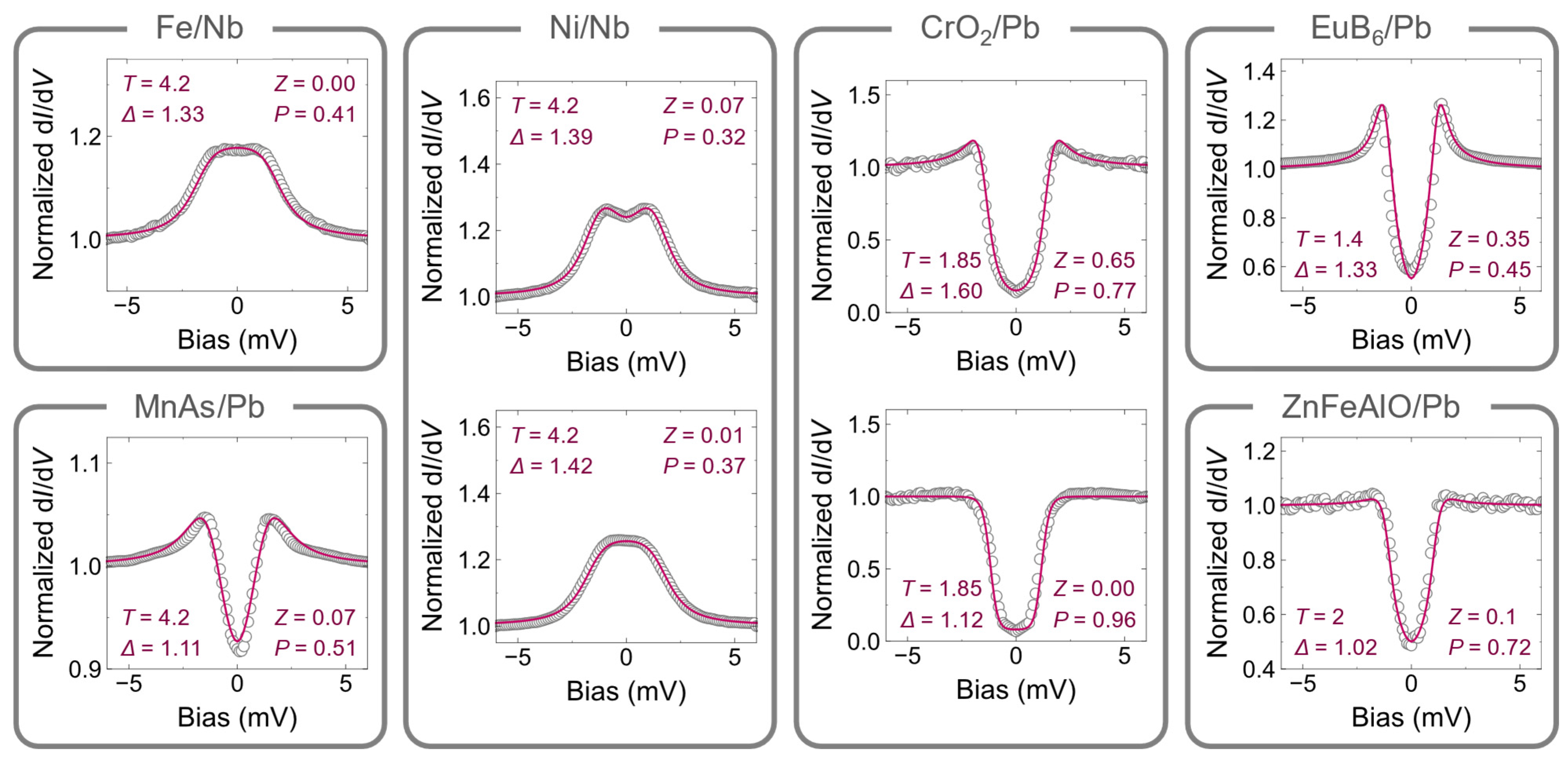
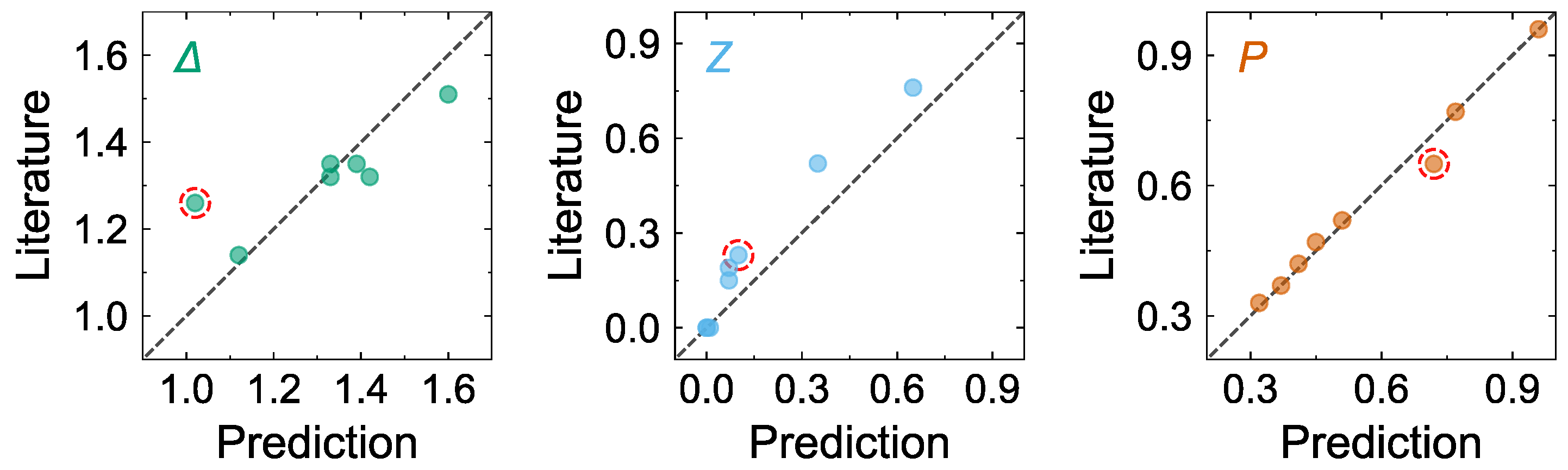
| Materials | Predictions | Literature | References |
|---|---|---|---|
| Fe/Nb | T = 4.2 K Δ = 1.33 meV Z = 0.00 P = 0.41 | T = 4.2 K Δ = 1.35 meV Z = 0 P = 0.42 | G. Strijkers et al. [31] |
| MnAs/Pb | T = 4.2 K Δ = 1.11 meV Z = 0.07 P = 0.51 | T = 4.2 K Z = 0.15 P = 0.52 | R. Panguluri et al. [32] |
| Ni/Nb | T = 4.2 K Δ = 1.39 meV Z = 0.07 P = 0.32 | T = 4.2 K Δ = 1.35 meV Z = 0.19 P = 0.33 | Y. Ji et al. [33] |
| Ni/Nb | T = 4.2 K Δ = 1.42 meV Z = 0.01 P = 0.37 | T = 4.2 K Δ = 1.32 meV Z = 0 P = 0.37 | Y. Ji et al. [33] |
| CrO2/Pb | T = 1.85 K Δ = 1.60 meV Z = 0.65 P = 0.77 | T = 1.85 K Δ = 1.51 meV Z = 0.76 P = 0.77 | Y. Ji et al. [33] |
| CrO2/Pb | T = 1.85 K Δ = 1.12 meV Z = 0.00 P = 0.96 | T = 1.85 K Δ = 1.14 meV Z = 0 P = 0.96 | Y. Ji et al. [33] |
| EuB6/Pb | T = 1.4 K Δ = 1.33 meV Z = 0.35 P = 0.45 | T = 4.2 K Δ = 1.32 meV Z = 0.52 P = 0.47 | X. Zhang et al. [34] |
| Zn0.95Fe0.05Al0.01O/Pb | T = 2 K Δ = 1.02 meV Z = 0.1 P = 0.72 | T = 2 K Δ = 1.26 meV Z = 0.23 P = 0.65 Γ = 0.39 | T. Xu et al. [35] |
4. Conclusions
Author Contributions
Funding
Institutional Review Board Statement
Informed Consent Statement
Data Availability Statement
Conflicts of Interest
Abbreviations
| P | Spin polarization |
| PCAR | Point contact Andreev reflection |
| ML | Machine learning |
| CNNs | Convolutional neural networks |
| BTK | Blonder-Tinkham-Klapwijk |
| T | Temperature |
| Δ | Superconducting gap |
| Z | Interfacial barrier strength |
| R2 | Coefficient of determination |
| Γ | Broadening term |
References
- Chen, T.Y.; Tesanovic, Z.; Liu, R.H.; Chen, X.H.; Chien, C.L. A BCS-like gap in the superconductor SmFeAsO0.85F0.15. Nature 2008, 453, 1224–1227. [Google Scholar] [CrossRef]
- Lee, S.; Stanev, V.; Zhang, X.; Stasak, D.; Flowers, J.; Higgins, J.S.; Dai, S.; Blum, T.; Pan, X.; Yakovenko, V.M.; et al. Perfect Andreev reflection due to the Klein paradox in a topological superconducting state. Nature 2019, 570, 344–348. [Google Scholar] [CrossRef]
- Tortello, M.; Daghero, D.; Ummarino, G.A.; Stepanov, V.A.; Jiang, J.; Weiss, J.D.; Hellstrom, E.E.; Gonnelli, R.S. Multigap Superconductivity and Strong Electron-Boson Coupling in Fe-Based Superconductors: A Point-Contact Andreev-Reflection Study of Ba(Fe1-xCox)2As2 Single Crystals. Phys. Rev. Lett. 2010, 105, 237002. [Google Scholar] [CrossRef]
- Zhang, X.; Butch, N.P.; Syers, P.; Ziemak, S.; Greene, R.L.; Paglione, J. Hybridization, Inter-Ion Correlation, and Surface States in the Kondo Insulator SmB6. Phys. Rev. X 2013, 3, 011011. [Google Scholar] [CrossRef]
- Zhu, W.; Hou, X.; Li, J.; Huang, Y.; Zhang, S.; He, J.; Chen, D.; Wang, Y.; Dong, Q.; Zhang, M.; et al. Interfacial Superconductivity on the Topological Semimetal Tungsten Carbide Induced by Metal Deposition. Adv. Mater. 2020, 32, 1907970. [Google Scholar] [CrossRef]
- Borisov, K.; Ehrler, J.; Fowley, C.; Eggert, B.; Wende, H.; Cornelius, S.; Potzger, K.; Lindner, J.; Fassbender, J.; Bali, R.; et al. Spin polarization and magnetotransport properties of systematically disordered Fe60Al40 thin films. Phys. Rev. B 2021, 104, 134417. [Google Scholar] [CrossRef]
- Chalsani, P.; Upadhyay, S.K.; Ozatay, O.; Buhrman, R.A. Andreev reflection measurements of spin polarization. Phys. Rev. B 2007, 75, 094417. [Google Scholar] [CrossRef]
- Coey, J.M.D.; Chien, C.L. Half-Metallic Ferromagnetic Oxides. MRS Bull. 2003, 28, 720–724. [Google Scholar] [CrossRef]
- Rana, D.; Bhakar, M.; G, B.; Bera, S.; Saini, N.; Pradhan, S.K.; Mondal, M.; Kabir, M.; Sheet, G. High transport spin polarization in the van der Waals ferromagnet Fe4GeTe2. Phys. Rev. B 2023, 107, 224422. [Google Scholar] [CrossRef]
- Sheet, G.; Rosner, H.; Wirth, S.; Leithe-Jasper, A.; Schnelle, W.; Burkhardt, U.; Mydosh, J.A.; Raychaudhuri, P.; Grin, Y. High spin polarization in the ferromagnetic filled skutterudites KFe4Sb12 and NaFe4Sb12. Phys. Rev. B 2005, 72, 180407. [Google Scholar] [CrossRef]
- Soulen, R.J.; Byers, J.M.; Osofsky, M.S.; Nadgorny, B.; Ambrose, T.; Cheng, S.F.; Broussard, P.R.; Tanaka, C.T.; Nowak, J.; Moodera, J.S.; et al. Measuring the Spin Polarization of a Metal with a Superconducting Point Contact. Science 1998, 282, 85–88. [Google Scholar] [CrossRef]
- Upadhyay, S.K.; Palanisami, A.; Louie, R.N.; Buhrman, R.A. Probing Ferromagnets with Andreev Reflection. Phys. Rev. Lett. 1998, 81, 3247–3250. [Google Scholar] [CrossRef]
- Varaprasad, B.S.D.C.S.; Srinivasan, A.; Takahashi, Y.K.; Hayashi, M.; Rajanikanth, A.; Hono, K. Spin polarization and Gilbert damping of Co2Fe(GaxGe1−x) Heusler alloys. Acta Mater. 2012, 60, 6257–6265. [Google Scholar] [CrossRef]
- Blonder, G.E.; Tinkham, M.; Klapwijk, T.M. Transition from metallic to tunneling regimes in superconducting microconstrictions: Excess current, charge imbalance, and supercurrent conversion. Phys. Rev. B 1982, 25, 4515–4532. [Google Scholar] [CrossRef]
- Chen, T.Y.; Tesanovic, Z.; Chien, C.L. Unified Formalism of Andreev Reflection at a Ferromagnet/Superconductor Interface. Phys. Rev. Lett. 2012, 109, 146602. [Google Scholar] [CrossRef]
- Mazin, I.I.; Golubov, A.A.; Nadgorny, B. Probing spin polarization with Andreev reflection: A theoretical basis. J. Appl. Phys. 2001, 89, 7576–7578. [Google Scholar] [CrossRef]
- Daghero, D.; Piatti, E.; Zhigadlo, N.D.; Gonnelli, R.S. A model for critical current effects in point-contact Andreev-reflection spectroscopy. Low Temp. Phys. 2023, 49, 886–892. [Google Scholar] [CrossRef]
- Sheet, G.; Mukhopadhyay, S.; Raychaudhuri, P. Role of critical current on the point-contact Andreev reflection spectra between a normal metal and a superconductor. Phys. Rev. B 2004, 69, 134507. [Google Scholar] [CrossRef]
- Weng, L.; Kizaki, T.; Ma, C.; Gao, W.; Kono, D. A review of robust thermal error reduction of machine tools. Int. J. Mach. Tools Manuf. 2025, 209, 104298. [Google Scholar] [CrossRef]
- Li, H.; Ma, J.; Wang, Y.; Zhang, C.; Wu, S.; Su, H. A Combinatorial Machine Learning Models -Based Method for Predicting the Viscosity-Temperature Relationship of Crude Oil. In Proceedings of the 2025 IEEE 7th International Conference on Communications, Information System and Computer Engineering (CISCE), Guangzhou, China, 9–11 May 2025; pp. 881–885. [Google Scholar] [CrossRef]
- Wang, D.; Jiao, D.; Zhang, Z.; Zhou, R.; Guo, W.; Su, H. Interpretable Combinatorial Machine Learning-Based Shale Fracability Evaluation Methods. Energies 2025, 18, 186. [Google Scholar] [CrossRef]
- Kang, M.; Kim, D.; Kim, J.; Kim, N.; Lee, S. Strategies to Enrich Electrochemical Sensing Data with Analytical Relevance for Machine Learning Applications: A Focused Review. Sensors 2024, 24, 3855. [Google Scholar] [CrossRef]
- Klukowski, P.; Riek, R.; Güntert, P. Machine learning in NMR spectroscopy. Prog. Nucl. Magn. Reson. Spectrosc. 2025, 148–149, 101575. [Google Scholar] [CrossRef] [PubMed]
- Lussier, F.; Thibault, V.; Charron, B.; Wallace, G.Q.; Masson, J.-F. Deep learning and artificial intelligence methods for Raman and surface-enhanced Raman scattering. TrAC Trends Anal. Chem. 2020, 124, 115796. [Google Scholar] [CrossRef]
- Lee, J.-W.; Park, W.B.; Lee, J.H.; Singh, S.P.; Sohn, K.-S. A deep-learning technique for phase identification in multiphase inorganic compounds using synthetic XRD powder patterns. Nat. Commun. 2020, 11, 86. [Google Scholar] [CrossRef]
- Li, Y.; Wu, Y.; Yu, H.; Takeuchi, I.; Jaramillo, R. Deep Learning for Rapid Analysis of Spectroscopic Ellipsometry Data. Adv. Photonics Res. 2021, 2, 2100147. [Google Scholar] [CrossRef]
- Pielsticker, L.; Nicholls, R.L.; DeBeer, S.; Greiner, M. Convolutional neural network framework for the automated analysis of transition metal X-ray photoelectron spectra. Anal. Chim. Acta 2023, 1271, 341433. [Google Scholar] [CrossRef]
- Szymanski, N.J.; Bartel, C.J.; Zeng, Y.; Diallo, M.; Kim, H.; Ceder, G. Adaptively driven X-ray diffraction guided by machine learning for autonomous phase identification. npj Comput. Mater. 2023, 9, 31. [Google Scholar] [CrossRef]
- Szymanski, N.J.; Fu, S.; Persson, E.; Ceder, G. Integrated analysis of X-ray diffraction patterns and pair distribution functions for machine-learned phase identification. npj Comput. Mater. 2024, 10, 45. [Google Scholar] [CrossRef]
- Lee, D.; Stanev, V.; Zhang, X.; Kang, M.; Takeuchi, I.; Lee, S. Rapid analysis of point-contact Andreev reflection spectra via machine learning with physics-guided data augmentation. Mater. Today Phys. 2025, 57, 101792. [Google Scholar] [CrossRef]
- Strijkers, G.J.; Ji, Y.; Yang, F.Y.; Chien, C.L.; Byers, J.M. Andreev reflections at metal/superconductor point contacts: Measurement and analysis. Phys. Rev. B 2001, 63, 104510. [Google Scholar] [CrossRef]
- Panguluri, R.P.; Tsoi, G.; Nadgorny, B.; Chun, S.H.; Samarth, N.; Mazin, I.I. Point contact spin spectroscopy of ferromagnetic MnAs epitaxial films. Phys. Rev. B 2003, 68, 201307. [Google Scholar] [CrossRef]
- Ji, Y.; Strijkers, G.J.; Yang, F.Y.; Chien, C.L.; Byers, J.M.; Anguelouch, A.; Xiao, G.; Gupta, A. Determination of the Spin Polarization of Half-Metallic CrO2 by Point Contact Andreev Reflection. Phys. Rev. Lett. 2001, 86, 5585–5588. [Google Scholar] [CrossRef]
- Zhang, X.; von Molnár, S.; Fisk, Z.; Xiong, P. Spin-Dependent Electronic States of the Ferromagnetic Semimetal EuB6. Phys. Rev. Lett. 2008, 100, 167001. [Google Scholar] [CrossRef] [PubMed]
- Xu, T.; Gao, X.; Zhang, J.; Shi, L.; Ju, L.; Sun, T.; Zhang, X.; Jia, S.; Yan, S. Emergent carrier spin polarization in (Fe, Al)-codoped ZnO thin films explored by Andreev Reflection spectroscopy. J. Alloys Compd. 2024, 980, 173602. [Google Scholar] [CrossRef]


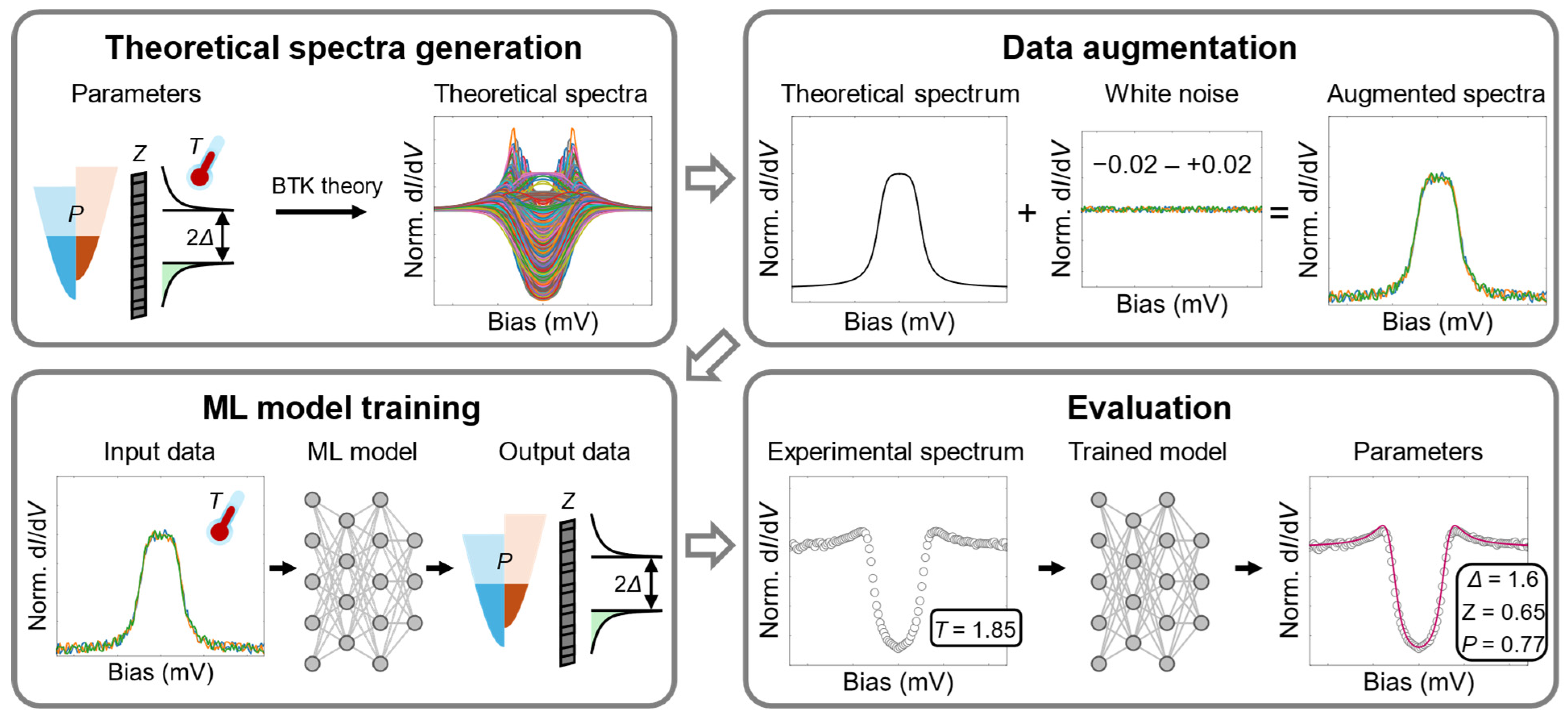


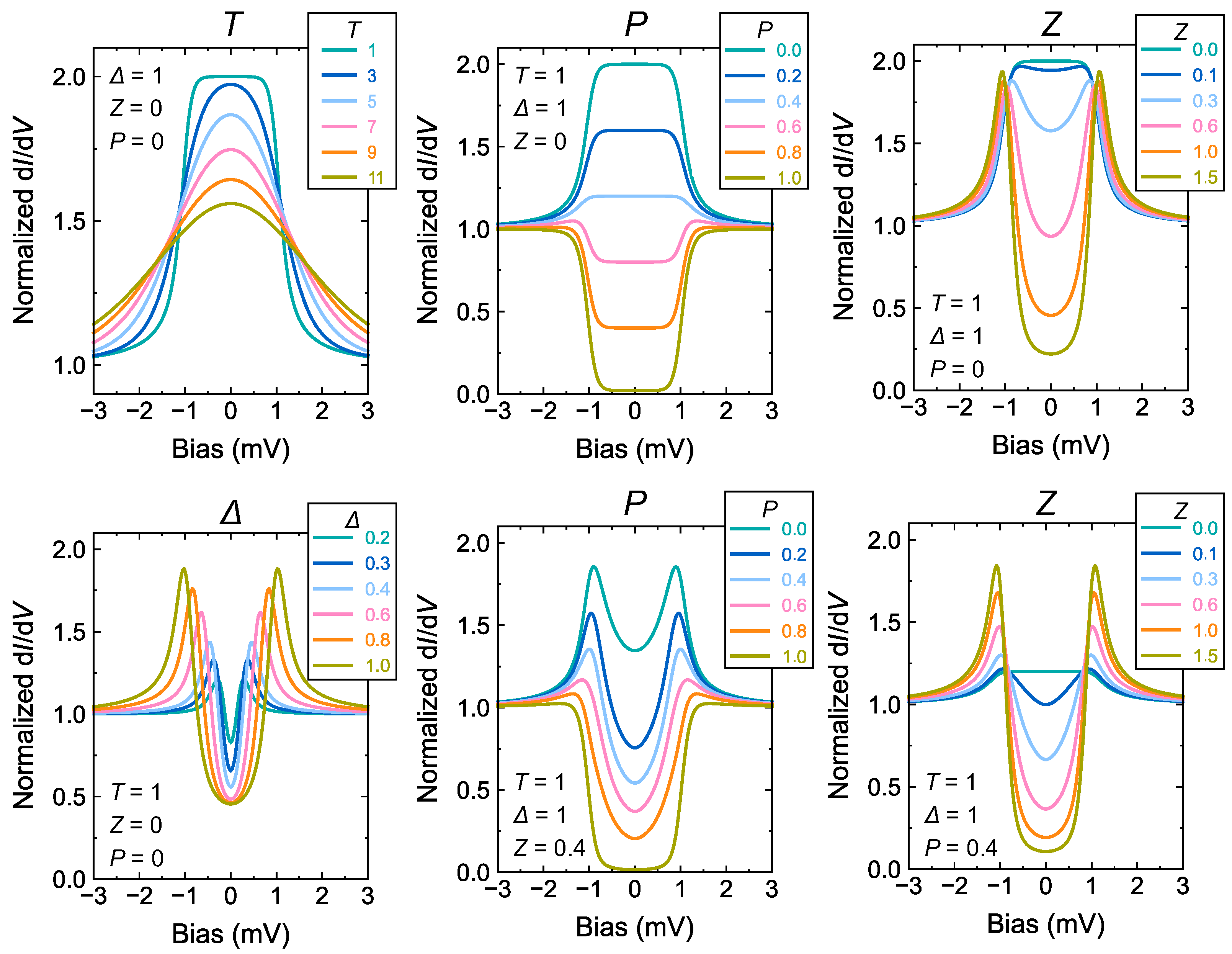
| Parameters | Range (Step) |
|---|---|
| Bias (mV) | 0–10 (per 1) |
| T (K) | 1.2–6.6 (per 0.6) |
| Δ (meV) | 0.6–1.6 (per 0.2) |
| Z | 0–1.1 (per 0.1) |
| P | 0.3–0.9 (per 0.05) |
| # of data | 9360 |
Disclaimer/Publisher’s Note: The statements, opinions and data contained in all publications are solely those of the individual author(s) and contributor(s) and not of MDPI and/or the editor(s). MDPI and/or the editor(s) disclaim responsibility for any injury to people or property resulting from any ideas, methods, instructions or products referred to in the content. |
© 2025 by the authors. Licensee MDPI, Basel, Switzerland. This article is an open access article distributed under the terms and conditions of the Creative Commons Attribution (CC BY) license (https://creativecommons.org/licenses/by/4.0/).
Share and Cite
Lee, D.; Lee, S. Measuring the Spin Polarization with a Superconducting Point Contact and Machine Learning. Appl. Sci. 2025, 15, 13257. https://doi.org/10.3390/app152413257
Lee D, Lee S. Measuring the Spin Polarization with a Superconducting Point Contact and Machine Learning. Applied Sciences. 2025; 15(24):13257. https://doi.org/10.3390/app152413257
Chicago/Turabian StyleLee, Dongik, and Seunghun Lee. 2025. "Measuring the Spin Polarization with a Superconducting Point Contact and Machine Learning" Applied Sciences 15, no. 24: 13257. https://doi.org/10.3390/app152413257
APA StyleLee, D., & Lee, S. (2025). Measuring the Spin Polarization with a Superconducting Point Contact and Machine Learning. Applied Sciences, 15(24), 13257. https://doi.org/10.3390/app152413257