Microstructural Insights into Strain Partitioning During Incipient Folding in Mechanically Layered Strata: Evidence from Deformation Bands in the Outer Carpathians, Poland

Abstract
1. Introduction
2. Geological Background
3. Materials and Methods
3.1. Field Observations and Structural Analysis
3.2. Microscopic Analysis
3.3. X-Ray Computed Microtomography (µCT)
4. Results
4.1. Structural Analysis
4.2. Microscopic Analysis
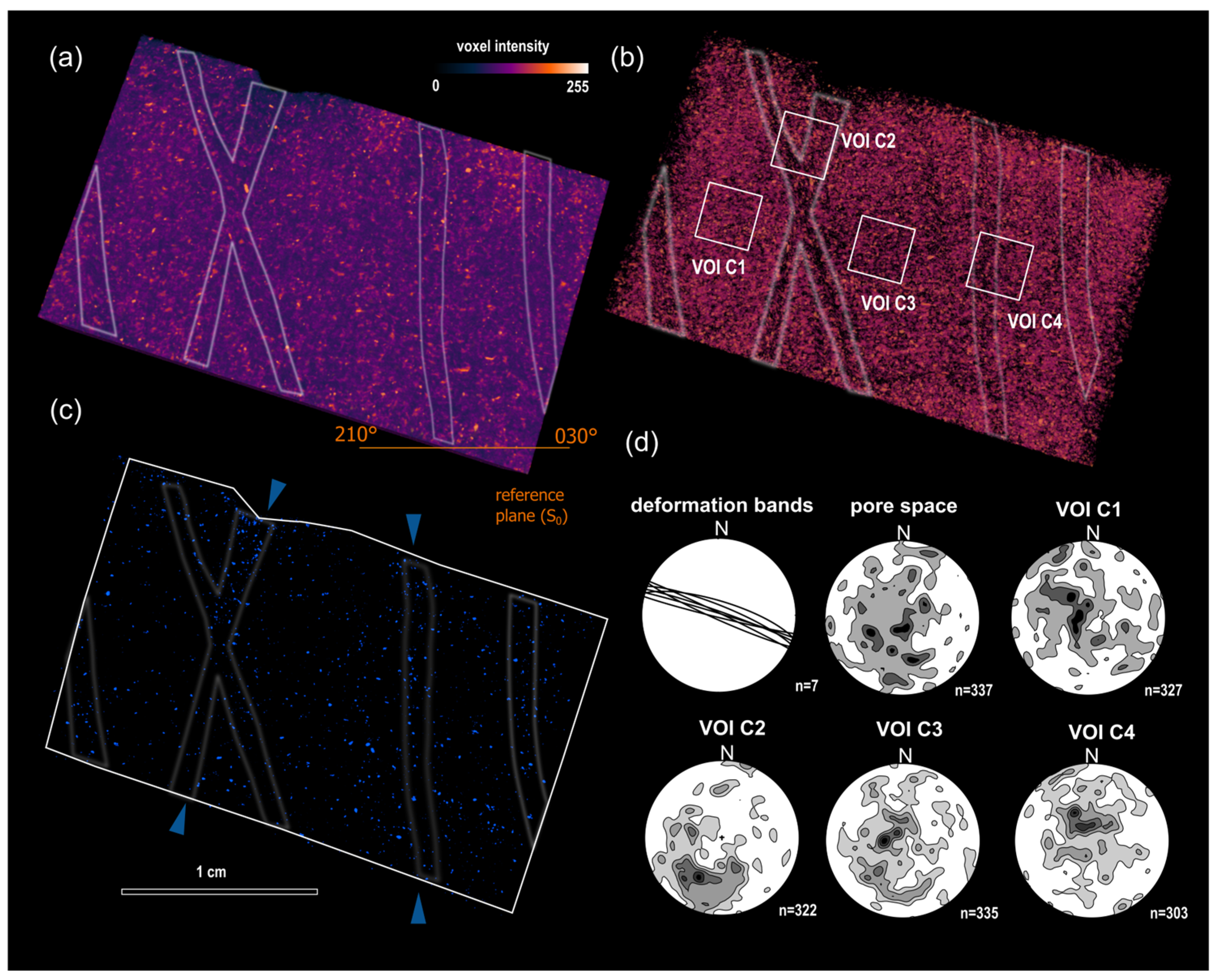
4.3. X-Ray Microtomography Assessment
5. Discussion
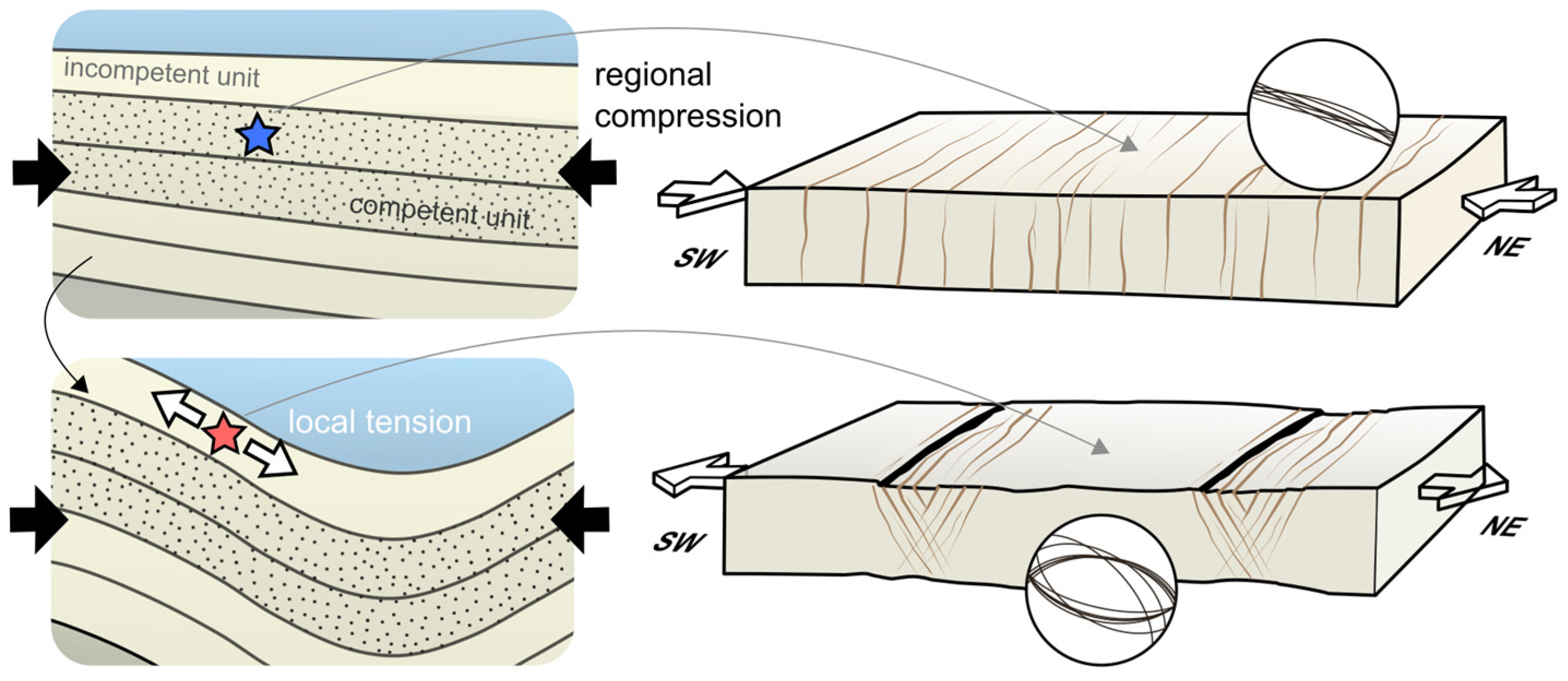
5.1. Strain Partitioning
5.2. Microstructure and Deformation Conditions
5.3. µCT Record and Implications
6. Conclusions
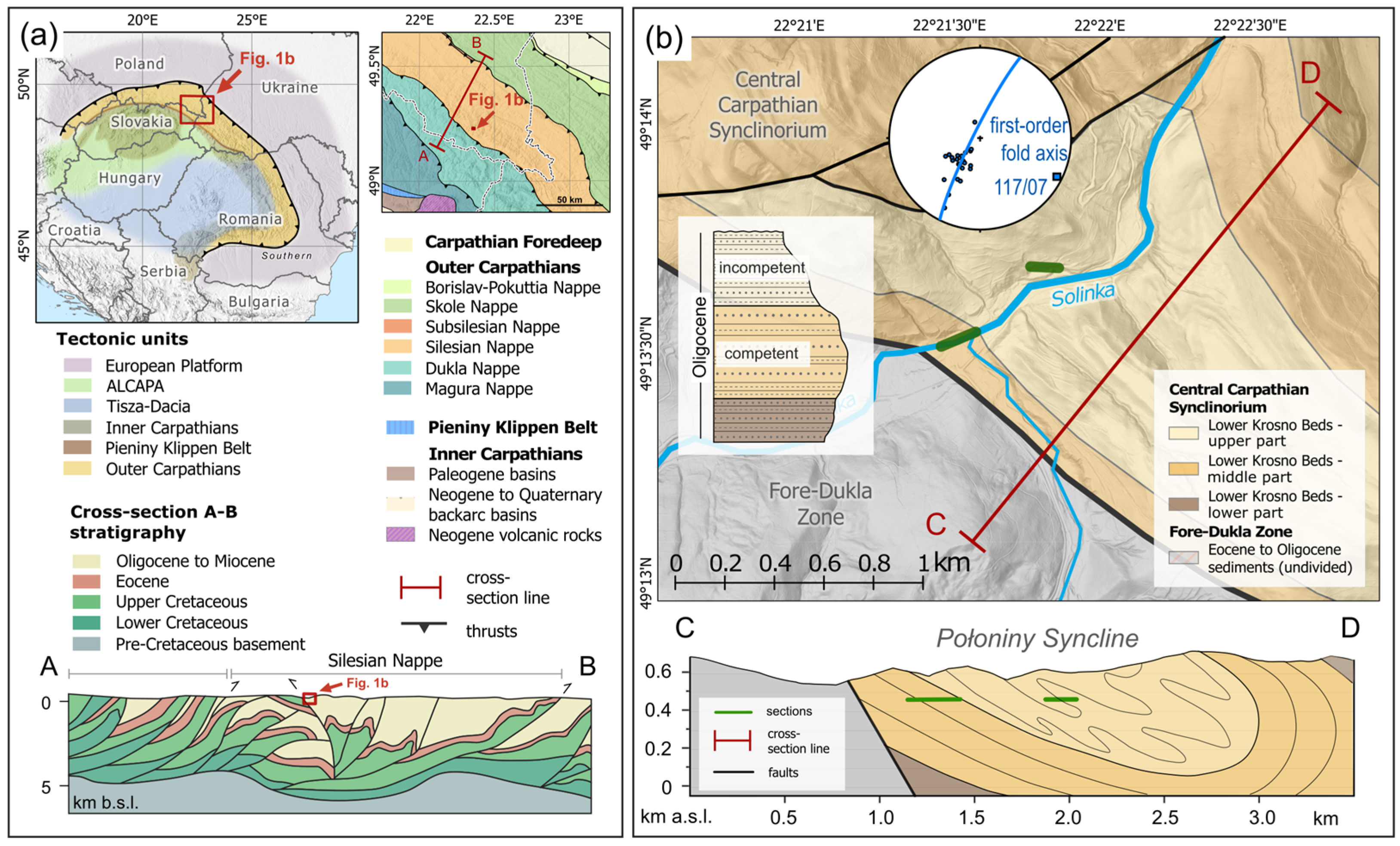
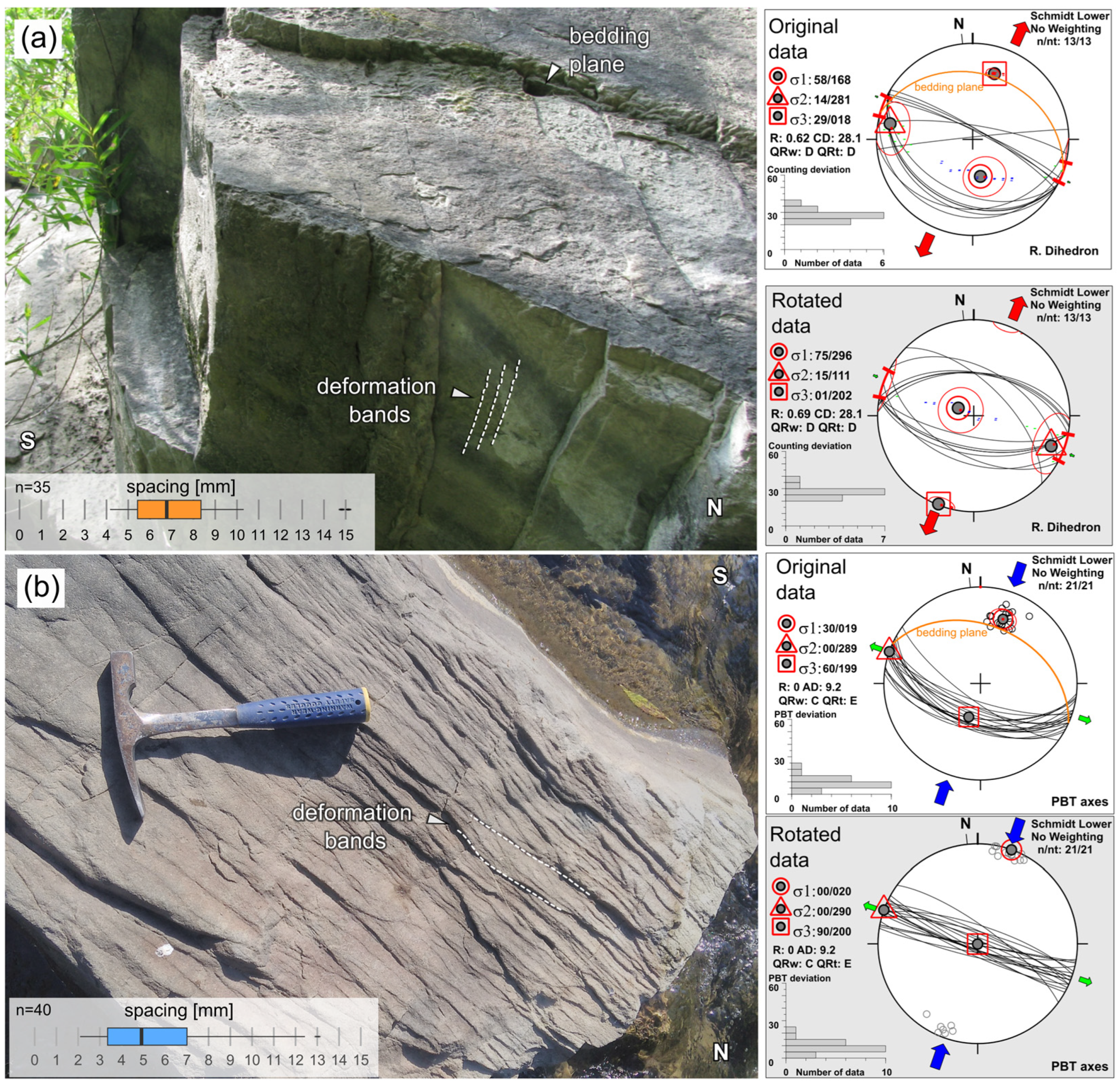
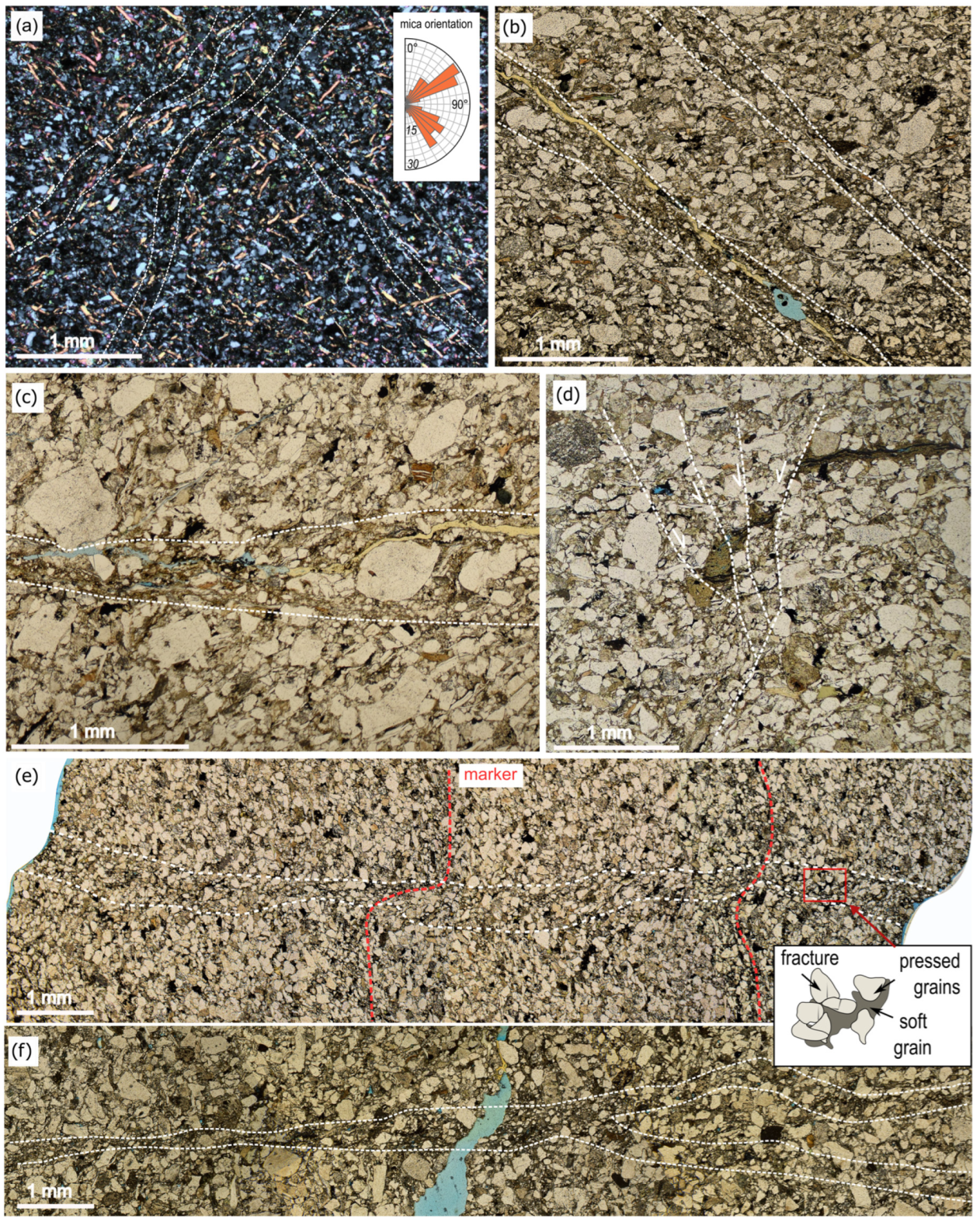
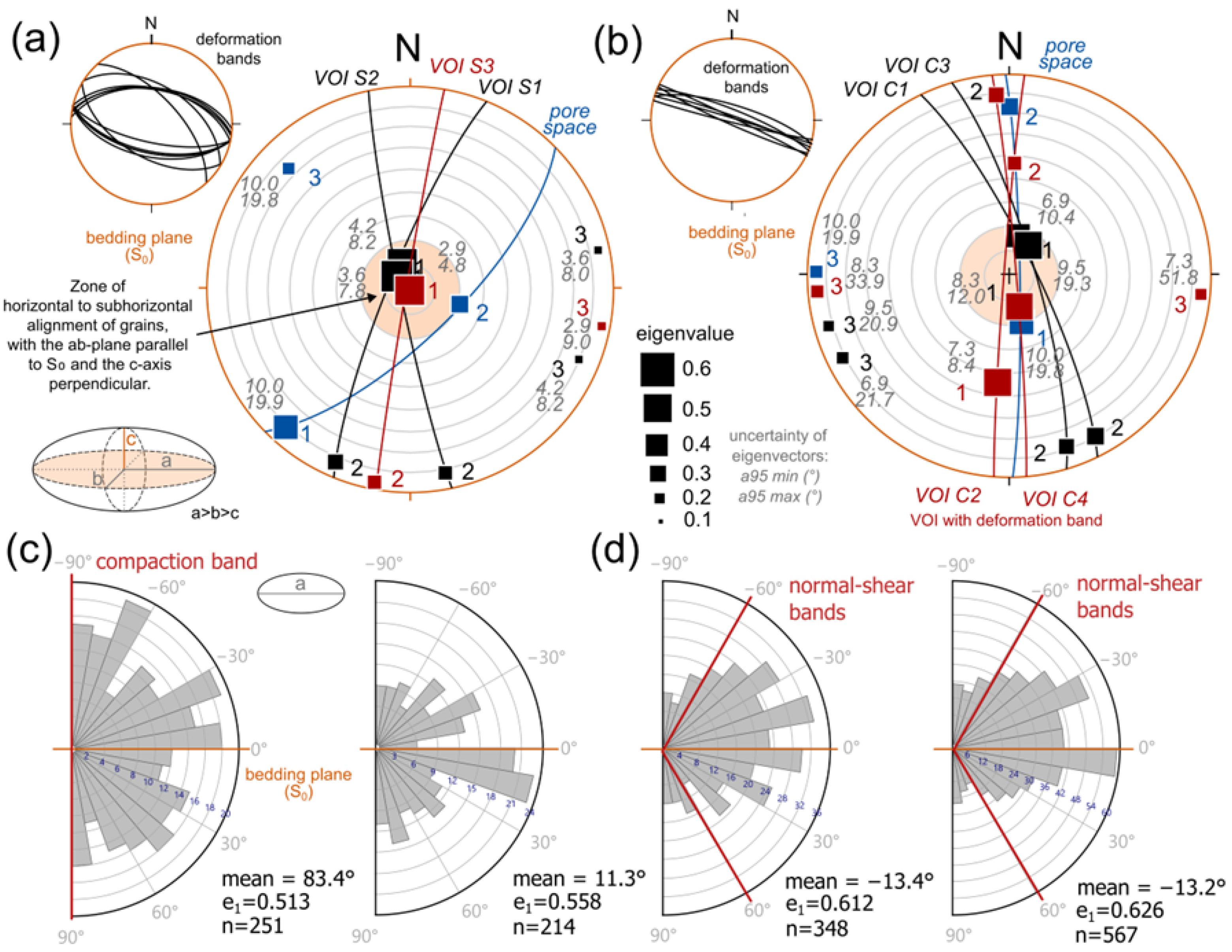
- This study documents two kinematically distinct types of deformation bands within the thick-bedded sandstones of the Lower Krosno Beds in the back limb of a first-order regional buckle fold. The normal-shear bands developed within the upper and less competent unit, and the compaction bands formed within the underlying, competent unit. The normal-shear bands accommodate localised, layer-parallel extension (NE–SW), whereas the compaction bands record more pervasive layer-parallel shortening (NE-SW). These structures document early strain partitioning during the onset of folding in the Silesian Nappe.
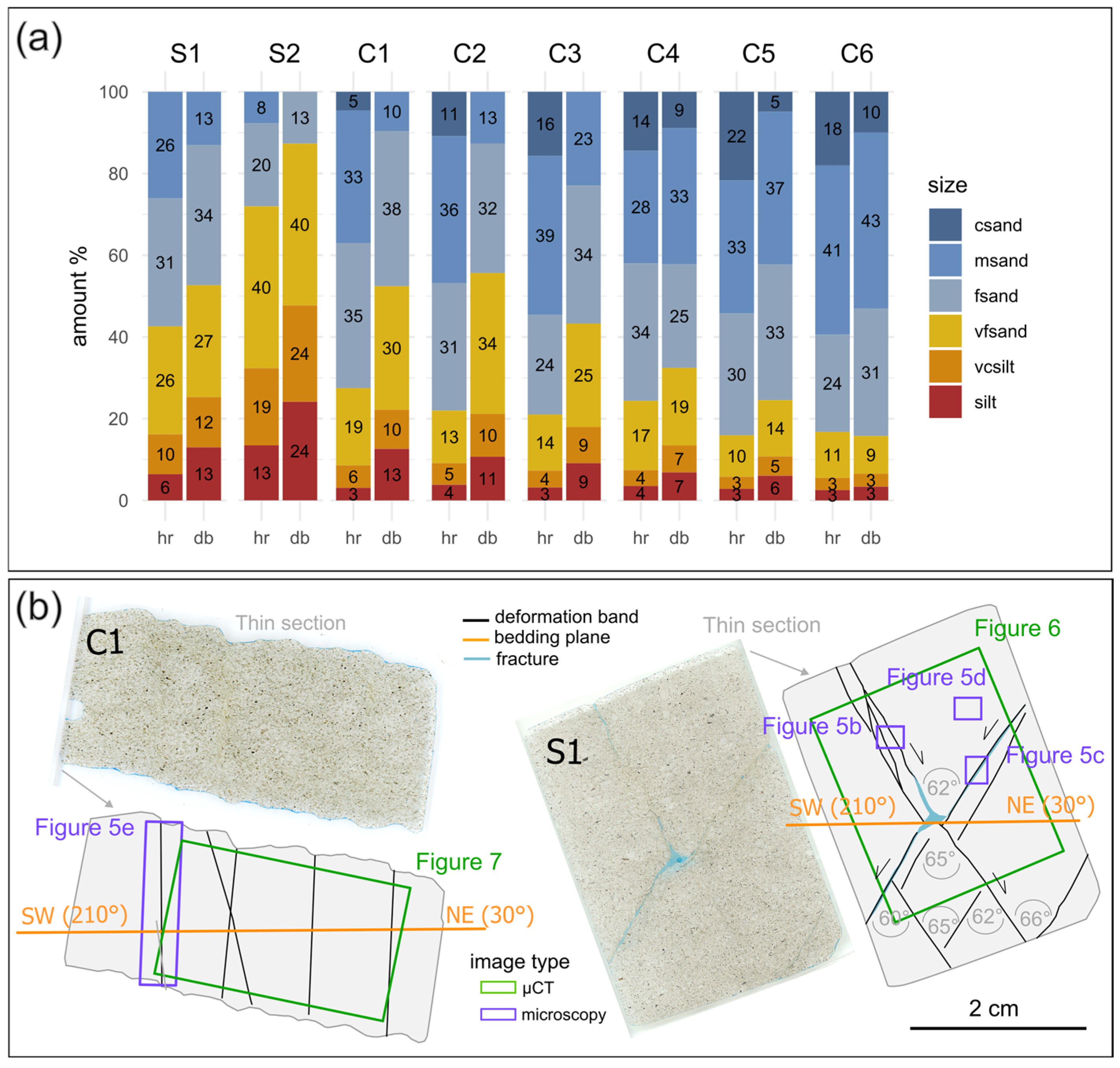
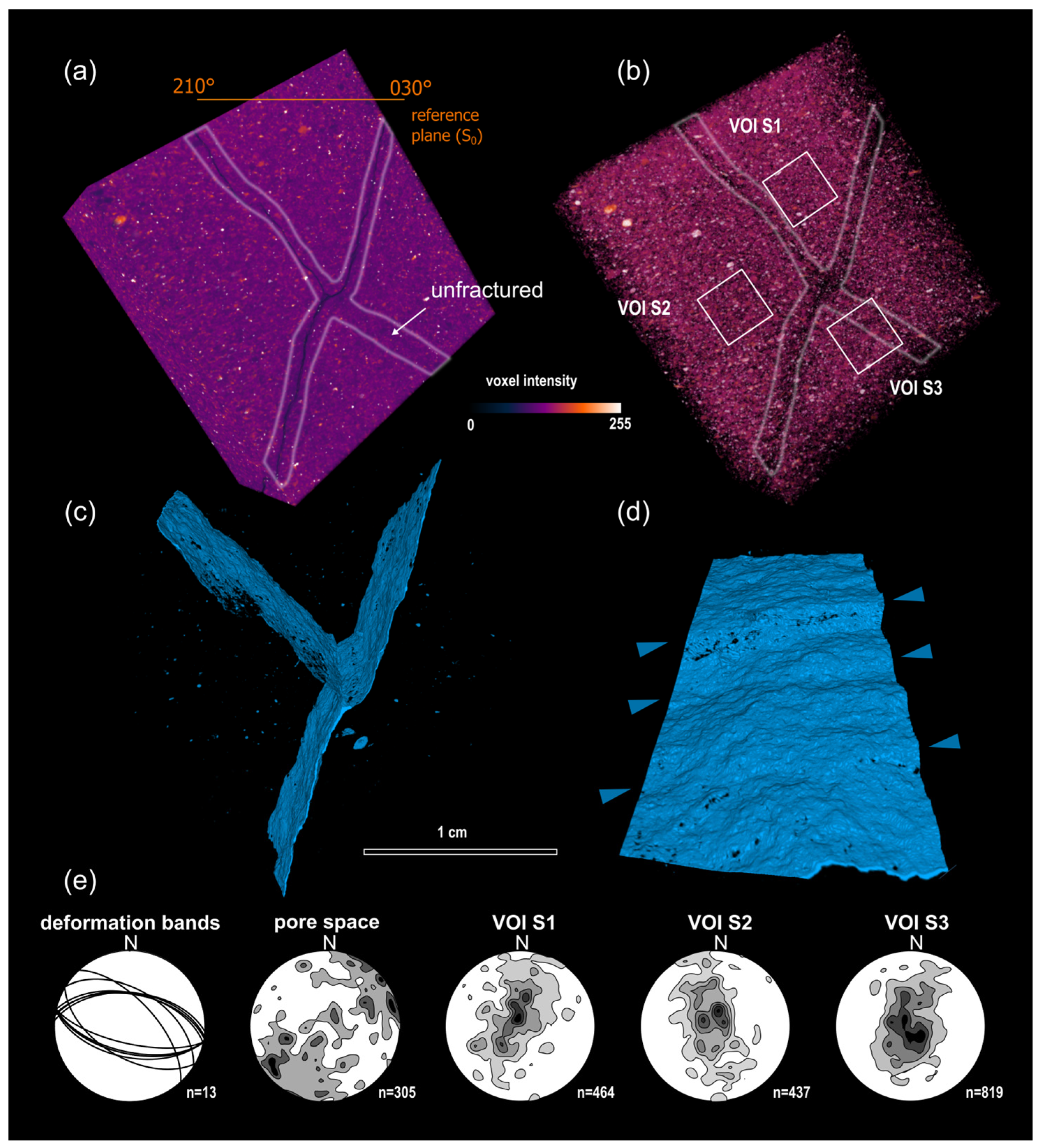
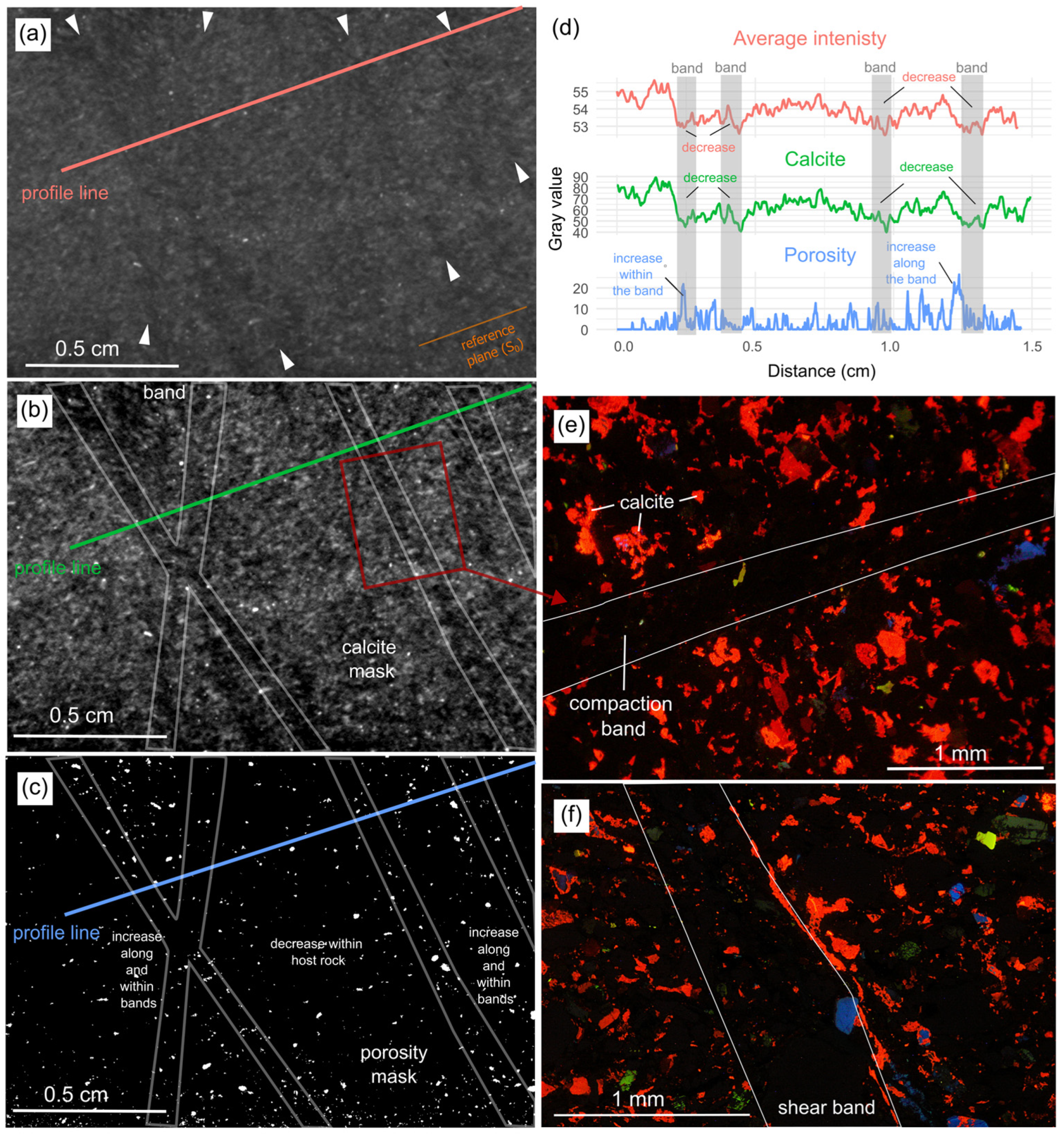
- Microstructural and µCT analyses reveal that the bands formed at shallow burial depths (<500 m) within poorly indurated sandstones, through grain disaggregation and cataclasis. The near absence of calcite cement and the presence of smaller, reoriented grains within the bands created a strong mechanical contrast that favoured their later reactivation as fractures. Notable porosity enhancement along and within the bands is observed.
- These findings demonstrate that deformation bands are sensitive indicators of early strain localisation in folds and highlight the role of mechanical layering in governing microscale deformation mechanisms. The 3D microscale analyses are consistent with field-scale observations, and the deformation mechanisms identified in outcrops are traceable at the grain scale. The study provides geological constraints that may be used in future burial modelling and diagenetic sequence reconstruction and underscores the value of combining X-ray microtomography with petrographic methods. Moreover, the 3D µCT-based fabric analysis offers a promising basis for future numerical quantification of microscale strains.
Funding
Institutional Review Board Statement
Informed Consent Statement
Data Availability Statement
Acknowledgments
Conflicts of Interest
References
- Ramsay, J.G. Folding and Fracturing of Rocks; McGraw-Hill: New York, NY, USA, 1967. [Google Scholar]
- Ferrill, D.A.; Smart, K.J.; Cawood, A.J.; Morris, A.P. The Fold-Thrust Belt Stress Cycle: Superposition of Normal, Strike-Slip, and Thrust Faulting Deformation Regimes. J. Struct. Geol. 2021, 148, 104362. [Google Scholar] [CrossRef]
- Liu, X.; Eckert, A.; Connolly, P. Stress Evolution during 3D Single-Layer Visco-Elastic Buckle Folding: Implications for the Initiation of Fractures. Tectonophysics 2016, 679, 140–155. [Google Scholar] [CrossRef]
- Świerczewska, A.; Tokarski, A.K. Deformation Bands and the History of Folding in the Magura Nappe, Western Outer Carpathians (Poland). Tectonophysics 1998, 297, 73–90. [Google Scholar] [CrossRef]
- Soliva, R.; Schultz, R.A.; Ballas, G.; Taboada, A.; Wibberley, C.; Saillet, E.; Benedicto, A. A Model of Strain Localization in Porous Sandstone as a Function of Tectonic Setting, Burial and Material Properties; New Insight from Provence (Southern France). J. Struct. Geol. 2013, 49, 50–63. [Google Scholar] [CrossRef]
- Gambino, S.; Fazio, E.; Maniscalco, R.; Punturo, R.; Lanzafame, G.; Barreca, G.; Butler, R.W.H. Fold-Related Deformation Bands in a Weakly Buried Sandstone Reservoir Analogue: A Multi-Disciplinary Case Study from the Numidian (Miocene) of Sicily (Italy). J. Struct. Geol. 2019, 118, 150–164. [Google Scholar] [CrossRef]
- Aydin, A. Small Faults Formed as Deformation Bands in Sandstone. Pure Appl. Geophys. 1978, 116, 913–930. [Google Scholar] [CrossRef]
- Schultz, R.A. Deformation Bands. In Geologic Fracture Mechanics; Cambridge University Press: Cambridge, UK, 2019; pp. 265–331. [Google Scholar]
- Soliva, R.; Ballas, G.; Fossen, H.; Philit, S. Tectonic Regime Controls Clustering of Deformation Bands in Porous Sandstone. Geology 2016, 44, 423–426. [Google Scholar] [CrossRef]
- Fossen, H.; Schultz, R.A.; Shipton, Z.K.; Mair, K. Deformation Bands in Sandstone: A Review. J. Geol. Soc. 2007, 164, 755–769. [Google Scholar] [CrossRef]
- Fossen, H.; Soliva, R.; Ballas, G.; Trzaskos, B.; Cavalcante, C.; Schultz, R.A. A Review of Deformation Bands in Reservoir Sandstones: Geometries, Mechanisms and Distribution. Geol. Soc. Lond. Spec. Publ. 2018, 459, 9–33. [Google Scholar] [CrossRef]
- Brandes, C.; Tanner, D.C.; Fossen, H.; Halisch, M.; Müller, K. Disaggregation Bands as an Indicator for Slow Creep Activity on Blind Faults. Commun. Earth Environ. 2022, 3, 99. [Google Scholar] [CrossRef]
- Beke, B.; Fodor, L.; Millar, L.; Petrik, A. Deformation Band Formation as a Function of Progressive Burial: Depth Calibration and Mechanism Change in the Pannonian Basin (Hungary). Mar. Pet. Geol. 2019, 105, 1–16. [Google Scholar] [CrossRef]
- Beke, B.; Szőcs, E.; Hips, K.; Schubert, F.; Petrik, A.; Milovský, R.; Fodor, L. Evolution of Deformation Mechanism and Fluid Flow in Two Pre-Rift Siliciclastic Deposits (Pannonian Basin, Hungary). Glob. Planet. Change 2021, 199, 103434. [Google Scholar] [CrossRef]
- Aydin, A.; Borja, R.I.; Eichhubl, P. Geological and Mathematical Framework for Failure Modes in Granular Rock. J. Struct. Geol. 2006, 28, 83–98. [Google Scholar] [CrossRef]
- Strzelecki, P.J.; Świerczewska, A. Wpływ Więźby Skały Na Mechanizm Deformacji: Studium Przypadku Wstęg Deformacyjnych w Piaskowcach Otryckich (Bieszczady). Przegląd Geol. 2023, 71, 231–234. [Google Scholar] [CrossRef]
- Ballas, G.; Soliva, R.; Sizun, J.P.; Fossen, H.; Benedicto, A.; Skurtveit, E. Shear-Enhanced Compaction Bands Formed at Shallow Burial Conditions; Implications for Fluid Flow (Provence, France). J. Struct. Geol. 2013, 47, 3–15. [Google Scholar] [CrossRef]
- Liu, Z.; Sun, Y. Characteristics and Formation Process of Contractional Deformation Bands in Oil-Bearing Sandstones in the Hinge of a Fold: A Case Study of the Youshashan Anticline, Western Qaidam Basin, China. J. Pet. Sci. Eng. 2020, 189, 106994. [Google Scholar] [CrossRef]
- Ujiie, K.; Maltman, A.J.; Sánchez-Gómez, M. Origin of Deformation Bands in Argillaceous Sediments at the Toe of the Nankai Accretionary Prism, Southwest Japan. J. Struct. Geol. 2004, 26, 221–231. [Google Scholar] [CrossRef]
- Michiguchi, Y.; Ogawa, Y. Dark Bands in the Submarine Nankai Accretionary Prism—Comparisons with Miocene–Pliocene Onshore Examples from Boso Peninsula. In Accretionary Prisms and Convergent Margin Tectonics in the Northwest Pacific Basin. Modern Approaches in Solid Earth Sciences; Ogawa, Y., Anma, R., Dilek, Y., Eds.; Springer: Dordrecht, The Netherlands, 2011; pp. 229–246. [Google Scholar]
- Alkhasli, S.; Zeynalov, G.; Shahtakhtinskiy, A. Quantifying Occurrence of Deformation Bands in Sandstone as a Function of Structural and Petrophysical Factors and Their Impact on Reservoir Quality: An Example from Outcrop Analog of Productive Series (Pliocene), South Caspian Basin. J. Pet. Explor. Prod. Technol. 2022, 12, 1977–1995. [Google Scholar] [CrossRef]
- Kaji, H.; Takeshita, T. Development of Deformation Bands and Deformation Induced Weathering in a Forearc Coal-Bearing Paleogene Fold Belt, Northern Japan. Appl. Sci. 2022, 12, 8348. [Google Scholar] [CrossRef]
- Zuluaga, L.F.; Fossen, H.; Rotevatn, A. Progressive Evolution of Deformation Band Populations during Laramide Fault-Propagation Folding: Navajo Sandstone, San Rafael Monocline, Utah, U.S.A. J. Struct. Geol. 2014, 68, 66–81. [Google Scholar] [CrossRef]
- Robert, R.; Robion, P.; Souloumiac, P.; David, C.; Saillet, E. Deformation Bands, Early Markers of Tectonic Activity in Front of a Fold-and-Thrust Belt: Example from the Tremp-Graus Basin, Southern Pyrenees, Spain. J. Struct. Geol. 2018, 110, 65–85. [Google Scholar] [CrossRef]
- Solecki, M.L. Deformation Bands-Migration Pathways or Barriers for Hydrocarbons in Sedimentary Rocks-Mini Review. J. Geotechnol. Energy 2023, 40, 15–21. [Google Scholar]
- Aleksandrowski, P. Step-like Tectonic Lineation in the Magura Flysch (Western Outer Carpathians). Ann. Soc. Geol. Pol. 1980, 50, 329–339. [Google Scholar]
- Poprawa, P.; Malata, T. Model Późnojurajsko-Wczesnomioceńskiej Ewolucji Tektonicznej Karpat Zewnętrznych. Przegląd Geol. 2006, 54, 1066–1080. [Google Scholar]
- Tomek, C.; Hall, J. Subducted Continental Margin Imaged in the Carpathians of Czechoslovakia. Geology 1993, 21, 535–538. [Google Scholar] [CrossRef]
- Fodor, L.; Csontos, L.; Bada, G.; Gyorfi, I.; Benkovics, L. Tertiary Tectonic Evolution of the Pannonian Basin System and Neighbouring Orogens: A New Synthesis of Palaeostress Data. Geol. Soc. Lond. Spec. Publ. 1999, 156, 295–334. [Google Scholar] [CrossRef]
- Sperner, B.; Ratschbacher, L.; Nemčok, M. Interplay between Subduction Retreat and Lateral Extrusion: Tectonics of the Western Carpathians. Tectonics 2002, 21, 1–1-1–24. [Google Scholar] [CrossRef]
- Schmid, S.M.; Bernoulli, D.; Fügenschuh, B.; Matenco, L.; Schefer, S.; Schuster, R.; Tischler, M.; Ustaszewski, K. The Alpine-Carpathian-Dinaridic Orogenic System: Correlation and Evolution of Tectonic Units. Swiss J. Geosci. 2008, 101, 139–183. [Google Scholar] [CrossRef]
- Golonka, J.; Krobicki, M.; Oszczypko, N.; Ślaczka, A.; Słomka, T. Geodynamic Evolution and Palaeogeography of the Polish Carpathians and Adjacent Areas during Neo-Cimmerian and Preceding Events (Latest Triassic-Earliest Cretaceous). Geol. Soc. Spec. Publ. 2003, 208, 138–158. [Google Scholar] [CrossRef]
- Golonka, J.; Waśkowska, A.; Ślączka, A. The Western Outer Carpathians: Origin and Evolution. Z. Dtsch. Ges. Geowiss. 2019, 170, 229–254. [Google Scholar] [CrossRef]
- Książkiewicz, M. The Tectonics of the Carpathians. In Geology of Poland, IV, Tectonics; Pożarski, W., Ed.; Wydawnictwo Geologiczne: Warsaw, Poland, 1977. [Google Scholar]
- Oszczypko, N.; Ślączka, A.; Żytko, K. Regionalizacja Tektoniczna Polski—Karpaty Zewnętrzne i Zapadlisko Przedkarpackie. Przegląd Geol. 2008, 56, 927–935. [Google Scholar]
- Oszczypko, N. Late Jurassic-Miocene Evolution of the Outer Carpathian Fold-and-Thrust Belt and Its Foredeep Basin (Western Carpathians, Poland). Geol. Q. 2006, 50, 169–194. [Google Scholar]
- Jankowski, L.; Kopciowski, R.; Wojciech, R. Geological Map of the Outer Carpathians: Borderland of Ukraine and Romania 1:200,000; Polish Geological Institute: Warsaw, Poland, 2007.
- Roure, F.; Sassi, W. Kinematics of Deformation and Petroleum System Appraisal in Neogene Foreland Fold-and-Thrust Belts. Pet. Geosci. 1995, 1, 253–269. [Google Scholar] [CrossRef]
- Ślączka, A.; Żytko, K. Geological Map of Poland 1:200,000 (Map of Surface Deposits), Łupków Sheet; Wydawnictwo Geologiczne: Warsaw, Poland, 1978.
- Kuśmierek, J. Deformacje Grawitacyjne, Nasunięcia Wsteczne a Budowa Wgłębna i Perspektywy Naftowe Przedpola Jednostki Dukielskiej w Bieszczadach. Pr. Geol. PAN 1979, 113, 1–68. [Google Scholar]
- Opolski, Z. O Stratygrafii Warstw Krośnieńskich. Spraw. Państwowego Inst. Geol. 1933, 7, 565–636. [Google Scholar]
- Bąk, K. Foraminiferal Biostratigraphy of the Egerian Flysch Sediments in the Silesian Nappe, Outer Carpathians, Polish Part of the Bieszczady Mountains. Ann. Soc. Geol. Pol. 2005, 75, 71–93. [Google Scholar]
- Ślączka, A. Explanations to the Geological Map of Poland 1:200,000; Łupków Sheet; Wydawnictwo Geologiczne: Warsaw, Poland, 1980.
- Sikora, W. Uwagi o Stratygrafii i Paleogeografii Warstw Krośnieńskich Na Przedpolu Otrytu Między Szewczenkiem a Polaną. Kwart. Geol. 1959, 3, 569–582. [Google Scholar]
- Koszarski, L.; Ślączka, A.; Żytko, K. Stratygrafia i Paleogeografia Jednostki Dukielskiej w Bieszczadach. Kwart. Geol. 1961, 5, 551–578. [Google Scholar]
- Haczewski, G.; Kukulak, J.; Bąk, K. Budowa Geologiczna i Rzeźba Bieszczadzkiego Parku Narodowego; Wydawnictwo Naukowe Uniwersytetu Pedagogicznego: Krakow, Poland, 2007. [Google Scholar]
- Delvaux, D.; Sperner, B. New Aspects of Tectonic Stress Inversion with Reference to the TENSOR Program. Geol. Soc. Spec. Publ. 2003, 212, 75–100. [Google Scholar] [CrossRef]
- Angelier, J.; Mechler, P. Sur Une Methode Graphique de Recherche Des Contraintes Principales Egalement Utilisables En Tectonique et En Seismologie: La Methode Des Diedres Droits. Bull. Société Géologique Fr. 1977, 7, 1309–1318. [Google Scholar] [CrossRef]
- Sperner, B.; Ratschbacher, L.; Ott, R. Fault-Striae Analysis: A Turbo Pascal Program Package for Graphical Presentation and Reduced Stress Tensor Calculation. Comput. Geosci. 1993, 19, 1361–1388. [Google Scholar] [CrossRef]
- Folk, R.L.; Ward, W.C. Brazos River Bar: A Study in the Significance of Grain Size Parameters. J. Sediment. Res. 1957, 27, 3–26. [Google Scholar] [CrossRef]
- Mees, F.; Swennen, R.; Van Geet, M.; Jacobs, P. Applications of X-Ray Computed Tomography in the Geosciences. Geol. Soc. Lond. Spec. Publ. 2003, 215, 1–6. [Google Scholar] [CrossRef]
- Feldkamp, L.A.; Davis, L.C.; Kress, J.W. Practical Cone-Beam Algorithm. J. Opt. Soc. Am. A 1984, 1, 612. [Google Scholar] [CrossRef]
- Guntoro, P.; Ghorbani, Y.; Koch, P.-H.; Rosenkranz, J. X-Ray Microcomputed Tomography (ΜCT) for Mineral Characterization: A Review of Data Analysis Methods. Minerals 2019, 9, 183. [Google Scholar] [CrossRef]
- Schindelin, J.; Arganda-Carreras, I.; Frise, E.; Kaynig, V.; Longair, M.; Pietzsch, T.; Preibisch, S.; Rueden, C.; Saalfeld, S.; Schmid, B.; et al. Fiji: An Open-Source Platform for Biological-Image Analysis. Nat. Methods 2012, 9, 676–682. [Google Scholar] [CrossRef] [PubMed]
- Peng, T.; Thorn, K.; Schroeder, T.; Wang, L.; Theis, F.J.; Marr, C.; Navab, N. A BaSiC Tool for Background and Shading Correction of Optical Microscopy Images. Nat. Commun. 2017, 8, 14836. [Google Scholar] [CrossRef]
- Tokarski, A.K. Geologia i Geomorfologia Okolic Ustrzyk Górnych (Polskie Karpaty Wschodnie). Stud. Geol. Pol. 1975, 48, 1–90. [Google Scholar]
- Rubinkiewicz, J. Fold-Thrust-Belt Geometry and Detailed Structural Evolution of the Silesian Nappe—Eastern Part of the Polish Outer Carpathians (Bieszczady Mts.). Acta Geol. Pol. 2007, 57, 479–508. [Google Scholar]
- Biot, M.A. Theory of Folding of Stratified Viscoelastic Media and Its Implications in Tectonics and Orogenesis. Bull. Geol. Soc. Am. 1961, 72, 1595–1620. [Google Scholar] [CrossRef]
- Hudleston, P.J.; Treagus, S.H. Information from Folds: A Review. J. Struct. Geol. 2010, 32, 2042–2071. [Google Scholar] [CrossRef]
- Nabavi, S.T.; Fossen, H. Fold Geometry and Folding—A Review. Earth Sci. Rev. 2021, 222, 103812. [Google Scholar] [CrossRef]
- Nicol, A.; Childs, C.; Walsh, J.J.; Schafer, K.W. A Geometric Model for the Formation of Deformation Band Clusters. J. Struct. Geol. 2013, 55, 21–33. [Google Scholar] [CrossRef]
- Louis, L.; Wong, T.F.; Baud, P.; Tembe, S. Imaging Strain Localization by X-Ray Computed Tomography: Discrete Compaction Bands in Diemelstadt Sandstone. J. Struct. Geol. 2006, 28, 762–775. [Google Scholar] [CrossRef]
- Wong, T.F.; Baud, P. Grain Crushing, Pore Collapse and Strain Localization in Porous Sandstone. In Mechanics of Natural Solids; Kolymbas, D., Viggiani, G., Eds.; Springer: Berlin/Heidelberg, Germany, 2009; pp. 239–254. [Google Scholar] [CrossRef]
- Wang, B.; Chen, Y.; Wong, T.F. A Discrete Element Model for the Development of Compaction Localization in Granular Rock. J. Geophys. Res. Solid Earth 2008, 113, 1–17. [Google Scholar] [CrossRef]
- Eichhubl, P.; Hooker, J.N.; Laubach, S.E. Pure and Shear-Enhanced Compaction Bands in Aztec Sandstone. J. Struct. Geol. 2010, 32, 1873–1886. [Google Scholar] [CrossRef]
- Mollema, P.N.; Antonellini, M.A. Compaction Bands: A Structural Analog for Anti-Mode I Cracks in Aeolian Sandstone. Tectonophysics 1996, 267, 209–228. [Google Scholar] [CrossRef]
- Schultz, R.A. Scaling and Paleodepth of Compaction Bands, Nevada and Utah. J. Geophys. Res. Solid Earth 2009, 114, B03407. [Google Scholar] [CrossRef]
- Robert, R.; Souloumiac, P.; Robion, P.; David, C. Numerical Simulation of Deformation Band Occurrence and the Associated Stress Field during the Growth of a Fault-Propagation Fold. Geosciences 2019, 9, 257. [Google Scholar] [CrossRef]
- Strzelecki, P.J.; Świerczewska, A.; Kopczewska, K.; Fheed, A.; Tarasiuk, J.; Wroński, S. Decoding Rocks: An Assessment of Geomaterial Microstructure Using X-Ray Microtomography, Image Analysis and Multivariate Statistics. Materials 2021, 14, 3266. [Google Scholar] [CrossRef]
- Bam, L.C.; Miller, J.A.; Becker, M. A Mineral X-Ray Linear Attenuation Coefficient Tool (MXLAC) to Assess Mineralogical Differentiation for X-Ray Computed Tomography Scanning. Minerals 2020, 10, 441. [Google Scholar] [CrossRef]
- Louis, L.; Baud, P.; Wong, T.F. Microstructural Inhomogeneity and Mechanical Anisotropy Associated with Bedding in Rothbach Sandstone. Pure Appl. Geophys. 2009, 166, 1063–1087. [Google Scholar] [CrossRef]
- Baud, P.; Schubnel, A.; Heap, M.; Rolland, A. Inelastic Compaction in High-Porosity Limestone Monitored Using Acoustic Emissions. J. Geophys. Res. Solid Earth 2017, 122, 9989–10008. [Google Scholar] [CrossRef]
- Wennberg, O.P.; Rennan, L. A Brief Introduction to the Use of X-Ray Computed Tomography (CT) for Analysis of Natural Deformation Structures in Reservoir Rocks. In Geological Society Special Publication; Geological Society of London: London, UK, 2018; Volume 459, pp. 101–120. [Google Scholar]
- Wang, G.; Zhang, X.; Liu, X.; Gao, H.; Pan, Y. Stabilization of Micaceous Residual Soil with Industrial and Agricultural Byproducts: Perspectives from Hydrophobicity, Water Stability, and Durability Enhancement. Constr. Build. Mater. 2024, 430, 136450. [Google Scholar] [CrossRef]
- Wang, G.; Zhang, X.; Liu, X.; Gao, H.; An, R.; Yan, L. Engineering Geological Characterization of Micaceous Residual Soils Considering Effects of Mica Content and Particle Breakage. Eng. Geol. 2023, 327, 107367. [Google Scholar] [CrossRef]
- de Lima Rodrigues, M.C.N.; Trzaskos, B.; Lopes, A.P. Influence of Deformation Bands on Sandstone Porosity: A Case Study Using Three-Dimensional Microtomography. J. Struct. Geol. 2015, 72, 96–110. [Google Scholar] [CrossRef]
- Strzelecki, P.J.; Radzik, N.; Tarasiuk, J.; Wroński, S. Spatial Orientation and Shape of Pores in a Sandstone: A Case Study from the Outer Carpathians Based on X-Ray Computed Microtomography. SGEM Conf. Proc. 2018, 18, 795–802. [Google Scholar] [CrossRef]
- Machowski, G.; Kuśmierek, J. Influence of Fracturing on Oil- and Gas-Productivity of Microporous Flysch Sandstones. Geologia 2008, 34, 385–403. [Google Scholar]
- Ballas, G.; Fossen, H.; Soliva, R. Factors Controlling Permeability of Cataclastic Deformation Bands and Faults in Porous Sandstone Reservoirs. J. Struct. Geol. 2015, 76, 1–21. [Google Scholar] [CrossRef]
- Davis, J.M.; Roy, N.D.; Mozley, P.S.; Hall, J.S. The Effect of Carbonate Cementation on Permeability Heterogeneity in Fluvial Aquifers: An Outcrop Analog Study. Sediment. Geol. 2006, 184, 267–280. [Google Scholar] [CrossRef]
- Strzelecki, P.J.; Solecki, M.L. Wpływ Mikrotekstury i Procesu Kwasowania Skały Na Jej Parametry Zbiornikowe: Studium Przypadku Piaskowców Krośnieńskich z Rejonu Dwernika, Bieszczady. Przegląd Geol. 2021, 69, 454–457. [Google Scholar] [CrossRef]





| Host Rock | Deformation Bands | ||||||||
|---|---|---|---|---|---|---|---|---|---|
| ID | Mean Grain Size | Sorting | Matrix | S0 | Mean Grain Size | Sorting | Mean Width | Width Range | Type |
| S1 | 0.143 | poor | 15–20% | strong | 0.108 | poor | 0.46 | 0.2–0.7 | shear |
| S2 | 0.088 | poor | 17–25% | strong | 0.060 | moderate | 0.12 | 0.1–0.2 | shear |
| C1 | 0.184 | poor | 5–6% | strong | 0.108 | poor | 0.69 | 0.4–1.0 | compaction |
| C2 | 0.212 | poor | 1–2% | moderate | 0.112 | poor | 0.88 | 0.4–1.3 | compaction |
| C3 | 0.243 | poor | 1–6% | moderate | 0.136 | poor | 1.01 | 0.6–1.4 | compaction |
| C4 | 0.225 | poor | 2–4% | weak | 0.180 | poor | 0.90 | 0.5–1.3 | compaction |
| C5 | 0.281 | poor | 2–4% | weak | 0.196 | poor | 1.10 | 0.7–1.5 | compaction |
| C6 | 0.264 | poor | 2–6% | moderate | 0.240 | moderate | 1.30 | 1.1–1.6 | compaction |
Disclaimer/Publisher’s Note: The statements, opinions and data contained in all publications are solely those of the individual author(s) and contributor(s) and not of MDPI and/or the editor(s). MDPI and/or the editor(s) disclaim responsibility for any injury to people or property resulting from any ideas, methods, instructions or products referred to in the content. |
© 2025 by the author. Licensee MDPI, Basel, Switzerland. This article is an open access article distributed under the terms and conditions of the Creative Commons Attribution (CC BY) license (https://creativecommons.org/licenses/by/4.0/).
Share and Cite
Strzelecki, P.J. Microstructural Insights into Strain Partitioning During Incipient Folding in Mechanically Layered Strata: Evidence from Deformation Bands in the Outer Carpathians, Poland. Appl. Sci. 2025, 15, 13212. https://doi.org/10.3390/app152413212
Strzelecki PJ. Microstructural Insights into Strain Partitioning During Incipient Folding in Mechanically Layered Strata: Evidence from Deformation Bands in the Outer Carpathians, Poland. Applied Sciences. 2025; 15(24):13212. https://doi.org/10.3390/app152413212
Chicago/Turabian StyleStrzelecki, Piotr J. 2025. "Microstructural Insights into Strain Partitioning During Incipient Folding in Mechanically Layered Strata: Evidence from Deformation Bands in the Outer Carpathians, Poland" Applied Sciences 15, no. 24: 13212. https://doi.org/10.3390/app152413212
APA StyleStrzelecki, P. J. (2025). Microstructural Insights into Strain Partitioning During Incipient Folding in Mechanically Layered Strata: Evidence from Deformation Bands in the Outer Carpathians, Poland. Applied Sciences, 15(24), 13212. https://doi.org/10.3390/app152413212