Article

Assessment of the Dynamic Behavior of a Bus Crossing a Raised Crosswalk for Road and Pedestrian Safety

by
Francisco Castro
1,2,*,
Francisco Queirós de Melo
1,
Nuno Viriato Ramos
1,
Pedro M. G. P. Moreira
1 and
Mário Augusto Pires Vaz
1,2
1
INEGI—Institute of Science and Innovation in Mechanical and Industrial Engineering, 4200-465 Porto, Portugal
2
FEUP—Faculty of Engineering, University of Porto, 4200-465 Porto, Portugal
*
Author to whom correspondence should be addressed.
Appl. Sci. 2025, 15(24), 13191; https://doi.org/10.3390/app152413191
Submission received: 31 October 2025 / Revised: 11 December 2025 / Accepted: 12 December 2025 / Published: 16 December 2025
(This article belongs to the Special Issue New Challenges in Vehicle Dynamics and Road Traffic Safety)

Abstract

This paper analyzes the dynamic behavior of a passenger bus running on a raised crosswalk. The main objective was to evaluate the vertical displacements and accelerations caused by the change in elevation, and to determine the potential for suspension damage. The study involved a numerical approach to the examination of a vehicle’s displacement related to the profile pavement by the implementation of a single body finite element module with suspension subjected to the effect of road unevenness. The so-obtained dynamic behavior with this model was implemented in MATLAB software, and the results were compared with the corresponding real-world accident data record and with an experimental study carried out with a bus running on a raised crosswalk at prescribed velocities. The velocity on the day of the accident was then calculated by computational simulations using the software PC-Crash®. The results show that the vertical displacement caused by the raised crosswalk can vary according to the bus velocity and the raised crosswalk height. Moreover, the results show that reducing the height of the raised crosswalk and redesigning it for a smoother transition with the pavement can help in minimizing the negative effects from impacts on the bus body. The findings of this study provide valuable insights for engineers and transportation planners, and can be used to improve the design and placement of raised crosswalks in the future.

1. Introduction

The adoption of raised crosswalks (vertical calming devices) to control vehicles’ velocity is a very efficient method by which to improve pedestrians’ safety, particularly in residential and urban areas [1,2]. However, when buses cross raised crosswalks, they are subjected to vertical displacements and accelerations, which may cause damage to the bus’s suspension system or passengers’ discomfort, especially if the raised crosswalk is excessively high or the bus is traveling at high speeds.

1.1. Literature Review

Most of the existing literature has focused on the impact of speed humps on crossing speed [3] and passenger comfort [4,5]. Although these aspects are fundamental, it is also essential to understand the impact of such countermeasures on the dynamics of vehicles and their influence on the occurrence of accidents. A recent study analyzed vertical accelerations generated by these types of calming devices, assessed through numerical models, in order to understand the threshold value of the acceleration that caused passengers discomfort [6]. Other studies have also shown that crossing speeds over raised devices strongly depend on the type of vehicle; for example, sport utility vehicles (SUVs) and sedans exhibited completely different speed profiles when crossing the same hump [7]. In addition, another study showed that other factors related to speed reduction include the shape of the traffic calming device and its relative spacing [8].
In parallel, the dynamic behavior of buses and the role of suspension parameters have also been investigated using lumped-parameter and multibody models. Some studies have investigated how the stiffness and damping of a bus’s suspension affects ride comfort [5,9], and detailed modal analysis of buses has been reported both experimentally and numerically [10,11,12,13]. These studies provided valuable information regarding generic bus suspension design or passenger comfort assessment. Nevertheless, they do not address the specific interaction between buses and non-standard raised crosswalks or the reconstruction of real accidents involving these types of devices.

1.2. Accident Description and Site Characteristics

This research paper was motivated by a real-world accident investigation, focusing on the behavior of a bus running through a raised crosswalk. During the event, the bus impacted the pavement with the lower front shield underneath the bus body, leading to a loss-of-control and a subsequent travelled distance of 130 m, accompanied by significant discomfort for the driver. The main suspected cause for the bus’s loss of control was a raised crosswalk. Throughout this paper, the term accident refers to the loss-of-control event in which the bus impacted the pavement and deviated from its intended trajectory. One of the main objectives of the investigation was to determine the bus’s velocity at the moment of the impact on the pavement.
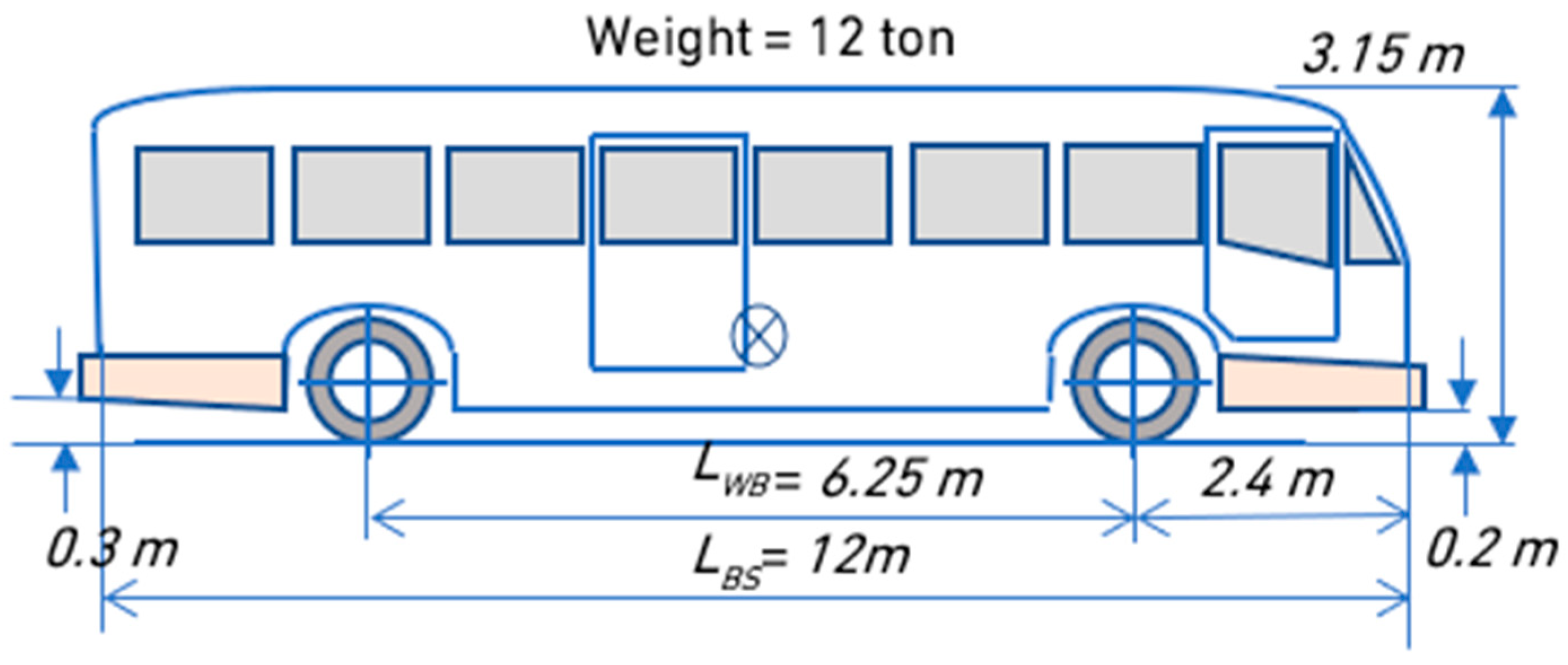
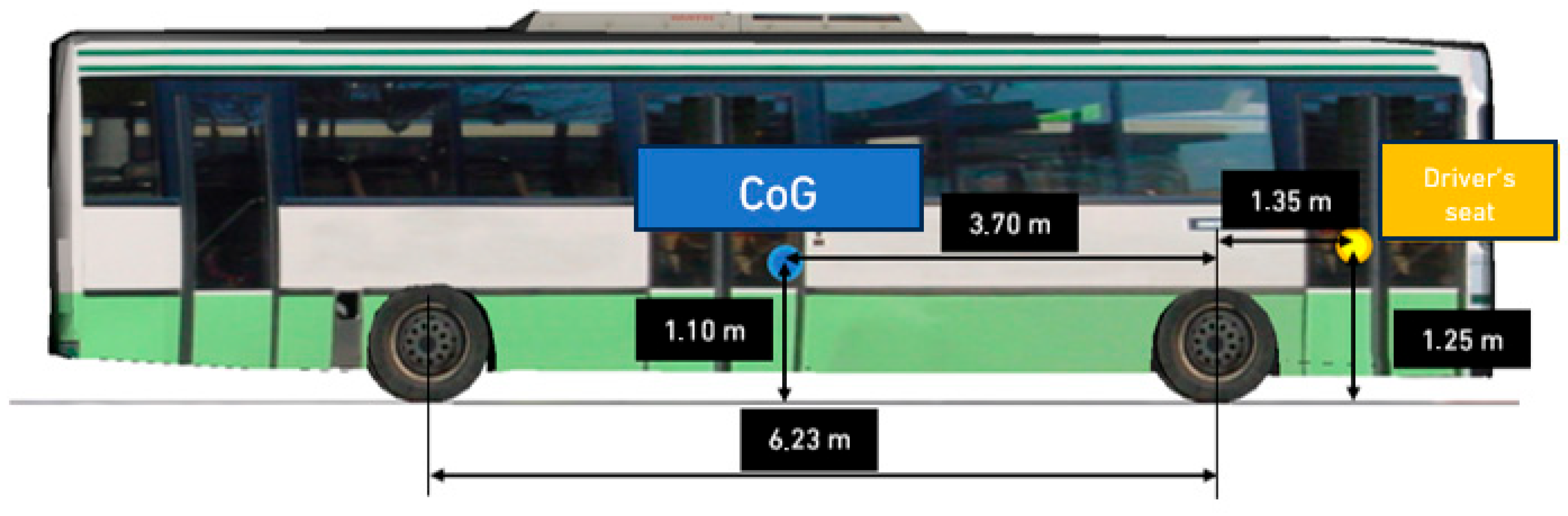
The bus dimensions are presented in Figure 1, while the dimensions of the raised crosswalk are shown in Figure 2. The raised crosswalk involved in the accident was not constructed in accordance with established design standards. For instance, according to the Directives for the Design of Urban Road RASt 06, designed by the Road and Transportation Research Association FGSV [14], a typical construction has a height of 5–7 cm, and the ramp for a bus type should be flatter than 1:25.
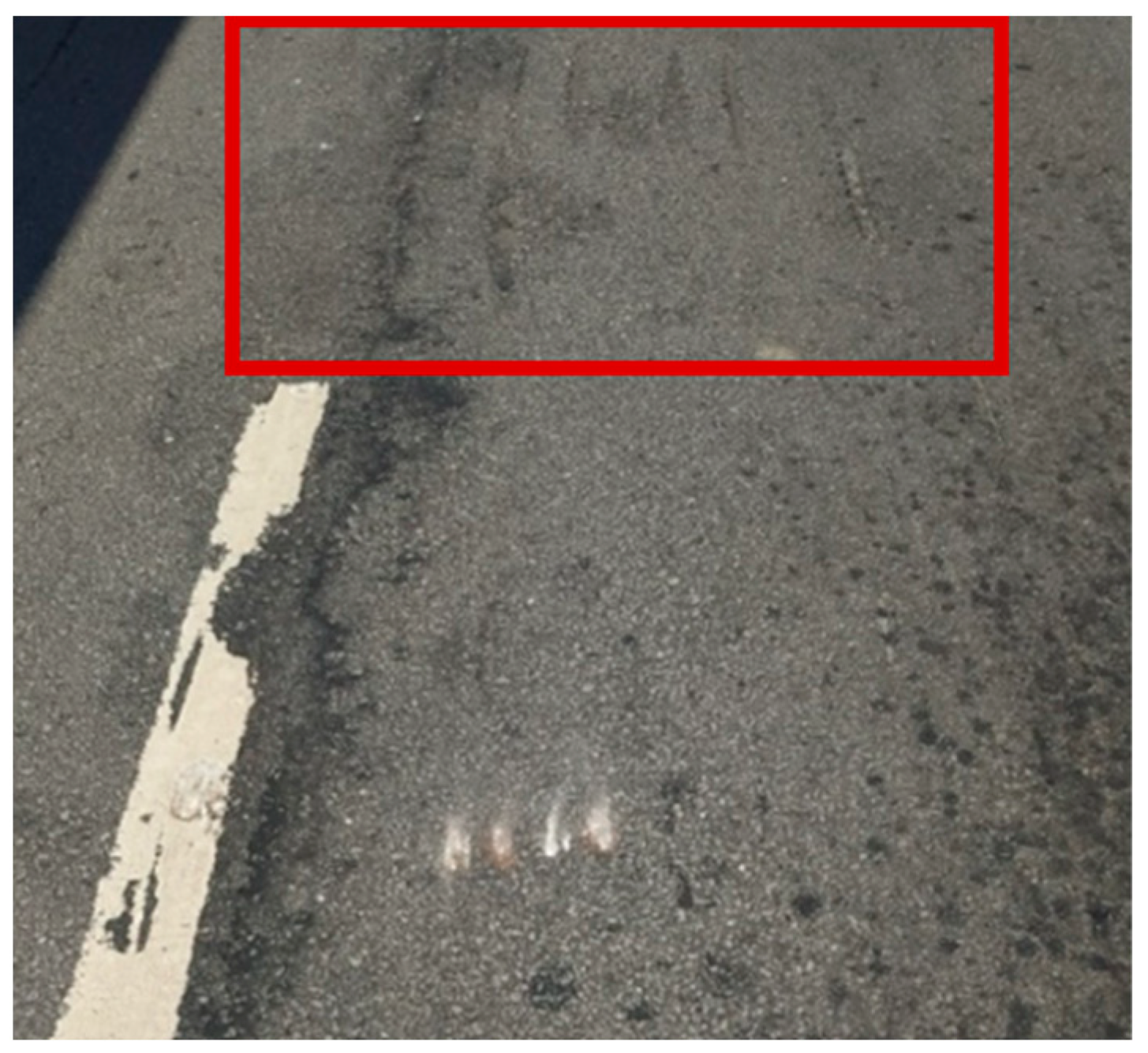
As mentioned above, the lower front shield underneath the bus body impacted the pavement, and consequently, marks were identified on the pavement, approximately 5.8 m from the upper part of the raised crosswalk (Figure 3). At the time of the accident, the raised crosswalk had no specific warning signage, and its non-standard geometry, combined with the excessive crossing speed, is believed to have contributed to the loss-of-control event.
The main purpose of this study was to analyze the dynamic behavior of the bus, the likelihood of an accident caused by the vehicle impacting the pavement, and the effects experienced by the bus driver. To this end, this study adopted a hybrid methodology that combines (i) an on-site experimental test, where the bus was instrumented with accelerometers and a wire displacement sensor; (ii) accident reconstruction computational simulations using the software PC-Crash® version 13.1 to estimate the velocity; and (iii) a simplified single-body finite element model of the bus suspension system implemented in software MATLAB® version R2020a. This hybrid approach allowed the reconstruction of the accident and the assessment of vertical displacements and accelerations, considering different velocities, bus loading conditions, and different raised crosswalk geometries.
Thus, the main contributions of this study are (i) the development of a simplified numerical model capable of reproducing measured responses and (ii) the conducting of a parametric analysis to evaluate the influence of the bus velocity, mass, and raised crosswalk geometry on vehicle risk and passenger safety. With the insights obtained, our intent is to support the design and assessment of raised crosswalks and also to show the potential of applying hybrid approaches in accident reconstruction investigations.
The content of this paper is organized as follows. In Section 1, a brief presentation of relevant studies to the topic is presented, as is the main motivation that led to this study, the investigation of a real-world accident. In Section 2, the numerical methodology developed to estimate the bus velocity is presented, as well as the experimental road test methodology and computational simulations used to validate the developed method. Section 3 depicts the results obtained from the three different approaches, followed by a discussion of all results. In Section 4, the main conclusions are presented, and future work is proposed.

2. Materials and Methods

This section describes the methodologies used to analyze the dynamic behavior of the bus when crossing the raised crosswalk. First, a simplified numerical model of the bus suspension system is developed and implemented using the Newmark integration scheme (Section 2.1). Then, the experimental road tests carried out at the accident site, including the sensor layout and data processing, are presented (Section 2.2). Finally, the PC-Crash simulations used to reconstruct the accident speed and to validate the numerical model are described (Section 2.3).

2.1. Numerical Modeling of the Dynamic Behavior of the Bus

2.1.1. Parametric Characterization of the Vehicle Structure

The focus of the numerical model is to analyze the bus behavior when subjected to transient forces arising from a raised crosswalk, having its dynamic behavior only conditioned by the vehicle suspension flexibility. In this analysis, the bus structure is assumed to be much more rigid than the suspension behavior. The main parameters by which to define this problem are as follows:
  • The structure is in the field of passive vibration transmission. This designation is associated with the mode of loading a dynamic system, where instead of quantifying external dynamic forces, the study prescribes time-dependent displacement and velocity vectors at the level of the degrees of freedom.
  • A single (and rigid) finite element, having the mass and inertial properties as similar as possible to the bus vehicle, is designed. This element has four nodes, where two of them are located at the vehicle ends, while the remaining refer to the front and rear axles’ location, here named as jSD and iSD, respectively. The transverse displacement, velocity, and acceleration of the vehicle body are assigned to these nodes. The nodes at the vehicle extremes have the displacement, velocity, and acceleration vectors related to the corresponding nodes at axles (element nodes i and j) by geometric relations as described ahead.
  • The elastic and energy dissipation elements are integrated into the vehicle’s suspension. In this case, one should mention that the springs, an energy exchanger (converting potential energy into kinetic and vice versa), and the vibration dampers, play very important roles in vibration dissipation.
A conventional suspension system is assumed; in detail, it refers to elastically deformable linear springs and dampers relying on the viscous dissipation energy type [10].
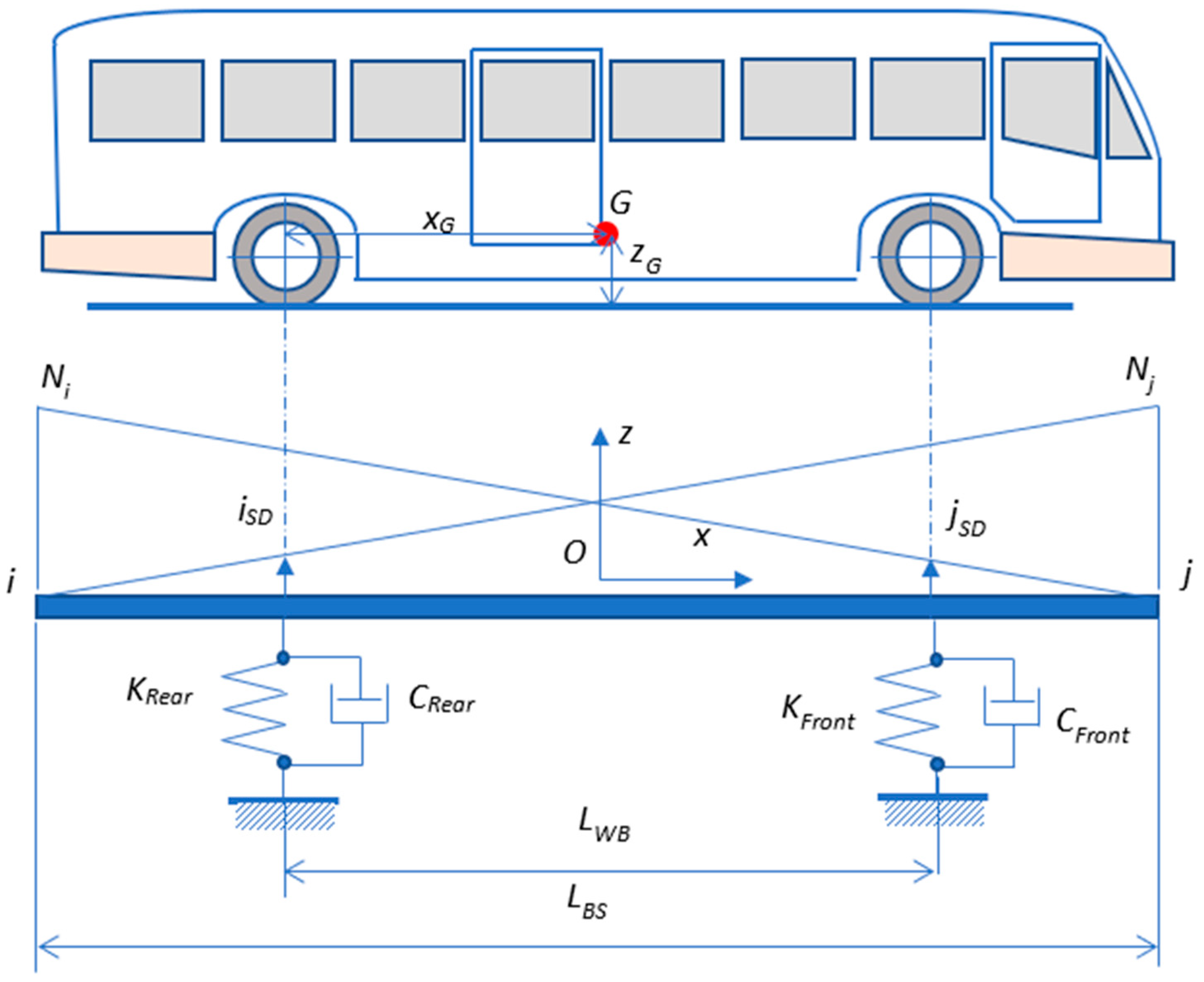
In Figure 4, the solid straight-line element is equivalent to the bus body above; this line is limited by node i and j, while the rear/front suspension axes assembly is located at auxiliary nodes iSD and jSD, respectively. Subscript SD stands for the spring damper set designation. Their distance corresponds to the vehicle wheelbase, while the bus length (between nodes i and j) is LBS. Spring has stiffness K (with a linear force/displacement deformation relation) and the damper has constant C for viscous damping. G denotes the vehicle’s center of gravity (CoG), with x G representing the distance from the rear axle to the CoG and z G is the distance from the CoG to the ground.
In this step of the numerical model development for the vehicle dynamic characterization, it is important to calculate mass, stiffness, and damping matrices, where the nodal parameters are assigned to different nodes. We start by defining the vehicle displacement in a vertical plate (longitudinally intersecting the vehicle body), as follows in Equation (1):
u ( x ) = N i u i + N j u j
where Ni and Nj are shape functions having x as an independent coordinate, defined by a reference basis placed at the middle of the vehicle body line element—Equation (2), as shown:
N i = 1 2 × 1 2 x L B S ;     N j = 1 2 × 1 + 2 x L B S
These functions satisfy the normalized condition of Ni being 1 at the coordinate of node i and zero at node j; conversely, Nj is zero at node i and 1 at node j.
At the suspension axes points, the value of displacements via shape functions is particularly useful to calculate the work performed by suspension accessories, such as the spring and damper. It is important to note that the displacements at auxiliary nodes are as follows:
  • Total displacement at node iSD—Equation (3):
u i S D = 1 2 u i × 1 2 x L B S x = L W B / 2 + 1 2 u j × 1 + 2 x L B S x = L W B / 2   = 1 2 u i × 1 + L W B L B S + 1 2 u j × 1 L W B L B S
  • Total displacement at node jSD—Equation (4):
u j S D = 1 2 u i × 1 2 x L B S x = + L W B / 2 + 1 2 u j × 1 + 2 x L B S x = + L W B / 2   = 1 2 u i × 1 L W B L B S + 1 2 u j × 1 + L W B L B S
Similarly, when dealing with the transverse velocity of the bus body (due to suspension oscillations), we find the following:
  • Total velocity at node iSD—Equation (5):
u ˙ i S D = 1 2 u ˙ i × 1 + L W B L B S + 1 2 u ˙ j × 1 L W B L B S
  • Total velocity at node jSD—Equation (6):
u ˙ j S D = 1 2 u ˙ i × 1 L W B L B S + 1 2 u ˙ j × 1 + L W B L B S

2.1.2. Evaluation of the Matrices Involved in the Dynamic Equilibrium Equation

The matrices necessary to set up the equilibrium equation of the vehicle model under dynamic forces are derived by seeking for stationary conditions of the total energy involved in the dynamic system. This scalar function results from the balance between the internal energy and the work externally performed by forces acting on the vehicle.
  • The internal energy is assigned to the amount stored in the springs plus the one generated in the dampers of the suspension system;
  • Additional internal energy is due to the mass of the dynamic system generating inertial forces;
  • The external work is due to forces acting on the vehicle axes due to prescribed displacements associated with the pavement profile (naturally, if that profile is smooth, then there will be no external work due to forced suspension displacements during the vehicle run).
Equation (7) presents the total energy of the system, as follows:
U T o t E n e r g y = 2 × ( 1 / 2 × K i S D × u i S D 2 ) T w o f r o n t s p r i n g s + 2 × ( 1 / 2 × K j S D × u j S D 2 ) T w o r e a r s p r i n g s + 2 × ( C i S D × u i S D × u ˙ i S D ) T w o f r o n t d a m p r e r s + 2 × ( C j S D × u j S D × u ˙ j S D ) T w o r e a r d a m p e r s + ρ A × 0 L B S u × u ¨   d x I n e r t i a l f o r c e s ( F i S D × u i S D + F j S D × u j S D ) W o r k b y e x t e r n a l f o r c e s
The stationary conditions of the potential functional UTotEnergy are developed by deriving the potential functional and setting it to zero, which corresponds to seeking a minimum (and stationary) value in a small domain. First, we consider a small variation of the potential functional depending on partial variations of the nodal displacements, as follows in Equation (8):
Δ U T o t E n e r g y = 2 × ( 1 / 2 × K i S D × 2 × u i S D × Δ u i S D ) T w o f r o n t s p r i n g s + 2 × ( 1 / 2 × K j S D × 2 × u j S D × Δ u j S D ) T w o r e a r s p r i n g s + 2 × ( C i S D × Δ u i S D × u ˙ i S D ) T w o f r o n t d a m p r e r s + 2 × ( C j S D × Δ u j S D × u ˙ j S D ) T w o r e a r d a m p e r s + ρ A × 0 L B S ( Δ u ) × u   ¨ d x I n e r t i a l f o r c e s ( F i S D × Δ u i S D + F j S D × Δ u j S D ) W o r k b y e x t e r n a l f o r c e s
The minimum and stability of this variation, as depending on an arbitrarily small partial variation of the nodal displacements, is achieved as follows in Equation (9) (where we abbreviate the individual partial derivation for each nodal displacement increment):
Δ U T o t E n e r g y Δ ( u i o r u j ) = 0
Note that the displacements at the suspension nodes, as functions of i and j (extreme nodes of the bus body), were defined.
Considering the nodal displacement conversion presented above, the previous system leads to the following one, written in its expanded form.
Suppose that the vehicle has different stiffness rate springs at the front and rear axles. Then, while labelling them as KFront and KRear, respectively, the energy variation terms in order to the nodal displacement increments are as follows (Equation (10)):
Δ U T o t E n e r g y Δ u i = Δ U T o t E n e r g y Δ u i S D Δ U i S D Δ u i + Δ U T o t E n e r g y Δ u j S D Δ U j S D Δ u i ( F i S D Δ u i S D + F j S D Δ u j S D ) Δ u i = 0 Δ U T o t E n e r g y Δ u j = Δ U T o t E n e r g y Δ u i S D Δ U i S D Δ u j + Δ U T o t E n e r g y Δ u j S D Δ U j S D Δ u j ( F i S D Δ u i S D + F j S D Δ u j S D ) Δ u j = 0
Useful terms are as follows:
  • Δ U T o t E n e r g y Δ u i S D = 2   ×   K i S D   ×   u i S D ;   Δ U T o t E n e r g y Δ u j S D = 2   ×   K j S D   ×   u j S D
  • Δ U i S D Δ u i = 1 2 × 1 + L W B L B S ;   Δ U j S D Δ u i = 1 2 × 1 L W B L B S
  • Δ U i S D Δ u j = 1 2 × 1 L W B L B S ;   Δ U j S D Δ u j = 1 2 × 1 + L W B L B S
The complete expressions of internal elastic energy variation for increments Δui and Δuj are given by Equation (11), as follows:
Δ U T o t E n e r g y Δ u i = 2 × K i S D × u i S D × 1 2 × 1 + L W B L B S + 2 × K j S D × u j S D × 1 2 × 1 L W B L B S Δ U T o t E n e r g y Δ u j = 2 × K i S D × u i S D × 1 2 × 1 L W B L B S + 2 × K j S D × u j S D × 1 2 × 1 + L W B L B S
However, as deduced above, Equation (12) is obtained, as follows:
u i S D = 1 2 u i × 1 + L W B L B S + 1 2 u j × 1 L W B L B S u j S D = 1 2 u i × 1 L W B L B S + 1 2 u j × 1 + L W B L B S
Substituting these transverse displacements of the vehicle axles, the extended form of the stiffness matrix (naturally only involving the contribution of the vehicle suspension springs) is presented in Equation (13), as follows:
K i i = K i S D 2 × 1 + L W B L B S 2 + K j S D 2 × 1 L W B L B S 2 ;     K i j = K i S D 2 × 1 L W B L B S 2 + K j S D 2 × 1 L W B L B S 2 K j i = K i S D 2 × 1 L W B L B S 2 + K j S D 2 × 1 L W B L B S 2 = K i j × K j j = K i S D 2 × 1 L W B L B S 2 + K j S D 2 × 1 + L W B L B S 2
It is interesting to note that, if the vehicle wheelbase coincides with the body length (that is, LWB = LBS, which is not a good design practice for this type of vehicle), the stiffness matrix becomes diagonal (uncoupled suspension interaction), as follows:
K i i = 2 × K i S D ;       K i j = 0 K j i = 0 = K i j × K j j = 2 × K j S D
The work variation for a small increment of the displacement vector due to structure inertial forces is obtained by the integral as shown in Equation (14):
Δ W I n F o r = ρ A × 0 L B S Δ u × u   ¨ d x = Δ u i Δ u j × ρ A × L B S / 2 L B S / 2 N i N i N i N j N j N i N j N j d x u ¨ i u ¨ j
Performing the minimum work for separate nodal displacement variation, Equation (15) is obtained, as follows:
Δ W I n F o r Δ u i = ρ A × 0 L B S Δ u × u ¨ d x = 1 0 × ρ A × L B S 2 L B S 2 N i N i N i N j N j N i N j N j d x u ¨ i u ¨ j = ρ × A × L B S 2 L B S 2 N i N i N i N j d x u ¨ i u ¨ j
Δ W I n F o r Δ u j = ρ A × 0 L B S Δ u u ¨ d x = 0 1 × ρ A × L B S / 2 L B S / 2 N i N i N i N j N j N i N j N j d x u ¨ i u ¨ j = ρ A × L B S / 2 L B S / 2 N j N i N j N j d x u ¨ i u ¨ j
From that separate nodal variation, it is possible to extract the mass matrix—Equation (16):
ρ A × L B S / 2 L B S / 2 N i N i N i N j N j N i N j N j d x = ρ A × L B S / 3 L B S / 6 L B S / 6 L B S / 3
To this continuous (and uniformly) distributed mass, adding the contribution of separate lumped masses, such as, for example, the engine (at the vehicle front or rear), to the consideration that such an accessory is practically located at node i or node j, we obtain the following:
D i s c r e t e   m a s s     a t f r o n t = M e n g i n e 0 0 0 D i s c r e t e   m a s s   a t   r e a r = 0 0 0 M e n g i n e
The work performed by damping forces is analytically similar to that which is due to the energy absorption by the springs, except for the factor 1/2 for the springs (that respond with a linearly increasing internal reaction force), which is not considered for damping forces due to viscous dissipation energy, proportional to the velocity. Then, a variation of the energy due to damping accessories by displacement increments is given by Equation (17):
Δ U D a m p i n g = 2 × ( C i S D × Δ u i S D × u ˙ i S D ) T w o f r o n t d a m p r e r s + 2 × ( C j S D × Δ u j S D × u ˙ j S D ) T w o r e a r d a m p e r s
Again, considering the axle displacements reduced to extreme nodes i and j and expressing the dissipation energy from independent nodal displacement as above, Equation (18) is obtained, as follows:
C = C i i = C i S D 2 × 1 + L W B L B S 2 + C j S D 2 × 1 L W B L B S 2 ;     C i j = K i S D 2 × 1 L W B L B S 2 + C j S D 2 × 1 L W B L B S 2 C j i = K i S D 2 × 1 L W B L B S 2 + C j S D 2 × 1 L W B L B S 2 = K i j × K j j = C i S D 2 × 1 L W B L B S 2 + C j S D 2 × 1 + L W B L B S 2
The time-dependent external forces contribution results in the following vector—Equation (19):
F i S D t Δ u i S D + F j S D t Δ u j S D Δ u i = F i S D t × 1 2 × 1 + L W B L B S + F j S D t × 1 2 × 1 L W B L B S ( F i S D ( t ) Δ u i S D + F j S D ( t ) Δ u j S D ) Δ u j = F i S D ( t ) × 1 2 × 1 L W B L B S + F j S D ( t ) × 1 2 × 1 + L W B L B S
Once again, it is interesting to note that, if the vehicle wheelbase coincides with its total length, then the force vector is found in Equation (20):
F i S D t × Δ u i S D + F j S D t × Δ u j S D Δ u i = F i S D t × 1 2 × 1 + L W B L B S = F i S D t ( F i S D ( t ) × Δ u i S D + F j S D ( t ) × Δ u j S D ) Δ u j = F j S D ( t ) × 1 2 × 1 + L W B L B S = F j S D ( t )

2.1.3. Real-Time Direct Integration Analysis by Newmark Method

The dynamic equilibrium of a structure subjected to time-dependent loads can be analyzed at any time instant by numerical tools with proven efficiency and accuracy, such as with the Newmark method [15]. This algorithm calculates the shape (by the displacement field) of a structure subjected to time-dependent forces using an incremental process based on the concept of the “constant acceleration method”, where, at each time step, the structure acceleration vector is assumed constant.
To develop the algorithm, we assume the equilibrium of the structure at an instant t + Δt, as follows in Equation (21):
M U ¨ t + Δ t + C U ˙ t + Δ t + K U t + Δ t = F t + Δ t
where U ¨ t + Δ t ,   U ˙ t + Δ t   and   U t + Δ t are, respectively, the acceleration, velocity and displacement vectors of the structure, while F t + Δ t  is the external force vector, all at time step t + Δt.
On expressing both the velocity and displacement vectors from their previous instant values, then by the constant acceleration concept and use of the trapezoidal rule in integrating a step-function, the following expressions define the structure evolution in time under dynamic loads—Equation (22):
U ˙ t + Δ t = U ˙ t + 0.5 × Δ t × ( U ¨ t + Δ t + U ¨ t )
U t + Δ t = U t + 0.5 × Δ t × ( U ˙ t + Δ t + U ˙ t )
The evaluation of U ¨ t + Δ t is the key solution of the algorithm; for that, the previous expressions are substituted in the structure equilibrium equation at time t + Δt, as follows in Equation (23):
M U ¨ t + Δ t + C ( U ˙ t + 0.5 × Δ t × ( U ¨ t + Δ t + U ¨ t ) ) + K ( U t + 0.5 × Δ t × ( U ˙ t + Δ t + U ˙ t ) ) = F t + Δ t
Separating the terms referring to time t + Δt and t, respectively, at the left- and right-hand sides of the equation, it is possible to solve it for the updated structure acceleration vector—Equation (24):
M + C Δ t + 0.25 Δ t 2 K × U ¨ t + Δ t a t t + Δ t = F t + Δ t K ( U t + Δ t × U ˙ t + 0.25 × Δ t 2 × U ¨ t ) D ( U ˙ t + 0.5 × Δ t × U ¨ t ) a t i n s tan t t
Once solved for U ¨ t + Δ t , knowing previous dynamic status at instant t (that is, the RHS of the equation), an updated vector for acceleration is obtained, leading to new velocity and displacement vectors.
The role played by the external force defines the dynamic structure behavior, once Ftt is variable at each time step. When a structure has a time-dependent prescribed force vector in the RHS equation, this problem is known as an active dynamic transmission. This is not exactly what is being analyzed in this case, where the vehicle suspension is stressed by external time-dependent displacement and velocity vectors; instead, the above-mentioned force F(t) is indirectly defined. In the present study, the structure is subjected to a passive dynamic transmission. The following version of the dynamic equilibrium equation is presented in Equation (25), as follows:
M U ¨ t + Δ t = K ( U 0 ) t + Δ t U t + Δ t R e l a t i v e   d i s p l a c e m e n t + C ( U ˙ 0 ) t + Δ t U ˙ t + Δ t R e l a t i v e   v e l o c i t y
Grouping the unknown vectors at LHS of the previous equation, a similar form of the active transmission version can now be presented, as in Equation (26):
M U ¨ t + Δ t + C U ˙ t + Δ t + K U t + Δ t = K ( U 0 ) t + Δ t + C ( U ˙ 0 ) t + Δ t F t + Δ t e q u i v a l e n t v e c t o r
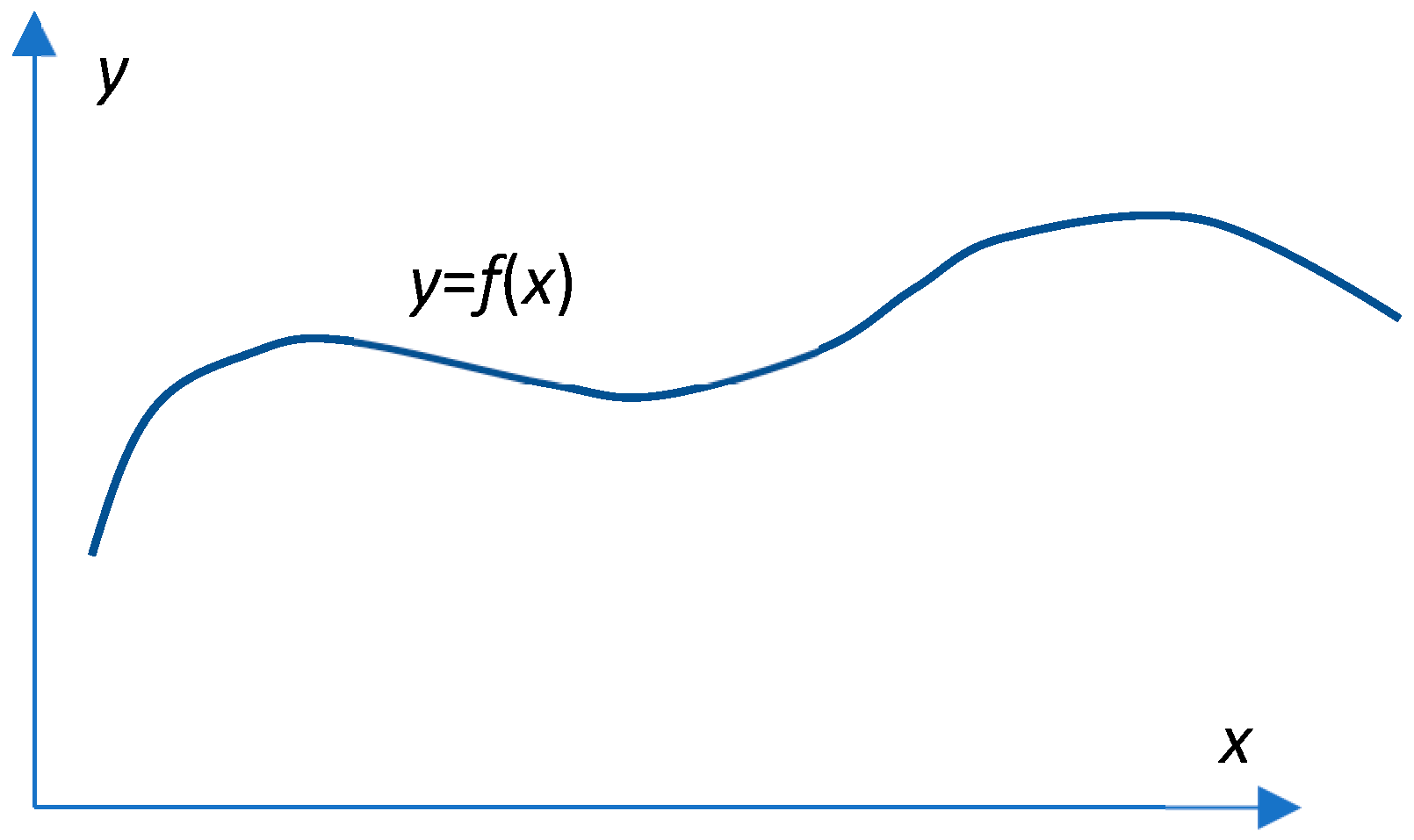
In the case of a vehicle running on a road with a geometrically prescribed profile, ( U 0 ) t + Δ t and ( U ˙ 0 ) t + Δ t are, respectively, the vertical displacement and velocity of the wheel hubs at any time step t + Δt. The velocity can be defined as a function of the displacement (road profile projected on a vertical direction) and the horizontal speed of the vehicle. The faster the vehicle runs, the sharper is the equivalent external force F t + Δ t , but only from the contribution of the vehicle dampers via C ( U ˙ 0 ) t + Δ t ; the springs have practically no progressive increment with speed on the external force vector. Figure 5 corresponds to a geometric model of the road profile expressed as a function y = x ; x is the vehicle’s horizontal displacement and y is the road elevation profile at that position. As the vehicle’s position is given by x = v × t , v being the vehicle’s horizontal velocity, this results in y = y ( v × t ) , a prescribed time-dependent displacement that acts as a dynamic input to the vehicle’s suspension.
The horizontal velocity of the vehicle is given by Equation (27),
x ˙ = d x / d t
The vertical velocity of the wheel hub passing on a road profile, as the one sketched by the function, is given by Equation (28),
y ˙ = d y d t = y × x ˙
where y = d y d x .
This velocity may be defined at each time step of Newmark’s time integration algorithm, as applied to the external force Ft+Δt.
The numerical method proposed was programmed and implemented using MATLAB software.

2.2. Experimental Methods

Road tests were carried out at the accident site, using the same bus model involved in the accident, and the route was prepared in a way that would allow overcoming the raised crosswalk at a constant and controlled speed, using GPS measurements (smartphone-based GPS application from Google) and the bus speedometer.

2.2.1. Measuring Equipment and Its Location

The measurements were planned with the aim of characterizing the forces that the suspensions of the bus and the driver’s seat exert on the driver’s body when both axles of the bus pass over the raised crosswalk. So, to know its effect on the driver, it was necessary to record the accelerations both in the vehicle’s chassis and in the driver’s seat. It is also necessary to obtain the relative displacement between the driver’s seat and the bus floor structure.
Two 3D accelerometers and a draw wire sensor, with an acquisition system to record the sensor signals, were used to carry out these measurements. The analysis of images collected by video and photography during the on-site tests was also important when obtaining consistent results.
To obtain the vertical displacements from the accelerations, it was necessary to carry out the double integration of the obtained signal; however, the amplitude of the displacement by this method depends on the initial conditions and the quality of the signal recorded. For that reason, we chose to also use a draw wire sensor to measure the displacements.
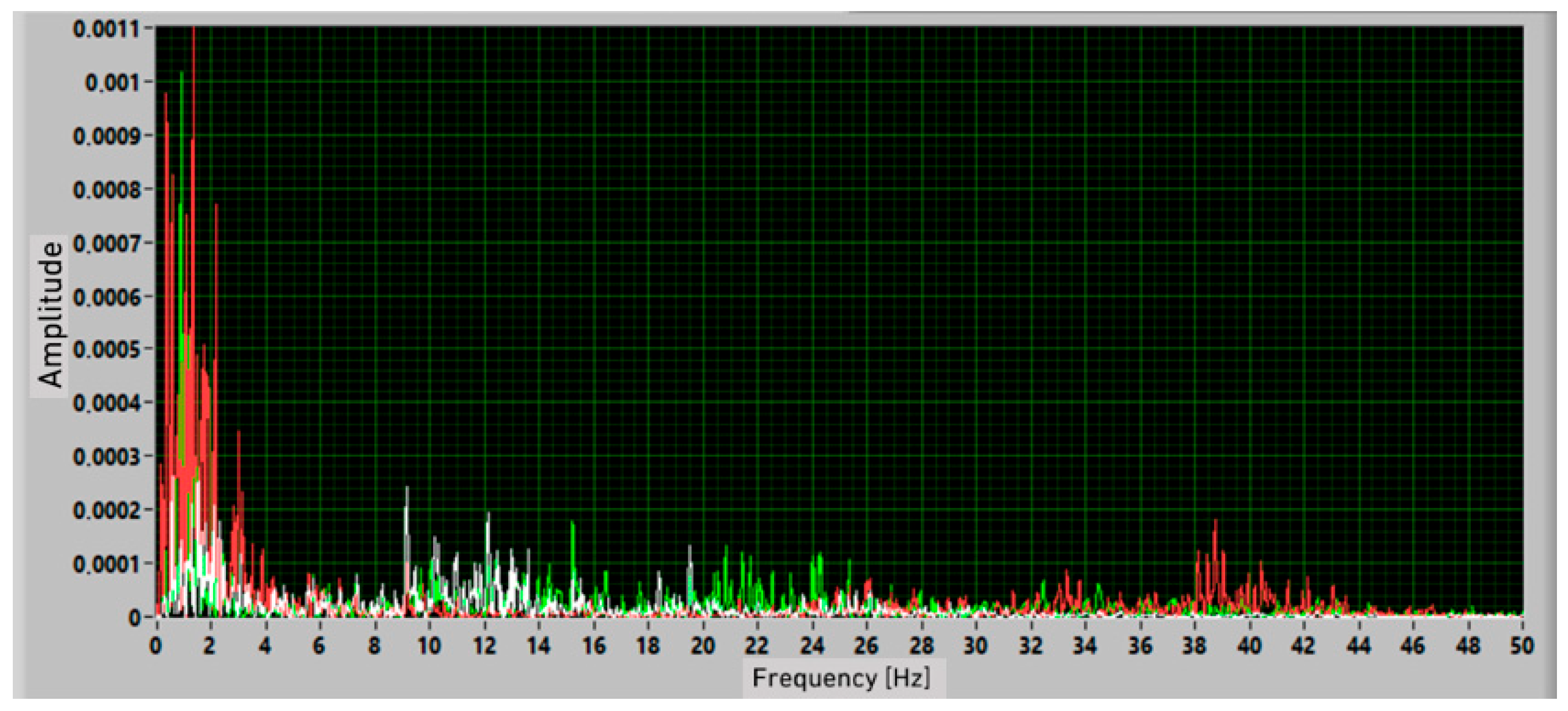
For the collection and processing of the signals via the sensors, the software Signal Express version 2013 from LabVIEW® was used, which is also the supplier of the acquisition modules. The frequency response function (FRF) was calculated for all signals recorded in each test to verify the most suitable cut-off frequency for filtering. It was verified for the FRF of the accelerometer signal installed in the driver’s seat (Figure 6) that the signals can be filtered above 44 Hz for noise reduction. For all signals, a low-pass, third-order Butterworth filter with a cut-off frequency of 44 Hz was used.
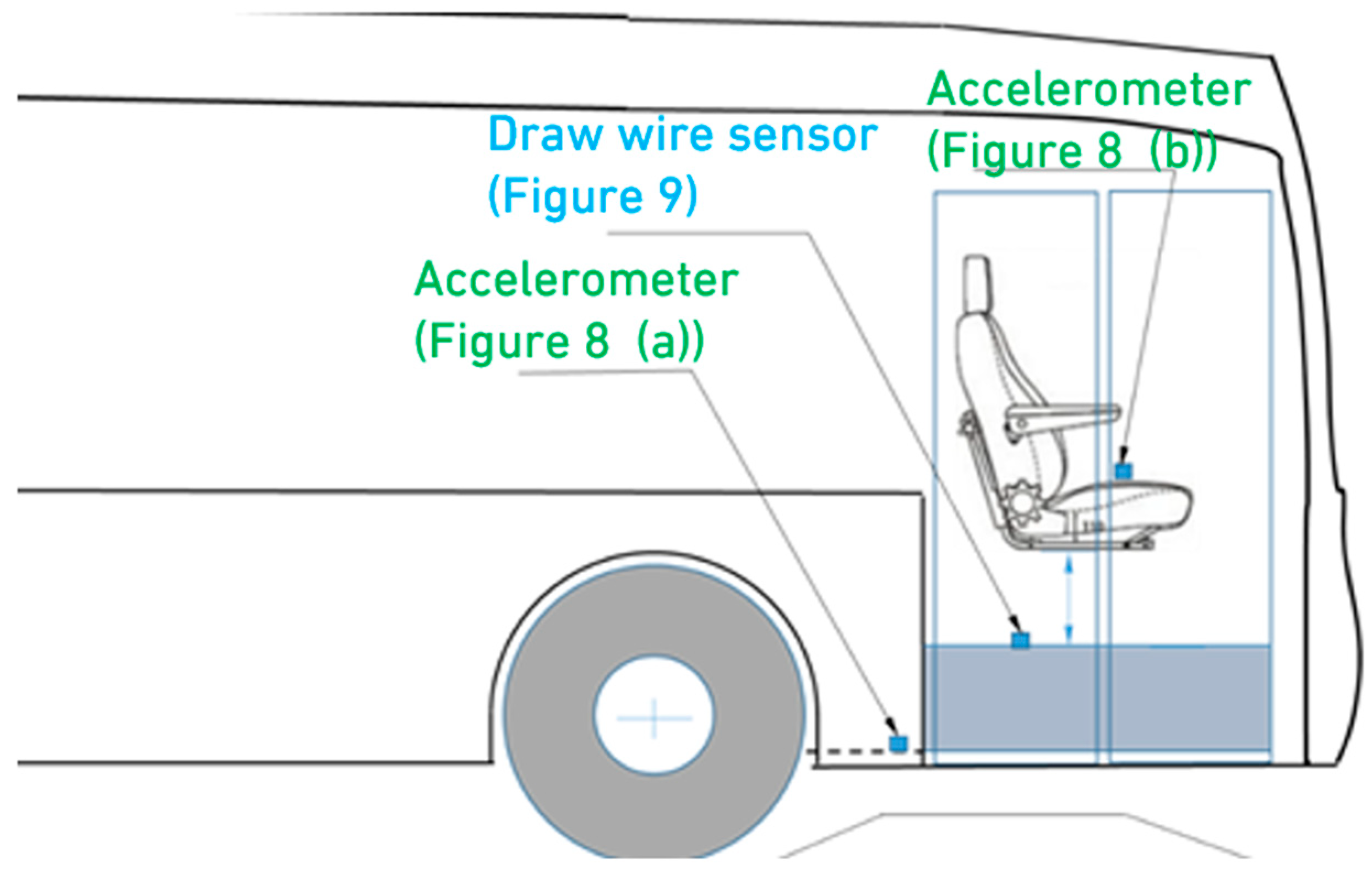
As mentioned above, the sensors were installed in the bus structure to evaluate the accelerations and displacements in the chassis and in the driver’s seat. Because one of the purposes of this study was to know the effect on the bus driver, the sensors were installed in the front of the bus (Figure 7).
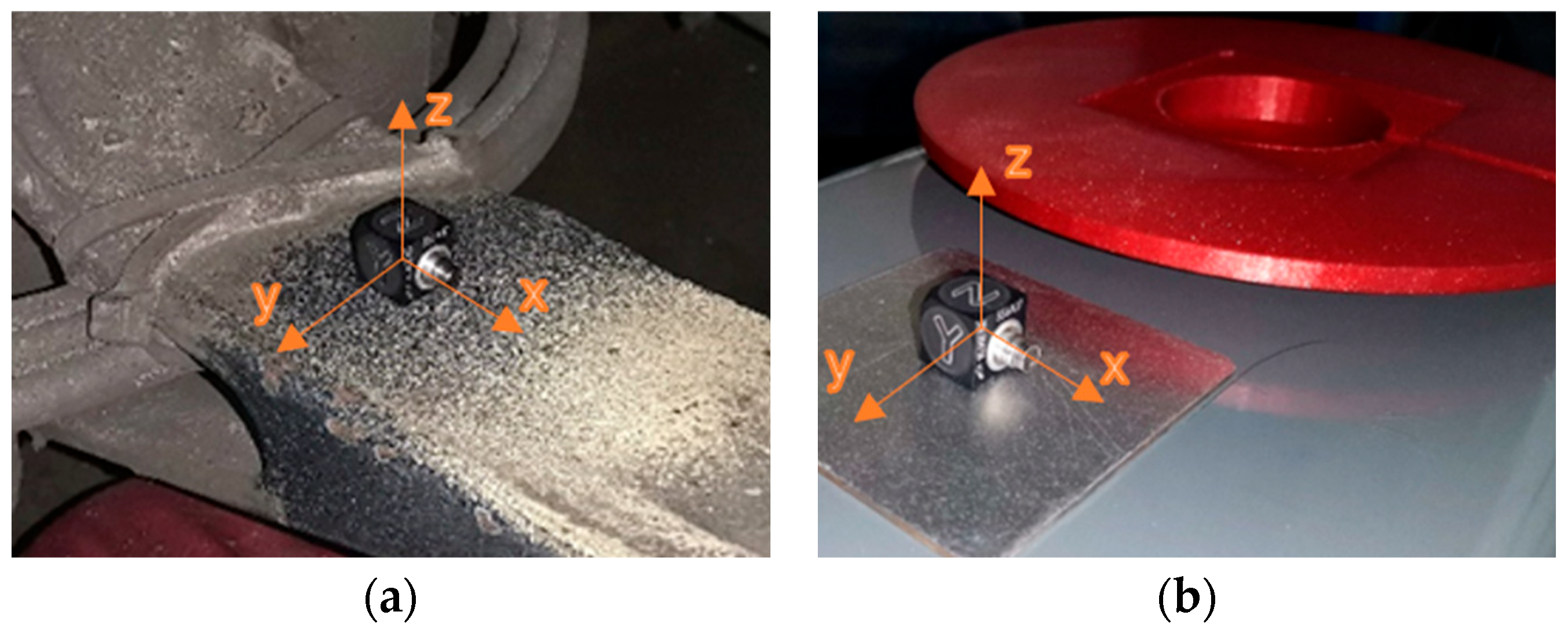
For the accelerometer installed on the front right arm of the bus chassis (Figure 8a), the longitudinal, transverse, and vertical axes correspond to the x, y, and z axes, respectively. On the other hand, for the accelerometer placed under the driver’s seat, but at its frame (Figure 8b), the longitudinal, transverse, and vertical directions correspond to the x, y, and z axes, respectively. In this case, a polymer component made by 3D printing was used according to the one recommended by the standard ISO 10326-1:2016 for evaluating accelerations in vehicle seats [16].
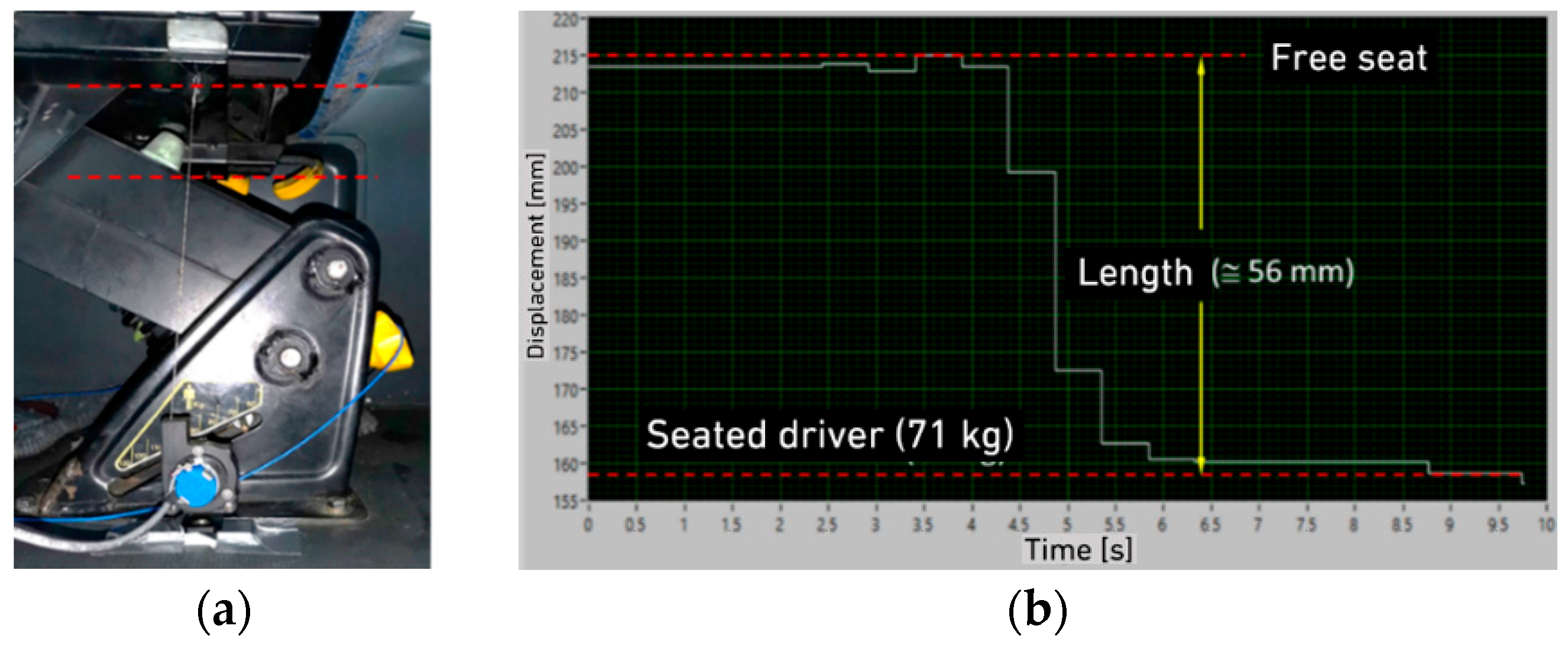
The draw wire displacement sensor was installed under the driver’s seat (Figure 9a), with its base glued to the platform and the wire end attached to the seat’s underside fixed support.
As the driver’s seat is the interface between the driver and the bus chassis, its dynamic behavior conditions the driver’s movement due to the raised crosswalk crossing. As these seats are designed to minimize driver fatigue, they usually have their own adjustable suspension, according to the driver’s weight and preferences.
After installing the draw wire sensor with the seat in the topmost position, and with no additional load, the sensor was set to zero. Then, when the driver (71 kg) was seated, it registered a displacement of 56 mm (Figure 9b).

2.2.2. Experimental Road Tests

Four road tests were carried out on the raised crosswalk: two at 10 km/h and two at 20 km/h. For each of them, the accelerometer and wire sensor signals were recorded, and video images were also collected (inside and outside the bus and in the neighborhood).
The speed of 10 km/h proved to be a safe driving speed without any significant disruption to the bus movement. However, the passage at 20 km/h proved to be excessive to overcome the raised crosswalk, because, at this velocity, the chassis hits the floor; therefore, we decided not to carry out measurements at higher speeds. Thus, only the results obtained in the passages at 20 km/h were processed to understand the dynamic behavior of the bus and the bus driver that might cause the accident.
To estimate and understand the dynamic behavior for higher speeds, computational simulations were performed with the software PC-Crash® version 13.1 and compared with the numerical model proposed.

2.3. Computational Simulations Using PC-Crash

To estimate the velocity of the bus on the day of the accident, computational simulations using software PC-Crash® [17] were performed, considering all of the results obtained from the road tests for its validation. Computational simulations using PC-Crash® software have already been applied to bus-related accidents, demonstrating good agreement with the observed outcome [18].
Firstly, the bus and the raised crosswalk were modeled according to the real dimensions (Figure 10).
From the comparative analysis of the previous figures, it can be seen that the longitudinal dimension of the raised crosswalk (5.76 m) differs by approximately 50 cm from the length between the axles of the bus (6.25 m). This similarity of lengths affects the dynamic behavior of the bus, as the lowering of the front axle and the raising of the rear axle occur simultaneously, as shown in Figure 11. This phenomenon favors the impact of the front part on the floor due to the rotation of the bus structure.

3. Results

This section presents the main results obtained from the three complementary approaches used in this study. First, the measurements from the experimental road tests are analyzed, with an emphasis on the accelerations and displacements recorded at the bus chassis and driver’s seat (Section 3.1). Then, the PC-Crash simulations used to estimate the accident speed are discussed (Section 3.2). Finally, the responses predicted by the numerical model for different bus speeds, masses and raised crosswalk geometries are presented and compared with the experimental observations (Section 3.3), followed by an overall discussion (Section 3.4).

3.1. Experimental Road Tests

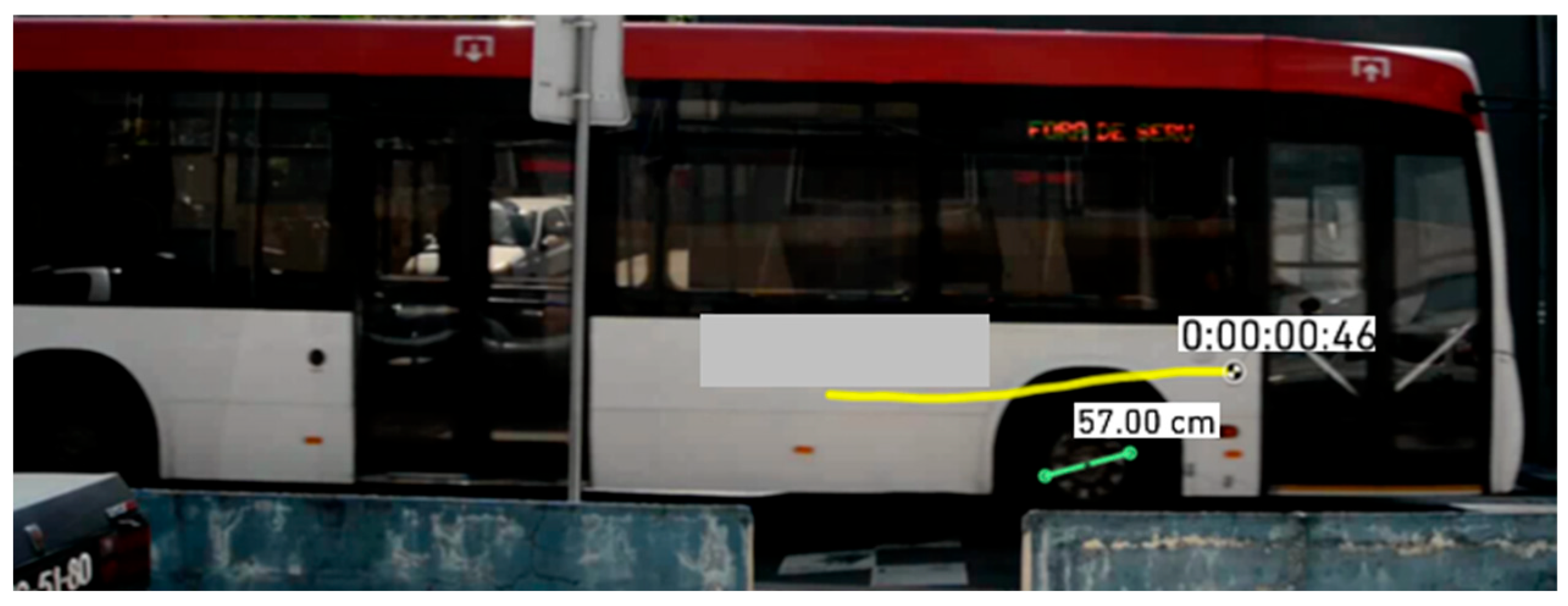
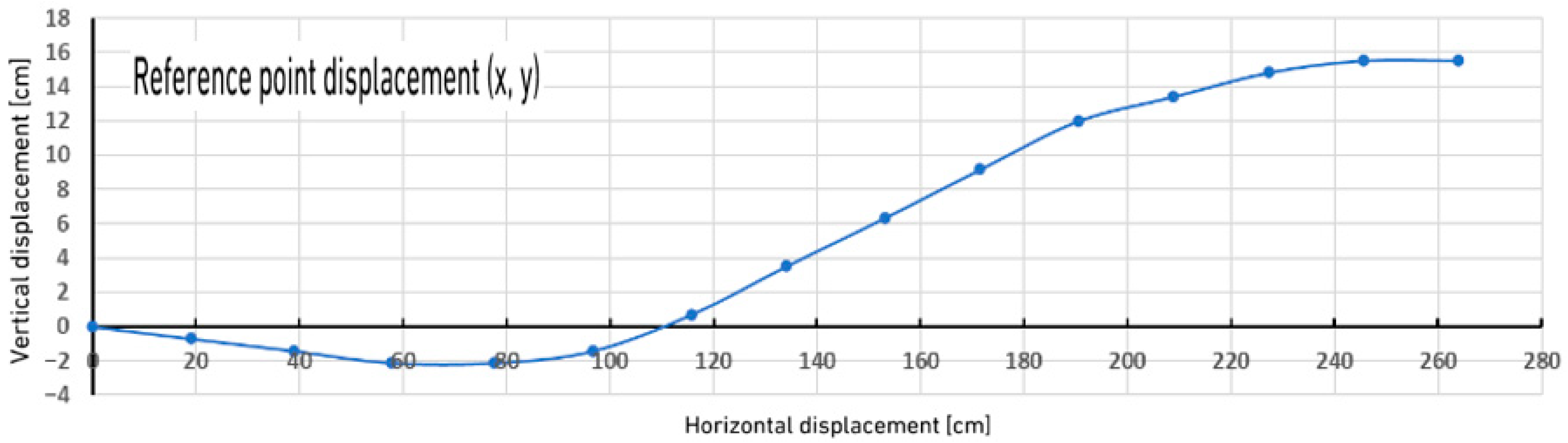
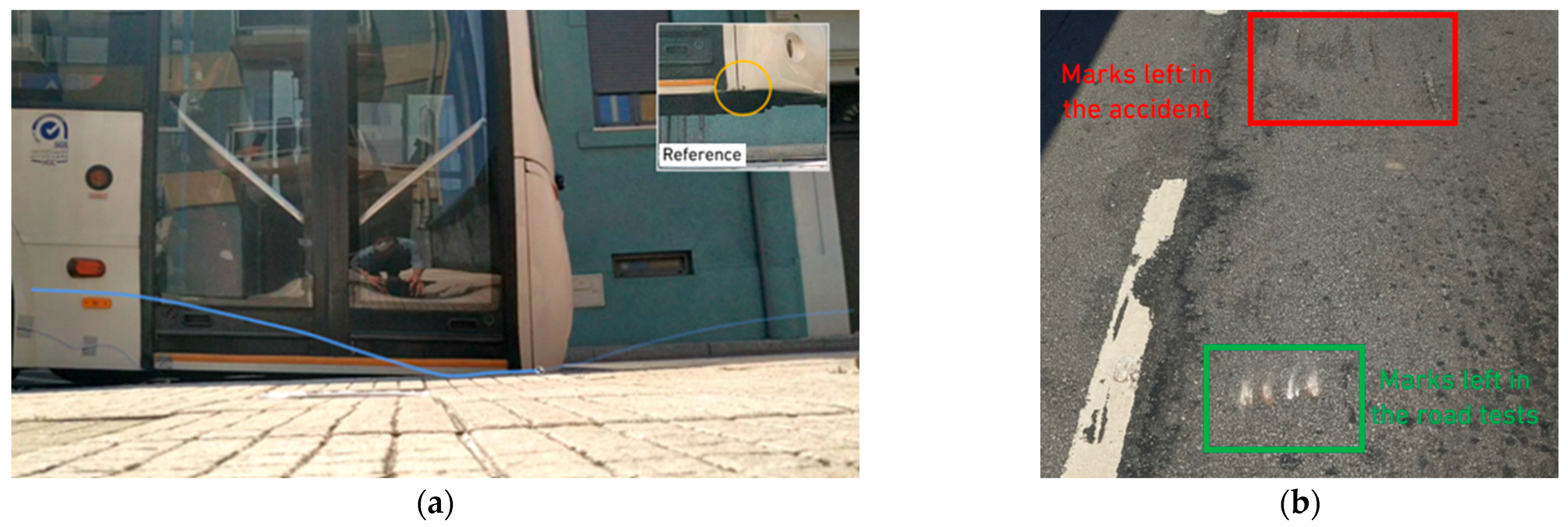
This subsection summarizes the results obtained during the on-site tests carried out with the bus crossing the raised crosswalk at 20 km/h, including the analysis of vertical displacements, accelerations and the driver’s body motion. An initial assessment of the problem in the study was carried out using the external video images collected during all of the tests. The height of the raised crosswalk was obtained through the effects verified on the bus. For that, a video motion analysis software, Kinovea® version 0.8.15, was used, in order to calibrate the image dimensions from known values of true magnitude. Thus, a reference point from the bus structure was selected and was tracked across its trajectory (the yellow point in Figure 12). The coordinates of the points were recorded, and those points were translated into a graphic (Figure 13). We found that the bus rises almost 16 cm from the ground, which can be approximately considered the height of the raised crosswalk.
For the velocity of 20 km/h, it was verified that an impact had already occurred between the lower front part of the bus and the pavement (Figure 14), and at the same time as the rear axle rises.
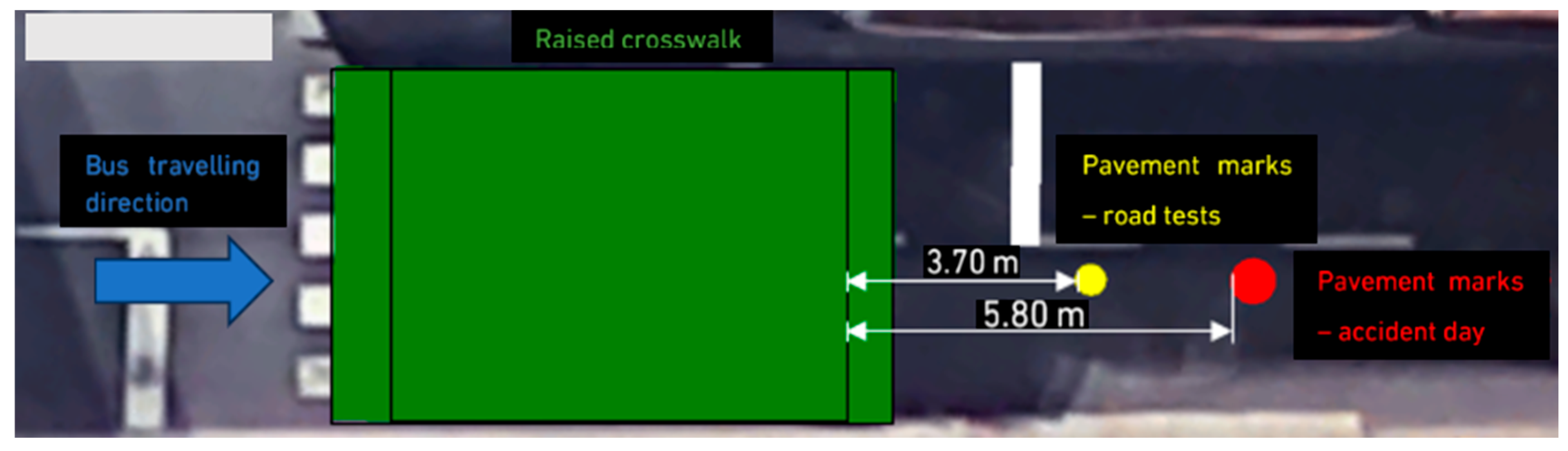
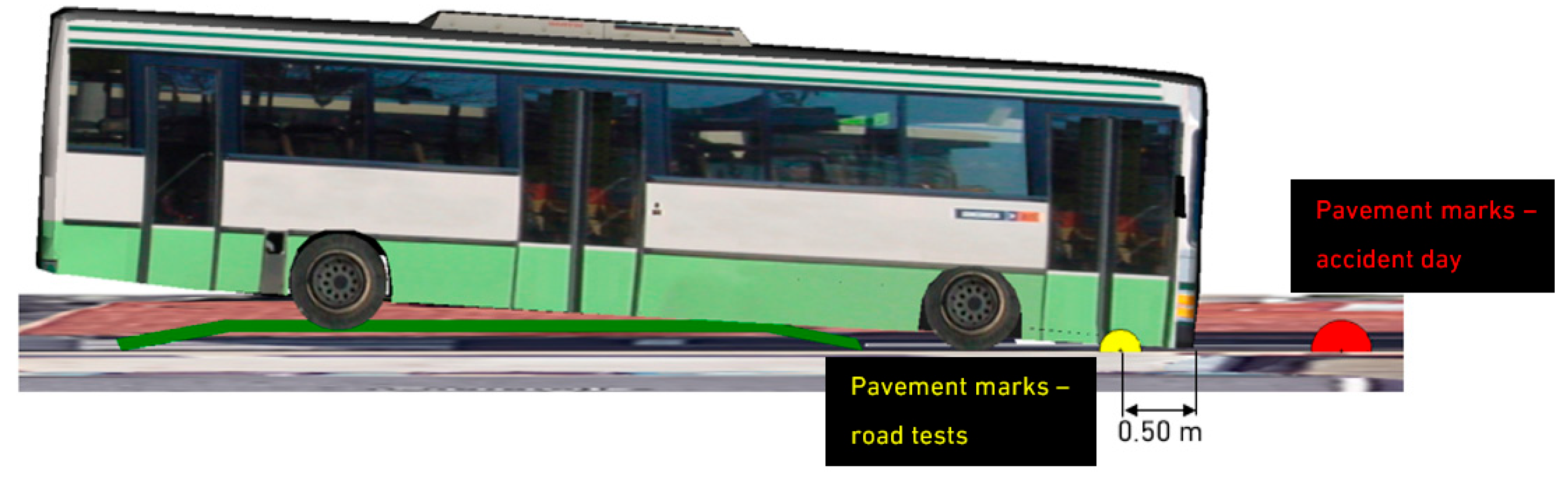
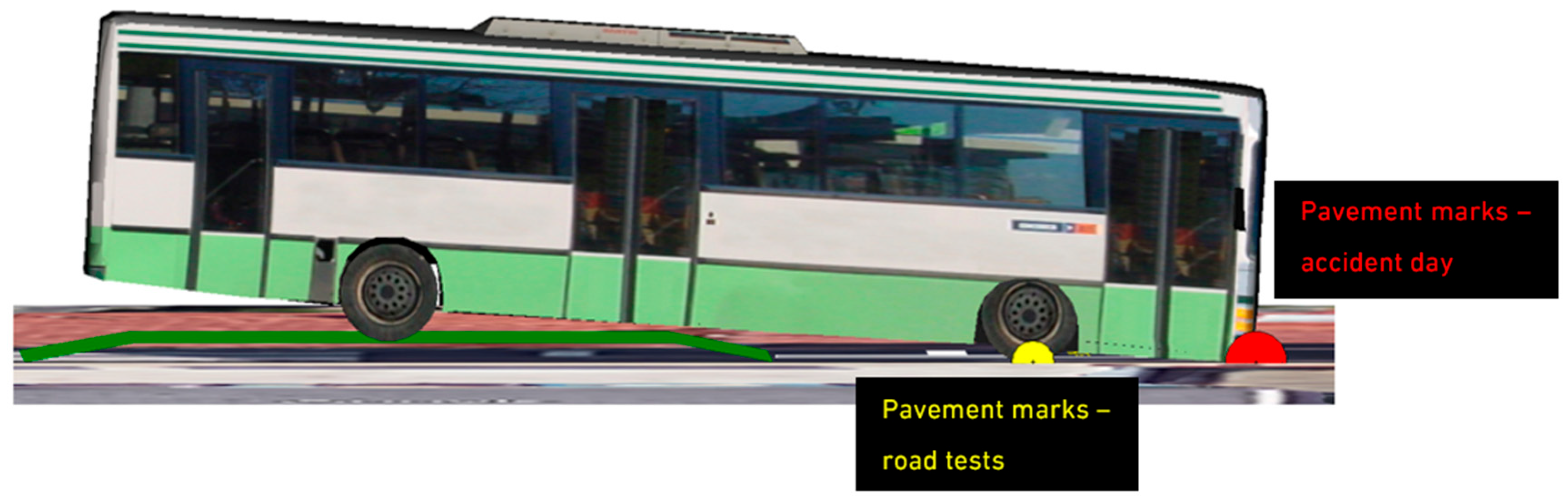
The marks left on the pavement during the road tests were located 3.7 m from the beginning of the descending zone of the raised crosswalk, while the marks left on the pavement on the day of the accident were located at 5.8 m (Figure 15). Therefore, it is possible to assume that, at the moment of the accident, the bus was traveling at a speed greater than 20 km/h (the estimation of velocity on the day of the accident will be studied later).
The acceleration and displacement data collected during the road tests performed at 20 km/h were consistent and showed the repeatability of the measurements. Thus, it was found that two different situations occurred during the passage of the front and rear axles.
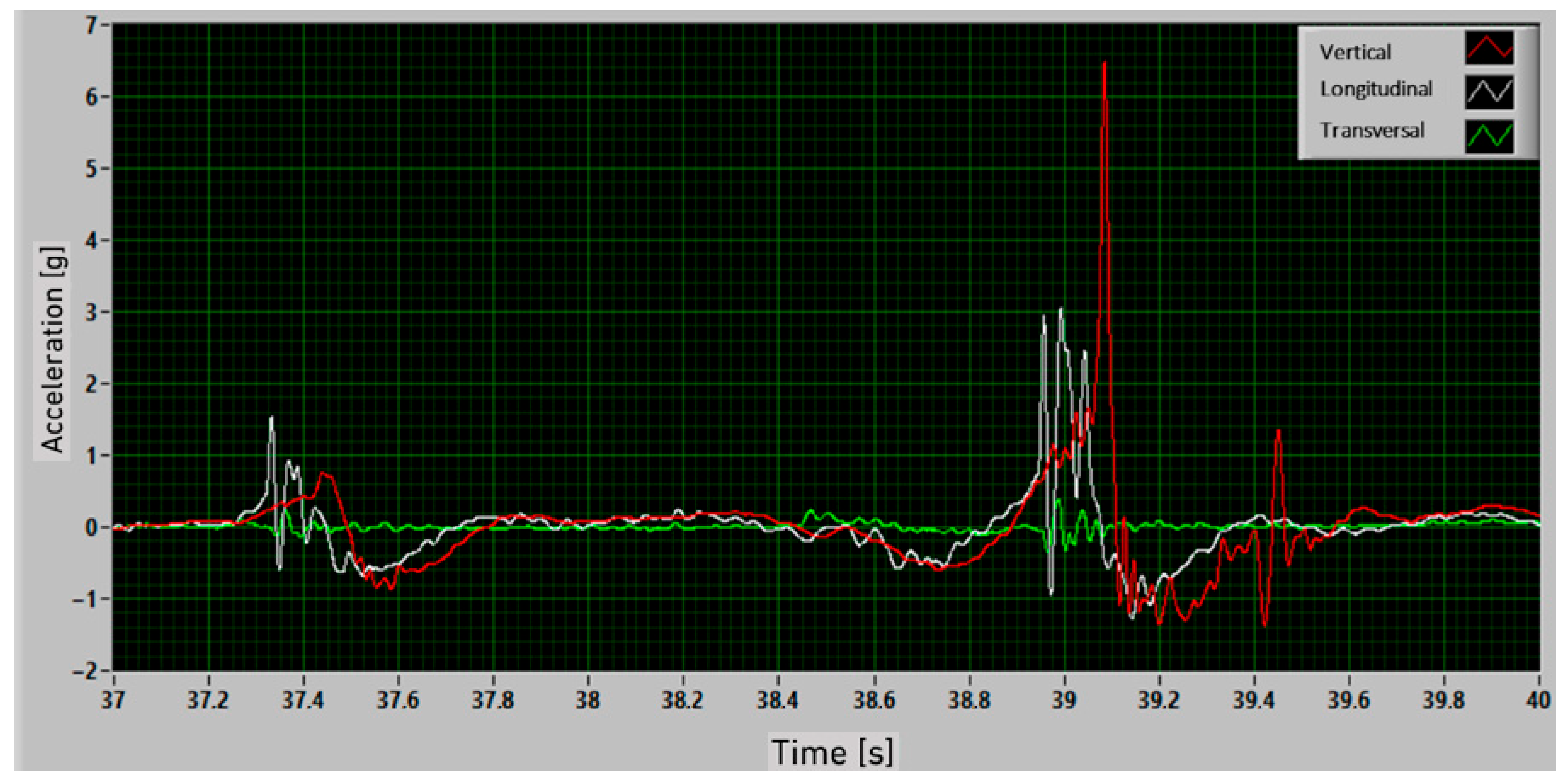
By analyzing the acceleration data collected from the chassis (Figure 16), it appears that, when the front axle starts to pass over the raised crosswalk, the longitudinal acceleration (in white) is higher than the vertical (in red), and both have values between 0 and 1.6 g and 0 and 0.8 g, respectively. However, when the rear axle passes over the raised crosswalk, the maximum vertical accelerations are in excess of 3 g and 6.5 g, respectively. The peak vertical acceleration, with an intensity of 6.5 g, suggests the existence of a short-lived impact phenomenon.
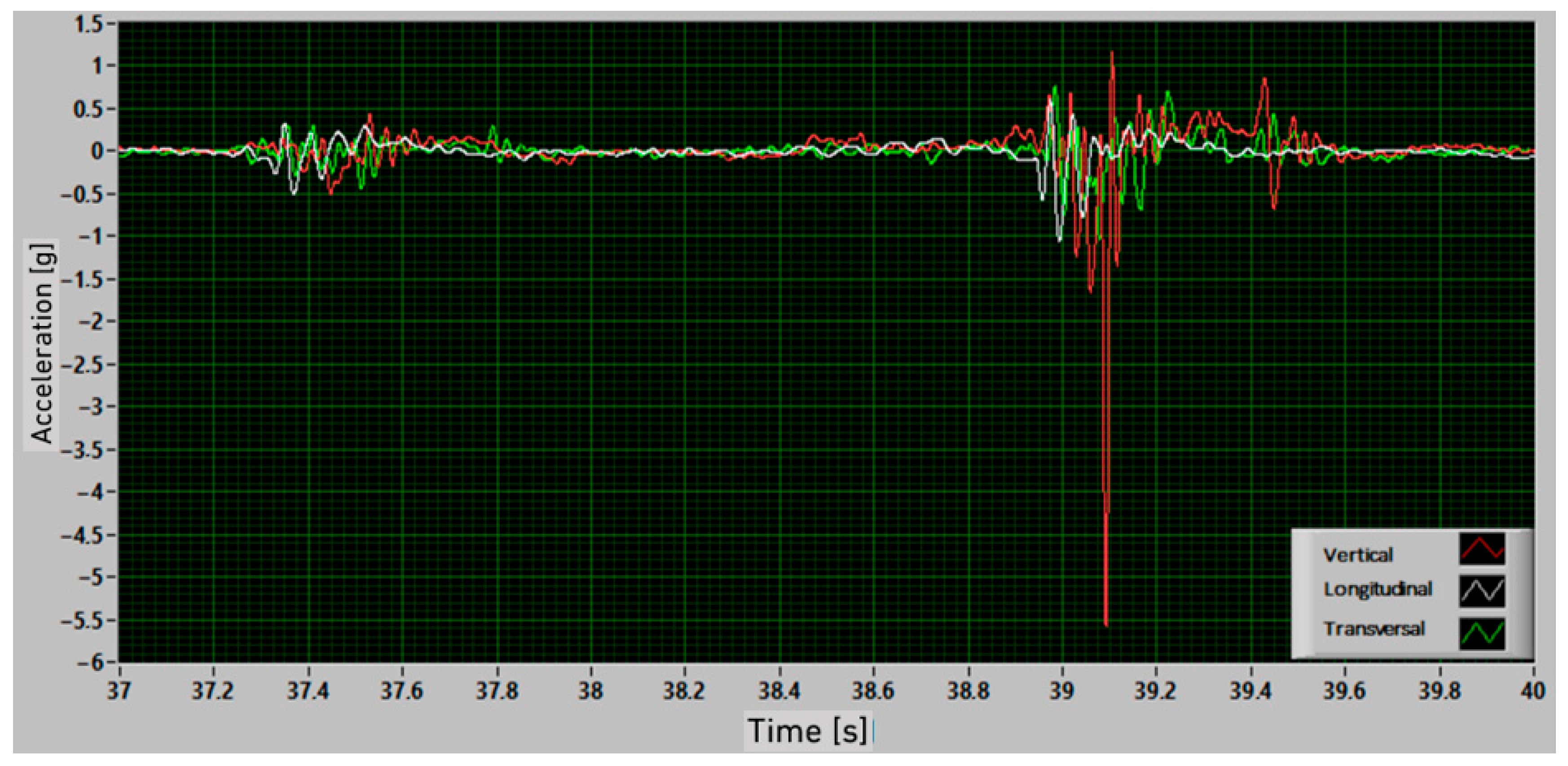
On the other hand, the measurements of the accelerations on the driver’s seat (Figure 17) presented a similar behavior, although attenuated by the suspension of the seat. It should be noted that the maximum vertical acceleration on the seat reaches—5.5 g and is in the opposite direction when compared with the values obtained for the accelerations on the chassis.
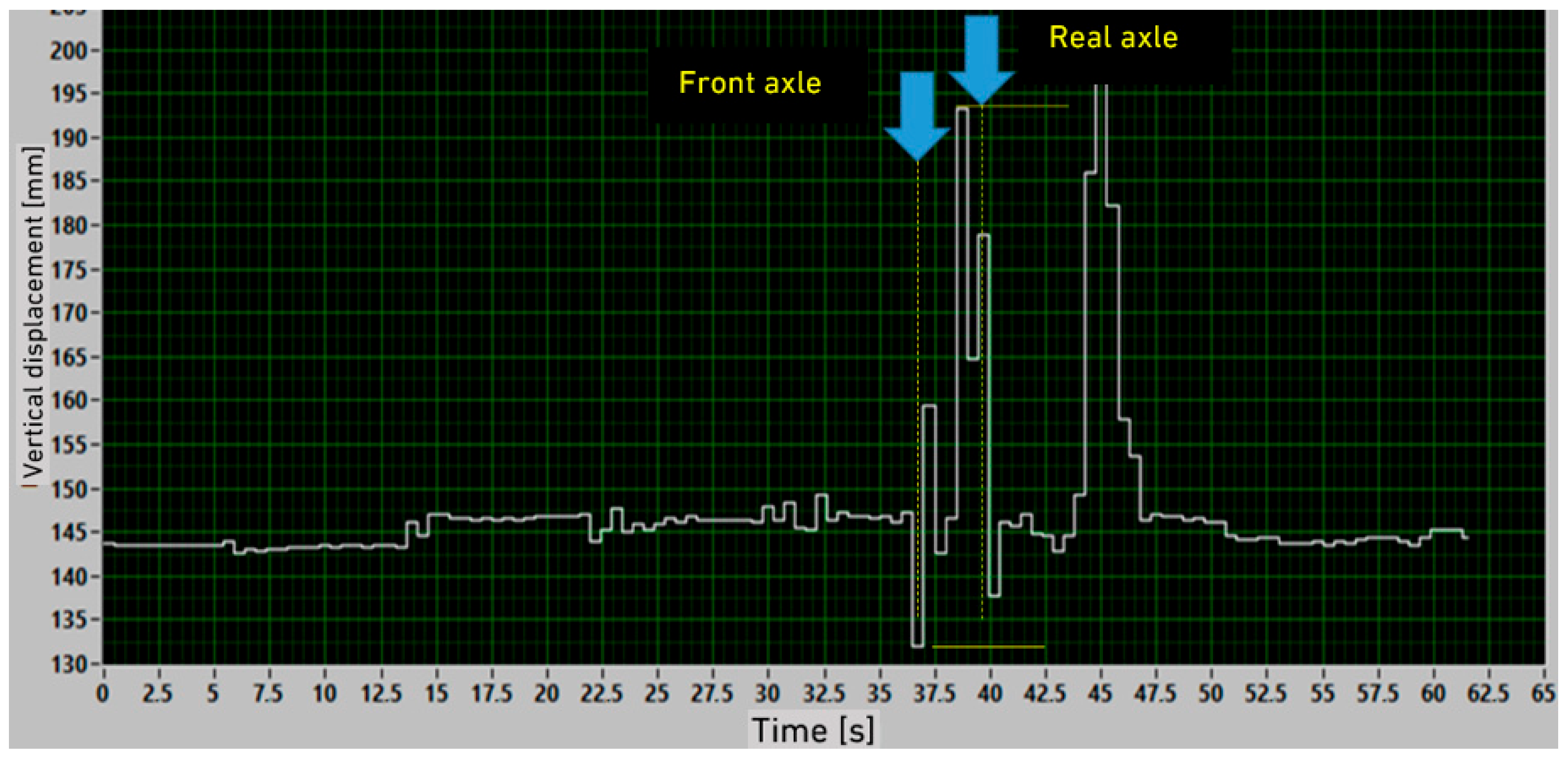
The data collected by the wire sensor show the displacements between the driver’s seat and the bus chassis during the passage over the raised crosswalk (Figure 18). A remarkable vertical displacement was recorded with a maximum amplitude of 61 mm, between the lower point—132 mm—and the upper point—193 mm. The last peak recorded in the graph at 45 s results from a posterior movement of the driver, not directly from the passage of the bus over the obstacle.
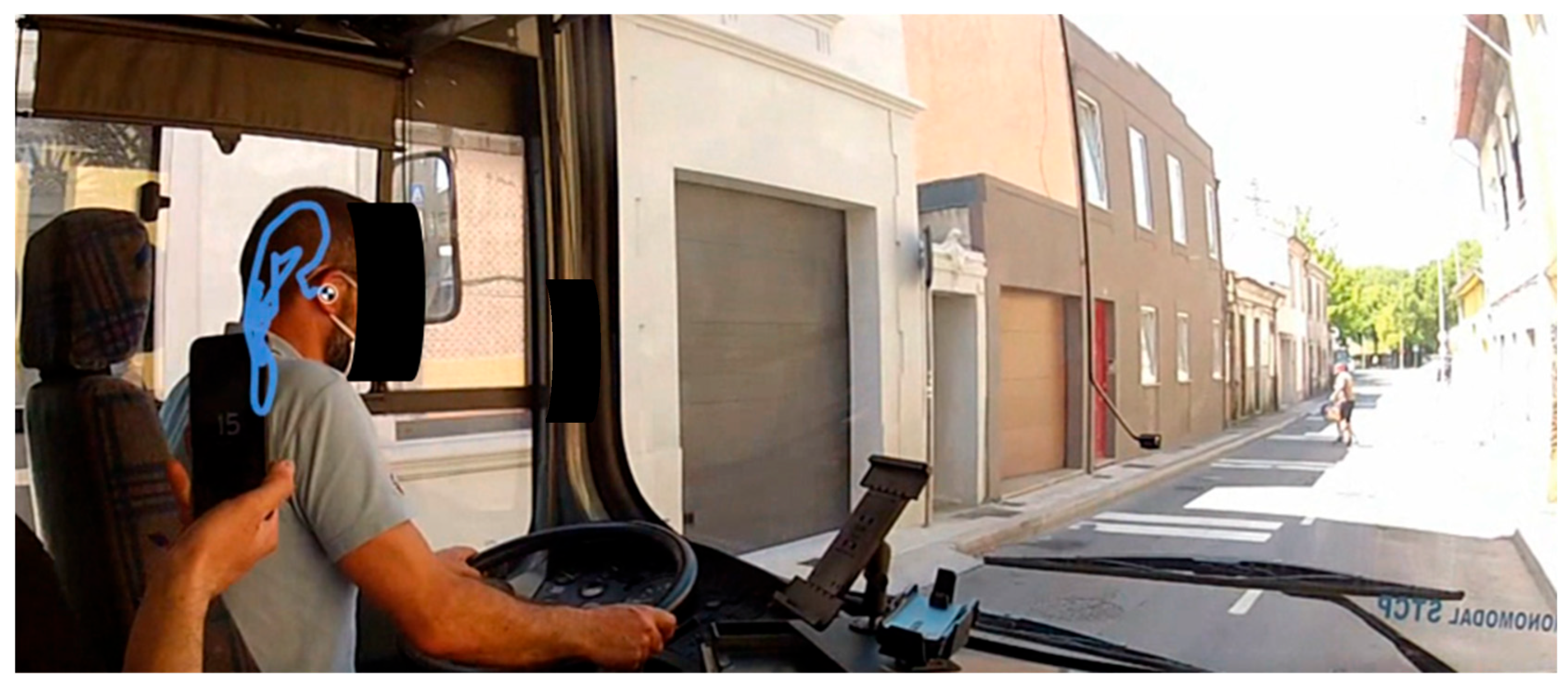
An important aspect of the study was the measurement and identification of the effects of the impact on the driver. Using the video recorded inside the bus, a camera rigidly fixed to the chassis, and a point tracking routine from the Kinovea® program, we intended to evaluate the trajectory of the driver’s head during the passage of both axes over the crossing.
Figure 19 shows the path taken by the driver’s right ear canal, a mark used as a reference, during the passage through the obstacle obtained in the Kinovea® image analysis software.
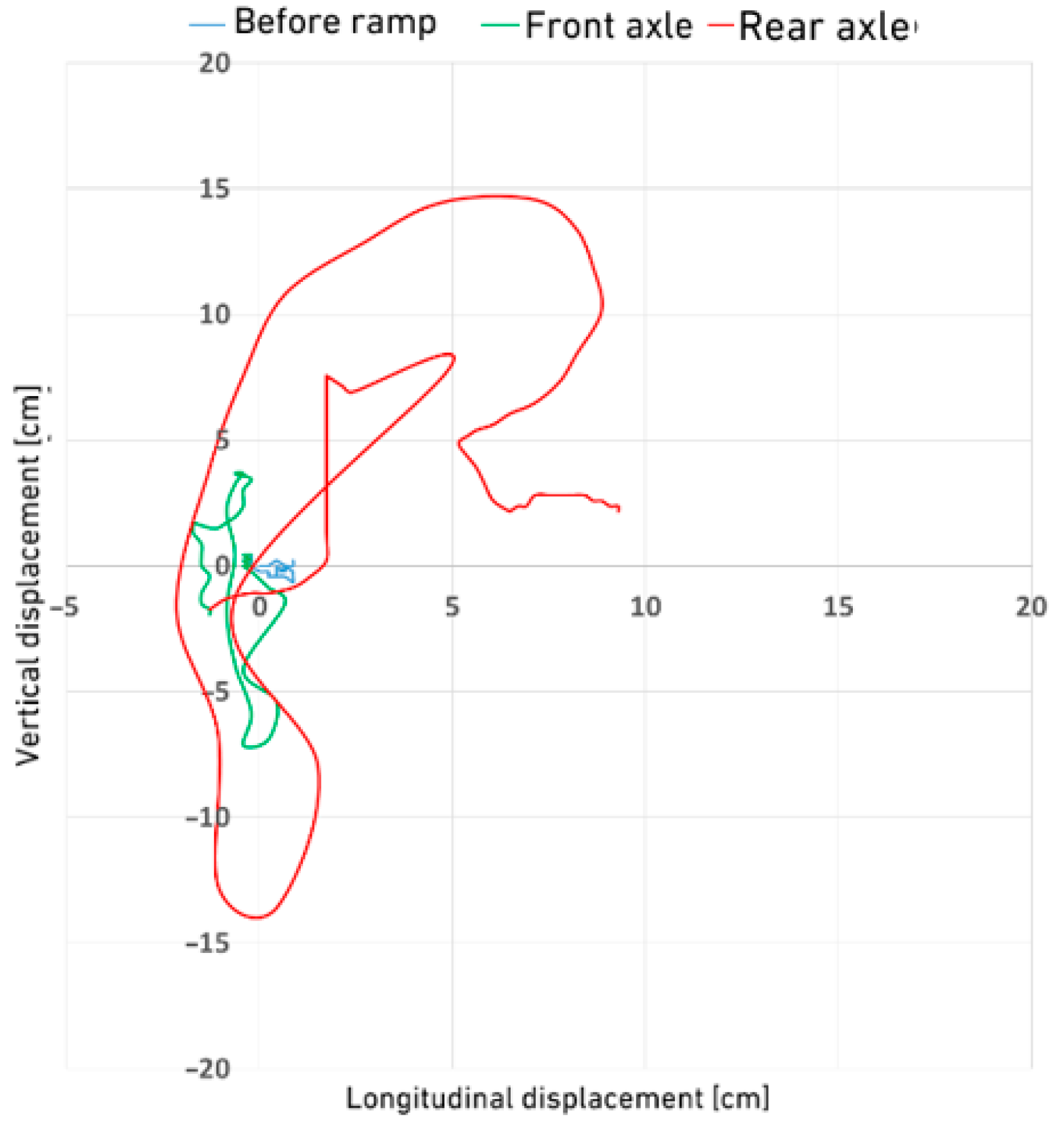
For a better interpretation of these results, a file was created with the coordinates of the reference point, and the graph shown in Figure 20 was drawn. From the results obtained, the main influence on the drive was verified when the rear axle finishes the passage over the raised crosswalk. A displacement of approximately 30 cm was obtained, which means that the driver was almost thrown out of his seat.
It is important to note that the authors also conducted road tests with the bus over speed humps and raised crosswalks with appropriate geometry characteristics. However, the results obtained were not relevant to this study, as the effects on both the bus and driver were very smooth.

3.2. Computational Simulations

The location of the point of impact of the bus with the pavement depends on the vehicle. The point of the bus that hits the pavement and its relative position to the axle was not exactly identified, nor was the speed variation recorded with exact resolution; thus, some uncertainty was admitted in the definition of the distance from the raised crosswalk to the point of impact (3.70 m according to the analysis carried out in the previous chapter).
After adjusting the PC-Crash model, it was simulated passing over the raised crosswalk at a speed of 17 km/h (the same as that recorded in GPS during the first road test). Figure 21 shows the results obtained by the PC-Crash model and, after several simulations with adjustments to the various parameters, it appeared that an error of 0.5 m for this speed would be acceptable, given the uncertainties in the evaluation of the variables considered, the length of the bus (12 m) and the loss-of-control distance travelled by the bus after impact (130 m).
With the PC-Crash model adjusted, several simulations were performed, increasing the speed of the bus. Therefore, it was possible to verify that the bus would have to travel at a speed of approximately 35 km/h to cause the impact with the pavement that created the road marks registered on the day of the accident (red marks highlighted on Figure 22).

3.3. Numerical Model

The numerical model is applied to understand the main causes that led to the bus’s loss of control when running the vehicle on a raised crosswalk. The obtained data are compared with the results recorded during the investigations (road tests and computational simulations).
As some characteristics of the bus were not available, a few assumptions were considered, such as the spring stiffness and the damping constant of the bus suspension system [7,10],
  • Spring stiffness, KFront = 300,000 N/m and KRear = 400,000 N/m;
  • Damping constant, CFront = 17,321 Ns/m and CRear = 20,400 Ns/m (this corresponds to 0.25 of the critical damping constant);
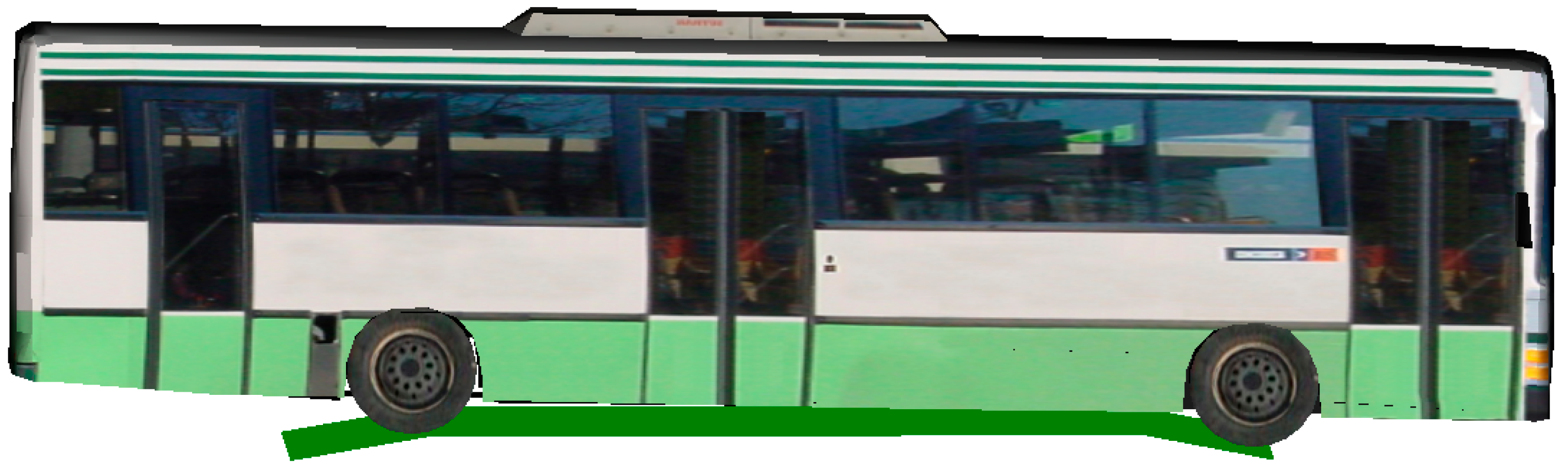
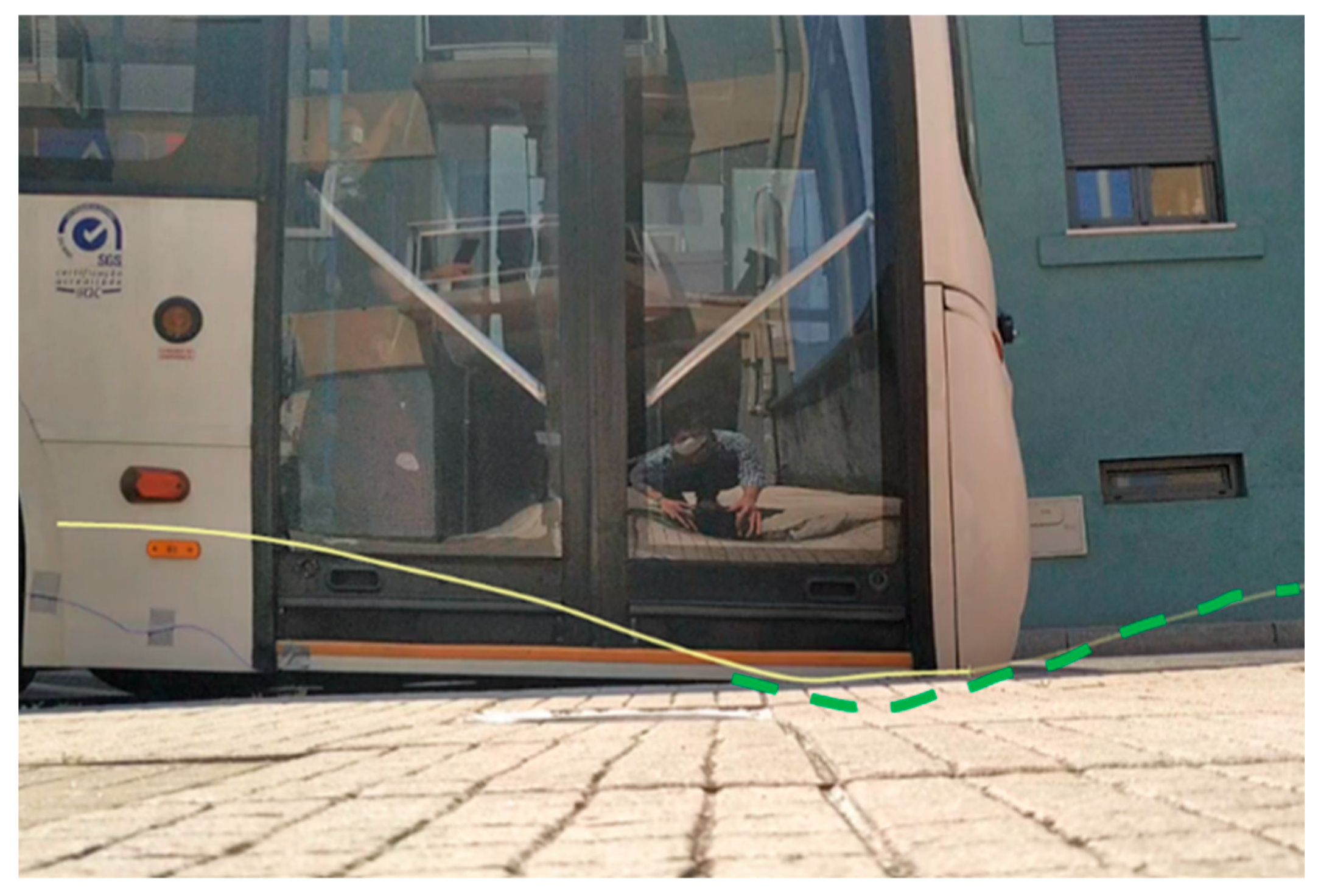
To represent the raised crosswalk on MATLAB software, the raised crosswalk was approximated to a multiple sinus shape, as a smooth approach of a trapezoidal profile, where sharp angular transitions are in reality taken by the tires in a smoothed trajectory at angles. As identified in one of the frames of the videos recorded during the road tests (Figure 23), a sinusoidal-shape trajectory of the vehicle front was truncated due to a road impact on the vehicle. The expected shape of the curve (without any interference from the pavement by contact) could be estimated, and is shown as the dashed green line.
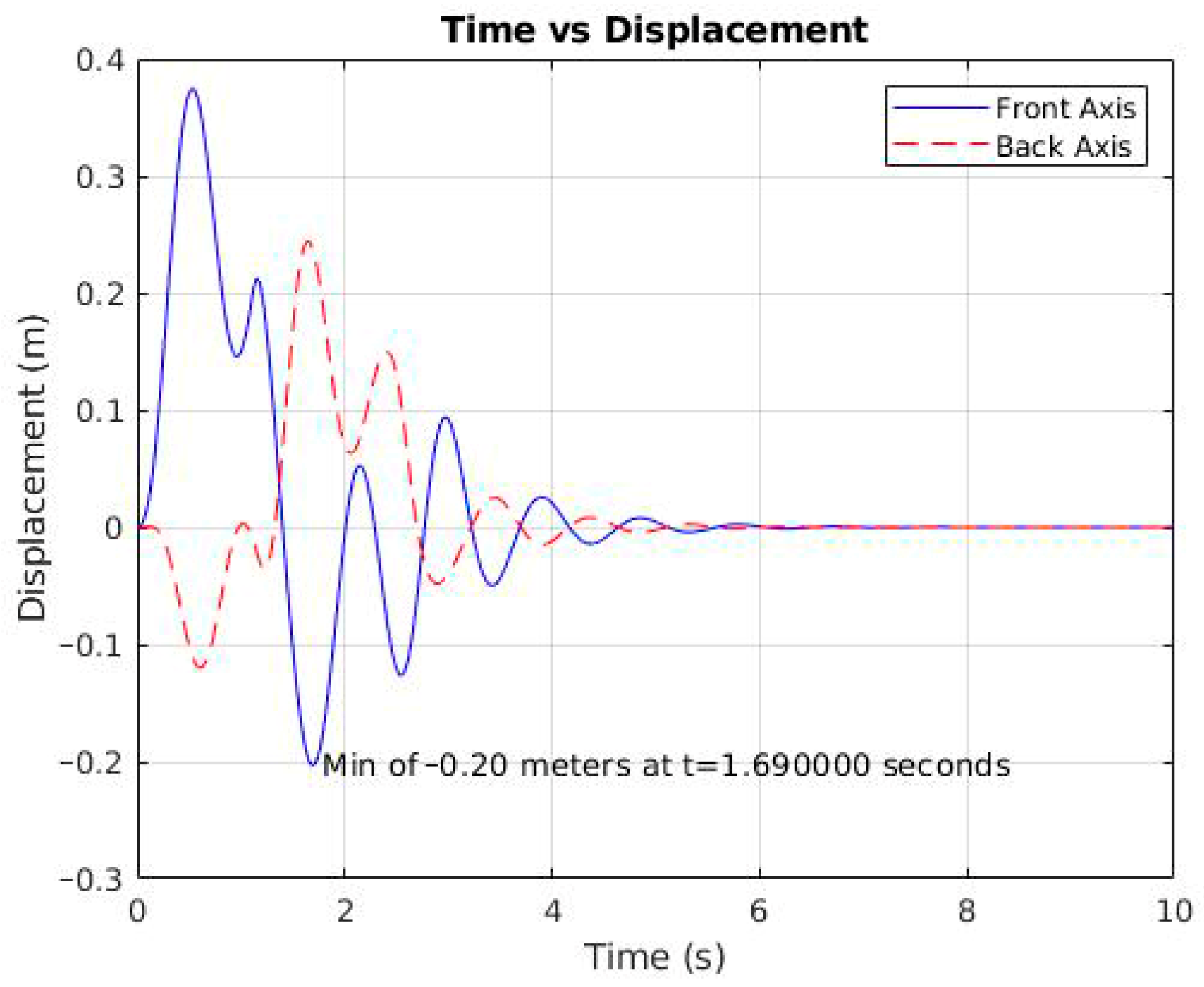
Firstly, the program was run for the velocities used during the road tests and which were also obtained from the computational simulations results. This was undertaken in order to optimize all of the characteristics of the bus (whose geometrical dimensions are presented above, in Figure 1 and Figure 2). It is important to mention that an impact is likely to occur with the pavement when the sum of the maximum negative vertical displacement of the bus passing through the raised crosswalk with the vehicle body bottom height-to-ground is less than 0.
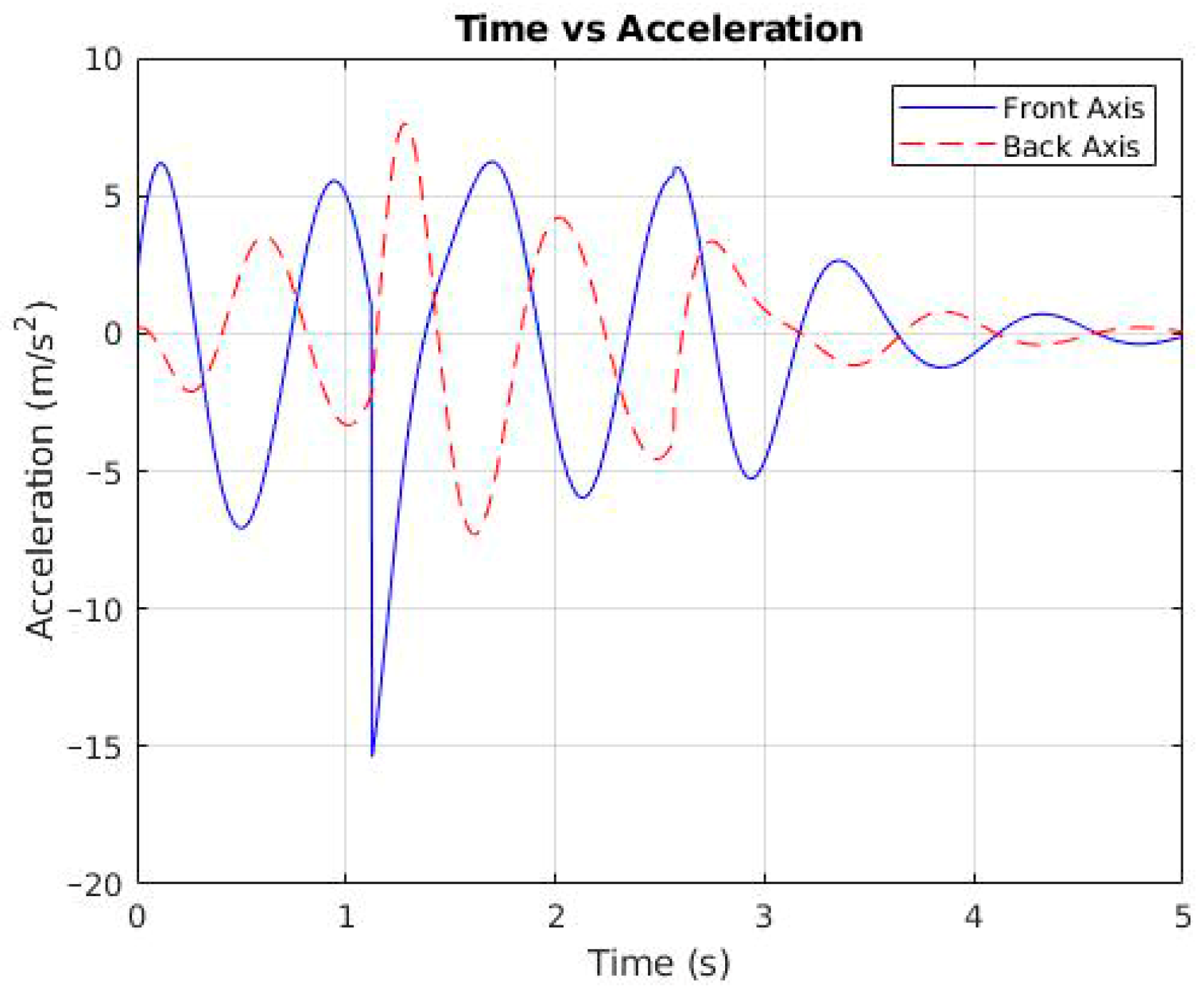
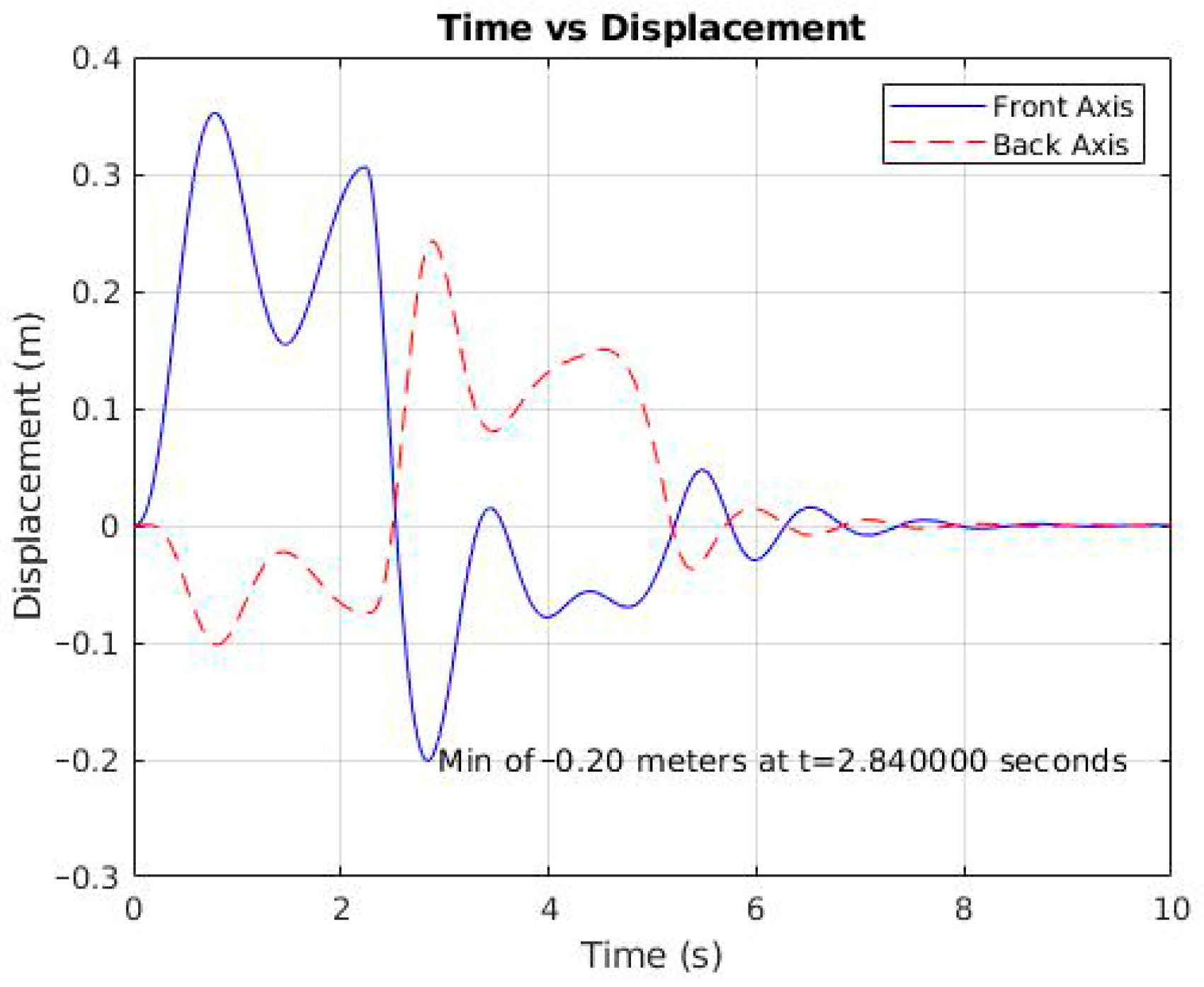
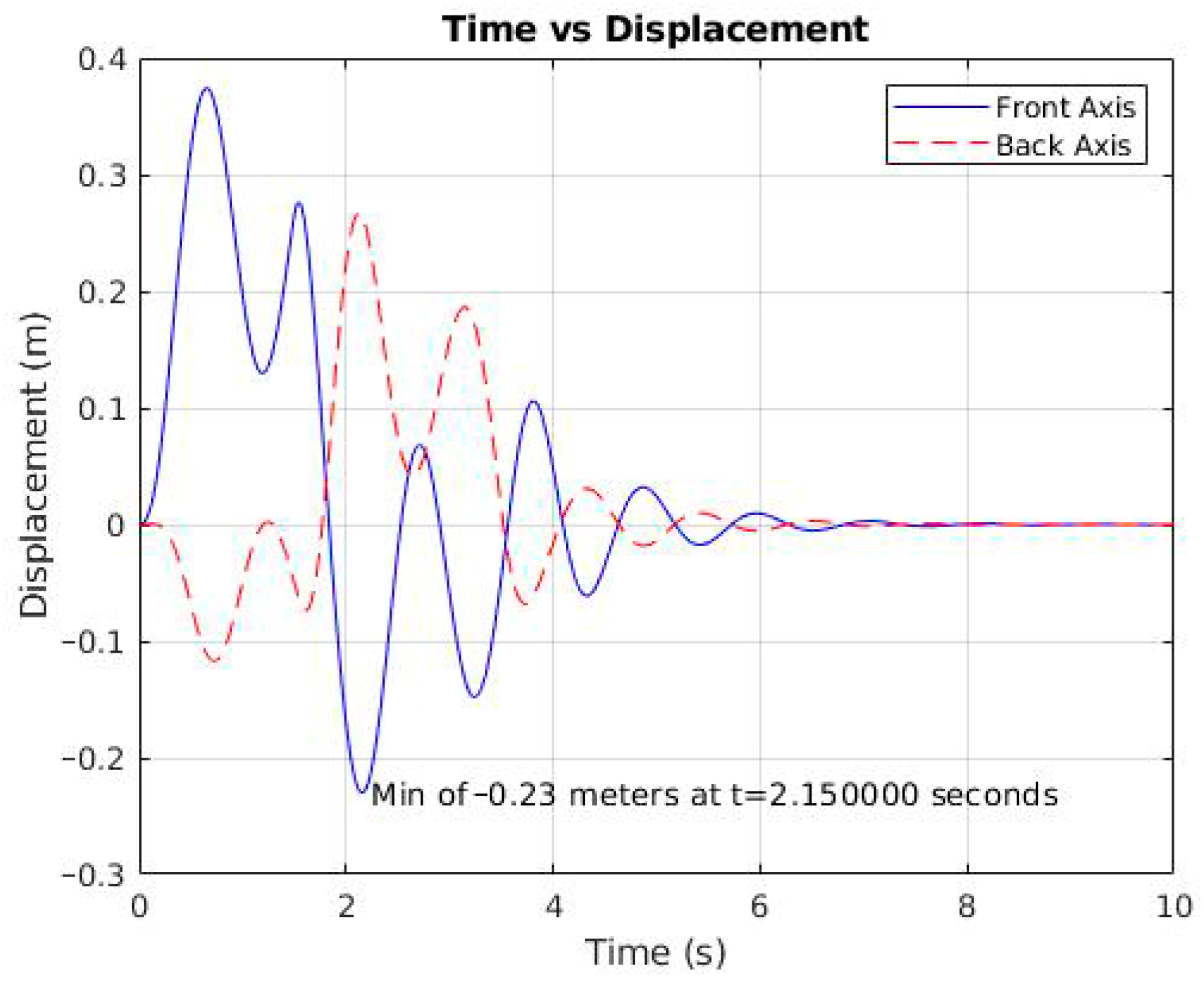
Figure 24 and Figure 25 show the results obtained for the bus running through the raised crosswalk at 20 km/h. For this velocity, an impact occurs between the front axis of the bus and the road pavement. The same episode occurred during the road tests, as per Figure 14. On the other hand, the vertical accelerations obtained compared with the accelerations obtained from the road tests are almost five times less. This can be explained as a result of the vehicle body’s impact against the pavement, a dynamic factor that cannot be evaluated accurately.
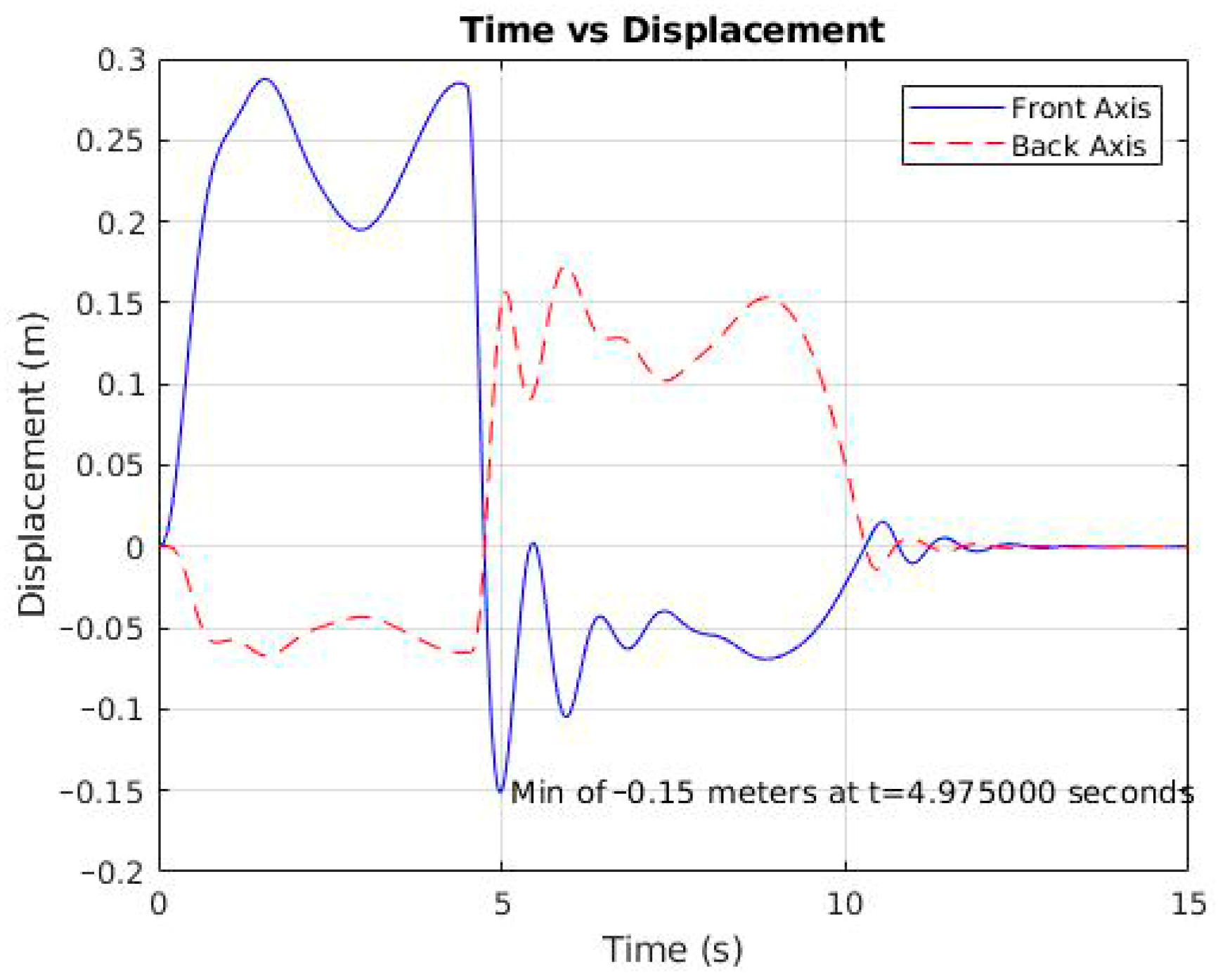
For the bus running at 35 km/h (Figure 26), the value obtained from the computational simulations using the software PC-Crash, which represents the true magnitude of the bus velocity during the accident, indicates that the impact also occurs and with more intensity when compared with the impact at 20 km/h.
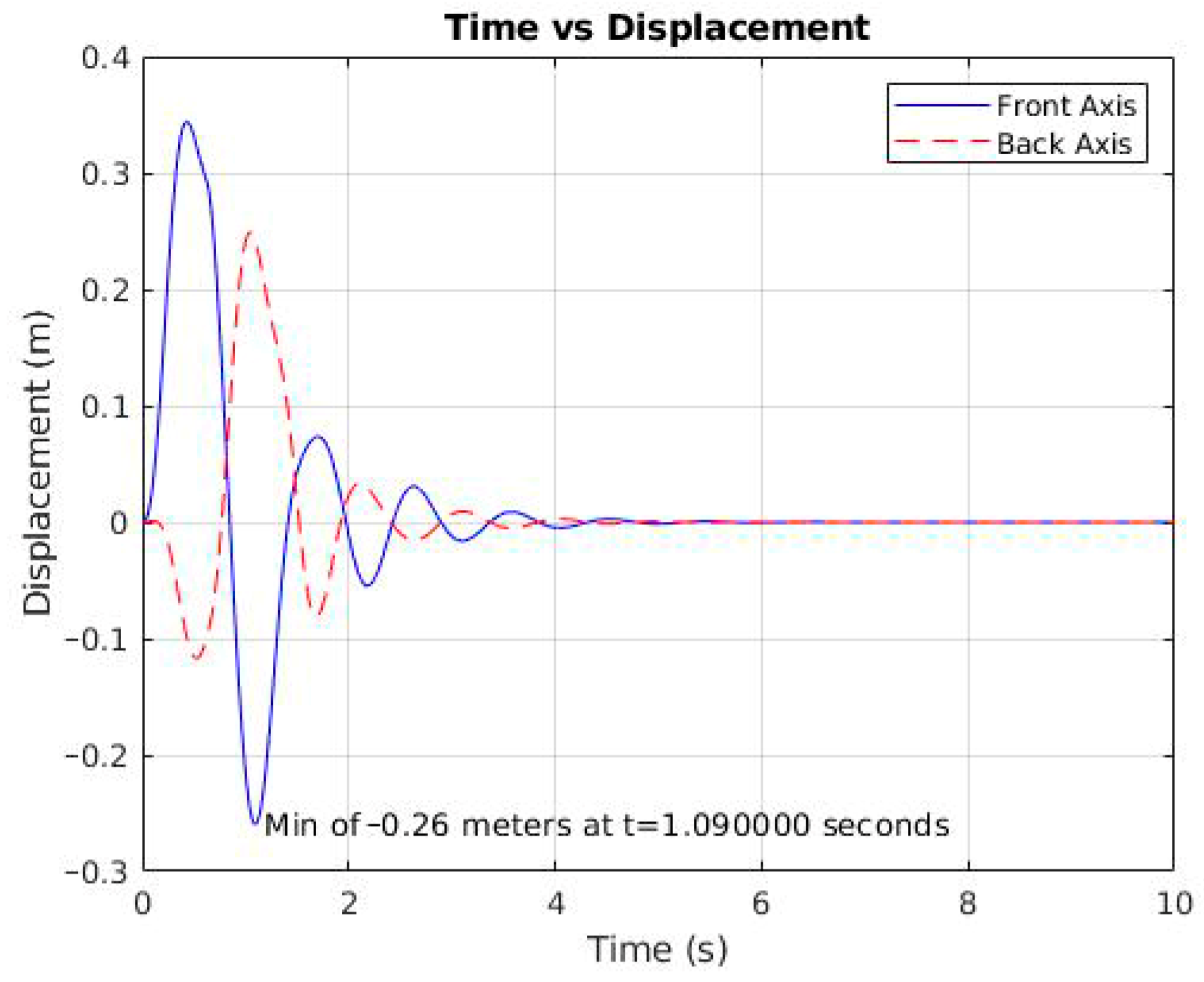
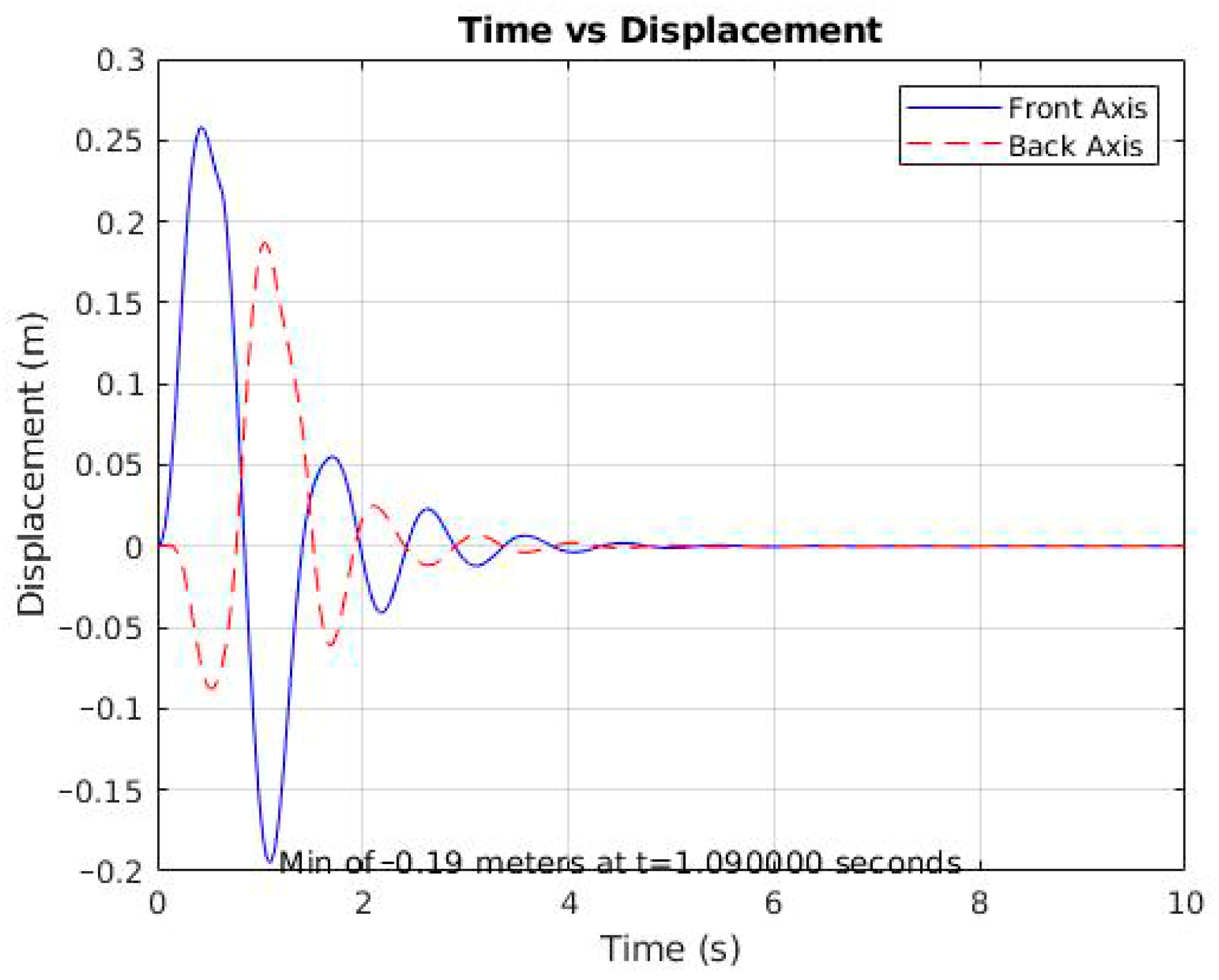
On the other hand, for lower velocities than those performed during the road tests (Figure 27 and Figure 28), the bus does not impact the pavement.
Note that the “negative” displacement gives a virtual interpretation; in fact, such displacements refer to the vehicle body extremes (bottom bumper line) when they evolve to a position lower than the horizontal plane containing the bottom bumper line, if the vehicle is on a flat and perfectly horizontal pavement.
An important note about the vehicle construction and geometry is assigned to the wheelbase Wbase. In the example analyzed, this parameter is 6.25, the mean suspension stiffness is Kmean = 350 kN/m and the vehicle mass is 12,000 kg. Therefore, the fundamental natural vibration mode is as follows:
f 1 = 1 2 π × 4 × 350,000 12,000 = 1.72   H z
The critical speed to run on the raised crosswalk (supposing that its horizontal extension matches the vehicle wheelbase) is given by the wave propagation equation, as follows:
W a v e   V e l o c i t y = W b a s e × f 1 = 6 × 1.72 = 10.32 m s 37   k m / h
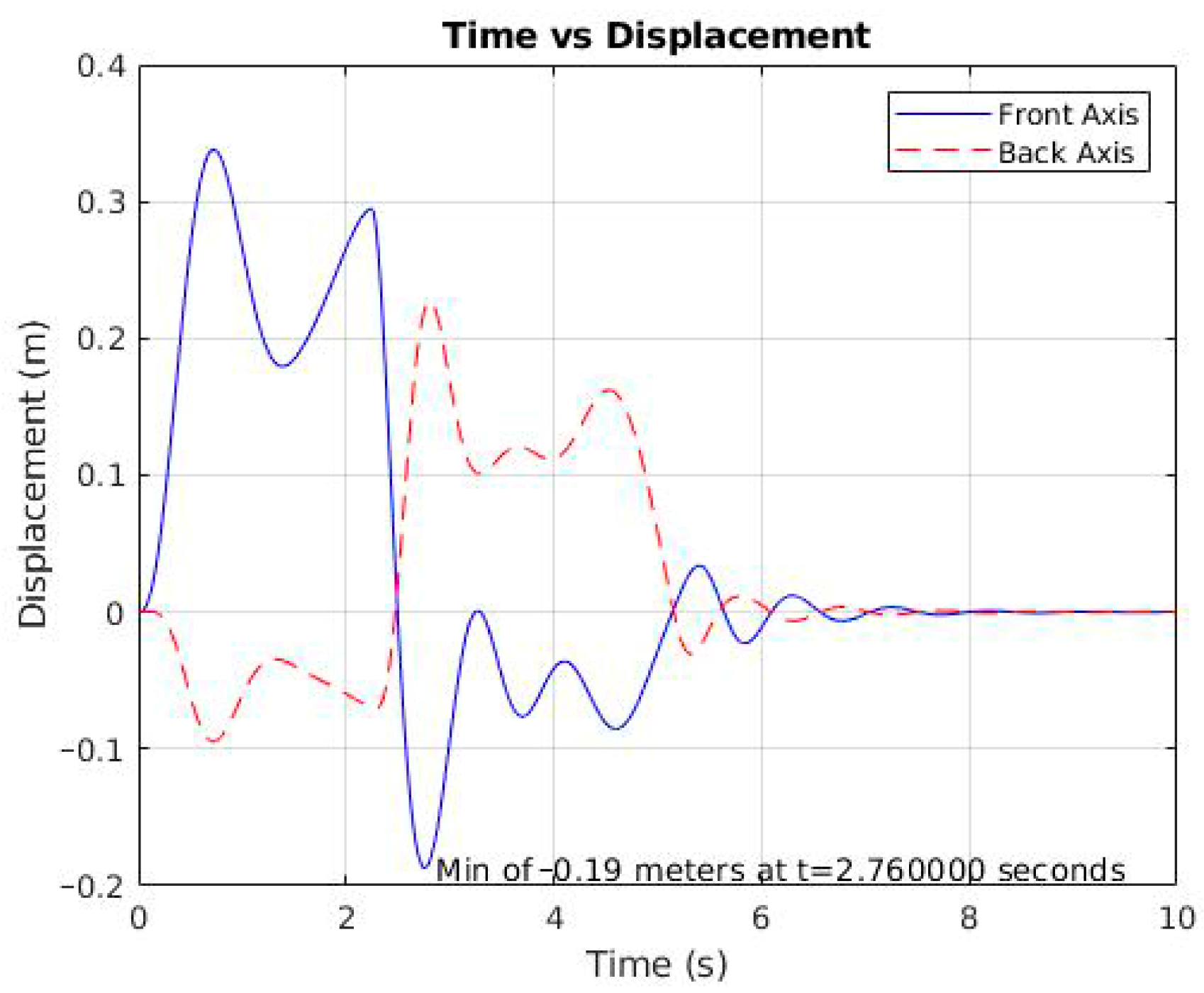
The mass considered until this moment (road tests, computational simulations, and the numerical approach) refers to an empty vehicle. In order to study the influence of the bus running with passengers, an increase of mass—4 tons (representing ≈ 54 passengers each weighing 75 kg)—was added. The results obtained for different velocities are shown in Figure 29 and Figure 30. With this increment of mass, it was found that, at 10 km/h, the front axle hit the pavement, contrary to the case presented previously. Similarly, for 20 km/h, an impact occurs, but with more intensity than the case presented before.
Another example, when considering the initial characteristics of a bus with a 12-ton mass, decreasing the height of the raised crosswalk to 0.15 m, and maintaining the extreme velocity of the bus at 35 km/h, showed that no impact on the pavement occurs (Figure 31).

3.4. Discussion

It was possible to verify that the main factors which contributed to the magnitude of the vertical displacement and accelerations included the bus velocity, the height of the raised crosswalk, and the weight of the bus (considered as unchanged parameters, the suspension stiffness and damping). The road tests and the simulations showed that, for the actual non-standard raised crosswalk geometry, the bus experienced large vertical displacements and rotations, combined with high vertical accelerations at the chassis and driver’s seat. The contact between the bus underneath front shield and the pavement was reproduced both experimentally and numerically at velocities lower than those estimated for the accident. Furthermore, it was possible to demonstrate by the numerical model that by increasing the bus mass (fully loaded), the accelerations and displacements obtained would be even higher, indicating that the margin of safety is very small for the raised crosswalk under analysis and that modest increase in the velocity or mass can trigger impacts. Finally, the reconstructed accident velocity obtained from the PC-Crash® software, obtained by matching the position of the pavement marks, was compatible with the more severe response scenarios identified in the numerical model.
An important outcome of the results was the geometric similarity between the upper longitudinal dimension of the raised crosswalk to the bus wheelbase. This configuration enhanced the dynamic effect of the passage of the axles and led to vehicle impact on pavement, intensifying the bus frontal pitch effect.
From the experimental road tests, it was also observed that the non-standard raised crosswalk geometry had a significant effect on the bus driver, who experienced a displacement of around 30 cm and high vertical accelerations. These results were obtained under low and controlled speeds during the road tests; nevertheless, similar conditions at higher speeds, such as those on the day of the accident, could lead to serious discomfort or even health risks.
Finally, the hybrid approach, combining on-site experimental road tests, computational simulations, and numerical analysis, provided a consistent picture of how the raised crosswalk affected the dynamic behavior of the bus and the safety of the driver. This combined methodology offered a more robust basis for interpreting the accident and for extrapolating design recommendations than any single technique used in isolation. The PC-Crash® simulations allowed us to obtain the speed range on the day of the accident, considering the pavement impact marks—approximately 36 km/h. The experimental tests confirmed that the simplified finite-element model could replicate the main features of the bus response for known speeds. Finally, the numerical model itself enabled a simulation of the systematic variation of speed, loading condition, and crosswalk geometry beyond what is feasible in the field.

4. Conclusions

The dynamic behavior of a bus running on a raised crosswalk was studied. A simple and practical finite element model, representing the vehicle as a single rigid body with the essential inertial parameters, was developed to study the vehicle oscillation on a vertical plane as it crosses a raised crosswalk. The effect of the raised crosswalk on the vehicle response was modelled with good accuracy, and all of the numerical results obtained were compared with a real-world vehicle accident investigation, which included experimental road tests and computational simulations using the software PC-Crash.®
The results obtained from the applied hybrid methodology showed that the combination of the non-standard raised crosswalk geometry, a longitudinal length close to the bus wheelbase, and the effects of an increasing speed led to large vertical displacements, body impact with the pavement, and high vertical accelerations at the driver’s position. The main factors that contributed to the magnitude of the vertical displacement included the height of the raised crosswalk, the speed of the bus, and the vehicle’s weight. To mitigate these issues, several measures could be considered, such as reducing the height of the raised crosswalk, redesigning the crosswalk with a smoother transition to minimize the vertical displacement, redesigning the bus geometry, or optimizing suspension parameters.
The main limitation of the proposed methodology is regarding the possibility of reduced accuracy in case of body collapse (non-linear deformation for plasticity) due to severe impacts with the pavement, which may alter the structural geometry and, consequently, the dynamic response.
Future work should focus on extending the developed methodology to the estimation of tire forces and their influence on the driver, the vehicle, and the pavement. Moreover, the study could be extended to different vehicle categories and various vertical calming devices geometries. Additional experimental road tests could also be included, considering different raised crosswalk geometries and bus loading conditions, which would further refine the construction design recommendations and help define quantitative safety and comfort thresholds.

Author Contributions

Conceptualization, F.C. and M.A.P.V.; methodology, F.C. and F.Q.d.M.; software, F.C. and N.V.R.; validation, M.A.P.V.; formal analysis, F.C.; investigation, F.C. and M.A.P.V.; resources, M.A.P.V. and P.M.G.P.M.; writing—original draft preparation, F.C.; writing—review and editing, M.A.P.V.; visualization, F.C.; supervision, P.M.G.P.M. and M.A.P.V.; project administration, F.C. All authors have read and agreed to the published version of the manuscript.

Funding

This research received no external funding.

Institutional Review Board Statement

Not applicable.

Informed Consent Statement

Not applicable.

Data Availability Statement

The data presented in this study are available on request from the corresponding author.

Conflicts of Interest

The authors declare no conflicts of interest.

References

  1. Parkhill, M.; Eng, P.; Sooklall, R.; Sc, M.A.; Bahar, G. Updated Guidelines for the Design and Application of Speed Humps. In Proceedings of the ITE 2007 Annual Meeting and Exhibit, Pittsburgh, PA, USA, 5–8 August 2007. [Google Scholar]
  2. Loprencipe, G.; Moretti, L.; Pantuso, A.; Banfi, E. Raised pedestrian crossings: Analysis of their characteristics on a road network and geometric sizing proposal. Appl. Sci. 2019, 9, 2844. [Google Scholar] [CrossRef]
  3. Gonzalo-Orden, H.; Pérez-Acebo, H.; Unamunzaga, A.L.; Arce, M.R. Effects of traffic calming measures in different urban areas. Transp. Res. Procedia 2018, 33, 83–90. [Google Scholar] [CrossRef]
  4. Jasiūnienė, V.; Pociūtė, G.; Vaitkus, A.; Ratkevičiūtė, K.; Pakalnis, A. Analysis and evaluation of trapezoidal speed humps and their impact on the driver. Balt. J. Road Bridge Eng. 2018, 13, 104–109. [Google Scholar] [CrossRef]
  5. Frej, D.P.; Zuska, A.; Cadge, K. Analysis of vertical vibrations affecting a child transported in a child seat during a car passing over the release speed bump. Arch. Motoryz. 2019, 86, 111–125. [Google Scholar] [CrossRef]
  6. D’Apuzzo, M.; Evangelisti, A.; Santilli, D.; Nardoianni, S.; Cappelli, G.; Nicolosi, V. Towards a New Design Methodology for Vertical Traffic Calming Devices. Sustainability 2023, 15, 13381. [Google Scholar] [CrossRef]
  7. Nardoianni, S. Statistical Analysis of Experimental Crossing Speed on Vertical Traffic Calming Devices: Influence of Vehicle Category and Road Safety Implications. In Proceedings of the International Conference on Computational Science and Its Applications, Istanbul, Turkey, 30 June–3 July 2025; 2025. [Google Scholar]
  8. Majer, S.; Sołowczuk, A. Effectiveness of a Series of Road Humps on Home Zone Streets: A Case Study. Sustainability 2025, 17, 644. [Google Scholar] [CrossRef]
  9. Sekulić, D.; Dedović, V.; Rusov, S.; Šalinić, S.; Obradović, A. Analysis of vibration effects on the comfort of intercity bus users by oscillatory model with ten degrees of freedom. Appl. Math. Model. 2013, 37, 8629–8644. [Google Scholar] [CrossRef]
  10. Lopes, R.; Farahani, B.V.; Melo, F.Q.d.; Moreira, P.M.G.P. A Dynamic Response Analysis of Vehicle Suspension System. Appl. Sci. 2023, 13, 2127. [Google Scholar] [CrossRef]
  11. Lopes, R.; Farahani, B.V.; Melo, F.Q.d.; Ramos, N.V.; Moreira, P.M.G.P. Dynamic modal analysis of a passenger bus: Theoretical and numerical studies. Transp. Res. Rec. 2021, 2675, 264–279. [Google Scholar] [CrossRef]
  12. Lopes, R.; Farahani, B.V.; Melo, F.Q.d.; Ramos, N.V.; Moreira, P.M.G.P. Numerical and theoretical modal analysis of transit buses. Procedia Struct. Integr. 2021, 37, 73–80. [Google Scholar] [CrossRef]
  13. Sekulic, D.; Dedović, V. The Effect of Stiffness and Damping of the Suspension System Elements on the Optimisation of the Vibrational Behaviour of a Bus. 2011. Available online: https://www.researchgate.net/publication/232613306 (accessed on 27 January 2023).
  14. Road and Transport Research Association; FGSV. Directives for the Design of Urban Roads, RAST 06; FGSV: Cologne, Germany, 2006. [Google Scholar]
  15. Newmark, N.M. A Method of Computation for Structural Dynamics. Trans. Am. Soc. Civ. Civil Eng. 1962, 127, 1406–1433. [Google Scholar] [CrossRef]
  16. ISO 10326-1:2016; Mechanical Vibration-Laboratory Method for Evaluating Vehicle Seat Vibration-Part 1: Basic Requirements. International Organization for Standardization: Geneva, Switzerland, 2016.
  17. GmbH, D.S.D. PC-CRASH. A Simulation Program for Vehicle Accidents Operating and Technical Manual. 2022. Available online: www.pc-crash.com (accessed on 6 February 2023).
  18. Castro, F.; Melo, F.Q.d.; Faria, D.; Ramos, N.V.; Moreira, P.M.G.P.; Vaz, M.A.P. The Dynamic Behavior of Heavy Vehicles in Cornering Actions: An Assessment of the Problem. Appl. Sci. 2025, 15, 11959. [Google Scholar] [CrossRef]
Figure 1. Main dimensions (geometry) of the bus.
Applsci 15 13191 g001
Figure 2. Geometry of the raised crosswalk.
Applsci 15 13191 g002
Figure 3. Marks left on the pavement by the impact of the lower front part of the bus on the accident day.
Applsci 15 13191 g003
Figure 4. Bus suspension system.
Applsci 15 13191 g004
Figure 5. Shape of the road profile. This is given by an analytical function of the type y = f(x).
Applsci 15 13191 g005
Figure 6. Frequency response function for the driver’s seat accelerations to select a cut-off frequency of 44 Hz.
Applsci 15 13191 g006
Figure 7. Location of the sensors in the bus chassis and under the driver’s seat.
Applsci 15 13191 g007
Figure 8. Location and axis systems for the accelerometers installed in the bus. (a) Accelerometer installed in the chassis, front right side. (b) Accelerometer installed in the driver’s seat.
Applsci 15 13191 g008
Figure 9. Driver’s seat vertical displacement measurement. (a) Location of the draw wire displacement sensor installed in the driver’s seat. (b) Driver’s seat suspension displacement measured for a user weighing 71 kg.
Applsci 15 13191 g009
Figure 10. Bus model used in PC-Crash simulations.
Applsci 15 13191 g010
Figure 11. Bus model and raised crosswalk model used in PC-Crash. Example of the dynamic behavior of the bus during the lowering of the front axle and the simultaneous raising of the rear axle.
Applsci 15 13191 g011
Figure 12. Path of the fixed reference point for the bus trajectory.
Applsci 15 13191 g012
Figure 13. Vertical and horizontal displacements of the fixed reference point on the bus structure during the passage of the front axle over the entrance of the raised crosswalk.
Applsci 15 13191 g013
Figure 14. Marks on the pavement produced by the bus impact. (a) Impact of the lower front part of the bus on the pavement during the road tests. (b) Marks left on the pavement by the impact of the lower front part of the bus.
Applsci 15 13191 g014
Figure 15. Distance between pavement marks measured during the road tests and on the accident day.
Applsci 15 13191 g015
Figure 16. Accelerations, collected on the chassis, along the 3 axes (x, y, z).
Applsci 15 13191 g016
Figure 17. Accelerations, collected on the driver’s seat, along the 3 axes (x, y, z).
Applsci 15 13191 g017
Figure 18. Vertical displacement, for the passage at 20 km/h, between the driver’s seat and the chassis.
Applsci 15 13191 g018
Figure 19. Trajectory of the driver’s right ear canal (blue line) obtained by video tracking during the passage over the raised crosswalk at a velocity of about 20 km/h.
Applsci 15 13191 g019
Figure 20. Trajectory described by the driver’s head as the bus passes over the raised crosswalk at 20 km/h.
Applsci 15 13191 g020
Figure 21. Distance between the impact marks resulting from the passage of the bus at 17 km/h and the point of impact obtained in the PC-Crash model.
Applsci 15 13191 g021
Figure 22. Ground impact point for a speed of 35 km/h.
Applsci 15 13191 g022
Figure 23. The sinusoidal-shaped trajectory of the bus during the road tests.
Applsci 15 13191 g023
Figure 24. Vertical displacement results obtained for a bus running at 20 km/h.
Applsci 15 13191 g024
Figure 25. Vertical acceleration results obtained for a bus running at 20 km/h.
Applsci 15 13191 g025
Figure 26. Vertical displacement results obtained for a bus running at 35 km/h.
Applsci 15 13191 g026
Figure 27. Vertical displacement results obtained for a bus running at 10 km/h.
Applsci 15 13191 g027
Figure 28. Vertical displacement results obtained for a bus running at 5 km/h.
Applsci 15 13191 g028
Figure 29. Vertical displacement results obtained for a bus (weighing 16 tons) running at 10 km/h.
Applsci 15 13191 g029
Figure 30. Vertical displacement results obtained for a bus (weighing 16 tons) running at 20 km/h.
Applsci 15 13191 g030
Figure 31. Vertical displacement results obtained for a bus running at 35 km/h (raised crosswalk height of 0.15 m).
Applsci 15 13191 g031
Disclaimer/Publisher’s Note: The statements, opinions and data contained in all publications are solely those of the individual author(s) and contributor(s) and not of MDPI and/or the editor(s). MDPI and/or the editor(s) disclaim responsibility for any injury to people or property resulting from any ideas, methods, instructions or products referred to in the content.