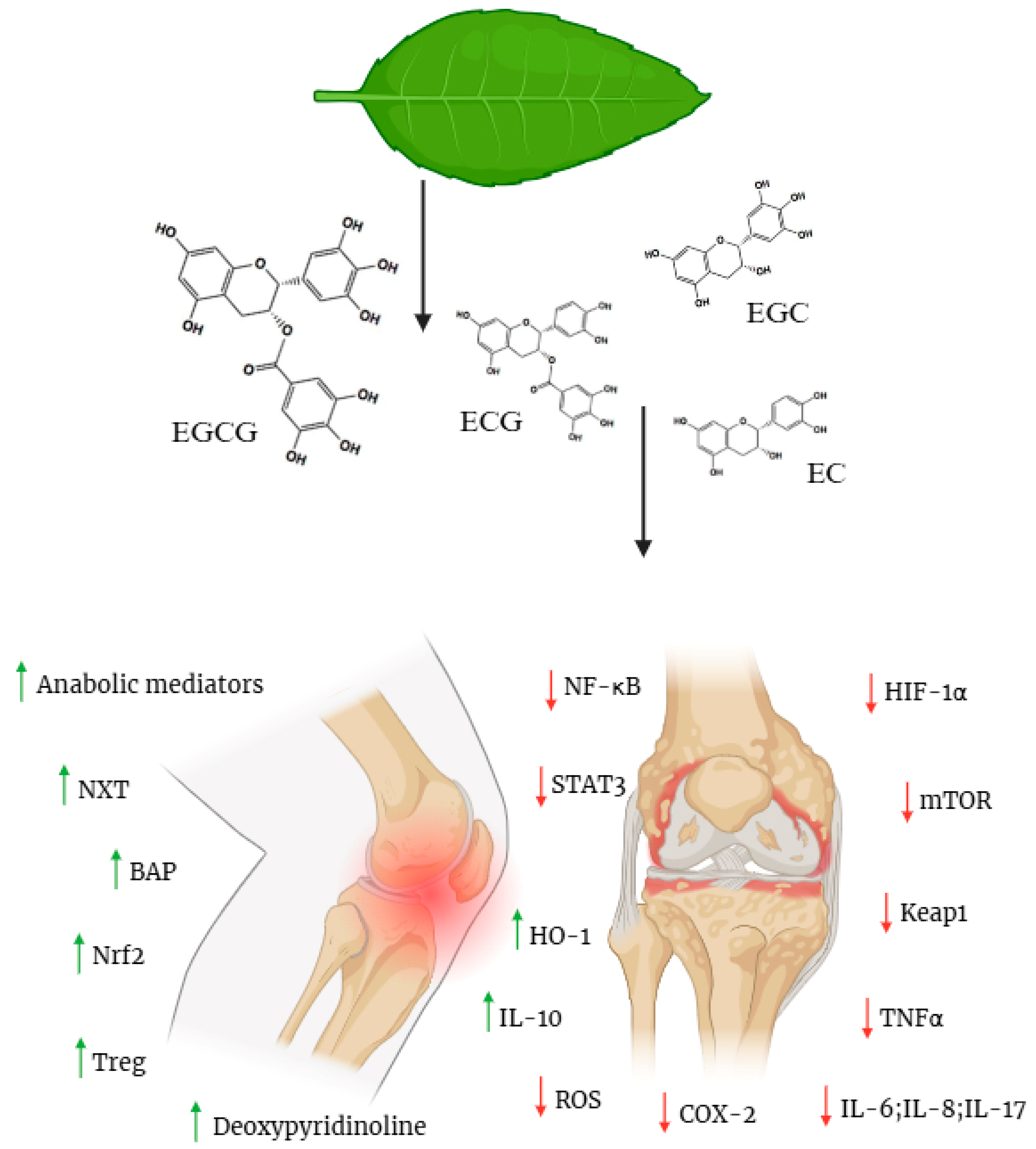
Green Tea Catechins in Osteoarthritis and Rheumatoid Arthritis: Narrative Review of the Available Literature in the Context of Pathogenesis and Treatment Prospects


Abstract
1. Introduction
2. Mechanisms of Action of Green Tea Catechins
2.1. Anti-Inflammatory Action
2.2. Antioxidant Activity
2.3. Regulation of Cartilage Degradation Processes
2.4. Regulation of Autophagy and Apoptosis in Joint Cells
3. Animal Models
3.1. Osteoarthritis
3.2. Rheumatoid Arthritis
4. In Vitro Studies
5. Clinical Trials
5.1. Osteoarthritis
5.2. Rheumatoid Arthritis
6. Discussion and Conclusions
Author Contributions
Funding
Institutional Review Board Statement
Informed Consent Statement
Data Availability Statement
Conflicts of Interest
Abbreviations
| ACLT | Anterior cruciate ligament transection |
| AGE | Advanced glycation end-product |
| ARE | Antioxidant response element |
| CIA | collagen-induced inflammation |
| CITED2 | Interacting Transactivator |
| COX-2 | Cyclooxygenase 2 |
| DMARDs | Disease-modifying antirheumatic drugs |
| DMM | The surgical destabilization of the medial meniscus |
| EC | Epicatechin |
| ECG | Epicatechin gallate |
| EGCG | Epigallocatechin gallate |
| HIF-1α | Hypoxia-inducible factor alpha |
| HO-1 | Heme oxygenase-1 |
| IL | Interleukin |
| iNOS | Inducible nitric oxide synthase |
| IP-10 | Interferon-γ-inducible protein-10 |
| MMP | Matrix metalloproteinase |
| mTOR | Mechanistic target of rapamycin |
| Nrf2 | Nuclear factor erythroid 2-related factor 2 |
| NSAIDs | Nonsteroidal anti-inflammatory drugs |
| OA | Osteoarthritis |
| PGE2 | Prostaglandin E2 |
| RA | Rheumatoid arthritis |
| RNS | Reactive nitrogen species |
| ROS | Reactive oxygen species |
| TAC | Total antioxidant capacity |
| TNF-α | Tumor necrosis factor alpha |
References
- Xie, X.; Fu, J.; Gou, W.; Qin, Y.; Wang, D.; Huang, Z.; Wang, L.; Li, X. Potential mechanism of tea for treating osteoporosis, osteoarthritis, and rheumatoid arthritis. Front. Med. 2024, 11, 1289777. [Google Scholar] [CrossRef]
- Gao, Y.; Zhang, Y.; Liu, X. Rheumatoid arthritis: Pathogenesis and therapeutic advances. Medcomm 2024, 5, e509. [Google Scholar] [CrossRef]
- Cai, Y.; Zhang, J.; Liang, J.; Xiao, M.; Zhang, G.; Jing, Z.; Lv, L.; Nan, K.; Dang, X. The Burden of Rheumatoid Arthritis: Findings from the 2019 Global Burden of Diseases Study and Forecasts for 2030 by Bayesian Age-Period-Cohort Analysis. J. Clin. Med. 2023, 12, 1291. [Google Scholar] [CrossRef]
- Giorgino, R.; Albano, D.; Fusco, S.; Peretti, G.M.; Mangiavini, L.; Messina, C. Knee Osteoarthritis: Epidemiology, Pathogenesis, and Mesenchymal Stem Cells: What Else Is New? An Update. Int. J. Mol. Sci. 2023, 24, 6405. [Google Scholar] [CrossRef] [PubMed]
- da Costa, B.R.; Pereira, T.V.; Saadat, P.; Rudnicki, M.; Iskander, S.M.; Bodmer, N.S.; Bobos, P.; Gao, L.; Kiyomoto, H.D.; Montezuma, T.; et al. Effectiveness and safety of non-steroidal anti-inflammatory drugs and opioid treatment for knee and hip osteoarthritis: Network meta-analysis. BMJ 2021, 375, n2321. [Google Scholar] [CrossRef] [PubMed]
- Kerschbaumer, A.; Sepriano, A.; Bergstra, S.A.; Smolen, J.S.; van der Heijde, D.; Caporali, R.; Edwards, C.J.; Verschueren, P.; de Souza, S.; E Pope, J.; et al. Efficacy of synthetic and biological DMARDs: A systematic literature review informing the 2022 update of the EULAR recommendations for the management of rheumatoid arthritis. Ann. Rheum. Dis. 2022, 82, 95–106. [Google Scholar] [CrossRef] [PubMed]
- Singh, R.; Akhtar, N.; Haqqi, T.M. Green tea polyphenol epigallocatechi3-gallate: Inflammation and arthritis. Life Sci. 2010, 86, 907–918, Erratum in Life Sci. 2010, 87, 196.. [Google Scholar] [CrossRef]
- Fechtner, S.; Singh, A.; Chourasia, M.; Ahmed, S. Molecular insights into the differences in anti-inflammatory activities of green tea catechins on IL-1β signaling in rheumatoid arthritis synovial fibroblasts. Toxicol. Appl. Pharmacol. 2017, 329, 112–120. [Google Scholar] [CrossRef]
- Bernatoniene, J.; Kopustinskiene, D.M. The Role of Catechins in Cellular Responses to Oxidative Stress. Molecules 2018, 23, 965. [Google Scholar] [CrossRef]
- Zhu, W.; Tang, H.; Cao, L.; Zhang, J.; Li, J.; Ma, D.; Guo, C. Epigallocatechin-3-O-gallate ameliorates oxidative stress-induced chondrocyte dysfunction and exerts chondroprotective effects via the Keap1/Nrf2/ARE signaling pathway. Chem. Biol. Drug Des. 2022, 100, 108–120. [Google Scholar] [CrossRef]
- Zhang, X.; Zhong, Y.; Rajabi, S. Polyphenols and post-exercise muscle damage: A comprehensive review of literature. Eur. J. Med. Res. 2025, 30, 260. [Google Scholar] [CrossRef] [PubMed]
- Ahmed, S.; Rahman, A.; Hasnain, A.; Lalonde, M.; Goldberg, V.M.; Haqqi, T.M. Green tea polyphenol epigallocatechin-3-gallate inhibits the IL-1 beta-induced activity and expression of cyclooxygenase-2 and nitric oxide synthase-2 in human chondrocytes. Free Radic. Biol. Med. 2002, 33, 1097–1105. [Google Scholar] [CrossRef] [PubMed]
- Akhtar, N.; Haqqi, T.M. Epigallocatechin-3-gallate suppresses the global interleukin-1beta-induced inflammatory response in human chondrocytes. Arthritis Res. Ther. 2011, 13, R93. [Google Scholar] [CrossRef]
- Rasheed, Z.; Anbazhagan, A.N.; Akhtar, N.; Ramamurthy, S.; Voss, F.R.; Haqqi, T.M. Green tea polyphenol epigallocatechin-3-gallate inhibits advanced glycation end product-induced expression of tumor necrosis factor-alpha and matrix metalloproteinase-13 in human chondrocytes. Arthritis Res. Ther. 2009, 11, R71. [Google Scholar] [CrossRef]
- Yang, E.-J.; Lee, J.; Lee, S.-Y.; Kim, E.-K.; Moon, Y.-M.; Jung, Y.O.; Park, S.-H.; Cho, M.-L. EGCG attenuates autoimmune arthritis by inhibition of STAT3 and HIF-1α with Th17/Treg control. PLoS ONE 2014, 9, e86062. [Google Scholar] [CrossRef]
- Welsch, K.; Holstein, J.; Laurence, A.; Ghoreschi, K. Targeting JAK/STAT signalling in inflammatory skin diseases with small molecule inhibitors. Eur. J. Immunol. 2017, 47, 1096–1107. [Google Scholar] [CrossRef]
- Menegazzi, M.; Campagnari, R.; Bertoldi, M.; Crupi, R.; Di Paola, R.; Cuzzocrea, S. Protective Effect of Epigallocatechin-3-Gallate (EGCG) in Diseases with Uncontrolled Immune Activation: Could Such a Scenario Be Helpful to Counteract COVID-19? Int. J. Mol. Sci. 2020, 21, 5171. [Google Scholar] [CrossRef] [PubMed]
- Longo, F.; Massaro, A.; Mauro, M.; Allegra, M.; Arizza, V.; Tesoriere, L.; Restivo, I. Cooperative Interaction of Hyaluronic Acid with Epigallocatechin-3-O-gallate and Xanthohumol in Targeting the NF-κB Signaling Pathway in a Cellular Model of Rheumatoid Arthritis. Antioxidants 2025, 14, 713. [Google Scholar] [CrossRef]
- Jówko, E.; Długołęcka, B.; Makaruk, B.; Cieśliński, I. The effect of green tea extract supplementation on exercise-induced oxidative stress parameters in male sprinters. Eur. J. Nutr. 2014, 54, 783–791. [Google Scholar] [CrossRef]
- Rahimi, R.; Falahi, Z. Effect of green tea extract on exercise-induced oxidative stress in obese men: A randomized crossover study. Asian J. Sports Med. 2017, 8, e55438. [Google Scholar] [CrossRef]
- Singh, A.K.; Umar, S.; Riegsecker, S.; Chourasia, M.; Ahmed, S. Regulation of Transforming Growth Factor β-Activated Kinase Activation by Epigallocatechin-3-Gallate in Rheumatoid Arthritis Synovial Fibroblasts: Suppression of K(63)-Linked Autoubiquitination of Tumor Necrosis Factor Receptor-Associated Factor 6. Arthritis Rheumatol. 2016, 68, 347–358. [Google Scholar] [CrossRef]
- Adcocks, C.; Collin, P.; Buttle, D.J. Catechins from green tea (Camellia sinensis) inhibit bovine and human cartilage proteoglycan and type II collagen degradation In Vitro. J. Nutr. 2002, 132, 341–346. [Google Scholar] [CrossRef]
- Leong, D.J.; Choudhury, M.; Hanstein, R.; Hirsh, D.M.; Kim, S.J.; Majeska, R.J.; Schaffler, M.B.; Hardin, J.A.; Spray, D.C.; Goldring, M.B.; et al. Green tea polyphenol treatment is chondroprotective, anti-inflammatory and palliative in a mouse post-traumatic osteoarthritis model. Arthritis Res. Ther. 2014, 16, 508. [Google Scholar] [CrossRef]
- Huang, H.-T.; Cheng, T.-L.; Ho, C.-J.; Huang, H.H.; Lu, C.-C.; Chuang, S.-C.; Li, J.-Y.; Lee, T.-C.; Chen, S.-T.; Lin, Y.-S.; et al. Intra-Articular Injection of (-)-Epigallocatechin 3-Gallate to Attenuate Articular Cartilage Degeneration by Enhancing Autophagy in a Post-Traumatic Osteoarthritis Rat Model. Antioxidants 2020, 10, 8. [Google Scholar] [CrossRef]
- Caramés, B.; Taniguchi, N.; Otsuki, S.; Blanco, F.J.; Lotz, M. Autophagy is a protective mechanism in normal cartilage, and its aging-related loss is linked with cell death and osteoarthritis. Arthritis Rheum. 2010, 62, 791–801. [Google Scholar] [CrossRef] [PubMed]
- Tian, Z.; Zhang, X.; Sun, M. Phytochemicals Mediate Autophagy Against Osteoarthritis by Maintaining Cartilage Homeostasis. Front. Pharmacol. 2021, 12, 795058. [Google Scholar] [CrossRef] [PubMed]
- Vinatier, C.; Domínguez, E.; Guicheux, J.; Caramés, B. Role of the Inflammation-Autophagy-Senescence Integrative Network in Osteoarthritis. Front. Physiol. 2018, 9, 706. [Google Scholar] [CrossRef] [PubMed]
- Susmiarsih, T.P.; Hadi, R.S.; Sofwan, A.; Kuslestari, K.; Razari, I. Effect of Green Tea Extract to the Degree of Knee Joint Damage and Nitric Oxide Levels in the Rabbit Osteoarthritis Model. Proc. ISETH 2019, 648–657. [Google Scholar] [CrossRef]
- Huang, H.-T.; Cheng, T.-L.; Yang, C.-D.; Chang, C.-F.; Ho, C.-J.; Chuang, S.-C.; Li, J.-Y.; Huang, S.-H.; Lin, Y.-S.; Shen, H.-Y.; et al. Intra-Articular Injection of (-)-Epigallocatechin 3-Gallate (EGCG) Ameliorates Cartilage Degeneration in Guinea Pigs with Spontaneous Osteoarthritis. Antioxidants 2021, 10, 178. [Google Scholar] [CrossRef]
- Kim, H.R.; Rajaiah, R.; Wu, Q.-L.; Satpute, S.R.; Tan, M.T.; Simon, J.E.; Berman, B.M.; Moudgil, K.D. Green tea protects rats against autoimmune arthritis by modulating disease-related immune events. J. Nutr. 2008, 138, 2111–2116. [Google Scholar] [CrossRef] [PubMed]
- Haqqi, T.M.; Anthony, D.D.; Gupta, S.; Ahmad, N.; Lee, M.-S.; Kumar, G.K.; Mukhtar, H. Prevention of collagen-induced arthritis in mice by a polyphenolic fraction from green tea. Proc. Natl. Acad. Sci. USA 1999, 96, 4524–4529. [Google Scholar] [CrossRef]
- Loeser, R.F.; Collins, J.A.; Diekman, B.O. Ageing and the pathogenesis of osteoarthritis. Nat. Rev. Rheumatol. 2016, 12, 412–420. [Google Scholar] [CrossRef]
- Luk, H.-Y.; Appell, C.; Chyu, M.-C.; Chen, C.-H.; Wang, C.-Y.; Yang, R.-S.; Shen, C.-L. Impacts of Green Tea on Joint and Skeletal Muscle Health: Prospects of Translational Nutrition. Antioxidants 2020, 9, 1050. [Google Scholar] [CrossRef]
- Bijlsma, J.W.; Berenbaum, F.; Lafeber, F.P. Osteoarthritis: An update with relevance for clinical practice. Lancet 2011, 377, 2115–2126. [Google Scholar] [CrossRef] [PubMed]
- Sarzi-Puttini, P.; Cimmino, M.A.; Scarpa, R.; Caporali, R.; Parazzini, F.; Zaninelli, A.; Atzeni, F.; Marcolongo, R. Do physicians treat symptomatic osteoarthritis patients properly? Results of the AMICA experience. Semin. Arthritis Rheum. 2005, 35, 38–42. [Google Scholar] [CrossRef] [PubMed]
- Khan, M.U.; Jamshed, S.Q.; Ahmad, A.; Bidin, M.A.; Siddiqui, M.J.; Al-Shami, A.K. Use of Complementary and Alternative Medicine among Osteoarthritic Patients: A Review. J. Clin. Diagn. Res. 2016, 10, JE01-6. [Google Scholar] [CrossRef] [PubMed]
- Katiyar, S.K.; Raman, C. Green tea: A new option for the prevention or control of osteoarthritis. Arthritis Res. Ther. 2011, 13, 121. [Google Scholar] [CrossRef]
- Hashempur, M.H.; Sadrneshin, S.; Mosavat, S.H.; Ashraf, A. Green tea (Camellia sinensis) for patients with knee osteoarthritis: A randomized open-label active-controlled clinical trial. Clin. Nutr. 2018, 37, 85–90. [Google Scholar] [CrossRef]
- Lundberg, I.E.; Nader, G.A. Molecular effects of exercise in patients with inflammatory rheumatic disease. Nat. Clin. Pract. Rheumatol. 2008, 4, 597–604. [Google Scholar] [CrossRef]
- Riegsecker, S.; Wiczynski, D.; Kaplan, M.J.; Ahmed, S. Potential benefits of green tea polyphenol EGCG in the prevention and treatment of vascular inflammation in rheumatoid arthritis. Life Sci. 2013, 93, 307–312. [Google Scholar] [CrossRef]
- Marotte, H.; Ruth, J.H.; Campbell, P.L.; Koch, A.E.; Ahmed, S. Green tea extract inhibits chemokine production, but up-regulates chemokine receptor expression, in rheumatoid arthritis synovial fibroblasts and rat adjuvant-induced arthritis. Rheumatology 2009, 49, 467–479. [Google Scholar] [CrossRef] [PubMed]
- Alghadir, A.H.; Gabr, S.A.; Al-Eisa, E.S. Green tea and exercise interventions as nondrug remedies in geriatric patients with rheumatoid arthritis. J. Phys. Ther. Sci. 2016, 28, 2820–2829. [Google Scholar] [CrossRef] [PubMed]
- EFSA Panel on Food Additives and Nutrient Sources added to Food (ANS); Younes, M.; Aggett, P.; Aguilar, F.; Crebelli, R.; Dusemund, B.; Filipič, M.; Frutos, M.J.; Galtier, P.; Gott, D.; et al. Scientific opinion on the safety of green tea catechins. EFSA J. 2018, 16, e05239. [Google Scholar] [CrossRef] [PubMed]
- Committee on Toxicity of Chemicals in Food, Consumer Products and the Environment (COT). Statement on the Hepatotoxicity of Green Tea Catechins [Internet]; Food Standards Agency: London, UK, 2024. Available online: https://cot.food.gov.uk/ (accessed on 16 October 2025).
- National Institute of Diabetes and Digestive and Kidney Diseases (NIDDK). LiverTox: Clinical and Research Information on Drug-Induced Liver Injury [Internet]; National Institutes of Health: Bethesda, MD, USA, 2012; Green Tea; Updated 20 November 2020. Available online: https://www.ncbi.nlm.nih.gov/books/NBK547925/ (accessed on 16 October 2025).


| Disease | Model/Context | Catechin(s) and Dose | Effect | Inflammatory Markers/Pathways | Ref |
|---|---|---|---|---|---|
| OA | Male Sprague-Dawley rats | EGCG (10 μM) | ↓ reduction in joint cartilage damage, COX2, MMP-13, mTOR ↑ Beclin1, LC3, P62, autophagy | COX2, MMP-13, mTOR, Beclin1, LC3, P62 | [24] |
| OA | Male Rabbit–New Zealand white | Green tea extract (200 mg/kg b.w.) | ↓ NO, degradation of the knee joint | NO | [28] |
| OA | Female guinea pigs of the DH strain | EGCG (10 μM) | ↓ apoptosis, MMP-13 and p16 Ink4a ↑ the condition of joint cartilage, Col II | Col II, MMP-13, p16 Ink4a | [29] |
| OA | C57BL/6 mice | EGCG (25 mg/kg b.w.) | ↓ loss of safranin O, cartilage erosion, IL-1β, TNFα, MMP-1, -3, -8 and -13 ↑ expression of the MMP regulator Cbp/p300 Interacting Transactivator 2 (CITED2 | Safranin O, IL-1β, TNFα, MMP-1, -3, -8 and -13 | [23] |
| RA | IL-1RaKO mice in the BALB/c | EGCG (40 mg/kg b.w.) | ↓ osteoclast markers, Th17, p-STAT-3, p-STAT3, mTOR, HIF-1α ↑ Treg Foxp3 | Treg Foxp3, Th17, p-STAT-3, p-STAT3, mTOR, HIF-1α, | [15] |
| RA | Inbred male Lewis | PGT (8 or 12 g/L) | ↓ severity of arthritis, IL-17 ↑ IL-10 | IL-10, IL-17 | [30] |
| RA | Male DBA/1 mice | GTP 2 mg/mL | ↓ COX-2, IFNγ, TNFα, IgG | COX-2, IFNγ, TNFα | [31] |
| Model/Context | Catechin(s) and Dose | Effect | Inflammatory Markers/Pathways | Ref |
|---|---|---|---|---|
| RA synoviocytes (in vitro) | EGCG/EGC 5–20 µM | Stronger suppression of IL-6/IL-8, COX-2, and MMP-2 vs. EC; TAK1 involvement | IL-6, IL-8, COX-2, MMP-2, TAK1 | [9] |
| Human chondrocytes, IL-1β (in vitro) | EGCG 10–50 µM | ↓ iNOS/COX-2 → ↓ NO and ↓ PGE2; inhibited activation/translocation of NF-κB | iNOS, COX-2, NF-κB (p65) | [12] |
| OA chondrocytes, IL-1β (in vitro) | EGCG 10–100 μM | Global silencing of IL-1β-induced inflammatory | NF-κB, JNK/c-Jun | [13] |
| OA chondrocytes, AGE–RAGE (in vitro) | EGCG 10–50 µM | ↓ TNF-α and ↓ MMP-13 Via p38/JNK inhibition under AGE challenge | TNF-α, MMP-13, p38, JNK | [14] |
| Human chondrocytes–oxidative stress (in vitro) | EGCG | Nrf2–ARE activation drives cytoprotection; effect blocked by Nrf2 inhibitor | Nrf2, HO-1, NQO1; ML385 sensitivity | [10] |
| Cartilage explants (in vitro) | EGC, ECG, EGCG (µM) | Inhibit degradation of proteoglycans and type II collagen; gallate esters most effective | GAG release, type II collagen integrity | [22] |
Disclaimer/Publisher’s Note: The statements, opinions and data contained in all publications are solely those of the individual author(s) and contributor(s) and not of MDPI and/or the editor(s). MDPI and/or the editor(s) disclaim responsibility for any injury to people or property resulting from any ideas, methods, instructions or products referred to in the content. |
© 2025 by the authors. Licensee MDPI, Basel, Switzerland. This article is an open access article distributed under the terms and conditions of the Creative Commons Attribution (CC BY) license (https://creativecommons.org/licenses/by/4.0/).
Share and Cite
Bochniak, O.; Plewa, P.; Piotrowska, K. Green Tea Catechins in Osteoarthritis and Rheumatoid Arthritis: Narrative Review of the Available Literature in the Context of Pathogenesis and Treatment Prospects. Appl. Sci. 2025, 15, 13176. https://doi.org/10.3390/app152413176
Bochniak O, Plewa P, Piotrowska K. Green Tea Catechins in Osteoarthritis and Rheumatoid Arthritis: Narrative Review of the Available Literature in the Context of Pathogenesis and Treatment Prospects. Applied Sciences. 2025; 15(24):13176. https://doi.org/10.3390/app152413176
Chicago/Turabian StyleBochniak, Oliwia, Paulina Plewa, and Katarzyna Piotrowska. 2025. "Green Tea Catechins in Osteoarthritis and Rheumatoid Arthritis: Narrative Review of the Available Literature in the Context of Pathogenesis and Treatment Prospects" Applied Sciences 15, no. 24: 13176. https://doi.org/10.3390/app152413176
APA StyleBochniak, O., Plewa, P., & Piotrowska, K. (2025). Green Tea Catechins in Osteoarthritis and Rheumatoid Arthritis: Narrative Review of the Available Literature in the Context of Pathogenesis and Treatment Prospects. Applied Sciences, 15(24), 13176. https://doi.org/10.3390/app152413176