Effects of Hip-Dominant Strength Exercises on Post-Activation Performance Enhancement


 , ,
, ,  ,
,  ,
,  ,
,  and
and 
Abstract
1. Introduction
2. Materials and Methods
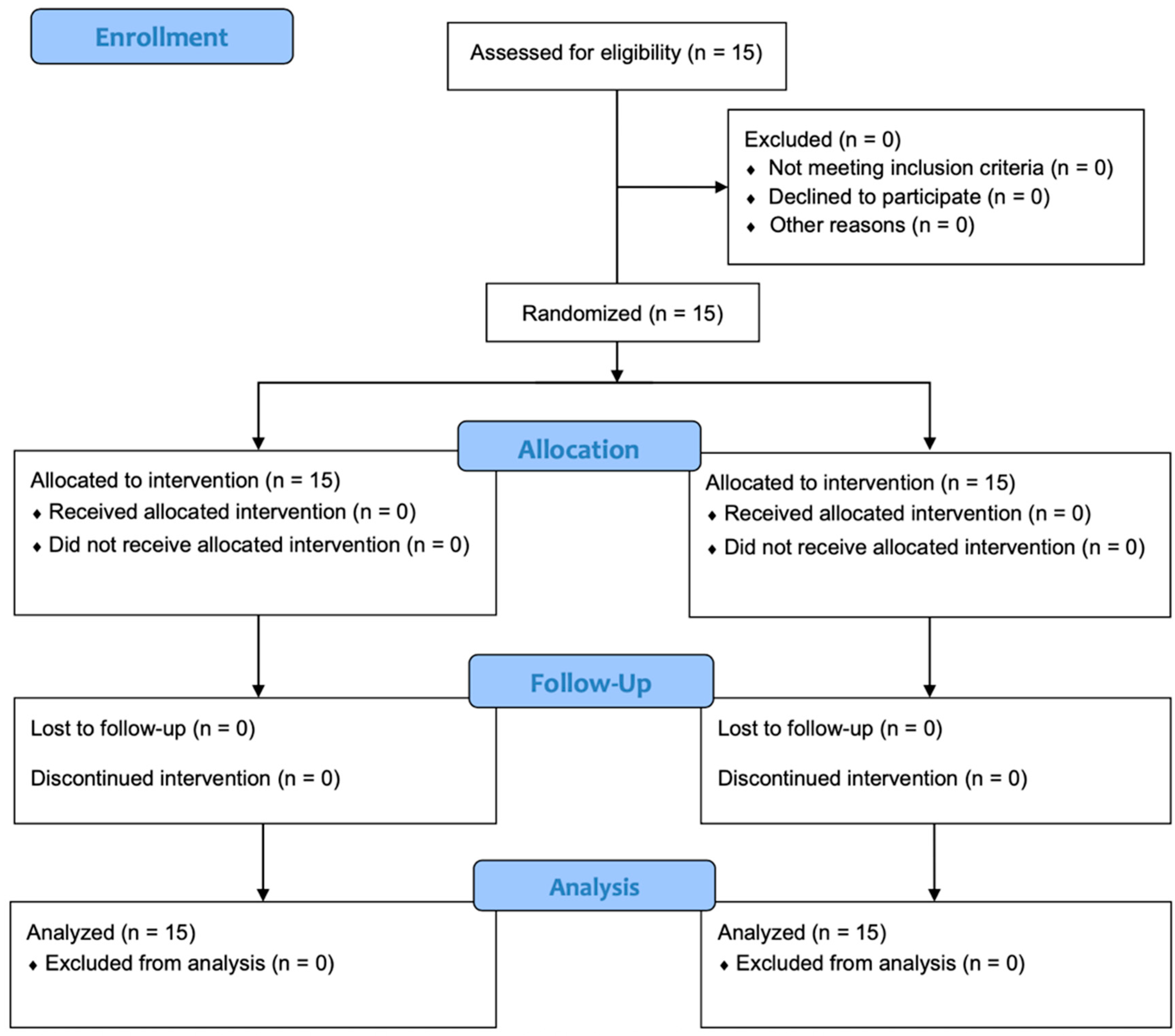
2.1. Participants
2.2. Measures
2.2.1. One-Repetition Maximum (1RM) Tests: Hip Thrust (HT) and Deadlift (DL)
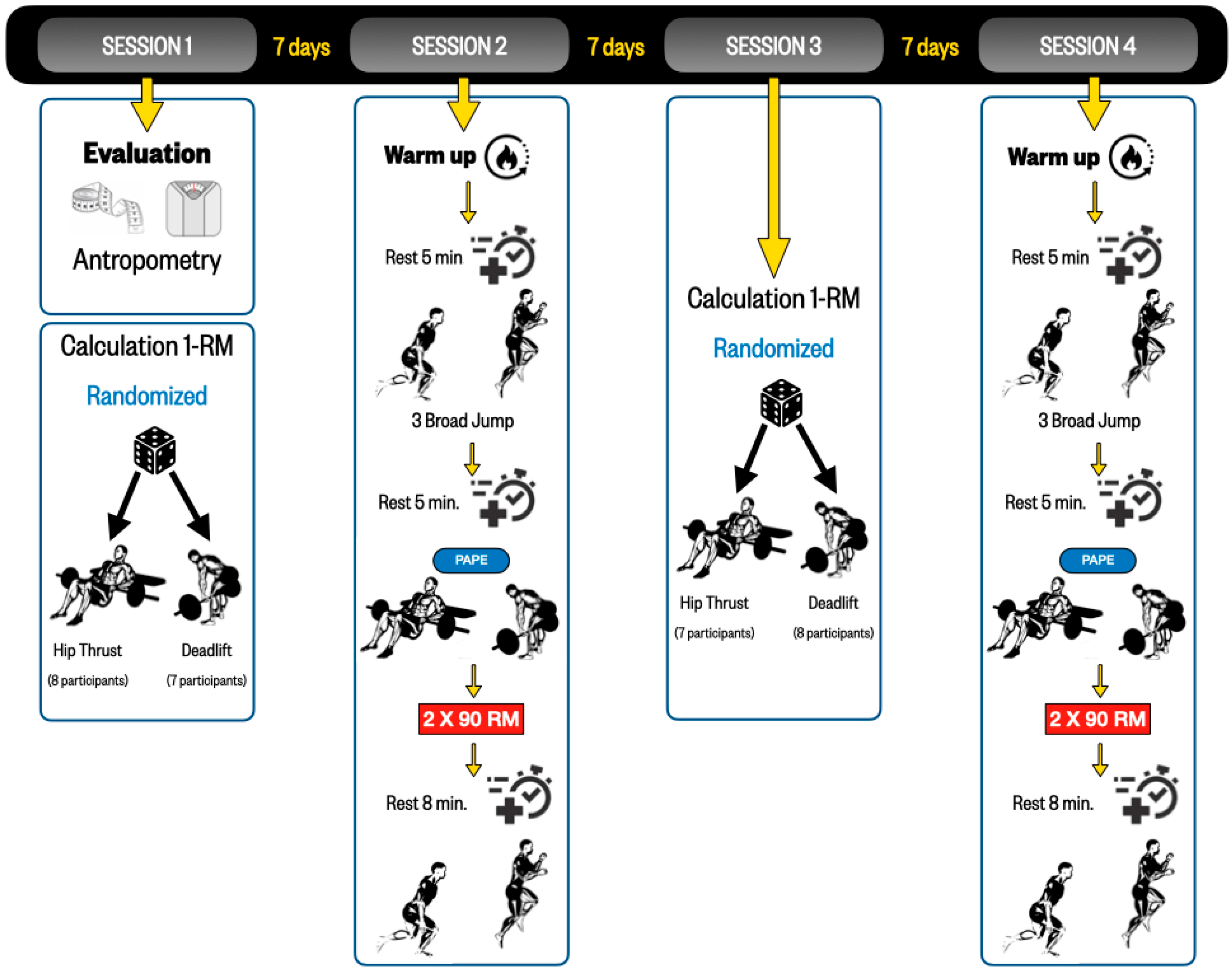
2.2.2. PAPE Inducing Action
2.2.3. Analysis
3. Results
4. Discussion
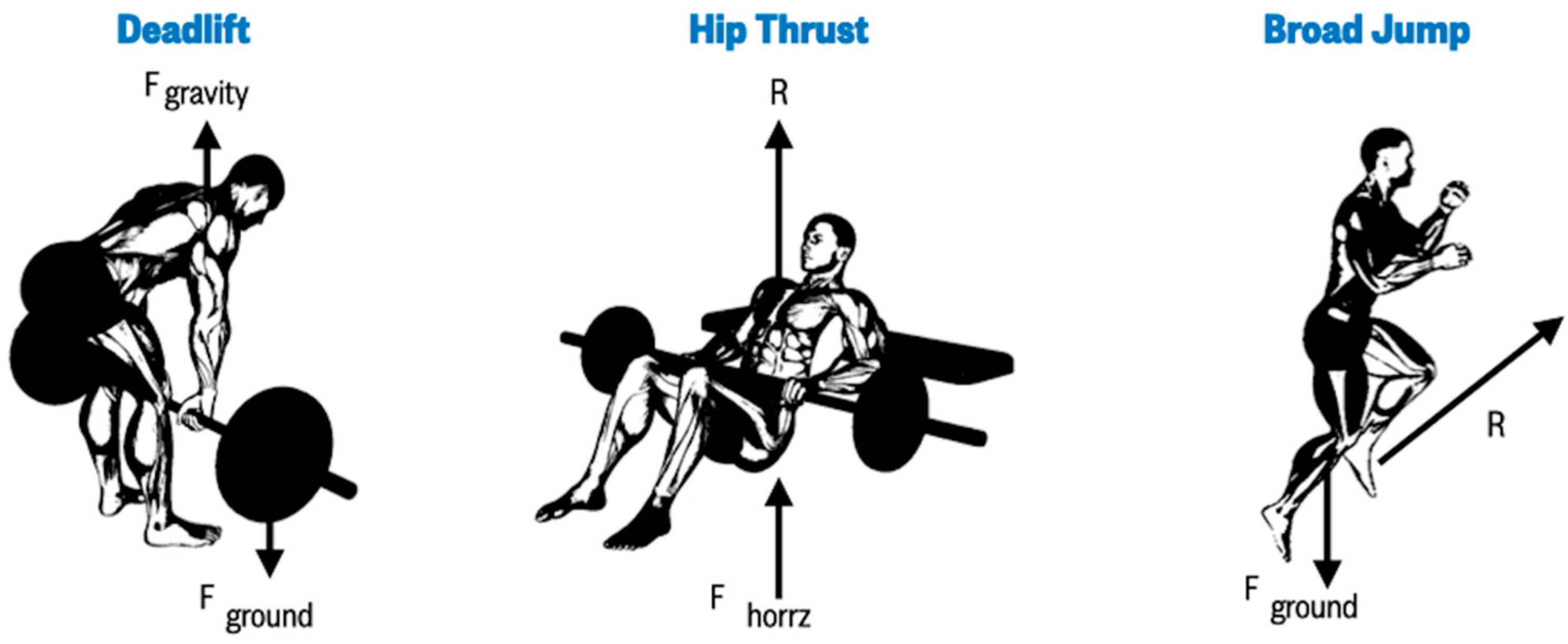
- Both DL and HT may effectively potentiate the hip extensors relevant to BJ, leading to similar net transfer despite differences in vector orientation.
- Training status and specific BJ experience likely condition the magnitude of the acute PAPE response
Limitations
5. Conclusions
Author Contributions
Funding
Institutional Review Board Statement
Informed Consent Statement
Data Availability Statement
Conflicts of Interest
Abbreviations
| PAPE | Post-activation performance enhancement |
| PAP | Post-activation potentiation |
| RM | Repetition maximum |
| COD | Change of direction |
| DL | Deadlift |
| HT | Hip thrust |
| BJ | Broad jump |
| CMJ | Countermovement jump |
| CI | Confidence interval |
References
- Hodgson, M.; Docherty, D.; Robbins, D. Post-activation potentiation: Underlying physiology and implications for motor performance. Sports Med. 2005, 35, 585–595. [Google Scholar] [CrossRef]
- Blazevich, A.J.; Babault, N. Post-activation Potentiation Versus Post-activation Performance Enhancement in Humans: Historical Perspective, Underlying Mechanisms, and Current Issues. Front. Physiol. 2019, 10, 1359. [Google Scholar] [CrossRef]
- Macintosh, B.R.; Robillard, M.E.; Tomaras, E.K. Should postactivation potentiation be the goal of your warm-up? Appl. Physiol. Nutr. Metab. 2012, 37, 546–550. [Google Scholar] [CrossRef]
- Scott, S.L.; Docherty, D. Acute effects of heavy preloading on vertical and horizontal jump performance. J. Strength. Cond. Res. 2004, 18, 201–205. [Google Scholar] [CrossRef]
- Gouvea, A.L.; Fernandes, I.A.; Cesar, E.P.; Silva, W.A.; Gomes, P.S. The effects of rest intervals on jumping performance: A meta-analysis on post-activation potentiation studies. J. Sports Sci. 2013, 31, 459–467. [Google Scholar] [CrossRef] [PubMed]
- Kasicki, K.; Rydzik, Ł.; Ambroży, T.; Spieszny, M.; Koteja, P. The Impact of Post-Activation Performance Enhancement Protocols on Vertical Jumps: Systematic Review. Appl. Sci. 2024, 14, 9664. [Google Scholar] [CrossRef]
- Kobal, R.; Pereira, L.A.; Kitamura, K.; Paulo, A.C.; Ramos, H.A.; Carmo, E.C.; Roschel, H.; Tricoli, V.; Bishop, C.; Loturco, I. Post-Activation Potentiation: Is there an Optimal Training Volume and Intensity to Induce Improvements in Vertical Jump Ability in Highly-Trained Subjects? J. Hum. Kinet. 2019, 66, 195–203. [Google Scholar] [CrossRef] [PubMed]
- Vargas-Molina, S.; Salgado-Ramirez, U.; Chulvi-Medrano, I.; Carbone, L.; Maroto-Izquierdo, S.; Benitez-Porres, J. Comparison of post-activation performance enhancement (PAPE) after isometric and isotonic exercise on vertical jump performance. PLoS ONE 2021, 16, e0260866. [Google Scholar] [CrossRef] [PubMed]
- Jarosz, J.; Gawel, D.; Socha, I.; Ewertowska, P.; Wilk, M.; Lum, D.; Krzysztofik, M. Acute Effects of Isometric Conditioning Activity with Different Set Volumes on Countermovement Jump Performance in Highly Trained Male Volleyball Players. Appl. Sci. 2025, 15, 2393. [Google Scholar] [CrossRef]
- Boullosa, D.; Del Rosso, S.; Behm, D.G.; Foster, C. Post-activation potentiation (PAP) in endurance sports: A review. Eur. J. Sport. Sci. 2018, 18, 595–610. [Google Scholar] [CrossRef]
- Carbone, L.; Garzon, M.; Chulvi-Medrano, I.; Bonilla, D.A.; Alonso, D.A.; Benitez-Porres, J.; Petro, J.L.; Vargas-Molina, S. Effects of heavy barbell hip thrust vs back squat on subsequent sprint performance in rugby players. Biol. Sport. 2020, 37, 325–331. [Google Scholar] [CrossRef]
- Pietraszewski, P.; Gołaś, A.; Zając, A.; Maćkała, K.; Krzysztofik, M. The Acute Effects of Combined Isometric and Plyometric Conditioning Activities on Sprint Acceleration and Jump Performance in Elite Junior Sprinters. Appl. Sci. 2025, 15, 2125. [Google Scholar] [CrossRef]
- Sale, D.G. Postactivation potentiation: Role in human performance. Exerc. Sport. Sci. Rev. 2002, 30, 138–143. [Google Scholar] [CrossRef]
- Robbins, D.W. Postactivation potentiation and its practical applicability: A brief review. J. Strength. Cond. Res. 2005, 19, 453–458. [Google Scholar] [CrossRef]
- Almuzaini, K.S.; Fleck, S.J. Modification of the standing long jump test enhances ability to predict anaerobic performance. J. Strength. Cond. Res. 2008, 22, 1265–1272. [Google Scholar] [CrossRef]
- Randell, A.D.; Cronin, J.B.; Keogh, J.W.L.; Gill, N.D. Transference of Strength and Power Adaptation to Sports Performance—Horizontal and Vertical Force Production. Strength. Cond. J. 2010, 32, 100–106. [Google Scholar] [CrossRef]
- National Strength & Conditioning Association; Haff, G.; Triplett, T. Essentials of Strength Training and Conditioning, 4th ed.; Human Kinetics: Champaign, IL, USA, 2015. [Google Scholar]
- Contreras, B.; Vigotsky, A.D.; Schoenfeld, B.J.; Beardsley, C.; McMaster, D.T.; Reyneke, J.H.; Cronin, J.B. Effects of a Six-Week Hip Thrust vs. Front Squat Resistance Training Program on Performance in Adolescent Males: A Randomized Controlled Trial. J. Strength. Cond. Res. 2017, 31, 999–1008. [Google Scholar] [CrossRef] [PubMed]
- Seitz, L.B.; Mina, M.A.; Haff, G.G. Postactivation Potentiation of Horizontal Jump Performance Across Multiple Sets of a Contrast Protocol. J. Strength. Cond. Res. 2016, 30, 2733–2740. [Google Scholar] [CrossRef] [PubMed]
- Urbański, R.; Biel, P.; Kot, S.; Perenc, D.; Aschenbrenner, P.; Stastny, P.; Krzysztofik, M. Impact of active intra-complex rest intervals on post-back squat versus hip thrust jumping potentiation. Sci. Rep. 2023, 13, 19593. [Google Scholar] [CrossRef] [PubMed]
- Garcia-Sillero, M.; Chulvi-Medrano, I.; Maroto-Izquierdo, S.; Bonilla, D.A.; Vargas-Molina, S.; Benitez-Porres, J. Effects of Preceding Transcranial Direct Current Stimulation on Movement Velocity and EMG Signal during the Back Squat Exercise. J. Clin. Med. 2022, 11, 5220. [Google Scholar] [CrossRef]
- World Medical Association. World Medical Association Declaration of Helsinki: Ethical principles for medical research involving human subjects. Jama 2013, 310, 2191–2194. [Google Scholar] [CrossRef]
- Baechle, T.R.; Earle, R.W.; National Strength & Conditioning Association. Essentials of Strength Training and Conditioning, 3rd ed.; Human Kinetics: Champaign, IL, USA, 2008. [Google Scholar]
- Andersen, V.; Fimland, M.S.; Mo, D.A.; Iversen, V.M.; Vederhus, T.; Rockland Hellebo, L.R.; Nordaune, K.I.; Saeterbakken, A.H. Electromyographic Comparison of Barbell Deadlift, Hex Bar Deadlift, and Hip Thrust Exercises: A Cross-Over Study. J. Strength. Cond. Res. 2018, 32, 587–593. [Google Scholar] [CrossRef]
- Kilduff, L.P.; Owen, N.; Bevan, H.; Bennett, M.; Kingsley, M.I.; Cunningham, D. Influence of recovery time on post-activation potentiation in professional rugby players. J. Sports Sci. 2008, 26, 795–802. [Google Scholar] [CrossRef]
- Wilson, J.M.; Duncan, N.M.; Marin, P.J.; Brown, L.E.; Loenneke, J.P.; Wilson, S.M.; Jo, E.; Lowery, R.P.; Ugrinowitsch, C. Meta-analysis of postactivation potentiation and power: Effects of conditioning activity, volume, gender, rest periods, and training status. J. Strength. Cond. Res. 2013, 27, 854–859. [Google Scholar] [CrossRef] [PubMed]
- Ho, J.; Tumkaya, T.; Aryal, S.; Choi, H.; Claridge-Chang, A. Moving beyond P values: Data analysis with estimation graphics. Nat. Methods 2019, 16, 565–566. [Google Scholar] [CrossRef]
- Cohen, J. Statistical Power Analysis for the Behavioral Sciences, 2nd ed.; Lawrence Erlbaum Associates: Hillsdale, NJ, USA, 1988. [Google Scholar]
- Richardson, J.T.E. Eta squared and partial eta squared as measures of effect size in educational research. Educ. Res. Rev. 2011, 6, 135–147. [Google Scholar] [CrossRef]
- Dobbs, W.C.; Tolusso, D.V.; Fedewa, M.V.; Esco, M.R. Effect of Postactivation Potentiation on Explosive Vertical Jump: A Systematic Review and Meta-Analysis. J. Strength. Cond. Res. 2019, 33, 2009–2018. [Google Scholar] [CrossRef] [PubMed]
- Petisco, C.; Ramirez-Campillo, R.; Hernandez, D.; Gonzalo-Skok, O.; Nakamura, F.Y.; Sanchez-Sanchez, J. Post-activation Potentiation: Effects of Different Conditioning Intensities on Measures of Physical Fitness in Male Young Professional Soccer Players. Front. Psychol. 2019, 10, 1167. [Google Scholar] [CrossRef]
- Contreras, B.; Vigotsky, A.D.; Schoenfeld, B.J.; Beardsley, C.; Cronin, J. A Comparison of Gluteus Maximus, Biceps Femoris, and Vastus Lateralis Electromyographic Activity in the Back Squat and Barbell Hip Thrust Exercises. J. Appl. Biomech. 2015, 31, 452–458. [Google Scholar] [CrossRef]
- Mackala, K.; Stodółka, J.; Siemienski, A.; Coh, M. Biomechanical analysis of standing long jump from varying starting positions. J. Strength. Cond. Res. 2013, 27, 2674–2684. [Google Scholar] [CrossRef]
- Kraemer, W.J.; Ratamess, N.A. Fundamentals of resistance training: Progression and exercise prescription. Med. Sci. Sports Exerc. 2004, 36, 674–688. [Google Scholar] [CrossRef]
- O’Brien, T.D.; Reeves, N.D.; Baltzopoulos, V.; Jones, D.A.; Maganaris, C.N. Strong relationships exist between muscle volume, joint power and whole-body external mechanical power in adults and children. Exp. Physiol. 2009, 94, 731–738. [Google Scholar] [CrossRef]
- Ah Sue, R.; Adams, K.J.; DeBeliso, M. Optimal Timing for Post-Activation Potentiation in Women Collegiate Volleyball Players. Sports 2016, 4, 27. [Google Scholar] [CrossRef]
- Arias, J.C.; Coburn, J.W.; Brown, L.E.; Galpin, A.J. The Acute Effects of Heavy Deadlifts on Vertical Jump Performance in Men. Sports 2016, 4, 22. [Google Scholar] [CrossRef]
- Bogdanis, G.C.; Tsoukos, A.; Veligekas, P. Improvement of Long-Jump Performance During Competition Using a Plyometric Exercise. Int. J. Sports Physiol. Perform. 2017, 12, 235–240. [Google Scholar] [CrossRef]
- Seitz, L.B.; Haff, G.G. Factors Modulating Post-Activation Potentiation of Jump, Sprint, Throw, and Upper-Body Ballistic Performances: A Systematic Review with Meta-Analysis. Sports Med. 2016, 46, 231–240. [Google Scholar] [CrossRef]
- Chiu, L.Z.; Fry, A.C.; Weiss, L.W.; Schilling, B.K.; Brown, L.E.; Smith, S.L. Postactivation potentiation response in athletic and recreationally trained individuals. J. Strength. Cond. Res. 2003, 17, 671–677. [Google Scholar] [PubMed]
- Tillin, N.A.; Bishop, D. Factors modulating post-activation potentiation and its effect on performance of subsequent explosive activities. Sports Med. 2009, 39, 147–166. [Google Scholar] [CrossRef] [PubMed]
- McErlain-Naylor, S.; King, M.; Pain, M.T. Determinants of countermovement jump performance: A kinetic and kinematic analysis. J. Sports Sci. 2014, 32, 1805–1812. [Google Scholar] [CrossRef]
- Smith, J.C.; Fry, A.C. Effects of a ten-second maximum voluntary contraction on regulatory myosin light-chain phosphorylation and dynamic performance measures. J. Strength. Cond. Res. 2007, 21, 73–76. [Google Scholar] [CrossRef] [PubMed]
- Hamada, T.; Sale, D.G.; MacDougall, J.D.; Tarnopolsky, M.A. Postactivation potentiation, fiber type, and twitch contraction time in human knee extensor muscles. J. Appl. Physiol. 2000, 88, 2131–2137. [Google Scholar] [CrossRef] [PubMed]



| BJ (cm) | Δ | p | d | Time | Time × Protocol | Protocol | |||||
|---|---|---|---|---|---|---|---|---|---|---|---|
| Pre | Post | p | η2p | p | η2p | p | η2p | ||||
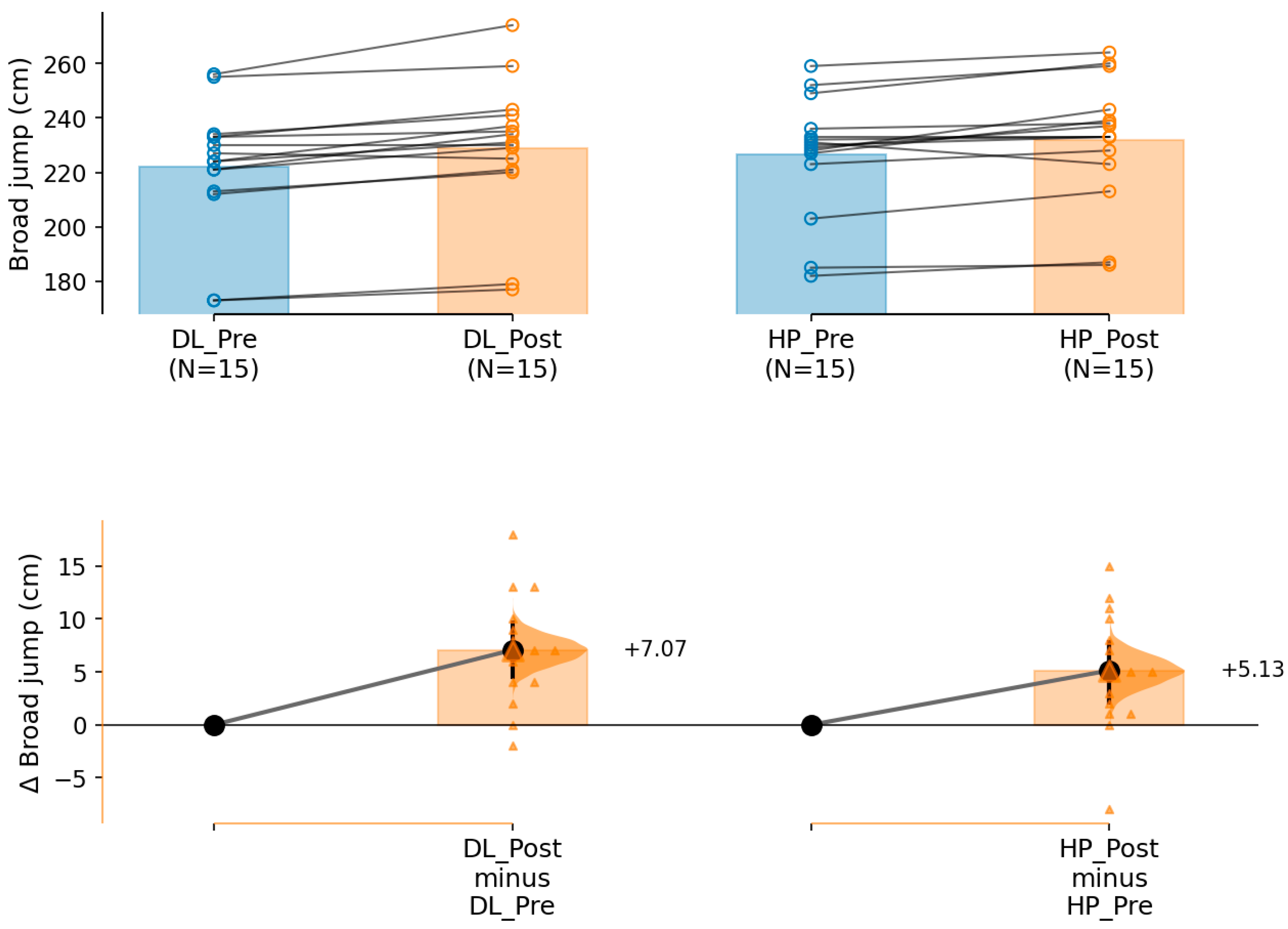
| DL | 221.9 ± 23.5 | 228.9 ± 25.0 | 7.1(4.5–9.7) | <0.001 | 0.29 (0.16–0.53) | <0.001 | 0.707 | 0.326 | 0.069 | 0.122 | 0.162 |
| HT | 226.5 ± 21.9 | 231.7 ± 22.9 | 5.1 (2.1–57.8) | 0.003 | 0.23 (0.08–0.43) | ||||||
Disclaimer/Publisher’s Note: The statements, opinions and data contained in all publications are solely those of the individual author(s) and contributor(s) and not of MDPI and/or the editor(s). MDPI and/or the editor(s) disclaim responsibility for any injury to people or property resulting from any ideas, methods, instructions or products referred to in the content. |
© 2025 by the authors. Licensee MDPI, Basel, Switzerland. This article is an open access article distributed under the terms and conditions of the Creative Commons Attribution (CC BY) license (https://creativecommons.org/licenses/by/4.0/).
Share and Cite
Castro, N.; Benítez-Porres, J.; Carbone, L.; Chulvi, I.; Bonilla, D.A.; Petro, J.L.; Peña, J.; Vargas-Molina, S. Effects of Hip-Dominant Strength Exercises on Post-Activation Performance Enhancement. Appl. Sci. 2025, 15, 13162. https://doi.org/10.3390/app152413162
Castro N, Benítez-Porres J, Carbone L, Chulvi I, Bonilla DA, Petro JL, Peña J, Vargas-Molina S. Effects of Hip-Dominant Strength Exercises on Post-Activation Performance Enhancement. Applied Sciences. 2025; 15(24):13162. https://doi.org/10.3390/app152413162
Chicago/Turabian StyleCastro, Nicolás, Javier Benítez-Porres, Leandro Carbone, Iván Chulvi, Diego A. Bonilla, Jorge L. Petro, Javier Peña, and Salvador Vargas-Molina. 2025. "Effects of Hip-Dominant Strength Exercises on Post-Activation Performance Enhancement" Applied Sciences 15, no. 24: 13162. https://doi.org/10.3390/app152413162
APA StyleCastro, N., Benítez-Porres, J., Carbone, L., Chulvi, I., Bonilla, D. A., Petro, J. L., Peña, J., & Vargas-Molina, S. (2025). Effects of Hip-Dominant Strength Exercises on Post-Activation Performance Enhancement. Applied Sciences, 15(24), 13162. https://doi.org/10.3390/app152413162