

Article

Medium-Chain Fatty Acid Products Derived from Agriculture and Food Production Sidestreams Decrease Cattle Greenhouse Gas Emissions In Vitro


1
Department of Animal and Dairy Science, University of Georgia, 425 River Road, Athens, GA 30602, USA
2
Department of Veterinary Medicine and Animal Sciences, University of Milan, Via dell’Università 6, 26900 Lodi, Italy
3
Department of Food Science and Technology, University of Georgia, 100 Cedar Street, Athens, GA 30602, USA
*
Author to whom correspondence should be addressed.
Appl. Sci. 2025, 15(24), 13154; https://doi.org/10.3390/app152413154
Submission received: 18 November 2025 / Revised: 8 December 2025 / Accepted: 9 December 2025 / Published: 15 December 2025

Featured Application

Medium-chain fatty acid feed supplements produced by fermentation using agricultural and food byproducts as substrates can reduce enteric greenhouse gas production, notably CO2, without impairing dietary ruminal digestibility. Environmental and economic benefits to producers are potentially available through these novel products.

Abstract

Impacts of including medium-chain fatty acid (MCFA) products in cattle diets on dry matter digestibility (DMD), volatile fatty acid (VFA), and ruminal gas production were assessed in vitro. Two MCFAs—caproic acid (C6) and caprylic acid (C8)—were produced by a novel bioprocess using agriculture and food waste and microencapsulated with maltodextrin for fast release (FR) and gum arabic for slow release (SR) in addition to C6 and C8 salts. The MCFAs were tested alone and in combination at 1% of dietary dry matter, resulting in eighteen treatments, including a control without MCFA. No treatment reduced DMD%, CH4%, or CH4 yield compared to the control. All treatments except T3 (C8 FR) decreased (p ≤ 0.05) CO2% compared to the control. Certain combinations of MCFA products reduced (p < 0.001) total gas yield and CO2 yield compared to the control, with T17 (C6 FR, C6 SR, C8 FR, C8 SR) having the strongest effect: a total gas yield reduction of 13.9% and a CO2 yield reduction of 29.8%. There was a treatment effect (p ≤ 0.05) on all VFA molar proportions, excluding valerate (p = 0.24). Overall, the MCFA products affected several ruminal fermentation parameters and substantially reduced CO2 production.

1. Introduction

Ruminants have a highly specialized digestive tract that breaks down feedstuffs regarded as undigestible to other mammals via microbial enzymes [1]. Bacteria, archaea, fungi, and other microorganisms ferment carbohydrates and fibrous components such as cellulose and hemicellulose to create volatile fatty acids (VFA) such as acetate, propionate, butyrate, and others, which are energy sources for the ruminant [2]. During this process, H2 is utilized by various microbial hydrogen “sinks”, such as methanogenesis, resulting in different end-products. For instance, hydrogenotrophic methanogenic archaea utilize H2 to reduce carbon dioxide (CO2) to methane (CH4) [2]. While ruminant production triggers eructation of ruminal gas [2], the production and release of greenhouse gases (GHG) carry both environmental and economic concerns. According to the 2013 United Nations Food and Agriculture Organization (UNFAO) Global Assessment of Emissions and Mitigation Opportunities (GLEAM), CH4 and CO2 emissions make up approximately 44% and 27% of livestock sector emissions, respectively [3]. GHG emissions from cattle make up approximately 65% of livestock sector emissions [3]. Lastly, enteric CH4 emissions from cattle make up approximately 77% of total enteric CH4 emissions [3]. On the economic front, CH4 emissions in cattle have been reported to be negatively correlated with dry matter digestibility (DMD), implying lower feed efficiency [4]. Feed efficiency is connected to input costs (e.g., feed ingredients) and output results (e.g., meat products, milk yield, cattle byproducts) [5]. Additionally, there is a growing consensus among consumers to limit meat and milk consumption due to health concerns and environmental impacts, reducing producers’ ability to profit from their livestock [6]. Therefore, it is paramount for ruminant nutritionists to find innovative solutions to reduce GHG production for producers’ livelihoods and for the environment.
Animal scientists have analyzed and attempted to manipulate methanogenesis in several ways. These efforts include different breeding, management, and nutritional interventions, especially via feed additives and supplements [6]. Among these, feed additives have ranged from native plants from Mexico [7] to tropical rice straw supplemented with fibrolytic enzymes [8], yielding promising results in laboratories, and some even being produced commercially. Among the feed additives developed to mitigate enteric CH4 emissions, 3-nitrooxypropanol (3-NOP) has shown one of the strongest inhibitory effect on ruminal methanogenesis, reducing CH4 emissions by up to 30% in dairy cattle and 45% in beef cattle [9]. 3-NOP works by inhibiting mcr, a gene that plays an integral role in methanogenic archaea utilizing H2 to produce CH4 [9]. Several studies have altered 3-NOP dosage because the optimal dosage is yet to be discovered [10]. One meta-analysis investigating the financial impact of 3-NOP use on dairy farms suggested that the mean change in income over feed cost was negative (−$0.352 per head per day) over a ten-year period [10]. In fact, the cost of 3-NOP to farms is said to be $2.009 per kg CH4, and the meta-analysis found sufficient evidence to conclude that increasing 3-NOP dosage above the mean in dairy diets significantly decreased CH4 production by roughly 0.7 g CH4 per day [10]. This suggests that greater levels of 3-NOP may be beneficial in dairy diets but could significantly increase costs for the livestock sector, making cattle production more reliant on lawmakers and industries for financial incentives to utilize this product [10].
Additional feed additives that have been studied include medium-chain fatty acids (MCFAs), which are fatty acids with chain lengths ranging from six to twelve carbons (C6–C12) [6]. There are many mechanisms by which MCFAs operate to inhibit methanogenesis, including (1) shifting the rumen microbiome toward microorganisms that consume H2, rather than produce H2 for methanogenesis, and subsequently producing propionate; (2) targeting methanogen-harboring protozoa and archaea populations, which are the main methanogens in the rumen; and (3) decreasing ruminal fiber degradation to mitigate methanogenesis [11,12]. Coconut oil and palm kernel oil are the primary sources of MCFAs [12,13]. However, the severe ecological damage associated with palm kernel and coconut oil production has prompted researchers to seek out new approaches for producing MCFAs [13]. Biotechnologists, for example, are exploring microbial biosynthesis to produce MCFAs using engineered strains of bacteria [14] and yeast [15]. While these techniques have proven successful, the associated costs are high. Also, microbial biosynthesis using engineered strains requires pure substrates, such as sugars or starches, which compete with food production and cause environmental burdens [16].
Recently, a less costly and more environmentally beneficial approach, known as microbial chain elongation, has emerged to biosynthesize MCFAs from diverse agricultural and food production waste streams using open-culture microbiomes [17]. Unlike the MCFAs derived from palm kernel and coconut oil, which are predominantly capric acid (C10) and lauric acid (C12), the microbial chain elongation process generates primarily caproic acid (C6) and caprylic acid (C8), opening a new supply route for these products. Furthermore, by using local organic waste streams as raw materials, microbial chain elongation for the domestic production of MCFAs can be considered a sustainable solution that reduces competition between feed and food and affords new opportunities for waste valorization. Also, by using local organic waste streams as feedstock, the microbial chain elongation process produces MCFAs without competing for food production, while addressing the agricultural and food waste crisis. Indeed, according to a review of agricultural and food waste statistics and practices, the United States generates 61 million tons of food waste annually, resulting in up to $100 billion worth of food loss. Similarly, Europe generates 90 million tons annually, resulting in €40 billion in losses [18]. Therefore, biosynthesizing MCFAs from agricultural and food production waste streams using microbial chain elongation could provide a cost-effective pathway for producing anti-methanogenic animal feed products that support beef and dairy producers while decarbonizing the food production system on multiple fronts.
When the resources needed to test the effects of nutritional strategies in the rumen are scarce or cost-prohibitive, ruminant nutritionists often rely on in vitro rather than in vivo approaches [19]. When controlling parameters such as the number and type of animals used, feed rations, and inoculum collection methods, in vitro fermentation techniques can be highly cost-effective and provide high statistical power to the experiment, depending on the number of bottles and trials conducted [20]. Thus, the objective of the present study was to test the effectiveness of novel MCFA products on total gas, GHG (CH4 and CO2), VFA production, and DMD using an in vitro fermentation model. We hypothesized that the MCFA products generated by the novel microbial chain elongation biosynthesis process would reduce GHG production, promote production of specific VFAs (i.e., propionate), and have minimal impact on DMD during ruminal fermentation.

2. Materials and Methods

This study was carried out in a series of three in vitro trials to maximize the number of experimental units and allow evaluations of the MCFAs alone and in combination. All animal handling and sample collection were performed according to the guidelines established by the Institutional Animal Care and Use Committee (IACUC) of the University of Georgia (protocol A2024 10-011-Y1-A0).

2.1. Diet Composition and Analysis

Feed ingredients were obtained from the University of Georgia’s J. Phil Campbell Sr. Research and Education Center, located in Watkinsville, GA, USA. Ingredients were ground using 2 mm grating in a Wiley mill (Thomas Scientific, Swedesboro, NJ, USA) and oven-dried at 60 °C for 72 h to obtain their dry matter (DM) content. Feed incubated in vitro during the trials was prepared as total mixed rations. In Trial 1, a 50:50 forage-concentrate (DM basis) diet was made with the following ingredient proportions: 50% ground hay, 13.5% dried distiller’s grains (DDG), 36.2% ground corn, and 0.3% mineral mix. In Trials 2 and 3, a 43:57 forage-concentrate diet was made with the following ingredient proportions: 43% ground hay, 15.7% DDG, 41% ground corn, and 0.3% mineral mix. Increasing the concentrate proportion in the diets of Trials 2 and 3 was necessary to compensate for the lower nutritive value of hay used in those trials while maintaining a relatively constant level of the nutrients provided by the entire diet (Table 1).
Diets were sent to Cumberland Valley Analytical Services (Waynesboro, PA, USA) for nutrient analysis. Briefly, acid detergent fiber (ADF) was determined by AOAC Method 973.18. Dry matter was determined by AOAC Method 930.15. Fat was determined by the method AOCS Am 5-04. Lignin was determined by the method described in Goering and Van Soest [21]. Minerals were determined by AOAC Method 985.01. Neutral detergent fiber (NDF) was determined by the method described in Van Soest et al. [22].

2.2. Medium-Chain Fatty Acid Preparation

The microbial chain elongation-derived MCFA products were developed at the Department of Food Science and Technology at the University of Georgia. Four microencapsulated MCFA products were developed, two with caproic acid (C6) and two with caprylic acid (C8). One set of C6- and C8-MCFA products was formulated for fast release (FR) into the rumen using maltodextrin as the microencapsulation medium, and a second set was formulated for slow release (SR) using a mixture of maltodextrin and gum arabic. Additionally, one C6 salt (C6H11NaO2, Tokyo Chemical Industry Co., Tokyo, Japan) and one C8 salt (C8H15NaO2, Thermo Fisher Scientific, Ward Hill, MA, USA) were used in the in vitro incubations (Table 2). For treatments T1 through T4, the single MCFA product was added to a jar containing the trial’s diet at 1% of dietary dry matter. For treatments T5 and T6, each MCFA salt was added to a jar containing the trial’s diet at 1% of dietary dry matter. For treatments T7 through T12, each MCFA product was added to a jar containing the trial’s diet at 0.5% of dietary dry matter, totaling 1% inclusion of MCFA products. For treatments T13 through T16, each MCFA product was added to a jar containing the trial’s diet at 0.33% of dietary dry matter, totaling 1% inclusion of MCFA products. For treatment T17, each MCFA product was added to a jar containing the trial’s diet at 0.25% of dietary dry matter, totaling 1% inclusion of MCFA products. All diets were oven-dried at 60 °C for 72 h to calculate DM content.

2.3. In Vitro Fermentation, Gas Collection, and Analyses

The in vitro fermentation procedure was performed according to Hendricks et al. [23], which resembles ANKOM’s in vitro True Digestibility procedure for the ANKOM DAISY incubator (ANKOM Technology, Macedon, NY, USA). Briefly, ANKOM F57 filter bags were pre-rinsed with acetone for 3–5 min and allowed to dry for 24 h. Filter bags were weighed before and after adding 0.5 g of the treatment sample in replicate. Filter bags were heat-sealed and placed in 125 mL serum glass bottles. In Trial 1, there were seven treatments (T0, T1, T2, T3, T4, T5, T6) with ten replicates each. In Trial 2, there were eleven treatments (T0, T1, T2, T3, T4, T7, T8, T9, T10, T11, T12) with six replicates each. In Trial 3, there were ten treatments (T0, T1, T2, T7, T12, T13, T14, T15, T16, T17) with six to eight replicates each. During all three trials, half of the bottles were incubated in a water bath for 24 h and the other half for 48 h. Additionally, there were five blank filter bags per time. Artificial saliva was prepared and included in the bottles at a ratio of 2:1 saliva–rumen fluid [24]. Water baths were filled with 39 °C water to simulate the rumen environment.
The ruminal fluid donors were Angus steers held at J. Phil Campbell Sr. Research and Education Center in Watkinsville, GA, USA. They were fed the same diet as the fermentation substrates mixed in the laboratory (Table 1). Animals were adapted to the diet for three to four weeks prior to rumen fluid collection. Animals were fed between 800 and 900 h, and ruminal contents were collected 1 to 3 h after feeding (between 1000 h and 1100 h). The goal for each collection was to amass up to 7000 mL of rumen fluid to have sufficient inoculum for the saliva–rumen fluid mixture. In Trial 1, seven donor steers were used to collect ruminal samples via esophageal tubing connected to a glass Erlenmeyer flask and a vacuum pump [25]. The first 500 mL was discarded to avoid saliva contamination, and the subsequent 1000 mL was collected into pre-warmed 39 °C thermoses. In Trials 2 and 3, two rumen-cannulated steers were used as donors. The top layer of rumen contents was discarded, and rumen contents that were further inside the rumen were strained through nylon mesh into pre-warmed 39 °C thermoses. 3500 mL of rumen fluid was obtained from each steer.
Collected rumen fluid was immediately transported to the laboratory (within 20 min), where it was strained again through nylon mesh into graduated cylinders and transferred to a covered flask containing artificial saliva. A stir plate was used to constantly homogenize the inoculum (artificial saliva plus rumen fluid). The pH was measured before and after the addition of the rumen fluid to the buffer solution. A total of 90 mL of saliva–rumen fluid mixture was dispensed into 125 mL bottles containing ANKOM filter bags with the treatments. Bottles were flushed with CO2 and immediately capped, homogenized, and placed in 39 °C water baths for fermentation to begin. Blank bottles were also included in replicate, which contained the saliva–rumen fluid mixture and empty filter bags. At different time points (approximately 3 h to 6 h intervals) during each trial, bottles were agitated to simulate ruminal movements. Total gas (mL) was measured using syringes and collected into its accompanying Tedlar bag for composition analysis [26,27]. After 24 h or 48 h of incubation, bottles were removed from the water baths, and their respective filter bags were handled as described in Hendricks et al. [23] to quantify dry matter digestibility (DMD). Briefly, filter bags were removed from the bottles, rinsed with cold water, gently squeezed to drain excess water, and dried at 60 °C for 72 h. DMD (g) was calculated by subtracting the final DM (filter bag and feed post-fermentation) from the initial DM (filter bag and feed pre-fermentation), and adjusted by the appropriate blank bag correction factors. DMD (%) was calculated by dividing the DMD (g) by the initial DM (g) and multiplying by 100%. The final pH of the fermented liquid was measured using a pH probe, and 10 mL of liquid was salvaged in a 15 mL centrifuge tube and stored at −20 °C for further VFA analysis.
Gas composition was measured using a gas chromatograph equipped with a flame ionization detector and methanizer (8610C, SRI Instruments, Torrance, CA, USA) using nitrogen as the carrier gas. Samples were manually inserted into the column (0.3 m HaySep-D packed Teflon, Restek, Bellefonte, PA, USA) with an injection volume of 500 μL. Values for CH4% and CO2% were calculated using a defined calibration curve correlating the mole fraction of each gas to their relative peak area. Volumes of CH4 (mL) and CO2 (mL) were calculated by multiplying the mole fraction of each gas by the volume of total gas collected (mL). CH4 yield and CO2 yield (mL/g DMD) were calculated by dividing the volume of each gas (mL) by DMD (g). Total gas yield (mL/g DMD) was calculated by dividing the total volume of gas collected (mL) by DMD (g).

2.4. Volatile Fatty Acid Analysis

VFA analysis was performed according to the methodology described by Lourenco et al. [28]. Briefly, one part of a 25% metaphosphoric acid solution (wt/vol) was added to five parts of the fermentation liquid that was thawed and homogenized. Samples were frozen for a minimum of 12 h to promote protein precipitation. Subsequently, samples were thawed, centrifuged, and five parts were allocated to a new tube and combined with one part of an internal standard (2-ethylbutyric acid at 4.55 g/L). One part of this new solution was combined with two parts ethyl acetate, homogenized, and settled for five minutes. A volume ranging from 500 to 800 μL was pipetted from the top layer to capture the VFAs and disregard the waste. The top layers were analyzed for VFA composition using a gas chromatograph (Shimadzu GC-2010 Plus, Shimadzu Corp., Kyoto, Japan), equipped with a flame ionization detector and a capillary column (Zebron ZB-FFAP GC Cap; 30 m × 0.32 mm × 0.25 μm; Phenomenex Inc., Torrance, CA, USA), using helium as the carrier gas. The oven temperature was set at 110 °C and was increased to 200 °C over the course of 6 min. The injector temperature was set at 250 °C, and the detector temperature was set at 350 °C. Sample injection volume was set at 1.0 μL.

2.5. Data Analysis

Statistical analysis was performed in the software Minitab® (version 22.3) using a mixed-effects model. The random factors were the trial and the person who weighed each filter bag and feed, and the fixed factors were time (24 h or 48 h), treatment (T0–T17; Table 1), and their interactions. Tukey’s Honestly Significant Difference tests were executed for all the response variables. For all statistical tests, results were declared significant at p ≤ 0.05 and tendencies reported at 0.05 < p ≤ 0.10.

3. Results

Except for two variables, total gas yield (p = 0.33) and molar proportion of butyrate (p = 0.44), all other response variables assessed in this study were significantly affected (p < 0.01) by fermentation time. Although quantified in the statistical models, the effects of time (24 or 48 h) and the time-by-treatment interactions were not the focus of the current study. Thus, only the main effects of treatment are presented.

3.1. Dry Matter Digestibility and pH

Table 3 shows the mean DMD (% disappeared) and the mean final pH observed for each treatment. Treatment had a significant effect (p = 0.02) on DMD%, with T16 having the greatest DMD% of all treatments (49.74%), which was found to be greater (p = 0.04) than T6, and tended to be greater (p = 0.10) than T0, translating into an increase of 6.08% compared to the control diet. There was a significant effect (p < 0.001) of treatment on mean final pH, but only T13 significantly differed (p = 0.02) from T0 (approximately 6.72 and 6.74, respectively).

3.2. CH4 and CO2 Volume and Percentage

Table 4 describes total gas collection and composition analysis for CH4 and CO2. There was an effect (p < 0.001) of treatment on total gas collected (mL). Compared to T0, T17 decreased (p < 0.001) total gas collected (mL) by 9.9%. There were no other treatments that were significantly different from T0 for total gas production.
There was an effect (p < 0.001) of treatment on the percentage of CH4 in the collected gas, and T6 significantly increased (p = 0.01) CH4 (%) by 10.2% compared to T0. There was an effect (p < 0.001) of treatment on CO2 (%). Excluding T3, all other treatments significantly differed (p ≤ 0.05) from T0 by reducing the percentage of CO2 in the gas produced, and T11, T12, and T17 decreased (p < 0.001) CO2 (%) by 15.1%, 13.6%, and 16.2% compared to T0, respectively.
There was no effect (p = 0.42) of treatment on the volume (mL) of CH4 produced. However, treatment significantly affected (p < 0.001) the volume of CO2 produced during fermentation, with T0 having the highest production of all treatments (47.06 mL). All other treatments numerically decreased the volume of CO2, with several (T6, T9, T10, T11, T12, T14, T15, T16, T17) significantly reducing the volume of CO2 produced compared to the control (p ≤ 0.05). However, the greatest reduction was observed for T17, which decreased (p < 0.001) the volume of CO2 produced by 24.95%.

3.3. Total Gas, CH4, and CO2 Yields

Figure 1 describes total and individual gas yields in terms of volume of gas produced (mL) per unit of DMD (g). There was a significant effect (p < 0.001) of treatment on total gas yield. T17 was the treatment with the lowest total gas yield, which was found to be significantly lower (p < 0.001) than T0, with a reduction of 13.9%. Additionally, T14, T15, and T16 yielded less total gas than T0 (p ≤ 0.05).
Regarding CH4 yield, a significant effect (p = 0.03) of treatment was observed, with T17 producing the lowest value, which was found to be significantly lower (p ≤ 0.05) than the yields of T6 and T10. Despite T17 producing a reduction of 8.61% in CH4 yield compared to T0 (101.84 versus 111.44 mL/g DMD), this reduction was not statistically significant (p = 0.64).
In contrast, CO2 yield was remarkably affected by treatment (p < 0.001), and several treatments (T9, T11, T12, T13, T14, T15, T16, T17) significantly reduced (p ≤ 0.05) CO2 yield compared to T0. However, the lowest reduction (p = 0.001) compared to T0 was observed for T17: a decrease of 29.75%.

3.4. Volatile Fatty Acids

Table 5 describes total VFA production (mM) and individual VFA molar proportions as a result of treatment. There was an effect (p = 0.003) of treatment on total VFA production. Only T3 significantly reduced (p = 0.01) total VFA production compared to T0. There was an effect (p = 0.001) of treatment on the molar proportion of acetate, but none of the treatments were significantly different (p > 0.05) from T0. There was an effect (p < 0.001) of treatment on propionate molar proportion, and T4, T5, T6, and T7 were significantly lower (p ≤ 0.02) in propionate molar proportion than T0. There was an effect (p < 0.001) of treatment on butyrate molar proportion. T5 and T6 were significantly higher (p ≤ 0.001) in molar proportion of butyrate than T0 by 4.11% and 7.03%, respectively. Similarly, treatment had an effect (p < 0.001) on molar proportions of isobutyrate, with T5 and T6 having significantly higher (p ≤ 0.05) isobutyrate molar proportions than T0. There was no effect of treatment (p = 0.24) on valerate molar proportion, but molar proportions of isovalerate were significantly different (p < 0.001) across treatments. Although none of the treatments significantly differed (p ≥ 0.26) from T0, differences were detected between specific treatments, such as between T6 and T16 for isovalerate molar proportions (p = 0.002). There was a treatment effect (p < 0.001) on molar proportions of caproate. Except for T1 and T17, all other treatments had greater (p ≤ 0.02) molar proportions of caproate than T0. There was an effect of treatment on the acetate/propionate ratio (A:P; p < 0.001). T5 and T6 were significantly higher (p < 0.001) in A:P than T0 by 4.40% and 10.26%, respectively.

4. Discussion

Medium-chain fatty acids are commonly defined as saturated fatty acids that contain a hydrocarbon chain with 6 to 12 carbon atoms [24,25]. This variation in their hydrocarbon chain length, as well as other properties, affects the function and fate of the MCFAs within the rumen. Many animal nutrition studies investigating MCFAs tend to focus on lauric acid (twelve-carbon chain, C12) combined with myristic acid (fourteen-carbon chain, C14), long-chain fatty acids, because they are extracted from coconut oil and palm kernel oil in high volumes for industrial applications [29]. Other fatty acids that can be extracted from these oils, albeit in smaller quantities, include MCFAs caproic acid (C6), caprylic acid (C8), capric acid (C10), and long-chain fatty acids palmitic acid (C16), oleic acid (C18), and linoleic acid (C18) [29]. In this study, C6 and C8 were produced in an economically and environmentally sustainable manner using food and agriculture waste as substrates for microbial chain elongation. While much of the previous literature does not focus on shorter-length MCFAs, the process for creating the MCFAs used in our study was cost-effective and environmentally conscious, justifying their use as a feed ingredient.

4.1. Diet Digestibility and pH

The %DMD for all treatments did not differ from the control diet. This is consistent with other studies using MCFAs in ruminant diets, which showed no effect of MCFA supplementation on DMD. However, we observed that T16, a treatment containing a combination of one source of C6 and two sources of C8, numerically increased DMD by 6.08% compared to T0. Early work by Dohme et al. [30] showed no effect of any MCFA on apparent organic matter degradation compared to a control diet. Likewise, Vadroňová et al. [31] reported only numerical increases in DMD due to the inclusion of different MCFA in in vitro incubations, except when myristic acid (C14) was included as a single fatty acid, which resulted in a significant decrease in DMD compared to the basal diet alone. Moreover, Pérez-Ruchel et al. [32] did not see significant effects of MCFA supplementation on DMD compared to a control diet. In an in vivo study, Burdick et al. [33] reported no differences in DMD when MCFA were fed to lactating Holstein cows. In an in vitro study using 3-NOP and fumarate, 2 mg/g DM of 3-NOP did not improve DMD compared to the control [34]. Moreover, Xuan et al. [35] reported that the percentage of DMD was not significantly affected by increasing the dose of 3-NOP in vitro. No response in DMD observed in our study is in line with previously published work testing MCFA and even other anti-methanogenic nutritional strategies in ruminant diets.
Treatment T13, which contained a combination of two sources of C6 and one source of C8 had a significantly lower pH than T0. Vadroňová et al. [31] found that significantly higher pH values occurred when MCFAs were supplemented to the diet. On the contrary, MCFA supplementation did not have an impact on pH in multiple studies [27,31], except for C12, which reduced pH compared to a control diet [30]. Although variations in pH were detected in the current study, the extent to which they had biological impacts is unclear. Given that the magnitude of variation was low, these results indicate that the artificial saliva maintained a stable pH throughout the study.

4.2. Gas Volume, Percentage, and Yield

Compared to the control diet (T0), only T17, a treatment containing a combination of all four MCFA products at an inclusion rate of 0.25% of dietary DM each, significantly changed the total gas volume collected during fermentation. This combination of MCFA products decreased the total gas volume by 9.9% and the yield by 13.9%, demonstrating the most significant capacity to reduce gas production in the rumen compared to all other treatments. In contrast with our results, Pérez-Ruchel et al. [32] reported minimal differences in the amount of gas produced in vitro due to the inclusion of MCFA in the diet of dairy cows. Also, Luan et al. [36] found no differences in in vitro gas production when C8 was added to a control diet over a wide inclusion range (i.e., 1.5–15%). However, our gas yield trends were consistent with findings demonstrating a significant decrease in total gas yield (mL/g incubated DM) when MCFAs were supplemented alone or in combination [31]. Likewise, Xuan et al. [35] showed significant decreases in in vitro total gas production (mL) as the dosage of 3-NOP increased from 0.025 mg to 0.05 mg and 0.1 mg, and all three treatments were significantly lower than the control. Liu et al. [34] reported no significant impact on total gas production when 3-NOP was added in vitro; however, gas production increased when 3-NOP was supplemented with 100 mg/g DM of fumarate.
Production of CO2—as absolute volume (mL), percentage of the gas collected, and CO2 yield—was highest in T0 and lowest in T17. Other treatments, particularly those comprising a combination of MCFA products, significantly reduced CO2 yield compared to T0. Our results are in line with reports showing that CO2 emissions decreased when MCFAs were added to a basal ruminant diet [37]. However, the two MCFAs utilized by Soliva et al. [37] were lauric acid (C12) and myristic acid (C14), which have longer carbon chains than the MCFAs used in the current study (C6 and C8). Longer-chained fatty acids have also been assessed by others: from C14 to C22 [38] and from C16 to C18 [39]. CO2 production numerically decreased proportionally with the inclusion of sunflower oil in the diet (chain length varying from C16 to C18), with an inclusion rate ranging from 1% to 5% of dietary DM [38]. Conversely, inclusions ranging from 0.5% to 1% of Tucumã oil numerically increased CO2 yield [39]. The significant and consistent CO2 reductions observed in our study are noteworthy and require further investigation to confirm whether the effects were due to the use of shorter MCFAs like C6 and C8.
Combinations of MCFAs, including C8, have been successful in reducing CH4 emissions [31]. However, research surrounding the combined effects of C6 and C8 on CH4 and CO2 is deficient. Compared to T0, none of our treatments significantly reduced the volume of CH4, the percentage of CH4 in the collected gas, or the CH4 yield. CH4 production and yield have been reported to diminish by the supplementation of MCFAs, including C8 [31]. However, the results seem to depend on the type of diet utilized: when C8 was added to a low-concentrate diet (30% concentrate), the percentage of CH4 was significantly lower than the control diet, but in a high-concentrate diet (70% concentrate), the percentage of CH4 did not change due to inclusion of C8 [36]. Working with a diet composed of approximately 41% concentrate, Dohme et al. [30] found no differences in CH4 emission (mmol/day) due to inclusion of C8. Using only corn silage as substrate also revealed that C6 and C8 salts did not significantly decrease CH4 concentration (μmol/mL) compared to the control [40]. Moreover, mixtures of 40% C8 and 60% C10, and mixtures of even inclusions of C6, C8, C10, and C12 did not significantly impact CH4 concentrations [40]. In contrast, additives such as 3-NOP and fumarate have proven to be highly successful in reducing CH4 emissions in vitro: Liu et al. [34] reported that CH4 production (mL) was significantly reduced when 3-NOP alone, fumarate alone, and 3-NOP and fumarate together were supplemented in vitro compared to the control. Similarly, Xuan et al. [35] found that CH4 production (mL) was significantly reduced when 3-NOP was supplemented by any amount in vitro.
The half-life of CH4 is much shorter than that of CO2 in the atmosphere. In addition, CH4 production is linked with the energetic efficiency in ruminants, so there is more literature investigating the production of CH4 than CO2 in cattle. Still, techniques that target and inhibit enteric emissions of both gases are desirable for making small steps toward slowing climate change [6]. This study could be a catalyst for more intentional research on CO2, which has a much longer existence in the atmosphere. Moreover, the lack of significant effects on CH4 production with the MCFA products tested here needs further investigation, as it might be due to their level of inclusion, type of diet, length of MCFAs, or the nature of in vitro assays itself. The inhibitory impacts of MCFAs on methanogenic activity may manifest over longer durations. Investigating fermentation parameters using continuous feeding techniques, which allow for microbiome restructuring, may be necessary to see significant effects.
MCFA microencapsulation with maltodextrin and gum arabic was intented to provide fast and slow release of the MCFAs. The results did not suggest any significant differences between the formulations, however in vitro assays such as the one performed in our study are not conducive to observing effects of release time. Further exploration in live animals could aid answering questions about the fast- and slow-release microencapsulation methods.

4.3. Volatile Fatty Acid Production

Except for T3, which produced significantly lower total VFA than T0, all the other treatments were similar to T0 for that trait. In several MCFA-supplemented in vitro studies, no significant differences were found between control diets and MCFA-supplemented diets for total VFA [27,31,35,41]. However, excluding isobutyrate, isovalerate, and caproate, the total concentration of VFAs (mmol/L) was significantly lower than the control when 0.05 mg and 0.1 mg 3-NOP was supplemented in vitro [35].
Treatments T5 and T6 were significantly higher in acetate/propionate ratio (A:P) than T0 by 4.40% and 10.26%, respectively. Caprylic acid (C8) alone, as well as caprylic and caproic acid (C6) combined, significantly increased A:P compared to the control [40]. On the contrary, Liu et al. [34] reported that A:P was significantly reduced compared to the control when 3-NOP was supplemented (3.20 vs. 3.32) and even more so when 3-NOP and fumarate were supplemented in vitro (2.63 vs. 3.32). Moreover, A:P was significantly reduced when any amount of 3-NOP was supplemented in vitro compared to the control, and supplementing 0.05 mg and 0.1 mg of 3-NOP significantly reduced A:P compared to supplementing 0.025 mg of 3-NOP [35]. None of the treatments were significantly different in acetate molar proportion from T0, which is in accordance with several studies [27,28,31,35,41,42]. However, when 3-NOP was supplemented in vitro, the molar proportion of acetate was significantly reduced regardless of dosage compared to the control [35]. T4, T5, T6, and T7 were significantly lower in molar proportion of propionate than T0. Also, Dohme et al. [30] found that caprylic acid significantly reduced the molar proportion of propionate compared to the control. In contrast, Xuan et al. [35] showed that any level of 3-NOP supplementation in vitro increased propionate molar proportion compared to the control.
Treatments T5 and T6 were significantly higher in the molar proportion of butyrate than T0 by 4.11% and 7.03%, respectively. Luan et al. [36] found that caprylic acid supplementation significantly increased butyrate concentrations on low-concentrate and significantly decreased butyrate concentrations on high-concentrate diets compared to the control. Dohme et al. [30] showed that caprylic acid also significantly increased butyrate molar proportions using RUSITEC. Xuan et al. [35] demonstrated that butyrate molar proportions were elevated when 3-NOP was added in vitro compared to the control. Similarly, T5 and T6 had significantly higher isobutyrate molar proportions than T0. Isobutyrate concentrations were significantly reduced compared to the control when caprylic acid was supplemented to a low-concentrate diet, but not a high-concentrate diet [36].
There was no effect of treatment on valerate molar proportion, but molar proportions of isovalerate were significantly different across treatments. Although none of the treatments differed from T0 for isovalerate molar proportions, differences were detected between specific treatments, such as for T6 vs. T16 (p = 0.002). Similar to our findings, there was no effect on valerate molar proportion when 3-NOP was supplemented in vitro compared to the control [35]. Contrary to this, valerate molar proportions were shown to be significantly reduced compared to the control when caprylic acid was combined with nitrates [31]. Isovalerate molar proportions have had mixed effects by caprylic acid across different studies [27,31,41]. Although mixed effects on production of VFAs were observed, an overarching message for VFA production by the products was that molar proportions of acetate, propionate, and butyrate showed trends that were consistent with their main MCFAs, but contrary to 3-NOP effects found in the literature.
As an additional mechanism among anti-methanogenic feed additives, MCFAs inhibit methanogenic activity more effectively than short-chain fatty acids (SCFAs, or VFAs) due to their longer chains and higher lipophilicity. Within the cell, MCFAs deprotonate and lower intracellular pH, which diverts normal energetic utilization for methanogenesis, growth, and metabolism to energy utilization for pumping MCFAs out of the cell [43].

5. Conclusions

The MCFAs evaluated in the current study had only mild effects on inhibiting production of CH4. However, they consistently decreased production and yield of CO2, especially when used in combination (i.e., T17). Furthermore, the combination of MCFAs reduced total production of gas and had slightly positive effects on DMD, constituting promising preliminary results. Moreover, only one level of dietary inclusion was assessed here (1% of dietary DM), so additional research is necessary to investigate the impacts that other levels of inclusion would have on the metrics evaluated, particularly on ruminal GHG production.

Author Contributions

Conceptualization, J.M.L. and J.G.U.; methodology, N.A., K.S., J.M.L., J.G.U. and H.Z.; validation, N.A., K.S., J.M.L., J.G.U. and H.Z.; formal analysis, N.A., K.S. and J.M.L.; investigation, N.A., K.S., A.H.R., M.M.D. and J.M.L.; resources, J.M.L., J.G.U., H.Z., G.P. and L.P.; writing—original draft preparation, N.A.; writing—review and editing, N.A., J.M.L., M.M.D., J.G.U., H.Z., G.P. and L.P.; visualization, N.A., K.S. and J.M.L.; supervision, N.A., J.M.L. and J.G.U.; project administration, N.A. and J.M.L.; funding acquisition, J.M.L. and J.G.U. All authors have read and agreed to the published version of the manuscript.

Funding

This research was funded by the Georgia Agricultural Commodity Commission for Beef, Award # AWD00019171.

Institutional Review Board Statement

The animal study protocol was approved by the Institutional Animal Care and Use Committee (IACUC) of the University of Georgia (protocol A2024 10-011-Y1-A0, approved on 16 January 2025).

Informed Consent Statement

Not applicable.

Data Availability Statement

The raw data supporting the conclusions of this article will be made available by the authors on request.

Acknowledgments

The authors would like to acknowledge and thank Kayode Taiwo for his helpfulness during gas chromatography; Hunter Perez, Donald Holupka, Savannah Locke, and Gabrielle Schultz for their assistance during gas collection; and Utsav Lamichhane and Liz Jiannine Rojas for their support at the farm and throughout the laboratory incubations.

Conflicts of Interest

The authors declare no conflicts of interest. The funders had no role in the design of the study; in the collection, analyses, or interpretation of data; in the writing of the manuscript; or in the decision to publish the results.

Abbreviations

The following abbreviations are used in this manuscript:
CH4Methane
CO2Carbon dioxide
VFAVolatile fatty acid
GHGGreenhouse gas
DMDDry matter digestibility
3-NOP3-nitrooxypropanol
MCFAMedium-chain fatty acid
FRFast release
SRSlow release
DMDry matter
DDGDried distiller’s grains
A:PAcetate/propionate ratio
SCFAShort-chain fatty acid
ADFAcid detergent fiber
NDFNeutral detergent fiber

References

  1. Perez, H.G.; Stevenson, C.K.; Lourenco, J.M.; Callaway, T.R. Understanding Rumen Microbiology: An Overview. Encyclopedia 2024, 4, 148–157. [Google Scholar] [CrossRef]
  2. Russell, J.B. Rumen Microbiology and Its Role in Ruminant Nutrition; Department of Microbiology, Cornell University: Ithaca, NY, USA, 2002; pp. 9–10. [Google Scholar]
  3. Gerber, P.J. Tackling Climate Change Through Livestock: A Global Assessment of Emissions and Mitigation Opportunities; Food and Agriculture Organization of the United Nations: Rome, Italy, 2013; ISBN 9789251079201. [Google Scholar]
  4. Johnson, K.A.; Johnson, D.E. Methane Emissions from Cattle. J. Anim. Sci. 1995, 73, 2483–2492. [Google Scholar] [CrossRef] [PubMed]
  5. Archer, J.A.; Richardson, E.C.; Herd, R.M.; Arthur, P.F. Potential for Selection to Improve Efficiency of Feed Use in Beef Cattle: A Review. Aust. J. Agric. Res. 1999, 50, 147–161. [Google Scholar] [CrossRef]
  6. Beauchemin, K.A.; Ungerfeld, E.M.; Eckard, R.J.; Wang, M. Review: Fifty Years of Research on Rumen Methanogenesis: Lessons Learned and Future Challenges for Mitigation. Animal 2020, 14, S2–S16. [Google Scholar] [CrossRef]
  7. Ochoa-García, P.A.; Anderson, R.C.; Arévalos-Sánchez, M.M.; Rodríguez-Almeida, F.A.; Félix-Portillo, M.; Muro-Reyes, A.; Božić, A.K.; Arzola-Álvarez, C.; Corral-Luna, A. Astragallus Mollissimus Plant Extract: A Strategy to Reduce Ruminal Methanogenesis. Trop. Anim. Health Prod. 2021, 53, 436. [Google Scholar] [CrossRef]
  8. Sujani, S.; Piyasena, T.; Seresinhe, T.; Pathirana, I.; Gajaweera, C. Supplementation of Rice Straw (Oryza Sativa) with Exogenous Fibrolytic Enzymes Improves in Vitro Rumen Fermentation Characteristics. Turk. J. Vet. Anim. Sci. 2017, 41, 25–29. [Google Scholar] [CrossRef]
  9. Kelly, L.; Kebreab, E. Recent Advances in Feed Additives with the Potential to Mitigate Enteric Methane Emissions from Ruminant Livestock. J. Soil Water Conserv. 2023, 78, 111–123. [Google Scholar] [CrossRef]
  10. Pupo, M.R.; Ferraretto, L.F.; Nicholson, C.F. Effects of Feeding 3-Nitrooxypropanol for Methane Emissions Reduction on Income over Feed Costs in the United States. J. Dairy Sci. 2025, 108, 5061–5075. [Google Scholar] [CrossRef]
  11. Castro-Montoya, J.; De Campeneere, S.; Van Ranst, G.; Fievez, V. Interactions between Methane Mitigation Additives and Basal Substrates on in Vitro Methane and VFA Production. Anim. Feed. Sci. Technol. 2012, 176, 47–60. [Google Scholar] [CrossRef]
  12. Meijaard, E.; Abrams, J.F.; Juffe-Bignoli, D.; Voigt, M.; Sheil, D. Coconut Oil, Conservation and the Conscientious Consumer. Curr. Biol. 2020, 30, R757–R758. [Google Scholar] [CrossRef]
  13. Meijaard, E.; Brooks, T.M.; Carlson, K.M.; Slade, E.M.; Garcia-Ulloa, J.; Gaveau, D.L.A.; Lee, J.S.H.; Santika, T.; Juffe-Bignoli, D.; Struebig, M.J.; et al. The Environmental Impacts of Palm Oil in Context. Nat. Plants 2020, 6, 1418–1426. [Google Scholar] [CrossRef]
  14. Choi, Y.J.; Lee, S.Y. Microbial Production of Short-Chain Alkanes. Nature 2013, 502, 571–574. [Google Scholar] [CrossRef] [PubMed]
  15. Zhu, Z.; Hu, Y.; Teixeira, P.G.; Pereira, R.; Chen, Y.; Siewers, V.; Nielsen, J. Multidimensional Engineering of Saccharomyces Cerevisiae for Efficient Synthesis of Medium-Chain Fatty Acids. Nat. Catal. 2020, 3, 64–74. [Google Scholar] [CrossRef]
  16. Mahmud, N.; Taiwo, K.J.; Usack, J.G. Decarbonizing the Food System with Microbes and Carbon-Neutral Feedstocks. Annu. Rev. Food Sci. Technol. 2025, 236, 81–104. [Google Scholar] [CrossRef] [PubMed]
  17. Angenent, L.T.; Richter, H.; Buckel, W.; Spirito, C.M.; Steinbusch, K.J.J.; Plugge, C.M.; Strik, D.P.B.T.B.; Grootscholten, T.I.M.; Buisman, C.J.N.; Hamelers, H.V.M. Chain Elongation with Reactor Microbiomes: Open-Culture Biotechnology to Produce Biochemicals. Environ. Sci. Technol. 2016, 50, 2796–2810. [Google Scholar] [CrossRef]
  18. Girotto, F.; Alibardi, L.; Cossu, R. Food Waste Generation and Industrial Uses: A Review. Waste Manag. 2015, 45, 32–41. [Google Scholar] [CrossRef]
  19. Lourenco, J.M.; Froetschel, M.A.; Segers, J.R.; Tucker, J.J.; Stewart, R.L. Utilization of Canola and Sunflower Meals as Replacements for Soybean Meal in a Corn Silage-Based Stocker System. Transl. Anim. Sci. 2017, 1, 592–598. [Google Scholar] [CrossRef]
  20. Yáñez-Ruiz, D.R.; Bannink, A.; Dijkstra, J.; Kebreab, E.; Morgavi, D.P.; O’Kiely, P.; Reynolds, C.K.; Schwarm, A.; Shingfield, K.J.; Yu, Z.; et al. Design, Implementation and Interpretation of in vitro Batch Culture Experiments to Assess Enteric Methane Mitigation in Ruminants—A Review. Anim. Feed Sci. Technol. 2016, 216, 1–18. [Google Scholar] [CrossRef]
  21. Goering, H.K.; Van Soest, P.J. Forage Fiber Analyses; USDA Agricultural Research Service: Washington, DC, USA, 1970. [Google Scholar]
  22. Van Soest, P.J.; Robertson, J.B.; Lewis, B.A. Methods for Dietary Fiber, Neutral Detergent Fiber, and Nonstarch Polysaccharides in Relation to Animal Nutrition. J. Dairy Sci. 1991, 74, 3583–3597. [Google Scholar] [CrossRef]
  23. Hendricks, T.J.; Hancock, D.W.; Tucker, J.J.; Maia, F.J.; Lourenco, J.M. Ensiling Alfalfa and Alfalfa–Bermudagrass with Ferulic Acid Esterase-Producing Microbial Inoculants. Crop Forage Turfgrass Manag. 2021, 7, e20093. [Google Scholar] [CrossRef]
  24. McDougall, E.I. Studies on Ruminant Saliva 1. The Composition and Output of Sheep’s Saliva. Biochem. J. 1942, 36, 99–109. [Google Scholar] [CrossRef]
  25. Lourenco, J.M.; Callaway, T.R.; Kieran, T.J.; Glenn, T.C.; McCann, J.C.; Lawton Stewart, R. Analysis of the Rumen Microbiota of Beef Calves Supplemented during the Suckling Phase. Front. Microbiol. 2019, 10, 1131. [Google Scholar] [CrossRef] [PubMed]
  26. Lourenco, J.M.; DiLorenzo, N.; Stelzleni, A.M.; Segers, J.R.; Stewart, R.L. Use of By-Product Feeds to Decrease Feed Cost While Maintaining Performance of Developing Beef Bulls. Prof. Anim. Sci. 2016, 32, 287–294. [Google Scholar] [CrossRef]
  27. Henry, D.D.; Ruiz-Moreno, M.; Ciriaco, F.M.; Kohmann, M.; Mercadante, V.R.G.; Lamb, G.C.; DiLorenzo, N. Effects of Chitosan on Nutrient Digestibility, Methane Emissions, and In Vitro Fermentation in Beef Cattle. J. Anim. Sci. 2015, 93, 3539–3550. [Google Scholar] [CrossRef] [PubMed]
  28. Lourenco, J.M.; Kieran, T.J.; Seidel, D.S.; Glenn, T.C.; Da Silveira, M.F.; Callaway, T.R.; Stewart, R.L. Comparison of the Ruminal and Fecal Microbiotas in Beef Calves Supplemented or Not with Concentrate. PLoS ONE 2020, 15, e0231533. [Google Scholar] [CrossRef]
  29. Gervajio, G. Fatty Acids and Derivatives from Coconut Oil. In Kirk-Othmer Chemical Technology of Cosmetics; Seidel, A., Ed.; Whiley: Hoboken, NJ, USA, 2013; pp. 445–482. [Google Scholar]
  30. Dohme, F.; Machmüller, A.; Wasserfallen, A.; Kreuzer, M. Ruminal Methanogenesis as Influenced by Individual Fatty Acids Supplemented to Complete Ruminant Diets. Lett. Appl. Microbiol. 2008, 32, 47–51. [Google Scholar] [CrossRef]
  31. Vadroňová, M.; Šťovíček, A.; Jochová, K.; Výborná, A.; Tyrolová, Y.; Tichá, D.; Homolka, P.; Joch, M. Combined Effects of Nitrate and Medium-Chain Fatty Acids on Methane Production, Rumen Fermentation, and Rumen Bacterial Populations In Vitro. Sci. Rep. 2023, 13, 21961. [Google Scholar] [CrossRef]
  32. Pérez-Ruchel, A.; Britos, A.; Alvarado, A.; Fernández-Ciganda, S.; Gadeyne, F.; Bustos, M.; Zunino, P.; Cajarville, C. Impact of Adding Tannins or Medium-Chain Fatty Acids in a Dairy Cow Diet on Variables of in Vitro Fermentation Using a Rumen Simulation Technique (RUSITEC) System. Anim. Feed. Sci. Technol. 2023, 305, 115763. [Google Scholar] [CrossRef]
  33. Burdick, M.; Zhou, M.; Guan, L.L.; Oba, M. Effects of Medium-Chain Fatty Acid Supplementation on Performance and Rumen Fermentation of Lactating Holstein Dairy Cows. Animal 2022, 16, 100491. [Google Scholar] [CrossRef]
  34. Liu, Z.; Wang, K.; Nan, X.; Cai, M.; Yang, L.; Xiong, B.; Zhao, Y. Synergistic Effects of 3-Nitrooxypropanol with Fumarate in the Regulation of Propionate Formation and Methanogenesis in Dairy Cows In Vitro. Appl. Environ. Microbiol. 2022, 88, e0190821. [Google Scholar] [CrossRef]
  35. Xuan, T.; Zheng, T.; Li, T.; Wu, B.; Li, T.; Bao, W.; Qin, W. The Effects of Different Doses of 3-NOP on Ruminal Fermentation Parameters, Methane Production, and the Microbiota of Lambs In Vitro. Fermentation 2024, 10, 440. [Google Scholar] [CrossRef]
  36. Luan, J.; Feng, X.; Yang, D.; Yang, M.; Zhou, J.; Geng, C. Effects of Medium-Chain Fatty Acids (MCFAs) on in Vitro Rumen Fermentation, Methane Production, and Nutrient Digestibility under Low- and High-Concentrate Diets. Anim. Sci. J. 2023, 94, e13818. [Google Scholar] [CrossRef] [PubMed]
  37. Soliva, C.R.; Meile, L.; Cieślak, A.; Kreuzer, M.; Machmüller, A. Rumen Simulation Technique Study on the Interactions of Dietary Lauric and Myristic Acid Supplementation in Suppressing Ruminal Methanogenesis. Br. J. Nutr. 2004, 92, 689–700. [Google Scholar] [CrossRef] [PubMed]
  38. Elghandour, M.M.Y.; Vallejo, L.H.; Salem, A.Z.M.; Salem, M.Z.M.; Camacho, L.M.; Buendía, R.G.; Odongo, N.E. Effects of Schizochytrium Microalgae and Sunflower Oil as Sources of Unsaturated Fatty Acids for the Sustainable Mitigation of Ruminal Biogases Methane and Carbon Dioxide. J. Clean. Prod. 2017, 168, 1389–1397. [Google Scholar] [CrossRef]
  39. Ramos, A.F.O.; Terry, S.A.; Holman, D.B.; Breves, G.; Pereira, L.G.R.; Silva, A.G.M.; Chaves, A.V. Tucumã Oil Shifted Ruminal Fermentation, Reducing Methane Production and Altering the Microbiome but Decreased Substrate Digestibility within a Rusitec Fed a Mixed Hay—Concentrate Diet. Front. Microbiol. 2018, 9, 1647. [Google Scholar] [CrossRef]
  40. Arzola-Alvarez, C.; Ruiz-Barrera, O.; Castillo-Castillo, Y.; Ontiveros, M.; Fonseca, M.; Jones, B.W.; Smith, W.B.; Hume, M.E.; Harvey, R.; Poole, T.L.; et al. Effects in Air-Exposed Corn Silage of Medium Chain Fatty Acids on Select Spoilage Microbes, Zoonotic Pathogens, and in Vitro Rumen Fermentation. J. Environ. Sci. Health B 2023, 58, 45–50. [Google Scholar] [CrossRef]
  41. Jackman, J.A.; Boyd, R.D.; Elrod, C.C. Medium-Chain Fatty Acids and Monoglycerides as Feed Additives for Pig Production: Towards Gut Health Improvement and Feed Pathogen Mitigation. J. Anim. Sci. Biotechnol. 2020, 11, 44. [Google Scholar] [CrossRef]
  42. Stamatopoulou, P.; Malkowski, J.; Conrado, L.; Brown, K.; Scarborough, M. Fermentation of Organic Residues to Beneficial Chemicals: A Review of Medium-Chain Fatty Acid Production. Processes 2020, 8, 1571. [Google Scholar] [CrossRef]
  43. Palomo-Briones, R.; Xu, J.; Spirito, C.M.; Usack, J.G.; Trondsen, L.H.; Guzman, J.J.L.; Angenent, L.T. Near-Neutral pH Increased n-Caprylate Production in a Microbiome with Product Inhibition of Methanogenesis. Chem. Eng. J. 2022, 446, 137170. [Google Scholar] [CrossRef]
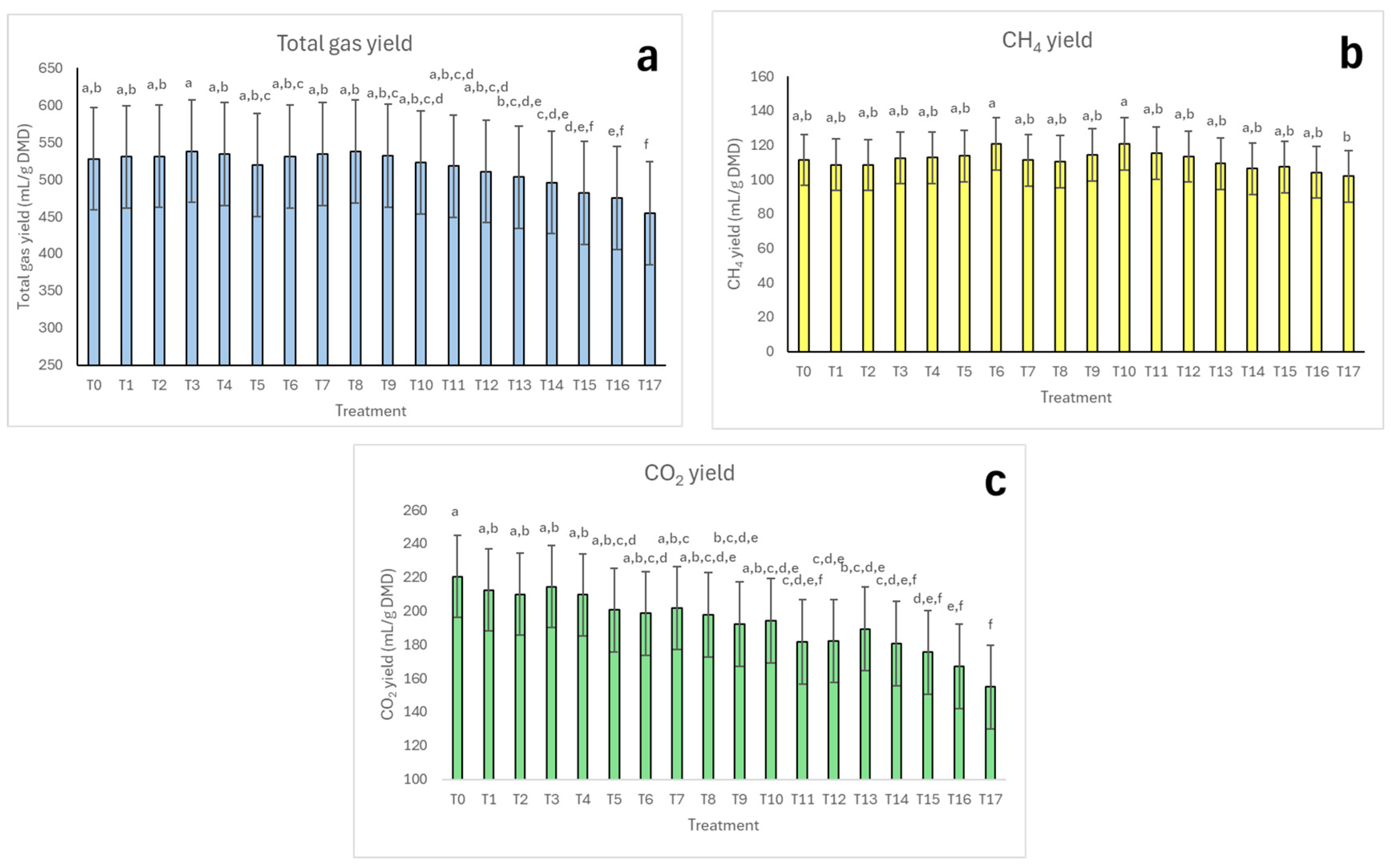
Figure 1. (a) Total gas yield (mL/g DMD) for each treatment; (b) CH4 yield (mL/g DMD) for each treatment; (c) and CO2 yield (mL/g DMD) for each treatment. Means within the same subfigure with different superscripts (a, b, c, d, e, f) are significantly different (p ≤ 0.05) according to Tukey’s HSD tests.
Applsci 15 13154 g001
Table 1. Composition of the diets used during the in vitro trials and for the donor steers.
Diet for Trial 1Diet for Trials 2 & 3
Ingredient, % dry matter (DM)
Ground hay, %5043
Dried distiller’s grains, %13.515.7
Ground corn, %36.241
Mineral premix, %0.30.3
Nutrient, % DM
Dry matter, %92.790.4
TDN, %69.267.8
Crude protein, %11.912.4
Fat, %3.943.83
NFC, %37.538.6
Fiber, % DM
ADF, %22.824.0
NDF, %42.842.0
Lignin, %3.764.6
Minerals, % DM
Calcium, %0.860.94
Phosphorus, %0.490.52
Magnesium, %0.220.23
Potassium, %1.521.07
Sodium, %0.140.14
Calculated Energy Values
NEM, Mcal/kg1.721.68
NEG, Mcal/kg1.101.06
NEL, Mcal/kg1.571.54
Table 2. Total number of bottles incubated across three trials, and treatment abbreviations with corresponding medium-chain fatty acid (MCFA) products.
No. of BottlesTreatmentMCFA Product 1Trial
44T0Control1, 2, 3
44T1C6 FR1, 2, 3
44T2C6 SR1, 2, 3
32T3C8 FR1, 2
32T4C8 SR1, 2
20T5C6 Salt1
20T6C8 Salt1
24T7C6 FR, C6 SR2, 3
12T8C6 FR, C8 FR 2
12T9C6 FR, C8 SR2
12T10C6 SR, C8 FR2
12T11C6 SR, C8 SR2
24T12C8 FR, C8 SR2, 3
16T13C6 FR, C6 SR, C8 FR3
16T14C6 FR, C6 SR, C8 SR3
16T15C6 FR, C8 FR, C8 SR3
16T16C6 SR, C8 FR, C8 SR3
16T17C6 FR, C6 SR, C8 FR, C8 SR3
1 C6: Caproic Acid. C8: Caprylic Acid. FR: Fast Release. SR: Slow Release.
Table 3. Dry matter digestibility (DMD; % disappeared) and mean final pH for each treatment.
TreatmentDMD (%)pH
T0 (Control)46.89 a,b6.74 a,b,c
T147.93 a,b6.73 a,b,c,d
T247.80 a,b6.74 a,b,c,d
T347.23 a,b6.74 a,b,c,d
T447.61 a,b6.73 a,b,c,d
T548.40 a,b6.74 a,b,c,d
T646.13 b6.75 a
T747.95 a,b6.73 c,d
T847.61 a,b6.72 c,d
T946.63 a,b6.72 c,d
T1045.94 a,b6.73 b,c,d
T1146.75 a,b6.73 a,b,c,d
T1247.32 a,b6.73 c,d
T1349.52 a,b6.72 d
T1448.33 a,b6.73 a,b,c,d
T1548.24 a,b6.73 a,b,c,d
T1649.74 a6.74 a,b,c
T1747.85 a,b6.75 a,b
p-value 10.02<0.001
1 Level of significance of the effect of the treatment. Means within the same column with different superscripts (a, b, c, d) are significantly different (p ≤ 0.05) according to Tukey’s HSD tests.
Table 4. Total gas volume collected (mL), CH4 (% and mL), and CO2 (% and mL) for each treatment.
TreatmentTotal Gas Collected (mL)CH4 (%)CO2 (%)CH4 (mL)CO2 (mL)
T0 (Control)114.8 a,b21.22 b,c42.11 a24.0547.06 a
T1116.3 a20.31 c40.03 b23.6645.52 a,b
T2115.3 a,b20.33 c39.90 b23.5344.91 a,b
T3116.0 a,b20.68 b,c40.06 a,b24.2145.62 a,b
T4115.7 a,b20.94 b,c39.23 b,c24.2344.43 a,b,c
T5113.1 a,b22.47 a,b38.55 b,c,d24.6242.78 a,b,c,d
T6113.1 a,b23.39 a36.70 c,d25.5541.22 b,c,d,e
T7117.1 a20.77 b,c38.21 b,c,d24.6344.07 a,b,c
T8118.1 a20.43 b,c37.27 b,c,d24.4243.30 a,b,c,d
T9113.7 a,b21.31 a,b,c36.56 c,d24.1640.49 b,c,d,e
T10112.3 a,b,c22.49 a,b,c37.05 b,c,d25.0140.30 b,c,d,e
T11111.2 a,b,c22.13 a,b,c35.76 d24.1838.27 d,e
T12111.0 a,b22.02 a,b,c36.40 d24.3939.49 d,e
T13117.0 a21.53 a,b,c38.36 b,c,d25.5443.65 a,b,c,d
T14112.4 a,b21.25 a,b,c37.28 b,c,d24.3340.63 b,c,d,e
T15108.9 b,c21.99 a,b,c37.33 b,c,d24.7739.87 c,d,e
T16112.2 a,b21.63 a,b,c36.20 c,d24.8939.13 c,d,e
T17103.4 c21.96 a,b,c35.30 d23.6335.32 e
p-value 1<0.001<0.001<0.0010.42<0.001
1 Level of significance of the effect of the treatment. Means within the same column with different superscripts (a, b, c, d, e) are significantly different (p ≤ 0.05) according to Tukey’s HSD tests.
Table 5. Total VFA production (mM), individual VFA molar proportions, and acetate/propionate ratio (A:P) for each treatment.
Treatment Total VFA (mM) Acetate MP Propionate MP Isobutyrate MP Butyrate MP Isovalerate MP Valerate MP Caproate MP A:P
T0 (Control)74.78 a60.54 a,b22.30 a0.96 c,d12.38 c,d1.76 a,b,c1.340.72 e2.73 c
T175.69 a60.54 a,b22.30 a0.95 d12.32 d1.75 b,c1.330.82 d,e2.73 c
T274.39 a60.44 b22.08 a,b0.96 c,d12.39 c,d1.77 a,b1.321.02 c2.75 c
T371.20 b60.29 b22.12 a,b0.97 b,c,d12.46 c,d1.78 a,b,c1.331.07 c2.74 c
T475.75 a60.40 b21.78 b,c0.97 b,c,d12.69 b,c1.78 a1.341.03 c2.78 b,c
T574.14 a,b60.30 b21.27 c0.98 a,b12.89 a,b1.78 a,b1.351.45 a2.85 b
T673.52 a,b60.91 a20.41 d1.00 a13.25 a1.80 a1.321.33 a,b3.01 a
T774.92 a,b60.33 b21.76 b,c0.97 b,c12.51 b,c,d1.78 a,b1.311.06 c2.79 b,c
T875.68 a,b60.62 a,b21.68 a,b,c0.97 a,b,c,d12.62 b,c,d1.78 a,b,c1.281.06 b,c2.82 b,c
T975.87 a,b60.56 a,b21.68 a,b,c0.97 a,b,c,d12.65 b,c,d1.78 a,b,c1.291.13 b,c2.82 b,c
T1074.68 a,b60.51 a,b21.78 a,b,c0.97 a,b,c,d12.60 b,c,d1.78 a,b,c1.301.07 b,c2.80 b,c
T1174.26 a,b60.48 a,b21.85 a,b,c0.96 b,c,d12.58 b,c,d1.76 a,b,c1.291.11 b,c2.79 b,c
T1275.47 a60.41 a,b21.92 a,b0.96 b,c,d12.40 c,d1.75 a,b,c1.311.13 b,c2.78 b,c
T1376.24 a60.22 b22.32 a,b0.97 b,c,d12.33 c,d1.78 a,b,c1.341.02 c,d2.72 c
T1475.61 a,b60.31 a,b22.10 a,b0.96 b,c,d12.43 b,c,d1.77 a,b,c1.361.03 c2.75 c
T1575.31 a,b60.34 a,b21.94 a,b,c0.96 b,c,d12.35 c,d1.75 a,b,c1.371.101 b,c2.77 b,c
T1676.36 a60.70 a,b22.10 a,b0.96 b,c,d12.22 c,d1.73 c1.300.96 c,d2.76 b,c
T1774.88 a,b60.42 a,b22.19 a,b0.96 c,d12.39 b,c,d1.76 a,b,c1.340.91 c,d,e2.74 c
p-value 10.0030.001<0.001<0.001<0.001<0.0010.24<0.001<0.001
1 Level of significance of the effect of the treatment. Means within the same column with different superscripts (a, b, c, d, e) are significantly different (p ≤ 0.05) according to Tukey’s HSD tests.
Disclaimer/Publisher’s Note: The statements, opinions and data contained in all publications are solely those of the individual author(s) and contributor(s) and not of MDPI and/or the editor(s). MDPI and/or the editor(s) disclaim responsibility for any injury to people or property resulting from any ideas, methods, instructions or products referred to in the content.



