1. Introduction
The rapid development of urban construction has resulted in higher demands for the exploration and utilization of urban underground spaces. Understanding the geotechnical properties of near-surface strata is crucial for site assessment, urban subsidence monitoring, and underground pipeline maintenance [
1]. However, urban geophysical surveys face numerous challenges, including strong noise, limitations on sensor deployment, and high construction costs [
2]. Distributed Acoustic Sensing (DAS), as a novel seismic data acquisition technology, has undergone rapid development in recent years [
3]. The DAS system measures strain or strain rate along the fiber axis by detecting phase changes in Rayleigh backscattered signals within the optical fiber [
4,
5]. Compared with traditional seismic geophones, DAS offers advantages such as high sampling density, flexible deployment, low cost, and resistance to harsh environments, enabling large-scale, high-density, and long-term continuous observations [
6].
In recent years, DAS technology has been extensively applied in various geophysical studies, including natural earthquake detection and urban near-surface imaging [
7,
8]. It has been implemented for monitoring natural and induced seismic events [
9] and for imaging urban traffic noise [
10]. DAS has also been employed in downhole measurements [
11], vertical seismic profiling (VSP) reservoir monitoring [
12], and CO
2 sequestration monitoring [
13].
Both domestic and international researchers have also used DAS observation data to conduct studies on active-source and ambient noise imaging. They have further discussed the development trends and challenges of DAS applications in seismology and hydrocarbon exploration [
14,
15,
16,
17]. In addition, significant progress has been made in DAS-based observation and imaging under various special signal sources and extreme field conditions. Examples include urban near-surface structure monitoring [
18], thunderstorm acoustic source analysis and lightning localization [
19,
20], glacier sliding and polar tectonic activity imaging [
21,
22], urban traffic and railway noise monitoring [
23,
24], near-surface imaging under mechanical disturbance [
25], safety assessment of nuclear power plants and quarries [
26], and seismic response to ocean storms [
27,
28]. DAS has even been applied to studies of the lunar environment [
29]. These studies further broaden the applications of DAS in multi-source detection and complex scenario imaging.
In urban near-surface imaging, passive surface-wave methods have attracted increasing attention due to their low cost and strong adaptability [
30]. In recent years, DAS has been widely applied to passive noise imaging and has become an important approach for passive surface-wave studies. In particular, seismic ambient noise imaging reconstructs surface-wave signals by computing noise cross-correlation functions. This technique can effectively constrain the S-wave velocity structure at depths of several meters to hundreds of meters within the frequency band dominated by traffic noise [
31]. High-density arrays are crucial for high-frequency surface-wave imaging, but the deployment cost of traditional seismometers remains very high. For example, the Long Beach experiment used more than 5300 short-period sensors to achieve an 8.5 km × 4.5 km coverage. If existing urban communication optical cables are utilized, DAS technology can achieve ultra-dense, low-cost, and high-resolution exploration of urban underground spaces. However, DAS ambient noise imaging based on urban telecommunication fibers still faces multiple challenges. First, urban noise sources are highly directional, time-varying, and unevenly distributed, with limited frequency bandwidth. These characteristics result in poor convergence of cross-correlation signals and affect surface-wave reconstruction. Second, the fixed routes and complex coupling conditions of urban telecommunication fibers cause significant signal attenuation, which limits wavefield sampling. In addition, DAS observations generate massive data volumes with relatively low signal-to-noise ratios. In traditional workflows, manual dispersion extraction and velocity inversion are inefficient and lack automation, making it difficult to achieve flexible and efficient imaging in complex urban environments.
To improve the stability and efficiency of DAS ambient noise imaging based on urban telecommunication cables, both data processing and inversion procedures need to be optimized. In DAS data processing, accurate extraction of surface-wave dispersion curves and velocity inversion are the key steps for revealing subsurface structures. Extracting high-resolution dispersion information is essential for reducing inversion non-uniqueness and improving imaging accuracy [
32]. In this study, ambient noise data were collected through telecommunication fibers buried in urban underground space. Seismic interferometry was applied to reconstruct surface-wave signals, and the fundamental-mode dispersion curves were inverted using the preconditioned steepest descent (PSD) method. The PSD scheme provides a balance between stability and convergence efficiency by allowing the update direction to vary between steepest-descent and quasi-Newton behavior through the hyper-parameter
. This flexibility makes PSD well suited for nonlinear surface-wave inversion without the need to explicitly compute the full Hessian. An adaptive inversion was achieved by dynamically selecting the optimal regularization parameter
through the construction of an L-curve. The resulting S-wave velocity profiles depict the near-surface structure with high resolution. The results demonstrate that the proposed workflow can stably extract surface-wave dispersion information under complex urban noise conditions. By incorporating automatic regularization parameter selection through the L-curve, the method achieves high-resolution subsurface velocity imaging.
2. Materials and Methods
2.1. Ambient-Noise Cross-Correlation and Phase-Weighted Stacking
To obtain coherent surface-wave signals from the urban ambient noise, the continuous DAS records were divided into short time segments and preprocessed. Each segment was detrended, bandpass filtered, spectrally whitened, and one-bit normalized to reduce the influence of amplitude fluctuations and improve waveform coherence.
For each time segment, the reference channel and the target channel were cross-correlated to extract coherent arrivals between the two locations. The cross-correlation function is expressed as:
where
and
denote the preprocessed signals of the two channels. The cross-correlation results from all segments were then averaged to obtain a stable linear stack,
where
denotes the number of time segments included in the linear stacking. The value of
is determined by the segment length and the stacking duration.
To further enhance the coherent components, phase-weighted stacking (PWS) was applied. The phase stack was calculated by normalizing the instantaneous phase of each segment as:
and the final PWS stacked result was obtained as:
where
is the phase-weighting exponent that controls the strength of coherence enhancement in PWS. The phase stack acts as a coherency-based filter whose sharpness is governed by
; the linear stack is retrieved when
= 0. Increasing
generally imposes stronger suppression of incoherent energy, whereas smaller
provides a more conservative weighting.
Because the signal characteristics vary along the fiber, a spatial sliding-window scheme was adopted. Local subarrays were defined along the cable, and the first channel in each subarray was used as the reference for cross-correlation.
2.2. Principles of the High-Resolution Linear Radon Transform
The urban ambient noise recorded by the DAS system is long-duration data with a low signal-to-noise ratio. Introducing the high-resolution linear radon transform (HRLRT) helps focus energy in the frequency-phase velocity domain and suppress higher-mode and body-wave interference. This process facilitates accurate extraction of the fundamental-mode surface-wave dispersion curves. The conventional Radon transform can be expressed in matrix form as follows:
where
represents the virtual shot gather,
is the model vector in the Radon domain describing the energy distribution over different slowness values (equivalently phase velocities) and frequencies, and
is the Radon transform operator [
33], which can be expressed as follows:
where
denotes the frequency,
is the slowness, and
represents the receiver offset relative to the source position. By applying phase corrections and stacking the wavefield data of each frequency component under a series of assumed velocities, the dispersion energy distribution can be constructed and identified in the frequency–velocity domain.
A sparsity-constrained optimization method is introduced to achieve high-resolution reconstruction of the dispersion image by penalizing non-sparse structures in the Radon-domain model space. The Radon model
is estimated by solving the following optimization problem [
34,
35]:
where
is the data weighting matrix,
is the Radon-domain model weighting matrix enforcing sparsity, and
is the regularization factor used to balance data fitting and model constraint.
In practice, is updated iteratively based on the amplitude of the current model estimate, following an iteratively reweighted strategy that promotes sparsity in the Radon domain.
In this study, the seismic records were transformed from the time domain to the frequency domain using the short-time Fourier transform (STFT), and the HRLRT was subsequently applied to perform phase-velocity scanning for each frequency window, producing an energy distribution image in the frequency–velocity domain. To further enhance the signal-to-noise ratio and mode focusing of the dispersion image, the PWS technique was incorporated; it improves phase coherence and suppresses random noise by weighting the instantaneous phase information to enhance coherence, thereby sharpening and clarifying the dispersion curves without significantly amplifying background noise [
36]. In the seminal PWS study, a squared phase stack (
) is used as a typical choice [
36]. In this study,
.
A horizontally layered model containing a low-velocity interlayer was designed for testing. The model parameters are listed in
Table 1. The total model length is 120 m, with a receiver spacing of 1 m, and the source wavelet is a 20 Hz Ricker wavelet.
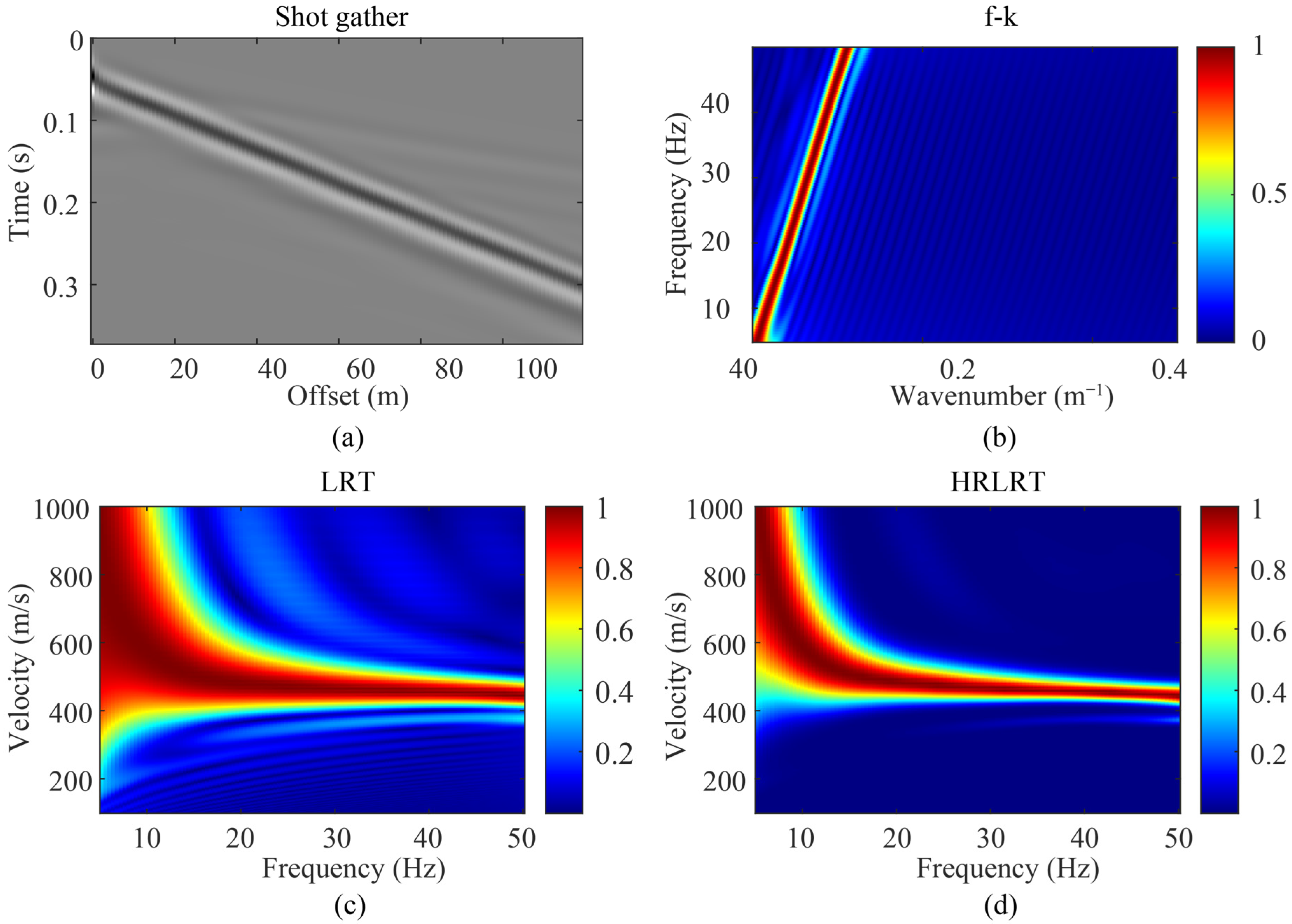
Dispersion analysis was performed on the synthetic data using both the linear radon transform (LRT) and the HRLRT. The processing results are shown in
Figure 1. The results indicate that HRLRT exhibits stronger energy focusing and higher resolution, producing more concentrated dispersion energy bands. It also maintains good recognizability in weak-energy regions. In contrast, the dispersion energy distribution obtained by the conventional LRT is relatively diffuse and less focused. These findings verify that HRLRT performs better under theoretical model conditions.
2.3. Principles of the Preconditioned Steepest Descent Method
In near-surface structure inversion, the surface-wave dispersion curve reflects the response of the subsurface shear-wave velocity structure to wave propagation. By matching the observed dispersion curves with theoretical velocity models, the S-wave velocity profile of the subsurface can be indirectly derived.
The key to surface-wave dispersion inversion lies in constructing a reasonable objective function and applying an efficient nonlinear optimization algorithm to iteratively update the model so that the simulated results fit the observed data more closely. The data misfit function, which quantifies the difference between the observed and predicted dispersion curves, is expressed as follows:
where
is the data weighting matrix,
represents the observed data, and
denotes the predicted phase velocities calculated from the model
through the forward modeling algorithm.
The PSD method requires information on the gradient and the second derivative of the objective function. These quantities can be estimated numerically by replacing derivatives with finite differences. The Hessian matrix is treated as a diagonal matrix, and since both the gradient and the Hessian cannot be derived analytically, finite-difference approximations are used to compute the gradient information.
The PSD algorithm essentially provides a compromise between the steepest descent and Newton’s methods. In the
k-th iteration, the model update can be expressed as follows [
37,
38,
39]:
where
is the descent direction at the
k-th iteration,
is the current gradient, and
represents the finite-difference approximation of the Hessian matrix. By traversing a set of balance factors
and step lengths
, the PSD algorithm searches for an appropriate update direction. The factor
controls the descent direction in the preconditioning scheme: a small
makes the update behave similarly to a quasi-Newton correction, while a larger
results in a direction closer to the classical steepest-descent method. The parameter
determines the step size along the chosen direction. For each trial pair
, the objective function of the updated model is evaluated. If the objective function value is smaller than that of the previous model
, the
k-th iteration is considered successful; otherwise, the iteration terminates and the current model
is taken as the final result.
In this study, a nonlinear inversion was carried out using the PSD method, and a model-smoothing constraint was introduced to improve the stability of the inversion process. The inversion objective function consists of a data-fitting term and a model-smoothing term, which can be expressed as follows:
where
is the regularization parameter that controls the weighting between data fitting and model smoothness, and
is the reference model, which is set to a zero vector in this study, indicating that only a minimum-structure constraint is imposed. By adjusting the value of
, a dynamic balance between data-fitting accuracy and model smoothness can be achieved [
40].
2.4. Principles of the L-Curve Corner Identification Strategy
To improve the automation of the inversion process and reduce subjectivity and uncertainty in the selection of the regularization parameter, an automatic L-curve corner detection strategy based on curvature analysis was incorporated into the PSD inversion workflow [
41,
42].
Under the Tikhonov regularization framework, the objective function can be expressed as follows:
where
is the forward operator,
is the observed data vector,
is the model parameter vector,
denotes the reference model.
is the smoothing constraint operator, and
is the regularization parameter.
For each measurement point, a series of different
values were assigned, and the objective function was minimized for each case.
The two corresponding error terms are calculated as follows:
where
represents the data error term, reflecting the degree to which the model fits the observed data, and
represents the model error term, indicating the degree of smoothness constraint imposed relative to the reference model.
Taking
as the horizontal axis and
as the vertical axis, an L-curve is constructed to describe the two-dimensional relationship between the data error term and the model error term. The curvature function is then calculated in logarithmic coordinates as follows:
The parameter corresponding to the maximum curvature is taken as the optimal regularization coefficient:
This method automatically identifies the corner of the L-curve, avoiding repeated trial calculations and achieving an optimal balance between data fitting and model smoothness. It significantly enhances the automation and stability of the inversion process.
3. Field Experiment
3.1. DAS Data Acquisition and Experimental Setup
The study area is located within the Chaoyang Campus of Jilin University in Changchun City, Jilin Province, China, on the eastern margin of the Songliao Basin. The terrain was relatively flat and tectonically stable, mainly consisting of terraces and gently undulating hills, with an elevation of approximately 250–350 m. The region provides favorable conditions for shallow surface-wave propagation.
According to existing urban geological data, the shallow subsurface structure of central Changchun mainly comprises artificial fill and unconsolidated sediments within the upper 10 m, which are commonly associated with roads, building foundations, and old riverbeds, and exhibit relatively low shear-wave velocities. Between depths of 10–25 m, the strata consist primarily of medium-density silty clay or interbedded silt layers that may have undergone partial compaction, resulting in slightly higher shear-wave velocities. Below about 25 m, semi-weathered bedrock or dense soil layers dominate, where the shear-wave velocity increases further.
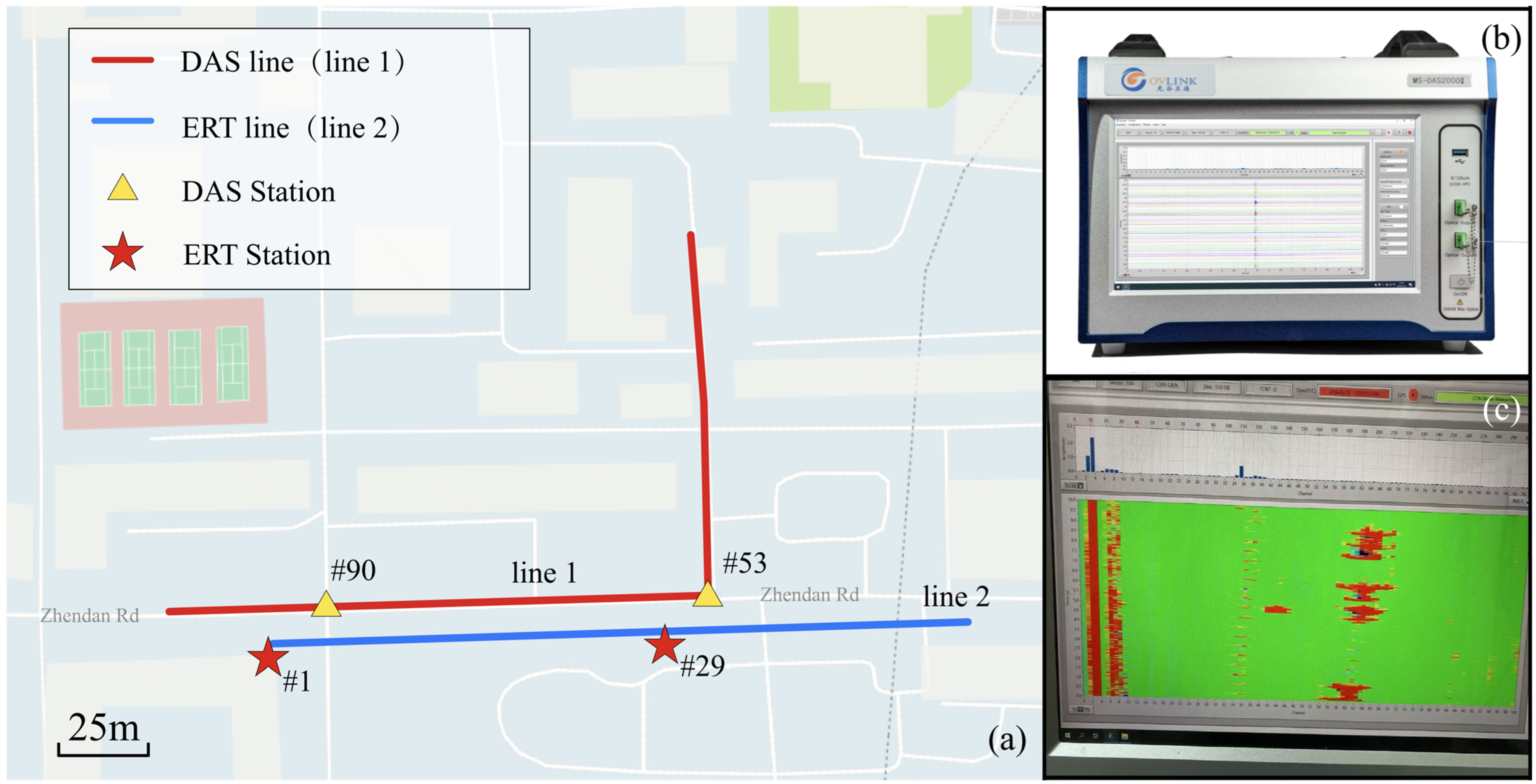
Both a DAS array (Line 1) and a high-density electrical resistivity tomography (ERT) array (Line 2) were deployed along the main road of the campus, as shown in
Figure 2. The primary noise sources of the DAS array were vehicle traffic on nearby roads and anthropogenic activities along pedestrian pathways [
10]. The ERT array was installed within the green belt adjacent to the road.
The DAS data were acquired using a DAS-2000 III interrogator (OVLINK, Wuhan Optical Valley Interlink Technology Co., Ltd., Wuhan, China), as shown in
Figure 2b. During acquisition, the system provides a real-time display of the array response (
Figure 2c), which allows the operator to confirm that all channels are functioning properly. During the acquisition period from 20 July to 24 July 2024, the DAS system continuously recorded data at a sampling frequency of 1 kHz and a channel spacing of 3 m, with one-minute noise records collected at regular intervals. The total length of the experimental DAS array (Line 1) was approximately 312 m. The array changes its orientation from north–south to east–west at the channel 53, a turning point that can be identified through cross-correlation of the complete dataset. In this study, data from the channels 53 to 90 were selected for analysis. Channels beyond 90 were excluded due to the proximity of the cable to the campus gate and main external road, where strong environmental noise affected data stability.
3.2. DAS Data Analysis and Spectrum Characteristics
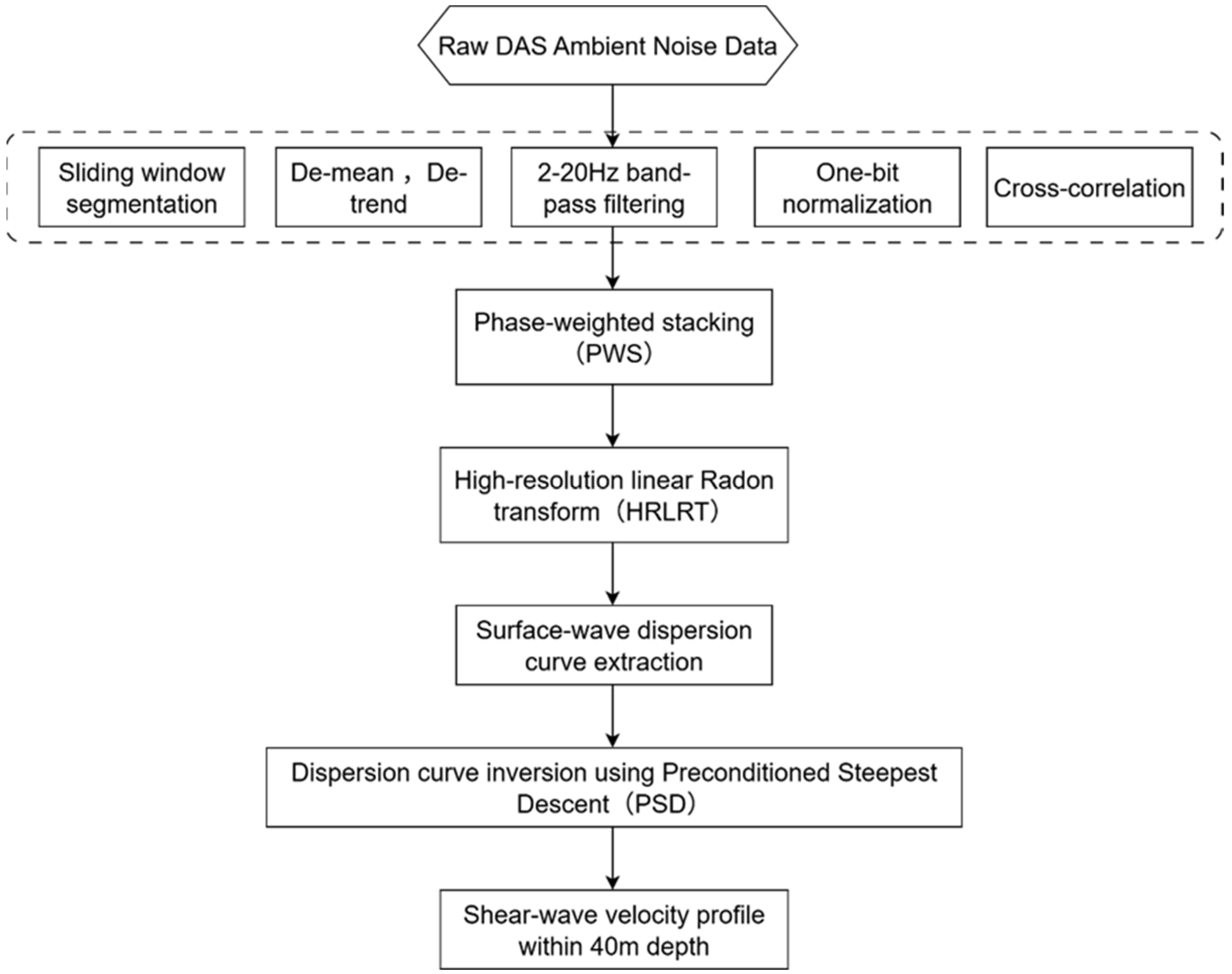
A total of 38 channels from channel 53 to channel 90 were selected for inversion, and the processing workflow is illustrated in
Figure 3. The results of data preprocessing are shown in
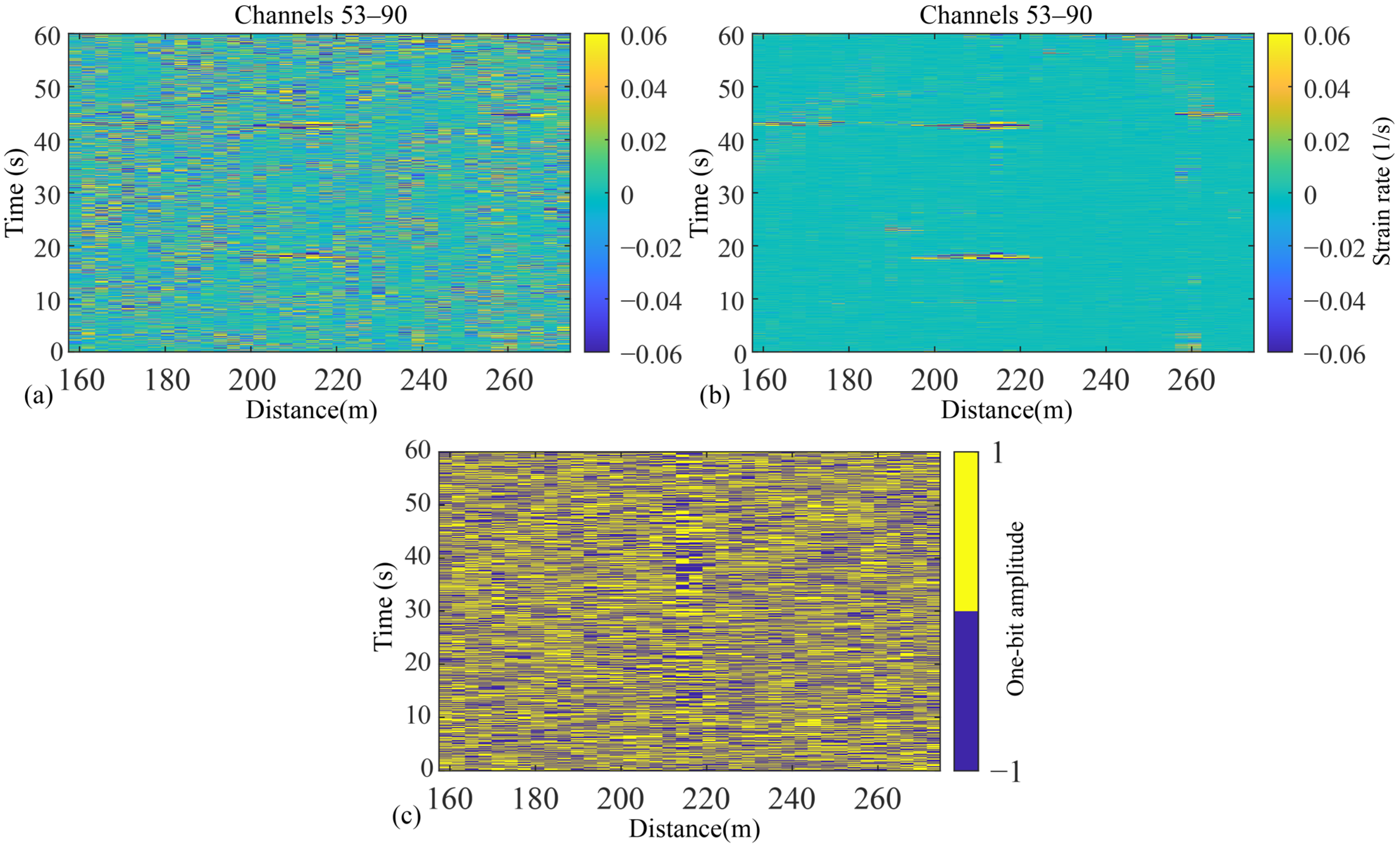
Figure 4. The raw DAS records (
Figure 4a) were first detrended and demeaned [
43], and then segmented into 10 s windows. A 2–20 Hz band-pass filter was applied to remove low-frequency drift and high-frequency noise (
Figure 4b). Because short-duration high-amplitude pulses are present in the data (
Figure 4b), “one-bit” normalization was applied to suppress amplitude anomalies while preserving the phase information, ensuring that the cross-correlation is not dominated by a few strong impulsive signals (
Figure 4c), and cross-correlation was performed on each time segment to obtain coherent surface-wave signals.
To further enhance the stability and signal-to-noise ratio of the cross-correlation results, the PWS method was applied to the cross-correlation functions of all time segments. The PWS method utilizes the phase consistency among different time windows to perform a weighted linear stacking along the time dimension, thereby suppressing random noise and reinforcing coherent signals.
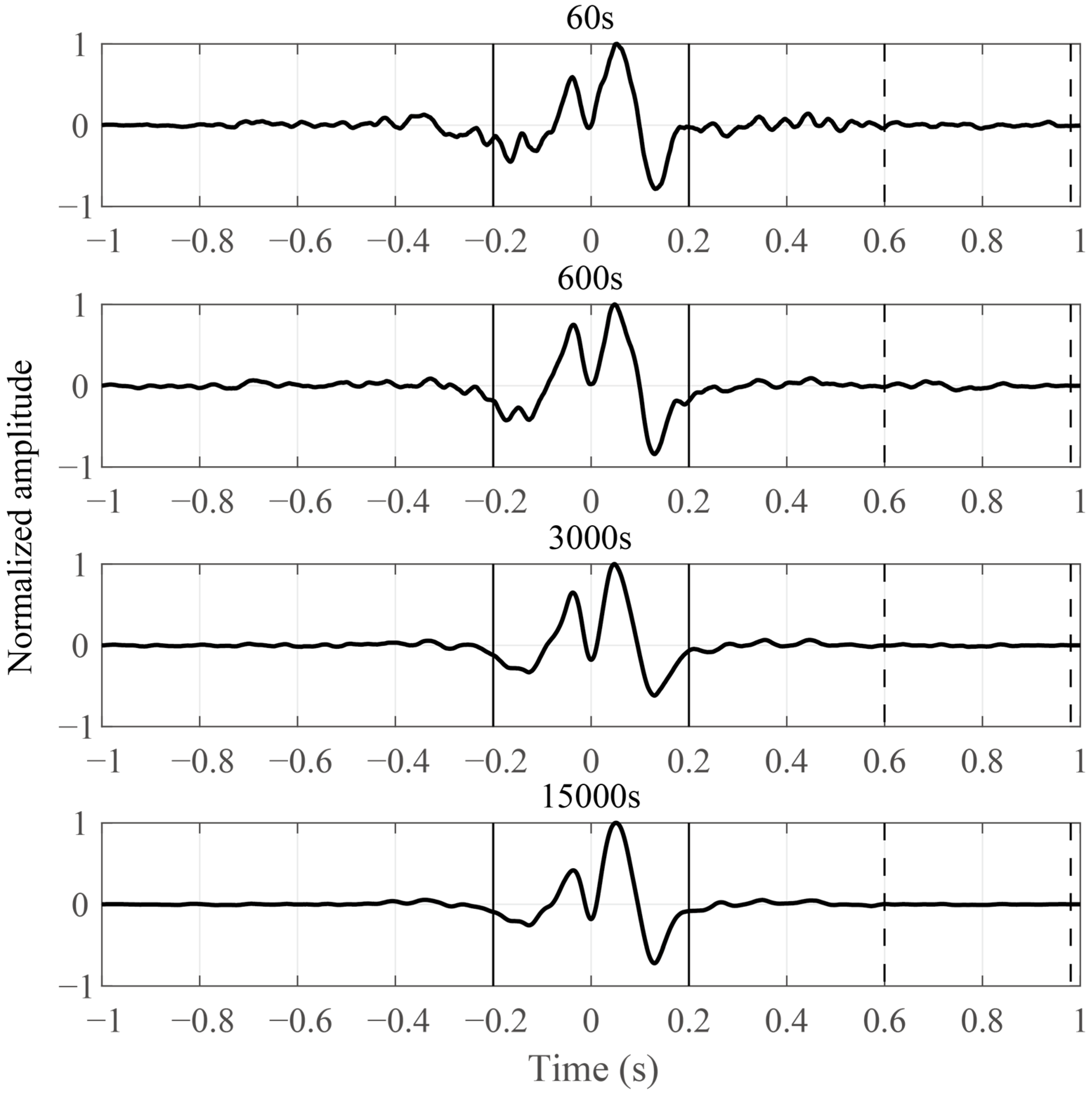
To evaluate the influence of long-term stacking on the signal-to-noise ratio (SNR), 95 h of continuous DAS observation data were analyzed. The dataset includes typical anthropogenic ambient noise generated by vehicle traffic and pedestrian activities on campus during morning and evening hours, exhibiting a distinct diurnal pattern. Four groups of tests with different time-stacking durations were conducted to evaluate the improvement of the SNR (
Figure 5). Among them, the 15,000 s stacking duration produced a noticeably higher SNR compared with the other three groups. This shows that as the stacking duration increases, the SNR generally improves significantly. However, when the stacking time exceeds 24 h, the rate of improvement gradually decreased [
10]. To balance data quality and computational cost, a 24 h time window was selected as the analysis unit for temporal stacking, enabling efficient utilization of the long-term continuous recordings.
The optical fiber layout in the experimental area is oriented mainly in north–south and east–west directions, and the cross-correlation analysis results are shown in
Figure 6. In some segments, the correlation is relatively poor, exhibiting distinct stratified features. Based on the analysis, channel 53 can be identified as the starting point of the east–west survey line. The DAS system records continuously distributed multichannel time-series signals along the fiber axis, with each channel corresponding to a specific spatial location. When cross-correlation is performed across all channels simultaneously, the results may be affected by the spatial non-stationarity of the wavefield, the decay of coherence with distance, and excessive computational complexity. Localized cross-correlation can, to some extent, improve the stability of surface-wave signals.
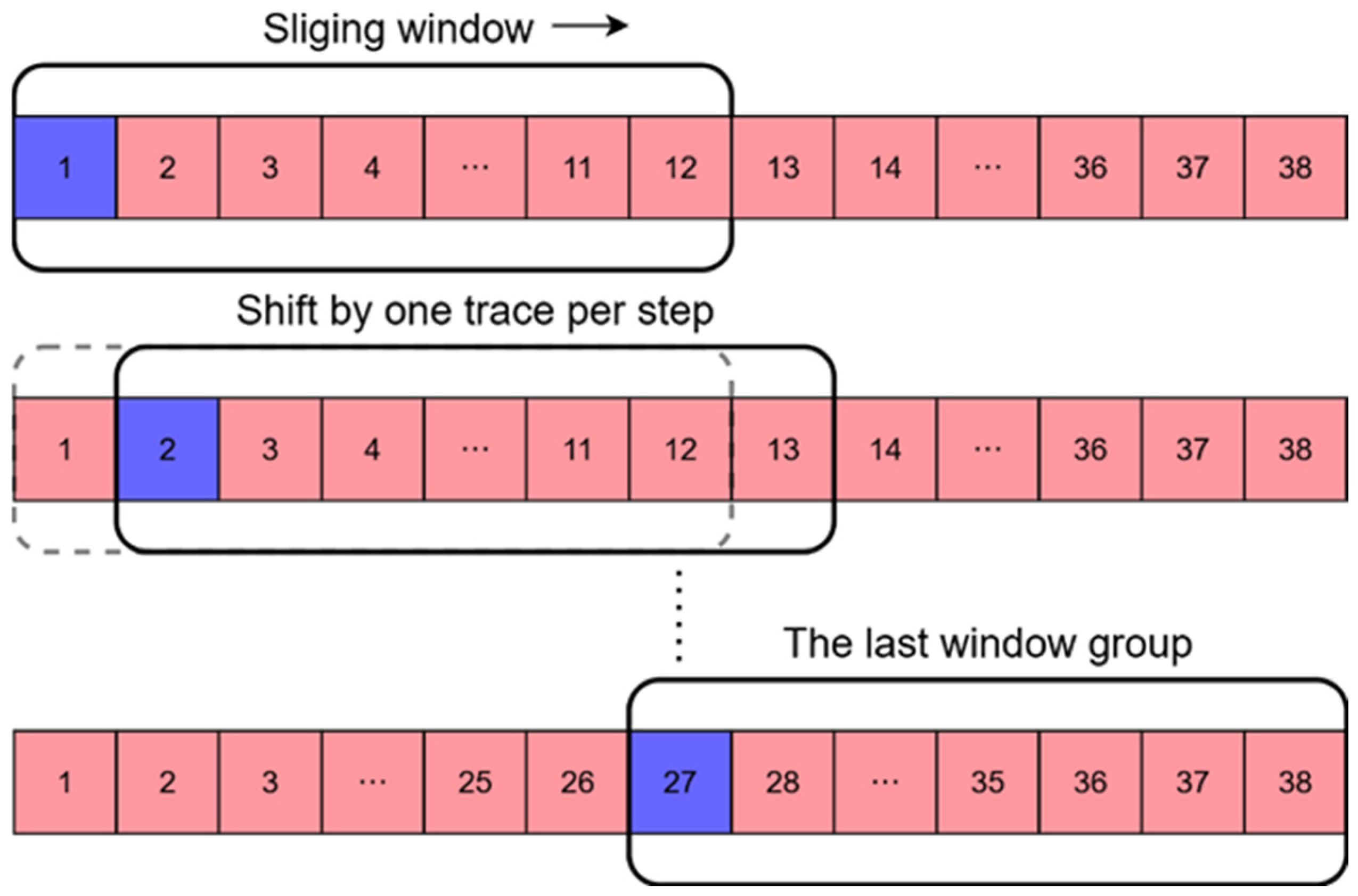
Due to the complex structures along the urban fiber route and the strong noise interference, a sliding-window cross-correlation approach was applied [
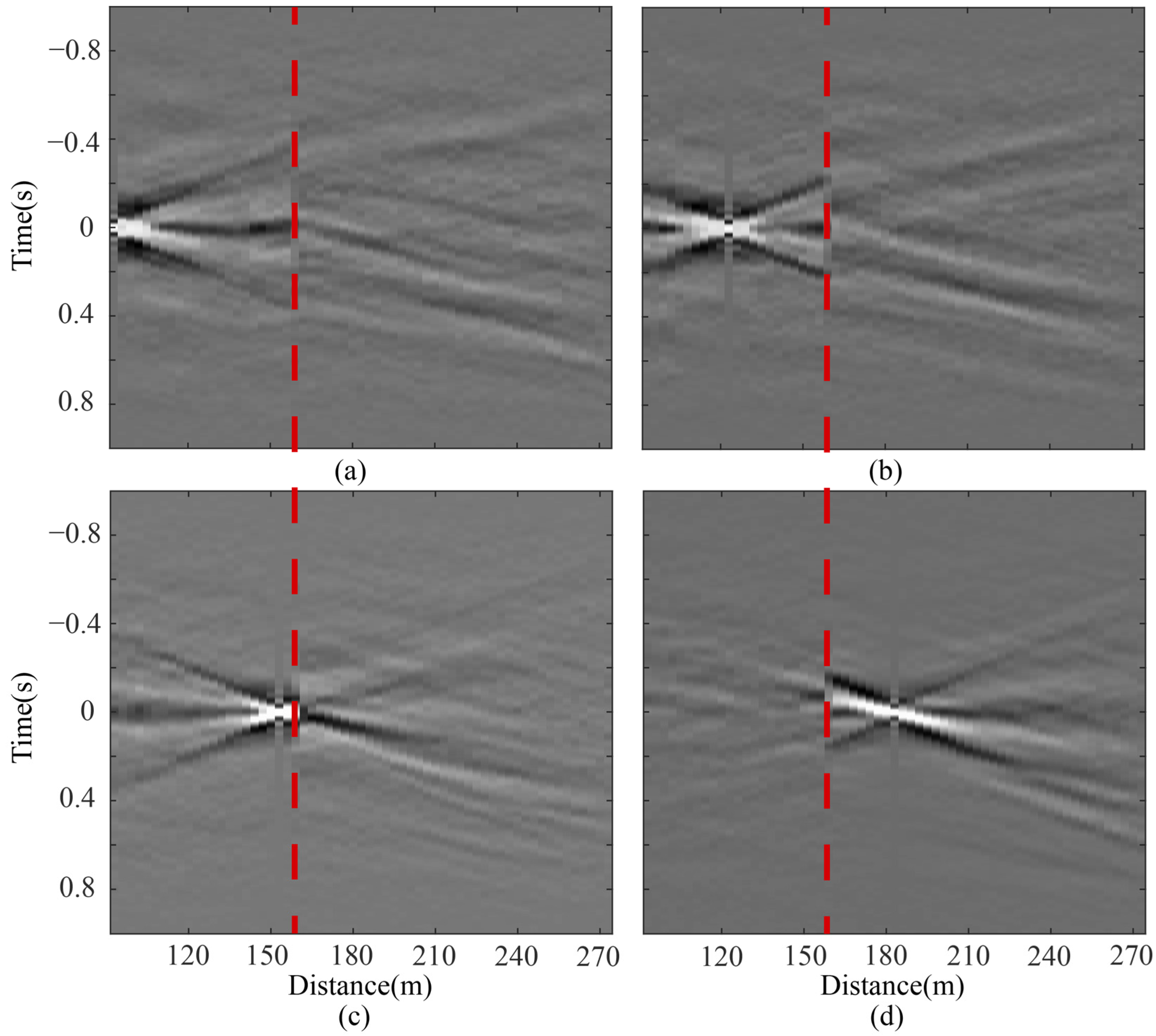
44]. In the spatial dimension, a highly overlapping windowing scheme was designed, as illustrated in
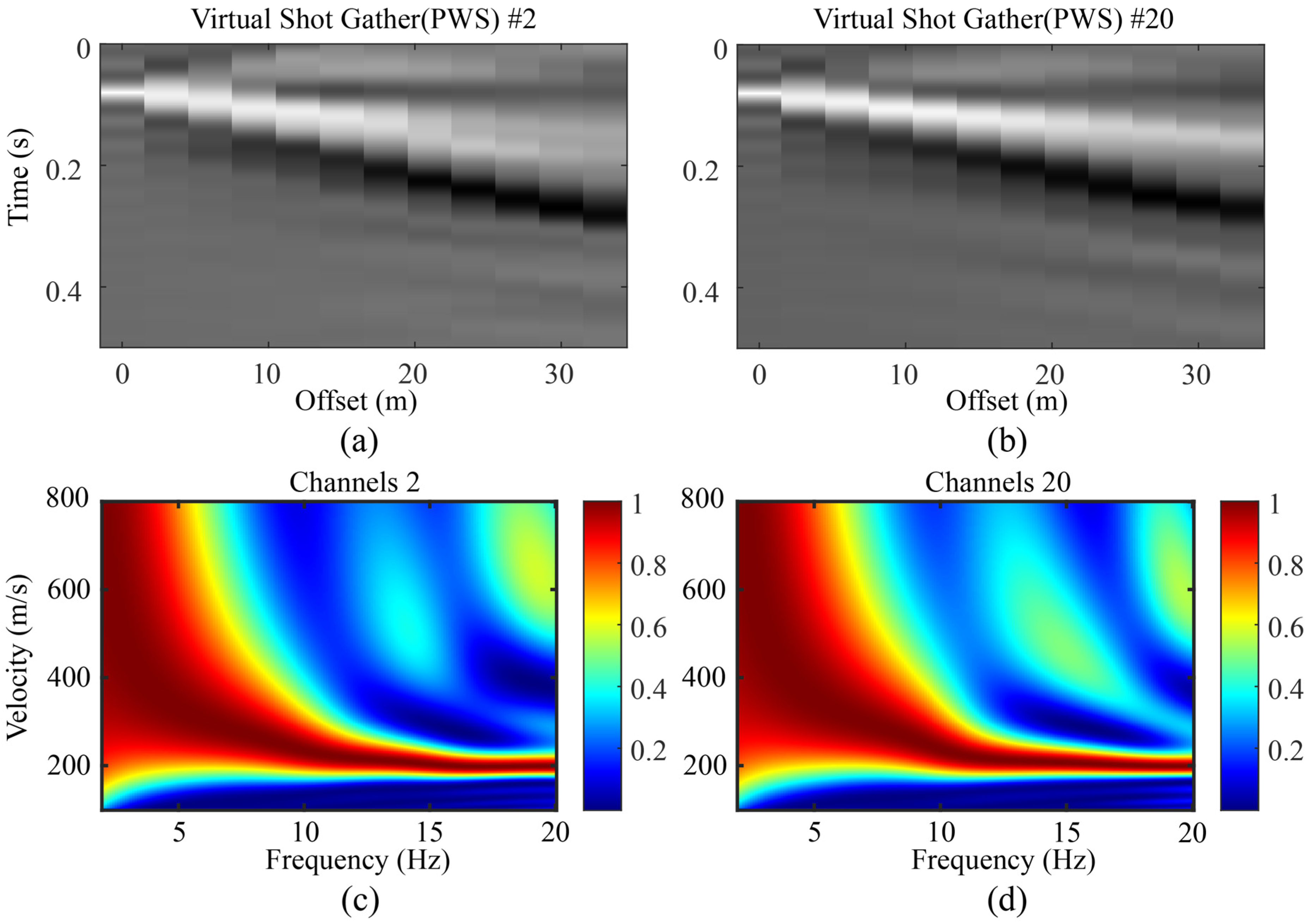
Figure 7. Within the range of channels 53 to 90, a total of 38 channels were divided into overlapping analysis windows with a step size of one channel and a window width of twelve channels, resulting in 27 local cross-correlation windows. In each window, the first channel was fixed as the reference, and its cross-correlation functions with the remaining channels were calculated. The results were then PWS to extract coherent waveform features within the local range (
Figure 8a,b).
The analysis strategy combining spatial sliding windows and PWS within temporal segments effectively enhances the signal-to-noise ratio of the cross-correlation results while maintaining spatial resolution. This approach also adapts well to potential spatial heterogeneity along the fiber direction, facilitating subsequent virtual-source imaging and geophysical interpretation.
The stacked cross-correlation data were processed using the HRLRT to obtain the energy distribution in the frequency-phase velocity domain (
Figure 8c,d), where the dispersion curves exhibit clear modal focusing characteristics.
3.3. Dispersion Curve Extraction and Inversion
After extracting the fundamental-mode Rayleigh wave dispersion curves, the PSD method was applied to perform one-dimensional S-wave velocity inversion at 27 survey points. In the initial model, the subsurface was divided into 20 layers, with initial S-wave velocities estimated from the average observed phase velocities and layer thicknesses evenly distributed. The density of all layers was fixed at 2000 kg/m3, and the P-to-S wave velocity ratio was 2.45. The upper and lower bounds of S-wave velocity were determined according to the observed phase velocity range. During the inversion, both S-wave velocity and layer thickness were iteratively updated, with the step size and preconditioning factor adjusted based on parameter sensitivity tests to balance convergence speed and stability. The maximum number of iterations was 80. After completing the one-dimensional inversions at all 27 points, Kriging interpolation was applied to generate a two-dimensional S-wave velocity profile along the survey line.
In this experiment, the inversion objective function consists of a data misfit term and a model smoothness constraint. The regularization factor was adaptively determined using the L-curve criterion. For each survey point, an L-curve was constructed based on the objective function under different regularization parameters, and the parameter corresponding to the point of maximum curvature was selected as the optimal solution. This approach eliminates the need for manual parameter tuning during inversion, significantly reducing repetitive trial computations and greatly improving both efficiency and the level of automation in the inversion workflow.
ERT measurements were conducted at the experimental site for comparison with the DAS imaging results. The ERT survey line was deployed parallel to the DAS array, as shown by line 2 in
Figure 2. The distance between the two arrays was approximately 6 m, with a total ERT line length of 210 m and an electrode spacing of 3.5 m.
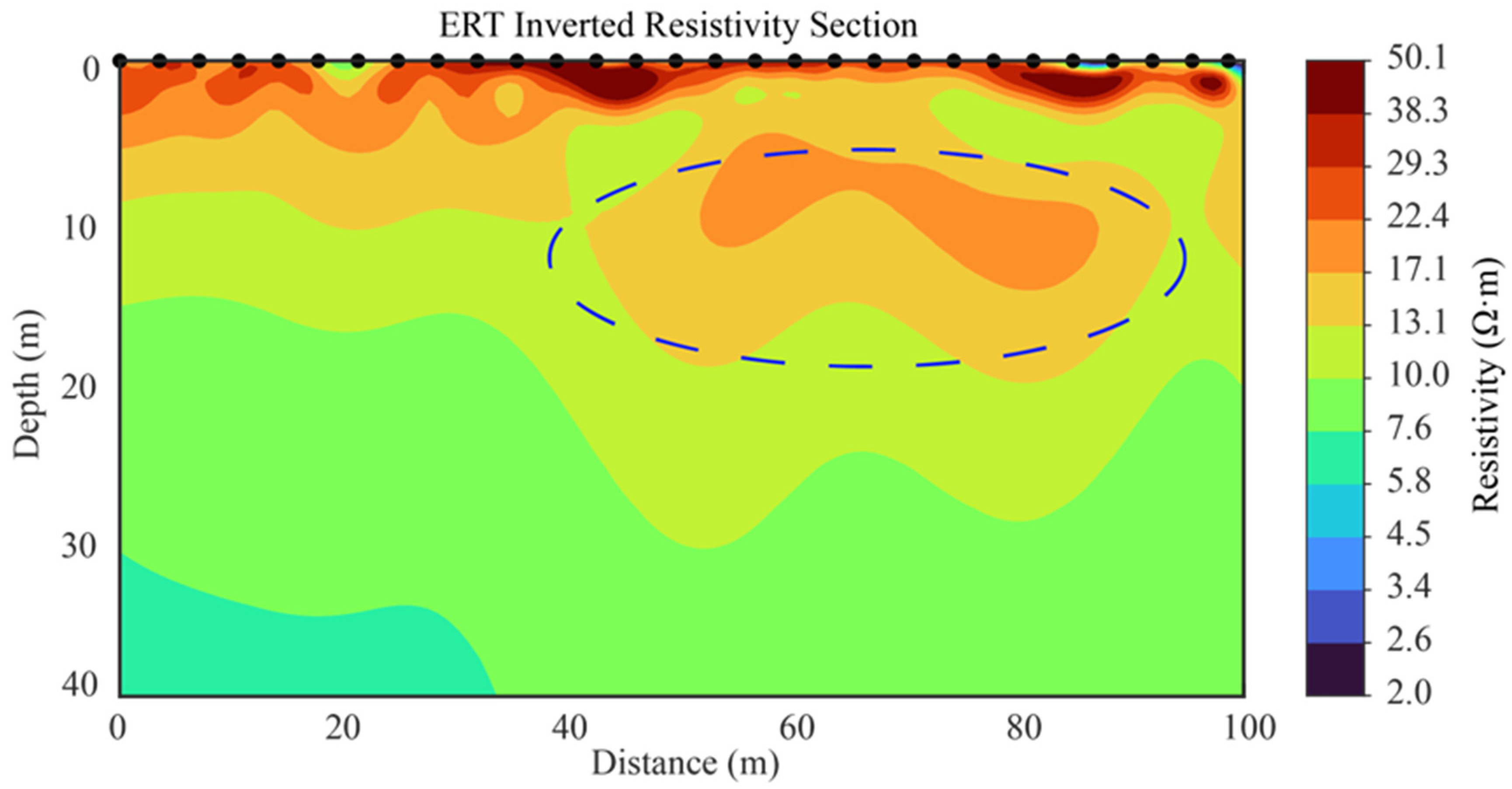
Figure 9 presents the inverted resistivity section, where the low-, medium-, and high-resistivity zones can be clearly identified.
4. Data Interpretation
The one-dimensional S-wave velocity profiles exhibit similar stratified features at multiple survey points. As shown in
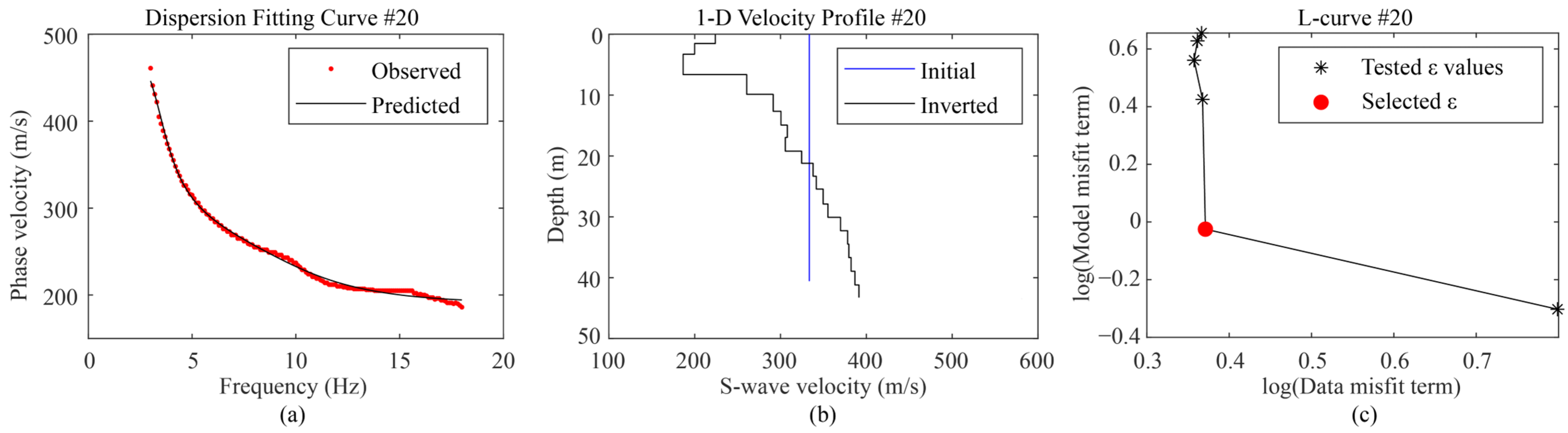
Figure 10, the inverted dispersion curve at channel 20 fits well with the observed dispersion curve within the frequency range of 3–18 Hz. The corresponding L-curve and the automatically selected corner point used to determine the regularization parameter are shown in
Figure 10c. The shallow layer (approximately 0–10 m) is characterized by a distinct low-velocity zone with velocities of 180–250 m/s. The velocity gradually increases to about 300–350 m/s in the middle layer and approaches 450 m/s at greater depths, showing a general trend of increasing velocity with depth. The S-wave velocity profile clearly delineates stratified structures and distinct interfaces, reflecting the transition from surface fill and loose sediments to stiffer layers or the top of the bedrock.
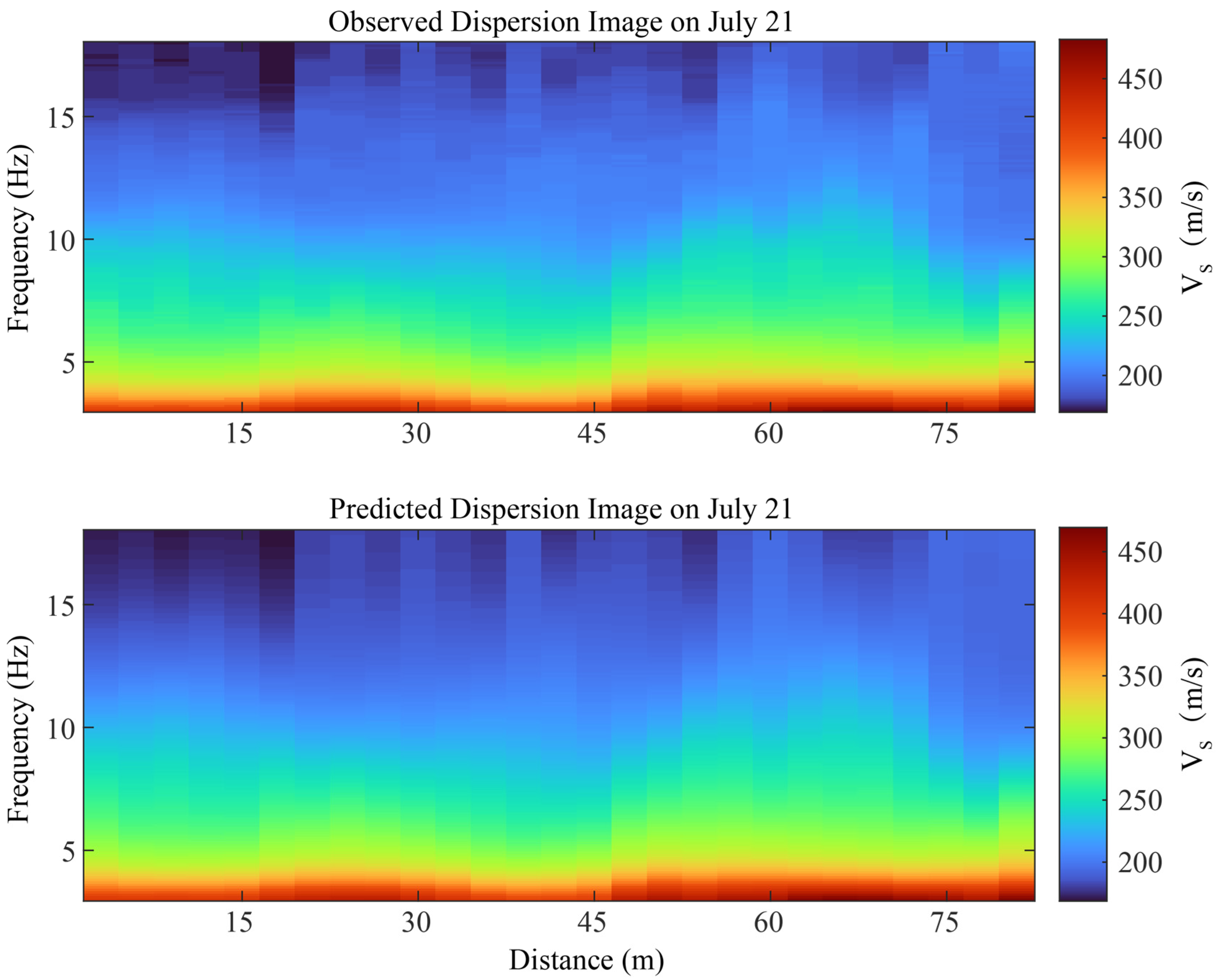
Figure 11 further demonstrates that the observed and predicted dispersion curves show consistent energy bands and overall trends.
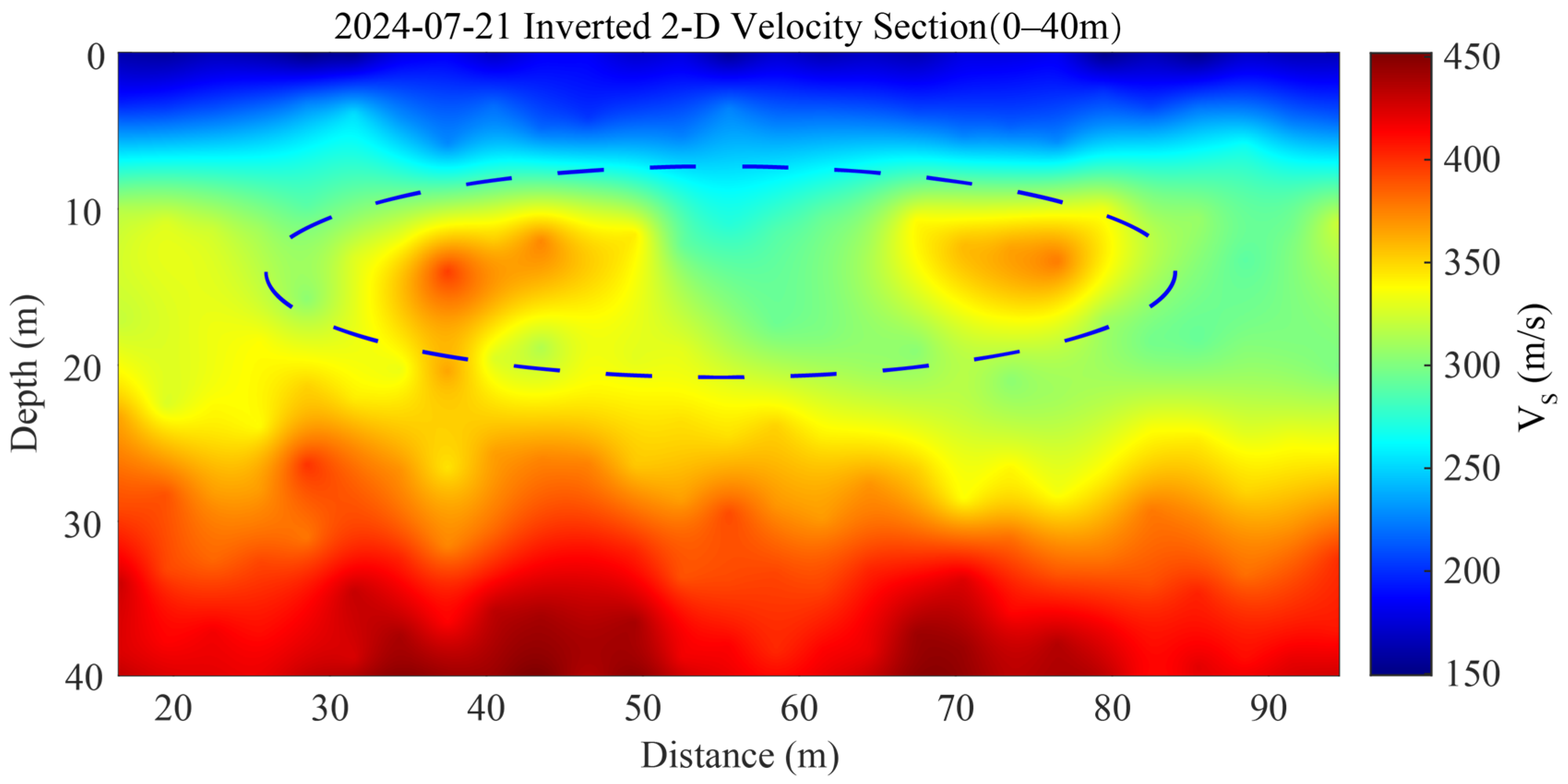
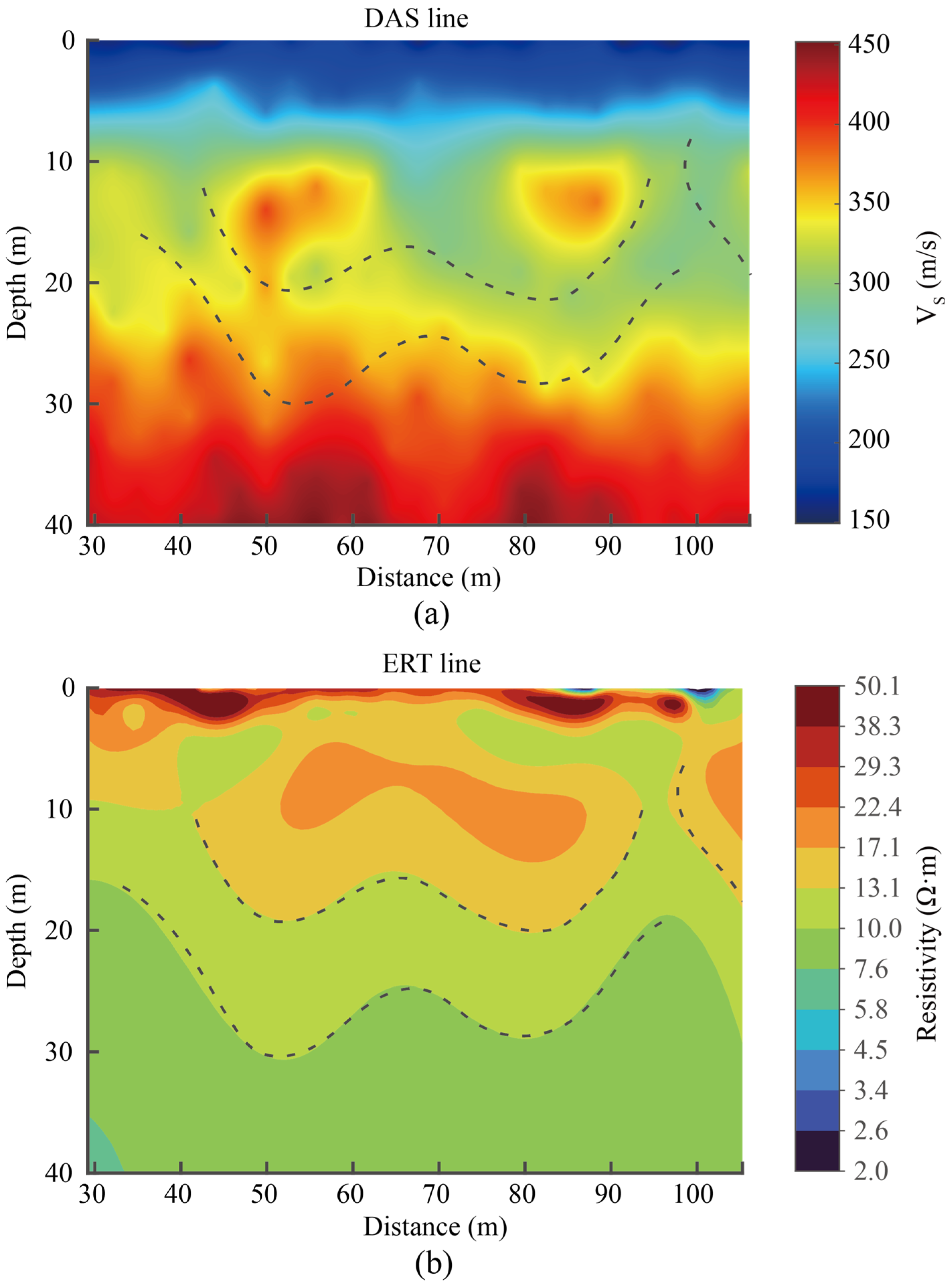
Figure 12 shows the two-dimensional S-wave velocity section obtained along the survey line on 21 July 2024. Overall, the profile exhibits a typical sedimentary pattern with low velocities in the near-surface and higher velocities at depth, indicating a general increase in velocity with depth. When combined with the ERT resistivity imaging results shown in
Figure 9, the subsurface structure can be divided into three distinct layers.
The upper layer (0–6 m) represents the unsaturated zone (vadose zone), which is mainly composed of sandy clay and clayey loam with low moisture content. It appears as a low-velocity zone in the DAS velocity section and a medium- to high-resistivity zone in the ERT section. The light-blue boundary in
Figure 12 is interpreted as the groundwater table.
The middle layer (6–20 m) corresponds to the saturated aquifer, consisting predominantly of silt and fine sand. Pore spaces in this layer are filled with groundwater, enhancing its electrical conductivity. Consequently, it appears as a low-resistivity zone in the ERT image and a medium-velocity zone in the DAS section. This layer serves as the primary groundwater-bearing formation in the study area.
The bottom layer (below 20 m) is interpreted as bedrock or consolidated sedimentary strata, characterized by high density and low porosity. It manifests as a high-velocity red zone in the DAS velocity profile and a relatively low-resistivity zone in the ERT section, representing the transition from unconsolidated deposits to bedrock or lithified sediments.
A pronounced high-velocity anomaly is observed in the mid-shallow portion of the profile (depth ~10–20 m, horizontal distance 35–75 m), enclosed by a dashed ellipse in
Figure 12. The anomaly exhibits significantly higher S-wave velocities than surrounding areas at the same depth, suggesting a locally reinforced layer, bedrock uplift, compacted backfill, or other dense structural body. The corresponding region in the ERT inversion (
Figure 9) displays a coincident high-resistivity anomaly.
A comparison of the DAS velocity and ERT resistivity sections at the same position (
Figure 13) shows that the high-resistivity anomaly in the ERT image spatially coincides with the high-velocity anomaly in the DAS section. This consistency verifies the reliability of the DAS-derived anomalies and confirms their correspondence to subsurface rigid structures.
5. Discussion
In this study, continuous urban ambient noise recorded by the DAS array was used to construct virtual shot gathers through cross-correlation and stacking. The inverted S-wave velocity model reveals a shallow low-velocity layer, a middle transition zone, and a deeper high-velocity region, along with several localized anomalies. These features are generally consistent with the geological background and with the overall trend of the ERT results. Although the main structure appears stable, several factors related to resolution and data quality warrant further discussion.
The horizontal resolution of the S-wave velocity model is primarily constrained by the 3 m channel spacing of the DAS array, which defines the lateral sampling of the virtual shot gathers. Although a 12-channel sliding window is applied in the cross-correlation to enhance local coherence, the window shifts one channel at a time, so the effective lateral sampling remains unchanged. Small-scale lateral variations can still be identified in the final model, whereas the regularization applied during inversion introduces smoothing that may broaden the apparent extent of localized anomalies, even though their presence and locations are robust.
The characteristics of the urban noise field also influence the stability of the cross-correlations. Surface waves generated by vehicle traffic provide the dominant coherent energy, while mechanical vibrations, tire–road interactions, and near-field impulses introduce non-informational components that reduce coherence, particularly when the noise field is strongly directional or varies rapidly. In addition, the limited low-frequency content of the ambient noise restricts the penetration depth of the surface-wave imaging, reducing sensitivity to deeper structures.
The telecommunication fiber at the experimental site has a relatively simple and uniform installation condition along its route, resulting in generally stable signal behavior. Minor local variations along the fiber path may still influence the coherence of individual channels, but the sliding-window cross-correlation strategy helps mitigate the impact of these localized variations. In contrast, large-scale urban telecommunication networks typically contain additional structural components, such as splice points, distribution nodes, and segments with varying installation conditions. Evaluating the applicability and performance of the proposed workflow under such more complex fiber-network settings will be an important direction for future work.
Although only the 24 h stacked result is presented, data from other periods within the ~90 h recording show consistent velocity structures, indicating that the method is stable at the structural scale. Because DAS and ERT sense different physical properties, their comparison in this study provides only qualitative structural consistency rather than a quantitative relationship between resistivity and S-wave velocity. A quantitative uncertainty analysis is not feasible under the current noise and deployment conditions. Future work may include longer-term repeated measurements or the installation of a small number of conventional geophones to provide independent cross-validation.
6. Conclusions
This study proposes a workflow for shallow urban subsurface imaging using DAS data acquired from existing urban telecommunication cables. By applying cross-correlation and PWS to continuous urban ambient noise records, stable noise cross-correlation functions were obtained for subsequent surface-wave analysis. The combination with the HRLRT helped concentrate the dispersion energy, resulting in clearer fundamental Rayleigh-wave dispersion curves. Furthermore, a nonlinear PSD inversion method with automatic regularization parameter selection based on the L-curve criterion was employed, reducing manual parameter tuning and improving the stability of the inverted models.
The proposed workflow was applied under typical urban noise conditions, yielding a two-dimensional S-wave velocity profile with good shallow resolution that outlines the near-surface low-velocity cover layer, localized high-velocity anomalies, and a gradual increase in velocity with depth. The results suggest that the passive surface-wave imaging using DAS systems deployed on existing urban telecommunication cables can provide geologically reasonable subsurface structures in complex urban environments. The proposed workflow provides a useful reference for conducting low-cost subsurface investigations utilizing urban fiber-optic communication networks, while further validation and uncertainty assessment remain important directions for future work.