Research on Dynamic Loads Acting on a Vehicle Caused by the Road Profile with Different Surfaces

 ,
,  , and
, and
Featured Application
Abstract
1. Introduction
- On a track with a random road profile;
- On a constant road profile.
- Weather conditions (applies to ground surfaces);
- The pressure forces exerted by the vehicle wheels on the road surface (deepening of ruts, hardening of the ground in places of increased pressure;
- Random changes in the lateral roll angle and longitudinal slope of the road profile;
- Subgrade deformability.
- Maximum suspension deflection;
- Average suspension deflection;
- Maximum sprung mass acceleration;
- Average sprung mass acceleration;
- Maximum unsprung mass acceleration;
- Average unsprung mass acceleration.
- Repeatability of results;
- Reproducibility of measurements;
- Consistency of the input over time;
- No influence of weather conditions on the input.
- Performing various research tests in conditions that ensure complete safety;
- Performing accelerated durability tests while maintaining correlation with operating conditions;
- Simulating situations that a vehicle may encounter during operation,
- Allowing for vehicle comparisons;
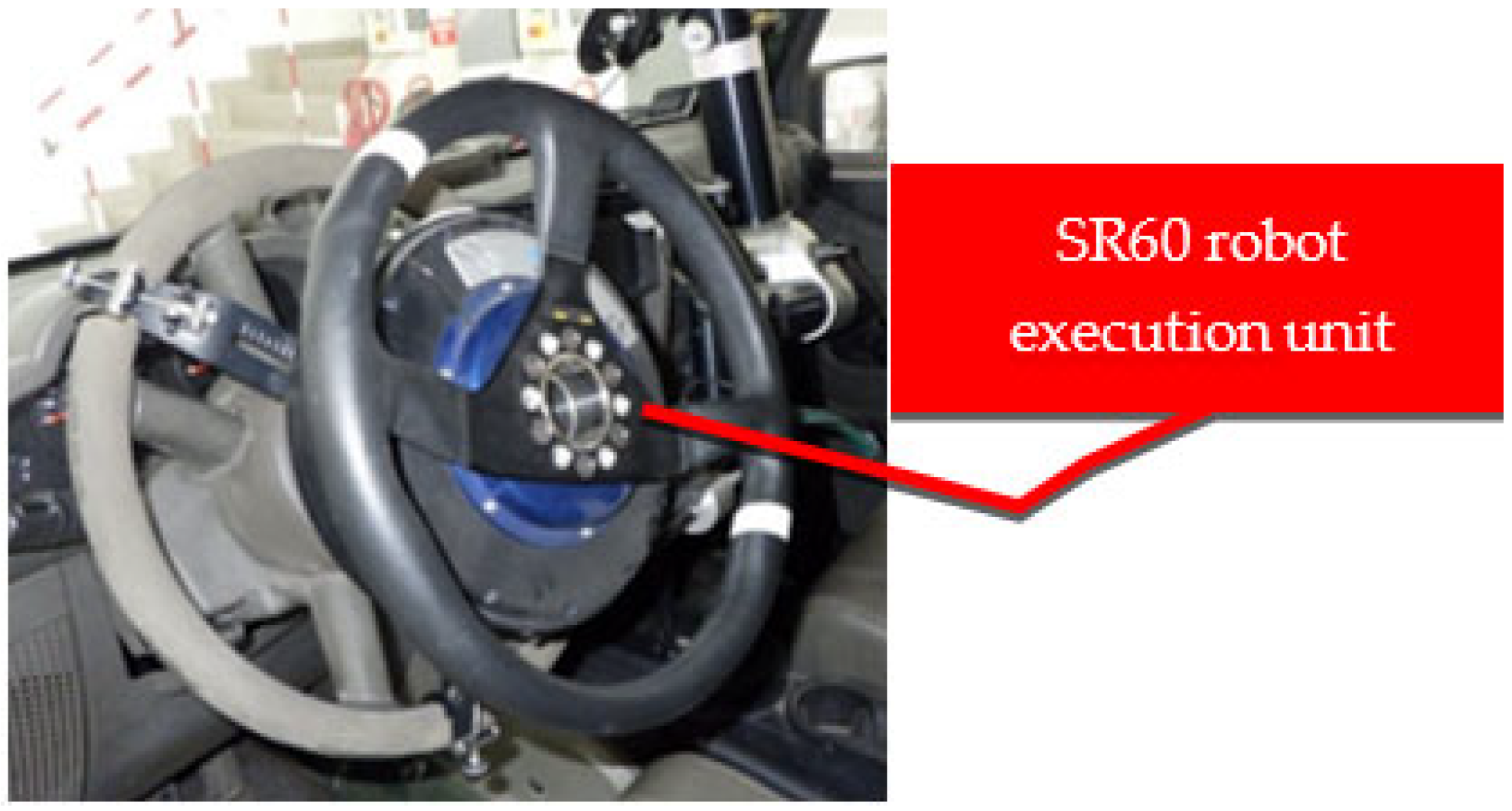
- Using a robot to control the vehicle.
2. Materials and Methods
- Vertical acceleration of the sprung mass;
- Vertical acceleration of the unsprung mass;
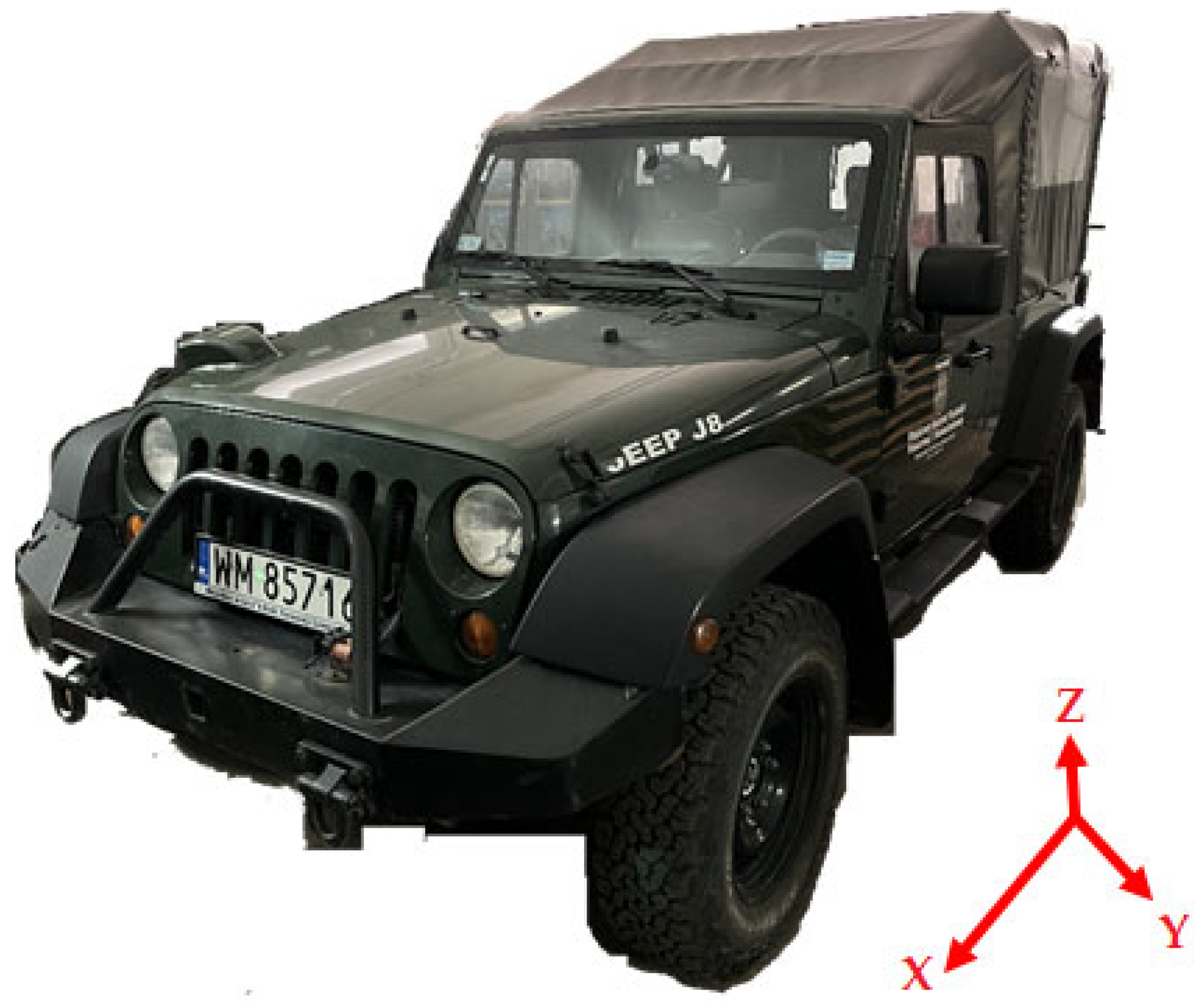
- Vertical and angular accelerations at the vehicle’s center of mass;
- Vehicle speed.
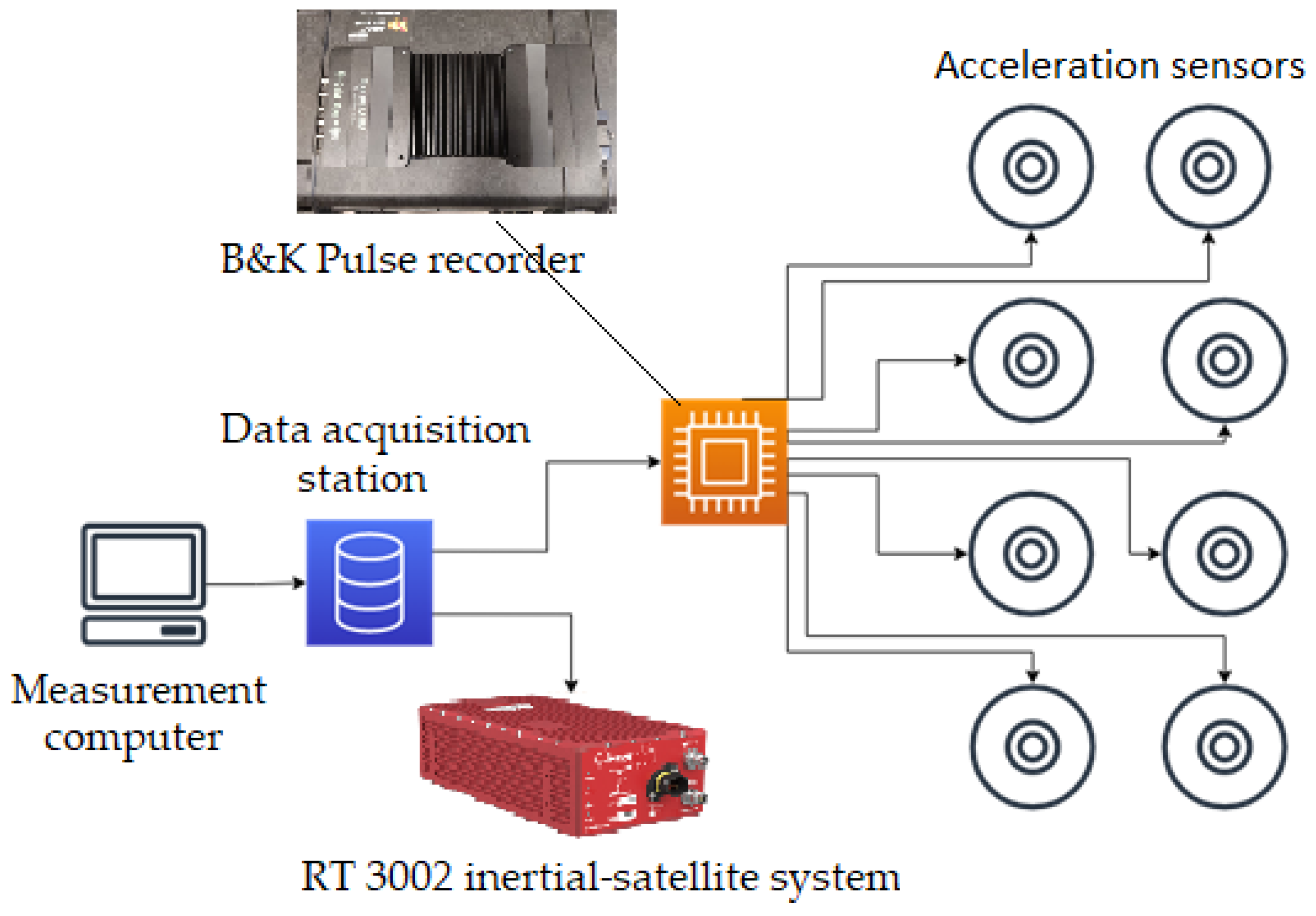
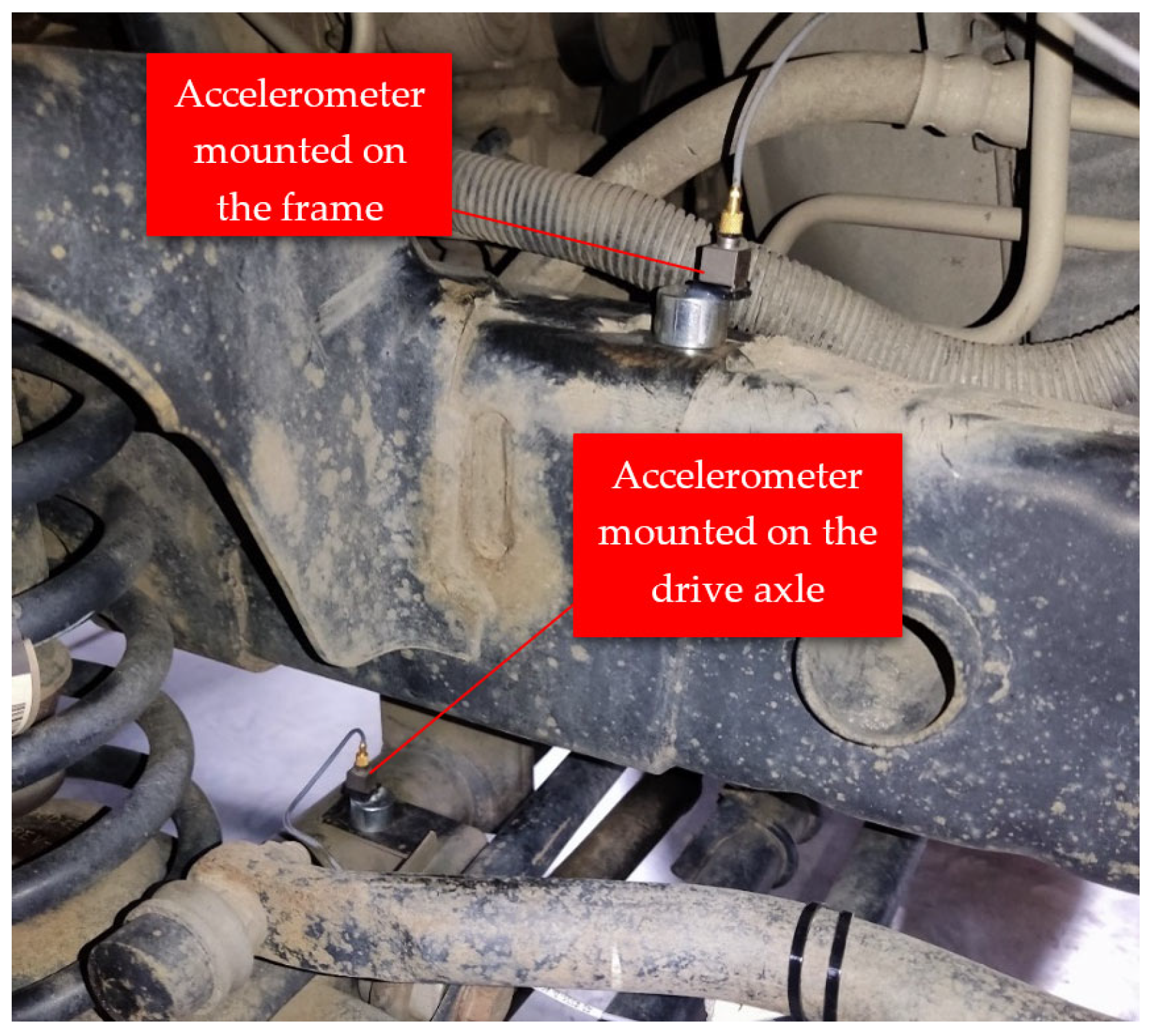
- Acceleration sensors mounted on the vehicle’s axle;
- Acceleration sensors mounted on the frame;
- RT 3002 Inertial-satellite system mounted at the vehicle’s center of mass;
- Pulse recorder from Brüel & Kjaer Type 3050-A-060 (Brüel & Kjaer, Nærum, Denmark);
- Data acquisition stations;
- Measurement computer.
- D2—tank track no. 2;
- D3—tank track no. 3;
- D4—concrete track with damaged surface;
- D5—off-road.
- hRMS—road profile height RMS,
- hi—road profile height,
- n—number of samples.
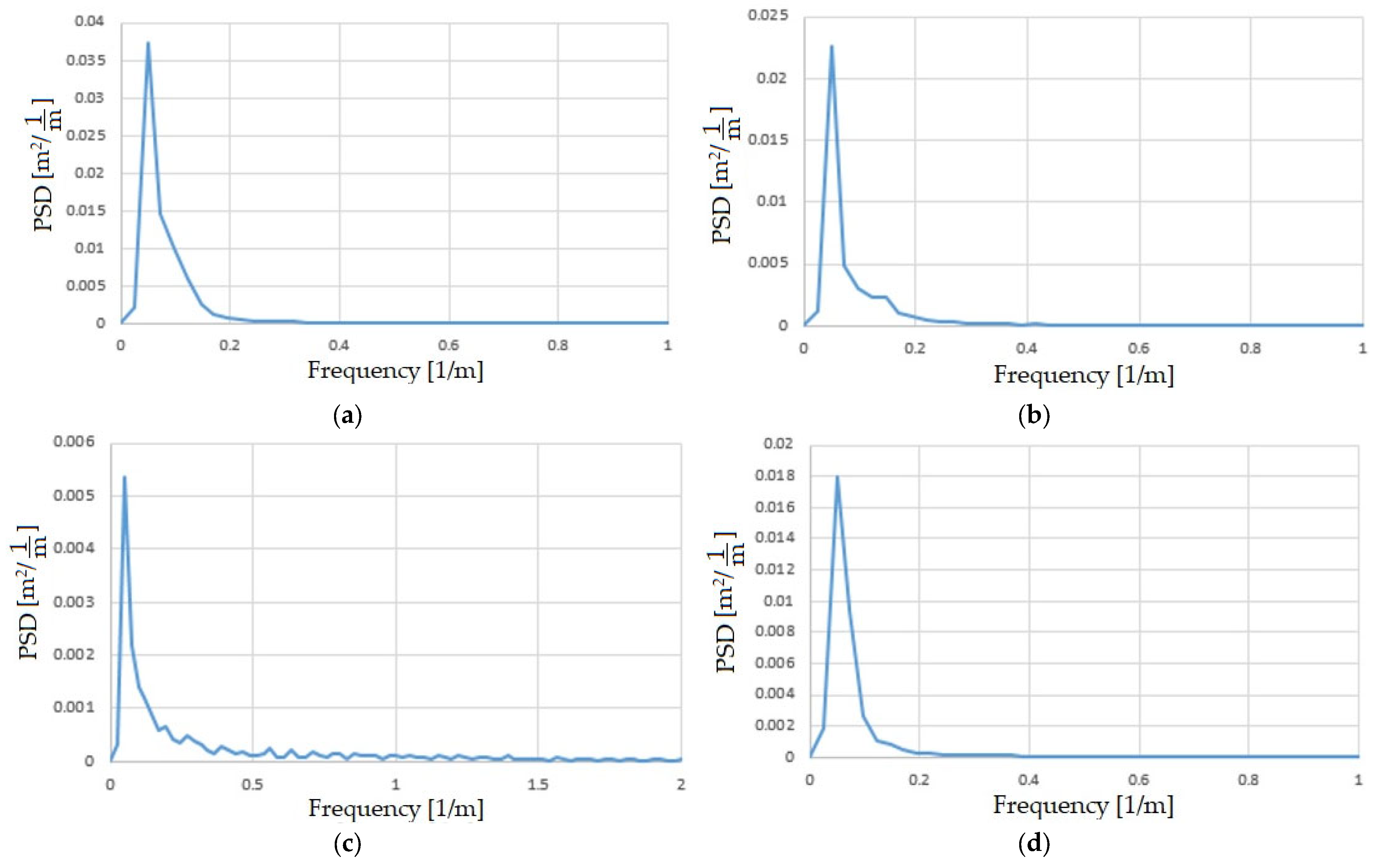
- PSDh—vector of power spectral density values,
- abs(FFT(h))—modulus from the Fast Fourier Transform (FFT),
- n—number of samples,
- fs—sampling frequency.
- In the vehicle’s path (designated as RMS in the table);
- Average value over the road width (designated as RMS2.5 in the table).
3. Results and Discussion
3.1. Results of Experimental Studies
- Root mean square (RMS) accelerations measured on the vehicle frame;
- Root mean square (RMS) accelerations measured on the vehicle’s drive axle;
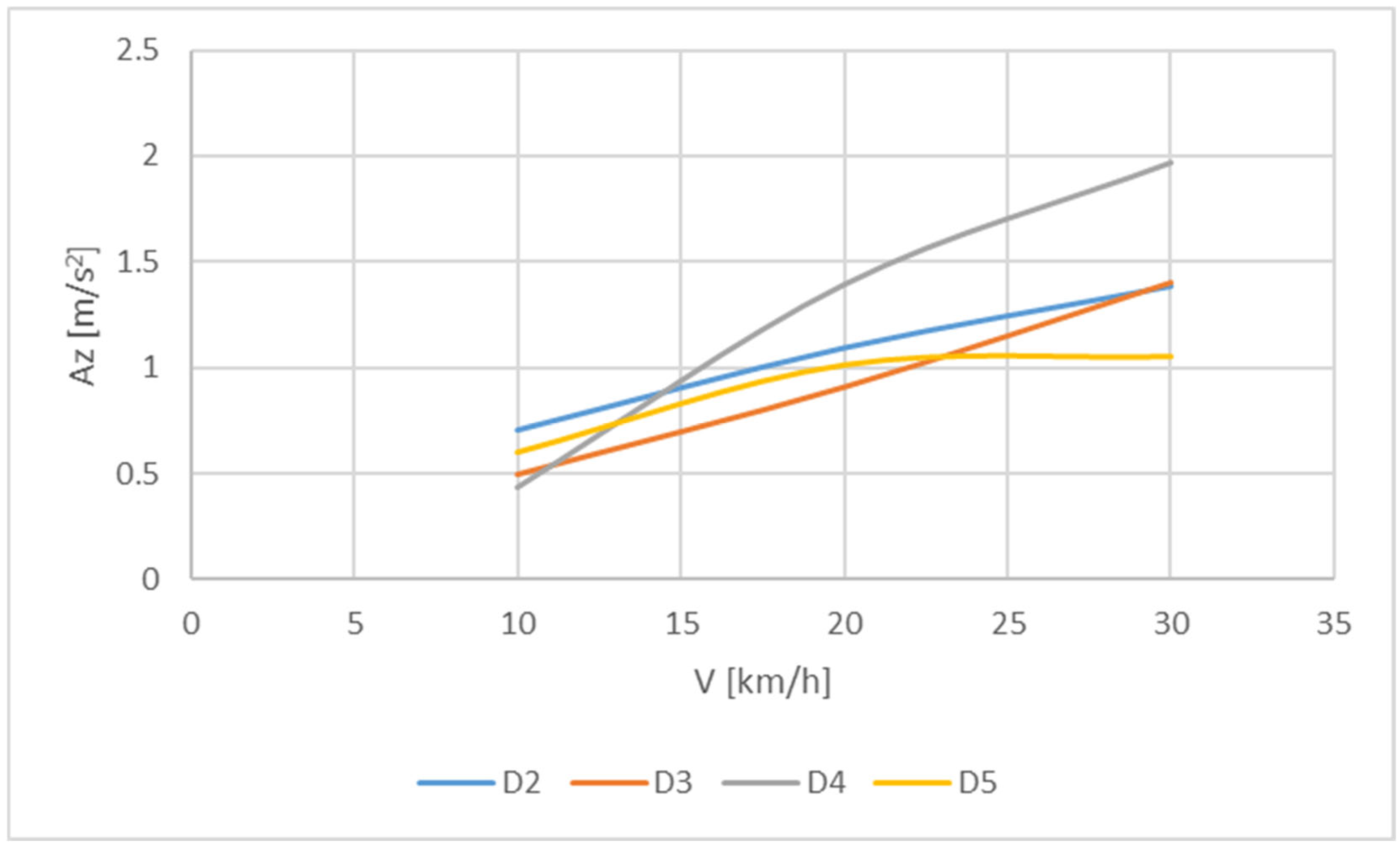
- Root mean square (RMS) accelerations in the Z axis at the vehicle’s center of mass as a function of driving speed;
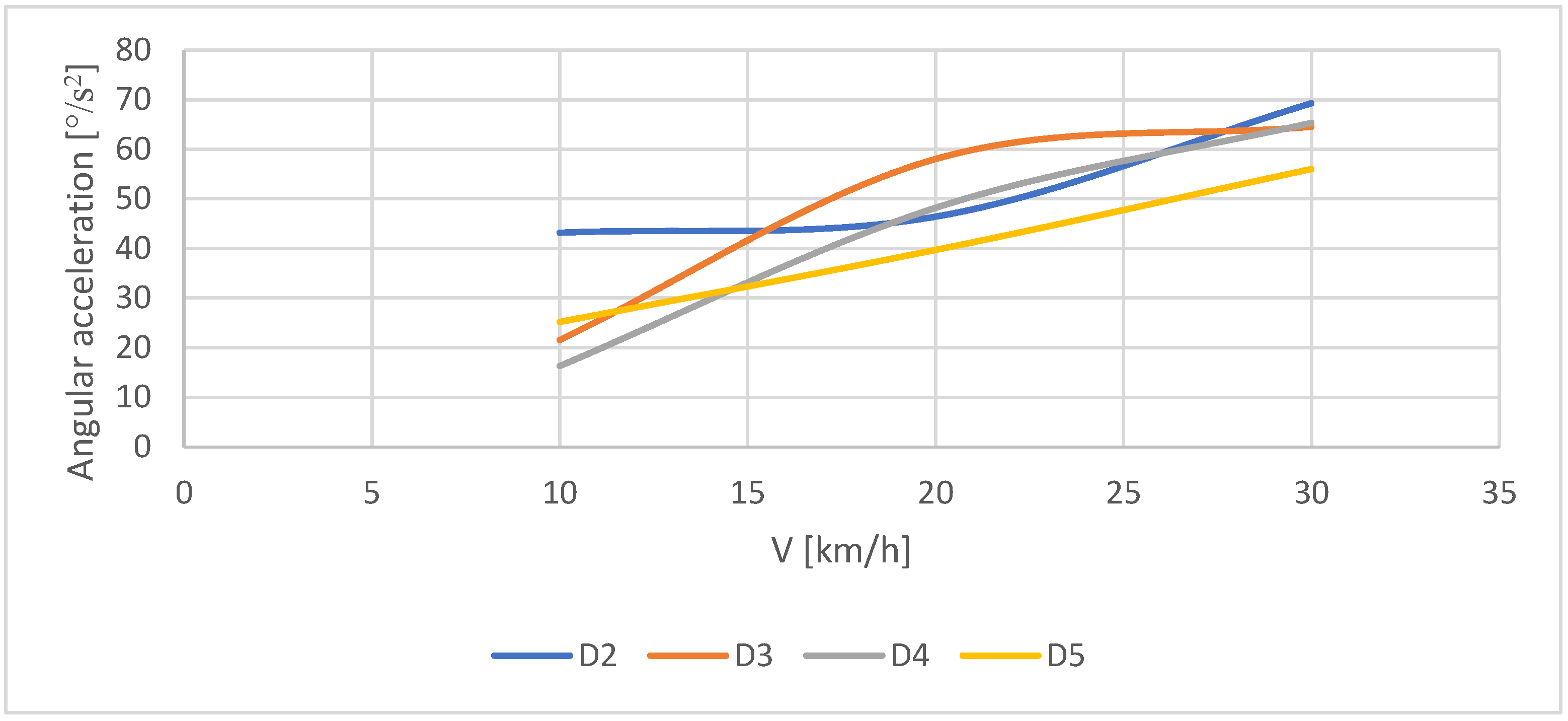
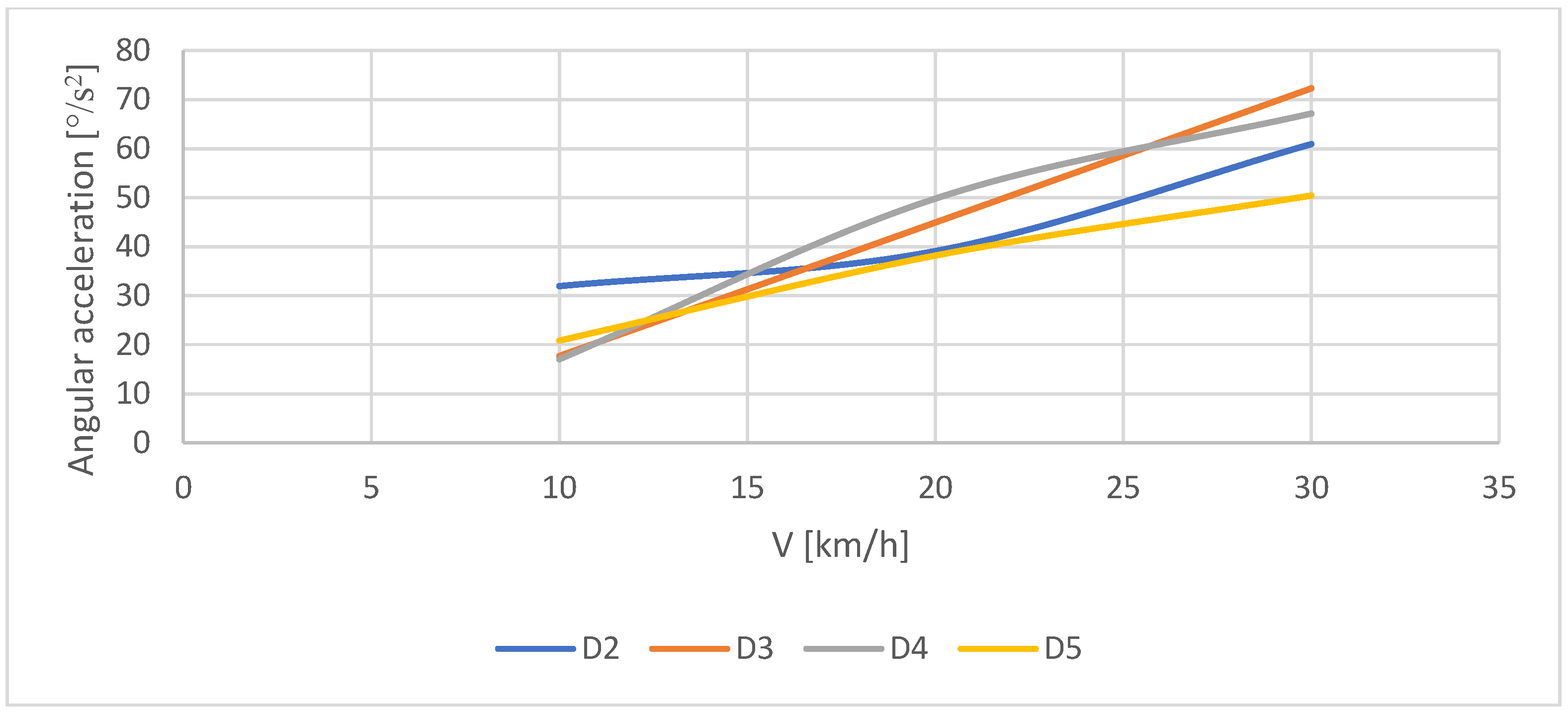
- Root mean square (RMS) angular accelerations about the X axis as a function of driving speed;
- Root mean square (RMS) angular accelerations about the Y axis as a function of driving speed;
- Average values of 10 maximum accelerations measured on the vehicle frame;
- Average values of 10 maximum accelerations measured on the vehicle’s drive axle;
- Average values of 10 maximum accelerations in the Z axis at the vehicle’s center of mass as a function of driving speed;
- Average values of 10 maximum angular accelerations about the X axis as a function of driving speed;
- Average values of 10 maximum angular accelerations about the Y axis as a function of driving speed.
3.2. The Effects of the Course Tests
4. Conclusions
- As speed increases, the effective vertical acceleration amplitudes (RMSs) of the sprung and unsprung masses increase;
- As speed increases, the effective angular acceleration amplitudes (RMSs) about the X and Y axes increase;
- As speed increases, the average value of the 10 maximum amplitudes of the measured physical quantities increases;
- Indicators of soil profile variability, e.g., RMS, are insufficient to ensure the required level of dynamic loads on the vehicle’s running gear components during test drives; therefore, a comprehensive approach is necessary, taking into account the analyzed X, Y, and Z profile;
- The level of observed dynamic loads and fatigue-related loads clearly increases with driving speed and changes with changes in the type of surface;
- The essence of selecting vehicle movement conditions in the mileage testing process is to determine the appropriate driving speed for a given ground surface type. It is necessary to propose a method for determining vehicle mileage testing conditions for each type of ground surface.
- Creating a certification system for test tracks;
- Developing a mathematical and physical model that would take into account longitudinal and lateral movement and the impact of tire pressure;
- Examining the impact of vehicle age and mileage on the magnitude of dynamic impacts on the vehicle and drivers.
Author Contributions
Funding
Institutional Review Board Statement
Informed Consent Statement
Data Availability Statement
Acknowledgments
Conflicts of Interest
Abbreviations
| D2 | tank track no. 2 |
| D3 | tank track no. 3 |
| D4 | concrete track with damaged surface |
| D5 | Off-road |
| FFT | Fast Fourier Transform |
| PSD | Power Spectral Density |
| RMS | Root Mean Square |
References
- Hammer, J.; Poliak, M.; Jaśkiewicz, M.J.; Riha, Z.; Abramovic, B. Probability of secure return of semi-Trailers to the domicicle of the carrier with regard to transport costs. In Proceedings of the 12th International Science-Technical Conference Automotive Safety, Kielce, Poland, 21–23 October 2020. [Google Scholar]
- Drozd, K.; Matijošius, J.; Boretska, I. Analysis of vibration modes of semi-trailer axle and their effects on fatigue life. In Proceedings of the Metal International Conference on Metallurgy and Materials Conference Proceedings, Brno, Czech Republic, 17–19 May 2023; pp. 296–301. [Google Scholar]
- Figlus, T.; Kuczyński, L. Selection of a semi-trailer for the haulage of long oversize loads, taking into account an analysis of operational damage. In Proceedings of the 11th International Science and Technical Conference Automotive Safety, Častá, Slovakia, 18–20 April 2018; pp. 1–5. [Google Scholar]
- Ajayi, O.O.; Kurien, A.M.; Djouani, K.; Dieng, L. Analysis of Road Roughness and Driver Comfort in ‘Long-Haul’ Road Transportation Using Random Forest Approach. Sensors 2024, 24, 6115. [Google Scholar] [CrossRef] [PubMed]
- Dizo, J.; Blatnicky, M. Evaluation of vibrational properties of a three-wheeled vehicle in terms of comfort. Manuf. Technol. 2019, 19, 197–203. [Google Scholar] [CrossRef]
- Galal, A.H.; Nasser, A.M. Frequency Response of 10 Degrees of Freedom Full-Car Model For Ride Comfort. Int. J. Sci. Res. Eng. Technol. 2015, 4, 43–49. [Google Scholar]
- Dižo, J.; Blatnický, M.; Melnik, R.; Karľa, M. Improvement of Steerability and Driving Safety of an Electric Three-Wheeled Vehicle by a Design Modification of its Steering Mechanism. LOGI Sci. J. Transp. Logist. 2022, 13, 49–60. [Google Scholar] [CrossRef]
- Jagelčák, J.; Kiktová, M.; Frančák, M. The Analysis of Maneuverability of Semi-trailer Vehicle Combination. Transp. Res. Procedia 2020, 44, 176–181. [Google Scholar] [CrossRef]
- Dedik, M.; Gašparík, J.; Záhumenská, Z. Quality assessment in the logistics of rail passenger transport. MATEC Web Conf. 2017, 134, 00009. [Google Scholar] [CrossRef]
- Konečný, V.; Brídziková, M. Research of the Influence of Demand Factors on Suburban Bus Transport in Slovak Republic. In Research and the Future of Telematics. TST 2020; Mikulski, J., Ed.; Communications in Computer and Information Science; Springer: Cham, Switzerland, 2020; Volume 1289. [Google Scholar] [CrossRef]
- Sivilevičius, H.; Maskeliūnaitė, L. Assessment of the Quality of Passenger Transportation by Train Using Multiple Criteria Decision Making Methods; Lecture Notes in Intelligent Transportation and Infrastructure, Part F308; Springer: Berlin/Heidelberg, Germany, 2025; pp. 1–260. [Google Scholar]
- Blatnický, M.; Štauderová, M.; Dižo, J. Numerical Analysis of the Structure Girder for Vehicle Axle Scale Calibration. Procedia Eng. 2017, 177, 510–515. [Google Scholar] [CrossRef]
- Jilek, P.; Berg, J.; Tchuigwa, B.S.S. Influence of the Weld Joint Position on the Mechanical Stress Concentration in the Construction of the Alternative Skid Car System’s Skid Chassis. Appl. Sci. 2022, 12, 397. [Google Scholar] [CrossRef]
- Savchenko, Y.; Mykhalevych, M.; Drozdziel, P.; Verbitskiy, V.; Wrona, R. Accuracy and durability increasing of the body level control systems in the immobile state of the vehicle. Diagnostyka 2022, 23, 2022310. [Google Scholar] [CrossRef]
- Liu, J.; Liu, J.; Li, Y.; Wang, G.; Yang, F. Study on Multi-Mode Switching Control Strategy of Active Suspension Based on Road Estimation. Sensors 2023, 23, 3310. [Google Scholar] [CrossRef]
- Dižo, J.; Blatnický, M.; Sága, M.; Harušinec, J.; Gerlici, J.; Legutko, S. Development of a New System for Attaching the Wheels of the Front Axle in the Cross-Country Vehicle. Symmetry 2020, 12, 1156. [Google Scholar] [CrossRef]
- Nešić, N.; Simonović, J.; Blagojević, M.; Milojević, S.; Jović, S. Vehicle Suspension System with Integrated Inerter—Extended Analysis. IOP Conf. Ser. Mater. Sci. Eng. 2022, 1271, 012030. [Google Scholar] [CrossRef]
- Vdovin, D.; Levenkov, Y.; Chichekin, I. Prediction of fatigue life of suspension parts of the semi-trailer in the early stages of design. IOP Conf. Ser. Mater. Sci. Eng. 2020, 820, 012002. [Google Scholar] [CrossRef]
- Zhao, X.; Kang, J.; Lei, T.; Li, X.; Cao, Z.; Wang, Y. Research on air cushion suspension support system with low speed and heavy load. J. Phys. Conf. Ser. 2020, 1549, 052020. [Google Scholar] [CrossRef]
- Hryciów, Z.; Rybak, P.; Wojciechowski, M.; Wachowiak, P.; Kalicki, B. Hydropneumatic suspension testing of a wheeled armoured personnel carrier. Eksploat. Niezawodn.-Maint. Reliab. 2023, 25, 162497. [Google Scholar] [CrossRef]
- Ławniczak, S.; Simiński, P. Hydropneumatic suspension modelling for wheeled armoured fighting vehicle. J. KONES 2009, 16, 285–297. [Google Scholar]
- Yu, X.-B.; Chen, J.-X.; Zhou, R.; Xu, F.-C.; Sun, F. Influence analysis of linear motor type suspension parameters on energy-harvesting characteristics. Shenyang Gongye Dauxe Xuebao/J. Shenyang Univ. Technol. 2023, 45, 428–435. [Google Scholar]
- Mikula, L.; Famfulík, J.; Richtář, M.; Sarkan, B. Influence of air spring parameters to tyre wear. Int. J. Heavy Veh. Syst. 2024, 31, 496–512. [Google Scholar] [CrossRef]
- Peceliunas, R.; Zuraulis, V.; Drozdziel, P.; Pukalskas, S. Prediction of Road Accident Risk for Vehicle Fleet Based on Statistically Processed Tire Wear Model. Promet-Traffic Transp. 2022, 34, 619–630. [Google Scholar] [CrossRef]
- Stoklosa, J.; Bartnik, M. Influence of tire pressure on the vehicle braking distance. Arch. Automot. Eng. 2022, 97, 60–73. [Google Scholar] [CrossRef]
- Vrabel, J.; Stopka, O.; Rievaj, V.; Šarkan, B.; Pruskova, K.; Michalk, P. Measuring the resistance of tires for passenger vehicle against the rolling and sliding on loading area of the flatbed truck when providing the transport services. Commun. Sci. Lett. Univ. Zilina 2016, 18, 124–128. [Google Scholar] [CrossRef]
- Kisiel, M.; Szpica, D. Experimental and Numerical Flow Assessment of the Main and Additional Tract of Prototype Differential Brake Valve. Appl. Sci. 2025, 15, 7483. [Google Scholar] [CrossRef]
- Ren, X.; Lu, Y.; Wang, F. Research on Pneumatic Test System for the Dynamic Characteristic of Hydraulic Solenoid Valve in Brake-by-Wire System. J. Phys. Conf. Ser. 2023, 2674, 12029. [Google Scholar] [CrossRef]
- Skrucany, T.; Vrabel, J.; Kazimir, P. The influence of the cargo weight and its position on the braking characteristics of light commercial vehicles. Open Eng. 2020, 10, 154–165. [Google Scholar] [CrossRef]
- Vrabel, J.; Skrucany, T.; Bartuska, L.; Koprna, J. Movement analysis of the semitrailer with the tank-container at hard braking—The case study. IOP Conf. Ser. Mater. Sci. Eng. 2019, 710, 012025. [Google Scholar] [CrossRef]
- Gogola, M.; Ondruš, J.; Kubalak, S.; Turiak, P. Comparison of braking properties of selected vehicle with different methods. Arch. Automot. Eng. 2022, 95, 5–17. [Google Scholar] [CrossRef]
- Borawski, A.; Szpica, D.; Mieczkowski, G.; Awad, M.M.; Shalaby, R.M.; Sallah, M. Simulation study of the vehicle braking process with temperature-dependent coefficient of friction between brake pad and disc. Heat Transf. Res. 2021, 52, 1–11. [Google Scholar] [CrossRef]
- Panchenko, S.; Gerlici, J.; Lovska, A.; Ravlyuk, V. Assessment of Uneven Wear of Freight Wagon Brake Pads. Appl. Sci. 2025, 15, 6860. [Google Scholar] [CrossRef]
- Zhang, Y.; Zhang, M. The application status of unit brakes on metro vehicles in China. IOSR J. Mech. Civ. Eng. 2018, 3, 17–23. [Google Scholar] [CrossRef]
- Panchenko, S.; Gerlici, J.; Lovska, A.; Ravlyuk, V. A Systemic Approach to Formalized Description of Factors Affecting the Brake System Elements of Wagon Bogies. Commun.-Sci. Lett. Univ. Zilina 2025, 27, B85–B95. [Google Scholar] [CrossRef]
- Bosurgi, G.; Marra, S.; Pellegrino, O.; Sollazzo, G.; Villari, M. Effects of Road Marking Visibility on Vehicles Driving Along Curves: A Preliminary Study in a Simulated Environment. Transp. Res. Rec. 2022, 2676, 691–702. [Google Scholar] [CrossRef]
- Tyan, T.; Vinton, J.; Beckhold, E.; Zhang, X.; Rupp, J.; Kochhar, N.; Barbat, S. Modeling of an Advanced Steering Wheel and Column Assembly for Frontal and Side Impact Simulations. SAE Int. J. Mater. Manf. 2014, 7, 366–401. [Google Scholar] [CrossRef]
- Xiao, S.; Yuan, M.; Zheng, B.; Peng, X.; Zhang, X. Mechanisms of chest injuries from steering wheel intrusion in frontal collisions. Proc. Inst. Mech. Eng. D J. Automob. Eng. 2024, 239, 7494–7504. [Google Scholar] [CrossRef]
- Droździel, P.; Krzywonos, L.; Madlenak, R.; Rybicka, I. Selected aspects of analyses of failure rates of active safety systems in buses. Commun.-Sci. Lett. Univ. Zilina 2014, 16, 114–119. [Google Scholar] [CrossRef]
- Simiński, P. Problematyka ruchu nowoczesnych transporterów specjalnych. Postępy Nauk. I Tech. 2012, 14, 244–249. [Google Scholar]
- Simiński, P. Wojskowe Pojazdy Kołowe; Wydaw. BEL Studio Sp. z o. o.: Warszawa, Poland, 2015. [Google Scholar]
- Simiński, P.; Leszczyński, R. Selected road safety aspects in special vehicles. J. Civ. Eng. Transp. 2024, 6, 25–31. [Google Scholar] [CrossRef]
- Hudec, J.; Šarkan, B. Effect of periodic technical inspections of vehicles on traffic accidents in the Slovak Republic. Commun.-Sci. Lett. Univ. Zilina 2022, 24, A142–A159. [Google Scholar] [CrossRef]
- Hudec, J.; Šarkan, B.; Czodörová, R. Examination of the results of the vehicles technical inspections in relation to the average age of vehicles in selected EU states. Transp. Res. Proc. 2021, 55, 2–9. [Google Scholar] [CrossRef]
- Vlkovsky, M.; Veselík, P. Cargo securing—Comparison of different quality roads. Acta Univ. Agric. Silvic. Mendel. Brun. 2019, 67, 1015–1023. [Google Scholar] [CrossRef]
- Sakhno, V.; Murovanyi, I.; Razboinikov, O.; Palamarchyk, O.; Dembitskyi, V. Comparative Estimation of Maneuverability of the Multi-Track Road Trains of Different Layout Schemes. Commun.-Sci. Lett. Univ. Zilina 2025, 27, B30–B40. [Google Scholar] [CrossRef]
- Bartnik, G.; Krzysiak, Z.; Samociuk, W.; Łysiak, G.; Plizga, K.; Szmigielski, M.; Nieoczym, A.; Kaliniewicz, Z.; Brumerčik, F. Dokumentowanie spełniania wymagań w obszarze bezpieczeństwa technicznego na przykładzie dystrybucji paliw ciekłych. Przem. Chem. 2017, 96, 1039–1041. [Google Scholar] [CrossRef]
- Kosobudzki, M.; Zajac, P.; Gardyński, L. A Model-Based Approach for Setting the Initial Angle of the Drive Axles in a 4 × 4 High Mobility Wheeled Vehicle. Energies 2023, 16, 1938. [Google Scholar] [CrossRef]
- Pytka, J. Experimental Research on Stability of an Off-Road Vehicle on Deformable Surfaces; SAE Technical Paper 2010-01-1898; SAE: Warrendale, PA, USA, 2010. [Google Scholar] [CrossRef]
- Sojka, M.; Cornák, Š.; Droppa, P. Selected problems of tracked vehicle movement modelling. In Proceedings of the 21st International Scientific Conference Transport Means 2017, Klaipeda, Lithuania, 20–22 September 2017; pp. 493–498. [Google Scholar]
- Xu, X.; Wang, K.; Li, Q.; Yang, J. An Optimal Hierarchical Control Strategy for 4WS-4WD Vehicles Using Nonlinear Model Predictive Control. Machines 2024, 12, 84. [Google Scholar] [CrossRef]
- Borowiec, M.; Sen, A.K.; Litak, G.; Hunicz, J.; Koszałka, G.; Niewczas, A. Vibrations of a vehicle excited by real road profiles. Forsch. Ingenieurwesen/Eng. Res. 2010, 74, 99–109. [Google Scholar] [CrossRef]
- Kosobudzki, M. Preliminary Selection of Road Test Sections for High-Mobility Wheeled Vehicle Testing under Proving Ground Conditions. Appl. Sci. 2022, 12, 3513. [Google Scholar] [CrossRef]
- Hanzl, J.; Pecman, J.; Bartuska, L.; Stopka, O.; Sarkan, B. Research on the Effect of Road Height Profile on Fuel Consumption during Vehicle Acceleration. Technologies 2022, 10, 128. [Google Scholar] [CrossRef]
- Gogola, M. Analysing the vibration of bicycles on various road surfaces in the city of Žilina. Arch. Automot. Eng. 2020, 88, 77–97. [Google Scholar] [CrossRef]
- Lee, Y.; Yu, S.; Kang, K.; Lee, S. Development of Load Spectrum for Wheel Hub Bearings of a Commercial Vehicle Through Road Load Data Acquisition. Int. J Automot. Technol. 2025, 1–12. [Google Scholar] [CrossRef]
- Małek, A.; Marciniak, A.; Kroczyński, D. Defining Signatures for Intelligent Vehicles with Different Types of Powertrains. World Elec. Veh. J. 2025, 16, 135. [Google Scholar] [CrossRef]
- Pečman, J.; Stopka, O.; Rybicka, I.; Stopková, M. Influence of road longitudinal terrain profile on vehicle kinetic energy recovery and mitigation of selected transport negative aspects. Transp. Probl. 2023, 18, 125–133. [Google Scholar] [CrossRef]
- Dai, L.; Cui, M.-D.; Zhu, Z.-W.; Li, Y.; Qiu, J.-R.; Cheng, X.-X. Effects of Vehicle Speed on Vehicle-Induced Dynamic Behaviors of a Concrete Bridge with Smooth and Rough Road Surfaces. Appl. Sci. 2023, 13, 9460. [Google Scholar] [CrossRef]
- Liu, L.; Guo, X.; Yang, X.; Liu, L. Combined Identification of Vehicle Parameters and Road Surface Roughness Using Vehicle Responses. Appl. Sci. 2024, 14, 10310. [Google Scholar] [CrossRef]
- Ziółkowski, A.; Fuć, P.; Lijewski, P.; Bednarek, M.; Jagielski, A.; Kusiak, W.; Igielska-Kalwat, J. The Influence of the Type and Condition of Road Surfaces on the Exhaust Emissions and Fuel Consumption in the Transport of Timber. Energies 2023, 16, 7257. [Google Scholar] [CrossRef]
- Jin, H.; Zang, L.; Mao, Y.; Xue, C.; Jiao, J. Research and application of load spectrum technology of reliability running test method for vehicle. Proc. Inst. Mech. Eng. Part D J. Automob. Eng. 2024, 238, 1405–1426. [Google Scholar] [CrossRef]
- Pytka, J.; Budzyński, P.; Tarkowski, P.; Piaskowski, M. A portable wheel tester for tyre-road friction and rolling resistance determination. IOP Conf. Ser. Mater. Sci. Eng. 2016, 148, 012025. [Google Scholar] [CrossRef]
- Wojciechowski, Ł.; Cisowski, T.; Małek, A. Route optimization for city cleaning vehicle. Open Eng. 2021, 11, 483–498. [Google Scholar] [CrossRef]
- Becker, C.M.; Els, P.S. Profiling of rough terrain. Int. J. Veh. Des. 2014, 64, 240. [Google Scholar] [CrossRef]
- Jacenko, N.N. Drgania, Wytrzymałość i Przyspieszone Badania Samochodów Ciężarowych; WKiŁ: Warszawa, Poland, 1975. [Google Scholar]
- BAAINBwBundesamt für Ausrüstung, Informationstechnik und Nutzung der Bundeswehr und WTDWehrtechnische Dienststellen: Hand in Hand zum neuen Großgerät. Available online: https://www.bmvg.de/de/aktuelles/baainbw-wtd-grossgeraet-militaertechnik-11204 (accessed on 9 May 2022).
- Driving and Corrosion Tests Observing a Vehicle’s Service Life in Time-Lapes. Available online: https://www.dau.edu/sites/default/files/Migrated/CopDocuments/Corrosion%20DEA%20Orlando_WTD%2041-final.pdf (accessed on 20 September 2025).
- Luty, W.; Mieteń, M. Geometrical analysis of profile of certain heavy terrain sections exerting dynamic loads on the chassis components of off-road vehicles. J. KONBiN 2017, 41, 151–170. [Google Scholar] [CrossRef][Green Version]
- Luty, W.; Mieteń, M. The analysis of conditions for testing mileage of military vehicles. Sci. J. Mil. Univ. Land Forces 2018, 50, 181–191. [Google Scholar] [CrossRef]
- Decker, Ž.; Rudzinskas, V.; Drozd, K.; Caban, J.; Tretjakovas, J.; Nieoczym, A.; Matijošius, J. Analysis of the Vehicle Chassis Axle Fractures. Materials 2023, 16, 806. [Google Scholar] [CrossRef]
- Mieteń, M. Problematyka Parametryzacji Dróg Nieutwardzonych. Badania i Rozwój Młodych Naukowców w Polsce—Nauki Techniczne i Inżynieryjne; Część III; Młodzi Naukowcy: Poznań, Poland, 2017. [Google Scholar]
- Jilek, P.; Němec, J. System for Changing Adhesion Conditions in Experimental Road Vehicle. Int. J. Automot. Technol. 2021, 22, 779–785. [Google Scholar] [CrossRef]
- Yang, Y.; Liu, C.; Chen, L.; Zhang, X. Phase deviation of semi-active suspension control and its compensation with inertial suspension. Acta Mech. Sin. 2024, 40, 523367. [Google Scholar] [CrossRef]
- Stefanow, D. The Impact of Transfer Case Parameters on the Tractive Efficiency of Heavy Off-Road Vehicles. Sustainability 2025, 17, 8586. [Google Scholar] [CrossRef]





| Vehicle Parameter | Designation | Value [kg] |
|---|---|---|
| Weight per left front axle wheel | M1L | 655 |
| Weight per right front axle wheel | M1P | 675 |
| Weight per front axle | M1 | 1330 |
| Weight per left rear axle wheel | M2L | 700 |
| Weight per right rear axle wheel | M2P | 710 |
| Weight per rear axle | M2 | 1410 |
| Weight per left side | ML | 1355 |
| Weight per right side | MP | 1385 |
| Vehicle curb weight | Mw | 2740 |
| Weight difference per side | ΔM | 30 |
| Vehicle Parameter | Unit | Value |
|---|---|---|
| Distance of the center of mass from the vertical plane passing through the vehicle’s 1st axis | mm | 1518 |
| Height of the center of mass above the road surface | mm | 742 |
| Distance of the center of mass from the vehicle’s longitudinal plane of symmetry | mm | 9 |
| Static theoretical lateral roll angle | ° | 47.25 |
| Substrate Type Designation | Substrate Characteristics |
|---|---|
| D2—tank track no. 2 |
|
| D3—tank track no. 3 |
|
| D4—concrete track with damaged surface |
|
| D5—off-road |
|
| Substrate Type Designation | RMS [m] | RMS2.5 [m] | Difference Between RMS and RMS2.5 [m] |
|---|---|---|---|
| D2 | 0.0548 | 0.0611 | 0.63 |
| D3 | 0.0403 | 0.0404 | 0.01 |
| D4 | 0.0217 | 0.0338 | 1.21 |
| D5 | 0.0376 | 0.0382 | 0.06 |
| Substrate Type Designation | RMS [m] | Section Length [m] | Sampling Frequency [1/m] |
|---|---|---|---|
| D2 | 0.06 | 3815 | 100 |
| D3 | 0.04 | 2334 | 100 |
| D4 | 0.02 | 1343 | 100 |
| D5 | 0.04 | 1024 | 100 |
| Parameter | D2 | D3 | D4 | D5 | Unit |
|---|---|---|---|---|---|
| 1.54 | 1.19 | 0.93 | 1.20 | m/s2 | |
| 1.71 | 1.18 | 0.85 | 1.00 | m/s2 | |
| 1.74 | 0.84 | 1.02 | 1.29 | m/s2 | |
| 1.76 | 0.84 | 0.75 | 1.10 | m/s2 | |
| 0.73 | 0.60 | 0.51 | 0.41 | m/s2 | |
| 0.94 | 0.27 | 0.35 | 0.87 | m/s2 | |
| 0.76 | 0.45 | 0.27 | 0.70 | m/s2 | |
| 0.85 | 0.39 | 0.47 | 0.73 | m/s2 | |
| 0.71 | 0.50 | 0.44 | 0.60 | m/s2 | |
| 31.92 | 17.66 | 17.01 | 20.83 | °/s2 | |
| 43.18 | 21.57 | 16.35 | 25.22 | °/s2 |
| Parameter | D2 | D3 | D4 | D5 | Unit |
|---|---|---|---|---|---|
| 2.42 | 2.02 | 2.54 | 1.65 | m/s2 | |
| 1.68 | 1.66 | 2.35 | 1.64 | m/s2 | |
| 1.88 | 1.55 | 3.11 | 1.62 | m/s2 | |
| 1.77 | 1.38 | 2.46 | 1.97 | m/s2 | |
| 1.35 | 1.28 | 2.08 | 0.69 | m/s2 | |
| 1.39 | 1.26 | 1.95 | 0.81 | m/s2 | |
| 1.15 | 0.94 | 1.05 | 1.22 | m/s2 | |
| 1.07 | 1.09 | 1.92 | 1.51 | m/s2 | |
| 1.10 | 0.91 | 1.39 | 1.02 | m/s2 | |
| 39.10 | 44.92 | 49.81 | 38.17 | °/s2 | |
| 46.43 | 58.04 | 48.19 | 39.72 | °/s2 |
| Parameter | D2 | D3 | D4 | D5 | Unit |
|---|---|---|---|---|---|
| 2.32 | 2.59 | 4.76 | 1.82 | m/s2 | |
| 2.38 | 3.34 | 4.13 | 2.04 | m/s2 | |
| 2.66 | 2.62 | 4.57 | 2.11 | m/s2 | |
| 2.42 | 2.91 | 3.57 | 2.38 | m/s2 | |
| 1.98 | 1.72 | 2.77 | 1.06 | m/s2 | |
| 2.03 | 1.29 | 2.74 | 1.34 | m/s2 | |
| 2.00 | 1.69 | 2.60 | 1.38 | m/s2 | |
| 1.42 | 1.04 | 2.61 | 1.59 | m/s2 | |
| 1.38 | 1.40 | 1.97 | 1.06 | m/s2 | |
| 60.94 | 72.30 | 67.17 | 50.44 | °/s2 | |
| 69.27 | 64.56 | 65.34 | 56.02 | °/s2 |
Disclaimer/Publisher’s Note: The statements, opinions and data contained in all publications are solely those of the individual author(s) and contributor(s) and not of MDPI and/or the editor(s). MDPI and/or the editor(s) disclaim responsibility for any injury to people or property resulting from any ideas, methods, instructions or products referred to in the content. |
© 2025 by the authors. Licensee MDPI, Basel, Switzerland. This article is an open access article distributed under the terms and conditions of the Creative Commons Attribution (CC BY) license (https://creativecommons.org/licenses/by/4.0/).
Share and Cite
Mieteń, M.; Seńko, J.; Caban, J.; Szcześniak, K.; Walkiewicz, M. Research on Dynamic Loads Acting on a Vehicle Caused by the Road Profile with Different Surfaces. Appl. Sci. 2025, 15, 13106. https://doi.org/10.3390/app152413106
Mieteń M, Seńko J, Caban J, Szcześniak K, Walkiewicz M. Research on Dynamic Loads Acting on a Vehicle Caused by the Road Profile with Different Surfaces. Applied Sciences. 2025; 15(24):13106. https://doi.org/10.3390/app152413106
Chicago/Turabian StyleMieteń, Marcin, Jarosław Seńko, Jacek Caban, Krzysztof Szcześniak, and Marcin Walkiewicz. 2025. "Research on Dynamic Loads Acting on a Vehicle Caused by the Road Profile with Different Surfaces" Applied Sciences 15, no. 24: 13106. https://doi.org/10.3390/app152413106
APA StyleMieteń, M., Seńko, J., Caban, J., Szcześniak, K., & Walkiewicz, M. (2025). Research on Dynamic Loads Acting on a Vehicle Caused by the Road Profile with Different Surfaces. Applied Sciences, 15(24), 13106. https://doi.org/10.3390/app152413106