Article

Numerical Stability and Handling Studies of Three-Wheeled Vehicles Using ADAMS/Car

by
Katarzyna Stańko-Pająk
1,
Jarosław Seńko
2,
Radosław Nowak
2,*,
Maciej Rymuszka
2,
Dariusz Danielewicz
3 and
Kamil Jóźwik
3
1
Doctoral School, Warsaw University of Technology, 00-661 Warszawa, Poland
2
Faculty of Automotive and Construction Machinery Engineering, Warsaw University of Technology, Narbutta 84 Str, 02-524 Warsaw, Poland
3
The Military Institute of Armoured and Automotive Technology, Okuniewska 1, Sulejówek n., 05-070 Warsaw, Poland
*
Author to whom correspondence should be addressed.
Appl. Sci. 2026, 16(1), 98; https://doi.org/10.3390/app16010098 (registering DOI)
Submission received: 5 December 2025 / Revised: 18 December 2025 / Accepted: 19 December 2025 / Published: 22 December 2025

Featured Application

Three-wheeled vehicles intended for use in congested urban environments and for providing mobility to people with limb disabilities represent an important engineering and scientific challenge. Due to their application by users with physical impairments, ensuring adequate stability and handling performance is essential. This paper presents simulation studies of an electrically driven three-wheeled vehicle. The obtained results provide information on the vehicle’s capability to negotiate obstacles safely. In future work, the simulation results will be validated against experimental data. The presented characteristics may be useful for vehicle design purposes and for further research on three-wheeled vehicle dynamics.

Abstract

Three-wheeled vehicles are gaining popularity in European and Asian cities due to their low cost, stability, maneuverability, and compact size. Among these, tilting vehicles facilitate cornering, maintain stability, and reduce centrifugal forces. This study investigates a delta-configured, three-wheeled tilting vehicle designed for people with reduced mobility. Vehicle dynamics were analyzed using ADAMS/Car simulations, including steady-state cornering and single-lane change tests, focusing on body motion and forces in suspension and steering systems. Results show that tilting of the body significantly enhances cornering safety compared to non-tilting three-wheelers, providing insights for designing efficient urban vehicles for diverse user groups.

1. Introduction

Increasingly congested streets, especially in larger urban areas, pose new challenges for the automotive sector in terms of designing new vehicles and infrastructure. Transport congestion has become a serious issue not only for transport users but also for infrastructure planners and managers [1,2,3,4,5,6,7]. A potential solution to this problem is the concept of Micromobility, which involves the use of small, lightweight, zero-emission vehicles in transportation systems. These vehicles enable the user to cover relatively short distances and are classified as Personal Mobility Devices (PMD), such as electric scooters [8,9,10,11] or bicycles [12,13,14], as well as three-wheeled vehicles [15,16,17] and others [18,19].
Three-wheelers are particularly popular in many Asian countries [16], but they are also increasingly seen on the streets of European cities. They are characterized by relatively low cost, easy access to driving licenses—or, in some cases, no license requirement at all—and simple maintenance and repair. They combine the stability of four-wheel vehicles with the maneuverability of a scooter [20,21,22], which allows for efficient movement among other road users and facilitates parking.
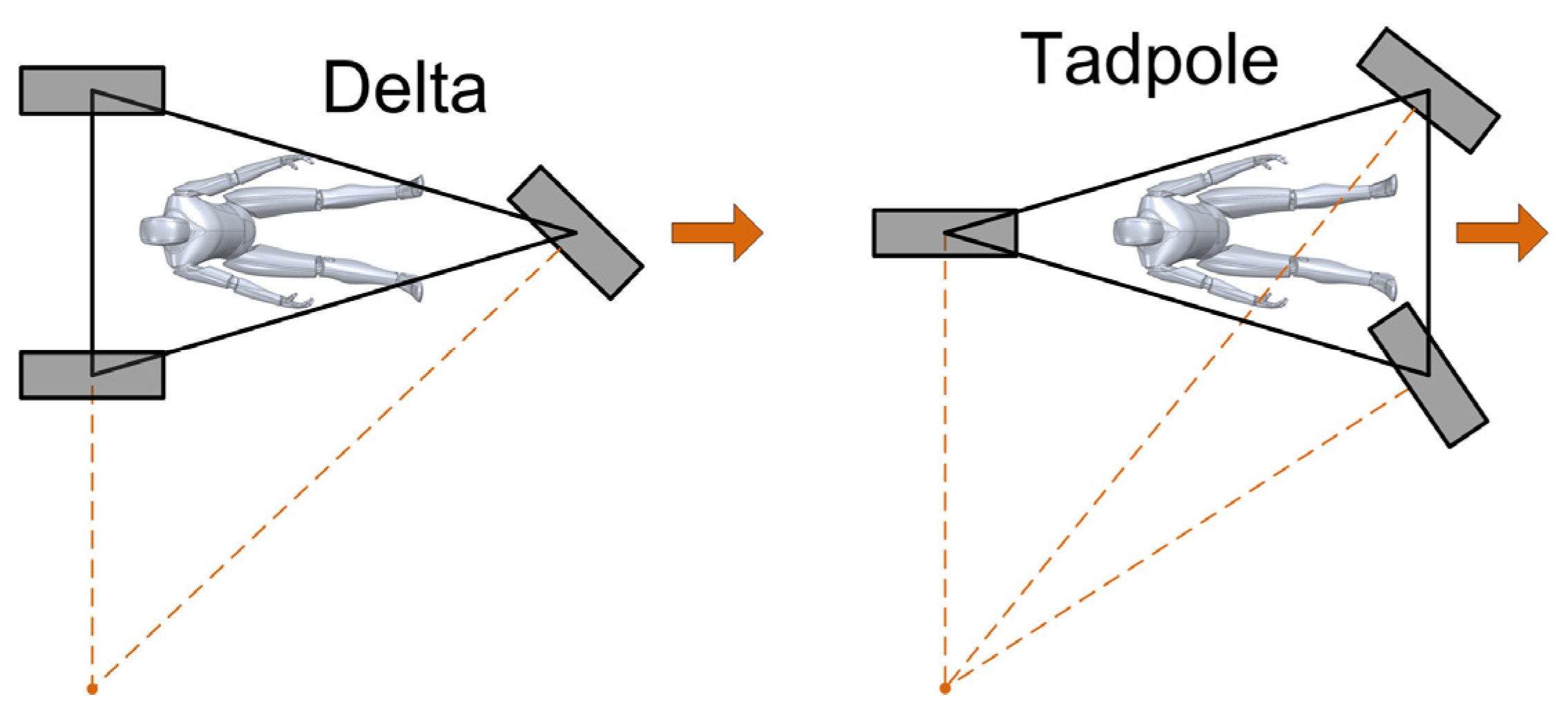
Currently, there are two dominant configurations of such vehicles on the market: the Delta layout, featuring a single front wheel, and the Tadpole layout, with two wheels at the front and one at the rear, as shown in Figure 1.
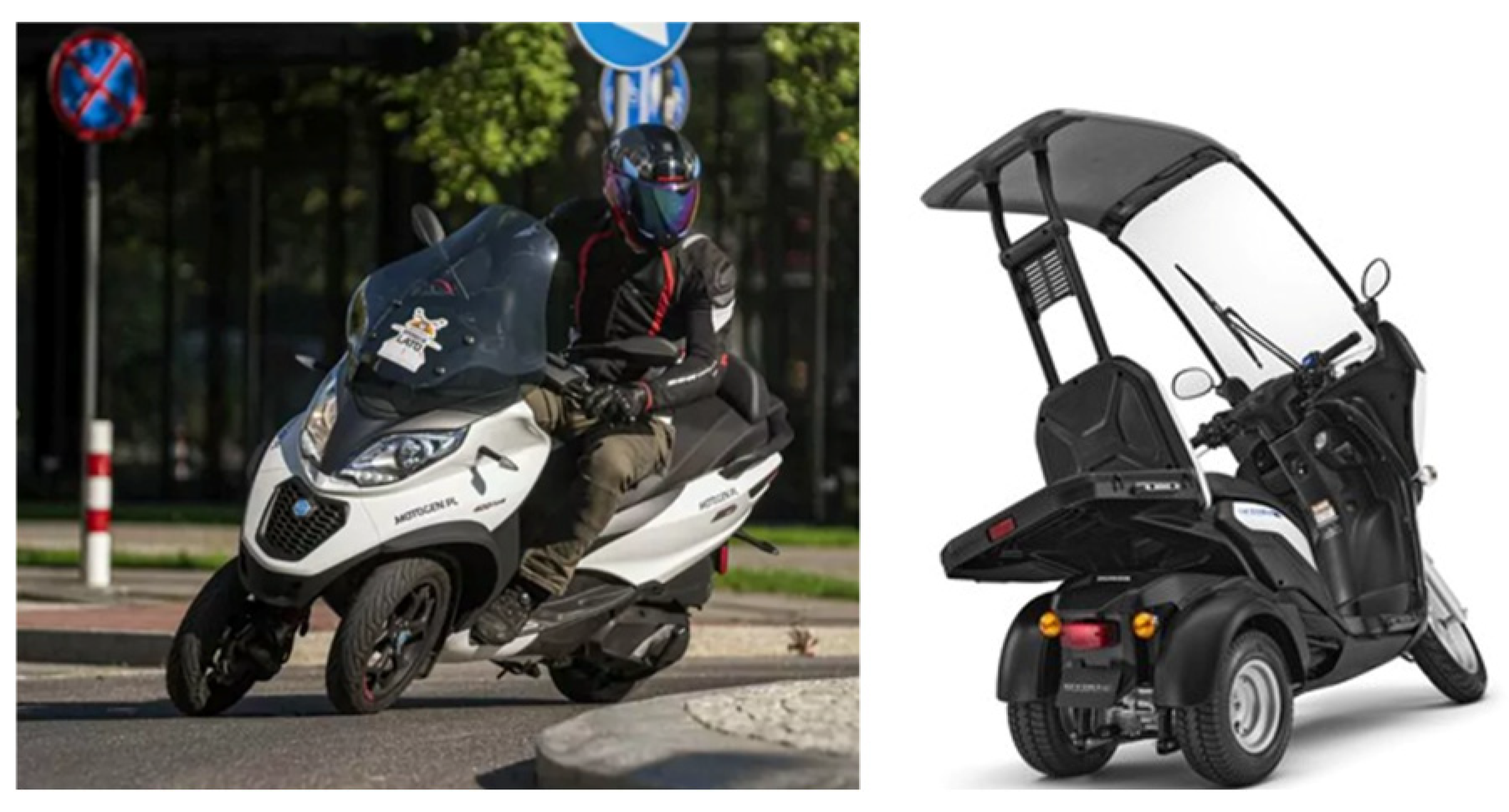
There are also vehicles available on the market that feature tilting capability, both in the Delta and the Tadpole configurations. Examples of such vehicles are presented in Figure 2.
Three-wheeled vehicles, due to their easy adaptability, offer a wide range of applications. They are most used for fast and efficient transport of small cargo, which makes them well-suited as delivery vehicles. Another example is the concept of a three-wheeled vehicle designed for people with disabilities, in which several dedicated solutions have been implemented, including a rotating and lowering seat that enables a wheelchair user to transfer independently, as well as a special storage compartment allowing the driver to load the wheelchair without assistance from a third person. Mobility conditions for people with disabilities—e.g. using wheelchairs—are discussed in more detail in [26,27].
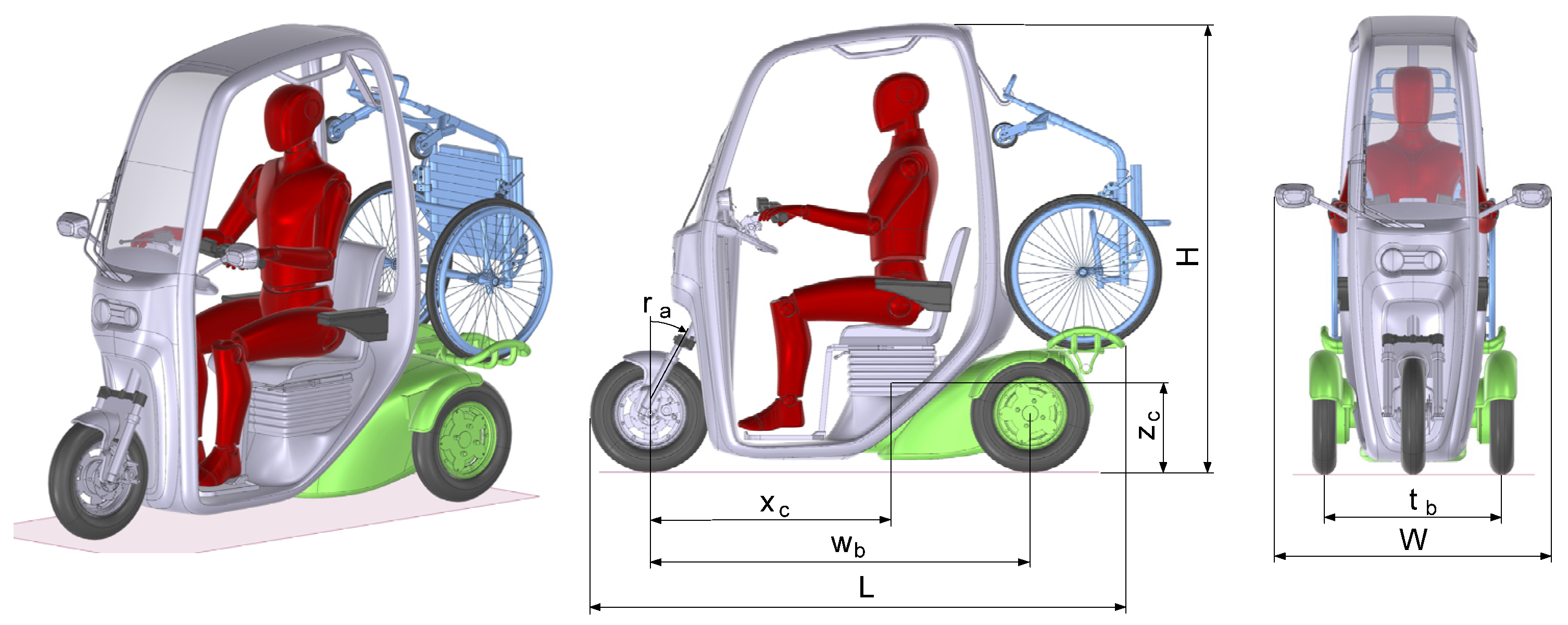
Additionally, the vehicle is equipped with a tilt-assist mechanism that helps the disabled driver return to an upright position after completing a turning maneuver [28]. The concept of the vehicle is shown in Figure 3.
Figure 3 shows the most important dimensions of the three-wheeled vehicle model: H—height, L—length, W—width, and the position of the center of gravity in the global Cartesian coordinate system, assumed as usual in ADAMS/Car at the center of the front wheel. The front wheel track tD and the vehicle axle track wD are also marked.
In the case of tilting vehicles, safety is a key issue, strongly influenced by their stability and controllability. The topics of stability and controllability of wheeled vehicles have been addressed in numerous research studies [29,30,31,32].
By using simulation environments, such as MSC.ADAMS/Car, it is possible to investigate vehicle stability in various road scenarios without the need for a physical prototype, without risking its damage or destruction, and without the necessity of employing expensive measurement equipment.
The aim of this study is to present the results of simulation tests that evaluate vehicle dynamics during steady-state cornering and during direction changes. The analyses focused on the vehicle body motion parameters and on the interactions of forces within the suspension and steering systems. The results provide valuable insight into the practical applications of a tilting three-wheeled vehicle, particularly regarding its potential for energy-efficient and ergonomic transportation. The findings may also have significant implications for future design and development of three-wheeled vehicles [16,33].

1.1. Stability and Controllability of the Three-Wheeled Vehicles

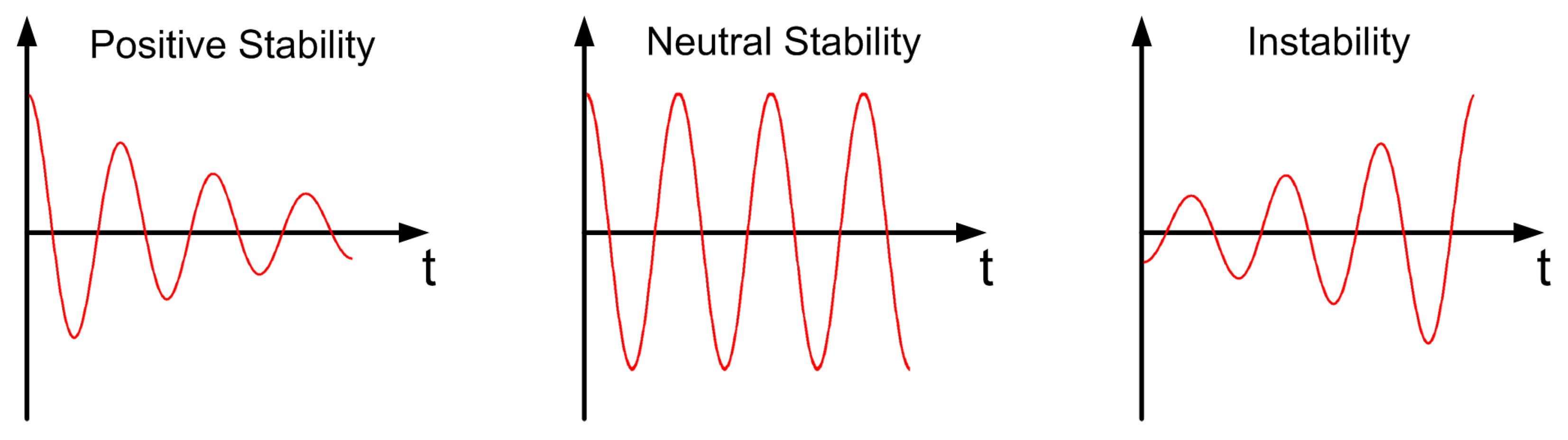
Stability and controllability are among the fundamental properties that determine a vehicle’s active safety [21,34,35,36,37]. Three types of stability can be distinguished: positive stability, neutral stability, and instability. From a mathematical perspective, positive stability refers to the ability of a system or object to maintain a steady state over time, even when subjected to disturbances. In physics, stability describes the tendency of a system to return independently to its static equilibrium position after being displaced.
Neutral stability characterizes a system that maintains a new state after a disturbance. When an object or system is displaced from its equilibrium, it remains in the new position and does not return to the initial one.
Instability occurs when a system or object, after being disturbed from its initial state, begins to move away from the equilibrium position. In such a case, the system does not return to its original position nor remain in the new one; instead, it experiences a force that drives it further from equilibrium. If this condition is not controlled, it may lead to malfunction or even damage to the system or object [38,39,40,41]. The types of stability are illustrated in Figure 4.
Vehicle stability can be interpreted in various ways, depending on the specific application of the vehicle [17]. One approach to defining vehicle stability is its ability to maintain the desired trajectory (within an acceptable positioning error range) without deviating from the intended path. This approach can be applied to evaluate the stability of a tilting three-wheeled vehicle using a single-lane change test. After performing the test, the new trajectory can be compared with the original one. In an ideal scenario, both trajectories would be parallel; however, due to dynamic effects acting on the vehicle—resulting from, among other factors, tire deformation—this is not achievable. The angle between the original and the new trajectory can be used to estimate the stability of the vehicle, where a more stable vehicle produces a smaller angle, and the new trajectory matches the original one at most points.
Another method for assessing vehicle stability is its ability to withstand lateral forces associated with lateral acceleration while cornering, without rolling over. This serves as an indicator of safety and stability, as a more stable vehicle can negotiate curves at higher speeds or with a smaller radius (i.e., with higher lateral acceleration) while maintaining steerability [42,43]. A similar detailed case study, but with articulated vehicles, is presented in [44,45,46].
In tilting three-wheeled vehicles, stability and controllability become even more critical due to their unique design. Stability in such vehicles is a complex, multi-factor issue that requires careful consideration and engineering to ensure that the vehicle remains stable and responds appropriately to the driver’s input [47].

1.2. Equations of Motion of the Vehicle in Terms of Wheels Configuration

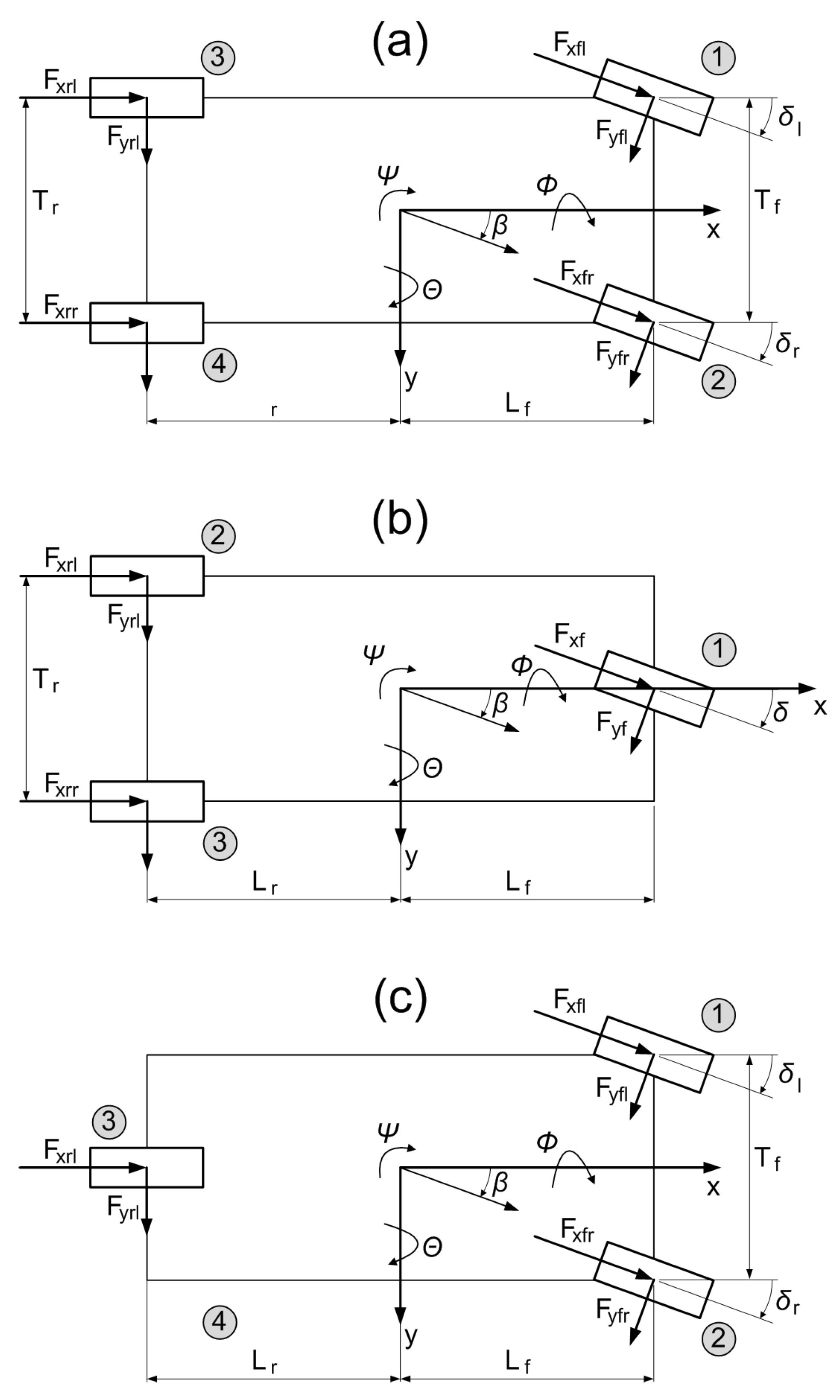
The roll motion equation of a vehicle describes the dynamics of the roll angle, defined as the angle between the longitudinal axis of the vehicle and the horizontal plane. The roll angle may depend on factors such as lateral acceleration, geometric relationships between specific vehicle points, and the steering input. Vehicle stability can be analyzed by examining the behavior of the roll angle in response to these factors [21,29,48].
Vehicle parameters that should be considered in roll dynamics analysis include vehicle mass, center of gravity location (Figure 5), moments of inertia, stiffness of compliant elements in the roll joint, and damping coefficients of rubber–metal components and viscous elements. The roll motion equation provides a mathematical framework for understanding the stability of the vehicle [49,50].

2. Materials and Methods

Numerical studies and simulations of engineering objects make use of a variety of computer tools, such as FEM analysis [52,53], Abaqus 2017 [54], MATLAB Simulink R2015a [55], and other software tools.
MBS (Multi-Body Simulation) is a numerical simulation method used to solve problems related to the kinematics and dynamics of rigid or flexible bodies, assuming kinematic pair connections and user-defined excitations. When using MSC.ADAMS/Car, the constructed vehicle model consists of moving bodies connected by kinematic pairs, which impose the appropriate degrees of freedom. Each component has defined geometric and material parameters, including the location of the center of mass and the specification of the inertia matrix.
In the Adams/Car environment, several basic scenarios are provided for studying vehicle dynamics on straight or curved tracks with specified parameters. Functions can be implemented to define linear or nonlinear characteristics of vehicle system components and subsystems. Simulations can be performed in steady-state conditions, or, if a drivetrain system is defined, intermediate and transient states can also be analyzed. The software is suitable for examining a vehicle under defined initial and boundary conditions, reflecting real driving conditions [56].
MSC.ADAMS/Car allows for simulations based on “events”. The software offers several open-loop events; in this case, the Ramp Steer and Single Line Change events were selected for simulation. All simulations are conducted at typical urban driving speeds ranging from 10 to 50 km/h.

2.1. MSC.ADAMS/Car Model of the Tilted Three-Whelled Vehicle

In all simulations, a parameterized model of a tilting three-wheeled vehicle in the Delta configuration—one wheel at the front and two at the rear—was used. The vehicle features a tilting mechanism that allows for angular displacement of the front section relative to the rear section, which remains stationary with respect to the ground. This system increases the number of wheel contact points with the ground to three, enhancing stability compared to single-track vehicles, particularly at low speeds. Additionally, the tilting mechanism improves both the stability and the controllability of the vehicle [8,57].
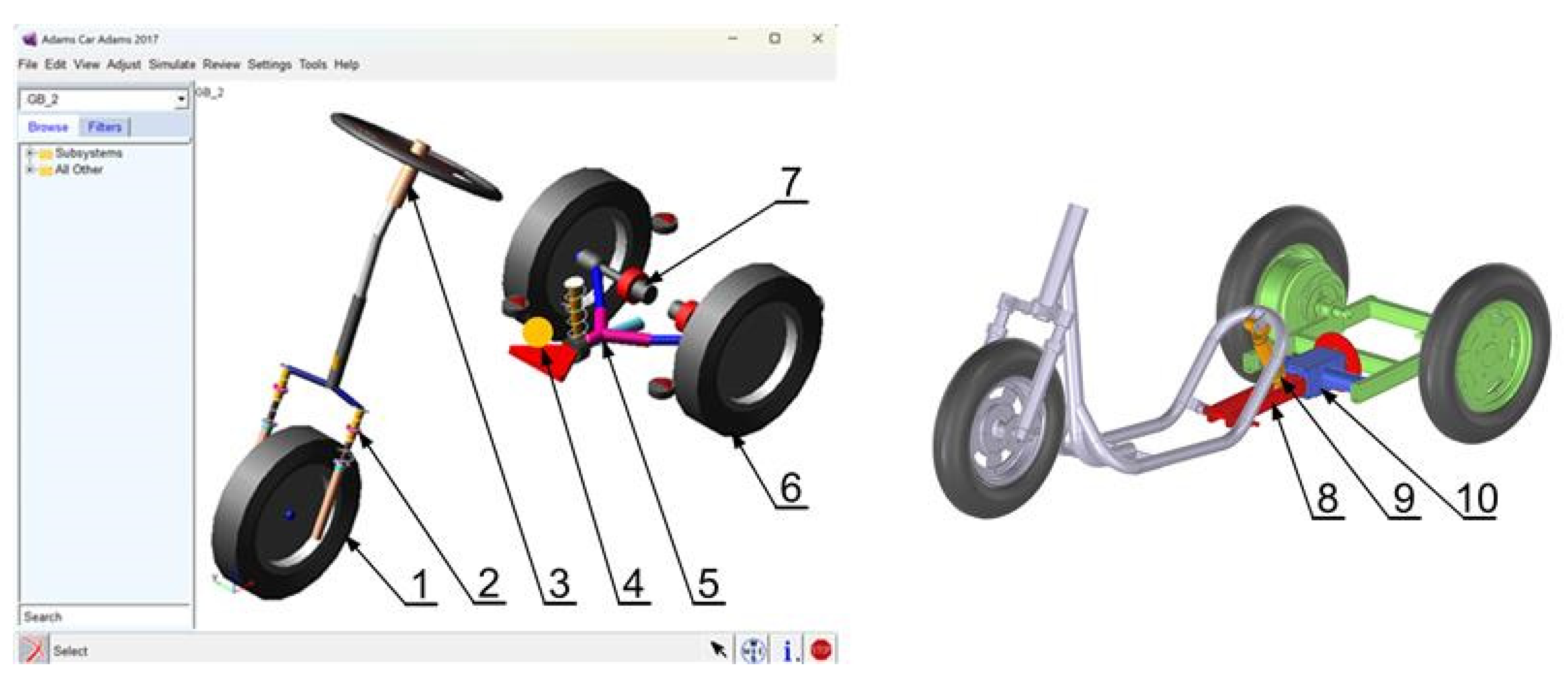
The visualization of the model shown in Figure 6 is simplified, as the vehicle body is not represented as a solid; instead, the appropriate mass and inertia properties are assigned to a point located at the vehicle center of gravity. The tire model includes its characteristic properties as well as the components attaching it to the wheels. Figure 6 also shows a visualization of the joint connected with the rotation of the body relative to the rear wheel subframe. The two body elements are connected by a rubber–metal element, which has a maximum tilt angle of 12 degrees.
The front suspension consists of two telescopic fork tubes, which are attached to the vehicle frame and extend downward toward the front wheel. The fork tubes incorporate springs and dampers. The steering system allows for control of the front wheel steering angle.
The rear suspension consists of two wheels connected to the chassis, which in turn is connected to the vehicle body via a spring and damper system. The rear suspension also includes the mechanism responsible for tilting the front section of the vehicle relative to the rear. The drivetrain, represented schematically, includes all the components that deliver torque to the wheels, such as the motors and gearbox.
In Table 1, the main geometrical parameters of the three-wheeled vehicle are presented.
Parameters shown in Table 1 were used to prepare a simulation model.

2.2. Ramp Steer Simulation

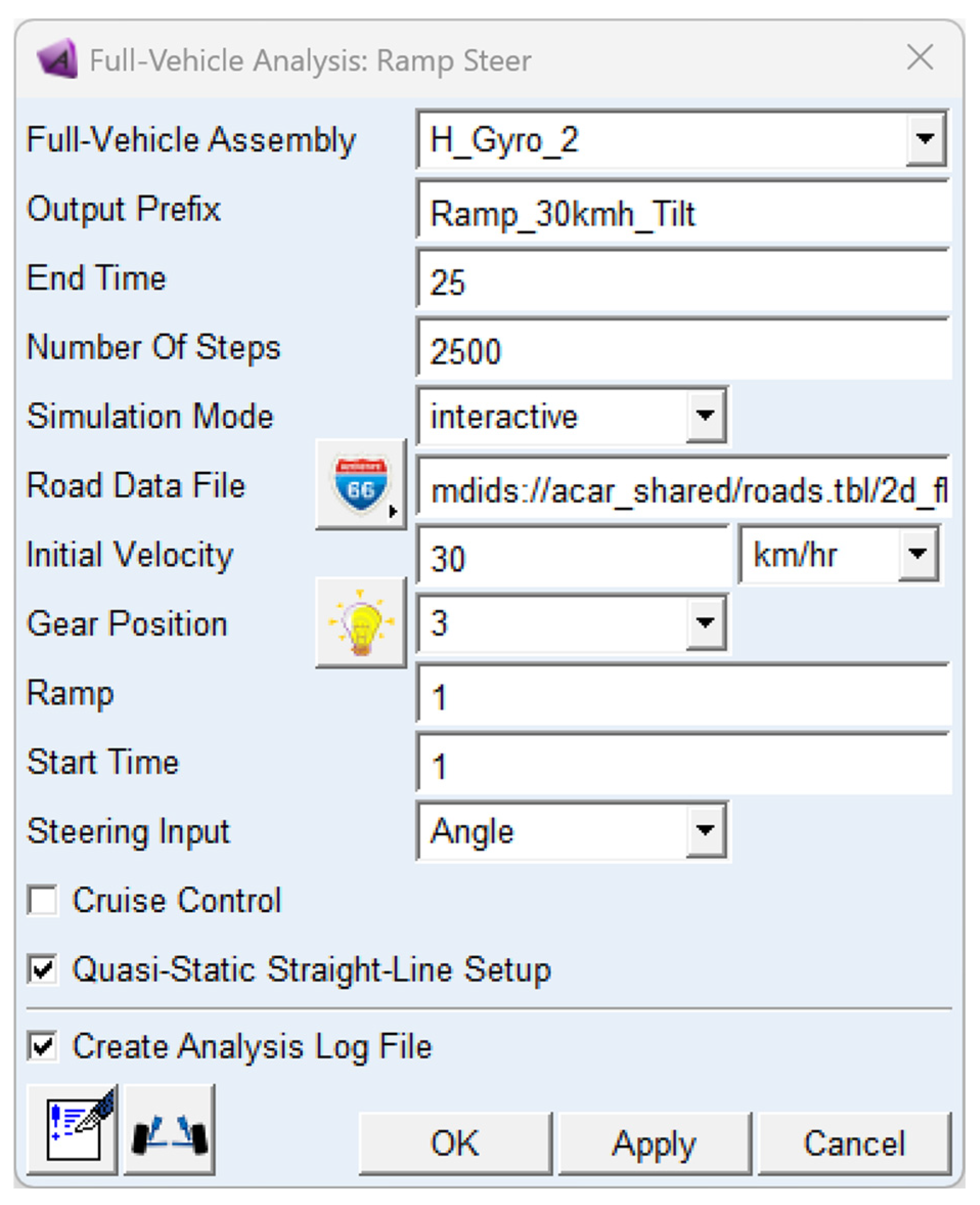
Ramp Steer, in the field of vehicle dynamics simulation, is one of the possible open-loop steering system events. The steering input (Figure 7) is applied to the vehicle at a linearly increasing rate from 0 to 3 degrees. The vehicle initially travels at a constant speed, while the steering input is gradually increased to a specified value or until a defined time limit is reached. This type of simulation also allows for the analysis of the vehicle response to a progressively increasing excitation in the form of a growing front wheel steering angle. The results, expressed as the maximum achieved lateral acceleration, can be used to estimate lateral forces and to determine the vehicle safety and stability margins.

2.3. Single-Lane Change Simulation

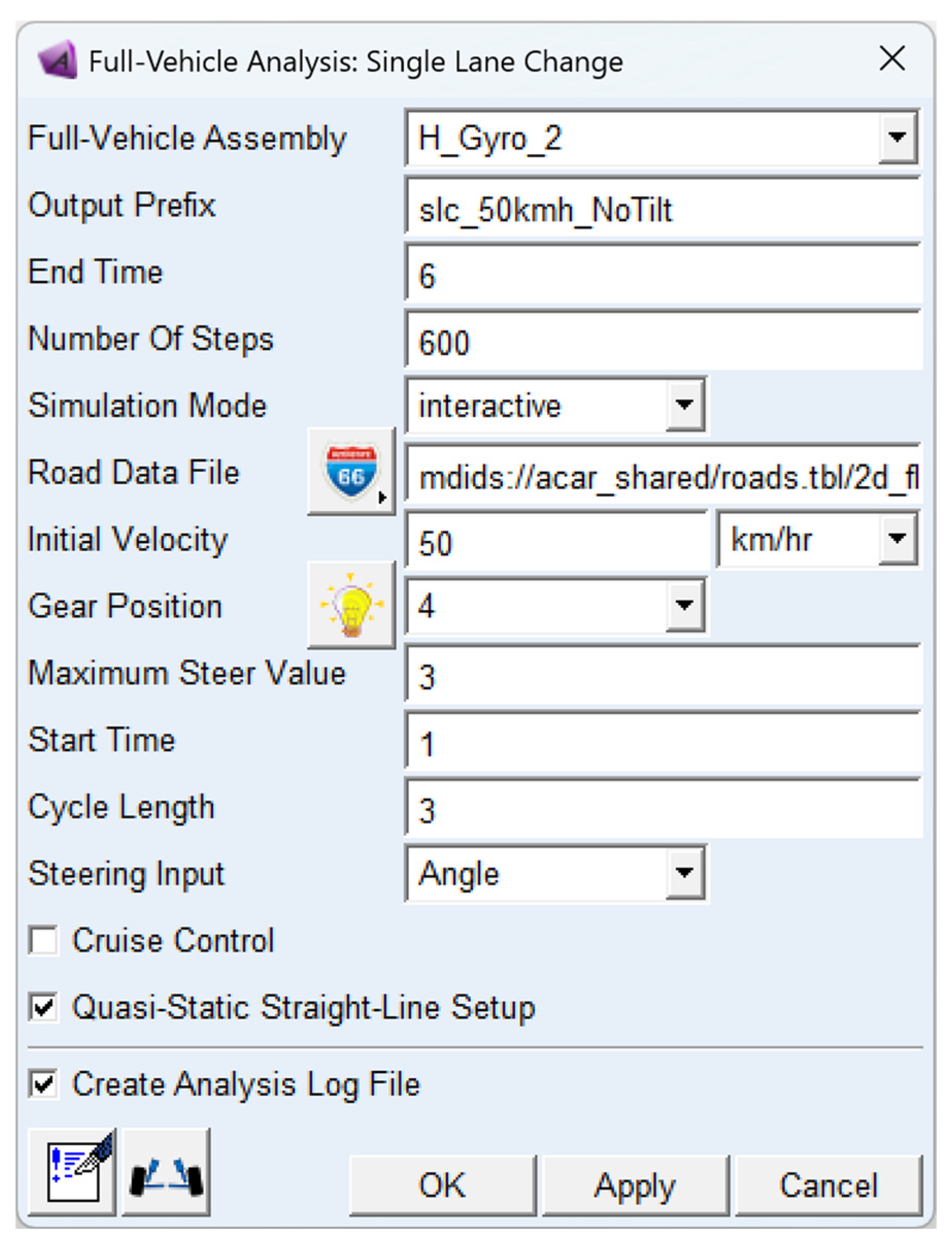
The Single-Lane Change (SLC) simulation refers to an event in which the vehicle initially travels straight, then steers to the left to avoid a virtual obstacle ahead, and after a specified time interval, steers to the right, continuing its motion along a straight path parallel to the initial one but laterally shifted with respect to the vehicle. The steering input (Figure 8) signal used in this test is like a smoothed Heaviside function with a continuous transition between steady-state motion conditions. This event is intended to represent a vehicle performing a lane change or an emergency avoidance maneuver. During the single-lane change simulation, the vehicle’s response to a double steering input is measured and analyzed. This can be used to assess the vehicle’s handling characteristics, response time, and lateral stability during an emergency maneuver. Another indicator of stability in this test is the vehicle trajectory before and after the maneuver and the degree of its mutual parallelism.

3. Results and Discussion

The simulations performed in the MSC.ADAMS/Car 2017 software were divided according to the type of analysis and the inclusion or exclusion of the vehicle’s lateral roll effect.

3.1. Ramp Steer Simulation Results

The Ramp Steer without tilt simulations serves as a reference point for the comparison of subsequent simulations and constitutes the basis for data validation. For simulations that took body tilt into account, curves were drawn under similar driving speed conditions, and the results were compared. The simulation taking into account tilt was performed with an increasing steer turn from 0 to 3 degrees, and for each degree of steering wheel turn, the body roll was 4 degrees greater, with a maximum of 12 degrees. The simulation conditions without body tilt had analogous steering wheel angle increments.
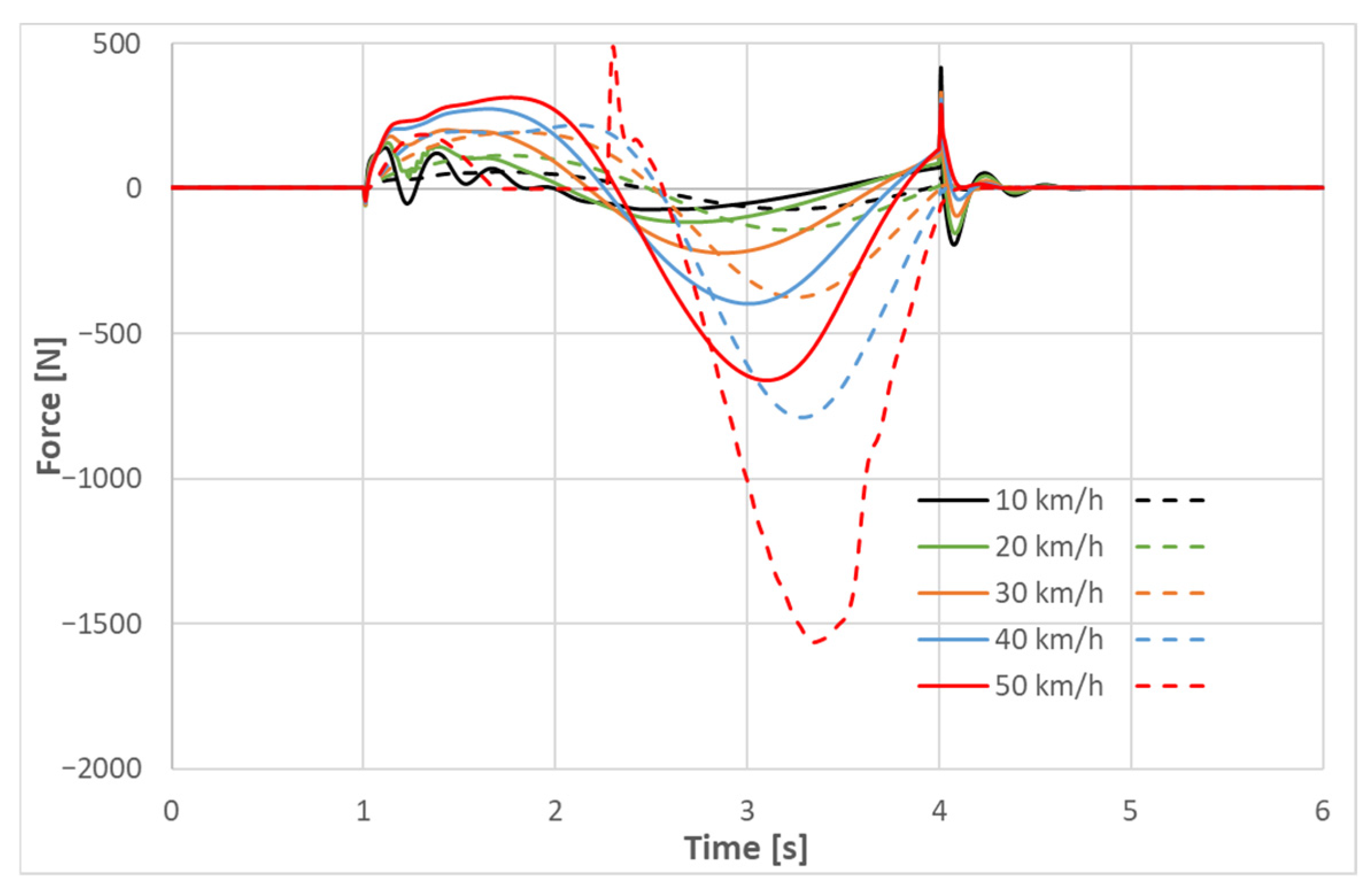
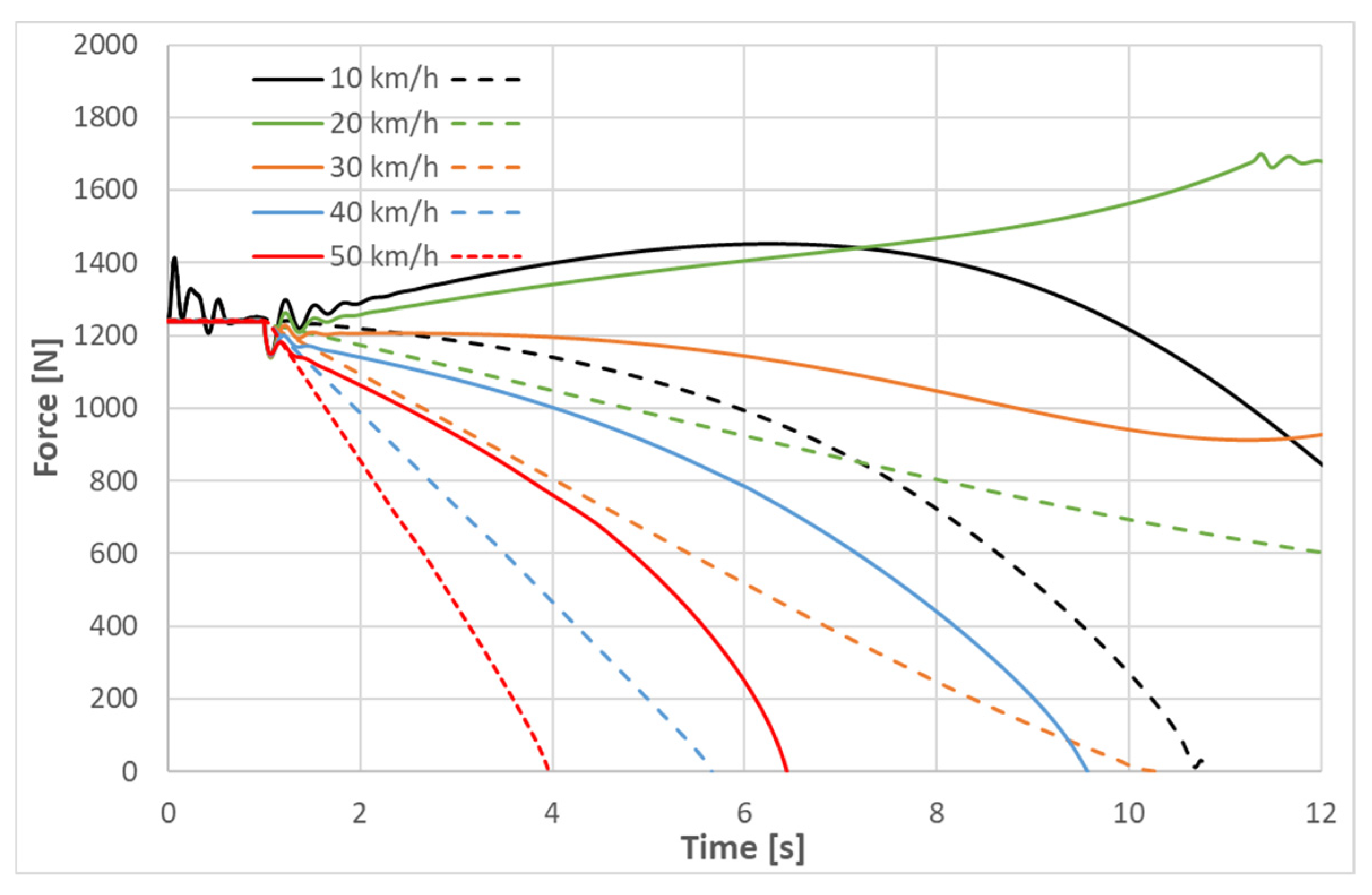
In the case of the simulations without tilt, the plot shown in Figure 9 presents the time history of the normal force acting on the left rear wheel during the simulation at the specified velocities. A left-hand turn of the vehicle was simulated until the loss of lateral stability occurred. The rollover moment was represented by the normal force, reaching a value of zero. It is worth noting that at the initial driving speed of 10 km/h, no rollover occurs; instead, only vehicle deceleration was observed under the assumed increase in the steering angle. At initial speeds of 20 and 30 km/h, a relatively high normal force value was achieved throughout the entire simulation time period, which indicated that there was no tendency for the vehicle to roll over and lose stability.
The normal force shown in the plot for the left rear tire (Figure 9) exhibits an unsteady state in the initial phase of the simulation, which occurred due to the vehicle body roll. This disturbed the initial stability, causing fluctuations of the normal force until the vehicle reached a state of relative stability. At speeds of 10, 30, 40, and 50 km/h, the normal force reached zero within the assumed simulation time, which indicated that the left wheel had lost contact with the road surface and, as a result, there was a tendency to lose stability and roll over.
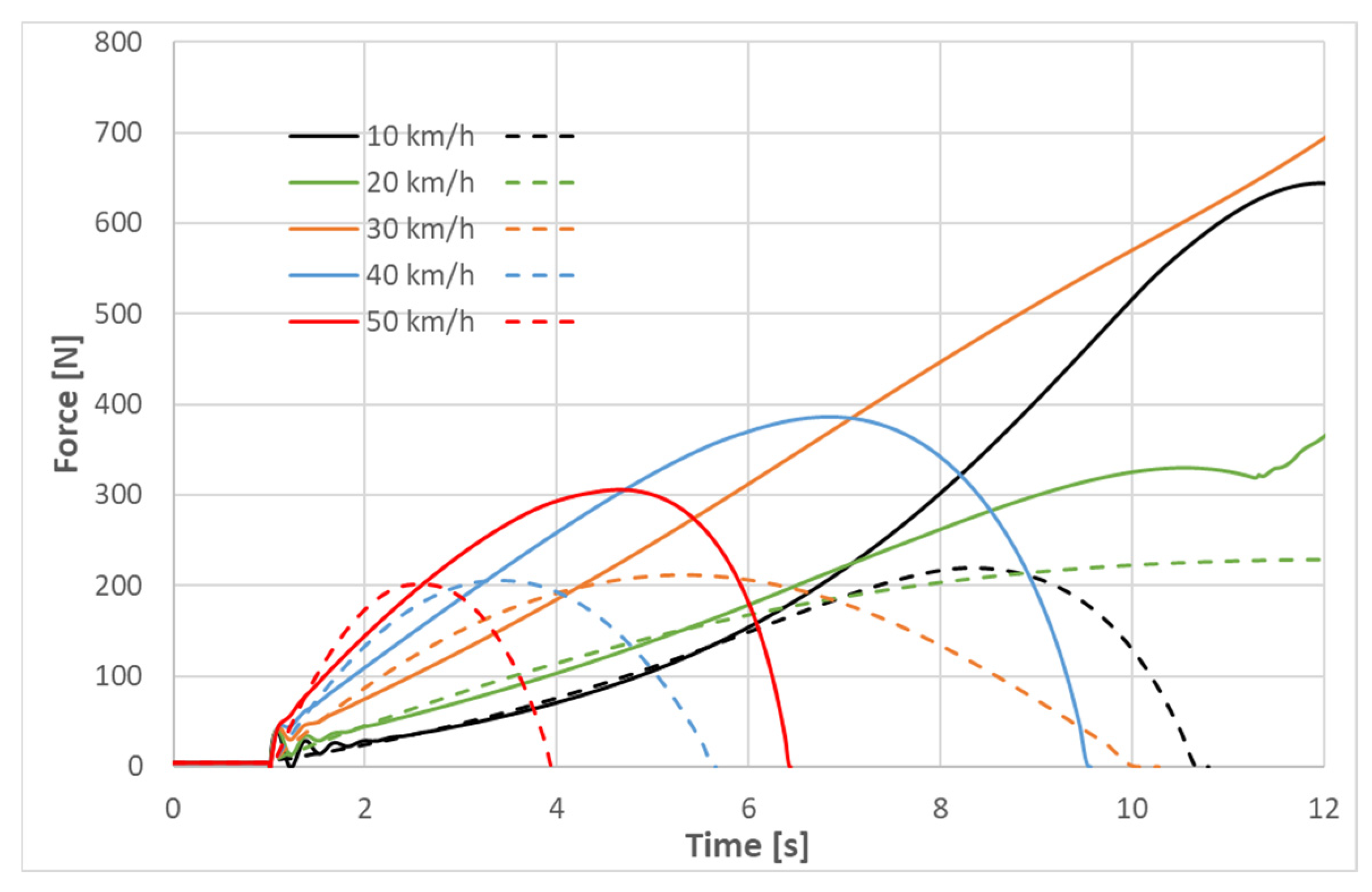
Figure 10 shows the lateral force acting on the same left rear wheel. The maximum lateral force that the vehicle wheel could transmit to the ground without any body tilt was approximately 700 N and was represented by the local extrema on each curve. Maximum lateral force increased constantly when the initial speed increased to 10, 20, and 30 km/h, which proved that the vehicle did not roll over. When speed reached 40 and 50 km/h, however, it was noticeable that there was a local extreme value of force, and then a decrease in the force value up to zero. Therefore, the car finally lost stability and rolled.
Figure 10 presents the time history of the lateral force acting on the left rear tire during the simulation, taking into account tilting of the body. The maximum achieved lateral force was 210 N, which corresponded to an increase of about 30% compared to the maximum force obtained in the simulation without body roll. An exception was the simulation at a speed of 20 km/h, where the vehicle did not experience rollover at all. This can be attributed to the fact that this speed was enough to achieve the lateral acceleration and force sufficient to drive through the curve of the road.
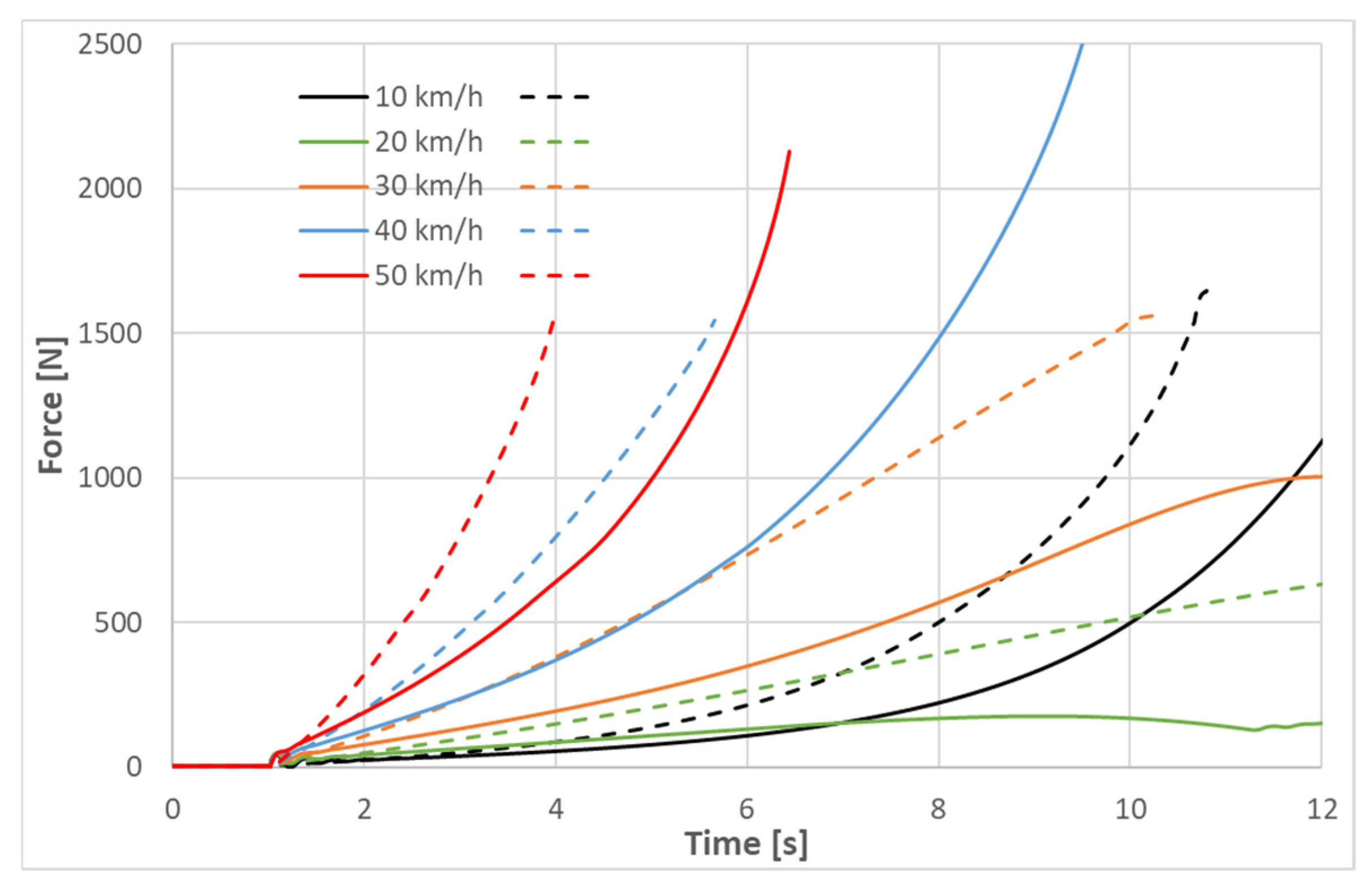
Figure 11 presents the simulation results of the lateral forces acting on the right rear tire. In comparison with the lateral force on the left tire, its value increased throughout the entire test. As the vehicle began to rotate (onset of the loss of stability), the vehicle’s mass shifted to the right side, thereby increasing the normal forces, which allowed for the tire to transmit higher lateral forces.
Similarly to the forces acting on the left wheel, the lateral forces acting on the right tire also increased during the test with body roll enabled. In this case, the body inclination had a significant effect and resulted in more than a 25% increase in the transmitted force compared to the results of the simulation without body roll.
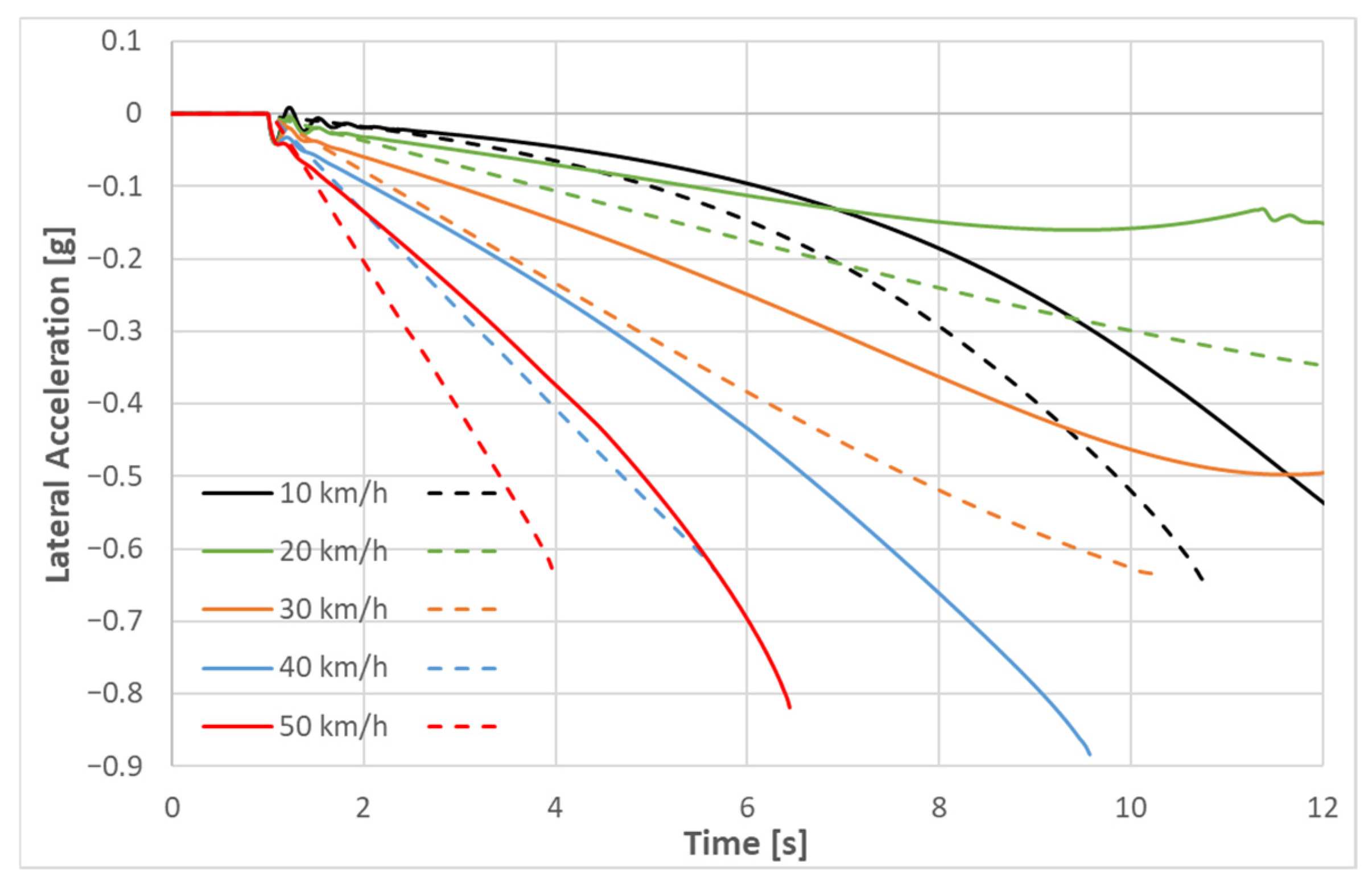
The plot shown in Figure 12 presents the lateral acceleration acting on the vehicle during the simulation. The maximum acceleration “g” achieved in all simulations without body roll reached 0.9 g, after which the vehicle rolled over.
With body inclination activated, the lateral acceleration during the simulation reached a maximum value of 0.65 g, which was approximately 45% lower than in simulations carried out without inclination. This is confirmed by the curves shown in Figure 12. The lateral acceleration achieved by the vehicle was in the range of about 0.4–0.9 g, corresponding to that experienced by a passenger car when negotiating a road curve.

3.2. Single-Lane Change Simulation Results

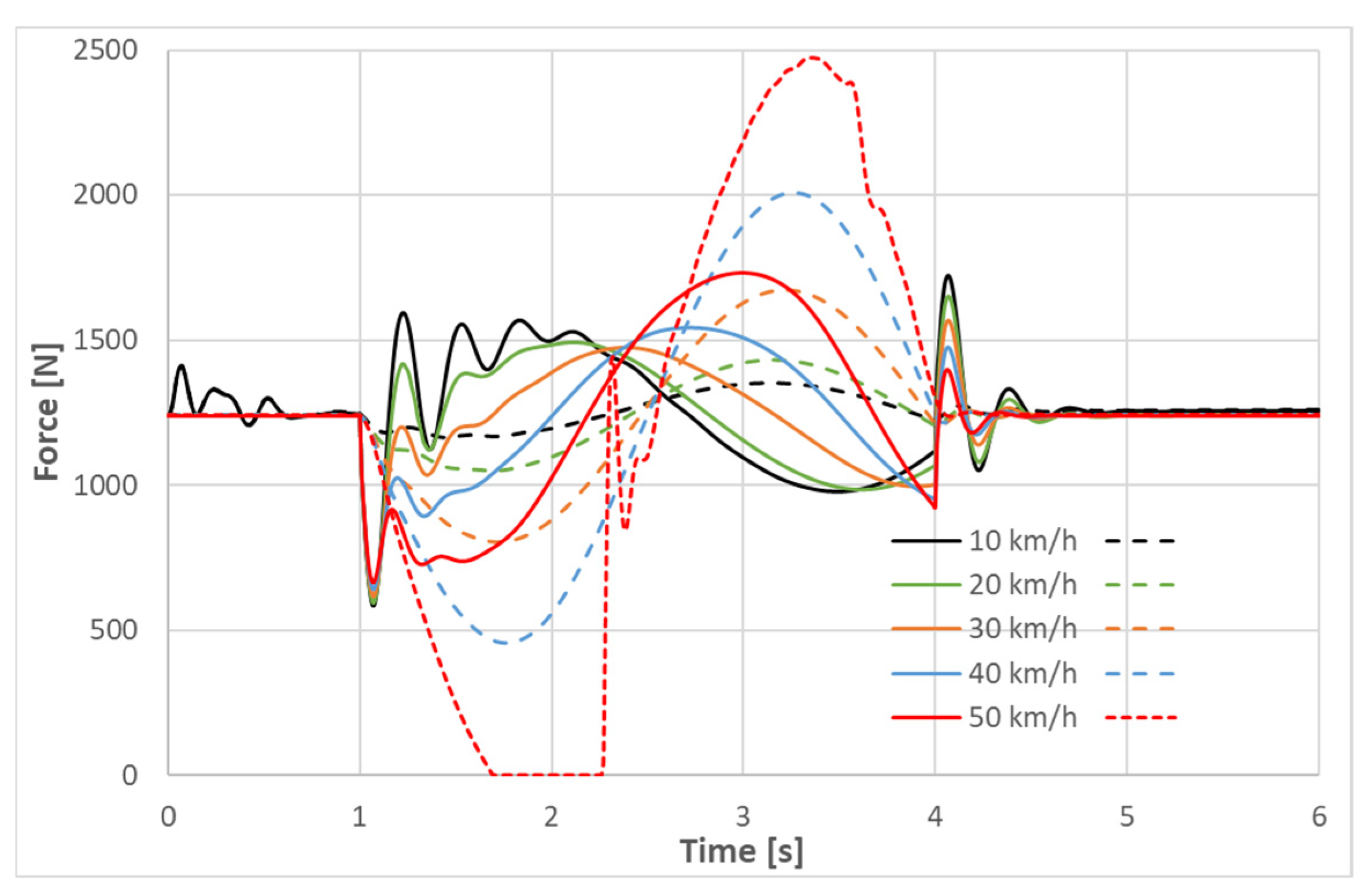
The normal force acting on the left rear tire as a function of time is shown in Figure 13. In all simulations without tilt, the vehicle successfully completed the simulated maneuver. The entire test was carried out at the maximum possible steering angle that the vehicle could achieve at each of the prescribed speeds. In the first stage of each simulation, the normal force approached zero, which indicated that, for a short period of time, the vehicle was traveling only on the outer (right) rear wheel. Any further increase in the steering angle would result in a loss of lateral stability of the vehicle. In the second half of the simulation, the situation was reversed, as the left wheel carried most of the lateral load on the rear axle of the vehicle.
In the simulations in which the tilt was activated at an initial speed of 50 km/h, it was noticeable that the normal force reached zero during the first run. This caused the left tire to lose traction and the car to almost roll over. According to Figure 13, after both steering inputs were completed, the vehicle returned to straight-line motion. However, the greater the vehicle speed, the greater the variations in the lateral force, which ultimately dampened to zero. This tendency can be mitigated by applying a higher damping coefficient to the ball joint, for example, or by extending the negative steering scrub radius.
There was a noticeable natural tendency for the lateral force on the left rear wheel to increase in proportion to the increase in vehicle speed, as shown in Figure 14. In the case of simulations with body tilt disabled, transient states were observed at the beginning and end of the maneuver, resulting from insufficient speed and attempts to adjust the steering angle so that the vehicle’s center of gravity followed the trajectory imposed by the software. When the body tilt system was activated, the lateral forces transmitted by the left rear wheel were greater for each assumed driving speed. This was due to a different load distribution acting on the vehicle. It is worth noting, however, that despite the increased force values, the vehicle did not lose its stability.
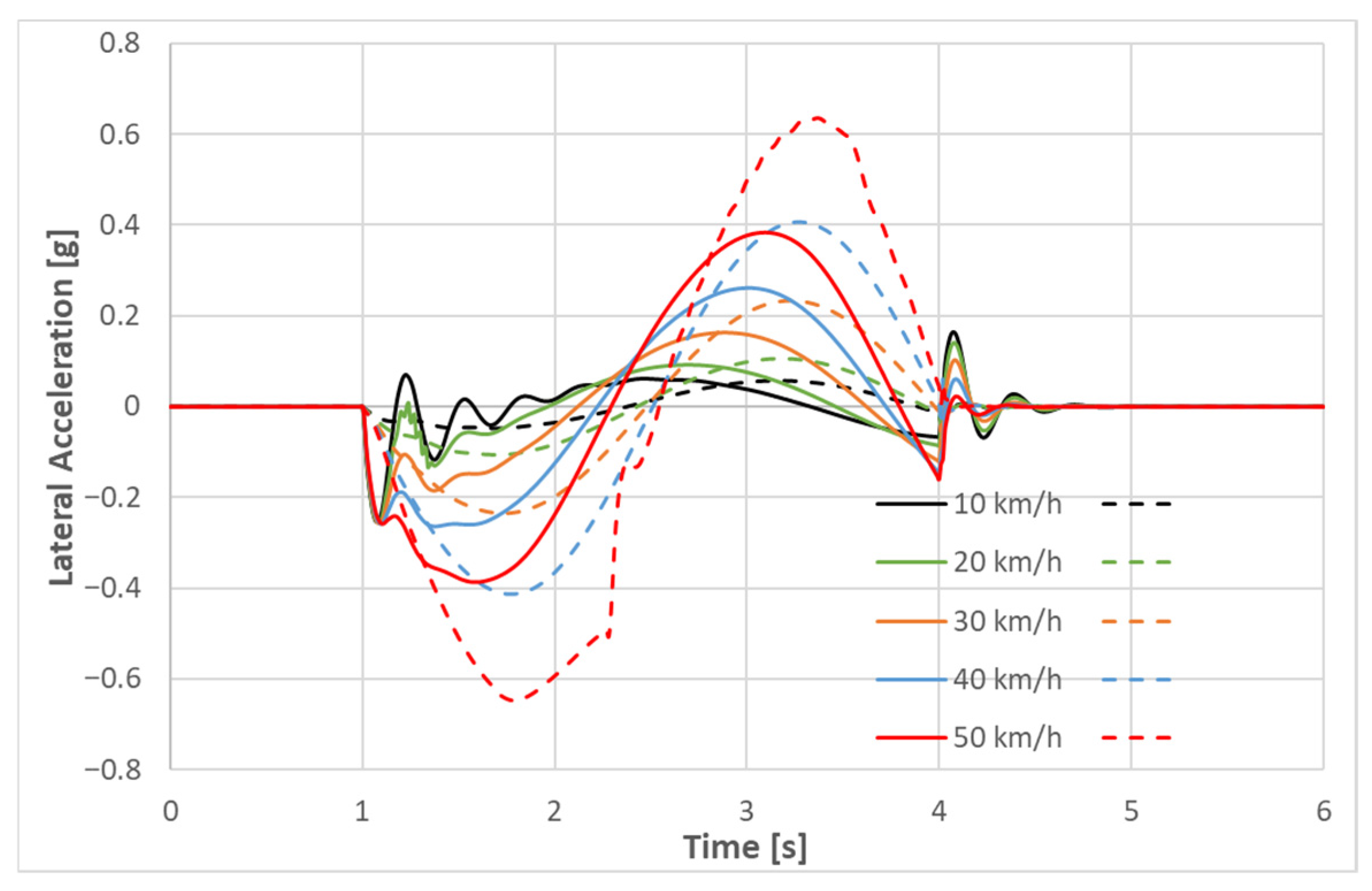
The lateral acceleration versus time plot (Figure 15) presents results that can be considered consistent with those obtained during the Ramp Steer simulation of the vehicle without roll, as the maximum achieved lateral acceleration was approximately 0.63 g, which indicated that the vehicle was operating at the limit of adhesion.
A similar increasing trend with the body tilting function activated was also observed for the maximum lateral accelerations achieved by the tire. In the Single-Lane Change test with the tilting model enabled, the same value of lateral acceleration was recorded in both directions as in the Ramp Steer test with tilting, as shown in Figure 15.

4. Conclusions

Three-wheeled vehicles with two rear wheels and a tilting front end represent a technology that remains under active development, yet holds significant transportation potential, particularly for people with limited mobility or physical disabilities. These vehicles offer benefits in terms of compactness, maneuverability, and operational efficiency, making them suitable for congested urban traffic and emerging autonomous mobility solutions [58,59,60,61,62].
This study uniquely integrates dynamic simulations of a tilting three-wheeled vehicle using the ADAMS/Car environment to assess the effects of tilting on vehicle stability, handling, and lateral force distribution. Our work goes beyond conventional reviews by systematically examining how body tilt influences force transmission, steering response, and motion stability under both steady-state cornering and transient maneuvers [58,59]. This complements recent research comparing steering behavior and tilt influence in narrow vehicles [59] and confirms that body tilt plays a substantial role in enhancing dynamic performance [60].
To further strengthen the simulation-based methodology and complement traditional analyses, we drew inspiration from recent advances in virtual sample generation and calibration techniques used in other engineering fields. Methods that generated synthetic training data via virtual samples and autoencoder models improved information completeness and enabled robust model calibration under limited data conditions. Such approaches have demonstrated superior performance in complex systems, for example, achieving high in situ calibration accuracy for sensor networks in building thermal systems using virtual samples and autoencoders [63,64].
All the tests conducted in this study showed that activating the tilting function significantly enhanced the dynamic performance of the vehicle. When tilt was enabled, both maximum lateral acceleration and lateral tire forces increased by over 30% compared to simulations without tilt, resulting in improved handling and motion stability. These improvements translated into higher achievable speeds during cornering without compromising control [58,60,61]. Similar simulation-based frameworks that leveraged systematic variation in inputs and dynamic responses have proven valuable in other domains where virtual calibration and data augmentation helped ensure robust analysis [63,64].
Furthermore, recent research on diffusion-guided virtual sample generation methods demonstrates how knowledge-guided synthetic dataset construction can enhance information completeness and support zero-shot fault diagnosis in complex systems, providing an additional analogy for enriching simulation datasets and improving confidence in model responses [64].
The results presented here are of practical relevance to designers and engineers of three-wheeled vehicles. They suggest that incorporating active tilting mechanisms and comprehensive simulation studies can significantly enhance vehicle versatility, safety, and traffic performance. By integrating force analysis with handling evaluation, this work contributes to a practical simulation-based perspective that complements experimental research and supports data-driven engineering design [58,59,60,61,62].
Moreover, the enhanced stability and controllability of tilting vehicles may offer tangible benefits for people with reduced mobility by increasing independence and access to transport.
In conclusion, the potential of vehicles with tilting bodies is substantial. Continued research that combines dynamic simulation, mathematical modeling, and advanced data-generation techniques will be essential to advance these vehicles toward real-world deployment. The findings in this study provide a solid foundation for further research in dynamic simulation and prototype development of three-wheeled tilting vehicles [58,59,60,61,62,63,64].

Author Contributions

Conceptualization, J.S., K.S.-P., and M.R.; methodology, J.S. and R.N.; software, K.S.-P. and M.R.; validation, D.D., K.J., and K.S.-P.; formal analysis, K.S.-P. and R.N.; investigation, K.S.-P.; resources, J.S., M.R., and K.S.-P.; data curation, J.S. and D.D.; writing—original draft preparation, K.S.-P. and R.N.; writing—review and editing, K.S.-P. and K.J.; visualization, K.S.-P. and J.S.; supervision, J.S. and R.N.; project administration, J.S.; funding acquisition, J.S. and D.D. All authors have read and agreed to the published version of the manuscript.

Funding

This research was funded by the EU-FENG grant number FENG.01.01-IP.02-3750/23, entitled: “TriVolta–a universal chassis platform with variable suspension geometry for light urban vehicles with very high mobility and electric drive,” and the APC was funded by the Military Institute of Armoured and Automotive Technology.

Institutional Review Board Statement

Not applicable.

Informed Consent Statement

Not applicable.

Data Availability Statement

The original contributions presented in this study are included in the article. Further inquiries can be directed to the corresponding author.

Conflicts of Interest

The authors declare no conflicts of interest.

References

  1. Caban, J. Traffic congestion level in 10 selected cities of Poland. Sci. J. Silesian Univ. Technol. Ser. Transp. 2021, 112, 17–31. [Google Scholar] [CrossRef]
  2. Caban, J.; Droździel, P. Traffic congestion in chosen cities of Poland. Sci. J. Silesian Univ. Technol. Ser. Transp. 2020, 108, 5–14. [Google Scholar] [CrossRef]
  3. Caban, J.; Voltr, O. A Study on the use of eco-driving technique in city traffic. Arch. Automot. Eng. Arch. Motoryz. 2021, 93, 15–25. [Google Scholar] [CrossRef]
  4. Dudziak, A.; Caban, J. Organization of Urban Transport Organization—Presentation of Bicycle System and Bicycle Infrastructure in Lublin. LOGI—Sci. J. Transp. Logist. 2021, 12, 36–45. [Google Scholar] [CrossRef]
  5. Ma, C.; Liu, Y.; Xu, X.; Zhao, H. A Review of Research on Coordinated Control of Traffic Signals at Urban Road Intersection Groups. Promet—Traffic Transp. 2025, 37, 1489–1507. [Google Scholar] [CrossRef]
  6. Palo, J.; Stopka, O. On-site traffic management evaluation and proposals to improve safety of access to workplaces. Commun.—Sci. Lett. Univ. Žilina 2021, 23, A125–A136. [Google Scholar]
  7. Stopka, O.; Sarkan, B.; Chovancova, M.; Kapustina, L.M. Determination of the appropriate vehicle operating in particular urban traffic conditions. Commun.—Sci. Lett. Univ. Zilina 2017, 19, 18–22. [Google Scholar] [CrossRef]
  8. Dižo, J.; Blatnický, M.; Lovska, A.; Molnár, D.; Šuvada, R. An Engineering Design of a Scooter. In Machine and Industrial Design in Mechanical Engineering; Rackov, M., Miltenović, A., Banić, M., Eds.; KOD 2024. Mechanisms and Machine Science; Springer: Cham, Switzerland, 2025; Volume 174. [Google Scholar] [CrossRef]
  9. Szemere, D.; Nemeslaki, A. The implications of electric scooters as a new technology artifact in urban transportation. Acta Polytech. Hung. 2023, 20, 227–240. [Google Scholar] [CrossRef]
  10. Turoń, K.; Kubik, A.; Folęga, P.; Chen, F. Perception of shared electric scooters: A case study from Poland. Sustainability 2023, 15, 12596. [Google Scholar] [CrossRef]
  11. Yang, H.; Ma, Q.; Wang, Z.; Cai, Q.; Xie, K.; Yang, D. Safety of micro-mobility: Analysis of E-Scooter crashes by mining news reports. Accid. Anal. Prev. 2020, 143, 105608. [Google Scholar] [CrossRef] [PubMed]
  12. Dudziak, A.; Caban, J. The Urban Transport Strategy on the Example of the City Bike System in the City of Lublin in Relation to the COVID-19 Pandemic. LOGI—Sci. J. Transp. Logist. 2022, 13, 1–12. [Google Scholar] [CrossRef]
  13. Kubalák, S.; Gogola, M.; Cerný, M. Options for assessing the impact of the bike-sharing system on mobility in the city Žilina. Transp. Res. Procedia 2021, 55, 378–386. [Google Scholar] [CrossRef]
  14. Rathouský, B.; Mervart, M. The cycling transport in Prague. Perner’s Contacts 2023, 18. [Google Scholar] [CrossRef]
  15. Blatnický, M.; Dižo, J.; Sága, M.; Molnár, D.; Slíva, A. Utilizing Dynamic Analysis in the Complex Design of an Unconventional Three-Wheeled Vehicle with Enhancing Cornering Safety. Machines 2023, 11, 842. [Google Scholar] [CrossRef]
  16. Dwivedi, A.; Kumar, R.; Kumar, R.; Jaiswal, R.; Srivastava, A.; Verma, M. Design and Fabrication of an Electric Tricycle. In Proceedings of the 2023 International Conference on IoT, Communication and Automation Technology, ICICAT 2023, Gorakhpur, India, 23–24 June 2023. [Google Scholar]
  17. Jilek, P.; Berg, J.; Tchuigwa, B.S.S. Influence of the Weld Joint Position on the Mechanical Stress Concentration in the Construction of the Alternative Skid Car System’s Skid Chassis. Appl. Sci. 2022, 12, 397. [Google Scholar] [CrossRef]
  18. Jilek, P.; Cerman, J. Design of sliding frame system for two-wheeled vehicle. In Transport Means—Proceedings of the International Conference; 2020; pp. 136–141. Available online: https://hdl.handle.net/10195/77047 (accessed on 4 December 2025).
  19. Yildiz, B.; Çiğdem, Ş.; Meidute-Kavaliauskiene, I. Sustainable mobility and electric vehicle adoption: A study on the impact of perceived benefits and risks. Transport 2024, 39, 129–145. [Google Scholar] [CrossRef]
  20. Blatnický, M.; Dižo, J.; Molnár, D.; Suchánek, A. Comprehensive Analysis of a Tricycle Structure with a Steering System for Improvement of Driving Properties While Cornering. Materials 2022, 15, 8974. [Google Scholar] [CrossRef]
  21. Dižo, J.; Blatnický, M.; Melnik, R.; Karľa, M. Improvement of Steerability and Driving Safety of an Electric Three-Wheeled Vehicle by a Design Modification of its Steering Mechanism. Logi Sci. J. Transp. Logist. 2022, 13, 49–60. [Google Scholar] [CrossRef]
  22. Lukac, M.; Brumercik, F.; Krzywonos, L. Driveability simulation of vehicle with variant tire properties. Commun.—Sci. Lett. Univ. Žilina 2016, 18, 34–37. [Google Scholar] [CrossRef]
  23. Motrike. Delta vs. Tadpole Trike. Available online: https://www.motrike.com/delta-vs-tadpole-trike/ (accessed on 4 December 2025).
  24. Honda Gyro Canopy. Available online: https://pl.e-scooter.co/honda-gyro-canopy/ (accessed on 11 March 2023).
  25. Piaggio MP3 400 na 2021—Duży Skuter na Samochodowe Prawo Jazdy [Piaggio MP3 400 for 2021—Large Scooter for Car License Holders]. Available online: https://motogen.pl/piaggio-mp3-400-na-2021-duzy-skuter-na-samochodowe-prawo-jazdy-test/ (accessed on 7 April 2023).
  26. Kukla, M.; Wieczorek, B.; Warguła, Ł.; Berdychowski, M. An analytical model of the demand for propulsion torque during manual wheelchair propelling. Disabil. Rehabil. Assist. Technol. 2021, 16, 9–16. [Google Scholar] [CrossRef]
  27. Wieczorek, B.; Kukla, M.; Warguła, Ł. The symmetric nature of the position distribution of the human body center of gravity during propelling manual wheelchairs with innovative propulsion systems. Symmetry 2021, 13, 154. [Google Scholar] [CrossRef]
  28. Stańko-Pająk, K.; BBursa Seńko, J.; Detka, T.; Korczak, S.; Nowak, R.; Popiołek, K.; Lisiecki, J.; Paczkowski, A. Selected Aspects of Materials Engineering for Vehicle Design. IOP Conf. Ser. Mater. Sci. Eng. 2022, 1247, 012039. [Google Scholar] [CrossRef]
  29. Jilek, P. Vehicle wheel positioning innovation on a machine for measuring the contact parameters between a tyre and the road. Arch. Automot. Eng. 2023, 100, 31–43. [Google Scholar] [CrossRef]
  30. Skrucany, T.; Vrabel, J.; Kazimir, P. The influence of the cargo weight and its position on the braking characteristics of light commercial vehicles. Open Eng. 2020, 10, 154–165. [Google Scholar] [CrossRef]
  31. Vrabel, J.; Jagelcak, J.; Stopka, O.; Kiktova, M.; Caban, J. Determination of the maximum permissible cargo length exceeding the articulated vehicle length in order to detect its critical rotation radius. In Proceedings of the XI International Science-Technical Conference Automotive Safety, Casta-Papiernicka, Slovakia, 18–20 April 2018; pp. 1–7, ISBN 978-1-5386-4579-6. [Google Scholar] [CrossRef]
  32. Zhang, G.; Wang, T.; Wang, H.; Wu, S.; Shao, Z. Stability Analysis of a Vehicle–Cargo Securing System for Autonomous Trucks Based on 6-SPS-Type Parallel Mechanisms. Machines 2023, 11, 745. [Google Scholar] [CrossRef]
  33. Kurniawan, M.P.; Chonhenchob, V.; Singh, S.P.; Sittipod, S. Measurement and Analysis of Vibration Levels in Two and Three Wheel Delivery Vehicles in Southeast Asia. Packag. Technol. Sci. 2015, 28, 1047–1058. [Google Scholar] [CrossRef]
  34. Pieniążek, W.; Więckowski, D. Badania Kierowalności i Stateczności Pojazdów Samochodowych; PWN: Warsaw, Poland, 2020. [Google Scholar]
  35. Frej, D.; Hupka, M. The vehicle insurance and the risk of road accidents in Poland. Arch. Automot. Eng. 2025, 107, 49–81. [Google Scholar] [CrossRef] [PubMed]
  36. Rybicka, I.; Caban, J.; Vrabel, J.; Šarkan, B.; Stopka, O.; Misztal, W. Analysis of the safety systems damage on the example of a suburban transport enterprise. In Proceedings of the XI International Science-Technical Conference Automotive Safety, Casta-Papiernicka, Slovakia, 18–20 April 2018; pp. 1–6, ISBN 978-1-5386-4579-6. [Google Scholar] [CrossRef]
  37. Sorum, N.G.; Sorum, M.G. Prediction and Investigation of the Injury Severity of Drivers Involved in Speeding-Related Crashes Using Machine Learning Models. Promet—Traffic Transp. 2025, 37, 1612–1627. [Google Scholar] [CrossRef]
  38. Zhang, L. Increasing the Road Safety of E-bike: Design of Protective Shells Based on Stability Criterion. Ph.D. Thesis, The University of Nottingham Ningbo China, Ningbo, China, 2017. [Google Scholar]
  39. Decker, Ž.; Tretjakovas, J.; Drozd, K.; Rudzinskas, V.; Walczak, M.; Kilikevičius, A.; Matijosius, J.; Boretska, I. Material’s Strength Analysis of the Coupling Node of Axle of the Truck Trailer. Materials 2023, 16, 3399. [Google Scholar] [CrossRef] [PubMed]
  40. Kosobudzki, M.; Zajac, P.; Gardyński, L. A Model-Based Approach for Setting the Initial Angle of the Drive Axles in a 4 × 4 High Mobility Wheeled Vehicle. Energies 2023, 16, 1938. [Google Scholar] [CrossRef]
  41. Pravilonis, T.; Sokolovskij, E. Analysis of composite material properties and their possibilities to use them in bus frame construction. Transport 2020, 35, 368–378. [Google Scholar] [CrossRef]
  42. Jilek, P.; Nemec, J. Changing adhesion force for testing road vehicles at safe speed. Eng. Rural. Dev. 2020, 19, 1411–1417. [Google Scholar]
  43. Huston, J.C.; Graves, B.J.; Johnson, D.B. Three Wheeled Vehicle Dynamics; SAE Technical Paper 820139; SAE International: Warrendale, PA, USA, 1982. [Google Scholar] [CrossRef]
  44. Jagelčák, J.; Gnap, J.; Kostrzewski, M.; Kuba, O.; Frnda, J. Calculation of an Average Vehicle’s Sideways Acceleration on Small Roundabouts. Sensors 2022, 22, 4978. [Google Scholar] [CrossRef]
  45. Jagelčák, J.; Kiktová, M.; Frančák, M. The Analysis of Manoeuvrability of Semi-trailer Vehicle Combination. Transp. Res. Procedia 2020, 44, 176–181. [Google Scholar] [CrossRef]
  46. Vrabel, J.; Skrucany, T.; Bartuska, L.; Koprna, J. Movement analysis of the semitrailer with the tank-container at hard braking-the case study. IOP Conf. Ser. Mater. Sci. Eng. 2019, 710, 012025. [Google Scholar] [CrossRef]
  47. Terada, K.; Sano, K.; Watanabe, K.; Kaieda, T.; Takano, K. Study on the Behavior of Three-Wheeled Vehicles Travelling over Low-μ Road Surfaces; Yamaha Motor Co., Ltd.: Iwata, Japan, 2016. [Google Scholar]
  48. Chang, C.; Lee, T. Analysis of Stability of Three- and Four-Wheeled Vehicles. Seria III 1990, 33, 45–52. [Google Scholar]
  49. Sharma, R. Ride, eigenvalue and stability analysis of three-wheel vehicle using Lagrangian dynamics; Maharishi Markandeshwar University: Mullana, India, 2017; No. 13. [Google Scholar]
  50. Lurie, D. Stability of Three-Wheeled Vehicles and Bicycles; Department of Mechanical Engineering, Worcester Polytechnic Institute: Worcester, MA, USA, 2015. [Google Scholar]
  51. Saeedi, A.; Kazemi, R. Stability of Three-Wheeled Vehicles with and without Control System. Int. J. Automot. Eng. 2012, 2, 31–38. [Google Scholar]
  52. Nieoczym, A.; Drozd, K. Fractographic Assessment and FEM Energy Analysis of the Penetrability of a 6061-T Aluminum Ballistic Panel by a Fragment Simulating Projectile. Adv. Sci. Technol. Res. J. 2021, 15, 50–57. [Google Scholar] [CrossRef]
  53. Zharkevich, O.; Nikonova, T.; Gierz, Ł.; Berg, A.; Berg, A.; Zhunuspekov, D.; Warguła, Ł.; Łykowski, W.; Fryczyński, K. Parametric Optimization of a New Gear Pump Casing Based on Weight Using a Finite Element Method. Appl. Sci. 2023, 13, 12154. [Google Scholar] [CrossRef]
  54. Rosłaniec, K. Analysis of the effect of projectile impact angle on the puncture of a steel plate using the finite element method in Abaqus software. Appl. Comput. Sci. 2022, 18, 56–69. [Google Scholar] [CrossRef]
  55. Kulička, J.; Jílek, P. The Fourier analysis in transport application using Matlab. In Proceedings of the Transport Means International Conference, Juodkrantė, Lithuania, 5–7 October 2016; pp. 820–825. [Google Scholar]
  56. Seńko, J.; Nowak, R. Symulacyjne badania pojazdu typu Formula Student. Logistyka 2010, 2, 321–327. [Google Scholar]
  57. Nowak, T.; Seńko, J.; Jasiński, P.; Paczkowski, A. Selected Issues Related to the Research on Hybrid Three-Wheeler for Disabled. Arch. Motoryz. 2018, 80, 95–113. [Google Scholar] [CrossRef]
  58. Navikas, M.; Pitrėnas, P. Determination and Evaluation of a Three-Wheeled Tilting Vehicle Prototype’s Dynamic Characteristics. Appl. Sci. 2022, 12, 5121. [Google Scholar] [CrossRef]
  59. Weigel-Milleret, A. Steady-state comparison of torque vectoring and vehicle tilt influence on narrow vehicle steering characteristics, Oeconomia. 2023. [Google Scholar] [CrossRef]
  60. Haraguchi, H. Obstacle avoidance capabilities of PMVs with inward active tilt. Sensors 2025, 8, 29. [Google Scholar]
  61. Khadr, A. Multibody dynamics modeling and simulation of a three-wheeled mobile robot using a robotic approach, Simulation Modelling Practice and Theory. Int. J. Intell. Unmanned Syst. 2024, 12, 270–289. [Google Scholar] [CrossRef]
  62. Liu, P.; Gu, Y.; Xu, Z.; Zhang, J.; Wei, W.; Wang, Y. Research on steering-tilting characteristics of an active tilting three-wheeled vehicle. Proc. Inst. Mech. Eng. Part D J. Automob. Eng. 2023, 37, 2831–2839. [Google Scholar] [CrossRef]
  63. Sun, Z.; Yao, Q.; Jin, H.; Xu, Y.; Hang, W.; Chen, H. A novel in-situ sensor calibration method for building thermal systems based on virtual samples and autoencoder. Energy 2024, 297, 131314. [Google Scholar] [CrossRef]
  64. Sun, Z.; Yao, Q.; Shi, L.; Jin, H.; Xu, Y.; Yang, P.; Xiao, H.; Chen, D.; Zhao, P. Virtual sample diffusion generation method guided by large language model-generated knowledge for enhancing information completeness and zero-shot fault diagnosis in building thermal systems. J. Zhejiang Univ. Sci. A 2025, 26, 895–916. [Google Scholar] [CrossRef]
Figure 1. Three-wheeled vehicle configuration [23].
Applsci 16 00098 g001
Figure 2. Examples of tilted three-wheeled vehicle configurations: Tadpole (Piaggio MP3; left) and Delta (Honda Gyro; right) [24,25].
Applsci 16 00098 g002
Figure 3. Concept of three-wheeled vehicle for people with disabilities [28].
Applsci 16 00098 g003
Figure 4. Different types of vehicle stability.
Applsci 16 00098 g004
Figure 5. (a) Four-wheel model, (b) Delta three-wheel model, (c) Tadpole three-wheel model [51].
Applsci 16 00098 g005
Figure 6. Isometric view of the parameterized tilting three-wheeled vehicle(MD ADAMS and CAD model): 1—front tire, 2—front suspension, 3—steering system, 4—vehicle body, 5—rear suspension, 6—rear tires, 7—drivetrain system, 8—control arm, 9—shock absorber, 10—pivot arm.
Applsci 16 00098 g006
Figure 7. Example of Ramp Steer simulation input parameters.
Applsci 16 00098 g007
Figure 8. Example of Single-Lane Change simulation initial parameters.
Applsci 16 00098 g008
Figure 9. Left rear tire normal force in time-domain dependences for five different velocities from 10 up to 50 km/h. Continuous-line curves—without tilt; dashed-line curves—with tilt.
Applsci 16 00098 g009
Figure 10. Left rear tire lateral force in time domain. Continuous-line curves—without tilt; dashed-line curves—with tilt.
Applsci 16 00098 g010
Figure 11. Right rear tire lateral force in time domain. Continuous-line curves—without tilt; dashed-line curves—with tilt.
Applsci 16 00098 g011
Figure 12. Time-domain lateral acceleration of CG of vehicle. Continuous-line curves—without tilt; dashed-line curves—with tilt.
Applsci 16 00098 g012
Figure 13. Left rear tire normal force in time domain. Continuous-line curves—without tilt; dashed-line curves—with tilt.
Applsci 16 00098 g013
Figure 14. Left rear tire lateral force in time domain. Continuous-line curves—without tilt; dashed-line curves—with tilt.
Applsci 16 00098 g014
Figure 15. CG lateral acceleration in time domain. Continuous-line curves—without tilt; dashed-line curves—with tilt.
Applsci 16 00098 g015
Table 1. Vehicle main geometrical parameters.
ParameterSymbolValueUnit
Vehicle’s lengthL1947mm
Vehicle’s heightH1777mm
Vehicle’s widthW801mm
Massm353kg
Center of gravity height zxc307mm
Center of gravity height xzc1028mm
WheelbaseWb1520mm
Track widthTb700mm
Front and rear tires-90/90–12-
RakeRa67.5degree
Disclaimer/Publisher’s Note: The statements, opinions and data contained in all publications are solely those of the individual author(s) and contributor(s) and not of MDPI and/or the editor(s). MDPI and/or the editor(s) disclaim responsibility for any injury to people or property resulting from any ideas, methods, instructions or products referred to in the content.