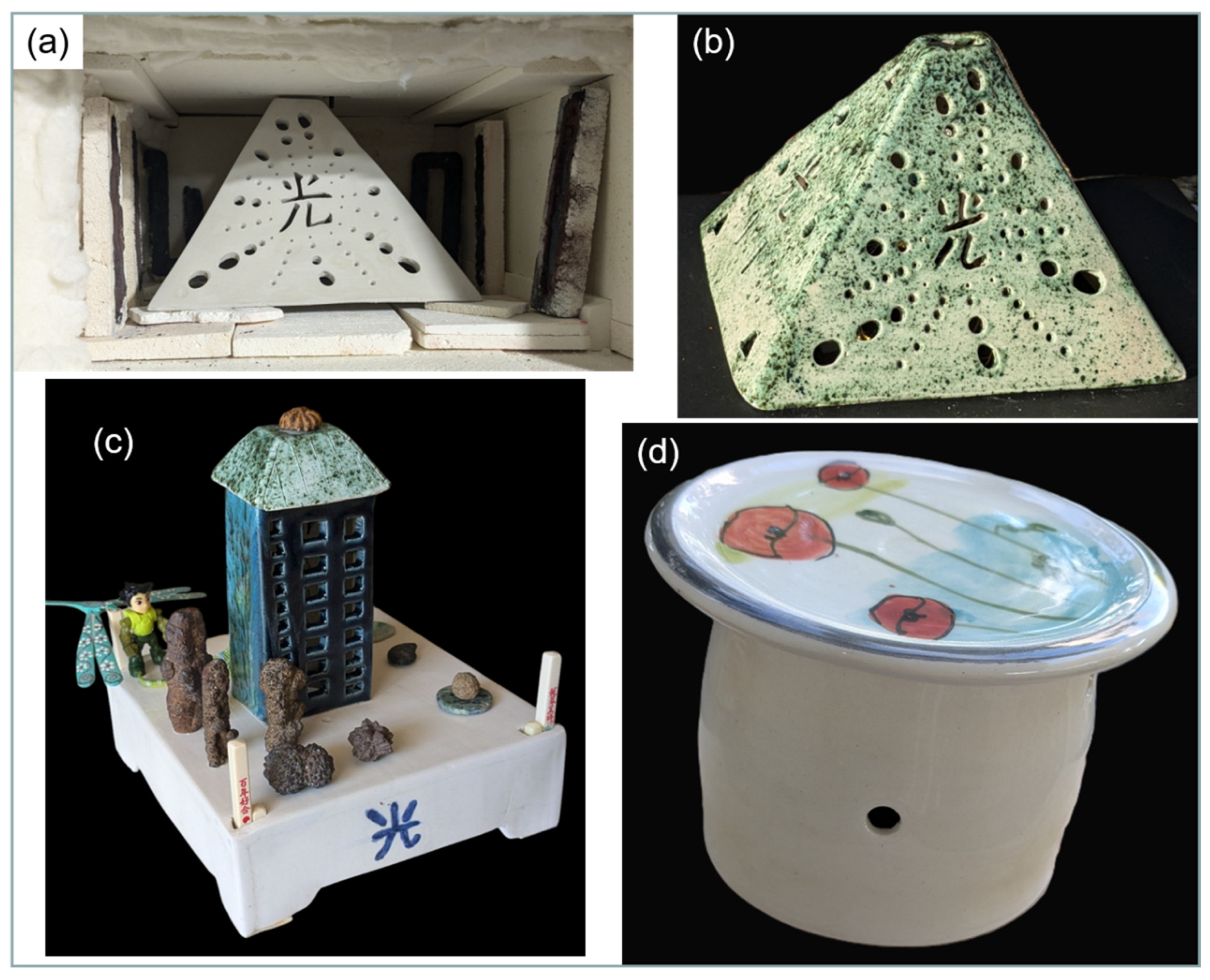
Microwave Firing of Ceramics: Developing Homemade Susceptors and Their Practical Applications

Featured Application
Abstract
1. Introduction
1.1. The Place of Microwave Heating in Ceramic Firing Methods
1.2. Microwave Heating Principles and Current State of Knowledge
- General Principles
- High-Temperature Heating of Ceramics with Microwaves
- High-Temperature Microwave Kiln Design
- Advantages of Microwave Heating
- Significant reduction in sintering time and energy consumption.
- Lower firing temperatures (50–75 °C lower than traditional methods) to achieve similar results.
- Faster and more uniform densification of materials.
- Comparable or superior mechanical properties of microwave-fired products compared to those fired conventionally.
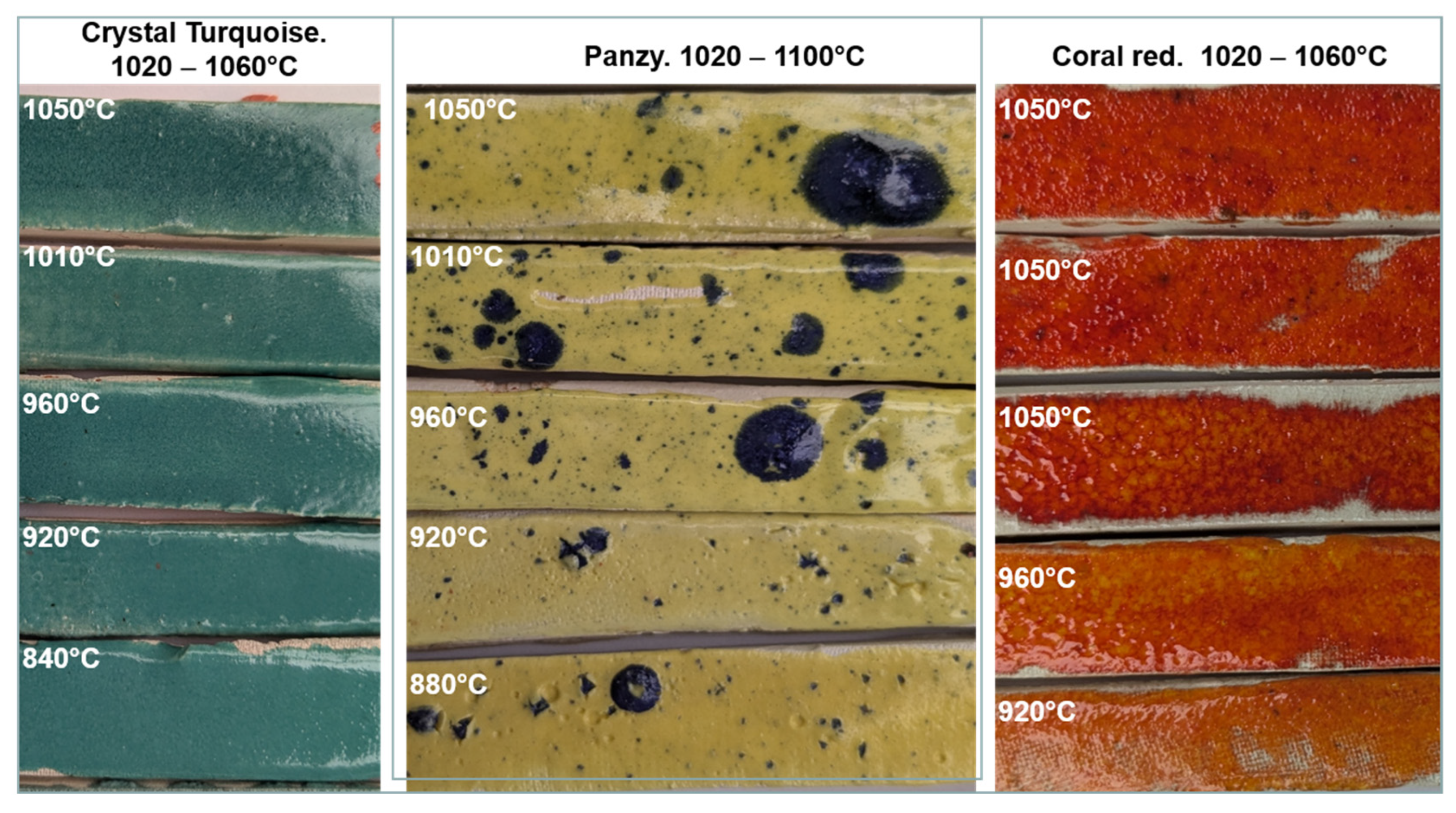
- Challenges still exist in accurately measuring sintering temperatures, as thermocouples and pyrometers have limitations. However, analysing the final colour of the ceramics, glazes, and decals can serve as a useful tool for assessing and mapping the firing temperature of the finished pieces [23].
1.3. Aim of the Article
2. Materials and Methods
2.1. The Microwave Kilns
2.2. Susceptors
2.2.1. Susceptor Considerations
2.2.2. Susceptor Manufacturing: Materials and Procedure
2.2.3. Macroscopic Susceptor Characterisation Method
2.2.4. Microscopic Susceptor Characterisation Method
3. Results
3.1. Macroscopic Evaluation of the Properties of Different Susceptor Formulations
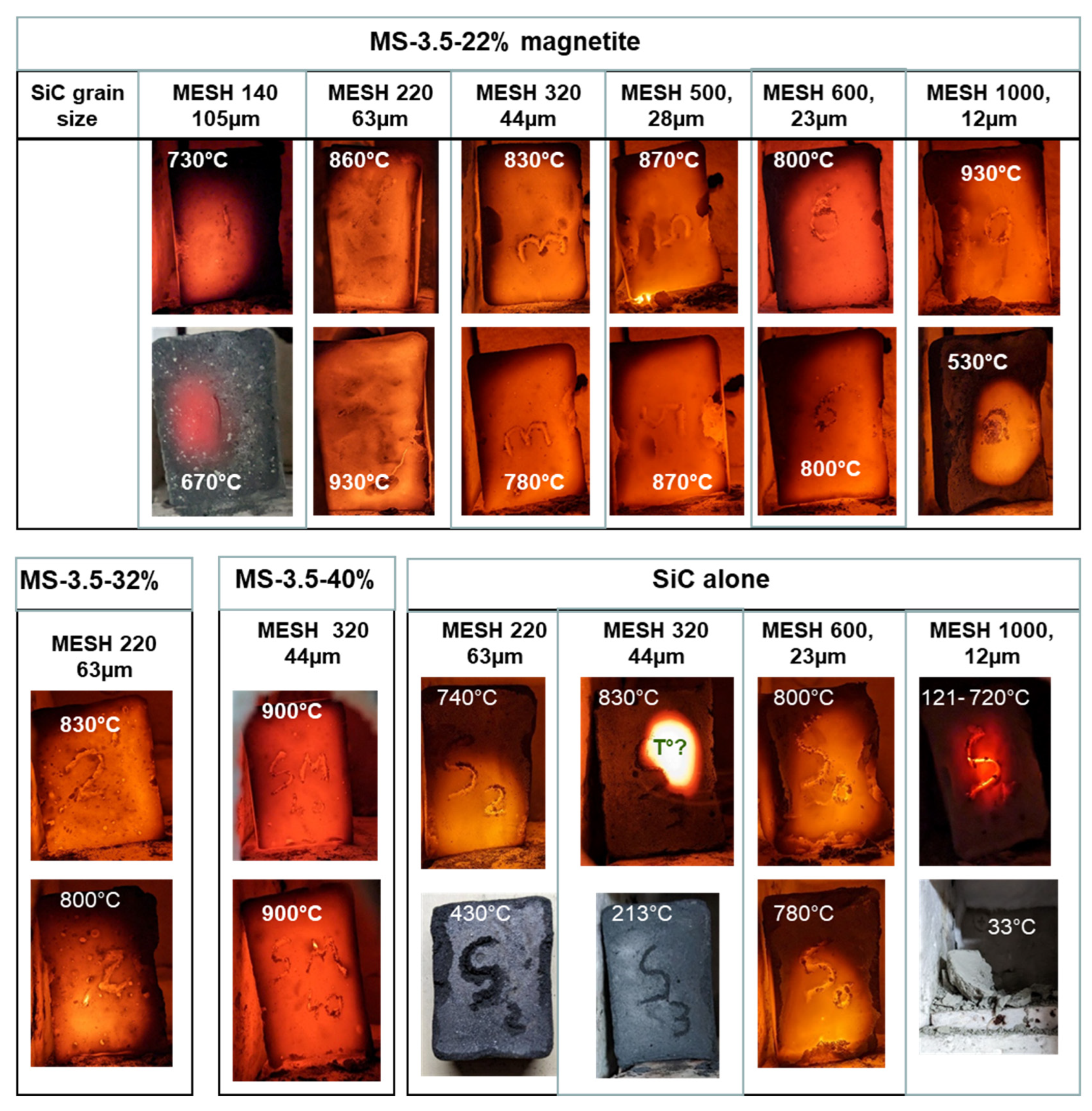
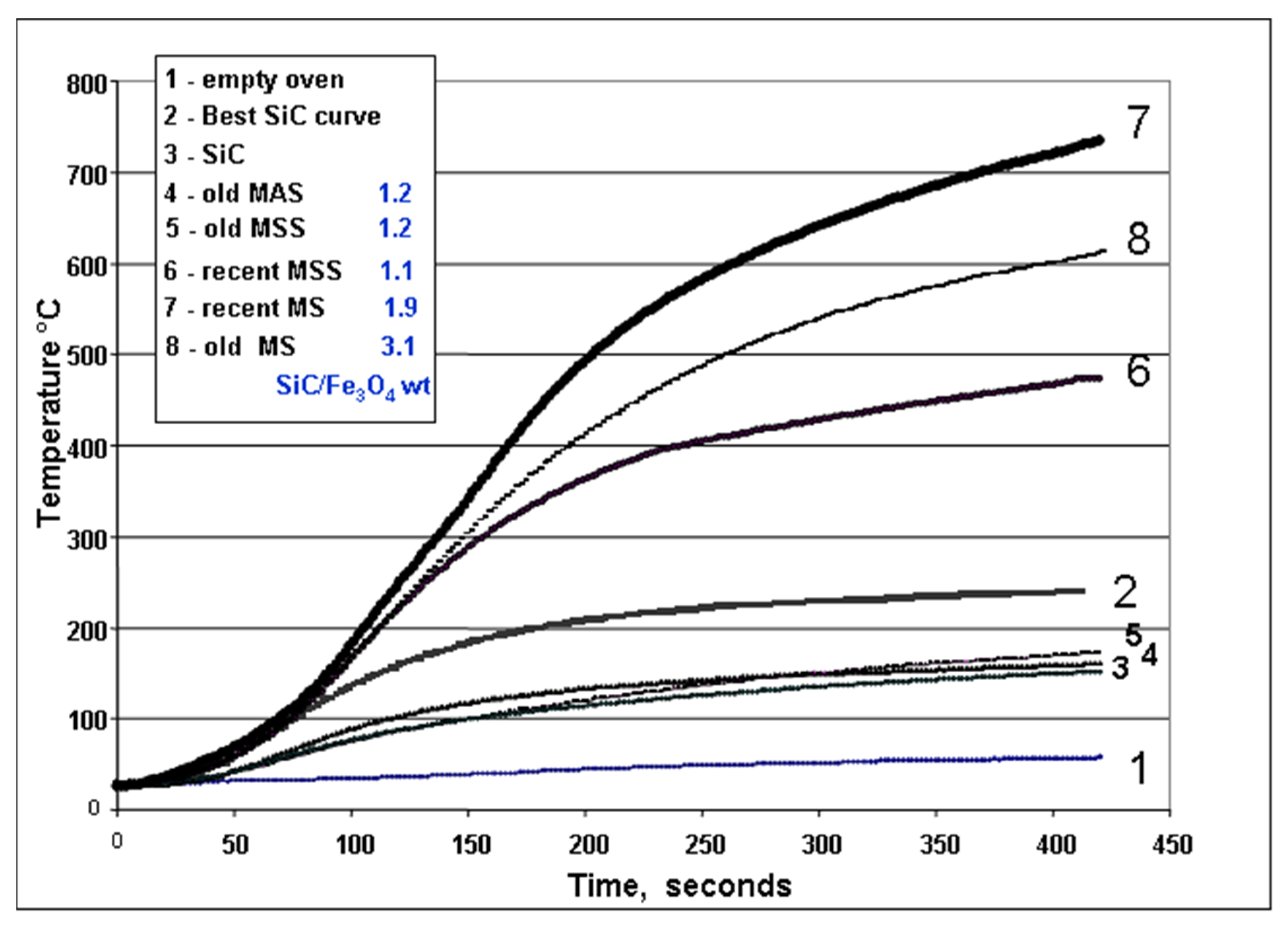
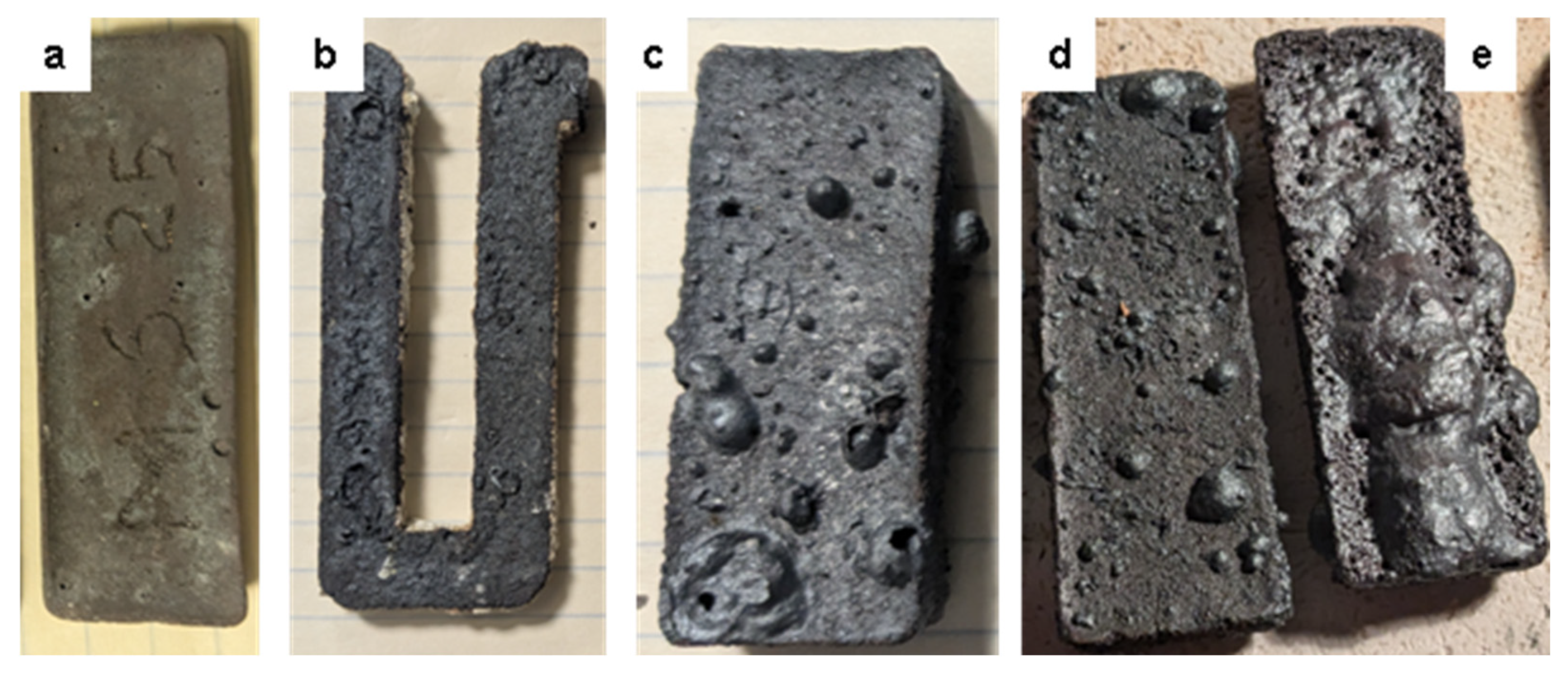
- Silicon Carbide (SiC) Alone
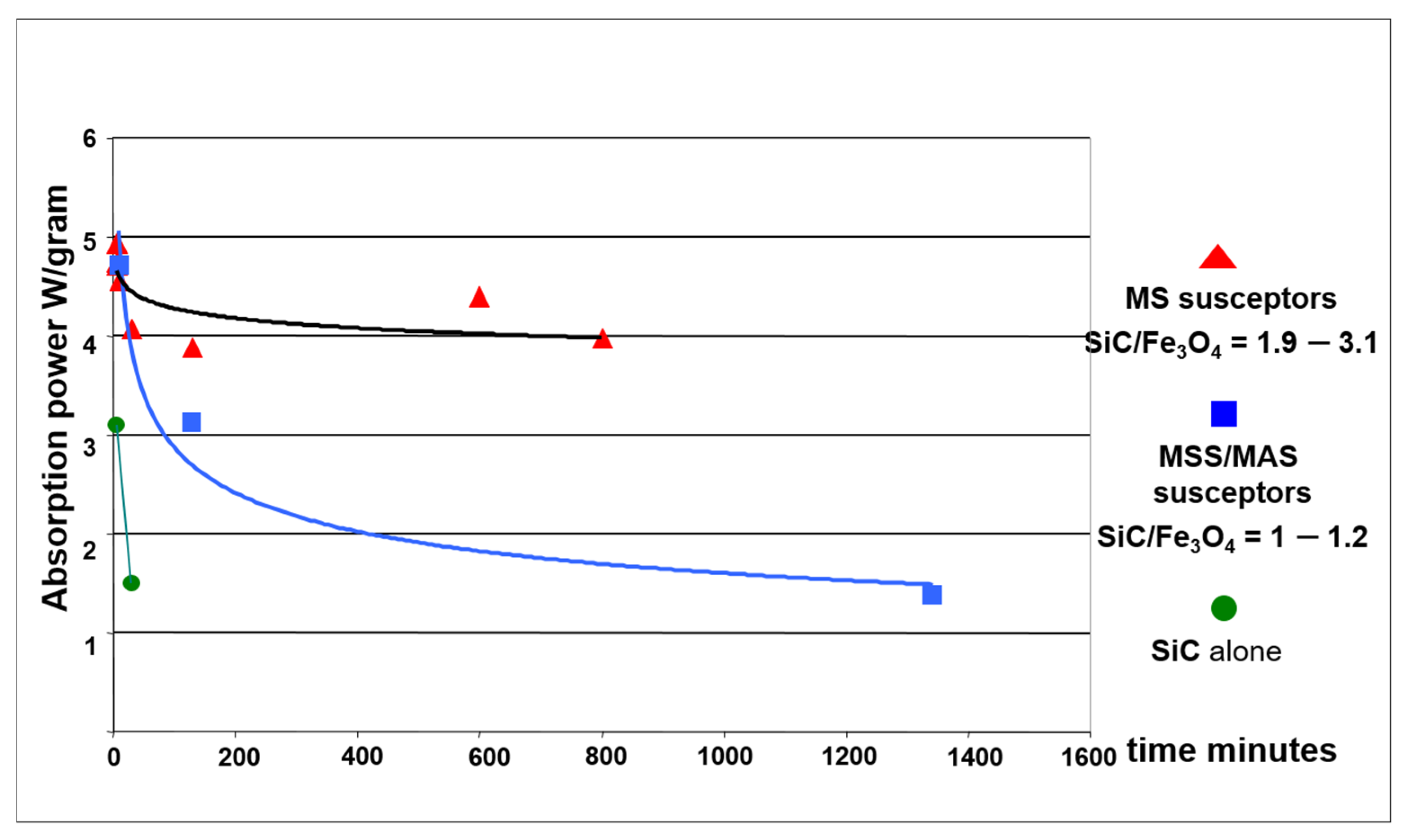
- Silicon Carbide + Magnetite (MS) with SiC/Fe3O4 ratio = 1.9 − 3.1
- Silicon Carbide + Magnetite + Silica or alumina (MSS, MAS) with SiC/Fe3O4 ratio = 1 − 1.3
- Other Formulations
3.2. Microscopic Susceptor Characterisation
3.2.1. Descriptions of Mineral Transformations in Susceptors
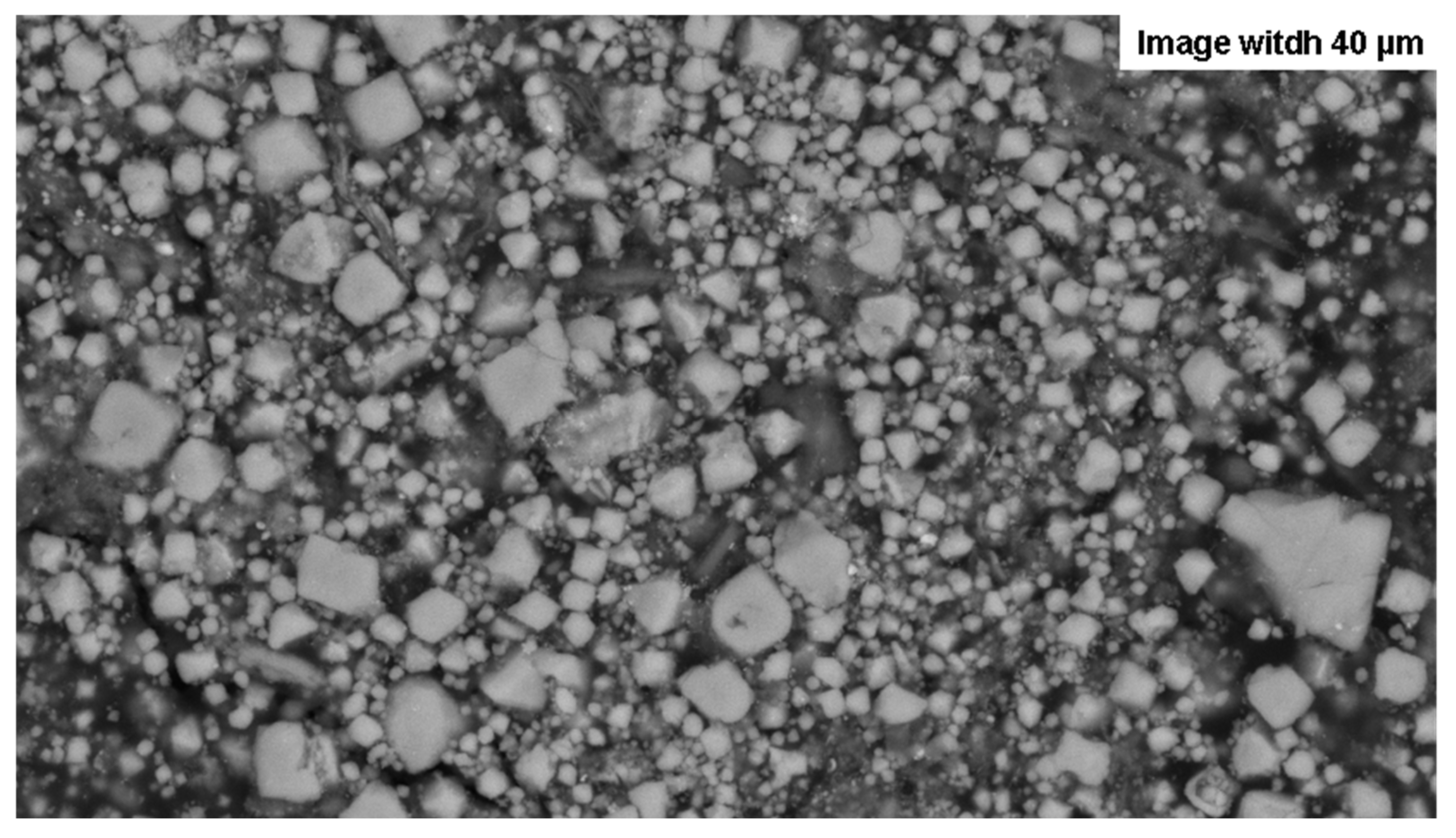
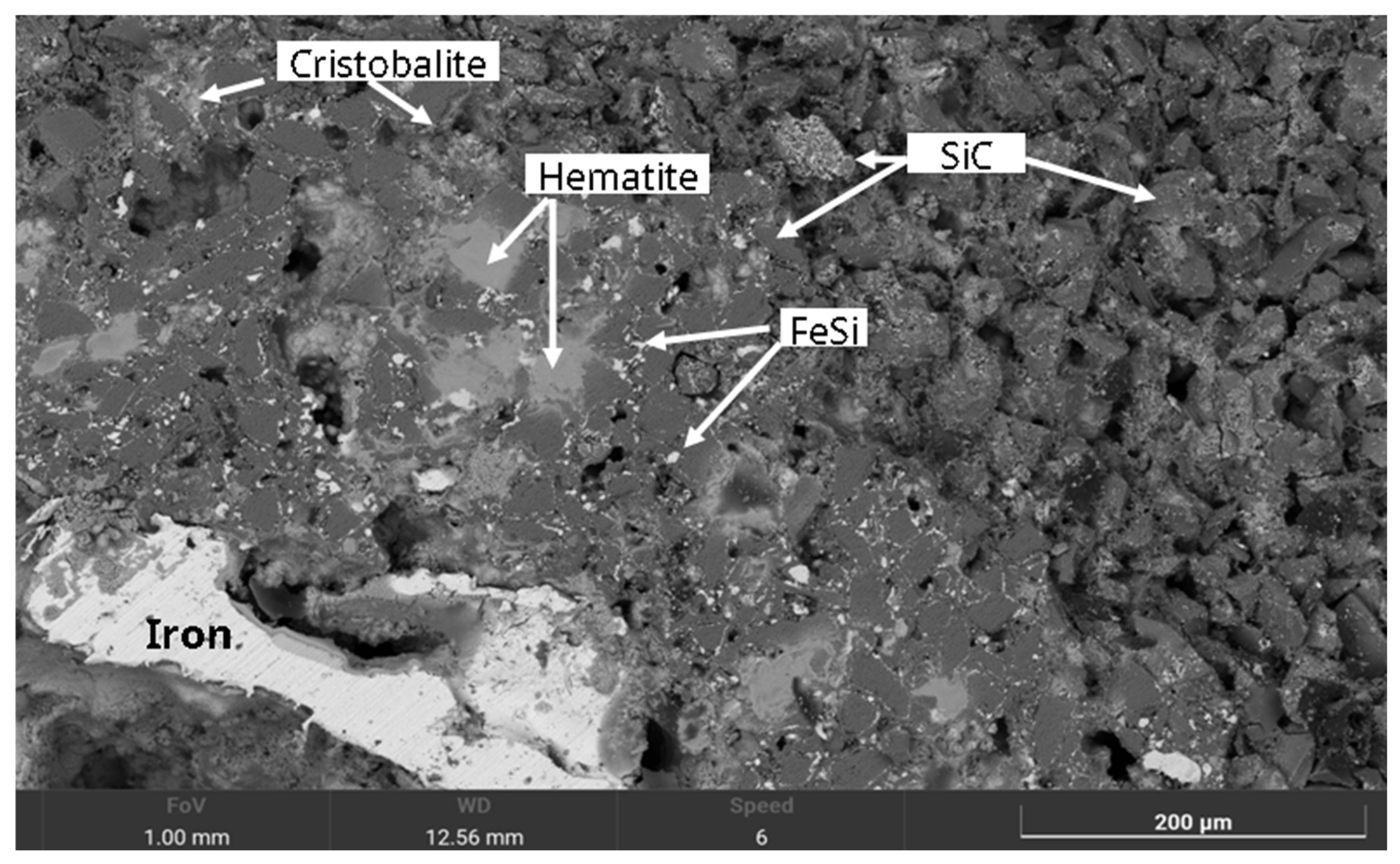
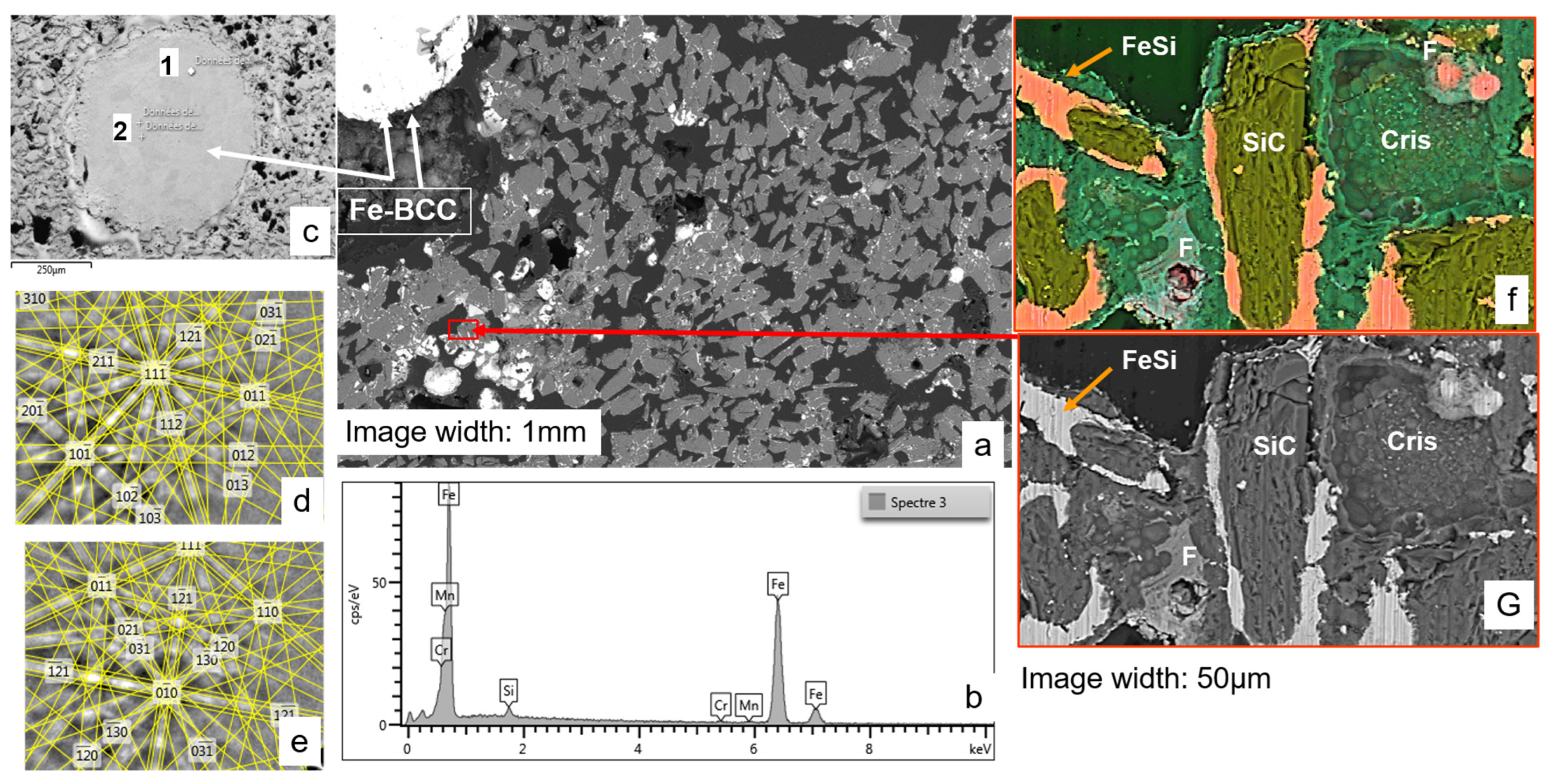
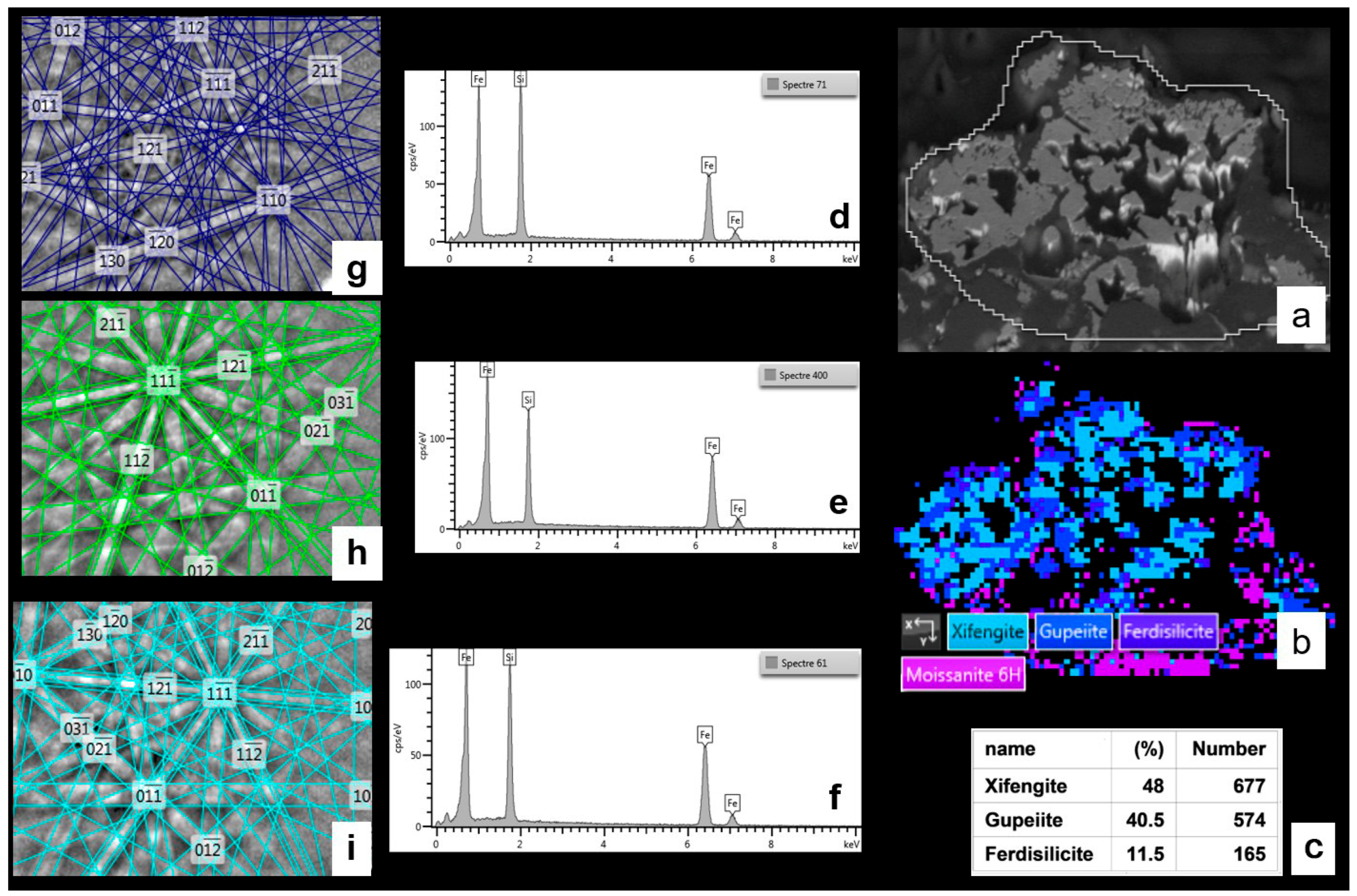
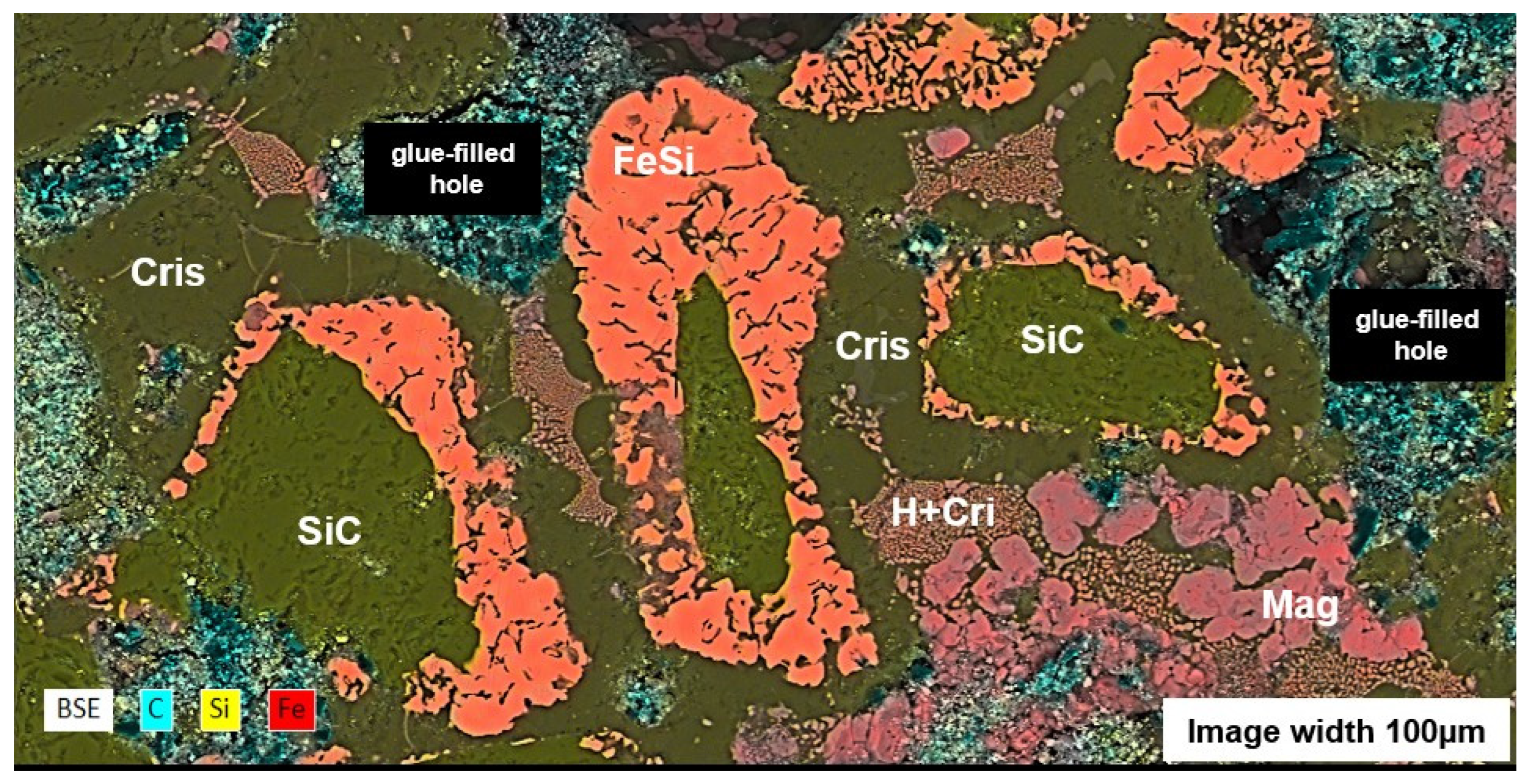
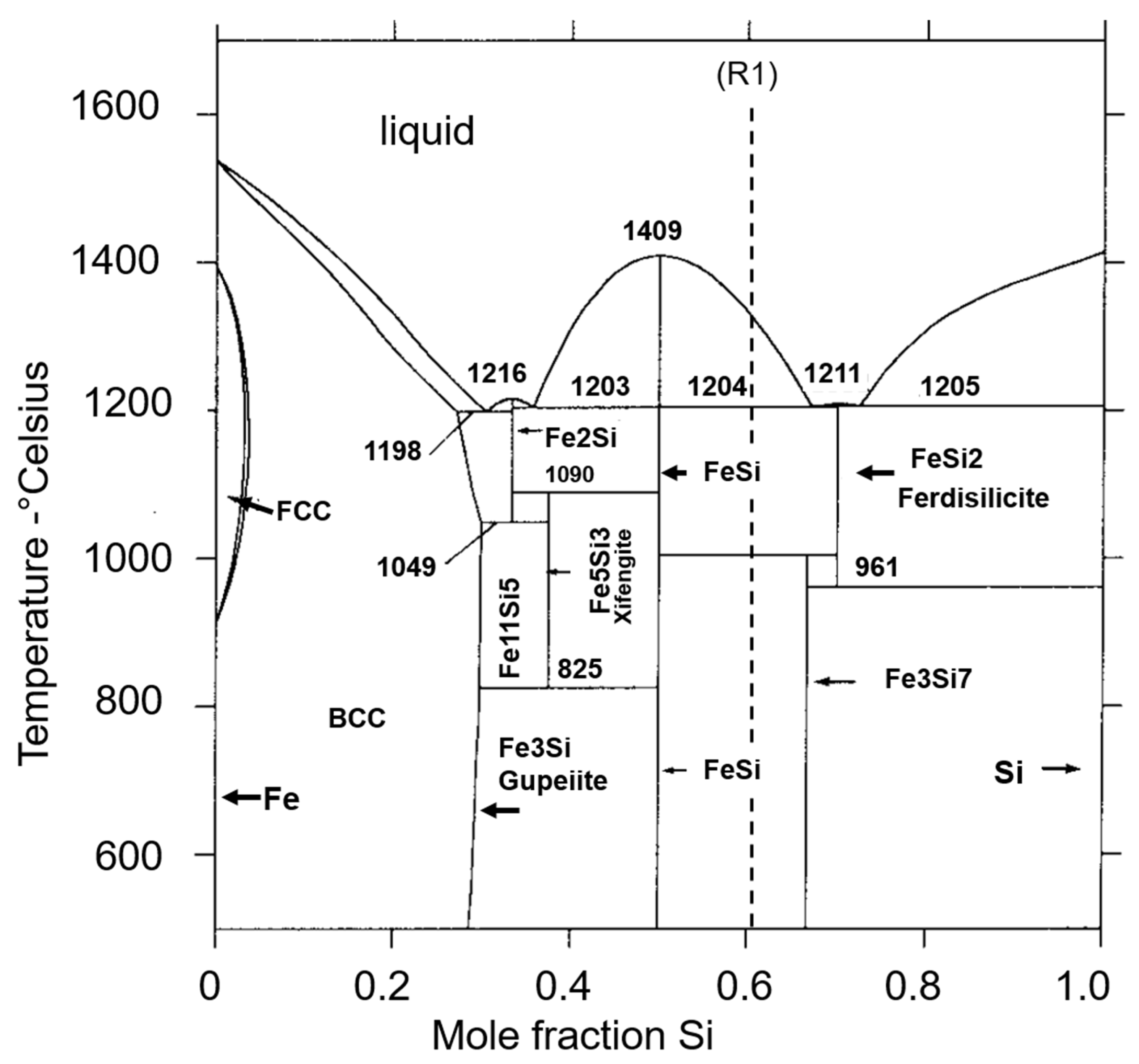
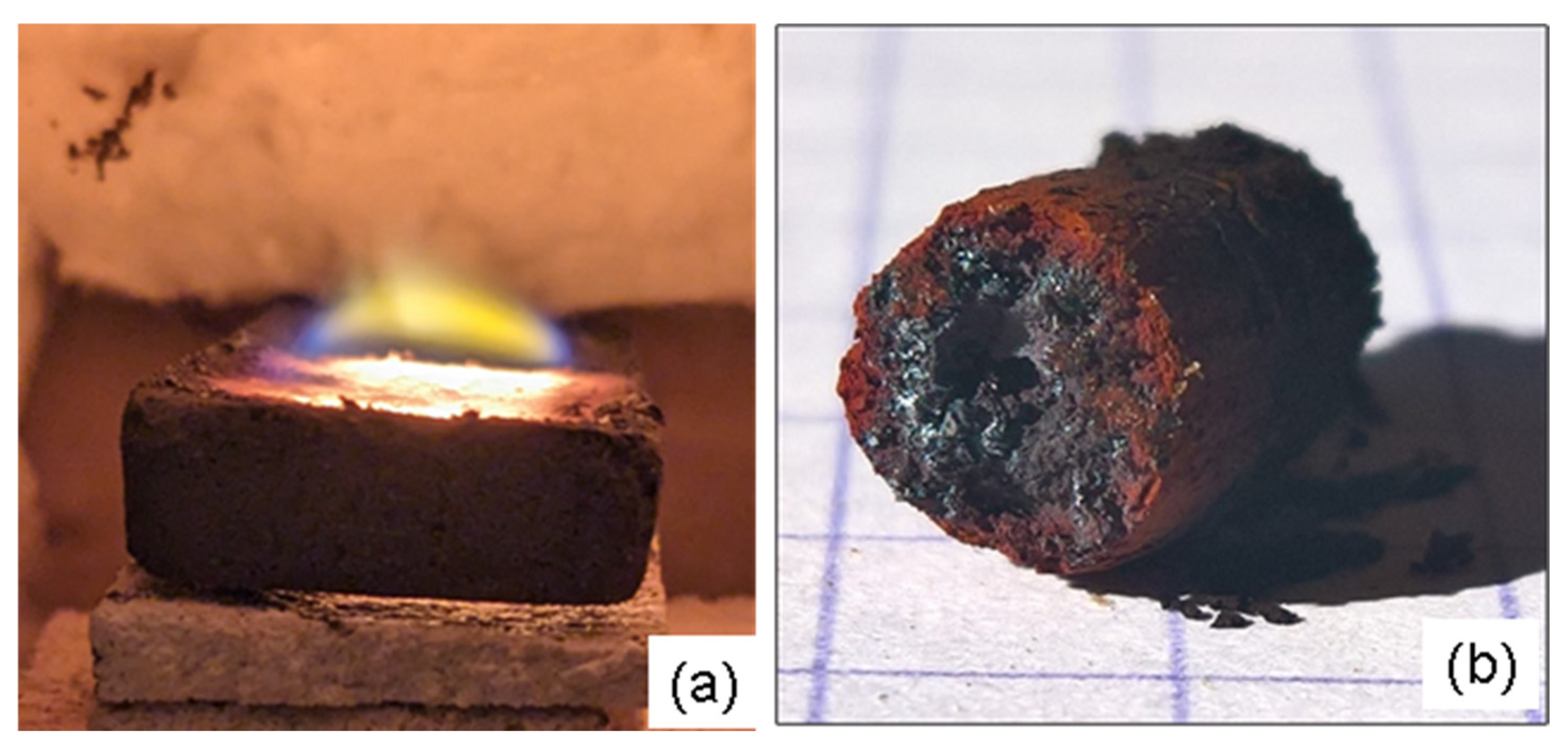
- Sintering: At the microscopic scale, mineral transformations are characterised by a total disappearance of the initial magnetite within the first minutes of sintering, leading to mineral reactions with silicon carbide. During the initial 7 min sintering at 850 °C, magnetite transforms into three distinct phases: (1) iron droplets, 100 to 200 µm in size, typically located within the largest pores; (2) hematite dispersed throughout the matrix; and (3) micrometric granules of ferrosilicon (gupeiite, Fe3Si) associated with a layer of cristobalite, formed at the periphery of the silicon carbide grains (Figure 10).
- Low Fe3O4 content susceptor evolution. During successive heating cycles of ceramics up to 1300 °C, the mineralogy and structure of the magnetite-poor susceptors (SiC/Fe3O4 > 2) undergo moderate changes, as does their external appearance, irrespective of the formulation (with or without added quartz or alumina) (Table 4).
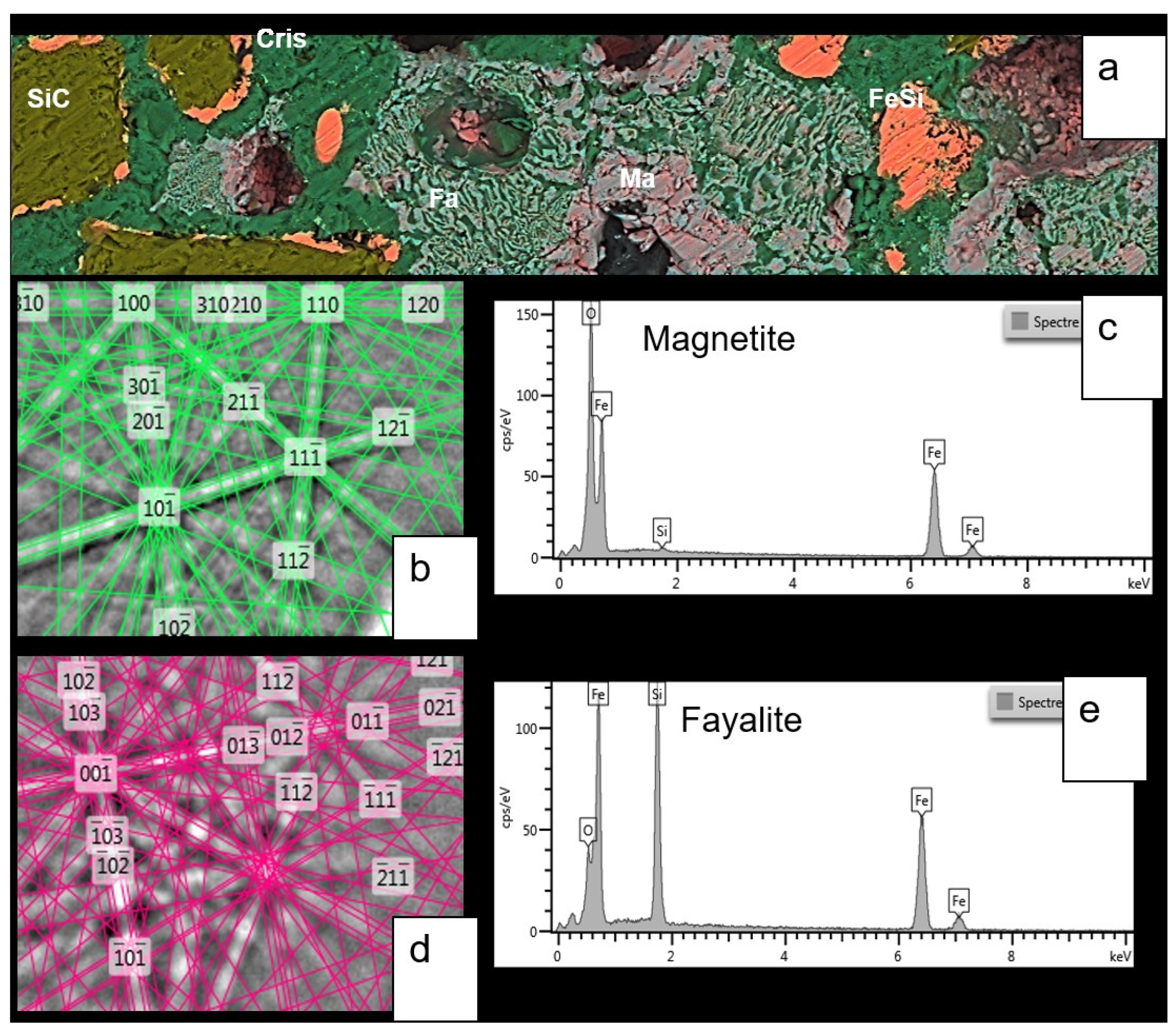
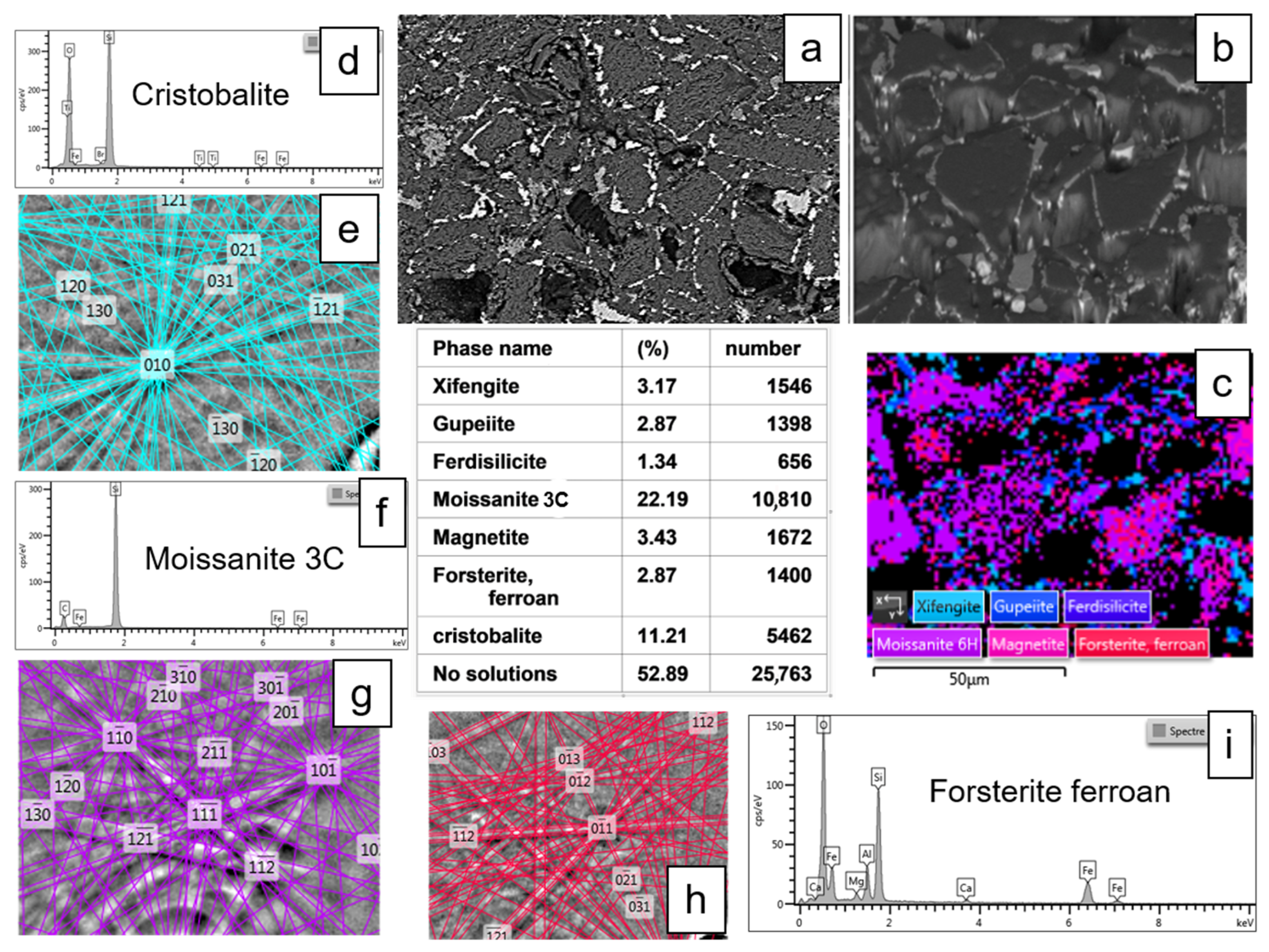
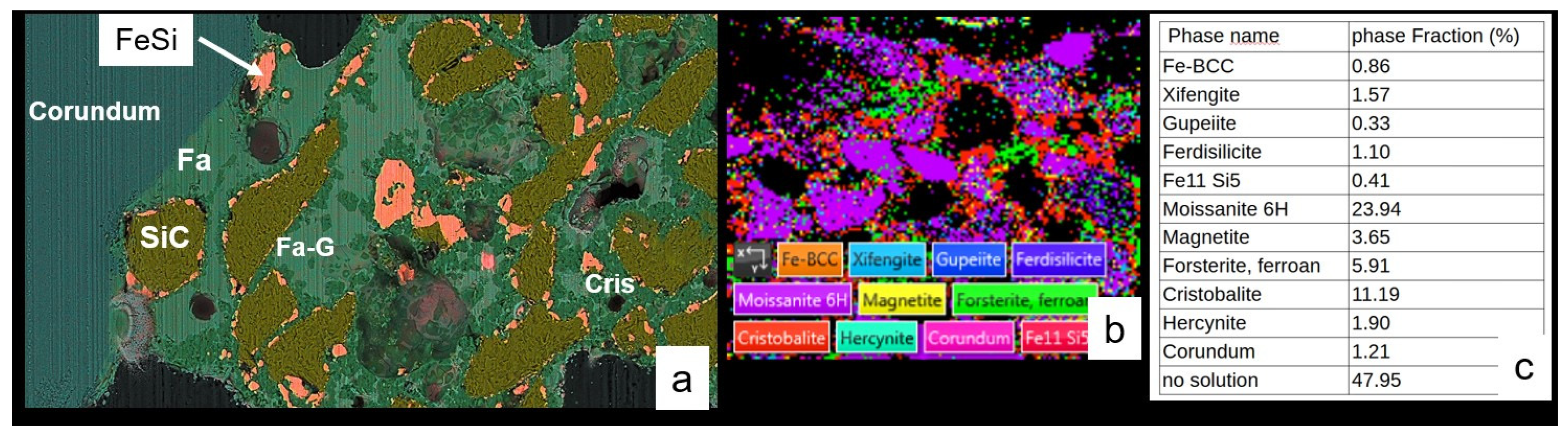
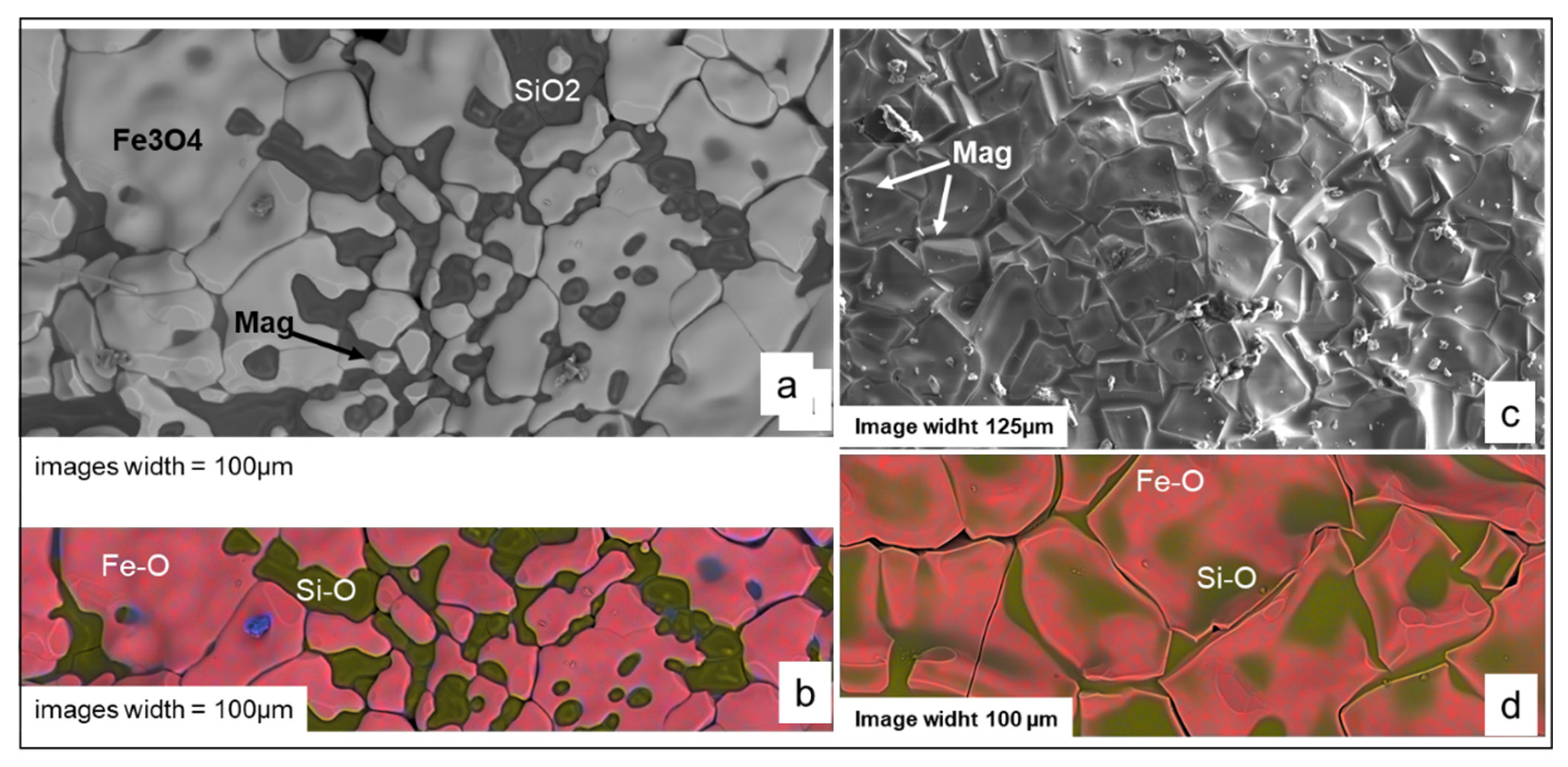
- High Fe3O4 content susceptor evolution. As the transformation of their external appearance suggested, the mineralogy of the susceptors with a high Fe3O4 content during the heating cycles of the ceramics shows strong modifications.
3.2.2. Interpretation of Mineral Transformations: Evaluation of Temperature and Redox Conditions
3.3. Added Values of the Studied Susceptors
4. Examples of Application: Ceramic Firing and Glazing
4.1. Ceramic Materials and Firing Procedure
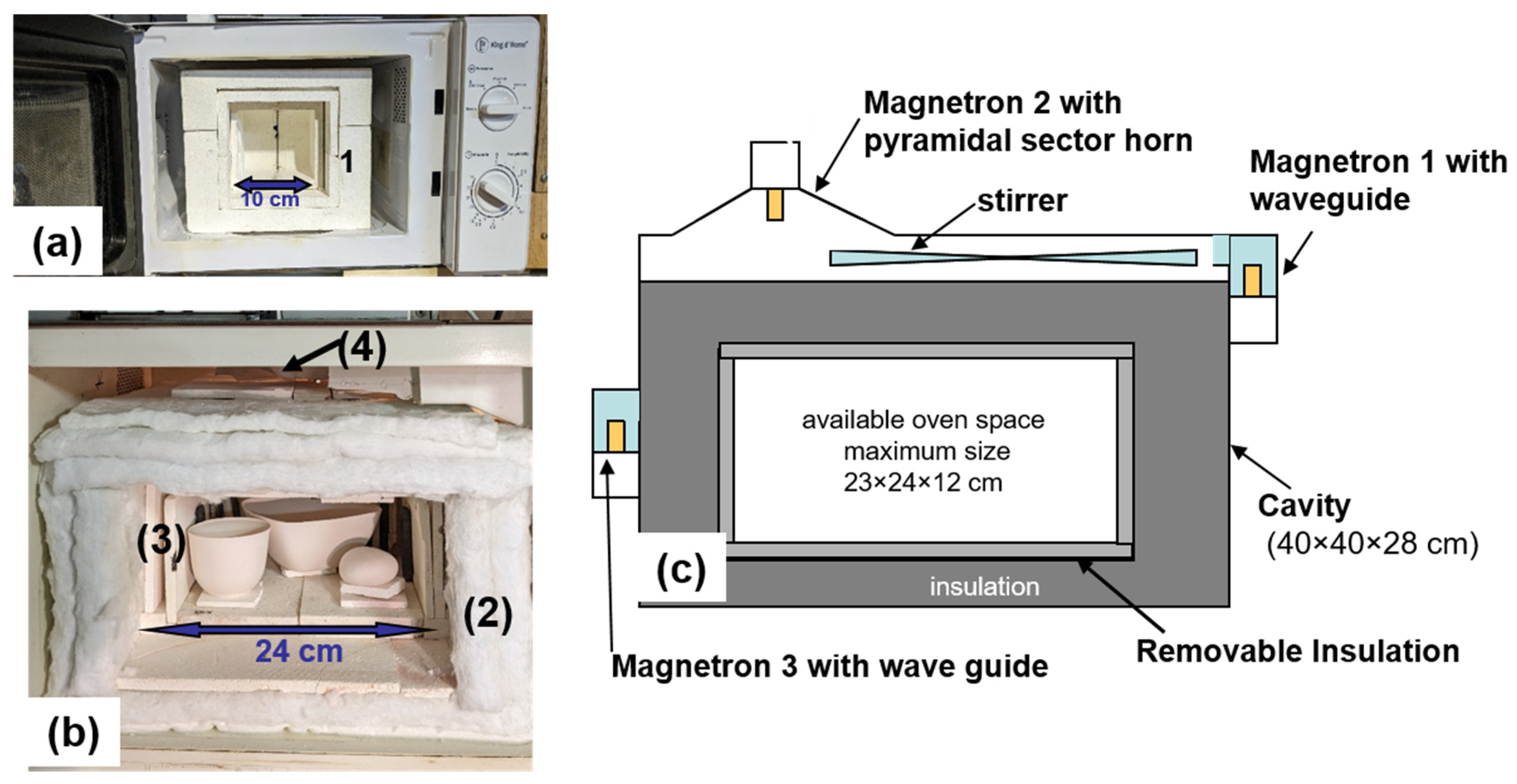
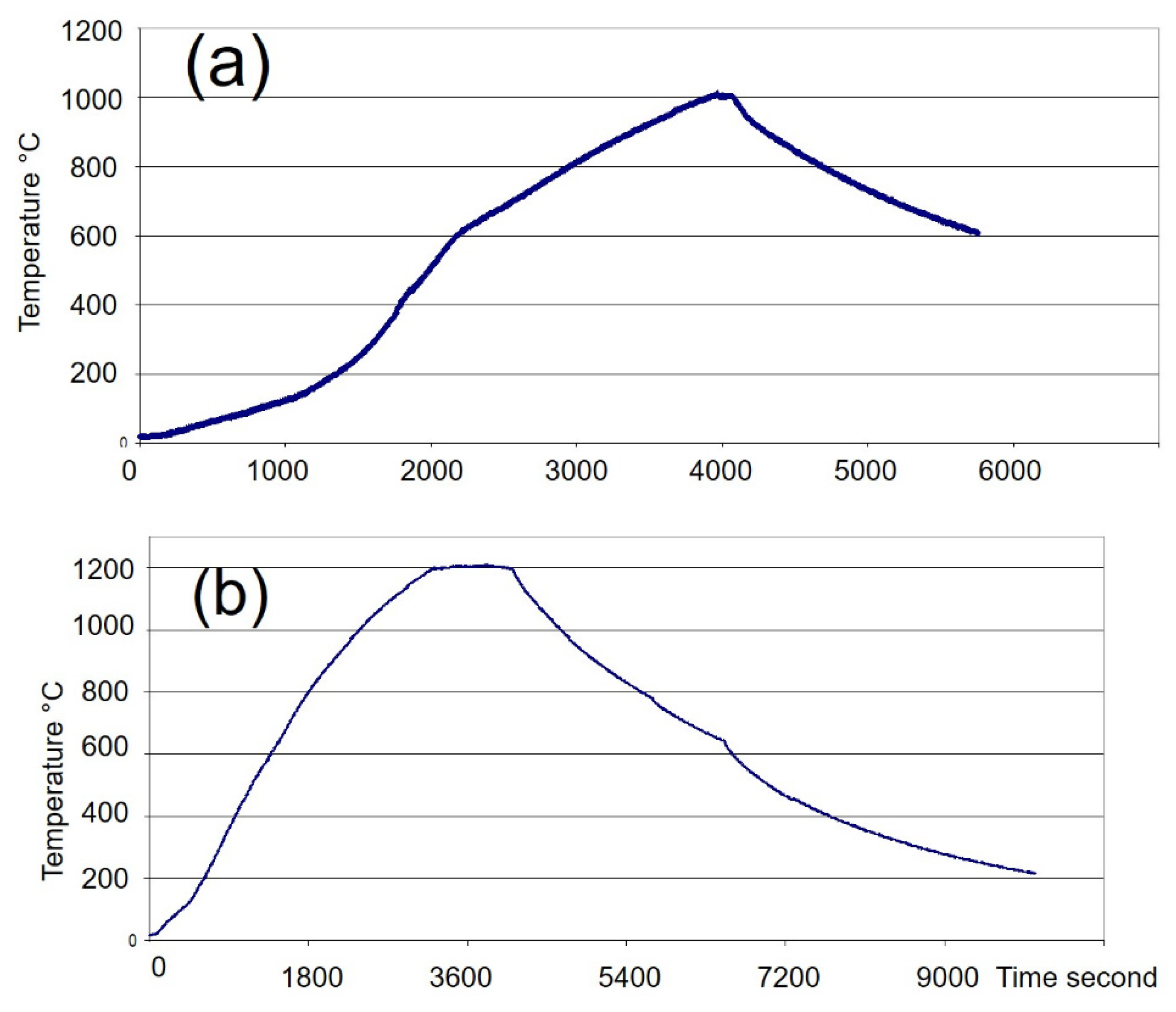
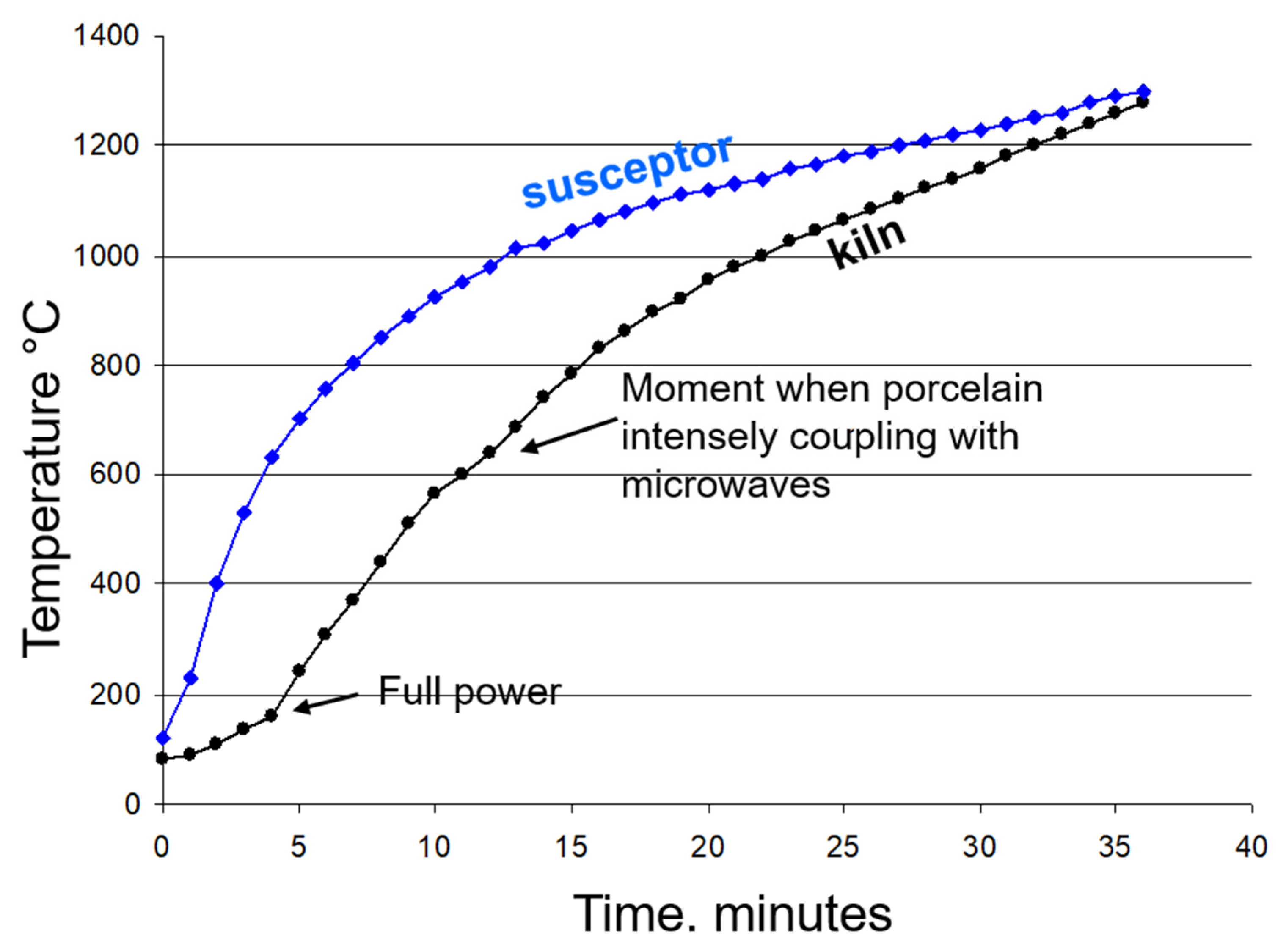
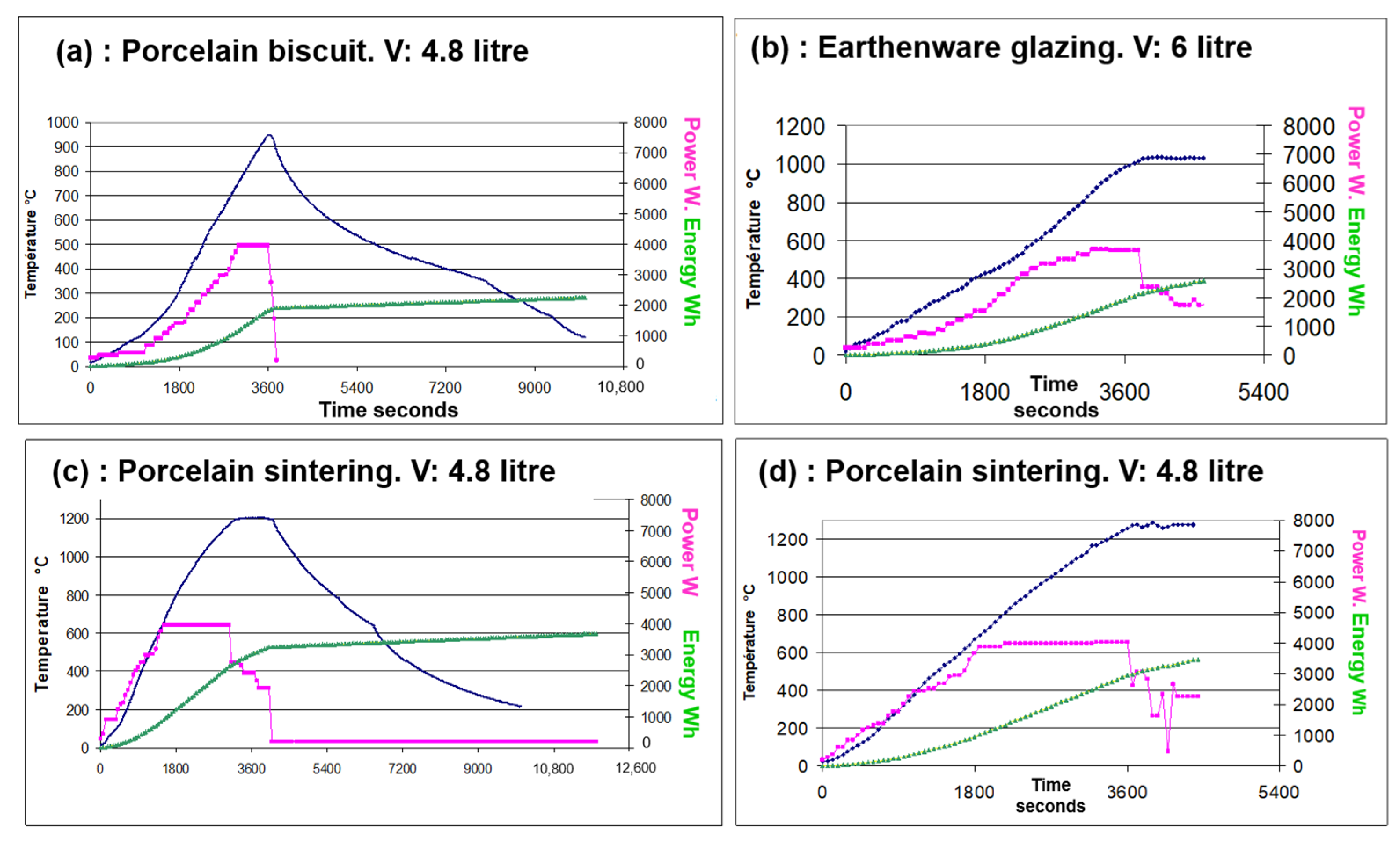
- First Firing (Raw Pieces): A gradual ramp-up was used, varying from 6 to 10 °C/min up to 200 °C. Power was then increased progressively to full capacity around 600 °C following a ramp-up of about 25 °C/min (Figure 4a). In the large microwave system, heating was achieved through a sequential, stepped power-increase protocol involving three magnetrons. Initially, the first magnetron was activated, and its power was increased progressively until the sample temperature reached 200–250 °C. Subsequently, the second magnetron was engaged, and its power was ramped up until the system achieved 400 °C. Finally, the third magnetron was switched on; it typically reached its full power, and thus the overall maximum system power, when the temperature was around 600 °C. This staged activation minimised thermal shock and ensured controlled heating across the temperature range. From this point, heating was performed at full power without regulation until the maximum temperature was reached. A plateau could then be maintained by readjusting the power.
- Second Firing (Glazing/Porcelain): For small pieces in the small microwave, the power was gradually increased up to 150 °C before switching to full power (Figure 21). In the large microwave, with its larger pieces, the power increase was more gradual, reaching full power around 600 °C over 20 min (Figure 4b).
4.2. Material Limitations
4.3. Some Achievements of Large Handicraft Pieces
4.3.1. Ceramic Quality
4.3.2. Glazing Quality
4.3.3. Time and Energy Saving
5. Discussion
6. Conclusions
Funding
Data Availability Statement
Acknowledgments
Conflicts of Interest
References
- Edgar, R.H.; Osepchuk, J.M. Consumer, Commercial, and Industrial Microwave Ovens and Heating Systems. In Handbook of Microwave Technology for Food Applications; Datta, A.K., Anantheswaran, R.C., Eds.; Marcel Dekker: New York, NY, USA, 2001; pp. 215–275. [Google Scholar]
- Schiffmann, R.F. Microwave processes for the food industry. In Handbook of Microwave Technology for Food Applications; Datta, A.K., Anantheswaran, R.C., Eds.; Marcel Dekker: New York, NY, USA, 2001; pp. 299–353. [Google Scholar]
- Guo, Q.; Sun, D.W.; Cheng, J.H.; Han, Z. Microwave processing techniques and their recent applications in the food industry. Trends Food Sci. Technol. 2017, 67, 236–247. [Google Scholar] [CrossRef]
- Zhang, H.S.; Chen, M.Q.; Fu, B.A.; Li, Q.H. Evaluation on microwave drying of waste paper towel with multi-magnetron and mode stirrer. Dry. Technol. 2021, 39, 882–895. [Google Scholar] [CrossRef]
- Martins da Silva, L.; Eugênio, T.F.; de Medeiros, G.A.; de Castro Medeiros, R.G.; de Freitas, P.G.M.; de Castro, J.A. Evaluation of the Use of Microwave Energy on The Reduction of Iron Ore and Steelmaking Mill Scale Composite Self-Reducing Mixtures. Mater. Res. 2022, 25, 1–7. [Google Scholar] [CrossRef]
- Sugihashi, A.; Kinoshita, T. Development of Microwave Heating Process for Feedstock for Iron Production; Technical Report, Nippon Steel & Sumitomo Metal Technical Report; Nippon Steel Corporation: Tokyo, Japan, 2008; Volume 121. [Google Scholar] [CrossRef]
- Colombini, E.; Papalia, K.; Barozzi, S.; Perugi, F.; Veronesi, P. A Novel Microwave and Induction Heating Applicator for Metal Making: Design and Testing. Metals 2020, 10, 676. [Google Scholar] [CrossRef]
- National Research Council. Microwave Processing of Materials; The National Academies Press: Washington, DC, USA, 1994. [Google Scholar] [CrossRef][Green Version]
- Clark, D.E.; Sutton, W.H. Microwave Processing of Materials. Annu. Rev. Mater. Sci. 1996, 26, 299–331. [Google Scholar] [CrossRef]
- Singh, S.; Gupta, D.; Jain, V.; Sharma, A.K. Microwave Processing of Materials and Applications in Manufacturing Industries: A Review. Mater. Manuf. Process. 2015, 30, 1–29. [Google Scholar] [CrossRef]
- Oghbaei, M.; Mirzaee, O. Microwave versus conventional sintering: A review of fundamentals, advantages and applications. J. Alloy. Compd. 2010, 494, 175–189. [Google Scholar] [CrossRef]
- Karayannis, V.G. Microwave sintering of ceramic materials. In Proceedings of the 20th Innovative Manufacturing Engineering and Energy Conference (IManEE 2016), Kozani, Greece, 23–25 September 2016; IOP Conf. Series: Materials Science and Engineering. IOP Publishing: Bristol, UK, 2016; Volume 161, p. 012068. [Google Scholar] [CrossRef]
- Menezes, R.R.; Souto, P.M.; Kiminami, R.H.G.A. Microwave hybrid fast sintering of porcelain bodies. J. Mater. Process. Technol. 2007, 190, 223–229. [Google Scholar] [CrossRef]
- Lyra, G.P.; Santos, V.; Agnolon Pallone, E.M.J.; Gagedschmidt, H.; Kiminami, R.A.; De Santis, B.C.; Rossignolo, J.A. Microwave hybrid fast sintering of red clay ceramics. Int. J. Appl. Ceram. Technol. 2021, 18, 705–715. [Google Scholar] [CrossRef]
- Menezes, R.R.; Souto, P.M.; Kiminami, R.H.G.A. Microwave sintering of ceramics. Part I: Fundamental aspects. Cerâmica 2007, 53, 1–10. [Google Scholar] [CrossRef]
- Santos, T.; Hennetier, L.; Costa, V.A.F.; Costa, L.C. Microwave versus conventional porcelain firing: Temperature Measurement. J. Manuf. Process. 2019, 41, 92–100. [Google Scholar] [CrossRef]
- Santos, T.; Gomes, C.S.F.; Santos, N.F.; Costa, V.A.F.; Costa, L.C. Global insight into microwave stoneware firing: Crystallochemical transformations. Ceram. Int. 2022, 48, 21492–21501. [Google Scholar] [CrossRef]
- Santos, T.; Hennetier, L.; Costa, V.A.F.; Costa, L.C. Global insight into microwave stoneware firing: Macro and microstructural changes. Int. J. Appl. Ceram. Technol. 2021, 18, 1801–1813. [Google Scholar] [CrossRef]
- Santos, T.; Costa, L.C.; Hennetier, L.; Valente, M.A.; Monteiro, J.; Sousa, J. Microwave processing of porcelain tableware using a multiple generator configuration. Appl. Therm. Eng. 2013, 50, 677–682. [Google Scholar] [CrossRef]
- Santos, T.; Gomes, C.S.F.; Costa, V.A.F.; Costa, L.C. Microwave Versus Conventional Porcelain Firing: Greenware to Biscuit Crystallochemical Transformations. J. Manuf. Sci. Eng. 2021, 143, 121 001-1 –10. [Google Scholar] [CrossRef]
- Santos, T.; Hennetier, L.; Costa, V.A.F.; Costa, L.C. Using Microwave Radiation for Porcelain Tableware Sintering. In Proceedings of the Progress in Electromagnetics Research Symposium Proceedings, Prague, Czech Republic, 6–9 July 2015; pp. 939–943. [Google Scholar]
- Aman, B.; Acharya, S.; Reeja-Jayan, B. Making the Case for Scaling Up Microwave Sintering of Ceramics. Adv. Eng. Mater. 2024, 26, 2302065. [Google Scholar] [CrossRef]
- Santos, T.; Hennetier, L.; Costa, V.A.F.; Costa, L.C. Temperature Assessment Through Decal Color in Microwave-Fired Porcelain. J. Manuf. Mater. Process. 2025, 9, 213. [Google Scholar] [CrossRef]
- Chaix, J.-M.; Bouchet, R.; Bouvard, D.; Fabre, T.; Garnault, T. A Viewpoint on Hot Spots in Microwave Sintering and Flash Sintering. Adv. Eng. Mater. 2023, 25, 2201742. [Google Scholar] [CrossRef]
- Santos, T.; Costa, L.C.; Valente, M.; Monteiro, J.; Sousa, J. 3D Electromagnetic Field Simulation in Microwave Ovens: A Tool to Control Thermal Runaway. In Proceedings of the COMSOL Conference, Paris, France, 17–19 November 2010. [Google Scholar]
- Bhattacharya, M.; Basak, T. A review on the susceptor assisted microwave processing of materials. Energy 2016, 97, 306–338. [Google Scholar] [CrossRef]
- Ngamkiatpaisan, A.; Hankoy, M.; Kitiwan, M.; Keawprak, N.; Tunthawiroon, P. A Study on SiC Susceptor Configuration for Microwave Hybrid Heating. Suranaree J. Sci. Technol. 2023, 30, 030152. [Google Scholar] [CrossRef]
- Plaza-González, P.; Monzó-Cabrera, J.; Catalá-Civera, J.M.; Sánchez-Hernández, D. Effect of Mode-Stirrer Configurations on Dielectric Heating Performance in Multimode Microwave Applicators. Trans. Microw. Theory Tech. 2005, 53, 1699. [Google Scholar] [CrossRef]
- Ye, J.; Lan, J.; Xia, Y.; Yang, Y.; Zhu, H.; Huang, K. An approach for simulating the microwave heating process with a slow-rotating sample and a fast-rotating mode stirrer. Int. J. Heat Mass Transf. 2019, 140, 440–452. [Google Scholar] [CrossRef]
- Kirby, B.W. Alternative Crucibles for U-Mo Microwave Melting; US Department of Energy: Washington, DC, USA, 2017. [Google Scholar]
- Liu, C.; Yu, D.; Kirk, D.W.; Xu, Y. Electromagnetic wave absorption of silicon carbide based materials. RSC Adv. 2017, 7, 595. [Google Scholar] [CrossRef]
- Adebayo, L.A.; Soleimania, H.; Yahyaa, N.; Abbasb, Z.; Wahaaba, F.A.; Ayinlaa, R.T.; Alia, H. Recent advances in the development OF Fe3O4-Based microwave absorbing materials. Ceram. Int. 2021, 47, 13582–13589. [Google Scholar] [CrossRef]
- Mandal, S.; Seal, A.; Dalui, S.K.; Dey, A.K.; Ghatak, S.; Mukhopadhyay, A.K. Mechanical characteristics of microwave sintered silicon carbide. Bull. Mater. Sci. 2001, 24, 121–124. [Google Scholar] [CrossRef]
- Chen, Y.; Yu, C.; Cheng, X.; Wang, R.; Deng, C.; Ding, J.; Liu, Z.; Ma, B.; Zhu, H.; Hu, J.; et al. Advances in Sintering Technologies for SiC Ceramics: Mechanisms, Challenges, and Industrial Applications. High-Temp. Mater. 2025, 2, 10013. [Google Scholar] [CrossRef]
- Raju, K.; Yoon, D.-H. Sintering additives for SiC based on the reactivity: A review. Ceram. Int. 2016, 42, 17947–17962. [Google Scholar] [CrossRef]
- Crouzet, C.; Brunet, F.; Recham, N.; Auzende, A.-L.; Findling, N.; Magnin, V.; Ferrasse, J.-H.; Goffé, B. Hydrothermal Steel Slag Valorization—Part II: Hydrogen and Nano-Magnetite Production. Front. Earth Sci. 2017, 5, 86. [Google Scholar] [CrossRef]
- Loharkar, P.K.; Ingle, A. Assessment of microwave susceptors for optimum temperature rise using parametric numerical simulation. J. Therm. Eng. 2022, 8, 323–334. [Google Scholar] [CrossRef]
- GTranell, G.; Andersson, M.E.; Ringdalen, E.; Ostrovski, O.; Steinmo, J.J. Reaction zones in a FeSi75 furnace—Results from an industrial excavation. In Proceedings of the Ferrosilicon Smelting, the Twelfth International Ferroalloys Congress Sustainable Future, Helsinki, Finland, 6–9 June 2010. [Google Scholar]
- Tang, W.M.; Zheng, Z.X.; Ding, H.F.; Jin, Z.H. Control of the interface reaction between silicon carbide and iron. Mater. Chem. Phys. 2003, 80, 360–365. [Google Scholar] [CrossRef]
- Tang, W.M.; Zheng, Z.X.; Ding, H.F.; Jin, Z.H. A study of the solid-state reaction between silicon carbide and iron. Mater. Chem. Phys. 2002, 74, 258–264. [Google Scholar] [CrossRef]
- Lacaze, J.; Sundman, B. An Assessment of the Fe-C-Si System. Mettallurgical Trans. A 1991, 22, 2211–2223. [Google Scholar] [CrossRef]
- Cui, S.; Jung, I.-H. Critical reassessment of the Fe-Si system. Calphad 2017, 56, 108–125. [Google Scholar] [CrossRef]
- Nekhoroshev, E.; Shishin, D.; Cheng, S.; Shevchenko, M.; Jak, E. Re-optimization of the FeO–Fe2O3–SiO2 system integrated with experimental phase equilibria studies. J. Am. Ceram. Soc. 2025, 108, e20702. [Google Scholar] [CrossRef]
- Prostakova, V.; Shishin, D.; Shevchenko, M.; Jak, E. Thermodynamic optimization of the Al2O3–FeO–Fe2O3–SiO2 oxide system. Calphad 2019, 67, 101680. [Google Scholar] [CrossRef]
- Bale, C.W.; Bélisle, E.; Chartrand, P.; Decterov, S.A.; Eriksson, G.; Gheribi, A.E.; Hack, K.; Jung, I.-H.; Kang, Y.-B.; Melançon, J.; et al. FactSage thermochemical software and databases, 2010–2016. Calphad 2016, 54, 35–53. [Google Scholar] [CrossRef]
- Institut de la Ceramique Francaise. Technologie Ceramique.1–390, 2025. Available online: https://ceramique-francaise.com (accessed on 2 December 2025).
- Zaichuk, O.V.; Amelina, O.À.; Hordieiev, Y.S.; Rudnieva, L.L. Thermodynamic analysis of the reaction od diopside phase formation during synthesis of ceramic pigments from granulated blast-furnace slag. Vopr. Khimii I Khimicheskoi Tekhnologii 2022, 5, 46–53. [Google Scholar] [CrossRef]
- Nguyen, M.; Sokolar, R. The influence of the raw materials mixture on the properties of forsterite ceramics. IOP Conf. Ser. Mater. Sci. Eng. 2018, 385, 012039. [Google Scholar] [CrossRef]
- Schmidt, M.W.; Gao, C.; Golubkova, A.; Rohrbach, A.; Connolly, J.A.D. Natural moissanite (SiC)—A low temperature mineral formed from highly fractionated ultra-reducing COH-fluids. Prog. Earth Planet. Sci. 2014, 1, 27. [Google Scholar] [CrossRef]
- Rappenglück, M.A. Natural Iron Silicides: A Systematic Review. Minerals 2022, 12, 188. [Google Scholar] [CrossRef]
- Jamwal, U.; Mittal, S.K.; Keneria, D. Polarization and Ferromagnetism in Microwave-Absorbing Materials. In Ferroic Materials—Understanding, Development, and Utilization; Intechopen: London, UK, 2024; pp. 1–25. [Google Scholar] [CrossRef]
- Buchelnikov, V.D.; Louzguine-Luzgin, D.V.; Xie, G.; Li, S.; Yoshikawa, N. Heating of metallic powders by microwaves: Experiment and theory. J. Appl. Phys. 2008, 104, 113505. [Google Scholar] [CrossRef]







| Type | Name | Weight Gram | Fe3O4 Wt. % | Silica or Alumina Wt. % | SiC Wt. % | Mole % Silicon SiC * | Mole % Iron | Ratio SiC/Fe3O4 | Porosity * % |
|---|---|---|---|---|---|---|---|---|---|
| SiC | SiC-3.5 | 15 | 0 | 0 | 100 | 100 | 0 | 55 | |
| MS Fe3O4 + SiC | MS-3.5-22 | 23 | 22 | 0 | 68 | 85.7 | 14.3 | 3.1 | 60 |
| MS-6-25R | 15 | 25 | 0 | 75 | 83.4 | 16.6 | 2.6 | 51 | |
| MS-7-25 | 20 | 25 | 0 | 75 | 83.4 | 16.6 | 2.6 | 51 | |
| MS-6-35R | 15 | 35 | 0 | 65 | 78.2 | 21.8 | 1.9 | 55 | |
| MSS Fe3O4 + SiC + silica sand | MSS-7-30 | 20 | 30 | 25 | 35 | 72 | 28 | 1.3 | 64 |
| MSS-6-35R | 15 | 35 | 25 | 40 | 65.9 | 34.1 | 1.0 | 55 | |
| MSS-9-35-R | 13 | 35 | 25 | 40 | 65.9 | 34.1 | 1.0 | 55 | |
| MAS Fe3O4 + SiC + alumina sand | MAS-7-30 | 20 | 30 | 25 | 35 | 72 | 28 | 1.3 | 64 |
| MAS-9-35-R | 13 | 35 | 25 | 40 | 65.9 | 34.1 | 1.0 | 55 |
| kJ/(kg⋅K) | |
|---|---|
| SiC | 0.678 |
| Magnetite | 0.653 |
| quartz | 0.7 |
| Alumine | 0.9 |
| Type | Batch Susceptor Number | Average Thermal Power W/Gram | Thermal Power Standard Deviation | Average Cumulative Usage Time Minutes | Average Surface T °C | |
|---|---|---|---|---|---|---|
| Just sintered | SiC | 7 | 3.10 | 1.80 | 7 | 561 |
| MS-3.5-22 | 8 | 4.71 | 0.29 | 7 | 843 | |
| MS-6-25R | 1 | 4.75 | 7 | 850 | ||
| MS-6-35R | 1 | 4.94 | 7 | 883 | ||
| MS-7-25 | 4 | 4.56 | 0.36 | 11 | 752 | |
| MSS-7-30 MAS-7-30 | 4 | 4.71 | 0.86 | 11 | 823 | |
| «recent» Two cycles of heating | SiC | 4 | 1.50 | 0.64 | 30 | 283 |
| MS-6-25R | 1 | 4.07 | 30 | 732 | ||
| MS-6-35R | 1 | 3.89 | 130 | 702 | ||
| MSS-6-35R | 1 | 3.13 | 130 | 565 | ||
| «old» More 10 cycles of heating | MS-3.5-22 | 7 | 4.40 | 0.39 | 600 | 790 |
| MS-7-25 | 2 | 3.97 | 0.002 | 800 | 850 | |
| MSS-7-30 MAS-7-30 | 17 | 1.37 | 0.36 | 1341 | 261 |
| SiC/Fe3O4 > 1.8 | SiC/Fe3O4 < 1.3 | ||||||||||
|---|---|---|---|---|---|---|---|---|---|---|---|
| Type | MS 22–25 | MSS 22 | MAS 22 | MSS 30–35 | MAS 30–35 | ||||||
| Usage Time | 7 min | 25 min | 130 min | >600 min | 130 min | >600 min | 130 min | >600 min | |||
| Mineral Name | T max °C | 850 | 1100 | 1100 | 1300 | 1300 | 1300 | 1100 | 1300 | 1100 | >1300 |
| Moissanite * (1) | SiC | (-) | (--) | (--) | (--) | (---) | (--) | (---) | (----) | (---) | (----) |
| Magnetite * (1) | Fe3O4 | (-----) | (-----) | (-----) | (-----) | (-----) | (-----) | (-----) | (-----) | (-----) | (-----) |
| Quartz * (1) | SiO2 | (-) | (-) | (-) | |||||||
| Alumina * (1) | Al2O3 | (-) | (-) | (-) | |||||||
| Iron BCC | Fe | (++) | (++) | (---) | (---) | (+) | (--) | (-----) | (-) | (-----) | |
| Ferrosilicon sum | (+) | (++) | (++) | (-) | (-) | (-) | (++) | (--) | (++) | (--) | |
| Gupeiite | Fe3Si | (+) | (+) | (+) | |||||||
| Xifengite | Fe5Si3 | (+) | (+) | (+) | (+) | (+) | (+) | (+) | |||
| Fe11Si5 | (+) | (+) | (+) | (+) | (+) | ||||||
| Ferdisilicite | FeSi2 | (+) | (+) | (+) | |||||||
| Cristobalite | SiO2 | (++) | (++) | (++) | (++) | (++) | (++) | (++) | (++++) | (++) | (+++) |
| Trydimite | SiO2 | (++) | (+) | ||||||||
| Magnetite * (2) | Fe3O4 | (+) | (+) | (+) | (++) | (++) | (++) | (+++) | |||
| Hematite | Fe2O3 | (++) | (+++) | (+) | (++) | (+) | |||||
| Mullite | Al6Si2O13 | (+) | |||||||||
| Fayalite/forsterite ferroan | Fe2SiO4 | (+) | (++) | (++) | (+) | (+) | |||||
| Hercynite | FeAl2O4 | (+) | (+) | (+) | |||||||
| Glass | Fe-Si-O | (+) | (+) | (+) | (++) | ||||||
| Si-Al-Fe-O | (+) | ||||||||||
| Type | MS 22 | MAS 22 | |
|---|---|---|---|
| Duration of heating—T°C | 28 mn. T° 1100 °C | >600 mn. T°1300 °C | |
| Mineral proportions based on frequency of occurrence in the FeSi group | |||
| Location | FeSi mono-crystal zonation % | Matrix % | Matrix % |
| Xifengite % | 48 | 42.94 | 46.05 |
| Gupeiite % | 40.5 | 38.83 | 9.69 |
| Ferdisilicite % | 11.5 | 18.22 | 32.19 |
| Fe11 Si5 % | n.d. | n.d. | 12.07 |
| Mineral composition in number of occurrence in matrix (75 × 75 µm) × 2 150 × 150 µm | |||
| Total FeSi % | 15.69 | 6.7 | |
| Moissanite 3c or 6H (SiC) % | 47.11 | 47.09 | |
| Magnetite (Fe3O4) % | 7.29 | 7.18 | |
| Fayalite or Forsterite ferroan (Fe2SiO4) % | 6.10 | 11.61 | |
| Cristobalite (SiO2) % | 23.81 | 22.00 | |
| Hercynite (FeAl2O4) Fe % | 3.73 | ||
| Porosity (MS22) or porosity + glass (MAS 22) % | 52.89 | 47.95 | |
| Susceptor Name | MS-3.5 | MS-6-R | MS-7 | MSS-6-R | MSS-7 | MAS-7 |
|---|---|---|---|---|---|---|
| Weight gram | 15 | 15 | 20 | 15 | 20 | 20 |
| % Fe3O4 | 22 | 35 | 25 | 35 | 30 | 30 |
| % SiC | 68 | 65 | 65 | 35 | 40 | 40 |
| SiC/Fe3O4 wt. % | 3.1 | 1.9 | 2.6 | 1.0 | 1.3 | 1.3 |
| Volume cm3 | 10.0 | 9.6 | 10.8 | 9.6 | 10.8 | 10.8 |
| % SiC consumed | 11.16 | 18.57 | 13.26 | 34.48 | 25.86 | 25.86 |
| Volume Fe3Si cm3 | 0.39 | 0.61 | 0.59 | 0.61 | 0.70 | 0.70 |
| Volume silica cm3 | 0.21 | 0.34 | 0.32 | 0.34 | 0.38 | 0.38 |
| Solid phase volume variation % | −7.4 | −12.3 | −12.2 | −11.4 | −14.6 | −13.0 |
| Sintering CO volume, litre | 0.64 | 1.01 | 0.97 | 1.01 | 1.16 | 1.16 |
| Sintering CO2 volume, litre | 1.00 | 1.59 | 1.52 | 1.59 | 1.82 | 1.82 |
| (a) Max CO volume, litre | 29.4 | 33.6 | 33.6 | |||
| (b) Max CO2 volume, litre | 46.2 | 52.8 | 52.8 |
| SiC/Fe3O4 > 1.8 Wt. % | SiC/Fe3O4 < 1.3 Wt. % | |||||
|---|---|---|---|---|---|---|
| MS 22–25 | MSS 30–35 | MAS 30–35 | ||||
| Max T °C | 1500 | 1300 | 1150 | 1300 | 1150 | 1300 |
| Heating cycles | 2 | 30 | 10 | 15 | 15 | |
| Redox capacities | No | No | Yes | Yes | Yes | Yes |
| Physical degradations | No | No | No | Yes | No | Yes |
| Type of degradation | Partial melting | Strong melting | ||||
| Significant loss of Thermal power | No | No | Yes | Yes | Yes | Yes |
| End of life reached | No | No | No | Yes | No | Yes |
Disclaimer/Publisher’s Note: The statements, opinions and data contained in all publications are solely those of the individual author(s) and contributor(s) and not of MDPI and/or the editor(s). MDPI and/or the editor(s) disclaim responsibility for any injury to people or property resulting from any ideas, methods, instructions or products referred to in the content. |
© 2025 by the author. Licensee MDPI, Basel, Switzerland. This article is an open access article distributed under the terms and conditions of the Creative Commons Attribution (CC BY) license (https://creativecommons.org/licenses/by/4.0/).
Share and Cite
Goffé, B. Microwave Firing of Ceramics: Developing Homemade Susceptors and Their Practical Applications. Appl. Sci. 2025, 15, 13053. https://doi.org/10.3390/app152413053
Goffé B. Microwave Firing of Ceramics: Developing Homemade Susceptors and Their Practical Applications. Applied Sciences. 2025; 15(24):13053. https://doi.org/10.3390/app152413053
Chicago/Turabian StyleGoffé, Bruno. 2025. "Microwave Firing of Ceramics: Developing Homemade Susceptors and Their Practical Applications" Applied Sciences 15, no. 24: 13053. https://doi.org/10.3390/app152413053
APA StyleGoffé, B. (2025). Microwave Firing of Ceramics: Developing Homemade Susceptors and Their Practical Applications. Applied Sciences, 15(24), 13053. https://doi.org/10.3390/app152413053