Article

Estimation of the Shear Stress (WSS) at the Wall of Tracheal Bifurcation

by
Nicoleta-Octavia Tanase
1,*,
Ciprian-Stefan Mateescu
1,2,
Doru-Daniel Cristea
1,2 and
Corneliu Balan
1
1
REOROM Laboratory, Department of Hydraulics, Hydraulic Machinery and Environmental Engineering, Faculty of Energy Engineering, National University of Science and Technology Politehnica Bucharest, 313, Splaiul Independemtei, 060042 Bucharest, Romania
2
Innovation and e-Health Centre, University of Medicine and Pharmacy “Carol Davila”, 18, Pitar Mos, 010451 Bucharest, Romania
*
Author to whom correspondence should be addressed.
Appl. Sci. 2025, 15(24), 13055; https://doi.org/10.3390/app152413055
Submission received: 27 October 2025 / Revised: 3 December 2025 / Accepted: 9 December 2025 / Published: 11 December 2025
(This article belongs to the Special Issue Recent Advances and Emerging Trends in Computational Fluid Dynamics)

Abstract

The paper is concerned with experimental investigations and numerical simulations of airflow in a rigid model of human tracheal bifurcation during a respiratory cycle in the presence of cough. The main goal of the study is to calculate the velocity and tracheal wall shear stress (WSS) distributions under the time variation in the pressure difference. A sequence of inspiration-expiration of measured flow rates and pressure is used to calibrate the 3D unsteady numerical solutions for different imposed boundary conditions at the edges of the bifurcation. The experimental data are obtained using commercial medical devices: (i) a spirometer and (ii) a mechanical ventilator, respectively. CT images of the lung airways were used to reconstruct the tracheal test geometry by 3D printing techniques. Flow spectrum, vortical structures, and the wall stresses are analyzed for the computed cases. Four turbulence models (kɛ, kω SST, kɛ R, and LES) are compared, and all indicate an increase in peak WSS and vortex intensity during coughing versus normal expiration. The present work confirms the importance of CFD simulations to model and quantify airflow throughout the respiratory cycle. The paper proposes a method to calculate wall shear stress, one of the most relevant parameters for characterizing airway function and the mechanical response of tracheal endothelial cells.

1. Introduction

The study of airflow in the bifurcating airways is one of the most important issues in the analysis and characterization of the respiratory physiology and functioning of the pulmonary system, offering helpful information for diagnostic and medication, particle distribution and deposition, stenosis formation, and tumor presence [1,2,3,4,5]. The airflow in the lungs is distributed through the trachea, the largest bifurcation, which connects the larynx with the bronchial networks. The trachea is composed of several “D-shaped” tracheal rings with horseshoe-shaped cartilages and a variety of soft connective tissues, including the trachealis muscle, mucosa and submucosa, and adventitia membrane [6].
The influences of tracheal bifurcation geometry (asymmetry, angle) on the function of the respiratory system were investigated in several papers [7,8]. The quality of CT images has been much improved in recent decades [9,10,11,12], so a 2D and 3D reconstruction of the real tracheal bifurcations is possible today. A faithful reconstruction of the airway’s configuration at the entrance to the lungs is the first step in the study of airflow during the respiratory cycles. One important issue related to the treatment of some respiratory disorders is the correlation of the mechanical ventilation parameters with the normal functionality of the lungs. In many cases, mechanical ventilation is utilized to replace normal or spontaneous breathing in a patient with respiratory diseases [13], such as in the case of intrapulmonary percussive ventilation (IPV), which is an airway clearance procedure used in hospitals to help patients clear their airway secretions [14]. Another case revolves around the patients with chronic obstructive pulmonary disease (COPD) who undergo invasive mechanical ventilation (IMV) and how the setting should be adjusted to provide sufficient airflow [15]. Moreover, patient-specific markers, such as age, for example, are related to the tissue modification in time, which may have raised many complications for patients undergoing this procedure, such as ventilator-induced lung injury (VILI) [16,17,18,19].
Several studies have included an in vitro assessment of the flow distribution inside the airways [20,21]. These experiments were focused on the determination of the effectiveness of mucus suctioning and the flow characteristics of cross-sections of the geometry of the trachea and main bronchi.
Another approach was to obtain numerical solutions of the airflow in a particular configuration and to correlate them with real cases [2,14,22,23]. By solving the incompressible Navier–Stokes equations under physiologically plausible boundary conditions, it is possible to simulate the airflow throughout the respiration cycle [24]. The computations of air dynamics open the possibility to correlate not only the flow pattern with the dysfunctions associated with medical cases [25,26,27]. But also, to obtain quantitative values of stresses in the respiratory system for imposed variations in flow rate, pressure, and wall shear stress (WSS), respectively [23,28,29,30]. The pressure in the respiratory system can be monitored by pleural manometry [31], using endotracheal tubes [32,33,34] or impedance tomography [35]. Pressure data during the respiratory cycle are also published in [36]. Correlations between tracheal imaging (HRCT techniques) during a breathing cycle and corresponding numerical solutions evidence the influence of wall deformation on the airflow pattern, the differences between rigid and deformable tracheal wall being significant mainly for severe contractions, which are present in diseased conditions [37]. The influences of glottis motion on the laryngeal jet were numerically studied in [38]. The numerical transient solutions demonstrate the effect of glottis dynamics on the input air velocity in the trachea during the respiratory cycle.
The interaction between air and tracheal endothelial wall is quantified by the shear stress, which is directly related to the wall stiffness [29], mucus formation [39,40,41,42], airway epithelial cell response [43,44], and airway damage and injuries [45,46,47,48]. Experimental values of WSS are very difficult to obtain and are scarcely found in the literature, e.g., [43] published some data obtained in vitro for the mouse trachea. The importance of WSS prediction on the airway endothelium during respiration is evident; so, in the absence of in vivo measurements, the research was focused on the design of CFD procedures to calculate WSS for different configurations and imposed boundary conditions [29,30,38,49,50,51,52,53,54]. The first step in modelling the air dynamics in the trachea is the proper definition of the 3D flow domain. Recreating the trachea and the main bronchi from CT scans was the subject of research throughout the years [55,56]. Prior to now, simplified models of human airways have only included diameters and lengths, excluding asymmetrical characteristics, curvatures, hard edges, and surface imperfections [57,58,59]. The complexity of the model’s geometry plays an important role in the precision of the computed air dynamics; therefore, a more realistic and patient-specific airway system is used today in calculations [60,61,62].
The goal of our study is to establish a procedure to calculate the vortical structures and the shear stress at the tracheal bifurcation during a respiratory cycle, exclusively using in vivo flow rate measurements. An intensive care ventilator connected to a laboratory setup and a commercial spirometer provides experimental data for calibration of the numerical procedure. The calculations are performed with the commercial code for RANS (Reynolds-Averaged Navier–Stokes) and LES (Large Eddy Simulation) turbulence models. The 3D unsteady flows are run under imposed boundary conditions for velocity and pressure at the edges of the tracheal geometry reconstructed from a CT image. One main aim of the study is to analyze the flow spectrum in the presence of uncontrolled exhalation (generated by coughing) and to compare the computed wall shear stress distribution with results corresponding to normal respiration.
The content of this work is structured into the following three chapters. Materials and methods are presented in the three paragraphs of Section 2. Section 2.1 shows the construction of the tracheal model by 3D printing using a CT image. Section 2.2 shows the experimental investigations: (i) in vivo data acquisition of flow rate variation during respiratory cycles with a commercial spirometer and (ii) study of airflow dynamics in a setup which mimics the configuration and functioning of a tracheal bifurcation. Section 2.3 shows the meshing of the reconstructed tracheal bifurcation and the numerical procedure. The correlations between the numerical results and experimental data, the computed wall shear stress (WSS) distributions, flow patterns, and the intensity of vortical structures in the trachea are shown in Section 3. The results of the simulations are discussed in Section 4.
The paper ends with Section 5, where the conclusions of the work and the perspectives of the study are presented.

2. Materials and Methods

2.1. Construction of the Tracheal Model

The first step in reconstructing the tracheal geometry was to subtract the three-dimensional (3D) architecture of a trachea from a CT scan [63] using 3DSlicer® and Blender® software (3.2 version). The SlicerSegmentEditorExtraEffects toolbox was used to access certain functions for the segmentation process. The CT scan data in the “nrrd” file format was added to the workspace of 3DSlicer by clicking on the “Load Data” button, as the data was acquired from a third-party and was in a different format from a normal medical image format (DICOM). Four planes were opened in the program window, and the “Segment Editor” tooltip was selected from the top Modules menu to have access to segmentation tools for the extraction of the trachea model. The “Add” function was used to create a new segmentation for the trachea, and the “Local Threshold” function was used to select the interior space of the trachea walls (interval: −1500: −300). The “Paint” function was also used to highlight the region of interest, which was the interior of the trachea. It should be noted that CT volume had dimensions of 512 × 512 × 265 voxels, with an in-plane resolution of 0.65 × 0.65 mm2 and a slice thickness of 1.25 mm.
The next step was to apply the “Mask Volume” function and the “Fast Marching” function, which were both part of the SlicerSegmentEditorExtraEffects toolbox. The maximum volume was set to 2.00% to preserve the shape of the best quality. The resulting 3D model was displayed in the 4th plane designated for this application. Some residual architectures of the bronchioles and lungs were also generated due to the threshold values, and these were removed using the “Scissors” function. A smoothing function was applied with a smoothing factor of 0.10 to prepare the trachea for export.
The exported file had the extension “obj” and was opened using Blender software for several adjustments. Several planes were drawn to cut unnecessary geometries in the model, and a series of Boolean operations were applied to extract only the trachea with the main bifurcation of bronchi. Different shapes were created, such as “Cube”, “Cylinder”, and “Ellipsoid”, to limit the bronchioles’ expansion. The result after segmentation was later converted and exported as a single file with the “stl” format.
After the processing was executed in Blender, the final model was achieved and later converted from “.obj” file format to “stl” file format to be processed within a 3D printing software. The “stl” file format of the trachea and main bronchi was imported into the CHITUBOX V1.8.1 software for 3D printing. Several adjustments and alignments of the model were performed to ensure optimal quality and transparency of the 3D-printed trachea. Overall, this procedure is a successful method for subtracting the 3D architecture of a trachea from a CT scan using 3DSlicer® and Blender® software, and finally to reconstruct a physical model for experimental and numerical investigations of the air dynamics during a respiratory cycle. The geometry of the trachea extracted from CT is extended to secure the inlet/outlet connections during the experiments (see the last image from the Figure 1) and to stabilize the flow in the trachea, which also contributes to decreasing errors in the numerical simulations (Figure 1).
The geometry from Figure 1, considered to be representative for a tracheal bifurcation, is reconstructed by 3D printing using ELEGOO photopolymer resin with the following properties: solidification wavelength = 405 nm; hardness (Shore D) = 84; viscosity (25 °C) = 150–200 mPa·s; liquid density = 1.100 g/cm3; solid density = 1.195 g/cm3; flexural strength = 59–70 MPa; tensile strength = 36–53 MPa. The physical model is used in experiments performed with a mechanical ventilator; the same configuration is transformed into numerical code for the airflow calculations.

2.2. Experimental

2.2.1. Spirometer

A spirometer is the most common medical device for measuring the air volume during respiratory cycles. The Easy on PC Spirometer from NDD was used in our experiments; the instantaneous flow rate Q(t), i.e., mean velocity, was measured with an ultrasonic transducer, and the air volume V(t) was calculated by integration: V1,2 = t 1 t 2 Q dt ≅ (Q1 + Q2)/2 (t2 − t1).
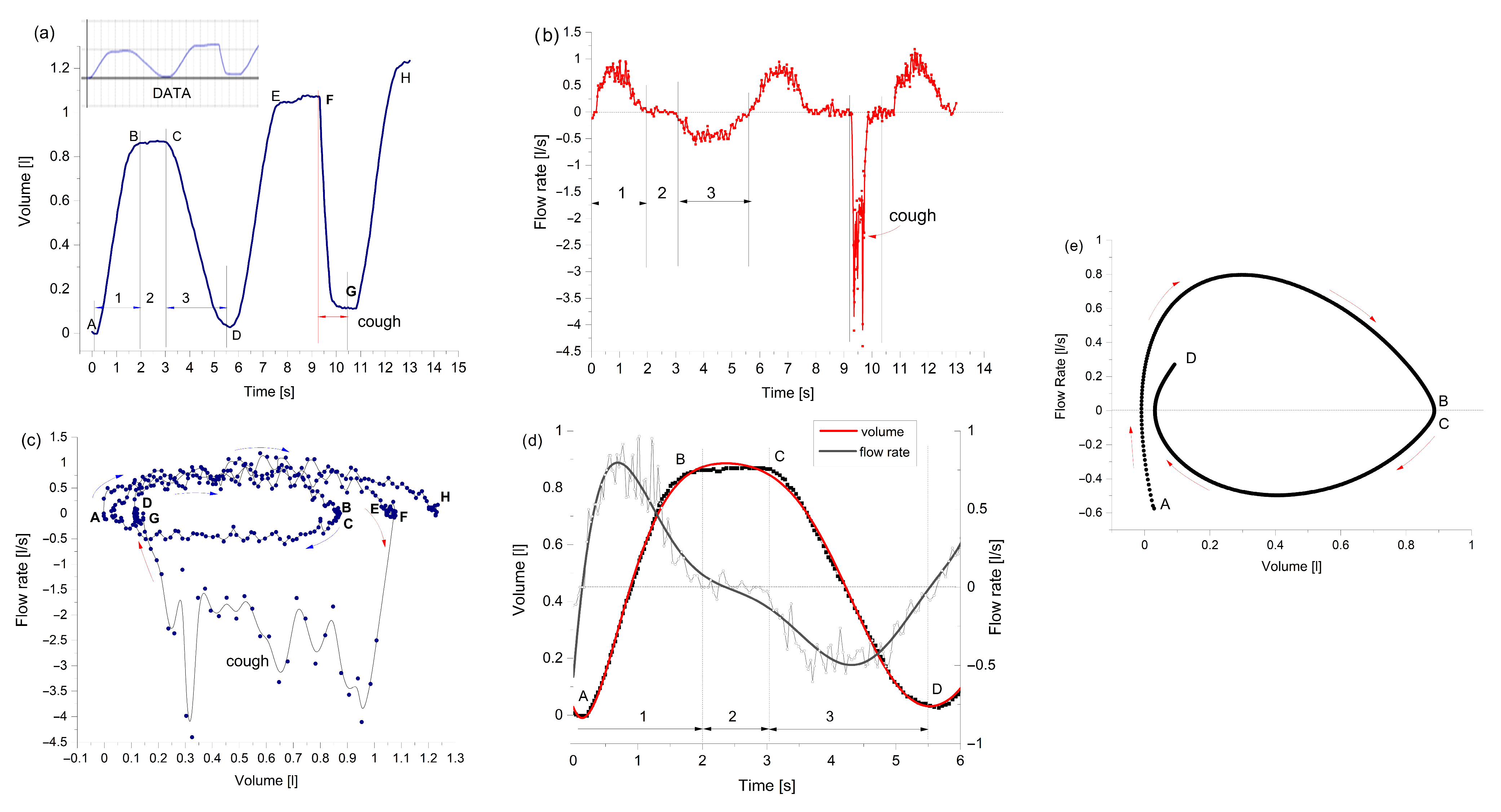
The raw data of the MVV (Maximum Voluntary Ventilation) test is represented in Figure 2b. The normal respiration interval (A–D; divided into 3 regions: 1—inspiration, 2—plateau, 3—expiration) is followed by a respiration (D–H) in the presence of cough (F,G; Figure 2a). The cough generates high fluctuations in flow rate during a short period of time (Figure 2b), which can be better observed in the parametric plot Q(V) (Figure 2c). The normal respiration cycle (A–D) is visualized by a deformed ellipse in the plot in Figure 2c. In the representations from Figure 2b,c, we kept the original data received from the spirometer, without any fitting. Of course, the fluctuations are present, especially for the flow rate, which is computed from diagram V(t) (Figure 2a), which is the only data delivered graphically by the spirometer. It is difficult to establish the origin of fluctuations if data acquisition is made only with a commercial (unmodified) spirometer; fluctuations might be real during respiration or might be a result of the transducer functioning (noise) and errors during data processing. However, if the received signal is fitted (for example, with a polynomial function; Figure 2d), the fluctuations of the flow rate disappear, and the parametric plot Q(V) becomes smooth (Figure 2e), at least in the region unaffected by cough.
Finally, one considers that the fluctuation of flow rate recorded during a respiratory cycle is an intrinsic part of the phenomenon, so we decided to use the raw data from Figure 2b as input data for numerical calculations in Section 4.

2.2.2. Ventilator

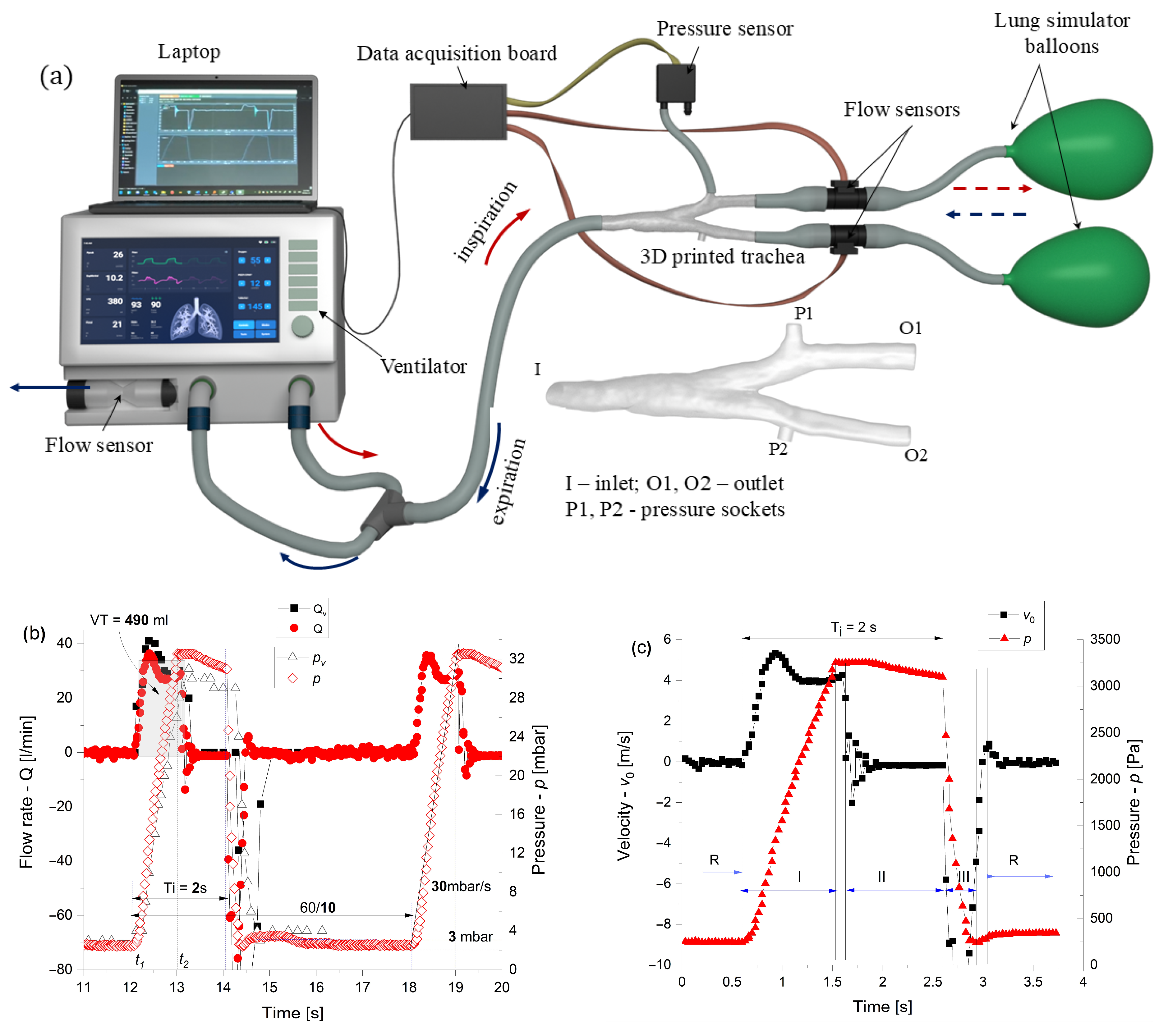
The setup used to simulate a tracheal respiratory cycle in the presence of cough is shown in Figure 3a. Airflow is generated through the 3D printed bifurcation using a Savina 300 mechanical ventilator. The Savina 300 was set to “VC-CMV/VC-AC” ventilation mode (volume control–continuous mandatory ventilation/volume control–assist control). The following input parameters were set for the measurements: respiratory rate RR = 10/min, inspiratory time Ti = 2 s, pressure inspiration rate DebitAcc = 30 mbar/s, positive end-expiratory pressure PEEP = 3 mbar (minimum pressure in the system) and tidal volume VT = 490 mL, corresponding to a healthy patient weighing 70 kg (tidal volume is approximately 7 mL/kg of body mass). Since the aim of our investigation is to model the tracheal airflow during cough, functioning lungs were mimicked using elastic balloons that expel the air abruptly.
A comparison between the input characteristics for the mechanical ventilator and the measured data with the setup transducers is shown in Figure 3b. Flow rates and pressure were monitored with a pair of flow transducers and a pressure transducer. To mimic the lung functioning in the regime of spontaneous coughing during expiration, two simulator simple balloons were connected at the outlet of the tracheal bifurcation. During inspiration, the transferred flow rate from the ventilator to the bifurcation Qvi is distributed in the two branches O1 and O2, and the exit flow rate Qve, Qv = Qvi = Qve, is measured with a flow sensor implemented in Savina 300 (Figure 3a). The inspiration volume is V(t) = VT at t = t2, with V(t1) = 0, where t1 and t2 mark the time interval during which the pressure increases with the imposed ramp DebitAcc (Figure 3b). The circulated flow rates in the branches, Q1 and Q2, are measured with independent flow transducers, the total measured flow rate, Q = Q1 + Q2, being expected to be at each moment equal to Qvi or Qve, respectively. Data collection of flow characteristics was made using a custom Arduino-based board setup. This board translated, after calibration, the transducer values into corresponding flow characteristics, which were then recorded on a computer.
The time dependence of the mean velocity v0 = Q⁄Ai (where Ai is the I-inlet area) during the respiratory cycle (inspiration—expiration) is represented in Figure 3c. The measured pressures p1 and p2 at P1 and P2 sockets follow the same pattern with the input pressure pv(t) recorded by the ventilator. The difference in maximum magnitude and the signal time shift at the end of the inspiration period between the two signals is most probably generated by the construction differences in the transducers. It is important to mention that measured values of flow rates Q1 and Q2 are very similar, and the differences in pressures p1 and p2 are insignificant (in the range of transducer error). Since the pressure loss in the two branches is not detectable by our transducers, one considers the same pressure value p = p1 = p2 at the two outlets O1 and O2 (Figure 3a).
Figure 3c depicts three distinctive zones of the respiration cycle. Each cycle is clearly demarcated by the presence of a resting area R. These zones are pivotal in characterizing the phases of the simulated respiratory cycle: Region I—inspiration marks the air-inhalation phase; Region II—transition phase signifies the intermediary state between inspiration and expiration; and Region III—expiration represents a fast (uncontrolled) air expelled, generated by coughing.
In Region I, the linear increase in the input pressure (in the prescribed limits) for 1 s, corroborated by the stiffness of balloons, determines the transport of the preset tidal volume value. The recorded flow rate (or calculated air velocity) during the effective inspiration period has a typical variation in the second-order output overshoot in flow rate, followed by a quasi-steady state, corresponding to the first-order linear input in pressure. When the tidal volume reaches the preset value, the pressure is maintained almost constantly in the system, the deformation of the balloons is maximum, and the flow rate rapidly decreases to zero after a short period of oscillations. The transition period of approximately 1 s defines Region II.
Expiration in the presence of a cough takes place in Region III, characterized by a sharp decrease in pressure (up to the imposed threshold) and the reverse flow rate through the trachea. After a short period of 0.2 s, the system is at rest (Q ≅ 0, p = PEEP input value) for less than 1 s, and the cycle starts again. The cycles from Figure 3c were chosen to establish the variation in time of the boundary conditions and to calibrate numerical simulations of unsteady airflow during a respiratory cycle in the presence of cough in the tracheal model.

2.3. Numerical

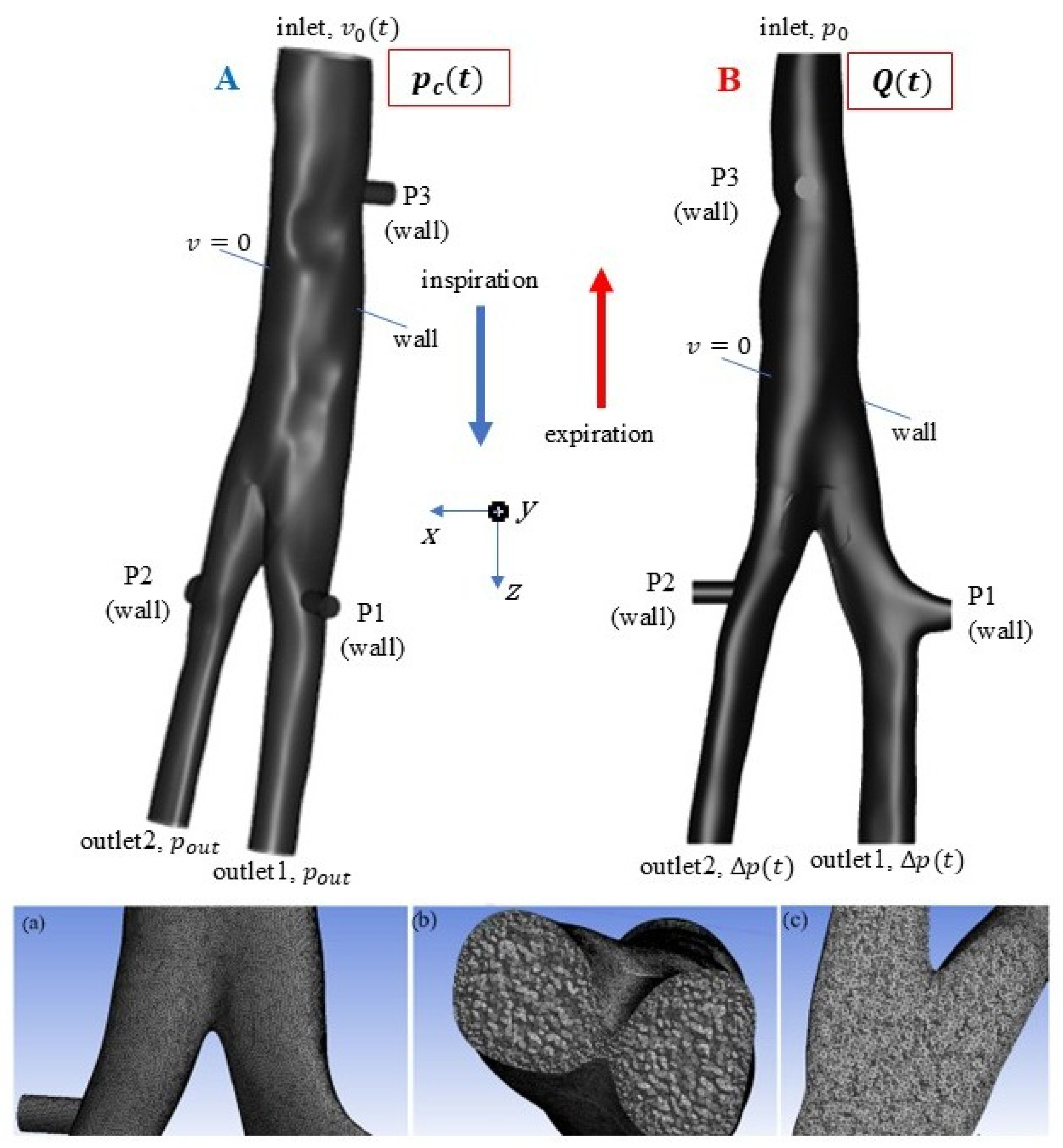
The numerical simulations of the airflows in the tracheal bifurcation were performed with the Fluid Flow (Fluent) software of ANSYS 2021 R1. The tracheal geometry from the CT scan, slightly modified to correspond with that tested in experiments (two pressure ports, P1 and P2, were introduced; Figure 1), was imported into the Fluent Meshing module of ANSYS 2021 R1. The flow domain was discretized in 2.3 million cells, and the network consists of 4.7 million nodes, with orthogonal cell quality in the range 0.3 to 1.0 (Figure 4). No systematic influence of the mesh size on the results was observed.
The working fluid is incompressible air with the following properties at normal conditions: density ρ = 1.225 kg/m3 and viscosity η =1.7894 × 10⁻⁵ Pas. The maximum Reynolds number in simulations (corresponding to the peak in expiration) is around 10,000. Numerical solutions are obtained using the unsteady solver of the four turbulence models, standard and realizable k ε , k ε   R , k ω   S S T (Shear Stress Transport) and LES (Large Eddy Simulation), on a PC with the following characteristics: Intel(R) Xeon(R) Silver 4214R CPU @ 2.40GHz (48 CPUs) 2.39 GHz (2 processors), Solver Processes: 4 CPU. All the terms (momentum, turbulent kinetic energy, and specific dissipation rate) of the transport equation were discretized using a second-order upwind scheme, and SIMPLE algorithms were used for the pressure–velocity coupling solvers, with a least-squares cell-based method for the gradient scheme and implicit time integration. The convergence criteria for all quantities are 10−6, with recommended ranges for dimensionless wall distance y+, 0 < y+ < 12 [64]. The numerical simulations were performed with time steps of 10 ms at 100 iterations/time step (spirometer data) and 33 ms at 500 iterations/time step (ventilator, the same time interval for data acquisitions). We must mention that the magnitude of the time step, as well as the number of nodes, were established by limiting the computation time to reach the imposed convergence criteria (usually several days were needed for each running case).
Analyses, comparisons, and limitations of the turbulence models’ applications in airflow simulations are presented in several recent papers, e.g., [38,65] (which recommended k ω   S S T model for respiratory flows) [54,66].
The airflow inside the tracheal bifurcation is analyzed for two cases, with different time-dependent imposed boundary conditions as shown in Figure 4: (A) flow rate is imposed at the inlet and pressure is imposed at the outlet, and (B) pressure difference is imposed between the outlet and the inlet. The walls of the trachea are stationary and rigid, and a no-slip boundary condition is imposed on the air at the walls.
So, case B simulates a normal respiration cycle, but in usual tests performed with a spirometer, only the output can be measured, i.e., flow rate variation in time, the air volume being calculated. No information about the pressure difference can be obtained, even though the airflow in this case is pressure-controlled.
In conclusion, a normal respiratory cycle can be modeled only if the pressure difference is considered as input. Our calculations follow three steps:
  • Since the flow rate is measured, case A is first simulated, and the pressure difference, ∆p(t) = pc(t) − pout, is obtained for the given geometry and boundary conditions: v0(t) at the inlet and pout at the outlet.
  • The pressure difference from case A is used as input for case B: ∆p(t) at the outlet and p0 at the inlet. The calculated variation in flow rate in time is compared with the measured one, the result being validated qualitatively and quantitatively (within an admissible error range).
  • After validation of case B, the flow spectrum, velocity, and stress distributions in the tracheal bifurcation are represented, and the results are analyzed.
During a respiratory cycle, the generation of vortical structures in the trachea is inherent. An important parameter for determining where vortices occur is the vorticity number Wo (a similar parameter to the q-criterion used in [38]). The vorticity number is defined as the ratio of vorticity (i.e., curl of velocity magnitude) to strain rate. The vorticity number greater than 1 indicates the regions of high probability of presence of vortical structure [67,68]. The presence of vortices and flow separation in the vicinity of the wall determines the variation in shear stress, which directly affects the tracheal airway lumen and mucus transport. Vorticity number is calculated by an implemented UDF (user-defined function), its distribution in bifurcation being represented for each turbulent model.

3. Results

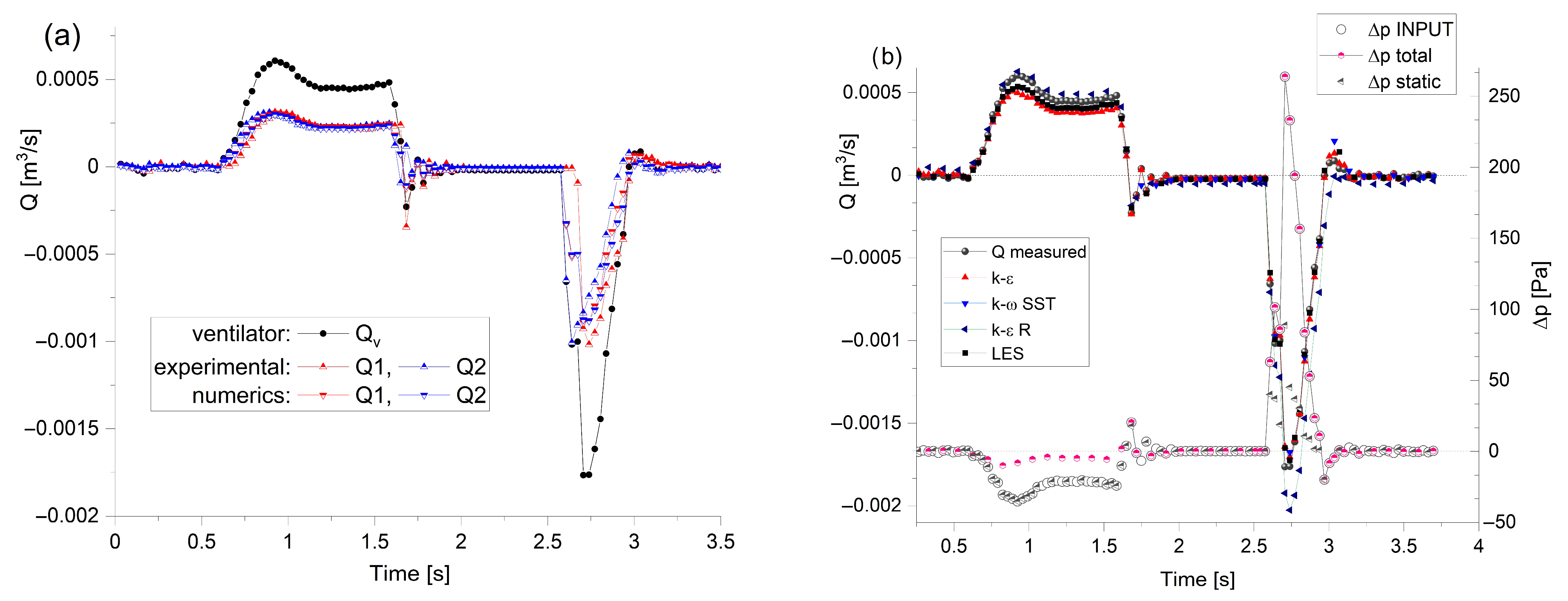
Case A, corresponding to ventilator experimental data, is used to validate this numerical procedure. The boundary conditions at the inlet of the bifurcation are v0(t) and the measured pressure pout = p(t) at the outlet (Figure 3c). The confidence in numerics is confirmed by the results of the flow rates distribution in the branches, the mean error between computed and measured flow rates Q1 and Q2 being below 5% during the respiratory cycle (Figure 5a). There are no major differences in the calculated flow rate against the turbulence models used in computations (Figure 5b). The pressure difference ∆p(t) from case A, used as input for case B, is compared in Figure 5b with the calculated pressure differences. The static computed pressure difference is consistent with the imposed boundary condition for the whole cycle, with the exception of the cough period, where the total computed pressure follows the input pressure.
Slight quantitative differences between the numerical solution B and experiment are observed for k ω   S S T , LES, and k ε   R models during inspiration, with a maximum error of ± 5% relative to experimental data. The computed flow rate for Case B using the k ε model shows an error of 14% at the peak of inspiration (t ≅ 0.92 s), while the k ε   R model exhibits a higher peak flow rate during coughing compared to the other models (Figure 5b). However, all models offer the same qualitative flow rate time variation as the measurements and insignificant differences during the cough period.
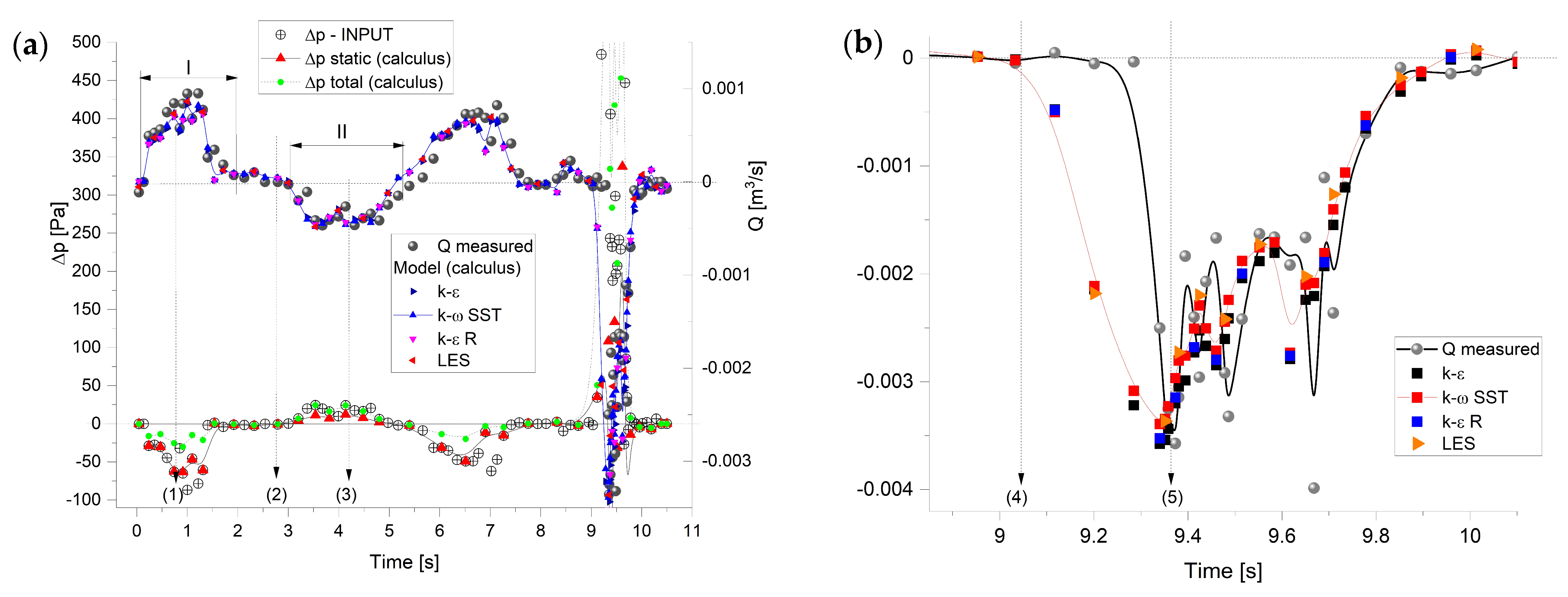
The data obtained from the spirometer test (Figure 2) is used to simulate a real respiratory cycle in the tracheal geometry from Figure 1. In Figure 6, the computed pressure difference from case A, used as input for case B, and the corresponding flow rate time variations in the tracheal bifurcation are shown. The comparison between the input/measured flow rate for case A and the output flow rate for case B validates the simulations performed with pressure difference as input. The computed RMSE and MAE errors for the total flow rate are below 10−3 for all models, indicating good agreement between the numerical simulations and the experimental measurements.
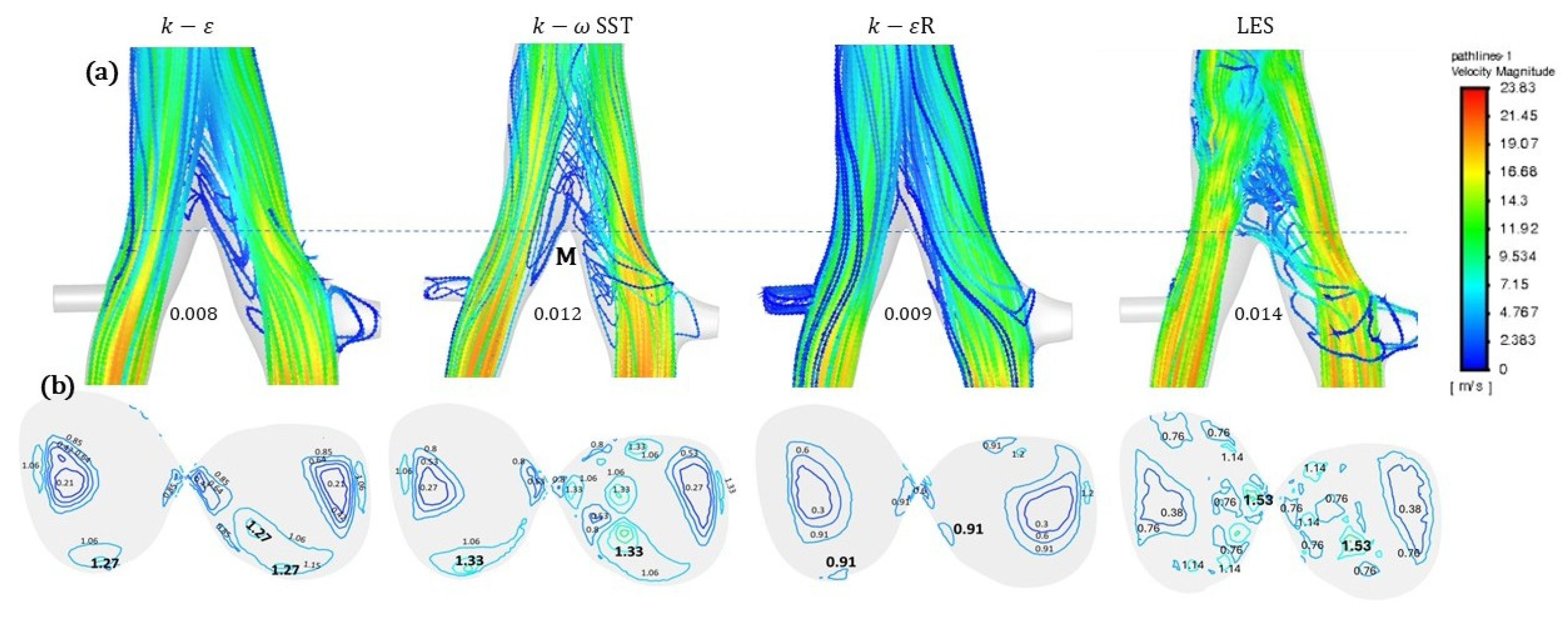
Figure 7 shows, at moment t = 2.71 s (before the onset of expiration; point (2) in Figure 6a), the streamline patterns in a median plane of bifurcation (Figure 7a) and the corresponding vorticity number contours on the normal plane positioned in the bifurcation (Figure 7b). Qualitative differences between the computed streamline distributions for the turbulence models are observed. Vortices and inverse flows in the vicinity of bifurcation are more developed for the k ω   S S T and LES models.
The values of calculated WSS in the vicinity of the bifurcation point M from Figure 7 are given at five moments of time in Table 1 (similar values were obtained by [53,54]).
The results from Figure 5 and Figure 6 confirm the published CFD analysis showing that k ω   S S T and LES turbulence models give a fair and similar representation of unsteady flows in confined bifurcations. We are confident that the present simulations performed with the k ω   S S T and LES models provide, within an acceptable margin of error, qualitative and quantitative results that describe the real air dynamics in the tracheal geometry investigated. The k ω   S S T model is preferred in our study due to its higher accuracy in computing the flow in the vicinity of the walls (where shear stress is calculated) and in predicting wall separation, as reported by [38,54,61,69].
The cough corresponds to the time interval t ∈ (9 ÷ 10.2) s in Figure 6b. The sharp increase in velocity during expiration under cough determines the increasing turbulence intensity and stress.
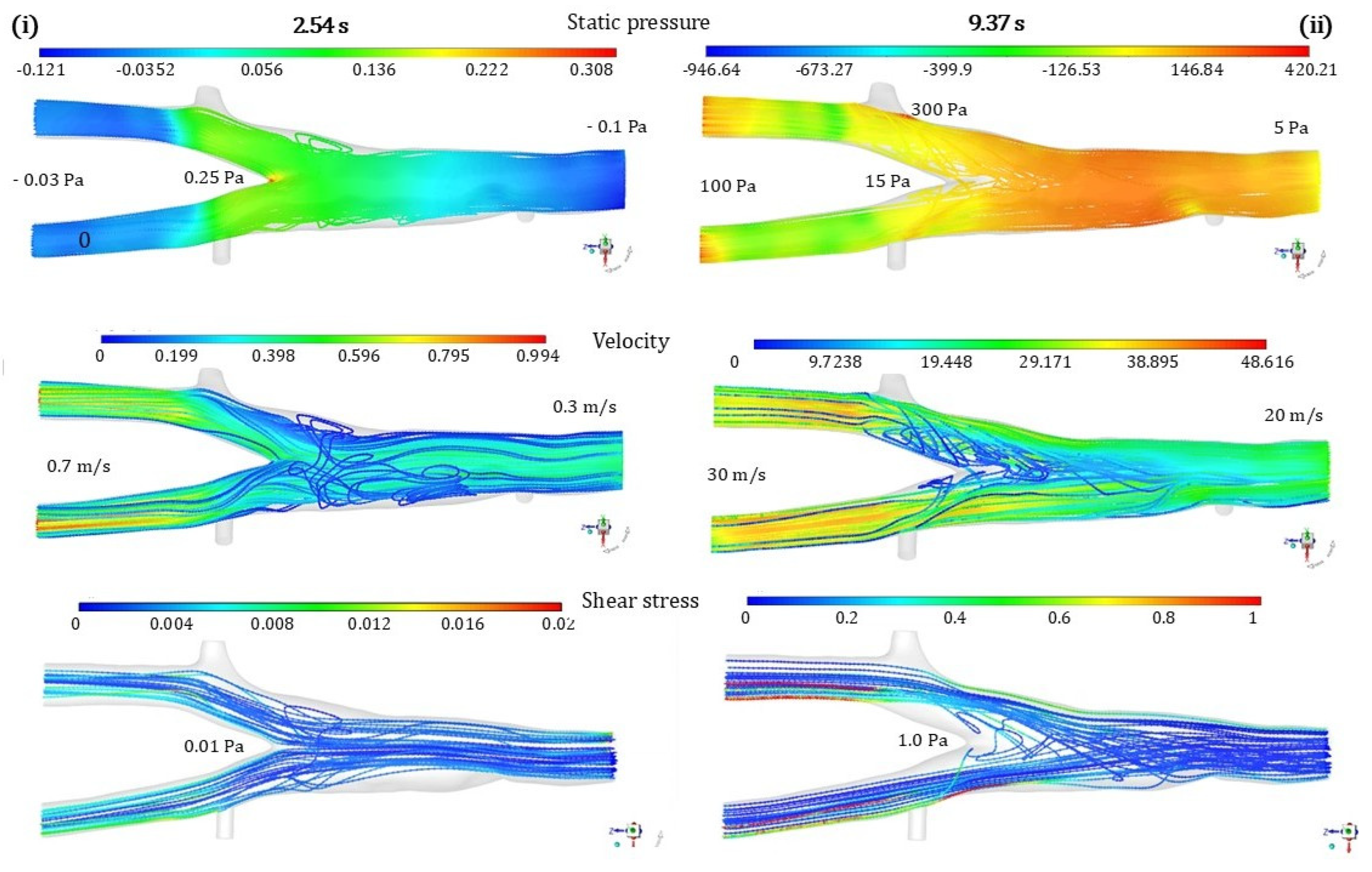
In Figure 8, different flow patterns are displayed at t = 2.54 s (in the period of rest between normal cycle inspiration-expiration) and t = 9.37 s (corresponding to the onset of expiration during cough), computed with k ω   S S T model.
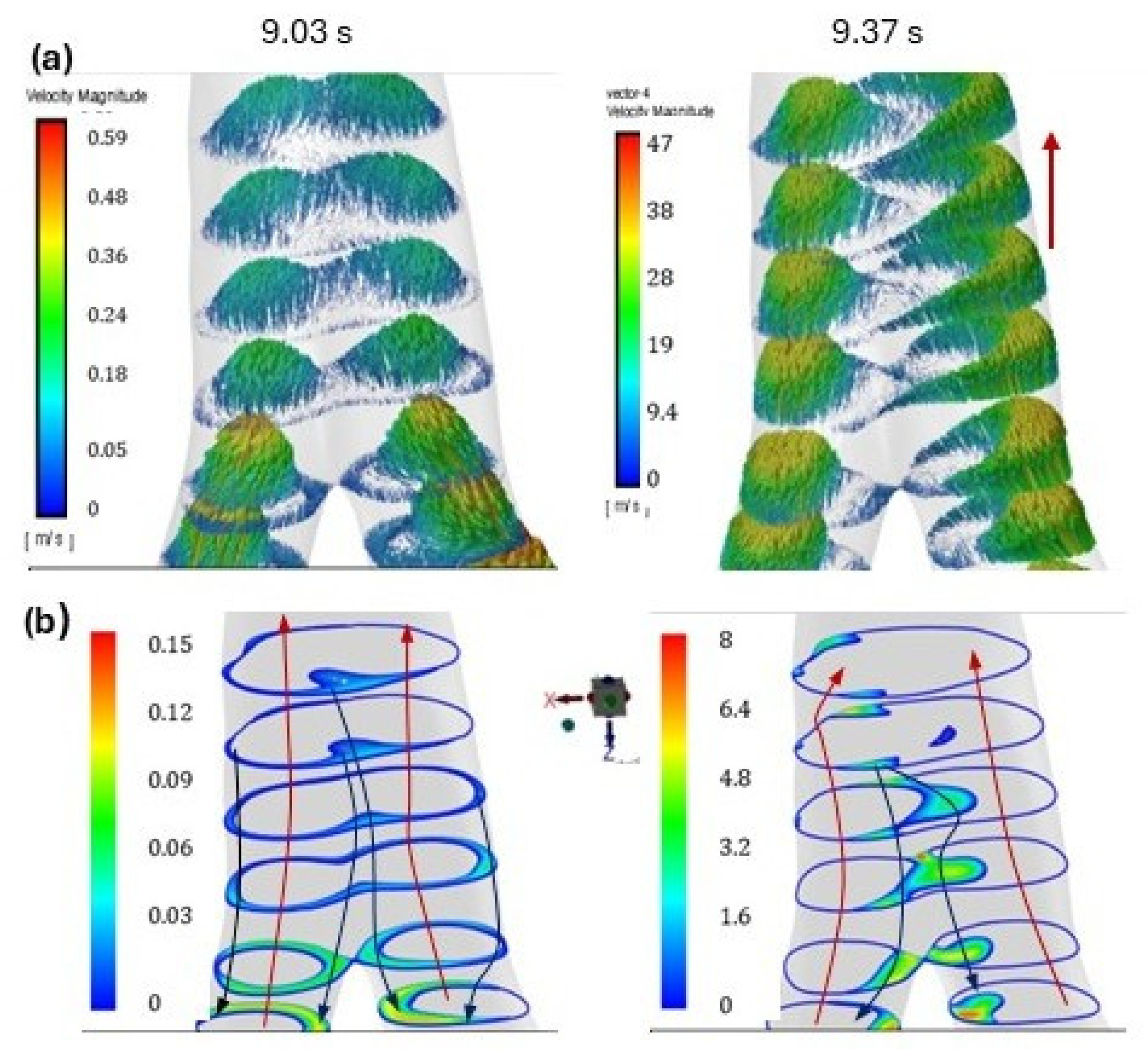
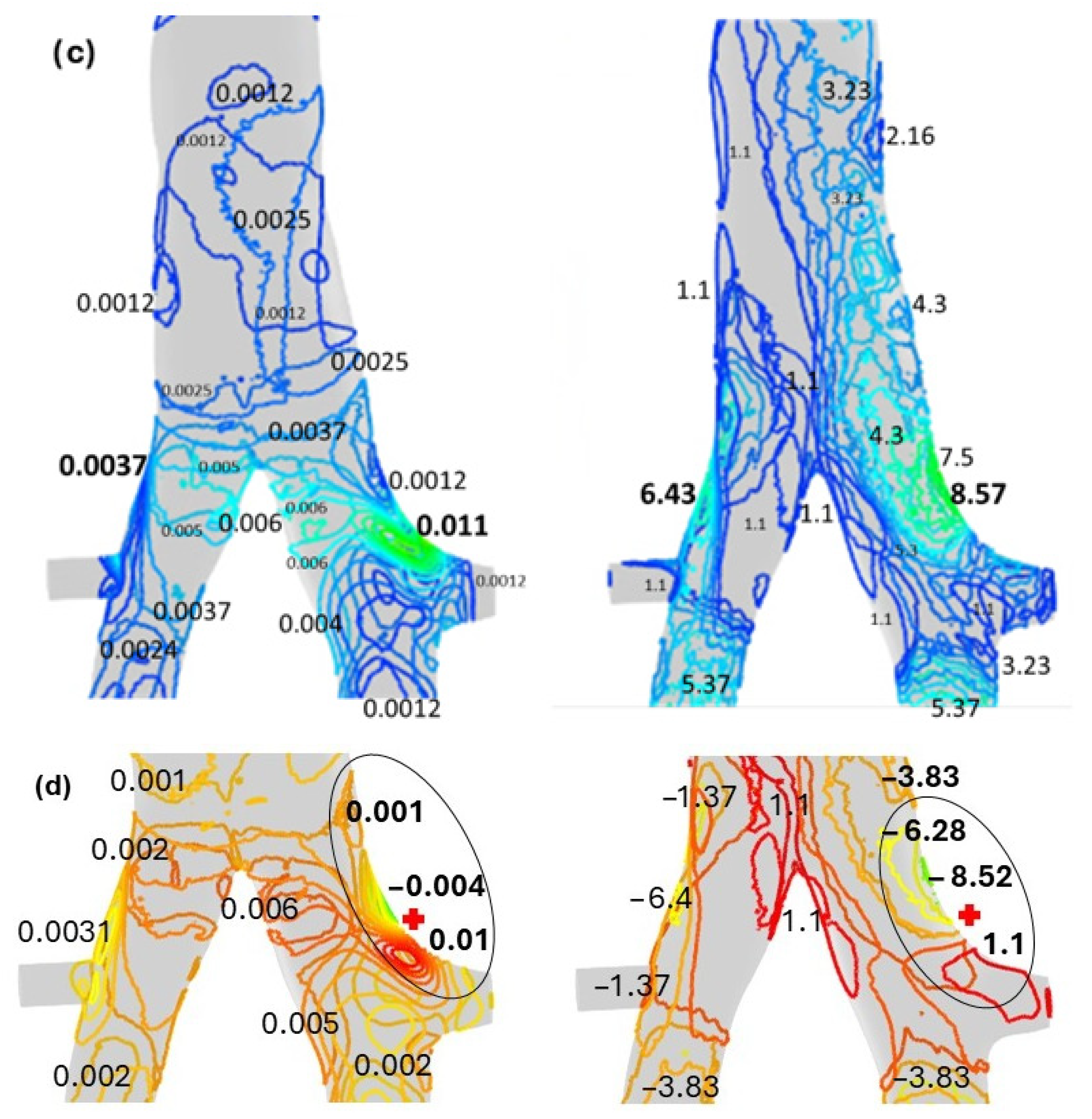
Figure 9 shows the velocity distributions inside the trachea and the iso-WSS distributions at a lapse of time before cough (point 4) and at the onset of cough (point 5); see Figure 6b. The computed average velocity during coughing at the bifurcation exit is approximately 20 m/s, as shown in Figure 8 at t = 9.37 s, which is comparable to the measured exhaled air velocities from coughing (16 ÷ 18 m/s), [70].
Our results are confirmed by previously published data for velocity and wall shear stress magnitudes in airways during respiration, in the absence of cough. One concludes that the proposed computation procedure of a respiratory cycle has the potential to offer valuable and correct information about the air dynamics in the tracheal bifurcation.
The results shown in Figure 9 are analyzed and discussed in the next chapter.

4. Discussion

The sharp increase in the transported flow rate in a short period of time due to coughing generates the inverse flows within the bifurcation (Figure 9a,b). It is important to note that inverse flows at the peak of maximum expiration velocity (t ≅ 9.37 s) are mainly present in the middle core of the trachea (Figure 9b). The rapid change of velocity in the vicinity of the walls produces a high gradient of WSS in time and space—compare the WSS values from Figure 9c and Table 1, also the values of pressure, velocity, and shear stress inside the bifurcation (Figure 8).
The increase in wall stress associated with high local gradients and oscillations is remarkable during coughing. Even though in real tracheal bifurcation, the magnitudes of WSS probably do not reach these values due to wall deformation, the simulations indicate the regions where endothelial cells might be affected in time.
Numerical simulations of cough are absent in the literature, so our calculated values of WSS in Figure 9c at t = 9.37 s cannot be compared with published data. However, during a cough, the trachea is suddenly contracted, the flow section is reduced, and the velocity is accelerated. At this moment, WSS reaches the maximum, with similar results being obtained in quasi-steady simulations of the inhalation–exhalation cycle through a trachea with severe deformation [53]. The distribution of the WSS z-component (WSSz) is displayed in Figure 9d. The change of the WSSz sign is observed at the outer walls. This is related to the presence of a flow separation area and stagnation points (where WSSz = 0).
The existence of a separation region and the oscillations of stagnation point at the wall, associated with rapid variation in WSS magnitude and trachea deformation, have a major influence on the functioning of endothelial cells [71,72,73]. The existence of flow separation areas and air recirculation in the vicinity of the tracheal wall is an indication of possible lung dysfunctions [74]. In vivo measurements of WSS in the respiratory system are not possible; even in a reconstructed replica, it is very difficult to directly measure the WSS. The WSS calculations are based on the measurements of the velocity distributions. Various techniques are used to obtain the velocity distributions in reconstructed tracheal bifurcations: MRV [75], 3D-PTV [76], and PIV system [77,78]. The algorithm to compute the WSS is not simple, since the gradient of velocity at the wall must be measured with high accuracy. Very recently, a deep learning method was proposed to quantify the WSS by synchronizing the PIV velocity measurements with information captured by micro-pillar shear stress sensors [79].
WSS values and their distributions are important information to establish the airways’ functioning of tracheal configurations in relation to pulmonary diseases and the response of endothelial cells [29,43,48,53,80]. The possibility of computing the dynamics of wall stresses during a respiratory cycle is one main necessary condition for understanding the cell’s responses, pathogenesis of pulmonary tissues [71,72], re-epithelialization of tracheal grafts [81], and mucus formation [39,41,82].
It is important to mention that the proposed CFD procedure to compute the air dynamics in the trachea is based exclusively on non-invasive investigations: CT images and flow rate measurements obtained with a commercial spirometer. The present results are validated against laboratory experiments and are consistent with available data published in the literature.

5. Conclusions and Final Remarks

The paper presents experiments and numerical simulations of airflow dynamics in a reconstructed tracheal geometry. The study proposes an original numerical procedure for computing the wall stress distribution in a tracheal geometry, using as input the time-varying air volume during a respiratory cycle measured with a spirometer.
The procedure simulates a real respiratory cycle, where the airflow rate results from the input pressure difference generated by lung contraction. Our method introduces a novel approach in CFD analysis of airway flow, using a time-dependent imposed pressure difference as a boundary condition to obtain a given output (i.e., flow rate). The correspondence between the calculated and the measured flow rates during respiration confirms the validity of the procedure.
Starting from experimental data, either obtained with a spirometer or from a clinical mechanical ventilator-controlled setup, the study focused on computing vortical structures in the flow domain and the associated stress distribution. The difference in vorticity number and WSS values between normal respiration and respiration in the presence of coughing is highlighted for the first time in a CFD analysis of tracheal flows. The results from four turbulence models implemented in ANSYS ( k ε ,   k ω   S S T , k ε   R , and LES, respectively) are compared. The differences were more pronounced during coughing, particularly in the peak magnitude of WSS, vorticity number, and streamline patterns. Our analysis indicates that the k ω   S S T turbulence model provides a reasonable characterization of the tracheal airflow dynamics.
Once the numerical calculations are validated by experiments, relevant information can be obtained about the kinematics and dynamics of the investigated airflows in the tracheal geometry: (a) the distributions of the velocity within the bifurcation, (b) the wall shear stress (WSS) and the vortical distributions in the trachea, (c) time variation in flow spectrum and flow rate. Correlating WSS with the flow spectrum and vorticity number magnitude may provide a quantitative characterization of airflow dynamics during different phases of the respiratory cycle.
The velocity and vortical structures determine the stress distribution at the tracheal walls and give an insight into the capacity and functioning of the lungs. The magnitude and time oscillations of WSS influence the response of tracheal endothelial cells. By corroborating all information extracted from computations, one can obtain a general characterization of the respiratory system from a biomechanical point of view.
Mechanical ventilated respiration (with the flow rate controlled during inspiration) and normal respiration (driven by a pressure difference) are modelled and analyzed. Numerical simulations of the two cases show the differences between normal and mechanically induced breathing, which is important for developing more patient-friendly personalized ventilation strategies. This is the further target of the study in our group.
The correspondence and correlations between the airflows simulations and medical diagnostics of respiratory dysfunctions are still in progress, with a positive perspective for a better treatment of the patients. We believe that our work is a contribution to achieving this goal.

Author Contributions

Conceptualization, N.-O.T., C.-S.M. and D.-D.C.; methodology, N.-O.T. and C.B.; software, N.-O.T.; validation, N.-O.T., C.-S.M. and D.-D.C.; formal analysis, N.-O.T. and C.B.; investigation, N.-O.T., C.-S.M. and D.-D.C.; resources, N.-O.T., C.-S.M., D.-D.C. and C.B.; data curation, C.-S.M. and D.-D.C.; writing—original draft preparation, N.-O.T., C.-S.M. and D.-D.C.; writing—review and editing, C.B.; visualization, N.-O.T.; supervision, C.B.; project administration, N.-O.T. and C.B.; funding acquisition, N.-O.T. and C.B. All authors have read and agreed to the published version of the manuscript.

Funding

This research was supported by EC and The Romania Executive Agency for Higher Education, Research, Development, and In-novation Funding—UEFISCDI, grant COFUND-CHIST-ERA no. 206/2019 and a grant from the National Program for Research of the National Association of Technical Universities—GNAC ARUT 2023, (Contract no. 131/2023).

Institutional Review Board Statement

Not applicable.

Informed Consent Statement

Not applicable.

Data Availability Statement

The original contributions presented in this study are included in the article.

Acknowledgments

The authors acknowledge the support provided by CHIST-ERA—19—XAI—009 MUCCA project, EC and the Romanian Executive Agency for Higher Education, Research, Development, and Innovation Funding—UEFISCDI, grant COFUND-CHIST-ERA no. 206/2019. Nicoleta—Octavia Tanase gratefully acknowledge the support provided by a grant from the National Program for Research of the National Association of Technical Universities—GNAC ARUT 2023, (Contract no. 131/2023). The authors acknowledge the reviewers for their observations and remarks, which contributed to improving the quality of the paper.

Conflicts of Interest

The authors declare no conflicts of interest.

References

  1. Luo, H.Y.; Liu, Y. Modeling the bifurcating flow in a CT-scanned human lung airway. J. Biomech. 2008, 41, 2681–2688. [Google Scholar] [CrossRef]
  2. Kleinstreuer, C.; Zhang, Z. Airflow and particle transport in the human respiratory system. Annu. Rev. Fluid Mech. 2009, 42, 301–334. [Google Scholar] [CrossRef]
  3. Yu, H.; Yen, H.H.; Li, Y. Deposition of bronchiole-originated droplets in the lower airways during exhalation. J. Aerosol Sci. 2020, 142, 105524. [Google Scholar] [CrossRef]
  4. Poynot, W.J.; Gonthier, K.A.; Dunham, M.E.; Crosby, T.W. Classification of tracheal stenosis in children based on computational aerodynamics. J. Biomech. 2020, 104, 109752. [Google Scholar] [CrossRef] [PubMed]
  5. Huang, F.; Zhang, Y.; Tong, Z.B.; Chen, X.L.; Yang, R.Y.; Yu, A.B. Numerical investigation of deposition mechanism in three mouth–throat models. Powder Technol. 2021, 378, 724–735. [Google Scholar] [CrossRef]
  6. Teng, Z.; Trabelsi, O.; Ochoa, I.; He, J.; Gillard, J.H.; Doblare, M. Anisotropic material behaviours of soft tissues in human trachea: An experimental study. J. Biomech. 2012, 45, 1717–1723. [Google Scholar] [CrossRef] [PubMed]
  7. Gemci, T.; Ponyavin, V.; Chen, Y.; Chen, H.; Collins, R. Computational model of airflow in upper 17 generations of human respiratory tract. J. Biomech. 2008, 41, 2047–2054. [Google Scholar] [CrossRef]
  8. Freitas, R.K.; Schröder, W. Numerical investigation of the three-dimensional flow in a human lung model. J. Biomech. 2008, 41, 2446–2457. [Google Scholar] [CrossRef]
  9. May, M.S.; Wüst, W.; Brand, M.; Stahl, C.; Allmendinger, T.; Schmidt, B.; Uder, M.; Lell, M.M. Dose Reduction in Abdominal Computed Tomography, Intraindividual Comparison of Image Quality of Full-Dose Standard and Half-Dose Iterative Reconstructions with Dual-Source Computed Tomography. Investig. Radiol. 2011, 46, 465–470. [Google Scholar] [CrossRef]
  10. Yu, L.; Leng, S.; McCollough, C.H. Dual-energy CT-based monochromatic imaging. AJR Am. J. Roentgenol. 2012, 199, S9–S15. [Google Scholar] [CrossRef]
  11. Fernandez, J.J. Computational methods for electron tomography. Micron 2012, 43, 1010–1030. [Google Scholar] [CrossRef]
  12. Benz, D.C.; Benetos, G.; Rampidis, G.; von Felten, E.; Bakula, A.; Sustar, A.; Kudura, K.; Messerli, M.; Fuchs, T.A.; Gebhard, C.; et al. Validation of deep-learning image reconstruction for coronary computed tomography angiography: Impact on noise, image quality and diagnostic accuracy. J. Cardiovasc. Comput. Tomogr. 2020, 14, 444–451. [Google Scholar] [CrossRef]
  13. Alzahrany, M.; Banerjee, A. A biomechanical model of pendelluft induced lung injury. J. Biomech. 2015, 48, 1804–1810. [Google Scholar] [CrossRef]
  14. Gutmark, E.; Anand, V.; Wheeler, A.; Zahn, A.; Cavari, Y.; Eluk, T.; Hay, M.; Katoshevski, C.; Gutmark-Little, I. Demonstration of mucus simulant clearance in a Bench-Model using acoustic Field-Integrated Intrapulmonary Percussive ventilation. J. Biomech. 2022, 144, 111305. [Google Scholar] [CrossRef]
  15. Parrilla, F.J.; Morán, I.; Roche-Campo, F.; Mancebo, J. Ventilatory strategies in obstructive lung disease. Semin. Respir. Crit. Care Med. 2014, 35, 431–440. [Google Scholar] [CrossRef]
  16. Srivastav, V.K.; Kumar, B.; Jain, A.; Paul, A.R. A Computational Study on Airflow in Human Respiratory Tract at Normal and Heavy Breathing Conditions. In Proceedings of the 6th International and 43rd National Conference on Fluid Mechanics and Fluid Power, Allahabad, Uttar Pradesh, India, 15–17 December 2016. [Google Scholar]
  17. Amini, R.; Kaczka, D.W. Impact of ventilation frequency and parenchymal stiffness on flow and pressure distribution in a canine lung model. Ann. Biomed. Eng. 2013, 41, 2699–2711. [Google Scholar] [CrossRef] [PubMed]
  18. Bauer, K.; Brücker, C. The influence of airway tree geometry and ventilation frequency on airflow distribution. J. Biomech. Eng. 2015, 137, 081001. [Google Scholar] [CrossRef] [PubMed]
  19. Marini, J.J.; Rocco, P.R.M.; Gattinoni, L. Static and dynamic contributors to ventilator-induced lung injury in clinical practice pressure, energy, and power. Am. J. Respir. Crit. Care Med. 2020, 201, 767–774. [Google Scholar] [CrossRef]
  20. Walenga, R.L.; Longest, P.W.; Sundaresan, G. Creation of an in vitro biomechanical model of the trachea using rapid prototyping. J. Biomech. 2014, 47, 1861–1868. [Google Scholar] [CrossRef] [PubMed]
  21. Kerekes, A.; Nagy, A.; Veres, M.; Rigó, I.; Farkas, A.; Czitrovszky, A. In vitro and in silico (IVIS) flow characterization in an idealized human airway geometry using laser Doppler anemometry and computational fluid dynamics techniques. Measurement 2016, 90, 144–150. [Google Scholar] [CrossRef]
  22. Wei, W.; Huang, S.W.; Chen, L.H.; Qi, Y.; Qiu, Y.; Li, S.T. Airflow behavior changes in upper airway caused by different head and neck positions: Comparison by computational fluid dynamics. J. Biomech. 2017, 52, 89–94. [Google Scholar] [CrossRef]
  23. Crosby, T.; Adkins, L.; McWhorter, A.; Kunduk, M.; Dunham, M. Computational Fluid Dynamics Model of Laryngotracheal Stenosis and Correlation to Pulmonary Function Measures. Respir. Physiol. Neurobiol. 2023, 312, 104037. [Google Scholar] [CrossRef] [PubMed]
  24. Poorbahrami, K.; Oakes, J.M. Regional flow and deposition variability in adult female lungs: A numerical simulation pilot study. Clin. Biomech. 2019, 66, 40–49. [Google Scholar] [CrossRef]
  25. Aliboni, L.; Tullio, M.; Pennati, F.; Lomauro, A.; Carrinola, R.; Carrafiello, G.; Nosotti, M.; Palleschi, A.; Aliverti, A. Functional analysis of the airways after pulmonary lobectomy through computational fluid Dynamics. Sci. Rep. 2022, 12, 3321. [Google Scholar] [CrossRef]
  26. Ren, S.; Li, W.; Wang, L.; Shi, Y.; Cai, M.; Hao, L.; Luo, Z.; Niu, J.; Xu, W.; Luo, Z. Numerical Analysis of Airway Mucus Clearance Effectiveness Using Assisted Coughing Techniques. Sci. Rep. 2020, 10, 2030. [Google Scholar] [CrossRef]
  27. Xiao, Q.; Gunatilaka, C.; McConnell, K.; Bates, A. The effect of including dynamic imaging derived airway wall motion in CFD simulations of respiratory airflow in patients with OSA. Sci. Rep. 2024, 14, 17242. [Google Scholar] [CrossRef] [PubMed]
  28. Sarabia-Vallejos, M.A.; Zuñiga, M.; Hurtado, D.E. The role of three-dimensionality and alveolar pressure in the distribution and amplification of alveolar stresses. Sci. Rep. 2019, 9, 8783. [Google Scholar] [CrossRef]
  29. Xia, G.; Tawhai, M.H.; Hoffman, E.A.; Lin, C.L. Airway Wall Stiffening Increases Peak Wall Shear Stress: A fluid-structure interaction study in rigid and compliant airways. Ann. Biomed. Eng. 2010, 38, 1836–1853. [Google Scholar] [CrossRef]
  30. Stéphano, J.; Mauroy, B. Wall shear stress distribution in a compliant airway tree. Phys. Fluids 2021, 33, 031907. [Google Scholar] [CrossRef]
  31. Zielinska-Krawczyka, M.; Krenkea, R.; Grabczaka, E.M.; Light, R.W. Pleural manometry–historical background, rationale for use and methods of measurement. Respir. Med. 2018, 136, 21–28. [Google Scholar] [CrossRef]
  32. Sondergaard, S.; Karason, S.; Hanson, A.; Nilsson, K.; Hojer, S.; Lundin, S.; Stenqvist, O. Direct measurement of intratracheal pressure in pediatric respiratory monitoring. Pediatr. Res. 2002, 51, 339–345. [Google Scholar] [CrossRef]
  33. Uchiyama, A.; Yoshida, T.; Yamanaka, H.; Fujino, Y. Estimation of tracheal pressure and imposed expiratory work of breathing by the endotracheal tube, heat and moisture exchanger, and ventilator during mechanical ventilation. Respir. Care 2013, 58, 1157–1169. [Google Scholar] [CrossRef] [PubMed]
  34. Higeno, R.; Uchiyama, A.; Enokidani, Y.; Fujino, Y. Advanced cuff pressure control ventilation (ACPCV); a bench study of a new concept of mechanical ventilation. J. Med. Eng. Technol. 2021, 45, 324–333. [Google Scholar] [CrossRef] [PubMed]
  35. Sun, N.; Brault, C.; Rodrigues, A.; Ko, M.; Vieira, F.; Phoophiboon, V.; Slama, M.; Chen, L.; Brochard, L. Distribution of airway pressure opening in the lungs measured with electrical impedance tomography (POET): A prospective physiological study. Crit. Care 2025, 29, 28. [Google Scholar] [CrossRef] [PubMed]
  36. Yartsev, A. The Expiratory and Inspiratory Process, in Deranged Physiology—A Free Online Resource for Intensive Care Medicine. 2015. Available online: https://derangedphysiology.com/main/home (accessed on 5 July 2025).
  37. Sul, B. Dynamics of the tracheal airway and its influences on respiratory airflows: An exemplar study. J. Biomech. Eng. 2019, 141, 111009. [Google Scholar] [CrossRef]
  38. Emmerling, J.; Vahaji, S.; Morton, D.A.V.; Fletcher, D.F.; Inthavong, K. Scale resolving simulations of the effect of glottis motion and the laryngeal jet on flow dynamics during respiration. Comp. Meth. Programs Biomed. 2024, 247, 108064. [Google Scholar] [CrossRef]
  39. Button, B.; Boucher, R.C. Role of Mechanical Stress in Regulating Airway Surface Hydration and Mucus Clearance Rates. Respir. Physiol. Neurobiol. 2008, 163, 189–201. [Google Scholar] [CrossRef]
  40. Hill, D.B.; Button, B.; Rubinstein, M.; Boucher, R.C. Physiology and pathophysiology of human airway mucus. Physiol. Rev. 2022, 102, 1757–1836. [Google Scholar] [CrossRef]
  41. Erken, O.; Fazla, B.; Muradoglu, M. Effects of elastoviscoplastic properties of mucus on airway closure in healthy and pathological conditions. Phys. Rev. Fluids 2023, 8, 053102. [Google Scholar] [CrossRef]
  42. Tufail, A.; Jiang, Y.; Cui, X. A review on the mucus dynamics in the human respiratory airway. Biomech. Model. Mechanobiol. 2025, 24, 107–123. [Google Scholar] [CrossRef]
  43. Sidhaye, V.K.; Schweitzer, K.S.; Caterina, M.J.; Shimoda, L.; King, L.S. Shear stress regulates aquaporin-5 and airway epithelial barrier function. Proc. Natl. Acad. Sci. USA 2008, 105, 3345–3350. [Google Scholar] [CrossRef]
  44. Chatterjee, S.; Nieman, G.F.; Christie, J.D.; Fisher, A.B. Shear stress-related mechanosignaling with lung ischemia: Lessons from basic research can inform lung transplantation. Am. J. Physiol. Lung Cell Mol. Physiol. 2014, 307, L668–L680. [Google Scholar] [CrossRef] [PubMed]
  45. Vlahakis, N.E.; Hubmayr, R.D. Cellular Stress Failure in Ventilator-injured Lungs. Am. J. Respir. Crit. Care Med. 2005, 171, 1328–1342. [Google Scholar] [CrossRef] [PubMed]
  46. Huertas, A.; Guignabert, C.; Barberà, J.A.; Bärtsch, P.; Bhattacharya, J.; Bhattacharya, S.; Bonsignore, M.R.; Dewachter, L.; Dinh-Xuan, A.T.; Dorfmüller, P.; et al. Pulmonary vascular endothelium: The orchestra conductor in respiratory diseases. Eur. Respir. J. 2018, 51, 1700745. [Google Scholar] [CrossRef] [PubMed]
  47. Nour, S. Endothelial shear stress enhancements: A potential solution for critically ill Covid-19 patients. Bio. Med. Eng. Online 2020, 19, 91. [Google Scholar] [CrossRef]
  48. Jamaati, H.; Monjezi, M. Airflow-related shear stress: The main cause of VILI or not? Tanaffos 2024, 23, 139–145. [Google Scholar]
  49. Evans, D.J.; Green, A.S.; Thomas, N.K. Wall shear stress distributions in a model of normal and constricted small airways. Proc. Inst. Mech. Eng. H 2014, 228, 362–370. [Google Scholar] [CrossRef] [PubMed]
  50. Green, A.S. Modelling of peak-flow wall shear stress in major airways of the lung. J. Biomech. 2004, 37, 661–667. [Google Scholar] [CrossRef]
  51. Livanos, A.; Bouchoris, K.; Aslani, K.E.; Gourgoulianis, K.; Bontozoglou, V. Prediction of shear stress imposed on alveolar epithelium of healthy and diseased lungs. Biomech. Model. Mechanobiol. 2024, 23, 2213–2227. [Google Scholar] [CrossRef]
  52. Nucci, G.; Suki, B.; Lutchen, K. Modeling air flow-related shear stress during heterogeneous constriction and mechanical ventilation. J. Appl. Physiol. 2003, 95, 348–356. [Google Scholar] [CrossRef]
  53. Sul, B.; Wallqvist, A.; Morris, M.J.; Reifman, J.; Rakesh, A. Computational study of the respiratory air flow characteristics in normal and obstructed human airways. Comp. Biol. Med. 2014, 52, 130–143. [Google Scholar] [CrossRef]
  54. Taheriana, S.; Rahaia, H.; Taheriana, B.G.S.; Rahaia, H.; Gomeza, B.; Waddingtonb, T.; Mazdisnian, F. Computational fluid dynamics evaluation of excessive dynamic airway collapse. Clin. Biomech. 2017, 50, 145–153. [Google Scholar] [CrossRef]
  55. Kim, J.W.; Heise, R.L.; Reynolds, A.M.; Pidaparti, R.M. Quantification of Age-Related Lung Tissue Mechanics under Mechanical Ventilation. Med. Sci. 2017, 5, 21. [Google Scholar] [CrossRef]
  56. Ou, X.; Meng, J.; Ma, C.; Wa, H.; Chen, Y.; Luo, F. Numerical simulation of voluntary respiration in a model of the whole human lower airway. Biomech. Model. Mechanobiol. 2025, 24, 663–681. [Google Scholar] [CrossRef]
  57. Walters, D.K.; Burgreen, G.W.; Lavallee, D.M.; Thompson, D.S.; Hester, R.L. Efficient, physiologically realistic lung airflow simulations. IEEE Trans. Biomed. Eng. 2011, 58, 3016–3019. [Google Scholar] [CrossRef] [PubMed]
  58. Wang, J.; Zhou, B.; Yang, X.; Zhou, C.; Ling, T.; Hu, B.; Song, Y.; Liu, L. Computed tomography-based bronchial tree three-dimensional reconstruction and airway resistance evaluation in adolescent idiopathic scoliosis. Eur. Spine J. 2020, 29, 1981–1992. [Google Scholar] [CrossRef] [PubMed]
  59. Ma, J.; Su, W.C.; Chen, Y.; Shang, Y.; Dong, J.; Tu, J.; Tian, L. A combined computational and experimental study on nanoparticle transport and partitioning in the human trachea and upper bronchial airways. Aerosol Air Qual. Res. 2020, 20, 2404–2418. [Google Scholar] [CrossRef]
  60. Johari, N.H.; Osman, K.; Helmi, N.H.N.; Abdul Kadir, M.A.R. Comparative analysis of realistic CT-scan and simplified human airway models in airflow simulation. Comput. Methods Biomech. Biomed. Eng. 2015, 18, 48–56. [Google Scholar] [CrossRef]
  61. Lalas, A.; Nousias, S.; Kikidis, D.; Lalos, A.; Arvanitis, G.; Sougles, C.; Moustakas, K.; Votis, K.; Verbanck, D.; Usmani, O.; et al. Substance deposition assessment in obstructed pulmonary system through numerical characterization of airflow and inhaled particles attributes. BMC Med. Inform. Decis. Mak. 2017, 17, 173. [Google Scholar] [CrossRef] [PubMed]
  62. Ou, C.; Hang, J.; Deng, Q. Particle deposition in human lung airways: Effects of airflow, particle size, and mechanisms. Aerosol Air Qual. Res. 2020, 20, 2846–2858. [Google Scholar] [CrossRef]
  63. Mostafavi, S.M. COVID19-CT-Dataset: An Open-Access Chest CT Image Repository of 1000+ Patients with Confirmed COVID-19 Diagnosis. Harvard Dataverse. 2021. Available online: https://dataverse.harvard.edu/dataset.xhtml?persistentId=doi:10.7910/DVN/6ACUZJ (accessed on 10 July 2025).
  64. Menter, F.; Sechner, R. Best Practice: RANS Turbulence Modeling in Ansys CFD, Course, 2021. Available online: https://www.scribd.com/document/637262645/Best-Practice-Rans-turbulence-modeling-in-Ansys-CFD (accessed on 18 June 2025).
  65. Lancmanová, A.; Bodnár, T. Numerical simulations of human respiratory flows: A review. Discov. Appl. Sci. 2025, 7, 242. [Google Scholar] [CrossRef]
  66. Shaheed, R.; Mohammadian, A.; Gildeh, H.K. A comparison of standard k-ε and realizable k-ε turbulence models in curved and confluent channels. Environ. Fluid Mech. 2019, 19, 543–568. [Google Scholar] [CrossRef]
  67. Jeong, J.; Hussain, F. On the identification of a vortex. J. Fluid Mech. 1995, 285, 69–94. [Google Scholar] [CrossRef]
  68. Balan, C.; Broboana, D.; Kadar, R.; Giurgea, C.; Rafiroiu, D.; Bernad, S. Biomedical vortex flows. In Vortex Dominated Flows; Susan-Resiga, R., Bernad, S., Muntean, S., Eds.; Eurostampa: Timisoara, Romania, 2007; pp. 429–492. [Google Scholar]
  69. Gaddam, M.G.; Santhanakrishnan, A. Effects of varying inhalation duration and respiratory rate on human airway flow. Fluids 2021, 6, 221. [Google Scholar] [CrossRef]
  70. Kwon, S.B.; Park, J.; Jang, J.; Cho, Y.; Park, D.S.; Kim, C.; Bae, G.N.; Jang, A. Study on the initial velocity distribution of exhaled air from coughing and speaking. Chemosphere 2012, 87, 1260–1264. [Google Scholar] [CrossRef] [PubMed]
  71. Tschumperlin, D.J.; Drazen, J.M. Mechanical stimuli to airway remodeling. Am. J. Respir. Crit. Care Med. 2001, 164, S90–S94. [Google Scholar] [CrossRef]
  72. Lin, C.; Zheng, X.; Lin, S.; Zhang, Y.; Wu, J.; Li, Y. Mechanotransduction regulates the interplays between alveolar epithelial and vascular endothelial cells in lung. Front. Physiol. 2022, 13, 818394. [Google Scholar] [CrossRef]
  73. Verma, M.; De, A. Dynamics of oscillatory fluid flow inside an elastic human airway. In Numerical Fluid Dynamics. Forum for Interdisciplinary Mathematics; Zeidan, D., Merker, J., Da Silva, E.G., Zhang, L.T., Eds.; Springer: Singapore, 2022. [Google Scholar] [CrossRef]
  74. Onaci, A.V.I.; Totorean, A.F.; Bedreag, O.H.; Papurica, M. Numerical analysis of airflow in a patient-specific 3D recon-structed trachea and bronchi model. In Acoustics and Vibration of Mechanical Structures—AVMS-2025; Herisanu, N., Marinca, V., Eds.; Springer Proceedings in Physics; Springer: Cham, Switzerland, 2025; Volume 345. [Google Scholar] [CrossRef]
  75. Jalal, S.; Nemes, A.; Van de Moortele, T.; Schmitter, S.; Coletti, F. Three-dimensional inspiratory flow in a double bifurcation airway model. Exp. Fluids 2016, 57, 148. [Google Scholar] [CrossRef]
  76. Janke, T.; Katrin Bauer, K. Development of a 3D-PTV algorithm for the investigation of characteristic flow structures in the upper human bronchial tree. In Proceedings of the 18th International Symposium on the Application of Laser and Imaging Techniques to Fluid Mechanics, Lisbon, Portugal, 4–7 July 2016. [Google Scholar]
  77. Bauer, K.; Chaves, H.; Brücker, C. Visualizing flow partitioning in a model of the upper human lung airways available to purchase. J. Biomech. Eng. 2010, 132, 031005. [Google Scholar] [CrossRef]
  78. Lizal, F.; Jedelsky, J.; Morgan, K.; Bauer, K.; Llop, J.; Cossio, U.; Kassinos, S.; Verbanck, S.; Ruiz-Cabello, J.; Santos, A.; et al. Experimental methods for flow and aerosol measurements in human airways and their replicas. Eur. J. Pharm. Sci. 2018, 113, 95–131. [Google Scholar] [CrossRef]
  79. Lagemann, E.; Roeb, J.; Brunton, S.L.; Lagemann, C. A deep learning approach to wall-shear stress quantification: From numerical training to zero-shot experimental application. J. Fluid Mech. 2025, 1014, A1. [Google Scholar] [CrossRef]
  80. Arshad, M.; Ghim, M.; Mohamied, Y.; Sherwin, S.J.; Weinberg, P.D. Endothelial cells do not align with the mean wall shear stress vector. J. R. Soc. Interface 2021, 18, 20200772. [Google Scholar] [CrossRef]
  81. Hankyu Lee, H.; Marin-Araujo, A.E.; Aoki, F.G.; Haykal, S.; Waddell, T.K.; Cristina, H.; Amon, C.H.; Romero, D.A.; Karoubi, G. Computational fluid dynamics for enhanced tracheal bioreactor design and long-segment graft recellularization. Sci. Rep. 2021, 11, 1187. [Google Scholar] [CrossRef] [PubMed]
  82. Even-Tzur, N.; Kloog, Y.; Wolf, M.; Elad, D. Mucus secretion and cytoskeletal modifications in cultured nasal epithelial cells exposed to wall shear stresses. Biophys. J. 2008, 95, 2998–3008. [Google Scholar] [CrossRef] [PubMed]
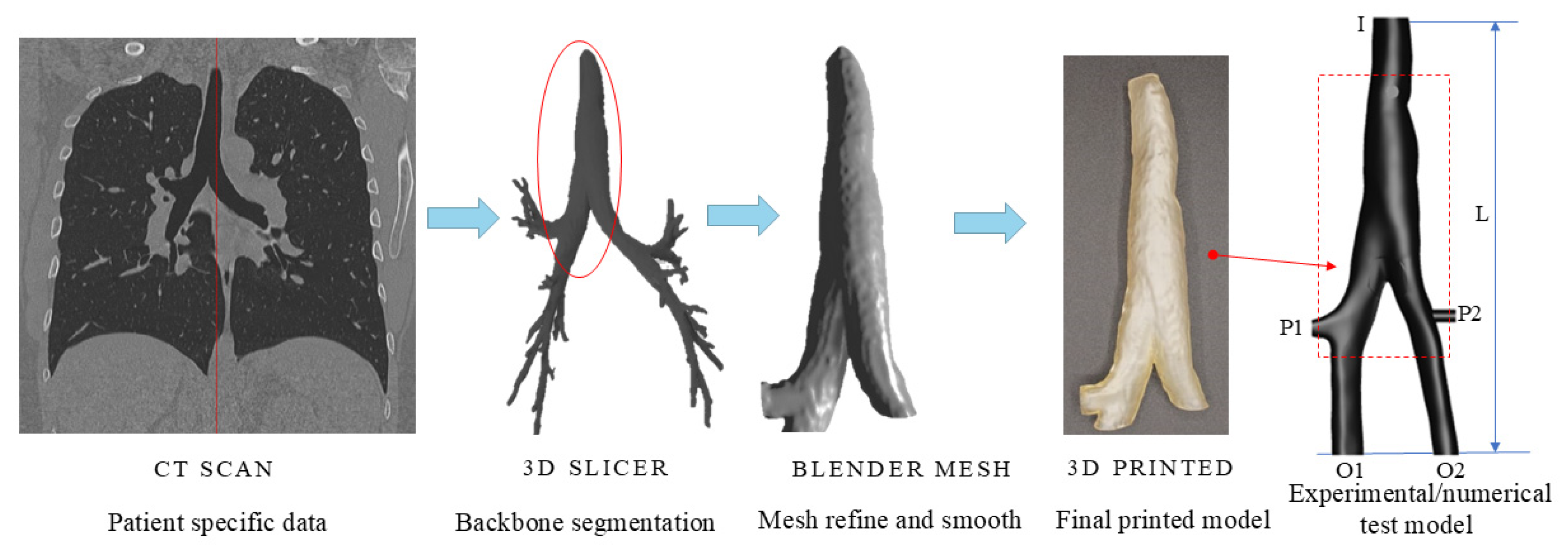
Figure 1. Reconstruction of a tracheal replica from a CT scan (obtained from the free database [63]) to a 3D printed model. The dimensions of the tested model are the following: inlet I-area AI = 1.33 × 10⁻⁴ m2, outlet O1-area AO1 = 4.82 × 10⁻⁵ m2, outlet O2-area AO2 = 4.72 × 10⁻⁵ m2, length from inlet to outlet L = 0.134 m.
Applsci 15 13055 g001
Figure 2. The diagrams obtained from spirometer data after an MVV test performed by a co-author of the paper: (a) V(t), including the plot of raw data printed from the spirometer; (b) time dependent flow rate, Q(t); (c) the parametric plot, Q(V); (d) raw data fitted with a 9-degree polynomial function for the interval A-D, (e) resulting parametric plot Q(V).
Applsci 15 13055 g002
Figure 3. (a) Experimental set-up for investigation of the airflow in tracheal bifurcation; detail with the location of the pressure port. Q = Q1 + Q2 is the inlet flow rate, where Q1 and Q2 are the flow rates in branches O1 and O2, respectively. (b) Input and measured parameters in the experiment: Qv and pv are the flow rate and pressure recorded by the mechanical ventilator, Q and p are the flow rate and pressure measured by transducers. (c) Detail of one cycle expiration–inspiration in the presence of cough, the mean inlet velocity, and outlet pressure variation in time, used as boundary conditions for the unsteady airflow numerical simulations in bifurcation.
Applsci 15 13055 g003
Figure 4. Boundary conditions for the analyzed cases: A and B; mesh details near the bifurcation: (a) exterior, (b) interior downstream of the bifurcation, (c) interior median plane. The computed results are (i) pressure pc(t) from case A, and (ii) flow rate Q(t) from case B.
Applsci 15 13055 g004
Figure 5. (a) The experimental and numerical distribution of flow rate Q1 and Q2 in the tested tracheal bifurcation, case A. (b) Comparison between experimental flow rate and computed flow rate for case B, with input ∆p(t) from case A; calculated pressure differences are also shown.
Applsci 15 13055 g005
Figure 6. Time variation in flow rate—comparison between the measurements and calculated values from case B: (a) normal cycle inspiration (I)—expiration (II)—inspiration, (b) detail of the flow rate variation during coughing.
Applsci 15 13055 g006
Figure 7. Numerical solutions for streamlines at t = 2.71 s (a) and iso-vorticity number distribution in the bifurcation plane (b) for the turbulence models (data from Figure 6a). The values of WSS at bifurcation point M are also given, with the maximum vorticity values highlighted in bold.
Applsci 15 13055 g007
Figure 8. Streamlines colored with pressure, velocity magnitude, and shear stress inside the tracheal bifurcation at two moments: (i) in the period of rest between normal inspiration–expiration cycle (t = 2.54 s), (ii) at the onset of cough (t = 9.37 s); see Figure 6.
Applsci 15 13055 g008
Figure 9. Distributions of velocity vectors (a), positive velocity areas (b), WSS iso-values distributions (c), and detail with z-component of WSS, where flow separation area and stagnation points are marked (d), at two times during the analyzed cough period from Figure 6b (results obtained with k ω   S S T model).
Applsci 15 13055 g009aApplsci 15 13055 g009b
Table 1. WSS [Pa] values at bifurcation point at the moments (1)–(5) from Figure 6.
Time0.742.714.149.039.37
Model
k ε   0.3100.00874.5 × 10−50.00130.57
k ω   S S T 0.2830.0120.02110.001971.1
k ε R 0.2860.00960.01970.00140.72
LES0.2780.0140.0260.00172.1
Disclaimer/Publisher’s Note: The statements, opinions and data contained in all publications are solely those of the individual author(s) and contributor(s) and not of MDPI and/or the editor(s). MDPI and/or the editor(s) disclaim responsibility for any injury to people or property resulting from any ideas, methods, instructions or products referred to in the content.