Abstract
Fermented fruit beverages enriched with probiotic microorganisms are gaining increasing interest due to their potential to combine sensory appeal with functional properties. In this study, apple and pear juices were fermented using Saccharomyces cerevisiae var. boulardii and the reference wine strain S. cerevisiae RV002, followed by sweetening with xylitol, erythritol, or stevia. The aim was to evaluate the fermentative performance of the probiotic yeast, the chemical composition of the resulting beverages, and the influence of sweeteners on the results of sensory evaluation. Both yeast strains efficiently produced ethanol within typical ranges for cider and perry. The highest ethanol concentration was observed in apple juice fermented with S. boulardii (49.01 ± 0.60 g/L), while the lowest occurred in pear juice fermented with S. boulardii (41.28 ± 1.00 g/L). Total phenolic content (TPC) decreased after apple juice fermentation but remained largely unchanged in pear juice. Notably, S. boulardii use resulted in the highest post-fermentation TPC value in pear juice (0.34 ± 0.002 g/L), while the lowest value was obtained in apple juice fermented with RV002 strain (0.27 ± 0.005 g/L). Our findings highlight the potential of S. boulardii for producing novel functional alcoholic beverages. Future work should examine long-term probiotic viability and optimise formulations for commercial application.
1. Introduction
The alcoholic beverage industry in Poland and the rest of Europe is growing quickly because more individuals are interested in drinks with unique aromas and flavours that may be beneficial to their health. As people become more aware of nutrition, there is also an apparent rise in demand for drinks with less sugar and higher levels of bioactive compounds and probiotics [1,2]. This study proposes a concept for creating two new alcoholic beverages derived from pear and apple juices, fermented with the probiotic yeast Saccharomyces cerevisiae var. boulardii, and subsequently sweetened with xylitol, erythritol, or stevia. The combination of locally sourced fruit raw materials, probiotic fermentation, and natural non-nutritive sweeteners aligns with current trends in functional food innovation [3,4,5].
Poland is the leading apple producer in the European Union. According to Eurostat data, the 2023 apple harvest in Poland was close to 3.8 million tonnes, accounting for over 30% of the total EU production [4]. In contrast, pear production in Poland remains relatively modest, averaging 50–60 thousand tonnes annually, while Italy (0.6 million tonnes) and Spain (0.4 million tonnes) dominate EU pear cultivation [4,6,7].
In Poland, apples are mainly processed into juice concentrate, which accounts for about 60–70% of all processed fruit. Pears, on the other hand, are primarily used to make purées, nectars, and desserts. There has been a rise in interest in fruit fermentation in recent years, especially for making ciders, fruit wines, and functional alcoholic drinks [4,6,8,9].
Both apples and pears are recognised as valuable sources of bioactive compounds. Apples provide significant levels of polyphenols (catechins and procyanidins), dietary fibre (notably pectin), vitamin C, and trace minerals. Pears are distinguished by their high fibre content (approximately 3 g/100 g) and polyphenolic profile dominated by chlorogenic acids, catechins, and tannins. The average polyphenol concentration in apples ranges from 110–250 mg/100 g fresh weight, whereas pears typically contain 60–120 mg/100 g. These compounds possess antioxidant properties, support the immune system, and exhibit prebiotic potential by stimulating the proliferation of beneficial intestinal microbiota [4,10,11,12,13].
Saccharomyces cerevisiae var. boulardii is a yeast strain exhibiting well-documented probiotic properties, characterised by its resistance to gastric acids and ethanol. It demonstrates the capacity to survive under fermentation conditions and to synthesise a range of metabolites beneficial to the intestinal microbiota [14,15,16]. Saccharomyces cerevisiae var. boulardii has been increasingly recognised as a valuable probiotic yeast with significant potential for incorporation into functional fermented beverages. Its pronounced tolerance to ethanol, acidic environments, and elevated fermentation temperatures allows the strain to remain viable and metabolically active in diverse substrates, including beer, wine, and fruit-based fermentations. During growth, S. boulardii synthesises a variety of bioactive metabolites, including short-chain fatty acids, polyamines, and antioxidant peptides, which may enhance the nutritional profile and functional properties of the resulting beverages. Experimental studies have confirmed its successful utilisation in the formulation of probiotic beers, fruit wines, and kombucha-type drinks, where cell densities consistently exceed 106 CFU/mL—a concentration generally regarded as necessary to exert probiotic effects. Thus, S. boulardii demonstrates potential not only as an effective fermentative organism that contributes to flavour and aroma development, but also as a functional culture that confers additional health-related benefits [17,18,19].
Saccharomyces cerevisiae RV002 is an active dry wine yeast produced by Angel Yeast Co., Ltd. (Yichang, Hubei, China), specifically formulated to ensure reliable primary fermentation in grape musts and fruit-based substrates. According to manufacturer documentation, RV002 supports rapid and complete sugar utilisation, promotes enhanced pigment and tannin extraction, increases polysaccharide release, and demonstrates favourable post-fermentation flocculation, attributes that render it particularly suitable for the production of red wines and structured fruit wines. In scientific contexts, RV002 is frequently employed as a reference industrial strain of S. cerevisiae, owing to its robust performance at oenological temperatures and consistent ethanol production kinetics. Given its high extraction efficiency and strong flocculating capacity, RV002 is recommended for premium red and fruit wines, as well as for mixed-culture fermentations that require rapid clarification and compatibility with malolactic fermentation [20,21].
Non-nutritive and low-calorie sweeteners, including erythritol, xylitol, and steviol glycosides, are increasingly employed as alternatives to sucrose in the formulation of alcoholic beverages, particularly in reduced-sugar and functional products. These compounds enable precise sweetness modulation and post-fermentation adjustment without being metabolised by fermentative yeasts, thereby maintaining beverage stability and preventing unwanted refermentation. Erythritol, a four-carbon sugar alcohol obtained via microbial fermentation, is largely non-metabolisable by Saccharomyces cerevisiae, which makes it an effective agent for providing residual sweetness in low-alcohol beers and wines. It also contributes to mouthfeel enhancement and a mild cooling sensation, without adding calories. Xylitol, another polyol, exhibits similar non-fermentable properties but offers sweetness intensity comparable to sucrose, as well as humectant functionality, which is beneficial for flavour retention in liqueurs and fortified wines. Both compounds are recognised as Generally Recognised as Safe (GRAS); however, excessive consumption may cause gastrointestinal discomfort due to osmotic effects [22,23,24]. Stevia (Stevia rebaudiana) extracts, rich in steviol glycosides such as rebaudioside A, represent a high-intensity, non-caloric sweetening alternative increasingly used in beers and ready-to-drink alcoholic cocktails to mitigate bitterness and improve flavour balance without increasing energy value. Collectively, these sweeteners offer considerable technological and sensory potential for innovation in the alcoholic beverage sector. Nonetheless, challenges persist regarding off-flavour masking, regulatory labelling, and consumer perception, highlighting the need for further research into their synergistic interactions, fermentation stability, and long-term storage performance [25,26,27].
Recent changes in the beverage industry show that new fermented products focused on health benefits, especially those related to probiotics, prebiotics, and postbiotics, are growing rapidly. More and more people are choosing non-dairy, plant-based substrates like fruit, cereal, and botanical matrices that deliver viable microbial cultures without lactose. This demonstrates that more people are looking for functional and clean-label alternatives to sugary or alcoholic drinks [28]. In recent years, scientific and regulatory perspectives on probiotics and prebiotics have evolved considerably. The International Scientific Association for Probiotics and Prebiotics (ISAPP) has introduced a unified definition of postbiotics as non-viable microbial cells or their components that confer health benefits, and has refined the definition of prebiotics to emphasise their selective utilisation by host microorganisms and evidence-based physiological effects. These developments have supported the emergence of novel fermented beverages incorporating synbiotic formulations, polyphenol-rich fibres, and plant-derived oligosaccharides to enhance gut health and bioactivity. Fermentation matrices have likewise diversified, including platforms such as kombucha, water kefir, and mixed-culture systems [29,30,31,32,33].
Fermentation of NFC fruit juices using yeast with documented probiotic properties, combined with natural, low-calorie sweeteners such as xylitol, erythritol or stevia, enables the production of beverages with reduced sugar content and potential health-promoting properties, resulting from both the properties of the fermented raw material and the presence of probiotic yeast cells. Such solutions align with current trends in the development of functional beverages and the search for new products that may be appreciated by consumers who recognise the versatile role of food in maintaining the body’s well-being.
Taking into account the above factors and market trends, we found it interesting to explore the possibility of obtaining beverages fermented by Saccharomyces cerevisiae var. boulardii yeast from apple and pear juice. The secondary, but no less important, objective of our research was to evaluate the possibility of using various sweeteners to correct the sweetness of apple and pear juice by probiotic yeasts.
2. Materials and Methods
2.1. Fruit Juices
Freshly pressed not-from-concentrate (NFC) apple (“Naturalny Sok Jabłkowy 100% NFC”) and pear (“Naturalny Sok Gruszka 100% NFC”) juices (AJ for apple juice and PJ for pear juice, respectively) were procured from the fruit processing company Tłocznia Szymanowice (Szymanowice, Mazowieckie, Poland) and utilised in all experimental trials. According to the manufacturer’s declaration, the juices were cold-pressed from Polish apples and pears harvested in 2025. To ensure the manufacturer’s declared shelf life of at least 10 months (unopened, factory-filled, vacuum-packed, sterile LDPE bags), the juices were pasteurised at a temperature not exceeding 80 °C.
2.2. Yeasts and Inoculum Preparation
The Saccharomyces cerevisiae var. boulardii culture was freshly sourced from the commercial probiotic formulation Enterol250 (Biocodex, 94250 Gentilly, France), each capsule containing not less than 250 mg of lyophilised S. cerevisiae var. boulardii CNCM I745 cells. The lyophilised yeast was reactivated in 150 mL of YPG broth (yeast extract 10 g/L; bacto-peptone 20 g/L; glucose 20 g/L; pH 5.2 ± 0.1), sterilised by autoclaving (121 °C, 20 min), and cultivated at 32 ± 1 °C for 24 h using a reciprocal laboratory shaker operating at 140 oscillations per minute (Eberbach E5900, Belleville, IL, USA).
Following cultivation, the yeast suspension was centrifuged at 5000× g for 10 min (Laboratory Centrifuge MPW380R; MPW; Warsaw; Poland) and washed twice with sterile 0.9% (w/v) sodium chloride solution. The dry matter (DM) content of the resulting yeast suspension was quantified spectrophotometrically at 540 nm using a pre-established calibration curve (Rayleigh Analytical Instrument, Beijing, China).
A second yeast strain, Saccharomyces cerevisiae RV002, a wine yeast (Angel Yeast Ltd., Yichang, China), was used as a reference. One hour before inoculation, the dried yeast was suspended in sterile 0.9% NaCl solution, and its DM content was determined analogously to that of S. cerevisiae var. boulardii. For fermentation, both strains were inoculated at a concentration equivalent to 250 mg DM per 250 mL of juice.
2.3. Determination of Total Phenolic Content (TPC)
The total phenolic content was determined spectrophotometrically using the Folin–Ciocalteu method, as adapted from Vieira et al. [34]. Briefly, 1.5 mL of either the gallic acid standard solution or an appropriately diluted juice was combined with 2.25 mL of distilled water, followed by the addition of 1.5 mL of Folin–Ciocalteu reagent diluted 1:10 (v/v) with water. After gentle mixing, the reaction mixture was left in the dark for 5 min, after which 1.5 mL of 6% (w/v) sodium carbonate solution was added. The mixture was incubated in the dark for 30 min, and absorbance was subsequently measured at 725 nm against a reagent blank using a UV9200 UV/Vis spectrophotometer (Rayleigh Analytical Instrument, Beijing, China).
A calibration curve was established using gallic acid standards, and the results were expressed as grams of gallic acid equivalents (GAE) per litre of juice. The blank was prepared by substituting the gallic acid or juice sample with distilled water.
2.4. Determination of pH and Total Extract
Samples were centrifuged at 5000× g for 10 min, and the temperature was adjusted to 20 ± 1 °C before analysis. The pH was determined using an SI Analytics HandyLab 100 pH meter (Xylem Analytics, Mainz, Germany). Total soluble solids were measured using a handheld digital refractometer (Atago, Tokyo, Japan) and expressed as degrees Brix (°Bx).
2.5. Juice Fermentation
Fermentations were conducted in 1 L glass bottles containing 250 mL of the relevant juice, supplemented with diammonium phosphate (DAP, (NH4)2HPO4) at a concentration of 0.2 g/L. Each fermentation treatment was performed in triplicate. Juices were inoculated with yeast suspensions at a rate of 250 mg DM per litre of juice. Bottles were fitted with fermentation locks filled with glycerol to restrict oxygen ingress. Alcoholic fermentation proceeded at 29 ± 1 °C for 7 days.
After fermentation, 50 mL aliquots were collected for chemical analysis and stored at −20 °C. The remaining fermented juice was held at 7 ± 1 °C for 24 h before sensory evaluation.
2.6. Sample Designation
The following abbreviated sample codes were adopted for clarity:
AJ; PJ—Apple juice and pear juice, respectively
unf-unfermented
AJ Sb; PJ Sb—apple juice or pear juice fermented with S. cerevisiae var. boulardii
AJ Sc; PJ Sc—apple juice or pear juice fermented with S. cerevisiae RV002, the reference strain of wine yeast
Xyltl*—fermented juice with xylitol, E967, (50 g/L) added after fermentation
Erytrtl*—fermented juice with erythritol, E968, (77 g/L) added after fermentation
Stevia*—fermented juice with stevia, E960a, (0.5 g/L) added after fermentation
*—When determining the doses of xylitol, erythritol and stevia, we relied on the results of our preliminary, published [35] and unpublished trials, in which we selected the range of interchangeable doses of sweeteners based on literature data [36,37,38] describing the sweetness of individual sweeteners in relation to sucrose. We assumed we would adopt a single sweetener dose (equivalent to 50 g of sucrose/L), corresponding to 50 g/L xylitol, 77 g/L erythritol, and 0.8 g/L stevia.
2.7. Sensory Evaluation
After the 7-day fermentation, samples were equilibrated for 24 h at 7 ± 1 °C. Sensory assessments were conducted by a trained panel of 10 members (aged 25–65 years) from the Department of Biotechnology and Food Sciences at Lodz University of Technology (Poland). All panellists were experienced in evaluating fermented beverages through regular participation in related research.
Samples (approximately 50 mL) were served at approximately 12 °C in a randomised order, anonymised using alphanumeric codes, and presented in single-use plastic cups. Unsalted crackers and distilled water were provided for palate cleansing between evaluations.
Panellists assessed sensory attributes including colour intensity, aroma, sweetness, fruitiness, yeastiness, and aftertaste, using a 10-point scale (1 = lowest intensity; 10 = highest intensity). Reference solutions were prepared as follows: for colour, aroma, and fruitiness—5% (v/v) ethanol in the corresponding juice (prepared from 92% rectified spirit); for sweetness—juice diluted 1:10 with distilled water and sweetened with sucrose (50 g/L). In addition to evaluating individual parameters, the evaluators were asked to answer the following question: On a scale of 1 to 10 (where 1 means “never” and 10 means “definitely”), to what extent would you like to purchase such a product in the future?
2.8. Chromatographic Analysis of Sugars, Organic Acids, and Alcohols
Quantitative analyses of glucose (GLU), fructose (FRU), citric acid (CitA), malic acid (MalA), succinic acid (SucA), lactic acid (LacA), acetic acid (AceA), tartaric acid (TarA), glycerol (GlyOH), sorbitol (SorOH) and ethanol (EtOH) were performed using High-Performance Liquid Chromatography (HPLC) with an Agilent 1260 Infinity system (Agilent Technologies, Santa Clara, CA, USA USA) equipped with a Hi-Plex H+ column (7.7 × 300 mm, 8 µm) and a refractive index detector (RID) maintained at 55 °C. Column temperature was set to 60 °C. The mobile phase consisted of 0.005 M H2SO4 (HPLC grade) at a flow rate of 0.7 mL/min, with a 20 µL injection volume.
Before analysis, samples were treated with 10% (w/v) zinc sulphate for protein precipitation, centrifuged (5500× g, 10 min), and filtered through 0.22 µm PTFE membranes.
2.9. Statistical Analysis
All analyses were performed at least in triplicate. Statistical evaluations, including analysis of variance (ANOVA), standard deviation (SD) calculation, and Student’s t-test at a significance level of α = 0.05, were conducted using OriginPro 7.5 (OriginLab Corporation, Northampton, MA, USA).
3. Results and Discussion
3.1. Apple and Pear Juice Parameters
The basic parameters of juices used in our experiments are shown in Table 1.
Table 1.
Parameters of the apple juice and pear juice used in the experiments.
The principal physicochemical attributes of the apple (AJ) and pear (PJ) juices utilised in this investigation are presented in Table 1. Both juices exhibited comparable total soluble solids (11.9–12.2 °Brix) values, which are typical of freshly pressed fruit juices. The pH measurements confirmed that apple juice was more acidic (3.16 ± 0.06) than pear juice (3.61 ± 0.11), reflecting the well-documented compositional differences between Malus domestica and Pyrus communis fruits.
Among the fermentable carbohydrates, fructose was the predominant sugar in both juices, reaching concentrations of 69.98 ± 2.83 g/L in AJ and 68.79 ± 4.12 g/L in PJ. Glucose levels were markedly higher in AJ (28.72 ± 1.99 g/L) than in PJ (19.52 ± 0.71 g/L), whereas sorbitol—a characteristic sugar alcohol of pears—was substantially more abundant in PJ (18.25 ± 1.60 g/L) than in AJ (3.32 ± 0.33 g/L). Overall, the total concentration range of simple sugars and polyols extended from 3.32 g/L (sorbitol in AJ) to 69.98 g/L (fructose in AJ). These findings confirm the fructose-dominant character of both matrices, with pear juice distinguished by its significantly higher sorbitol content. Comparable sugar profiles have been reported in compositional analyses of apple and pear juices, where glucose and fructose typically range from 9–32 g/L and 66–96 g/L, respectively, in apple juices [39], and from 7–31 g/L and 48–83 g/L, respectively, in pear juices [12,40]. Reported sorbitol concentrations in pear juice vary considerably, from approximately 6 to 25 g/L depending on cultivar and ripening stage [12,40,41]. For apple juices, the sorbitol concentration range of 2.5–7 g/L reported by Dietrich [41] closely matches the values observed in our study.
The distribution of organic acids also revealed distinct species-specific patterns. Malic acid was the principal organic acid in apple juice (5.77 ± 0.41 g/L). In contrast, pear juice contained a lower concentration of malate (2.01 ± 0.06 g/L) but a considerably higher amount of citric acid (0.84 ± 0.04 g/L, compared with 0.04 ± 0.002 g/L in AJ). Succinic acid was detected exclusively in PJ (0.28 ± 0.02 g/L), while lactic (0.03 ± 0.002 g/L) and tartaric acids (0.60 ± 0.04 g/L) were found solely in AJ. In total, the range of organic acids extended from 0.03 to 5.77 g/L. These results are consistent with earlier studies, which report that malic acid is the predominant acid in apple juice, whereas pear juice generally exhibits higher proportions of citric and succinic acids [41,42]. The trace level of lactic acid detected in AJ likely reflects a minor degree of spontaneous malolactic conversion occurring before controlled fermentation.
Before fermentation, only trace amounts of alcohols and polyols were present, confirming the absence of undesired microbial activity in the raw materials. Ethanol concentrations reached 0.32 ± 0.01 g/L in AJ and 0.17 ± 0.01 g/L in PJ, while glycerol was detected solely in AJ (0.15 ± 0.01 g/L). The low ethanol and glycerol levels are characteristic of fresh, unfermented juices [43,44] and provide a reliable baseline for subsequent fermentation experiments.
The compositional patterns determined in this study closely align with those previously reported for apple and pear juices undergoing fermentation with Saccharomyces species. In apple juice, the predominance of fructose and malic acid, together with the relatively low pH, typifies musts commonly used for cider production [45,46]. In contrast, pear juice is generally characterised by a higher pH, a lower malate-to-citrate ratio, and elevated sorbitol levels, which collectively impart the distinctive sensory profile of perry [47]. The concentration of sorbitol measured in PJ (18.25 g/L) accords with the well-established observation that S. cerevisiae is unable to metabolise sorbitol efficiently under anaerobic conditions, resulting in its persistence as a residual sweetener following fermentation [48].
Overall, the compositional data obtained here fall within the expected ranges for natural apple and pear juices before Saccharomyces-driven fermentation. The higher malic acid concentration and lower pH of AJ suggest a greater potential for acid reduction during yeast fermentation. In contrast, the sorbitol-rich, citrate-dominant profile of PJ indicates a predisposition towards a sweeter, less acidic flavour profile in the final fermented product. The minimal levels of ethanol and glycerol further confirm the microbiological stability of both juices before inoculation. Consequently, the compositional differences between AJ and PJ establish a robust baseline for interpreting the biochemical and sensory transformations that occur during fermentation with S. cerevisiae var. boulardii and the reference wine yeast strain.
3.2. Composition of Fermented Apple and Pear Juices
The concentrations of selected sugars, organic acids, and alcohols in apple (AJ) and pear (PJ) juices following fermentation with Saccharomyces cerevisiae var. boulardii and S. cerevisiae RV002 are presented in Table 2 and Table 3.
Table 2.
The concentrations [g/L] of selected acids, sugars, and alcohols in the samples after fermentation of apple juice with S. boulardii and S. cerevisiae yeast.
Table 3.
The concentrations [g/L] of selected acids, sugars, and alcohols in the samples after fermentation of pear juice with S. boulardii and S. cerevisiae yeast.
Both yeast strains demonstrated high fermentative efficiency, as evidenced by near-complete utilisation of fermentable carbohydrates (glucose and fructose) and the production of ethanol and secondary metabolites.
Post-fermentation analyses revealed that glucose and fructose levels were extremely low in both juices, indicating efficient carbohydrate metabolism by both yeasts. In AJ, glucose decreased to 0.05 ± 0.002 g/L when fermented with S. boulardii and to 0.06 ± 0.005 g/L for S. cerevisiae fermentation. Fructose levels were a bit higher, at 0.62 ± 0.044 g/L and 2.05 ± 0.156 g/L, respectively. A comparable trend was observed in the pear juice fermented by both strains. The glucose concentrations in PJ reached 0.08 ± 0.008 g/L for S. boulardii and 0.01 ± 0.001 g/L for S. cerevisiae, while fructose values decreased from the initial values (Table 1) to 1.10 ± 0.059 g/L and 0.98 ± 0.035 g/L (Table 2), respectively.
In the apple juice worts, S. cerevisiae fermented fructose less completely than S. boulardii. These result aligns with previous findings, which show that S. cerevisiae preferentially ferments glucose over fructose due to differential transporter affinities and enzymatic kinetics, resulting in the accumulation of residual fructose [45,49,50]. However, the data analysis after the pear juice fermentations (Table 3) does not support this thesis (p = 0.055). Although S. boulardii and S. cerevisiae strains are genetically very similar, our observations and those of others [51,52] indicate that the results of fermentation of sugars from fruit juices by probiotic yeasts may differ from those predicted, based on fermentation by S. cerevisiae yeasts.
Comparing the sorbitol concentrations before (Table 1) and after fermentations (Table 2 and Table 3), it may be stated that it was unaffected by fermentation, suggesting that neither S. boulardii nor S. cerevisiae metabolised this polyol in our worts. These results corroborate earlier reports that S. cerevisiae cannot assimilate sorbitol under anaerobic conditions [48].
Fermentation induced some modifications in the organic acid composition of both juice types. In apple juices, the malic acid remained the predominant acid (5.77 ± 0.406 g/L in unfermented AJ), with concentrations of 5.12 ± 0.23 g/L after S. boulardii fermentation and 5.85 ± 0.30 g/L for the S. cerevisiae strain. These slight differences (p = 0.042) may be associated with metabolic variation between strains and the partial synthesis of malate intermediates under fermentative stress, as proposed by Vion et al. [53]. In pear juice samples, malic acid concentrations (2.21–2.28 g/L) were slightly but significantly higher (p < 0.05) than in the unfermented PJ (2.01 ± 0.056 g/L), with no statistical difference (p > 0.4) between strains, reflecting the naturally lower malate content of pears.
The increase (p< 0.05) of the succinic acid, a characteristic secondary product of yeast metabolism, was detected in both fermented juices. In the apple juice, the concentration of this acid changed from 0 (Table 1) to 0.54–0.65 g/L (depending on the strain, Table 2). For pear juice, this increase was also observed, from 0.28 ± 0.021 g/L in unfermented PJ to 0.69–0.71 g/L after fermentation.
However, although there were significant (p < 0.05) differences in the concentration of this acid, depending on the yeast strain, its overall increase during fermentation can also be attributed to the presumed presence of trace amounts of lactic acid bacteria, which are usually responsible for the occurrence of this acid in fermented products. Our research did not include microbiological analyses for possible bacterial contaminants, so, based on our results, we are unable to confirm or rule it out. What was also discussed by others [54,55,56,57].
When comparing the acetic acid concentration before and after fermentation in both juices, a significant increase was observed. Acetic acid formation varied notably (p < 0.05—Table 2 and Table 3) between strains. In both juices, S. boulardii generated higher acetic acid concentrations (0.25 g/L in AJ; 0.41 g/L in PJ) than S. cerevisiae (0.06 g/L and 0.14 g/L, respectively). Comparable findings have been reported in other fermentations, where non-wine or probiotic S. cerevisiae strains were found to produce more volatile acids as a result of differences in acetaldehyde metabolism [58].
Tartaric acid presence increased significantly during fermentations of apple juices (Table 1 and Table 2). For pear juices (Table 1 and Table 3), these concentrations remained stable. The apple juice samples after fermentation were distinguished by higher levels (1.06–1.07 g/L) than pear juices (0.03–0.04 g/L), which reflects compositional differences between the two fruits.
Citric acid was undetected in any fermented sample, contradicting previous reports and indicating that S. cerevisiae strains typically produce or maintain citric acid at low to moderate concentrations during alcoholic fermentation. This is attributed to the lack of effective mechanisms for citric acid degradation under anaerobic or high-glucose conditions, leading to its persistence or minimal accumulation as a byproduct of glucose metabolism via the TCA cycle [13,59].
Ethanol synthesis was evident in both juice samples, confirming the effectiveness of alcoholic fermentation. In the fermented apple juices, the ethanol levels were 49.01 ± 0.60 g/L for S. boulardii and 47.98 ± 1.32 g/L for S. cerevisiae. In the pear juices, the levels of ethanol after fermentation were 41.28 ± 1.00 g/L and 41.35 ± 3.34 g/L, for the tested strains, respectively. These differences were not statistically significant (p > 0.05) between strains. The total ethanol yields were about 5.9–6.2% (v/v) in AJ and 4.9–5.0% (v/v) in PJ, which are within the normal range for cider and perry fermentations [45,47,60].
Glycerol, an important secondary metabolite contributing to sweetness and mouthfeel, accumulated to 4.85 ± 0.17 g/L in apple juice fermented by S. boulardii and 4.38 ± 0.29 g/L when fermented by S. cerevisiae. In pear juice, the corresponding concentrations were 4.05 ± 0.10 g/L and 3.73 ± 0.31 g/L, respectively. The increase in glycerol concentration during S. cerevisiae fermentations is consistent with the possible osmotic stress response reported by others [61,62,63].
When comparing both juice types, fermentation of AJ generally resulted in higher (p < 0.05) ethanol concentration, whereas fermented pear juices contained greater amounts of succinic and acetic acids. Differences between the yeast strains were relatively modest.
Overall, these findings confirm that both strains efficiently fermented the available monosaccharides. The compositional shifts observed are consistent with previous reports on fruit fermentations conducted with Saccharomyces species, in which the interplay among substrate composition, yeast strain, and acidity significantly influences metabolite formation and also the resulting sensory characteristics [45,47].
Total Phenolic Content in Apple and Pear Juices
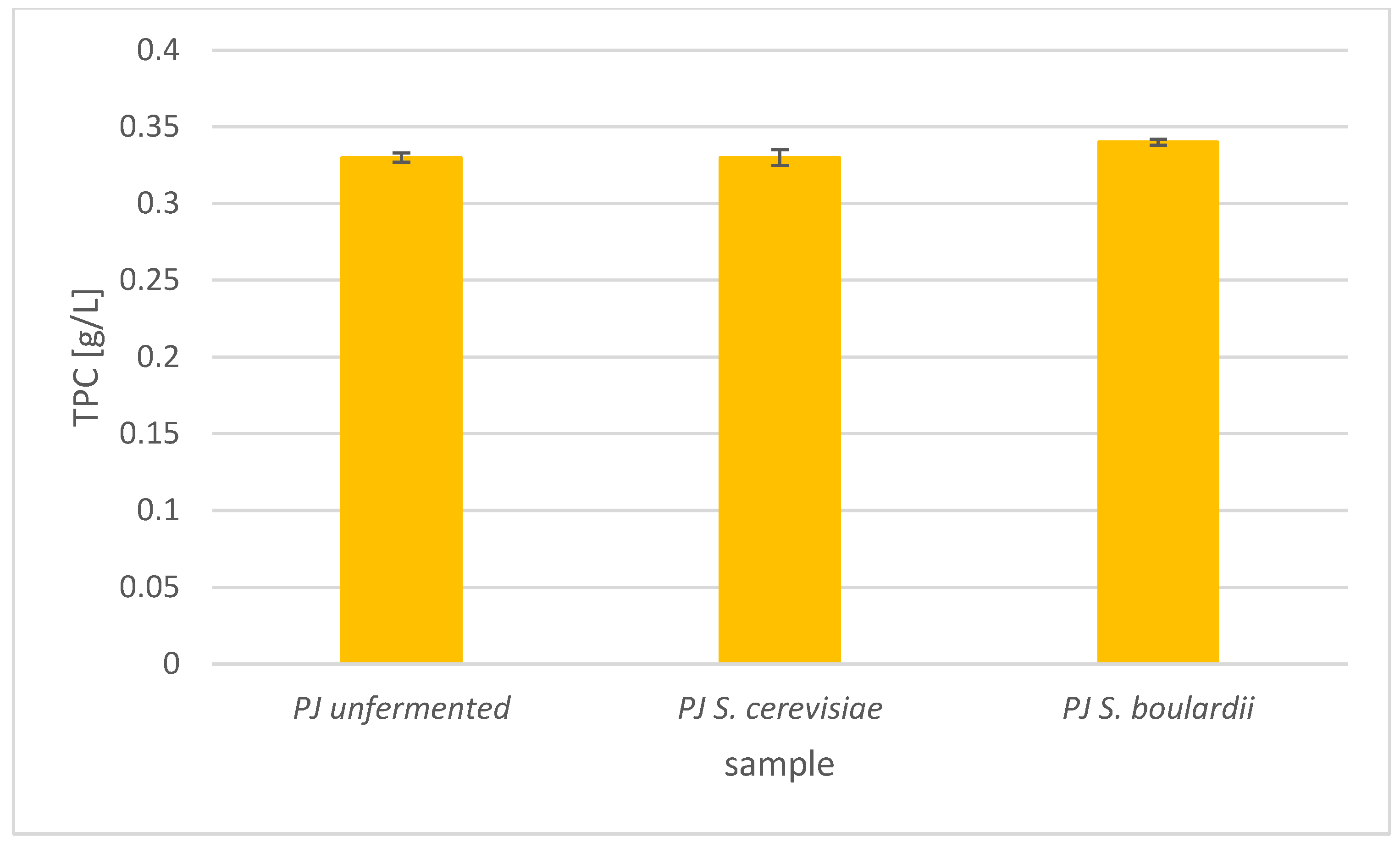
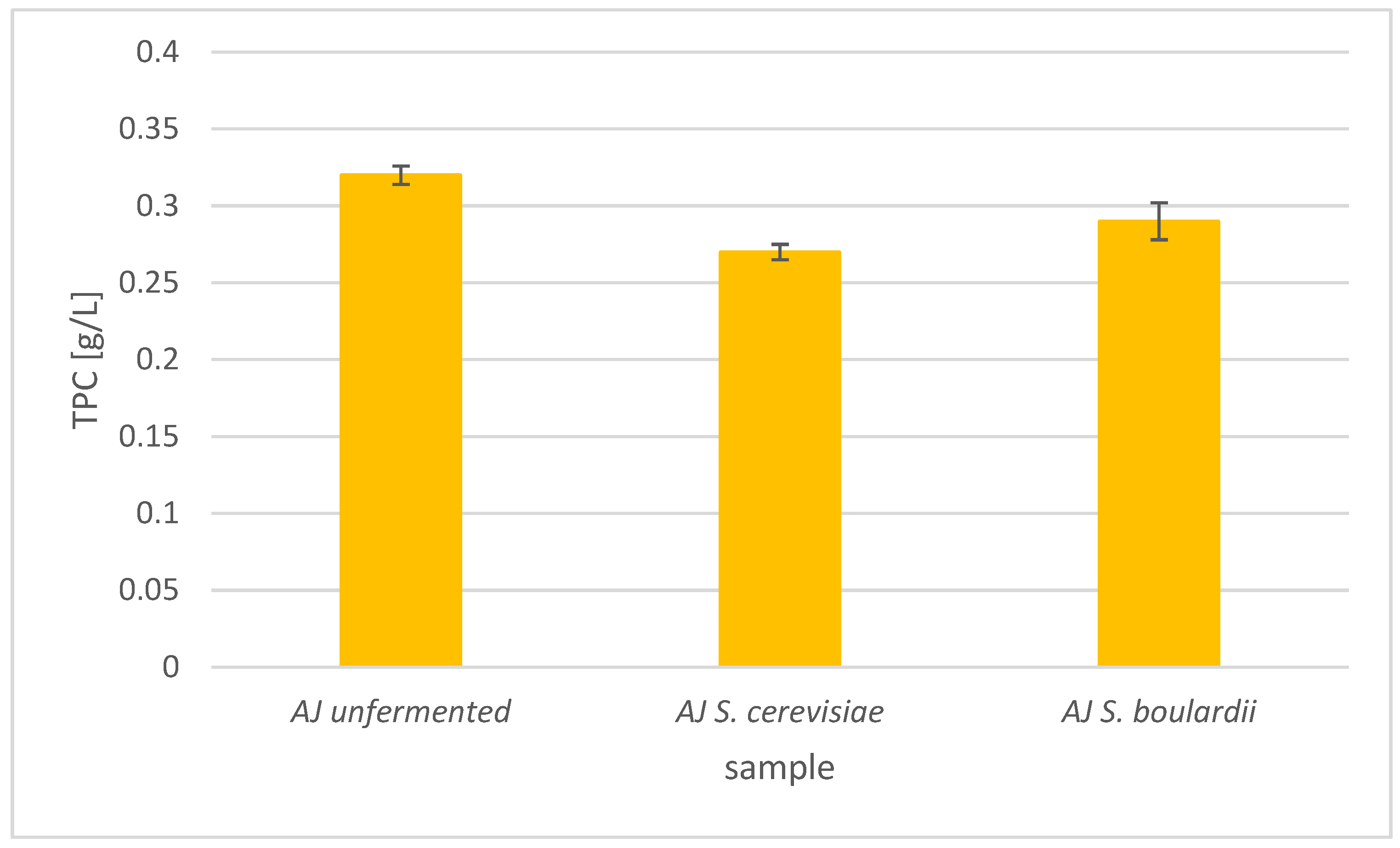
Phenolic compounds are essential for the antioxidant activity, colour stability, and taste of fruit-based drinks. Because of this, we thought it would be valuable to investigate this parameter in juices before and after fermentation. The total phenolic content (TPC) of apple (AJ) and pear (PJ) juices before and after fermentation with Saccharomyces cerevisiae RV002 and S. cerevisiae var. boulardii is shown in Figure 1 and Figure 2.
Figure 1.
Total polyphenols concentration in the apple juice before and after fermentation.
Figure 2.
Total polyphenols concentration in the pear juice before and after fermentation.
In unfermented apple juice, the TPC amounted to 0.32 ± 0.006 g/L, and this value declined following fermentation with both yeast strains. After fermentation with S. cerevisiae wine, the reference strain, the TPC decreased to 0.27 ± 0.005 g/L (approximately a 15.6% reduction), whereas fermentation with probiotic yeast yielded a slightly higher final total phenolic compounds of 0.29 ± 0.012 g/L (a decrease of about 9.4% relative to the initial concentration).
Conversely, the TPC in pear juices remained stable after fermentation. The unfermented pear juice exhibited a TPC of 0.33 ± 0.003 g/L, a value that was maintained following fermentation with S. cerevisiae (0.33 ± 0.005 g/L) and was equal to 0.34 ± 0.002 g/L for the sample fermented with S. boulardii.
The different trends observed for both strains made it difficult for us to clearly explain this phenomenon, as the literature on this subject offers many explanations for changes in polyphenol concentration during alcoholic fermentation. Many publications suggest the possibility of polyphenol adsorption to yeast cell walls and their possible oxidation during fermentation [64,65,66]. The slight differences among probiotic strains were also explained by minor variations in the structure and electrical charge of the cell walls, which may translate into differences in the ability to retain polyphenols on their surfaces [67,68,69].
Similar retention of phenolic compounds has been reported in perry and other low-acid fruit fermentations, where the higher pH and the presence of natural sorbitol appear to provide a protective effect against oxidative losses [47,70].
The preliminary results presented here encourage us to continue researching the impact of probiotic yeast on TPC. In our opinion, our observations support the suggestion that the probiotic yeast strain we tested better preserved the high polyphenolic potential of fermented juices than the RV002 wine yeast strain.
3.3. Sensory Properties of Fermented Apple and Pear Juices
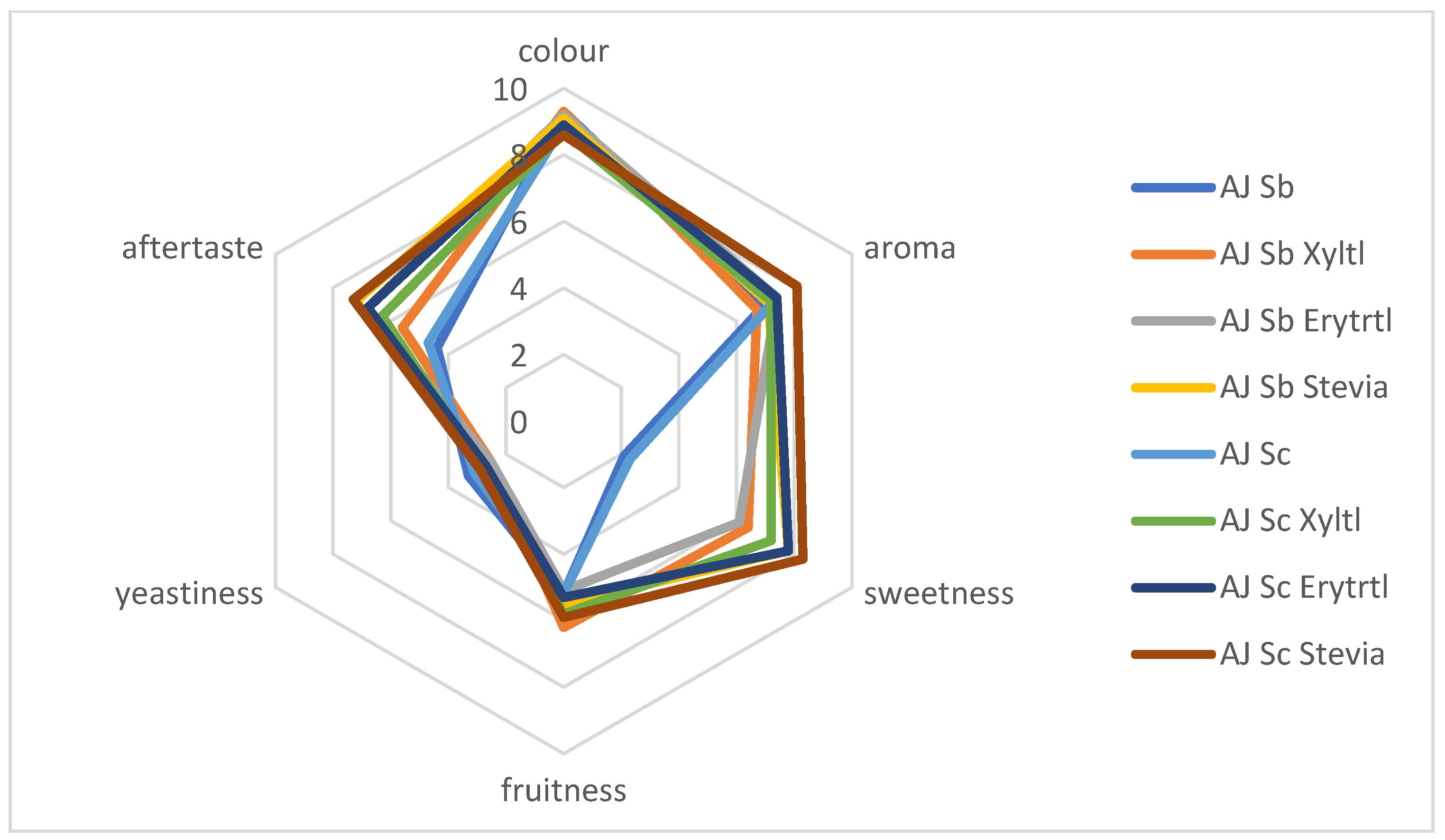
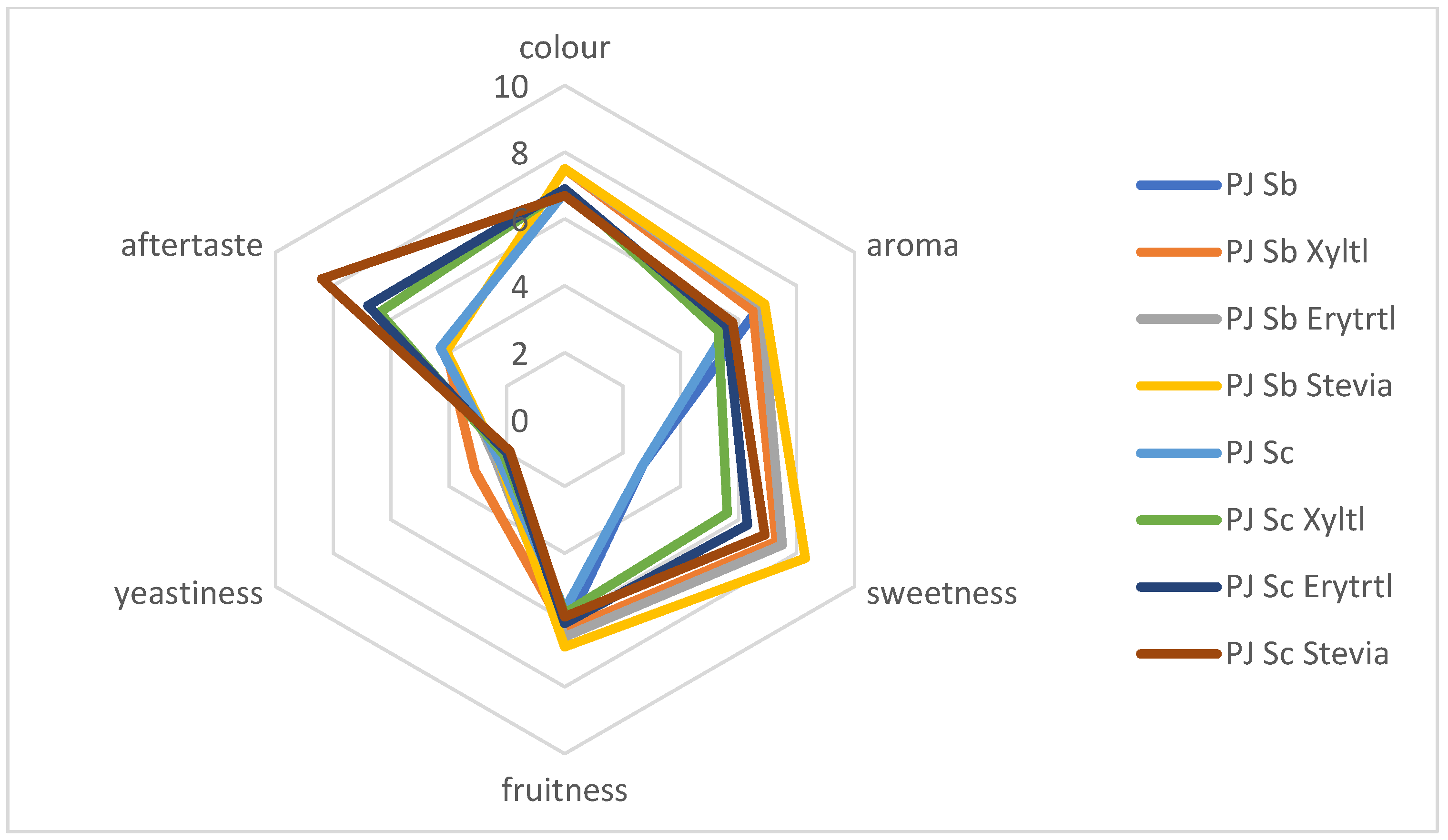
The sensory features of the fermented juices, with or without sweetener added after fermentation, are presented in Figure 3 and Figure 4.
Figure 3.
Sensory properties of the fermented apple juice.
Figure 4.
Sensory properties of the fermented pear juice.
Across the apple juice (AJ) samples, colour intensity remained consistently high following fermentation. Colour assessed mean values ranged from 8.6 (Sc + stevia) to 9.3 (Sb without sweetener or with xylitol).
The lowest mean aroma value was observed for Sb + xylitol (6.7), while the highest was recorded for Sc + stevia (8.1). The interplay between flavour and sweeteners in low-sugar beverages occurs via both physical and cognitive mechanisms. Polyols such as xylitol and erythritol can reduce the volatility and diffusion of scent components by augmenting molecular friction within the matrix. Nonetheless, this does not invariably diminish sensory intensity, as the synergy between sweetness and olfaction may enhance the overall smell experience. Stevia is a high-intensity sweetener, but it may impart a bitter or metallic note that diminishes the overall aroma. Nevertheless, when stevia is used with polyols, these undesirable flavours are largely masked. Blends of polyols and stevia not only emulate the taste of sucrose more effectively, but also enhance the olfactory appeal of sweet, fresh aromas, rendering them more universally palatable than stevia alone [71,72].
As anticipated, perceived sweetness rose substantially with all sweeteners relative to the unsweetened controls (2.1–2.3). Among Sb samples, sweetness followed the order: stevia (7.8) ≥ xylitol (6.4) > erythritol (6.1), whereas among Sc samples, the order was stevia (8.3) > erythritol (7.8) > xylitol (7.2). Thus, the sensory potency of the sweeteners was perceived as stevia ≥ erythritol > xylitol, with slightly stronger responses observed in Sc fermentations. It is important to note that the selection of dose relationships derived from our findings [35] and existing literature [36,37,38] complicates the formulation of definitive hypotheses regarding the sweetness of individual sweeteners in contexts outside the parameters of our experiment.
Fruitiness is a crucial parameter of fermented juice, describing the raw material identity that customers expect. This parameter increased moderately following the addition of the sweetener (range 5.1–6.2). However, as shown in Figure 3, the values of this parameter form a relatively tight cluster, making it difficult to draw reliable, general conclusions from this alone.
Yeastiness impression is one of the usually not expected sensoric parameters of fermented beverages. Intensity of this parameter decreased slightly under all sweetened conditions relative to the unsweetened controls, with scores falling from approximately 3.1 to 3.3 to 2.5 to 2.9. This reduction suggests that sweeteners effectively masked fermentation-derived notes for both yeast strains.
Aftertaste intensity, like yeastiness and aroma, was influenced by sweeteners, increasing from 4.4–4.7 (unsweetened) to 7.2–7.3 with stevia, while erythritol (6.8) and xylitol (5.6–6.3) produced intermediate effects.
In pear juice (PJ), overall colour perception was lower than in AJ but remained consistent within 6.7–7.5.
Aroma mean scores were notably higher after the fermentations conducted by probiotic yeast than after wine yeast fermentations (6.5–6.9 vs. 5.3–5.8). The explanation linking the beverage’s aroma to the type and amount of sweetener added was discussed earlier in the case of apple juice fermentation. As for the apple juices, the perceived sweetness increased markedly with all sweeteners relative to the unsweetened controls (2.7). For Sb, the order of perceived intensity was stevia (8.3) ≥ erythritol (7.5) ≥ xylitol (7.3), whereas for Sc it followed stevia (6.9) > erythritol (6.3) > xylitol (5.6). Thus, the same qualitative ranking of sweetening potency observed in the case of the apple juices was maintained in the fermentations of pear juices, though the magnitude of perceived sweetness was higher in Sb than in Sc-carried fermentations.
Fruitiness was generally greater in PJ than in AJ and responded positively to the addition of sweetener. The yeastiness was lower overall in PJ compared with AJ and declined further upon sweetening. The lowest values of this parameter were recorded when stevia was added (2.3 in Sb and 1.9 in Sc), suggesting that sweetness may have effectively masked yeast-associated flavours in both strains, as observed during apple juice fermentations.
Aftertaste exhibited a clear strain-dependent response to sweetening. In Sb samples, aftertaste intensity remained constant at 4.1 across all sweeteners. In contrast, Sc samples showed a marked increase in xylitol (6.4), erythritol (6.8), and stevia (8.4).
The evaluators gave the lowest rating (average 1.2–1.8) to unsweetened juices after fermentation, regardless of the yeast strain used, when assessing the willingness to purchase a product similar to the one tested. The highest rating (average 8.5) on this scale was given to pear juice sweetened with stevia and fermented using Saccharomyces boulardii. In the case of apple juice, the highest rating (8.3) was given to apple juice also sweetened with stevia and fermented with probiotic yeast, although it must be noted that both types of juice, fermented with RV002 wine yeast and sweetened with stevia, received similar scores: 7.9 points for apple juice and 8.1 points for PJ, respectively.
Pear and apple juices fermented and sweetened with xylitol and erythritol received scores ranging from 5.3 to 7.8, regardless of the yeast type used.
While additional comprehensive research is required to formulate broader conclusions regarding the influence of sweeteners and yeast varieties on the flavour and aroma of fermented apple and pear juices, our initial findings suggest that yeast type significantly enhances taste and aroma, particularly in pear juice.
Secondly, the addition of sweeteners consistently reduced perceived yeastiness while increasing aftertaste persistence, following the order stevia > erythritol > xylitol.
Non-nutritive sweeteners are recognised for their capacity to enhance perceived fruit notes by suppressing acidity and bitterness while masking yeast-derived volatiles. Stevia, in particular, tends to provide the highest sweetness at equivalent sucrose-equivalence levels but may also impart a more persistent, liquorice-like aftertaste [73,74,75]. Erythritol and xylitol are sugar alcohols that add to the mouthfeel and body. Erythritol provides a cooling sensation and a clean finish, while xylitol results in a softer sweetness and a fuller texture [3,76]. Post-fermentation back-sweetening has been shown to make cider and perry taste more fruity and less “yeasty”. Stevia usually leaves the most lasting aftertaste, while erythritol has a more balanced taste profile with less yeastiness [70,77]. Additionally, the strain-specific sensory patterns identified—specifically, the intensified aroma and glycerol-related roundness in Sb fermentations—correspond with prior findings that probiotic Saccharomyces strains can alter volatile release and mouthfeel in ways distinct from traditional wine yeasts [45].
It is important to highlight that our sensory evaluation concentrated on clusters of parameters perceived as sensory impressions. Nonetheless, it is crucial to acknowledge that the sensations of taste and smell depend on the quality and quantity of the fermented juice. Succinic acid, characterised by pronounced bitter and salty nuances, significantly influences a wine’s mouthfeel and structural integrity. Malic and citric acids primarily influence the beverage’s acidity and freshness. Ethanol and glycerol further alter the sensory characteristics by enhancing sweetness, viscosity, and fragrance. Higher alcohols and esters intensify fruity and flowery feelings. The equilibrium and concentration of significant organic acids, such as malic, lactic, tartaric, citric, and acetic acids, fundamentally influence the sweetness, sourness, and aftertaste of a substance [78,79,80].
Our sensory findings presented here indicate that substituting the conventional wine yeast with the probiotic strain S. cerevisiae var. boulardii did not lead to any adverse alterations in colour, aroma, or taste attributes of the fermented beverages. This result is significant because S. boulardii was not originally chosen for use in winemaking, but it shows sensory performance similar to that of well-known wine yeasts. These results highlight the potential of probiotic yeasts in creating fermented fruit beverages with functional attributes. Similar conclusions have been reported by others [81,82,83,84], which also supports the observations of Pinto et al. [85], who highlighted that probiotic yeast fermentation offers new opportunities for enhancing beverage functionality and overall sensory quality.
4. Conclusions
We aimed to evaluate the possibility of using probiotic yeast for the fermentation of Polish NFC pear and apple juices available on the market. The basic chemical parameters of the fermented juices were evaluated, including ethanol concentration. The fermented juices were subjected to sensory evaluation, during which the use of three sweeteners was compared, as well as the willingness to purchase a similar product in the future.
It was observed that the S. boulardii strain exhibited strong fermentative efficiency, directly comparable with the results obtained for the reference wine yeast. It was also evidenced by the near-complete utilisation of fermentable sugars and comparable ethanol yields. The probiotic yeast also exhibited very good retention of total phenolic content in the fermented juices.
Fermentations involving the probiotic strain have been shown to preserve desirable sensory characteristics such as aroma, fruitiness, and sweetness, without generating undesirable yeast-derived notes. The incorporation of natural sweeteners after fermentation resulted in a substantial enhancement of sweetness perception, aroma, and aftertaste intensity, while concurrently attenuating undesired yeastiness. The results demonstrated that stevia resulted in the strongest sweetness and the most persistent aftertaste.
The use of the S. boulardii strain for fermentation introduces a functional probiotic feature to new products, as it is associated with the presence of live Saccharomyces boulardii yeast cells. The previous studies [83,86,87] confirm that S. boulardii displays a remarkably high tolerance to ethanol, remaining viable at concentrations up to 8% and, in some reports, even 20%, placing it alongside—or above—the more robust S. cerevisiae strains. The yeast sustains effective fermentation activity, continuing to metabolise sugars and generate ethanol at levels similar to those of distillery strains, and retains metabolic activity despite considerable ethanol stress. In various alcoholic matrices, it also preserves high cell counts, typically exceeding 6 log CFU/mL throughout and following fermentation, highlighting its suitability for functional alcoholic formulations. Relative to other S. cerevisiae strains, S. boulardii shows good tolerance to ethanol, low pH, and thermal variation, emphasising its overall durability in challenging fermentation conditions.
From an academic perspective, the research increases understanding of the interactions between probiotic yeast and polyphenols, as well as the effects of specific sweetening agents on the sensory attributes of yeast-fermented fruit juices. From a technological and industrial perspective, these insights enable the development of a new category of functional beverages that integrate probiotic yeast, lower calorie content, and natural sweetness.
Despite the encouraging findings reported in this study, it is important to acknowledge its limitations. Firstly, while the feasibility of producing S. boulardii-fermented beverages from Polish NFC pear and apple juices was demonstrated, the strain’s long-term viability and functional stability were not assessed, leaving a key aspect of probiotic performance for future investigation. However, the probiotic properties of S. boulardii are well documented in the literature, but confirmation that these properties were maintained during fermentation and storage is lacking, as cell viability was not tested. Finally, the sugar metabolism of S. boulardii in the apple and pear media requires more comprehensive biochemical and molecular analyses. These limitations provide clear opportunities for further research and will facilitate the development of a more sophisticated understanding of S. boulardii-based fermented beverages.
Author Contributions
Conceptualization and supervision, A.M.P., M.B. and A.R.; methodology and investigation, A.M.P., M.W., K.D. and U.D.; software and validation, U.D. and K.P.-P.; writing and visualisation, A.M.P. All authors have read and agreed to the published version of the manuscript.
Funding
This research received no external funding.
Institutional Review Board Statement
Not applicable.
Informed Consent Statement
Not applicable.
Data Availability Statement
Raw results are available from the authors upon request.
Conflicts of Interest
The authors declare no conflicts of interest.
References
- Ashaolu, T.J.; Varga, L.; Greff, B. Nutritional and Functional Aspects of European Cereal-Based Fermented Foods and Beverages. Food Res. Int. 2025, 209, 116221. [Google Scholar] [CrossRef] [PubMed]
- Shazad, A.; Tlais, A.Z.A.; Gottardi, D.; Filannino, P.; Patrignani, F.; Lanciotti, R.; Gobbetti, M.; Di Cagno, R. Enhancing Bioactive Profiles of Elderberry Juice through Yeast Fermentation: A Pathway to Low-Sugar Functional Beverages. Curr. Res. Food Sci. 2025, 10, 101100. [Google Scholar] [CrossRef] [PubMed]
- Grembecka, M. Sugar Alcohols—Their Role in the Modern World of Sweeteners: A Review. Eur. Food Res. Technol. 2015, 241, 1–14. [Google Scholar] [CrossRef]
- Mierczak, K.; Garus-Pakowska, A. An Overview of Apple Varieties and the Importance of Apple Consumption in the Prevention of Non-Communicable Diseases—A Narrative Review. Nutrients 2024, 16, 3307. [Google Scholar] [CrossRef]
- Jakobek, L.; Matić, P. Phenolic Compounds from Apples: From Natural Fruits to the Beneficial Effects in the Digestive System. Molecules 2024, 29, 568. [Google Scholar] [CrossRef]
- Agricultural Production—Orchards. Available online: https://ec.europa.eu/eurostat/statistics-explained/index.php?title=Agricultural_production_-_orchards (accessed on 6 November 2025).
- WAPA—The World Apple and Pear Association. Available online: https://www.wapa-association.org/asp/article_2.asp?doc_id=667 (accessed on 6 November 2025).
- Rutkowski, K.; Brzozowski, P.; Zmarlicki, K.; Warabieda, W.; Sekrecka Małgorzata Mieszczakowska, M.; Miszczak, A.; Buler, Z.; Kruczyńska, D.; Filipczak, J.; Głos, H. (Eds.) Opracowanie Podstaw Teoretycznych Założenia i Prowadzenia Modelowego Sadu, Dostarczającego Surowca Do Produkcji Soków; Instytut Ogrodnictwa—Państwowy Instytut Badawczy: Skierniewice, Poland, 2023; ISBN 978-83-67039-26-0. [Google Scholar]
- Juice Market Trends in Europe. Consumers Are Focusing on Immune. Available online: https://www.innovamarketinsights.com/trends/juice-market-trends-in-europe/ (accessed on 6 November 2025).
- Francini, A.; Fidalgo-Illesca, C.; Raffaelli, A.; Sebastiani, L. Phenolics and Mineral Elements Composition in Underutilized Apple Varieties. Horticulturae 2021, 8, 40. [Google Scholar] [CrossRef]
- Asma, U.; Morozova, K.; Ferrentino, G.; Scampicchio, M. Apples and Apple By-Products: Antioxidant Properties and Food Applications. Antioxidants 2023, 12, 1456. [Google Scholar] [CrossRef]
- Akagić, A.; Oras, A.; Gaši, F.; Meland, M.; Drkenda, P.; Memić, S.; Spaho, N.; Žuljević, S.O.; Jerković, I.; Musić, O.; et al. A Comparative Study of Ten Pear (Pyrus communis L.) Cultivars in Relation to the Content of Sugars, Organic Acids, and Polyphenol Compounds. Foods 2022, 11, 3031. [Google Scholar] [CrossRef]
- Ferreira, J.; Tkacz, K.; Turkiewicz, I.P.; Santos, I.; Camoesas E Silva, M.; Lima, A.; Sousa, I. Exploring the Bioactive Properties and Therapeutic Benefits of Pear Pomace. Antioxidants 2024, 13, 784. [Google Scholar] [CrossRef]
- Pais, P.; Almeida, V.; Yılmaz, M.; Teixeira, M.C. Saccharomyces boulardii: What Makes It Tick as Successful Probiotic? J. Fungi 2020, 6, 78. [Google Scholar] [CrossRef]
- Abid, R.; Waseem, H.; Ali, J.; Ghazanfar, S.; Muhammad Ali, G.; Elasbali, A.M.; Alharethi, S.H. Probiotic Yeast Saccharomyces: Back to Nature to Improve Human Health. J. Fungi 2022, 8, 444. [Google Scholar] [CrossRef]
- Kaźmierczak-Siedlecka, K.; Ruszkowski, J.; Fic, M.; Folwarski, M.; Makarewicz, W. Saccharomyces boulardii CNCM I-745: A Non-Bacterial Microorganism Used as Probiotic Agent in Supporting Treatment of Selected Diseases. Curr. Microbiol. 2020, 77, 1987–1996. [Google Scholar] [CrossRef]
- Edwards-Ingram, L.; Gitsham, P.; Burton, N.; Warhurst, G.; Clarke, I.; Hoyle, D.; Oliver, S.G.; Stateva, L. Genotypic and Physiological Characterization of Saccharomyces boulardii, the Probiotic Strain of Saccharomyces cerevisiae. Appl. Environ. Microbiol. 2007, 73, 2458–2467. [Google Scholar] [CrossRef] [PubMed]
- Czerucka, D.; Rampal, P. Experimental Effects of Saccharomyces boulardii on Diarrheal Pathogens. Microbes Infect. 2002, 4, 733–739. [Google Scholar] [CrossRef]
- Abdul Manan, M. Progress in Probiotic Science: Prospects of Functional Probiotic-Based Foods and Beverages. Int. J. Food Sci. 2025, 2025, 5567567. [Google Scholar] [CrossRef]
- Wine Yeast RV002. Available online: https://en.angelyeast.com/products/distilled-spirits-and-biofuels/wine/wine-yeast-rv002.html (accessed on 8 November 2025).
- Vo, H.T.; Nguyen, K.T.N.; Luu, C.M.; Bui, L.H.D.; Nguyen, T.N.; Doan, T.T.K.; Huynh, P.X. Optimization of Fruit Wine Production from Pineapple (Ananas comosus (L.) Merr.) Using Saccharomyces cerevisiae RV002. Acta Sci. Pol. Technol. Aliment. 2025, 24, 67–76. [Google Scholar] [CrossRef]
- Mazi, T.A.; Stanhope, K.L. Erythritol: An In-Depth Discussion of Its Potential to Be a Beneficial Dietary Component. Nutrients 2023, 15, 204. [Google Scholar] [CrossRef]
- Ahuja, V.; Macho, M.; Ewe, D.; Singh, M.; Saha, S.; Saurav, K. Biological and Pharmacological Potential of Xylitol: A Molecular Insight of Unique Metabolism. Foods 2020, 9, 1592. [Google Scholar] [CrossRef]
- Re-evaluation of Erythritol (E 968) as a Food Additive | EFSA. Available online: https://www.efsa.europa.eu/en/efsajournal/pub/8430 (accessed on 8 November 2025).
- Anderson, J.C.; Carlson, T.L.; Fosmer, A.M. Cargill Inc. Fermentation methods for producing steviol glycosides. Patent WO2017024313A1, 9 February 2017. [Google Scholar]
- European Food Safety Authority Panel on Food Additives and Nutrient Sources added to Food (ANS) Scientific Opinion on the Safety of Steviol Glycosides for the Proposed Uses as a Food Additive. Eur. Food Saf. Auth. J. 2010, 8, 1537. [CrossRef]
- Ramos, M.P.; Vilariño, J.M.L. Hop Bitterness in Beer Evaluated by Computational Analysis. J. Inst. Brew. 2023, 129, 97–109. [Google Scholar] [CrossRef]
- Gen Z Replace Alcohol and Coffee with Mushroom Shots and Kombucha. Available online: https://www.thetimes.com/uk/healthcare/article/gen-z-replace-alcohol-and-coffee-with-mushroom-shots-and-kombucha-dnbkktzj0 (accessed on 8 November 2025).
- Salminen, S.; Collado, M.C.; Endo, A.; Hill, C.; Lebeer, S.; Quigley, E.M.M.; Sanders, M.E.; Shamir, R.; Swann, J.R.; Szajewska, H.; et al. The International Scientific Association of Probiotics and Prebiotics (ISAPP) Consensus Statement on the Definition and Scope of Postbiotics. Nat. Rev. Gastroenterol. Hepatol. 2021, 18, 649–667. [Google Scholar] [CrossRef] [PubMed]
- La Torre, C.; Pino, R.; Fazio, A.; Plastina, P.; Loizzo, M.R. Synergistic Bioactive Potential of Combined Fermented Kombucha and Water Kefir. Beverages 2025, 11, 65. [Google Scholar] [CrossRef]
- Wang, C.; You, Y.; Huang, W.; Zhan, J. The High-Value and Sustainable Utilization of Grape Pomace: A Review. Food Chem. X 2024, 24, 101845. [Google Scholar] [CrossRef] [PubMed]
- Awulachew, M.T. Probiotics and Thermal Processing: A Review of Challenges and Protective Strategies. Lett. Food Res. 2025, 1, e25057. [Google Scholar] [CrossRef]
- Jost, S.; Herzig, C.; Birringer, M. A Balancing Act—20 Years of Nutrition and Health Claims Regulation in Europe: A Historical Perspective and Reflection. Foods 2025, 14, 1651. [Google Scholar] [CrossRef]
- Vieira, F.; Lourenço, S.; Fidalgo, L.; Santos, S.; Silvestre, A.; Jerónimo, E.; Saraiva, J. Long-Term Effect on Bioactive Components and Antioxidant Activity of Thermal and High-Pressure Pasteurization of Orange Juice. Molecules 2018, 23, 2706. [Google Scholar] [CrossRef]
- Patelski, A.M.; Dziekońska-Kubczak, U.; Ditrych, M. The Fermentation of Orange and Black Currant Juices by the Probiotic Yeast Saccharomyces cerevisiae Var. Boulardii. Appl. Sci. 2024, 14, 3009. [Google Scholar] [CrossRef]
- Tan, V.W.K.; Wee, M.S.M.; Tomic, O.; Forde, C.G. Temporal Sweetness and Side Tastes Profiles of 16 Sweeteners Using Temporal Check-All-That-Apply (TCATA). Food Res. Int. 2019, 121, 39–47. [Google Scholar] [CrossRef]
- Gwak, M.-J.; Chung, S.-J.; Kim, Y.J.; Lim, C.S. Relative Sweetness and Sensory Characteristics of Bulk and Intense Sweeteners. Food Sci. Biotechnol. 2012, 21, 889–894. [Google Scholar] [CrossRef]
- Wee, M.; Tan, V.; Forde, C. A Comparison of Psychophysical Dose-Response Behaviour across 16 Sweeteners. Nutrients 2018, 10, 1632. [Google Scholar] [CrossRef]
- Karadeniz, F.; Ekşi, A. Sugar Composition of Apple Juices. Eur. Food Res. Technol. 2002, 215, 145–148. [Google Scholar] [CrossRef]
- He, W.; Laaksonen, O.; Tian, Y.; Haikonen, T.; Yang, B. Chemical Composition of Juices Made from Cultivars and Breeding Selections of European Pear (Pyrus communis L.). J. Agric. Food Chem. 2022, 70, 5137–5150. [Google Scholar] [CrossRef] [PubMed]
- Dietrich, H.; Kruger-Steden, E.; Pats, C.D.; Will, F.; Rheinberger, A.; Hopf, I. Increase of Sorbitol in Pear and Apple Juice by Water Stress, a Consequence of Climatic Change? Fruit Process 2007, 6, 348–355. [Google Scholar]
- Li, J.; Zhang, C.; Liu, H.; Liu, J.; Jiao, Z. Profiles of Sugar and Organic Acid of Fruit Juices: A Comparative Study and Implication for Authentication. J. Food Qual. 2020, 2020, 7236534. [Google Scholar] [CrossRef]
- Gorgus, E.; Hittinger, M.; Schrenk, D. Estimates of Ethanol Exposure in Children from Food Not Labeled as Alcohol-Containing. J. Anal. Toxicol. 2016, 40, 537–542. [Google Scholar] [CrossRef]
- Ranganathan, A.; Iftikhar, S.; Tripathi, J.; Paroha, S. Production of Vinegar from Pear Juice and Comparative Analysis of Its Quality with Apple Juice Vinegar. Adv. Res. 2024, 25, 117–125. [Google Scholar] [CrossRef]
- Way, M.L.; Jones, J.E.; Longo, R.; Dambergs, R.G.; Swarts, N.D. A Preliminary Study of Yeast Strain Influence on Chemical and Sensory Characteristics of Apple Cider. Fermentation 2022, 8, 455. [Google Scholar] [CrossRef]
- Sukhvir, S.; Kocher, G.S. Development of Apple Wine from Golden Delicious Cultivar Using a Local Yeast Isolate. J. Food Sci. Technol. 2019, 56, 2959–2969. [Google Scholar] [CrossRef]
- Guerrini, S.; Galli, V.; Barbato, D.; Facchini, G.; Mangani, S.; Pierguidi, L.; Granchi, L. Effects of Saccharomyces cerevisiae and Starmerella bacillaris on the Physicochemical and Sensory Characteristics of Sparkling Pear Cider (Perry). Eur. Food Res. Technol. 2023, 249, 341–352. [Google Scholar] [CrossRef]
- van Aalst, A.C.A.; Mans, R.; Pronk, J.T. An Engineered Non-Oxidative Glycolytic Bypass Based on Calvin-Cycle Enzymes Enables Anaerobic Co-Fermentation of Glucose and Sorbitol by Saccharomyces cerevisiae. Biotechnol. Biofuels Bioprod. 2022, 15, 112. [Google Scholar] [CrossRef]
- Berthels, N.J.; Cordero Otero, R.R.; Bauer, F.F.; Thevelein, J.M.; Pretorius, I.S. Discrepancy in Glucose and Fructose Utilisation during Fermentation by Saccharomyces cerevisiae Wine Yeast Strains. Fed. Eur. Microbiol. Soc. Yeast Res. 2004, 4, 683–689. [Google Scholar] [CrossRef]
- Verhagen, K.J.A.; Pardijs, I.H.; van Klaveren, H.M.; Wahl, S.A. A Dive into Yeast’s Sugar Diet—Comparing the Metabolic Response of Glucose, Fructose, Sucrose, and Maltose Under Dynamic Feast/Famine Conditions. Biotechnol. Bioeng. 2025, 122, 1035–1050. [Google Scholar] [CrossRef] [PubMed]
- Pereira de Paula, B.; de Souza Lago, H.; Firmino, L.; Fernandes Lemos Júnior, W.J.; Ferreira Dutra Corrêa, M.; Fioravante Guerra, A.; Signori Pereira, K.; Zarur Coelho, M.A. Technological Features of Saccharomyces cerevisiae Var. boulardii for Potential Probiotic Wheat Beer Development. LWT 2021, 135, 110233. [Google Scholar] [CrossRef]
- Fietto, J.L.R.; Araújo, R.S.; Valadão, F.N.; Fietto, L.G.; Brandão, R.L.; Neves, M.J.; Gomes, F.C.O.; Nicoli, J.R.; Castro, I.M. Molecular and Physiological Comparisons between Saccharomyces cerevisiae and Saccharomyces boulardii. Can. J. Microbiol. 2004, 50, 615–621. [Google Scholar] [CrossRef]
- Vion, C.; Yeramian, N.; Hranilovic, A.; Masneuf-Pomarède, I.; Marullo, P. Influence of Yeasts on Wine Acidity: New Insights into Saccharomyces cerevisiae. OENO One 2024, 58. [Google Scholar] [CrossRef]
- Martins, A.M.; Cordeiro, C.A.; Ponces Freire, A.M. In Situ Analysis of Methylglyoxal Metabolism in Saccharomyces cerevisiae. Fed. Eur. Biochem. Soc. Lett. 2001, 499, 41–44. [Google Scholar] [CrossRef]
- Martins, A.M.; Mendes, P.; Cordeiro, C.; Freire, A.P. In Situ Kinetic Analysis of Glyoxalase I and Glyoxalase II in Saccharomyces cerevisiae. Eur. J. Biochem. 2001, 268, 3930–3936. [Google Scholar] [CrossRef]
- Stewart, B.J.; Navid, A.; Kulp, K.S.; Knaack, J.L.S.; Bench, G. D-Lactate Production as a Function of Glucose Metabolism in Saccharomyces cerevisiae. Yeast Chichester Engl. 2013, 30, 81–91. [Google Scholar] [CrossRef]
- Пескoва, И.В.; Острoухoва, Е.В.; Луткoва, Н.Ю.; Зайцева, О.В. Влияние штамма дрoжжей на сoстав oрганических кислoт вина. Магарач Винoградарствo И Винoделие 2020, 22, 174–178. [Google Scholar]
- Liu, P.-T.; Lu, L.; Duan, C.-Q.; Yan, G.-L. The Contribution of Indigenous Non-Saccharomyces Wine Yeast to Improved Aromatic Quality of Cabernet Sauvignon Wines by Spontaneous Fermentation. LWT-Food Sci. Technol. 2016, 71, 356–363. [Google Scholar] [CrossRef]
- Zhao, Y.; Yang, R.; Wang, W.; Sun, T.; Han, X.; Ai, M.; Huang, S. Study on Nutritional Characteristics, Antioxidant Activity, and Volatile Compounds in Non-Saccharomyces cerevisiae–Lactiplantibacillus Plantarum Co-Fermented Prune Juice. Foods 2025, 14, 1966. [Google Scholar] [CrossRef] [PubMed]
- Way, M.L.; Jones, J.E.; Longo, R.; Dambergs, R.G.; Swarts, N.D. Regionality of Australian Apple Cider: A Sensory, Chemical and Climate Study. Fermentation 2022, 8, 687. [Google Scholar] [CrossRef]
- Ivit, N.N.; Longo, R.; Kemp, B. The Effect of Non-Saccharomyces and Saccharomyces Non-Cerevisiae Yeasts on Ethanol and Glycerol Levels in Wine. Fermentation 2020, 6, 77. [Google Scholar] [CrossRef]
- Toure, N.; Atobla, K.; Cisse, M.; Dabonne, S. Bioethanol Production from Cashew (Anacardium occidentale L.) Apple Juice by Batch Fermentation Using Saccharomyces cerevisiae E450. Int. J. Biol. Chem. Sci. 2019, 13, 2546–2559. [Google Scholar] [CrossRef]
- Gardner, N.; Rodrigue, N.; Champagne, C.P. Combined Effects of Sulfites, Temperature, and Agitation Time on Production of Glycerol in Grape Juice by Saccharomyces cerevisiae. Appl. Environ. Microbiol. 1993, 59, 2022–2028. [Google Scholar] [CrossRef]
- Romano, G.; Taurino, M.; Gerardi, C.; Tufariello, M.; Lenucci, M.; Grieco, F. Yeast Starter Culture Identification to Produce of Red Wines with Enhanced Antioxidant Content. Foods 2024, 13, 312. [Google Scholar] [CrossRef]
- Grieco, F.; Carluccio, M.A.; Giovinazzo, G. Autochthonous Saccharomyces cerevisiae Starter Cultures Enhance Polyphenols Content, Antioxidant Activity, and Anti-Inflammatory Response of Apulian Red Wines. Foods 2019, 8, 453. [Google Scholar] [CrossRef]
- Mekoue Nguela, J.; Vernhet, A.; Sieczkowski, N.; Brillouet, J.-M. Interactions of Condensed Tannins with Saccharomyces cerevisiae Yeast Cells and Cell Walls: Tannin Location by Microscopy. J. Agric. Food Chem. 2015, 63, 7539–7545. [Google Scholar] [CrossRef]
- Fochesato, A.S.; Cristofolini, A.; Poloni, V.L.; Magnoli, A.; Merkis, C.I.; Dogi, C.A.; Cavaglieri, L.R. Culture Medium and Gastrointestinal Environment Positively Influence the Saccharomyces cerevisiae RC016 Cell Wall Polysaccharide Profile and Aflatoxin B1 Bioadsorption. LWT 2020, 126, 109306. [Google Scholar] [CrossRef]
- Baek, K.-R.; Lee, H.-J.; Jeong, K.-H.; Park, B.-R.; Kim, S.-J.; Seo, S.-O. Parabiotic Immunomodulatory Activity of Yeast Cell Wall Polysaccharides from Saccharomyces cerevisiae and S. boulardii. J. Funct. Foods 2024, 123, 106577. [Google Scholar] [CrossRef]
- Datta, S.; Timson, D.J.; Annapure, U.S. Antioxidant Properties and Global Metabolite Screening of the Probiotic Yeast Saccharomyces cerevisiae Var. Boulardii. J. Sci. Food Agric. 2017, 97, 3039–3049. [Google Scholar] [CrossRef] [PubMed]
- Kliks, J.; Kawa-Rygielska, J.; Gasiński, A.; Rębas, J.; Szumny, A. Changes in the Volatile Composition of Apple and Apple/Pear Ciders Affected by the Different Dilution Rates in the Continuous Fermentation System. LWT 2021, 147, 111630. [Google Scholar] [CrossRef]
- Barba, C.; Angós, I.; Maté, J.I.; Cornejo, A. Effects of Polyols at Low Concentration on the Release of Sweet Aroma Compounds in Model Soda Beverages. Food Chem. X 2024, 22, 101440. [Google Scholar] [CrossRef] [PubMed]
- Marín-Arroyo, M.R.; González-Bonilla, S.M. Sensory Characterization and Acceptability of a New Lulo (Solanum quitoense Lam.) Powder-Based Soluble Beverage Using Rapid Evaluation Techniques with Consumers. Foods 2022, 11, 3129. [Google Scholar] [CrossRef]
- Prakash, I.; Dubois, G.E.; Clos, J.F.; Wilkens, K.L.; Fosdick, L.E. Development of Rebiana, a Natural, Non-Caloric Sweetener. Food Chem. Toxicol. Int. J. Publ. Br. Ind. Biol. Res. Assoc. 2008, 46 (Suppl. S7), S75–S82. [Google Scholar] [CrossRef]
- DuBois, G.; San Miguel, R.; Hastings, R.; Chutasmit, P.; Trelokedsakul, A. Replication of the Taste of Sugar by Formulation of Noncaloric Sweeteners with Mineral Salt Taste Modulator Compositions. J. Agric. Food Chem. 2023, 71, 9469–9480. [Google Scholar] [CrossRef]
- DuBois, G.E.; Prakash, I. Non-Caloric Sweeteners, Sweetness Modulators, and Sweetener Enhancers. Annu. Rev. Food Sci. Technol. 2012, 3, 353–380. [Google Scholar] [CrossRef]
- O’Donnell, K.; Kearsley, M. Sweeteners and Sugar Alternatives in Food Technology; John Wiley & Sons: Hoboken, NJ, USA, 2012; ISBN 978-1-118-37397-2. [Google Scholar]
- Rodríguez Madrera, R.; Lobo, A.P.; Alonso, J.J.M. Effect of Cider Maturation on the Chemical and Sensory Characteristics of Fresh Cider Spirits. Food Res. Int. 2010, 43, 70–78. [Google Scholar] [CrossRef]
- Guan, T.; Gui, X.; Wu, Y.; Wang, S.; Tian, L.; Liu, Q.; Wu, Y. Aromatic and Sensorial Profiles of Guichang Kiwi Wine Fermented by Indigenous Saccharomyces cerevisiae Strains. J. Food Sci. 2025, 90, e70067. [Google Scholar] [CrossRef]
- Lei, X.; Chen, Y.; Gao, B.; Lyu, X.; Mu, H.; Hao, D.; Qin, Y.; Song, Y.; Jiang, J.; Liu, Y. Impact of Indigenous Saccharomyces cerevisiae Strains on Chemical and Sensory Profiles of Xinjiang and Ningxia Sauvignon Blanc Wines. Food Chem. X 2025, 28, 102575. [Google Scholar] [CrossRef]
- Wu, Y.; Li, Z.; Zou, S.; Dong, L.; Lin, X.; Chen, Y.; Zhang, S.; Ji, C.; Liang, H. Chemical Composition and Flavor Characteristics of Cider Fermented with Saccharomyces cerevisiae and Non-Saccharomyces cerevisiae. Foods 2023, 12, 3565. [Google Scholar] [CrossRef]
- Mulero-Cerezo, J.; Tuñón-Molina, A.; Cano-Vicent, A.; Pérez-Colomer, L.; Martí, M.; Serrano-Aroca, Á. Probiotic Rosé Wine Made with Saccharomyces cerevisiae Var. boulardii. Arch. Microbiol. 2023, 205, 201, LIFE SCIENCES, 2022. [Google Scholar]
- Mulero-Cerezo, J.; Briz-Redón, Á.; Serrano-Aroca, Á. Saccharomyces cerevisiae Var. boulardii: Valuable Probiotic Starter for Craft Beer Production. Appl. Sci. 2019, 9, 3250. [Google Scholar] [CrossRef]
- De Paula, B.P.; Chávez, D.W.H.; Lemos Junior, W.J.F.; Guerra, A.F.; Corrêa, M.F.D.; Pereira, K.S.; Coelho, M.A.Z. Growth Parameters and Survivability of Saccharomyces boulardii for Probiotic Alcoholic Beverages Development. Front. Microbiol. 2019, 10, 2092. [Google Scholar] [CrossRef]
- Lazo-Vélez, M.A.; Serna-Saldívar, S.O.; Rosales-Medina, M.F.; Tinoco-Alvear, M.; Briones-García, M. Application of Saccharomyces cerevisiae Var. boulardii in Food Processing: A Review. J. Appl. Microbiol. 2018, 125, 943–951. [Google Scholar] [CrossRef]
- Pinto, T.; Vilela, A.; Cosme, F. Chemical and Sensory Characteristics of Fruit Juice and Fruit Fermented Beverages and Their Consumer Acceptance. Beverages 2022, 8, 33. [Google Scholar] [CrossRef]
- Ramírez-Cota, G.Y.; López-Villegas, E.O.; Jiménez-Aparicio, A.R.; Hernández-Sánchez, H. Modeling the Ethanol Tolerance of the Probiotic Yeast Saccharomyces cerevisiae Var. Boulardii CNCM I-745 for Its Possible Use in a Functional Beer. Probiotics Antimicrob. Proteins 2021, 13, 187–194. [Google Scholar] [CrossRef]
- Du, L.P.; Hao, R.X.; Xiao, D.G.; Guo, L.L.; Gai, W.D. Research on the Characteristics and Culture Conditions of Saccharomyces boulardii . Adv. Mater. Res. 2011, 343–344, 594–598. [Google Scholar] [CrossRef]
Disclaimer/Publisher’s Note: The statements, opinions and data contained in all publications are solely those of the individual author(s) and contributor(s) and not of MDPI and/or the editor(s). MDPI and/or the editor(s) disclaim responsibility for any injury to people or property resulting from any ideas, methods, instructions or products referred to in the content. |
© 2025 by the authors. Licensee MDPI, Basel, Switzerland. This article is an open access article distributed under the terms and conditions of the Creative Commons Attribution (CC BY) license (https://creativecommons.org/licenses/by/4.0/).