Article

Physical Activity as an Indicator of Frailty in Chronic Acquired Brain Injury: A Cutoff Point Proposal


by
Laura López-López
1,
Diana Ruiz-Ramos
2,
Irene Cabrera-Martos
1,
Araceli Ortiz-Rubio
1,
Alba Navas-Otero
1,
Alejandro Heredia-Ciuró
1,* and
Marie Carmen Valenza
1
1
Department of Physiotherapy, Faculty of Health Sciences, University of Granada, 18016 Granada, Spain
2
Brain Injury Rehabilitation Center, Agredace Association, 18015 Granada, Spain
*
Author to whom correspondence should be addressed.
Appl. Sci. 2025, 15(24), 13040; https://doi.org/10.3390/app152413040
Submission received: 19 September 2025 / Revised: 7 December 2025 / Accepted: 10 December 2025 / Published: 11 December 2025

Abstract

Frailty is a frequent complication in individuals with chronic acquired brain injury (CABI), associated with functional decline and higher disability risk. Identifying an indicator based on physical activity may contribute to earlier detection and targeted management strategies. Our study aimed to evaluate the indicative capacity and identify threshold values of physical activity associated with frailty in patients with CABI. Patients were assessed and classified into frail or non-frail groups according to the Physical Performance Test. Main variables included objective physical activity levels measured by an accelerometer and subjective physical activity levels evaluated with the Physical Activity Scale for the Elderly (PASE). Additional measures included exercise self-efficacy, disability, and falls efficacy. A total of 316 participants were included. Significant differences were found among groups (p < 0.05), with the frail CABI group showing the worst outcomes. Significant differences (p < 0.05) also emerged between frail and non-frail groups in favor of the latter. Regarding indicative values, the cutoff point for steps per day was ≤1313.50 (AUC: 0.962; sensitivity: 0.96; specificity: 0.20). For subjective physical activity, the cutoff point for the PASE score was ≤2.20 (AUC: 0.581; sensitivity: 0.97; specificity: 0.80). Objective and subjective physical activity levels can indicate frailty in CABI patients, supporting their clinical utility.

1. Introduction

Acquired brain injury (ABI) is commonly defined as damage to the brain that occurs after birth and is not attributable to congenital anomalies, developmental conditions, or neurodegenerative processes [1]. ABI encompasses a broad spectrum of etiologies, including traumatic events such as traumatic brain injury and non-traumatic causes such as stroke, anoxic injury, infections, or neoplasms. Regardless of the mechanism, ABI frequently leads to alterations in cognitive, emotional, and physical functioning [2].
A growing body of evidence indicates that many individuals continue to experience clinically relevant deficits well beyond the acute and subacute phases of recovery. Long-term sequelae may involve persistent impairments in different aspects such as executive functions, motor control, emotional regulation, and social participation [3]. These deficits can remain stable, fluctuate, or even worsen over time, contributing to progressive limitations in daily functioning. For this reason, understanding the complexity and variability of these long-term consequences is essential for designing targeted therapeutic strategies and informing healthcare planning for this population.
Regarding physical function, approximately one-fifth of individuals with ABI demonstrate significant deterioration in mobility and functional capacity in the years following injury [3]. This decline, together with fear and pain, causes patients to often face many barriers in increasing their levels of physical activity [4]. Socioeconomic constraints such as financial limitations, reduced access to rehabilitation services, and gaps in health literacy strongly shape physical activity behavior and impede understanding of exercise recommendations and self-management strategies [5]. Additionally, social and environmental factors, including limited social support, lack of tailored community programs, and difficulties accessing safe exercise environments or adapted equipment, further reduce opportunities for sustained exercise and functional training [6]. Consequently, these barriers contribute to decreased engagement in regular physical activity and increase the risk of frailty. In this way, Kunkel et al. [7] affirmed that patients with chronic ABI (CABI) are generally deconditioned, sedentary, and less active than age-matched healthy controls.
Physical inactivity has been consistently linked to reduced performance in activities of daily living, decreased muscle strength, impaired cardiovascular fitness, and balance deficits [8,9]. Beyond these effects, chronic sedentary behavior can induce progressive loss of muscle mass and function (sarcopenia), reduced bone density, impaired postural control, metabolic dysregulation, and low-grade systemic inflammation [10]. These physiological alterations cumulatively increase vulnerability to falls, limit functional independence, and accelerate the development of physical frailty [11].
Frailty is a multidimensional syndrome characterized by declining physical function, reduced physiological reserve, and heightened vulnerability to stressors such as illness or hospitalization [12]. Frail individuals are at increased risk not only for falls, hospital admission, and institutionalization, but also for adverse medical events, including infections, prolonged recovery after injury or surgery, and progressive loss of mobility and independence. In addition, frailty has been associated with accelerated cognitive decline, reduced quality of life, and heightened dependency in activities of daily living [12]. Importantly, frailty also constitutes an independent predictor of mortality, underscoring its relevance as a critical marker of global health vulnerability [13].
While physical activity is frequently included as one of the dimensions of frailty, determining domain-specific thresholds of activity may enhance the capacity to distinguish frail from non-frail individuals with CABI. Similar conclusions have been observed in other populations, such as community-dwelling older adults, patients with chronic heart failure, type 2 diabetes, and cancer survivors, demonstrating that quantifying specific activity domains can improve frailty assessment and risk stratification [14,15,16].
Considering this, we hypothesized that domain-specific physical activity levels could provide values indicative of frailty in individuals with CABI. The purpose of this study was to evaluate the indicative value of physical activity and to determine cutoff points for identifying frailty.

2. Materials and Methods

2.1. Study Design

It was a cross-sectional study that was performed from December 2024 to February 2025. This study was approved by the GRANADA Research Ethics Committee (SICEIA-2024-000098) and conducted following the ethical guidelines of the Declaration of Helsinki. All subjects who agreed to participate signed a written informed consent. The STROBE guidelines were followed during the course of the research.
This cross-sectional study was conducted between December 2024 and February 2025 in the province of Granada, Spain, in collaboration with ABI associations. The study protocol was approved by the GRANADA Research Ethics Committee (SICEIA-2024-000098) and adhered to the ethical principles outlined in the Declaration of Helsinki [17]. All participants provided written informed consent prior to enrollment. The research was conducted following the STROBE guidelines for observational studies to ensure methodological rigor and transparent reporting [18]. The study period was selected to facilitate recruitment during standard rehabilitation program schedules while minimizing seasonal variability in physical activity levels.

2.2. Participants

CABI patients were recruited through the Provincial Association of Families for the Rehabilitation of Acquired Brain Injury of Granada. Potential participants were initially contacted via telephone or in-person visits by the research team and were provided with detailed information regarding the study objectives, procedures, and voluntary nature of participation. Written informed consent was obtained from all individuals prior to enrollment.
Eligible participants were adults aged 18 years or older with a documented diagnosis of non-congenital acquired brain injury occurring at least six months prior to the evaluation, and associated with long-term functional sequelae, distinguishing it from acute ABI, where recovery is ongoing, and medical instability persists [19]. Participants were required to have the ability to ambulate independently or with minimal assistance, sufficient cognitive capacity to comprehend and respond to questionnaires, and willingness to provide informed consent.
Exclusion criteria included (a) presence of severe psychiatric disorders, progressive neurological conditions, organ failure, or active cancer; (b) inability to cooperate or complete assessments; or (c) inability to provide informed consent.
Healthy control participants were recruited from the local community through advertisements and word-of-mouth. Controls were age- and sex-matched to the CABI participants and screened to exclude neurological, psychiatric, or chronic medical conditions that could affect physical or cognitive function.

2.3. Group Assignment

CABI participants were categorized into two groups based on frailty status, which was assessed using the Physical Performance Test (PPT) [20]. The PPT consists of nine items evaluating upper fine motor function, upper gross motor function, balance, mobility, coordination, and endurance. Each item is scored on a five-point scale ranging from 0 (“unable to perform”) to 4 (“most capable or fastest”), resulting in a total score ranging from 0 to 36.
Assessments were conducted by trained physiotherapists who were blinded to the participants’ clinical histories to minimize bias. Inter-rater reliability for the PPT within the research team had been previously established (intraclass correlation coefficient, ICC = 0.92). In cases where scoring was uncertain, the item was re-demonstrated and repeated to ensure accurate scoring, following established PPT administration recommendations.
Participants with a total PPT score greater than 24 were classified as non-frail, while those with a score of 24 or lower were classified as frail, in accordance with the cutoff proposed by Brown et al. [21]. This stratification allowed for a comparison of physical activity levels between frail and non-frail CABI individuals.

2.4. Measurements

To enhance methodological clarity, all assessments were conducted in a quiet, controlled environment within the association’s rehabilitation facilities. Evaluations were scheduled in the morning to minimize fatigue-related variability. Before each measurement, participants received standardized instructions to ensure consistent task understanding across individuals.
Anthropometric and sociodemographic data, including age, sex, weight, height, time since injury, etiology, comorbidities, and medication use, were collected through structured interviews. Interviews were performed by trained assessors using the same predefined questionnaire to ensure uniform data recording. Clinical information included time since injury, etiology, comorbidities, and current pharmacological treatment, which were confirmed through medical records when available and cross-checked with participant self-report to ensure accuracy.
Exercise self-efficacy, disability, and falls efficacy were evaluated in both CABI participants and healthy controls following standardized administration procedures. Because some outcomes were self-reported, assessors ensured comprehension by reading each item aloud when necessary and confirming participants’ understanding without providing cues that could influence responses. When cognitive limitations were suspected, additional time was provided to avoid rushed or incomplete answers. To reduce potential bias, questionnaires were administered in the same sequence for all participants, and no family members or caregivers were present during the assessment unless explicitly requested by the participant.
Exercise self-efficacy was assessed using the Self-Efficacy for Exercise Questionnaire (SEEQ). This instrument consists of items rating the individual’s confidence in maintaining exercise behaviors under challenging circumstances, scored on a 1–5 Likert scale, with higher scores reflecting stronger self-efficacy. Standard scoring procedures were applied, and missing responses were managed according to SEEQ guidelines [22].
Disability was evaluated with the 12-item World Health Organization Disability Assessment Schedule (WHODAS-12). The total score ranges from 0 to 48, with higher values indicating greater difficulty in performing daily activities. Participants completed the questionnaire with assistance as needed, ensuring that clarifications did not modify item meaning [23].
Falls self-efficacy was measured using the Falls Efficacy Scale (FES), which assesses perceived confidence during 10 routine activities. Each item is scored from 1 (high confidence) to 10 (low confidence). The total score represents overall fear of falling, with higher values indicating lower confidence [24].
Physical activity was assessed through both subjective and objective measures. Subjective activity was quantified using the Physical Activity Scale for the Elderly (PASE), which evaluates leisure, household, and work-related activities performed over the previous week. Weighted scores for each domain were calculated according to the official scoring algorithm to obtain a total PASE score [25].
Objective physical activity was measured with a wrist-worn triaxial accelerometer (Fitbit). Participants were instructed to wear the device on their non-dominant wrist during all waking hours for 7 consecutive days, removing it only for water-based activities. Wear-time compliance was monitored automatically, and non-wear periods were excluded based on established algorithms (≥60 min of zero acceleration). A day was considered valid if wear time exceeded 10 h. The mean daily step count across valid days was used for analysis [26].

2.5. Sample Size

We applied the Luiz and Magnanini procedure for finite populations to determine the sample size. Using a 5% significance level (95% CI, z[a]/2 = 1.96) and a 3% tolerable sampling error, the initial calculation indicated a need for 80 participants to estimate a 57% prevalence of frailty. This number was then increased by 20% to examine adjusted associations between frailty and physical activity domains, and an additional 10% was added to compensate for potential dropouts, with a total of 104 participants per group.

2.6. Statistical Analysis

We carried out the statistical analysis using SPSS 20.0 (SPSS, Chicago, IL, USA), with statistical significance set at p < 0.05. Continuous variables are reported as mean ± SD, and categorical variables as frequencies. Normality of continuous variables was assessed using the Kolmogorov–Smirnov test, and homogeneity of variances was verified using Levene’s test. Given the assumptions of normality and homoscedasticity, group comparisons (frail CABI, non-frail CABI, and healthy controls) were conducted using ANOVA for continuous data and chi-square tests for categorical data, with Bonferroni post hoc tests applied when ANOVA revealed significant differences.
The indicative capacity of different physical activity domains for the absence of frailty was evaluated using ROC curve analysis. Areas under the curve (AUC) were calculated for subjective activity measures (housework, work, leisure, total PASE) and objective activity recorded via Fitbit. Higher AUC values reflected the stronger discriminatory ability of physical activity to distinguish non-frail individuals.

3. Results

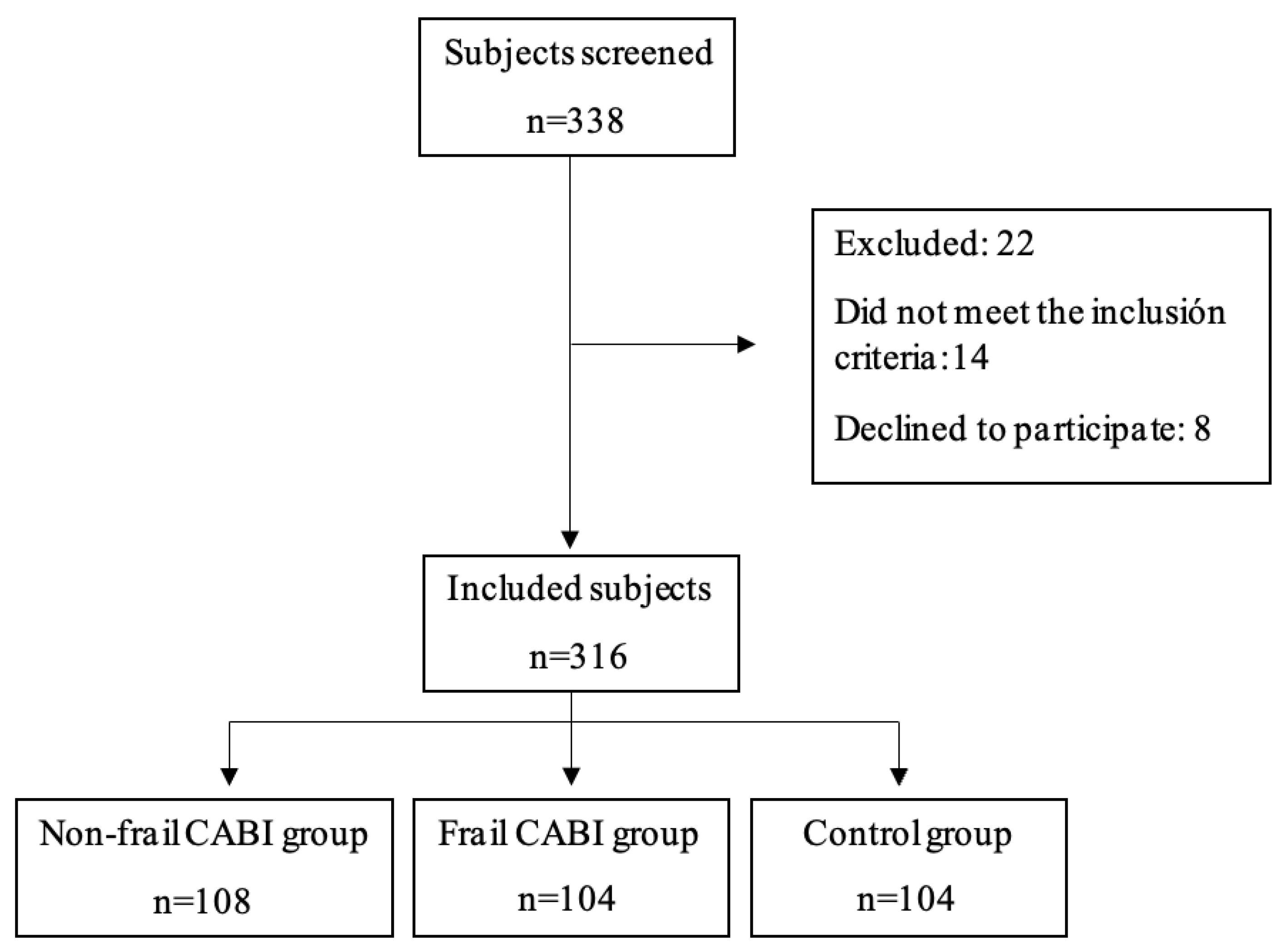
The final sample was composed of 316 subjects. The distribution of participants is shown in Figure 1. A total of 22 participants were excluded. Eight declined to participate, six presented an acquired brain injury less than 6 months prior, five were not able to ambulate, two had psychiatric disorders, and one participant was younger than 18 years. The remaining 212 patients were included and compared with 104 healthy controls.
Descriptive data of the sample at baseline are shown in Table 1. Mean age was significantly higher in the frail CABI group compared to the non-frail CABI group (p < 0.05). Gender distribution also differed significantly across groups, with a higher proportion of males in the non-frail group (p < 0.001). BMI did not differ significantly between frail and non-frail CABI participants (p = 0.08), indicating that baseline anthropometric status was not associated with frailty in this sample. Comparisons with the control group are reported for descriptive purposes.
Regarding etiology, frail and non-frail CABI groups differed in the distribution of injury causes. Head trauma was more prevalent in the non-frail group (p < 0.001), while brain tumors were more common in the frail group (p = 0.002).
Comorbidities showed group-dependent patterns: thyroid disorders were more frequent in frail individuals (p = 0.011), and smoking prevalence differed significantly among groups (p = 0.033). Medication use also varied substantially. Frail participants showed markedly higher use of anticoagulants, antidepressants, antiepileptics, muscle relaxants, and hypnotics compared with both non-frail CABI individuals and healthy controls (all p < 0.01).
Table 2 shows the results of physical activity level, frailty, self-efficacy, and disability between the groups. Frailty severity, as measured by the PPT, differed significantly across the three groups (p < 0.001), with frail CABI participants showing markedly reduced scores compared to both non-frail CABI and controls.
Disability (WHODAS-12) showed a progressive gradient, with the highest disability in the frail CABI group, followed by the non-frail group, and the lowest levels in controls (p < 0.001). Falls efficacy also differed significantly, with frail individuals reporting the lowest confidence in avoiding falls (p < 0.001).
Exercise self-efficacy (SEEQ) was significantly reduced in CABI patients relative to controls (p < 0.01), although differences between frail and non-frail CABI were modest.
Physical activity levels exhibited clear stratification across groups. Total PASE scores were lowest in frail individuals, intermediate in non-frail CABI, and highest in healthy controls (p < 0.001). Housework activity and work-related activity also showed significant between-group differences (p < 0.01). Leisure-time activity did not significantly differ between CABI groups but was higher in controls.
Objectively measured physical activity (steps/day) followed a similar pattern: frail participants accumulated the fewest steps per day, non-frail participants showed intermediate values, and controls displayed substantially higher levels (p < 0.001).

ROC Analysis

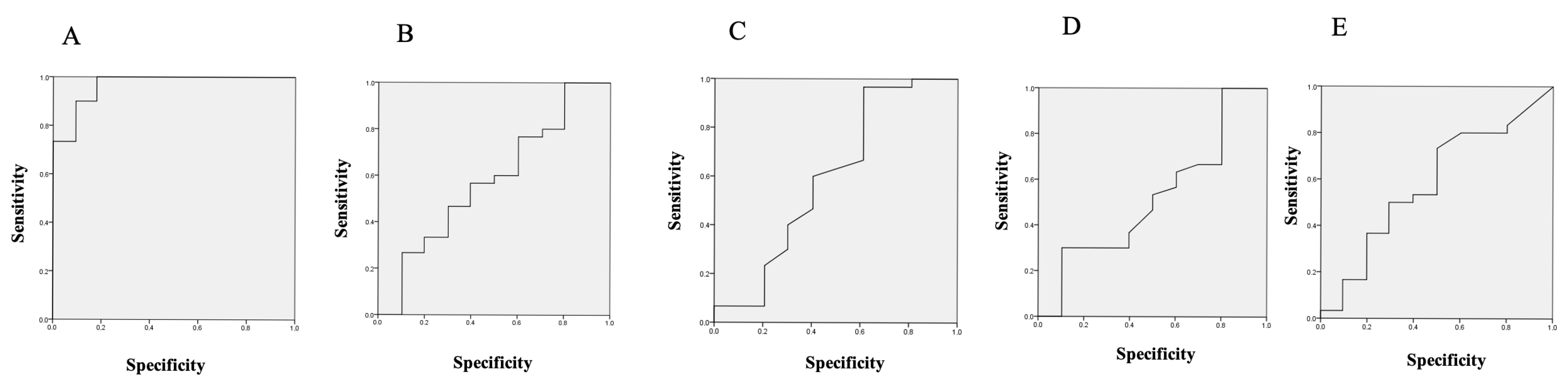
ROC curve analyses were performed to determine the discriminatory ability of physical activity measures to identify frail CABI individuals. Cutoff points, including sensitivity and specificity values, are displayed in Figure 2.
Across all models, higher step counts and higher PASE scores were associated with a greater likelihood of being classified as non-frail. Objective activity (steps/day) demonstrated strong discriminatory performance, while PASE total and domain-specific subscores also showed acceptable to good accuracy.
The cutoff point for steps per day was ≤1313.50 with an AUC of 0.962 (sensitivity of 0.96 and specificity of 0.20). The cutoff point for PASE total score was ≤2.20, with an AUC of 0.581 (sensitivity of 0.97 and specificity of 0.80). The AUC of housework activity PASE subscore was 0.603 (sensitivity of 0.97 and specificity of 0.81), and the cutoff point was ≤0.50, indicative of frailty. The AUC of work-related activity PASE subscore was ≤0.528 (sensitivity of 0.97 and specificity of 0.80), and the cutoff point was ≤0.44. Finally, for the leisure activities PASE subscore, the AUC was 0.574 (sensitivity of 0.83 and specificity of 0.80), and the cutoff point was ≤0.13.

4. Discussion

The present study aimed to analyze the indicative power of physical activity and to identify specific cutoff values associated with frailty in individuals with CABI. Our findings showed that different physical activity domains were able to distinguish between frail and non-frail CABI participants. Importantly, these results provide clinically relevant thresholds that may assist healthcare professionals in identifying patients at higher risk of frailty, guiding early intervention strategies, and optimizing rehabilitation planning.
For the subjective physical activity level, subjects with a score of ≤2.20 in the PASE total score, ≤0.50 in the housework activity, ≤0.44 in the work-related activity, and ≤0.13 in the leisure activity PASE subscore are considered to be frail. The AUC is 0.581 for the PASE total score, and 0.603, 0.528, and 0.574 for housework, work-related, and leisure activity subscores, respectively.
For the objective physical activity level, subjects with ≤11313.50 steps per day are considered to be frail, with an AUC of 0.962. An objective measure of physical activity levels yielded a better AUC indicative of frailty compared to the total score and subscores of the self-report physical activity levels.
These findings are consistent with studies in older adults and other clinical populations, where the PASE has shown similar moderate accuracy in identifying frailty or low functional status. Previous research has reported AUC values between 0.55 and 0.70 when using PASE scores to predict frailty, suggesting that while subjective measures capture relevant behavioral tendencies, they may lack the precision of objective accelerometry-based metrics. Our results align with this pattern, supporting the notion that self-reported activity provides valuable, but not definitive, information for frailty screening [27,28,29].
Objective measures such as heart rate monitors and motion sensors are being used with increasing regularity. Objective measures with real-time data storage capabilities offer a distinct advantage over self-report methods in that they provide reliable information on patterns of physical activity within a given day or over several days [30]. However, because of their low cost and ease of administration, investigators conducting field-based research have still used self-report methods to assess physical activity [31]. For this reason, our results hold clinical significance and relevance by providing values for both measures.
Resnick et al. [32] carried out a study that aimed to assess physical activity with objective and subjective measures in individuals with chronic stroke. They found discrepancies between subjective and objective reports of physical activity. Subjective results have frequently been noted to overestimate physical activity and are generally not strongly related to physiological measures. The discrepancies found in this study between subjective and objective reports of physical activity replicate previous research findings [33].
Resnik et al. concluded that CABI patients are severely deconditioned and use, on average, 68% of physiologic reserve to ambulate. It is possible, therefore, that they perceived their level of activity to be high, given the exertion required to engage compared to the number of steps they took.
CABI patients tend to have a lower frequency of moderate to vigorous bouts of physical activity and are less likely to reach generally recommended minimum levels of physical activity than healthy controls [34]. Increasing physical activity has been suggested to be a key strategy to attenuate the declines in muscle mass and physical function associated with symptoms of frailty [35]. Nevertheless, the early stages of the frailty process may be clinically silent. When the losses of reserve reach an aggregate threshold that leads to serious vulnerability, the syndrome may become detectable by looking at clinical, functional, behavioral, and biological markers [36].
In our study, older age in the frail CABI group likely reflects diminished physiological reserve, a recognized risk factor for frailty and poor outcomes in brain injury populations [37]. Although BMI did not differ significantly between groups, subclinical nutritional deficits may still contribute to frailty vulnerability. Differences in injury etiology may indicate more severe baseline brain injury, further exacerbating frailty. However, our cross-sectional design and the uneven distribution of sociodemographic data, comorbidities, pharmacological treatments, and injury types across groups could act as confounders. Future longitudinal research with multivariable adjustment is needed to clarify how age, nutritional status, and injury severity jointly influence frailty in chronic acquired brain injury [38].
Other methodological limitations should be considered when interpreting our findings. First, our cross-sectional design does not allow causal inference, and reverse causality cannot be excluded. Second, although the PPT is a widely used and validated tool for classifying frailty [21,39,40], the use of physical activity metrics alongside PPT may introduce conceptual overlap and incorporation bias. Additionally, the reported PASE cutoff should be interpreted cautiously, as scoring or normalization procedures could influence the results.
Although these limitations exist, this research demonstrates that ROC analysis can still provide valuable information regarding optimal physical activity levels associated with frailty status, based on objective surveillance. The results may support the development of evidence-based recommendations and guidelines in clinical and public health contexts. Early frailty diagnosis in persons with illness can empower doctors and institutions to provide important clinical prognostic information to the patients and their families [41] and to revert the patient to a robust (non-frail) state, especially in the early stages [42].

5. Conclusions

Our study revealed that frailty was closely associated with physical activity levels across different activity domains in individuals with chronic acquired brain injury. Both objective and subjective measures of physical activity were able to identify values indicative of frailty status, supporting their clinical utility for functional risk stratification in this population. These findings highlight the relevance of assessing domain-specific physical activity to better characterize vulnerability, guide individualized rehabilitation strategies, and support early preventive interventions aimed at reducing functional decline in CABI patients.

Author Contributions

Conceptualization, M.C.V. and L.L.-L.; methodology, A.H.-C. and I.C.-M.; software, A.H.-C.; validation, I.C.-M. and M.C.V.; formal analysis, L.L.-L.; investigation, D.R.-R. and A.N.-O.; resources, A.O.-R.; data curation, D.R.-R.; writing—original draft preparation, L.L.-L. and A.H.-C.; writing—review and editing, M.C.V. and A.O.-R.; visualization, I.C.-M.; supervision, L.L.-L.; project administration, A.H.-C.; funding acquisition, A.N.-O. All authors have read and agreed to the published version of the manuscript.

Funding

The author ANO has received financial support through an FPU (“Formación Profesorado Universitario”) grant of the Spanish Ministry of Education (FPU 22/01543).

Institutional Review Board Statement

The study was conducted in accordance with the Declaration of Helsinki and approved by the CEIm Provincial de Granada (NUTRI-DCA-2024/15/01/2024) for studies involving humans (15 January 2024).

Informed Consent Statement

Informed consent was obtained from all subjects involved in the study.

Data Availability Statement

Data supporting the findings of this study are available from the corresponding author upon reasonable request.

Conflicts of Interest

The authors declare no conflicts of interest.

Abbreviations

The following abbreviations are used in this manuscript:
ABIAcquired brain injury
AUCArea under the curve
BMIBody mass index
CABIChronic acquired brain injury
FESFalls Efficacy Scale
PASEPhysical Activity Scale for the Elderly
PPTPhysical Performance Test
ROCReceiver operating characteristic
SEEQSelf-Efficacy for Exercise Questionnaire
STROBEStrengthening the Reporting of Observational Studies in Epidemiology
WHODASWorld Health Organization Disability Assessment Schedule

References

  1. Toronto Acquired Brain Injury Network. Definition of Acquired Brain Injury; Toronto Acquired Brain Injury Network: Toronto, ON, Canada, 2005. [Google Scholar]
  2. De Luca, R.; Calabrò, R.S.; Bramanti, P. Cognitive rehabilitation after severe acquired brain injury: Current evidence and future directions. Neuropsychol. Rehabil. 2018, 28, 879–898. [Google Scholar] [CrossRef]
  3. Thüss, N.S.; den Hertog, H.M.; van Bennekom, C.A.M.; Spikman, J.M.; van der Naalt, J. The post-ABI effect-long-term impact of aging on participation after acquired brain injury. J. Neurol. 2025, 272, 675. [Google Scholar] [CrossRef]
  4. Burgess, C.; Tian, E.J.; Tyack, E.; Kumar, S. Barriers and enablers to physical activity for individuals living with traumatic brain injury: A mixed methods systematic review. Brain Inj. 2024, 38, 1157–1170. [Google Scholar] [CrossRef]
  5. Johnson, L.W.; Diaz, I. Exploring the social determinants of health and health dispari-ties in traumatic brain injury: A scoping review. Brain Sci. 2023, 13, 707. [Google Scholar] [CrossRef]
  6. Pham, T.; Green, R.; Neaves, S.; Hynan, L.S.; Bell, K.R.; Juengst, S.B.; Zhang, R.; Driver, S.; Ding, K. Physical activity and perceived barriers in individuals with moder-ate-to-severe traumatic brain injury. PM R 2023, 15, 705–714. [Google Scholar] [CrossRef] [PubMed]
  7. Kunkel, D.; Fitton, C.; Burnett, M.; Ashburn, A. Physical inactivity post-stroke: A 3-year longitudinal study. Disabil. Rehabil. 2015, 37, 304–310. [Google Scholar] [CrossRef]
  8. Bastone, A.C.; Ferriolli, E.; Teixeira, C.P.; Dias, J.M.; Dias, R.C. Aerobic fitness and habitual physical activity in frail and nonfrail community-dwelling elderly. J. Phys. Act. Health 2015, 12, 1304–1311. [Google Scholar] [CrossRef] [PubMed]
  9. Hassani, A.; Kubicki, A.; Brost, V.; Mourey, F.; Yang, F. Kinematic analysis of motor strategies in frail aged adults during the Timed Up and Go: How to spot the motor frailty? Clin. Interv. Aging 2015, 10, 505–513. [Google Scholar] [CrossRef] [PubMed]
  10. Mo, Y.; Zhou, Y.; Chan, H.; Evans, C.; Maddocks, M. The association between sedentary behaviour and sarcopenia in older adults: A systematic review and meta-analysis. BMC Geriatr. 2023, 23, 877. [Google Scholar] [CrossRef]
  11. Kehler, D.S.; Hay, J.L.; Stammers, A.N.; Hamm, N.C.; Kimber, D.E.; Schultz, A.S.H.; Szwajcer, A.; Arora, R.C.; Tangri, N.; Duhamel, T.A. A systematic review of the association between sedentary behaviors with frailty. Exp. Gerontol. 2018, 114, 1–12. [Google Scholar] [CrossRef]
  12. Fried, L.P.; Tangen, C.M.; Walston, J.; Newman, A.B.; Hirsch, C.; Gottdiener, J.; Seeman, T.; Tracy, R.; Kop, W.J.; Burke, G.; et al. Frailty in older adults: Evidence for a phenotype. J. Gerontol. A Biol. Sci. Med. Sci. 2001, 56, M146–M156. [Google Scholar] [CrossRef] [PubMed]
  13. Wang, S.; Tan, J.; Song, K.; Zhang, Q.; Yang, W.; Wu, Y. Impact of pre-existing frailty on all-cause mortality in stroke survivors: A systematic review and dose-response meta-analysis. Age Ageing 2025, 54, afaf273. [Google Scholar] [CrossRef]
  14. Lin, Y.K.; Chen, C.Y.; Cheung, D.S.T.; Montayre, J.; Lee, C.Y.; Ho, M.H. The relationship between physical activity trajectories and frailty: A 20-year prospective cohort among community-dwelling older people. BMC Geriatr. 2022, 22, 867. [Google Scholar] [CrossRef]
  15. Tang, Z.; Shen, C.; Tong, W.; Xiang, X.; Feng, Z.; Han, B. Frailty in community-dwelling adults aged 40 years and over with type 2 diabetes: Association with self-management behaviors. Int. J. Environ. Res. Public Health 2022, 19, 9092. [Google Scholar] [CrossRef]
  16. Coffman, E.M.; Smitherman, A.B.; Willis, E.A.; Ward, D.S.; Tate, D.F.; Valle, C.G. Frailty and comorbidities among young adult cancer survivors enrolled in an mHealth physical activity intervention trial. J. Cancer Surviv. 2025, 19, 54–65. [Google Scholar] [CrossRef] [PubMed]
  17. Barrios Osuna, I.; Anido Escobar, V.; Morera Pérez, M. Declaración de Helsinki: Cambios y exégesis. Rev. Cuba. Salud Pública 2016, 42, 132–142. [Google Scholar]
  18. Von Elm, E.; Altman, D.G.; Egger, M.; Pocock, S.J.; Gøtzsche, P.C.; Vandenbroucke, J.P. The STROBE Checklist for Cohort, Case-Control, and Cross-Sectional Studies (2024 Version). STROBE Statement. 2024. Available online: https://www.strobe-statement.org/checklists/ (accessed on 9 September 2025).
  19. Tornås, S.; Løvstad, M.; Solbakk, A.K.; Evans, J.; Endestad, T.; Hol, P.K.; Schanke, A.K.; Stubberud, J. Rehabilitation of executive functions in patients with chronic acquired brain injury with goal management training, external cuing, and emotional regulation: A randomized controlled trial. J. Int. Neuropsychol. Soc. 2016, 22, 436–452. [Google Scholar] [CrossRef]
  20. Reuben, D.B.; Siu, A.L. An objective measure of physical function of elderly outpatients: The Physical Performance Test. J. Am. Geriatr. Soc. 1990, 38, 1105–1112. [Google Scholar] [CrossRef]
  21. Brown, M.; Sinacore, D.R.; Binder, E.F.; Kohrt, W.M. Physical and performance measures for the identification of mild to moderate frailty. J. Gerontol. A Biol. Sci. Med. Sci. 2000, 55, M350–M355. [Google Scholar] [CrossRef] [PubMed]
  22. Delgado, M.; Zamarripa, J.; de la Cruz, M.; Cantú Berrueto, A.; Álvarez Solves, O. Validación de la versión mexicana del Cuestionario de Auto-eficacia para el Ejercicio. Rev. Psicol. Deporte 2017, 26, 85–90. [Google Scholar]
  23. Tarvonen-Schröder, S.; Tenovuo, O.; Kaljonen, A.; Laimi, K. Usability of World Health Organization Disability Assessment Schedule in chronic traumatic brain injury. J. Rehabil. Med. 2018, 50, 514–518. [Google Scholar] [CrossRef]
  24. Tinetti, M.E.; Richman, D.; Powell, L. Falls efficacy as a measure of fear of falling. J. Gerontol. 1990, 45, P239–P243. [Google Scholar] [CrossRef]
  25. Sia, T.; Connors, K.A.; Morgan, P. Physical Activity in People With Motor Neuron Disease: Validity of the Physical Activity Scale for the Elderly as a Measuring Tool. Arch. Phys. Med. Rehabil. 2023, 104, 102–107. [Google Scholar] [CrossRef]
  26. Tully, M.A.; McBride, C.; Heron, L.; Hunter, R.F. The validation of Fitbit Zip™ physical activity monitor as a measure of free-living physical activity. BMC Res. Notes 2014, 7, 952. [Google Scholar] [CrossRef]
  27. Chen, H.; Cheng, M.C.; Sun, Y.; Zhu, Y.Q.; Sun, L.X.; Zhang, Y.X.; Feng, B.B.; Wu, G.C. Dose-response relationship between physical activity and frailty: A systematic review and meta-analysis. Heliyon 2024, 10, e33769. [Google Scholar] [CrossRef]
  28. Li, Q.; Guan, J.; Wang, R. Association of physical activity levels with frailty index in elderly Chinese: Evidence from the China Health and Retirement Longitudinal Study (CHARLS). BMC Geriatr. 2025, 25, 762. [Google Scholar] [CrossRef]
  29. Yang, Y.; Chen, L.; Filippidis, F.T. Accelerometer-measured physical activity, frailty, and all-cause mortality and life expectancy among middle-aged and older adults: A UK Biobank longitudinal study. BMC Med. 2025, 23, 125. [Google Scholar] [CrossRef] [PubMed]
  30. Trost, S.G.; Pate, R.R.; Freedson, P.S.; Sallis, J.F.; Taylor, W.C. Using objective physical activity measures with youth: How many days of monitoring are needed? Med. Sci. Sports Exerc. 2000, 32, 426–431. [Google Scholar] [CrossRef] [PubMed]
  31. Sallis, J.F. Self-report measures of children’s physical activity. J. Sch. Health 1991, 61, 215–219. [Google Scholar] [CrossRef] [PubMed]
  32. Resnick, B.; Michael, K.; Shaughnessy, M.; Nahm, E.S.; Kopunek, S.; Sorkin, J.; Orwig, D.; Goldberg, A.; Macko, R.F. Inflated perceptions of physical activity after stroke: Pairing self-report with physiologic measures. J. Phys. Act. Health 2008, 5, 308–318. [Google Scholar] [CrossRef]
  33. Thompson, D.L.; Rakow, J.; Perdue, S.M. Relationship between accumulated walking and body composition in middle-aged women. Med. Sci. Sports Exerc. 2004, 36, 911–914. [Google Scholar] [CrossRef] [PubMed]
  34. Fulk, G.D.; Combs, S.A.; Danks, K.A.; Nirider, C.D.; Raja, B.; Reisman, D.S. Accuracy of 2 activity monitors in detecting steps in people with stroke and traumatic brain injury. Phys. Ther. 2014, 94, 222–229. [Google Scholar] [CrossRef] [PubMed]
  35. Fried, L.P. Interventions for human frailty: Physical activity as a model. Cold Spring Harb. Perspect. Med. 2016, 6, a025916. [Google Scholar] [CrossRef]
  36. Lang, P.O.; Michel, J.P.; Zekry, D. Frailty syndrome: A transitional state in a dynamic process. Gerontology 2009, 55, 539–549. [Google Scholar] [CrossRef]
  37. Lewis, E.T.; Dent, E.; Alkhouri, H.; Kellett, J.; Williamson, M.; Asha, S.; Holdgate, A.; Mackenzie, J.; Winoto, L.; Fajardo-Pulido, D.; et al. Which frailty scale for patients admitted via Emergency Department? A cohort study. Arch. Gerontol. Geriatr. 2019, 80, 104–114. [Google Scholar] [CrossRef]
  38. Mañas, L.R.; García-Sánchez, I.; Hendry, A.; Bernabei, R.; Roller-Wirnsberger, R.; Gabrovec, B.; Liew, A.; Carriazo, A.M.; Redon, J.; Galluzzo, L.; et al. Key messages for a frailty prevention and management policy in Europe from the ADVANTAGE JOINT ACTION Consortium. J. Nutr. Health Aging 2018, 22, 892–897. [Google Scholar]
  39. Galimberti, S.; Graziano, F.; Maas, A.I.R.; Isernia, G.; Lecky, F.; Jain, S.; Sun, X.; Gardner, R.C.; Taylor, S.R.; Markowitz, A.J.; et al. Effect of frailty on 6-month outcome after traumatic brain injury: A multicentre cohort study with external validation. Lancet Neurol. 2022, 21, 153–162. [Google Scholar] [CrossRef]
  40. Berek, A.; Kindl, P.; Schiefecker, A.J.; Altmann, K.; Putnina, L.; Helbok, R.; Pfausler, B.; Beer, R.; Rass, V. The impact of frailty on functional outcome in neurointensive care patients. Eur. J. Neurol. 2025, 32, e70292. [Google Scholar] [CrossRef]
  41. Vidoni, E.D.; Billinger, S.A.; Lee, C.; Hamilton, J.; Burns, J.M. The physical performance test predicts aerobic capacity sufficient for independence in early-stage Alzheimer disease. J. Geriatr. Phys. Ther. 2012, 35, 72–78. [Google Scholar] [CrossRef]
  42. Davenport, A. Comparison between the Physical Performance Test and the Clinical Frailty Score in adult patients with chronic kidney disease treated by haemodialysis. Gerontol. Geriatr. Med. 2022, 8, 23337214221085875. [Google Scholar] [CrossRef]
Figure 1. Flowchart.
Applsci 15 13040 g001
Figure 2. Cutoff points with respective sensitivities and specificities of CBI frailty in steps per day (A), Physical Activity Scale for the Elderly (PASE) total score (B), housework activity PASE subescore (C), work-related activity PASE subescore (D), and leisure activity PASE subescore (E).
Applsci 15 13040 g002
Table 1. Descriptive characteristics of patients.
VariablesFrail CABI Group
(N = 104)
Non-Frail CABI Group
(N = 108)
Control Group
(N = 104)
F/p
Gender n (% males)41(39.42)97(89.81)54(51.92)<0.001 **
Age (y)55.54 ± 15.7049.94 ± 14.4952.55 ± 15.674.548 c
BMI (kg/m2)26.53 ± 2.9927.52 ± 3.0924.90 ± 3.753.483 a
Time since accident (months)75.82 ± 50.3871.80 ± 72.82-0.838
Etiology n (%)
 Stroke57(54.81)55(50.93)-0.504
 Head trauma26(25.00)48(44.44)-<0.001 **
 Encephalopathy0(0)5(4.63)-0.162
 Tumor21(20.19)0(0)-0.002 *
Comorbidities n (%)
 Diabetes21(20.19)10(9.26)9(8.65)0.207
 AHT26(25.00)21(19.44)35(33.65)0.132
 HCL26(25.00)21(19.44)22(21.15)0.878
 Thyroid disorders38(36.54)0(0)12(11.54)0.011 *
 Smoker52(50.00)46(42.59)50(48.08)0.033 *
Pharmacological treatment
n (%)
 Anticoagulant65(62.5)21(19.44)12(11.54)<0.001 **
 Antidepressant39(37.5)31(28.70)0(0)<0.001 **
 Antiepileptic39(37.5)10(9.26)0(0)<0.001 **
 Muscle relaxant52(50.00)21(19.44)0(0)<0.001 **
 Hypnotics33(31.73)31(28.70)7(6.73)0.009 *
Data are given as mean (standard deviation) unless otherwise indicated. CABI: chronic acquired brain injury; BMI: body mass index; AHT: arterial hypertension; HCL: hypercholesterolemia. a: Significant differences between the control and non-frail CBI groups. b: Significant differences between the control and frail CBI groups. c: Significant differences between the frail CBI and non-frail CBI groups. * p < 0.05, ** p < 0.001.
Table 2. Results of physical activity level, frailty, self-efficacy, and disability between the groups.
VariablesFrail Group
(N = 104)
Non-Frail Group
(N = 108)
Control Group
(N = 104)
F
SEEQ49.05 ± 15.8950.57 ± 19.5461.39 ± 13.309.68 ab
WHODAS-1280.25 ± 47.7147.00 ± 23.2423.52 ± 13.2547.60 abc
FES94.55 ± 7.8474.20 ± 20.0958.64 ± 17.8245.29 abc
PPT8.55 ± 2.3224.40 ± 3.3233.76 ± 3.28488.40 abc
PASE
Housework activity1.08 ± 0.781.33 ± 0.482.02 ± 0.4937.76 ab
Work-related activity2.91 ± 3.585.08 ± 4.936.48 ± 4.488.26 b
Leisure activity1.43 ± 1.681.58 ± 2.032.04 ± 1.811.60
Total score5.41 ± 4.787.99 ± 5.9310.49 ± 5.0511.85 ab
Steps per day1104.82 ± 691.113357.40 ± 2201.5712,593.38 ± 7173.9042.68 ab
Data are given as mean (standard deviation). SEEQ: Self-Efficacy for Exercise Questionnaire; WHODAS: World Health Organization Disability Assessment Schedule; FES: Falls Efficacy Scale; PPT: Physical Performance Test; PASE: Physical Activity Scale for the Elderly. a: Significant differences between the control and non-frail CBI groups. b: Significant differences between the control and frail CBI groups. c: Significant differences between the frail CBI and non-frail CBI groups.
Disclaimer/Publisher’s Note: The statements, opinions and data contained in all publications are solely those of the individual author(s) and contributor(s) and not of MDPI and/or the editor(s). MDPI and/or the editor(s) disclaim responsibility for any injury to people or property resulting from any ideas, methods, instructions or products referred to in the content.