Article

Eco-Friendly Thermoplastic Starch Nanocomposite Films Reinforced with Microfibrillated Cellulose (MFC) from Fraxinus uhdei (Wenz.) Lingelsh


by
Eduardo Gil-Trujillo
1,
María Guadalupe Lomelí-Ramírez
1,
José Antonio Silva-Guzmán
1,
José Anzaldo-Hernández
1,
J. Jesús Vargas-Radillo
1,
Lucia Barrientos-Ramírez
1,
Erick Omar Cisneros-López
2,
Rosa María Jiménez-Amezcua
3,
Frederico de Araujo Kronemberger
4,
Amanda Loreti Hupsel
4,
José Guillermo Torres-Rendón
1,* and
Salvador García Enriquez
1,*
1
Department of Wood Cellulose and Paper, University of Guadalajara, Guadalajara 44430, Mexico
2
Department of Physics, University of Guadalajara, Guadalajara 44430, Mexico
3
Department of Chemistry Engineering, University of Guadalajara, Guadalajara 44430, Mexico
4
Chemical Engineering Program, COPPE, Federal University of Rio de Janeiro, Rio de Janeiro P.O. Box 68.502, Brazil
*
Authors to whom correspondence should be addressed.
Appl. Sci. 2025, 15(24), 12925; https://doi.org/10.3390/app152412925
Submission received: 13 October 2025 / Revised: 20 November 2025 / Accepted: 2 December 2025 / Published: 8 December 2025
(This article belongs to the Special Issue Green Composite Materials: Design, Application, and Recycling)

Featured Application

Starch films reinforced with microfibrillated cellulose (MFC), extracted from Fraxinus uhdei (Wenz.) Lingelsh, represent a promising alternative for the development of sustainable packaging in the food industry. The incorporation of MFC significantly improved the mechanical properties of the starch films, increasing their strength and flexibility, while reducing water and oxygen permeability, critical factors for extending the shelf life of food. Furthermore, as it is a biodegradable material from a renewable source, its use contributes to reducing the environmental impact associated with conventional plastic. These films can be used in the packaging of fruit, fresh vegetables, and bakery products or as edible coatings, offering a combination of functionality, safety, and sustainability.

Abstract

In this work, microfibrillated cellulose (MFC) from ash branch wood was used as reinforcement in a thermoplastic starch matrix to develop environmentally friendly materials. Pulp fibers and MFCs were characterized by SEM, TEM, and FTIR. Corn starch biofilms were prepared via casting, formulating eight biofilms with 5 and 10 wt% of MFC. Also, extracts of Muicle and Hibiscus were added to incorporate antibacterial properties. The biofilms were evaluated for mechanical, thermal, and antibacterial properties. Also, properties such as color, opacity, morphology, electrical conductivity, contact angle, and solubility, among others, were evaluated. The reinforced biofilms were homogeneous, dimensionally stable, and transparent with slight color changes. MFC incorporation enhanced hydrogen bonding, which increased the ultimate tensile strength from 11.2 MPa to approximately 19–21 MPa and the Young’s modulus from 809 MPa to 1034–1192 MPa. The presence of MFC also reduced solubility from 48.7% to 38.7–39.8% and decreased water vapor permeability by about 20–23% in biofilms with 10 wt% MFC. Gas barrier properties and the glass transition temperature depended on extract type and fiber content, indicating greater rigidity. The use of ash-based MFC encourages the implementation of circular economy strategies and the development of sustainable biocomposites.

1. Introduction

In recent decades, the search for sustainable materials has gained considerable momentum, especially in the field of biodegradable polymers. Starch is a widely available natural polymer, obtained mainly from plant sources. Thanks to intrinsic properties such as biodegradability, abundance, low cost, and renewability, numerous biocomposites based on this material have been developed [1,2,3]. Chemically, starch consists of D-glucose units linked by glycosidic bonds (1 → 4) [4] and has two main structures: amylose, with a linear configuration (20–30%), and amylopectin, with a branched configuration (70–80%) [5,6].
Starch-based thermoplastics represent an emerging alternative to conventional fossil-fuel-derived plastics, as they are renewable, economical, and degradable under natural conditions. However, they have significant limitations, such as high sensitivity to moisture, low mechanical strength, and poor thermal barrier properties, which restrict their use in more demanding applications [7,8]. Various methods have been explored to overcome these limitations, including chemical treatments, the use of alternative polymers (such as polylactic acid, PLA), and reinforcement with nanostructured materials, such as mineral nanoparticles or nanoscale cellulose [9,10,11,12].
Recent studies have shown that adding MFC significantly improves the performance of starch films. For example, replacing polluting polymers with starch matrices reinforced with nanocellulose derived from agro-industrial waste (such as Agave tequilana bagasse) has reduced water vapor permeability by up to 20% while increasing tensile strength and Young’s modulus, albeit with a decrease in elongation at break. In addition, biocomposites with unbleached nanofibers have shown better mechanical properties due to their greater adhesion to the matrix [10]. Moreover, Żołek-Tryznowska et al. (2023) developed corn starch films reinforced with MFC and reported a decrease in the contact angle with water (from 70° to 39°) and an increase in surface free energy, indicating improved interfacial homogeneity and higher polarity [13]. Freitas et al. (2021) observed that the addition of 3–5 wt% MFC isolated from rice straw reduced the solubility and water vapor permeability while increasing the stiffness and thermal stability of the films [14]. Montoya et al. (2012) produced thermoplastic starch films reinforced with plants and bacterial cellulose microfibers, observing significant improvements in tensile strength and elastic modulus, which was attributed to the formation of a homogeneous fibrillar network within the starch matrix [15]. In another study, Kumar et al. (2014) compared films with cellulose micro- and nanofibrils, showing that MFC improved transparency, flexibility, and water vapor barrier properties due to better dispersion of the fibrils and hydrogen bonding interactions with the starch [16]. Andresen et al. (2006) applied silylation treatments to cellulose microfibrils to improve their interfacial compatibility with hydrophobic polymer matrices, demonstrating that surface modification controls wettability and adhesion without affecting the integrity of the cellulose network [17]. These results confirm that MFC acts as a multifunctional reinforcement that improves mechanical strength, internal cohesion, and barrier properties of TPS, positioning such composites as a competitive biodegradable materials for sustainable packaging applications.
In terms of nanometric cellulose, research dealing with fibers from other sources, such as Chrysopogon zizanioides, has revealed that concentrations of 3 wt% of cellulose nanofibers (CNF) can increase tensile strength by up to 161% and modulus by 167%, in addition to significantly improving thermal stability and crystallinity [18]. Similarly, CNC-reinforced starch films modified from cassava waste have shown increases of up to 73% in mechanical strength, along with greater thermal stability and controlled hydrophilicity properties [7]. Other studies continue to demonstrate the positive effect of nanocellulose as a reinforcement in biodegradable composites [19,20,21]. For example, the addition of CNF to thermoplastic starch foam matrices increased their thermal stability, dynamic modulus, and heat resistance while reducing water absorption [22]. Moreover, the integration of CNF improved the barrier properties and stiffness of films made from different types of starch (cereal, legume, tuber), depending on their origin and content [23].
On the other hand, Fraxinus uhdei (Wenz.) Lingelsh, commonly known as tropical ash or shamel ash, is a fast-growing deciduous tree native to Mexico and Central America. It can reach heights of 35–40 m and diameters exceeding 1 m under favorable conditions, being one of the most vigorous species within the Fraxinus genus [24]. Its trunk is straight and cylindrical, and it develops an expansive crown, which has favored its widespread use as an ornamental and shade tree in tropical and subtropical regions worldwide [25].
The wood of F. uhdei is light to moderately dense, with an average specific gravity of approximately 0.50 g cm−3. It exhibits moderate shrinkage, fine texture and straight grain, properties that confer good workability and machining performance [26]. Although somewhat less elastic and impact-resistant than Fraxinus excelsior, the wood of F. uhdei is suitable for applications such as light furniture, interior paneling, tool handles, veneers, and other joinery elements where moderate strength and esthetic appearance are required [26,27]. Its cellulose fibers have also been studied for pulp and paper production due to their uniformity and ease of bleaching [28].
In addition to its technological applications, F. uhdei plays an important ecological role as a fast-growing pioneer species in reforestation and soil restoration programs in degraded tropical landscapes. However, its adaptability and high reproductive rate have also led to invasive behavior in certain Andean and Pacific regions, where it can outcompete native flora [26]. Despite these challenges, its biomass potential and rapid growth make it a promising lignocellulosic resource for sustainable material development and bio-based composites.
Despite the advances mentioned above, the use of F. uhdei (common ash) as a source of MFC to reinforce thermoplastic starch films has not yet been widely explored. This approach not only constitutes an innovation in the use of potentially underexploited forest fibers but can also contribute unique properties due to the structural nature of ash cellulose, including its lignocellulosic composition, fibril distribution, and potential for chemical interaction with the starch matrix.
Justicia spicigera (Muicle), also known as Muicle, moyotli, moyotle, blood of Christ, or ych-kaan, is a shrub of the Acanthaceae family widely distributed in Mexico, from Sonora to the Yucatan Peninsula. Its yellow and reddish flowers, as well as its leaves and stems, are used in traditional medicine to treat respiratory, skin, and gastrointestinal conditions. They are also used as natural dyes due to their richness in phenolic compounds and flavonoids. Recent studies have reported that extracts of J. spicigera have antimicrobial activity against pathogenic bacteria, attributed to secondary metabolites such as flavones and tannins, which are capable of altering the integrity of the bacterial membrane and exerting bactericidal effects [29,30].
Hibiscus sabdariffa L., known as Hibiscus or roselle, belongs to the Malvaceae family and is cultivated in tropical and subtropical regions. Its calyxes, rich in anthocyanins, flavonoids, organic acids, and phenolic compounds, have been extensively studied for their antimicrobial potential. Research has shown that aqueous and ethanolic extracts of H. sabdariffa inhibit the growth of Gram-positive and Gram-negative bacteria, including Escherichia coli, Staphylococcus aureus, Salmonella typhi, and Pseudomonas aeruginosa [31,32]. The use of extracts from J. spicigera and H. sabdariffa as natural antimicrobial agents represents a sustainable alternative to synthetic antibiotics, with advantages such as lower toxicity, low cost, biodegradability, and a lower risk of generating bacterial resistance, which favors their application in food preservation, bioactive packaging, and polymeric systems with antimicrobial properties.
In this context, the present study aims to develop thermoplastic starch films reinforced with cellulose nanofibers extracted from F. uhdei and characterize their mechanical, thermal, barrier, and optical performance, among other relevant parameters. The use of MFC from F. uhdei (Wenz.) Lingelsh represents a distinctive contribution compared with previous starch-based nanocomposites. Unlike conventional sources such as wood pulp, bamboo, or agro-residues (e.g., corn husk, sugarcane bagasse), F. uhdei wood is an urban and silvicultural residue abundantly generated in western Mexico due to pruning and replacement programs. MFC from such sources exhibits a balanced chemical composition (with moderate lignin remnants and a high aspect ratio) that provides both mechanical reinforcement and enhanced interfacial compatibility with the thermoplastic starch matrix. This valorization pathway not only introduces a novel, underexplored biomass feedstock but also strengthens the circular bioeconomy by transforming a local waste into a high-value micromaterial for sustainable packaging.
In summary, this research aims to contribute to knowledge about advanced bio-based composites and promote the use of renewable forest resources for the design of sustainable materials. Comparison with previous studies using other sources (such as agro-industrial waste or herbaceous fibers) will allow the identification of the particular strengths of F. uhdei’s MFC, as well as the establishment of recommendations for their scaling and future application.

2. Materials and Methods

2.1. Materials

Ash wood was obtained from the Primavera Forest (Jalisco, Mexico). Sodium hydroxide (NaOH, 97% purity) and sodium thiosulfate (0.1 N) were purchased from Karal S.A. de C.V. (León, Mexico). Anthraquinone (97% purity), cupriethylenediamine (CED), potassium permanganate, sulfuric acid (97% purity), sodium chlorite (97% purity), hydrochloric acid (37% purity) and hydrogen peroxide (30% purity) were obtained from Merck (Darmstdt, Germany). Glycerol was purchased from Golden Bell and magnesium sulfate from Productos Químicos Monterrey (Monterrey, Mexico). Native corn starch was purchased from IMSA, Industrializadora de Maíz S.A. de C.V. (Guadalajara, Mexico). Folin–Ciocalteu phenol reagent, gallic acid, MTT [3-(4,5-dimethylthiazol-2-il)-2,5-diphenyltetrazolium bromide, DMSO (dimethyl sulfoxide), Histopaque-1077, 0.25% trypsin–EDTA solution and 0.4% Trypan blue dye were obtained from Sigma–Aldrich (Toluca, Mexico).

2.2. Preparation of Cellulose Pulp

The ash branches were debarked, chipped and screened. The chips that passed through a screen with 7 mm slot and were used, and those retained in the holes of a 5 mm screen were discarded. In total, 2 kg of ash wood chips were cooked in a digester at 170 °C for 1 h using a Kraft process with 32.4% sulfidity, adding 298.3 g of NaOH and 150.2 g of Na2S. The hydromodule was 8:1 (liquor:wood) [33]. The time taken for the temperature to rise from room temperature to cooking temperature (170 °C) was 40 min. After the process, the pulp was washed with plenty of water to remove the residual liquor. The pulp was then depurated and homogenized.

2.2.1. Kappa Number

The Kappa number was determined following the TAPPI T236 om-22 standard [34]. A pulp sample was dispersed in 800 mL of distilled water at 25 °C, then treated with 100 mL of 0.1 N KMnO4 and 100 mL of 4.0 N H2SO4 for 10 min. Then, 20 mL of 1 N KI and a few drops of starch solution were added, and the mixture was titrated with 0.1 N Na2S2O3. A blank was prepared under identical conditions without pulp. Calculations followed TAPPI T236 om-22, and all measurements were performed in duplicate.

2.2.2. Quantification of α-, β-, and γ-Cellulose

The quantification of cellulose fractions followed the TAPPI T203 cm-22 standard [35]. Briefly, 1.5 g of dry bleached pulp was suspended in 75 mL of 17.5% NaOH and mixed with 25 mL of distilled water. After stirring for 30 min at 25 °C, the mixture was diluted with 100 mL of water and stirred for another 30 min. For α-cellulose determination, 25 mL of filtrate was reacted with 10 mL of 0.5 N K2Cr2O7 and 50 mL of concentrated H2SO4, cooled, and titrated with (NH4)2Fe(SO4)2 using ferroin as indicator. For β- and γ-cellulose, 50 mL of filtrate was mixed with 50 mL of 3 N H2SO4 and heated at 70–80 °C, and the resulting supernatant was titrated under the same conditions. Calculations followed TAPPI T203 cm-22. All tests were performed in duplicate.

2.2.3. Fourier-Transform Infrared (FTIR) Analysis

FTIR spectra were obtained using a PerkinElmer L280 spectrometer (PerkinElmer, Waltham, MA, USA). The measurements were performed on cellulose fibers and biofilms within the spectral range of 700–4000 cm−1, with a resolution of 4 cm−1.

2.2.4. Viscosymmetry

The viscosity (µ) and degree of polymerization (DP) were determined following the TAPPI T230 om-19 standard [36]. First, 0.15 g of dry bleached pulp was dispersed in 25 mL of distilled water, then mixed with 25 mL of 0.167 M cupriethylenediamine solution (C18H13N4NaO7S). After nitrogen purging and stirring for 15–30 min to ensure complete dissolution, the solution was placed in a viscometer at 25 ± 0.1 °C. The efflux time between two marks was recorded once thermal equilibrium was reached. Each sample was analyzed in triplicate, and viscosity was calculated according to TAPPI T230 om-19.

2.3. MFC Obtention and Characterization

Microfibrillated cellulose (MFC) was obtained from the treated ash pulp using a colloid mill (Super Mascolloider Microprocessor, Masuko Sangyo Co., Ltd., Kawaguchi, Japan). The pulp suspension, prepared at a consistency of 2%, was passed five times through a pair of grinding disks rotating at 1500 rpm, with a fixed gap of 0.1 mm between them.

Microscopy Electron Transmission (TEM)

Transmission electron microscopy (TEM) was employed to examine the morphology of the microfibers using a JEM 1200EX-II instrument (JEOL Ltd., Tokio, Japan) equipped with an Orius SC1000 CCD camera (Gatan Inc., Walnut Creek, CA, USA). A drop of a dilute fiber suspension was deposited onto a palladium grid for analysis.

2.4. Obtaining Extracts

The Muicle leaves and Hibiscus flowers were washed separately under running water, dried with absorbent paper, and cut into small pieces. A batch of leaves was also dried in an oven at 45 °C for 48 h and pulverized manually with a mortar and pestle. The amount of plant material used for extraction was 25 g/500 mL of 96% ethanol (ratio 1:20). The biological material was extracted for 48 h at room temperature, under agitation and protected from light, and then centrifuged separately at 3000 rpm (revolutions per minute) for 15 min. The liquid extracts were concentrated using a rotary evaporator (Buchi, Flawil, Switzerland) at 40 °C and 150 rpm until paste-like extracts were obtained. Each concentrated extract was then recovered from the rotating flask, evaporated at room temperature, and stored at 4 °C in 1.5 mL microtubes protected from light.
Determination of total polyphenols: this assay was estimated using the Folin–Ciocalteu method [37] with modifications. The extract (1 mL) was mixed with 1 mL of distilled water and 5 mL of Folin–Ciocalteu reagent (10% v/v). After 8 min, 4.0 mL of sodium carbonate (7.5%) was added. The mixture was left to stand for 90 min at 25 °C. The absorbance was measured at 765 nm using a UV-Vis spectrophotometer (Velab 5100 UV). The phenolic content was calculated using a standard curve (10–100 g/mL, R2 = 0.991) of gallic acid, and the results are expressed as milligrams of gallic acid equivalents per gram of dry matter (mg GAE/g dw). Each standard and sample was analyzed in triplicate.
Total flavonoid content was determinate by the aluminum chloride assay method [38]. A 0.5 mL aliquot of each extract was mixed with 1.5 mL of methanol, 0.1 mL of 10% AlCl3, 0.1 mL of 1M potassium acetate (CH3CO2K) (or 1M sodium nitrite) and 2.8 mL of distilled water. After 30 min at room temperature, the absorbance was measured at 510 nm with a UV-Vis spectrophotometer (Velab 5100 UV). The total flavonoid content was calculated based on the calibration curve (5–45 mg/mL, R2 = 0.994) and expressed as catechin equivalents (mg CE/g dry weight). All samples were analyzed in triplicate, and the mean values were calculated.

2.5. Starch and Biofilms Preparation

A solution was prepared by mixing native corn starch (5.5 g), deionized water (92.5 g) and glycerol (1.65 g) with different concentrations of ash MFC (0, 5.0, and 10.0 wt%, calculated relative to the starch content), along with varying Muicle (1.0 and 2.0 mL) or Hibiscus (1.25 and 2.5 mL) extract solutions, with respective concentrations of 0.0027 and 0.0036 g/mL. Sample names and exact amounts of fibers and extracts are shown in Table 1. The solution was kept under constant agitation at 80 °C for 45 min. The gelatinized dispersion was sonicated (Branson M2800H, Nuevo Laredo, Mexico) for 5 min to remove air bubbles. The dispersion was then poured into Teflon-coated metal molds and placed in a circulating air oven (Luzeren DHG-9070A, Yancheng, China) at 35 °C and 60% relative humidity for 20 h. The thicknesses of the biofilms were measured at five random positions on each biofilm using a micrometer (Mitutoyo Co., Ltd., Kanagawa, Japon).

2.5.1. Characterization of Biofilms

Analysis of Color, Opacity, Thickness, Grammage, and Electrical Conductivity
Colorimetric analysis of the thermoplastic starch biofilms was conducted using a USB2000 UV-Vis-NIR spectrometer (OceanOptics, Orlando, FL, USA) at ten randomly selected points. The measurements were reported according to the CIELab color space, where L represents lightness (0 = black to 100 = white), and the chromaticity coordinates a* (green/red axis) and b* (blue/yellow axis) were recorded. The total color difference (ΔE*) was calculated using the following formula [39]:
∆E* = [(∆L*)2 + (∆a*)2 + (∆b*)2]1/2
where ΔL* = Li* − L* is the brightness difference, Δa* = ai* − a* is the red-green chromaticity difference, Δb* = bi* − b* is the yellow-blue chromaticity difference, and i is the reference value of each parameter.
The grammage of the prepared biofilms was determined as follows [40,41]: square samples (3 × 3 cm2) were cut, dried at 60 °C for 24 h, and subsequently weighed using an analytical balance. The grammage was then calculated using the following equation:
G = M/A
where G is the grammage (g/m2), M is the mass (g) and A is the biofilm area (m2). The opacity of the biofilms was calculated at 600 nm using Equation (3) [42,43]:
Opacity = −ln (A600)/(δ)
where A600 represents the absorbance at 600 nm and δ is the average thickness (mm) of the biofilm. Measurements were performed in triplicate, and the mean values, along with their respective standard deviations, were calculated.
Electrical conductivity was determined using a 6½-digit precision digital multimeter (Tektronix DMM 4050, Beaverton, OR, USA). A total of fifty measurements were taken across five different regions of each biofilm sample, maintaining a fixed electrode spacing of 1 inch.
Solubility and Water Vapor Permeability
Water vapor permeability (WVP) was gravimetrically determined according to ASTM E96/E96M-22a [44]. Films were sealed over containers holding 10 g of anhydrous silica gel (exposed area: 4.7 10−4 m2) and placed in a climate chamber at 25 °C and 80% RH (saturated CaCl2 solution). Assemblies were weighed using an analytical balance (0.0001 g readability), initially hourly for 6 h, then every 24 h, after which WVP was calculated using the following equations:
WVP = (WVTR)/S (R2 − R1)
WVTR = (G/t)/A
where G is the change in weight (g), t is the time (h), A is the test area (m2), S is the saturation vapor pressure of water at the test temperature (Pa), R1 is relative humidity at the source expressed as a fraction (0.0), and R2 is relative humidity at the steam sink expressed as a fraction (0.8).
Biofilm solubility was determined by cutting three 2 × 2 cm2 specimens per sample, drying them at 110 °C for 24 h, and recording the initial dry mass (W0). Samples were then immersed in 50 mL of distilled water at 25 °C for 24 h, dried again at 110 °C to constant weight, and weighed to obtain the final mass (Wf). Water solubility (WS%) was calculated as
WS (%) = ((W0 − Wf)/W0) × 100
Gas Permeability
The pure gas permeation of the prepared membranes was measured using the constant-volume method. A schematic drawing of the gas permeation unit is shown in Figure 1. Permeation tests were performed with CO2 or O2 at 30 °C and feed pressures of 3–5 bar. Gas accumulation on the permeate side of the membrane vessel causes the pressure to rise, and its variation is recorded using a gas pressure sensor.
The pure gas permeability (P) can be calculated by the following equation:
P   =   dP dt · V A ·   P ·   T CNTP T · P CNTP ·   L
where P is the gas permeability (Barrer, 1 Barrer = 10−10·cmSTP3·cm·cm−2·s−1·cmHg−1); dP/dt is the pressure variation over time, measured by the gas pressure sensor (cmHg·s−1); V is the permeate accumulation vessel volume (cm3); A is the area of the membrane (cm2); ΔP is the transmembrane pressure difference; T is the operating temperature (K); L is the membrane thickness (cm); and TCNTP and PCNTP are the temperature and pressure under standard conditions, respectively. The active membrane area used in the experiments was 6.05 cm2. The ideal selectivity α A⁄B of the gases was calculated by Equation (8), using the measured permeabilities of the membranes for gases A and B:
(A/B) = PA/PB
Differential Scanning Calorimetry (DSC)
Differential scanning calorimetry (DSC) analyses were conducted using a TGA–DSC Discovery calorimeter (TA Instruments, New Castle, DE, USA). The instrument was calibrated for both heat flow and temperature using indium as a standard reference (melting point, Tm; = 429.75 K; enthalpy of fusion, ΔHm = 28.6 J g−1 [45]). Dynamic temperature scans were performed to evaluate the thermal behavior of the composites under a nitrogen atmosphere (50 cm3 min−1) at a constant heating rate of 10 K min−1 over the temperature range of 223.15–523.15 K.
Mechanical Properties
Tensile tests were carried out following the ASTM D882-18 standard [46] using a universal testing machine (Instron 4411) at a crosshead speed of 25 mm min−1. The samples, with dimensions of 10 mm in width, 170 mm in length, and an average thickness of 0.217 mm, were conditioned at 50% relative humidity for 48 h prior to testing.
Scanning Electron Microscope (SEM)
The starch and biofilms were examined by SEM using a Jeol JSM IT710 high-resolution scanning microscope (JEOL Ltd., Tokyo, Japan). The biofilm samples were coated with gold and observed using an acceleration voltage of 10 kV.
Contact Angle
A DataPhysics OCA20 Contact Angle System was used to measure the static water contact angle. The films were conditioned for 24 h in a controlled laboratory environment at 52% relative humidity. They were fixed to a sample holder so that the test area was a suspended zone of the film being measured. A 5 μL droplet of distilled water was deposited while the sequence was recorded using SCA20 version 2.0 software. Then, the instant when the drop landed on the material was selected to obtain the angle readings.
Antibacterial Properties
To establish the antibacterial behavior of the developed films, the disk diffusion method [47] was used, based on the methodology reported by Manzano et al. (2011) [48], employing two bacterial models: Staphylococcus aureus and Escherichia coli. Both bacteria were inoculated with 125 µL of bacterial suspension with an optical density of 0.4 to 600 nm absorbance per 25 mL of Mueller–Hinton solid medium. This medium was poured into Petri dishes, allowing it to solidify at room temperature under aseptic conditions. Subsequently, 6 mm diameter disks of each of the biofilms were placed on the plates. The plates were incubated for 24 h at 37 °C. The diameter of the inhibition halo around each disk was then measured in millimeters.

2.6. Statistical Analysis

All measurements were performed in duplicate, and the results are reported as mean values. Statistical analyses were conducted in OriginLab using a three-way ANOVA. The evaluated factors were (A) fiber concentration, (B) extract type, and (C) extract solution concentration. The corresponding p-values are denoted as pA, pB, pC, pAB, pAC, pBC, and pABC to assess the main effects and interaction terms among the factors. Statistical significance was established at p < 0.05.

3. Results and Discussion

3.1. Preparation of Ash Pulp

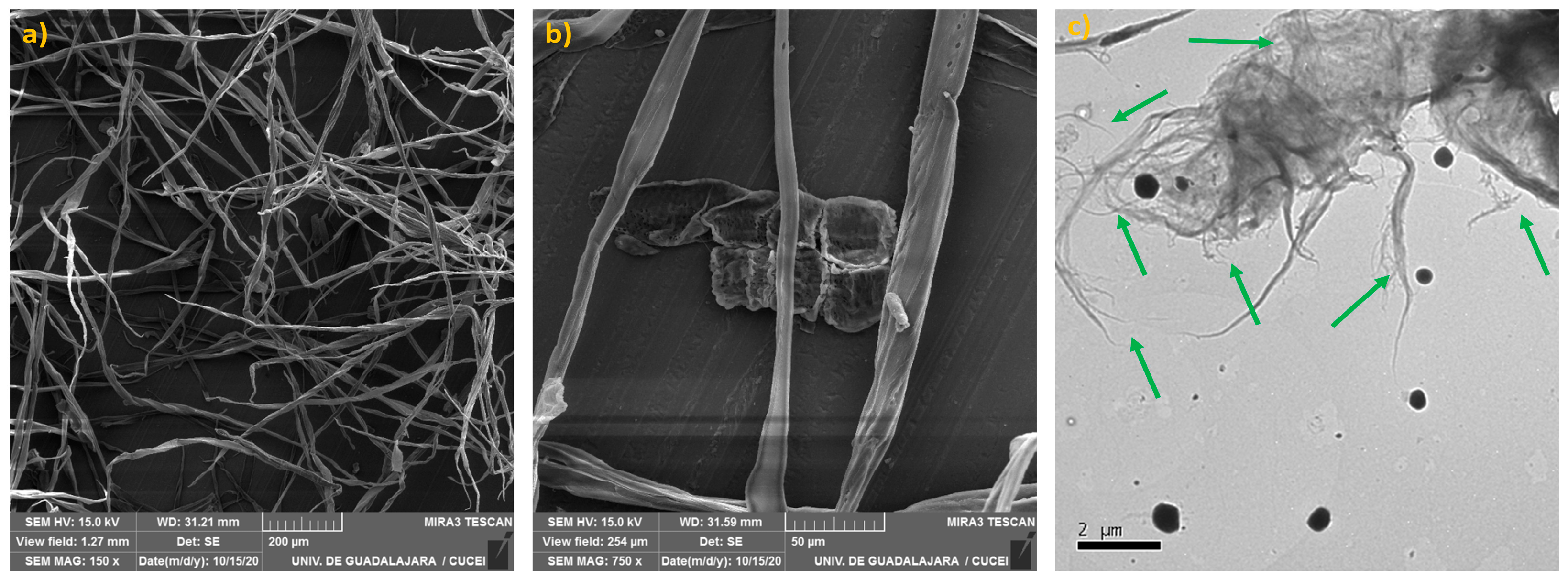
The particles used for the pulping process were the ones that passed through the 7 mm slot screen but were retained in the 5 mm hole screen. The yield of the cooking process was 34.7%, with a Kappa number of 9.27, representing 1.39% of residual lignin. Alpha cellulose, β-cellulose, and γ-cellulose fractions were 84.9%, 11.7%, and 3.4%, respectively. Fibers were observed under a microscope, and no significant damage to the fibers was observed (Figure 2a,b). The length and width of the fibers are within the limits reported in the literature (0.91–1.46 mm and 22–32 microns, respectively), while the wall thickness is slightly above (4.1 microns) [49,50]. The degree of polymerization was 773.6, representing a molecular weight of 264,571 g/mol. The slenderness ratio (length/diameter) is key to the tear and break resistance of paper. Values above 33 indicate that fibers are suitable for paper manufacturing, and for high quality, they must exceed 60 [49]. Depending on their slenderness, fibers are classified as highly elastic (>75), elastic (50–75), rigid (30–50), or very rigid (<30). In this study, the value was 58.9, indicating elastic fibers suitable for paper manufacturing. The Runkel ratio was 0.593, which, according to the Runkel ratio classification, means that the fiber is good for paper manufacturing [51]. The stiffness coefficient was 0.373 and the flexibility coefficient was 0.628. Figure 2c shows a TEM image, where the generated fibrillation can be seen, with some fibers visible at the nanometer level (indicated by the green arrows). However, such nanofibrils are not detached from the bigger microfibers.

Infrared Spectroscopy (FTIR) of Fibers

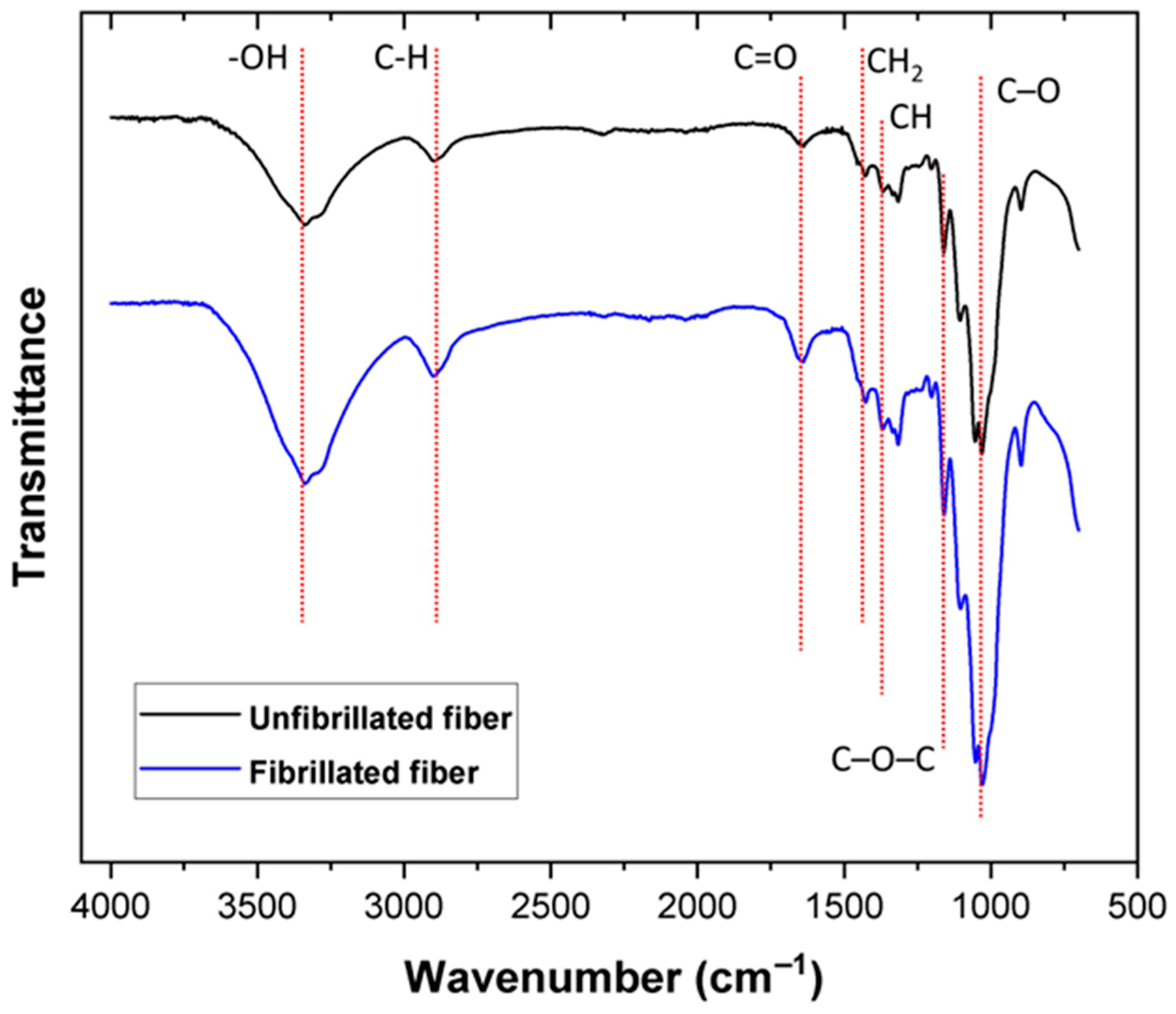
Figure 3 shows the spectra of unfibrillated and fibrillated fibers. The broad band in the range from 3400 to 3200 cm−1 is associated with O–H (hydroxyl) stretching vibrations. In the fibrillated fiber (blue), this band is more intense and wider, indicating greater availability of free hydroxyl groups, probably due to the increase in specific surface area or the breaking of intermolecular hydrogen bonds during fibrillation. The 2900 cm−1 range bands correspond to the C–H stretching of methyl and methylene groups. A slight increase in intensity can be seen in the fibrillated fiber, indicating greater surface exposure of cellulose chains. The signal at 1730 cm−1 corresponds to the C=O stretching of carboxyl or ester groups (typical of hemicellulose/lignin). In the region of 1600–1500 cm−1, there are bands attributable to aromatic C=C vibrations of lignin. The bands at 1425 cm−1 (CH2 vibrations) and 1370 cm−1 (C–H deformation) are attributed to the glycosidic skeleton of the cellulose. In the region of 1160 to 1030 cm−1, the bands are the typical cellulose signals: the bands at 1160 cm−1 are attributed to the asymmetric stretching C–O–C of glycosidic ethers, while in the 1050–1030 cm−1 range, the stretching of C–O in primary and secondary alcohols is responsible for the presence of those bands. In general, an increase in intensity was observed in fibrillated fibers, indicating greater exposure of the cellulose structures [52,53,54].

3.2. Obtaining Extracts from Hibiscus and Muicle

The yield of the obtained extracts was 37% and 54% for Hibiscus sabdariffa and Justicia spicigera (Muicle), respectively. Hibiscus extracts showed 10.1 ± 0.51 mg gallic acid equivalents/g of plant material for total polyphenols and 6.8 ± 0.21 mg catechin equivalents/g for total flavonoids. These values are consistent with the literature [55]. In contrast, Muicle extracts exhibited substantially higher contents (30.58 ± 0.84 mg GAE/g and 22.13 ± 1.61 mg CE/g), suggesting a greater abundance of hydroxylated phenolic and flavonoid structures capable of donating hydrogen atoms or electrons. These bioactive compounds are known to interfere with bacterial cell wall integrity and oxidative metabolism, which can explain the moderate inhibition zones observed in the films containing Muicle extract. Therefore, the compositional differences between the extracts are directly related to their potential antibacterial and antioxidant contributions, which in turn influence the functional performance of the biofilms.

3.3. Starch and Biofilms Preparation and Characterization

Biofilms approximately 200 µm thick and 170 mm in diameter were obtained. The starch-based thermoplastic biofilms showed a homogeneous appearance with no visible agglomerates, good dimensional stability, and absence of fractures. The microstructure and biofilm thickness affect the optical properties of the biofilms, which are strongly influenced by the internal and surface heterogeneity of the matrix [10,56,57]. Visual inspection of the CNFs-reinforced biofilms showed a slight color change to brown as the amount of both Muicle and Hibiscus extract increased (Figure 4a). In all cases, transparency was maintained.

3.3.1. Analysis of Color and Opacity, Thickness, Grammage, and Electrical Conductivity of Biofilms

Color and opacity analysis in thermoplastic starch biofilms allows for the detection of changes in optical absorption associated with the incorporation of additives, degradation, or crystallinity of the material. Table 2 shows the results of the color and opacity analysis. The color analysis L*a*b*, shows that the thermoplastic starch biofilm was the lightest (88.5). As expected, L* decreased when fiber [40,58] and extract concentration increased, e.g., FA05M1.0 (79.9) to FA10M2.0 (72.3). Also, L* in the Hibiscus biofilms decreased even more than in the Muicle biofilms, with values as low as 56.6 for FA10H2.5, indicating that the Hibiscus extract darkens the biofilm more than the Muicle extract. Hue a*: The thermoplastic was almost neutral (0.16). All biofilms have negative a* values, indicating a turn towards green, especially biofilms with more Hibiscus extracts (e.g., −6.57 in FA10H1.25). The b* hue for the thermoplastic starch biofilm was slightly yellowish (2.34), the other biofilms show negative b* values, indicating a bluish hue, especially FA05H2.5 (−12.44) and FA10H1.25 (−9.37). Figure 4b shows the CIELAB space color distribution diagram. The total color change (ΔE) increased with higher fiber content and higher extract concentration. In this respect, the Hibiscus extract generated more changes (maximum ΔE = 34.80 for FA10H2.5) than Muicle (maximum ΔE = 20.12 for FA10M2.0). The three-factor ANOVA showed that the three main effects (fiber concentration, extract type and extract solution concentration) are statistically significant (p < 0.05) in all color properties (L*, a*, b*, ΔE). A significant interaction was observed only between fiber concentration and extract type, indicating that the effect of fiber depends on the type of extract incorporated. In general, the films darken (lower L*) and showed higher ΔE with increasing fiber and extract, with the most noticeable changes occurring when Hibiscus extract is used.
Table 2 shows the opacity results at wavelengths of 400 nm and 600 nm. The opacity of the TPS biofilms was significantly higher (4.18 A·mm−1 at 400 nm and 5.46 A·mm−1 at 600 nm) compared to the biofilms incorporating MFC, which showed opacities between 0.75 and 1.80 A·mm−1 (400 nm) and between 1.80 and 3.39 A·mm−1 (600 nm). The decrease in opacity suggests that the addition of MFC favors the formation of more transparent biofilms, probably due to better dispersion of the components and changes in the internal structure of the material [42]. The three-factor ANOVA indicated that fiber concentration, extract type, and extract concentration significantly affect film opacity at 400 and 600 nm (p < 0.05). In general, the films became more transparent as the fiber and extract concentration increased, with the most pronounced effects observed with Hibiscus extract. Films without fibers or extracts (TPS) have the highest opacity, while combinations of high fiber content and Hibiscus extract show the highest transparency.
Table 3 shows the average results and their standard deviations for the properties of thickness, grammage, and electrical conductivity. The thermoplastic starch (TPS) biofilms had an average thickness of 125 ± 0.5 µm and a grammage of 148 ± 9.11 g/m2. When the different extracts and concentrations were incorporated, a general increase in thickness and grammage was observed. Similar effects have been reported [10,59]. For example, the FA10M1.0 and FA10M2.0 biofilms reached thicknesses of 190 ± 4.1 µm and 187 ± 3.7 µm, respectively, with weights of 178 ± 10.8 g/m2 and 184 ± 10.7 g/m2. Similarly, formulations with Hibiscus extracts had thicknesses close to 193 ± 3.8 µm and grammage greater than 180 g/m2, especially FA10H1.25 and FA10H2.5. The increase in thickness and grammage of the biofilms when extracts and MFC were added can be attributed to a greater number of solids in the matrix, which increases the mass per unit area. Additional interactions between the starch polymer and the compounds present in the extracts (Muicle and Hibiscus) can favor denser and more voluminous networks.
It can be observed that biofilms with 10 wt% MFC and extracts have the highest thickness and grammage values. This suggests that water and solid retention during drying increases with additive content, resulting in thicker and heavier layers. In general, the basis grammage and thickness values follow a parallel trend, indicating uniformity in the preparation process. ANOVA indicated that fiber concentration, extract type and extract solution concentration significantly affect film thickness and grammage (p < 0.05), while all interactions were insignificant (p > 0.05).
Table 3 also shows the electrical conductivity results for all biofilms. The incorporation of 5% and 10% MFC into thermoplastic starch films significantly influences their electrical conductivity. In general, fiber reinforcement tends to reduce the conductivity of the material, since natural fibers, being mainly cellulosic, do not conduct electricity and act as barriers to ion transport [10]. This phenomenon is more pronounced when the fiber load is increased, since the greater amount of non-conductive material interferes more with the flow of current. In this context, films reinforced with Hibiscus extract showed higher electrical conductivity compared to those reinforced with Muicle extract. This behavior can be attributed to the chemical composition of the extracts: Hibiscus is rich in phenolic compounds, such as anthocyanins, which have antioxidant properties and can contribute to the formation of ionic networks within the polymer matrix, facilitating charge transport and, therefore, increasing the electrical conductivity of the material [60]. On the other hand, although Muicle extract also contains bioactive compounds, it did not show such a pronounced effect on improving electrical conductivity. Values of σ ~10−5 S/cm are consistent with nearly insulating polymers; the very low current reflects that the material is mainly non-conductive, with conductivity induced by residual moisture or ionic impurities. The ANOVA indicated that all main factors were significant (p < 0.05) and that the decrease in conductivity with higher fiber content depended on the type of extract, being less pronounced for the Hibiscus extract. The extract concentration has an independent positive influence.

3.3.2. Solubility and Water Vapor Permeability of Biofilms

Table 4 shows the results for solubility and water vapor permeation. Packaging material should act as a barrier, minimizing or preventing moisture exchange with the environment to reduce the effect of water vapor. One of the main limitations of starch is its hydrophilic nature. The abundance of hydroxyl groups in its structure gives it polarity and high affinity for ambient water. This interaction with moisture significantly affects the properties of TPS biofilms, as water weakens the interactions between starch chains and increases their molecular mobility, favoring retrogradation [61]. The incorporation of MFC into thermoplastic starch biofilms significantly reduced their solubility compared to the control TPS (48.7%), reaching values between 38.7 and 44.1%. This decrease can be associated with the formation of more compact networks and additional interactions (hydrogen bonds or physicochemical interactions) between the starch, fibers and extracts, which limit penetration and dissolution in water. These results are similar to those reported in the literature [62,63]. Similarly, both water vapor transmission and permeance decreased compared to the control. This reduction is attributed to increased structural density, lower amorphous fraction, and possible reduction in hydrophilicity, which are factors that hinder the diffusion of water molecules through the biofilm [10,19,64,65]. Taken together, these results suggest that the incorporation of MFC improves the stability and barrier properties of the biofilms, making them more suitable for applications in biodegradable packaging where low solubility and low water vapor permeability are required [64,66]. The ANOVA showed that nanofiber concentration (A), extract solution concentration (B), and extract type (C) have significant effects on film solubility (p < 0.05), as does the A × B interaction. Extract type also has an influence: Muicle produces slightly less soluble films than Hibiscus with the same formulation. The concentration of the extract reinforces this trend, further decreasing solubility. For water vapor transmission, A, B, and C were significant (p < 0.05), as was the interaction between A × B (p < 0.05). The increase in fiber reduces the water vapor transmission, indicating a better water vapor barrier (TPS = 14.5 vs. FA10H2.5 = 9.7). Muicle extract conferred lower transmission than Hibiscus, suggesting that its composition interacts more with the polymer matrix. The concentration of the extract also decreases transmission, probably due to a filling effect. For water vapor permeance, the main factors A, B, and C and the interactions A × B and A × C were significant (p < 0.05). Permeance decreases with more fiber and extract, reinforcing the idea of greater tortuosity for vapor passage. Muicle extract achieves lower permeance than Hibiscus at the same formulation. The A × C interaction suggests that the effect of extract concentration depends on the amount of fiber incorporated.

3.3.3. CO2, O2 Permeability of Biofilms

Table 4 shows the results of the averages for gas permeation barrier properties. Biofilms with Muicle extracts and 5% MFC had a reduction in permeability, from 1.65 to 0.79, when increasing the extract solution concentration from 1.0 to 2.0. This indicates that the barrier against CO2 improved. When the amount of fiber increased to 10%, permeability increased from 1.40 to 2.29. At low extract concentrations (and low fiber), Muicle extracts could densify the matrix. However, at higher fiber content, excess extract can generate a less compact structure (polyphenolic interactions, irregular dispersion). Regarding O2 permeability, all samples with Muicle extracts are below the detection limit (<0.10), indicating an excellent oxygen barrier. The ANOVA showed that A, B, and C are significant (p < 0.05), as is the interaction between A and B. Although many values are below 0.10 (detection limit), in formulations with 2.5% Hibiscus or 10% Muicle, the values increased slightly, which indicates a change in the structure of the matrix. This supports the idea that both the type and concentration of the extract and fiber modulate the gas barrier.
By increasing the concentration of the Hibiscus extract in the biofilms from 1.25 to 2.5, CO2 permeability increased significantly: from 1.15 to 3.57 and from 1.06 to 2.31 for biofilms with 5 and 10% MFC, respectively. Biofilms with 5% MFC showed very good O2 permeability values. The FA10H2.5 biofilm showed a permeability of 0.58, which was the highest O2 permeability. Hibiscus extract appears to impair the barrier more than Muicle ones, possibly because it contains more hydrophilic or hygroscopic compounds, which interfere with the compaction of the matrix. It can induce plasticity or generate microchannels due to incompatibility. The ANOVA showed significance for A, B, C, and the interaction between A × B (p < 0.05). The CO2 is more limited in films with higher fiber and extract content, with lower values of Muicle than Hibiscus extracts. The presence of values “<0.10” in the control indicates that these films are already reasonable barriers, but the addition of fiber/extract favors CO2 permeability.

3.3.4. Fourier-Transform Infrared Spectroscopy (FTIR-ATR) of Biofilms

Figure 5 shows the FTIR spectra of all the biofilms produced. The TPS shows the typical starch profile, with a broad band between 3000 and 3500 cm−1 associated with O–H stretching and hydrogen bond interactions. The bands at 2880–2950 cm−1 are attributed to C–H stretching vibrations of methyl groups within the starch backbone [67,68]. The absorption at 1643 cm−1 corresponds to water retained in the sample. In addition, the regions at 1200–1450 cm−1 and 1030–1160 cm−1 show overlapping peaks assigned to bending and stretching vibrations of C–H, C–C, –OH, C–OH, and C–O–C bonds, which is consistent with previous reports [1,69,70].
In general, all spectra exhibit the characteristic bands of starch, confirming the basic structure of the polysaccharide is maintained after modification. However, slight variations in intensity and band shift are observed, indicating interactions between the added components and the starch matrix.
In the region of 3600–3000 cm−1, a broad band around 3298 cm−1 can be distinguished, which can be attributed to O–H stretching. This band reflects the presence of hydroxyl groups and hydrogen bonding interactions within the starch matrix [20,40]. In formulations with MFC, the reduction in intensity and slight shift in this band suggest that some of the O–H groups are involved in new interactions, possibly with additives or fibers, decreasing the availability of free groups and, therefore, surface hydrophobicity. The bands around 2927 cm−1 correspond to the C–H stretching of the methylene and methyl groups present in the structure of the starch and/or plasticizers. The stability of this band indicates that there were no significant changes in the overall aliphatic composition, although minor variations in intensity could be related to differences in the concentration of plasticizer or associated lipid compounds. In the 1640 cm−1 range, a typical band associated with the bending vibration of adsorbed water and, in some cases, C=O bonds of additives was observed. The slight decrease in intensity in biofilms with MFC suggests lower water absorption, consistent with the decrease in solubility and permeability reported in the table above, which reinforces the hypothesis of a more compact and less hydrophilic matrix [71]. The characteristic bands of C–O and C–O–C in glucopyranose rings and glycosidic bonds appeared between 1200 and 900 cm−1. The signal at 1152 cm−1 is attributed to C–O–C vibrations (glycosidic bridge), while the peak around 998 cm−1 is related to the stretching of C–O in the ring and is sensitive to the crystalline arrangement of the starch [72]. Changes in the intensity of this region may indicate alterations in the crystallinity and degree of retrogradation of the TPS matrix after the incorporation of CNFs.
Overall, the spectra show that, although the fundamental structure of the starch is not modified, the addition of MFC causes variations in the supramolecular organization and hydrogen interactions. These modifications are consistent with the results of lower solubility and water vapor permeability, since a denser network that is less accessible to water translates into greater stability and better barrier properties [73,74]. Therefore, FTIR analysis confirms that MFC generated chemical–physical interactions that strengthen the thermoplastic starch matrix without drastically altering its primary structure.

3.3.5. Differential Scanning Calorimetry (DSC)

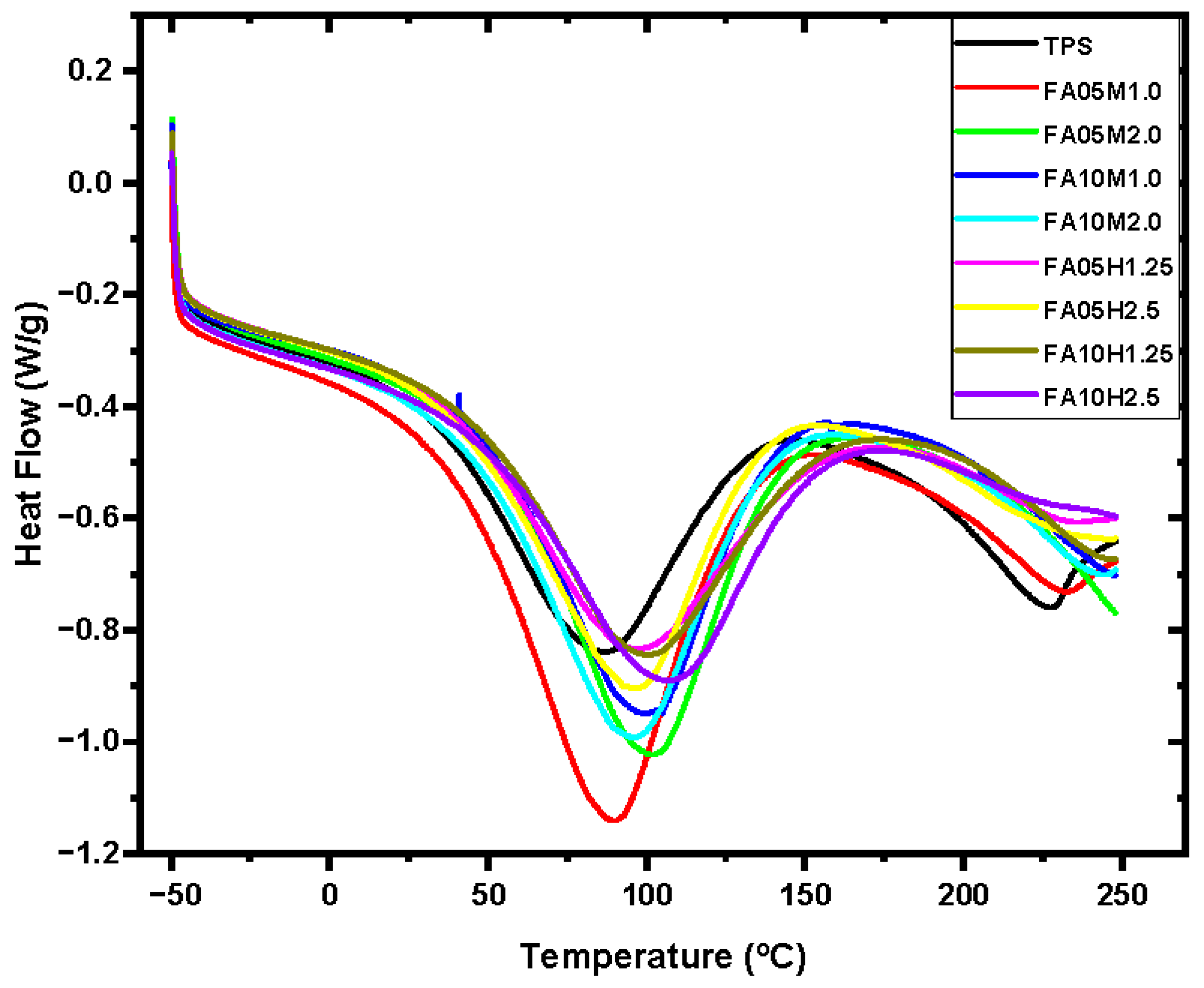
All DSC curves (Figure 6) presented a typical endothermic peak that can be attributed to starch gelatinization. Table 4 shows the Tg values. Note that the glass transition temperature (Tg) of the TPS biofilm without additives and without MFC was 85.8 °C. The incorporation of MFC increased the Tg in all formulations, with values ranging from 89.9 to 106.7 °C. This increase suggests a progressive restriction in the mobility of the polymer chains, related to physical and chemical interactions between the TPS matrix and MFC and extracts. The greatest increase was observed in FA10H2.5 (106.7 °C), indicating that the combination of higher MFC content and Hibiscus extract generated a more rigid network with greater cohesion. This gave biofilms greater thermal stability. These results are consistent with previous studies where the incorporation of fibers or nanocellulose into thermoplastic matrices raises the Tg by limiting segmental mobility and increasing the density of intermolecular bonds. Santana et al. (2017) [75] and Savadekar and Mhaske (2012) [76] observed similar behavior and noted that addition of nanocellulose extracted from sisal and cotton fibers to starch compounds, plasticized with glycerol, slightly shifted the DSC curve to the right (i.e., toward higher temperatures). This means that the melting temperature was higher compared to the control. ANOVA showed that all main factors (A, B, C) were significant (p < 0.05), as was the A × B interaction. Tg increases progressively with the addition of fiber and extract, indicating a more rigid and less mobile matrix. Muicle extract tends to increase Tg more than Hibiscus extracts in the same formulation, possibly due to stronger interactions with starch. This increase in Tg suggests that fibers and extracts acted as reinforcements, restricting the mobility of the chains.

3.3.6. Mechanical Properties

Figure 7a shows the maximum stress results, which increased as the MFC content increased, from ~10–12 MPa to ~19–21 MPa at 10 wt%. This behavior indicates that MFC acted as a reinforcement, improving load transfer and matrix cohesion [77]. Formulations with Muicle extract (2.0%) showed slightly higher strength than those with Hibiscus extracts (2.5%), suggesting that the matrix–MFC interaction depended on the type and concentration of extracts. In terms of Young’s modulus, Figure 7b shows how it increased with increasing MFC content from ~800 MPa to >1100 MPa. This means that the materials became stiffer and less deformable. The highest values were observed in formulations with Muicle extract at 2.0%, which reinforces the hypothesis of better compatibility or dispersion of MFC with this additive. The trend confirmed that MFC improved the stiffness and mechanical strength of the biocomposite [78]. Moreover, Figure 7c shows that when MFC increased, the elongation at break decreased dramatically from ~40% to <10%. This occurs because both stiffness and crystallinity increased, restricting the mobility of polymer chains and reducing their ability to deform before breaking. The decrease is similar in all formulations, showing that although the extracts influenced strength and stiffness, their impact on ductility is minor [79].
The mechanical properties of starch-based films depend significantly on both the source of the starch (botanical variety, amylose/amylopectin content, and degree of crystallinity) and the size, morphology, and chemical nature of the reinforcing materials used. These variables directly influence the formation of internal networks, stress distribution, and load transfer within the polymer matrix [80].
Statistical analysis (ANOVA) shows that the main factors A, B, and C, as well as the first-order interactions AB and AC, show significant differences in all the properties evaluated (p < 0.05). In contrast, B and C interaction and the triple ABC interaction did not show significant effects (p > 0.05), indicating that individual factors and simple interactions have the greatest influence on the system’s response. This pattern suggests that the variation in each factor and its first-order combinations was decisive in explaining the differences observed, while higher-order interactions did not contribute statistically.
Table 5 presents a comparison of the mechanical properties obtained in this work with those previously reported in the literature, allowing the identification of trends, similarities, and differences associated with the different types of starch and reinforcements used. Comparative results from the literature show wide variability in the mechanical properties of starch-based biocomposites reinforced with MFC, mainly due to the botanical source of starch, the type and content of the reinforcement, and the proportion and nature of the plasticizer used. In general, the reported tensile strength values range from 1.8 MPa to 56.6 MPa, while Young’s modulus varies over an even wider range (from 5.8 MPa to 6400 MPa), reflecting noticeable differences in the degree of stiffness and internal cohesion of the matrices. The elongation at break showed opposite behaviors, fluctuating between 0.08% and more than 100%, depending on the balance between plasticity and structural rigidity.
Systems made from potato, corn, or cassava starch tend to have moderate strength (3–17 MPa) and variable elongation, while formulations with sugarcane, banana, or kenaf nanofibers tend to show higher moduli (up to 1100 MPa) and better reinforcement properties due to the high crystallinity and fibrillar aspect of these reinforcements. In contrast, biocomposites based on more amorphous starches, such as rice or tapioca, can achieve high elongation (50–100%) when combined with effective plasticizers such as glycerol or sorbitol, although at the expense of lower stiffness. This study, using MFC obtained from ash wood and starch plasticized with 30% glycerol, presents intermediate values for strength (11–18 MPa), Young’s modulus (800–1180 MPa), and elongation at break (11–37%), which put it in the upper range of performance compared to similar starch biocomposites. These results confirmed that the controlled incorporation of MFC generated effective reinforcement, improving load transfer and matrix cohesion without excessively compromising the flexibility of the material.

3.3.7. Scanning Electron Microscopy (SEM)

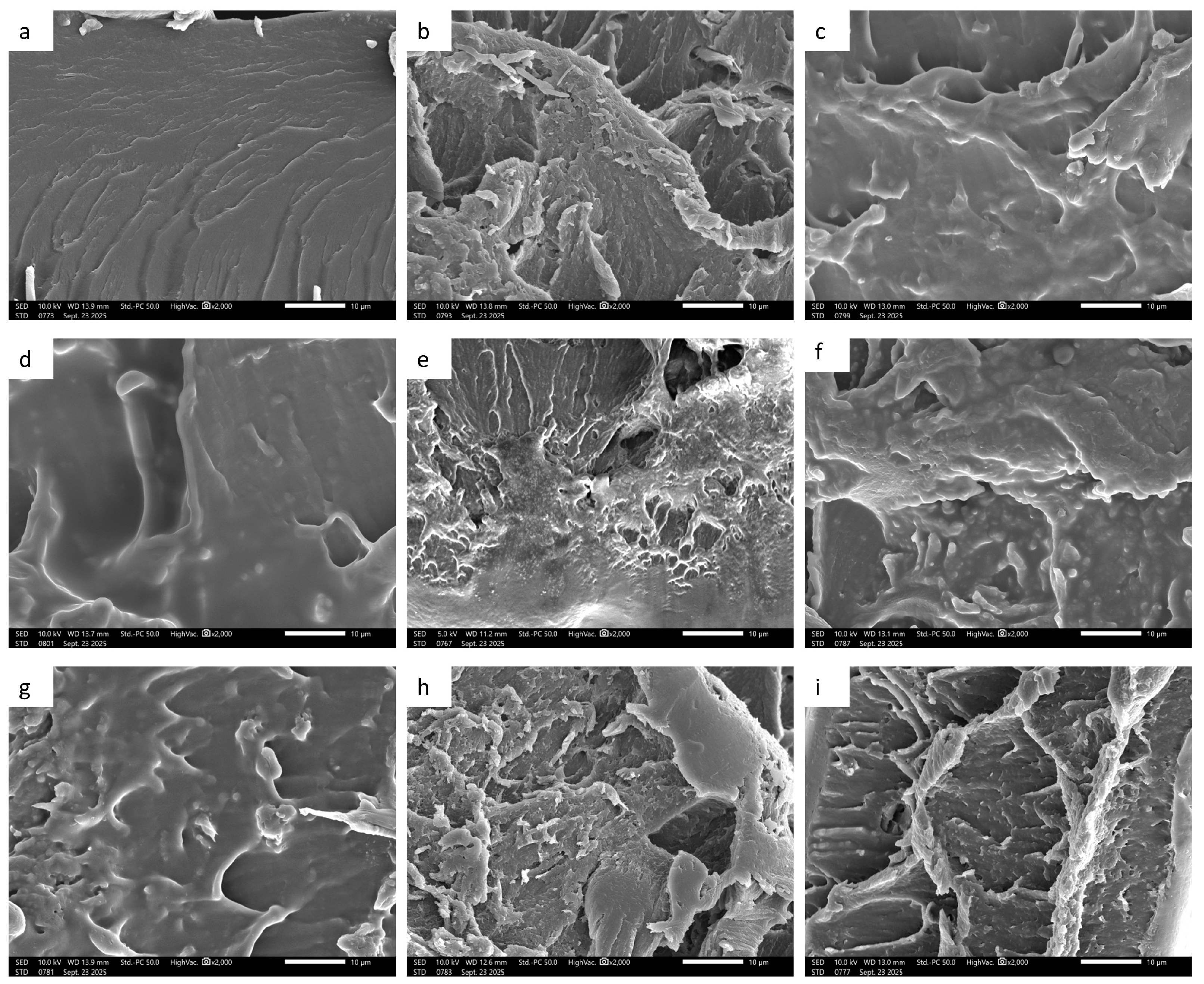
The SEM micrographs (Figure 8) show significant changes in the surface morphology of the films after the incorporation of MFC. The control sample Figure 8a exhibited a homogeneous and continuous surface, which is characteristic of a non-reinforced polymer matrix. In contrast, reinforced samples Figure 8b–i showed greater roughness, microcavity formation and partial fiber exposure. This demonstrates the influence of the cellulosic reinforcement on the internal structure. In particular, micrographs (e) and (i) revealed fibrillar networks and porosity, suggesting a heterogeneous distribution of the reinforcement and the generation of a more open structure. These morphological differences indicated that the matrix–reinforcement interaction varies with the formulation, which directly affects the mechanical and barrier properties of the material.

3.3.8. Contact Angle

Table 3 shows the average contact angle values for all biofilms. The contact angle values of biofilms ranged from 53.8° to 75.1°, showing notable differences in their surface wettability. TPS (62.7°) exhibited moderate hydrophilicity, while the FA05M1.0 and FA05M2.0 formulations increased their angle to 75.1°, indicating a tendency toward more hydrophobic surfaces. In contrast, FA10M2.0 and FA10H1.25 showed the lowest angles (53.8° and 56.6°, respectively), reflecting greater affinity for water and, therefore, more hydrophilic surfaces. The other formulations presented intermediate values, showing that both the concentration of MFC and the type of extract influenced the surface distribution of functional groups and roughness, which are determining factors of surface energy [65,83].
In general, it can be observed that the composition and preparation method did not produce a linear change in hydrophobicity but rather generated a combined effect that modified the exposure of polar and non-polar groups. This behavior suggests that it was possible to modulate the interaction with water and the moisture barrier of biofilms by adjusting the formulation and process, which is key for applications where performance in aqueous media needs to be controlled.
Figure 9 shows representative images of the water droplets used to determine the contact angle in the different biofilms. It can be seen that the droplets had shapes with various degrees of sphericity, reflecting changes in surface wettability. Samples with more rounded droplets corresponded to more hydrophobic surfaces (higher contact angles), while flatter droplets indicated more hydrophilic surfaces (lower contact angles).
The ANOVA showed that A and B are significant (p < 0.05), C is not significant, and only the A × B interaction was significant. This indicates that the hydrophobicity of the films depended on the combination of fiber concentration and extract type. In general, higher fiber loads increased the contact angle, although the effect varied depending on the extract: Hibiscus and Muicle extract-based biofilms showed clear differences in wettability. The extract solution concentration did not significantly modify the contact angle and other interactions were not relevant.

3.3.9. Antibacterial Properties

The antibacterial activity of biofilms was evaluated using the disk diffusion method against the model strains Staphylococcus aureus and Escherichia coli. Figure 10 shows the culture plates obtained after 24 h of incubation at 37 °C. In general, most samples did not show visible inhibition zones, indicating an absence of significant antibacterial effect under the test conditions.
However, sample FA10H2.5 showed a noticeable clearing zone around the disk, corresponding to an average inhibition halo of 15 mm, suggesting the presence of active compounds with a moderate bacteriostatic effect. This functional antibacterial response indicated that the incorporation of phenolic-rich extracts into the polymer matrix enabled the controlled release and diffusion of bioactive compounds, resulting in measurable inhibition of microbial growth. This result could be attributed to greater diffusion of the bioactive agents or to the presence of phenolic metabolites with antimicrobial capacity in this formulation [83,84].
The absence of halos in the other samples may be related to a low concentration of the active agent, poor solubility in the aqueous medium, or limited diffusion in the agar matrix [85]. Similar results have been reported by other authors when evaluating starch biofilms reinforced with cellulose or natural extracts, where antibacterial activity depends on the controlled release and compatibility of the active compound with the polymer matrix [86,87].
These findings indicate that the formulation corresponding to sample FA10H2.5 has a potential antibacterial effect, which should be confirmed by accurate measurement of the halo diameter and complementary tests, such as the determination of the minimum inhibitory concentration (MIC) or the colony-forming unit (CFU) count assay.

4. Conclusions

Ash trees represent a promising source of microfibrillated cellulose (MFC). Muicle extracts showed a higher yield and higher polyphenol and flavonoid content than Hibiscus extracts, indicating that it is richer in bioactive compounds.
The obtained thermoplastic starch biofilms were homogeneous, dimensionally stable, and free of fractures. Microstructure and thickness influenced their optical properties, and although the addition of Muicle and Hibiscus extracts produced a slight color change, transparency was maintained.
The basic structure of starch was maintained in all biofilms, but the incorporation of MFC caused additional hydrogen interactions. These modifications strengthened the thermoplastic starch matrix, reducing its solubility and water vapor permeability without significantly altering its primary composition.
The incorporation of Muicle and Hibiscus extracts and the amount of fiber modulate the barrier of biofilms against CO2 and O2. Muicle extracts improved the CO2 barrier at moderate fiber concentrations, while Hibiscus extracts tended to increase permeability, possibly due to their more hydrophilic nature. All biofilms with Muicle extracts showed an excellent barrier against O2 (<0.10), demonstrating that the type and concentration of extract and fiber significantly affect the structure and barrier properties of the matrix.
The incorporation of MFC and both types of extracts increased the glass transition temperature (Tg) of starch biofilms, indicating greater rigidity and thermal stability of the matrix. Muicle extracts increased the Tg more than Hibiscus extracts, suggesting stronger interactions with starch and a reinforcing effect on the mobility of polymer chains.
Biomaterials reinforced with MFC showed a significant improvement in tensile strength and elastic modulus, attributed to the interfacial interaction between the polymer matrix and the fibers. This structural reinforcement allowed adequate flexibility to be maintained, demonstrating a homogeneous distribution of phases and favorable mechanical synergy for applications in biodegradable packaging and functional materials.
The biofilms showed contact angles between 53.8° and 75.1°, indicating that hydrophobicity or hydrophilicity depended on the concentration of MFC and the type of extract.
Evaluation using the disk diffusion method revealed that most formulations did not show visible inhibition halos, except for sample FA10H2.5, which showed a moderate bacteriostatic effect against E. colli. This behavior suggested the presence of bioactive compounds or phenolic extracts capable of limiting microbial growth, indicating potential for application in controlled-release systems or active coatings.
The use of ash trees to produce MFC contributes to diversifying non-food biomass sources, promotes circular economy, and opens up opportunities to develop biocomposites and functional materials with less environmental impact than those derived from synthetic or traditional sources.

Author Contributions

Conceptualization, J.A.-H., J.G.T.-R. and S.G.E.; methodology, E.G.-T., L.B.-R., E.O.C.-L., A.L.H. and S.G.E.; formal analysis, E.O.C.-L., J.J.V.-R., F.d.A.K., A.L.H. and S.G.E.; investigation, M.G.L.-R., R.M.J.-A. and S.G.E.; resources, R.M.J.-A., J.A.S.-G. and S.G.E.; data curation, M.G.L.-R., R.M.J.-A., F.d.A.K. and S.G.E.; writing—original draft preparation, J.J.V.-R., J.G.T.-R. and S.G.E.; writing—review and editing, J.G.T.-R. and S.G.E.; visualization, J.G.T.-R. and S.G.E.; supervision, J.A.-H., J.G.T.-R. and S.G.E.; project administration, J.G.T.-R. and S.G.E.; funding acquisition, J.A.S.-G., J.G.T.-R. and S.G.E. All authors have read and agreed to the published version of the manuscript.

Funding

This research received no external funding.

Institutional Review Board Statement

Not applicable.

Informed Consent Statement

Not applicable.

Data Availability Statement

The data that support the findings of this study are available from the corresponding authors, J.G.T.-R. and S.G.E., upon reasonable request.

Acknowledgments

We also thank the National Council for Humanities, Sciences, and Technologies (CONAHCyT) for the doctoral scholarship awarded to E.G.-T. (CVU 955556) for a Doctorate in sustainable biomaterials science.

Conflicts of Interest

The authors declare no conflicts of interest.

References

  1. Lomelí-Ramírez, M.G.; Barrios-Guzmán, A.J.; García-Enriquez, S.; de Jesús Rivera-Prado, J.; Manríquez-González, R. Chemical and mechanical evaluation of bio-composites based on thermoplastic starch and wood particles prepared by thermal compression. BioResources 2014, 9, 2960–2974. [Google Scholar] [CrossRef]
  2. Mali, S.; Grossmann, M.V.E.; Garcia, M.A.; Martino, M.N.; Zaritzky, N.E. Microstructural characterization of yam starch films. Carbohydr. Polym. 2002, 50, 379–386. [Google Scholar] [CrossRef]
  3. Satyanarayana, K.G.; Arizaga, G.G.C.; Wypych, F. Biodegradable composites based on lignocellulosic fibers-An overview. Prog. Polym. Sci. 2008, 34, 982–1021. [Google Scholar] [CrossRef]
  4. James, M.; Myers, A. Seed starch synthesis. In Handbook of Maize: Its Biology; Bennetzen, J., Hake, S., Eds.; Springer: New York, NY, USA, 2009; pp. 439–456. [Google Scholar]
  5. Rindlav-Westling, Å.; Stading, M.; Gatenholm, P. Crystallinity and morphology in films of starch, amylose and amylopectin blends. Biomacromolecules 2002, 3, 84–91. [Google Scholar] [CrossRef]
  6. Fredriksson, H.; Silverio, J.; Andersson, R.; Eliasson, A.C.; Åman, P.J.C.P. The influence of amylose and amylopectin characteristics on gelatinization and retrogradation properties of different starches. Carbohydr. Polym. 1998, 35, 119–134. [Google Scholar] [CrossRef]
  7. Huang, L.; Xu, H.; Zhao, H.; Xu, M.; Qi, M.; Yi, T.; An, S.; Zhang, X.; Li, C.; Huang, C.; et al. Properties of thermoplastic starch films reinforced with modified cellulose nanocrystals obtained from cassava residues. New J. Chem. 2019, 43, 14883–14891. [Google Scholar] [CrossRef]
  8. Fazeli, M.; Keley, M.; Biazar, E. Preparation and characterization of starch-based composite films reinforced by cellulose nanofibers. Int. J. Biol. Macromol. 2018, 116, 272–280. [Google Scholar] [CrossRef]
  9. Nasri-Nasrabadi, B.; Behzad, T.; Bagheri, R. Preparation and characterization of cellulose nanofiber reinforced thermoplastic starch composites. Fibers Polym. 2014, 15, 347–354. [Google Scholar] [CrossRef]
  10. Lomelí-Ramírez, M.G.; Reyes-Alfaro, B.; Martínez-Salcedo, S.L.; González-Pérez, M.M.; Gallardo-Sánchez, M.A.; Landázuri-Gómez, G.; Vargas-Radillo, J.J.; Diaz-Vidal, T.; Torres-Rendón, J.G.; Macias-Balleza, E.R.; et al. Thermoplastic starch biocomposite films reinforced with nanocellulose from Agave tequilana weber var. Azul Bagasse. Polymers 2023, 15, 3793. [Google Scholar] [CrossRef]
  11. Shamsabadi, O.D.; Soltanolkottabi, F. Green nanocomposite of (starch/polylactic acid/cellulose nanofiber) thermoplastic. Polym. Polym. Compos. 2024, 32, 09673911241294213. [Google Scholar] [CrossRef]
  12. Montero, B.; Rico, M.; Barral, L.; Bouza, R.; López, J.; Schmidt, A.; Bittmann-Hennes, B. Preparation and characterization of bionanocomposite films based on wheat starch and reinforced with cellulose nanocrystals. Cellulose 2021, 28, 7781–7793. [Google Scholar] [CrossRef]
  13. Żołek-Tryznowska, Z.; Bednarczyk, E.; Tryznowski, M.; Kobiela, T. A comparative investigation of the surface properties of corn-starch-microfibrillated cellulose composite films. Materials 2023, 16, 3320. [Google Scholar] [CrossRef]
  14. Freitas, P.A.; Arias, C.I.L.F.; Torres-Giner, S.; González-Martínez, C.; Chiralt, A. Valorization of rice straw into cellulose microfibers for the reinforcement of thermoplastic corn starch films. Appl. Sci. 2021, 11, 8433. [Google Scholar] [CrossRef]
  15. Montoya, Ú.; Zuluaga, R.; Castro, C.; Goyanes, S.; Gañán, P. Development of composite films based on thermoplastic starch and cellulose microfibrils from Colombian agroindustrial wastes. J. Thermoplast. Compos. Mater. 2014, 27, 413–426. [Google Scholar] [CrossRef]
  16. Kumar, V.; Bollström, R.; Yang, A.; Chen, Q.; Chen, G.; Salminen, P.; Bousfield, D.; Toivakka, M. Comparison of nano-and microfibrillated cellulose films. Cellulose 2014, 21, 3443–3456. [Google Scholar] [CrossRef]
  17. Andresen, M.; Johansson, L.S.; Tanem, B.S.; Stenius, P. Properties and characterization of hydrophobized microfibrillated cellulose. Cellulose 2006, 13, 665–677. [Google Scholar] [CrossRef]
  18. Midhun, C.D.M.; dos Santos Rosa, D.; Camani, P.H.; Kumar, A.S.; Kv, N.; Begum, P.S.; Dinakaran, D.; John, E.; Baby, D.; Thomas, M.M.; et al. Thermoplastic starch nanocomposites using cellulose-rich Chrysopogon zizanioides nanofibers. Int. J. Biol. Macromol. 2021, 191, 572–583. [Google Scholar] [CrossRef]
  19. Babaee, M.; Jonoobi, M.; Hamzeh, Y.; Ashori, A. Biodegradability and mechanical properties of reinforced starch nanocomposites using cellulose nanofibers. Carbohydr. Polym. 2015, 132, 1–8. [Google Scholar] [CrossRef]
  20. Cheng, G.; Zhou, M.; Wei, Y.J.; Cheng, F.; Zhu, P.X. Comparison of mechanical reinforcement effects of cellulose nanocrystal, cellulose nanofiber, and microfibrillated cellulose in starch composites. Polym. Compos. 2019, 40 (Suppl. S1), E365–E372. [Google Scholar] [CrossRef]
  21. de Oliveira, A.L.M.; Bento, J.A.C.; Fidelis, M.C.; Dias, M.C.; de Barros, H.E.A.; Natarelli, C.V.L.; do Lago, R.C.; Barbosa, J.W.; Ossani, P.C.; Caliari, M.; et al. Effect of pine, eucalyptus, and corn straw nanofibers on the structural properties of rice flour-based biodegradable films. Ind. Crops Prod. 2023, 191, 115929. [Google Scholar] [CrossRef]
  22. Ghanbari, A.; Tabarsa, T.; Ashori, A.; Shakeri, A.; Mashkour, M. Thermoplastic starch foamed composites reinforced with cellulose nanofibers: Thermal and mechanical properties. Carbohydr. Polym. 2018, 197, 305–311. [Google Scholar] [CrossRef]
  23. Montero, B.; Rico, M.; Rodríguez-Llamazares, S.; Barral, L.; Bouza, R. Effect of nanocellulose as a filler on biodegradable thermoplastic starch films from tuber, cereal and legume. Carbohydr. Polym. 2017, 157, 1094–1104. [Google Scholar] [CrossRef]
  24. Tropical Plants Database, Ken Fern. Available online: https://tropical.theferns.info/viewtropical.php?id=Fraxinus+uhdei (accessed on 7 October 2025).
  25. Backyard Nature. Fraxinus uhdei (Tropical Ash). 2024. Available online: https://www.backyardnature.net/q/fraxinus.htm (accessed on 7 October 2025).
  26. Saavedra-Ramírez, K.A.; Etter, A.; Ramírez, A. Tropical ash (Fraxinus udhei) invading Andean forest remnants in Northern South America. Ecol. Process. 2018, 7, 16. [Google Scholar] [CrossRef]
  27. Francis, J.K. Fraxinus uhdei (Wenz.) Lingelsh.: Tropical Ash. U.S. Department of Agriculture, Forest Service, Institute of Tropical Forestry, General Technical Report IITF-28. 1990. Available online: https://data.fs.usda.gov/research/pubs/iitf/sm_iitf028%20%20%284%29.pdf (accessed on 7 October 2025).
  28. McElwee, R.L.; Tobias, R.C.; Gregory, A.H. Wood characteristics of three southern hardwood species and their relationship to pulping properties. TAPPI J. 1970, 53, 1882–1886. [Google Scholar]
  29. Baqueiro-Peña, I.; Guerrero-Beltrán, J.Á. Physicochemical and antioxidant characterization of Justicia spicigera. Food Chem. 2017, 218, 305–312. [Google Scholar] [CrossRef]
  30. Ohenhen, O.N.; Njoku, P.C.; Igara, C.E. Antibacterial and antioxidant activity of Justicia spicigera extracts: Activity enhancement by addition of metal salts. In Proceedings of the 39th CSN Annual International Conference 2016, Workshop and Exhibition, Rivers State University of Science and Technology, Port Harcourt, Nigeria, 18–23 September 2016; p. B06A952. [Google Scholar]
  31. Ali, B.H.; Wabel, N.A.; Blunden, G. Phytochemical, pharmacological and toxicological aspects of Hibiscus sabdariffa L.: A review. Phytother. Res. Int. J. Devoted Pharmacol. Toxicol. Eval. Nat. Prod. Deriv. 2005, 19, 369–375. [Google Scholar]
  32. Da-Costa-Rocha, I.; Bonnlaender, B.; Sievers, H.; Pischel, I.; Heinrich, M. Hibiscus sabdariffa L.–A phytochemical and pharmacological review. Food Chem. 2014, 165, 424–443. [Google Scholar] [CrossRef]
  33. Jardim, J.M.; Hart, P.W.; Lucia, L.A.; Jameel, H.; Chang, H.M. The effect of the Kraft pulping process, wood species, and pH on lignin recovery from black liquor. Fibers 2022, 10, 16. [Google Scholar] [CrossRef]
  34. TAPPI T236 om-22; Kappa Number of Pulp. Standard by Technical Association of the Pulp and Paper Industry. Tappi Press: Atlanta, GA, USA, 2022.
  35. TAPPI T 203 cm-22; Alpha-, Beta- and Gamma-Cellulose in Pulp. Standard by Technical Association of the Pulp and Paper Industry. Tappi Press: Atlanta, GA, USA, 2022.
  36. TAPPI T230 om-19; Viscosity of Pulp (Capillary Viscometer Method). Standard by Technical Association of the Pulp and Paper Industry. Tappi Press: Atlanta, GA, USA, 2019.
  37. Singleton, V.L.; Rossi, J.A. Colorimetry of total phenolics with phosphomolybdic-phosphotungstic acid reagents. Am. J. Enol. Vitic. 1965, 16, 144–158. [Google Scholar] [CrossRef]
  38. Nanasombat, S.; Thonglong, J.; Jitlakha, J. Formulation and characterization of novel functional beverages with antioxidant and anti-acetylcholinesterase activities. Funct. Foods Health Dis. 2015, 5, 1–16. [Google Scholar] [CrossRef]
  39. Jaramillo, C.M.; González Seligra, P.; Goyanes, S.; Bernal, C.; Famá, L. Biofilms based on cassava starch containing extract of yerba mate as antioxidant and plasticizer. Starch-Stärke 2015, 67, 780–789. [Google Scholar] [CrossRef]
  40. Fronza, P.; Batista, M.J.; Franca, A.S.; Oliveira, L.S. Bionanocomposite based on cassava waste starch, locust bean galactomannan, and cassava waste cellulose nanofibers. Foods 2024, 13, 202. [Google Scholar] [CrossRef]
  41. Luís, Â.; Domingues, F.; Ramos, A. Production of Hydrophobic Zein-Based Films Bioinspired by The Lotus Leaf Surface: Characterization and Bioactive Properties. Microorganisms 2019, 7, 267. [Google Scholar] [CrossRef]
  42. de Oliveira, J.P.; de Almeida, M.E.F.; Costa, J.D.S.S.; da Silva, I.B.; de Oliveira, J.S.; Oliveira, E.L.; Landim, L.B.; da Silva, N.M.C.; de Oliveira, C.P. Effect of eucalyptus nanofibril as reinforcement in biodegradable thermoplastic films based on rice starch (Oryza sativa): Evaluation as primary packaging for crackers. Food Chem. 2025, 474, 143177. [Google Scholar] [CrossRef]
  43. Almeida, T.; Karamysheva, A.; Valente, B.F.; Silva, J.M.; Braz, M.; Almeida, A.; Silvestre, A.J.D.; Vilela, C.; Freire, C.S. Biobased ternary films of thermoplastic starch, bacterial nanocellulose and gallic acid for active food packaging. Food Hydrocoll. 2023, 144, 108934. [Google Scholar] [CrossRef]
  44. ASTM E96/E96M-22; Standard Test Methods for Gravimetric Determination of Water Vapor Transmission Rate of Materials. American Society for Testing and Materials: West Conshohocken, PA, USA, 2022.
  45. Group, I.W.; Sabbah, R.; Xu-Wu, A.; Usa, J.C.; Leitão, M.P.; Roux, M.V.; Torres, L.A. Reference materials for calorimetry and differential thermal analysis. Thermochim. Acta 1999, 331, 93–204. [Google Scholar] [CrossRef]
  46. ASTM D882-18; Standard Test Method for Tensile Properties of Thin Plastic Sheeting. American Society for Testing and Materials: West Conshohocken, PA, USA, 2019.
  47. Bauer, A.W.; Kirby, W.M.; Sherris, J.C.; Turck, M. Antibiotic susceptibility testing by a standardized single disk method. Am. J. Clin. Pathol. 1966, 45, 493–496. [Google Scholar] [CrossRef]
  48. Manzano, C.; Landa, A.; Calva, D.; Lehman, M.; Erro, L.E.; Tonantzintla, P.M. Un Método Simple para la Medida de Halos de Difusión en Cultivos Biológicos; Software Integral para Laboratorio (Sofilab) SA de CV: Mexico City, Mexico, 2011. [Google Scholar]
  49. Ververis, C.; Georghiou, K.; Christodoulakis, N.; Santas, P.; Santas, R. Fiber dimensions, lignin and cellulose content of various plant materials and their suitability for paper production. Ind. Crops Prod. 2004, 19, 245–254. [Google Scholar] [CrossRef]
  50. Österling, S.R.; Ferritsius, O.; Ferritsius, R. Mechanical Pulping: The influence of fiber dimensions on mechanical pulp long fiber tensile index and density. Nord. Pulp Pap. Res. J. 2012, 27, 844–859. [Google Scholar] [CrossRef]
  51. NagarajaGanesh, B.; Rekha, B.; Mohanavel, V.; Ganeshan, P. Exploring the possibilities of producing pulp and paper from discarded lignocellulosic fibers. J. Nat. Fibers 2023, 20, 2137618. [Google Scholar] [CrossRef]
  52. Xu, F.; Yu, J.; Tesso, T.; Dowell, F.; Wang, D. Qualitative and quantitative analysis of lignocellulosic biomass using infrared techniques: A mini-review. Appl. Energy 2013, 104, 801–809. [Google Scholar] [CrossRef]
  53. Robles, E.; Fernández-Rodríguez, J.; Barbosa, A.M.; Gordobil, O.; Carreño, N.L.; Labidi, J. Production of cellulose nanoparticles from blue agave waste treated with environmentally friendly processes. Carbohydr. Polym. 2018, 183, 294–302. [Google Scholar] [CrossRef]
  54. Contreras, H.J.; Trujillo, H.A.; Arias, G.; Pérez, J.; Delgado, E. Espectroscopia Atr-Ftir De Celulosa: Aspecto Instrumental Y Tratamiento Matemático De Espectros. e-Gnosis 2010, 8, 1–13. [Google Scholar]
  55. Pacheco-Coello, F.; Ramírez-Azuaje, D.; Pinto-Catari, I.; Peraza-Marrero, M.; Orosco-Vargas, C. Comparación de compuestos fenólicos totales en Hibiscus sabdariffa L. Venezuela. Rev. Colomb. Cienc. Químico-Farm. 2019, 48, 521–527. [Google Scholar] [CrossRef]
  56. González-Pérez, M.M.; Lomelí-Ramírez, M.G.; Robledo-Ortiz, J.R.; Silva-Guzmán, J.A.; Manríquez-González, R. Biodegradable Biocomposite of Starch Films Cross-Linked with Polyethylene Glycol Diglycidyl Ether and Reinforced by Microfibrillated Cellulose. Polymers 2024, 16, 1290. [Google Scholar] [CrossRef] [PubMed]
  57. Gutiérrez, T.J.; Tapia, M.S.; Pérez, E.; Famá, L. Edible films based on native and phosphated 80:20 waxy:normal corn starch. Starch-Stärke 2015, 67, 90–97. [Google Scholar] [CrossRef]
  58. Do Lago, R.C.; de Oliveira, A.L.M.; de Amorim dos Santos, A.; Zitha, E.Z.M.; Nunes Carvalho, E.E.; Tonoli, G.H.D.; de Barros Vilas Boas, E.V. Addition of Wheat Straw Nanofibrils to Improve the Mechanical and Barrier Properties of Cassava Starch–Based Bionanocomposites. Ind. Crops Prod. 2021, 170, 113816. [Google Scholar] [CrossRef]
  59. Almeida, D.M.; Woiciechowski, A.L.; Wosiacki, G.; Prestes, R.A.; Pinheiro, L.A. Propriedades físicas, químicas e de barreira em filme formados por blenda de celulose bacteriana e fécula de batata. Polímeros 2013, 23, 538–546. [Google Scholar] [CrossRef]
  60. Escobar-Millán, Z.; García-Iglesias, T.; Gómez-Leyva, J.F.; Ramírez-Alvarado, D.; Figueroa-Martínez, R.; Torres-Bugarín, O.; García-García, M.R. Extracto de jamaica (Hibiscus sabdariffa L.): Efecto antioxidante y terapéutico. Acta De Ciencia En Salud 2022, 14–19. [Google Scholar] [CrossRef]
  61. Ma, X.; Chang, P.R.; Yu, J. Plasticized starch. In Starch-Based Polymeric Materials and Nanocomposites: Chemistry, Processing and Applications; Ahmed, J., Tiwari, B.K., Imam, S.H., Rao, M.A., Eds.; CRC Press: Boca Raton, FL, USA; Taylor & Francis Group, LLC: Boca Raton, FL, USA, 2012; pp. 69–83. [Google Scholar]
  62. Fazeli, M.; Simão, R.A. The effect of cellulose nanofibers on the properties of starch biopolymer. Macromol. Symp. 2018, 380, 1800110. [Google Scholar] [CrossRef]
  63. Abd Karim, S.F.; Idris, J.; Jai, J.; Musa, M.; Ku Hamid, K.H. Production of thermoplastic starch-aloe vera gel film with high tensile strength and improved water solubility. Polymers 2022, 14, 4213. [Google Scholar] [CrossRef]
  64. Granda, L.A.; Oliver-Ortega, H.; Fabra, M.J.; Tarrés, Q.; Pèlach, M.À.; Lagarón, J.M.; Méndez, J.A. Improved process to obtain nanofibrillated cellulose (CNF) reinforced starch films with upgraded mechanical properties and barrier character. Polymers 2020, 12, 1071. [Google Scholar] [CrossRef]
  65. Li, M.; Tian, X.; Jin, R.; Li, D. Preparation and characterization of nanocomposite films containing starch and cellulose nanofibers. Ind. Crops Prod. 2018, 123, 654–660. [Google Scholar] [CrossRef]
  66. Pelissari, F.M.; Andrade-Mahecha, M.M.; do Amaral Sobral, P.J.; Menegalli, F.C. Nanocomposites based on banana starch reinforced with cellulose nanofibers isolated from banana peels. J. Colloid Interface Sci. 2017, 505, 154–167. [Google Scholar] [CrossRef]
  67. Ragoubi, M.; Terrié, C.; Leblanc, N. Physico-Chemical, Rheological, and Viscoelastic Properties of Starch Bio-Based Materials. J. Compos. Sci. 2022, 6, 375. [Google Scholar] [CrossRef]
  68. Merino, D.; Mansilla, A.Y.; Gutiérrez, T.J.; Casalongué, C.A.; Alvarez, V.A. Chitosan coated-phosphorylated starch films: Water interaction, transparency and antibacterial properties. React. Funct. Polym. 2018, 131, 445–453. [Google Scholar] [CrossRef]
  69. Ghosh Dastidar, T.; Netravali, A. Cross-linked waxy maize starch-based “green” composites. ACS Sustain. Chem. Eng. 2013, 1, 1537–1544. [Google Scholar] [CrossRef]
  70. Prabhakar, M.N.; Rehman Shah, A.; Song, J.I. Improved flame-retardant and tensile properties of thermoplastic starch/flax fabric green composites. Carbohydr. Polym. 2017, 168, 201–211. [Google Scholar] [CrossRef]
  71. Xiong, J.; Li, Q.; Shi, Z.; Ye, J. Interactions between wheat starch and cellulose derivatives in short-term retrogradation: Rheology and FTIR study. Food Res. Int. 2017, 100, 858–863. [Google Scholar] [CrossRef]
  72. Van Soest, J.J.; Tournois, H.; de Wit, D.; Vliegenthart, J.F. Short-range structure in (partially) crystalline potato starch determined with attenuated total reflectance Fourier-transform IR spectroscopy. Carbohydr. Res. 1995, 279, 201–214. [Google Scholar] [CrossRef]
  73. Khadsai, S.; Janmanee, R.; Sam-Ang, P.; Nuanchawee, Y.; Rakitikul, W.; Mankhong, W.; Likittrakulwong, W.; Ninjiaranai, P. Influence of crosslinking concentration on the properties of biodegradable modified cassava starch-based films for packaging applications. Polymers 2024, 16, 1647. [Google Scholar] [CrossRef]
  74. Mu, J.; Yu, S. Quantitative Evaluation of Water Vapor Permeability Coefficients of Earth Materials Under the Influence of Density and Particle Size Distribution. Buildings 2025, 15, 1821. [Google Scholar] [CrossRef]
  75. Santana, J.S.; do Rosário, J.M.; Pola, C.C.; Otoni, C.G.; de Fátima FerreiraSoares, N.; Camilloto, G.P.; Cruz, R.S. Cassava starch-based nanocomposites reinforced with cellulose nanofibers extracted from sisal. J. Appl. Polym. Sci. 2017, 134, 44637. [Google Scholar] [CrossRef]
  76. Savadekar, N.R.; Mhaske, S.T. Synthesis of nano cellulose fibers and effect on thermoplastics starch based films. Carbohydr. Polym. 2012, 89, 146–151. [Google Scholar] [CrossRef]
  77. Omran, A.A.B.; Mohammed, A.A.; Sapuan, S.M.; Ilyas, R.A.; Asyraf, M.R.M.; Rahimian Koloor, S.S.; Petrů, M. Micro-and nanocellulose in polymer composite materials: A review. Polymers 2021, 13, 231. [Google Scholar] [CrossRef]
  78. Silva, F.A.; Dourado, F.; Gama, M.; Poças, F. Nanocellulose bio-based composites for food packaging. Nanomaterials 2020, 10, 2041. [Google Scholar] [CrossRef]
  79. Zhang, B.; Huang, C.; Zhao, H.; Wang, J.; Yin, C.; Zhang, L.; Zhao, Y. Effects of cellulose nanocrystals and cellulose nanofibers on the structure and properties of polyhydroxybutyrate nanocomposites. Polymers 2019, 11, 2063. [Google Scholar] [CrossRef]
  80. Muñoz-Gimena, P.F.; Oliver-Cuenca, V.; Peponi, L.; López, D. A review on reinforcements and additives in starch-based composites for food packaging. Polymers 2023, 15, 2972. [Google Scholar] [CrossRef]
  81. Khalili, H.; Bahloul, A.; Ablouh, E.H.; Sehaqui, H.; Kassab, Z.; Hassani, F.Z.S.A.; El Achaby, M. Starch biocomposites based on cellulose microfibers and nanocrystals extracted from alfa fibers (Stipa tenacissima). Int. J. Biol. Macromol. 2023, 226, 345–356. [Google Scholar] [CrossRef]
  82. Ribeiro, T.S.M.; Martins, C.C.N.; Scatolino, M.V.; Dias, M.C.; Mascarenhas, A.R.P.; Ferreira, C.B.; Bianchi, M.L.; Tonoli, G.H.D. Using Cellulose Nanofibril from Sugarcane Bagasse as an Eco-Friendly Ductile Reinforcement in Starch Films for Packaging. Sustainability 2025, 17, 4128. [Google Scholar] [CrossRef]
  83. Daglia, M. Polyphenols as antimicrobial agents. Curr. Opin. Biotechnol. 2012, 23, 174–181. [Google Scholar] [CrossRef]
  84. Cushnie, T.T.; Lamb, A.J. Recent advances in understanding the antibacterial properties of flavonoids. Int. J. Antimicrob. Agents 2011, 38, 99–107. [Google Scholar] [CrossRef]
  85. Dashipour, A.; Razavilar, V.; Hosseini, H.; Shojaee-Aliabadi, S.; German, J.B.; Ghanati, K.; Khakpour, M.; Khaksar, R. Antioxidant and antimicrobial carboxymethyl cellulose films containing Zataria multiflora essential oil. Int. J. Biol. Macromol. 2015, 72, 606–613. [Google Scholar] [CrossRef]
  86. Shan, P.; Wang, K.; Yu, F.; Yi, L.; Sun, L.; Li, H. Gelatin/sodium alginate multilayer composite film crosslinked with green tea extract for active food packaging application. Colloids Surf. A Physicochem. Eng. Asp. 2023, 662, 131013. [Google Scholar] [CrossRef]
  87. Andrade-Mahecha, M.M.; Tapia-Blácido, D.R.; Menegalli, F.C. Development and optimization of biodegradable films based on achira flour. Carbohydr. Polym. 2012, 88, 449–458. [Google Scholar] [CrossRef]
Figure 1. Schematic representation of the gas permeation unit.
Applsci 15 12925 g001
Figure 2. Images (a,b) are SEM micrographs of unbleached ash pulp; (c) TEM image of fibrillated ash pulp.
Applsci 15 12925 g002
Figure 3. Spectra of fibrillated and non-fibrillated fiber.
Applsci 15 12925 g003
Figure 4. (a) image of obtained biofilms, (b) scatter diagram L*a*b*.
Applsci 15 12925 g004
Figure 5. FTIR spectra of biofilms.
Applsci 15 12925 g005
Figure 6. DSC thermograms of thermoplastic starch and biofilms.
Applsci 15 12925 g006
Figure 7. Mechanical properties of the biocomposites tested. (a) Maximum stress, (b) Young’s modulus, and (c) elongation at break.
Applsci 15 12925 g007
Figure 8. Micrographs of biofilms (a) TPS, (b) FA05M1.0, (c) FA05M2.0, (d) FA05H1.25, (e) FA05H2.5, (f) FA10M1.0, (g) FA10M2.0, (h) FA10H1.25, and (i) FA10H2.5.
Applsci 15 12925 g008
Figure 9. Contact angle for all biofilms evaluated: (a) TPS, (b) FA05M1.0, (c) FA05M2.0, (d) FA05H1.25, (e) FA05H2.5, (f) FA10M1.0, (g) FA10M2.0, (h) FA10H1.25, and (i) FA10H2.5.
Applsci 15 12925 g009
Figure 10. Disk diffusion assay to evaluate the antibacterial activity of the films against E. coli and S. aureus.
Applsci 15 12925 g010
Table 1. Formulation and key features of biofilms.
SampleMFC
(g)
Muicle Extract
(g)
Hibiscus Extract
(g)
TPS---------
FA05M1.00.2750.0027---
FA05M2.00.2750.0054---
FA10M1.00.550.0027---
FA10M2.00.550.0054---
FA05H1.250.275---0.0045
FA05H2.50.275---0.0090
FA10H1.250.55---0.0045
FA10H2.50.55---0.0090
Sample name code letters: F = Films; A = Ash fiber; 05 and 10 = Concentration de MFC (wt% calculated relative to the starch content); M = Muicle extract; H = Hibiscus extract; 1.0, 2.0, 1.25 and 2.50 = Milliliters of extract solution.
Table 2. Color parameters (L*a*b*) and opacity of thermoplastic starch biofilms.
BiofilmL*a*b*ΔEOpacity (A·mm−1)
400 nm600 nm
TPS88.49 ± 1.650.16 ± 0.012.34 ± 0.06---4.18 ± 0.195.46 ± 0.25
FA05M1.079.92 ± 2.31−0.64 ± −0.03−6.56 ± 0.1912.38 ± 0.671.34 ± 0.063.07 ± 0.14
FA05M2.078.66 ± 1.94−1.19 ± 0.06−6.83 ± 0.1213.51 ± 0.301.13 ± 0.052.80 ± 0.13
FA10M1.075.77 ± 2.09−1.91 ± 0.08−5.23 ± 0.4314.95 ± 0.581.80 ± 0.083.39 ± 0.15
FA10M2.072.29 ± 1.90−2.22 ± 0.11−9.35 ± 0.6420.12 ± 0.640.87 ± 0.042.75 ± 0.12
FA05H1.2566.96 ± 1.48−1.20 ± 0.08−8.08 ± 0.1123.96 ± 0.191.32 ± 0.062.23 ± 0.10
FA05H2.562.62 ± 1.64−3.10 ± 0.09−12.44 ± 0.3229.97 ± 0.271.19 ± 0.052.21 ± 0.10
FA10H1.2570.26 ± 2.02−6.57 ± 0.08−9.37 ± 0.1222.69 ± 0.381.22 ± 0.062.24 ± 0.10
FA10H2.556.57 ± 1.47−3.85 ± 0.09−10.94 ± 0.2734.80 ± 0.290.75 ± 0.031.80 ± 0.08
± standard deviation.
Table 3. Properties of thickness, grammage, electrical conductivity, and contact angle.
BiofilmThickness
(µm)
Grammage
(g/m2)
Electrical
Conductivity
σ (10−5 S/cm)
Contact
Angle (°)
TPS125 ± 0.5148 ± 9.112.59 ± 0.0862.7 ± 4.5
FA05M1.0146 ± 3.8154 ± 10.12.06 ± 0.1464.8 ± 1.1
FA05M2.0143 ± 2.7156 ± 9.872.07 ± 0.1275.1 ± 4.7
FA10M1.0190 ± 4.1178 ± 10.81.52 ± 0.0773.6 ± 5.2
FA10M2.0187 ± 3.7184 ± 10.71.53 ± 0.0853.8 ± 3.7
FA05H1.25151 ± 2.9158 ± 8.412.01 ± 0.1270.3 ± 4.3
FA05H2.5147 ± 3.4156 ± 9.402.03 ± 0.1063.2 ± 1.7
FA10H1.25193 ± 3.8181 ± 11.41.47 ± 0.0756.6 ± 2.6
FA10H2.5189 ± 4.1186 ± 10.91.49 ± 0.0871.6 ± 2.2
± standard deviation.
Table 4. Solubility, water vapor permeation, and gas permeation barrier properties.
SampleSolubility (%)Water Vapor Transmission
(g/h m2)
Water Vapor Permeance
1010 (g/Pa m s)
Permeability
Barrer *
Tg
(°C)
CO2O2
Control TPS48.7 ± 0.8214.51 ± 0.952.877 ± 0.19<0.10<0.1085.8
FA05M1.043.8 ± 0.7610.91 ± 0.412.569 ± 0.171.65<0.1089.9
FA05M2.042.9 ± 0.9111.23 ± 0.532.517 ± 0.180.79<0.10100.3
FA10M1.039.8 ± 0.6710.17 ± 0.472.298 ± 0.171.40<0.1097.8
FA10M2.038.7 ± 0.599.94 ± 0.432.284 ± 0.182.29<0.1096.1
FA05H1.2544.1 ± 0.8410.61 ± 0.492.483 ± 0.191.15<0.1098.5
FA05H2.543.8 ± 0.6810.78 ± 0.392.501 ± 0.173.570.2396.9
FA10H1.2539.4 ± 0.549.87 ± 0.372.247 ± 0.181.060.11102.9
FA10H2.538.9 ± 0.629.67 ± 0.422.216 ± 0.172.310.58106.7
(*) 1 Barrer = 10−10·cmSTP3·cm·cm−2·s−1·cmHg−1: main ± standard deviation (SD).
Table 5. Comparison of the mechanical properties obtained in this study with those previously reported in the literature for starch-based biofilms and biocomposites.
MatrixReinforcerPlasticizerTensile Strength (MPa)Young’s Modulus, (MPa)Elongation (%)Reference
StarchMFC from AshGlycerol (30%)11–18800–118011–37Our work
Corn starchMFC from AgaveGlycerol (30%)3.9 to 10.1643.51 to 277.3~9 to ~80[10]
Corn starchCNC, CNF,
MCF
Glycerol (20%)~3.1 to ~6.2~150 to ~460-----[20]
Corn starchMFC Recycled OCC cardboardGlycerol (30%)2.0 to 14.35.8 to 212.717.9 to 76.8[56]
Potato
starch
Nanofibers from rice strawGlycerol (42.8%)3.1 to 5.0136 to 160126 to 61[9]
Corn starchCNFs from kenafGlycerol (37%)8.6 to 38.016.6 to 141.027 to 52[19]
Rice starchCorn straw, Pine, Eucalyptus NF.Sorvitol1.84 to 56.580.02 to 25.310.76 to 42.62[21]
Cassava peel starchnanofibers from cassavaGlycerol (26%)6.57 to 10.38----41.1 to 45.3[40]
Potato StarchCNFs from EucalyptusGlycerol~3.5 to ~6.1~135 to ~370~20 to ~37.5[64]
Corn starchSugar beet CNFsGlycerol and Xylitol (1:1), (30%)21.9 to 28.879.26 to 22.3073.07 to 103.80[65]
Banana starchCNFs from banana peelsGlycerol (25%)7.3 to 11.1478.6 to 1047.720.7 to 32.2[66]
Potato StarchMFC and CNCs from alfa fibersGlycerol (40%)~2 to ~17~170 to ~1100~0.08 to ~0.9[81]
Cassava starchCNFs from sugarcane bagasseGlycerol (24%)4.6 to 15.7192.5 to 487.04.39 to 11.0[82]
Disclaimer/Publisher’s Note: The statements, opinions and data contained in all publications are solely those of the individual author(s) and contributor(s) and not of MDPI and/or the editor(s). MDPI and/or the editor(s) disclaim responsibility for any injury to people or property resulting from any ideas, methods, instructions or products referred to in the content.