Article

Influence of Morse Taper Angle and Bone Quality on the Biomechanical Behavior of Dental Implants: A Finite Element Analysis Study


1
Department of Dentistry, Graduate School, Kyung Hee University, Seoul 02447, Republic of Korea
2
Department of Oral & Maxillofacial Surgery, College of Dentistry, Kyung Hee University, Seoul 02447, Republic of Korea
*
Author to whom correspondence should be addressed.
Appl. Sci. 2025, 15(23), 12629; https://doi.org/10.3390/app152312629
Submission received: 27 October 2025 / Revised: 14 November 2025 / Accepted: 27 November 2025 / Published: 28 November 2025

Abstract

This study performed a finite element analysis to evaluate the biomechanical effects of implant connection geometry and bone quality (D2, D4) on stress distribution and structural stability. A mandibular model consisting of cortical and cancellous bone was generated, and implant components—including fixture, abutment, screw, and crown—were simulated. Two designs were analyzed based on Morse taper angle (11° or 15°) and the presence of an apical slot. A tightening torque of 32 N·cm and an occlusal load of 200 N were applied, with the lateral mandible constrained. The 11° taper with the non-slot design showed the highest von Mises stress (1048.81 MPa) in the fixture with D4 bone type and Tessera crown. In contrast, the 15° taper with the slot design improved stress distribution at the fixture–abutment interface, reducing fixture stress by 26.78% in D2 bone type. Localized stress near the slot was observed but did not compromise overall structural stability. Under oblique loading, stress concentrated primarily in the cortical bone, whereas D4 cancellous bone showed increased susceptibility to microdamage. Prosthetic materials demonstrated no significant differences in stress behavior. These findings suggest that connection design and bone density strongly influence biomechanical performance and should guide individualized implant selection.

1. Introduction

Mechanical complications associated with dental implants and upper prostheses are closely related to the design of the implant components, which may ultimately lead to biological problems such as peri-implant bone loss [1,2]. Previous studies have reported that screw loosening and fracture are the most frequent mechanical complications, and the resulting microgaps at the implant–abutment (I/A) interface increase the risk of prosthetic component fracture [3,4]. Screw-related complications are known to occur when the applied load on the I/A interface exceeds the clamping force (preload) of the fixation screw [5]. The I/A interface serves as a platform for transmitting loads to the implant and surrounding bone, making design strategies that reduce stress concentrations and promote uniform load distribution critical for minimizing implant failure risk [6,7]. Design concepts aimed at increasing the effective contact area of the I/A interface have driven the transition from early external connection-focused designs to internal connection systems. Internal connections enhance load distribution and interface stability through increased I/A contact area [8,9], and in particular, internal Morse taper connections have been reported to reduce micromovement and microleakage at the interface through frictional and wedge effects [10,11]. However, the taper angle of a Morse taper implant is in a trade-off relationship with the implant neck thickness: increasing the taper angle expands the I/A contact area but may reduce the supporting neck wall thickness. In fact, increasing the neck thickness from 0.45 mm to 0.50 mm has been shown to reduce peak stress by at least 12%, indicating that a balanced optimization between contact area expansion and structural strength is required [12,13]. Furthermore, the incorporation of a slot structure at the bottom of the connection can enhance the rotational stability of the abutment. Still, it may also induce localized stress concentrations, leading to mechanical complications [14].
In addition to implant structural design, the mechanical properties (elastic modulus) of prosthetic materials, as well as the quality and density of the peri-implant bone, influence load transfer and stress distribution. The choice of prosthetic materials such as zirconia, ceramic, or PFM can alter stress concentration patterns, with these differences primarily observed at the level of the implant components [15,16]. Moreover, in compromised or weak bone, repetitive loading accelerates stress absorption, reducing structural support and transmitting excessive stress to implant components, thereby increasing the risk of complications [17,18].
Meanwhile, in clinical settings, it is difficult to perform precise quantitative comparisons based on stress concentration. Therefore, finite element analysis (FEA) has established itself as an essential research tool that can reproducibly quantify stress and strain distributions under conditions that are difficult to reproduce clinically by integrating material properties and occlusal loads into a three-dimensional (3D) model of the jawbone and soft tissue [19,20,21]. Nevertheless, many dental FEA studies have primarily focused on the stress distribution within the fixture or comparisons between connection types, such as internal friction and external hexagonal [6,22,23]. Accordingly, the present study systematically evaluates the stress and strain responses of implant components and the biomechanical behavior of surrounding bone using I/A models incorporating Morse taper angles and slot designs. Specifically, this study aims to examine the hypothesis that increasing the Morse taper angle expands the I/A contact area and improves load distribution, thereby providing rational design guidance to minimize implant failure.

2. Materials and Methods

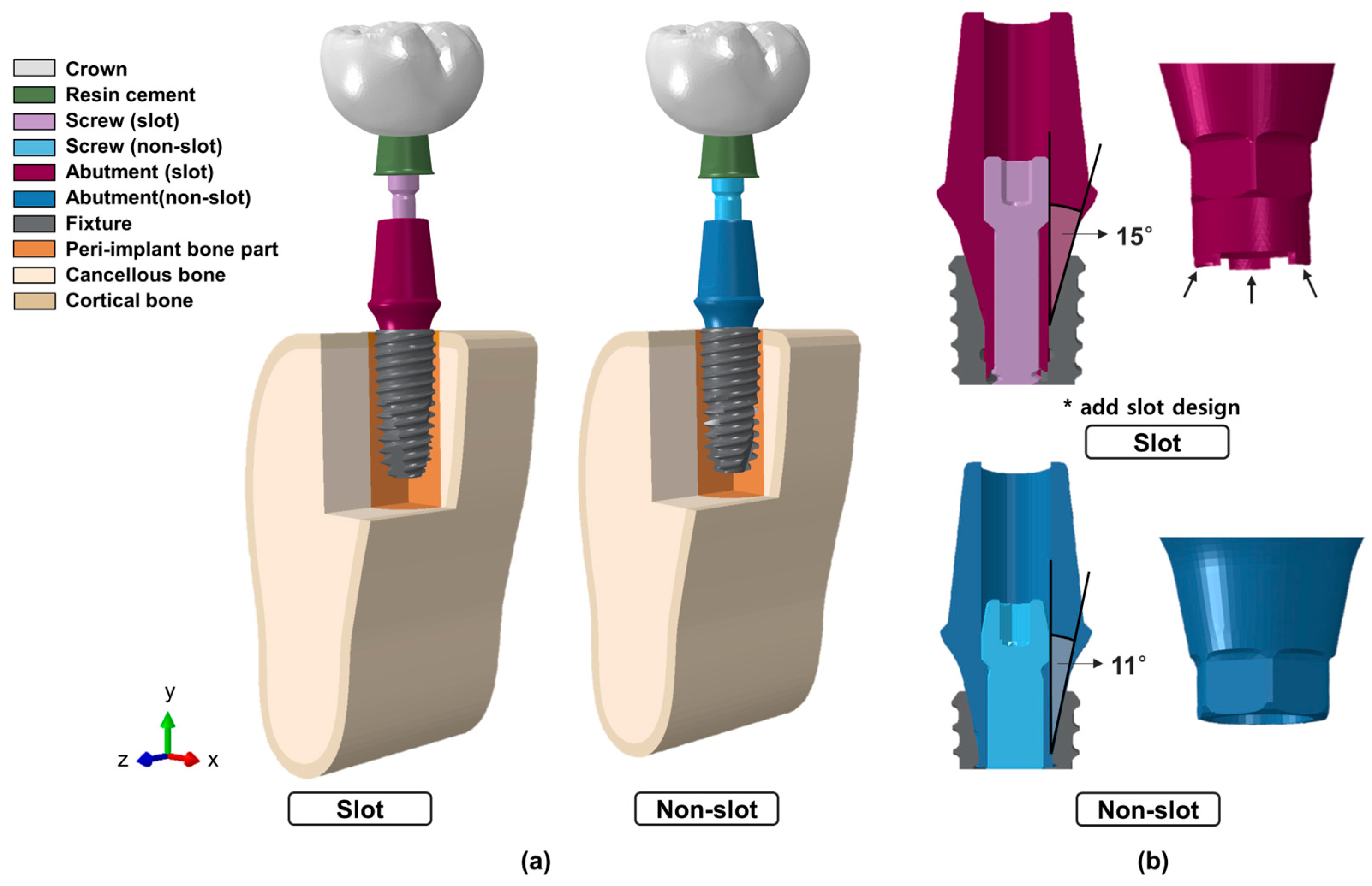
3D mandibular models were developed using modeling software (SolidWorks 2020, Dassault Systems, Velizy, France). The mandible was segmented into cortical bone and cancellous bone according to anatomical features. To thoroughly analyze the osseointegration interface, a virtual cylindrical layer with a diameter of 1.0 mm was created at the bone–fixture junction (Figure 1a). The implant was then virtually inserted into the bone by performing a subtraction of its geometry, establishing the bone–fixture interface for subsequent finite element analysis. The implant system used for analysis was a bone-level, internal connection fixture (length 10 mm, diameter 4.0 mm), positioned in the mandibular first molar site. Two types are modeled based on the Morse taper angle (11° or 15°) and the presence of an apical slot structure (Figure 1b). The finite element model was composed of four-node tetrahedral elements. The mesh size for the implant–abutment–bone complex ranged from 0.2 to 1.0 mm, refined at the implant–abutment interface and crestal bone regions [24]. The final mesh information, including the number of nodes and elements for each structure, is summarized in Table 1.
All materials in the finite element model were assumed to be isotropic, homogeneous, and linearly elastic [25]. The bone model classified cancellous bone into D2 and D4 according to the classification of Misch classification, reflecting normal bone and reduced bone strength conditions such as osteoporosis [26,27]. The components of the implant include fixture, abutment, screw and crown. The abutment, fixture, and screw were all fabricated from commercially pure titanium grade IV, consistent with the manufacturer’s specifications (Osstem Implant, Seoul, Republic of Korea) [28]. The crown was reconstructed into a virtual model based on the natural tooth. Prosthetic crowns were using three materials: Porcelain-Fused-to-Metal (PFM), Tessera, and Zirconia [15,29]. A resin cement layer with a thickness of 0.1 mm was incorporated between the abutment and crown [30]. The elastic modulus and Poisson’s ratio for each component are shown in Table 2.
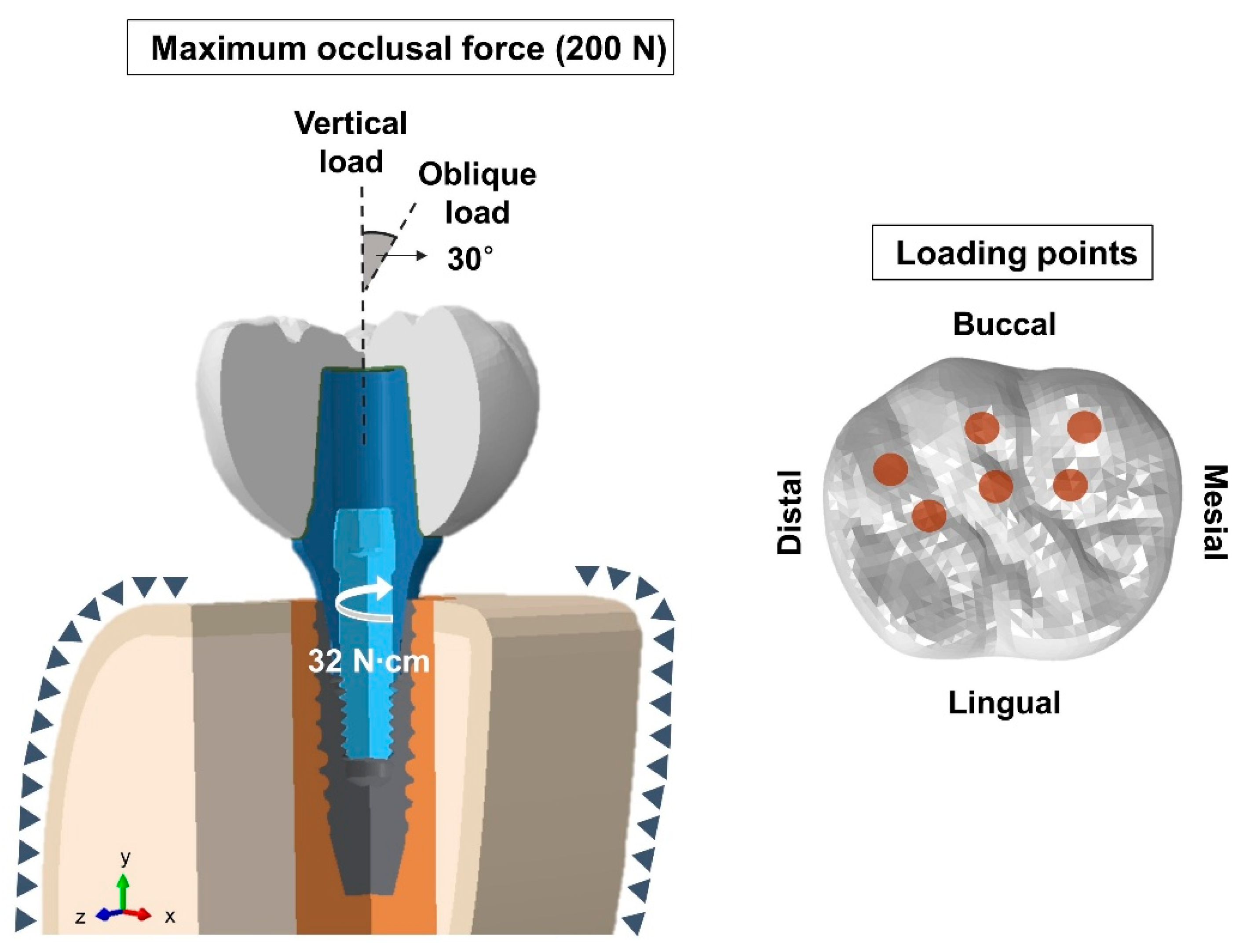
FEA was performed using Abaqus (Abaqus CAE 2025, Dassault Systems, Velizy, France). The simulation was conducted in two steps. First, a tightening torque of 32 N·cm was applied to the screw, generating pre-load at the screw–abutment interface [27,31]. In the next step, a maximum occlusal force of 200 N was applied to the total of the cusps and fossa in the direction of the tooth axis and the incline angle of 30 degrees (Figure 2) [32,33]. To simulate the support of the surrounding tissues for the mandible, both lateral sections of the bone model were fixed in all directions (x, y, z), restricting any displacement. Boundary conditions were defined as follows: the interfaces between fixture–abutment, abutment–screw, and abutment–cement were defined as “contact” with a friction coefficient of 0.3. The bone–fixture interface and all other interfaces were assumed to be completely “tie” [19].

3. Results

The yield strength of commercially pure Grade IV titanium (500 MPa) was used as a reference for analysis [28,34]. Yield strength is the maximum stress a material can withstand before plastic deformation occurs. The von Mises stress was employed to evaluate the distortion energy density and to predict potential structural failure. In addition, peri-implant strain values were calculated to assess the risk of fatigue failure. According to mechanostat theory, a strain threshold of 3000 με was applied, beyond which microdamage may accumulate faster than bone remodeling can compensate, potentially leading to microfracture and loss of healing capacity [35,36].
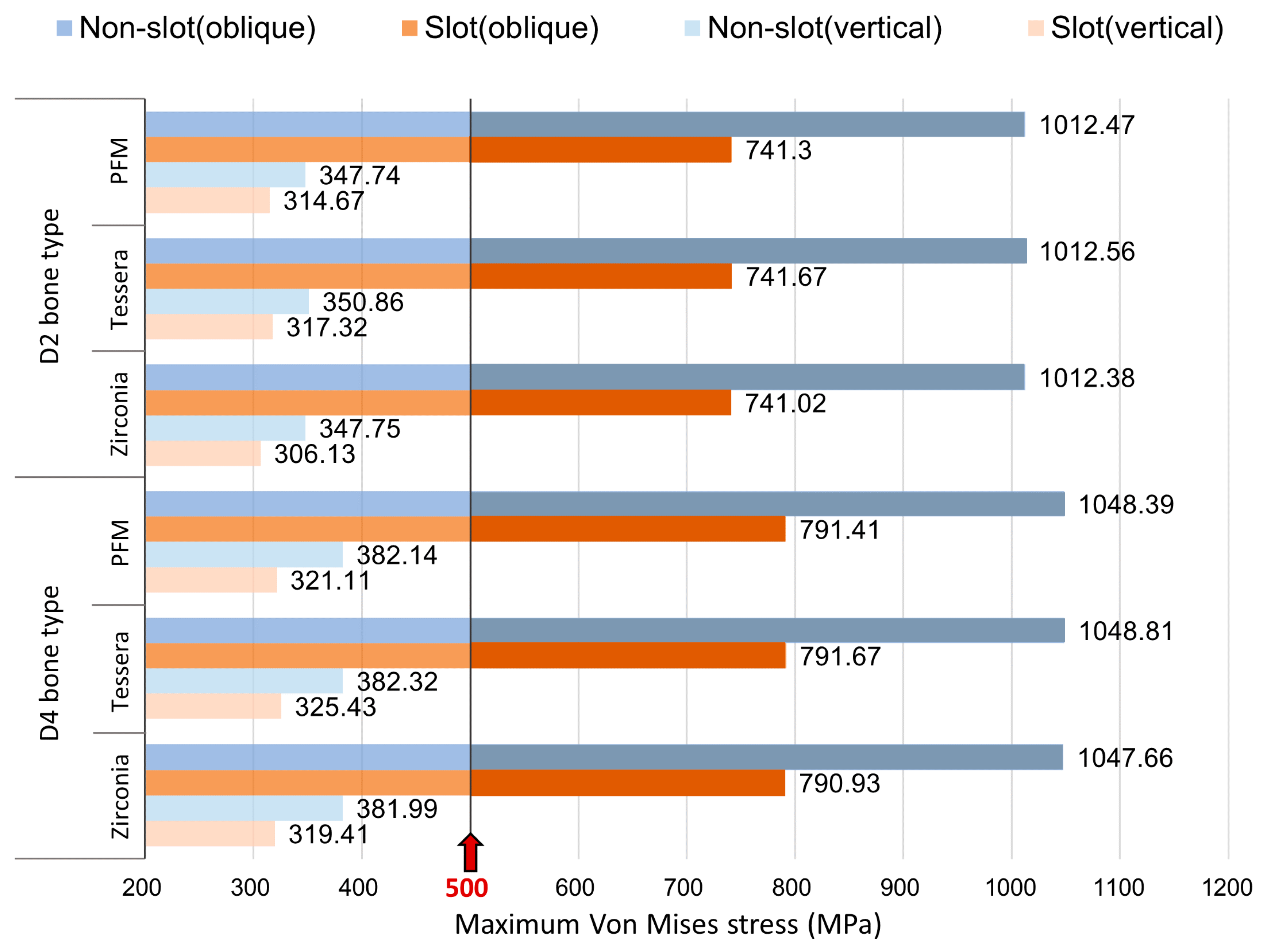
The stress distribution within the fixture was primarily influenced by the connection geometry rather than the crown material. While the crown type (PFM, Tessera, or Zirconia) had no significant effect, the fixture applied the slot design consistently showed lower maximum von Mises stress than the non-slotted design under both vertical and oblique loading conditions (Figure 3). The stress reduction was more pronounced under oblique loading conditions. On average, the slot design reduced maximum fixture stress by 264.18 MPa, likely due to the wider fixture–abutment contact area, which improved stress distribution.
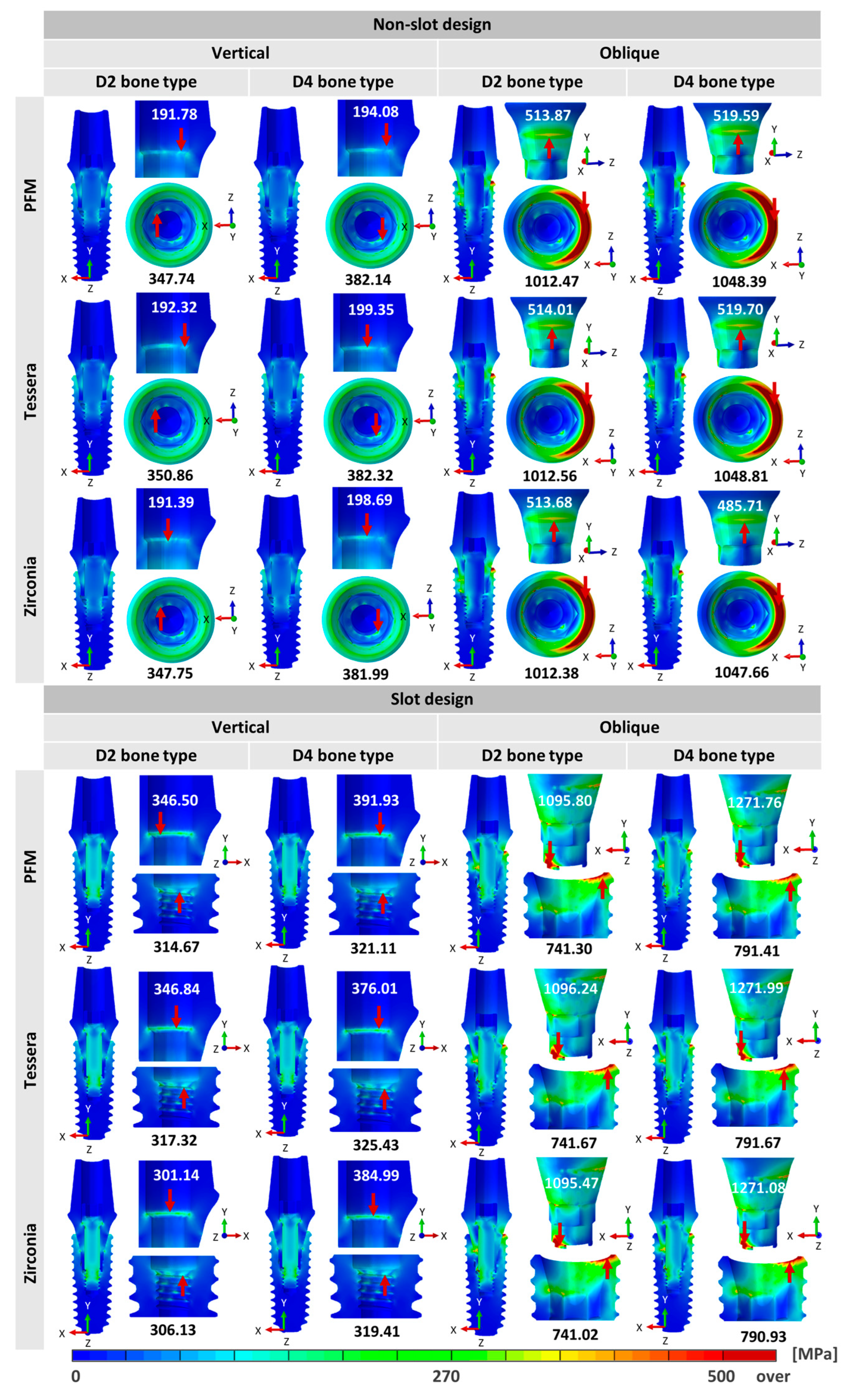
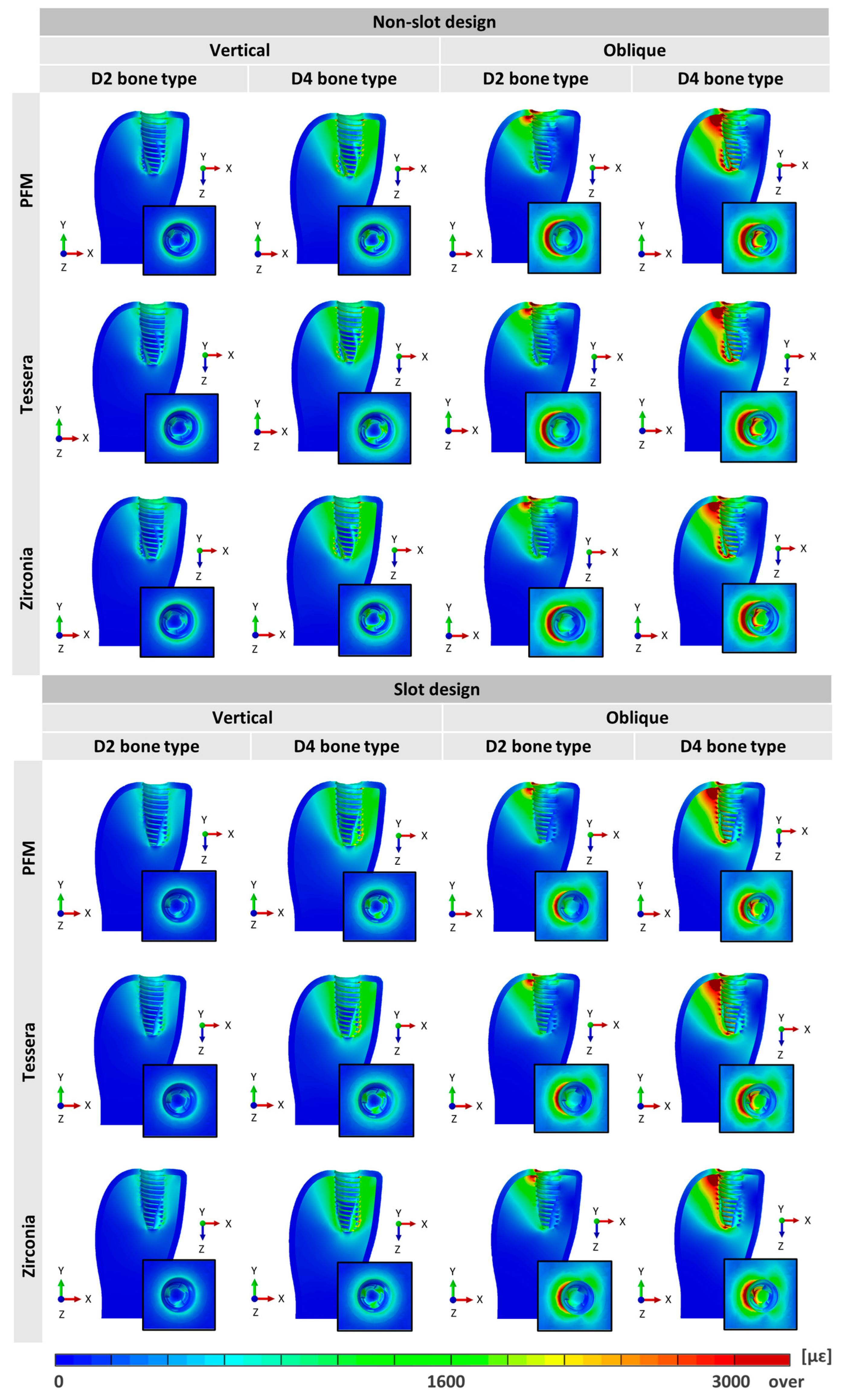
The highest von Mises stress (1048.81 MPa) occurred in the fixture that applied the non-slot design in D4 bone type with the Tessera crown. Stress concentrations were observed primarily along the buccal and lingual contact areas along the loading direction (Figure 4). The abutment showed the highest stress (1271.99 MPa) in the D4 bone type with the Tessera crown, the highest value among all components. Nevertheless, when the slot design was applied, the maximum stress of the fixture was reduced by 26.78% in D2 bone type and 24.51% in D4 bone type, indicating improved stress distribution. Fatigue fracture analysis results showed that the volume fraction exceeding the critical strain (3000 με) remained below 3% in all models (Figure 5). Areas with a high risk of fatigue were primarily concentrated in the cancellous bone surrounding the implant, especially around the lingual implant, which is subject to oblique loading. As bone quality decreased, the strain-exceeding area expanded in D4 bone type in cancellous. The slot design exhibited the highest volume fraction (2.85%) in both the cortical and cancellous bone regions. However, this localized increase did not indicate significant structural damage. In D2 bone type, the volume fractions of cortical and cancellous bone were nearly 0%, and while slightly increased under oblique loading, they remained minimal.

4. Discussion

This study analyzed the stress and strain acting on dental implant components and the surrounding bone, depending on connection type and bone quality, to identify key factors. The results confirmed that increasing the Morse taper angle significantly improved load distribution and long-term implant stability by increasing the I/A bonding surface area.
Risk factors for mechanical complications include fixture design, inadequate abutment junction, cantilevered prosthesis design, and excessive occlusal forces due to patient habits such as bruxism or clenching [35]. Unexpected occlusal forces, either in magnitude or direction, may overload the implant-alveolar bone complex, potentially leading to implant failure. To address this limitation, widening the fixture–abutment interface has been recommended [37,38]. These mechanical-biological interactions vary depending on the bone quality and biological conditions of each patient. Therefore, comprehensive optimization is necessary, accounting for the biomechanical properties of the implant and bone tissue. Therefore, various factors need to be analyzed to achieve a balance between increasing the abutment bonding area and the implant neck thickness, depending on the bone tissue characteristics.
This study compared two abutment designs: one without a slot and one with a slot. The slot design, with a 15° taper angle and three slots at the apex, increased the contact area, improving load distribution and reducing micromotion. Analysis revealed that under vertical loading, the 15° slot design exhibited the lowest von Mises stress (<1048.81 MPa), which was significantly lower than the yield strength of titanium Grade IV (500 MPa). Under oblique loading, the slot design also showed 26.78% stress reduction in D2 bone type and 24.51% stress reduction in D4 bone type, demonstrating that the wide taper angle effectively distributed stress transfer. This is interpreted as the wide taper angle effectively dissipating stress transferred to the fixture. These results are consistent with previous fatigue test results and support the notion that a large taper angle increases the contact area at the fixture–abutment interface, alleviating stress concentration and enhancing structural stability [39]. The slot design abutment observed stress concentration in the apical slot under all conditions. However, the slot clinically contributed to preventing abutment displacement and maintaining proper hexagonal alignment, so the stress concentration was judged not to have a significant effect on stability. Although relatively rare, fixture fracture is considered a serious complication, as it carries a poor prognosis and requires complete removal. In contrast, abutment and screw fracture are considered relatively manageable complications [40]. Therefore, sacrificial failure at the abutment and screw may be considered a positive design concept to prevent fixture fracture.
Complications of dental implants arise from the complex interactions between biological tissues and mechanical components. Biological complications may lead to mechanical failure, while conversely, mechanical problems, such as fixture cracking, may promote biological responses, such as microbial infection. While consistent mechanical stimulation is essential for bone remodeling, stress concentrations in D4 bone type may accelerate bone loss. If functional loading exceeds the load-bearing capacity of the bone–fixture interface, osseointegration may be compromised, leading to implant and surrounding tissue failure. Previous studies have reported that maximum von Mises stress within the implant component significantly increases when marginal bone loss exceeds 2 mm [41,42].
In this study, strains remained below the physiologically acceptable limit (3000 με) in both cortical and cancellous bone when an occlusal force of 200 N was applied. Loading direction had a significant effect on the cortical bone surrounding the implant neck. oblique loading led to a larger fatigue failure zone across all bone types. In particular, the slot design showed the highest fatigue failure volume fraction (2.85%) in both cortical and cancellous bone, demonstrating that the connection structure influences stress distribution. Suppose occlusal forces are imbalanced or marginal bone loss exceeds physiological limits during the prosthetic stage. In that case, residual stresses may not be sufficiently absorbed by the bone and accumulate in the implant components, potentially compromising long-term stability. Furthermore, D4 bone type may exhibit reduced stress-dissipation capacity, thereby expanding the fatigue failure zone, leading to irreversible microcracks and progressive bone resorption. Such non-infectious bone loss may serve as a precursor to peri-implantitis. Stable stress distributions were observed in all three crown materials, with no significant differences between materials. However, factors such as cement type and thickness, metal-to-metal friction, and cyclic loading may affect long-term performance depending on the prosthetic material used.
In this study, we demonstrated the stress distribution and mechanical stability of the fixture with the slot design. While the slot design appears to be an advantageous option for improving fixture–abutment stability in most cases, it cannot be definitively regarded as optimal for all clinical situations. The selection of abutment geometry should be based on comprehensive clinical judgment, considering individual factors such as load transfer efficiency, implant placement position, and patient-specific occlusal patterns. In D4 bone type, limited load distribution capacity may induce micromovement at the bone–implant interface, potentially compromising implant stability. The results of this study demonstrated that an internal conical connection with a large contact area, particularly the slot design abutment, increased the contact area and more evenly distributed the load. Therefore, combining the slot design with a wide taper angle may effectively distribute stress between the implant components and surrounding bone, even in weak bone environments, thereby enhancing structural stability and long-term biomechanical performance. Nevertheless, the slot design requires regular clinical monitoring and maintenance to prevent damage or fracture in the slot area, where stress tends to concentrate.
This study precisely evaluated the effects of the fixture–abutment interface on implant components and surrounding bone by varying only the abutment geometry while maintaining constant fixture conditions. Fine meshing was applied to stress-concentrated areas to ensure convergence and reliability, and insights into mechanical-biological interactions were provided, considering clinical variables. However, this study has several limitations. First, all materials were assumed to be isotropic, homogeneous, and linearly elastic, which does not adequately represent the anisotropic and viscoelastic behavior of biological tissues. This simplification may have resulted in an over or underestimation of stress magnitudes, particularly in cancellous bone. Furthermore, experimental validation and long-term fatigue behavior were not evaluated, and systemic factors that affect bone remodeling were not considered. Second, although the applied load was within the normal physiological occlusal range, actual masticatory forces vary substantially in magnitude, direction, and duration. Such complex loading conditions could alter the predicted stress and strain distributions. Third, this study considered only cancellous bone densities (D2 and D4) and did not account for variations in cortical bone thickness, which can influence load transfer and stress concentration patterns. To address these limitations, future research should include experimental validation—such as in vitro mechanical testing or fatigue evaluations—to confirm the numerical predictions, and incorporate dynamic and cyclic loading conditions. Additionally, implementing time-dependent bone remodeling models and patient-specific bone morphology would allow for more realistic simulations and improve the predictive accuracy of finite element analyses.

5. Conclusions

This study evaluated FEA to determine whether bone type and implant–abutment connection design significantly influence the biomechanical stability of dental implants. A slot design employing a 15° Morse taper improved stress distribution, effectively reducing peak stress in the fixture and distributing stress through the abutment. While the slot design concentrated stress on the abutment, this was likely due to the efficient stress distribution. Under oblique loading conditions, stress concentration was more pronounced in the cortical bone region, and D4 bone type showed a higher risk of microdamage accumulation and bone loss. To ensure long-term biomechanical stability, it is crucial to optimize the implant connection geometry and consider the patient’s bone quality when developing treatment plans. Clinically, it is advisable to assess bone quality in advance and select a connection design that effectively distributes stress.

Author Contributions

Conceptualization, E.K. and Y.-D.K.; methodology, E.K.; validation, Y.Y.; formal analysis, J.-E.K.; investigation, E.K. and J.-E.K.; writing—original draft preparation, E.K.; writing—review and editing, Y.Y. and J.-E.K.; visualization, Y.-D.K.; supervision, Y.-D.K.; project administration, Y.-D.K.; funding acquisition, Y.-D.K. All authors have read and agreed to the published version of the manuscript.

Funding

This study was supported by a research grant from the National Research Foundation of Korea: (NRF) funded by the Ministry of Education of Korea (NRF-2023R1A2C1003876).

Institutional Review Board Statement

Not applicable.

Informed Consent Statement

Not applicable.

Data Availability Statement

The original contributions presented in this study are included in the article. Further inquiries can be directed to the corresponding author.

Acknowledgments

The authors would like to thank the institutions that supported this research. Special thanks to Osstem Implant Co., Ltd. for their technical support in model development and analysis using modeling and analysis software.

Conflicts of Interest

The authors declare no conflicts of interest.

References

  1. Dittmer, S.; Dittmer, M.P.; Kohorst, P.; Jendras, M.; Borchers, L.; Stiesch, M. Effect of implant-abutment connection design on load bearing capacity and failure mode of implants. J. Prosthodont. 2011, 20, 510–516. [Google Scholar] [CrossRef] [PubMed]
  2. Jang, H.-W.; Kang, J.-K.; Lee, K.; Lee, Y.-S.; Park, P.-K. A retrospective study on related factors affecting the survival rate of dental implants. J. Adv. Prosthodont. 2011, 3, 204–215. [Google Scholar] [CrossRef]
  3. Verma, A.; Singh, S.V.; Arya, D.; Shivakumar, S.; Chand, P. Mechanical failures of dental implants and supported prostheses: A systematic review. J. Oral Biol. Craniofacial Res. 2023, 13, 306–314. [Google Scholar] [CrossRef]
  4. Dhima, M.; Paulusova, V.; Lohse, C.; Salinas, T.J.; Carr, A.B. Practice-based evidence from 29-year outcome analysis of management of the edentulous jaw using osseointegrated dental implants. J. Prosthodont. Dent. Implant. 2015, 23, 121–130. [Google Scholar]
  5. Piermatti, J.; Yousef, H.; Luke, A.; Mahevich, R.; Weiner, S. An in vitro analysis of implant screw torque loss with external hex and internal connection implant systems. Implant. Dent. 2006, 15, 427–435. [Google Scholar] [CrossRef]
  6. Caricasulo, R.; Malchiodi, L.; Ghensi, P.; Fantozzi, G.; Cucchi, A. The influence of implant-abutment connection to peri-implant bone loss: A systematic review and meta-analysis. Clin. Implant. Dent. Relat. Res. 2018, 20, 653–664. [Google Scholar] [CrossRef]
  7. Lin, C.; Chang, S.; Chang, W.; Kuo, Y. Factorial analysis of variables influencing mechanical characteristics of a single tooth implant placed in the maxilla using finite element analysis and the statistics-based Taguchi method. Eur. J. Oral Sci. 2007, 115, 408–416. [Google Scholar] [CrossRef]
  8. Camps-Font, O.; Rubianes-Porta, L.; Valmaseda-Castellón, E.; Jung, R.E.; Gay-Escoda, C.; Figueiredo, R. Comparison of external, internal flat-to-flat, and conical implant abutment connections for implant-supported prostheses: A systematic review and network meta-analysis of randomized clinical trials. J. Prosthet. Dent. 2023, 130, 327–340. [Google Scholar] [CrossRef]
  9. Marconcini, S.; Giammarinaro, E.; Covani, U.; Mijiritsky, E.; Vela, X.; Rodríguez, X. The Effect of tapered abutments on marginal bone level: A retrospective cohort study. J. Clin. Med. 2019, 8, 1305. [Google Scholar] [CrossRef] [PubMed]
  10. Ribeiro, R.F.; da Mata, V.B.; Tomaselli, L.d.O.; Simionato, A.A.; Santos, E.d.S.; Faria, A.C.L.; Rodrigues, R.C.S.; Nascimento, C.D. Microbial Leakage through Three Different Implant–Abutment Interfaces on Morse Taper Implants In Vitro. Dent. J. 2024, 12, 226. [Google Scholar] [CrossRef] [PubMed]
  11. Vinhas, A.S.; Aroso, C.; Salazar, F.; López-Jarana, P.; Ríos-Santos, J.V.; Herrero-Climent, M. Review of the mechanical behavior of different implant–abutment connections. Int. J. Environ. Res. Public Health 2020, 17, 8685. [Google Scholar] [CrossRef] [PubMed]
  12. Jeng, M.-D.; Lin, Y.-S.; Lin, C.-L. Biomechanical evaluation of the effects of implant neck wall thickness and abutment screw size: A 3D nonlinear finite element analysis. Appl. Sci. 2020, 10, 3471. [Google Scholar] [CrossRef]
  13. Tribst, J.P.M.; Özkara, N.; Blom, E.J.; Kleverlaan, C.J.; Ausiello, P.; Bruhnke, M.; Feilzer, A.J.; Piva, A.M.d.O.D. The Effect of Implant–Abutment Contact Area on the Stress Generation of Bone-Level and Tissue-Level Implants. Appl. Sci. 2025, 15, 2744. [Google Scholar] [CrossRef]
  14. Zhang, W.-T.; Cheng, K.-J.; Liu, Y.-F.; Wang, R.; Chen, Y.-F.; Ding, Y.-D.; Yang, F.; Wang, L.-H. Effect of the prosthetic index on stress distribution in Morse taper connection implant system and peri-implant bone: A 3D finite element analysis. BMC Oral Health 2022, 22, 431. [Google Scholar] [CrossRef]
  15. Nokar, K.; Atri, F.; Nokar, S. Comparative evaluation of the effect of implant crown materials on Implant Components and bone stress distribution: A 3D finite element analysis. Int. J. Dent. 2023, 2023, 1896475. [Google Scholar] [CrossRef]
  16. Mosharraf, R.; Abbasi, M.; Givehchian, P. The Effect of Abutment Angulation and Crown Material Compositions on Stress Distribution in 3-Unit Fixed Implant-Supported Prostheses: A Finite Element Analysis. Int. J. Dent. 2022, 2022, 4451810. [Google Scholar] [CrossRef]
  17. Chen, X.; Moriyama, Y.; Takemura, Y.; Rokuta, M.; Ayukawa, Y. Influence of osteoporosis and mechanical loading on bone around osseointegrated dental implants: A rodent study. J. Mech. Behav. Biomed. Mater. 2021, 123, 104771. [Google Scholar] [CrossRef]
  18. Yoon, Y.; Kim, J.-E.; Kim, E.; Park, S.; Kang, I.; Kwon, Y.-D. Stability of the Implant–Alveolar Bone Complex According to the Peri-Implant Bone Loss and Bone Quality: A Finite Element Analysis Study. Appl. Sci. 2024, 14, 11674. [Google Scholar] [CrossRef]
  19. Lee, H.; Jo, M.; Sailer, I.; Noh, G. Effects of implant diameter, implant-abutment connection type, and bone density on the biomechanical stability of implant components and bone: A finite element analysis study. J. Prosthet. Dent. 2022, 128, 716–728. [Google Scholar] [CrossRef] [PubMed]
  20. Baggi, L.; Cappelloni, I.; Maceri, F.; Vairo, G. Stress-based performance evaluation of osseointegrated dental implants by finite-element simulation. Simul. Model. Pract. Theory 2008, 16, 971–987. [Google Scholar] [CrossRef]
  21. Ding, X.; Liao, S.; Zhu, X.; Zhang, X.; Zhang, L. Effect of Diameter and Length on Stress Distribution of the Alveolar Crest around Immediate Loading Implants. Clin. Implant. Dent. Relat. Res. 2009, 11, 279–287. [Google Scholar] [CrossRef]
  22. Swami, V.; Vijayaraghavan, V.; Swami, V. Current trends to measure implant stability. J. Indian Prosthodont. Soc. 2016, 16, 124–130. [Google Scholar] [CrossRef]
  23. Brunski, J.B. Biomechanical factors affecting the bone-dental implant interface. Clin. Mater. 1992, 10, 153–201. [Google Scholar] [CrossRef]
  24. Park, J.; Park, S.; Kang, I.; Noh, G. Biomechanical effects of bone quality and design features in dental implants in long-term bone stability. J. Comput. Des. Eng. 2022, 9, 1538–1548. [Google Scholar] [CrossRef]
  25. Junior, J.F.S.; Verri, F.R.; de Faria Almeida, D.A.; de Souza Batista, V.E.; Lemos, C.A.A.; Pellizzer, E.P. Finite element analysis on influence of implant surface treatments, connection and bone types. Mater. Sci. Eng. C 2016, 63, 292–300. [Google Scholar] [CrossRef] [PubMed]
  26. Shen, Y.-W.; Huang, H.-L.; Hsu, J.-T.; Fuh, L.-J. Effects of diameters of implant and abutment screw on stress distribution within dental implant and alveolar bone: A three-dimensional finite element analysis. J. Dent. Sci. 2024, 19, 1126–1134. [Google Scholar] [CrossRef]
  27. Yoon, Y.; Kang, I.; Noh, G.; Kwon, Y.-D. Biomechanical analysis of alveolar bones with compromised quality supporting a 4-unit implant bridge; a possible association with implant-related sequestration (IRS). Clin. Oral Investig. 2024, 28, 197. [Google Scholar] [CrossRef]
  28. Cervino, G.; Romeo, U.; Lauritano, F.; Bramanti, E.; Fiorillo, L.; D’amico, C.; Milone, D.; Laino, L.; Campolongo, F.; Rapisarda, S.; et al. Fem and von mises analysis of OSSTEM® dental implant structural components: Evaluation of different direction dynamic loads. Open Dent. J. 2018, 12, 219–229. [Google Scholar] [CrossRef] [PubMed]
  29. Galal, R.M.; ElHotieby, M.M.; Hamza, G.E.; Eldemery, Y.M. Assessment of different materials used for fabrication of fixed free fixed dental prostheses: Finite element analysis. Bull. Natl. Res. Cent. 2024, 48, 61. [Google Scholar] [CrossRef]
  30. Tay, F.R.; Pashley, D.H. Monoblocks in root canals: A hypothetical or a tangible goal. J. Endod. 2007, 33, 391–398. [Google Scholar] [CrossRef]
  31. Bickford, J.H.; Saunders, H. An introduction to the design and behaviour of bolted joints. J. Vib. Acoust. 1983, 105, 147–148. [Google Scholar] [CrossRef]
  32. Anitua, E.; de Ibarra, N.L.S.; Martín, I.M.; Rotaeche, L.S. influence of dental implant diameter and bone quality on the biomechanics of single-crown restoration. A finite element analysis. Dent. J. 2021, 9, 103. [Google Scholar] [CrossRef] [PubMed]
  33. Li, R.; Wu, Z.; Chen, S.; Li, X.; Wan, Q.; Xie, G.; Pei, X. Biomechanical behavior analysis of four types of short implants with different placement depths using the finite element method. J. Prosthet. Dent. 2023, 129, 447.e1–447.e10. [Google Scholar] [CrossRef] [PubMed]
  34. Osman, R.B.; Swain, M.V. A Critical Review of dental implant materials with an emphasis on titanium versus zirconia. Materials 2015, 8, 932–958. [Google Scholar] [CrossRef]
  35. Bahat, O. Brånemark system implants in the posterior maxilla: Clinical study of 660 implants followed for 5 to 12 years. Int. J. Oral Maxillofac. Implant. 2000, 15, 646–653. [Google Scholar]
  36. Frost, H.M. Bone “mass” and the “mechanostat”: A proposal. Anat. Rec. 1987, 219, 1–9. [Google Scholar] [CrossRef]
  37. Huang, Y.-C.; Huang, Y.-C.; Ding, S.-J. Primary stability of implant placement and loading related to dental implant materials and designs: A literature review. J. Dent. Sci. 2023, 18, 1467–1476. [Google Scholar] [CrossRef]
  38. Omori, Y.; Lang, N.P.; Botticelli, D.; Papageorgiou, S.N.; Baba, S. Biological and mechanical complications of angulated abutments connected to fixed dental prostheses: A systematic review with meta-analysis. J. Oral Rehabil. 2019, 47, 101–111. [Google Scholar] [CrossRef] [PubMed]
  39. Cho, S.-M.; Byun, S.-H.; Ahn, S.-Y.; Han, H.-S.; On, S.-W.; Park, S.-Y.; Yi, S.-M.; Park, I.-Y.; Yang, B.-E.; Kim, L.-K. Biomechanical Evaluation of a Novel Non-Engaging Abutment and Screw in Internal Implant Systems: Comparative Fatigue and Load Testing. J. Funct. Biomater. 2025, 16, 107. [Google Scholar] [CrossRef]
  40. Han, S.H.; Lee, S.Y. Alternative method to salvage an internally damaged implant using cast post. J. Implantol. Appl. Sci. 2022, 26, 270–278. [Google Scholar] [CrossRef]
  41. Bing, L.; Mito, T.; Yoda, N.; Sato, E.; Shigemitsu, R.; Han, J.; Sasaki, K. Effect of peri-implant bone resorption on mechanical stress in the implant body: In vivo measured load-based finite element analysis. J. Oral Rehabil. 2020, 47, 1566–1573. [Google Scholar] [CrossRef] [PubMed]
  42. Jin, Z.-H.; Peng, M.-D.; Li, Q. The effect of implant neck microthread design on stress distribution of peri-implant bone with different level: A finite element analysis. J. Dent. Sci. 2020, 15, 466–471. [Google Scholar] [CrossRef] [PubMed]
Figure 1. Three-dimensional model: (a) Composition of implants and bone; (b) Specifications of the implant components of non-slot and slot designs. * The slot structure is expected to result in a wide stress distribution in the implant component by increasing the contact area and improving rotational stability.
Applsci 15 12629 g001
Figure 2. Boundary and loading conditions: Preload and maximum occlusal force.
Applsci 15 12629 g002
Figure 3. Maximum von Mises stress values in slot and non-slot design. The non-slot design produced higher stress levels in all types, with the greatest difference observed under oblique loading.
Applsci 15 12629 g003
Figure 4. Distribution of maximum von Mises stress in Implant components. Stress concentrations of implant components were observed around the fixture neck and abutment interface, and were particularly pronounced under oblique loading compared to vertical loading.
Applsci 15 12629 g004
Figure 5. Von Mises stress of the fixture according to the bone type. Stress concentration in the bone was prominent in D4 bone type, and was particularly concentrated in the lingual region under oblique loading conditions.
Applsci 15 12629 g005
Table 1. Number of nodes, elements, and mesh size for the FEA model.
Model SectionNumber
of Nodes
Number of
Elements
Element Size (mm)
Fixture* NS247,53148,9080.2–0.25
* S221,92844,220
AbutmentNS119,08024,5720.2–0.25
S302,85961,991
ScrewNS50,43310,3230.2–0.25
S64,39413,525
Resin cement63,35019,2570.15
Crown350,47665,8480.5
Cortical bone46,56410,538 0.2–1.0
Cancellous bone239,39144,959
Peri-implant
cortical bone part
NS30,62165220.2
S30,9976581
Peri-implant
cancellous bone part
NS281,08454,7690.2
S255,70450,111
* NS: non-slot design, S: slot design.
Table 2. Material properties of the FE models.
Model SectionYoung’s
Modulus
Poisson’s
Ratio
Reference
* Titanium105,0000.34[28]
Resin cement18,6000.28[30]
Cortical bone13,7000.3[27]
Cancellous boneD213700.3[27]
D46900.3[26]
CrownPorcelain-Fused-to-Metal149,4500.34[29]
Tessera103,0000.229[29]
Zirconia210,0000.3[15]
* Titanium: abutment, screw, fixture.
Disclaimer/Publisher’s Note: The statements, opinions and data contained in all publications are solely those of the individual author(s) and contributor(s) and not of MDPI and/or the editor(s). MDPI and/or the editor(s) disclaim responsibility for any injury to people or property resulting from any ideas, methods, instructions or products referred to in the content.