



CoFT: A Fair and Transparent Compensation Framework for Hierarchical Federated Learning


Abstract
1. Introduction
1.1. Our Contributions
- Hierarchical Scalability: Our framework is natively designed to support complex, multi-level organizational structures inherent to HFL. The multi-layered channel design—from the top-tier Sub-Channels down to the contributor-level Virtual Channels—directly maps to real-world hierarchies (e.g., consortiums, hospital networks), ensuring the system can scale organizationally without compromising on logical integrity or efficiency.
- High Cost-Efficiency via Off-Chain Operations: We drastically reduce the blockchain transaction costs associated with reward distribution. By leveraging a hierarchy of state channels, all reward updates occur entirely off-chain during the T learning epochs, incurring zero gas costs. This hybrid approach transforms the prohibitively expensive complexity of a naive on-chain model (where every reward is a transaction) into a sustainable, additive complexity of (where costs are linear to the number of participants, not the project duration).
- Cryptographic Verifiability and Transparency: Our framework ensures that the entire compensation process is both transparent and mathematically verifiable. The final state of the system is committed to the blockchain via a single, immutable Merkle root. This allows any participant to independently and trustlessly verify their earned rewards by presenting a compact cryptographic proof to a smart contract, eliminating the need for a trusted third-party auditor.
- Automated and Trustless Payouts: We empower the ultimate contributors by removing counterparty risk. Through the use of dedicated on-chain Payout Contracts, contributors can permissionlessly claim their final, verified rewards directly from a smart contract. The payout is not dependent on the goodwill of the parent institution but is automatically enforced by the blockchain protocol, guaranteeing payment upon submission of a valid proof.
- Fair and Flexible Burden-Sharing: CoFT provides a mechanism for fairly distributing the financial burden of incentives among multiple top-tier institutions. The multi-funder Sub-Channel allows several project sponsors to collaboratively fund the reward pool and reconcile expenses based on pre-agreed-upon terms during the final settlement, making large-scale collaborative projects more economically viable.
1.2. Related Work
1.2.1. Monetary and Reputation-Based Incentives
1.2.2. Blockchain-Based Incentives and Limitations
2. Technical Overview
2.1. State Channels
- Establishment: A set of participants lock funds into the on-chain contract. This creates the channel’s initial state, , which is a cryptographically signed agreement on the initial fund distribution . The total locked funds, , remain constant throughout the channel’s life.
- State Transition: Once established, all interactions occur off-chain. Participants update the channel’s state by creating and co-signing state-update messages. A transition from state to is represented by a function , where is the transaction agreed upon by all parties. These off-chain updates are instant and incur no gas fees.
- Settlement: When participants wish to close the channel, they submit the final, mutually agreed-upon state, , to the on-chain contract. The contract verifies the signatures on this state and distributes the locked funds according to the final balances. This design is highly efficient, as only two on-chain transactions are required: one to open and one to close the channel.
2.2. Channel Factory
- On-Chain Collateral Pool: The factory contract, , pools the total liquidity from a group of providers . Each provider deposits funds into the contract, creating a single, large on-chain collateral pool: . This collateral remains locked on-chain, serving as the security deposit for all off-chain activities.
- Off-Chain Sub-Channel Allocation: The factory enables the creation of numerous logical sub-channels off-chain. For example, the pooled funds can be allocated to various receivers . Each provider can commit a portion of their deposit, , to a specific receiver . The fund conservation principle requires that the total allocation by a provider does not exceed their deposit: .
- Settlement: When a specific sub-channel is to be settled, its final agreed-upon off-chain state is submitted to the factory contract. The factory verifies the final state and updates the on-chain ledger accordingly, for instance by transferring the owed amount to the receiver . This allows for the settlement of many channels with minimal on-chain footprint.
2.3. Virtual Channels
- Establishment: Consider Alice (A) and Bob (B), who want to transact but only have direct channels with an intermediary, Ingrid (I): channel and channel . To open a virtual channel , Alice and Bob lock a portion of their funds in their respective direct channels as collateral for the virtual channel. This agreement is co-signed by Alice, Bob, and Ingrid.
- State Transition: Once the virtual channel is established, Alice and Bob can exchange an unlimited number of off-chain state updates directly with each other, just as in a regular two-party channel. For a payment of amount from Alice to Bob, they create and co-sign a new state where their balances are updated to . Ingrid is not involved in this update process.
- Settlement: To close the virtual channel, Alice and Bob present the final state of to Ingrid. Ingrid verifies the final state and updates the balances in the two underlying direct channels to reflect the net outcome of the virtual channel. For example, if Alice paid a net amount of to Bob, the final settlement would be:
- -
- In channel : Alice’s balance decreases by , and Ingrid’s increases by .
- -
- In channel : Ingrid’s balance decreases by , and Bob’s increases by .
Ingrid’s net balance change across both channels is zero, confirming her role as a trustless facilitator.
2.4. Stablecoins
- Minting: A user creates new stablecoins by depositing an equivalent amount of fiat currency, v, into the reserve. This operation increases both the supply and the collateral, maintaining the peg: .
- Burning: A user redeems stablecoins for fiat currency by sending them back to be destroyed (burned). This operation decreases both the supply and the collateral: .
3. Proposed Framework
3.1. Framework Overview
- System Initialization: At the project’s outset, all participants (Institutions, Sub-institutions, Contributors) are registered and assigned cryptographic keys. Concurrently, top-tier institutions deposit fiat currency, which the Administrator uses to mint an equivalent amount of stablecoins. These stablecoins serve as the collateralized reward pool for the entire project.
- Channel Establishment: A secure, on-chain Channel Factory is established by the top-tier institutions, who lock the minted stablecoins into this smart contract as the total reward fund. Following this, a multi-tier hierarchy of logical, off-chain channels is created. These channels connect the various participant tiers, establishing a pathway for efficient reward distribution without requiring constant on-chain transactions.
- Channel Update: Throughout the federated learning process, contributors train models with their data and submit them up the hierarchy. As contributions are evaluated each round, rewards are calculated. Instead of immediate on-chain payment, the state of the off-chain channels is updated to reflect the rewards accumulated by each participant. These updates are cryptographically signed off-chain, ensuring a secure and verifiable record of contributions over time.
- Settlement: Once the learning project concludes, the final, aggregated state of all off-chain channels is committed to the blockchain. Contributors can then initiate a reward claim by submitting verifiable proof of their final, signed channel state to a smart contract. Upon successful on-chain verification of this proof, the accumulated stablecoin rewards are transferred to the contributor, who can then redeem them for an equivalent value in fiat currency from the original collateral reserve.
3.1.1. Entities
- Institution (): An Institution is a participant at the top tier of the distributed learning system, acting as the root node for an independent tree structure. They are the primary sponsors of the collaborative project.
- -
- Funding: Initiates the process by depositing fiat currency to the Administrator for the minting of stablecoins.
- -
- Channel Establishment: Acts as the principal funder by depositing the main reward pool into the on-chain Channel Factory contract (implemented as the FundingRegistry). It then establishes off-chain Sub-Channels with its direct sub-institutions to allocate these funds logically.
- -
- Model Aggregation: Collaborates with other top-tier institutions to aggregate models received from lower tiers into a single global model.
- -
- Settlement: In the final stage, it co-signs the final state of the Sub-Channels, authorizing the release of funds from the on-chain contract to cover the total rewards paid to contributors.
- Sub-Institution (): A Sub-Institution is a participant in a tier below an institution, acting as an intermediary node in the hierarchy. This flexible role is crucial for both model aggregation and reward distribution logistics.
- -
- Model and Reward Relay: Receives local models from its child nodes, evaluates their contributions to calculate rewards , aggregates the models, and submits the aggregated result to its parent node.
- -
- Channel Management: Acts as both a parent and a child in the channel hierarchy. As a parent, it establishes State Channels or Virtual Channels to distribute its allocated reward pool to its children. As a child, it participates in channels created by its parent.
- -
- State Integrity: A child node of the root node is responsible for creating an individual Merkle Root from all the off-chain virtual channel states it manages. This is a critical step in creating the verifiable history of the entire system.
- -
- Settlement: During the settlement phase, it aggregates all reward liabilities from its descendants, propagates the total claim upwards, and deploys a dedicated Payout Contract on the blockchain, enabling contributors to claim their rewards directly and trustlessly.
- Contributor (): A Contributor is a participant at the lowest tier (a leaf node) of the system. They provide the foundational data and computational resources for the federated learning task.
- -
- Data Contribution: The primary role is to train a local model using their private data and submit the model parameters to their parent institution.
- -
- Off-Chain Agreement: Actively participates in a Virtual Channel, co-signing every state update to formally agree upon the reward accumulated in each learning round.
- -
- Reward Claim: Upon project completion, the Contributor interacts directly with the Payout Contract on the blockchain. They submit their final, co-signed channel state along with a cryptographic Merkle proof to securely and independently claim their total earned rewards.
- Administrator: The Administrator is the entity responsible for managing the stablecoin’s lifecycle, acting as the bridge between off-chain fiat currency and on-chain digital assets.
- -
- Minting: Issues stablecoins to an institution’s on-chain address after verifying the corresponding off-chain deposit of fiat currency.
- -
- Burning: Removes stablecoins from circulation by exchanging them back to fiat currency upon a contributor’s request.
- -
- Collateral Management: Guarantees the stability of the system’s currency by ensuring that the total supply of stablecoins in circulation is always fully backed by the collateral reserve, maintaining its value. This role can be fulfilled by a centralized entity or a decentralized autonomous organization (DAO).
3.1.2. A Hospital Network
- Institution (): The main headquarters of large hospital chains (e.g., National Medical Center, Regional Health Alliance). These institutions initiate and co-fund the project.
- Sub-Institution (): A flexible, intermediary role. This could be a specific branch hospital within a chain (e.g., Busan General Hospital as ) or a specialized department within that hospital (e.g., the Radiology Department as ).
- Contributor (): A Contributor, formally denoted as , is a leaf-node participant responsible for local model training. The indices clarify that this is the k-th contributor managed by the sub-institution . They are the ultimate recipients of rewards for their data and computation services. For brevity, in contexts where the parent is already specified (such as in the channel ), we may refer to the contributor simply as .
- Funding and On-Chain Setup: The HQs of the hospital chains () form a consortium. They jointly fund the project by depositing stablecoins into the central on-chain Contract , creating the secure collateral pool.
- Off-Chain Channel Hierarchy Establishment:
- The HQs establish multi-funder Sub-Channels with their main branch hospitals , logically allocating the reward funds.
- Each branch hospital then creates multi-party State Channels with its internal departments (Radiology, Oncology, etc.).
- Finally, each department establishes a direct, two-party Virtual Channel with its internal research labs (the contributors).
- Federated Learning and Off-Chain Updates: The Contributors train local models on their anonymized patient image data. As they submit models up the hierarchy, their contributions are evaluated by the parent departments, and the state of their respective s is updated off-chain to reflect the earned rewards. This process repeats, with models being aggregated up to the HQs, which collaborate to create the improved global model for the next round.
- Settlement and Reward Claim: Once the global model reaches the target accuracy, the project concludes. The final state of all off-chain channels is anchored to the blockchain via a single hash .
- A contributor can now claim its total earned rewards. It submits a cryptographic proof of its final state to its parent sub-institution’s on-chain Payout contract.
- The contract automatically verifies the proof against the on-chain anchor, and upon success, transfers the rewards to the contributor’s wallet. The contributor can then redeem these funds for fiat currency through the Administrator.
3.2. Detailed Framework Description
3.2.1. User Registration
- Registration: All Top-tier institutions, Sub-institutions, and Contributors are registered by the Administrator. During this process, each participant is assigned a public-private key pair (, ) for digital signatures.
- Stablecoin Issuance: The stablecoin issuance protocol details the secure conversion of off-chain fiat currency into on-chain stablecoins, which serves as the essential liquidity and collateral foundation for the entire off-chain channel network. This mechanism is necessary to lock required collateral off-chain before commencing channel operations.The procedure is defined as a multi-stage protocol involving the generalized system user U, the central administrator , and the stablecoin smart contract .
- Fiat Currency Deposit and Verification. The user U transfers an amount of fiat currency, , to a designated bank account managed by . This off-chain action serves as the collateral for the stablecoins.Upon receiving , performs two verifications:
- (a)
- Verifies the deposit amount and source.
- (b)
- Confirms that U is a valid, registered participant in the system.
Once verified, the sole authorized minter sends a transaction to on the blockchain. This transaction calls the mint() function, specifying the user’s public key address and the equivalent amount of stablecoins . - Minting and Transfer. executes the mint() function, which is secured to be callable only by . This execution has two main outcomes recorded in an atomic on-chain transaction:
- (a)
- The total supply of stablecoins TS on the blockchain increases by the amount .
- (b)
- The newly minted stablecoins are immediately assigned to U’s wallet, with the ownership recorded on the blockchain ( is the total stablecoins owned by U).
- Confirmation and Collateral Use. The user verifies the successful issuance and transfer by checking the blockchain. The minted stablecoins are then used as the security deposit for establishing off-chain channels. This final step provides an immutable, transparent record of the user’s liquid collateral, essential for trustlessly backing future reward payouts and channel operations.
3.2.2. Channel Establishment
- On-Chain Funding and Registration: The foundation of the system is a smart contract deployed on the blockchain, denoted , which serves two primary functions: a secure, collective escrow for the entire project’s reward pool, and an immutable registry for all participating high-level entities. This on-chain contract acts as the ultimate source of financial truth and the trust anchor for all subsequent off-chain interactions. All top-tier institutions and their direct sub-institutions must interact with this contract to join the project.
- (a)
- Funding and Registration: All participants commit funds and register on-chain through transactions to the contract.
- Top-tier Institutions: Each institution calls a deposit function on the contract to lock its share of the total reward pool, an amount in stablecoins.
- Sub-Institutions: Each sub-institution calls a registration function, depositing a minimal, recoverable stake and registering its public key with the contract. This stake serves as a security deposit for honest participation.
- (b)
- On-Chain State Solidification: Once the transactions are confirmed on the blockchain, the contract locks the funds and immutably records the participants’ information. The collective on-chain state, which we refer to as , is not a single signed object but is represented by the permanent data stored within the contract’s storage. This state includes:
- Participant Balances: A mapping from each participant’s address (, ) to their deposited balance (, ).
- Registered Public Keys: An immutable list or mapping of the public keys for all participating sub-institutions, essential for verifying off-chain signatures.
- Total Collateral: A public variable tracking the total amount of stablecoins locked in the contract, ensuring transparency of the total reward pool.
- Off-Chain Channel Hierarchy Establishment: This phase describes the process of setting up logical off-chain channels necessary for efficient off-chain transactions after the on-chain Channel Factory has been created. These channels do not involve actual on-chain transactions and only use the blockchain for final settlement.
- (a)
- Sub-Channel (): Once the on-chain channel factory is deployed, each top-tier institution establishes a logical sub-channel with each of its direct sub-institutions, . This channel functions as a multi-funder commitment ledger. Its primary purpose is to formally record the portion of collateral, denoted as , that each top-tier institution (for ) allocates to the specific reward pool managed by sub-institution .The total reward pool available to , which we denote as , is therefore the sum of these individual commitments from all M top-tier institutions:To ensure the solvency of the entire system, the fundamental principle of fund conservation must be maintained. The sum of all allocated reward pools across every sub-channel cannot exceed the total collateral, , locked in the on-chain channel factory. This governing relationship is formally expressed as:The establishment of this multi-party channel is a coordinated process:
- Coordinated Proposal: As the direct hierarchical parent, institution acts as the coordinator for creating the channel with . After an off-chain negotiation among all top-tier institutions to determine the allocations , constructs the proposed initial state and distributes it to all M top-tier institutions (including itself) and to the sub-institution .
- Multi-Party Agreement: To activate the channel, all participants must agree on the initial state. Each top-tier institution and the sub-institution independently verify the proposal and sign it with their respective private keys. They then return their signatures to the coordinator, .
- Initial State Finalization: Once has collected valid signatures from all participants, the initial state is finalized. This state serves as a binding off-chain agreement, detailing the public keys of all parties and the precise collateral committed by each top-tier institution to ’s reward pool.
- (b)
- State Channel (): Each parent node in the hierarchy, denoted , establishes a multi-party state channel with its set of K child nodes, . Here, serves as the unique identifier for the parent node. This channel acts as a logical ledger for cascading reward allocations, defining the total reward pool the parent commits to its direct descendants. The fund that allocates to this channel is derived from the balance it holds in its own parent channel (i.e., a or another channel).
- Proposal: The parent node proposes the initial state of the channel to all of its K child nodes. This proposal includes the total reward fund it is committing and requires a minimal deposit from each child.
- Agreement: To establish the channel, every child node must agree to the proposed state. Each child signs the state object with their private key, , and returns their signature to the parent. The channel is only activated once the parent collects valid signatures from all participants.
- Initial State: The collectively signed initial state, , represents a binding multi-party commitment. It specifies the parent’s total locked funds and the public keys and initial minimal deposits of all child participants.
- (c)
- Virtual Channel (): To facilitate direct reward distribution, each sub-institution establishes a two-party virtual channel, , with each contributor under its management. This channel serves as the primary ledger where a contributor’s rewards are incrementally recorded throughout the FL process. For notational clarity, we simplify the identifier for the k-th contributor managed by to just .The channel is established through a simple two-party agreement:
- Proposal: proposes the creation of the virtual channel to contributor . The proposal outlines the initial state, including the initial reward amount, , that is committing to this specific channel.
- Agreement and Activation: The contributor reviews the proposal. If they agree, they sign the initial state object with their private key, , and return their signature . Upon receiving the contributor’s signature, adds its own signature to finalize the agreement. The mutually signed initial state, , is then activated.
- Initial State: The initial state object defines the two parties and their starting balances. ’s balance begins with the committed fund , while the contributor starts with a minimal deposit . The state is only valid when co-signed by both participants.
Crucially, the sum of all initial funds committed by across all its virtual channels cannot exceed the total reward pool, , allocated to it from its parent channel (e.g., ). This ensures hierarchical fund conservation at every level:
- State Management: The state of all established off-chain channels—, , and —is managed through structured, cryptographically signed state objects. Any update to a channel’s state is considered valid only after it has been digitally signed by all participants involved in that specific channel, ensuring unanimous consent. These state objects are exchanged and stored exclusively off-chain for efficiency, but they are designed to be on-chain enforceable. The integrity and historical validity of these off-chain states are guaranteed through a Merkle Tree structure, which allows for efficient verification during the settlement phase, as detailed in the following sections.
3.2.3. Learning and State Update
- Hierarchical Aggregation and Contribution Evaluation: The learning and evaluation process follows a bottom-up aggregation flow for model parameters and a top-down distribution flow for the updated global model. This cycle repeats for each training round, .
- (a)
- Local Model Training: At the beginning of a round, the leaf nodes of the hierarchy—the contributors —train models on their local data. Upon completion, they submit their updated local model parameters to their direct parent node .
- (b)
- Iterative Evaluation and Aggregation: Each intermediary parent node in the hierarchy performs a dual function:
- Contribution Evaluation: The parent node assesses the submitted models from its children. It applies a predefined incentive mechanism to calculate the reward, , earned by each child for the current round. While the specific mechanism (e.g., based on performance gain, data size, or Shapley values) is orthogonal to our proposed compensation framework, our system is designed to be agnostic to and compatible with any such scheme.
- Model Aggregation: After evaluation, the parent node aggregates the valid models received from its children (e.g., using Federated Averaging) to produce a single, higher-level model. It then submits this aggregated model up to its own parent. This evaluation and aggregation process is recursively repeated at each tier up to the root nodes.
- (c)
- Global Model Finalization and Distribution: Models that have been aggregated up to the top tier are collected by the institutions . A designated or randomly selected institution aggregates these models to create the new global model, . A convergence test is then performed.
- If the model meets the predefined performance threshold, the training process terminates.
- Otherwise, the new global model is distributed back down the hierarchy to all contributors for the next round of training ().
- Off-Chain Channel State Update: Upon the completion of each learning cycle, a new channel state is generated for the virtual channel . This process is entirely off-chain. The sub-institution proposes the new state, which reflects the contributor’s total reward amount earned up to that point. The new state, , becomes the single valid state of the channel only after it is co-signed by both parties.The state’s balances are always calculated based on the initial commitments. Let be the total reward amount for contributor at the end of epoch t. This value is updated each round by adding the new reward (e.g., , where is the reward for the current round only). The state at epoch t is then defined as:This state update mechanism is the core of the system’s efficiency. Critically, only the leaf-level virtual channels are updated during the iterative learning phase. The higher-level, multi-party channels remain unchanged after their initial setup. This design effectively defers the complex settlement costs to a single, final event, drastically reducing the number of on-chain transactions and associated fees.
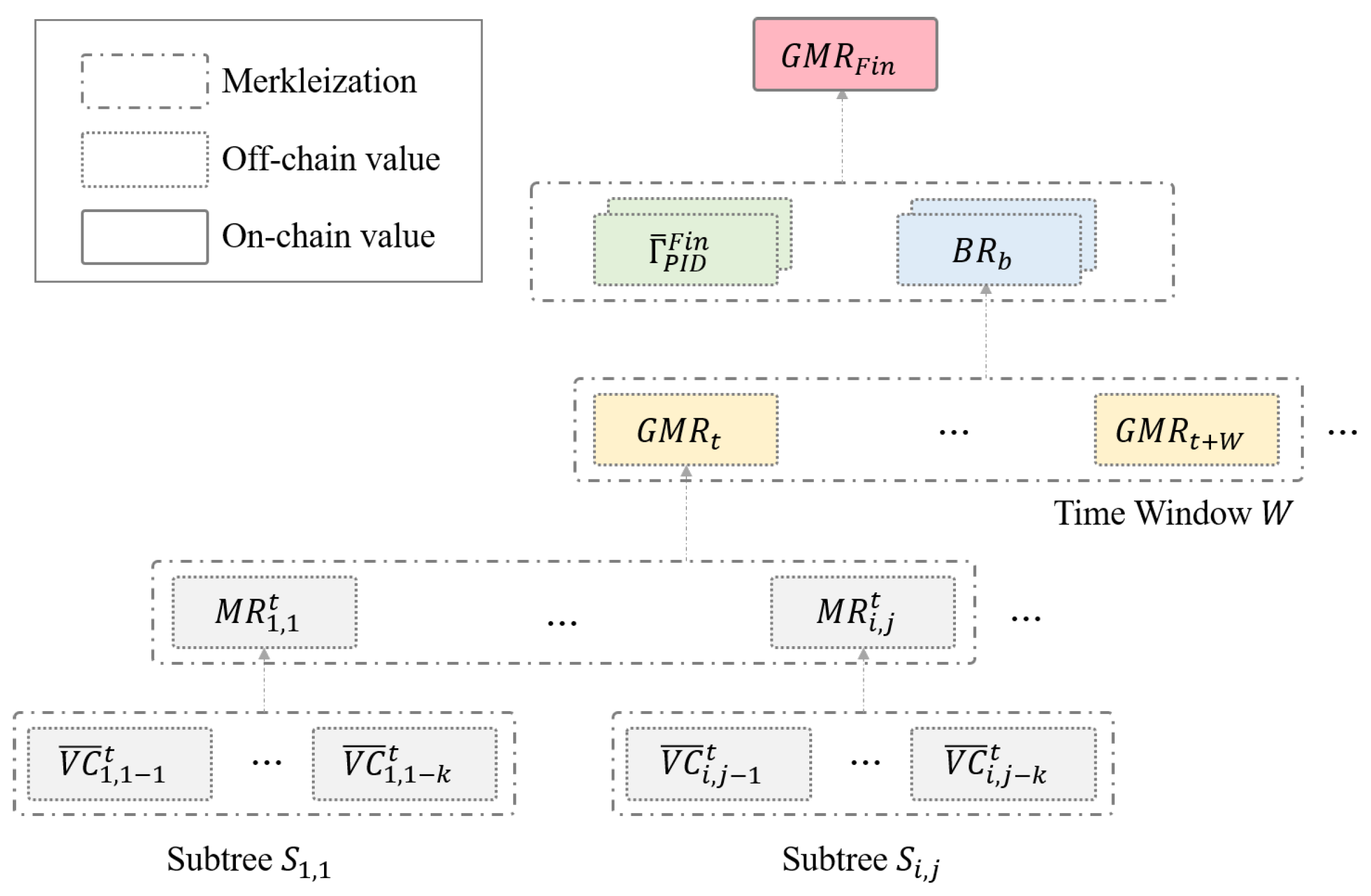
- Merkleization for Verifiable Off-Chain States: To guarantee the integrity of all off-chain state updates, the system constructs a multi-layered Merkle tree. This structure allows for the creation of a single, compact cryptographic proof for the entire history and final state of the system. Figure 2 illustrates this hierarchical construction. With the exception of the final root hash , all intermediate Merkle roots are generated and stored off-chain by the participants.The aggregation process occurs in a bottom-up fashion across several layers:
- (a)
- Layer 1: Leaf Node Generation: In each round , every sub-institution hashes the latest valid state of each virtual channel it manages. These hashes, , form the leaf nodes of the tree.
- (b)
- Layer 2: Per-Epoch State Aggregation: The leaf nodes are then aggregated upward to create a single hash commitment for each training round.
- First, each computes its own Merkle root, , from the leaf nodes it generated. This root represents the entirety of state updates managed by that sub-institution in round t.
- Next, these individual roots are collected to form a Global Merkle Root for the epoch, . To ensure the uniqueness of each input, the hash of each ’s identifier is concatenated with its Merkle root before being included in the final tree.
- (c)
- Layer 3: Final Commitment and On-Chain Anchor: To minimize on-chain transactions, the per-epoch roots are not immediately published. Instead, they are batched and anchored in a single, final transaction after the entire FL process is complete.
- Block Root Batching: For scalability, the values are periodically grouped into blocks (e.g., spanning W epochs). The Merkle root of each block, , is calculated and stored off-chain. This step batches the historical proofs.
- Final Anchor Construction: Upon termination of the training, the final global Merkle root, , is constructed. This single hash, which is the only data permanently anchored to the on-chain contract , is composed of two distinct sets of data to enable comprehensive proof during settlement:
- All historical Block Roots (), which collectively prove the history of all reward updates in every channel.
- The hashes of all final State Channel states (), which prove the final liability path between intermediary nodes.
A contributor’s final claim requires proof against both components: one to validate the amount of their reward, and another to validate the legitimacy of the settlement path.
3.2.4. Settlement and Reward Claim
- Phase 1: Off-Chain Finalization (Bottom-Up): This initial phase occurs entirely off-chain to determine the final, cryptographically agreed-upon payment obligations at every level of the hierarchy, starting from the contributors and moving upwards.
- Virtual Channel Closure: The sub-institution and each of its contributors create and co-sign one final state for their channel, . This state records the contributor’s final total reward, , which is equal to the total reward amount from the final training epoch, .
- Liability Propagation via State Channels: The final reward amount, , triggers a cascading liability update that propagates up the hierarchy. A child node uses its channel to claim reimbursement from its parent. This process repeats recursively, shifting the financial liability upwards until each top-level sub-institution aggregates the total reimbursement amount required for its entire subtree, denoted .
- Top-Tier Reconciliation via Sub-Channels: The top-tier institutions now negotiate and co-sign a final state for each Sub-Channel, . This state serves as a verifiable, multi-party agreement that guarantees the reimbursement of to , specifying the final contribution from each institution .
- Phase 2: On-Chain Settlement Execution: The finalized off-chain states are now used to execute the transfer of funds on the blockchain.
- Settlement Transaction: An authorized party (e.g., ) submits the final, co-signed state to .
- Automated Fund Distribution: The contract programmatically performs two actions upon verifying the validity of the submitted state:
- (a)
- Return Unused Collateral: Any remaining funds are returned from the escrow to the original top-tier institutions .
- (b)
- Transfer to Payout Contract: The verified reimbursement amount, , is transferred to the address of the dedicated Payout Contract, , which was deployed by . This formally shifts the liability to the Payout Contract, which now holds the exact funds owed to the contributors of that subtree.
- Phase 3: Contributor Reward Claim: With the Payout Contracts now funded, contributors can directly and without permission claim their rewards.
- Submission of Proofs: To claim their reward , a contributor submits a proof to the corresponding Payout Contract, . This proof contains:
- -
- The finalized virtual channel state, .
- -
- The finalized state of the intermediary state channel, .
- -
- The Merkle proofs, and , that connect these two states to the globally agreed-upon on-chain anchor, .
- On-Chain Verification and Disbursement: The Payout Contract executes the logic detailed in Algorithm 1. It verifies the co-signatures on the submitted states and validates the Merkle proofs against the . This dual proof confirms both the reward amount and the legitimacy of the settlement path. If all checks pass, the contract marks the claim as processed to prevent re-entry and transfers the reward to the contributor’s wallet.
| Algorithm 1 Claim Validation Logic within Payout Contract |
| Require: Final state , final state , proofs , |
| 1: Let be the anchor stored in the main contract |
| 2: |
| 3: |
| 4: if Registry.IsClaimed() then |
| 5: return False {Prevent re-entry} |
| 6: end if |
| 7: |
| 8: {Payout contract owner is } |
| 9: {Assuming state has this structure} |
| 10: |
| 11: |
| 12: if or then |
| 13: return False {Check both signatures} |
| 14: end if |
| 15: |
| 16: if then |
| 17: return False Proof of reward |
| 18: end if |
| 19: |
| 20: |
| 21: if then |
| 22: return False {Proof of path} |
| 23: end if |
| 24: |
| 25: Registry.SetClaimed() |
| 26: Transfer() |
| 27: |
| 28: return True |
4. Discussion
4.1. Hierarchical Scalability and Cost Efficiency
4.1.1. Scalability
4.1.2. Cost-Efficiency
4.2. Security, Fairness, and Trustlessness
4.2.1. Cryptographic Verifiability and Integrity
4.2.2. Executable Fairness and Trustless Payouts
4.3. Practical Feasibility and Adaptability
4.3.1. Incentive Agnosticism
4.3.2. Off-Chain Practicality and Robustness
5. Performance Evaluation
5.1. Experimental Setup
- Blockchain Simulator: Ganache v2.7.1
- EVM Version: london
- Smart Contract Compiler: Solidity v0.8.20
- Development Environment: Remix IDE v1.1.3
- Wallet Provider: MetaMask v13.8.0
- CPU: 13th Gen Intel(R) Core(TM) i5-13500 (2.50 GHz)
- RAM: 16 GB
- Gas Price: 20 Gwei
- ETH Price: $3000
5.2. On-Chain Cost
5.2.1. Economic Feasibility
5.2.2. Complexity
5.2.3. EVM Storage Costs
- 1st Mint (72k gas): Initializes two slots from 0 to non-zero (TS and the recipient’s balances).
- 2nd Mint (55k gas): Updates one existing non-zero slot (TS) and initializes one new 0 slot (the new recipient’s balances).
- 3rd Mint (38k gas): Updates two existing non-zero slots. It represents the stable-state cost for subsequent mints to the same users.
5.3. Verification Cost
5.4. Anchoring Scheme Parameter Analysis
- L1 (Block-Level) Proof: A proof of length that validates the specific epoch’s state (e.g., ) is included in its corresponding Block Root .
- L2 (Global-Level) Proof: A proof of length that validates the Block Root is included in the final, on-chain Global Merkle Root .
5.5. Theoretical Channel Scalability
6. Limitations and Future Work
6.1. Administrator Centralization
6.2. Liveness and Dispute Resolution
6.3. Privacy Considerations
6.4. Economic and Regulatory Risks
7. Conclusions
Author Contributions
Funding
Institutional Review Board Statement
Informed Consent Statement
Data Availability Statement
Acknowledgments
Conflicts of Interest
References
- Rani, S.; Kataria, A.; Kumar, S.; Tiwari, P. Federated learning for secure IoMT-applications in smart healthcare systems: A comprehensive review. Knowl.-Based Syst. 2023, 274, 110658. [Google Scholar] [CrossRef] [Scilit]
- Prasad, V.K.; Boverlinetacharya, P.; Maru, D.; Tanwar, S.; Verma, A.; Singh, A.; Tiwari, A.K.; Sharma, R.; Alkhayyat, A.; Țurcanu, F.-E.; et al. Federated learning for the internet-of-medical-things: A survey. Mathematics 2022, 11, 151. [Google Scholar] [CrossRef] [Scilit]
- Pelekoudas-Oikonomou, F.; Zachos, G.; Papaioannou, M.; de Ree, M.; Ribeiro, J.C.; Mantas, G.; Rodriguez, J. Blockchain-Based Security Mechanisms for IoMT Edge Networks in IoMT-Based Healthcare Monitoring Systems. Sensors 2022, 22, 2449. [Google Scholar] [CrossRef] [Scilit] [PubMed]
- Adeniyi, E.A.; Ogundokun, R.O.; Awotunde, J.B. IoMT-based wearable body sensors network healthcare monitoring system. In IoT in Healthcare and Ambient Assisted Living; Springer: Singapore, 2021; pp. 103–121. [Google Scholar]
- Arthi, K.; Chidhambararajan, B. Advanced Enabling Technologies of IoMT in Personalized Healthcare. In Technological Advancement in Internet of Medical Things and Blockchain for Personalized Healthcare; CRC Press: Boca Raton, FL, USA, 2024; pp. 1–15. [Google Scholar]
- Rodríguez-Rodríguez, I.; Campo-Valera, M.; Rodríguez, J.V.; Woo, W.L. IoMT innovations in diabetes management: Predictive models using wearable data. Expert Syst. Appl. 2024, 238, 121994. [Google Scholar] [CrossRef] [Scilit]
- Grand View Research, Internet of Medical Things Market Size, Share & Trends Analysis Report By Component (Hardware, Software), By Deployment (On-Premise, Cloud), By Application, By End Use, By Region, and Segment Forecasts, 2025–2030. Report ID: GVR-4-68040-109-0. 2024. Available online: https://www.grandviewresearch.com/industry-analysis/internet-of-medical-things-iomt-market-report (accessed on 15 November 2025).
- Wani, R.U.Z.; Thabit, F.; Can, O. Security and privacy challenges, issues, and enhancing techniques for Internet of Medical Things: A systematic review. Secur. Priv. 2024, 7, e409. [Google Scholar] [CrossRef] [Scilit]
- U.S. Food and Drug Administration, Cybersecurity in Medical Devices: Quality System Considerations and Content of Premarket Submissions. Guidance for Industry and Food and Drug Administration Staff. 2025. Available online: https://www.fda.gov/media/119933/download (accessed on 15 November 2025).
- Rana, O.; Spyridopoulos, T.; Hudson, N.; Baughman, M.; Chard, K.; Foster, I.; Khan, A. Hierarchical and decentralised federated learning. In Proceedings of the 2022 Cloud Continuum, Los Alamitos, CA, USA, 5 December 2022; pp. 1–9. [Google Scholar]
- Sun, H.; Tang, X.; Yang, C.; Yu, Z.; Wang, X.; Ding, Q.; Li, Z.; Yu, H. HiFi-Gas: Hierarchical Federated Learning Incentive Mechanism Enhanced Gas Usage Estimation. In Proceedings of the AAAI Conference on Artificial Intelligence, Vancouver, BC, Canada, 26–27 February 2024; Volume 38, pp. 22824–22832. [Google Scholar]
- Zhao, Y.; Liu, Z.; Qiu, C.; Wang, X.; Yu, F.R.; Leung, V.C. An incentive mechanism for big data trading in end-edge-cloud hierarchical federated learning. In Proceedings of the 2021 IEEE Global Communications Conference, Madrid, Spain, 7–11 December 2021; pp. 1–6. [Google Scholar]
- Park, M.; Chai, S. BTIMFL: A Blockchain-Based Trust Incentive Mechanism in Federated Learning. In Proceedings of the International Conference on Computational Science and Its Applications, Athens, Greece, 3–6 July 2023; pp. 175–185. [Google Scholar]
- Rahmadika, S.; Firdaus, M.; Jang, S.; Rhee, K.H. Blockchain-enabled 5G edge networks and beyond: An intelligent cross-silo federated learning approach. Secur. Commun. Netw. 2021, 2021, 5550153. [Google Scholar] [CrossRef] [Scilit]
- Zhang, J.; Wu, Y.; Pan, R. Auction-based ex-post-payment incentive mechanism design for horizontal federated learning with reputation and contribution measurement. arXiv 2022, arXiv:2201.02410. [Google Scholar]
- Zhang, J.; Wu, Y.; Pan, R. Online auction-based incentive mechanism design for horizontal federated learning with budget constraint. arXiv 2022, arXiv:2201.09047. [Google Scholar] [CrossRef] [Scilit]
- Liu, Y.; Tian, M.; Chen, Y.; Xiong, Z.; Leung, C.; Miao, C. A contract theory based incentive mechanism for federated learning. In Federated and Transfer Learning; Springer International Publishing: Cham, Switzerlands, 2022; pp. 117–137. [Google Scholar]
- He, G.; Li, C.; Song, M.; Shu, Y.; Lu, C.; Luo, Y. A hierarchical federated learning incentive mechanism in UAV-assisted edge computing environment. Ad Hoc Netw. 2023, 149, 103249. [Google Scholar] [CrossRef] [Scilit]
- Yang, D.; Ji, Y.; Kou, Z.; Zhong, X.; Zhang, S. Asynchronous federated learning with incentive mechanism based on contract theory. In Proceedings of the 2024 IEEE Wireless Communications and Networking Conference(WCNC), Dubai, United Arab Emirates, 21–24 April 2024; pp. 1–6. [Google Scholar]
- Chu, S.; Li, J.; Wei, K.; Qian, Y.; Wang, K.; Shu, F.; Chen, W. Design of two-level incentive mechanisms for hierarchical federated learning. arXiv 2023, arXiv:2304.04162. [Google Scholar]
- Li, Y.; Wang, X.; Zeng, R.; Yang, M.; Li, K.; Huang, M.; Dustdar, S. VARF: An incentive mechanism of cross-silo federated learning in MEC. IEEE Internet Things J. 2023, 10, 15115–15132. [Google Scholar] [CrossRef] [Scilit]
- Su, Z.; Cheng, R.; Li, C.; Chen, M.; Zhu, J.; Long, Y. Federated learning and reputation-based node selection scheme for internet of vehicles. Electronics 2025, 14, 303. [Google Scholar] [CrossRef] [Scilit]
- Xu, J.; Zhang, C.; Jin, L.; Su, C. A Trust-Aware Incentive Mechanism for Federated Learning with Heterogeneous Clients in Edge Computing. J. Cybersecur. Priv. 2025, 5, 37. [Google Scholar] [CrossRef] [Scilit]
- Zhu, Y.; Liu, Z.; Wang, P.; Du, C. A dynamic incentive and reputation mechanism for energy-efficient federated learning in 6g. Digit. Commun. Netw. 2023, 9, 817–826. [Google Scholar] [CrossRef] [Scilit]
- Wang, X.; Zhao, Y.; Qiu, C.; Liu, Z.; Nie, J.; Leung, V.C. Infedge: A blockchain-based incentive mechanism in hierarchical federated learning for end-edge-cloud communications. IEEE J. Sel. Areas Commun. 2022, 40, 3325–3342. [Google Scholar] [CrossRef] [Scilit]
- Wu, B.; Seneviratne, O. Blockchain-based Framework for Scalable and Incentivized Federated Learning. In Proceedings of the Companion Proceedings of the ACM on Web Conference 2025, Sydney, NSW, Australia, 28 April–2 May 2025; pp. 1761–1767. [Google Scholar]
- Tang, M.; Wong, V.W. An incentive mechanism for cross-silo federated learning: A public goods perspective. In Proceedings of the IEEE INFOCOM 2021-IEEE Conference on Computer Communications, Vancouver, BC, Canada, 10–13 May 2021; pp. 1–10. [Google Scholar]
- Burchert, C.; Decker, C.; Wattenhofer, R. Scalable funding of bitcoin micropayment channel networks. R. Soc. Open Sci. 2018, 5, 180089. [Google Scholar] [CrossRef] [Scilit] [PubMed]
- Dziembowski, S.; Eckey, L.; Faust, S.; Hesse, J.; Hostáková, K. Multi-party virtual state channels. In Proceedings of the Advances in Cryptology–EUROCRYPT 2019: 38th Annual International Conference on the Theory and Applications of Cryptographic Techniques, Darmstadt, Germany, 19–23 May 2019; pp. 625–656. [Google Scholar]
- Poon, J.; Dryja, T. The Bitcoin Lightning Network: Scalable Off-Chain Instant Payments. 2016. Available online: https://lightning.network/lightning-network-paper.pdf (accessed on 28 September 2025).

| Symbol | Description |
|---|---|
| An Institution (e.g., Hospital HQ), a top-tier participant. | |
| A Sub-Institution (e.g., Hospital Department), an intermediary. | |
| A Contributor (e.g., Research Lab), a leaf-node participant. | |
| T | Total number of training epochs (project duration). |
| W | Window Size (number of epochs batched into one L1 Merkle block). |
| N | Total number of Contributors. |
| The reward calculated for Contributor at epoch t. | |
| The on-chain FundingRegistry contract (Central Escrow). | |
| The on-chain PayoutContract deployed by . | |
| The off-chain Sub-Channel (between I and ). | |
| The off-chain multi-party State Channel (between and ). | |
| The off-chain Virtual Channel (between and ). | |
| Merkle Root of all states managed by at epoch t. | |
| Global Merkle Root for all states in a single epoch t. | |
| Block Root; the L1 Merkle root of W epochs (). | |
| The final L2 Global Merkle Root anchored on-chain (). | |
| Merkle Proofs required for claimReward. |
| Phase (Complexity) | Function (Operation) | Gas Used | Cost (USD) | Actor |
|---|---|---|---|---|
| 1. One-Time Setup () | ||||
| CoFTStablecoin (Deploy) | 1,266,396 | 76.00 | Admin | |
| FundingRegistry (Deploy) | 1,851,044 | 111.06 | Admin | |
| Subtotal (One-Time) | 3,117,440 | 187.06 | ||
| 2. Per-Institution () | ||||
| approve (for deposit) | 46,987 | 2.82 | Inst_I | |
| depositFunds | 82,301 | 4.94 | Inst_I | |
| Subtotal (per I) | 129,288 | 7.76 | ||
| 3. Per-Sub-Institution () | ||||
| PayoutContract (Deploy) | 1,122,722 | 67.36 | SubInst_S | |
| approve (for stake) | 46,987 | 2.82 | SubInst_S | |
| registerSubInstitution | 149,633 | 8.98 | SubInst_S | |
| registerPayoutContract | 29,303 | 1.76 | SubInst_S | |
| settleAndTransfer | 64,104 | 3.85 | Admin | |
| Subtotal (per S) | 1,412,749 | 84.77 | ||
| 4. Per-Contributor () | ||||
| claimReward () | 88,373 | 5.30 | Contr_C | |
| Subtotal (per N) | 88,373 | 5.30 | ||
| 5. Operational () | ||||
| anchorFinalState | 47,657 | 2.86 | Admin | |
| activateSettlement | 48,611 | 2.92 | Admin | |
| mint (1st: 2 new slots) | 72,001 | 4.32 | Admin | |
| mint (2nd: 1 new slot) | 54,877 | 3.29 | Admin | |
| mint (Nth: 0 new slots) | 37801 | 2.27 | Admin |
| Linear Approach () | CoFT Approach () | |||
|---|---|---|---|---|
| (Epochs) | Gas Used | Proof Length | CPU Time (ms) | Gas Used |
| 10 | 27,269 | 2 | 11.8 | 27,674 |
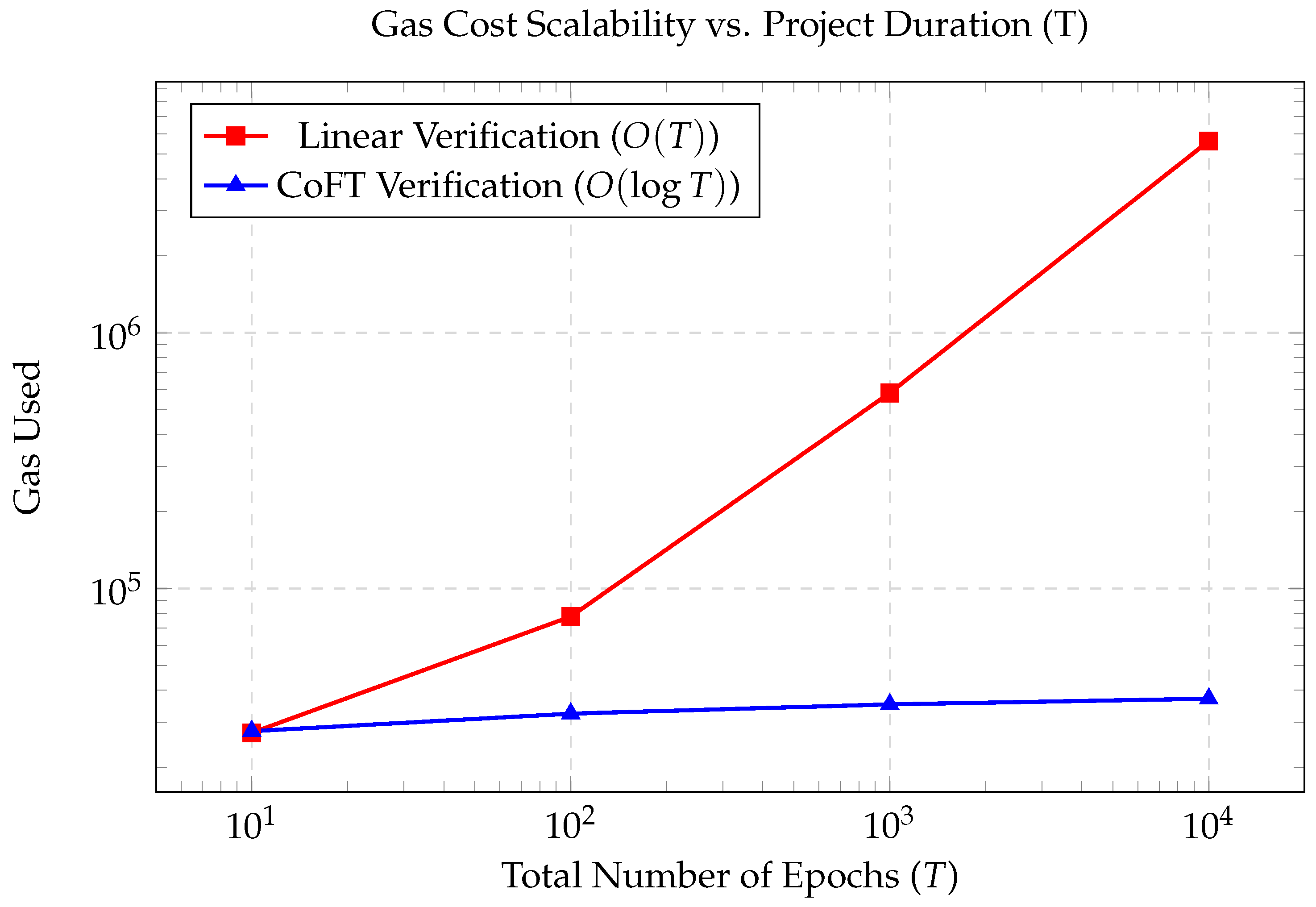
| 100 | 77,669 | 7 | 17.6 | 32,399 |
| 1000 | 581,681 | 10 | 44.5 | 35,230 |
| 10000 | 5,621,681 | 12 | 261.9 | 37,070 |
| W (Window) | (Blocks) | Proof L1 (len) | Proof L2 (len) | Gas Used |
|---|---|---|---|---|
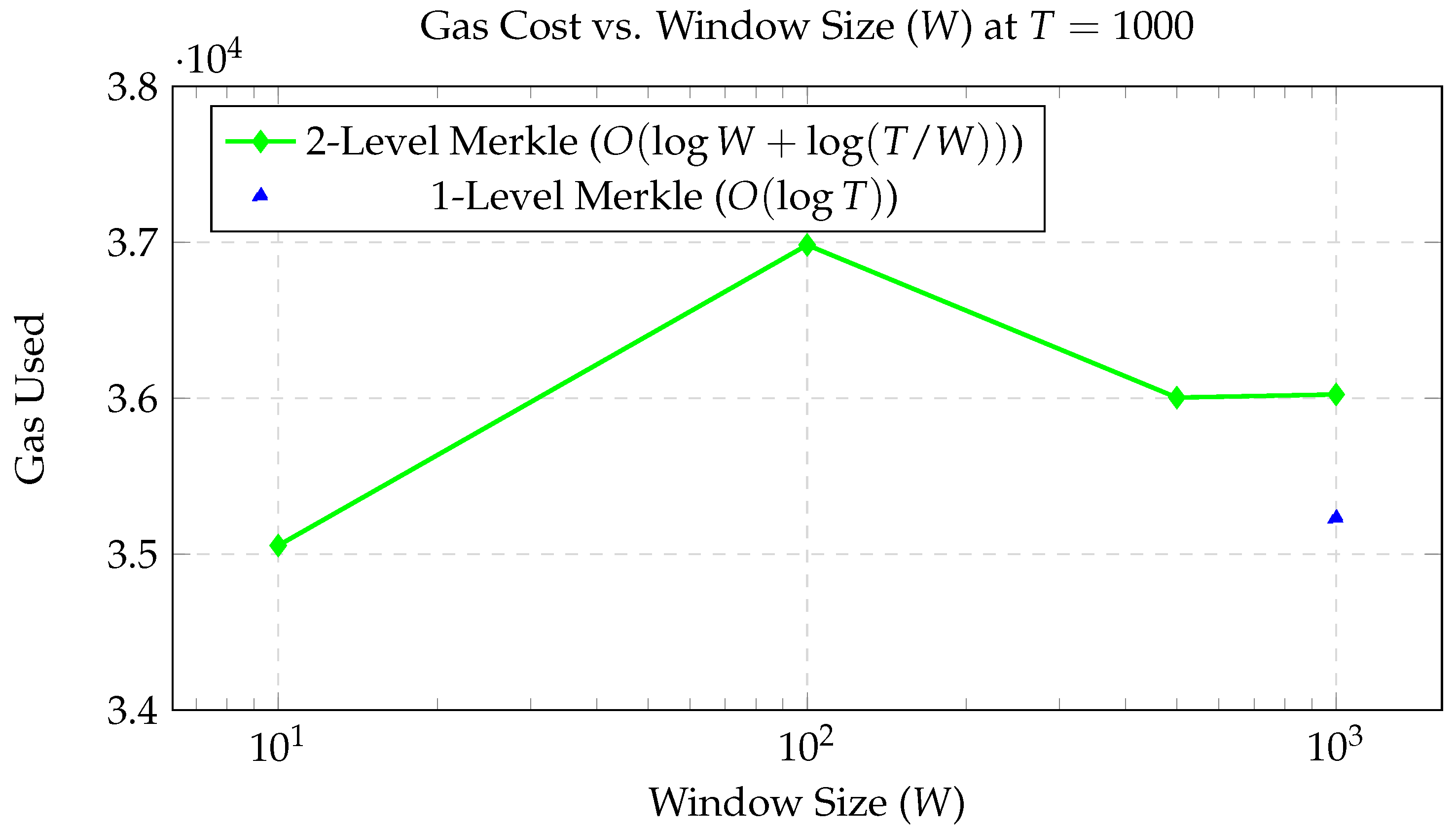
| 10 | 100 | 2 | 7 | 35,055 |
| 100 | 10 | 7 | 4 | 36,983 |
| 500 | 2 | 9 | 1 | 36,004 |
| 1000 | 1 | 10 | 0 | 36,024 |
| Scenario | Inst (I) | Branch (B) | Depth (D) | Contrib (C) | Total Logical Channels |
|---|---|---|---|---|---|
| Small Consortium | 2 | 3 | 1 | 10 | 66 |
| Medium Network | 3 | 5 | 2 | 20 | 1605 |
| Large Ecosystem | 5 | 10 | 3 | 50 | 256,105 |
Disclaimer/Publisher’s Note: The statements, opinions and data contained in all publications are solely those of the individual author(s) and contributor(s) and not of MDPI and/or the editor(s). MDPI and/or the editor(s) disclaim responsibility for any injury to people or property resulting from any ideas, methods, instructions or products referred to in the content. |
© 2025 by the authors. Licensee MDPI, Basel, Switzerland. This article is an open access article distributed under the terms and conditions of the Creative Commons Attribution (CC BY) license (https://creativecommons.org/licenses/by/4.0/).
Share and Cite
Noh, S.; Shin, S.U.; Rhee, K.-H. CoFT: A Fair and Transparent Compensation Framework for Hierarchical Federated Learning. Appl. Sci. 2025, 15, 12568. https://doi.org/10.3390/app152312568
Noh S, Shin SU, Rhee K-H. CoFT: A Fair and Transparent Compensation Framework for Hierarchical Federated Learning. Applied Sciences. 2025; 15(23):12568. https://doi.org/10.3390/app152312568
Chicago/Turabian StyleNoh, Siwan, Sang Uk Shin, and Kyung-Hyune Rhee. 2025. "CoFT: A Fair and Transparent Compensation Framework for Hierarchical Federated Learning" Applied Sciences 15, no. 23: 12568. https://doi.org/10.3390/app152312568
APA StyleNoh, S., Shin, S. U., & Rhee, K.-H. (2025). CoFT: A Fair and Transparent Compensation Framework for Hierarchical Federated Learning. Applied Sciences, 15(23), 12568. https://doi.org/10.3390/app152312568

