Energy-Dependent Neutron Emission in Medical Cyclotrons: Differences Between 18F and 11C and Implications for Radiation Protection


Featured Application
Abstract
1. Introduction
1.1. Neutron Generation Mechanisms in Medical Cyclotron (p,n) Reactions
1.2. Neutron Spectra in Medical Cyclotrons
- evaporation neutrons, dominating in the 0.3–4 MeV range, with a clear maximum around 1 MeV, originating from the de-excitation of the target nuclei as well as structural materials of the cyclotron, in particular the iron-rich magnetic components;
1.3. Radiobiological Effects of Neutrons: Physical Mechanisms and Biological Effects
2. Materials and Methods
3. Results
4. Discussion
5. Conclusions
Author Contributions
Funding
Institutional Review Board Statement
Informed Consent Statement
Data Availability Statement
Acknowledgments
Conflicts of Interest
Abbreviations
| PET | Positron Emission Tomography |
| PET-CT | Positron Emission Tomography-Computed Tomography |
| IAEA | International Atomic Energy Agency |
| SD | Standard deviation |
| CV | Coefficient of Variation |
References
- International Atomic Energy Agency. Cyclotron Produced Radionuclides: Principles and Practice; IAEA: Vienna, Austria, 2008. [Google Scholar]
- International Atomic Energy Agency. Cyclotron Produced Radionuclides: Operation and Maintenance of Gas and Liquid Targets; IAEA: Vienna, Austria, 2012. [Google Scholar]
- Vega Carrillo, H.R. Neutron energy spectra inside a PET cyclotron vault room. Nucl. Instrum. Methods Phys. Res. A 2001, 463, 375–386. [Google Scholar] [CrossRef]
- Alloni, D.; Prata, M. Characterisation of the secondary neutron field generated by a compact PET cyclotron with MCNP6 and experimental measurements. Appl. Radiat. Isot. 2017, 128, 204–209. [Google Scholar] [CrossRef] [PubMed]
- Jakubowska, T.; Długosz-Lisiecka, M.; Biegała, M. Comparison of radionuclide impurities activated during irradiation of 18O enriched water in tantalum and silver targets during the production of 18F in a cyclotron. Molecules 2023, 28, 3485. [Google Scholar] [CrossRef] [PubMed]
- Kambali, I.; Suryanto, H.; Parwanto. Radioactive by-products of a self-shielded cyclotron and the liquid target system for F-18 routine production. Australas. Phys. Eng. Sci. Med. 2016, 39, 403–412. [Google Scholar] [CrossRef]
- Infantino, A.; Cicoria, G.; Lucconi, G.; Pancaldi, D.; Vichi, S.; Zagni, F.; Mostacci, D.; Marengo, M. Radiation Protection Studies for Medical Particle Accelerators using Fluka Monte Carlo Code. Radiat. Prot. Dosimetry 2017, 173, 185–191. [Google Scholar] [CrossRef]
- Lin, J.B.; Lee, J.P.; Lin, D.B.; Chen, W.K.; Liu, W.S.; Chen, C.Y. Evaluation of stray neutron distribution in medical cyclotron vault room by neutron activation analysis approach. J. Radioanal. Nucl. Chem. 2009, 280, 481–487. [Google Scholar] [CrossRef]
- Mukherjee, B.; Singlachar, R. Development of a radiation hardness testing facility for semiconductor devices at a medical cyclotron. Nucl. Instrum. Methods Phys. Res. A 1996, 383, 631–633. [Google Scholar] [CrossRef]
- Paul, S.; Sahoo, G.S.; Tripathy, S.P.; Sharma, S.C.; Joshi, D.S.; Bandyopadhyay, T. Measurement of thick target neutron yield from the reaction (p + 181Ta) with projectiles in the range of 6–20 MeV. Nucl. Instrum. Methods Phys. Res. A 2018, 880, 75–79. [Google Scholar] [CrossRef]
- Lacerda, M.A.S.; Campolina, D.A.M.; Guimarães, A.M.; Benavente, J.A.; da Silva, T.A. Use of the MCNPX to calculate the neutron spectra around the GE-PETtrace 8 cyclotron of the CDTN/CNEN, Brazil. Appl. Radiat. Isot. 2014, 83, 235–241. [Google Scholar] [CrossRef]
- Orchard, G.M.; Feuerstake, T.; McDonald, C.; Waker, A.J. Investigation of the stray neutron fields produced from proton irradiated Ta, Co-59, Ni, Fe, Inconel X750 and stainless steel 310 targets in a materials testing laboratory environment. Appl. Radiat. Isot. 2021, 178, 109961. [Google Scholar] [CrossRef]
- Tsuda, S.; Endo, S.; Tanaka, K. Microdosimetric understanding of neutron RBE using a tissue-equivalent proportional counter. Radiat. Prot. Dosimetry 2010, 143, 456–460. [Google Scholar] [CrossRef][Green Version]
- Stricklin, D.L.; VanHorne-Sealy, J.; Rios, C.I.; Scott Carnell, L.A.; Taliaferro, L.P. Neutron radiobiology and dosimetry. Radiat. Res. 2021, 195, 480–496. [Google Scholar] [CrossRef]
- Lund, C.M.; Famulari, G.; Montgomery, L.; Kildea, J. A microdosimetric analysis of the interactions of mono-energetic neutrons with human tissue. Phys. Med. 2020, 73, 29–42. [Google Scholar] [CrossRef] [PubMed]
- ICRU. Stopping Powers and Ranges for Protons and Alpha Particles; ICRU Report 49; J ICRU: Bethesda, MD, USA, 1993. [Google Scholar]
- Sasaki, M.S.; Endo, S.; Hoshi, M.; Nomura, T. Neutron relative biological effectiveness in Hiroshima and Nagasaki atomic bomb survivors: A critical review. J. Radiat. Res. 2016, 57, 583–595. [Google Scholar] [CrossRef]
- Macaeva, E.; Mysara, M.; De Vos, W.H.; Baatout, S.; Quintens, R. Gene expression-based biodosimetry for radiological incidents: assessment of dose and time after radiation exposure. Int. J. Radiat. Biol. 2018, 94, 64–75. [Google Scholar] [CrossRef]
- Preston, D.L.; Ron, E.; Tokuoka, S.; Funamoto, S.; Nishi, N.; Soda, M.; Mabuchi, K.; Kodama, K. Solid cancer incidence in atomic bomb survivors. Radiat. Res. 2007, 168, 1–64. [Google Scholar] [CrossRef]
- Baiocco, G. Predicting neutron RBE: Results from the ANDANTE project. Radiat. Prot. Dosimetry 2016, 180, 364–368. [Google Scholar] [CrossRef]
- ICRP Publication 26. Recommendations of the International Commission on Radiological Protection. Ann. ICRP 1977, 1. [Google Scholar]
- ICRP Publication 103. The 2007 Recommendations of the International Commission on Radiological Protection. Ann. ICRP 2007, 37. [Google Scholar]
- ICRP Publication 92. Relative Biological Effectiveness (RBE), Quality Factor (Q), and Radiation Weighting Factor (wR). Ann. ICRP 2003, 33. [Google Scholar] [CrossRef]
- NCRP. Ionizing Radiation Exposure of the Population of the United States; NCRP Report No. 160; National Council on Radiation Protection and Measurements: Bethesda, MD, USA, 2009. [Google Scholar]
- Infantino, A.; Marengo, M.; Baschetti, S.; Cicoria, G.; Vaschetto, V.L.; Lucconi, G.; Massucci, P.; Vichi, S.; Zagni, F.; Mostacci, D. Accurate Monte Carlo modeling of cyclotrons for optimization of shielding and activation calculations. Radiat. Phys. Chem. 2015, 116, 231–236. [Google Scholar] [CrossRef]
- Guimarães, C.; Silari, M. Neutron spectra around medical cyclotrons. Radiat. Meas. 2012, 47, 35–41. [Google Scholar] [CrossRef]
- Utada, M.; Brenner, A.V.; Preston, D.L.; Cologne, J.B.; Sakata, R.; Sugiyama, H.; Kato, N.; Grant, E.J.; Cahoon, E.K.; Mabuchi, K.; et al. Radiation risk of ovarian cancer in atomic bomb survivors: 1958–2009. Radiat. Res. 2021, 195, 60–65. [Google Scholar] [CrossRef]
- Biegała, M.; Jakubowska, T. Levels of exposure to ionizing radiation among the personnel engaged in cyclotron operation and the personnel engaged in the production of radiopharmaceuticals, based on radiation monitoring system. Radiat. Prot. Dosim. 2020, 189, 56–62. [Google Scholar] [CrossRef]



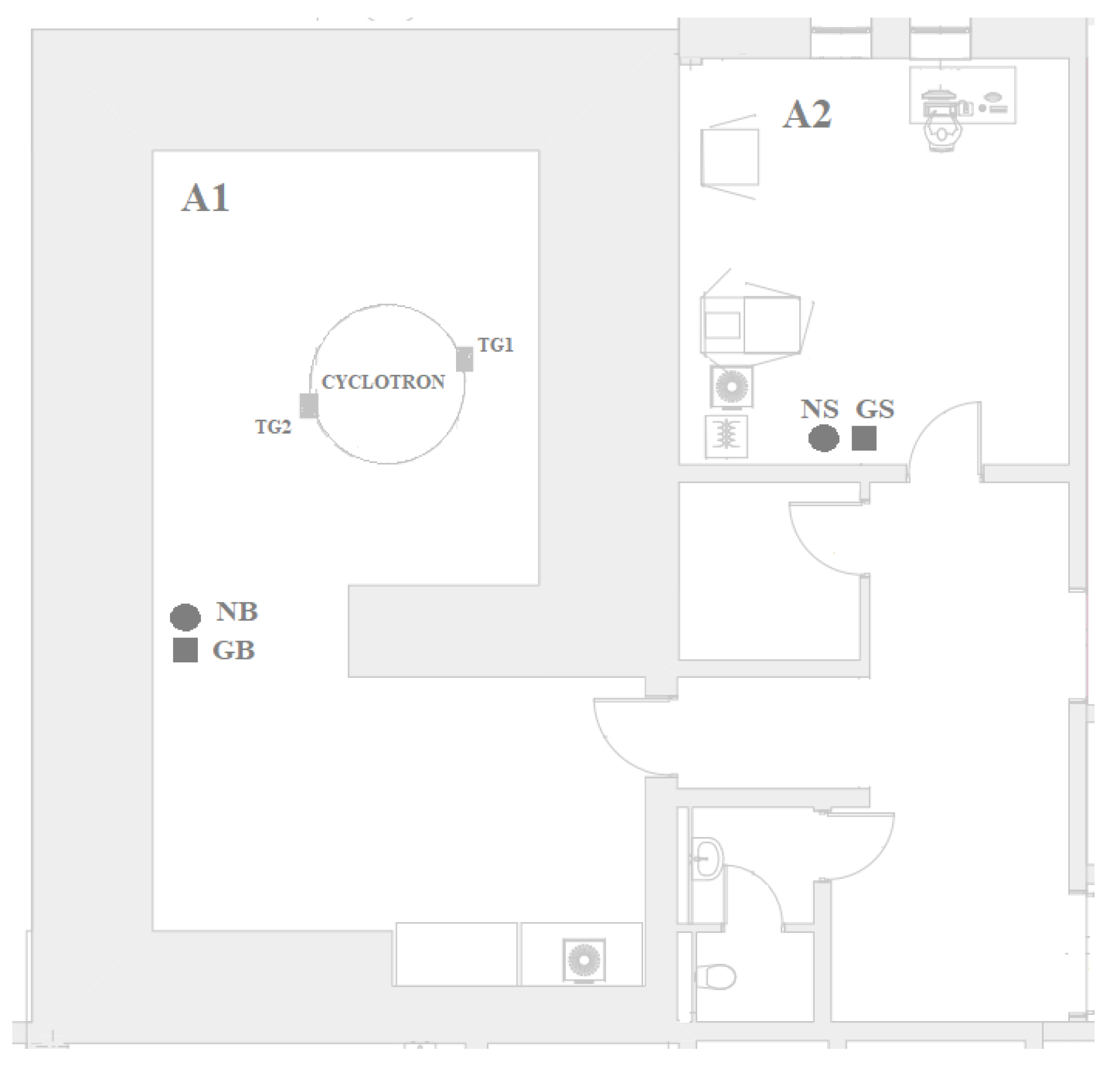
| Measurement Location | Probe Symbol | Detector Type | Energy Range | Measurement Range | Accuracy |
|---|---|---|---|---|---|
| Cyclotron bunker during isotope production | NB | MDN01 neutron | 50 keV to 6 MeV | 1 × 10⁻⁷ to 1 × 10⁻¹ Sv/h | ±15% |
| GB | MDG02 gamma | 80 keV to 1.5 MeV | Natural background to 0.1 Gy/h | ±15% | |
| Cyclotron control room during isotope production | NS | MDN01 neutron | 50 keV to 6 MeV | 1 × 10⁻⁷ to 1 × 10⁻¹ Sv/h | ±15% |
| GS | AGM02 gamma | 80 keV to 1.5 MeV | Natural background to 0.1 Gy/h | ±15% | |
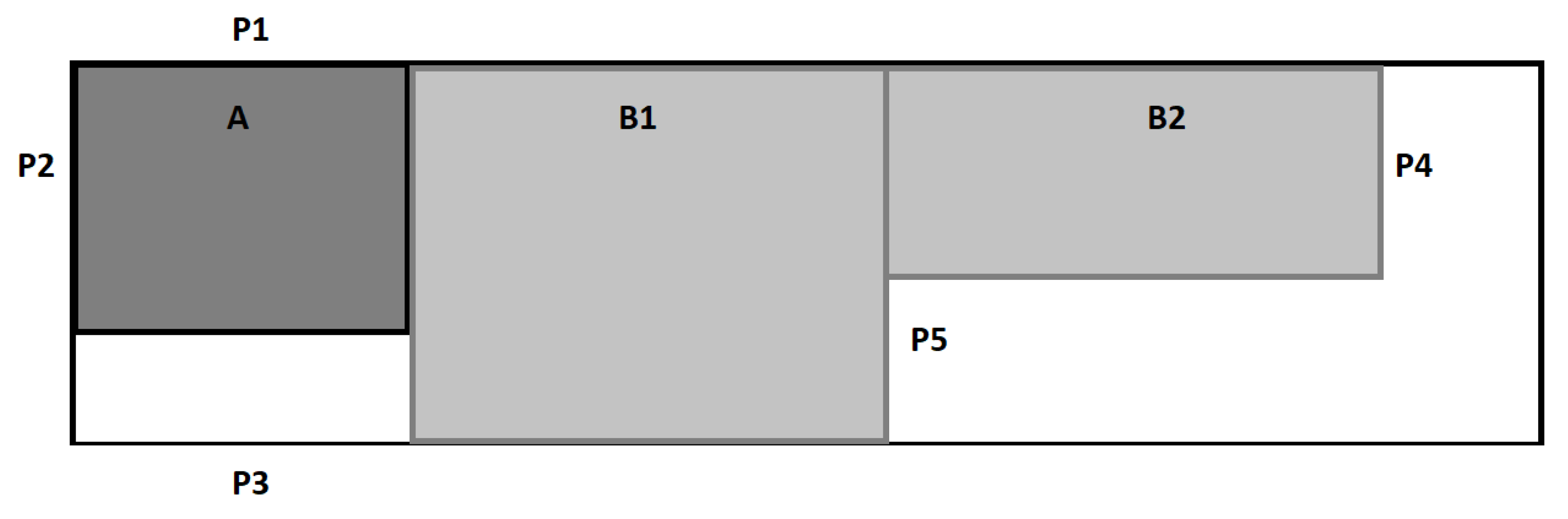
| Cyclotron bunker surroundings and supervised area boundaries | P1-P5 | FH40G-10 gamma | 30 keV to 4.4 MeV | 1 × 10⁻⁹ to 1 Sv/h | ±15% |
| FH40G-10 neutron probe | 2.5 × 10⁻⁵ keV to 410 MeV | 0.1 nSv/h to 0.4 Sv/h | ±15% |
| Data | 18F production | 11C production | ||||||||||
|---|---|---|---|---|---|---|---|---|---|---|---|---|
| Bunker | Control Room | Shielding Factor | Bunker | Control Room | Shielding Factor | |||||||
| GB | NB | GS | NS | Gamma | Neutrons | GB | NB | GS | NS | Gamma | Neutrons | |
| [μSv/h] | [μSv/h] | [μSv/h] | [μSv/h] | - | - | [μSv/h] | [μSv/h] | [μSv/h] | [μSv/h] | - | - | |
| 27 January 2025 | 205,747 | 120,000 | 5.91 | 7.99 | 34,813 | 15,019 | 26,322 | 44,000 | 0.70 | 0.51 | 37,442 | 86,957 |
| 1 April 2025 | 144,828 | 120,000 | 6.09 | 8.18 | 23,781 | 14,670 | 19,195 | 46,000 | 0.75 | 0.53 | 25,697 | 86,304 |
| 7 May 2025 | 157,471 | 120,000 | 5.89 | 8.03 | 26,735 | 14,944 | 19,080 | 45,800 | 0.72 | 0.52 | 26,574 | 87,739 |
| 25 May 2025 | 182,759 | 83,600 | 5.83 | 8.84 | 31,348 | 9457 | 21,609 | 47,200 | 0.75 | 0.61 | 28,697 | 77,377 |
| 3 June 2025 | 137,931 | 120,000 | 5.97 | 7.82 | 23,104 | 15,345 | 18,391 | 44,200 | 0.70 | 0.51 | 26,160 | 87,179 |
| 17 June 2025 | 140,230 | 119,000 | 5.82 | 7.87 | 24,095 | 15,121 | 17,816 | 42,600 | 0.71 | 0.49 | 25,058 | 87,295 |
| 24 June 2025 | 167,816 | 120,000 | 5.77 | 7.80 | 29,084 | 15,385 | 18,966 | 45,600 | 0.74 | 0.53 | 25,664 | 86,528 |
| 8 July 2025 | 247,126 | 120,000 | 5.87 | 7.84 | 42,100 | 15,306 | 27,356 | 46,000 | 0.72 | 0.52 | 37,890 | 87,954 |
| 22 July 2025 | 131,035 | 120,000 | 5.69 | 7.54 | 23,029 | 15,915 | 18,506 | 44,400 | 0.73 | 0.51 | 25,490 | 86,381 |
| 29 August 2025 | 154,023 | 70,800 | 5.44 | 6.90 | 28,313 | 10,261 | 18,276 | 44,100 | 0.74 | 0.49 | 24,697 | 89,817 |
| mean | 166,897 | 111,340 | 5.83 | 7.88 | 28,640 | 14,142 | 20,552 | 44,990 | 0.73 | 0.52 | 28,337 | 86,353 |
| SD | 34,317 | 17,311 | 0.17 | 0.46 | 5805 | 2171 | 3298 | 1281 | 0.02 | 0.03 | 4779 | 3147 |
| CV | 21% | 16% | 3% | 6% | 20% | 15% | 16% | 3% | 2% | 6% | 17% | 4% |
| Isotope/Target | P1 | P2 | P3 | P4 | P5 | Background | ||||||
|---|---|---|---|---|---|---|---|---|---|---|---|---|
| Gamma | Neutrons | Gamma | Neutrons | Gamma | Neutrons | Gamma | Neutrons | Gamma | Neutrons | Gamma | Neutrons | |
| nSv/h | nSv/h | nSv/h | nSv/h | nSv/h | nSv/h | nSv/h | nSv/h | nSv/h | nSv/h | nSv/h | nSv/h | |
| 11C/TG1 | 90.8 | 1.6 | 93.4 | 12.1 | 102.0 | 17.0 | 122.0 | 105.0 | 91.2 | 2.0 | 70.3 | 1.7 |
| 79.6 | 1.4 | 102.1 | 4.6 | 99.6 | 6.5 | 109.7 | 26.0 | 87.3 | 2.2 | 84.3 | 1.2 | |
| 91.3 | 1.8 | 95.3 | 9.7 | 105.0 | 15.8 | 125.0 | 107.0 | 92.6 | 1.9 | 87.5 | 1.3 | |
| 87.5 | 1.6 | 89.3 | 3.6 | 112.0 | 8.3 | 104.5 | 60.4 | 91.4 | 1.9 | 84.6 | 0.9 | |
| 85.2 | 1.3 | 88.0 | 1.0 | 119.0 | 5.5 | 90.8 | 13.1 | 90.4 | 1.8 | 85.1 | 0.6 | |
| Mean | 86.9 | 1.5 | 93.6 | 6.2 | 107.5 | 10.6 | 110.4 | 62.3 | 90.6 | 2.0 | 82.4 | 1.1 |
| SD | 4.3 | 0.2 | 5.0 | 4.1 | 7.1 | 4.8 | 12.4 | 38.9 | 1.8 | 0.1 | 6.1 | 0.4 |
| Median | 87.5 | 1.6 | 93.4 | 4.6 | 105.0 | 8.3 | 109.7 | 60.4 | 91.2 | 1.9 | 84.6 | 1.2 |
| 18F/TG2 | 83.7 | 24.6 | 85.0 | 280.0 | 240.0 | 506.0 | 271.0 | 498.0 | 84.4 | 14.6 | 74.6 | 2.1 |
| 122.0 | 32.0 | 180.0 | 20.4 | 314.0 | 180.0 | 170.0 | 384.0 | 83.9 | 10.7 | 74.2 | 1.3 | |
| 122.0 | 11.7 | 325.0 | 10.3 | 80.1 | 115.0 | 162.0 | 104.0 | 85.4 | 9.2 | 74.2 | 1.3 | |
| 118.0 | 1.4 | 620.0 | 38.2 | 193.0 | 83.6 | 86.2 | 13.6 | 67.1 | 1.7 | 54.1 | 1.9 | |
| 168.0 | 204.0 | 179.0 | 107.0 | 249.0 | 61.0 | 260.0 | 244.0 | 193.0 | 177.0 | 76.0 | 4.6 | |
| Mean | 122.7 | 54.7 | 277.8 | 91.2 | 215.2 | 189.1 | 189.8 | 248.7 | 102.8 | 42.6 | 70.6 | 2.2 |
| SD | 26.8 | 75.4 | 187.5 | 100.3 | 77.8 | 163.4 | 68.4 | 177.0 | 45.6 | 67.3 | 8.3 | 1.2 |
| Median | 122.0 | 24.6 | 180.0 | 38.2 | 240.0 | 115.0 | 170.0 | 244.0 | 84.4 | 10.7 | 74.2 | 1.9 |
Disclaimer/Publisher’s Note: The statements, opinions and data contained in all publications are solely those of the individual author(s) and contributor(s) and not of MDPI and/or the editor(s). MDPI and/or the editor(s) disclaim responsibility for any injury to people or property resulting from any ideas, methods, instructions or products referred to in the content. |
© 2025 by the authors. Licensee MDPI, Basel, Switzerland. This article is an open access article distributed under the terms and conditions of the Creative Commons Attribution (CC BY) license (https://creativecommons.org/licenses/by/4.0/).
Share and Cite
Jakubowska, T.; Biegała, M. Energy-Dependent Neutron Emission in Medical Cyclotrons: Differences Between 18F and 11C and Implications for Radiation Protection. Appl. Sci. 2025, 15, 11946. https://doi.org/10.3390/app152211946
Jakubowska T, Biegała M. Energy-Dependent Neutron Emission in Medical Cyclotrons: Differences Between 18F and 11C and Implications for Radiation Protection. Applied Sciences. 2025; 15(22):11946. https://doi.org/10.3390/app152211946
Chicago/Turabian StyleJakubowska, Teresa, and Michał Biegała. 2025. "Energy-Dependent Neutron Emission in Medical Cyclotrons: Differences Between 18F and 11C and Implications for Radiation Protection" Applied Sciences 15, no. 22: 11946. https://doi.org/10.3390/app152211946
APA StyleJakubowska, T., & Biegała, M. (2025). Energy-Dependent Neutron Emission in Medical Cyclotrons: Differences Between 18F and 11C and Implications for Radiation Protection. Applied Sciences, 15(22), 11946. https://doi.org/10.3390/app152211946