The Impact of Regulation Amendments on Decision Support System Effectiveness on the Example of Vessel Traffic Planning on the Dredged Świnoujście–Szczecin Fairway


Abstract
1. Introduction
2. Literature Review
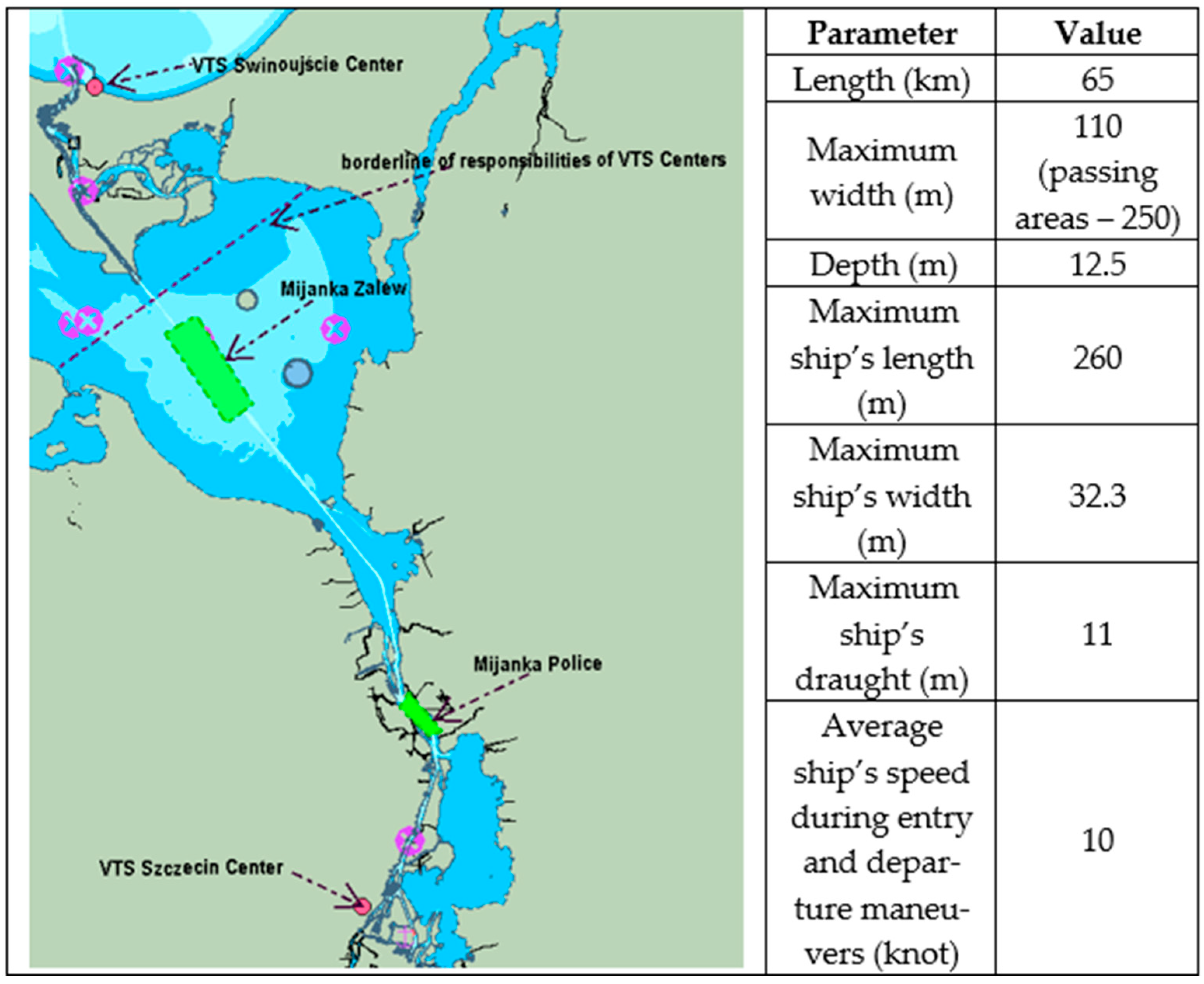
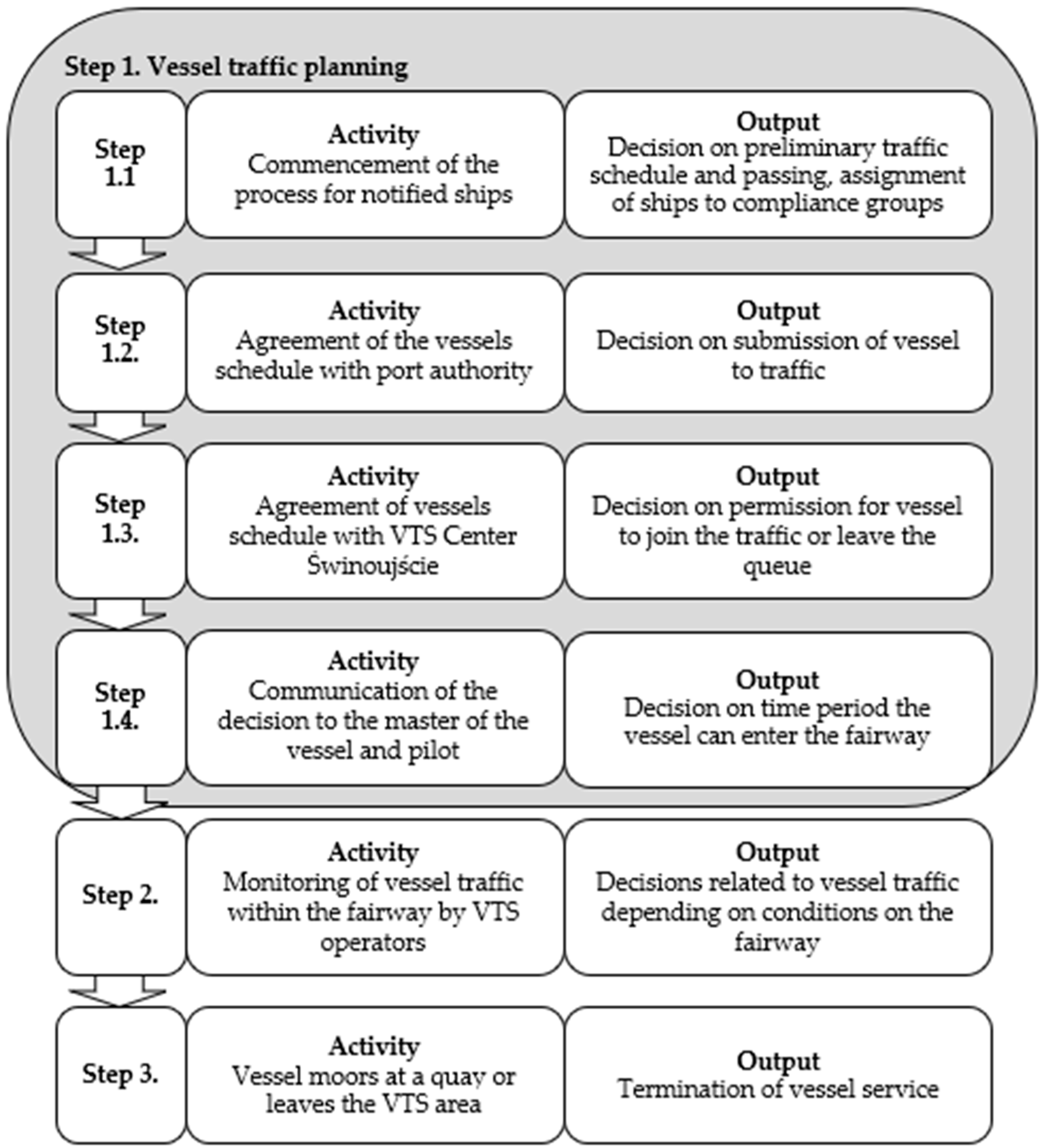
2.1. Characteristics of the Świnoujście–Szczecin Fairway and Decision-Making Process for Vessel Traffic Planning
- 1.1.
- Commencement of the process for notified ships.
- 2.1.
- Agreement of the vessels schedule with the port’s authority.
- 3.1.
- Agreement of the vessel’s schedule with the VTS Center Świnoujście.
- 4.1.
- Communication of the decision to the master of the vessel and pilot.
2.2. Analysis of the Literature Related to Risk Assessment
- The available studies reviewed mainly refer to risks occurring during vessel traffic within the route and do not take into account the decision-making process taken by VTS operators while planning the vessel’s entrance on fairways;
- The risks related to decisions carried out by VTS operators while planning vessel traffic on the Świnoujście–Szczecin fairway were analyzed to a limited extent;
- The probability of erroneous decisions during the planning of vessel traffic on the dredged Świnoujście–Szczecin fairway, considering the changes in vessels traffic regulations and the introduction of a DSS, should be analyzed in more detail.
3. Materials and Methods
- A vessel that poses a collision risk in two-way traffic;
- A vessel for which operating conditions within the fairway pose a significant threat.
- A FMEA form was prepared containing a description of the tasks and subtasks carried out in the vessel traffic planning process, the objectives pursued within each subtask, the identification of hazards and the category and type of possible errors.
- Each planned decision tends toward the consent for the vessel to join the traffic within the fairway (e.g., variable weather conditions and time of day, which may interrupt the process and the prohibition of the vessel joining traffic were not taken into account), the main focus is on information flow impacted by human factors.
- Ships can pass each other on the dredged fairway; nothing prevents the decision from being made.
- Vessel traffic planning takes place at the VTS Centre Szczecin.
- 2.
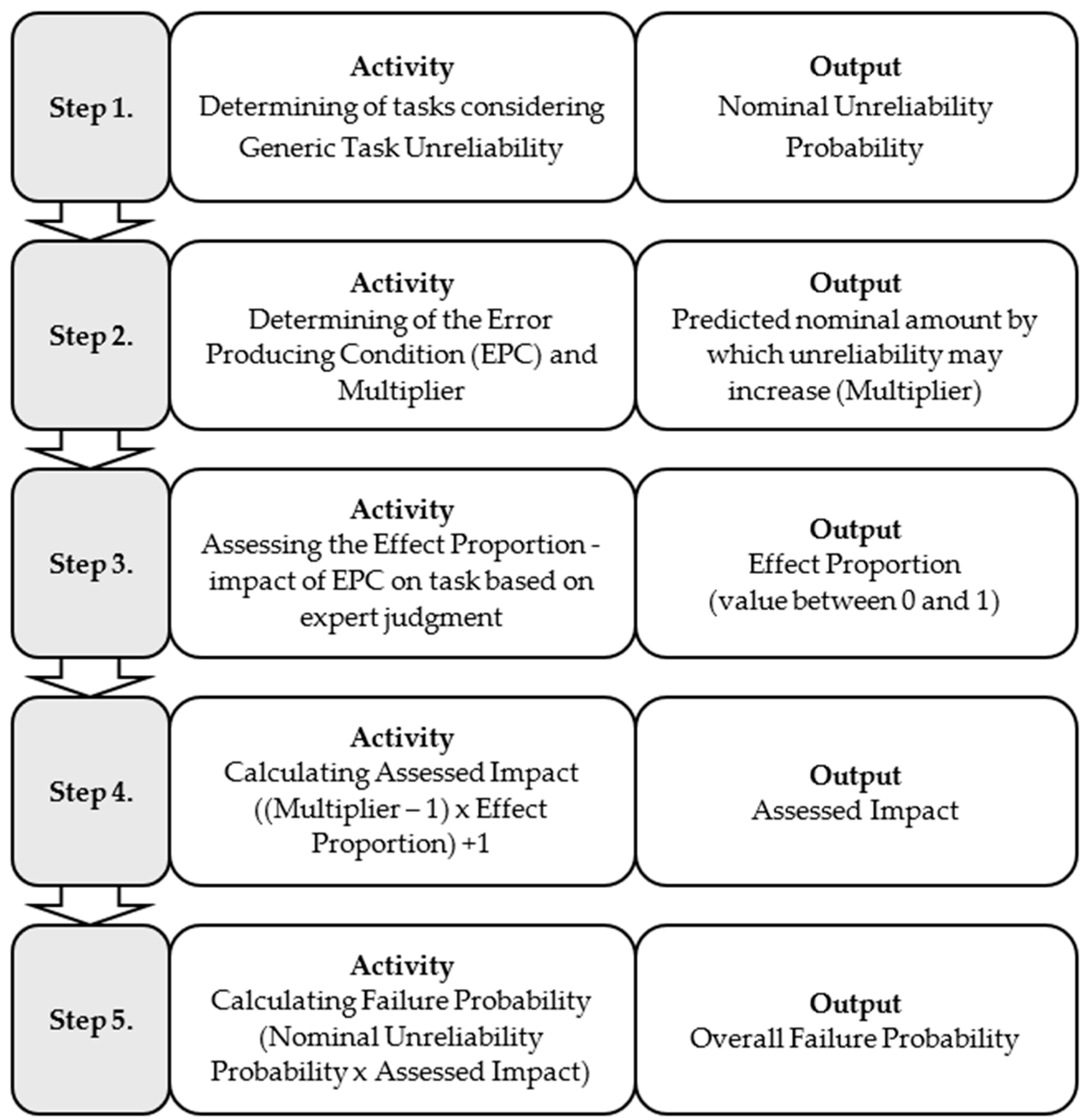
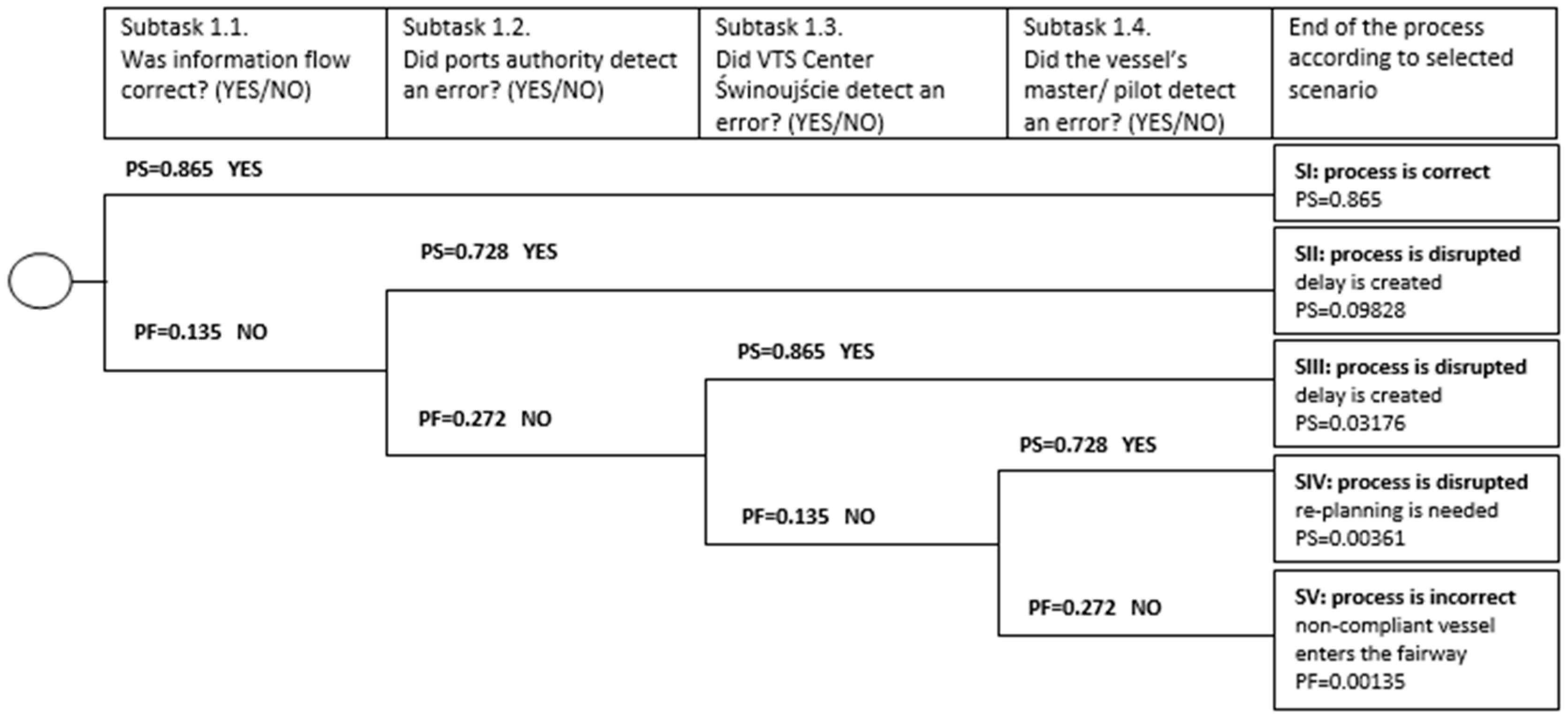
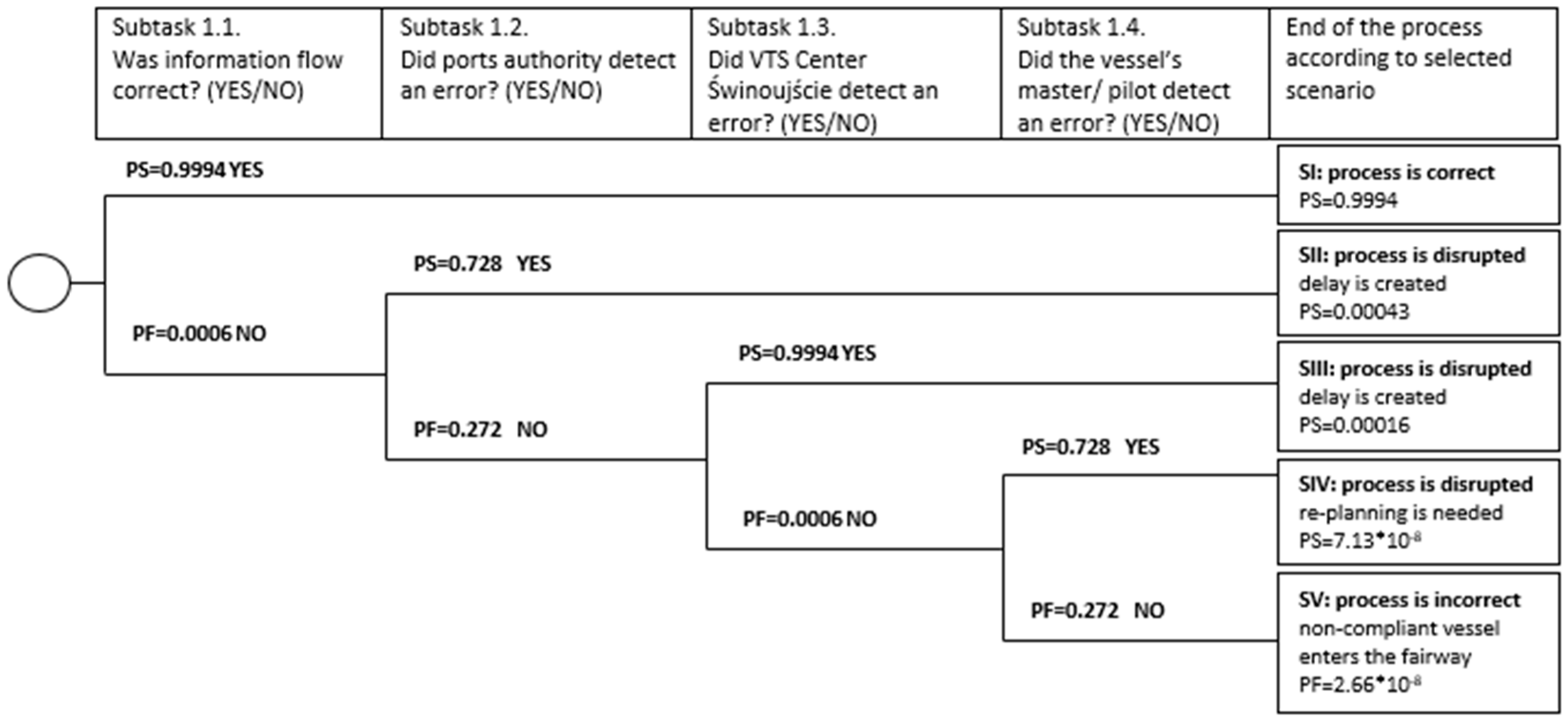
- The probability of failure was determined using the HEART method. This is a quantitative method for assessing human error. The nominal values of error probabilities were set based on the available literature [76]. It was assumed that the cause of individual human errors would be routine, due to a lack of attention and inappropriate work organization resulting from the exchange of information between decision-makers. Based on the process described, an event tree was developed, referring to the decision-making of VTS operators directly after the implementation of new vessel traffic regulations, which altered the course of the previous decision-making process (carried out before improvements). The probability of making erroneous decisions for each of the analyzed scenarios was calculated. Five scenarios of possible events (SoPEs) and their development were considered. An expert method was used to determine the values used in the analysis. The experts were experienced VTS operators and decision-makers from the Maritime Office in Szczecin.
- 3.
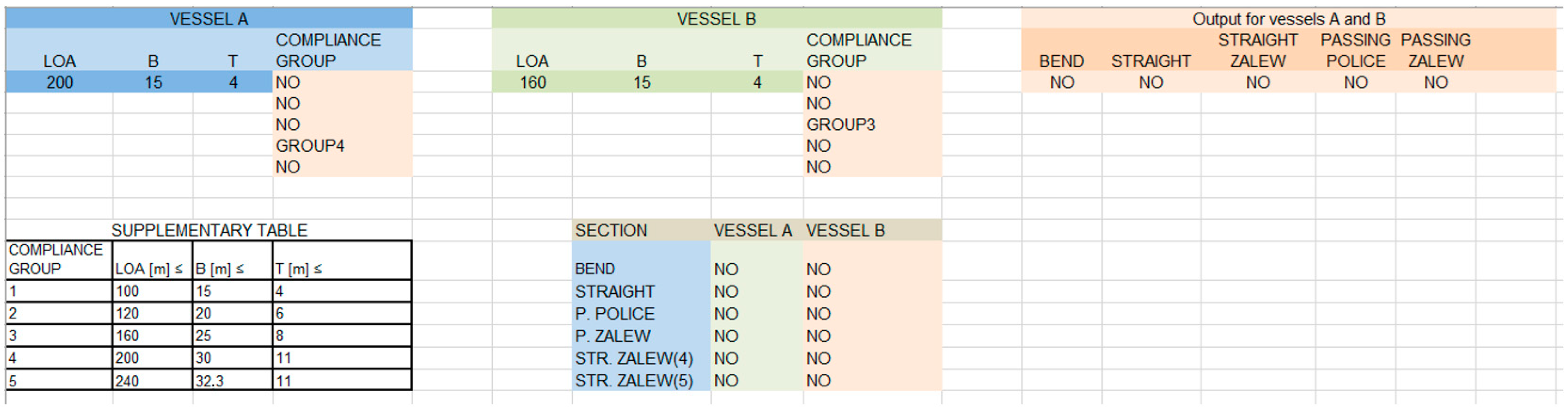
- Improvements were proposed to reduce the probability of making erroneous decisions by VTS operators. These improvements were related to the implementation of a DSS and VTS operator training. As a part of the DSS, a developed decision support tool (hereinafter referred as “calculator”) was applied.
- 4.
- The calculations of error occurrence probability using the HEART method were carried out, considering implementation of improvements. An event tree was developed for determined scenarios.
4. Results
4.1. Stage 1
4.2. Stage 2
- The exchange of information between VTS operators and the port’s authority (dispatcher), as well as VTS operators and the pilot or ship master, a value “0.16” was adopted, referring to a set of tasks requiring high skills and knowledge (typically applied to interactions with external participants under uncertain communication conditions or incomplete information flow).
- For relations between operators from VTS Centre Szczecin with operators from VTS Center Świnoujście, a value “0.09” was assumed, indicating relatively simple tasks performed quickly (typically applied in standardized internal communication between trained VTS operators using predefined procedures).
- For subtasks 1.1 and 1.3 performed by VTS operators, Multiplier value “6” was used for tasks dealing with poor information quality, when procedures are known but occasional interpretation issues may arise.
- For subtasks 1.2 and 1.4 performed in cooperation with other participants of decision-making process (e.g., ports authority) Multiplier value “8” was applied, considering involvement of external personnel with unknown training level or unclear expectations, reflecting the increased uncertainty in communication with port authorities or vessel masters.
- —probability of failure.
- , ;
- , ;
- , ;
- ,
- SoPE–SI: , ;
- SoPE–SII: , ;
- SoPE–SIII: , ;
- SoPE–SIV: , ;
- SoPE–SV: , .
- If an error is detected and corrected during subtask 1.1, the process is implemented correctly (SoPE–SI);
- If an error is detected early (subtask 1.2), only a minor delay may occur (SoPE–SII);
- If an error is detected during implementation of subtask 1.3, significant delay may take place (SoPE–SIII);
- if an error is detected later (subtask 1.4), replanning of vessel traffic may be required (SoPE–SIV);
- if an error is undetected at all, it results in an erroneous decision, such as admitting a non-compliant vessel to enter the fairway; in this case a serious accident may happen (SoPE–SV).
4.3. Stage 3
4.4. Stage 4
- The probability of success at the first stage (corrected information flow) has increased to , indicating reduced errors in information flow (SoPE–SI).
- The probability of a critical failure—i.e., an incompatible vessel entering the fairway without error detection (SoPE–SV)—was decreased drastically to . This probability value is acceptable according to the ALARP principle [77].
- The implementation of particular subtasks (SoPE–SII/SIV) deals with substantially lower probability values (compared to processes before DSS implementation).
5. Discussion and Conclusions
- Changes in the traffic regulations and ship grouping;
- The use of a developed decision support tool.
Author Contributions
Funding
Institutional Review Board Statement
Informed Consent Statement
Data Availability Statement
Acknowledgments
Conflicts of Interest
References
- Paulauskas, V.; Filina-Dawidowicz, L.; Paulauskas, D. Navigation Safety on Shipping Routes during Construction. Appl. Sci. 2023, 13, 8593. [Google Scholar] [CrossRef]
- Melnyk, O.; Onyshchenko, S.; Shumylo, O.; Ocheretna, V.; Kononova, O. Analysis of Factors Affecting the Ship Safety on the Basis of Six-Stage Risk Management Model. Stud. Syst. Decis. Control 2024, 561, 423–441. [Google Scholar] [CrossRef]
- Yan, R.; Liu, Y.; Wang, S. A data-driven optimization approach to improving maritime transport efficiency. Transp. Res. Part B Methodol. 2024, 180, 102887. [Google Scholar] [CrossRef]
- International Maritime Organization. Available online: https://www.imo.org/ (accessed on 8 August 2025).
- Durczak, W.; Filina-Dawidowicz, L. A Review of Vessel Traffic Services Systems Operating in Poland in Terms of Their Compliance with International Legislation. Appl. Sci. 2025, 15, 797. [Google Scholar] [CrossRef]
- Łazuga, K. Analysis of the Accessibility of the Świnoujście–Szczecin Fairway for Deep-Draught Ships. Appl. Sci. 2025, 15, 7104. [Google Scholar] [CrossRef]
- Schernewski, G.; Jekat, M.; Kösters, F.; Neumann, T.; Steffen, S.; von Thenen, M. Ecosystem Services Supporting Environmental Impact Assessments (EIAs): Assessments of Navigation Waterways Deepening Based on Data, Experts, and a 3D Ecosystem Model. Land 2024, 13, 1653. [Google Scholar] [CrossRef]
- Bąk, A.; Gucma, S.; Przywarty, M. Conditions of Safe Ship Operation in Restricted Areas Determined by Navigation Risk Assessment Methods. In Safety of Navigation in Restricted Areas; Synthesis Lectures on Ocean Systems Engineering; Springer: Cham, Switzerland, 2024. [Google Scholar] [CrossRef]
- RESOLUTION A.857(20), Guidelines for Vessel Traffic Services, IMO, Adopted on 27 November 1997. Available online: https://wwwcdn.imo.org/localresources/en/KnowledgeCentre/IndexofIMOResolutions/AssemblyDocuments/A.857(20).pdf (accessed on 8 August 2025).
- Project No POIS.03.02.00-00-0012/17; “Modernization of the Świnoujście-Szczecin Fairway to a Depth of 12.5 m”, Co-Financed by the European Union Under the Operational Program Infrastructure and Environment 2014–2020, Agreement from 21 December 2017. Available online: https://www.ums.gov.pl/333-uruchomiono-strone-www-projektu-modernizacja-toru-wodnego-swinoujscie-szczecin-do-glebokosci-12-5-m (accessed on 12 August 2023).
- Kuźmiński, W. Universalization of port activities in the context of structural changes in the port environment (on the example of the ports of Szczecin and Swinoujscie). Procedia Comput. Sci. 2024, 246, 4094–4103. [Google Scholar] [CrossRef]
- Melnyk, O.; Onishchenko, O.; Ternovsky, V.; Volaynskyy, S.; Koryakin, K. Safe and Reliable Operation of Maritime Transport Based on Integrated Systematic Safety Model. Stud. Syst. Decis. Control 2024, 561, 403–421. [Google Scholar] [CrossRef]
- Goerlandt, F. Risk Analysis for Vessel Accident Prevention in Marine Areas: An Accident-Theoretic Perspective on Spatial Aspects of Risk. In Area-Based Management of Shipping; Chircop, A., Goerlandt, F., Pelot, R., Aporta, C., Eds.; Springer: Cham, Switzerland, 2024. [Google Scholar] [CrossRef]
- Gucma, S.; Gralak, R.; Jesion, P.; Łempicki, M.; Przywarty, M. Analiza bezpieczeństwa eksploatacji statków na przebudowanym torze wodnym Świnoujście—Szczecin. Inżynieria Morska I Geotech. 2021, 6, 230–236. [Google Scholar]
- Kościelecki, M.; Kotkowska, D. Navigational Risk Analysis in the Area of the New Container Terminal in Świnoujście. In Scientific Papers of Silesian University of Technology. Organization & Management/Zeszyty Naukowe Politechniki Slaskiej; Seria Organizacji i Zarzadzanie: Gliwice, Poland, 2025; Volume 223, pp. 187–213. [Google Scholar] [CrossRef]
- Durlik, I.; Gucma, L.; Miller, T. Statistical Model of Ship Delays on the Fairway in Terms of Restrictions Resulting from the Port Regulations: Case Study of Świnoujście-Szczecin Fairway. Appl. Sci. 2023, 13, 5271. [Google Scholar] [CrossRef]
- Order No. 3 of the Director of the Maritime Office in Szczecin of 6 April 2023. Available online: https://www.ums.gov.pl/bezpieczenstwo-morskie/przepisy-portowe (accessed on 20 August 2025).
- Filina-Dawidowicz, L.; Durczak, W. Decision-making issues in vessels traffic planning after the deepening of the Świnoujście—Szczecin fairway to 12.5 m. In Proceedings of the 40th International Business Information Management Association (IBIMA), Seville, Spain, 23–24 November 2022; pp. 539–549. [Google Scholar]
- PIANC Report No. 121; Harbour Approach Channels Design Guidelines. 2014. Available online: https://www.pianc.org/publication/harbour-approach-channels-design-guidelines/ (accessed on 8 August 2025).
- Application VTS (Vessel Traffic Services), Maritime Office in Szczecin. Available online: https://www.ums.gov.pl/VTS/VTS_info.pdf (accessed on 8 August 2025).
- Filina-Dawidowicz, L.; Durczak, W. Organization of vessel traffic on dredged Świnoujście-Szczecin fairway: VTS operators’ viewpoint on the use of infrastructure for ships passing. Eur. Res. Stud. J. 2023, XXVI, 152–169. [Google Scholar] [CrossRef]
- ISO Guide 73:2009 (En); Risk Management—Vocabulary. Available online: https://www.iso.org/obp/ui/#iso:std:iso:guide:73:ed-1:v1:en (accessed on 22 August 2025).
- Staniuk, W.; Staniuk, M.; Chamier-Gliszczynski, N.; Jacyna, M.; Kłodawski, M. Decision-Making under the Risk, Uncertainty and COVID-19 Pandemic Conditions Applying the PL9A Method of Logistics Planning—Case Study. Energies 2022, 15, 639. [Google Scholar] [CrossRef]
- Kim, Y.; Lee, D. A Study on the Rational Decision-Making Process of Vessel Organization—Focusing on Cases of Vessel Accidents. Sustainability 2024, 16, 9820. [Google Scholar] [CrossRef]
- Kosek, W.; Chamier-Gliszczynski, N.; Woźniak, W.; Jachimowski, R. The Role of Polish Local Ports on the Central Baltic Coast in the Development of Offshore Wind Farms. Energies 2024, 17, 6123. [Google Scholar] [CrossRef]
- Shin, G.; Yang, H. Maritime accident prediction in Busan port using machine learning: An integrated approach with maritime accident reports and VTS data. Ocean Eng. 2025, 316, 119968. [Google Scholar] [CrossRef]
- Dudchenko, S.; Tymochko, O.; Makarchuk, D.; Golovan, A. Application of fuzzy cellular automata to optimize a vessel route considering the forecasted hydrometeorological conditions. East. Eur. J. Enterp. Technol. 2024, 2, 28–37. [Google Scholar] [CrossRef]
- Filina-Dawidowicz, L.; Rosochacki, W.; Iwańkowicz, R. Risk measures of load loss during service of refrigerating containers in seaports. Arch. Transp. 2015, 34, 19–27. [Google Scholar] [CrossRef]
- Olba, X.B.; Daamen, W.; Vellinga, T.; Hoogendoorn, S.P. Multi-criteria evaluation of vessel traffic for port assessment: A case study of the Port of Rotterdam. Case Stud. Transp. Policy 2019, 7, 871–881. [Google Scholar] [CrossRef]
- Arslan, E.; Nas, S. Conflicts Encountered with Bridge Team from the Perspective of Vessel Traffic Service Operators: A Research Within E-Navigation Concept. Trans. Marit. Sci. 2022, 11, 247–259. [Google Scholar] [CrossRef]
- Galierikova, A. The human factor and maritime safety. Transp. Res. Procedia 2019, 40, 1319–1326. [Google Scholar] [CrossRef]
- Fan, S.; Zhang, J.; Blanco-Davis, E.; Yang, Z.; Yan, X. Maritime accident prevention strategy formulation from a human factor perspective using Bayesian Networks and TOPSIS. Ocean Eng. 2020, 210, 107544. [Google Scholar] [CrossRef]
- Torok, A.; Semenov, I.; Filina-Dawidowicz, L.; Durczak, W. The Impact of Information Distortions on Decision-Making: A Case Study in Land–Sea Transport Chain Planning. Sustainability 2024, 16, 5568. [Google Scholar] [CrossRef]
- Semenov, I.; Filina-Dawidowicz, L.; Durczak, W. Investigating the Impact of Information Distortions on the Resilience of Land-sea Transport Chains Under Business-environment Instability Conditions. Period. Polytech. Transp. Eng. 2024, 52, 333–341. [Google Scholar] [CrossRef]
- Resolution, A. 849(20) Code for Investigation of Marine Casualties and Incidents, IMO, Adopted on 27 November 1997. Available online: https://wwwcdn.imo.org/localresources/en/KnowledgeCentre/IndexofIMOResolutions/AssemblyDocuments/A.849(20).pdf (accessed on 8 August 2025).
- Nguyen, T.-T.; My Tran, T.-D.; Duc, T.T.H.; Thai, V.V. Managing disruptions in the maritime industry—A systematic literature review. Marit. Bus. Rev. 2023, 8, 170–190. [Google Scholar] [CrossRef]
- Jiang, Z.; Xiao, Z.; Feng, Y.; Cao, Y.; Zhou, D.; Wang, X. Analysis of risk influential factors of marine pilots during the embarkation and disembarkation. J. Mar. Eng. Technol. 2024, 24, 40–53. [Google Scholar] [CrossRef]
- Lee, D.; Namgung, H.; Yoo, S.-L. Development of a Risk Assessment System for Navigational Obstacles Considering Collision and Pollution Risks. Appl. Sci. 2025, 15, 2325. [Google Scholar] [CrossRef]
- Marino, M.; Cavallaro, C.; Castro, E.; Musumeci, R.E.; Martignoni, M.; Roman, F.; Foti, E. New frontiers in the risk assessment of ship collision. Ocean Eng. 2023, 274, 113999. [Google Scholar] [CrossRef]
- Yıldız, S.; Uğurlu, Ö.; Wang, X.; Loughney, S.; Wang, J. Dynamic Accident Network Model for Predicting Marine Accidents in Narrow Waterways Under Variable Conditions: A Case Study of the Istanbul Strait. J. Mar. Sci. Eng. 2024, 12, 2305. [Google Scholar] [CrossRef]
- Park, S.; Yeo, J.; Lee, K. Developing a Ship Collision Risk Assessment Model with Internal and External Factors: Focused on South Korea Maritime Environment. J. Adv. Transp. 2024, 2024, 5062203. [Google Scholar] [CrossRef]
- Ye, Z.; Chen, Y.; Wang, T.; Tang, B.; Wan, C.; Zhang, H.; Zhou, B. A Two-Stage Bayesian Network Approach to Inland Waterway Navigation Risk Assessment Considering the Characteristics of Different River Segments: A Case of the Yangtze River. Sustainability 2024, 16, 8821. [Google Scholar] [CrossRef]
- Xue, J.; Yang, P.; Wang, Z.; Li, Q.; Hu, H. Cause analysis and management strategies for ship accidents: A Bayesian decision support model. Ocean Eng. 2025, 320, 120291. [Google Scholar] [CrossRef]
- Sui, Z.; Huang, Y.; Wen, Y.; Zhou, C.; Huang, X. Marine traffic profile for enhancing situational awareness based on complex network theory. Ocean Eng. 2021, 241, 110049. [Google Scholar] [CrossRef]
- Dhyani, A.; Wang, Y.; Verbeke, M.; Pissoort, D.; Reppa, V. A POMDP model-based online risk mitigation method for autonomous inland vessels. IFAC-PapersOnLine 2024, 58, 335–340. [Google Scholar] [CrossRef]
- Marzec, D.; Fellner, R. Review of risk assessment tools and techniques for selected aspects of functioning aerodrome operator. WUT J. Transp. Eng. 2023, 136, 5–22. [Google Scholar] [CrossRef]
- Stojliljkoovic, E.; Bijelic, B.; Cvetkovic, M. Using absolute probability judgement method for humanreliability assessment—A case study. Saf. Eng. 2017, 7, 79–84. [Google Scholar] [CrossRef]
- Purba, P.H.; Dinariyana, A.A.B.; Handani, D.W.; Rachman, A.F. Application of Formal Safety Assessment for Ship Collision Risk Analysis in Surabaya West Access Channel. IOP Conf. Ser. Earth Environ. Sci. 2020, 557, 012034. [Google Scholar] [CrossRef]
- Williams, J.C. Heart—A Proposed Method for Achieving High Reliability in Process Operation by Means of Human Factors Engineering Technology. Saf. Reliab. 2015, 35, 5–25. [Google Scholar] [CrossRef]
- International Maritime Organization. Revised Guidelines for Formal Safety Assessment (FSA) for Use in The IMO Rule-Making Process, MSC-MEPC.2/Circ.12/Rev.2, 9 April 2018. Available online: https://wwwcdn.imo.org/localresources/en/OurWork/Safety/Documents/MSC-MEPC%202-Circ%2012-Rev%202.pdf (accessed on 8 August 2025).
- Ahmad, H.; Faizal, M.; Mazlecha, M. Research reactor operator performance based on the human error assessment and reduction technique (HEART). IOP Conf. Ser. Mater. Sci. Eng. 2020, 785, 012048. [Google Scholar] [CrossRef]
- Probabilistic Risk Assessment Procedures Guide for NASA Managers and Practitioners: NASA/SP-2011-3421 Second Edition, December 2011. Available online: https://ntrs.nasa.gov/api/citations/20120001369/downloads/20120001369.pdf (accessed on 8 August 2025).
- Heikkilä, M.; Himmanen, H.; Soininen, O.; Sonninen, S.; Heikkilä, J. Navigating the Future: Developing Smart Fairways for Enhanced Maritime Safety and Efficiency. J. Mar. Sci. Eng. 2024, 12, 324. [Google Scholar] [CrossRef]
- Baldauf, M.; Claresta, G.; Nugroho, T.F. Vessel Traffic Services (VTS) to ensure safety of maritime transportation: Studies of potentials in Sunda Strait. IOP Conference. Ser. Earth Environ. Sci. 2020, 557, 012068. [Google Scholar] [CrossRef]
- Kotkowska, D.; Marcjan, K. Identification of errors committed by Vessel Traffic Service operators. Sci. J. Marit. Univ. Szczec. 2021, 65, 61–71. [Google Scholar] [CrossRef]
- Crestelo Moreno, F.; Roca Gonzalez, J.; Suardíaz Muro, J.; García Maza, J.A. Relationship between human factors and a safe performance of vessel traffic service operators: A systematic qualitative-based review in maritime safety. Saf. Sci. 2022, 155, 105892. [Google Scholar] [CrossRef]
- Janssen, T.; Baldauf, M.; Claresta, G. From Ship to Shore—Studies Into Potential Practical Consequences of Autonomous Shipping on VTS Operation and Training. TransNav Int. J. Mar. Navig. Saf. Sea Transp. 2023, 17, 383–390. [Google Scholar] [CrossRef]
- FMEA (Failure Modes and Effects Analysis). Available online: https://www.ifm.eng.cam.ac.uk/research/dmg/tools-and-techniques/fmea-failure-modes-and-effects-analysis/ (accessed on 8 August 2025).
- Liu, P.; Wu, Y.; Li, Y.; Wu, X. An improved FMEA method based on the expert trust network for maritime transportation risk management. Expert Syst. Appl. 2024, 238, 121705. [Google Scholar] [CrossRef]
- Bell, J.L.; Williams, J.C. Evaluation and Consolidation of the HEART Human Reliability Assessment Principles. Adv. Hum. Error Reliab. Resil. Perform. 2018, 589, 3–12. [Google Scholar] [CrossRef]
- Bowo, L.P.; Furusho, M.; Mutmainnah, W. A New HEART—4M Method for Human Error Assessment in Maritime Collision Accidents. Trans. Navig. 2020, 5, 39–46. [Google Scholar] [CrossRef]
- Bowo, L.P.; Furusho, M. Usability of Human Error Assessment and Reduction Technique with a 4M framework (HEART-4M)—A Case Study on Ship Grounding Accidents Semantic search result. J. Eta Marit. Sci. 2019, 7, 266–279. [Google Scholar] [CrossRef]
- Rejeki, Y.S.; Achiraeniwati, E.; Wanda, A. Measurement of operator reliability level using the Human Error Assessment and Reduction Technique (HEART) method. IOP Conf. Ser. Mater. Sci. Eng. 2020, 830, 032095. [Google Scholar] [CrossRef]
- de Maya, B.N.; Komianos, A.; Wood, B.; de Wolff, L.; Emek Kurt, R.; Turan, O. A practical application of the Hierarchical Task Analysis (HTA) and Human Error Assessment and Reduction Technique (HEART) to identify the major errors with mitigating actions taken after fire detection onboard passenger vessels. Ocean Eng. 2022, 253, 111339. [Google Scholar] [CrossRef]
- Akyuz, E.; Celik, M.; Cebi, S. A phase of comprehensive research to determine marine-specific EPC values in human error assessment and reduction technique. Saf. Sci. 2016, 87, 63–75. [Google Scholar] [CrossRef]
- Mollah, A.H. Application of failure mode and effect analysis (fmea) for process risk assessment. BioProcess Int. 2005, 3, 12–20. [Google Scholar]
- Sayareh, J.; Ahouei, V.R. Failure Mode and Effects Analysis (FMEA) for Reducing the Delays of Cargo Handling Operations in Marine Bulk Terminals. J. Marit. Res. 2013, X, 43–50. [Google Scholar]
- Goksu, S.; Arslan, O. A quantitative dynamic risk assessment for ship operation using the fuzzy FMEA: The case of ship berthing/unberthing operation. Ocean Eng. 2023, 287, 115548. [Google Scholar] [CrossRef]
- Ceylan, B.O.; Elidolu, G.; Arslanoğlu, Y. A novel approach for the analysis of engineering complex system accidents: The casualty of the M/V Vitaspirit. Ocean Eng. 2023, 276, 114217. [Google Scholar] [CrossRef]
- Fu, S.; Yu, Y.; Chen, J.; Han, B.; Wu, Z. Towards a probabilistic approach for risk analysis of nuclear-powered icebreakers using FMEA and FRAM. Ocean Eng. 2022, 260, 112041. [Google Scholar] [CrossRef]
- Fan, C.; Montewka, J.; Zhang, D. Towards a Framework of Operational-Risk Assessment for a Maritime Autonomous Surface Ship. Energies 2021, 14, 3879. [Google Scholar] [CrossRef]
- Zaman, M.B.; Kobayashi, E.; Wakabayashi, N.; Khanfir, S.; Pitana, T.; Maimun, A. Fuzzy FMEA model for risk evaluation of ship collisions in the Malacca Strait: Based on AIS data. J. Simul. 2014, 8, 91–104. [Google Scholar] [CrossRef]
- Luo, X.; He, H.; Zhang, X.; Ma, Y.; Bai, X. Failure Mode Analysis of Intelligent Ship Positioning System Considering Correlations Based on Fixed-Weight FMECA. Processes 2022, 10, 2677. [Google Scholar] [CrossRef]
- Alan, S.; Bal Beşikçi, E. Risk Factors Preventing Ships from Effective Vessel Traffic Services Reporting. Prog. Mar. Sci. Technol. 2025, 10, 503–507. [Google Scholar] [CrossRef]
- Islam, R.; Abbassi, R.; Garaniya, V.; Khan, F. Development of a human reliability assessment technique for the maintenance procedures of marine and offshore operations. J. Loss Prev. Process Ind. 2017, 50, 416–428. [Google Scholar] [CrossRef]
- Kirwan, B. A Guide to Practical Human Reliability Assessment; Taylor & Francis: London, UK, 1994. [Google Scholar]
- Trbojevic, V.M. Risk criteria in EU. Arch. Transp. 2005, 17, 209–220. [Google Scholar]



| Group | LOA * [m] ≤ | B * [m] ≤ | T * [m] ≤ |
|---|---|---|---|
| 0 | Auxiliary port vessels, bunker vessels supplying ships with fuel, inland navigation passenger vessels, barges and push boats with single-section barges. | ||
| 1 | 100 | 15 | 4 |
| 2 | 120 | 20 | 6 |
| 3 | 160 | 25 | 8 |
| 4 | 200 | 30 | 11 |
| 5 | 240 | 32.3 | 11 |
| No. | Section of Fairway | Fairway Mileage (km) | Type/Shape of Fairway | Rules of Mutual Passing of Compliance Groups Vessels |
|---|---|---|---|---|
| 1. | Mielin N-Paprotno | 5.40–11.4 | Bend | 0 **, 1/1, 1/2, 1/3, 2/2, 2/3 |
| 2. | Kanał Piastowski | 11.4–17.0 | Straight | 0 **, 1/1, 1/2, 1/3, 2/2, 2/3, 3/3 |
| 3. | Zalew N | 17.0–23.8 | Straight | 0 **, 1/1, 1/2, 1/3, 1/4, 1/5 2/2, 2/3, 3/3 |
| 4. | Mijanka Zalew II BT–III BT | 23.8–28.8 | Passing area | 0 **,1/2/3/4/5 * |
| 5. | Zalew S | 28.8–41.0 | Straight | 0 **, 1/1, 1/2, 1/3, 1/4, 1/5, 2/2, 2/3, 3/3 |
| 6. | Mieszany N | 41.0–49.5 | Bend/straight | 0 **, 1/1, 1/2, 1/3, 2/2, 2/3, 3/3 |
| 7. | Mijanka Police | 49.5–51.5 | Passing area | 0, 1/2/3/4/ * |
| 8. | Mijanka Police– Inoujście | 51.5–54.0 | Straight | 0 **, 1/1, 1/2, 1/3, 2/2, 2/3, 3/3 |
| 9. | Inoujście– Orli Przesmyk | 54.0–64.0 | Bend/straight | 0 **, 1/1, 1/2, 1/3, 2/2, 2/3 |
| 10. | Przekop Mieleński | 64.0–67.0 | Straight | 0 **, 1/1, 1/2, 1/3 ***, 2/2 |
| No. | Task and Subtasks | Objectives | Potential Risks | Human Error Categories | Type of Errors | Risk Control Measures |
|---|---|---|---|---|---|---|
| 1 | Vessel traffic planning | Planning the traffic with the adoption of new vessel traffic rules | Delays in the planning process; replanning; allowing a non-compliant vessel to enter fairway | Error of input/output information flows processing by employee within organization | Lack of attention; calculation error. Communication error; lack of knowledge | Training and implementation of support programs. Elimination of possible threats; ensuring compliance with regulations |
| 1.1 | Commencement of the process for notified vessels | General traffic plan and passing; assignment of ships to compliance groups | Delays in the planning process | Error of information evaluation by employee. Lack of a clear plan | Lack of attention; calculation error | Training and implementation of support programs. Ensuring compliance with regulations |
| 1.2 | Agreement of the vessels schedule with the port’s authority | Traffic priority setting with the port’s authority | Delays in the planning process | Error of work organization. Lack of clear feedback | Communication error; lack of knowledge | Identification of critical steps for information flow management |
| 1.3 | Agreement of the vessel’s schedule with the VTS Center Świnoujście | Confirmation of the preliminary schedule of vessel traffic in Świnoujście | Delays in the planning process and replanning | Error of information evaluation by employee | Lack of attention; calculation error | Training and implementation of support programs. Elimination of possible threats |
| 1.4 | Communication of the decision to the master of the vessel/pilot | Communicate the prepared decision to the master/pilot | Allowing a non-compliant vessel to operate | Error of communication within organization | Communication error; lack of knowledge | Effective control of access to information, elimination of the risk of breaches or abuse. |
| Nominal Unreliability Probability | Task Description |
|---|---|
| 0.0004 | Highly standardized tasks with low error probability. A simple, repetitive, well-practiced task performed under normal conditions. |
| 0.09 | Troubleshooting or decision-making task in familiar conditions, where causes and solutions are generally known. Routine, highly practiced, rapid task. |
| 0.16 | Task execution requires higher cognitive processing, judgment, and problem-solving ability under uncertain or unfamiliar conditions. |
| 0.34 | Task execution involves time pressure, stress and the need for quick decisions, possibly with incomplete information. Task execution requires a high level of comprehension and skill. |
| 0.55 | A totally new or first-time task, with no prior experience, guidance or support available. Completely unfamiliar task performed with no supervision or procedure. |
| Multiplier | Impact of Error | Description |
|---|---|---|
| 1 | Very low | EPC occurs occasionally and is easily mitigated by procedures. |
| 2 | Low | EPC occurs regularly and requires operator awareness to mitigate. |
| 4 | Moderate | EPC is present but partially controlled (e.g., through experience or supervision). |
| 6 | High | EPC has significant influence; communication difficulties, stress or time pressure. |
| 8 | Very high | EPC is critical; lack of control, no training and organizational chaos. |
| No. | Task and Subtasks | Nominal Unreliability Probability (Step 1) | Multiplier (Step 2) | Effect Proportion (Step 3) | Assessed Impact (Step 4) | Overall Failure Probability (Step 5) |
|---|---|---|---|---|---|---|
| 1 | Vessel traffic planning | |||||
| 1.1 | Commencement of the process for notified vessels | 0.09 | 6 | 0.1 | 1.5 | 0.135 |
| 1.2 | Agreement of the vessel schedule with the port’s authority | 0.16 | 8 | 0.1 | 1.7 | 0.272 |
| 1.3 | Confirmation of the ship schedule with the VTS Center Świnoujście | 0.09 | 6 | 0.1 | 1.5 | 0.135 |
| 1.4 | Communication of the decision to the master of the vessel and pilot | 0.16 | 8 | 0.1 | 1.7 | 0.272 |
| Probability of failure of the entire process | 0.00135 | |||||
| SoPE | Description | Outcome |
|---|---|---|
| SI: Process is correct | The decision-making process proceeds correctly, without disruption or information asymmetry | No action needed |
| SII: Process is disrupted | The decision-making process was disrupted; the next decision-making body corrected the error; the process ended correctly | The disruption causes a minor delay in the decision-making process |
| SIII: Process is disrupted | The decision-making process was disrupted; the next decision-making body corrected the error; the process ended correctly | The disruption causes a significant delay in the decision-making process |
| SIV: Process is disrupted | The decision-making process was disrupted; the next decision-making body corrected the error; the process ended correctly | The disruption causes the replanning of vessel traffic |
| SV: Process is incorrect | The decision-making process was disrupted; subsequent decision-making bodies did not correct the error; the process ended incorrectly and the disruption resulted in the admission of a non-compliant vessel to traffic. | Non-compliant vessel enters the fairway. The actions needed:
|
| No. | Task a1. | Nominal Unreliability Probability (Step 1) | Multiplier (Step 2) | Effect Proportion (Step 3) | Assessed Impact (Step 4) | Overall Failure Probability (Step 5) |
|---|---|---|---|---|---|---|
| 1 | Vessel traffic planning | |||||
| 1.1 | Commencement of the process for notified vessels | 0.0004 | 6 | 0.1 | 1.5 | 0.0006 |
| 1.2 | Agreement of the vessel schedule with the port’s authority | 0.16 | 8 | 0.1 | 1.7 | 0.272 |
| 1.3 | Confirmation of the ship schedule with the VTS Center Świnoujście | 0.0004 | 6 | 0.1 | 1.5 | 0.0006 |
| 1.4 | Communication of the decision to the master of the vessel and pilot | 0.16 | 8 | 0.1 | 1.7 | 0.272 |
| Probability of failure of the entire process | 2.66 × 10⁻⁸ | |||||
| Task/Subtasks | Recommendations |
|---|---|
| Vessel traffic planning |
|
| Commencement of the process for notified vessels |
|
| Agreement of the vessel schedule with the port’s authority |
|
| Confirmation of the ship schedule with the VTS Center Świnoujście |
|
| Communication of the decision to the master of the vessel and pilot |
|
Disclaimer/Publisher’s Note: The statements, opinions and data contained in all publications are solely those of the individual author(s) and contributor(s) and not of MDPI and/or the editor(s). MDPI and/or the editor(s) disclaim responsibility for any injury to people or property resulting from any ideas, methods, instructions or products referred to in the content. |
© 2025 by the authors. Licensee MDPI, Basel, Switzerland. This article is an open access article distributed under the terms and conditions of the Creative Commons Attribution (CC BY) license (https://creativecommons.org/licenses/by/4.0/).
Share and Cite
Durczak, W.; Semenov, I.; Filina-Dawidowicz, L. The Impact of Regulation Amendments on Decision Support System Effectiveness on the Example of Vessel Traffic Planning on the Dredged Świnoujście–Szczecin Fairway. Appl. Sci. 2025, 15, 11896. https://doi.org/10.3390/app152211896
Durczak W, Semenov I, Filina-Dawidowicz L. The Impact of Regulation Amendments on Decision Support System Effectiveness on the Example of Vessel Traffic Planning on the Dredged Świnoujście–Szczecin Fairway. Applied Sciences. 2025; 15(22):11896. https://doi.org/10.3390/app152211896
Chicago/Turabian StyleDurczak, Wojciech, Iouri Semenov, and Ludmiła Filina-Dawidowicz. 2025. "The Impact of Regulation Amendments on Decision Support System Effectiveness on the Example of Vessel Traffic Planning on the Dredged Świnoujście–Szczecin Fairway" Applied Sciences 15, no. 22: 11896. https://doi.org/10.3390/app152211896
APA StyleDurczak, W., Semenov, I., & Filina-Dawidowicz, L. (2025). The Impact of Regulation Amendments on Decision Support System Effectiveness on the Example of Vessel Traffic Planning on the Dredged Świnoujście–Szczecin Fairway. Applied Sciences, 15(22), 11896. https://doi.org/10.3390/app152211896